
It is Saturday morning. All is still on Bob the Cat. There is no wind and the only sound is the faint noise of the gentle lapping of tiny wavelets on our hull and the cheery early-morning bird calls emanating from the steep jungle rising beyond the shores of the small bay we are anchored in. The sun is not far above the horizon but the calm day is already hot, the thermometer showing 27 degrees in the shade and rising.
It being a Saturday there is no schooling and the children have already gone to the deserted shore to jump off the large, smooth boulders into the shallow water. They are far enough away that we can’t hear them, and David and I relish the peace by enjoying a quiet cuppa – coffee for him, tea for me. The hot drink increases my body temperature and I shift uncomfortably, my sweaty legs squelching as I rearrange them. I wipe my forehead, mopping up a cascade of sweat before it reaches my eyebrows. Not that it matters – my eyebrows are already white-flecked with salt. The gathering point of all perspiration emanating from my forehead they act like miniature evaporation ponds, with the result that they produce a steady amount of what looks more or less like table salt. I scratch one eyebrow and am rewarded with a snow-like salt fall onto the table below. Great, I think as I absentmindedly gather up the white dust in one hand and reach over to drop it in the sink behind me. Maybe I can market my home-made salt in some organic outlet. Environmentally friendly home-made sodium chloride. I feel another droplet forming just below my hairline, getting ready to trickle down.

For the umpteenth time I wonder whether cruising in some of the hottest parts of the world is advisable for women of the certain age that I’m rapidly approaching. David claims to be hot too, but I seem to notice that mature women such as myself suffer more than their menfolk. Are we the victims of hot flushes or would anybody turn into a salt farm under conditions as inhumanely hot and humid as these?
Hard to know, and it probably doesn’t matter much given there is no changing the outcome. I turn on the fan, its whirring noise interrupting the peace. Darting a quick look at David I see that he too is sighing with pleasure as the air whirls past him, instantly increasing the evaporative heat loss from his sweat-soaked skin, turning his cheekbones into salt farms too.
“It’s hot,” I croak.
“Well, they did warn us.” David grimaces. “Let’s face it. They all said it was going to be hot…”
He’s right. Whenever we would discuss the heat with other cruisers in Indonesia, they all said, “Just wait until you get to Malaysia. Then you’ll know what hot is…” nodding knowingly and tapping their sunburned noses.
Now that we’re here, we understand. Despite the heat waves of Europe, coming back to Malaysia was a thermal shock. It is hard to fathom how people can function in their daily lives in heat like this. On our return from Europe, as soon as we exited Singapore Airport the heat enveloped us – a heavy blanket suffocating our initiative, the oppressive warmth slowed down our movements and muddled our thoughts. In weather like this, just being awake is an effort, and it is hard to accomplish much. After reaching the marina where we had left Bob for a month, we acclimatised slowly whilst getting ready to leave.

Marina life is always uncomfortable compared to being on anchor. Being adjacent to land, there is seldom much wind, which serves to make it even more unpleasantly hot and plagued by mosquitoes at night-time. Marina water is always dirty so a refreshing dip in the sea is out of the question, and nor is it possible to cool oneself by wearing only a bikini: with boats tightly packed in, the distance to even the nicest of neighbours is invariably too short for any level of privacy.
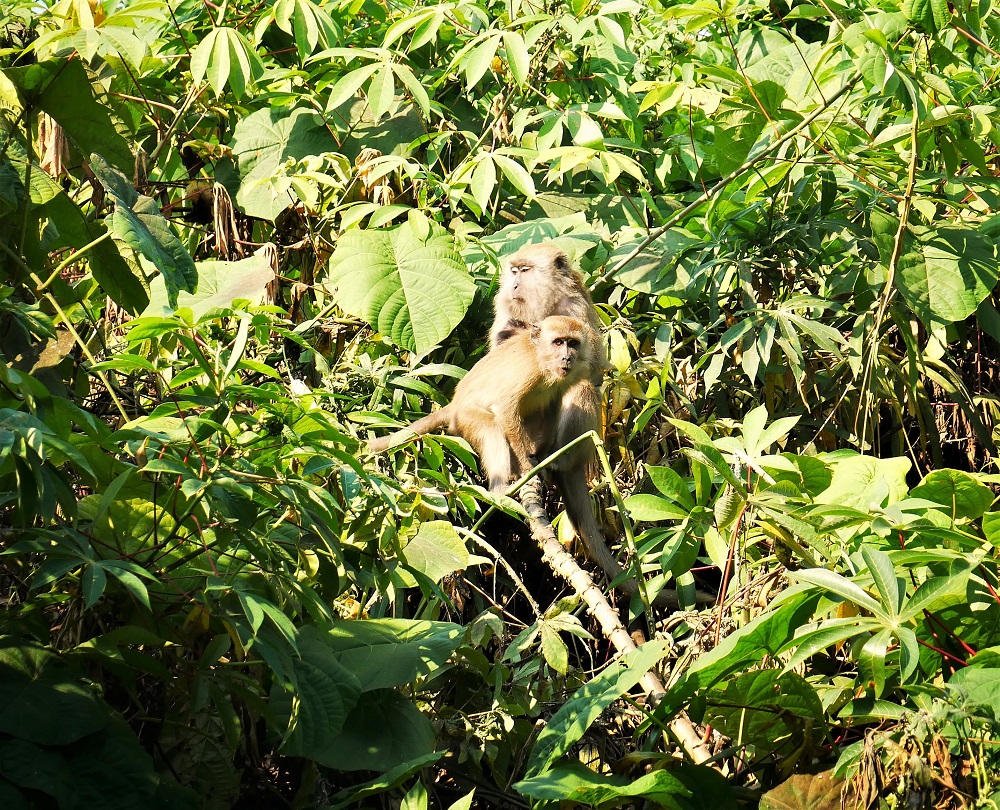
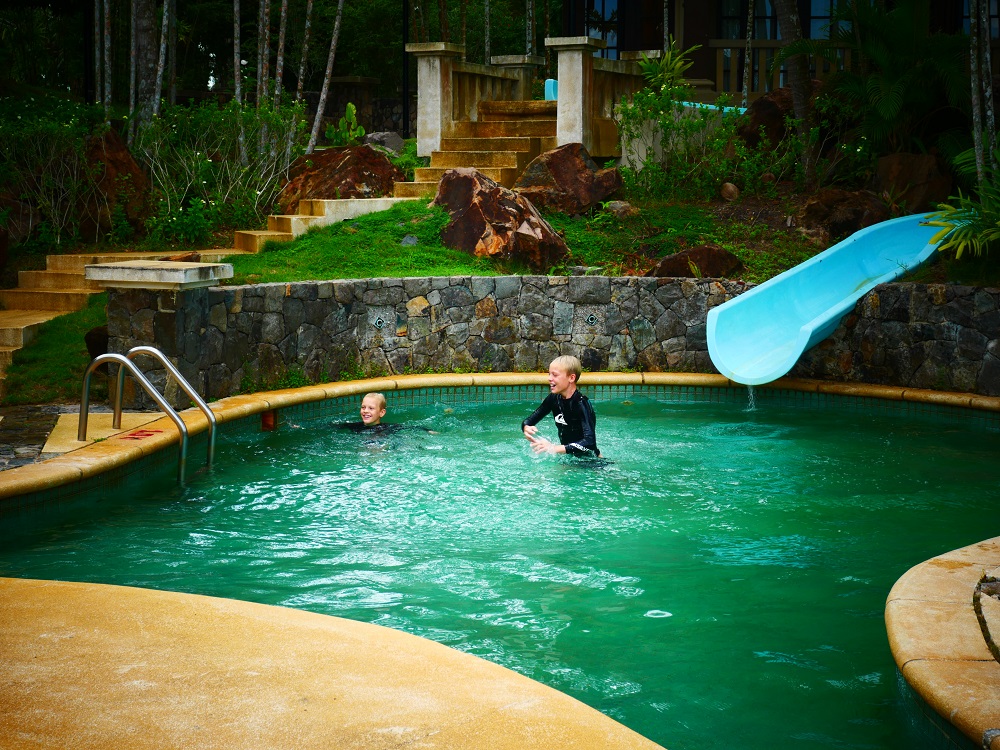
The marina that we left Bob in, Sebana Cove, is a weird place. It is situated just across a narrow waterway from Singapore, in the newly developed part of southern Malaysia called Johor Bahru. Owned by the Sultan of Johor, the marina is part of a large, empty resort the main attraction of which is a golf course. A colonial-style main building featuring high ceilings, stone columns and numerous tiled staircases houses the resort reception, a restaurant, bar, gym and a library. Behind the grand building is a beautiful pool complex with curved swimming pools enhanced by bridges, bubbles and billowing cascades. Neat rows of palm trees line the long driveway which meanders past the undulating, immaculately short-clipped golf course lawns. Birds call from the shady tree-tops and squirrels and monkeys frolic on the roof. The resort accommodation is nicely done cottages recessed amongst large, shady trees.
All of it splendid, immaculately kept, well-staffed – and completely empty. No guests stay in the cottages, no-one dines in the restaurant, and not once did we see anyone other than ourselves in the swimming pool. The golf course is empty, the bar deserted, the lounge chairs vacant. Two staff in dark suits man the empty reception and several waiters dressed in old-fashioned cabin-boy uniforms complete with sailors’ caps walk around aimlessly straightening up a knife here and pushing a chair in there in the bare restaurant. Every night, scantily clad beautiful young women sway in mile-high stilettos hugging the microphone stand as they croon soft pop cover songs to a vacant bar, the sailor waiters their only audience.
“They cannot possibly be making enough money to keep this place open!” I exclaimed to David one night as we were sitting in the bar, us and our yachtie friends the only guests in the establishment.
He looked across the empty bar to the happy hour lounge where the singers were dancing suggestively for a roomful of empty seats. “I guess it doesn’t need to make money if it is owned by the sultan…”
During our time there, the only people we saw at the resort were two Chinese businessmen and the liveaboards from the 10 or so yachts staying in the marina. The marina is incredibly affordable and the facilities nice, so a steady stream of boaties frequent the place, but there is no way the meagre earnings from that will make the resort go around.
Profitable or not, Sebana Cove is a nice enough marina, and it greatly helped our return to the hot boat to have access to a pool and a clean toilet block featuring endless cold showers. To help the resort business we ate in the restaurant and drank in the bar, and the staff seemed grateful for the liveliness we imparted to the echoing halls. The kids swam for hours every day in the pool as David did minor repairs and installed the sparkly boat parts we had bought in Europe while I cleaned, unpacked and provisioned in the air-conditioned supermarkets of nearby towns.
Once everything was installed and all the numerous newly acquired parts (new trampoline, new stove, fresh lightbulbs) had been put to good use, we were ready to leave for Pulau Tioman, a small island off the east coast of peninsular Malaysia where we’d heard of beautiful diving, luscious jungle and white beaches.
Which is where we are sitting now, sweating.
After eight months in Indonesia, Malaysia feels familiar yet different. Being neighbours, Malaysia and Indonesia share their language and the dominant religion of Islam, as well as the Malay ethnicity of the majority of their populations. Yet Malaysia is very different from Indonesia. For a start, it is relatively small where Indonesia is positively massive. Indonesia’s land area is six times larger, and its population number almost ten times that of Malasia. Malaysia is relatively rich in natural resources and as a result, it is now one of the wealthiest countries in south-east Asia, with a GDP per capita that is more than double than that of Indonesia. The two countries have a similar past, both being colonised first by the Portuguese and then by the Dutch, but in Malaysia the British took over from the Dutch in the late 18th century, leaving a lasting influence, including widespread proficiency in the English language, rubber and tea plantations and efficient infrastructure. The Brits imported large numbers of Chinese and Indian people, with the result that 23% of Malaysia’s population is of Chinese heritage and 7% of Indian origin.
Malaysia’s main exports are tin, rubber, palm oil and fossil fuels, and in an attempt to keep most of the petroleum-related earnings within the economy, the country has ambitious plans to double its refining capacities. Thus, near Sebana Cove Marina the huge Pengerang Integrated Petroleum Complex is under construction, the footprint of which will see several villages moved to make way for progress. For a long stretch on our way out to the Strait of Singapore from the marina we see nothing but oil tankers and rig platforms ready for deployment, sights that will likely continue to dominate the horizons of these parts for years to come.

It was a relief to leave the marina and the dusty mainland behind, and the island of Tioman is all that we hoped for, being on anchor off a lovely island with clean water and white beaches feeling luxuriously like a proper return to our normal cruising life.

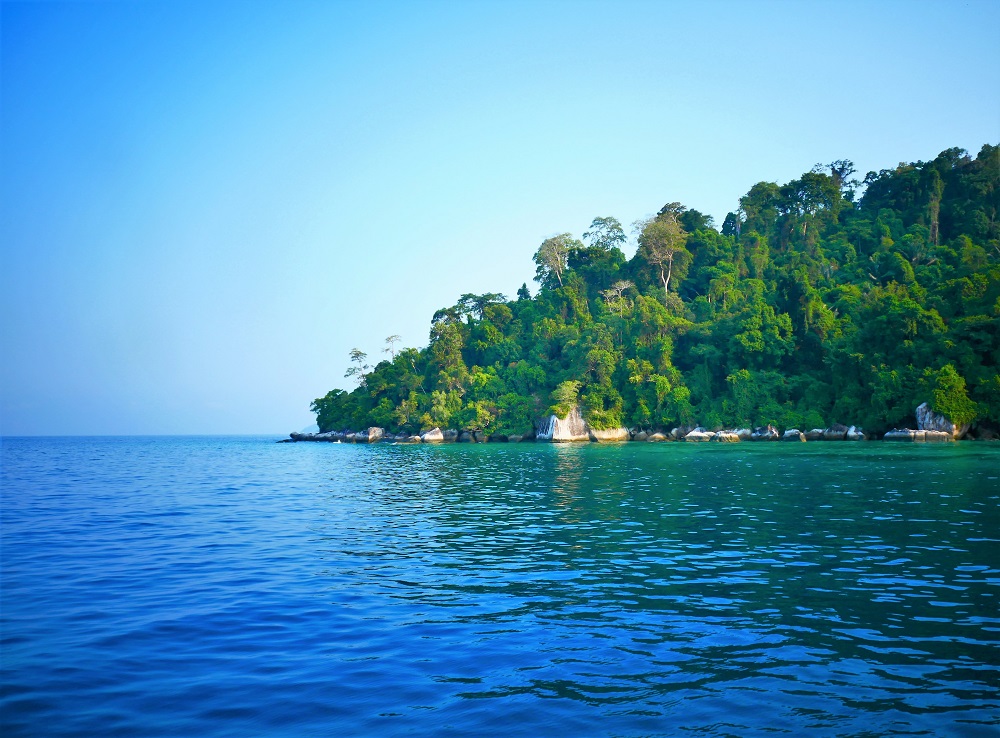
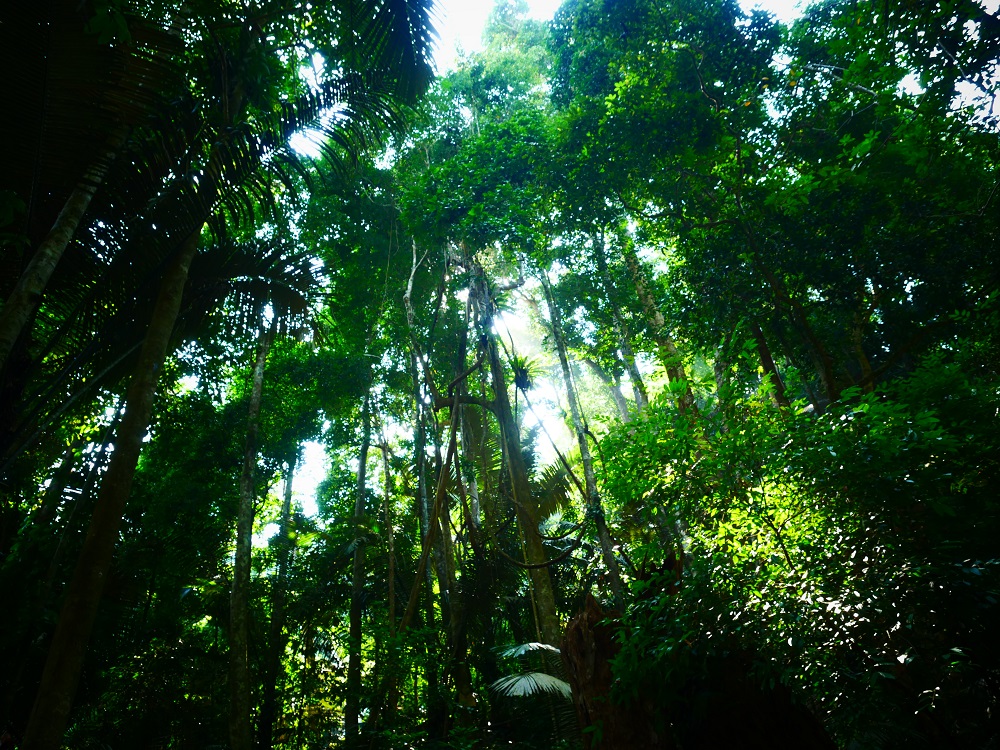
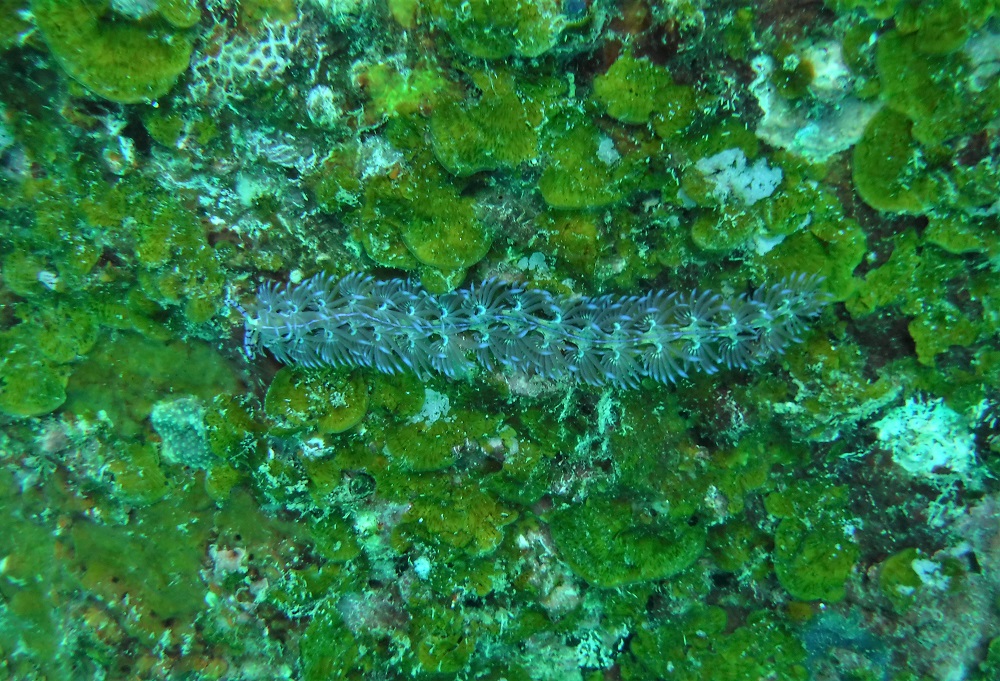
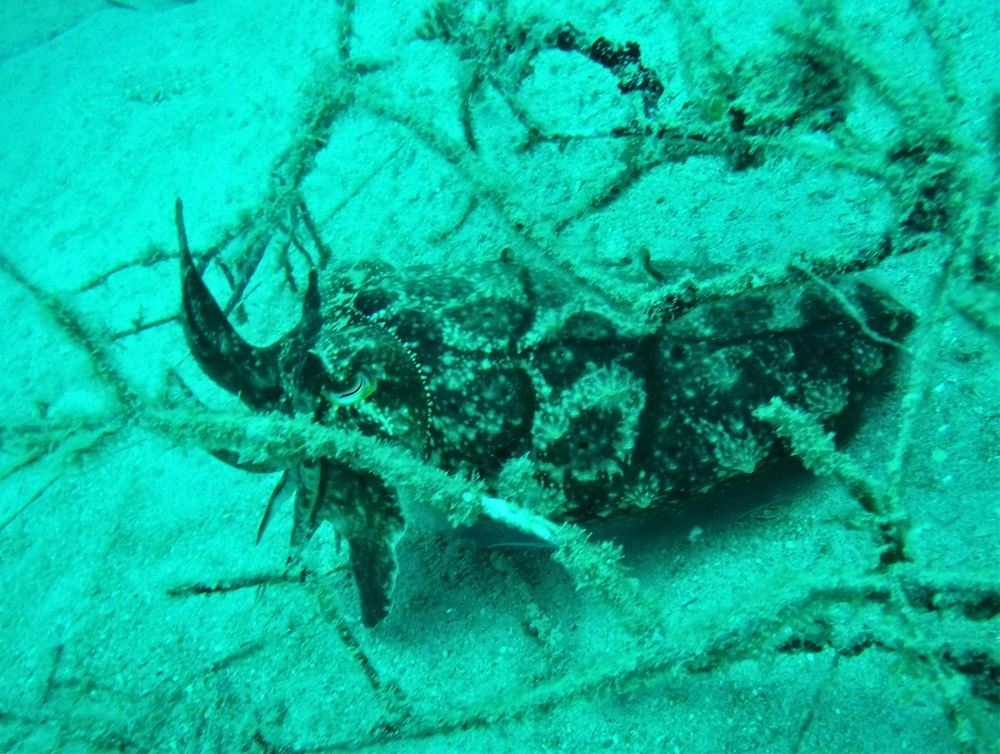
As I sit sweating on the anchorage on this our last day there, I think of what a beautiful place Tioman is. A steep island, the interior of which is entirely covered in thick, old growth, lusciously green jungle, Tioman is full of small resorts catering for tourists from all over the world. White sand beaches line the numerous small bays indenting the coastline and large boulders stacked haphazardly adorn every headland. With a large marine reserve, the island is popular with backpackers and divers, and the water is clean, full of hard and soft corals, turtles, sharks and lots of tiny critters that have divers frothing with enthusiasm.
The island is full of young sunburned Europeans carrying large backpacks on their strong shoulders and Chinese tourists with trendy sunglasses wheeling candy-coloured hard-shelled cabin-luggage along the bumpy pavement. Dive boats zoom around the coastline constantly and boatfuls of snorkellers wearing bright red lifejackets are disgorged hourly along the shallow reefs lining the quiet bays. Ashore, small cafés and restaurants line the waterfront, and the delicious smell of freshly barbecued chicken satay permeates the air. The open-air food court on the river features traditional Malay cuisine, and along the main road there are several Chinese eateries, complete with red paper lanterns and gilded dragon carvings. The singing from the mosques can be heard five times a day but the place is touristy enough that visitors wear bikinis on the beaches and sleeveless tops in town, although the line is drawn at serving alcohol in the restaurants, something that no establishment allows.


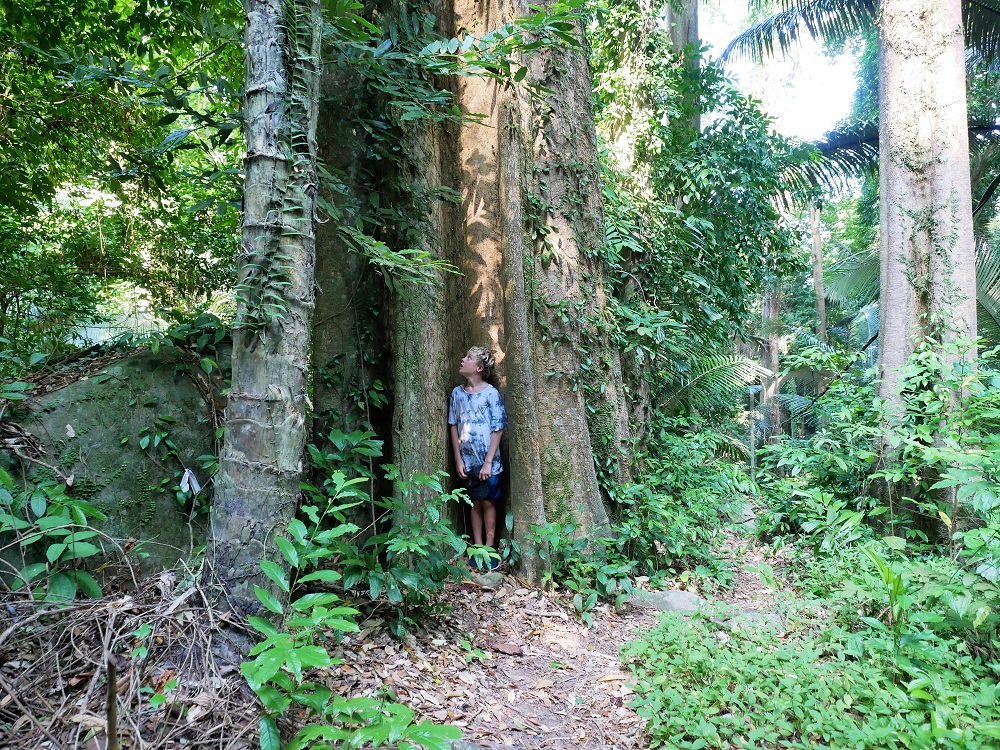
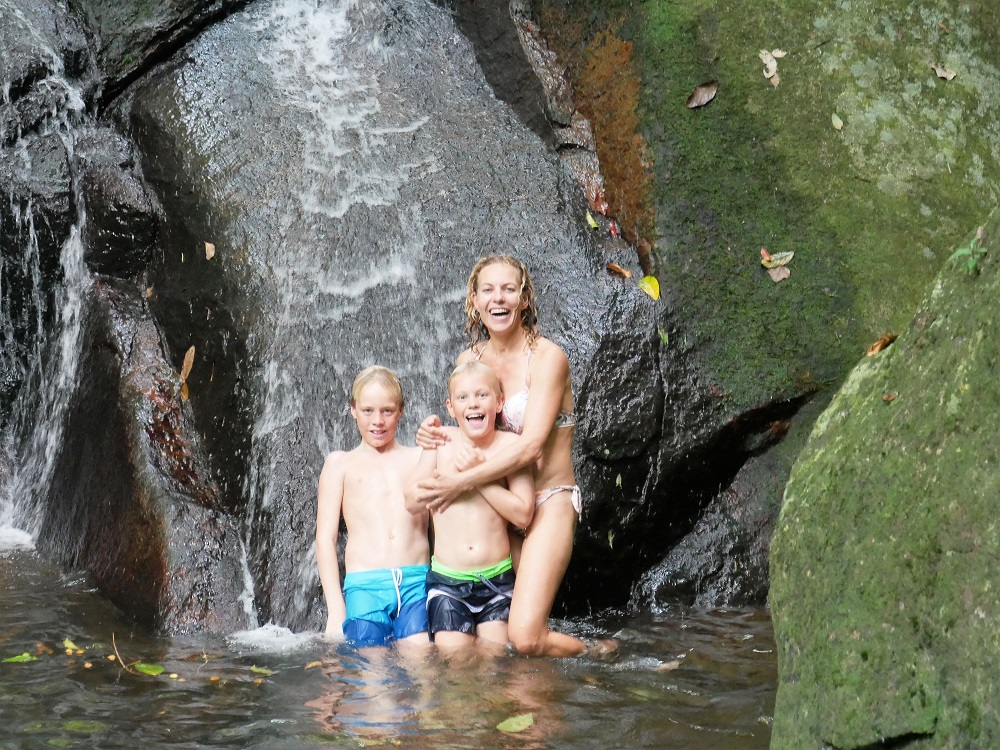
Whilst we’ve been here we’ve been diving and snorkelling, fully enjoying being in a place where you can jump into clean water anytime and anywhere. We’ve climbed across the island in the thick jungle, have eaten out and relaxed in the heat, only to jump in the sea once again to cool down. Each day, the hot, windless mornings give way to terrifically windy evenings, when the catabatic winds from the inland mountains sweep through the anchorage cooling us down, the storm-like intensity of which keeps us all awake many a night.
As a first introduction to Malaysia, Tioman has been great. But after just over a week here it is time to move on. We have about a month left until the north-western monsoon starts, and in that time we would like to see the Anambas, a remote Indonesian island group north-east of Tioman. Once the monsoon changes it is time to leave the east coast and head north-west to explore more of Malaysia.
Full of good impressions we leave Malaysia and head back to Indonesia, for one final fling.

 SV Bob The Cat