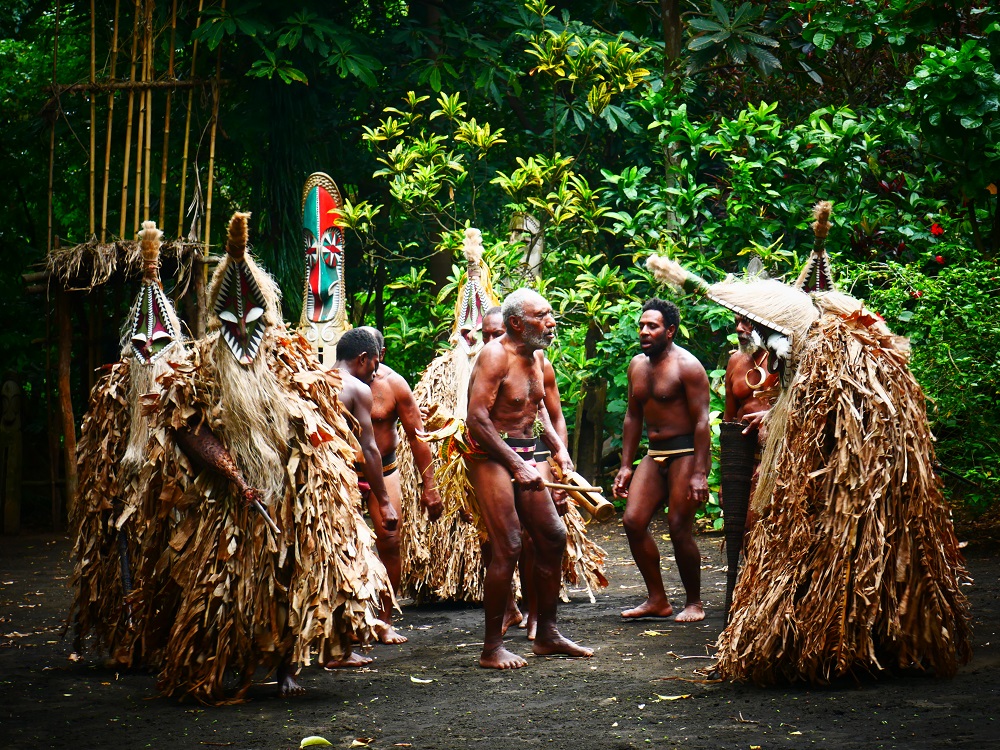
“Haiahoieh, haiaho!” chant the men, stomping their feet on the ground, small clouds of black dust rising. “Haiahoieh, haiaho!”
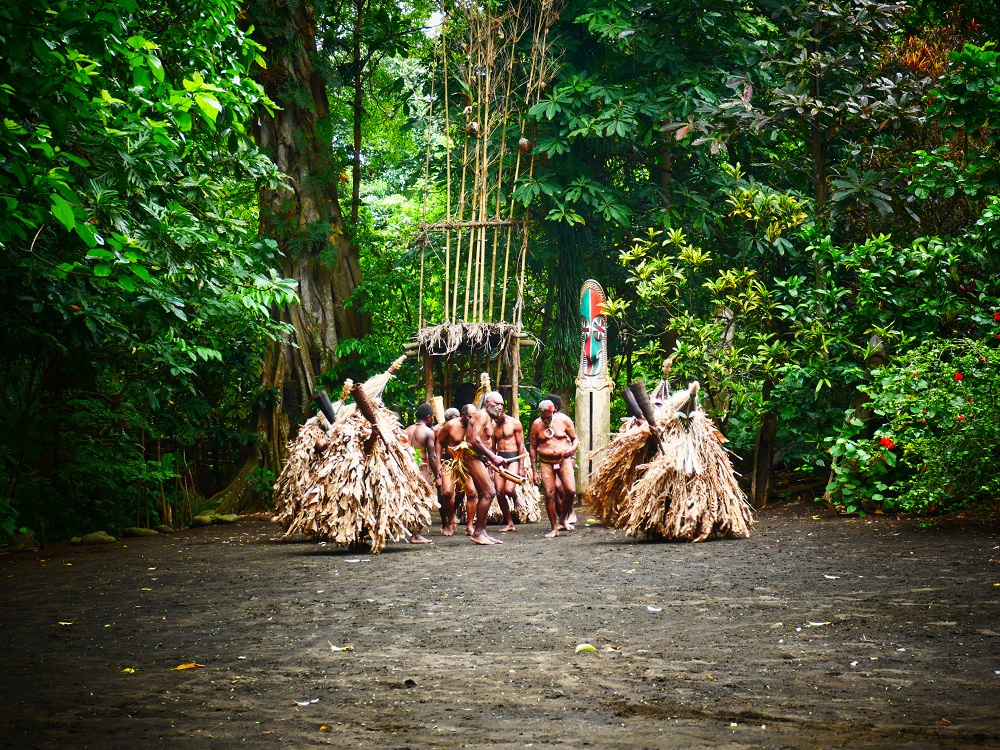
They sway and shuffle in front of the giant, brightly-painted carved wooden statues backed by green jungle, expanding and contracting in a tightly-woven circle, their backs to the assembled crowd. One man beats the rhythm of the song on a traditional drum, and the beat quickens with each footstep, sweat beginning to appear on their near-naked bodies. “Haiahoieh, haiaho!”
Suddenly, from the right-hand side, a fearsome creature whirls into the clearing, brushing past the audience and spinning its way towards the dancers. It is a man clad in an extraordinary costume – a conical carved hardwood mask featuring heavy white eyelids and intricate designs in green, red and white shapes, creating a fearsome grimacing whole. The mask chin culminates in a long whitish beard and the top of the head is adorned with a series of light tufts which extend down the back of the head to form long, white hair. A feathery cloak of dried banana leaves covers the dancer’s entire body. Shrouded in the mask and cloak, brandishing an elongated hollow club, the wearer looks like a rare demon bird, twirling and whirling, stomping and singing, the feathery cloak swishing with the movements of the dance, fragile dried banana leaves extending like an elaborate golden tutu. A moment later another masked dancer joins from the right, and after that another and another, until the dancing group is complete: six men in the middle wearing the traditional costume of a small woven penis sheath attached to a belt flanked by five menacing mask-wearers.
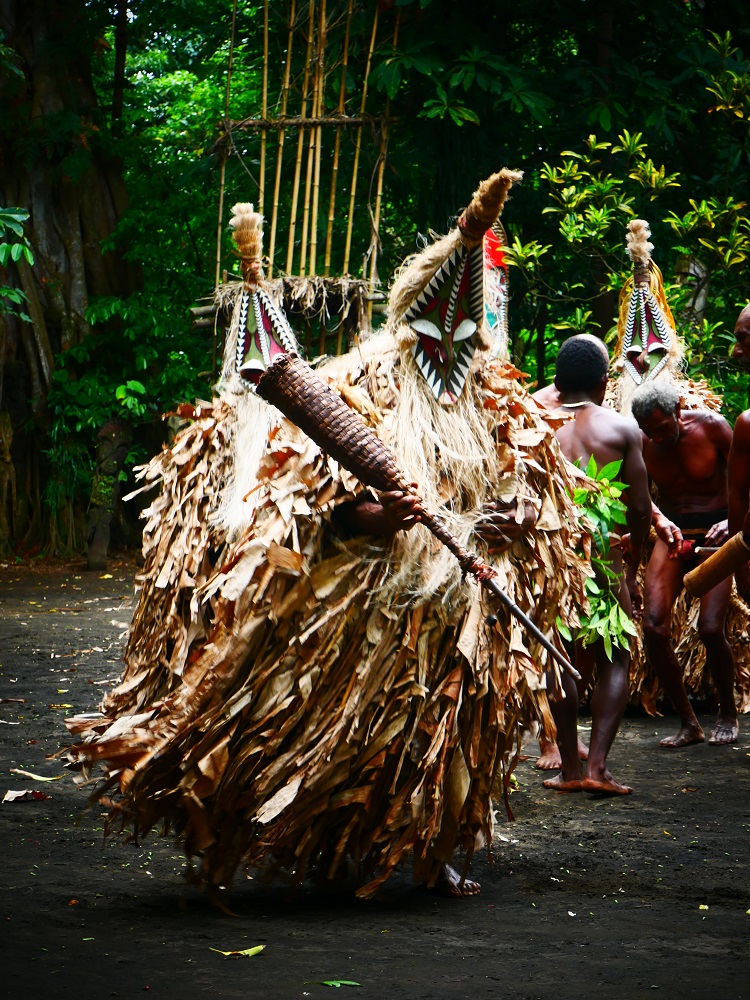
We are witnessing the famous Rom dance on the black volcanic island of Ambrym.
The Rom dance is a coming-of-age and advancing-in-status ritual dance done by men in villages in northern Ambrym. When a man wants to move up in the village pecking order, he must buy access to a sacred mask design, for which he pays in pigs, roosters and cash. The masks represent spiritual aspects of the power of yam, the most important food crop on the island. Once he has secured a mask design he is initiated and learns the ancient art of mask making in a series of top-secret rituals which culminate in a performance for the village where the man and select invitees dance wearing the extraordinary and powerful masks.
The dance lasts for about 40 minutes, the men in the middle shuffling and stomping, the mask-wearing demons whirling and rushing, grandstanding one moment, huddling the next. The beat of the drum carries the rhythm, supporting the feverish chanting until suddenly the pace quickens until a crescendo is reached and the dancers utter a last ‘Ho!’ and stop, sweat pouring off them.
We are in awe of the performance and feel lucky to have witnessed a ritual which, although this one was performed for tourists, is still very much alive on the island. The Rom dance is held once or twice each year and the dancers are proud to display their traditions to the world.
 The island of Ambrym is home to two volcanoes and a bunch of magic. According to Ni-Vanuatu, magic is strongest on islands featuring active volcanoes, and as Ambrym is home to two active volcanoes the island is Vanuatu’s sorcery capital. Sorcerers (man blong majik or man blong posen) abound on the island, casting spells and generally disrupting normal village life. The twin volcanoes are sacred and pleasing the mountain gods is essential for securing good and plentiful yam harvests.
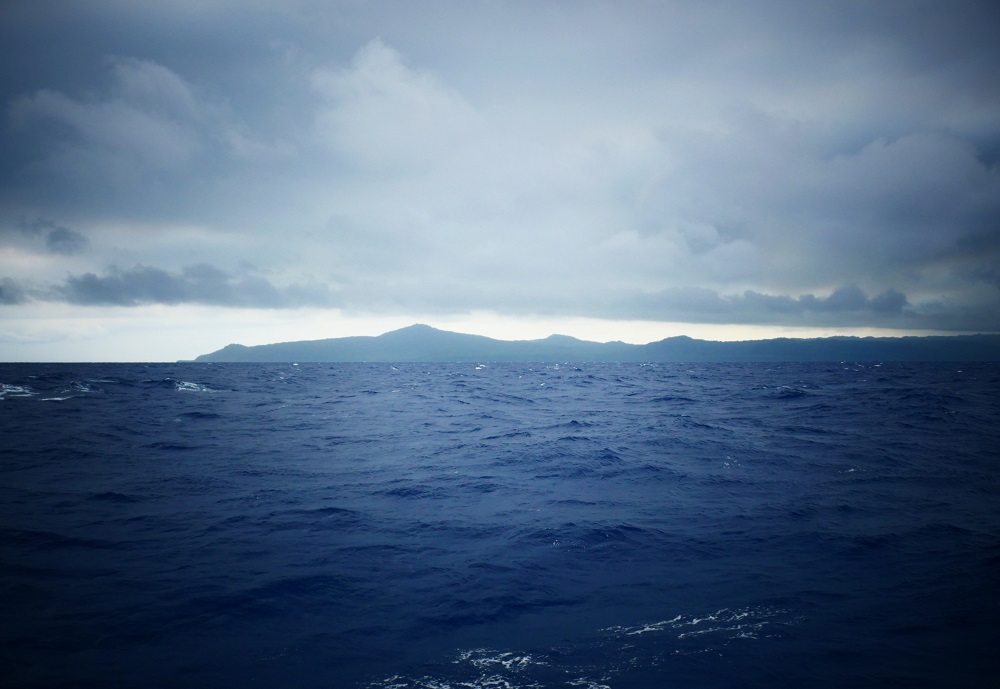
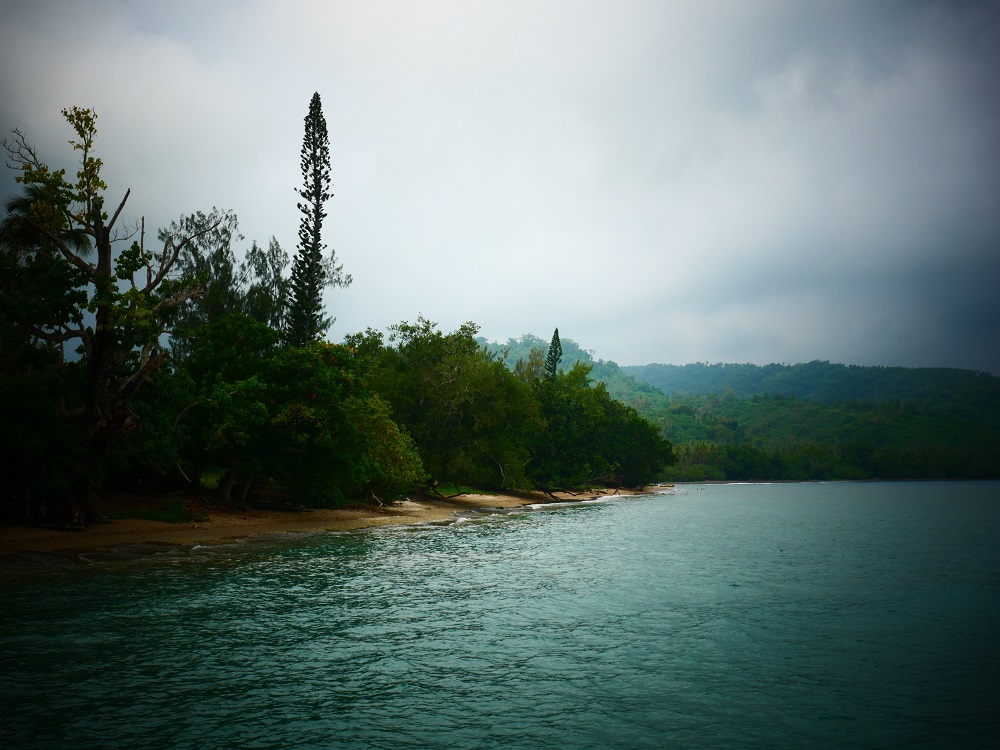
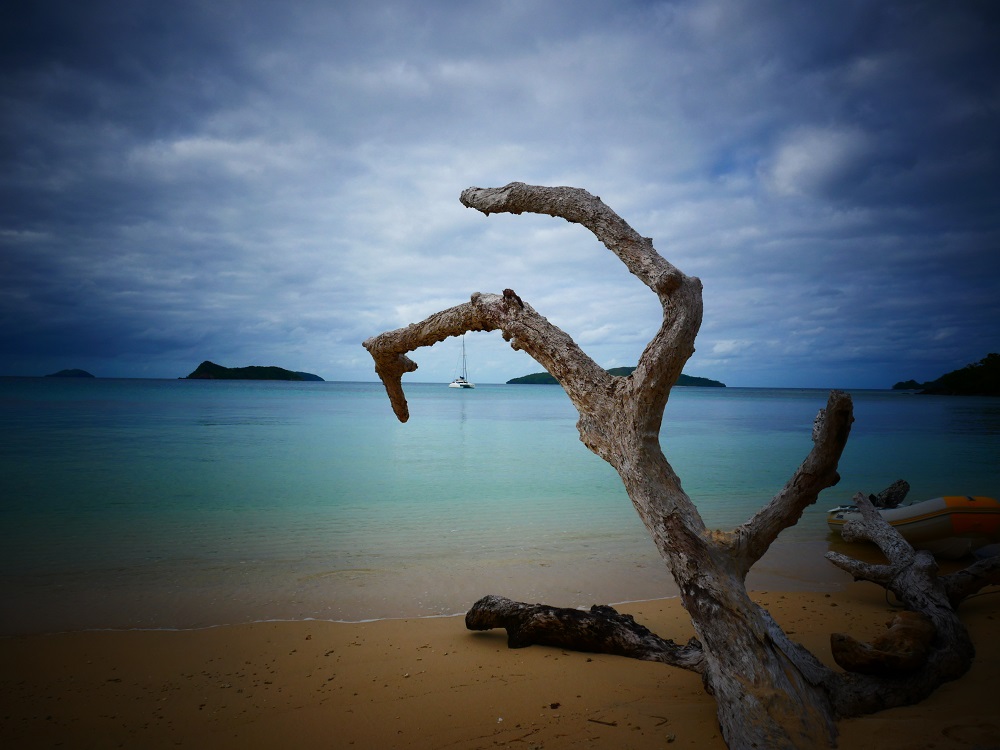
When we approached Ambrym from the south the island was shrouded in clouds – heavy grey fog hung darkly over the volcanic peaks, wispy strands of mist encroaching on the dark green hillsides like odourless white smoke from a thousand jungle fires. We anchored in a bay on the north-western coastline in front of Ranon village which is scenically set back behind the long, soft, black sand beach.
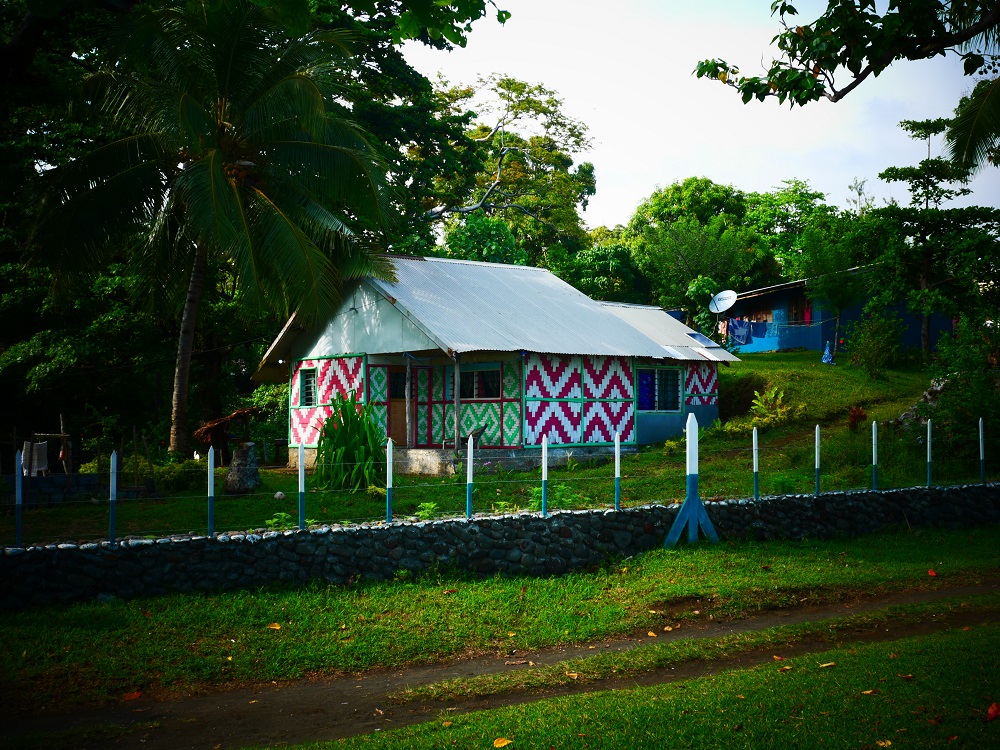
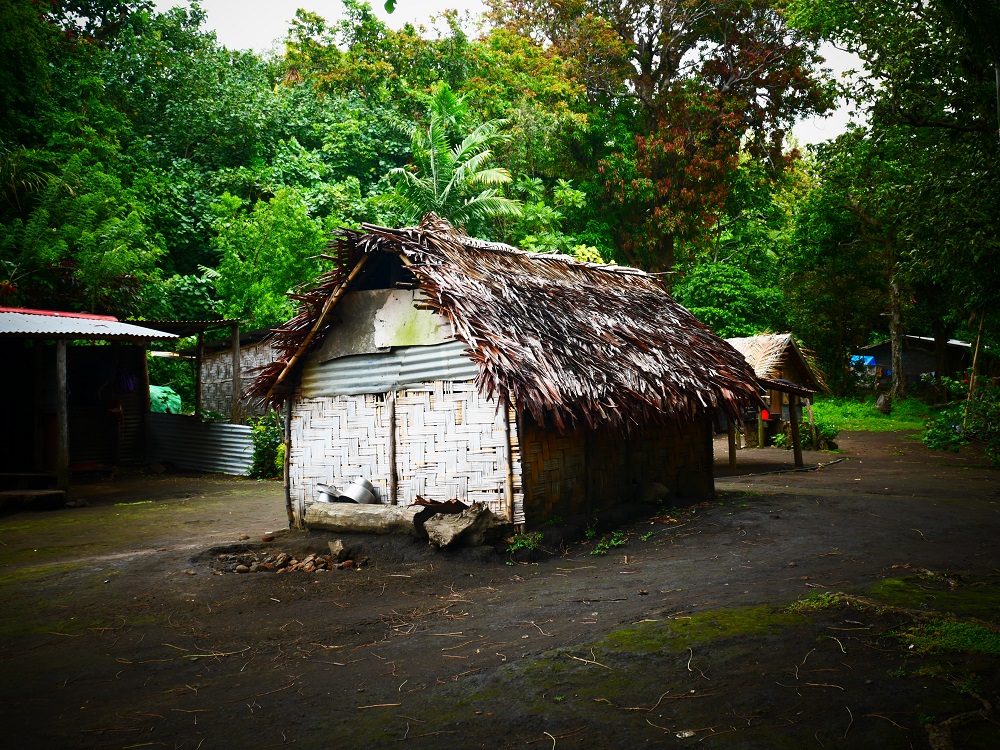
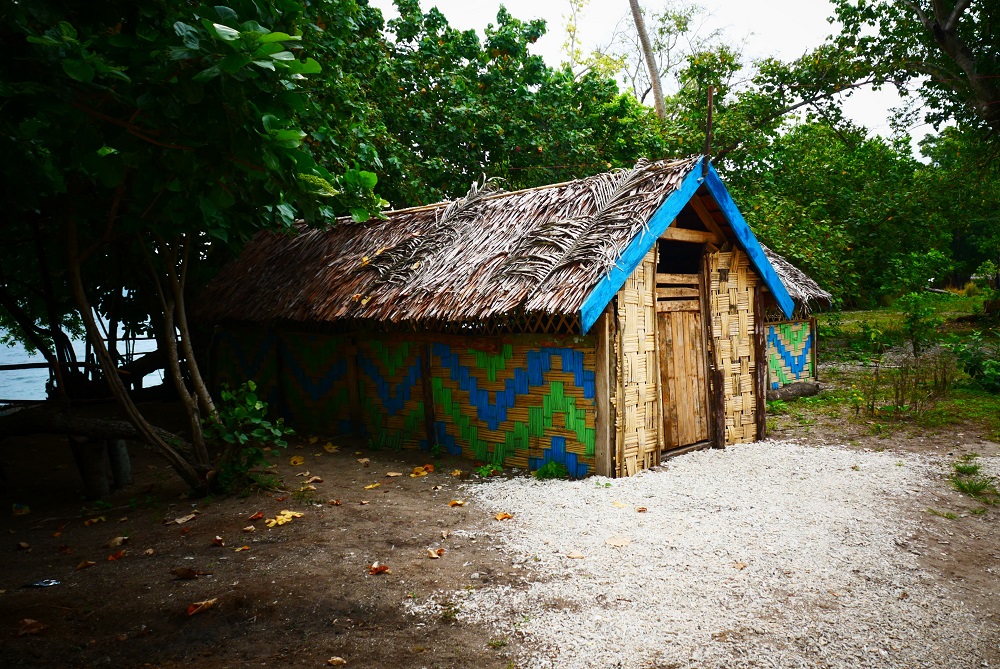
The villages here are small and tidy. The small, rectangular houses have walls woven from bamboo, the weaving forming varying geometric patterns sometimes accentuated by dye. Pigs and chickens root around between the small houses. Adults sit talking on benches near houses and gangs of scantily clad children run about squealing with laughter. Heavy mango trees have just started to drop their fruity burden, providing ample food for foragers, and all children we see carry armfuls of the small green fruits, black eyes peering out at us over mouths full of yellow fruit, chins dripping with sticky juice.

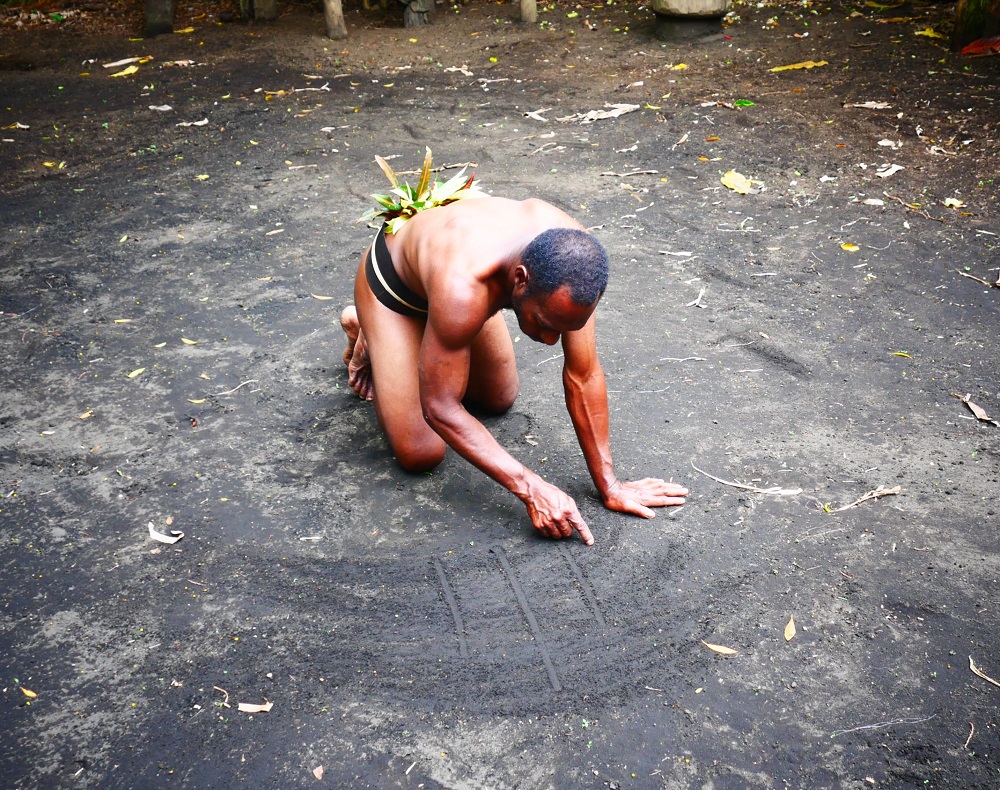
The art of sand drawing is strong on Ambrym. Done on a clean-wiped piece of dirt, the art illustrates ancient oral traditions. The drawings are large, symmetrical, intricately patterned shapes drawn without the artist lifting the finger from the sand, representing birds, turtles or parts of the human body.

The village of Fanla still remembers when Captain Cook came to the island. In 1774, the Resolution was anchored where we are now. The first man to spot the large ship stood terrified on the beach, watching Cook come ashore with a small party in a rowing boat. As is the custom in Vanuatu, the local Big Man (chief) offered the visitors some yam, the traditional staple. As he proffered the yam, he said ‘Ham rim’, which means ‘here are some yam’ in the local Ranon language. Cook misunderstood, thinking that the man was telling him the name of the Island, and wrote down the name as Ambrym. (Cook seems to have made a habit of misunderstanding the natives of Vanuatu when he charted the area. He named Tanna Island in the south after meeting some locals and pointing to the ground. When they said ‘tanna’, the local name for ‘dirt’ he promptly wrote that down and went on his merry way to do more charting. Presumably, those sorts of misunderstandings were common job hazards for early cartographers. I guess the upside for Vanuatu of having talkative natives is that Cook named fewer places ‘Disappointment Bay’, ‘Cape Hopeless’, ‘Starvation Point’ and suchlike, names that abound in New Zealand and Australia. Although there are a few ‘Cannibal Coves’ found here…)
Cook gave the Big Man some iron nails and a smoking pipe, historical treasures that the villagers still hold in their possession. The gravesite of the man who first met Cook is still standing in a little clearing just outside Fanla Village.
Cultural tensions between the modern, western world and the old, traditional Vanuatu ways started that day on Ambrym, with Captain Cook gifting iron to islanders who were living a stone-age existence. Today, these tensions are as strong as ever, with traditional culture like the Rom dance, majik, and the sacred rituals involved with the yam planting and harvest threatened by a world of cell phones and the intrusion of the all-pervasive western culture. Nowadays, most young men leave the island after Year 10 of school, heading to Malekula, Port Vila or Luganville for further education. Many go on to work overseas; all people we speak to mention relatives that work seasonally as fruit pickers in New Zealand or Australia. In Fanla, the chief’s son worked for a season as a fruit picker in Australia; now he is building a concrete house right in the middle of the village, the incomplete foundations surrounded by traditional small, woven bamboo houses. It must be strange for a young man to move from a culture of magic masks and ritual dances to fruit picking in Australia and back again.
“It must be difficult to keep the traditions when the young people leave?” I comment to Freddy, a local man who is showing us around.
“Yes,” he admits. “We try to teach the young people our culture, tell them that they can make an income from our traditions – like wood carving, and the Rom dance. We hope we can keep our culture alive, it is important for us.”
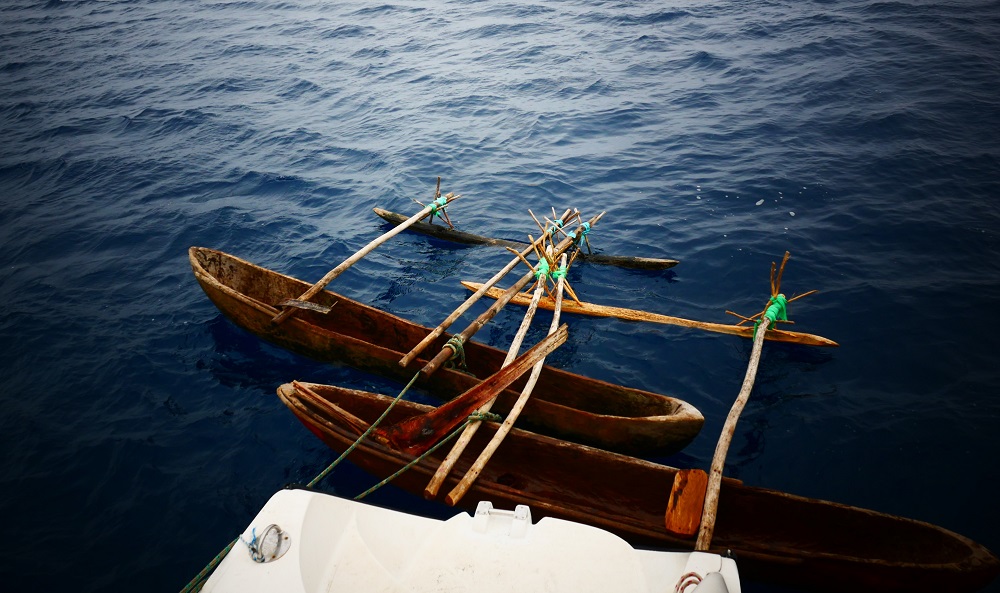
One afternoon several young men paddle up in small outriggers to say hi. We invite them on board and chat for a while. They are 15-16 years old, and with their neatly groomed dreadlocks, their second-hand surf t-shirts, fashionable earrings and winter beanies they look like they could have come straight from the streets of Auckland.
“Will you live here when you are older?” I ask Christophe, one of the first guys to come on board.
“Yes, I will live here,” he says. “It is a good place. I will leave to do more school in Malekula. But I will come back here.”
From all over the island, they are boarders at the secondary school in Ranon. We discuss the Rom dance, and they explain that they have similar rituals in their villages – masks that are used in initiation rites, which they will earn the right to wear when they become grown men, at the age of 18-20. They say the dances are tricky and that there is much to learn about the masks and the kastom behind them. But they are looking forward to the day when they join the ranks of men in their village.

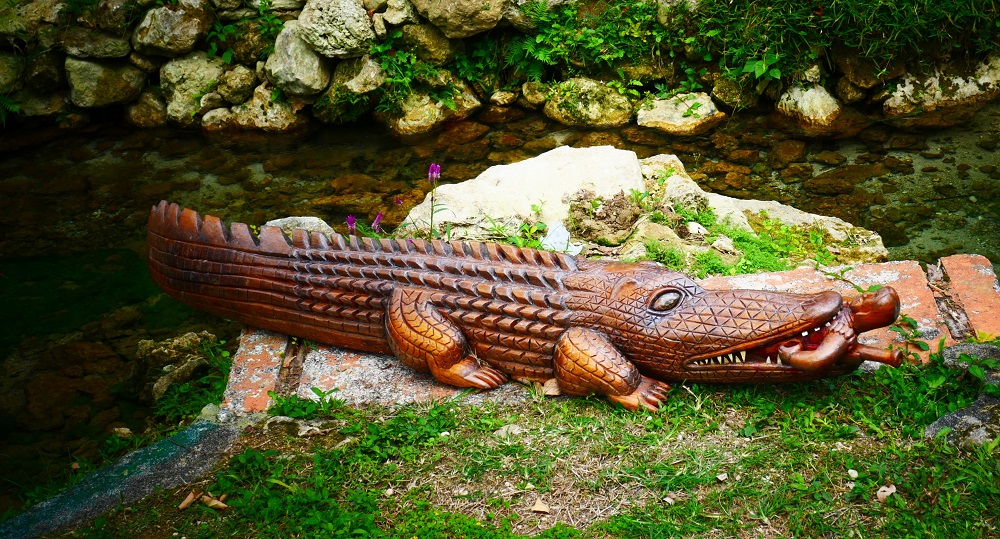
Rope is a precious commodity that is hard to come by, and several men approach us in the villages, asking if we want to trade rope for carvings. The rope is for tying up their cows, a job for which the natural fibres are not well suited. We find several decent second-hand ropes to swap for the beautiful carvings for which the island is famous.

We were hoping to climb the volcanoes, but as befits an island blong blak majik the dense, dark cloud cover that envelops the twin peaks never lifts during our time here, and our impression of the volcanoes remain a faint orange glow spreading above the hillside at night.













































 SV Bob The Cat