Hot and bewitching Banda

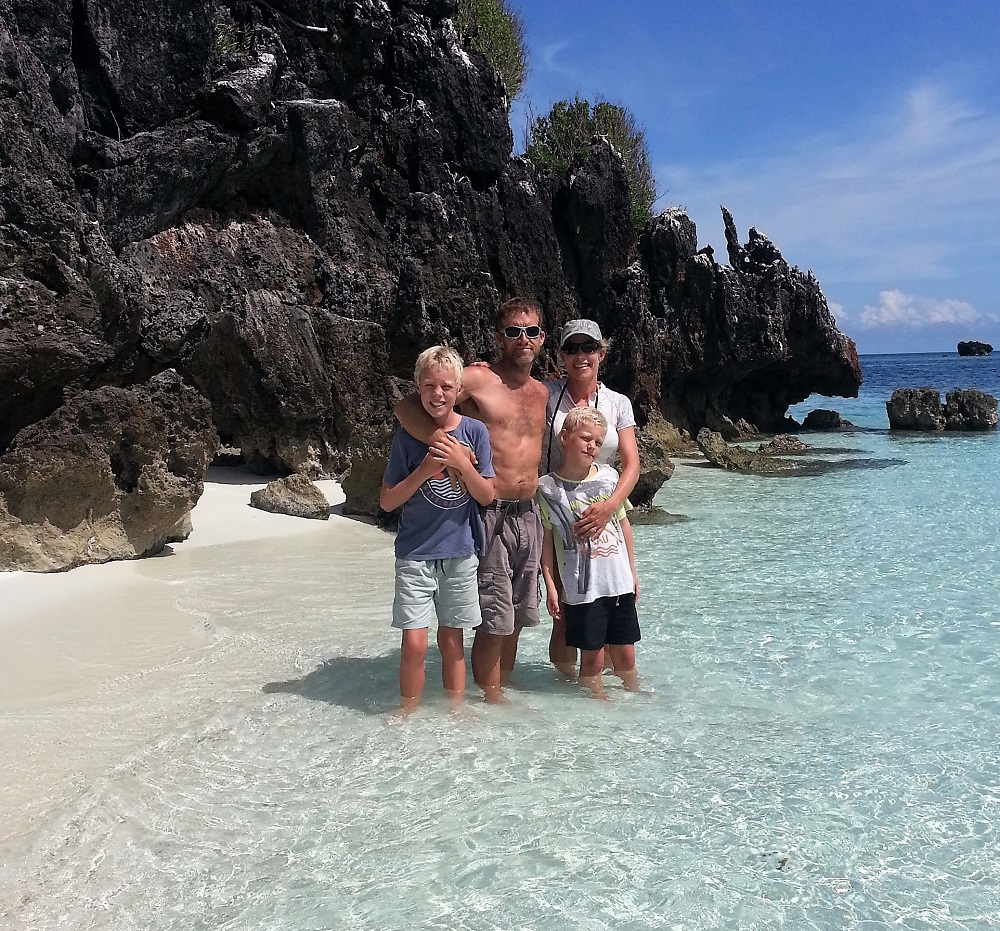
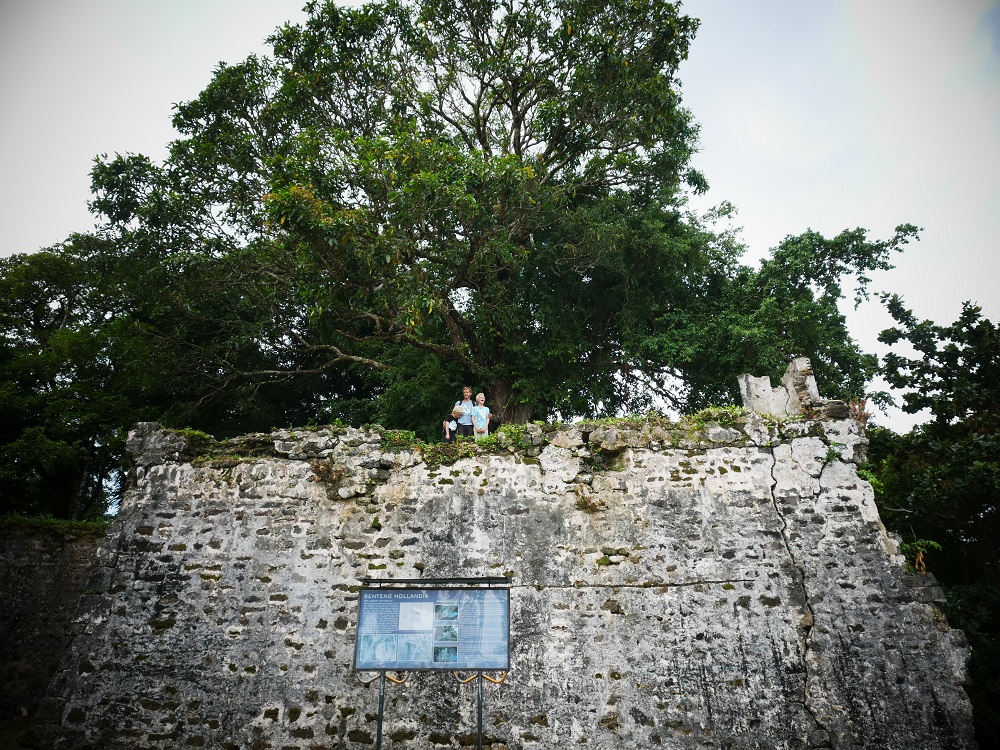
David and kids atop the ruins of Fort Hollandia on Banda Besar.

I’m standing in the galley preparing some lunch when Matias shouts from the trampoline, his voice carrying clearly through the open hatches.

“Incoming! Mummy, incoming!”

“Where?” I call as I drop the spoon I was holding into the sink and crouch down on the floor in one fluid, much-practiced move. Ninja-mum.

“At the back.” He leans in and speaks through the open hatch. “I think they’re coming right by us.” The lawnmower-like sound of a local boat engine grows stronger, the donk-donk-donk-donk-donking drowning out the music playing from our stereo.

From my kneeling position on the galley floor I glance at the clock. Ten to twelve. I might as well give up. “OK, thanks for the head’s up” I shout as I crawl along the saloon floor, keeping my head up so I can see where I’m going and my bottom down so that the passers-by can’t. The raised floor of the saloon is the trickiest and I lower myself so that I slide along the floor on my bare tummy, keeping both head and bottom low. The floor really could do with a sweeping, I think as I almost inhale a hairball and bits of sand and crumbs wedge themselves painfully into my sweaty thighs during my elegant progress. When I reach the staircase I shuffle around and descend the stairs into the port hull with a low backwards crab-like crawl.

The donk-donk-donking is now earsplittingly loud. They’re definitely close, and I can hear calling and hooting. It sounds like children.

Down in our cabin I stay low and reach up to quickly close the side hatch before I sweep a well-worn t-shirt and a skirt from the hook next to the bathroom door. I awkwardly dress in a crouched position, kneeling to pull the skirt up over my bottom and struggling to pull the t-shirt down over my sweat-soaked back. Once dressed, I stand tall and quickly step upstairs, tidying my hair. I can hear calling, and the engine noise is still present, but is it getting fainter?

“Who is it?” I shout out into the cockpit. “Are they still here?”

Matias stands in the doorway, a dark shape against midday brightness. “They just did a fly-by and took some photo. They’re heading away now.”

I breathe a sigh of relief and quickly tear off the t-shirt and yank off the skirt. The clothes are already damp from sweat and I hang them on the hook next to the kitchen so they’re ready for when the next boat comes.

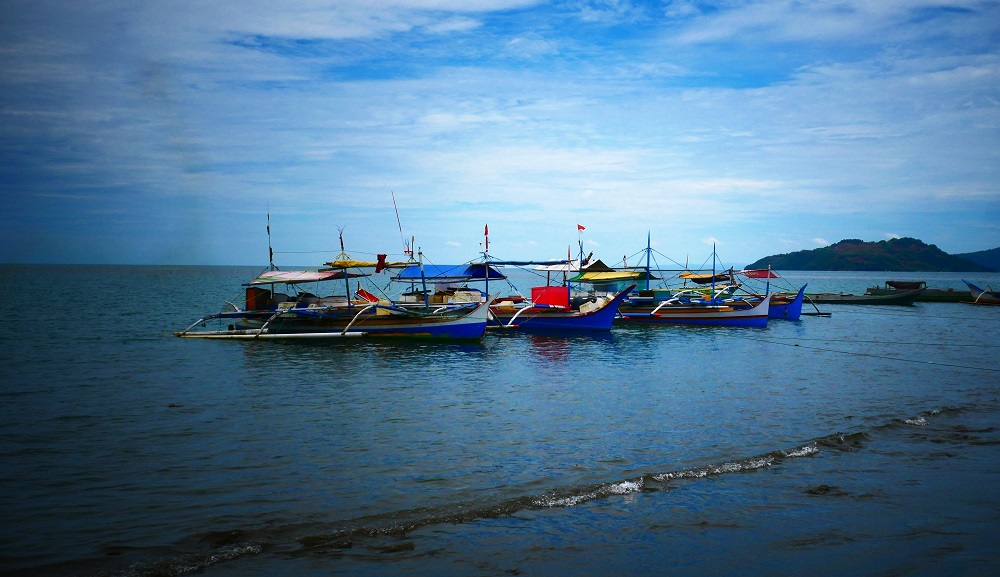
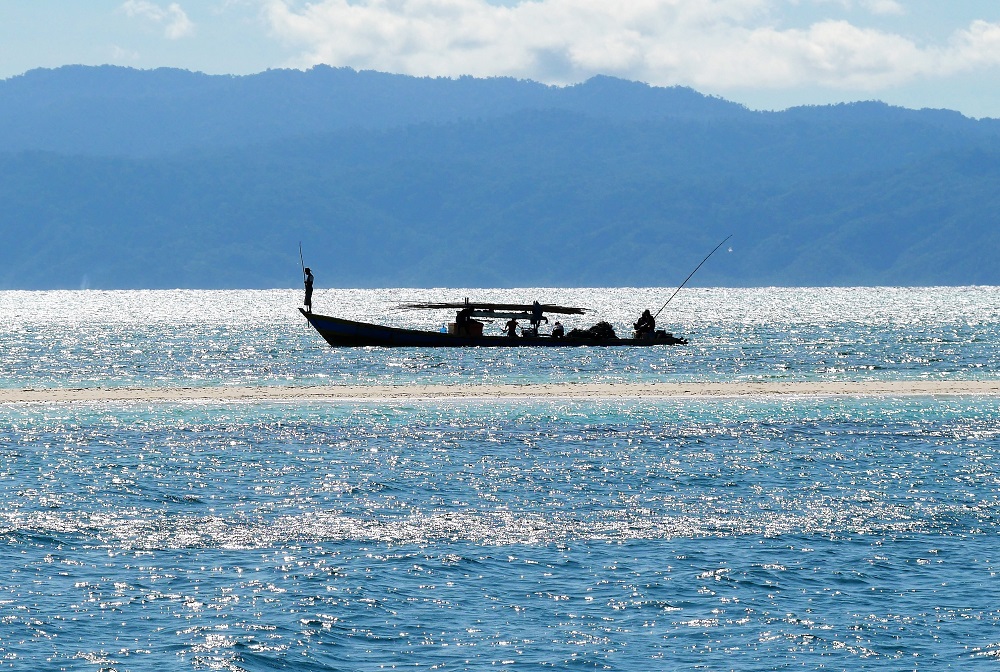
Fishing boats and water taxis are everywhere on the Spice Islands.

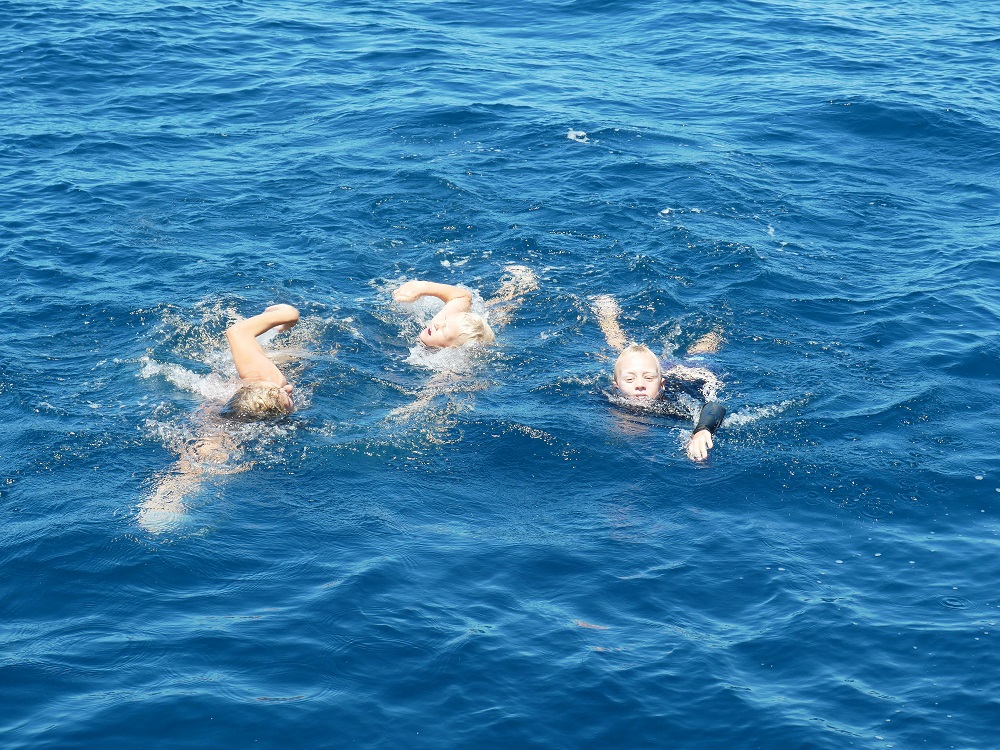
We’re in Banda, the southernmost islands of the Moluccas, and staying cool is a problem. The weather has been hot and heavy since we arrived, humid squalls interspersed with blinding sunshine. It’s a lot warmer here than up north, and we’re constantly soaked in sweat, the frequent rainfall meaning that we can’t open the hatches half the time, which makes the interior of the boat like an oven. We do have fans, but their feeble flows are inadequate to cool down the 30°C humid air. The only way to cool down is to wear as little clothes as possible and jump in the water as often as possible.

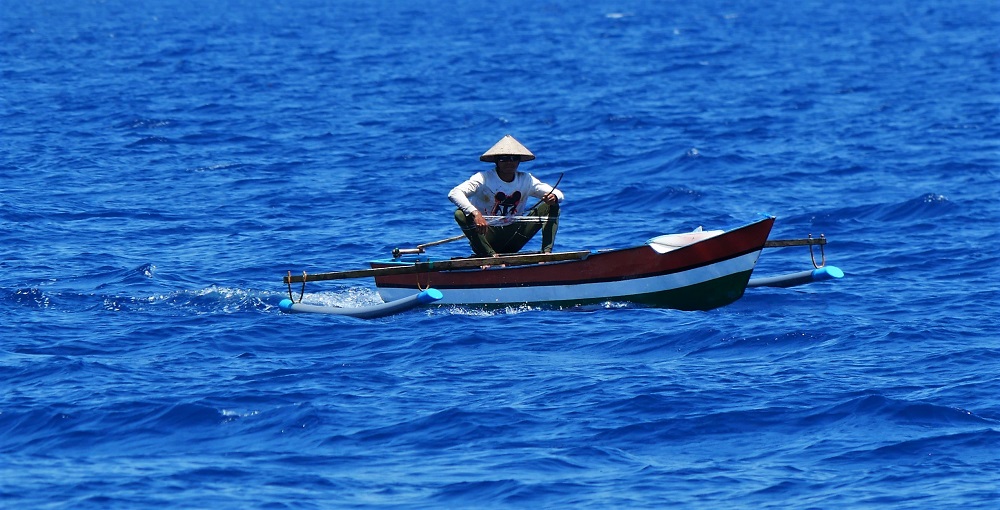
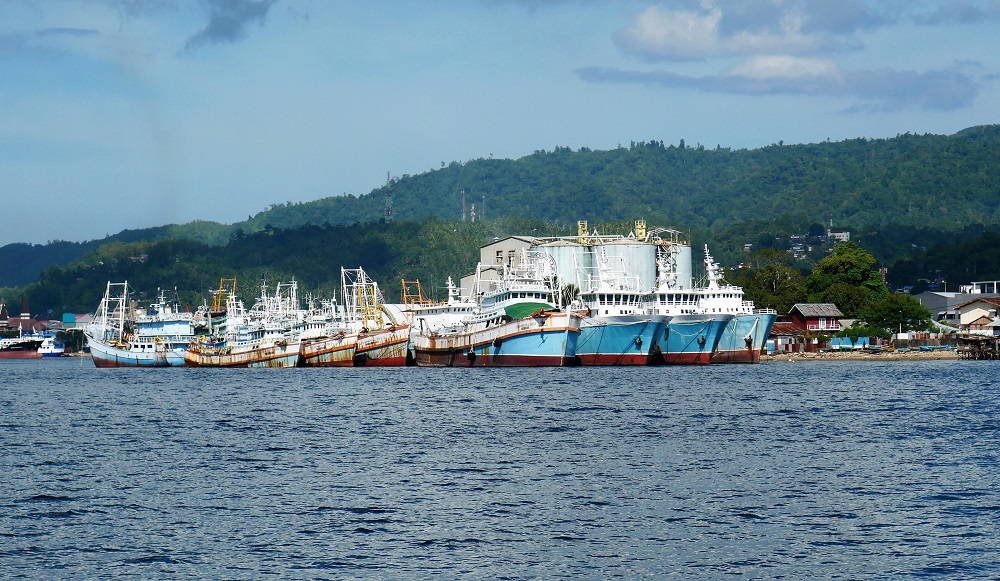
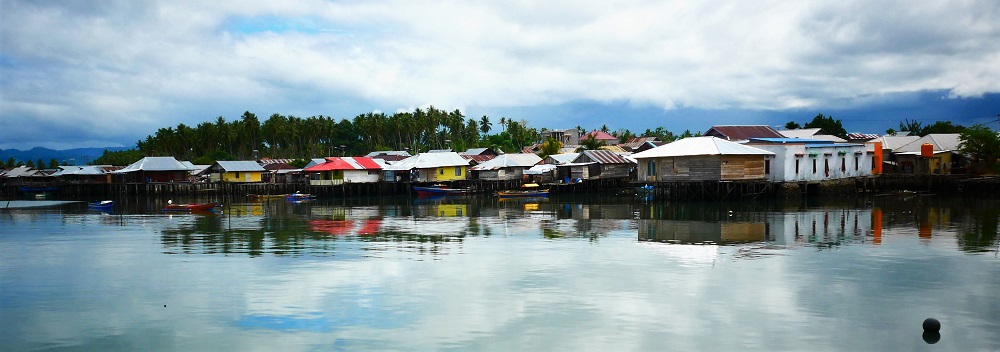
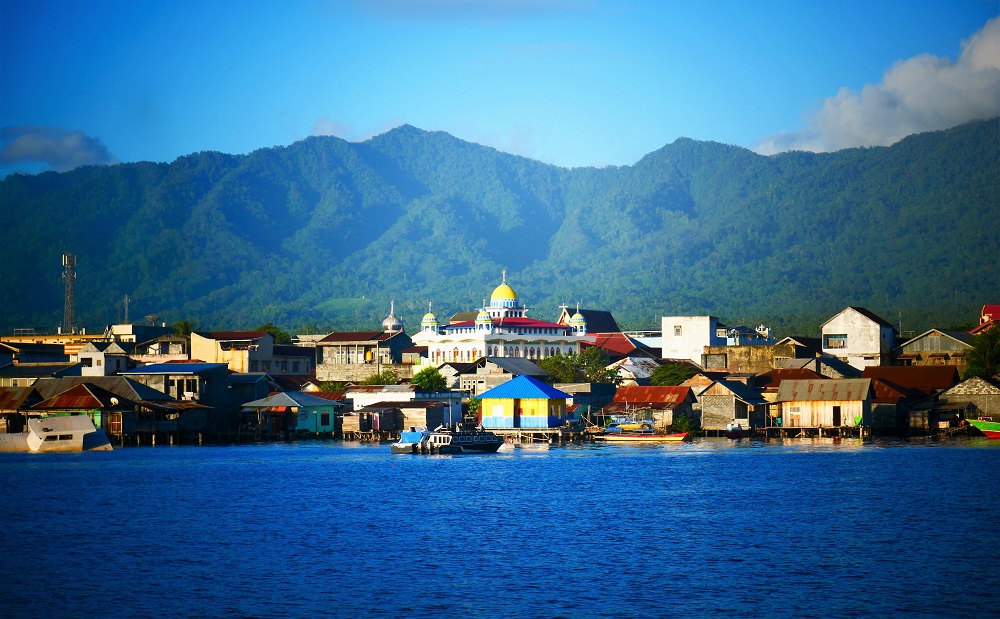
Both those options are somewhat restricted by the high volume of boat traffic on the anchorage. The main bit of Banda consists of three islands clustered closely together and the anchorage is just off the main town, right in the middle of the local boating lanes. It’s like being parked in the middle of a four-lane highway. The long, slender, local water taxies drive between the islands, and local fishers navigate smaller fishing canoes from town to the many FADs gracing the channels, fishing and transporting catch to the market or to the large refrigeration ship moored in the bay. Low-lying broad barge boats sluggishly move large amounts of ocean-weathered rock from the volcanic island of Banda Api to town, and shiny dive boats full of tourists zoom from the many dive resorts on Banda Neira across the channel to access dive sites off the surrounding islands.

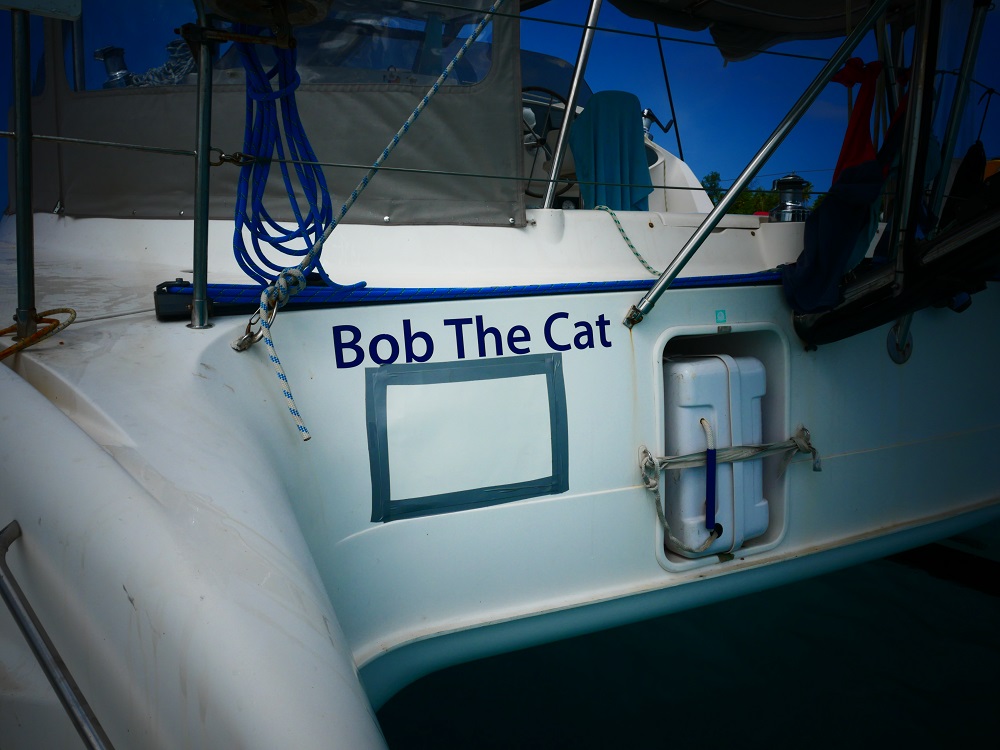
To make matters worse, Bob’s wrap-around windows make her a bit of a glasshouse. It is great to be able to look out, but unfortunately it also means that people can look in if they come close enough – which they do, and not just because we’re in the way. Yachties are a bit of a curiosity here, which means that the local boats will go out of their way to pass within a few metres so passengers and crew can take pictures and shout greetings, hooting and hollering as they wave their cellphones and gesticulate wildly in our direction.

All in all not a very private anchorage, and out of respect for the strictly Muslim population of Banda there is no doubt I should remain thoroughly and decently dressed whilst parked in such a public space. And I would, I really would – if it just wasn’t so crazy hot! Wearing clothes mean a constant trickle of sweat down the small of my back, a permanent film of liquid behind my knees, a sticky forehead and an itchy neck, as well as a steady stream of t-shirts to wash with our limited water-maker fresh water supplies. David and the kids just go bare-chested, greeting the traffic with friendly waves as they stand in full view on the deck, legs wide apart and feet planted firmly, only wearing shorts. Whereas I hide indoors in my bikini, crouching low every five minutes to prevent anyone spotting my indecent near-nudity, only putting on clothes for when I’m outside on the boat – eating in the cockpit, hanging up clothes, tidying or loading the dinghy.

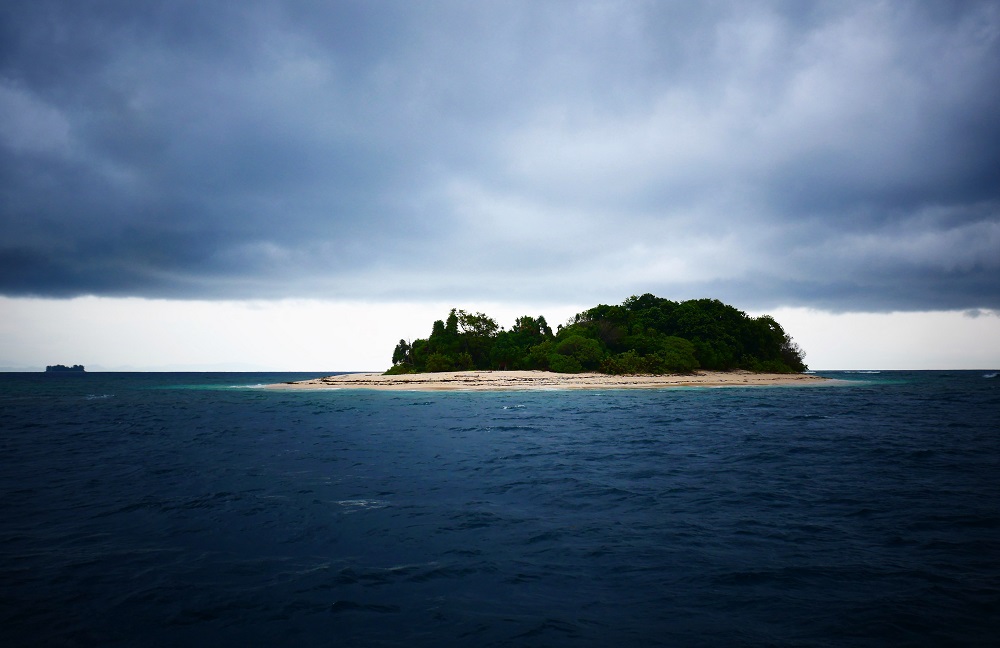
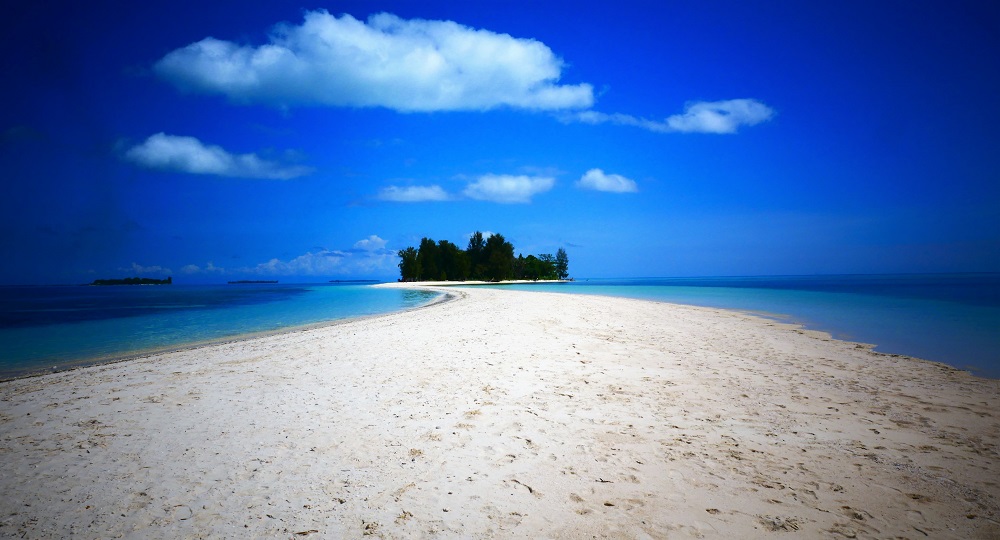
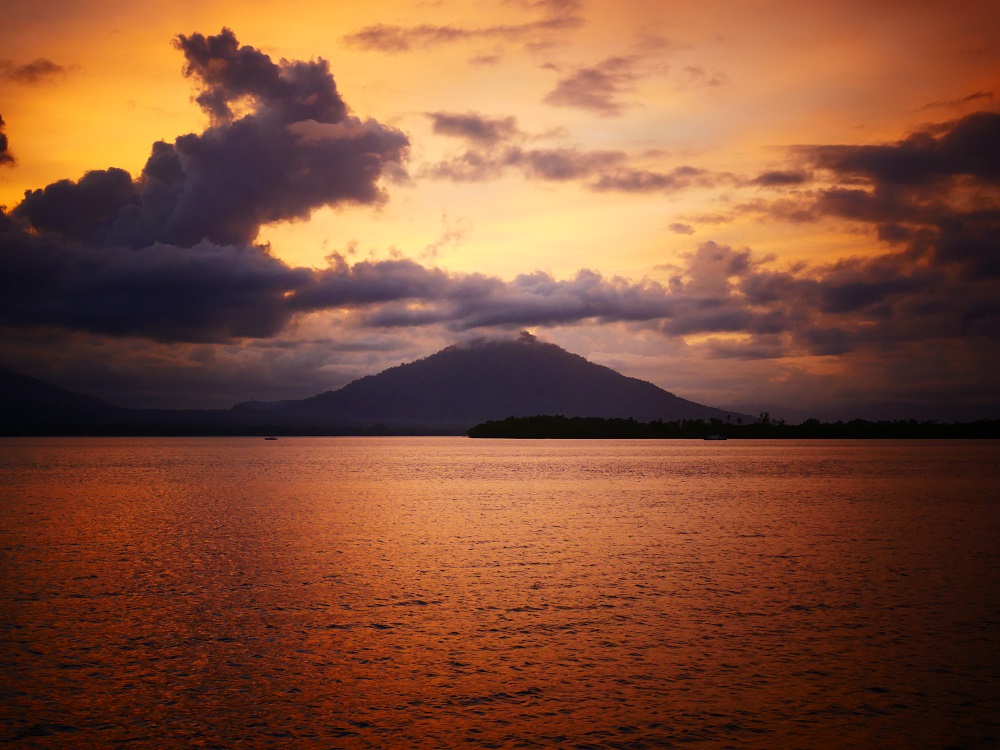
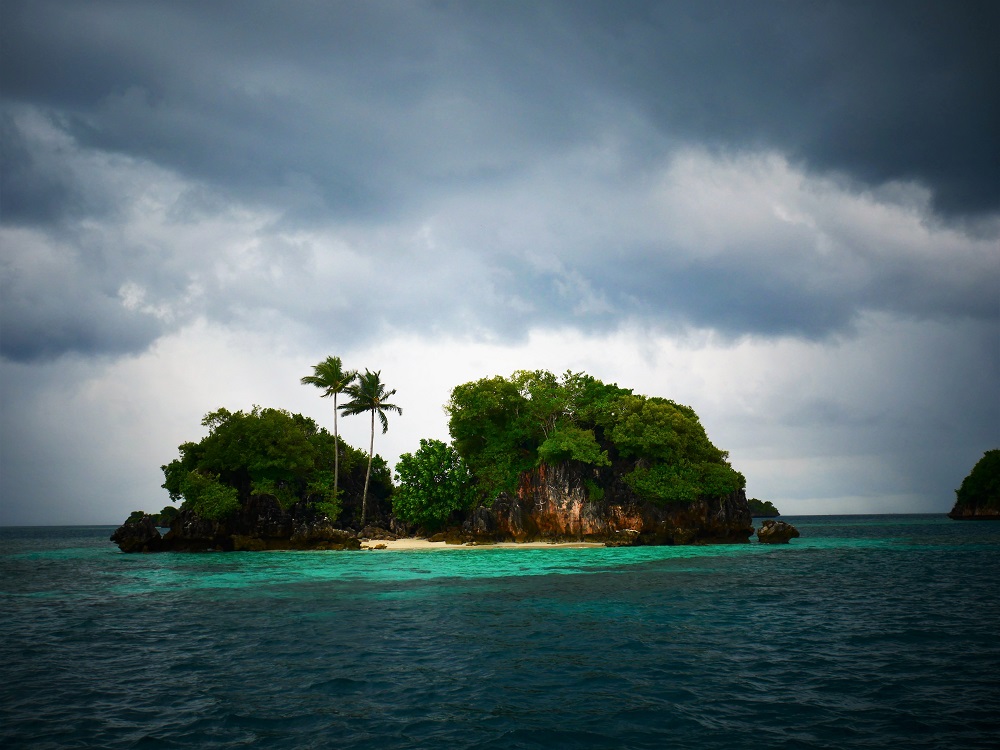
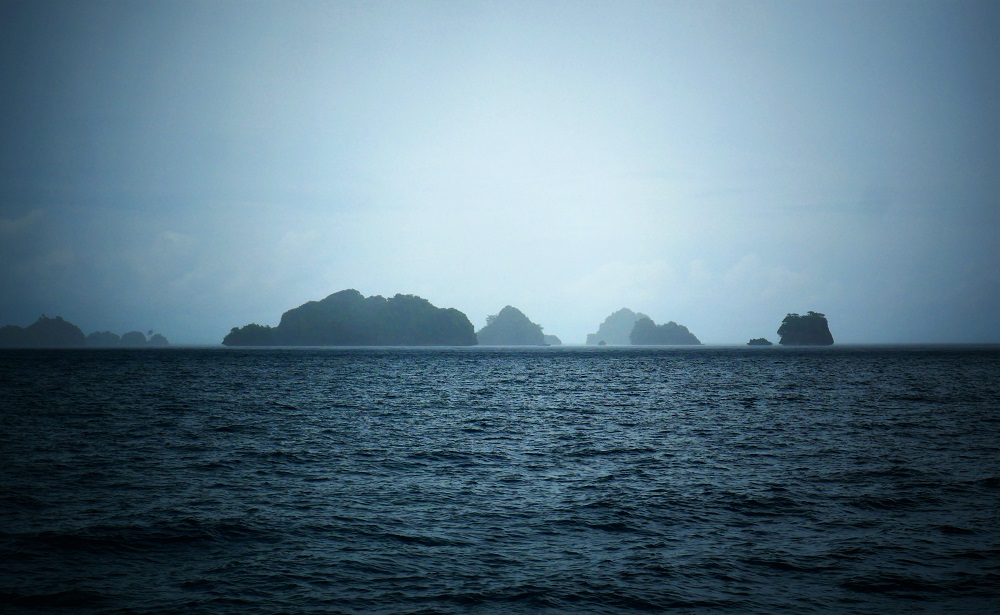
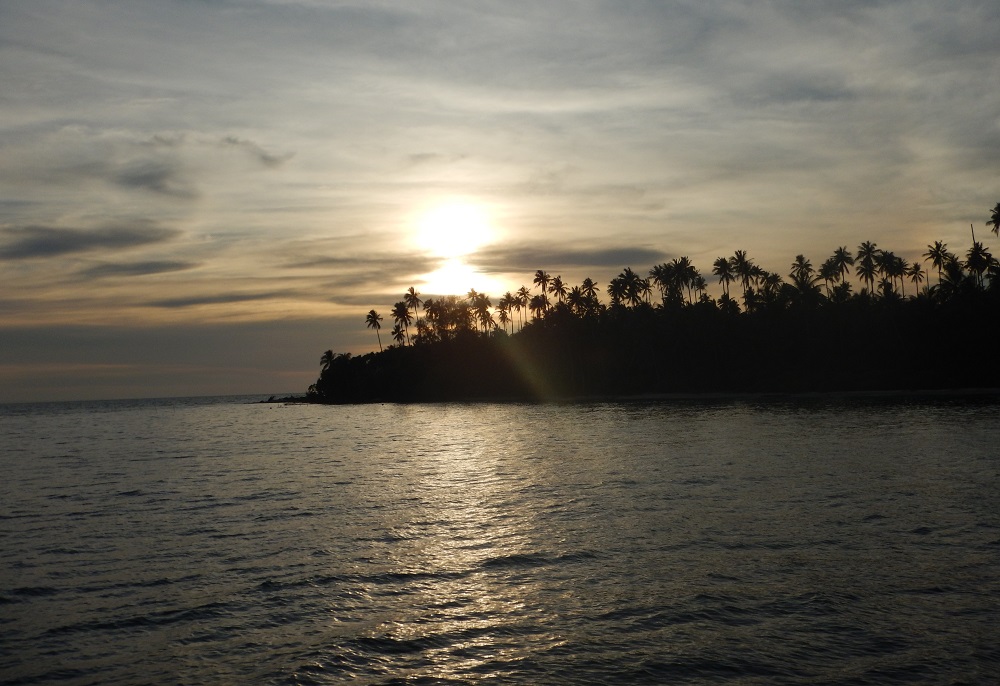
Lunch is nearly ready, and I gingerly step just outside in the cockpit for a breath of fresh air, towel at the ready should a boat approach. I survey the landscape and sigh contentedly. Other than the stuffy heat, Banda is bewitching. Steep, dark green volcanic islands rising from the deep sea, the conical volcano of Gunung Api shrouded in cloud, the lower lying islands of Banda Neira and Banda Besar shimmering aromatically under the hot sun.

Piles of nutmeg drying in the sun.

The native trees of these islands have shaped their history dramatically. Home to all the world’s nutmeg, the Banda Isles have been important for traders for thousands of years. Since prehistoric times nutmeg and mace have been used as flavourings and medicines, and Arab traders used to come to the Bandas to trade cloth for the coveted spices, which they then on-sold in India and Europe. The Arab traders kept the exact location of the spice islands secret, but as Portuguese ships began to enter the region in the early 1500s, European powers became aware of the lucrative islands. The Portuguese tried in vain to establish themselves in Banda but when the locals steadfastly withstood the attempts to Christianise them, they eventually gave up and moved their attention further north. This made way for the Dutch East India Company, which after realising how lucrative a monopoly on the world’s nutmeg would be, moved in with force, enslaving the few locals they didn’t manage to kill in the Banda Massacre of 1621. Realising how a Dutch spice monopoly would harm them, the English occupied the outlying Banda Island of Run, and in response, the Dutch got ready to defend their territory. And thus the Spice Wars began.

View from the low-lying Fort Nassau on Banda Neira.

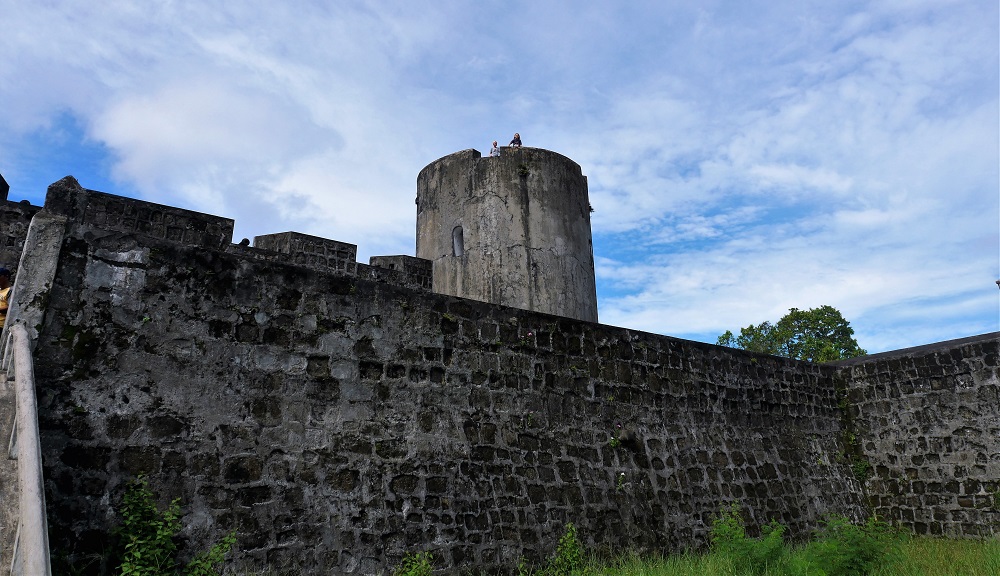
Evidence of centuries of spice conflict are everywhere in Banda. The quaint little township of Banda Neira (the Banda Island capital) with its narrow, fragrant streets lined with multi-storied colonial buildings, is situated below the imposing Fort Belgica, built in 1611 and reinforced and expanded in 1672. It overlooks the lower-lying ruins of Fort Nassau, which was built earlier not far above the high tide level by the Dutch at a site of an old Portuguese attempt at a fort from 1529. A third bastion, Fort Hollandia, built in 1624, graces the hills of the nearby island Banda Besar, its canons pointing out over the narrow channel between the islands, ensuring that any enemy ship was within range of the Dutch forces. We visit the dark, stone-walled forts, gazing out over the luscious landscape through tiny windows perched high on thick walls. To the kids’ delight, old, rusty canons are everywhere – in the forts, but also on street corners, perched at the end of narrow park areas, littering the roadside amidst a drift of rubbish.

Boat kids at the entrance to Fort Nassau.
King of the world! Matias and a friend scaling the heights of Fort Belgica’s reinforced towers.
Old canons littering the streets of Banda Neira.

Spice is still the key to wealth on these islands. On the large island of Banda Besar, the nutmeg trees grow in the shade of giant kenari trees bearing their sweet tropical almond-like nuts. Nutmeg hangs in rich bunches off the slender trees, ready to be picked three times a year whereas the kenari nuts drop to the leaf litter on the shady ground, where they are picked up daily by industrious workers. Cinnamon trees abound in roadside gardens, the fragile young trees cut down when the bark is thick enough to peel, the leaves spreading a spicy aroma mingling with that of nearby colourful flowerbeds. Clove trees are grown in plantations, the aromatic flower buds picked only once annually after the flowers have turned bright red. The plantations are owned by the Indonesian government who pays each family for harvesting and drying the valuable spices, providing a steady and not insignificant income for all households in this outlying region of Indonesia.
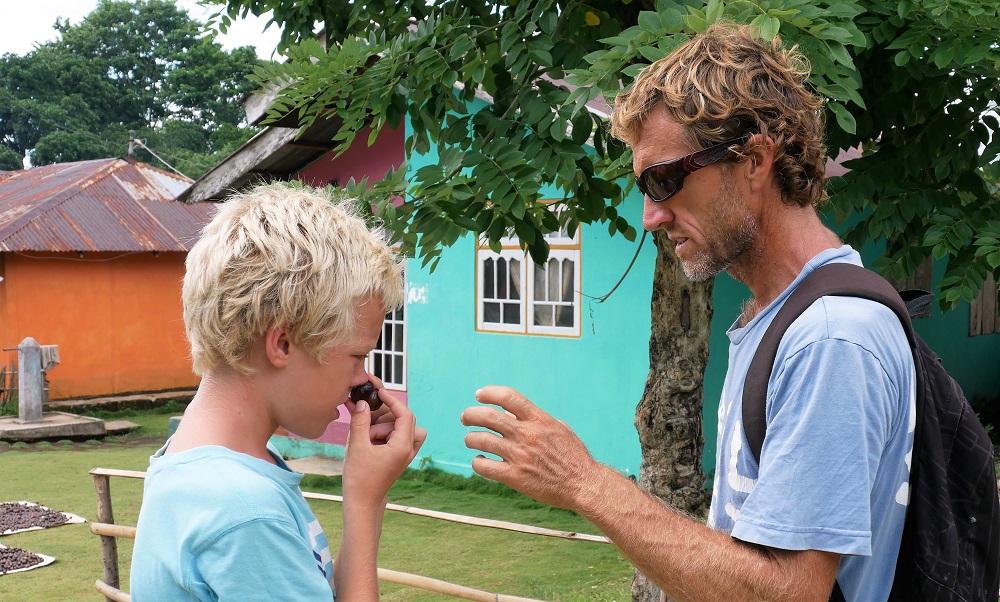
Smelling the nutmeg on the streets of Banda Besar.
The boys and I at the roots of a giant kenari tree.

Spices are everywhere in these fragrant isles. Nutmeg and mace are drying on mats in front of local houses, the vivid red of the mace livening up the narrow, sun-baked streets. Bags of cinnamon bark the size of large papyrus scrolls are offered for sale in the local market alongside dried lacy mace and chewy, candied nutmeg peel, the scent of which complements the spicy gingery tones emanating from bags of cloves, powdered turmeric, and numerous piles of fresh ginger and turmeric. We buy spice cakes and almond slices heavily infused with cinnamon and nutmeg, drink chilled cinnamon tea and nutmeg coffee in street-side cafes, and taste the islands’ signature dish of terong goreng kenari – fried eggplant with a spicy kenari-nut sauce.
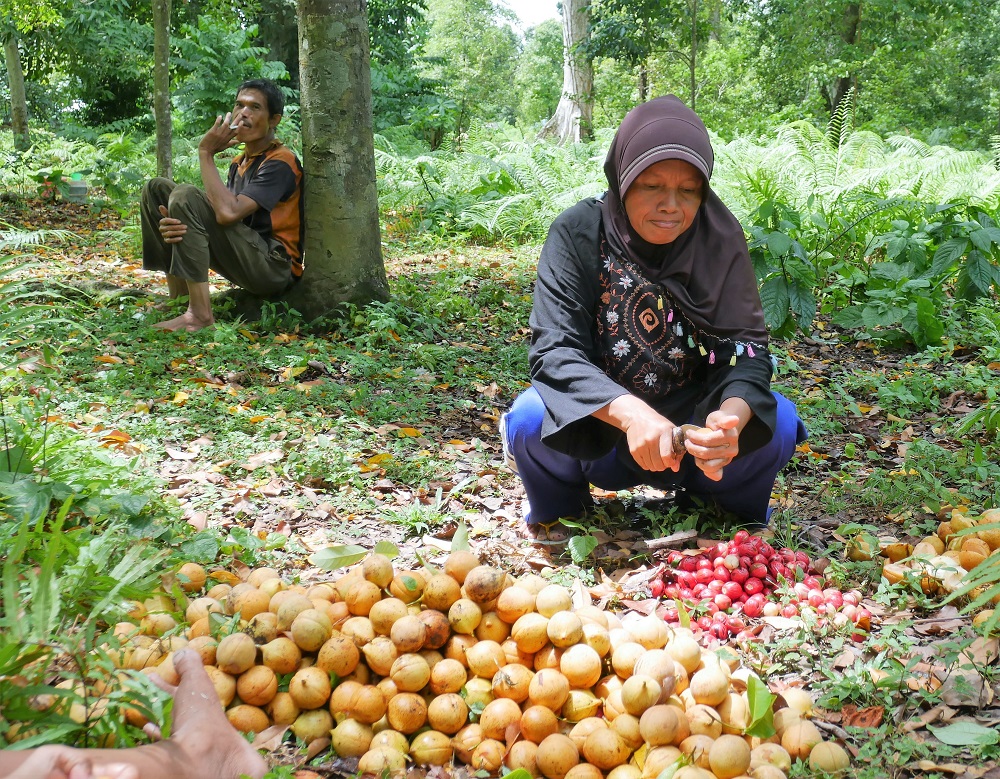
Local lady cutting up freshly harvested nutmeg whilst her husband looks on.
Fresh mace drying in the sun.
Outlook from the hills of Banda Besar, the volcano Gunung Api in the background.

In the 17th century the spice trade was the driver of the global economy, nutmeg was worth more than gold by weight, and the Dutch were very keen to have a monopoly over the nutmeg trade. The English occupied a tiny island (Run) in the Banda group, and after 60 years of fighting over it, the two countries finally compromised in the Treaty of Breda in 1667 (later labelled ‘the real estate deal of the millennium), whereby the Dutch surrendered Manhattan, an obscure island of low-lying swamp in New Netherlands in North America in exchange for the English surrendering the tiny island of Run in the Banda archipelago.

Thus set up for a lucrative monopoly, the Dutch East India Company ran the Banda Islands in spectacularly brutal fashion, decimating the original Bandanese population and importing hundreds of slaves each year to replace those who died under the savage conditions on the Dutch-run plantations. To protect their resources the Company destroyed all nutmeg trees on the outlying islands of Run and Ai, imposed the death penalty for stealing, selling or growing nutmeg elsewhere, banned the export of trees and rendered all exported nutmeg infertile by dipping it in lime before shipping.

The monopoly ended in 1810 when the British stormed the island of Banda Neira and quickly removed many nutmeg trees, which the British East India Company successfully transplanted anywhere tropical and fertile they had access to – Penang, India, the West Indies and Grenada. By that stage the Dutch East India Company had gone bankrupt and the Dutch government had taken over the running of the Dutch East Indies, the precursor of Indonesia.

Gunung Api, mountain of fire. The lava flow continues under water.

In recent years the only violence in Banda has been the eruption of the volcano, Gunung Api, on the island of Banda Api in 1988. Fortunately, the wind was blowing the hot ash off the main township and only one person died. The settlements on the island were abandoned thereafter and nowadays only few houses grace the steep foreshore. You can still see the black flow of lava down the hillside, continuing into the sea and making for incredible snorkelling, the shallows full of wave-swept lava boulders where the boys and their friends snorkel to find gems, little white and yellow crystals locked within the cooled, solidified lava. Deeper, the lava was quickly colonised by corals and the site now boasts more coral diversity than the surrounding, non-impacted reef.
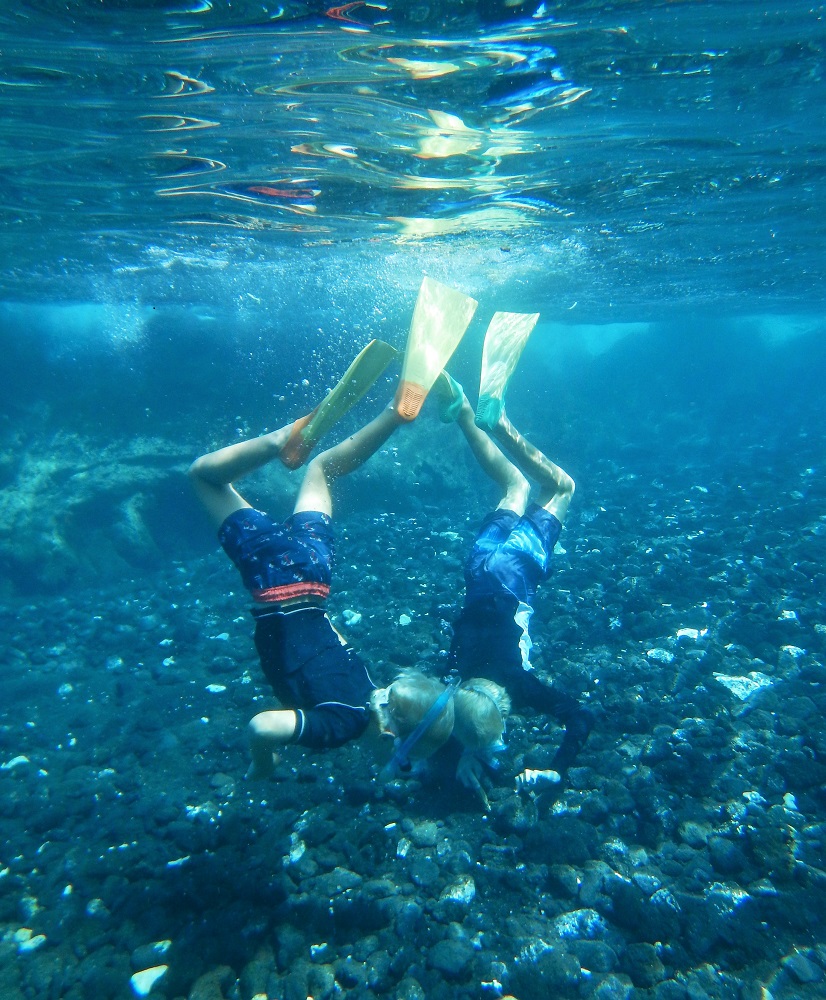
Diving for diamonds on the lava flow.

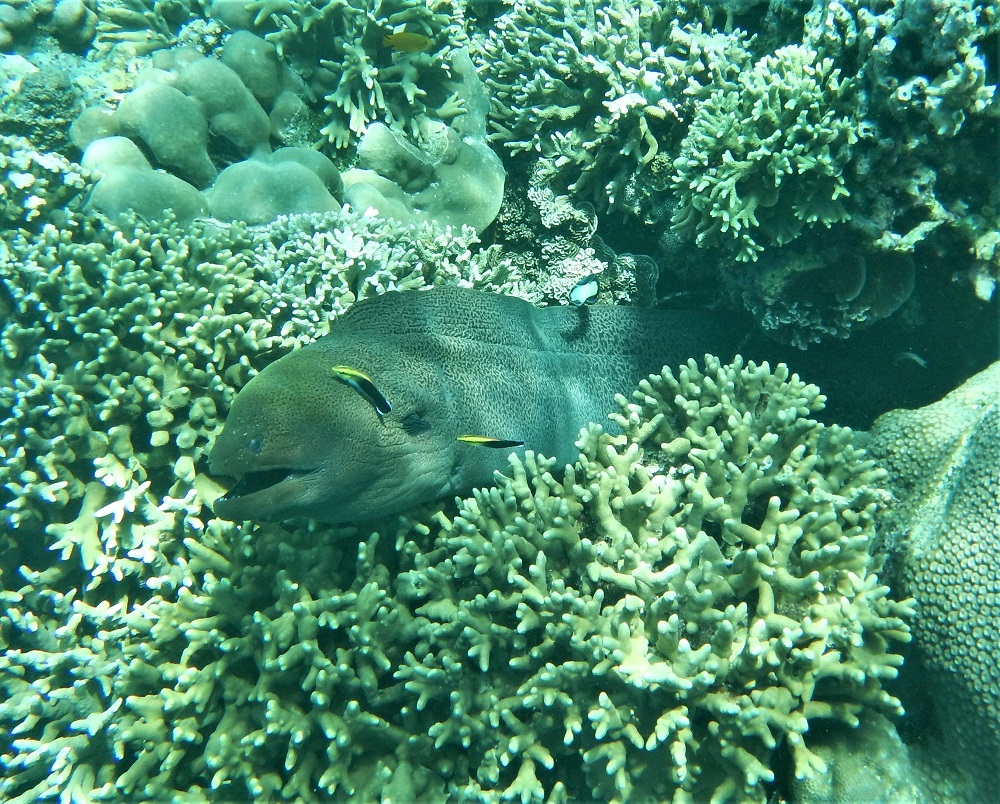
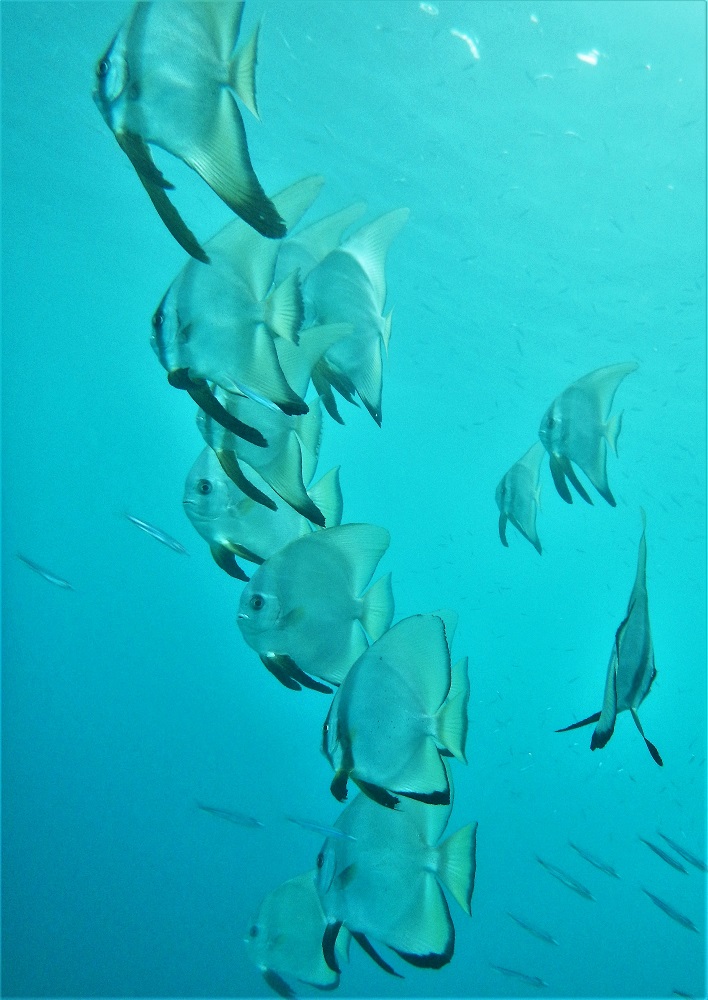
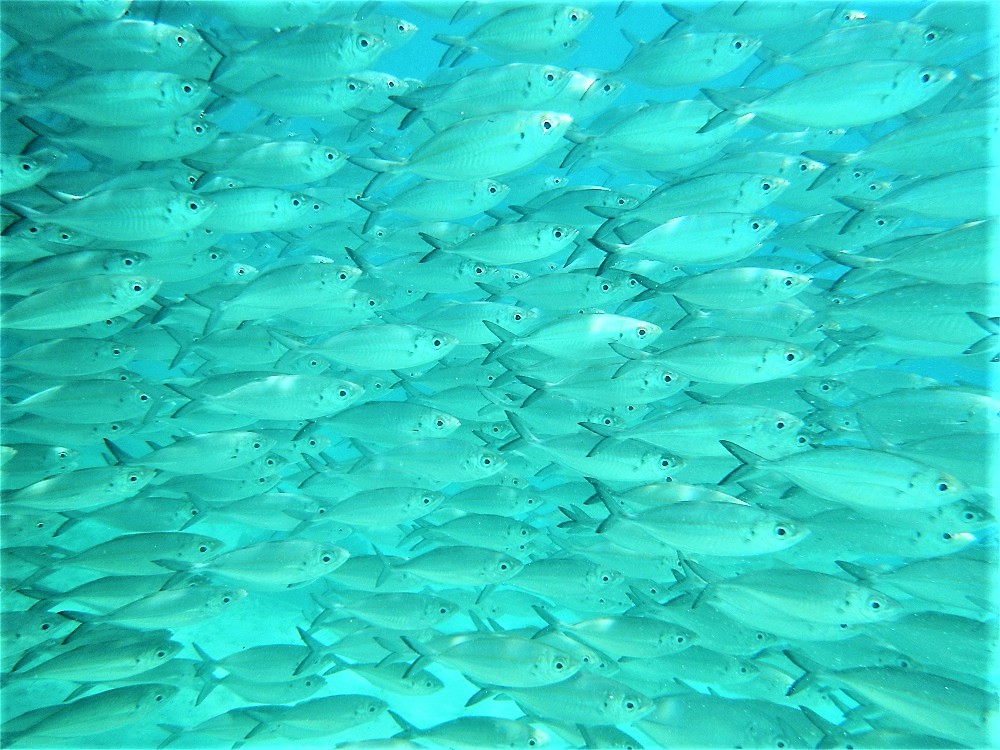
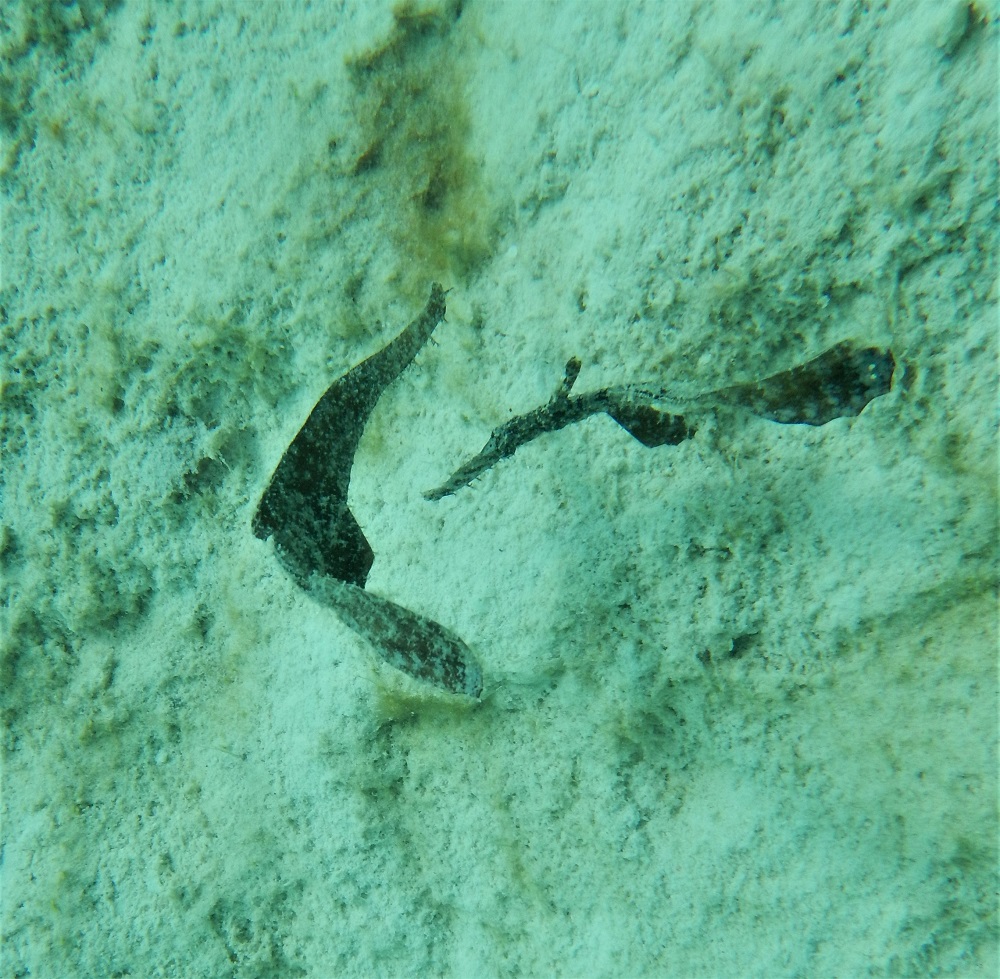
There are many tourists in Banda, mainly divers who have come to sample the wonders of the famously clear waters. The Banda Trench which is 6000 m deep is located to the south of the islands and the strong currents in the area makes for wonderful drift diving and famous wall drop-offs graced by large pelagic fish, including hammerhead sharks, one of which Matias spotted whilst snorkelling. We dive and snorkel clear, deep reefs, coming close to huge Napoleon Wrasse, enormous moray eels, well-camouflaged octopuses and swarms of colourful reef fish.
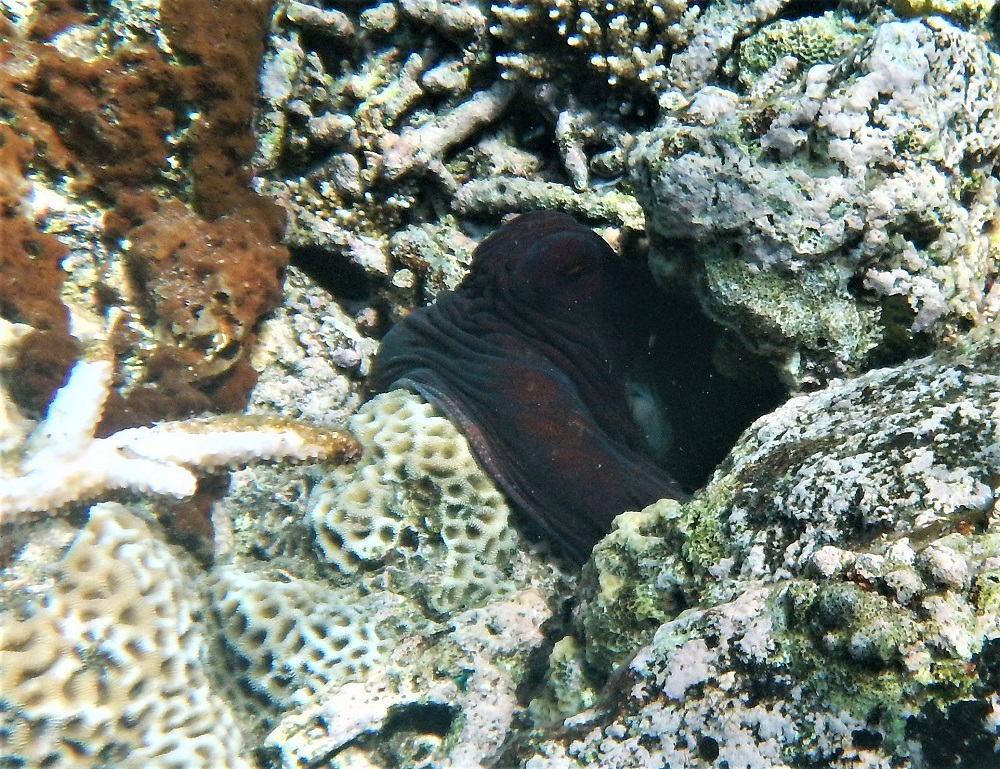
Shy octopus on the lava flow reef.
David and a needlefish.
Menacing moray eel.

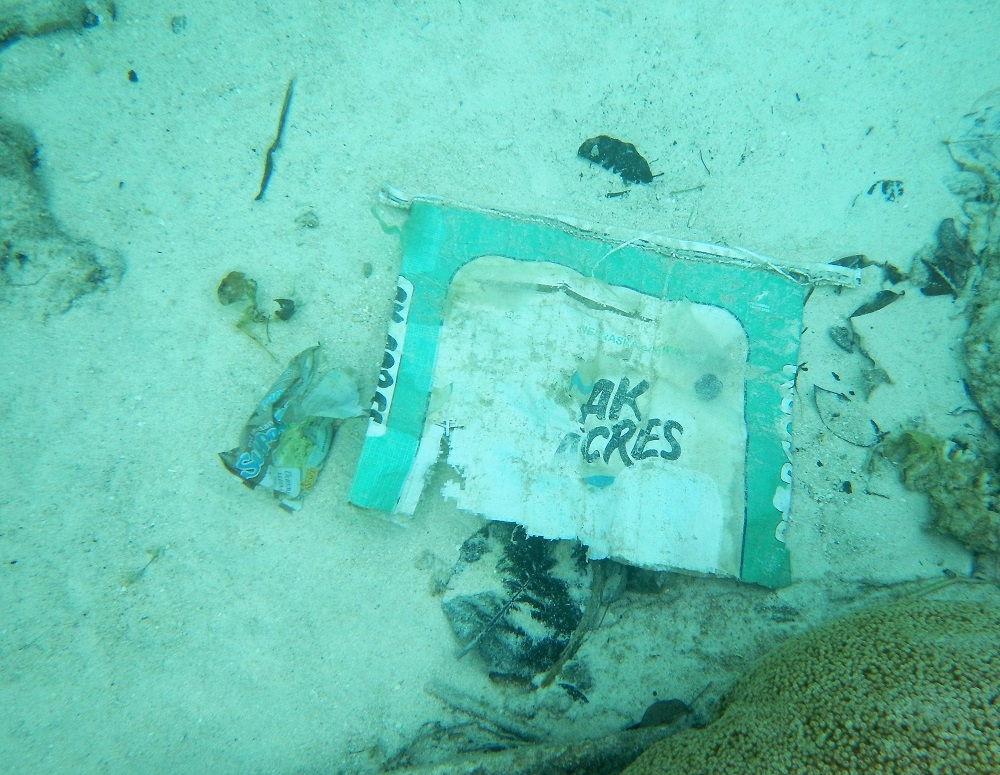
Unfortunately, there is quite a lot of rubbish in the water here, although it is clear that, unlike most places in Indonesia, the locals are trying to do something about it. Colour-coded bins line the narrow streets everywhere, and generally the town of Banda Neira is clean. We find out why when we meet the local school teacher, Mr Man, a short middle-aged man on a moped who stops us on the street of Banda Neira.

“Hello,” he says, clasping my hand with both of his. “My name is Mr Man. You must come and meet the school children.” He smiles and keeps hold of my hand. “You must come and help clean up the plastic from the beach, with the children.”

“Yes, the plastic is very bad for the ocean,” we respond. “What are the school children doing?”

“It is big, big problem. Education is very important. Come tomorrow and the children will pick up rubbish with you, and dance, and then we converse in English. The children’s parents will be very happy if you converse in English.”

We agree to meet him the following afternoon and he takes us to meet his keenest students, a group of lovely teenage girls who, clearly briefed, perform like well-trained actors. Their first task is to do a traditional dance for us (“Again,” shouts Mr Man when the music stops), veiled Muslim girls adorned with fern leaf crowns gyrating to traditional Indonesian music in their tight black jeans, iPhones poking out of their back pockets. After the dancing, we gather inside the classroom for the scheduled English conversation.

Banda school girls performing a traditional dance.

“Speaking English is very good for them,” Mr Man explains as he barks orders in Indonesian at the girls seated in front of us on old-fashioned school benches. “Their parents will be very happy.” He looks out over the girls. “Now, plastic!” he yells, and the class obediently hold up laminated cards spelling out the evils of plastic whilst they shout “Keep Banda Clean” in unison.
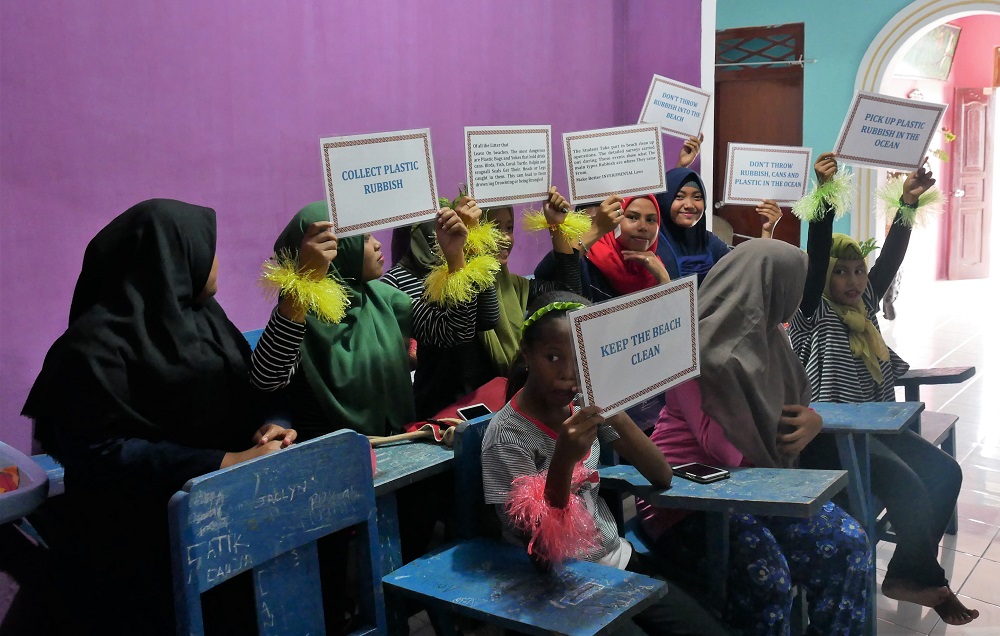
Keep Banda clean!

“Now, introduction!” he shouts after we’ve taken pictures of the earnest budding environmentalists, and one by one the girls stand to introduce themselves.

“Hello Mister and Missus, my name is …, my mother name is …, my father name is…,” they continue, introductions dragging painfully on and on until all their relatives have been properly presented. Next, Mr Man commands us to introduce ourselves, after which the girls are allowed to ask us questions: “What is your work?”, “Where do you come from?” and “Can we visit your boat?”

The day finishes with a couple of songs (“Sing Brother Jacob,” Man bellows, and they break into song. “Now in French!” he commands, and they sing along in non-recognisable French: “Fraca Shaka, Fraca Shaka, doray vous, doray vous…”), finishing off with ‘If you’re happy and you know it, clap your hands’.

It’s a bizarre, if well-meant, performance, and our role is clearly to listen and applaud, a live audience witnessing the success of Mr Man’s teaching practices. We never get to pick up any rubbish with the girls, but after the performance Mr Man shows me a book he has drafted on the evils of plastic contamination of the local seas and we contribute generously to its publication.
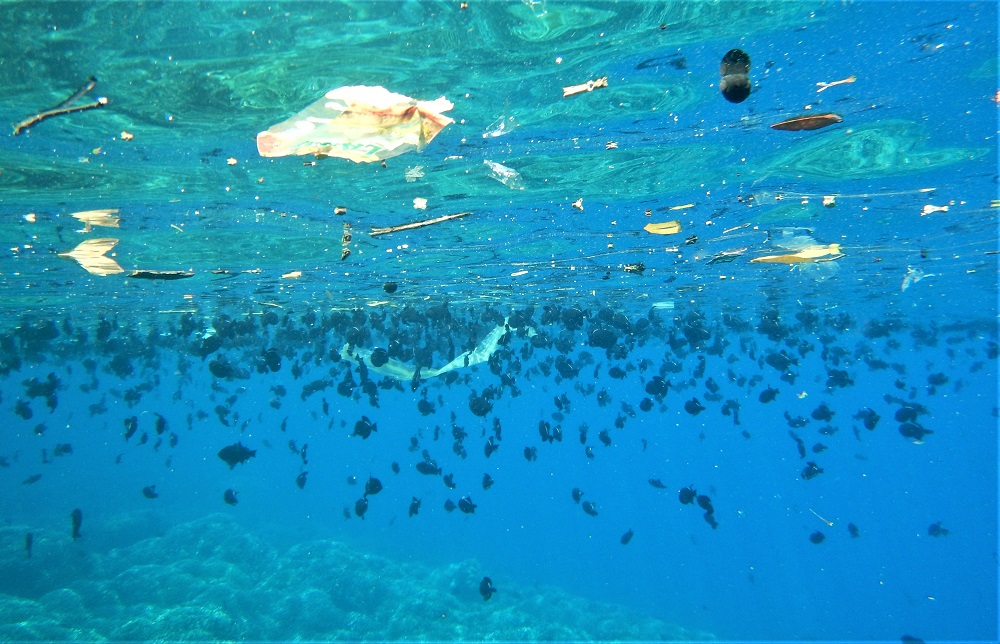
Fish gathering under a rubbish slick in Pulau Pisang, Banda Islands.

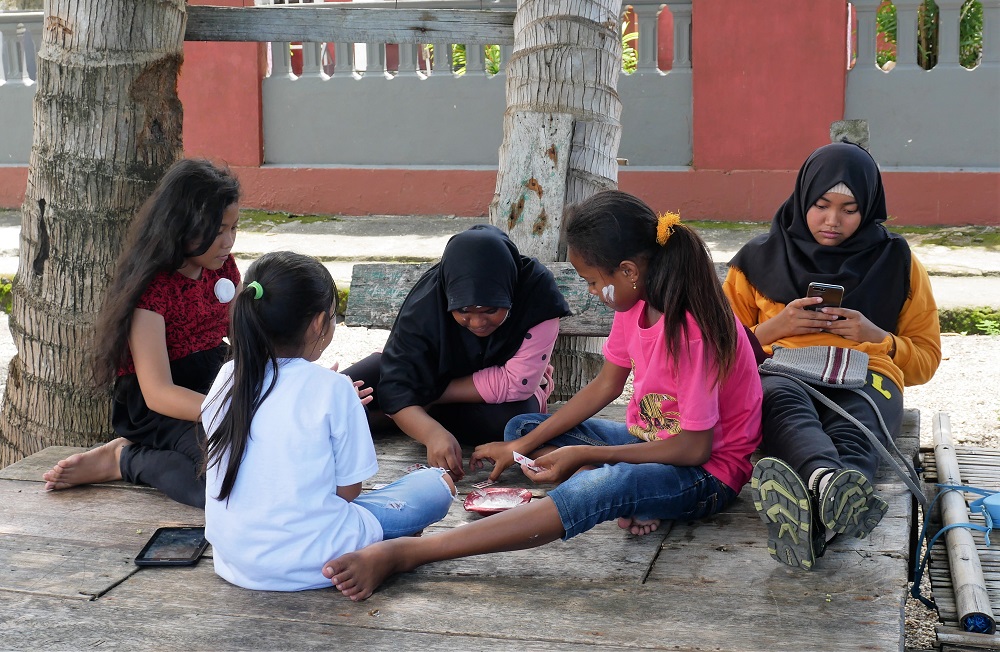
The following afternoon the girls visit all the yachts in the harbour, exclaiming about our taps, the trampoline, the deck, in between chasing after our children, cellphones outstretched, clamouring for close-up shots and selfies. The kids and their friends take it as a game and flee enthusiastically, screaming as they scramble through hatches, pursued relentlessly by veiled girls. After we’ve had tea and cake, the girls request music (Ed Sheeran, Katie Perry) which we play loud on the stereo, the visitors crooning along, eyes closed.

Group photo on Bob the Cat.

The girls relaxing after the school performance.
Caught! Matias reluctantly obliging a selfie request from a female fan at the school.

I’m in constant awe of the women here, wondering how they survive the heat, fully covered up as they are in jeans, long-sleeved pullovers, thick veils covering their hair – and then dancing, running after my kids, playing ball in the backyard gardens. It must mean that I could get acclimatised!

Back in the galley I wipe my brow. Lunch is ready and I call the children to start putting things out so we can eat in the cockpit. I look around. No boats nearby. Dare I eat in my bikini? David and the kids come out and sit down, cutting bread and cheese, slicing tomatoes. I make a sandwich and rush to seat myself in order to provide less of an obvious figure, and have just sunk my teeth into the sandwich when I hear the donk-donk-donking of a local engine.

“Duck, Mummy, duck!” urges Lukie and I quickly lie down, pressing my body against the sticky seat, clutching my sandwich to my face, hoping that my behind is not sticking up beyond the line of sight of the local boat.

“Have they gone?” I croak, still clutching my sandwich to my face.

David looks around and starts laughing. “You can sit up now,” he says. “They’re gone – and besides nobody is looking at us anymore. Check this guy out!”

He points, and I sit up to look out and see a completely naked man standing at the back of the German yacht which is anchored nearby. The boat came in early that morning and the man is having a long shower, rubbing generous helpings of soap into his private parts before turning around so that he can rinse off his behind, bending slightly to make sure that the water gets right in where it’s needed. Once his bottom is clean, he stretches out, closing his eyes and holds the showerhead up high, letting the cool water splash down his naked body, obviously relishing the rinse. We stare in disbelief as we chew our sandwiches, and when we look around we see that all local boat traffic has come to a complete standstill, the fishers staring at the naked man parading in full view of the entire town, their jaws hanging open.

“Bloody Germans,” I quip with a grin, “always naked!” and I swallow the rest of my sandwich and move my scantily clad body back inside the boat before anyone sees me.

Nude goats desecrating a local graveyard on Banda Besar.


Disconnected

This cruising life is awesome. We get to go to beautiful places, off the beaten track, and see amazing sights. We are free as birds and have only loose plans, steering a course that can be changed at a moment’s notice, changing destination on a whim to explore new and exciting shores.

The most interesting locations are often the most remote, places where few people live and even fewer visit. Invariably, these places have no internet, and so most of our lives now are lived offline, a fact that comes with its own challenges.

It is at once liberating and frustrating to not have internet access. It gives us a lot more time in our lives – once offline, we realise how much time we normally spend online, checking news, emails, social media, browsing TED talks and looking up any questions that come to mind.

At the same time, it is frustrating because many aspects of modern life simply assume uninterrupted internet access. Take schooling – we joined Te Kura, the New Zealand home schooling system, when we first started the trip. Their teaching is mainly done online, and students use applications such as Mathletics, Reading Eggs, and Google Classroom as a platform for student-teacher communication and collaboration. At first we thought we could work offline in Google Classroom, syncing when we got internet access, but it soon became clear that this only works if being offline is the exception rather than the rule. For example, we couldn’t start new files offline, and the syncing once online used unfeasible amounts of data.

Then we tried Microsoft Office, emailing documents, presentations and the occasional spreadsheet to the teacher. However, gone are the days where you just download Microsoft Office and use it. Nowadays, hefty periodic updates are required to run it, and even if you switch off the updates, the application is still required to connect to the internet monthly to validate the Office subscription and download more glossy screensaver imagery. Which means that for our two laptops with a Microsoft Operating System, Office doesn’t work half the time because internet wasn’t available when a check-in was due. Every time we reach internet the laptops stall for a day to update, the tiny little dots spinning round and round on the screen as we stare at it in impatient disbelief whilst our data is sucked dry.

This leads to many frustrations, where David, a staunch Linux-only-user, derides all Microsoft products and rants for hours about how badly Bill Gates’ products suck as he triumphantly continues to use his Linux laptop (which never needs any updates ever) while the rest of us are reduced to pen and paper. It is not news that anyone technologically minded abhors Microsoft’s clunkiness and there is no doubt that OpenOffice is almost as good, although I worry about the conversion when we have to email documents to official institutions like Customs in the countries we sail through.

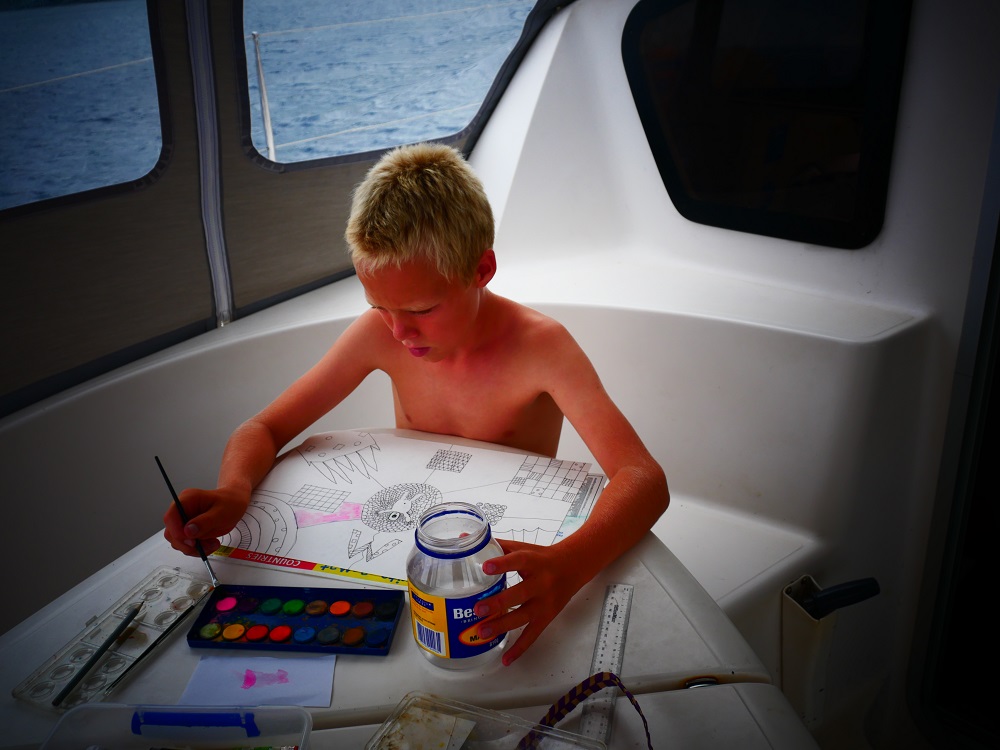
Drawing the old-fashioned way.

As an added complication, I keep forgetting my Microsoft account password, the retrieval of which is complicated by the fact that my Microsoft Office account was set up for my old, now obsolete, Vodafone email account. Vodafone discontinued their email service promising to forward any emails sent to the account in perpetuity, but for some reason the Microsoft emails are delayed by anything from an hour to a month. This means that all efforts to reset the password so that we can change settings (like update the email address) or renew our subscription are doomed – or at least incredibly time-consuming and the cause of much frustration.

“It is ridiculous! You need to use a safe password system! Anyone could hack all your stuff in ten minutes!” grumbles David when I admit that the password to Microsoft may be the same as that for Amazon, which possibly is quite similar to the online insurance login.

“I know,” I whisper, looking down on my hands as I promise solemnly to start using an online password vault. I spend the next three days painstakingly turning all my easy-to-guess passwords into impossible-to-break complex codes and storing them in LastPassTM, feeling proud of my efforts as I report back to David that finally, I too have joined the password-savy tech crowd. This still doesn’t help the ongoing Microsoft login problem, which now is delayed by a month as Microsoft only allows you to change email after a one-month waiting period (where they do what, exactly???) but at least we can sleep at night, knowing that nobody can easily log in to pay my insurance for me.

Out here there is no internet.

Anything electronic is complicated by limited internet. A couple of months into the trip, on a rare visit to a port with excellent internet, I tried to download some more books on my Kindle. Because we’re all avid readers, David switched us to some sort of family account which allows book sharing at the start of the trip, but for some reason this change means that I couldn’t buy any books at all. Once again, rectifying the situation took many days and numerous screenfuls of online chat with the friendly Amazon employee in the help centre located somewhere in northern India:

“Hi there, my name is Ravindran,” blooped the computer as the message popped up on my screen.

“Hi Ravindran” I typed, determined to remain polite and friendly despite the high levels of frustration I was experiencing.

“How may I help you?”

“I’m travelling with my family and am having problems downloading Kindle books…”

It turned out that for some reason the family account was set up for the UK, which means that we are not allowed to buy books when in any other country.

“I can change it to Australia or New Zealand,” blooped Ravindran. “But then you can only buy books in those countries.”

“But we are travelling. Do you have any options for people who travel?”

“You can buy many books now, and then just read them later?”

“Well, we will be travelling for the next year. What do people normally do when they travel? Or does Amazon have some sort of policy preventing travellers from buying Kindle books?” I typed, my resolve to stay patient ebbing.

In the end a solution was found, and we were granted permission to continue to buy books even though we are not fixed in any one country. I ended the three-hour-long chat by thanking Ravindran profusely for allowing us to continue to spend money with the company he works for.

Less accommodating are the people working for Garmin, our chart plotter company, who bluntly state that providing access to the charts we’ve paid for, and which we need to go offshore, is not their highest priority. Downloading charts is data-consuming and costly, and sometimes best done overnight where the internet is faster and cheap data packages can be bought.

We need internet to download charts so we can avoid sharp rocks.

We do have satellite email through our Iridium service. This allows us to make emergency calls and send and receive texts and small emails. It takes a long time for even a small amount of text to be received, and attachments are almost impossible to download. I guess that’s rare in this world of causal attachments of huge files, and we constantly have to remind those with whom we correspond to limit the size of any mail. It becomes clear to me that few people read emails carefully when I develop a toothache and use Iridium to email my dental centre back in New Zealand, and the receptionist disregards the post-script warning to limit attachments and quickly attaches my entire dental file, including all x-rays ever taken, to her reply. Which means that my Iridium is stuck for a week as I’m trying to clear her mail, downloading her 4 MB attachment in 25-50 KB chunks, spending hours sitting alertly pressing the ‘send/receive’ button to progress the slow download.

“Mummy, do you want to come snorkelling? You haven’t been for two days now?” ask the kids, to which I can only reply, “No, I’m busy downloading an email – only 2 MB to go!”

I’m busy downloading an email and have no time for water fun.

A monthly clog also occurs every time Raymond, our Indonesian agent, sends us letters for visa renewal, unfailingly sending his attachments to the Iridium account despite specific instructions to use our gmail address. This gets particularly frustrating when he repeatedly spells our names wrong on the attachments and therefore has to mail a new version. After a while we start adjusting his documents, correcting the spelling using a PDF editor in an attempt to save both bandwidth and time.

When we get to inhabited places and internet after a while away, we greedily indulge, relishing news and Wikipedia, the kids getting on with coding for maths and self-directed inquiries for reading and writing as well as downloading music and joining multi-player online games with friends from all over the Pacific. We download recipes that we’ve missed while offline and renew our music collection (Spotify requires all offline-stored music to be re-downloaded once a month, which costs us huge amounts of time and data), catch up with the achievements of our friends’ children on Facebook and email family members to set dates for Skype calls, as well as attend to more serious matters like flight bookings for our upcoming trip to Europe, insurance renewal and payment of yet more Microsoft bills. After a week of internet, we’ve generally done all things necessary and are getting thoroughly depressed with the ever-yet-never-changing news (Brexit, Trump, climate calamities and their victims, and widespread environmental degradation largely ignored by the leaders of the developed world) and are looking forward to leaving the internet behind again and escape to somewhere remote.

Lukie in the surf – the nicest places are often remote.

Yet, there are so many things about life before internet that I now find hard to fathom. How did we ever used to be able to travel without Google Maps showing us where to go for food, fuel and local attractions? How did yachties ever know where to go without satellite imagery showing all the cool spots, anchorable depths depicted nicely as a turquoise hue of water between the sandy white beach and the deep blue deeper waters? How did cruisers share their knowledge of where to go, where to provision, what sights to see, without platforms like Facebook or Cruiser forums like Noonsite? Nowadays, when planning for our next location we just do a bit of quick research online, downloading cruising guides which handily tells us where to go and what to avoid, posting questions on online sailing forums to seek guidance on anything we can’t easily find, and getting responses containing handy hints and specific advice within minutes. There are even forums for cruisers with kids, where families advertise where they are every month so that if your kids need some friends you know where to find them!

The internet is certainly handy when you need help, especially here in Indonesia where in the IT revolution the population bypassed computers to go straight to mobile devices and everybody is clutching a phone, busily interacting online. When I needed an x-ray for a suspected tooth problem I located an English-speaking dentist in Ambon on Facebook within minutes and had lengthy Messenger chats with him as to the pros and cons of periapical versus panoramic x-ray before agreeing that I would come and see him a month hence when we planned to reach Ambon. When, a month later, I went for my x-ray and asked him if he knew of an ophthalmologist he instantly provided the WhatsApp details of his eye doctor friend who, although surprised at my calls (“Where exactly did you get my number?”) nevertheless agreed to grant me an appointment within 24 hours.

Modern tech helps in other ways too. Getting by in this part of the world where nobody speaks English is made impossibly easy by Google Translate, an ingenious app which allows offline storage of dictionaries, which means that with the help of our smartphones we can instantly translate any word or phrase of ours into Bahasa Indonesia and translate the response of a local back into English. When there is internet the app allows the user to speak into the device to get near-instant voice translation, which means that we don’t even have to be able to spell the Indonesian – we just hold out our phone and have people speak into it. I remember pre-internet travelling clutching Lonely Planet Guides and little phrasebooks and marvel at how quickly times have changed.

Offline schooling is fine too.

After eight months of frustrations with reporting we decided in December to leave the NZ home schooling system, opting instead for a more flexible approach where we use the internet when available but don’t sweat it if it isn’t. This means there is no teacher to report to and no deadlines, allowing us to work more organically with whatever suits the location we’re in. It is liberating, and particularly satisfying to just open the laptop at any given morning and check what is working, and adapt to that, rather than spend hours battling an untimely update request.

And so, after almost a year on the boat we are learning to live offline, often preferring the peace and quiet that it offers. The places with internet here in Indonesia are often the less pleasant larger settlements where we renew our visas, crowded cities full of rubbish; busy, smelly and noisy places, the mayhem of which we enjoy for three days after which we exhaustedly flee to recuperate in the wilderness of remote atolls and quiet anchorages.

Getting to, and leaving, Ambon

Boys getting ready for passage.

Sailing around Indonesia is not easy. It is an island nation, but with the bulk of the country hugging the equator there is rarely much wind, which means that sailors quickly become dieselers, using the engine more often than the sail. Winds are most commonly associated with thunderstorms, which frequently rise out of seemingly nowhere to whip up the seas and light up the skies. What the country lacks in steady winds it makes up for in tide, and strong currents rage along the island coastlines, sucking boats over shallow coral reefs or pushing them towards narrow channels between small islands. Added to this, Indonesia is a famous surfing destination and large swells pummel its coastlines, making some anchorages unpleasantly bouncy and upwind sailing uncomfortable (upwind sailing is always uncomfortable if the sea is not dead flat – and it almost never is). And that’s just the weather – in this country born from fishing and trade the seas are full of floating logs and rubbish, lurking just under the surface ready to wreak havoc with propellers and damage hulls. And then, of course, there are the boats, which are everywhere and few of whom follow international sailing conventions.

Dangerously overloaded Indonesian vessel presumably carrying something very heavy.

So, as can be expected, our two-day passage to Ambon was interesting. At first the wind was blowing, and we flew along at 9 knots on a flat sea, glamour sailing throughout the heat of the day. Then, in the late afternoon, the glamour gave way to grim reality as we came out of the shadow of the islands and hit the waves and were tossed mercilessly, banging and crashing our way across a disturbed sea. Normally on a catamaran you do not need to tie anything down when sailing, and most of the time we have glasses, books, plates and toys freely out on our table tops. However, this was a rough sea, and as we smashed over wave after wave we carefully placed all glasses and cups in the sink and stuffed rolled-up towels into the bottle storage to keep the glass from smashing. Prepared for wavy conditions, I had smugly cooked early, a spaghetti sauce concocted on flat seas standing ready on the stove so that all we would have to do close to dinner time was to boil some pasta.

Alas, even this proved too much.

Close to dinnertime, I put the pasta water on, bracing my body against the cabinetry as I heaved the heavy saucepan up onto the stovetop and lit the burner while we banged and crashed along. Pasta water takes a long time to boil on our boat (slow burners combined with big appetites which means lots of water = about 40 minutes to boil the water) and half an hour after putting the water on, I was sitting outside looking out over the wavy seas trying to control my seasickness, when suddenly a loud crash sounded from the kitchen.

“Whoa,” I yelled, running inside expecting the worst. And sure enough, in the galley all was mayhem – the large saucepan of pasta water had somehow evaded the metal pot-restrainer affixed to the stove and landed heavily on the floor, near-boiling water steamily sloshing about in the galley.

Holding onto the corner of the counter with one hand and the edge of the cupboards with the other to steady myself on the wildly jerking boat I surveyed the damage. “Could you grab me a sponge and a bucket?” I asked David. “I’ll try to clean it up.”

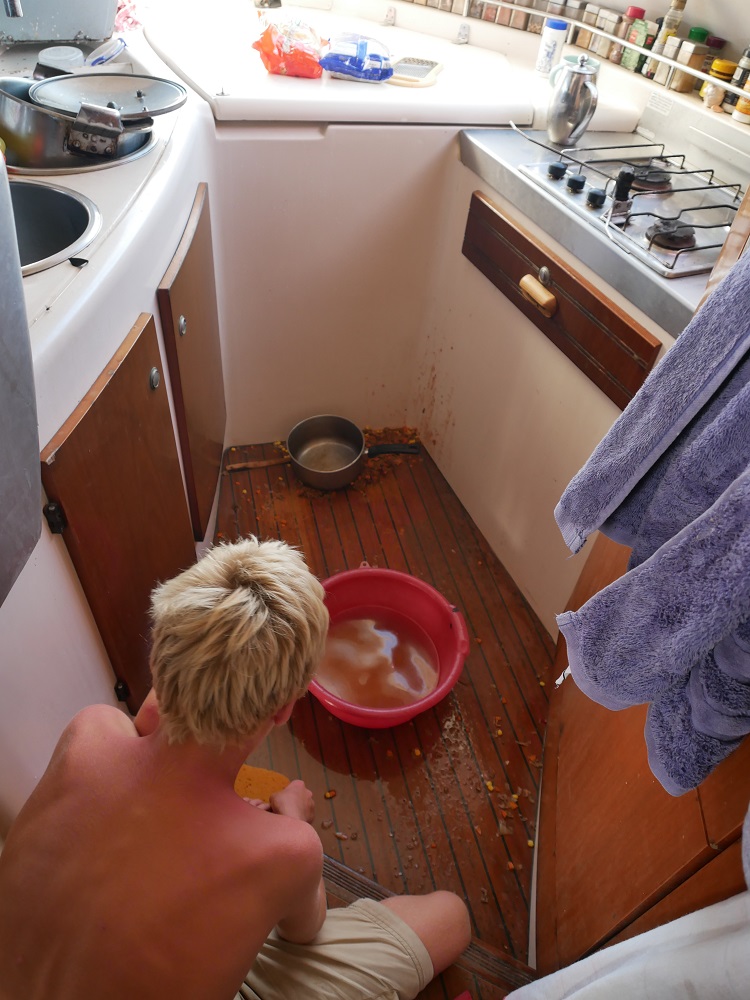
Just as he approached with the bucket another crash and a lurch heralded the boat hitting another wave and the pot holding the pasta sauce flew over the restrainer, smashing against the cupboard door just under the sink before loudly crashing to the wet floor, discharging spaghetti sauce everywhere. The boat did another violent heave and the steaming water sloshed over the semi-solid pasta sauce, splattering droplets onto the wall as it retreated with the next lurch, the galley floor turned into a shallow wave tank with the pasta sauce an island quickly eroded away by the boiling seas.

Matias cleaning up the galley mess.

It is the first time we’ve ever had pot kamikaze on Bob the Cat and as I sponged up the hot water and scooped up the sauce, I suddenly understood why the galley floor is sunken on most boats – it is presumably to contain the damage in situations like this! How clever they are, yacht designers.

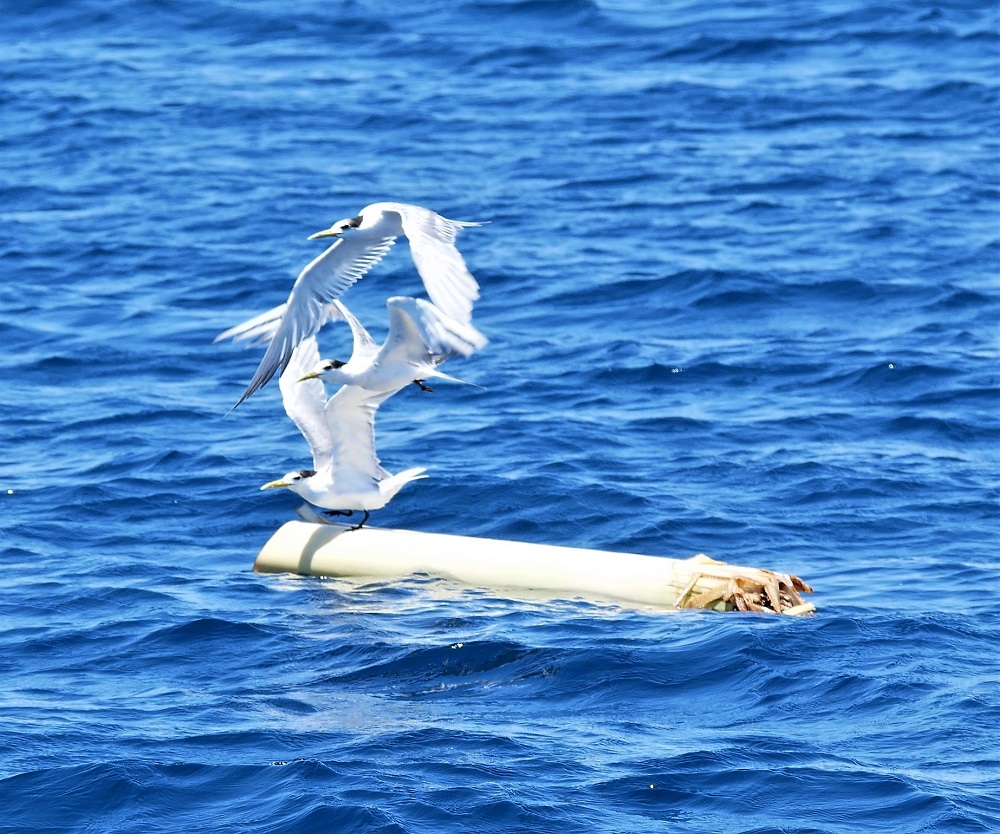
It wasn’t just the waves that kept us on edge. The seas off Ambon Island are littered with Fish Attracting Devices (FADs) – tiny wooden rafts attached to small buoys anchored in impossibly deep waters (some in depths of more than a thousand metres) far, far away from the coastline. Hard enough to spot in the daytime, small, insubstantial and surprisingly far from land as they are, the FADs are near impossible to see at night. Some of them are lit with small blinking lights but many are not, which makes coastal night sailing in this area somewhat like walking blindfolded through a minefield – you never know whether you will make it out unscathed.

Fish attraction device off Ambon Island.

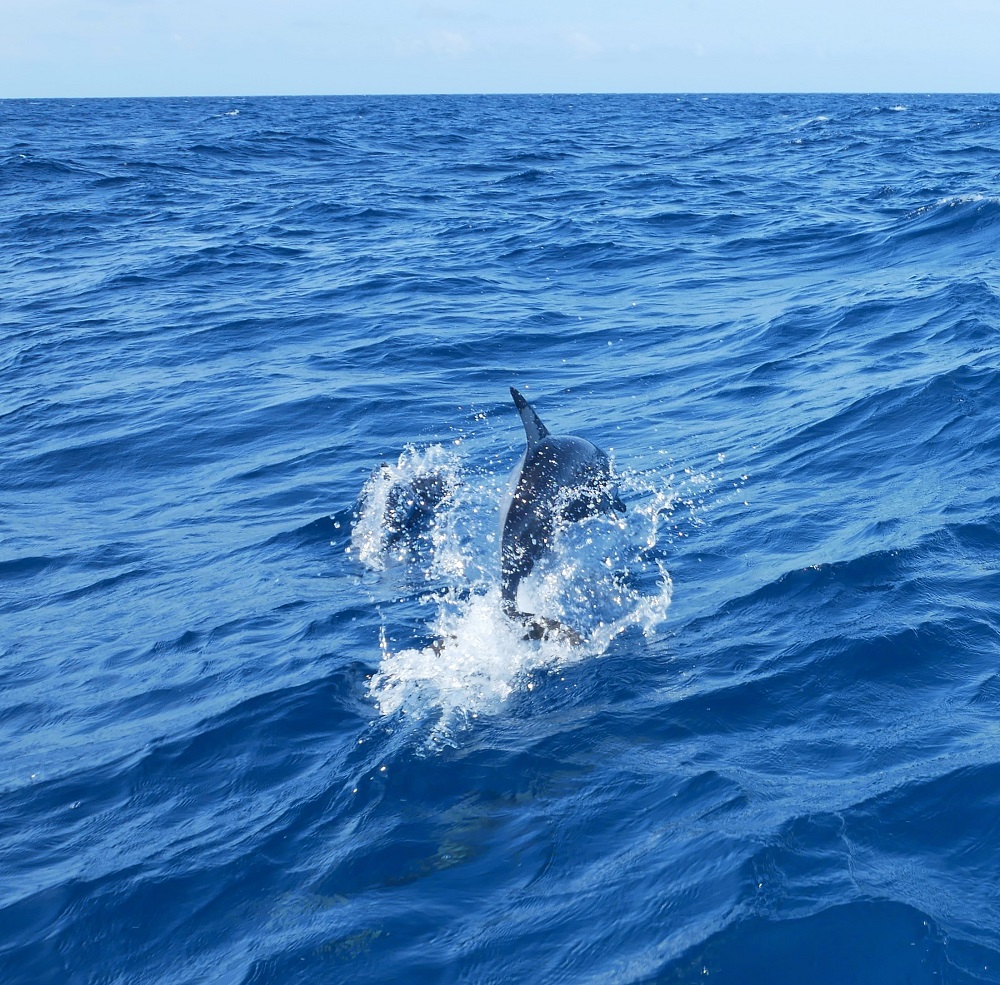
On my night watch, I sat tensely alert peering into the moonlit sea, trying to guess the distances to the myriad of blinking light. The radar is useful for revealing bigger targets but the FADs are too small to register, and as an added challenge Indonesian vessels don’t follow international lighting conventions – most boats here just display a set of blinking Christmas LED lights with no colour-coded port and starboard lights, which means that there is no easy way to determine whether a boat is headed towards us or away from us. All of which made for a harrowing night watch where I sat staring at the dark sea through hefty binoculars trying to make out the small shapes accompanying faint blinking lights on the waters, sometimes coming so close to FADs that I could see their shadows on the moonlit sea. The only light relief was a little pod of dolphins that followed the boat, squeaking up encouragement at me.

Floating logs pose a danger to yachts too.

Even big ships are hard to spot at night in Indonesia. Automatic Identification System (AIS – a transponder tracking system for ships) is mandatory for all foreign vessels that enter Indonesian waters, which is ironic since almost no Indonesian boats have AIS.  Even huge ships and large tows pass us by without leaving a trace on our AIS, and with the haphazard lighting employed by even large vessels, it is a wonder that we don’t end up colliding with anything.

Local fisherman far from shore.


On the plus side, on this particular trip we had a hefty current pushing us along the entire way south which meant that even when the wind disappeared later on in the night, we were still going 6-7 knots, pushed along by a 3-knot invisible tide.

Fishing boats in Ambon Harbour.

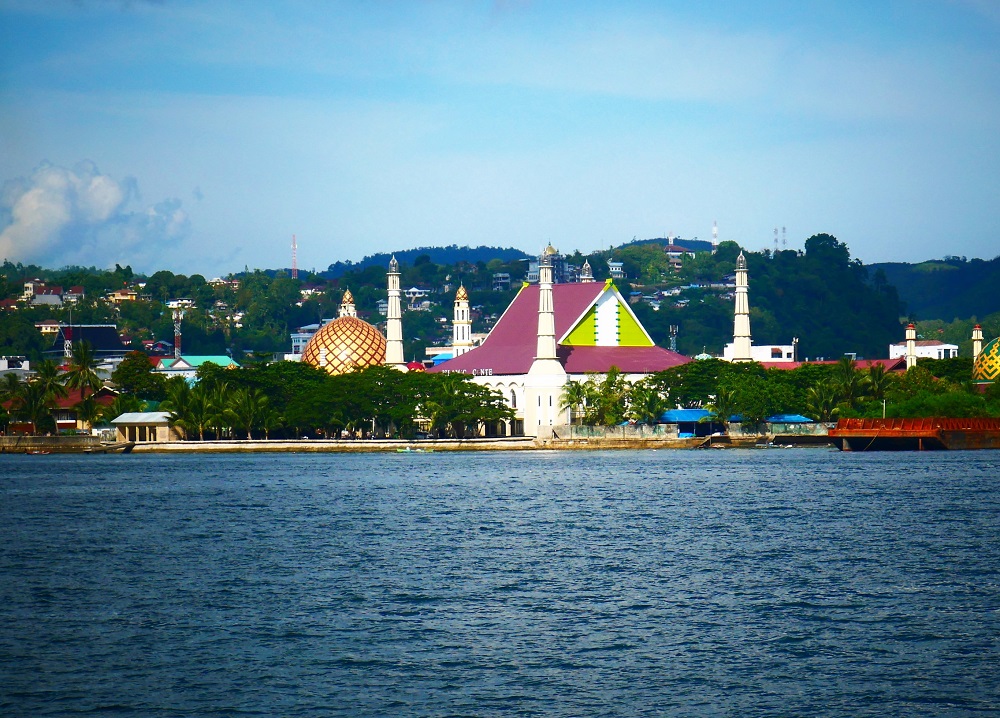
In the afternoon on the second day we finally made it to Ambon, anchoring in deep, rubbish-strewn water in amongst cargo boats and tiny wooden fishing rafts, right in front of the city centre, with a splendid view of two large churches and one gleaming mosque.

A modern church by the waterside in Ambon City.

Ambon is roughly half Muslim and half Christian, and since the secular fighting in the late nineties the two religions have co-existed peacefully. Somewhat passive-aggressively, the churches here have adopted the Muslim way, and from large loudspeakers in the street a female voice broadcasts prayer and a sermon twice a day. Sound travels far, and out on the water the day starts at 5 am with the muezzin melodically singing the usual call to prayer, followed by a long Christian broadcast starting at 7:30, and the cacophony of loud religious transmissions continue throughout the day and into the late night. Insofar as it is a competition, Islam comes out the clear winner – the mosque starts and ends the day, and the singing is way better.

The old mosque in Ambon City Centre.

It is entertaining but loud, and after a full day there we moved around the peninsula and anchored in the middle of the huge Baguala Bay where the call to prayer from the Muslim township of Passo only rings faintly out over the otherwise quiet bay.

Supermoon over Baguala Bay, Ambon.

Our three full days in Ambon went by in a whirlwind of shore visits and endless shopping, bemo rides, eating out and walking, dripping with sweat, through narrow streets and pungent markets in the heat of the day. It is a busy place and with about half a million inhabitants it is by far the biggest city we’ve been to in Indonesia. Large, dirty, noisy, colourful and hectic, but surprisingly easy to navigate with the aid of a little Google Translate and the ever-helpful Indonesians advising us which of the nicely colour-coded bemos cruising the streets, each on their set route, we should take to get to where we need to be.

Street scene from Ambon.
Lukie in the back of a bemo.

We deposited passports at Ofisi Imigrasi and picked them up again three days later. We visited small Chinese-owned shops selling everything from dive fins to lamps, nails, rope and chain and large, air-conditioned hypermarkets where live eels are held in tanks ready for the discerning shopper to pick their dinner. We frequented tiny, roadside restaurants where no English was spoken but the food was exquisite, and a smart upscale restaurant with English menus where the owner divulged the secret ingredients of his popular fish soup. I completed a new round of medical engagements, somehow managing to score an appointment with a dentist capable of doing x-ray (I’d had a sinus ache for a while and wanted to rule out a tooth problem, but had been unable to find anyone suitably qualified in Halmahera or Morotai) as well as a visit to one of the only ophthalmologist in the Moluccas for a quick consultation. We saw churches and mosques and a Hindu temple, and visited the museum where a collection of traditional wedding robes from all the provinces of Indonesia were displayed, as well as three huge whale skeletons and a 5-metre former man-eating stuffed saltwater crocodile from the neighbouring island of Bura.

Throughout our visit we monitored New Zealand and international news, following the post-shooting mood of the world all the while pretending to be Canadians, English or Danish. Only to the immigration officials and the dentist did we reveal our true country of residence, and both expressed their horror at the massacre.

Door detail from Ambon’s Hindu House.
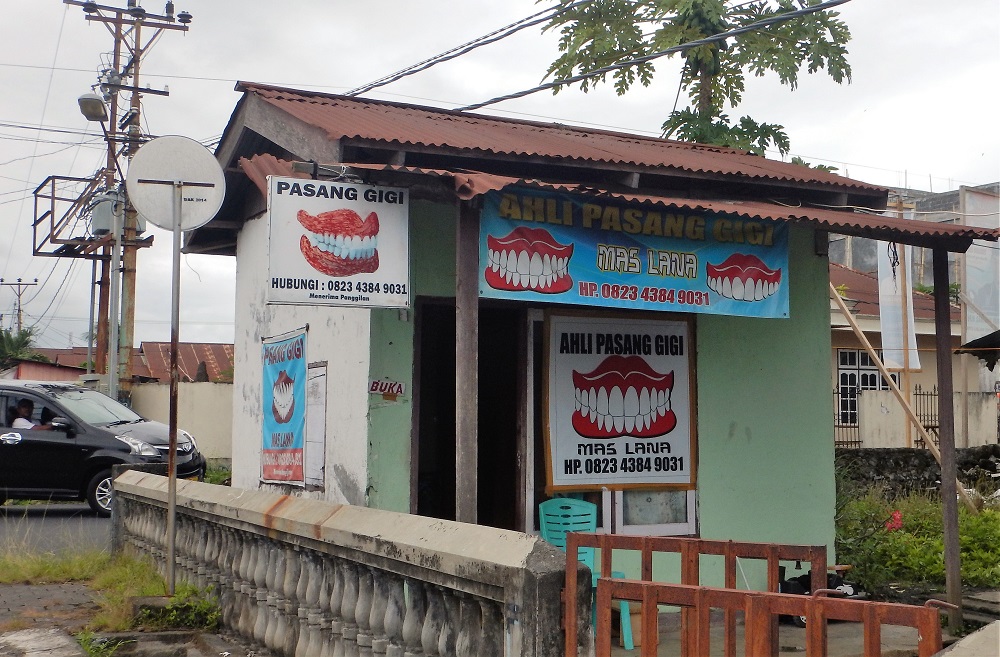
Not reassuring – a dental clinic in Halmahera.

Even when being on anchor there are navigational hazards to avoid, and on our very last morning in Ambon as we were taking the dinghy back to the boat after a last-minute shore run for fresh vegetables, our luck navigating Indonesian waters safely finally ran out. Two local outriggers with fishermen were circling the bay slowly.

“I think they’re setting nets,” said David shading his eyes against the sharp sun.

We slowly drove away from the beach, standing up to see better, gesturing to the fisher in the nearest outrigger, arms wide, asking which way we should go. The nets are fine and have hundreds of tiny white floats that are hard to spot on the glistening water.

“I think he is saying we should go right.” I indicated to David the direction the fisherman had pointed in and narrowed my eyes as I squinted through my sunglasses, trying to see the net on the sunlit reflective surface of the water.

David turned right and we drove along for a while. “He’s pointing out now,” I said. “So we can probably turn.”

David turned the dinghy and increased speed when suddenly I spotted the tiny little floats right in front of us.

“Stop! Pull up the engine, quick!”

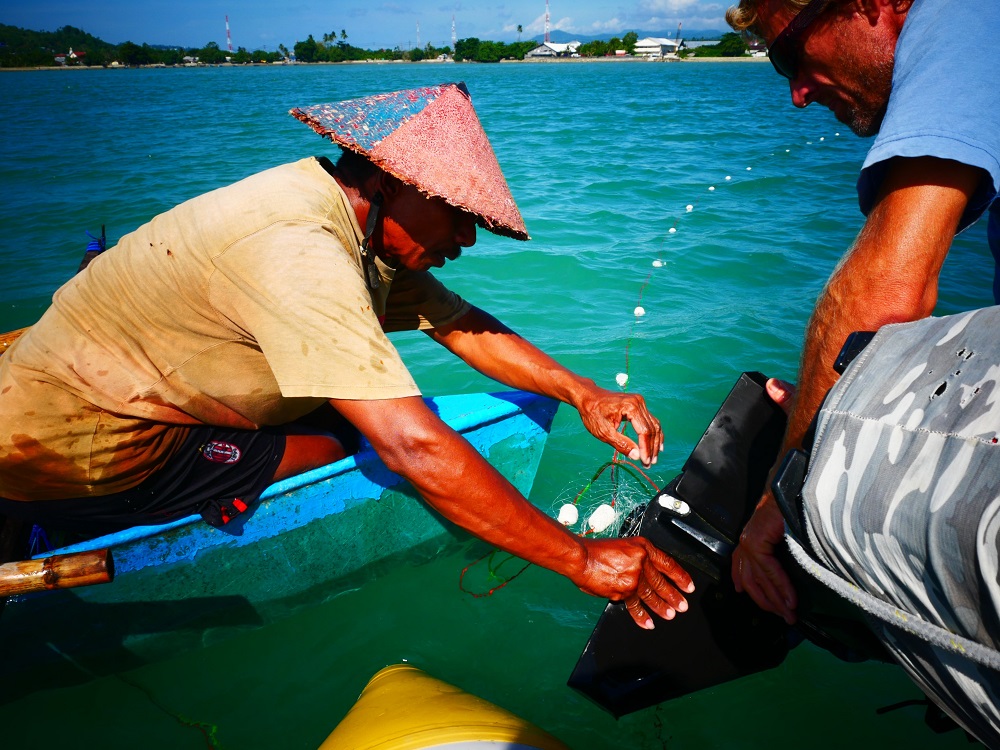
David slammed the outboard into neutral as the propeller hit the net and we stopped, the boat lurching forward as the outboard caught on the net. The fine mesh was wrapped around the propeller but still intact and the two fishing boats quickly paddled over to check the damage and help us unravel the delicate net from the propeller.

Relieved that no damage was done we quickly pulled up anchor to head for our next destination: Banda Island.

Removing net from propeller.
Fishermen in the sunset in Baguala Bay.


Of atrocities and peace – southern Halmahera to Ambon

Weather over serene atoll, Halmahera.

We were in Pulau Joronga, an atoll south of Halmahera, when we heard about the attack. It was early morning on Saturday 16th March. I was sitting in the cockpit looking out over the tiny islet we were anchored next to, a cup of steaming tea in my hand. Birds were singing and a large sea eagle was soaring above the tall vegetation growing on the little island. It was doing loops, away from the island and back again, surveying the shallow sea for fish.

I heard David come upstairs and put the kettle on. The children were chatting quietly in the background while he was rustling the bread bag, lighting the stove to make toast.

Pulau Joronga is a super quiet spot, a large lagoon surrounded by tiny islets. There was a mild breeze, but the air was already hot, the sun shining through the clears and warming the cockpit like an oven. The eagle passed over again, but the wind was ruffling the sea making it hard to see the fish, so it returned once more to the island, wide wings outstretched as it glided darkly against the light sky.

David came outside, hair in disarray, phone in hand.

“Did you hear? There’s been a shooting in New Zealand!”

I tore my eyes away from the eagle and looked up at him. “Oh, that gun scare – near a school? In the Bay of Plenty? That was a couple of weeks ago.”

“No, this is yesterday.” He ran his fingers through his hair. “A shooting in a mosque. 49 people dead.”

I sat up straight. “What?”

He handed me the phone and I read – CNN news, delivered via satellite. Mass shootings in two mosques in Christchurch. Men,women and children shotat. 49 dead. Right-wing, white supremacist, anti-immigration terrorist attack. In New Zealand.

It is incomprehensible. In New Zealand? But there are so few Muslims in New Zealand. It is not an issue there. I’m used to conversations about ‘the Muslim problem’ with European relatives, conversations echoing sentiments of unfamiliarity, crowdedness, foreignness, and most of all fear. I’m used to the blanket hostility against Islam of some Americans. But New Zealand? I can honestly say I’ve never heard anyone voice that Muslim immigrants pose a problem there. I’ve heard Kiwis worry about Chinese buying up land and ‘taking over’ New Zealand, and of course, we have our conflicts between Maori and Pakeha. But I’ve never heard anybody voice fear, or anger, about Muslims in New Zealand.

I sat stunned, tears in my eyes, my head in my hands. Incomprehensible.

Kids on the jetty in Pulau-Pulau Widi.

Pulau Joronga, where we were, is just south of Halmahera. Since leaving Morotai, we’ve been working our way slowly south, needing as we do to be in Ambon for the next monthly visa renewal. Ambon is in Central Maluku and so we’ve been sailing south, down the coast of Halmahera, past little townships discerned through the heat haze only via the reflection of the green, shiny mosque domes perched just uphill from the glistening water.

Mosque in Buli.

It is a peaceful part of the world and we’ve been sailing slow, sightseeing, having conversations and playing music, meeting the locals in this part of the world. And they’ve all been so nice – like all Indonesians, everyone we’ve met has been exceedingly helpful and friendly.

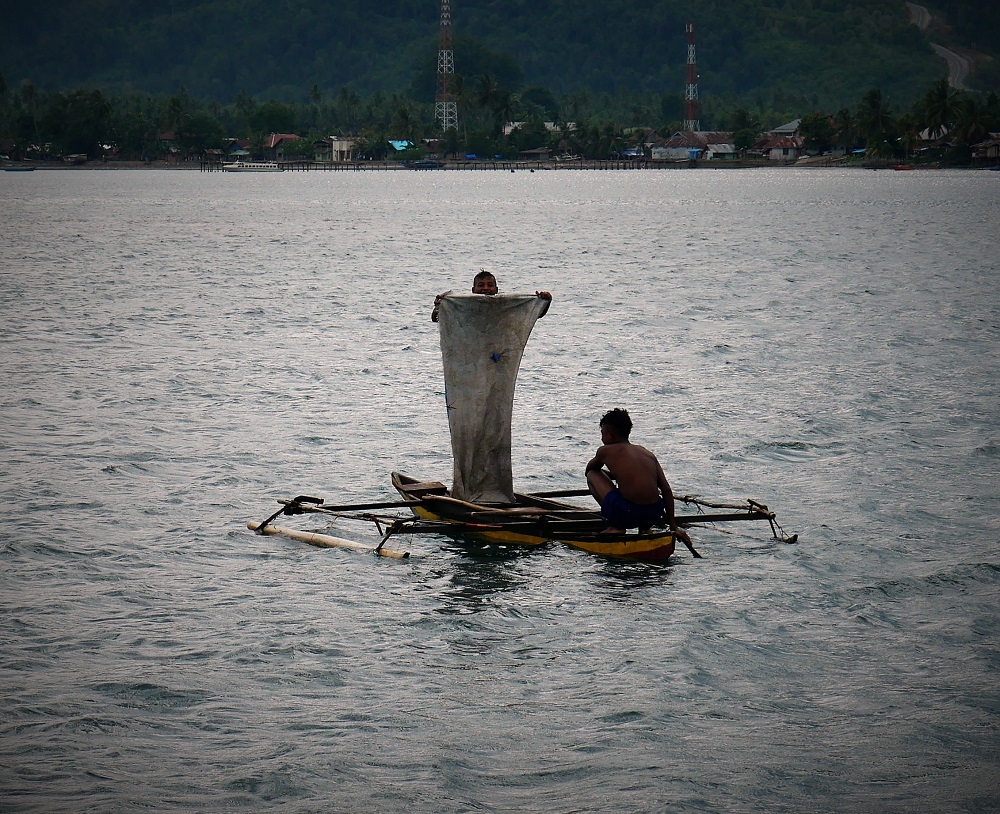
Home-made sail – kids in Buli.
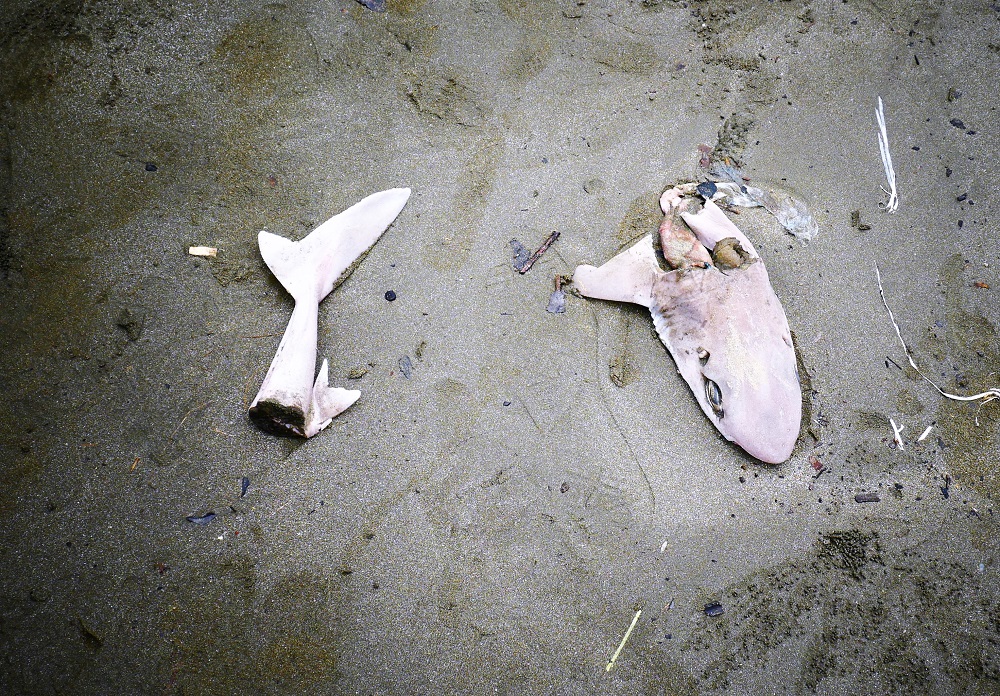
Disembowelled shark carcass on the black sand beach of Buli town, Halmahera.

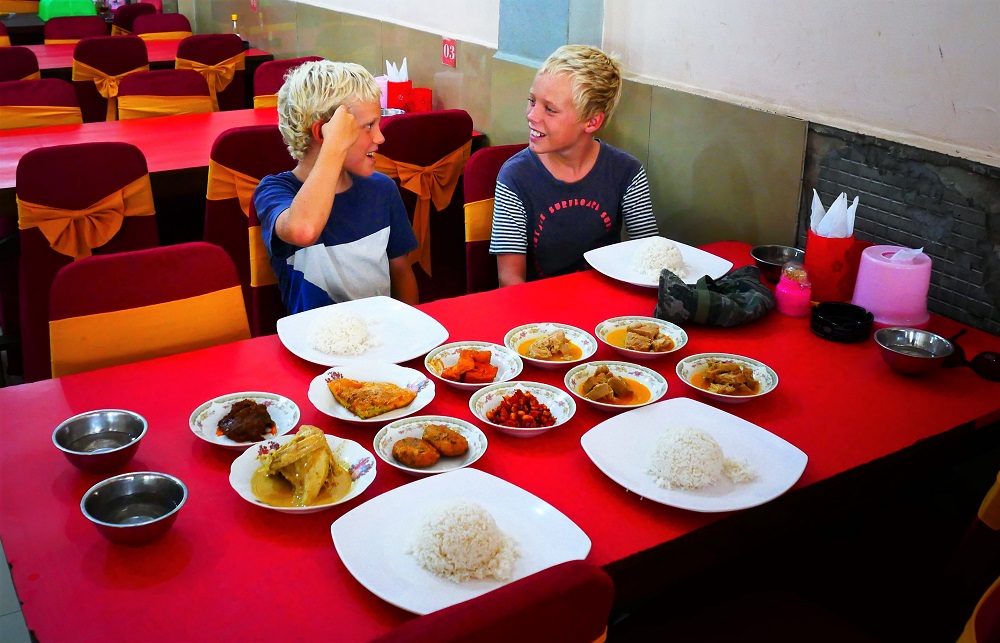
We visited Buli town, a small mining town based at the foot of scarred hills whose narrow waterside streets were drenched in the stench of drying fish. Here we bought vegetables, took selfies with local shop-owners, and went out for an immensely delicious lunch at a Padang-style restaurant, where customers choose from the many delicious dishes advertised on the shelves in the restaurant window. By pointing at different dishes, we managed to order exquisitely delicious sticky-fried sweet and sour tofu, curried jackfruit, tempeh fried with peanuts, chilli and tomatoes, beef rendang curry, vegetable-filled omelettes and potato cakes, all of which we ate quietly under the supervision of the eager restaurant matron.

A waitress serving the food from the window display.
Ready for a feast.

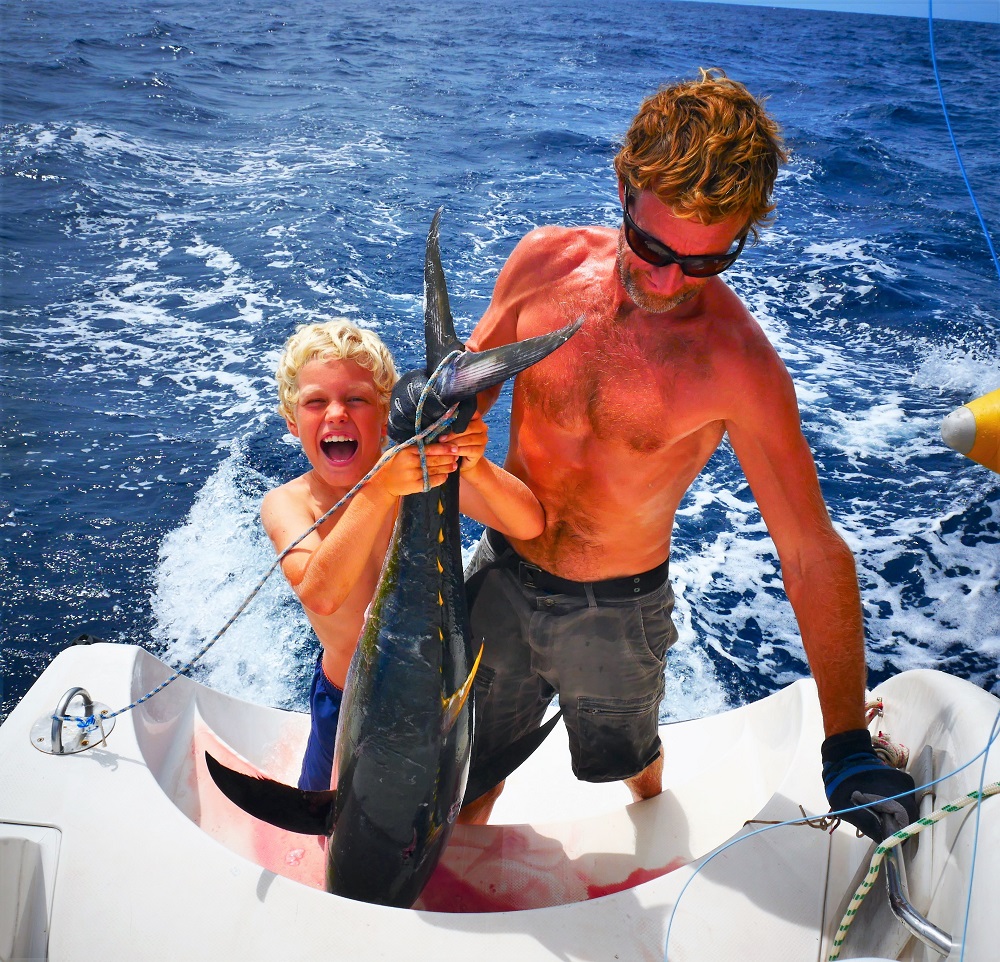
Halmahera is tuna country, and several commercial operations are based there. On the way south from Morotai we caught a huge yellowfin tuna, which at about 30 kg was only just lighter than 8-year-old Lukie. After we’d filleted half the fish our freezer was full to brim of sushi-grade tuna and we shared the rest with the fishermen we met at our first stop at some small islets off central Halmahera. When David offered them half the fish, they first refused it, saying that they had no ice or refrigeration to keep it, but once he’d filleted it we managed to distribute half-kilo chunks of tuna to the surrounding fishers no problem.

Monster fish, larger than Lukie.
Fishing boats off Buli town.

Nobody there seemed to know where New Zealand is – when we said where we’re from they just smiled uncertainly and nodded, no glimpse of recognition in their eyes. People know Australia, the UK, the Netherlands, the US. But not New Zealand.

Females of Islam – different levels of hijab in Buli town, Halmahera .

A couple of days before arriving at Pulau Joronga we were in Pulau-Pulau Widi, a huge atoll about 12 nautical miles east of southern Halmahera. Here, we met Carlos, a young builder from Java who has been contracted to build a high-end resort on the little islands lining the lagoon. The first person we’ve met who spoke English since Anna in Morotai, he came by in a longboat full of men on our first morning there.

“Hello,” he shouted.

“Hello,” we yelled back. “Selamat pagi.”

“Where are you from?” he asked, one hand holding onto our deck as he balanced upright in the wobbly longboat, the other hand shading his eyes from the sun as he squinted up at us, standing above him on the deck.

“New Zealand.”

“Ahh. Europe.” He nodded sagely.

“No – more like Australia. Near Australia.”

“Ahh. Australia. Australia. Welcome to Paradise.” He smiled and widened his hands, indicating the still lagoon, the quiet, mangrove lined islets, the turquoise sandbar behind the seagrass-filled shallow bay.

“Thank you. It is very beautiful here.”

“You come and see my buildings? Maybe one day you come and stay here, not uncomfortable like on a boat, nice houses, very comfortable.”

We were chagrined at having to describe ourselves as Australians, but now, a few days later, after this attack, we’d give a lot to go back to anonymity. Presumably, New Zealand’s status as largely terra incognita in Indonesia has changed now that we’re associated with a terror attack on Muslims, associations that will likely take many years to fade in this country already torn by secular conflict.

When we visited the building site, Carlos explained the plans. The project is run by an English lady called Natalie, who has visions of turning Pulau-Pulau Widi into a Maldive-like resort, with little cottages dotted on all the islands.

“We will build a hundred houses,” explained Carlos, extending his cigarette pack towards us and raising his eyebrows when we declined. He makes the houses in Ganelua, the nearest village on the Halmahera mainland, and then ships them to Pulau-Pulau Widi for assembly there. He is employing twelve men from the village and has so far constructed one house which they were assembling when we visited. Carlos has done business elsewhere in the world, has shipped houses to Darwin, Australia, the Philippines, and the Netherlands, and he wants to do business with us.

“You must be rich,” he said, grinning. “To be able to sail in a big boat like that.”

We smiled and said that we had been working hard and that we have to go back to work when we return to New Zealand. And that we are very happy to be able to see beautiful Indonesia.

“Well, happy is good, but happiness, it costs money.” He laughed loudly and wiped his hands on his t-shirt before offering us cigarettes again, shrugging his shoulders when we declined once more and lighting one for himself.

“I can build houses for New Zealand. You buy from me, you sell in New Zealand. I ship the house. Good, strong Indonesian hardwood. You have hardwood in New Zealand?”

“Yes, but it was all felled. It takes hundreds of years to grow. They used it all. So nowadays houses are made from pine, grown in plantations.”

“I can ship you hardwood houses.” He slapped David on the back. “I ship to you, you sell on, you take 50%! We do business together, you a businessman, yes?”

They were beautiful houses, but we’re not sure we want to be part of the demise of the Indonesian hardwood forests. On this atoll, all trees are protected.

“We can’t get wood from this island,” sighed Carlos. “We’re not allowed to cut trees. There are many good trees, good wood, here. But we can’t use.”

David and Carlos shaking hands on no deal, with two of Carlos’s crew looking on.

Apart from Carlos and his crew, there were about 30 fishers in the lagoon, living in stilt houses perched over the turquoise shallows. From the village Ganelua on the Halmahera mainland, they come to Pulau-Pulau Widi for months on end to fish, salting and drying their catch to bring back to the village to sell. The entire atoll is a forest reserve and no forest clearing or agriculture is allowed on any of the small islets surrounding the calm lagoon, so they bring vegetables along and get new supplies from the village when they run out. A policeman comes a couple of times a month to stay in a little stilt house and check that nobody is felling any trees.

The policeman’s stilt house.

We met Amat and Labeebah, a young fishing couple who live here in their stilt house for two months, then go back to the village for one month, then back here for two months, and so on. With them, we spoke in stilted Bahasa using a lot of gestures and when they asked if it is just the four of us (empat orang – four people) sailing around and we nodded they laughed and laughed, repeating it over and over, chuckling with mirth. Empat orang sailing around and around! How crazy! They served us tea and fried cassava in their immaculately clean house where we sat chatting, our faces zebraed by the stripes of the light blue water shining through the gaps between the dark hardwood floorboards. They have elegant hoisting systems for their two larger traditional outriggers, a small generator for electricity at night, and lots of small fish (bream and snapper) drying out the back – ikan garam (salt fish) as they explained. They offered to give us cassava and salt fish to go, and we declined politely even though Matias looked longingly at the cassava, and when we returned to the boat Lukie and I baked some chocolate brownies for them in an attempt to offer something back to these people who have so little and yet are willing to part with it to total strangers at the drop of a hat.

Amat and Labeebah’s stilt house.
Posing for photo amidst salt fish with Amat and Labeebah at the back of their small stilt house.

When interacting with locals here, our fish books are always a hit. Most people we meet are fishers and we have hour-long discussions about which fish we and they catch, what we see in their seas. In Pulau Widi, two middle-aged fishers came to our boat for a cup of tea, poring over fish books and our Indonesian Cruising Guide and excitedly discussing the sizes of the different fish they catch here as well as the ones they’re not allowed to catch. They can’t catch turtles, sharks, manta rays. Blast fishing is prohibited because it is bad for the reef, although we’ve seen evidence of it everywhere around Halmahera and Morotai, large patches of smashed up coral next to areas of thriving, live coral bursting with life. They laughed at the sounds of our children playing and asked whether we really only have two kids? When we answered yes, they laughed again, slapping David on the back as they held up their fingers to show how many they have – six and five, respectively. All grown up, back in Ganelua Village.

Are they Muslims, we asked? Yes, there is no mosque here, but there is one back in the village – everybody in Ganelua is Muslim.

Visitors on Bob the Cat.
Visiting fishermen poring over fish and guide books.
Stilt house of Pulau-Pulau Widi.

Pulau Widi was perhaps the serenest place we’ve ever been, and along with Morotai certainly the cleanest (no plastic pollution) location we’ve been in Indonesia – a glassy lagoon bordered by tiny, narrow islands, thousands of small white beaches backed by lush green jungle resonating with birdcalls. Mangroves line stretches of the little islands and herons took off and millions of fish jumped as we glided past silently on paddleboards. We hope that the tourists visiting the upcoming resort won’t disturb the peace and traditional way of life of the fishers in their stilt houses, but rather that they will benefit this community, create other means of income – at least for a while. I’m reading about climate change and am surprised to see anyone willingly want to copy the famously soon-to-be-under-water Maldives. Here, a major resort is planned for sites less than one metre above sea level; nowhere in Pualu-Pulau Widi is more than a couple of metres above sea level and the reality is that these atolls will all be gone in 50 years’ time. But I guess maybe there is some profit to be had in the meantime.

Pulau Joronga.

A couple of days later in Pulau Joronga, we were sitting stunned and numb, no longer noticing the eagle flying overhead, trying to process that a terrorist attack against Muslims has taken place in our country. We could only access snippets of news via satellite and learned that New Zealand is reacting by tightening gun laws and renouncing the Australian who carried out the attack. We feel awful for the families of the victims, for all the Muslims in New Zealand and for all Kiwis in general, who have had our peaceful country violated by the zealous hatred of a disturbed individual.

After the news had sunk in, we considered what it meant for us, travelling as we are in a Muslim country. We spent a day on the boat and on the beach, swimming and snorkelling, chatting to passing fishermen who brought us fresh drinking coconuts unprompted and without asking for payment. The people living there hadn’t heard the news – there was no internet there – and we tried to find out as much as we could about the Christchurch mosque attacks via satellite news before we got ready for the two-day passage to Ambon. The capital of the Moluccas, Ambon was the origin of the anti-Christian violence erupting in the Moluccas in 1990 and we’re nervous about how people feel there about this recent anti-Muslim attack. The anti-Christian sentiments in the more remote parts of Indonesia are fuelled by historic differences between neighbouring communities. But in larger cities like Ambon, there is always a risk of Muslim radicals, anti-westerners like those that engineered the Bali bombings back in 2002.

It is bad timing to go to a large Indonesian city less than a week after people have committed atrocities against Muslims in your country. Apprehensive about retributive violence we removed our New Zealand flag and covered up the large ‘New Zealand’ port of origin painted on our stern.

Port of origin erased.

I looked at David. “Where should we say we’re from, if people ask?”

“Denmark?” he suggested.

“No. They did the Muhammad cartoons, they’re known in the Muslim world.”

“Well, it sounds like the attacker was Australian, so we can’t say Australia. And the US is out, obviously. UK is probably safe, but then there’s the history of colonialism. We could just say ‘Europe’?”

“Or how about Canada? They haven’t done anything to Muslims, have they?” David is Canadian by birth, so it wouldn’t be a total lie. “Or I could say that I was born in Iran.” After all the interrogation I’ve faced in western airports around the world whilst travelling with my Danish passport listing Iran as my birthplace it would be nice to finally be able to state that I was born in Iran and receive a positive response.

“Well, I’m not sure what the status of conflict is between Sunni and Shia Muslims. So maybe not.”

He’s right, we don’t know enough about it. So we resolved to say we’re from Canada if people ask and set off towards Ambon hoping that there were no Indonesians amongst the victims and that there are no crazy radicals residing in Ambon. As a minimum, we must spend three days there (that’s how long the visa takes to process), and with nothing indicating we’re from New Zealand we hope to slip below the radar of any discerning fundamentalists patrolling the harbour or walking the streets.

New Zealand will never be the same after March 15th 2019, and neither will we. Travelling the world as we do, we never take for granted the kindness of strangers, all the people of different countries, religions, and political persuasion that we meet who go out of their way to make our acquaintance. Such tolerance and kindness make the world a better place, and I am ashamed that Muslims in New Zealand were not safe from the vile hatred of the minority.

We can only echo the many when we say: Kia Kaha to all Muslims in New Zealand, to Christchurch, and to all New Zealanders who find their world forever changed by this senseless act. From here in Indonesia we too unite with you in grief.

Morotai – then and now

Tiny Anna giving me a lift on her bike.

“You are very lucky you have two boys,” says Anna, beaming at our family from her seat at the table end. She sighs. “I hope God gives me children.”

I gaze over at the boys who are sitting making horrible faces at each other in the dockside eatery as they wait for their lunch to arrive. They are whispering quiet threats to one another and glancing over at me to see if I’m noticing, and generally getting as close to a fight as they can get away with when out and about. It’s noon and tempers are running high. Pre-lunch sugar low has always been a challenge in our family, and today is no different.

“Yes.” I grimace back at her. “Children are a blessing.”

“My husband says if I don’t get he will take a different wife.” She looks downcast, the headscarf that covers her hair only partly obscuring her furrowed brow as she tosses her head backwards. “But he doesn’t mean it. We love each other!”

I lean forward. “How long have you been married?”

“Four years. I meet my husband when I come here from Ternate in Halmahera, my hometown. We been married for four years but still no children.”

I nod uncertainly. “If you can’t have children, it may be… I mean, it could be either of you. It may not be a problem with you. Maybe it is him who can’t have children?”

She looks confused, shaking her head uncomprehendingly.

“How old are you?” I ask, changing tactics.

“28.” She smiles. “I hope children are coming soon.”

I pat her hand. “There is still time. You are young still.”

The conversation is interrupted as the lady from the food stall brings out steaming bowls of mie goreng, the children’s favourite Indonesian dish. They pull one more face at each other and then put aside their arguments to attack the food ferociously, the whispering stopping as their mouths get busy gaping over huge forkfuls of spicy noodles.

Stilt houses over the glassy sea in Daruba, Morotai.

We’re in Daruba, the capital of the Island of Morotai. For the last week, we’ve been exploring the dry, deserted, and bizarrely clean islands dotted off the south-western end of Morotai, relishing in the complete tranquillity offered by the isolation of these far northern isles. The only humans we’ve met have been elderly fishermen, who nodded and smiled as they surveyed us, their opaque eyes reflecting the shining white of the sea, answering bagus, bagus (good, good) when we gestured whether it is OK to visit the beach they’re fishing from.

Fishers on a glistening sea.

It’s a different feel here from elsewhere we’ve been in Indonesia. There are no tourists, no dive boats zooming around, no homestays or hotels. The locals in their colourful longboats see us and wave but don’t generally initiate conversation, busy as they are heads down fishing, fingers deftly handling lines or nets, cigarettes dangling from their lips. The hazy outline of the volcanoes of northern Halmahera grace the horizon, clouds circling their peaks in the daytime, the sun being speared by their jagged contours each night.

Dodola Island.
Dodola Island panoramic.
Bizarre underwater letters spelling Morotai off Dodola Island. Located at 6 metres of depth, the letters each stand 2 m tall. Presumably, the intention is that they will get covered in coral and form a lovely, underwater sign for tourist divers.

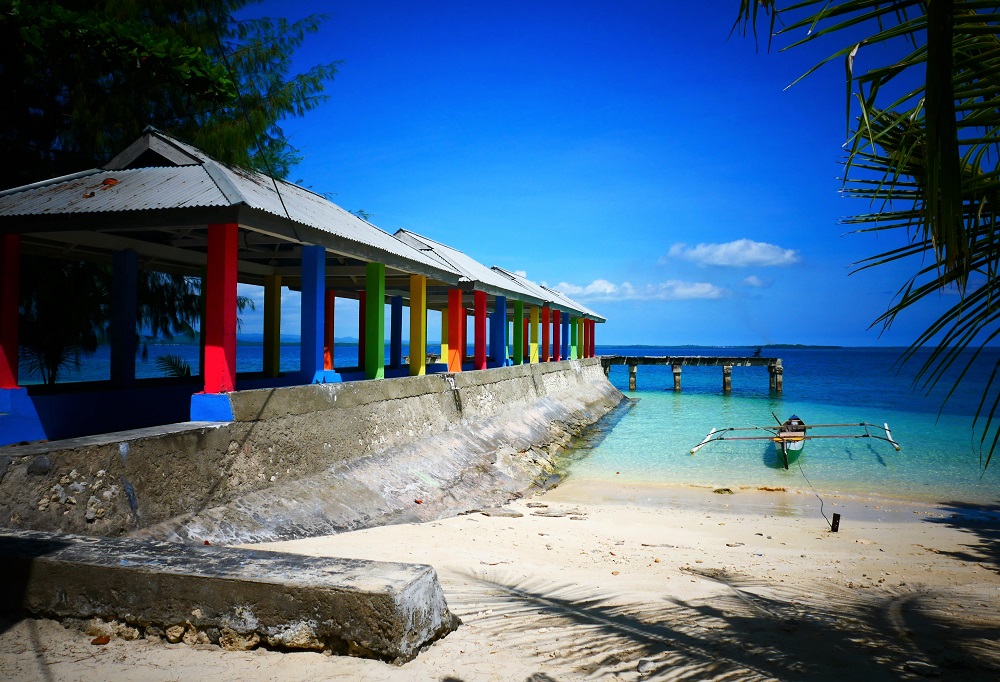
Last Friday we got to Dodola Island, two small islets joined by a long sandspit not far from Daruba. In contrast to the uninhabited islands surrounding it, Dodola featured low buildings in the bushy interior and a garishly colourful inflatable waterpark anchored just off the pristine beach. Curious, we went ashore to the empty beach, where we found a staff of twelve men sitting around, seemingly waiting for customers. We established that the kids could play on the waterpark for a minor fee and went for a walk to have a look around at the carefully painted pillars of the dock, the neatly raked beach, the empty houses and the half-finished building projects, the waterpark-induced squeals of the kids the only sound on the empty island apart from the regular pinging of the cellphones of the men sitting around.

Our kids on the empty floating waterpark anchored off Dodola Island.
Colourful jetty.

It was here that we met Anna – on the following day, a Saturday, when suddenly the island came to life as a continuous stream of boatloads of visitors from Daruba were offloaded on the beach. Families were sitting under the shady trees, music was playing from small loudspeakers, and a steady stream of lovestruck young couples were walking hand in hand along the sandspit separating the two islands, cellphones in hand as they selfied their love march. Curious to meet some locals on their weekend getaway, we’d gone ashore for a walk and hadn’t taken many steps before a tiny woman wearing wide pants, a sweatshirt and a black headscarf came up to us.

“Hello,” she said, smiling broadly. “I am Anna, guide of Morotai. I have been helping yachts with services before. If you need anything in Daruba, you can call me.”

She was here guiding an American man but would be free to help us with anything after a couple of days.

“There are sometimes problems between Muslims and Christians on Morotai,” she explained, perfect teeth gleaming in the sharp sunlight. “But I say to people, ‘No matter what you believe, you leave my guests alone.’” She wagged her finger chasteningly at us, and we smiled uneasily. “They say, ‘Sorry Anna, no problem if they are with you.’ So, you have no problem here when you with me. Come see me… – tomorrow Sunday, then Monday, come see me Saturday.”

“I think she means Tuesday,” I whispered to David. “That could work – we could go to Daruba Tuesday, see some war relics.”

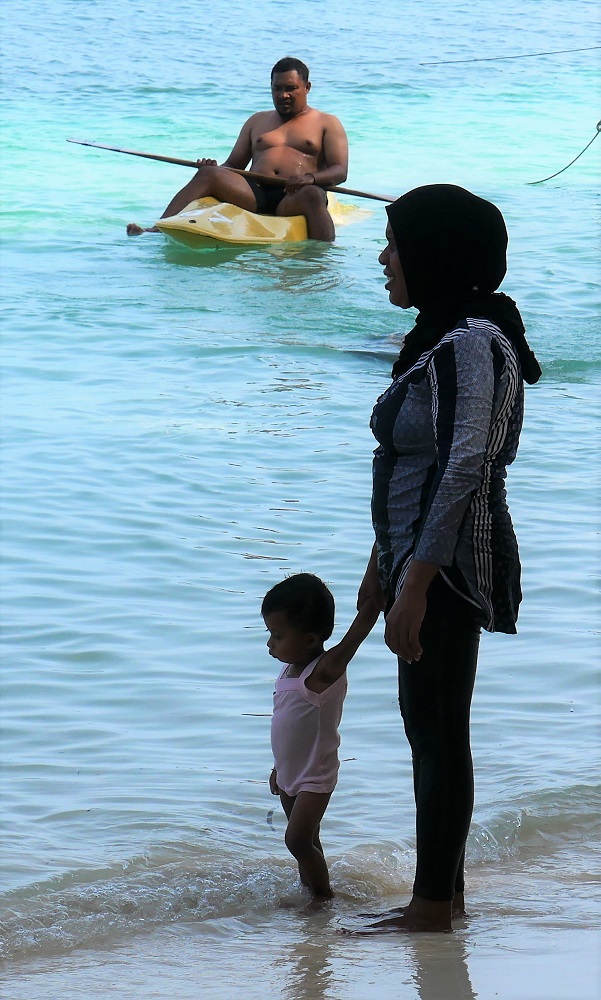
Full body suit – a local woman swimming with her son at Dodola Island.
Indonesia: different dress codes for men and women…

Which is why we’re sitting at the dockside food stall. With the diminutive Anna to protect us against potential outbreaks of sectarian violence, we are ready to explore Morotai’s history.

Just north of the island of Halmahera, Morotai is one of Indonesia’s northernmost islands, only a stone’s throw from the southern end of the Philippines. This proximity has shaped the large (~1800 km2), densely forested island’s history profoundly. Like Halmahera further south, the Japanese occupied Morotai during World War II. Eyeing up the flat lowlands of southern Morotai, the Allies mustered a huge attack on the Island in the Battle of Morotai which commenced on 15 September 1944. Deciding that the island was suitable for the building of airfields from which attacks could be launched at the Japanese-occupied Philippines, the Allies badly wanted the island, and, realising this, the Japanese threw everything they had at defending it. After a ferocious battle, the Allies conquered southern Morotai which, because of its strategic location, went on to become an important command centre for the remainder of the war.

The seas around Morotai are littered with wartime plane- and shipwrecks, and tanks and aircrafts used to be scattered in the jungle too, until some enterprising people from Jakarta came to disassemble them and move them to the capital for selling.

War relics: one of the few World War II tanks left on Morotai.

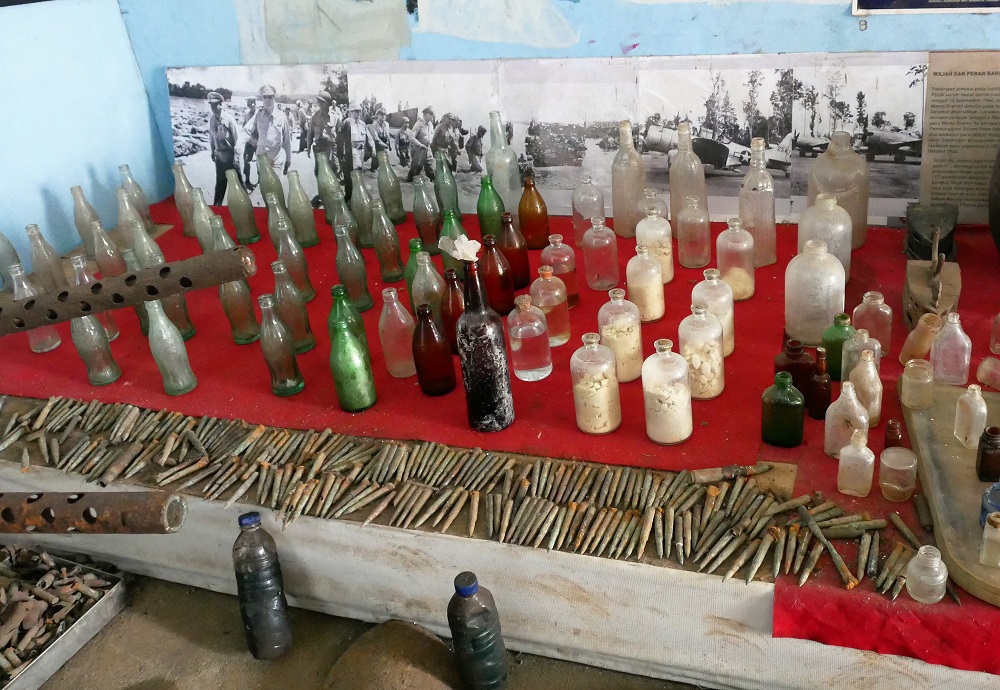
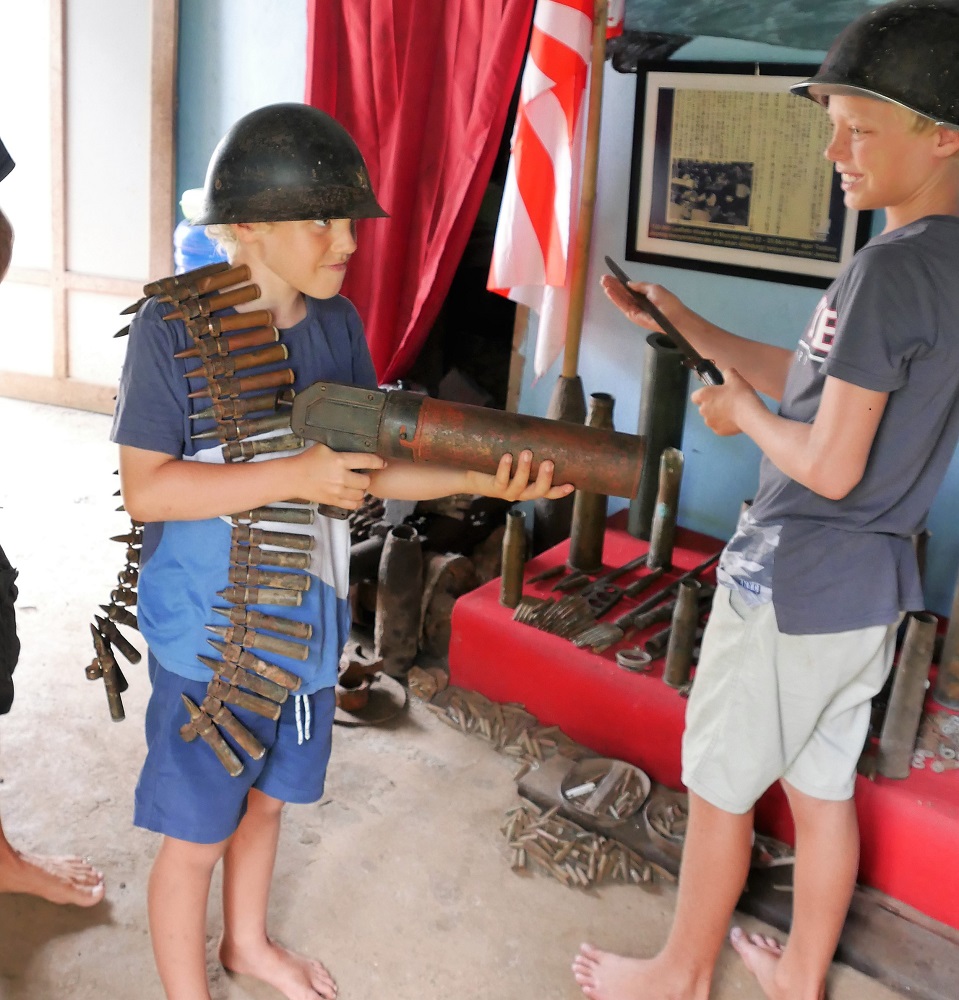
A local man has spent his life collecting smaller-sized relics and set up a museum in his home in the bush not far from the capital. Here are helmets and guns, ammunition belts and binoculars, hand-wound sirens and dog tags, as well as thousands of empty shells and a couple of grenades. He’s decorated the walls with articles and historic photos as well as his home-rendered paintings of war scenes. A bicycle left behind by the Japanese leans rustily against the wall and a collection of bottles display a snapshot of American life at war – aftershave, coca-cola, wine, beer and morphine, all neatly lined up according to content. We lean in to inspect the faces in the black and white photos on the walls – young men in uniform staring sombrely into the camera, young men with war-time haircuts riding tanks, standing next to airplanes, leaning against trucks, shirts off, grinning and laughing, and young men lying down, faces twisted in agony as nuns bend over their wounds.

Wartime bottles flanked by shells – from right to left: morphine, morphine in solution, wine, beer and coca cola.

Unlike most museums the children can touch everything here – eyeing up distant cows with Japanese binoculars, holding rusty guns to each other’s faces, fingering war-time coins from Holland, the US and Japan. They each have a turn at winding up the siren and wearing the helmets, Matias from the Allied forces, Lukas Japanese.

Lots of symbolism: also at the museum were Russian dolls of recent American presidents.

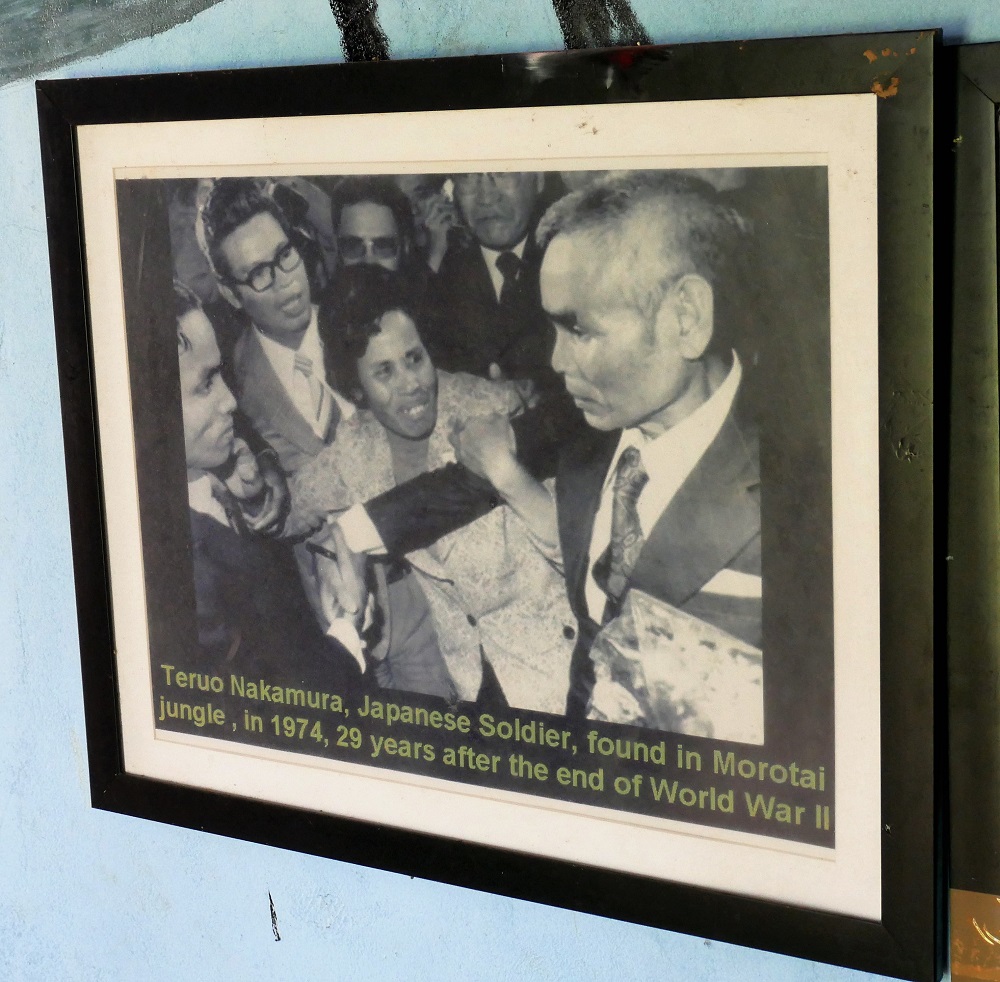
The Japanese didn’t give up easily and even after southern Morotai was taken by the Allied forces, large airfields constructed and raids sent off to liberate the Philippines, Japan continued to hold onto the northern part of the island, scattered troops hiding in the dense hilly jungle until the Japanese Empire surrendered in August 1945. One soldier in particular did not give up. In December 1974, Private Teruo Nakamura surrendered from the jungle of Morotai where he had been hiding since the war, either unaware that the war was over or believing rumours of it to be Allied propaganda. Japanese holdouts, as the stray Japanese soldiers that continued fighting long after the end of the war are known, were not uncommon in the Pacific, but Private Nakamura holds the record with his 29 years of hiding. A Taiwanese from the Austronesian ethnic aboriginal Amis tribe, the poor man didn’t speak Japanese, Indonesian, Dutch or English, and not long after being repatriated to Taiwan he died of lung cancer. One can only imagine what he must have been thinking for all those years in the jungle, a Taiwanese tribesman stuck in the war on an island far away from home, fighting for a country he didn’t belong to, whose language he didn’t even speak.

A photo of Private Nakamura when he was found in 1974.

Nowadays, there are no Japanese left in Morotai, and the only fighting that goes on is that between Muslims and Christians. Sectarian conflict goes back far in this corner of the world. Originally under the influence of the Muslim sultanate on Halmahera, many inhabitants of Morotai became Catholic when a Portuguese Jesuit mission settled on the island in the 1500s. Resenting this influence, the sultanate repeatedly forced most of the Christians off the island in the 1600s, resettling them near the Halmahera capital of Ternate where they could be more easily controlled. When the religious conflicts peaked in the Moluccas in 1999 and Muslims were driven from the town of Tobelo on Halmahera, many of them settled in Morotai, and the island is currently about 75% Muslim.

At the lunch table, Anna is telling us about the latest conflict.

“It was last week, I had some guests, and they were in a car, and there was protests in the street and fighting. And my guests, they were so afraid.” Her eyes widen. “So, I got out of the car and told the men fighting to leave my guests alone!” She taps her phone and starts playing videos of street fighting, leaning across to show us images of white-clad men shouting, fists pumping, street mayhem at the capital’s government house.

When asked what sparked the fighting, she explains that some politicians from Jakarta had come with packages for the school children, which they’d distributed as part of an election rally. In the parcels were, amongst other things, some biscuits. Within the wrapping of the biscuits was a small picture – of Jesus on the cross.

“That is not OK to give to Muslim children,” she says, shaking her head. “Oh my God! A picture of Jesus, and a cross! They got very, very angry that their children were given that. So they protested at Government House and attacked Christians and the Christians they run, run! Into the bush, hiding in the jungle, waiting for violence to be over.” She leans further forward, pressing ‘play’ again and the fighting erupts once more on the tiny screen.

Daruba school children walking home for lunch.

“Wow,” we say, leaning back in our chairs, nervously eyeing up the families sitting nearby who deviously look absolutely harmless, veiled women laughing in the sunshine, relaxed men playing chess, eating and drinking tea, the only sign of violence the squabbling between tiny children running around with slingshots.

“But no problem now, not a problem. This is last week, now is OK.” Anna smiles reassuringly.

Shipwrecks on the beach off Daruba, Morotai.
The boys squeezing into a bento with the shopping.

And, indeed, we only meet kindness in Morotai; laughing kids running by shouting ‘Hello Mister, hello Mister,’ friendly people wanting to practice their English, stopping whatever they’re doing to help us tie up the dinghy in a good spot, find the fresh market, catch the attention of a bento driver to give us a lift. People who recognise our children from the floating bouncy castle in Dodola Island shout “Lukie, Lukie,” and high five them on the dock, and, bellies full, our kids smile and laugh, friends again, chasing after each other in the peaceful dockside park.

When lunch is over we say goodbye to beautiful Anna of Morotai who, with her self-taught near-perfect English and great network of contacts has helped us understand a little more of this corner of the world. May she have many, many children and may these children never find pictures of Jesus in their biscuit packets.

Anna and the boys.

Halmahera: town time in Tobelo


Tobelo, the protestant church dominating the scenery against the backdrop of a volcano.

After almost two months in Raja Ampat the time came for us to leave in search of new adventures and different scenery. Indonesia is huge and we could easily spend years here without seeing it all. We plan to be in Singapore by August, and if we want to experience even a fraction of this amazingly varied country, we’ve got to keep moving westward.

With this in mind, once our vegetables had run out completely and the time for visa-renewal was looming, we left Sayang in north-western Raja Ampat and spent a pleasant 24 hours heading west to reach Halmahera, an island in the north Moluccas.

Also known as the Spice Islands, the Moluccas reach from Banda Island in the south to Morotai Island in the north, more than 1000 islands spread over 850,000 km2 (of which more than 90% is ocean), spanning 420 or so nautical miles from north to south. The site of ancient local kingdoms, the Moluccas have been important for spice trade a thousand years, particularly for nutmeg and cloves which originated only on these islands. In the late 16th century after some fighting between the British, Portuguese, Spanish and Dutch, the Moluccas were colonised by the Dutch East India Company who remained in control of the area, and the astonishing profitable spice trade, until 1942.

Halmahera: volcanic backdrop makes for beautiful scenery..

Halmahera, the largest island in the Moluccas, is a K-shaped island sporting no less than nine volcanoes, of which five are still active. Our first stop here is Tobelo, a harbour town on the north-eastern shore of Halmahera of large enough size for us to reach an immigration department office to do our monthly visa renewal. A bustling town set against the backdrop of a distant volcano, Tobelo has several supermarkets and a couple of fresh markets, and we spend a day putting our visa in for renewal, restocking with food supplies and refuelling.

One of Tobelo’s mosques shining prettily in the morning sun.

Tobelo is predominantly Christian, but a sizeable Muslim minority lives here and the town contains several mosques. In 1999, Tobelo erupted into religious violence as the Maluku Sectarian Conflict which started in Ambon further south swept north, seeing hundreds of people killed and ultimately leading to the displacement of most of the town’s Muslims. A fragile peace has since been established and many Muslims returned to the area, but Muslims and Christians still live segregated lives in Tobelo, and military outposts remain in some areas of Halmahera to prevent outbreaks of fresh violence.

Tobelo streetlife: Muslim schoolgirls riding home from school.

Although it may be the minority faith, of the two religions Islam is definitely the loudest. When anchored in front of the town we are awoken by deafening melodic singing from the mosques at 5 am, so loud that it feels like a loudspeaker is installed in our cockpit. At sunset, three different mosques each broadcast their own muezzin calling to prayer, resulting in a cacophony of competing Arabic melancholic song reverberating across the otherwise quiet bay, and we can only imagine how loud it must be in town. The singing abruptly stops at 7 pm, after which the loudspeakers start broadcasting sentimental western pop music from the 1980s, including Celine Dion’s “I want you to need me” and Meatloaf’s “I would do anything for love”, and we imagine the sudden shift a result of a fist-fight culminating in some Christians, fed up with the Arabic prayer call, taking control of the microphones.

A Muslim woman with her child on a scooter.
Catering for all – Muslim dress next to low-slung jeans at Tobelo’s Pasar Modern.

We don’t see any sign of violence and the population is incredibly friendly, calls of “Hey Mister!” following us wherever we go. As usual, the kids are a great hit with the local women, who frequently come up to exclaim at their blond hair and blue eyes, and Matias uses his charm to expertly navigate the local market, searching out the best fruit and vegetables. He’s learnt the numbers in Bahasa and is in charge of negotiation and payment when we buy fresh.

Lukie the ladies’ man.
Matias buying the local duku fruit.

Transport in town is by bento, the local rickshaw taxis, which involve the passengers sitting up front where the risk of injury should a crash occur is highest. The drivers weave deftly in and out of traffic, expertly scaling steep driveways and potholed roads as they bring us and our heavy shopping safely back to the harbour. The petrol station is out of town, and when, armed with eight 20-litre jerry cans we attempt to hire a bemo, one of the shared car taxies, a bento driver talks us into refuelling by bento instead, a move that sees him transporting 120 litres of diesel on the front of his little bike whilst a second bento follows carrying us and the petrol.

The bento driver persuaded us to use him rather than a car for the ride to the petrol station.
David and Lukie ready to go to the market.

We’re learning to cook Indonesian food and eat out at every opportunity to get some inspiration, using the newly found internet to download every dish we try. The kids have become experts at determining which dishes are least likely to be fiercely hot but the local patrons still laugh at them as they gasp and gulp down litres of water after every meal.

At the market we stock up on previously untried ingredients, buying laos (a local type of galangal), candle nuts, jerut purut (kaffir limes) and salem (a local aromatic leaf used in most Indonesian recipes), as well as several types of hitherto untested fruits.

Local spice lady.
We didn’t try all local delicacies – here is the market fish lady showing her wares.
Fish delivery to the market.

During the three-day wait for the visa, we move to an anchorage a couple of miles from town, a quiet spot between sandy atolls with a nice surf wave and decent snorkelling. While there, we are visited by kids coming up to the boat in their dug-out canoes to chat and sell coconuts and mangoes.

Kids coming to visit in the late afternoon.
Lukie with Nando, a nine-year-old visitor.

“Hey Mister. Hey Mister, Mister,” they say as they offload a rock anchor onto our stern and climb onboard, curiously stretching their legs and peeking around corners to see how we live. They are from Kokara, the local village, and aided by Google Translate, we converse for hours in broken Bahasa about their lives. Sons of fishermen they fish too after school, and they proudly display their home-made wooden goggles and spearguns, as well as a meagre catch of six tiny bream, their families’ dinner tonight. We donate a spare kids’ mask and snorkel to a gang of three to help their efforts and they leave only to return the next day with a gift of six drinking coconuts.

Rafiq (with the new mask) and Haljel (with the home-made goggles) from Kokara village.

Halmahera is charming and relaxed, and very different from the more Papua-dominated Raja Ampat and Triton Bay, the Indonesian regions we’ve seen so far. The volcanic backdrop lends welcome drama to the sandy beach palm-fringed island landscape, even if the ash deposited on deck every day gets a bit tiring to wash off. The eastern coastline means that there are lots of waves and a fair bit of wind. The other yachties we meet here are all hardcore Australian surfers, weather-beaten Queenslanders wearing broad-rimmed hats and boardshorts who have been surfing Indonesia for years and happily share their secrets, leaning heavily over charts to discuss surfbreaks and swell size, Bintang lager in hand.

It’s a nice change from all the snorkelling, and we surf most days, with David even getting to do some wave kiting, his first since Fiji. And there is so much more to see: first we’ll head to Morotai Island in the north, and after that we’ll explore the southern shores of Halmahera, before heading further south in the Spice Islands.

Finally, waves!
Lukie kiting towards the tiny waves.

Raja Ampat: paying the price


Birthday boy and his brother.

I open the fridge and rummage through the vege boxes. Only two carrots and a quarter of a cabbage. And the eggplants. What can I possibly make?

I leave the fridge and start searching through the behind-seat storage area. How many potatoes do we have? Urgh, they are slimy. I pull out the basket of potatoes and begin discarding those that have gone off. Nothing lasts long in this heat.

I stick my head out the saloon hatch to address Matias, who is jumping on the trampoline. “Matias, what do you want for dinner on your birthday?”

He stops jumping. “Eh?”

“What do you want for dinner tomorrow for your birthday? You can choose anything. As long as it contains chicken or fish and involves eggplant or cabbage.”

He turns towards me. “So what does that mean? What can I have?”

I hesitate. “Maybe that chicken cashew curry, but with tinned peas instead of fresh beans? Or the Spanish chicken casserole, with chicken on top of the tomato rice? Or fried fish?”

“I just want something with lots of vegetables.”

“Well, maybe the chicken casserole, then. We can put orange slices and eggplant in it, and olives too. And carrots.”

He smiles. “OK. I’ll have that,” he says. “Sounds yum.”

Great. Sounds like he is happy enough even though the menu choices are narrowing down dramatically as the fridge is nearing empty.

It’s been three and a half weeks since we last stocked up on fresh fruit and vegetables, and scurvy is looming. We have next to no vegetables left, our only fruit is a handful of sour oranges, and there’s only chicken, fish and tempeh in the freezer. Not the ideal ingredients for a birthday dinner, but there’s been nowhere to provision since we left Sorong on 25 January. We’ve been touring Raja Ampat with some friend boats and there’s been no opportunity to do any food shopping at all.

Matias’s birthday – enjoying birthday cake on the beach.
Raja Ampat jellyfish – beautiful but not suitable for eating.
Raja Ampat: fragile pipefish attempts to blend in with the background.
Raja Ampat: Hostile lionfish.

We’ve had an incredible time exploring beautiful spots full of wildlife, anchoring in deserted bays where we’ve surfed, dived and snorkelled, and climbed hills for stunning views. Raja Ampat is one of Indonesia’s top dive tourist destinations, and around every corner we’ve met countless phinisis, the tourist liveaboard boats, and lingered at dive locations that most of these visitors pay thousands of dollars to see on their once-in-a-lifetime diving holiday for which they’ve saved up for four years and flown halfway across the world. It is a very special place, full of priceless wonders.

Amazing wildlife – Lukie with a huge millipede.

In this stunning location I guess it is only natural that more people are trying to benefit financially from the tourists, and on this our second tour of Raja Ampat we met our fair share of them.

Unlike most yachting destinations, it is not free to come here. Raja Ampat is a marine park, and the regional government requires tourists to purchase a visitor’s permit. The permit lasts a year, costs Rp 1 million (around NZ$100) per person, and the funds go to the Raja Ampat Marine Protected Area and are used for conservation and protection of this marine wonderland. We dutifully paid the fee and obtained our permits on arrival here a couple of months back, and considered the matter sorted.

What we didn’t know was that there is great local strife over which permit is the right one, with a number of parties feeling that they’re entitled to collect their own fees.

In Alyui Bay, a picturesque inlet cared deep into the north-western tip of Waigeo Island, the Atlas South Sea Pearl Farm is nestled in along the steep shorelines. When we came to see the farm, its Australian owners told us that we had to pay the local village Rp 1 million to be allowed to use the Pearl Farm mooring buoys.

Picturesque Alyui Bay.

“If you don’t pay, we will be in trouble,” warned an Australian staff member who had come out to our mooring in a pearl farm boat in the late afternoon to advise us of the local fee. “Basically, the local guys will turn with machetes in the morning if you don’t pay the village fee.”

“But we weren’t going to visit the village,” we protested. “We just want to visit your pearl farm. See the operation, maybe buy some pearls.”

“It’s all a mess,” he sighed, leaning on the steering wheel of the pearl farm boat, his face dark against the setting sun. “They lease the land to us, and we put in the moorings for phinisis and yachts to use. But now the village wants anyone using our moorings to pay for being in their waters.”

“But we’ve already paid for the Raja Ampat visitor’s permit. There is no mention of any additional fees at the Marine Park offices in Waisai?”

“I know. But they’ll make my life hell if you don’t pay. We’ve got a lot of locals employed and the wider community here see the pearl farm as a cash cow to be milked. Last time we had a disagreement, they emptied all the fuel out of the pearl farm fleet, and we had to shut down operations for two weeks, causing huge losses.”

“But why isn’t this fee mentioned anywhere? We wouldn’t have come here if we’d known. We can’t start paying unauthorised fees, it will get out of hand. There are many villages and if we start paying every local village we are near, we will soon run out of money. As soon as we round the corner there will be another village asking us for money. These fees are not mentioned on any online cruiser forums or in our cruising guide – they don’t seem legitimate.”

“They aren’t, but the locals feel that they are.” He ran his fingers through his hair. “Look, I understand if you don’t want to pay. But you can’t stay on our mooring if you don’t. I’m happy to escort you to an anchorage just outside the waters we lease -” he gestured towards the outside of the bay, “and then you can stay there.”

We agreed to follow him, a convoy of four yachts heading to the outer bay in the failing light. On the way out I turned to David.

“I don’t see how anchoring just outside the pearl farm waters is going to help.”

He squinted against the setting sun. “He just doesn’t want the trouble from the village.”

“But he said they would come at dawn. With machetes.”

“No, he didn’t mean that, he just wanted us off their mooring. They don’t want to be in trouble with the locals.”

“But he said machetes,” I responded, a hysterical twinge to my voice. “That’s not cool.”

“They aren’t going to come to us. He just didn’t want to be in trouble with the locals. They won’t come to our boats.” He slowed the boat down to match the speed of the pearl boat in front; the guy was hanging over the side gesturing for us to anchor.

I placed myself in front of him. “I don’t know. He said: ‘If you don’t move, the locals will rock up with machetes tomorrow morning’. I don’t really want to stay in this bay! What about the kids? We can’t have men with machetes turning up to our boat, with the kids sleeping downstairs.”

David sighed. “OK. But I think you’re exaggerating. This place is too deep to anchor in anyway. If it makes you happy, I guess we can go back to the anchorage we used last night, I’m OK with anchoring there in the dark.”

He waved goodbye to the pearl boat and altered course to exit the bay. As we motored through the darkness, he turned to me.

“I wonder what that pearl farm has done to upset the locals. I mean, we weren’t approached by a villager – just by the pearl farm. The villagers never came to ask for any money. I wonder if they are as bad as he says.”

“I don’t know.” I look out over the black sea. “I’d rather not find out…”

The stunning scenery of Wayag Lagoon.

It all continued the next day when we went to Wayag, an anchorage further north. On our first afternoon there a shiny, official-looking boat approached us on the anchorage. It was blue and white, featuring large fish-and-water logos accompanied by Indonesian writing containing official-looking words like Nasional and Direktorat and held four uniformed men and one civilian. With many smiles they tied up alongside and boarded our boat, explaining that they were from the National Marine and Fisheries Ministry, the agency tasked with managing the Raja Ampat Marine Protected Area.

The National Marine and Fisheries Ministry boat pulling up alongside.

After a few pleasantries they pulled out a poster showing a map of the area, some underwater photos and otherwise covered in dense Indonesian writing featuring many bullet points and a long list of what looked to be fees – Rp10,000, Rp100,000, Rp1,000,000.

“So, this area is a marine park,” explained one of the uniformed men. “There are many important marine life here.”

“Yes,” we smiled. “We have the Raja Ampat permit, which we bought before coming here.” I showed them our visitor permits, pointing to the Rp 1 million fee listed in the bottom right-hand corner.

“Ah, yes.” He surveyed the permits, his colleague looking over his shoulder and scribbling notes on a pad. “These are permits from the Regional Authority.” He looked up at us. “We are from the National Marine and Fisheries Ministry.”

“Oh, so you are different…”

“Yes. We are protecting the marine reserve. Did you know that this is an important nursery area for the protected manta ray?” He gestured out towards the bay. “There are many young manta rays here. It is one of the most important manta nursery areas in the world.”

“Really? That is amazing.” I squinted at him through my sunglasses. “How can we help you? Come and sit down…”

They were on our boat to what they termed ‘socialise the idea’ of additional fees for visitors to Wayag lagoon. To protect the manta rays, they were proposing to ban motorised vessels altogether inside the lagoon and implement some charges that would go towards the upkeep of the reserve. If they provided moorings for yachts, would we still come and moor up in the outer bay? Even if we could only kayak or paddleboard in the inner lagoon? The proposed fees included a charge of Rp100,000 per overseas visitor per visit, with an additional Rp10,000 per surfboard, Rp20,000 per underwater camera and Rp15,000 per set of scuba diving gear. Not the end of the world, and we said that we would be happy to pay that amount, but that it was crucial that they work with the regional authorities to ensure visitors know about the fee when they first enter Raja Ampat. Could they make this additional fee part of the wider Raja Ampat permit? Otherwise it feels funny for the visitor, to have to pay so many separate fees to go to one place…

“Yes, yes, we understand.” He glanced towards a small longboat that was approaching our boat. “And then there is the village fee, some villagers are asking for one million rupiah for people to visit here.” He rolled his eyes and grimaced.

I nodded, eyeing up the boat. Two men wearing light blue shirts tied up to our stern and stepped onboard. The Ministry guys nodded at them and quickly looked away. “Yes, that sort of thing is difficult for visitors,” I said distractedly. “We don’t bring large amounts of cash to come here, and so it is important that we can buy the permit before arriving, or that we at least know about the fee in advance so we can bring cash.”

“We will make it payable online.” He gestured towards a website link on the poster.

“But there is no internet here – we haven’t had internet for weeks?”

“Yes, yes, we understand. We have to advertise the fee in Waisai and Sorong where people buy the Raja Ampat visitor’s permit.”

They nodded and smiled and scribbled down notes and then, eyeing up the two new men that had arrived they thanked us and stood to leave.

“Are these men with you?” I asked them.

“No, they are from the local village. I think they have come to check your Raja Ampat visitor’s permit.” The Ministry officials quickly boarded their boat and cast off, leaving us with the longboat men.

The village elder and his translator, wearing ranger uniforms.

The two men remaining in the boat looked less official. One was older, and one young, and both wore a light blue shirt with a logo embroidered on the sleeve, but their purple backpack and holey pants suggested they were not altogether official.

I turned towards them. “Hello there. How can we help you?”

They were from the local ranger’s office. The younger man spoke a little English, the older only the local Papuan language. They inspected our Raja Ampat visitor permits and shook their heads sorrowfully. The older man rummaged in the purple backpack and dug out a typed letter in Indonesian, which the younger man handed to us, explaining that it was from the local village. When we explained that we didn’t read Bahasa, they rummaged some more and produced a hand-written English translation.

Neatly transcribed English version of the permit letter.

The letter stated that we needed to purchase a permit from the local village, the customary owners of the territory, to visit the Wayag area. The fee is Rp 1 million per visit. The younger man explained that he was just an employee at the Ranger’s Station, he was there to translate for the older man, who as a village elder represented the village demands. The older man nodded and mumbled something in Papuan.

“He would like you pay the fee now,” explained the young man.

We smiled and explained that we didn’t bring any money because we weren’t aware of these charges. We have no problem paying customary fees and respect their right to the land and surrounding seas, but as there is no way for us to get money in the area, we need advance warning.

“We have been to places where you check in with the customary owners every time you go somewhere new,” we explained. “In Fiji, they have a system where you have to present a present to the village chief everywhere you go.”

“You pay money?”

“No, there it is kava, a root that they pound or chew up and then add water to, to make a drink.”

“Really?”

“Yes, they make a drink that makes them sit and stare into space and then fall asleep.”

The younger man explained to the elder, who widened his eyes and responded with a stream of Papuan.

The young man turned to us. “Like betel nut?”

“No, it is a long root, that they dry. So in Fiji we have to present half a kilo of dried root to the chief of every village we anchor near. The chief then thanks us for the kava, claps his hands three times, and then we are allowed to be in the area. Sometimes we have to drink the kava with him.”

They conversed excitedly again. “Do you have pictures of this root?”

We discussed the Fijian habits of kava drinking for a while, before turning back to the topic at hand.

“So you cannot pay now?”

“No, we don’t have a million Rupiah on us. We would need to go to Waisai, a sail of 80 miles, to the nearest ATM, to get the money. Getting there and back would take us days.”

They talked for a while in Papuan.
“OK. That is OK. You don’t have the money. You can stay here without the permit,” said the young man. “But next time you come, can you bring the money? And can you please tell the other boats,” he indicated towards our friends who were anchored not far away, “that they need to bring money next time they come.”

We promised to let the other boats know and to bring large amounts of cash should we ever return. We also suggested that they work with the regional and national government and try to advertise the extra fees in the regional centres of Sorong and Waisai where most cruisers come before going to Wayag.

We parted as friends and before they left, the young man made us promise once more to tell the other boats. Clearly they were tired of the confrontations, fed up with daily negotiations with yachts and phinisi crew, and still unsure how to easily enforce the payments so that the customary owners would benefit from the stream of visitors.

As they motored away, David turned to me. “It’s a lot simpler in Fiji, isn’t it? There it is clear what you have to do, and everybody just does it. You bring the kava along, you go see the chief first thing when you arrive. There’s a clear system and everybody is happy.”

“Yeah. I understand why they want to benefit from all the visitors to their area. But $100 per visit is a bit too much – I doubt many yachts would come here if they knew of charges like that. Even though it is a very nice part of the world.”

It is problematic. The government’s visitor permit is supposed to pay for moorings and the rangers that protect the area, but clearly the benefits of this are not clear to the local communities. All they see are boatloads of tourists paying millions of rupiah to enjoy their area, none of which money make it to them.

Raja Ampat – amazing beaches.
Raja Ampat sights – friendly turtle.
Birthday fun: kayak surfing behind the dinghy.

We don’t blame them – it is a precious spot and the locals too should benefit from the tourism. We would be happy to pay to see places of interest or to visit local villages and hear about their traditions. Earlier in the week we had done a jungle adventure tour down south to see the Bird of Paradise, organised by locals who know how to call to attract the birds. An early morning start, the trip had been fantastic, taking us up a calm river to a dense jungle through which we climbed uphill in the pre-dawn darkness till we reached the top of a hill where the birds gather. Experiences such as these are great ways for the locals to benefit from tourism by showing off their area.

The Bird of Paradise.
Matias in front of Wallace’s hut. Apparently, Wallace conceived the theory of evolution during a malaria attack when he visited Raja Ampat to collect the Bird of Paradise. The hut is a reconstruction of the shelter he lived in for a couple of months.

Back at the birthday dinner, I proudly carry out the Spanish chicken casserole, a flavoursome smoked paprika risotto packed full of our last vegetables, topped with chicken, olives and slices of orange. Delicious smells waft from the steaming pot and I smile indulgently at my oldest child as I lower it to the table. I’ve spent two and a half hours making it, carefully chopping our last vegetables, browning the chicken, sautéing the onion and garlic, adding the rice, stock and a precious drop of white wine before letting it infuse over a slow burner for an hour and a half. The fridge is now empty but it is worth it – there are not many things I can give him out here, and a delicious meal of his choosing is an awesome present under our circumstances.

I lift the lid dramatically and steam bellows out, filling the cockpit with the scent of roasted chicken and smokey rice. Matias leans forward and peers over the top of the pot.

“Oh,” he says. “What is this, Mummy?”

“It’s what you asked for.” I gesture uncertainly. “The chicken risotto. With eggplant and carrot and olives…”

“Oh.” He looks up at me with confused eyes. “I thought a casserole was like a pastry thing. Like where there is pastry on top.”

“No, that’s a pie. This is that Spanish chicken dish thing – we’ve had it before. You always like it?”

“Ahh. I thought it was a pastry thing. Anyway, it is fine.”

“I’m sorry if it wasn’t what you wanted?”

“It’s fine. But I guess if I’d known what this was, I would have chosen the chicken curry….”

And the kids are off in search for better food.


City time

On our way to Sorong: kids kayak surfing at a stop near Sorong.

Time flies when you’re having fun, and this week it is two months since we arrived in Indonesia. It’s been a great two months full of oceanic wildlife and beautiful islands, but all good things must come to an end and now it’s time to renew our visa.

“They do not make it easy for you, that’s for sure,” sighs David as he gathers the documentation required, stuffing folders into his backpack and smoothing his crumpled shirt with his hands. “I mean, the whole thing is so backwards. No other country makes you get fingerprints for a visitor’s visa. And to make us come back again and again, and the whole agent thing. So time consuming!”

“I’m sure the US wants fingerprints…” I respond.

“Yes, probably, but unlike the US you would have thought they would want visitors here, what with tourism being a big earner and all.” He sighs again and sits down to put his shoes on, sweat pouring down his face. “I mean, the whole agent thing – that is just so ridiculous!”

Early morning sunrise in Sorong Harbour.

It’s 10 am and 30 degrees C in the shade. There’s an overwhelming stink of dried fish in the air, the sun is beating down mercilessly and we are getting ready to go ashore to the immigration office. In Indonesia it is important to dress formally for such occasions and David is wearing long pants, shoes and a shirt, which is a lot of clothes for the weather. For women, the dress code is less onerous – as long as I look tidy and my knees and shoulders are covered I won’t offend anyone. The kids are wearing clean t-shirts and shorts and have washed for the occasion.

David is right. Indonesian visa procedures are ridiculously complicated; the bureaucracy here is energy sapping and relentless. There are a couple of visa options for yachties wishing to cruise in Indonesia. On arrival in all but the bigger ports you can only get a non-renewable one-month visa, so most boats opt to get a visa prior to arrival which gives you an initial two months in the country, and which thereafter can be renewed every month until you’ve been here for six months. We organised our visas through the Indonesian Embassy in Port Moresby, which required multiple copies of many forms and two visits to the embassy. In the past the two-month visa required a letter of support from an Indonesian citizen. This rule was changed in 2017 and the changes posted on the Indonesian Immigration Department’s website. However, frustratingly, most embassy officials and Immigration officers haven’t caught up with the changes, which means that a letter is still required when obtaining the two-month visa in most locations. Of course, many visitors don’t know an Indonesian citizen, but fortunately there are a host of ‘agents’ whom you can engage for $75 to type a letter stating that you are of good character and that they vouch for you. It seems pretty crazy that you can pay for someone to vouch for your character, but the embassy in Port Moresby wanted a letter, and so we engaged Raymond the Agent, paid the money and got the required document.

Multiple copies of passport photos were also required; for some inexplicable reason these had to be against a red background, which added a fair amount of hassle as we stitched up red t-shirts as background and played with camera settings and facial expressions until we had the required deadpan look just right and looked like a family in dire need of antidepressants, yellow faces with sombre expressions against a blood red background.

Birds over the water on a stop on the way to Sorong.

Predictably, renewing the visa involves a whole new set of bureaucratic hoops we have to jump through. We have to visit an Immigration office, which in Raja Ampat means a trip to Sorong, the provincial capital located on the westernmost point of the island of New Guinea. Once again we need a letter from an agent for each family member and these letters each require a Rp 6000 (~60 cents) stamp placed on top of the agent’s signature, necessitating a visit to, and patient queueing within, the post office before the whole-day Immigration Department operation which involves filling in numerous new forms, the entire family getting fingerprinted and vetted and depositing our passports with the department for three days while they assess our case.

Three days in Sorong means that we might as well get on with some shopping and other city matters, and we have a long list of errands that we slowly work our way through. Thankfully Indonesians are some of the nicest and most helpful people we’ve met, and the frustrations of the bureaucracy are more than made up for by the loveliness of the general population.

Sorong vegetable market.


The history of West Papua is conflict-ridden and bloody. Originally settled by Melanesians 40-50,000 years ago, the area was colonised by the Dutch in the 1600s and formally became part of the Dutch East Indies in 1824. Except for a period of two years during the Second World War when Japan occupied the northern part of New Guinea and surrounding islands, the region remained under Dutch control until the 1960s when Indonesian began muscling in on the territory in its bid to subvert western imperialism. At this stage the Dutch had been training Papuan independence forces for more than a decade, and following bloody conflicts the United Nations worked with the parties to plan a transition to Indonesian rule against assurances that the local population would be allowed to vote about independence at a later date. This date never materialised, and the subsequent heavy-handed thwarting of the Free Papua Movement by Indonesian military forces where an estimated 500,000 Papuans were killed and many more attacked, imprisoned and tortured, is officially known as the West Papuan genocide. To further Papuan ‘integration’, the 1970s and 80s’ Indonesian Government state transmigration programme saw tens of thousands of Javanese and Sumatran migrants settle in West Papua, and nowadays the population in the region is a mix between the native Papuans and Asian settlers.

White is beautiful: several supermarket shelves are devoted to whitening creams. What a place to grow up for a Papuan girl.

Sorong is a bustling town and the logistical centre of the region’s booming oil and gas industry. The population is about 200,000 and growing exponentially which leads to a city bursting at the seams. The streets are teeming with motorbikes and cars and dusty building sites line the roadside.

About half the population are Papuan (of whom the majority are Christians) and the other half Javanese / Sumatran (mainly Muslims). Mosques and churches grace the hillsides and veiled Asian women wearing facemasks walk alongside Papuans clad in shorts and t-shirts. Children, cats and small street-side vendors are everywhere, the smells of deep fried fish and chicken wafting from the numerous small shacks advertising nasi goreng (fried rice) or mie goreng (fried noodles) lining the road.

Not knowing any Bahasa makes every shopping mission an adventure and we are eternally grateful to Google Translate which works a treat. Everywhere we go we type our English questions and read them out in broken Bahasa to patiently waiting shopkeepers and passing pedestrians who go out of their way to help us locate anything from dive tank fills to boat parts to specialised medical services.

And so we spend hours sweatily walking up and down hot and dusty streets, stepping over skinny cats with sappy eyes listlessly lying on piles of decaying rubbish wedged into the dry soil, ducking in and out of tiny, dark shops, the kids reluctantly trailing behind us as they are mobbed by crowds of eager selfie-seekers. We tour the town in bemos (local shared taxis), leaning over drivers’ shoulders to display Google Maps of where we’re going, communicating via sign language and our limited Indonesian directional phrases (‘left’, ‘right’, ‘stop’), smiling and nodding and thanking profusely every time we reach the desired location.

I can see!

We visit an optician to get glasses for Lukie whose eyesight has lately deteriorated and walk out half an hour later with a prescription (-1 in both eyes) and a snazzy pair of glasses. We see a dentist to discuss what to do with Matias’s baby molars who are not budging even as the permanent teeth are coming out beside them, and fifteen minutes later we leave the premises, five baby teeth lighter and carrying a bottle of paracetamol and a course of antibiotics. A friendly nurse at the dentists goes out of her way to take me to an ophthalmologist so I can have my eyes tested while David oversees the negotiations with the dentist (there were none – he didn’t speak English and looked determined, so out the baby teeth came). While I’m at a department store with the kids shopping for hats and flip flops, David scours the town by bemo to locate boat parts and plumbing bits. We eat in food courts and roadside eateries, trying ten delicious tofu and tempeh dishes and breathing fire from the hot side-dishes involving chopped up greens, garlic and copious amounts of chilli. We find oats, butter and cheese (not available anywhere else in Raja Ampat) and stock up on frozen chicken, fresh fruit and vegetables.

Local delicacies: snake fruit (left) and dragon fruit (right).

In a blur of heat and a soak of sweat three days whirl past and as I’m getting the last of the fresh provisions David collects our passports, after which, exhausted and smelly, we’re ready to leave the city behind. We have a month until we need to be back to renew the visa again, and armed with a tonne of provisions and having warded off the worst of the medical emergencies, we are ready to say ‘so long, Sorong’.

Matias lurking beneath the sunset.

Priceless Raja Ampat

Wayag anchorage, Bob in the bay right of centre.

“So how much does it cost to be a guest on your boat?” I asked.

“Too much for me to pay,” said Saman. He sat down next to me. “I don’t know if is a lot of money for you, but is expensive for me.”

“I’m sure it would be expensive for me too.” I leaned back against a log of wood and looked out over the small sandy beach where his fellow crew members were busy setting up for a beach barbecue. “How many guests have you got?”

“At the moment we have six,” he said. “A family from France. He is the owner of the Juventus soccer team, and his wife and children.”

“Wow,” I said. “That does sound expensive. How many crew?”

“We are 17.”

“That’s a lot of crew for six guests.” I shaded my eyes against the sun, which was lowering in the sky. On the beach, the crew were setting up table and chairs, and a sun umbrella for shade. “What do they do, the guests? Do they dive?”

“No, these guys they surf. And some kayaking and some snorkelling.” He stretched his legs and we sat together watching one of his colleagues stick tall, wooden candle holders into the shallow water, carefully placing a tealight into each. Another uniformed crew member was busy hanging woven palm leaf art delicately from the surrounding trees. A third was raking the sand, artfully rippling it along the shoreline. “We spent three days near Sorong where there is a nice wave for surfing.”

“Oh, is there?”

“Yes, just a small wave. We have surf instructor on board. Some guests come for diving, some just to relax. Last year we had Tom Cruise come for ten days, and before that Tony Blair. They pay US$18,000 per day per guest.”

“Wow, that is expensive,” I said. “And this looks like pure luxury.” I indicated the beach which by now had been completely transformed, from a deserted strip of white sand bordered by wild vegetation into an elegantly manicured al fresco dining venue. A wooden table topped by a white tablecloth was set with silverware, porcelain plates, and glasses glinting in the fading sun. A tall flag swayed gently in the breeze. Driftwood sticks bundled together and fashioned into trees had been erected every few metres; from each branch hung a small rice paper lamp with a candle inside. A barbecue had been started, the smoke filling the air, the charcoal glowing, and cool-boxes containing meat and vegetables had been unpacked. Drinks were displayed in a large basin filled with ice, and over the gentle gurgle of small waves lapping gently against the limestone rock, three crew members were tuning their instruments, getting ready for the dinner performance.

David jamming with the phinisi crew.
Kids on the beach.

“Are they nice, the guests?” I asked.

“Well, they don’t like to talk to us crew. They never shook our hands when they arrived, they only introduced to the cruise manager.” He looked sad. “Many of our guests are like that, they don’t introduce. But there was one, from Mexico, the producer of a tele-novella. He introduced and used to stay up and talk to us in the evening.” In the approaching dusk his face lit up at the memory of the one nice guest they’d had that year.

The beach, prior to the barbecue transformation.

We were in the Wayag island group in northern Raja Ampat, eastern Indonesia. We had been having a sunset bonfire with some yachts on a tiny sandy beach when the crew of a luxury phinisi came to the beach. Traditional Indonesian sailing boats, the phinisi are used for charters throughout the country, and this boat was beautiful: 30 m of shiningly polished wood, elegantly shaped bowsprit, festively adorned interior and exterior.

Cruising is interesting in the way that it joins the rich, the poor and everything in between. Boats symbolise escape, freedom and exploring, appealing to adventurous and anti-establishment sailors alike. They also cost lots of money and as a result are a preferred vehicle for showing off amongst the super-rich. The ocean belongs to us all, and in our search for calm anchorages of serene beauty, astonishing wildlife and the potential for water sports, throughout the Caribbean and Pacific we have shared anchorages with gleaming superyachts and berthed in marinas next door to 40-metre floating mansions which are seemingly constantly being cleaned by large crews of staff wearing matching caps, polo-shirts and docksiders. We have kite-surfed with the Google founders, and ridden Richard Branson’s waves on Necker Island. In other words, wherever you go on a sailing boat in the tropics, you tend to meet the other 1%.

On Wayag Island, I reflected that it is easy to understand why the rich and famous come to Raja Ampat. Named for its four main islands (raja = king, ampat = four), the region is an area of unparalleled beauty renowned for its wildlife. It covers an area of over 4 million hectares, mainly marine, of which just under 1.5 million hectares are protected. Tourism is a main source of income, and much of that is diving: at the heart of the coral triangle, Raja Ampat is home to about 1500 species of reef fish and more than 550 species of coral, and is an important area for turtles, whales, dolphins, dugongs, sharks and manta rays, as well as saltwater crocodiles.

Since our post-Christmas provisioning, we had been island-hopping, exploring Raja Ampat, and even having seen just a fraction it was obvious why people with unlimited wealth flock here: it is a special part of the world.

New year antics: jumping with friends in Airborek.
Airborek: kids wakeboarding on a still New Year’s day, decorative phinisi in the background.

We spent time in Airborek, a small, sandy island in the Dampier Strait famous mainly for the incredible diving in the surrounding waters where manta rays frolic in the fertile waters. Here, the mantas were everywhere, their wingtips breaking the still surface waters of the anchorage in the early hours of the morning, their airborne acrobatics grazing the skies in the afternoon (apparently they jump in the hope that the landing will slough off some of the external parasites thriving on their skin). Wherever we went snorkelling they would join us, skimming the surface waters with their huge mouths, slurpily ingesting the tiny plankton that fuel the incredible marine fertility of the area. For the first time we saw black mantas, which are black inside and out, the only light feature on their bodies the pale grey shark suckers that clung onto their jet-black underbellies for the ride.

Large manta led by yellow pilot fish who only narrowly miss being ingested with every mouthful.

Large manta in foreground, me in the background.
Black manta.
Giant cuttlefish from Airborek.
Airborek: decorative spadefish.
Airborek: wobbegong shark.

We met more mantas at Eagle Rock, a set of relatively remote rocks rising steeply from the deep sea where local upwelling and strong tidal currents make for excellent diving. Unprotected, the anchorage only works in extremely calm weather and we were lucky to be able to spend several days parked in the middle of a huge marine feeding frenzy. Here, insane amounts of fish gathered around the current-swept rocks, huge humphead parrotfish chewing away at the coral on the bottom, and large tunas, trevallies and sharks slowly patrolling mid-water amongst millions of smaller fish, the schools of which at times were so dense that you could see nothing else. The anchorage boasted an embarrassment of manta rays; no matter where or when we jumped in the water they were there, gliding by, mouth agape, ingesting plankton, hovering over cleaning stations whilst tiny wrasse were busy nibbling off parasites. Curious by nature, the mantas sometimes came so close that I worried they mistook me for a mate.

Eagle Rock: mantas on the surface, surrounding the boat on anchorage.
Eagle Rock: manta acrobatics – showing off their sinisterly skeletal underbellies.

Eagle Rock: giant humphead parrotfish.

We did more snorkelling in the pass off Yangelo island, along the sides of which lies a lovely coral garden where the visibility was astounding and turtles glided by silently, not scared at all.

Friendly turtle from Yangelo.

We visited Sayang in the far north, a low-lying island fringed by endless white beach bordered by a huge turquoise expanse of shallow water, the perfect kite spot for which we were sadly lacking a convincing breeze, but where we nevertheless enjoyed sharing an enormous natural swimming pool with only one other boat. The island is a protected turtle breeding sanctuary, and when the kids were surfing the shallow reef break not far from the anchorage, scores of turtles fled their shadows.

White sand, turquoise lagoon in Sayang.
Sayang: Matias kitesurfing in no wind, Bob in the background.
Sayang: anchorage like a swimming pool.
Anchor chain antics in Sayang.
Sayang: Matias slaughtering driftwood.

And we relaxed in Wayag, enjoying its deep, still lagoons of green-blue water surrounded by limestone rock, created five million years ago by industrious marine organisms and uplifted 1.8 million years ago to form sharp, vertical cliffs riddled with holes and undercut by waves. Topped by vegetation, the karst cliffs are remarkable and the area felt prehistoric, the rocks taking on shapes of faces, the tree trunks resembling dinosaurs, the frigate birds becoming pterodactyls soaring in the skies.

Wayag scenery.
Bob in a bay in Wayag.
Wayag: Lukie next to giant clam.
Lukie snorkelling antics.
Wayag: spadefish lining up for a photo.
Wayag: blacktip reef sharks circled us in the shallows.
Wayag: impenetrable walls of fish.
Wayag: ghost pipefish dressed as seagrass flourished in the shallows.

Whilst exploring, we crossed the equator from south to north and back again, sailing across the imaginary line the first time, swimming the next, the kids and I racing each other from one hemisphere to the other.

The kids and I: swim race across the equator.
Next time we’ll cross the equator on the surfboards…
… or being dragged behind the boat.

The Raja Ampat we saw was idyllic and dramatic, breathtakingly beautiful, and a wonderworld for anyone who enjoys marine life. Despite the large fleets of phinisis introducing hundreds of tourists to the popular dive spots we never felt crowded and were often alone on the beach and in the water. There were only a handful of yachts, and the beautiful anchorages were seldom crowded.

Rubbish problem: plastic flotsam on a deserted beach.

The only downside to this priceless destination is the plastic pollution. Even in the middle of a marine sanctuary we found it everywhere – large items like bags, cups, empty oil containers, sandals floating on the surface, smaller un-identifiable pieces suspended in the water column. It was heart-breaking to snorkel with manta rays in the nutrient-rich waters only to see them ingest minute plastic particles along with the thick swarms of plankton that should rightfully be their only food source. It was disturbing to pick up a suspended plastic bag mid water to find that it was home to three species of fish and a crab, and terrible to discover a heap of plastic bottles and used disposable nappies next to a sign advertising a famous walk on a remote island. And it was horrendous to hear time and again the hollow clonk as the boat hit a rubbish slick composed of plastic containers whilst we were underway between islands.

Underwater plastic habitat.

For a region covered in marine protected areas in a country which is aggressively promoting marine tourism, the never-ending plastic problem is disappointing. It’s shameful. Every beach is littered with washed up water-bottles, straws, plastic bags and sandals. Even at the top of the Wayag karst cliff, after an arduous, near-vertical climb, we found crushed drink containers and shiny lolly wrappers. On the beach in Sayang where turtles come to lay their eggs we gathered and burned hundreds of bottles – water, soft drink, talcum powder, oil, deodorant, lubricants, and sauce – anything you could imagine bottling – which had been swept up here by relentless wave action. Every time I snorkelled I picked up as much suspended plastic as I could carry back to the boat, but it was clear that our efforts didn’t make much difference – there is simply too much plastic in the ocean in Indonesia, even in marine parks and sanctuaries, for anyone to clean up.

Sayang: Lukie and I ready to burn plastic bottles.

It’s a growing problem and as the Indonesian population increases and consumption rises it will likely get much, much worse before any improvements are made. Raja Ampat is a wonderful place to visit and people pay thousands of dollars a day to come here and enjoy the watery wonders on offer. Imagine how wonderful it would be if we could keep its marine environment clean and free of plastic?


North for Christmas

On the beach in south-eastern Misool area.

Mais regard, what do you think?”

Indicating the sand at our feet, Pierrot turned to me. “There are claw marks here, and here.” He tutted, crouched down, closely surveying the markings in the white, damp sand. I knelt beside him and looked out over the small beach, trying to make sense of the messy patterns.
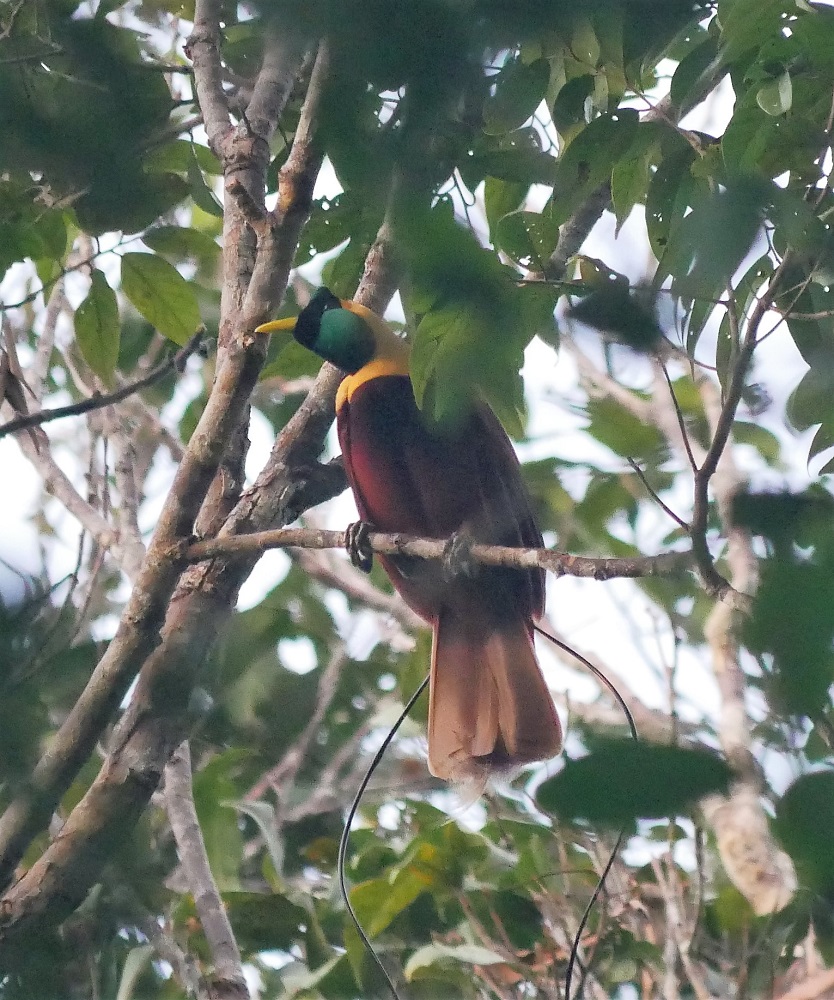
It was five days before Christmas. We were on a tiny beach of shining white sand surrounded by jagged rocky outcrops, leading into delightfully turquoise waters dotted with the dark outline of coral bommies. The sand was not pristine: clearly a huge animal had visited since the last high tide, making its way up from the rocks to the top of the beach only to turn around when reaching the vegetation, crossing over its own path to get back to the sea. The tracks were about a metre wide and consisted of a smooth section in the middle flanked by a clawlike pattern either side.
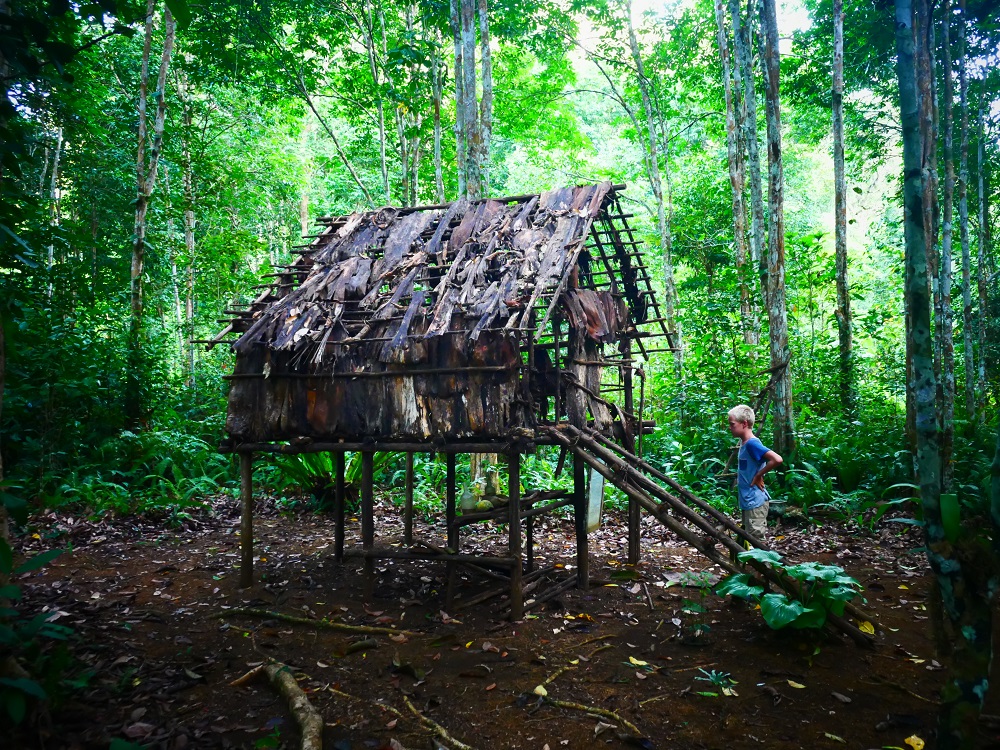
David and Matias surveying the tracks.

Pierrot and his wife Antonella, from the neighbouring boat SV C’est le Vent, had come in the morning to fetch us to have a look at the tracks. “We need a marine biologist,” they said. “We think a crocodile might have been on the beach.”

I didn’t pause to explain that my marine biological expertise is entirely limited to the identification of microscopic creatures that inhabit nutrient-enriched sandy sediments in shallow, warm temperate seas – a discrete niche very far from the identification of tracks made by huge carnivorous reptiles in tropical habitats. Instead I brought along 8-year-old Lukie, who only a couple of months ago completed a home-schooling inquiry on salt-water crocodiles and as a result is by far the person most knowledgeable about crocodiles on our boat. Lukie reckoned that he had seen some tracks as part of his investigations and was confident he would be able to recognise them again.

“They can swim very far,” he explained to Pierrot in the dinghy on the way over to the beach. “Hundreds of miles. But they mainly live in mangroves and are not common on coral reefs.”

Crocodile island under threatening skies.

On the beach we tried to recreate the animal from the tracks. If a crocodile, it would have to be huge.

“They can grow to 6.37 metres,” said Lukie. “I’m not sure how wide they are when they are that size. But they can eat sharks, I saw a photo of a crocodile with a huge shark in its mouth.”

Pierrot looked worried. “These are claw marks, no?” he said, pointing to a set of marks that could be construed to resemble a reptilian footprint.

Lukie shook his head knowingly. “I think it was a turtle,” he said. “A big one.”

“No, it is too big,” protested Pierrot, throwing out his hands. “Look, it is so wide! And what about these claws?”

“I agree with Lukie,” said David. “A croc would be able to hold up the weight of its upper body, and the tail would swish. A turtle has to drag the shell.”

Pierrot inspected the marks dubiously. “Maybe,” he said with a Gallic shrug.

“Look here,” said David. “These are the flipper marks. And then here, where it pushes itself forward, the marks are pressed together so they look like claws.”

“Perhaps you are right.” Pierrot bent down again, scrutinising the track. “Alors, we call it a turtle. And then we go snorkelling all day and come back tonight and see a huge crocodile sleeping on the beach, eh?”

Islets in south-eastern Misool.

We were in Misool, the southernmost part of the Raja Ampat region of Indonesia. Raja Ampat is located just west of the Bird’s Head western tip of Papua, so called because it resembles a bird’s head if you squint heavily when viewing it on a map. The area has incredibly high marine biodiversity and is a sought-after diving destination. It is also occasionally frequented by salt-water crocodiles, and divers have been attacked on the northwestern coast of Misool, at a well-known mangrove dive site. We were anchored in the outer atolls extending in a south-easterly direction from mainland Misool, a site devoid of mangroves, hundreds of miles from the crocs’ known territory.

Still, better safe than sorry. “Let’s get to another place,” I said to David. “I mean, I’m not sure saltwater crocodiles were part of the Christmas anchorage plans…”

And so we continued our northward island hopping in search of the perfect Christmas anchorage.

Approaching Misool – jagged cliffs rising from great depths.

It had been a long trip already. Getting to Misool from Triton Bay in the south was a bit of a mission: a 150-mile upwind passage, which David repeatedly asked me if I was up for. Reasoning that we would like to be in Misool or further north by Christmas and that the weather didn’t look like it was going to change in the foreseeable future, I decided that we should go, even though I don’t really enjoy sailing upwind.

“But there will be squalls,” he said. “We will have rain and there will be lightning around. Are you sure you want to go? It’s not going to be comfortable.”

“Yes, yes,” I said, waving my hand impatiently. “Let’s just get it over and done with, get there and relax for Christmas. How bad can it be?”

Famous last words.

Normally we’d easily do 150 miles in 24 hours, but sailing directly upwind is slow, especially in a boat like ours with an effective tacking angle of about 110 degrees. With that in mind, we planned for a three-day passage. Diesel is very hard to buy in Indonesia (it is subsidised for vehicle transport and foreigners are not allowed to buy it at the pump, which means that you have to engage a local agent, pay them handsomely to go and collect it for you, and hope that what they bring back is actually diesel) and so we were determined to sail as much as possible, only using the engine when the wind disappeared completely.

And so began the longest stretch of upwind sailing we’ve ever done. On the chart plotter, the light blue triangle indicating the wind direction steadfastly remained at the angle of our destination, our actual course a zigzag pattern across the purple line showing where we were supposed to go. We were relentlessly pursued by thunderstorms, the radar lit up with yellow, blobby monsters that appeared seemingly out of nowhere, coagulating until they covered most of the screen, ready to engulf us as we nervously steered our way across the screen, trying to keep the purple line as far from the yellow blobs as possible.

Going upwind is not only slow but also extremely uncomfortable, the boat heading directly into the waves, slamming up and down, jarring and shaking us, its contents. In the late afternoon on the first day the squalls started hitting, pelting us with rain, the wind changing from 10 to 25 knots within moments. At night the pattern would continue, with David manning the helm, me reefing sails, and the kids sleeping blithely through the thunder, lightning and crashing waves.

On the third day when I woke up in the early morning, bone tired after a night of two hours of sleep, we had 18 nautical miles to go. The wind was still coming directly from where we wanted to be, and we were travelling at a roughly 90-degree angle to the course we ought to follow, making our VMG (velocity made good – our actual progress in knots towards our target) hover between -0.2 and 0.5 depending on where the waves pushed us. Exhausted after a couple of hours dodging squalls David handed over the watch and lumbered off to bed, leaving me to sit staring at the chart plotter, a cup of steaming coffee in my hand, my eyes hurting with the effort of keeping them open, a hopeless sigh escaping my mouth. Only 18 miles to go, and we were going practically backwards. With the progress we were making it would take all day to get there. Arghh.

I stuck my head around the doorframe and peered at his sleeping shape, my loyalty towards the sailor in my life wavering. Maybe I could turn on the engine without him noticing? Take down the genoa, head directly into it at 5 knots, and be there by the time he woke up? Why all this pointless tacking, using the wind, when we could just turn on the engine and get there? Sailing is more comfortable, but at this stage we had slept perhaps a total of 8 hours each in 48 hours, every sleep interrupted by lightning storms and howling gusts. Shouldn’t we just try and get there?

My thoughts were interrupted by the kids demanding breakfast and by the time the general morning mayhem finished the winds had changed somewhat, allowing me to tack and hand steer a close course approximately towards our destination. Uplifted, I remained there until I had to wake David again with the approach of another squall.

“We’re getting there,” I said satisfied, pointing to the screen. With a bit of luck we’ll be there in three hours!”

He nodded, took the wheel, and I stumbled off to bed again.

Two hours later I woke up. Stretching in bed I checked the time, smiling at the thought that surely by now we would be approaching the island. I gaily rushed to the cockpit to check our progress only to have my hope deflated once again. In my absence the wind had changed and we were now 12 miles from our destination and heading almost due south, our current VMG a mighty 0.6 knots. Which meant that it would take us approximately 20 hours to get there.

Overwhelmed by despair I turned to David, blocking his way back into the saloon. “We need to put on the engine,” I blurbed out, tears in my eyes. “Otherwise we’ll never get there. Never.”

He looked at me puzzled. “This is sailing upwind,” he said. “Tacking is slow progress. We’ll get there.”

“But I want to put on the engines,” I said hysterically, my voice catching. “It’s been three days and now we could very well go into a fourth, just sitting here criss-crossing the course, not making any progress. I’m tired and I want to get there. I WANT TO GET THERE!”

“OK, OK,” he says, holding up both hands. “Fine, we’ll switch on the engine. Sheesh. Calm down!”

He switched on the engine and I sighed with relief, hope filling my heart as I slowly wound up the genoa and gazed lovingly at the chart plotter on which Bob was heading directly towards target.

Stuck in a squall.

The hardships didn’t stop with the arrival at Misool. After a barracuda we hooked on the way in was immediately devoured by a sizeable shark, nobody felt much like snorkelling. The island’s anchorages are deep and treacherous, and the first evening our anchor dragged twice, sending us drifting slowly out to sea as the insane beeping of the anchor alarm filled the quiet night. After two resetting attempts we all slept lightly, expecting the alarm to go off at any moment.

We reeled in only the head of the 1 m barracuda we hooked.

Like most places hard to get to, Misool is worth it, and once we got into the groove of tying up to protruding trees from vertical karst cliffs rather than anchoring we slept soundly again. And so we island-hopped in mild weather with our friends on SV C’est le Vent, exploring one untouched paradise after another, snorkelling pristine coral reefs, seeing the occasional fleeting glimpse of a turtle in the background but thankfully no crocodiles.

The islands south-east of Misool are amazing. Part of the Raja Ampat Marine Reserve, fishing is allowed to various degrees in certain areas only, making for excellent marine life. Vertical walls covered in soft corals plunge from scraggy surface rocks to untold depths. Shallow slopes support hard coral reefs teeming with life. The water is full of microscopic life and tiny baitfish squeeze together tightly into giant, living superballs, fleeing and darting from giant trevallies, tuna and other pelagics.

Clear waters teeming with bait fish.
Succulent giant clam winking slyly.
Friendly spadefish.

It’s not only marine life that is thriving. On the vertical karst cliffs of the small island group of Balbulol insectivorous pitcher plants clung on to the rough limestone rock in droves, and our boats, tied onto the same shores, were inundated with mosquitoes and sandflies. Three days from Christmas, I spent a day there painstakingly sowing mosquito nets for all hatches, sealing the boat up so that no unwanted insect could make its way in. But still, the severe karst cliffs didn’t fit with our expectations for Christmas so we fled north and anchored in shallow sand in a small group of sandy atolls far from mangroves, crocodiles and plunging rocky depths.

The near-vertical walls covered in insectivorous plants.
The stark cliffs of Balbulol.

“Let’s stay here for Christmas,” I enthused to David in the late afternoon on 23 December as we lowered the anchor onto a flat, sandy bottom just offshore an idyllic sandy island covered in palm trees. “Atolls, and a flat, sandy bottom to anchor on. Perfect!”

“Yay, clear shallow water,” cried the children, jumping up and down on the trampoline as the sun dropped behind the island, spreading tendrils of pink and purple over the palm-tree silhouettes and rosying the jumping boys’ cheeks.

Scenic sunset at Christmas Island.
Late afternoon swim at the beach.

At 1 am the anchor alarm went on – the boat had swung close to the island, but the under-keel depth was still fine. At 3 am the alarm went off again – we had swung around completely and a strong current was raging, but the anchor held. In the morning, we had come back to our original position, and there was little current, but it built during the early hours and by 11 am we were jumping in from the bow and getting swept by a 2-knot current to a rope tied between the two hulls within seconds, the kids whooping with delight as they clung onto the rope against the raging tide. We played Man Overboard Survivor, practising grabbing hold of lines as we flew past the hulls, scoring extra points if we managed to hold onto the back step and pull ourselves on board. Lukie did exceedingly well but I guess he’s the one who has had the most practice with the whole getting rapidly swept from the boat thing.

Survivor master Lukie.

We had a fantastic Christmas at the anchorage, with a Christmas Eve beach bonfire on a deserted but rat-infested island (which wasn’t too bad – they were numerous but cute and quite shy), and despite dwindling provisions managed to piece together a lovely Christmas day lunch with our friends which was only interrupted by a serious inundation of flies and a squall that sent us inside for dessert.

Damper on a stick at the Christmas Eve bonfire on Christmas Island.
Christmas morning pancakes.

There are only so many flies a family can take, and the day after Christmas we continued north against the current in search of provisions and internet, reaching Waisai on Waigeo Island, the centre of Raja Ampat, late on the 26th. Here we will restock our meagre supplies and then head off to enjoy the region, still aiming to find a shallow, sandy anchorage with good holding, and no currents, insects, rats or crocodiles. Maybe for New Year’s Eve?

Exploring ashore.
Sunset over Misool islets.