Tourist time: Lombok’s Gili Isles and a quick visit to Bali

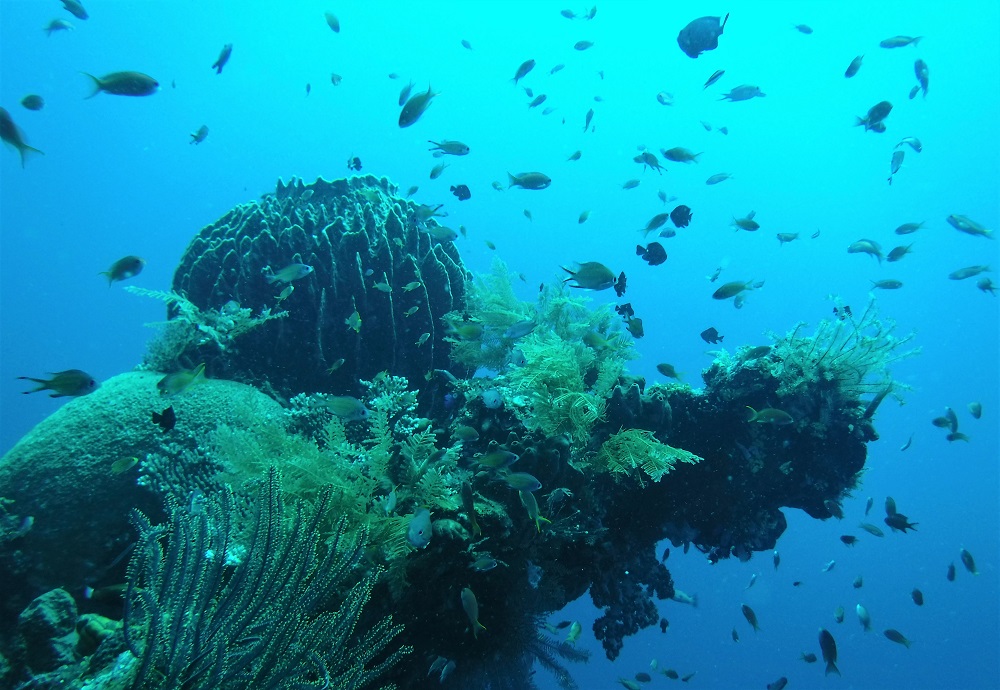
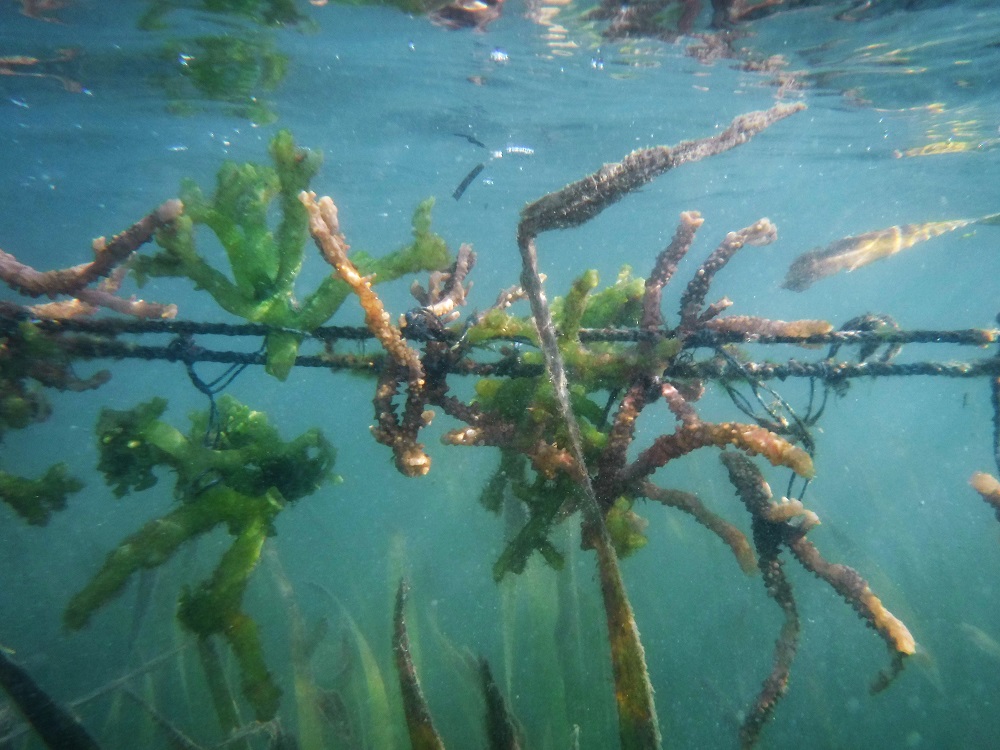
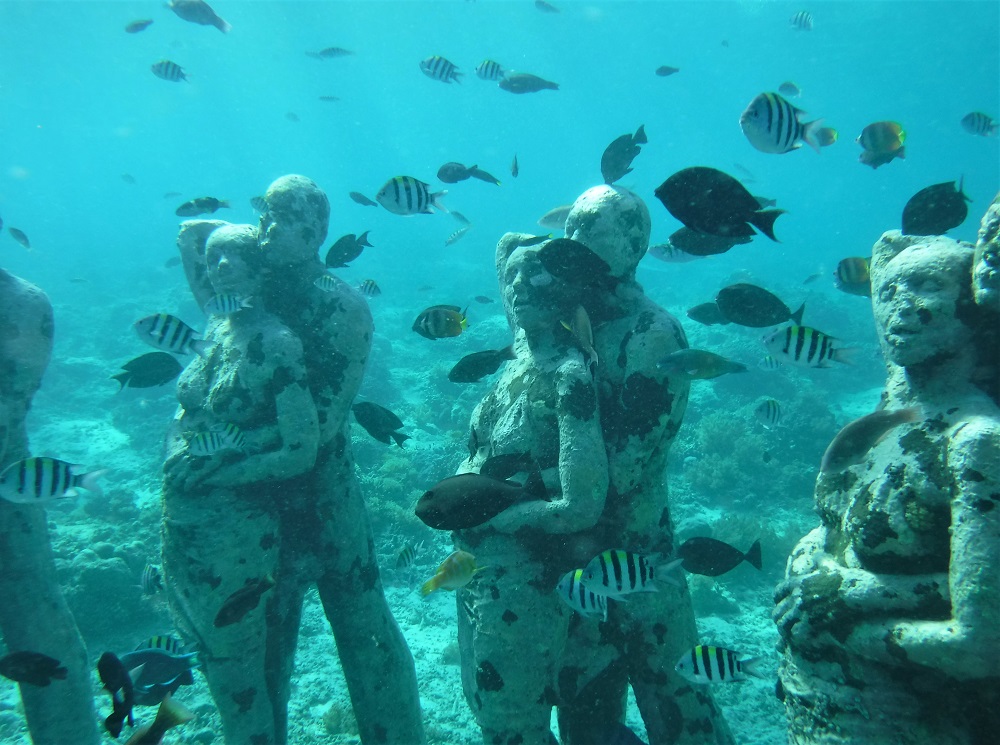
Close up of underwater sculptures, Gili Meno.

It was early morning. David and I were standing on the bow of Bob the Cat looking out over Amed Bay in northern Bali. It was a scenic shoreline, dominated to the west by the imposing volcano of Gunung Agung and to the east by the rugged hills of the north-eastern Bali interior. In front of the green mountains was a thin line of flat black sand shore backed by luscious palm trees. The morning was quiet, Hindu Bali being the first populated place in Indonesia where we had not been woken by the melodic singing from a mosque, and serene little temples carved from heavy volcanic rock were visible along the cliffs towards the western end of the bay.

Not that we were looking at the scenery. We were anxiously focused on the nearshore conditions.   

“Do you think it’s going to be OK?” I asked nervously.

“It’s pretty rough, that’s for sure,” he replied. “We don’t want him to drown – that would be a tragedy.”

“Maybe we should move?” I suggested. “Go to a calmer place?”

“Yeah, we could do. But the next sheltered anchorage is 40 miles away, though. It’ll take us eight hours with these light winds.”

The day had come where we had to part with Paco the Cat and we were worried about how to get him ashore. There was a bit of a swell rolling into the bay and on the shore the waves were pounding brutally against the steep, back sand beaches. We’d gone ashore the day before to get some dive tanks filled and had both gotten completely soaked whilst trying to hold the dinghy in the crashing surf and loading and offloading the cylinders. Now we were worried about how to safely get the cat onshore.

“The last thing we want is another dinghy capsize,” said David. “We don’t want him to get wet, ideally.”

I looked at the shoreline. From afar the waves looked small, narrow white undulating lines snaking their way up and down the black beach, insignificant foam splashing over distant sand. But landing a dinghy in anything but the smallest waves quickly becomes quite an ordeal. We can always anchor the dinghy off the shore and swim in but trying to keep a caged cat comfortably dry would be problematic.

“We could bring a boogie board,” I suggested. “Put the cage on top and surf him in on the white water…”

David looked at me sceptically. “He’ll drown if the cage goes under,” he said. He righted himself and turned towards the stern where the dinghy was tied on. “Maybe it’s better around the corner. I’ll take the dinghy over and see if there is a better landing spot there. If not, I guess we’ll have to move.”

Paco the boat cat helping navigation planning.

The transfer had been planned for two weeks. Antonella and Pierrot, Paco’s owners, live in Bali, and whilst Pierrot was still in Europe, Antonella was ready to get her cat back. Their boat was on a mooring in the south of Bali, and we had agreed to drop Paco off on our way north from Lombok, making the north coast of Bali the ideal meeting spot. That morning, Antonella was on her way by road, and we had made ready for his departure, packed his little bag containing cat passport, anti-flea shampoo and fluffy towel, prepared the kids mentally for saying goodbye to him. Everything was ready. Now we just needed to keep him safe for the shore landing and all would be well.  

Tiger Paco, fierce in combat.

We’d just spent ten days in the Gili Isles in north-western Lombok. Part of the well-trodden Indonesian budget tourist path, Lombok’s Gili isles (Gili means small island in the local dialect) are a quieter version of the intense scene of neighbouring Bali.

It was a bit of a shock to the system to suddenly find ourselves in tourist-land. We first got a feel for the culture-clash that tourism brings to Indonesia on Lombok’s south coast where, on the kite beach, groups of local women would wander, clad in full hijabs, taking selfies against the wild ocean backdrop, whilst on the water a bikini-clad kitesurfing instructor was carving close to the water’s edge doing impressive tricks. She must have been getting crazy sunburnt in the searing sun, and also cold in the 20-knot breeze, but she continued undeterred, oblivious to the irony of parading a thong bikini a stone’s throw away from severely veiled local women. On the same beach we witnessed a skimpily clad honeymooning couple kissing in a suggestively close stance on the beach only to be met with loud cries of ‘no, no,’ from a group of local, hijab-wearing women and their accompanying menfolk who happened to be walking past.
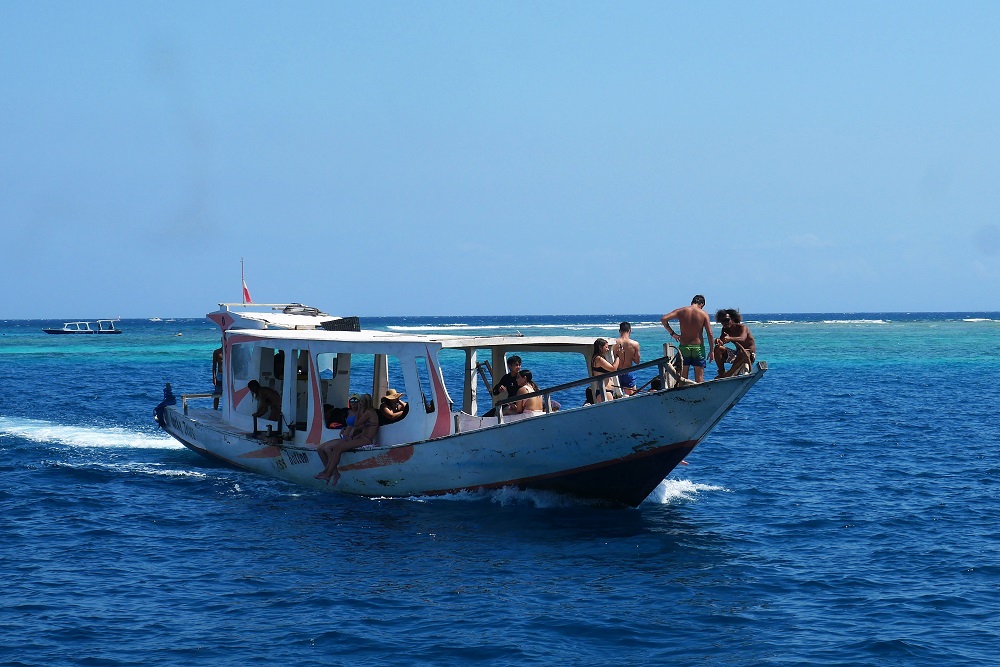
Bikinis and boardies: tourists arriving back from snorkelling at Gili Air.
Largely ignored: sign at the entrance to town asking tourists to cover up.

The Gilies take western tourism to an entirely new level. Here, ferries disgorge scores of bathing suit and board-short wearing 20-year-olds onto the floating jetty about 10 times a day, and the little island is full of young, tanned and largely naked Europeans, Asians and Australians. There’s a sign at the entrance to the town saying ‘please respect our culture,’ the local women wear veils covering their hair, and the local mosque blasts the prayers out loudly five times a day, but otherwise you could be in Ibiza, the tourists strutting about in their tight-fitting speedos, thong bikinis and high-heeled flip flops. We were anchored off Gili Air, a small round island fringed with white sand beaches leading into turquoise water sheltered behind a scenic barrier reef. The island is full of hotels and homestays, the premium water-front real estate lined with waterfront bars, hotels and restaurants offering bean bags and pastel painted loungers for punters to relax and enjoy the views. Every night the island kicks back during the three-hour long happy hour sessions where guests are served by busy waiters staggering under the weight of trays laden with pizzas and dew-dropped, crystal-rimmed margaritas, sidestepping the crowds to the beat of Ibiza Chill compilations.

Scenic view from Gili Air, north Lombok.
Boat kids in a cafe.

It’s a world away from the Indonesia we’ve seen on our seven-month long stint travelling the country, and whilst at first a bit of a shock to the senses (the blatant bikinis, bars, blaring western music), Gili Air is quite a nice little holiday place, an incredibly easy place to spend a week, a holiday away from the challenges of our normal life on the boat in remote Indonesia.

Here, everything was easy. There was a well-maintained floating dinghy dock, so we didn’t have to land the tender amongst rubbish piles on a smelly beach or tie up to a dilapidated jetty featuring rusty nails sticking out perilously close to our inflatable. Here you could wear a singlet and shorts without offending anybody, be anonymous amongst hordes of red-faced tourists, and purchase anything that you might need. Everybody on the island spoke English and the shops were stuffed with items catering to western tastes, showcasing wares we hadn’t seen in almost a year like tahini, couscous, walnuts and sunblock. There were ten dive shops on the island and about 60 snorkel tour operators, scenic underwater landscape including a sculpture park, a lovely surf break on the southern reef just next to the anchorage, as well as white beaches, clean azure waters and the obligatory touristy shops selling clothes, souvenirs and massages. The island is so small you can walk around it in an hour, and is free of motor vehicles, offering bike rental and horse-drawn carts as the only means of transport other than walking.

Horse-drawn carts on Gili Air.
Underwater statues off Gili Meno.
Heading off for a surf in the morning.
Lukie surfing the Gili Air break whilst Matias is doing his dive course.
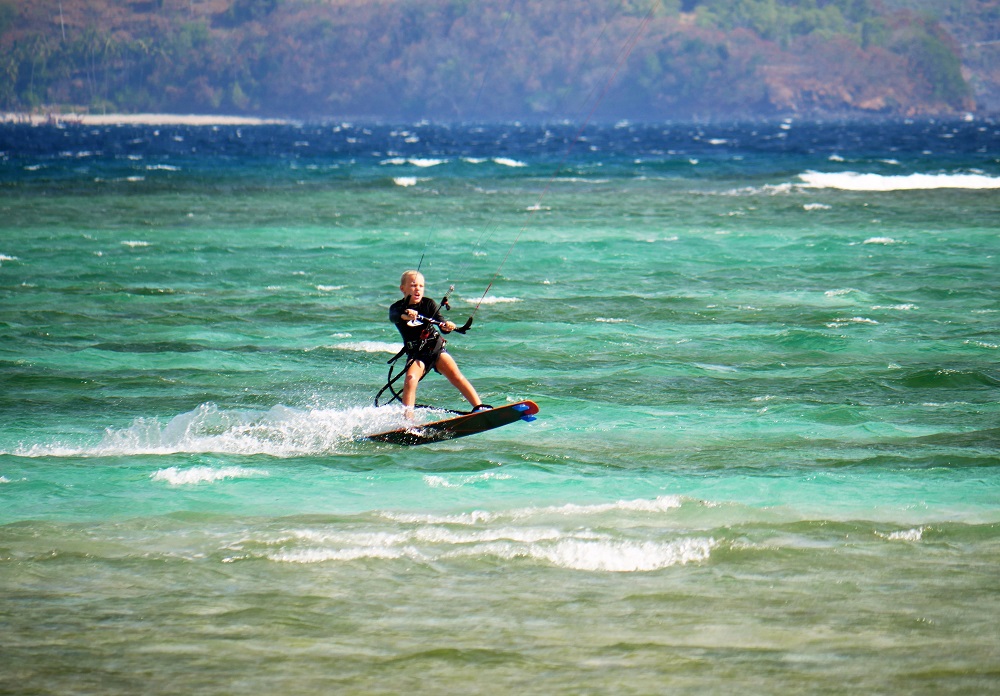
Lukie attempting small kite jumps in Gili Air.

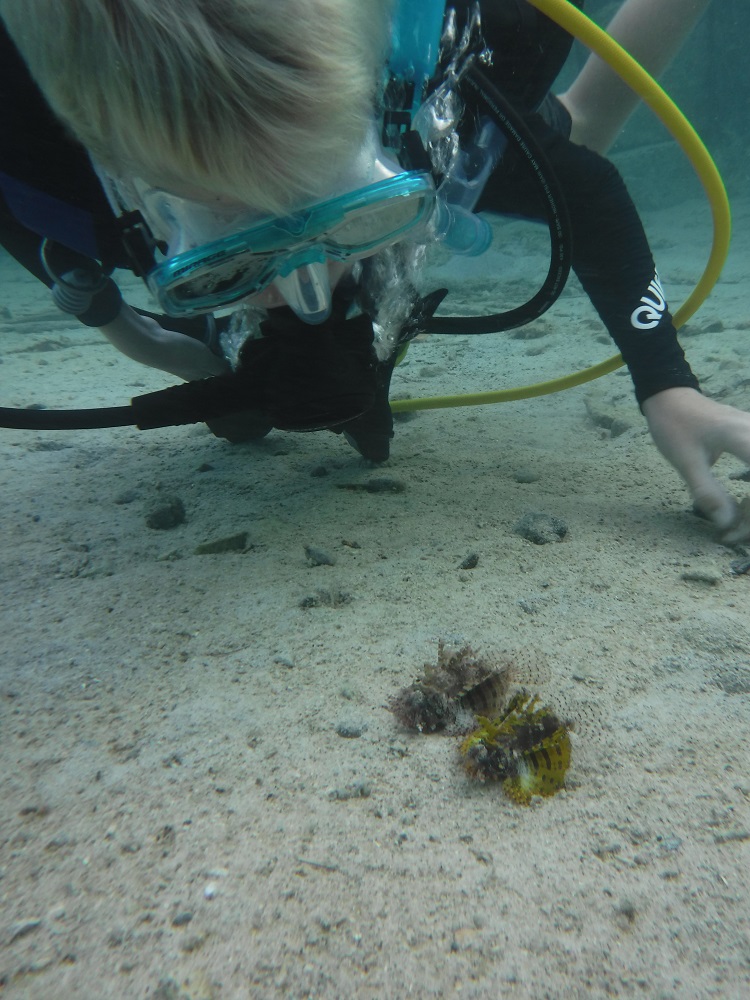
It was a perfect place to relax, and we enjoyed our stay there, catching up with friends, eating out and drinking cocktails on the beach overlooking the sunset, biking around the island, and snorkelling, diving, surfing and kitesurfing the surrounds. Matias took the opportunity to complete the PADI Junior Open Water course with a dive shop (my formal instructor registration lapsed long ago when I stopped paying the steep PADI fees, so I can’t give him the certification card) and enjoyed days on the dive boat by himself, coming back a proudly certified diver full of tales of swimming pool skills, shipwrecks and scorpion fish. Our diving there was amazing, full of scenic underwater landscapes and rare and cryptic lifeforms.

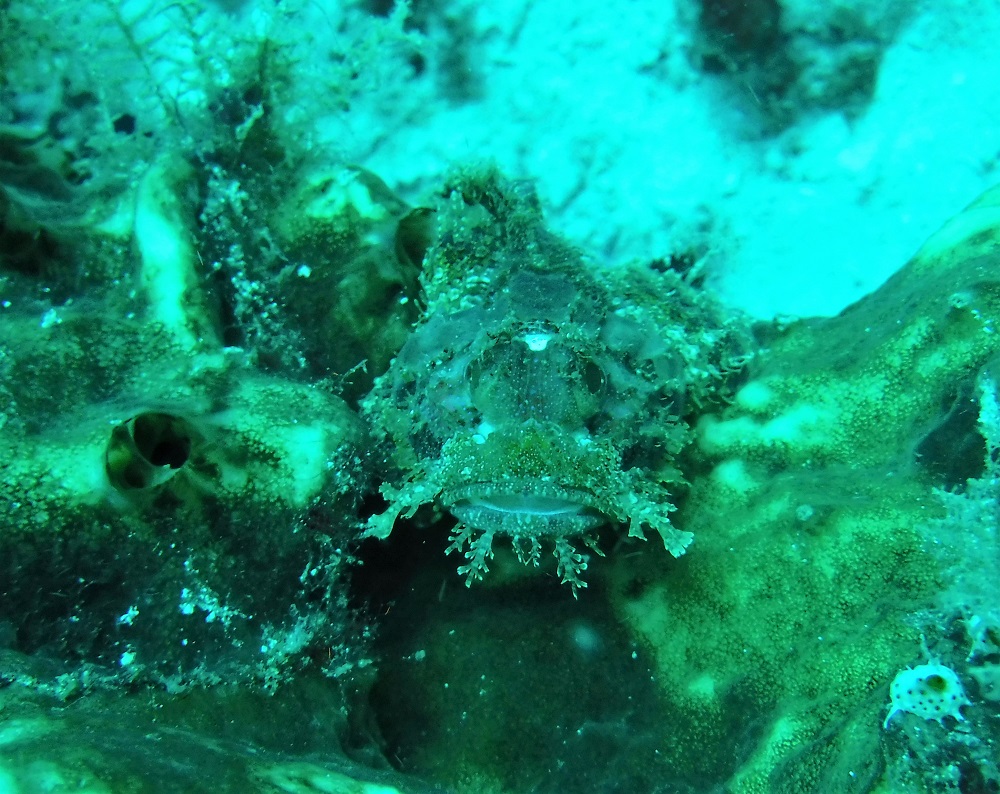
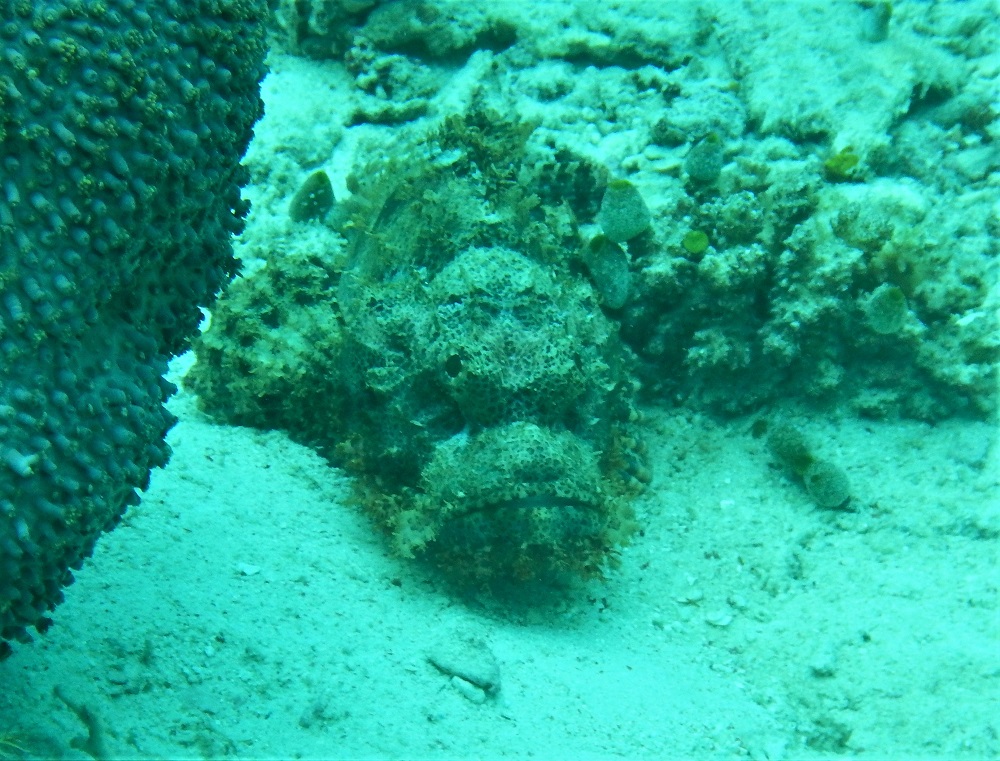
Crazy cryptic leafy scorpionfish.
Scorpionfish.
Weird horned thornback cowfish going about his business.
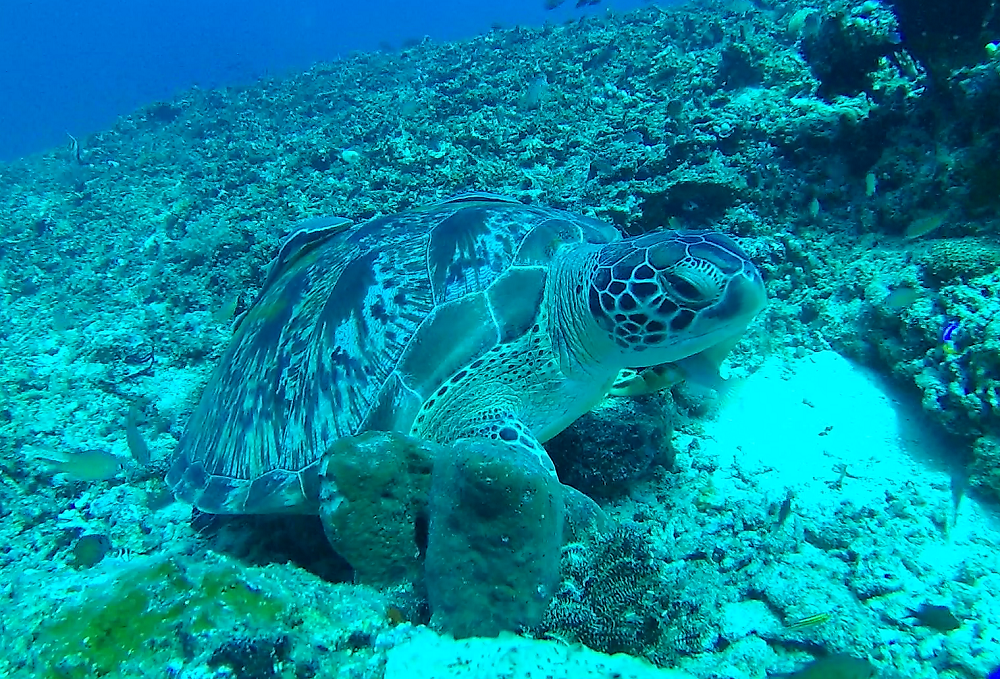
Friendly turtle.
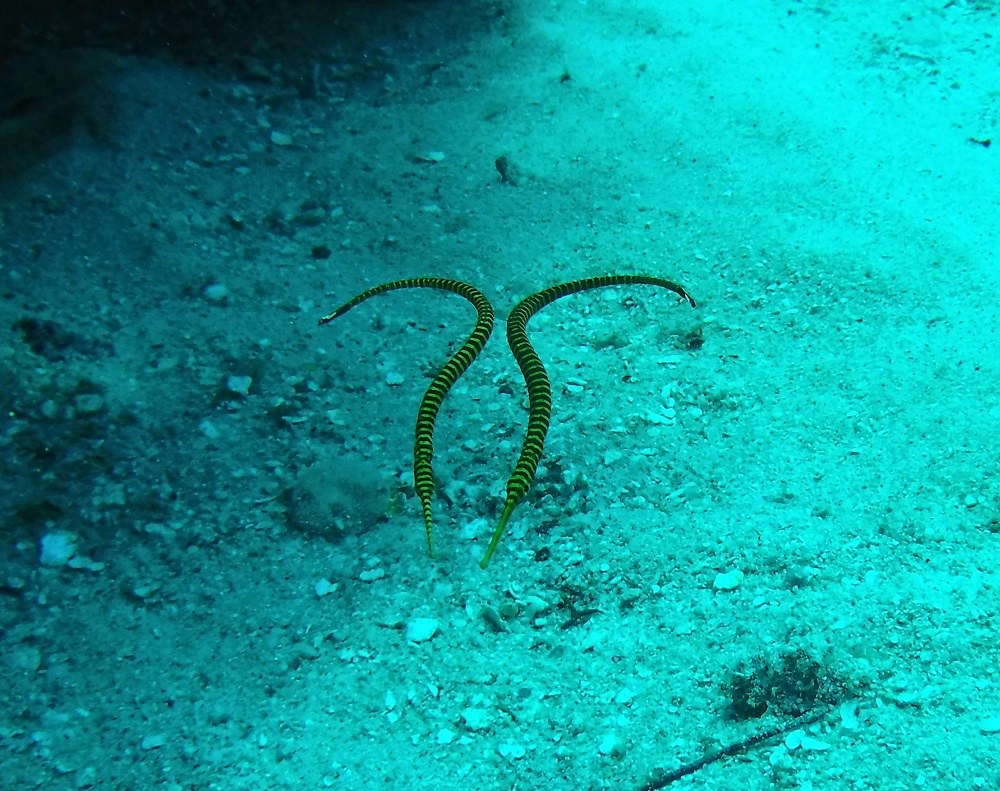
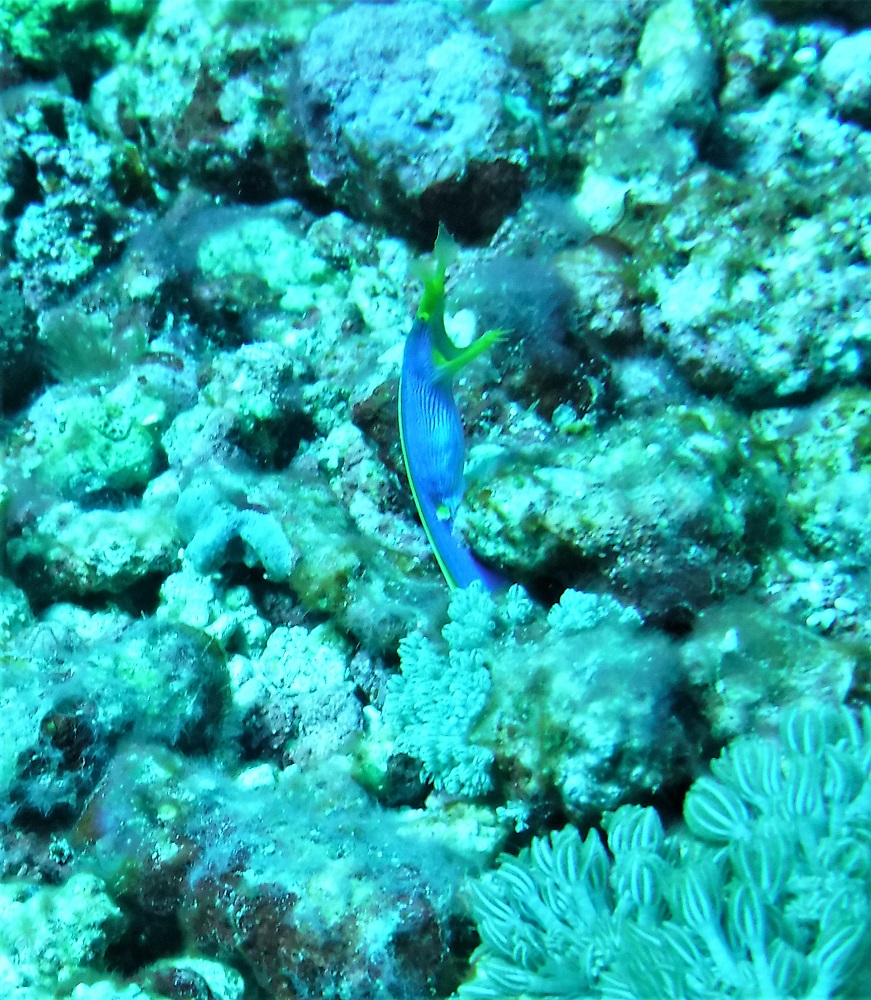
Orange-banded pipefish courting.
Striped puffer.
Little toby hiding next to an urchin.

After nine days in the Gilies we were ready to leave, feeling like we had seen most of the sights and that we’d had our fill of the endless tourist crowds and the numerous ferries and tour boats speeding in the anchorage which left Bob heaving in their wakes, glasses and plates flying about. Antonella was eagerly awaiting the Paco delivery, and we left for Amed in Bali so that we could be ready and waiting when she came by road.
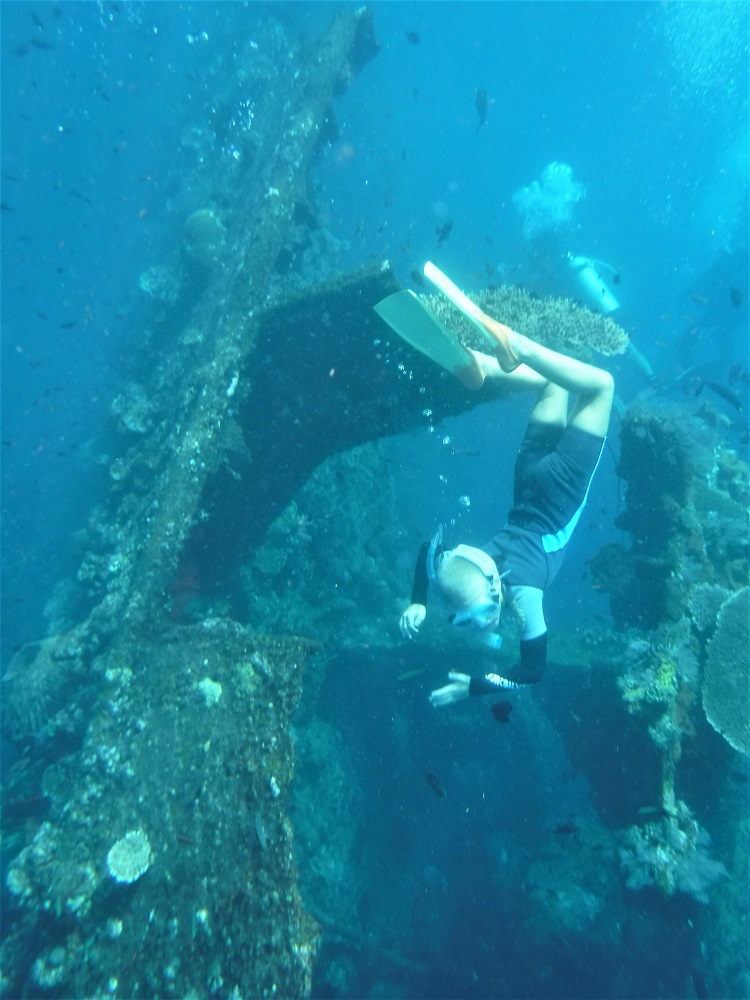
Lukie snorkelling the Liberty wreck.

In Bali, before Antonella arrived, we had time to do a quick dive of the wreck of the USAT Liberty, a US army cargo ship which was torpedoed by a Japanese submarine in 1942 and beached in Tulamben Bay, near Amed – a wonderful coral-encrusted wreck lying in 5-30 m of water which was an exciting first dive as a qualified diver for Matias.

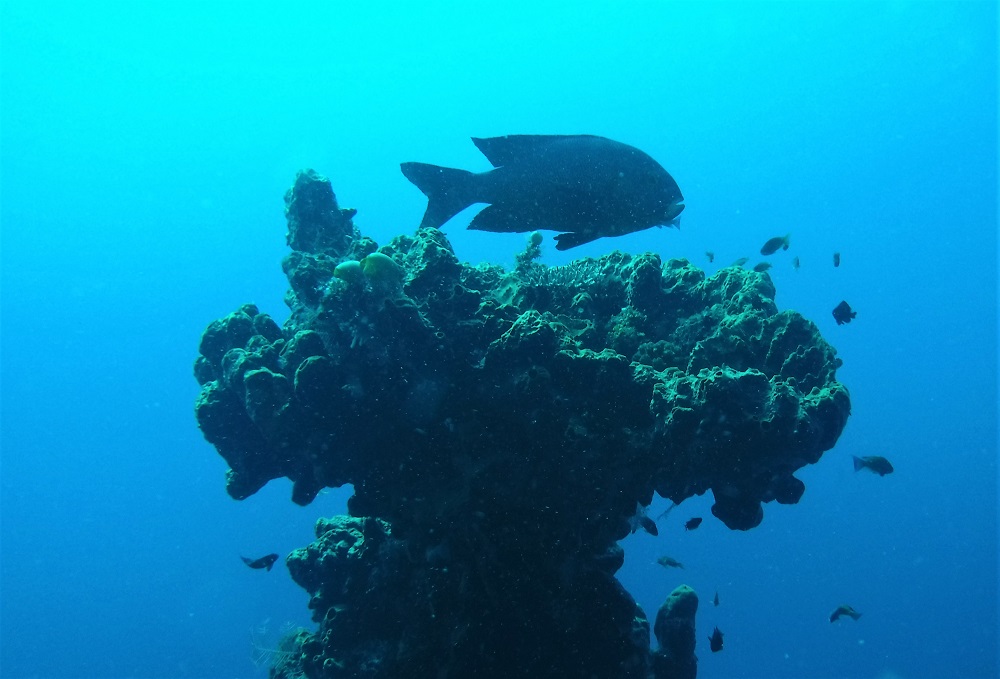
Friendly fish on the USAT Liberty wreck.
Underwater silhouettes.
Coral encrusted ship wreck, teeming with life.

Now, a day later, it was time to get serious about getting Paco ashore. I walked to the back of the boat as David was coming back from his dinghy reconnaissance.

“How was it? Any calmer over there?” I asked.

He climbed on board the boat. “It’s a bit better at the other end of the bay.” He rubbed his chin and started laughing. “I’m making it sound like surfing Jaws, aren’t I? It won’t be that bad, I’m sure we can do it…” He stroked Paco who was approaching him, rubbing against his legs. “It’ll be OK, Paco, we won’t drown you!”

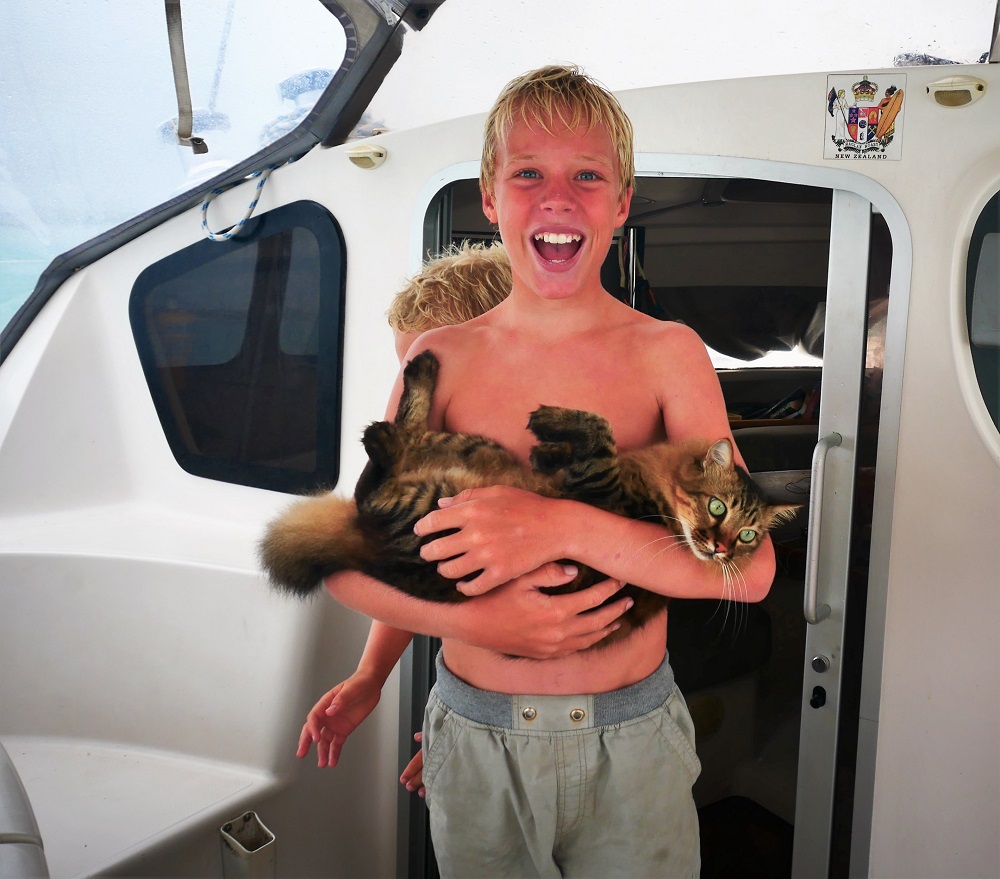
Get me away from this boat and these children!
Please let me go home…

In the end the transfer went smooth, David holding the dinghy in place in the surf, Antonella lifting Paco packed away in his little plastic cage and holding him high as she ran up the shore. And just like that he was off Bob the Cat and out of our lives, leaving a huge Paco-shaped hole in our hearts, the despair giving rise to eloquent art such as this poem by Matias which he penned for homeschooling a day after Paco’s departure:

Paco Power

Look at Paco now,

Soft fur, green eyes, belly rubbed, whiskery,

Staring at you,

Squirrel tail, furry face, woolly belly, fluffball.

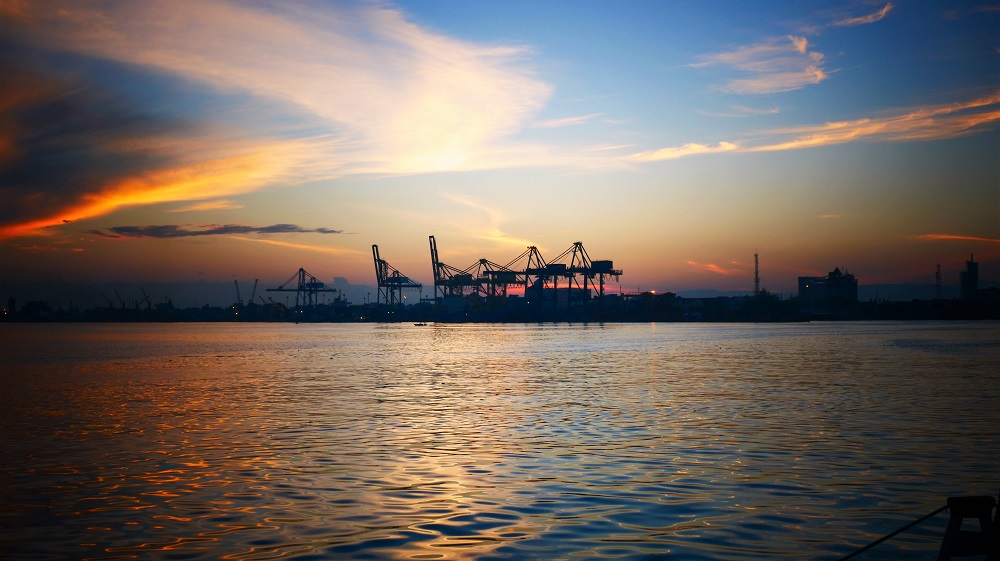
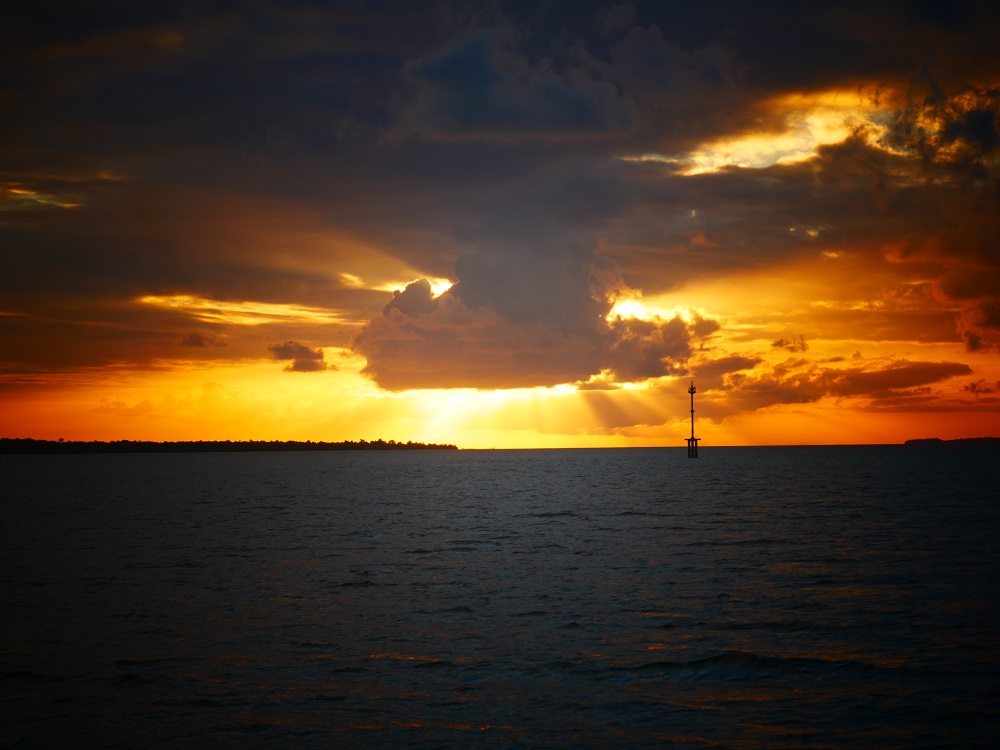
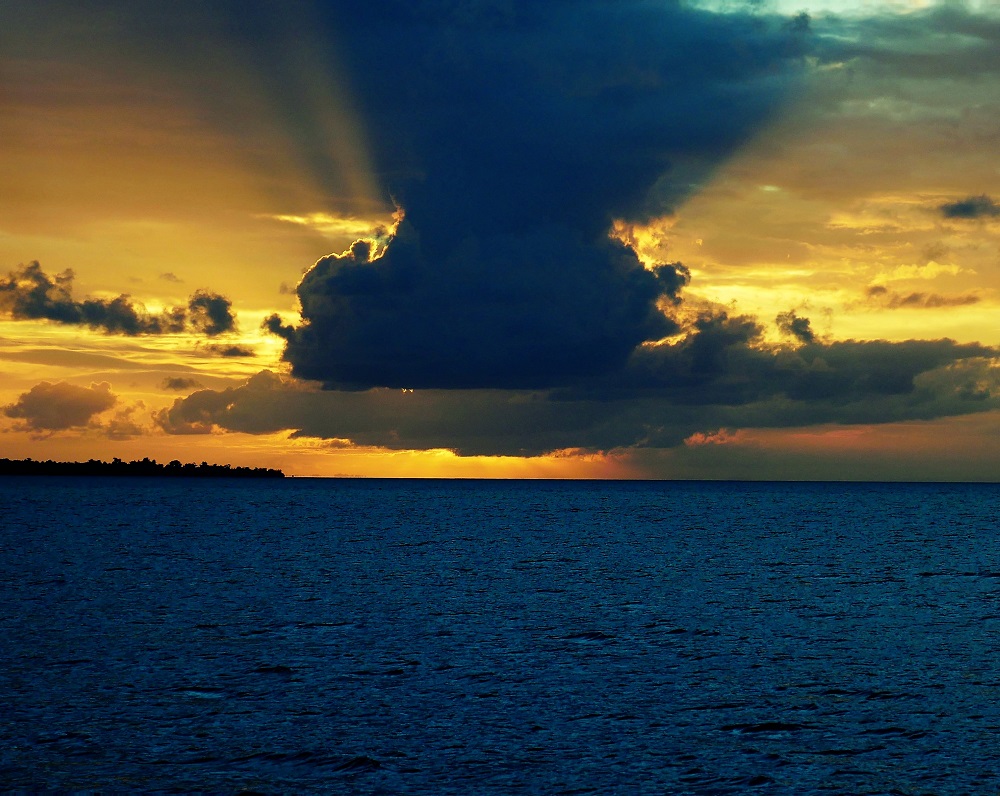
Sunset over Gunung Agung, viewed from Amed Bay, north Bali.

Wild, wavy and windy: south Lombok

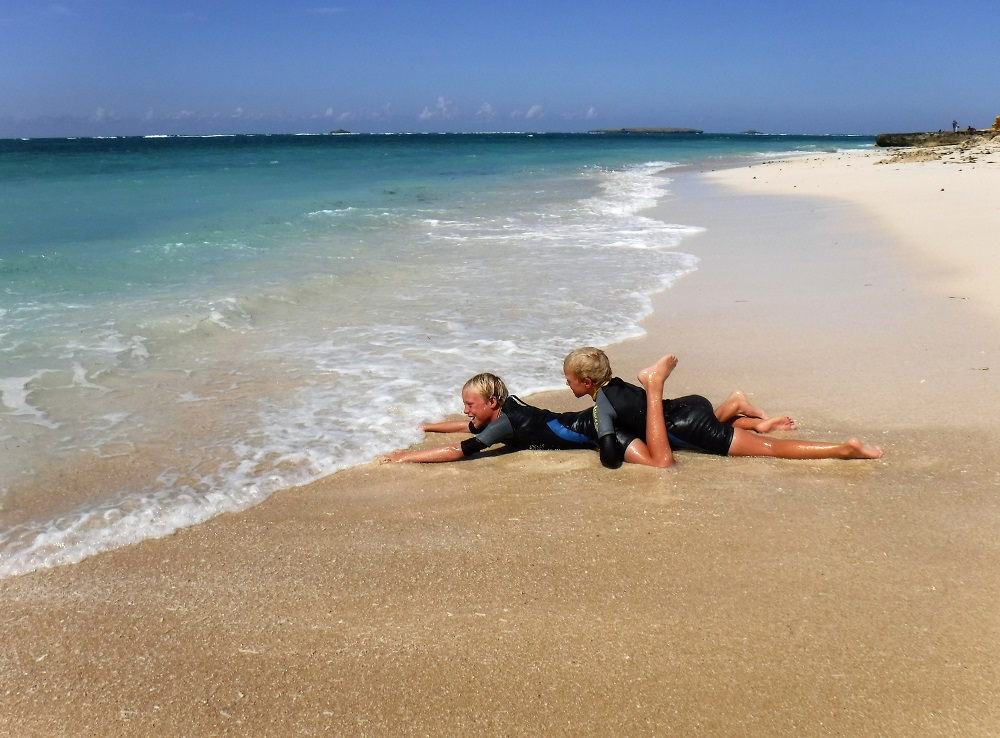
Brotherly love in the shallow waves of Kaliantan Bay.

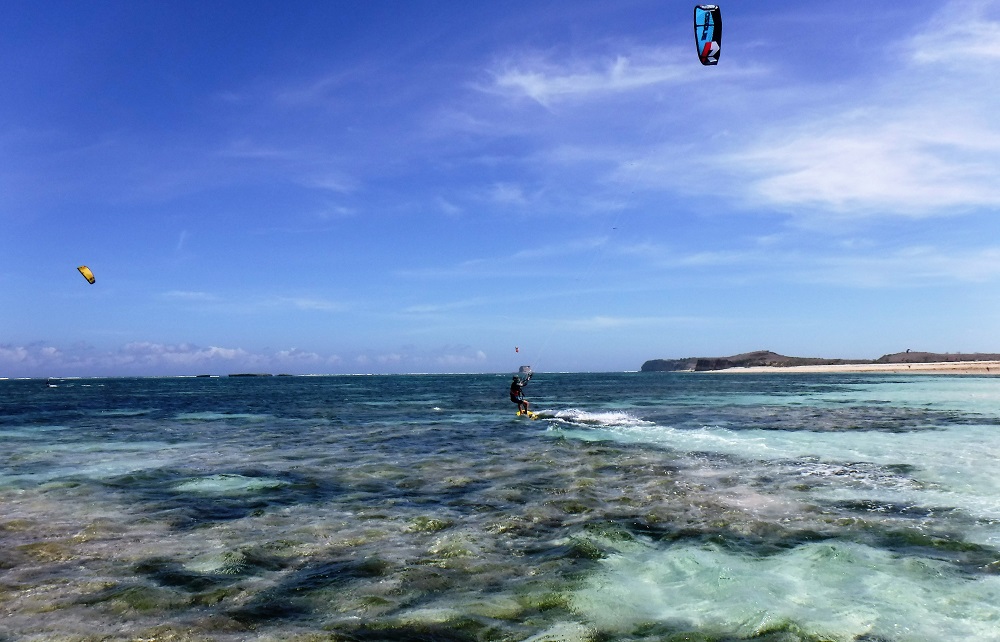
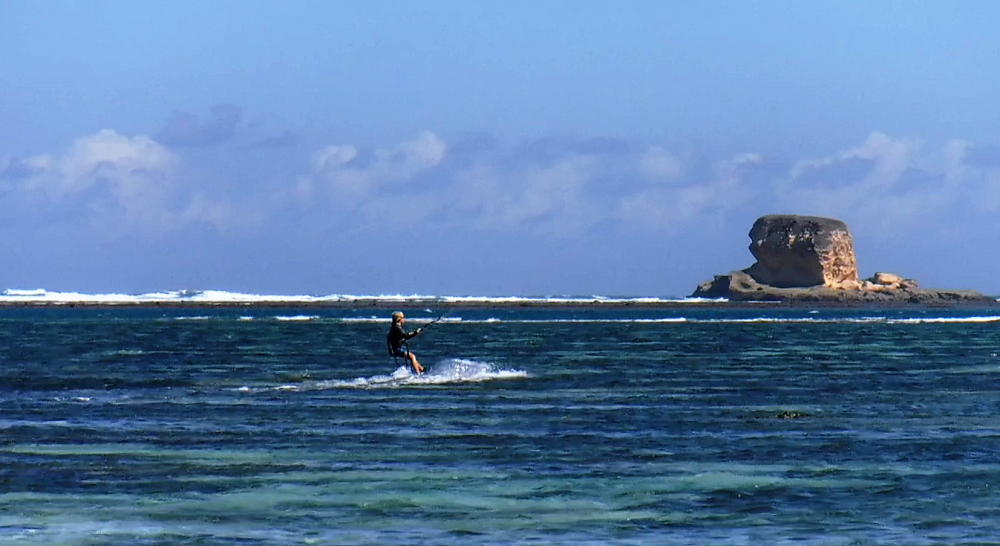
The problem with surfing as a hobby when you live on a boat is that, as a general rule, surf breaks make for poor anchorages. The problem with kite surfing in Indonesia is that, as a general rule, any piece of flat water is occupied by seaweed farms.

With reckless disregard for such general rules, we headed west from Komodo to the wild south coast of Lombok for a week of enjoying huge swell, big waves and steady, strong winds. Open to the Indian Ocean, the southern shores of the Lesser Sunda Islands (of which Lombok is a part) is windier than the rest of Indonesia, and David had been eyeing up a perfect kitesurfing spot for a while, carefully earmarking a good-looking location for anchoring within easy reach of the breaking waves and sheltered flat-water lagoon.

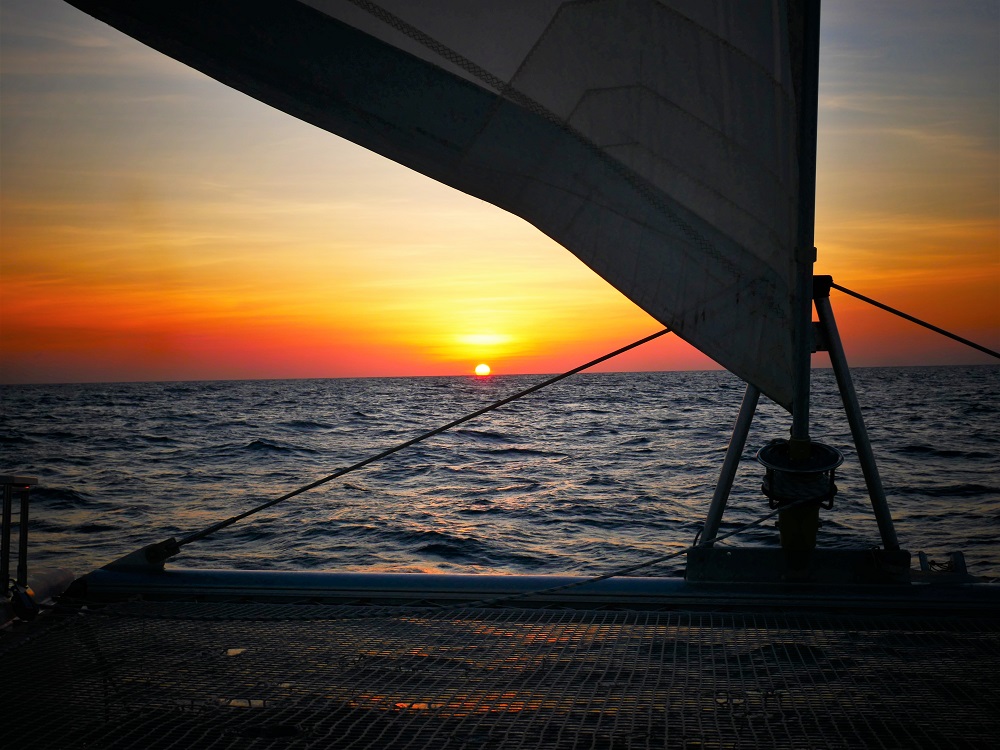
Heading west from Komodo: into the sunset.

The location was not in our cruising guide, and we had heard of no other yachties going there, but nowadays anyone can assess an anchorage from satellite photos, and we were full of optimism. The anticipation of getting to a great kite spot had been building for a couple of weeks, and as we rounded the south-eastern corner of Lombok David stood at the helm, looking satisfied. “It looks like the perfect spot,” he said, grinning. “Waves for me, flat water for you and the kids.”

I looked at the huge breakers smashing against the steep, dark cliffs of the shoreline. It looked pretty wild. “Uh hum,” I said non-committally. “As long as there’s somewhere calm to anchor…”

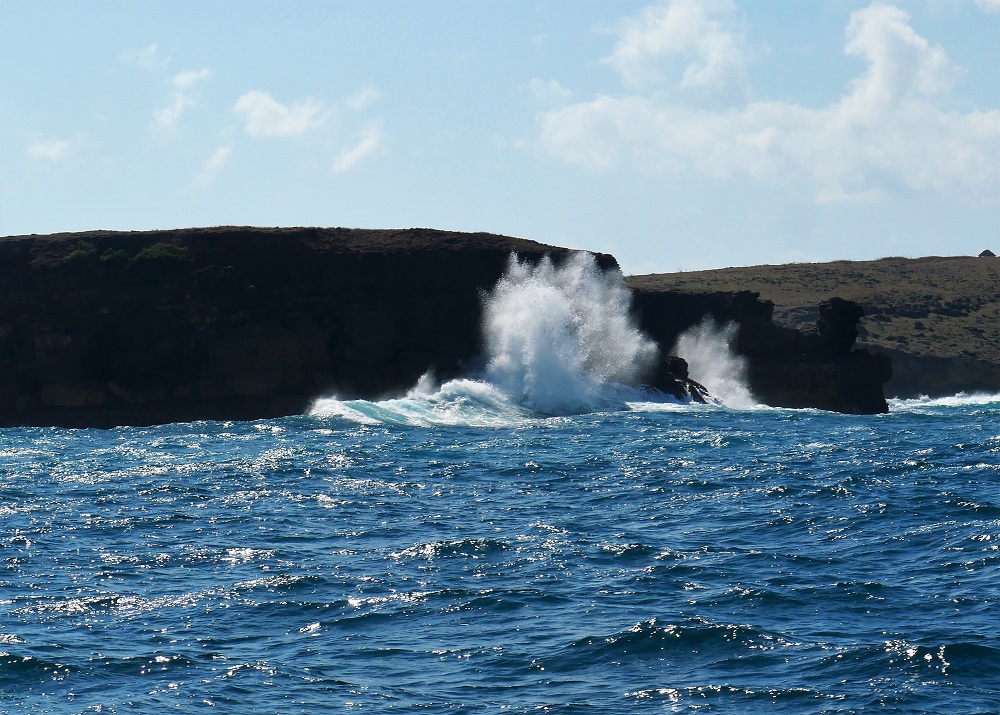
Waves smashing against the steep rocky shore of southern Lombok.

“It’s a huge bay,” he said. “We’ll just tuck around the headland where it will be nice and flat, out of the wind, then it’s only about a mile by dinghy to the kite beach.” He beamed. “As long as it’s not full of seaweed farms, we’ll be sweet!”

Predictably, a little while later as we were approaching the bay, I heard him swear from the cockpit.

“What’s that?” I called as I made my way out. “What’s the problem?”

He was standing at the helm, binoculars pressed to his eyes. “I don’t believe it!” he muttered. “Not again!”

I approached with my hand shielding my eyes, trying to make out what he was looking at. All I could see was a shoreline awash in foam, the huge waves crashing onto some very sharp looking rocks around the entrance and along the reef on the outside of the shallow lagoon. “What is it?”

He lowered the binoculars. “Seaweed farms!” he exclaimed. “I don’t believe it! Every time we find a kite spot, it is full of seaweed farms!”

I mumbled something consoling and took the binoculars from him. Focusing on the inside of the bay I saw it – hundreds of buoys interspersed with thousands of plastic bottles, dotted all over the water surface, filling up the entire bay. My gaze swept backwards and forwards, trying to find a buoy-free area large enough for us to anchor. There was nowhere.

“It’s OK,” said David, snatching the binoculars back. “There’s a channel through the farms there and an area just off to the side where I think we’ll fit.” He held the binoculars to his eyes. “Or else we could maybe sneak up there,” he said, gesturing further towards the headland, “as long as it’s deep enough.”

After spending a couple of hours motoring up and down narrow channels choked by expansive seaweed farms we found a small area to anchor in, just to the side of the main thoroughfare. Not quite as tucked in behind the headland as we had hoped – it was exposed to the swell and a bit lumpy – but the anchor held and at least there was enough swing room to keep us safe from hitting a farm.

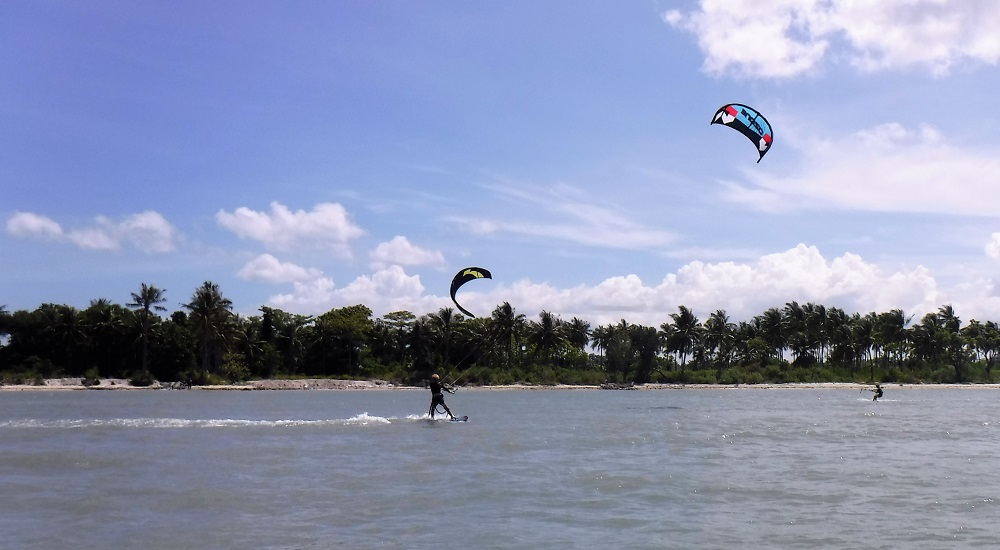
The kids kiting together (centre kites) in Kaliantan Bay.
Matias pumping up his kite.
Lukie landing a kite with David’s help.

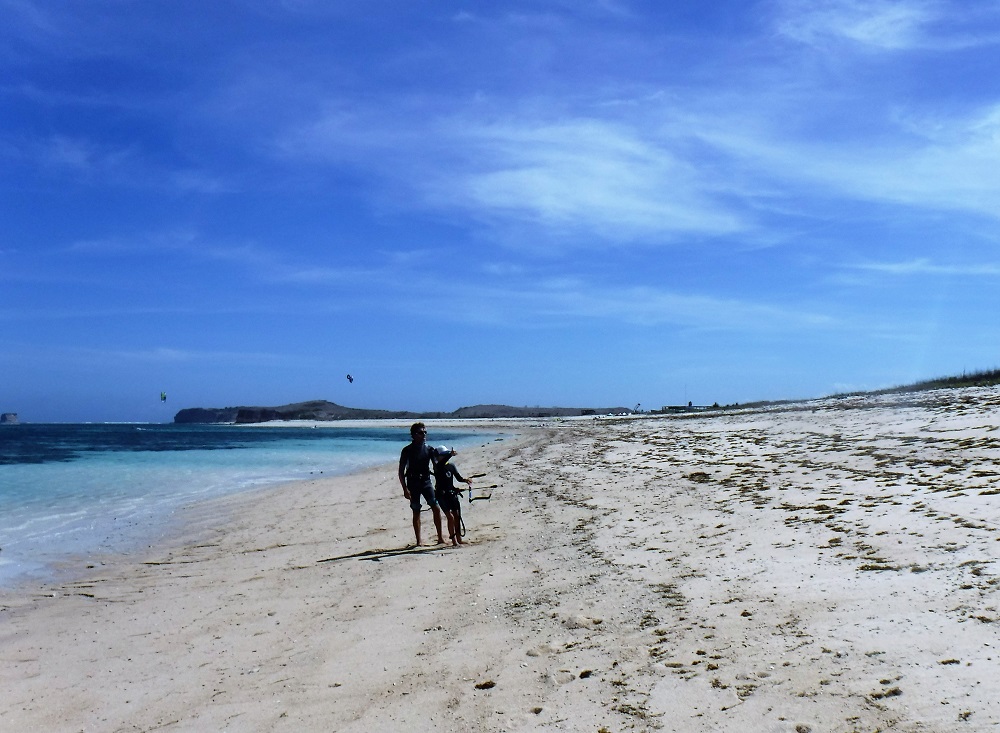
And then we set about exploring the bay. The kitesurfing spot was an excellent long white beach in front of which a shallow lagoon extended out to a surf-battered reef stretching for miles and miles. Two kite resorts had set up camp on the beach and several people were out kiting.

Over the next few days the swell rose and the entrance to the bay closed up, the huge waves crashing over the shallow bar reminding me of our hometown of Raglan where, at times, it is impossible to get a boat in or out of the estuary. When the violent rocking of the boat proved too much for even Paco the boat cat (who, given the constant exaggerated motion of the boat, seemed convinced that we were still on passage and spent his days curled up in a small ball asleep in a corner of the saloon seat) we moved to a spot closer to the headland where the swell was marginally smaller but still probably the worst I have ever experienced on anchorage. Trapped between seaweed farms and huge breaking waves we spent our days enjoying the wild elements. David and the kids found a small wave in the lee of the shore and spent the mornings surfing beautiful peeling waves, and in the afternoons we kite surfed in 20 knots of steady breeze, with Lukie just managing to hold onto a 4 m kite.

Matias taking off from the shallows.
Lukie enjoying the flat water of the lagoon.

On our third day there the swell peaked. In the morning, David and the kids had gone off for a surf and I was standing in the galley making a cup of tea, when I heard their voices. Puzzled, I went outside to see them paddling back the dinghy using David’s stand-up paddle.

“We tipped the dinghy, Mummy,” cried Lukie cheerfully. “The waves were huge! And we lost the anchor, and Daddy’s sunglasses, and the bailer!”

David looked grim. “Bloody lucky I could right it,” he said. “Now we have to see whether we can save the outboard.”

He had anchored the dinghy near the wave to let the kids out and sat watching them for a couple of minutes to ensure they were OK before heading out to anchor further away and jump in to join them. Whilst he was sitting there a huge set had come through, waves building to break where he was anchored, and when he rushed to raise the anchor it was stuck. He untied the knot to the anchor rope and the dinghy started surfing with him in it and overturned on the face of the wave, leaving the anchor with its rope and anything loose and not floating at the bottom of the surf zone.

He spent the rest of the morning rinsing, drying and lubricating the outboard and to our great relief managed to get it started again. After running it for a while we decided to try to go kitesurfing but had to bail when we nearly flipped the dinghy again approaching the wave-battered shore. The swell was so big that it was impossible to land a dinghy safely on the beach at high tide and we returned to the boat feeling lucky to have a working outboard and no loss of life.

The boys leaving for a surf pre-dinghy-flip.

Retrieving the dinghy anchor proved problematic.

“Let’s try snorkelling for it this morning,” I suggested the following day.

“Yeah…” said David hesitantly. “The visibility is pretty bad over there, though. It is all stirred up by the waves. It won’t be easy to find.”

We went anyway, and spent an hour searching in vain while the kids were surfing, the two of us duck diving into the murky shallows adjacent to the break and feeling our way over the sandy bottom, stumbling across coral bommies that protruded sharply from the flats but seeing no sign of the dinghy anchor or the 15 m of rope attached to it.

The following day we returned with scuba gear and spent an hour slowly swimming along compass transects, east to west and back again, covering a narrow swathe of about one metre either side of our path at a time, which was all that the poor visibility allowed. All to no avail, the anchor and rope remaining tantalisingly there but somehow hidden.

After that, we decided to come back at low tide in the hope that the visibility would be better then, and on our final day in the bay we managed to find the anchor, its rope deeply tangled in a tall branching staghorn coral. It took half an hour to carefully untangle the rope without breaking the coral and when it was all retrieved we drew a breath of relief and swore to replace the sinking rope with a floating line for easier future recovery should it happen again.

Kids enjoying the waves lapping up the shore at low tide in Kaliantan Bay.

After a week of surfing and kitesurfing every day and staying on a boat that was rolling like a Spanish bull trying to throw off a brutal toreador, we were tired and sore and in thorough need of a good rest. The swell mildened giving us a lucky break to exit the bay, and with Paco emitting an audible sigh of relief we put the wild southern coastline of Lombok behind us and headed for the west coast of the island to visit Lombok’s capital Mataram where we needed to do our last (!) Indonesian visa renewal.

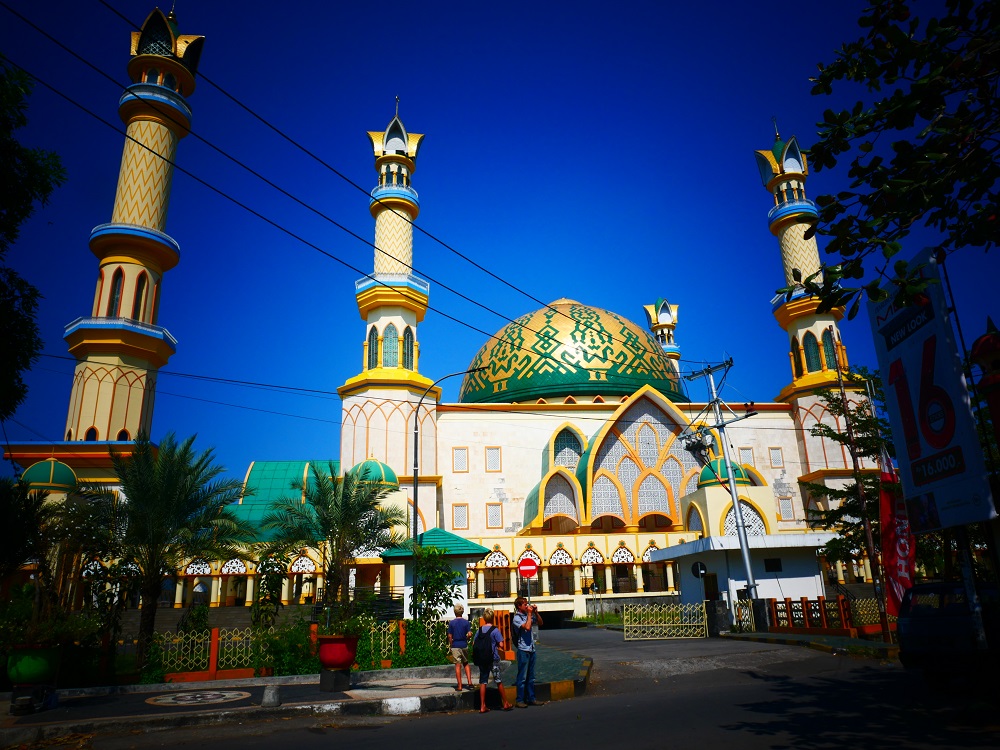
David and the kids in front of the Islamic Centre Mosque in Mataram, Lombok.

Lombok is an interesting place, and like the rest of Indonesia it is full of history. The original inhabitants of Lombok were the Sasak people who governed the island through numerous feuding kingdoms. Originally a mixture of Buddhist-Hindu-animists, the Sasak were forced to convert to Islam in the 16th century, after which many began practising a mixed religion called Wetu Telu that blended Islam with previous beliefs. In the early 16th century the Balinese kingdom conquered Lombok, and in the 17th century the Dutch East India Company established a treaty with a Sasak princess. Fed up with Balinese rule, the Sasak invited the Dutch to rule Lombok in the late 19th century, after which the Dutch promptly sent a large army and helped the Sasak fight off the Balinese.

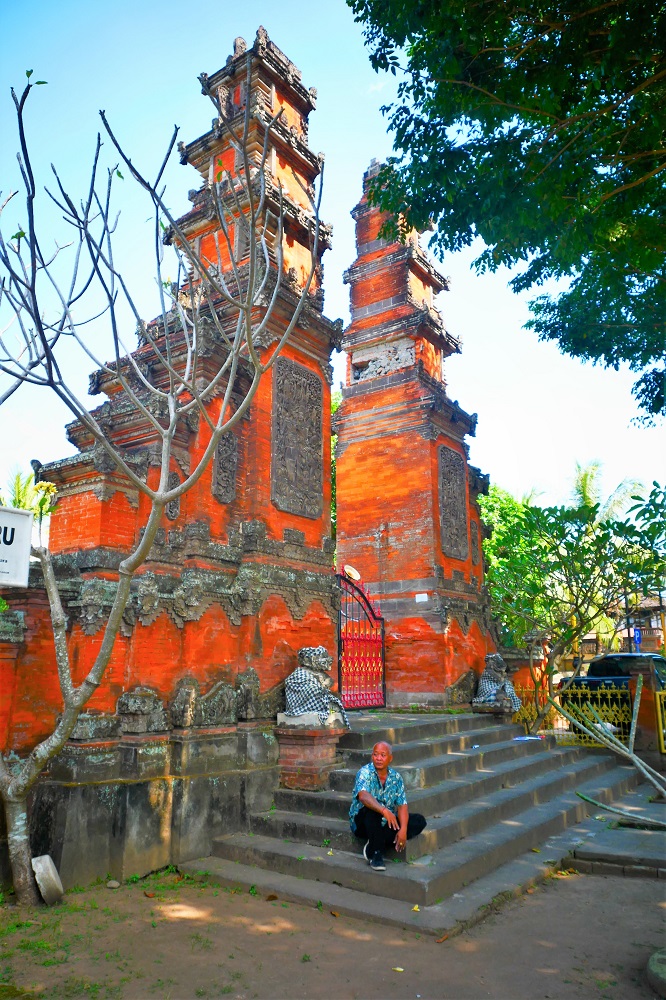
The Hindu Meru temple in Mataram.
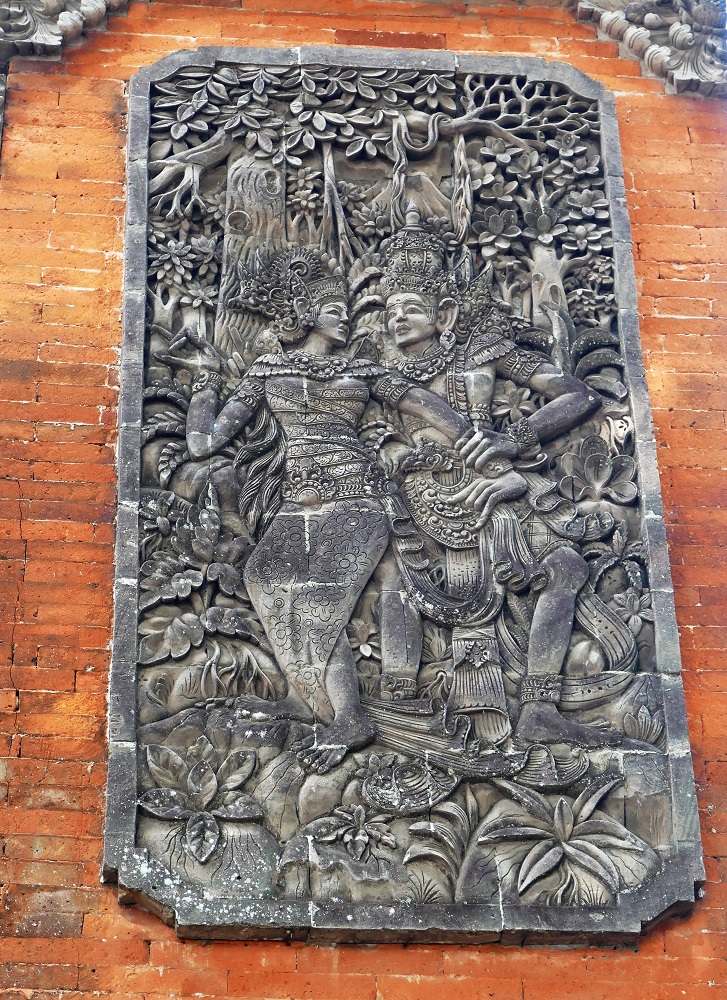
Elaborate stone carving gracing the front of the Meru Temple.

Bali is predominantly Hindu, and the Balinese left several Hindu temples on Lombok. In Mataram we visited the Meru Temple, built in 1720, a large dilapidated complex of multi-tiered shrines to various Hindu gods and goddesses. Nowadays the vast majority of the population of Lombok is Muslim and only about 10-15% are Hindu.

The minaret of a neighbouring mosque can be seen through the archway of the Hindu Meru temple of Mataram.

After a day on the west coast of Lombok we headed to the Gili Isles further north where we were meeting up with friends and hoping to relax in a calm anchorage.

Fishy faces

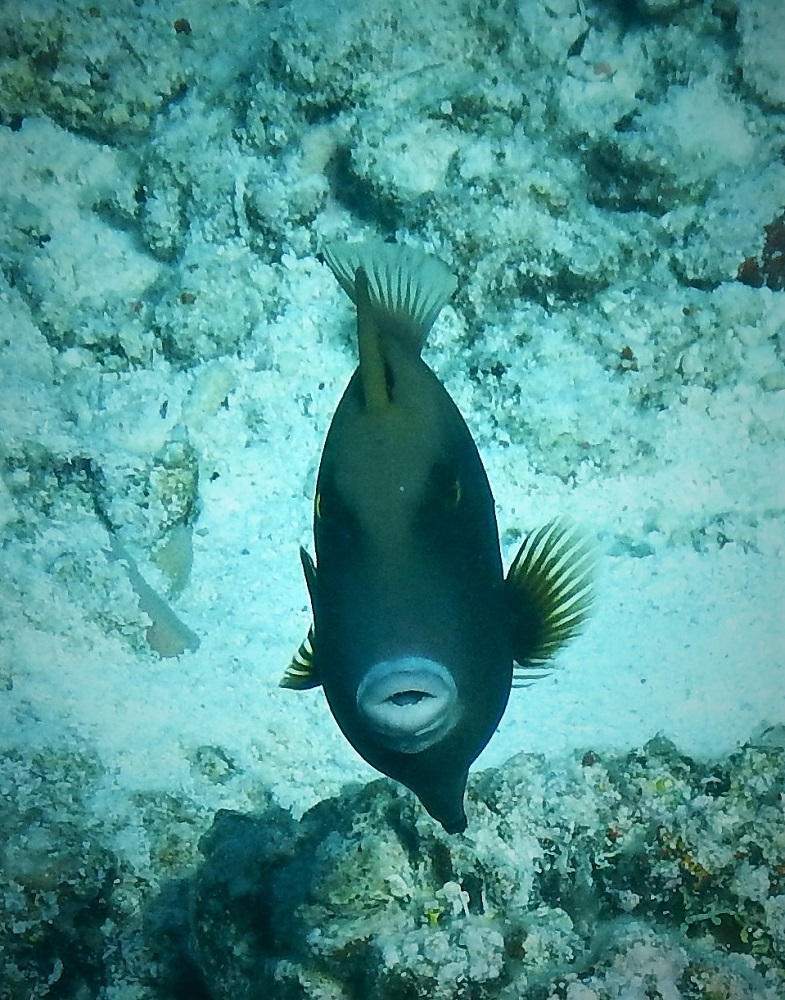
Luscious lips and fluttery lashes: a triggerfish on display.

When you spend as much time as we do in the water, fish become almost part of the family, their funny little faces the wallpaper of our life. Coral reef fish are so diverse that you always see something new, and when you really look at them, many fish look so weird that it is hard not to find them funny.

Following are some of our favourites, the little colourful, funny, odd or downright menacing faces we encounter day after day.

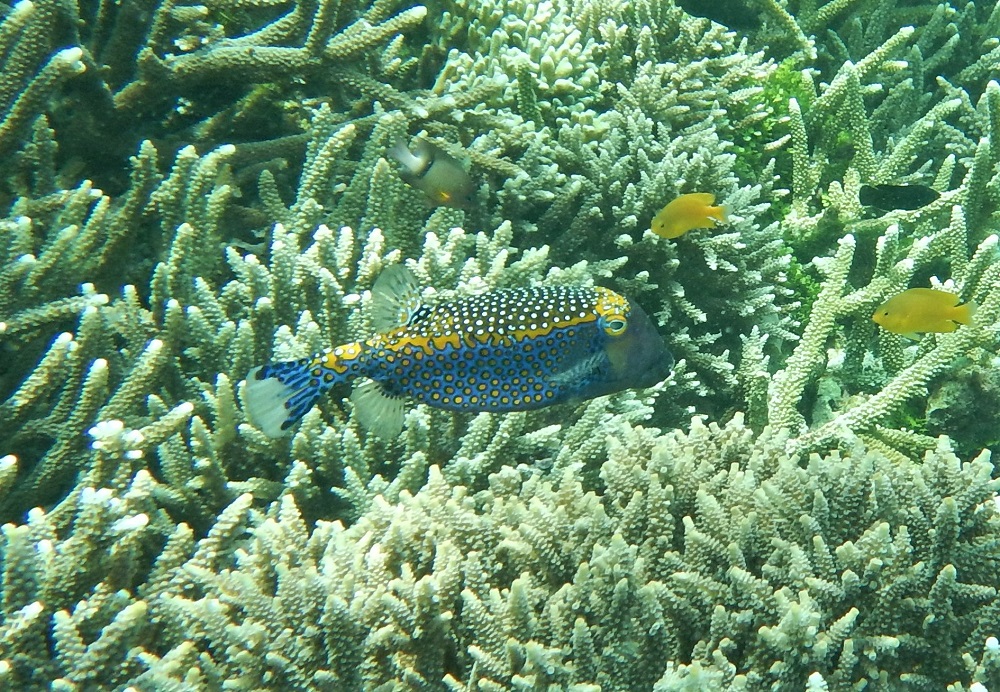
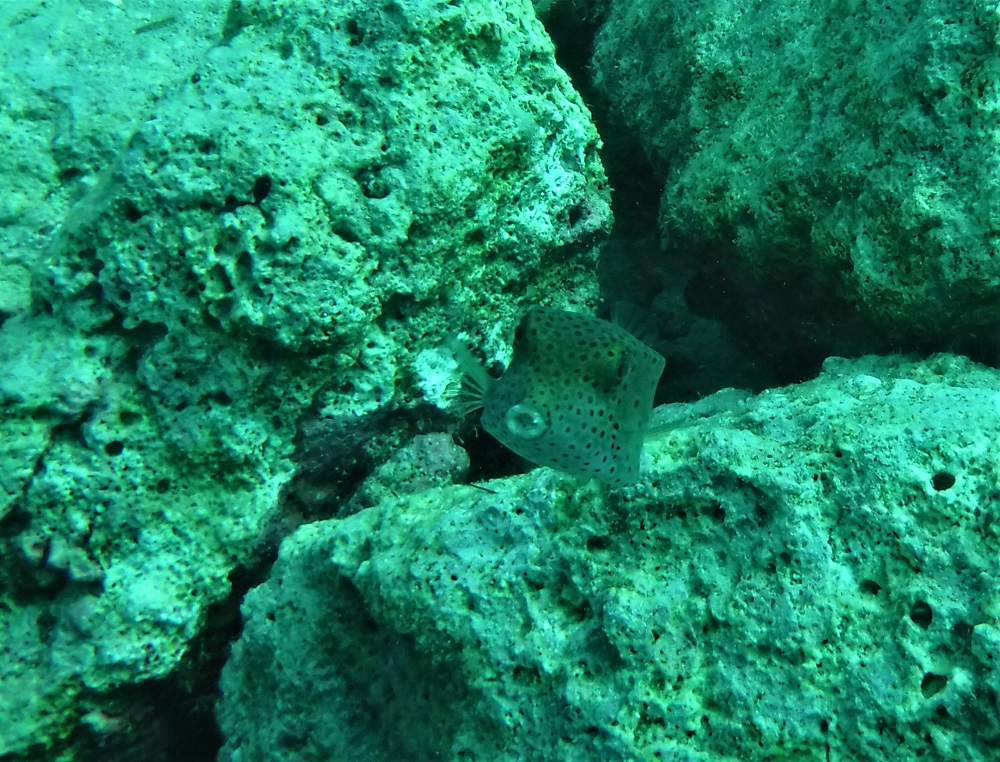
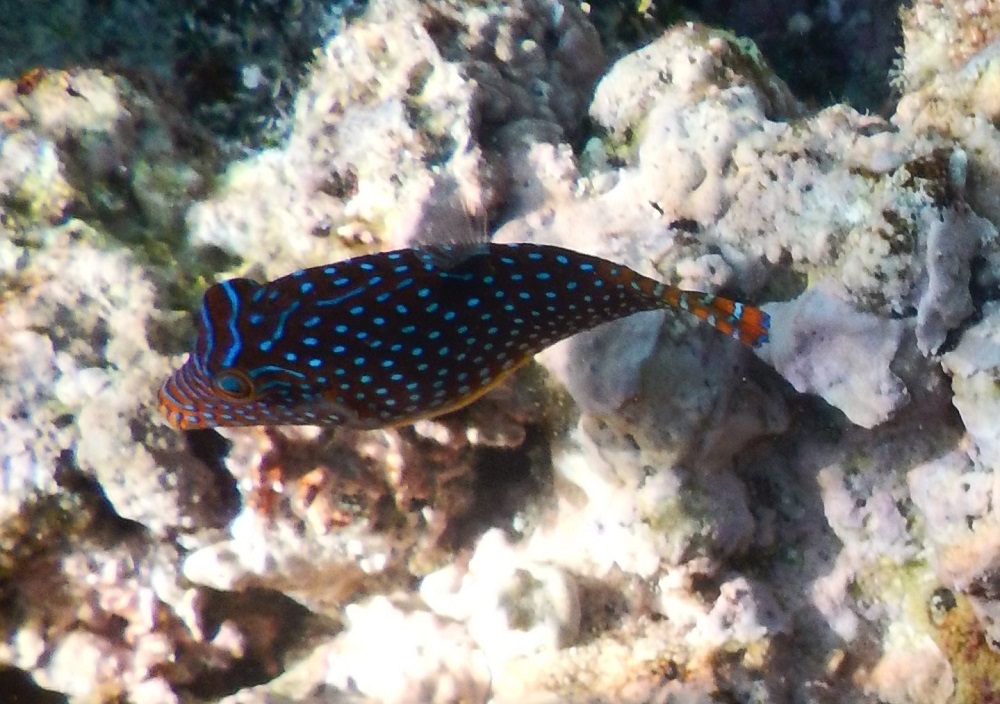
Impossibly square spotted boxfish.

The funny:

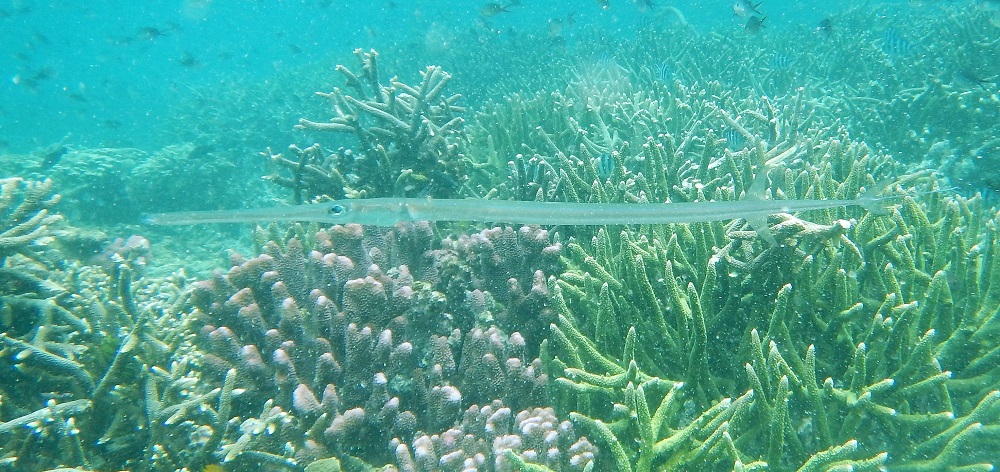
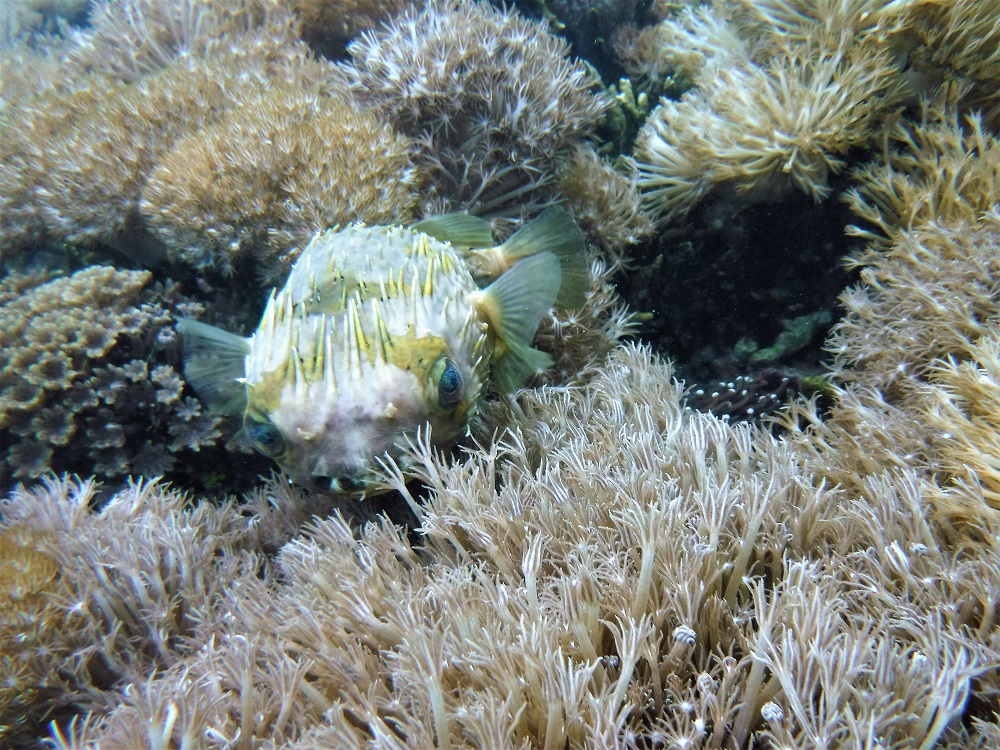
I know I’m a bit of a fanatic, but the thing about reef fish is that some of them just look so ridiculous that it beggars belief. The huge cataracty eyes of porcupine fish, the nervous kissy mouths of puffers, the bulging eyes ruining the disguise of spadefish – they are so ludicrous that it is hard to take them seriously. Same with the body shapes – I can respect a tuna or a shark, but what gave rise to the strange non-streamlined boxfishes, the triangular and strangely tail-fin-less tobys, and the insanely stretched expanse of cornetfish? And although I’m sure carefully evolved and incredibly adaptive, fish behaviour is really downright strange sometimes. Why does the trumpetfish think that hanging upside down renders it invisible? And the spadefish, carefully turning as you swim around them, trying to keep their slim side exposed rather than the expanse of their huge fins – it obviously works with predators, but really?

Long and incredibly thin: a cornetfish.
Evil elf: opaque-eyed balloonfish.
Boxfish coming up for a kiss.
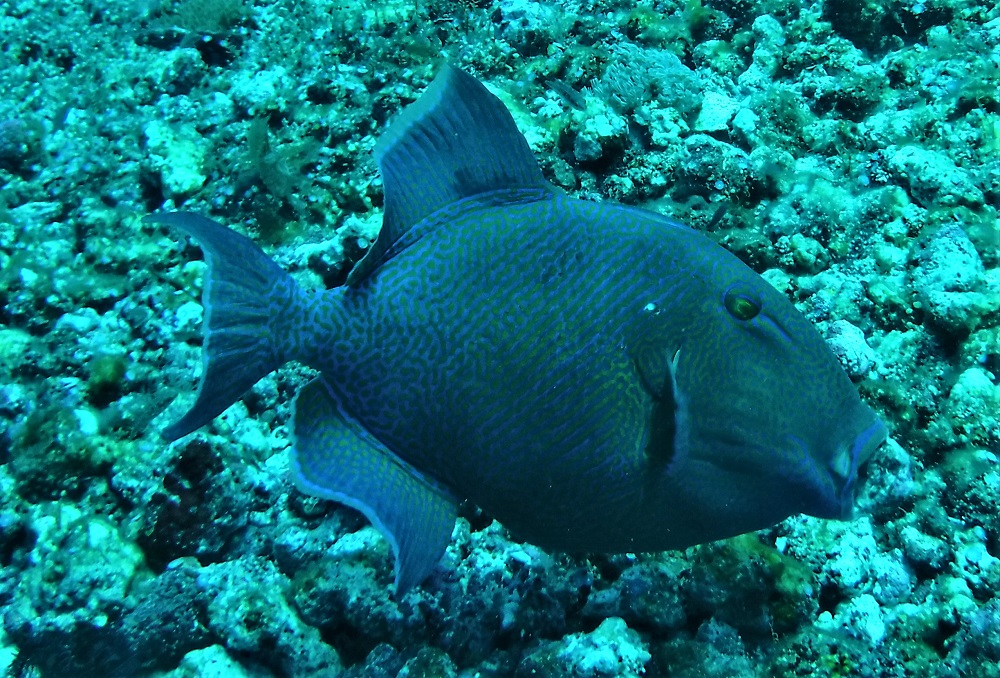
Blue triggerfish spitting out a foul-tasting rock.
Ridiculously frilly ribbon eel.
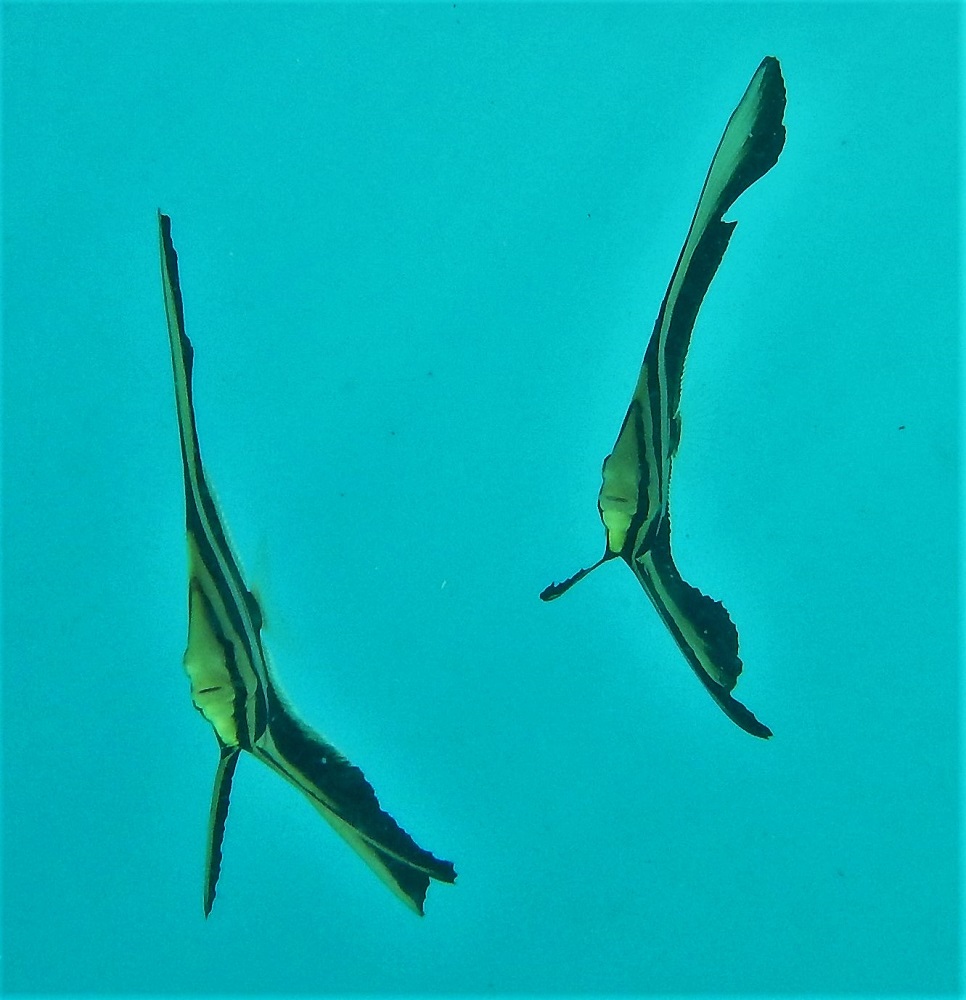
Juvenile spadefish with bulging eyes trying to show us their slim side.
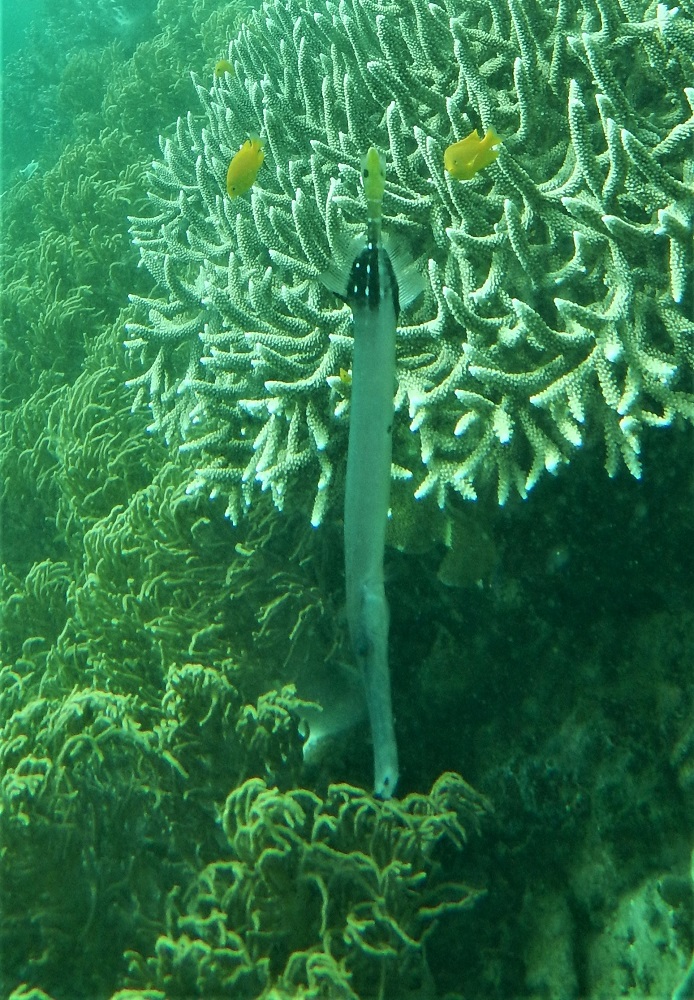
Trumpetfish: if I hang upside down I bet she can’t see me…

Evil lurkers:

Menacing predators with upturned mouths, bulging eyes and frilly eyelashes disguised as bits of coral or sponge are everywhere on the reef and given our untrained eyes, I’m sure we only spot a fraction of them.

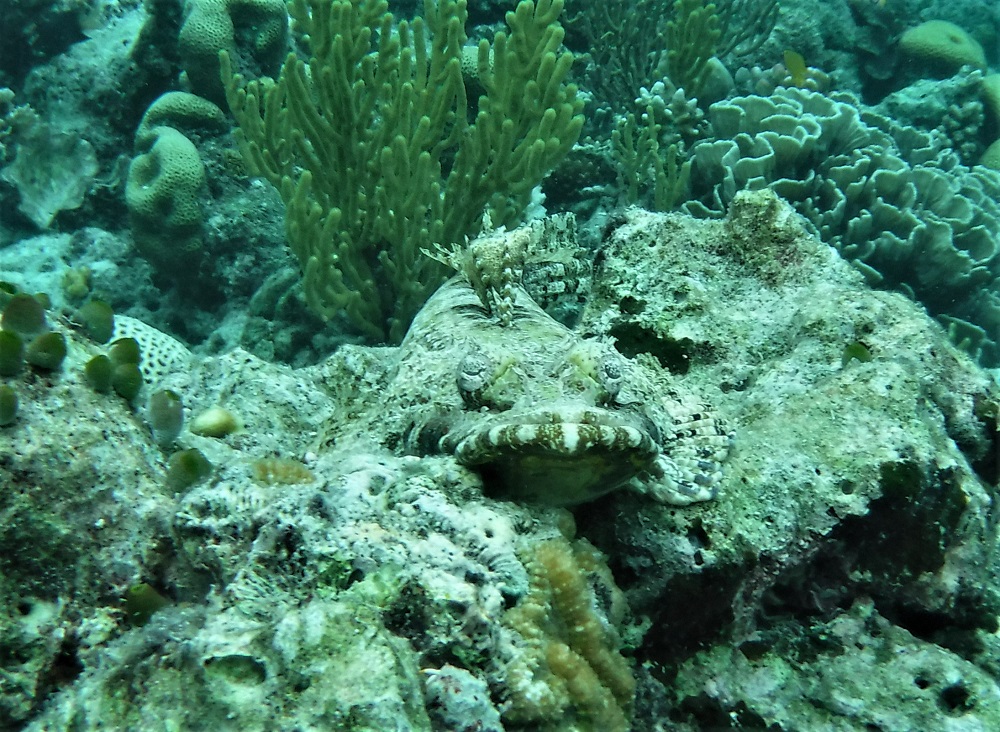
Morose-looking crocodile flathead. They believe themselves to be so well camouflaged that you can swim right up and touch them. They steadfastly stay in place and refuse to believe that you have seen through their disguise despite all evidence to the contrary.
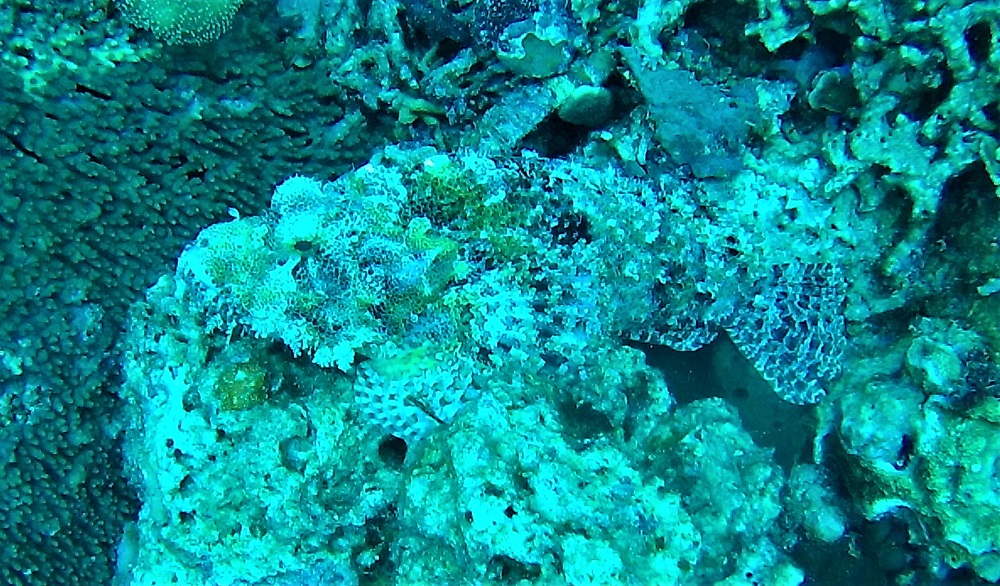
Full-bodied scorpionfish disguised as coral reef.
Another crocodile flathead – visible mainly through the bulging eyes.
No disguise needed: hostile all-black lionfish.
Grumpy scorpionfish: evil-doer hiding in plain sight.
Cross-eyed moray eel coming up to bite.
Devil scorpionfish pretending to be reef flat.

The terrified:

Most reef fish are prey and as a result many are nervous and skittery, fleeing the moment they see you to hide in expanses of corals or anemones or under dark ledges. Their huge eyes add to the general impression of a life lived in a state of near-constant panic.

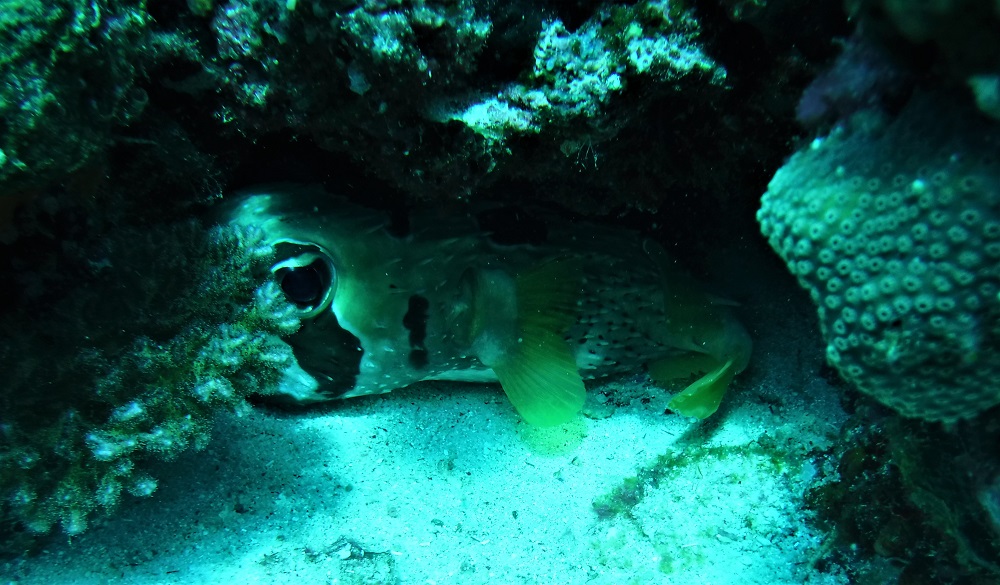
Black-blotched porcupinefish hiding under a ledge.
Nervous toby.
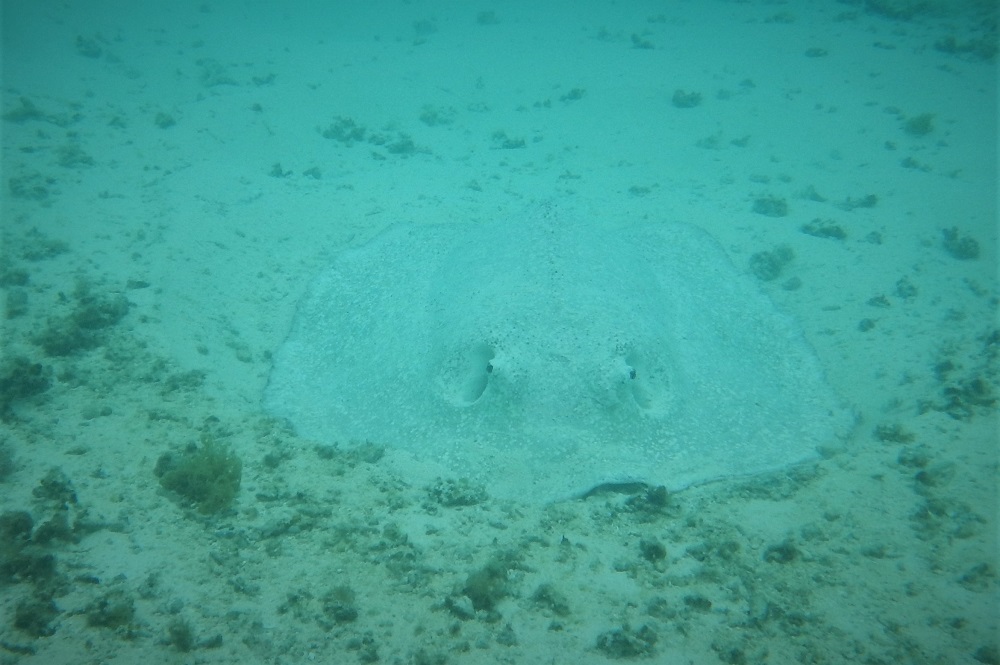
Apprehensive ray hoping to hide.
Wide-eyed triggerfish fleeing on our approach.
Longnose filefish hiding in the coral.
Distressed damselfish eyeing us suspiciously.
Blackspotted puffer turning to flee.

The beautiful:

And then of course there are all the beautiful fish – the dazzlingly colourful, the intricately patterned, the insanely elegant, which combine to make coral reefs so stunning.

Colourful blue-girdled angelfish coming up for a look.
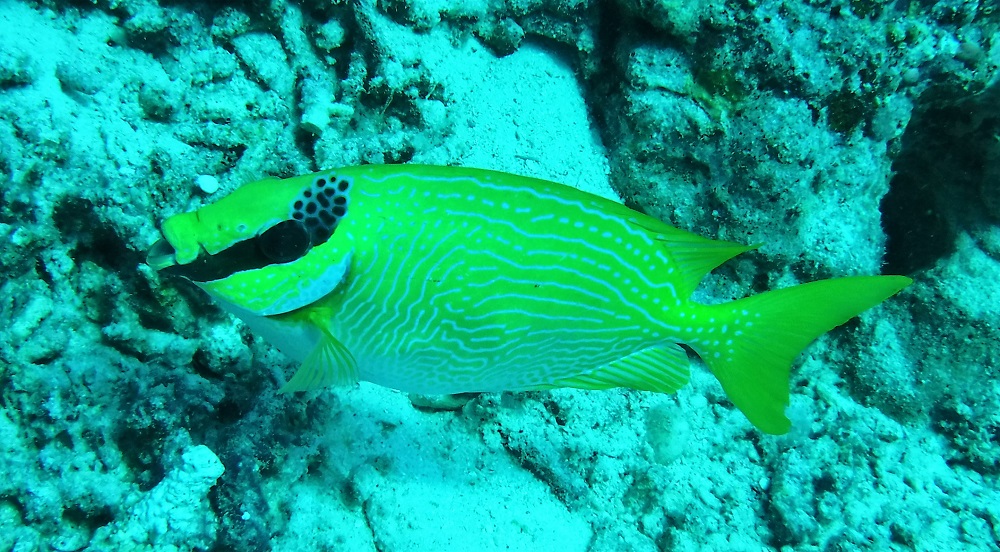
Masked rabbitfish showing off intricate patterns.
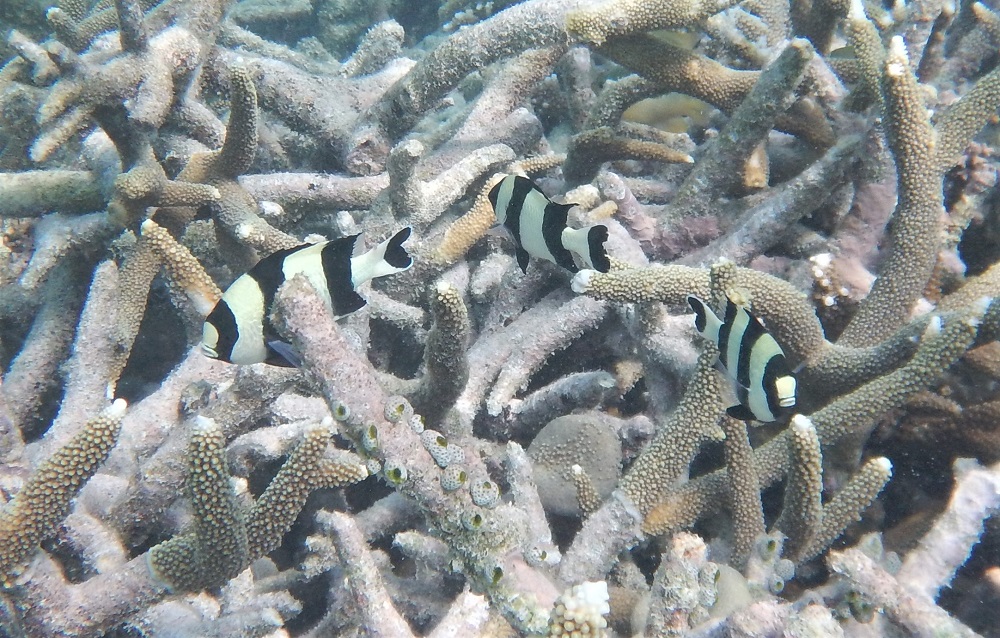
Zebrafish: black-tailed dascyllus hiding in staghorn coral.
Boxy but beautiful.
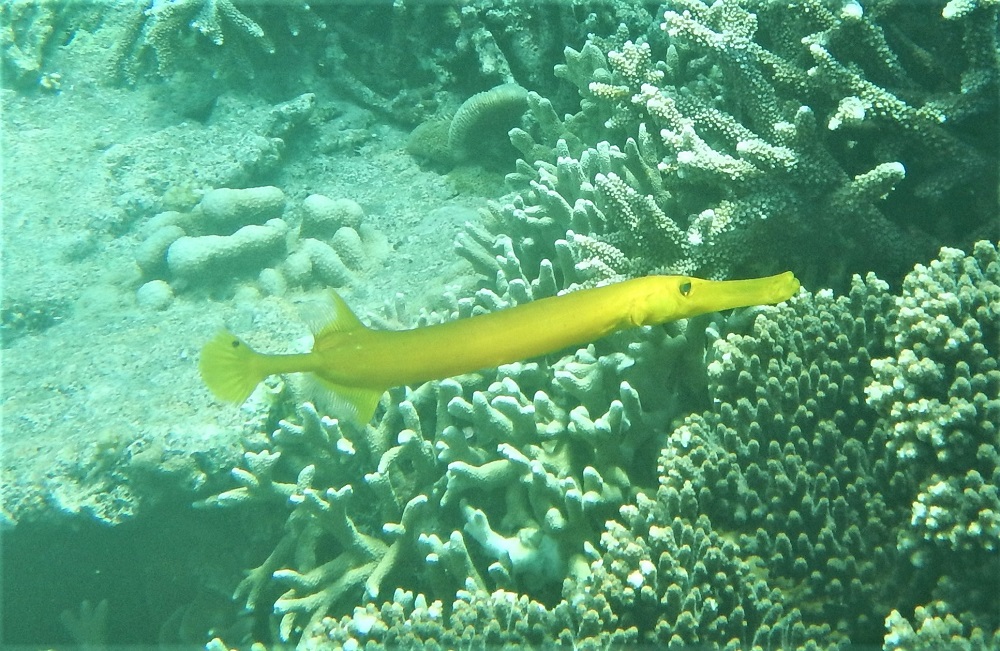
Yellow trumpetfish.
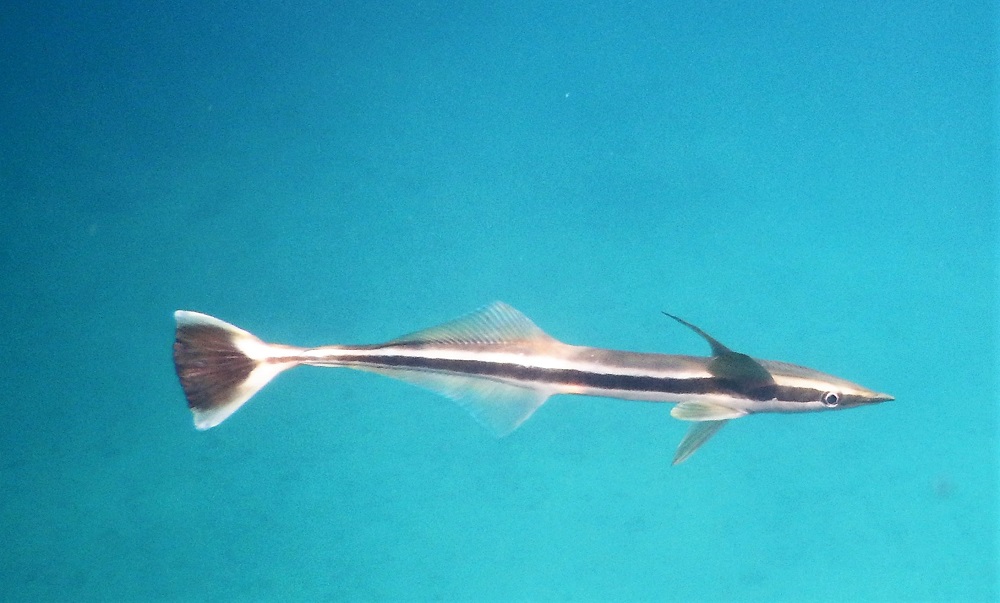
Sharksucker evaluating us for suck-up potential.
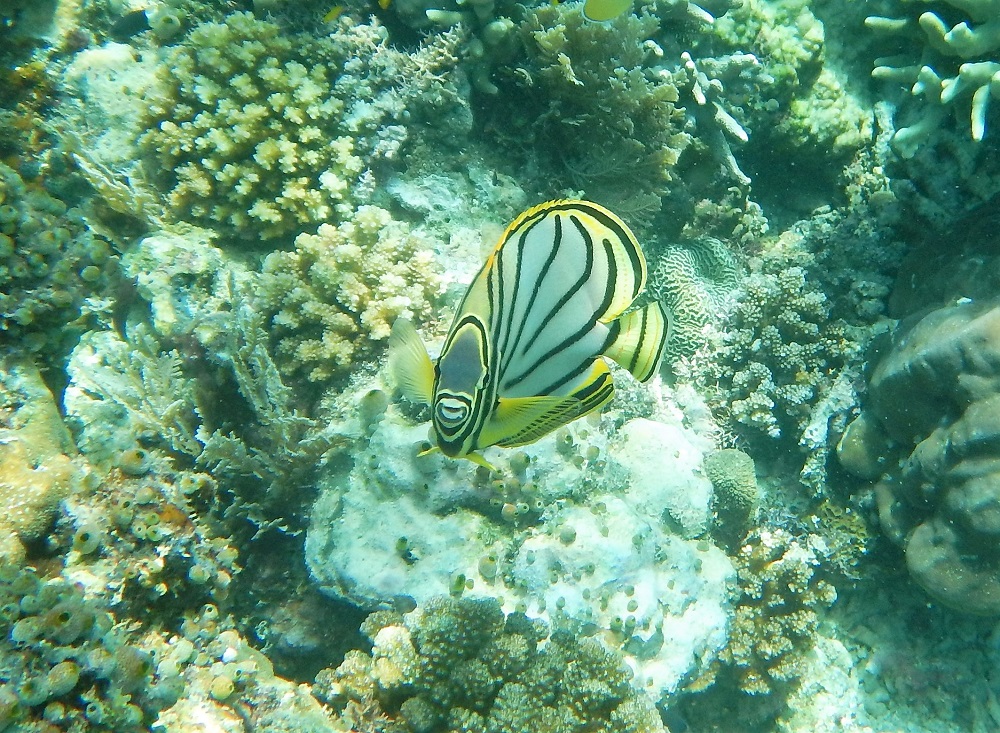
Symmetric perfection: reticent butterfly fish displaying his glamorous pattern.
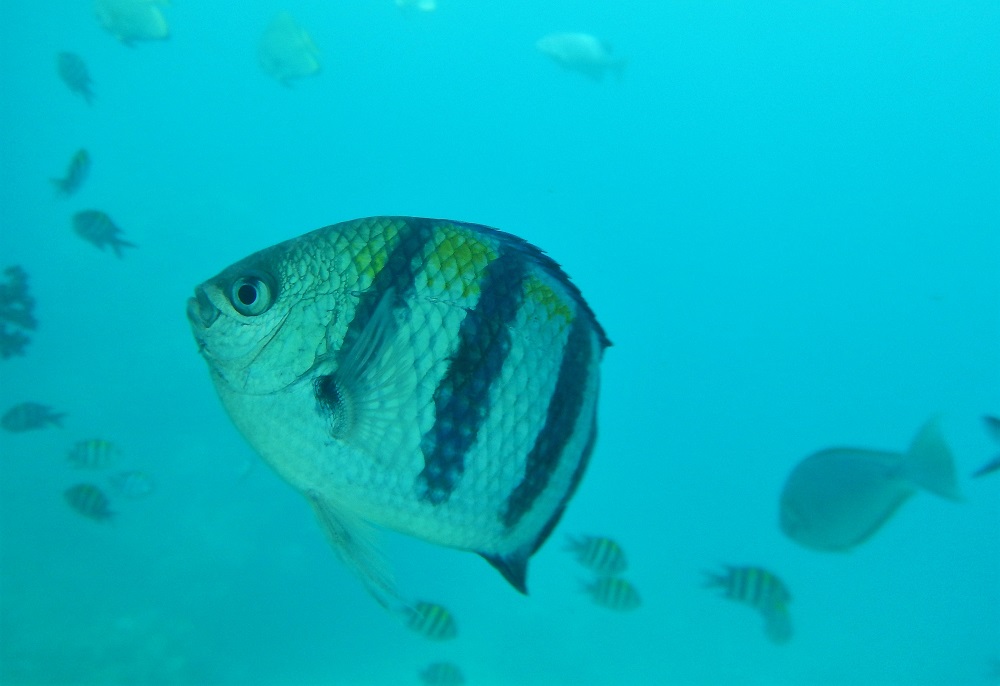
Sergeant displaying his beauty.
Bright guineafowl puffer.

Komodo: diving and dragons

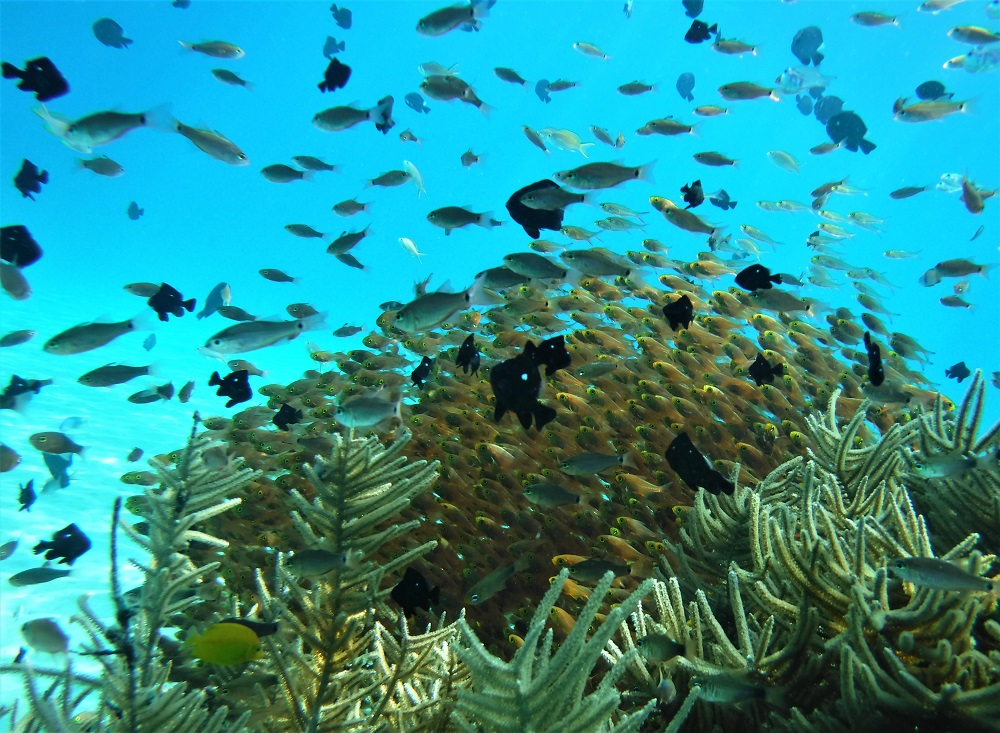
The water is thick with fish in Komodo National Park.

“Daddy,” said Lukie, “would you rather be eaten by a Komodo dragon or a saltwater crocodile?”

David looked out over the sunset colouring the quiet bay. “Hmm,” he said. “It’s a tough one. Maybe a saltwater crocodile?”

“No, I think a Komodo dragon is better,” interjected Matias. “At least you have a chance to run away from them. Saltwater crocodiles are faster.”

“But the Komodo dragon may just bite you and leave you to die from infection and poison.” Lukie collapsed on the cockpit seat with a groaning sound, arms flopping, legs beset with spasms. He lifted his head to look at the rest of us seated around the dinner table. “And then you have to lie there for two weeks until you finally die and then they come and eat you.” He dropped his head down to lie flat. “I think a saltie,” he said dreamily, looking up at the cockpit ceiling.

Lukie ready to fight off dragons.

He abruptly sat back up and we continued eating, silently contemplating a slow death by dragon poison combined with searing thirst and terrible sunburn on the desolate trail of a bone-dry island. Lukie paused his chewing, fork in mid-air. “Would you rather be attacked by a Komodo dragon or a great white shark, then?” he asked, gesturing with the fork.

“Dragon,” said David and Matias in unison.

Lukie nodded. “Me too. Because with the shark you would drown even if you are just injured, whereas with the dragon you might be able to get help.”

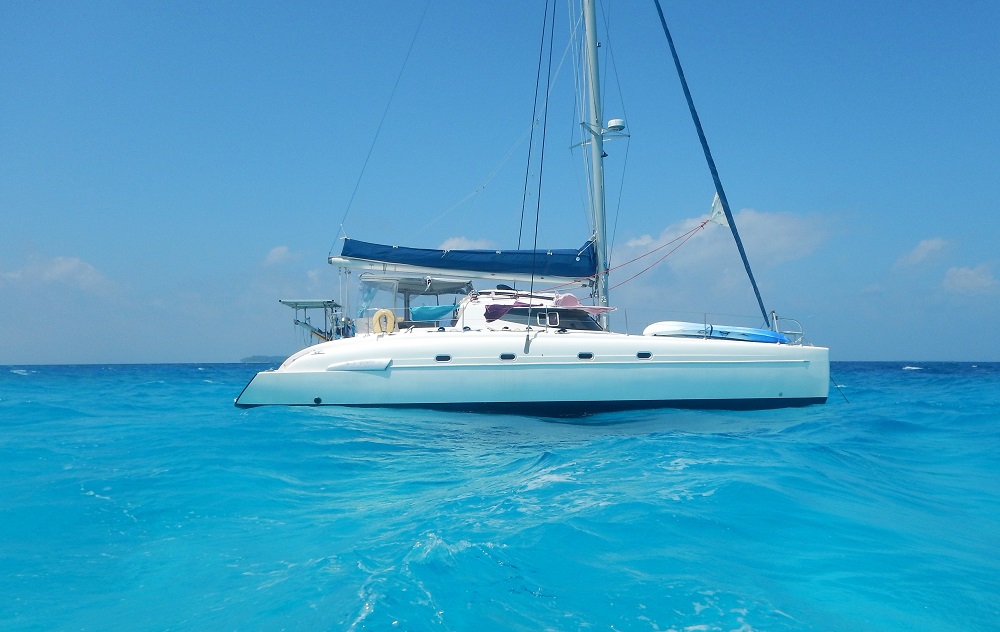
Bob in Crocodile Bay by Rinca Island, Komodo National Park.

We were anchored just outside Komodo National Park and had spent the day seeing the famous dragons on Rinca Island, one of the four islands on which they are found. The park extends out to sea, covering the islands of Komodo and Rinca as well as numerous smaller islets. It was established in 1980 to protect the dragons and preserve the amazing coral reefs of the many islands, and the area is one of the most visited in Indonesia, both by locals and tourists. In Rinca Island the bay where we anchored before going ashore to see the dragons was full of phinisis, the local tourist boats. Many of the boats were liveaboard dive charters who spend their days ferrying divers to and from world famous dive sites and throw in a land visit to see dragons for added excitement.

Komodo has fully embraced tourism, and the government is determined to profit. In typical Indonesian fashion, the fee system is comprehensive and incredibly complicated.

“So,” said David the night before we went to see the dragons. “There’s a boat fee that we’ll have to pay, that’s Rp 100,000. And then we must pay park entry, for foreigners that is Rp 100,000 per person per day. And a guide fee, of Rp 80,000.”

I nodded. “Sounds quite expensive.”

“Oh, but you haven’t heard half. There’s a holiday fee of Rp 225,000 per person, which applies on any national holiday and on all Sundays. Not sure if that is only for tourists or for locals too.” He sighed.

I nodded again. We were visiting the dragons on a Saturday, but because it was the week of the end of Ramadan it would be a public holiday, so we would have to pay the extra fee.

“And then, get this, there’s a hiking fee, of Rp 5000 per person. And a Rp 10,000 ‘wildlife observation fee’ per person…” He buried his head in his hands and groaned. “I mean, when do they charge that – how do they know whether you’re observing wildlife?”

“I heard that there’s a camera fee, too,” I said. “So maybe we just bring in the big camera and leave the phones on the boat, so we only pay once?”

Matias diving in Komodo: better pay the ‘wildlife observation fee’.

“Mummy,” interrupted Lukie, sticking his head in from the cockpit. “Would you rather be stuck on the island with just your camera, or with just your phone?”

“Phone,” I responded, waving him away. “But we won’t be stuck, there’s plenty of people there….”

Komodo dragons: worth every penny.

Seeing the dragons is, of course, worth the fees, and heaven knows it would be good if the locals could benefit from tourism and thus be encouraged to reduce development and destructive fishing within the park. Our guide on Rinca Island was from the island and explained what the park means for the locals. “When the government made the Park in 1980, they told the people living on the islands that they must never harm the dragons,” he said as we were walking along the sunny trail. “So even if you get bitten by one, you are not allowed to kill it.”

The dragons are carnivorous; their traditional prey were the small indigenous Timor deer living on the islands. People brought in pigs, buffaloes and larger deer, which quickly became prey for the hungry reptiles, who hide along animal trails and attack whatever comes along. Unfortunately, that includes the occasional passing human.

Do the locals benefit from the park? we asked and he responded that as most of the population are fishers and they fish on undisturbed, the park brings no changes to their lives. A few sell wood carvings to visitors and some are employed as rangers or guides but most of the park staff are from Java, and so overall it makes little difference to his village whether there’s a park or not.

Which leaves us wondering where all the money goes. Revenue from the park admissions are not fed back into park maintenance and there is therefore no incentive for the park to improve amenities. Not that they necessarily need to increase visitor numbers: in 2018, the park revenue was Rp 32 billion, a nice little earner for the government, and the locals grumble that the money goes towards paying for the governor’s big house on the hill.

Octopus coming out to play in Komodo National Park.

The outlandish fees certainly shorten our stay there. A day tied up to a mooring to enjoy snorkelling, diving or surfing in the park will cost us Rp 1 million (about NZ$100), which means that, being on a budget, we have to carefully pick the days we enter the park. Anchoring in depths accessible to yachts is forbidden in most locations, but there are insufficient moorings and a lot of dive boats, which leaves us tying up to phinisis on crowded moorings while waiting for a free spot.

Clear water: Lukie snorkelling on the anchor chain in Banta Island, Komodo.

“Daddy, if the mooring fails, would you rather be tied up to a phinisi, or have one tied up to you?” asked Lukie one morning when a tourist boat politely asked to tie up to us on a mooring just outside the park.

“Tied up to another boat,” said David as he made the visiting boat’s rope off on the port stern cleat. “That way you can just untie if something goes wrong. Whereas if they’re tied to you, you have to get yourself off the mooring and get them off you.” He smiled and waved at the tourists who were being served lunch on the phinisi foredeck just metres from our stern.

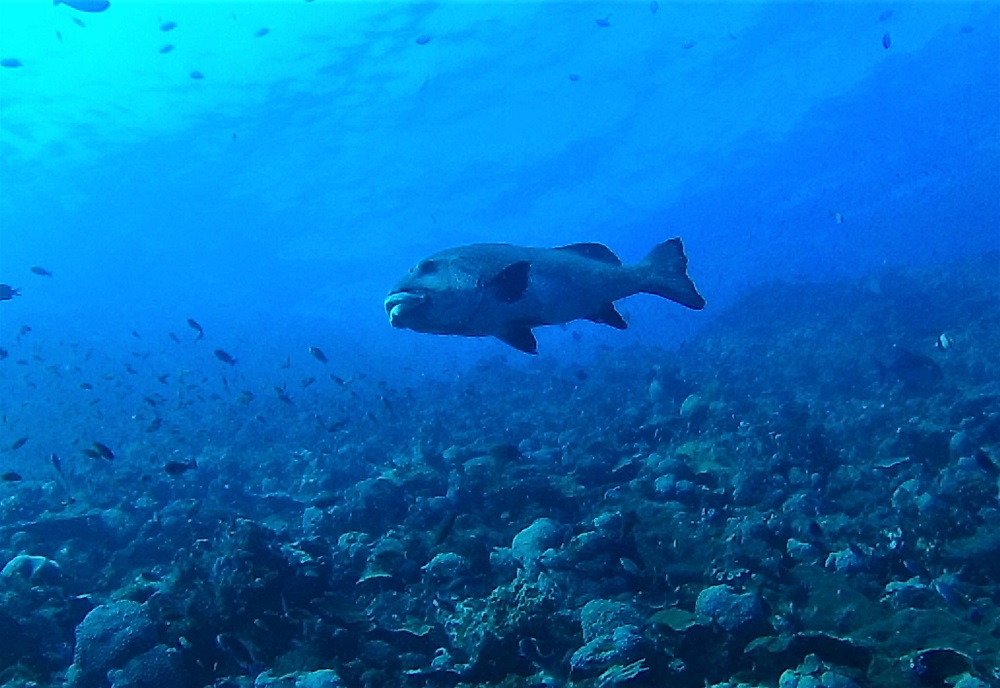
Large pelagics swim by on the current-swept dive sites.

It’s easy to understand why the diving industry here is thriving. The Komodo National Park is in the middle of the Indonesian through-flow, which means insane currents swirling past steep underwater mounts, making for exhilarating diving on vertical walls graced by huge pelagics like Napoleon wrasse, groupers, and giant trevallies as well as sharks and turtles. Shallow straits create ideal conditions for drift diving over current-scarred bottoms hiding cryptic life cowering in the shadows of large manta rays waiting for their turn at popular cleaning stations. Sheltered bays offer amazing coral concealing large moray eels, pipefishes and colourfully fragile nudibranchs.

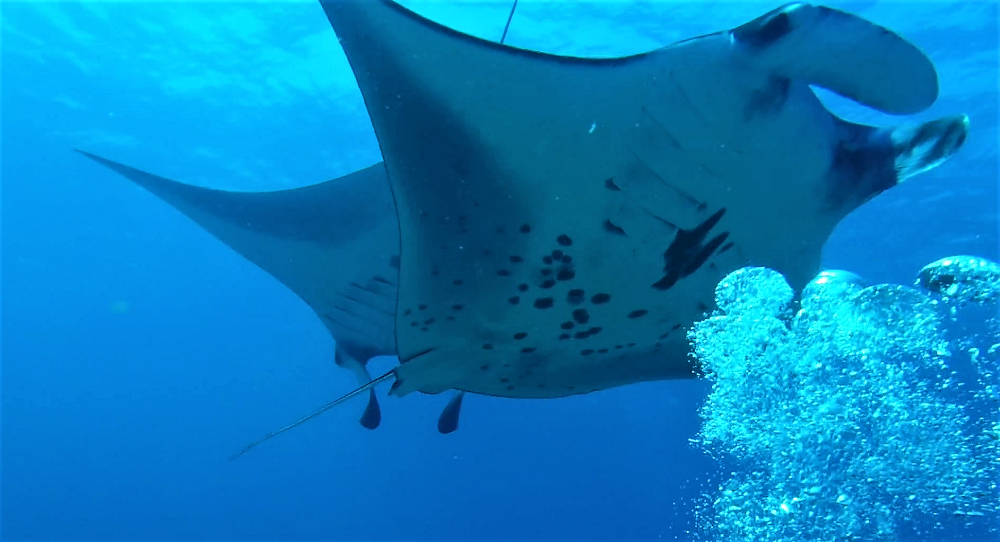
Manta rays playing with our dive bubbles.
Manta poo landing on our heads…

If the fee was similar to that of Raja Ampat, we would stay for weeks, cruising every inch of the park, diving all the famous sites, but as it is we limit our stay to one week, dipping in and out of the Park to maximise what we can see on our budget. Payment is to the rangers that patrol the park and when they failed to approach us at Gili Lawa Laut north of Komodo where we’ve been drift snorkelling with giant trevally in currents so strong that they created little whirlpools we decided instead to donate the money to WWF marine conservation efforts in Indonesia, figuring that they probably do a better job at using the money to improve the environment than the Indonesian government.

Placid turtle allowing a close-up.

It turns out that we are just in time to see it all. The government plans to close parts of the park and in 2020 all access to Komodo Island will be terminated, ostensibly for ‘habitat restoration’ but rumour has it that it is an attempt to clamp down on the illegal theft of dragons to supply a lucrative overseas pet trade market. Diving will still be allowed, but access to the most popular dive sites will be limited to a certain number of boats daily, which is probably sensible in terms of limiting the harm done to this breath-taking and unique environment.
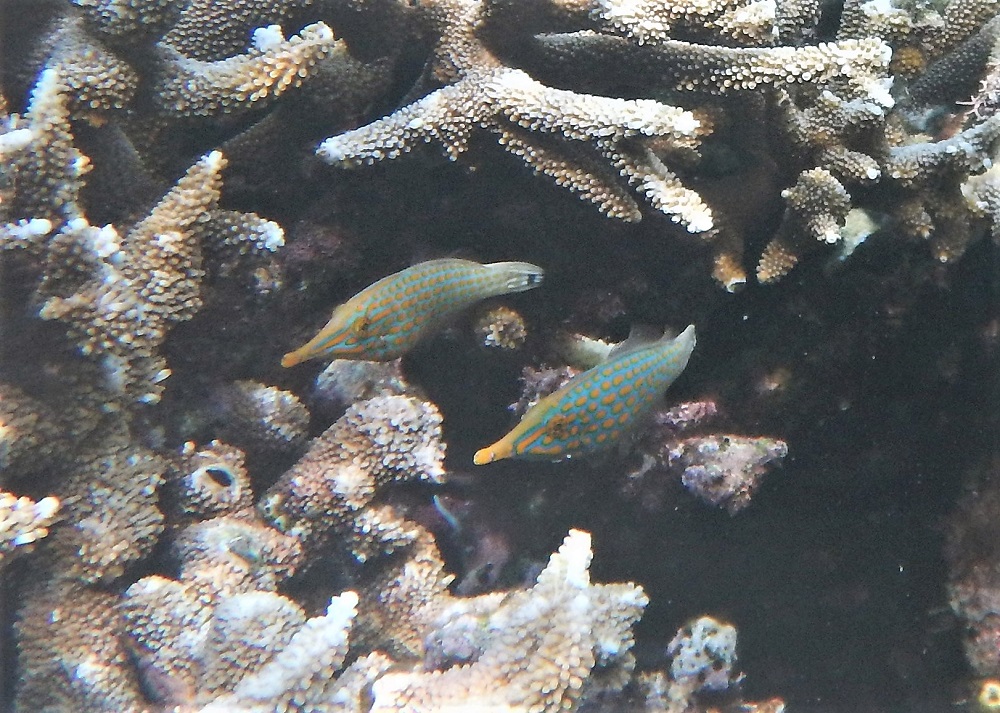
Shy pufferfish trying to blend in with the background at Banta Island, Komodo.
Razorfish trying to blend in with the background coral.

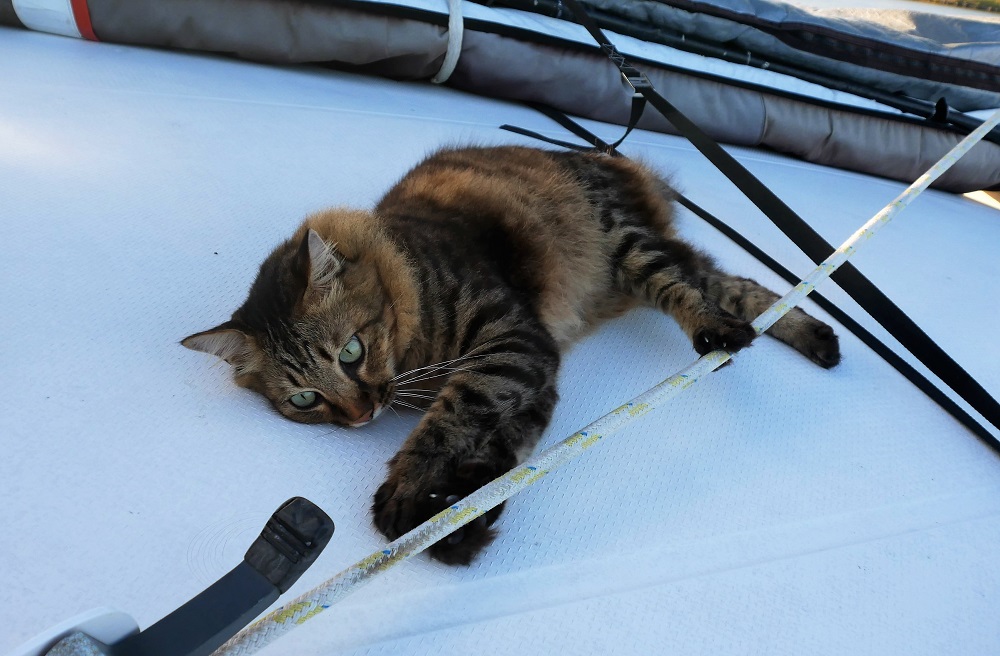
It is not just the underwater scenery that is amazing. The islands here are volcanic and dry, hills covered in yellow grasses with green vegetation and trees only gracing low-lying, shady valleys, a complete change from the jungle-clad humid isles further north. We are now far enough west to meet monkeys and snakes live on these islands too, and we are under strict instructions not to take Paco the Cat ashore, although I’m not sure he’s entirely safe on the boat with the giant sea eagles overhead forming menacing shadows with wings outstretched, their beady eyes lusting for small furry prey.  

Watch out for the eagles, Paco!

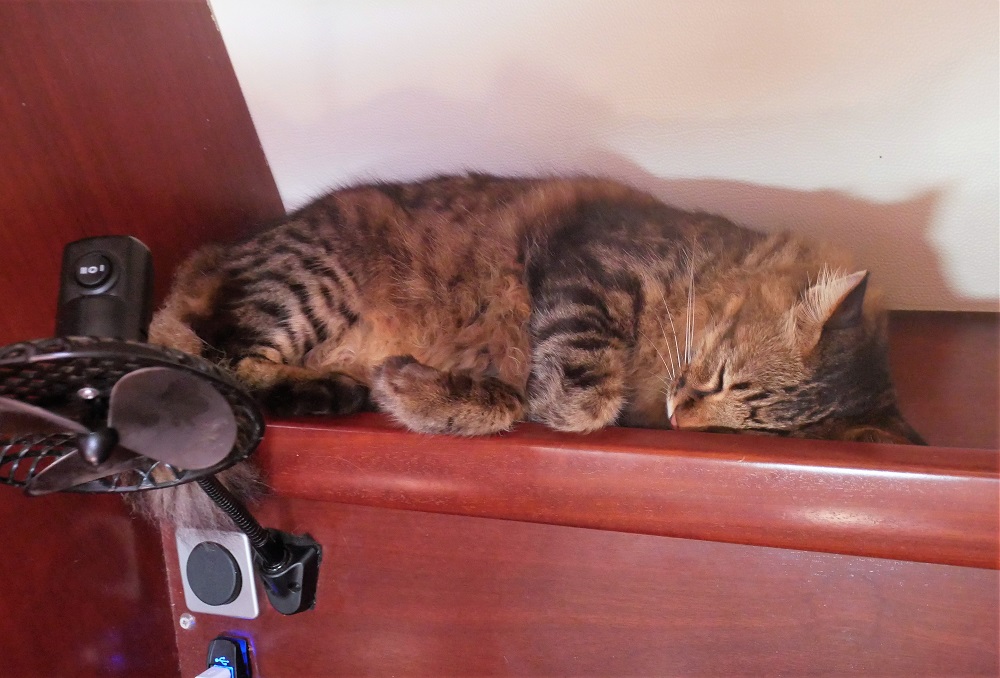
After an initial day of nervous uncertainty, Paco has relaxed into the rhythm of life on Bob the Cat. Being a monohull cat, he wedged himself tightly into a shelf for the first passage, expecting the boat to heel sharply over as soon as the sails came up, only to look astonished when his shelf remained level for the entire journey. Now a seasoned catamaran-cat, he knows he can lie pretty much anywhere when we’re underway and has taken over large parts of the saloon seats as he lounges about, fully outstretched, in the midday heat.

Paco wedged into his shelf.

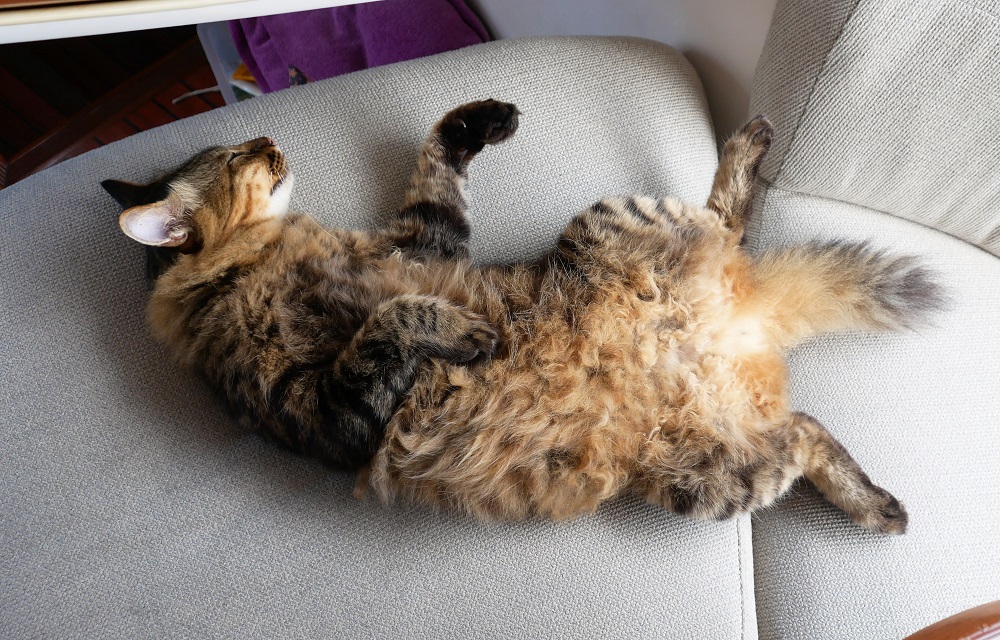
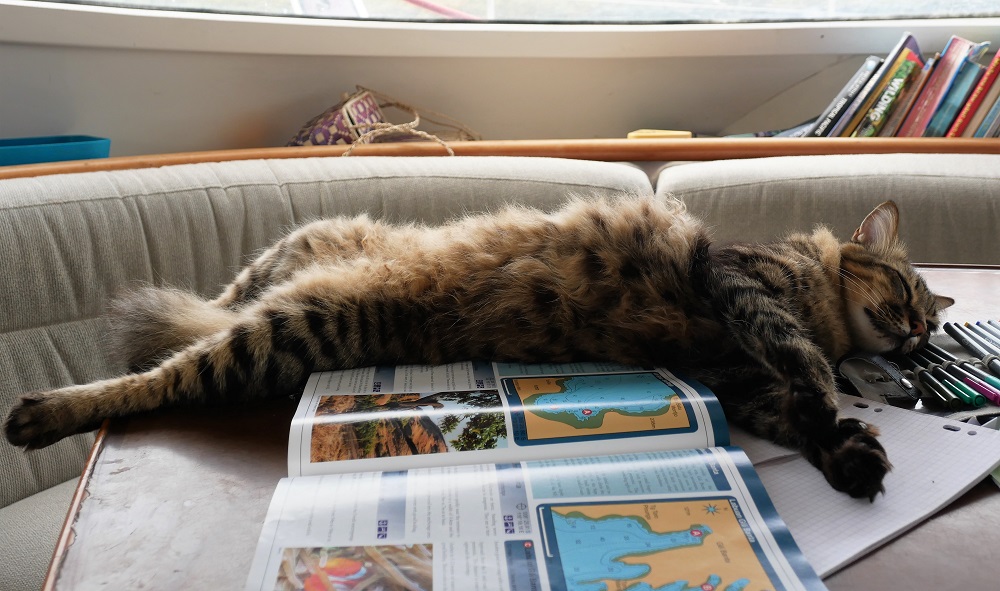
He is incredibly inactive and very tolerant, sleeping most of the day away and simply stretching out further with a deep purr as someone strokes him, only really waking up when he’s hungry, which sees him begging for fish by randomly attacking the ankles of anyone stepping into the kitchen. His preferred food is small mackerels, lightly steamed, and when we catch a tuna and offer him a steaming slab of fresh sushi he eyes us reproachfully and stretches his front paws up to the top of the fridge where his chilled mackerel are kept, meowing to indicate what he wants. We’re used to overweight, grumpy Bob at home who we thought was lazy, but Paco takes lethargy to a whole new level, and I do wonder whether boat life is stimulating enough for a cat.

Ahh, I feel tired.
Fully relaxed.
Afternoon nap on the table.

“Mummy,” said Lukie one afternoon as we were surveying Paco’s sleeping shape. “If you were Paco, would you rather stay in a Malaysian fish market where you could explore wherever you wanted, or come and live on Bob the Cat where there’s nowhere to go and nothing to chase, but there’s plenty to eat and you don’t get run over by a motorbike?”

A hard choice indeed – the cats we see on the streets here look terrible, all missing bits of their tails (presumably from being run over by the ever-present motorbikes), limping around with manky eyes and infected wounds dripping pus onto the pavement. There is no doubt that Paco’s life is easier, and he doesn’t seem unhappy, just strangely inert for a relatively young cat.

“Probably live on Bob the Cat,” I said. “But all the same, we better play a bit with him, keep him active.”

Bob in Banta Island bay.

Our last stop in Komodo was Banta Island, an uninhabited volcanic island north-west of the Park where we relished a solitude not normally encountered in the busy Indonesian waters.

David and Lukie climbing the hills of Banta.
Cooking damper on a beach fire on Banta Island.

“Mummy,” said Lukie, as we were climbing the hill behind the anchorage on a stunning afternoon. “Would you rather surf a tsunami or dive a whirlpool?”

Hmm. “Dive a whirlpool,” I said remembering some wonderful times in Scotland involving diving deceptively placid whirlpools at slack tide. “What about you, Lukie?”

“Surf a tsunami I think,” he says.

“Alright,” I said. “Then I guess we better head to Lombok!” And there on top of the hill, we turned west towards the afternoon sun, squinting our eyes to look in the direction of our next adventure.

Looking north from Banta Island, the western seafront just visible to the left of the image.

A crew addition in Makassar

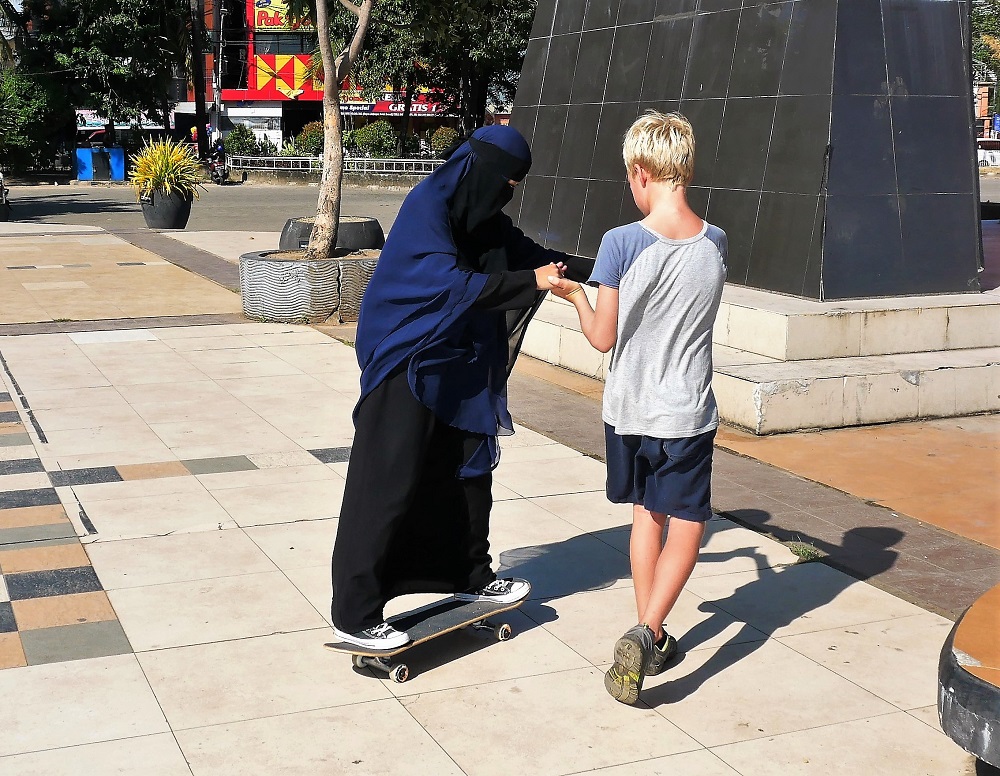
Makassar waterfront: the boys teaching Muslim Mary to skate.

The end of May marked the six-month anniversary of our arrival in Indonesia, which means that our visas were running out: to remain legal and avoid paying astronomical overstayer fees we had to leave the country. However, given that we were on a slow sailing boat and approximately in the middle of the large Indonesian archipelago, we couldn’t easily sail out, plus if we did, we would miss seeing the other half of the country. We had to find a way to leave and come back in, applying for a new visa on arrival.

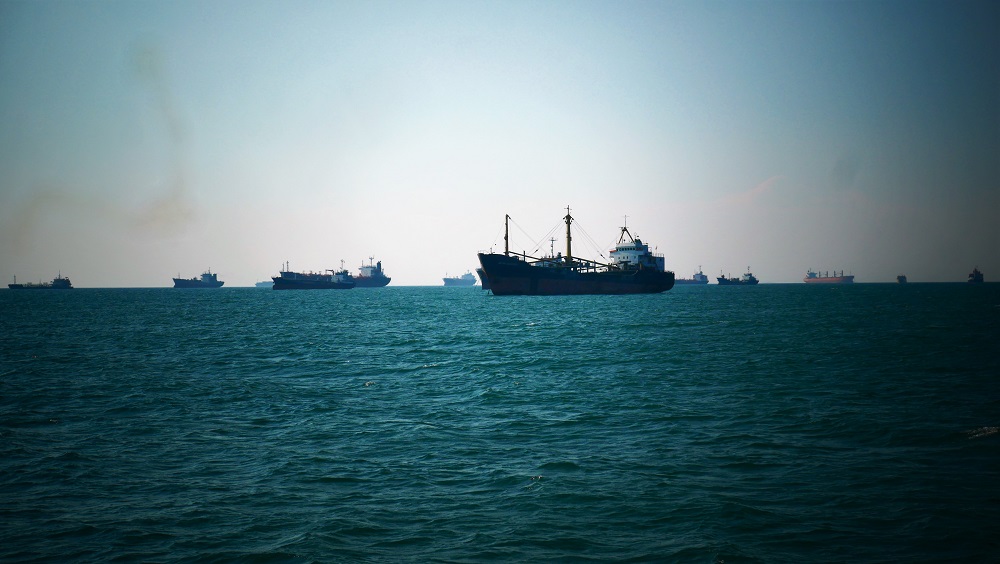
Ships anchored off Makassar Port.

So after kitesurfing in Jeneponto, we headed for the City of Makassar, the capital of Sulawesi, where there’s an international airport from which we could fly cheaply to Kuala Lumpur, Malaysia, return.

Whilst Indonesia is relatively safe, leaving our boat unattended for two days is asking for trouble, and so we flew out in two shifts: David first with a friend from a boat in a similar predicament, me and the kids once they got back.

Matias showing 19-year-old Mary from Makassar some moves.

We tend to dread large Indonesian cities – they are often incredibly dirty and as most of the rubbish around here end up in the ocean, the anchorages are often pretty disgusting. But Makassar was a pleasant surprise – a large (1.5 million) city with a charming waterfront, broad streets shaded by beautiful old leafy trees, kept clean by a tireless crew of street sweepers who were busy morning till night. It is very Muslim and although it didn’t come to a complete standstill, everything moved quite slow because of Ramadan. During the long daylight hours, taxi drivers slept hunched over the steering wheel, their cars parked in shady spots under large trees. In roadside shops, assistants sat idle behind busy fans, eyes half closed as they endured yet another day of unbearable hunger and thirst. The numerous mosques were blaring the call to prayer five times a day plus delivering what sounded like full sermons in between. Everyone we met was tired, hungry, and distracted, counting the minutes of the long daylight hours, living for the evenings where, after the sunset prayer, the waterfront streets came alive with hundreds of food stalls and delicious smells signalling an end to fasting, drawing crowds of thousands to the streets for celebration and socialising.  

The 99 domes mosque of Makassar waterfront.
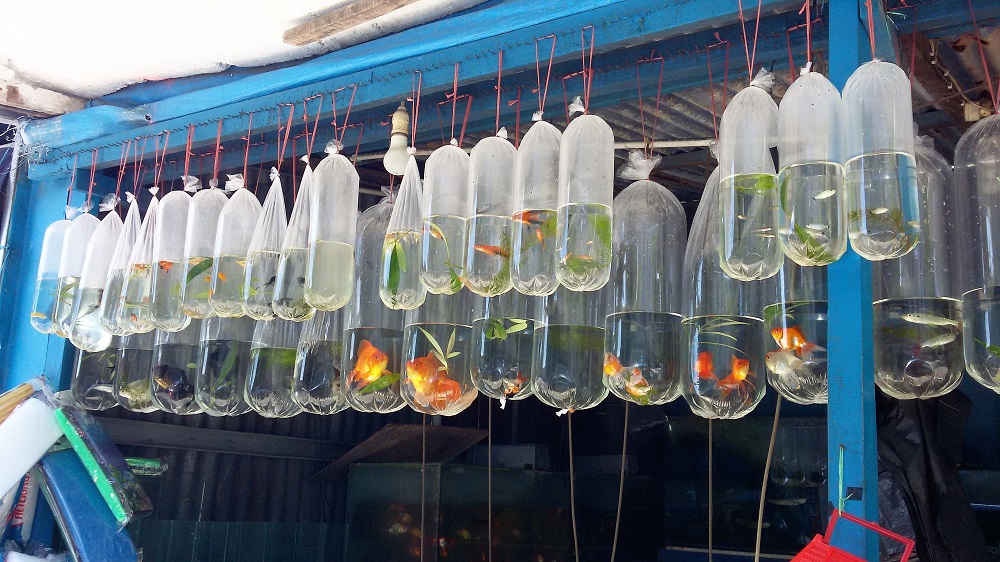
Aquarium fish for sale in a roadside stall.
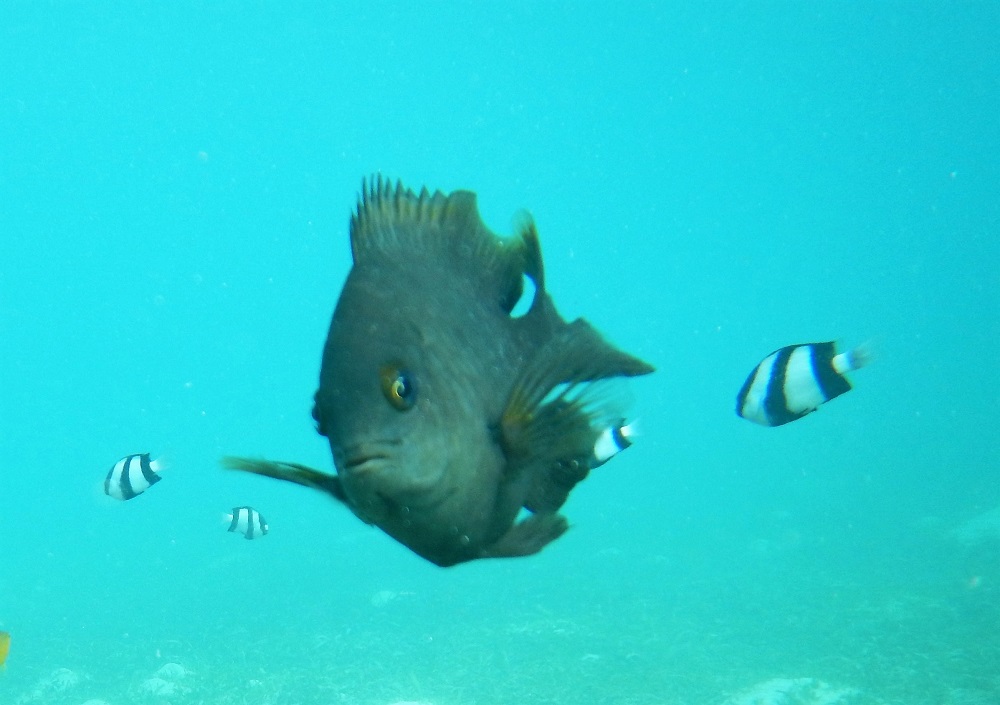
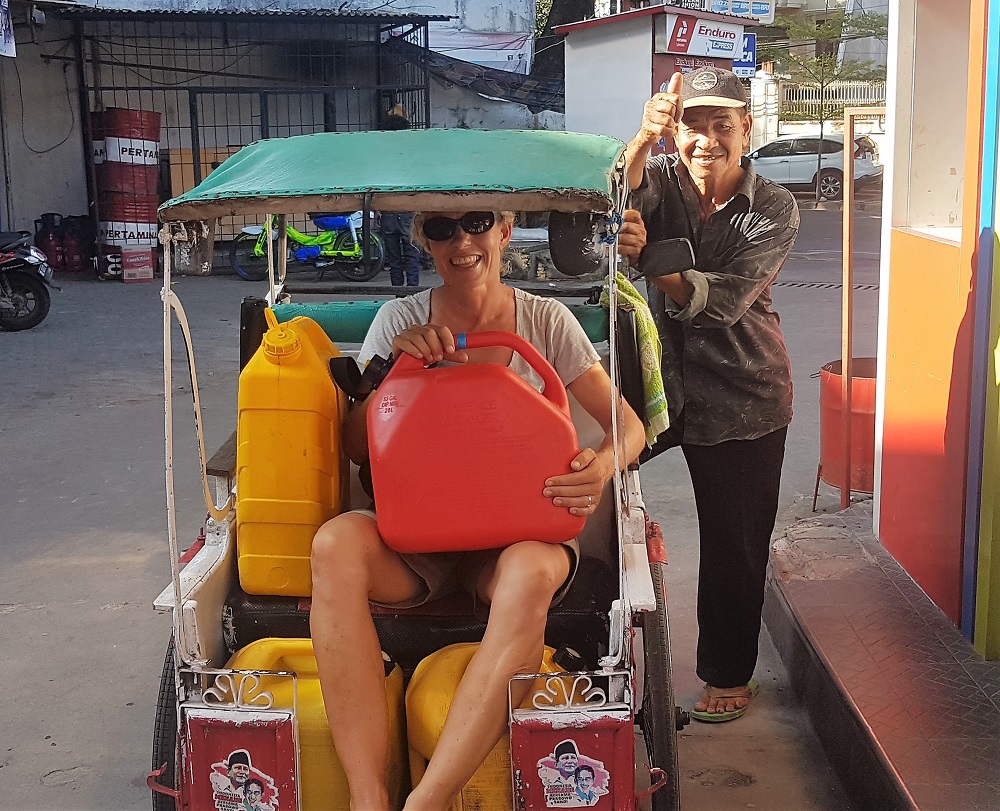
Buying diesel the Makassar way, in a cycle rickshaw. The poor, elderly driver observed Ramadan and so would cycle all day without food or drink.
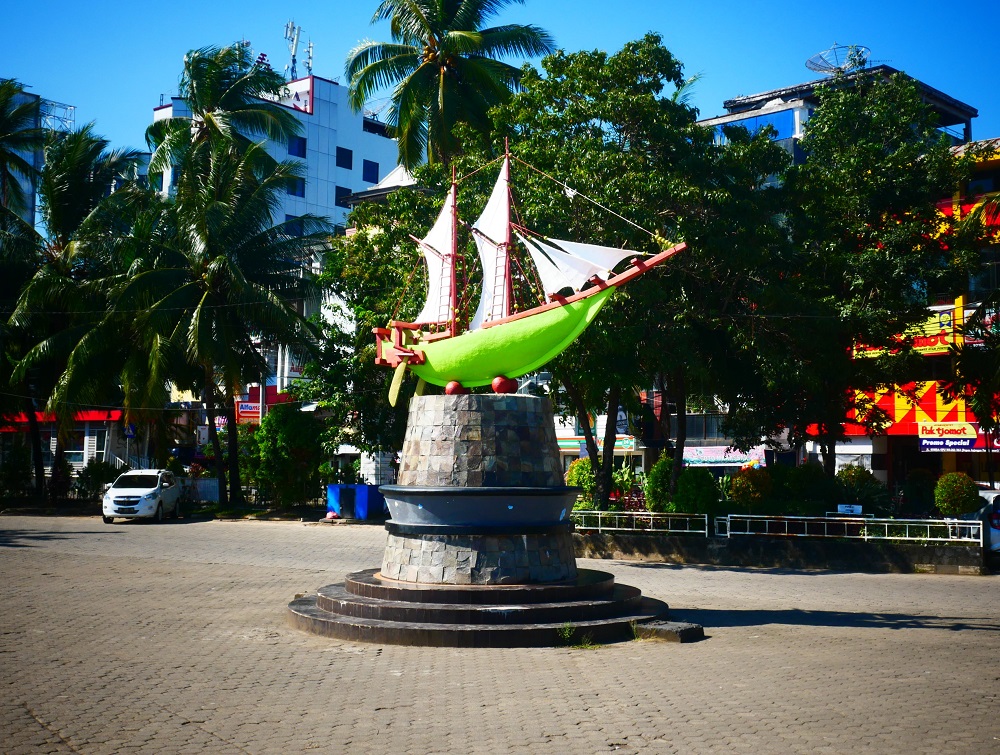
Waterfront monument.

In the airconditioned shopping malls, food was available in select eateries which were closed off behind heavy curtains, shielding the few cheaters who ate during daylight hours from the true believers. We sat uneasily, eating in secrecy, going to the toilets to sip from a hidden water bottle, not even daring to chew a mint in the taxi lest we tempted the driver.

Heavy curtains hiding the infidel sinners who have lunch during Ramadan.
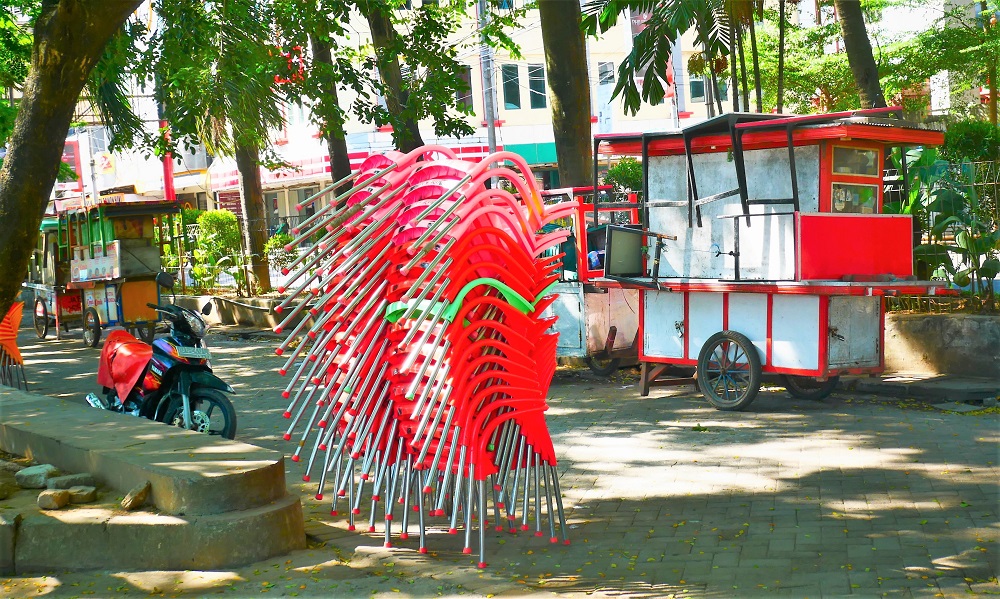
Plastic chairs stacked up by the waterfront park, ready for the midnight feast.

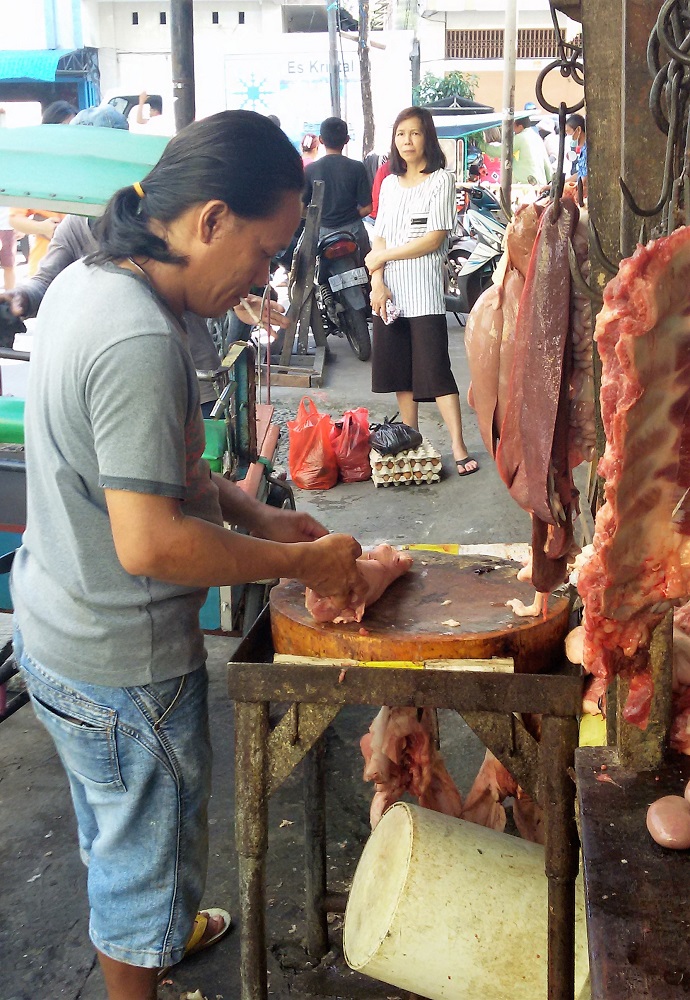
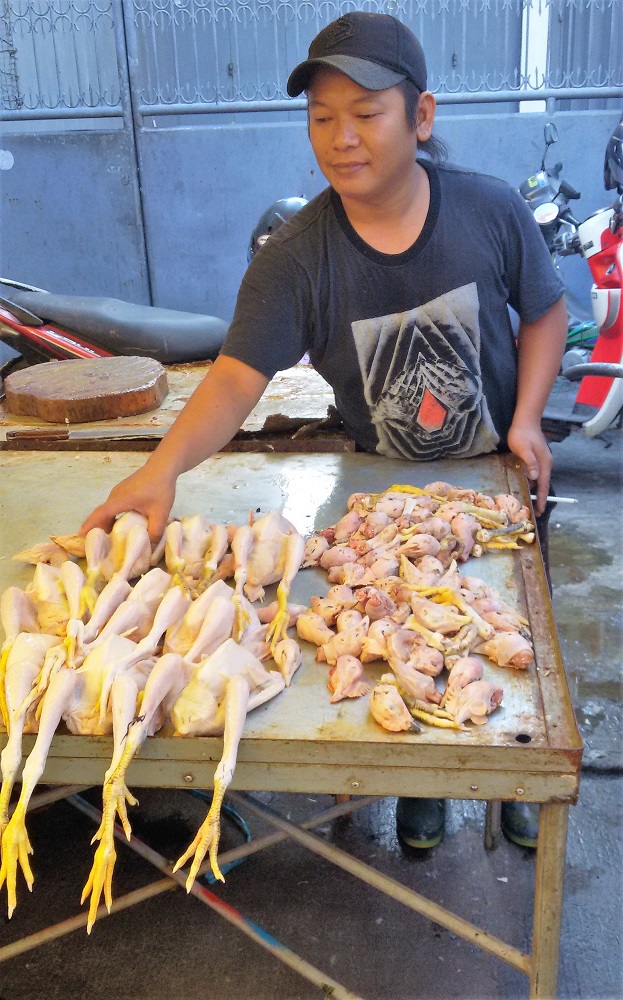
We ended up shopping in the narrow streets of Chinatown, where well-fed Chinese locals did not observe Ramadan, instead happily chopping up pork, deep-frying dumplings and presenting today’s catch of frog legs along with hundred-year-old-eggs and other delicacies.

Chinatown: happily chopping up pork in Muslim Makassar.
Chicken heads and feet for sale in Chinatown.

It was the week when the results from the recent general election were officially announced, and the losing candidate, Prabowo Subianto, was alleging election fraud and his supporters in the conservative Muslim 212 Movement threatening riots. The winner, incumbent moderate Joko Widodo, promised swift and merciless police response to any election-related violence, and police were on the ready in every larger Indonesian city. Makassar is pretty fundamentalist Muslim and one of Prabowo’s strongholds, and as a result everyone in town expected trouble. Shopkeepers closed up on the day of the announcement and most people we met intended to stay indoors after midday when any demonstrations would start. Unwilling to face a mob of hangry Muslim fundamentalists, we limited our excursions to a quick round of errands in the morning and otherwise hid out on the boat, watching the news of street riots in Jakarta that ended up killing eight people and injuring more than 700 as demonstrators hurled Molotov cocktails at security forces and set fire to cars parked at the national police headquarters. Makassar remained peaceful and we were grateful that we are not in Jakarta, where police later identified ISIS-linked Islamic fundamentalists amongst the protesters arrested.

Monseiur le Paco on deck.

Once back from the flying visit to Malaysia, our visas all sorted, we got ready to leave Makassar behind with one exciting addition to the family: our Swiss-Italian friends on SV C’est Le Vent needed to fly to Europe and kindly lent us their cat, Paco, for a month, with us promising to deliver him safely to Bali upon their return. Paco is a treasured fur kid who speaks only French and comes complete with a long list of instructions as well as a cat passport, cat shampoo, comb and a special towel, as well as a box of lightly steamed fish, the only thing he eats. Rescued from a Malaysian fish market when he was a tiny kitten six years ago, Paco is a boat cat through and through who has sailed more miles than the four of us put together. He is fluffy and slender, extremely good-looking and very friendly, and I already know it will be hard to give him back. In the meantime, we may have to rename the boat Paco the Cat.

Sunrise over Makassar Port.

The busy seas of Jeneponto

The kids kiting over shallow water.

I’m sitting on the starboard bow, squinting my eyes, binoculars at the ready, trying to spot buoys in our path as we slowly sail forward. The sea is flat and they should be easy to see, only we’re moving relatively fast, the buoys around here are very small and the afternoon sun is reflecting on the water, making it hard to see much.

Is that a buoy? I put the binoculars to my eyes and focus. Something white is bobbing up and down on the water surface, and there’s another white thing just along from it.

“Is that a buoy?” I ask Matias, who is sitting on the other bow.

He stands up and squints at the thing. “I think it’s just rubbish. There’s a net over there.” He points to our port side. Following his finger, I see a small buoy with a black flag protruding.

“Where’s the other end?” I ask, scanning the water ahead and to our starboard. Hopefully we’re not about to run over a net. “Can you see the other end?”

We’re both standing now, scanning the horizon. “Flag,” I yell to David who is at the helm.

David comes forward. “Where’s the other end? Check ahead and to starboard, I don’t want to run over it.”

It’s tricky sailing, this coastal Indonesian stuff. All day we’ve been weaving in and out of marked nets, surveying the horizon, peering at plastic on the surface trying to make out if it is tethered to the bottom, marking some sort of net, or just one of the billions of pieces of floating plastic that makes up the surface layer of the Indonesian territorial sea.

Seaweed farms tended by fishers in outriggers. The white dots on the water surface are empty plastic water bottles, each tied to the top of a vertical line of seaweed.

We’re on our way to Makassar, the capital of Sulawesi, where we need to renew our visas. The trip from Wakatobi has been interesting; as we left the deep seas of eastern Sulawesi the numerous Fish Attracting Devices (FADs) were replaced with equally numerous nets tethered to the surface of the shallow coastal shelf and, as we got closer to land, with thousands of seaweed farms.

We wanted to go kitesurfing at Jeneponto, a spot at the south-western end of Sulawesi where a kite resort is due to open in July. The area is subject to some local weather effects that make it uncharacteristically windy for Indonesia, and South-East Asia’s biggest independently run wind farm is sited just around the corner. The kite-resort-to-be is situated just back from a shallow, sandy bay opposite an idyllic-looking island with scores of spindly outrigger fishing boats landed on the white sand. On satellite imagery it looked the perfect spot to relax for a week before heading to the big smoke of Makassar, Indonesia’s fourth largest city.

We arrived in the general area late in the afternoon and found that a few developments had taken place since the last satellite photo. The entire coastal area in front of the wind farm and beyond was now full of seaweed farms, large rectangular spaces marked out by plastic bottles attached to vertical lines in neat rows, the bottles spaced about a foot apart and sticking up from the water surface at an angle, barnacle growth weighing down their submerged necks. Interspersed between the farms were fishing nets marked by buoys at either end. About one hundred fishers were labouring the small bay, working the nets or harvesting seaweed from their fragile outriggers. The farms extended into our intended anchorage and we cautiously wove our way into the bay between the lines, finally stopping in a small empty space to put down the anchor.

“I don’t see where we can go kiting,” I said, surveying the wall-to-wall seaweed farms of the bay.

“Well, let’s anchor, and then we can go ashore to scope out the resort,” replied David.

As I started lowering the anchor, a fisherman started towards us, waving his arms wildly.

Jaring?” shouted David, pointing down.

Jaring,” answered the fisherman, indicating the extent of the net by pointing to two widely space buoys.

Di mana jangkar?” asked David (where can we anchor?) and the fisherman grinned and waved for us to follow him.

“He must think we’re nuts,” I whispered to David as we followed the small outrigger to a corner of the free-looking space. “Coming here to anchor in the middle of their seaweed farms. It’s like camping in a New Zealand farmer’s cornfield.”

Tidak jaring di sini,” shouted the fisher, indicating a tiny area with no nets. It was a bit too close to the seaweed farm for comfort but provided the wind direction didn’t change we’d be OK.

Seaweed growing on a shallow farm line.

And so we anchored, surrounded by fisherfolk looking curiously on, no doubt puzzled as to why we’d chose to stop here, right in the middle of their seaweed farms, but also presumably aware that since their farms covered the nearest 500 hectares of shallow sea we had few other options.

Back in New Zealand I used to work on a marine spatial plan, an attempt to ensure that all marine users, whether commercial or recreational, were provided adequate space to do their activities. There, not surprisingly, aquaculture is only allowed in zoned areas, and once space has been allocated for aquaculture it is marked on charts and is off-limits to non-compatible uses like yachting. In Indonesia, there are no such plans, and everybody can do what they like: if seaweed farming suddenly turns profitable, there is no stopping locals from covering the entire nearshore area in seaweed farms, even if that may preclude activities such as boating, fishing and transport.

Udin visiting the boat.

Udin, a local seaweed farmer, stopped by our boat to chat. He explained that the seaweed is sold to China and that the local farmers earn about $1 per dry kg. The population pressure is high here and due to overfishing the fish stocks are dwindling, which means that fishermen turn to whatever they can to make a living. So now everybody grows seaweed and use bottom nets to catch whatever fish they can in the tight spaces between the many seaweed farms, and the bay is busy with boats manned by fishers covered in heavy clothing from top to toe, their heads shielded from the searing sun by their traditional conical hats. The fishers travel to and from the farms all day, sitting fishing during any downtime from the harvesting or sowing of seaweed onto the thin lines. At the end of the day, only a handful of tiny fish lie listless in the bottom of the boat to show for all their efforts.

It is Ramadan, which means that no devout Muslim is allowed to eat or drink between sunrise and sunset. To show respect, we don’t eat or drink during the daytime when we’re ashore, but the boat is our home and Udin came onboard just as I had set out the lunch plates. The kids were busy helping themselves, and he surveyed the bread, cheese, sliced tomatoes and cups of water with obvious discomfort.

Would he like any? I gestured, but he shook his head, saying tidak, no. It must be hard? Yes, he is very thirsty and there are five hours left till sunset. The worst is that he cannot smoke, no cigarettes during the day. He sighed and closed his eyes, his head leaning back against the seat.

It is an interesting phenomenon, Ramadan. For a whole month, people lie around listlessly and ill-tempered, plagued by raging thirst, blood-sugar lows and acute nicotine withdrawal. Everything slows down or stops, with a presumable huge knock-on effect on the economy. Ramadan started when we were in Wakatobi, and two days before it commenced I was trying to get some dive tanks filled at a dive shop, but they couldn’t do it because the guy who could operate the compressor was engaged in pre-Ramadan celebrations. Once Ramadan started I tried again, but then he was not at work because of Ramadan. Whenever we step ashore we see men and women lying sleeping the shade, turning grumpily as small children (who are allowed to eat) climb all over them, laughing and joking.
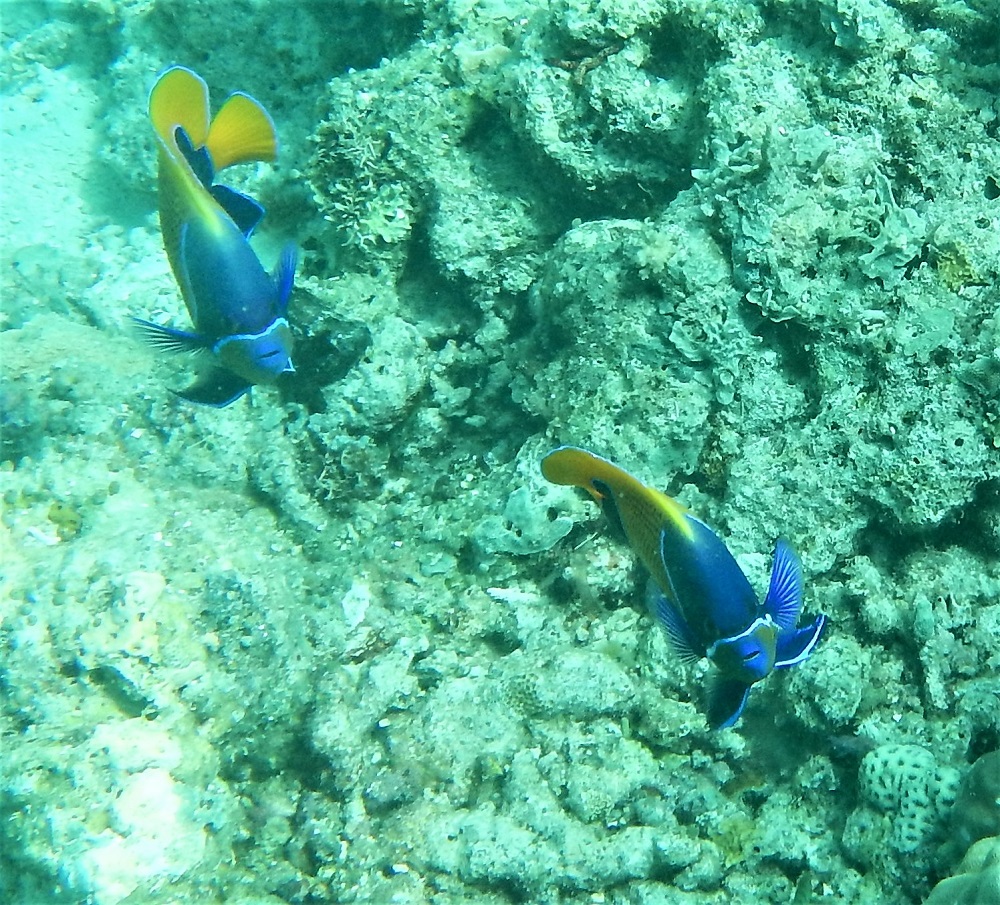
Lukie coming in for a high-five.

Despite the seaweed farms, we found a small area to kitesurf, a great spot on the intertidal sandbank where for parts of the tide it was deep enough for the kids to zoom up and down, and enjoyed a week of having the windiest spot in Indonesia all to ourselves.

Matias kiting away, Lukie and Bob the Cat in the background.

“I still don’t exactly see how they can open up a kite resort here,” I said to David one evening as we were relaxing on the deck. The sun was setting, the orange and pink hues of the sky reflecting in the thousands of plastic bottles covering the surface of the bay, the tiny outriggers of the late fishers outlined sharply against the darkening sky.

“I know,” said David. “There is no space. It’s OK for our two kids to go at the same time but imagine having 15 or 20 kiters all trying to fit into that intertidal area. And what will they do at low tide – people aren’t going to want to pay to come and wait for the tide to rise…”

Working the nets in the fading sun.

Now on the way to Makassar, as I sit on the bow trying to navigate us safely through the maze of seaweed farms, nets, and small fishing outriggers, I reflect on Jeneponto. I imagine that the developer of the resort is worried about the seaweed farms ruining his perfect kite spot, the accommodation for which he is already taking bookings online. But you can’t blame the locals for exploiting all available space for their semi-lucrative cash crop. It’s a poor area of Indonesia, and without the seaweed many families will struggle to have enough food to eat. Destructive fishing practices and general overfishing has clearly completely depleted the fish stocks on which locals traditionally relied, and something has to fill the gap. I recall a conversation with a French owner of a boutique adventure resort in Halmahera, who was complaining about the locals fishing the reefs around his resort

“I tell them it is not good to fish, that tourists will pay to come and see the fish,” he said. “They don’t have to kill them.”

I nodded. “How many local people do you employ in the resort?”

He looked down. “One,” he said. “The cook. But maybe if we grow, we can employ one or two more.”

Well. One employed person is not really going to replace the traditional income and food provided by fishing, and I guess over-exploitation of marine resources in Indonesia will not stop until realistic alternative livelihoods are available. At least the seaweed farming of Jeneponto is not extractive, and the farms will be providing shelter for juvenile fish, which may help restore the fish stocks of the general area.

And as much as I love kitesurfing, I would rather feed a couple of villages than line the pockets of an expat resort owner. So as we sail away I wish the seaweed farmers favourable conditions and bountiful harvests, and hope that somehow the kite resort can survive despite a severe lack of space.

Wakatobi water time

David got back from his trip to the UK finding the feeble flashlight with which I was supposed to ward off intruders unused and the kids and I eager to leave Wanci. Although we’d been making the best of the location, hanging out with our awesome friends, diving, snorkelling and even doing some kite surfing while he’d been gone, we were keen to see more of the famous Wakatobi National Park. Established in 2002 to protect the largest barrier reef in Indonesia and the associated area of astounding marine diversity, the National Park covers an area of 1.39 million hectares and is recognised as one of the highest priorities for marine conservation in Indonesia.

Lukie free diving down to high-five scuba-diving David.

Wakatobi is a veritable water paradise. Small sand-fringed islands are dotted over a large area of deep, clear water, each island surrounded by lush seagrass beds bordered by current-swept plunging coral walls. The ocean here is teeming with life – whales, dolphins, fish of all descriptions, several species of turtles, sea snakes, squid, and octopus.  

Seasnake on the shallow reef.

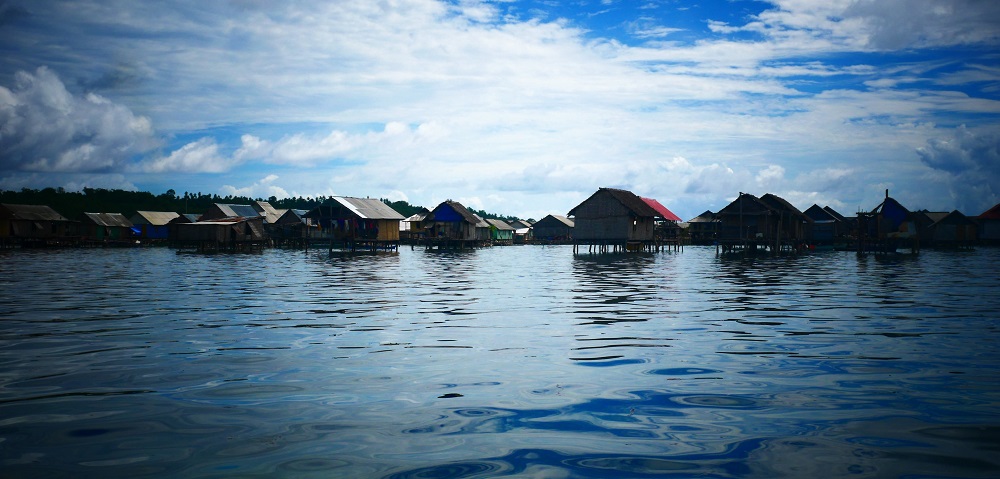
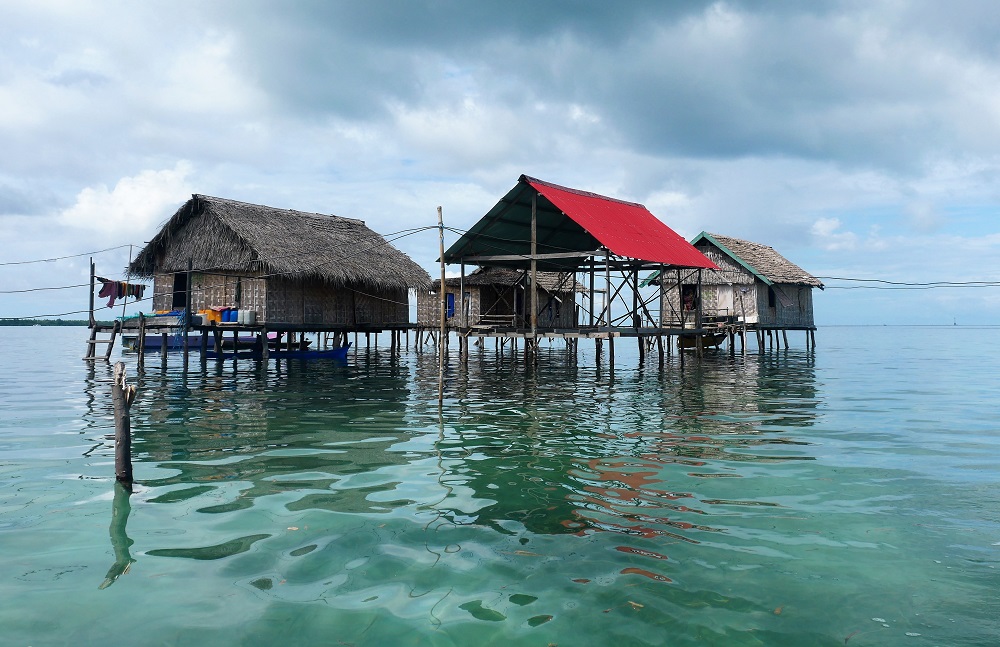
The ocean is especially important to the local people here, the Bajau sea gypsies who are a traditionally nomadic sea-dwelling tribe. Originally the Bajau lived exclusively on boats, which they sailed around in large flotillas of extended families, fishing and trading for food within a larger home area. Nowadays, the Indonesian government has encouraged the Bajau into permanent settlement and most live in wooden stilt houses built over the shallows, the walls of their small houses made from palm leaf mats, their longboats hoisted up underneath the house. Everywhere we sail in Wakatobi are these sea villages: dotting the perimeter of remote atolls, stretching out from the coastline of otherwise uninhabited islets, and extending seawards from larger, more traditional land-based townships.

Bajau township, stilt houses stretching out in neat rows over shallow water.
A Bajau-style mosque – I love the street sign.
Bajau boy, plaing in a bucket next to the boardwalks connecting the stilt houses.

Legend has it that the Bajau originally lived on land, but after their king lost a daughter at sea in a storm the tribe went searching for her. When they failed to find her, they feared returning to face the king’s wrath, and so they stayed afloat, travelling on the ocean forever after, following the bounty of the seas. Since they stopped being nomadic, the Bajau have been struggling to catch enough seafood to live, and in the recent past started using destructive fishing methods like blast and cyanide fishing to increase their catches. To limit resource damage, the Indonesian government has been encouraging them to use Fish Attracting Devices (FADs) instead, and the water around the Wakatobi islands is littered with little bamboo structures anchored in deep water.

Matias surveying two baby lionfish.

The international research organisation Operation Wallacea, a branch of which is based on Hoga Island in Wakatobi, has seen the destruction first hand.

“There were just dead fish everywhere, floating on the water,” explains Nina, a student from Austria doing her marine biology project on the island. She is describing a famous dive site within the marine reserve, where she and her buddy surfaced in a tide of dead reef fish. “We’re not sure if it was blast fishing – we didn’t hear any explosions – or if it was cyanide.” She says that the Indonesian government is working with locals to promote non-fishing based livelihoods and the use of sustainable fishing practices.

The rare mandarin fish, spotted at a Wakatobi jetty.

“The government knows that this site is special,” she says. “I mean, it is the largest barrier reef in Indonesia! They want to protect it, but in reality they can’t stop the locals from fishing, and I’ve even seen big commercial fishing boats within the reserve.”

Lukie surveying the seagrass beds.

It is certainly hard to keep the Bajau from fishing. The sea is everything to them – their home, their work, their entire world. Fishing is not just a job to them; it is in their blood, the way of life of their forefathers and their children. They are famously adept at free diving and the deepest dive recorded for a working Bajau is 79 m, although most of their dives will be shallower than that. Traditionally, they spearfish, spending up to 60 per cent of their working life under water, with the result that they have some fascinating genetic adaptations to apnea diving. They have enlarged spleens that hold more haemoglobin-enriched blood than normal people’s. When they dive, the spleen contracts, pushing these extra blood cells into the general circulation, thus boosting the oxygen levels in the blood. They also have a genetic adaptation which allows them to reduce their metabolic rate and thereby lower their need for oxygen whilst diving, one which prevents dangerous levels of carbon dioxide to build up in their blood, and another which increases the degree to which blood is squeezed out of extremities when they dive, which keeps the blood circulating just in the core region where it is needed to keep up vital functions.  

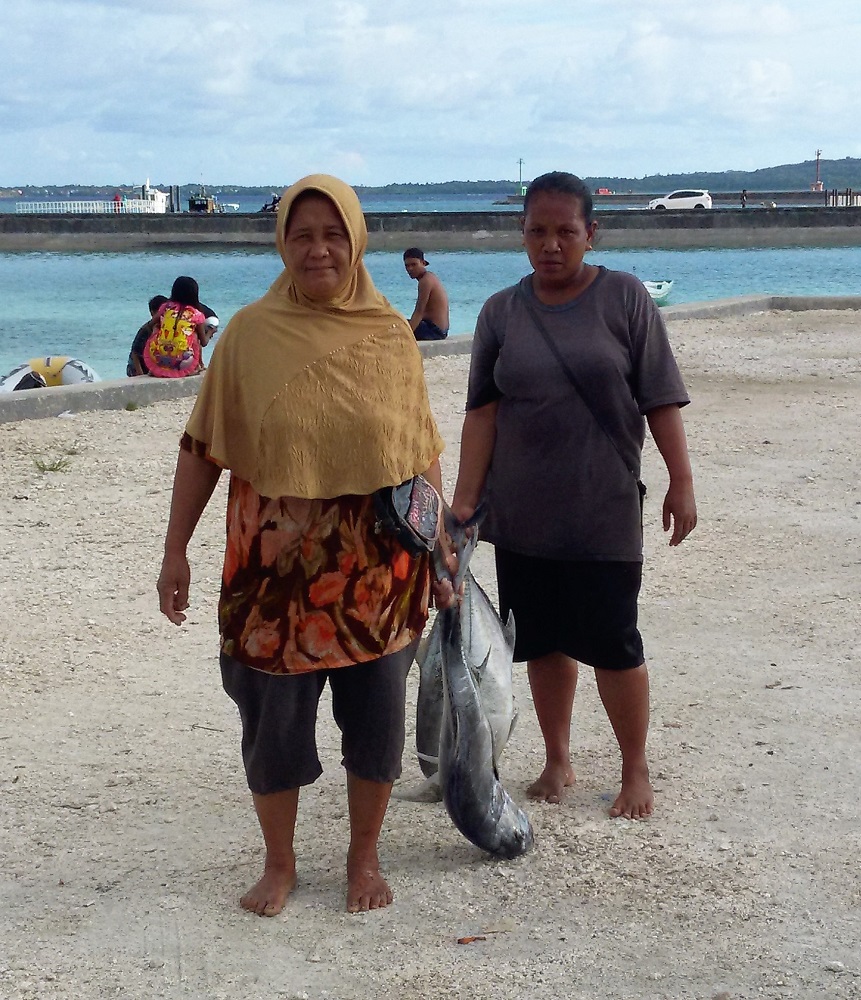
Made to fish – Bajau women heading to market in Wakatobi.

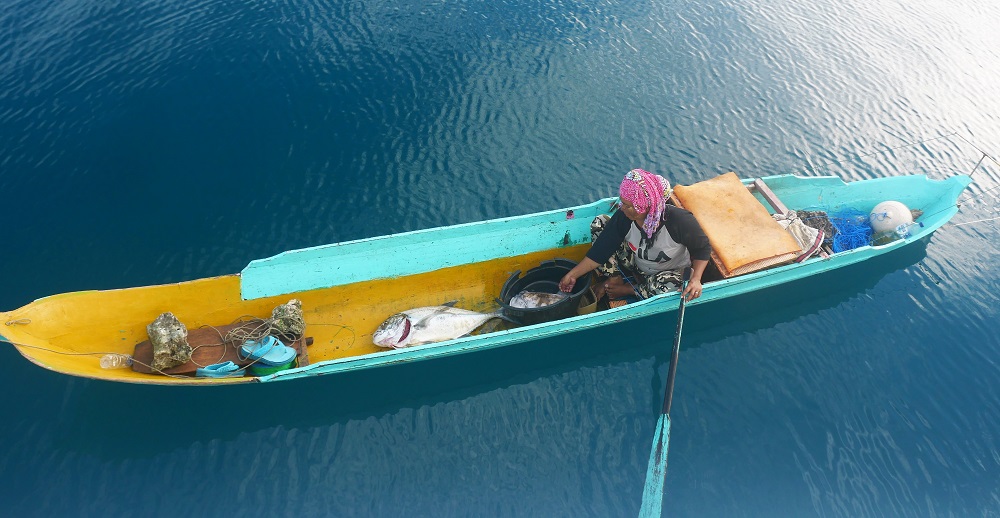
All in all, they’re the perfect diving machines, and we watch them with awe as they spearfish from their fragile boats, wearing only their traditional wooden goggles. Every day a new canoe comes to the boat, it’s owner wanting to sell today’s seafood – lobster, crab, mantis shrimp, fish, squid, cuttlefish, octopus, shellfish… We buy some to support the local population and they take the rest to the local markets where the Bajau dominate the fish aisles.

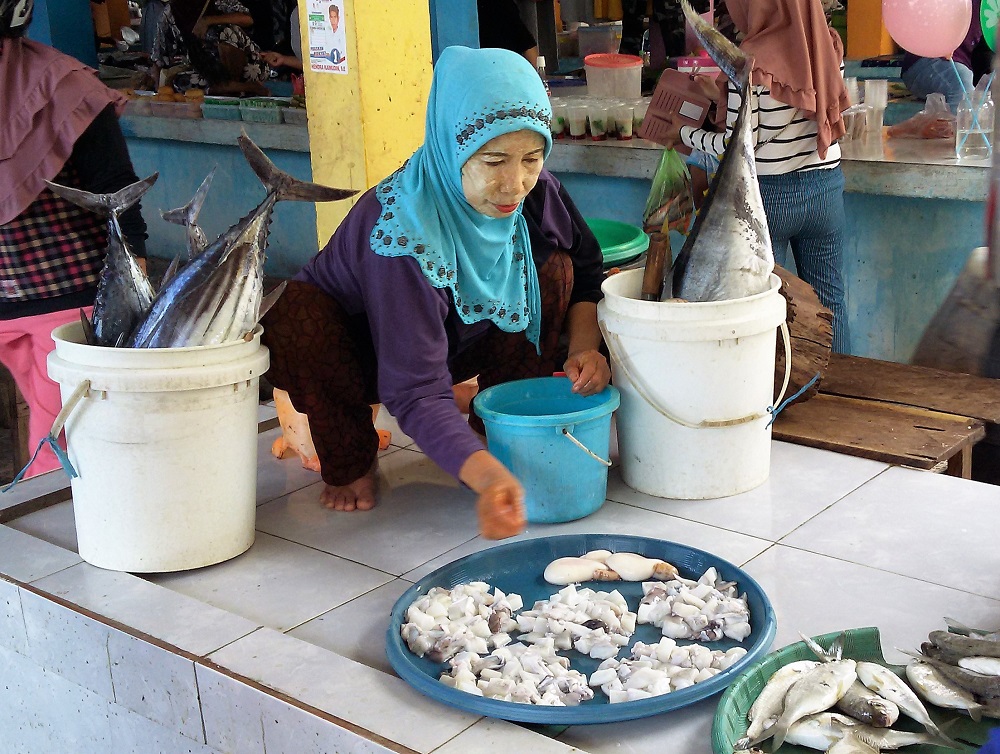
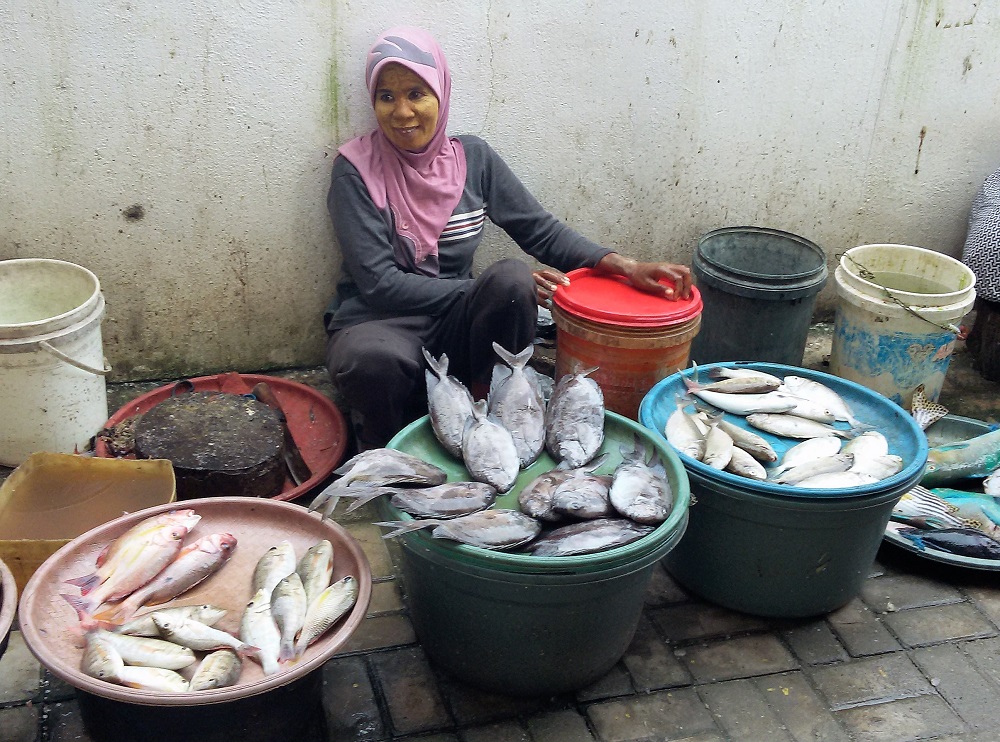
Bajau woman offering up fish for sale.
Bajau woman at the fish market. She’s wearing the traditional Bajau Sunscreen made from bark.

We spend our days in Wakatobi diving world-class spots – circling pinnacles rising from deep blue drop-offs, swimming under dramatic overhangs, drifting along sheer coral walls pushed by swift currents, finning leisurely over shallow reefs and seagrass beds. Everywhere you put your head down here there is something to see. Swarms of fish clouding the vision so that you can barely see the surface when you look up, seasnakes deftly exploring coral crevices, boring their heads into incredibly small holes, their tongues flicking in and out as they taste the water to find prey, and swimming vertically up and down when they go to and from the surface for a breath. On the reefs, delicate nudibranchs slowly move along sunlit coral and lazy turtles sleepily look out from deep crevices.

Pipefish in the seagrass.

Evil-looking crocodile flathead and scorpion fish blend in superbly with the reef surface and white flatfish are almost impossible to see against the white sand. Fragile pipefish and incredibly rare cryptic filefish hide in the seagrass beds, and giant trevally and large snapper hide in the depths of a fast-flowing channel. At a late afternoon dive on a pier we are treated to about fifty mandarin fish dancing to attract a mate and see mantis shrimp coming out of their burrows in the fading shafts of yellow sunlight dancing down from the sky above.

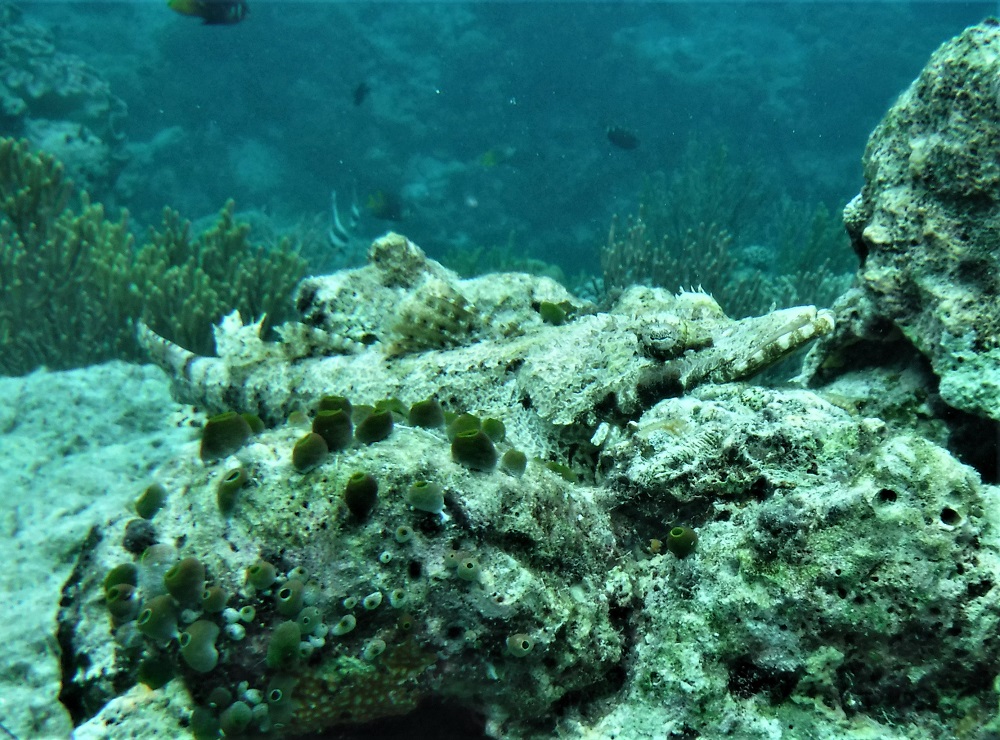
Spot the crocodile flathead on the rock.
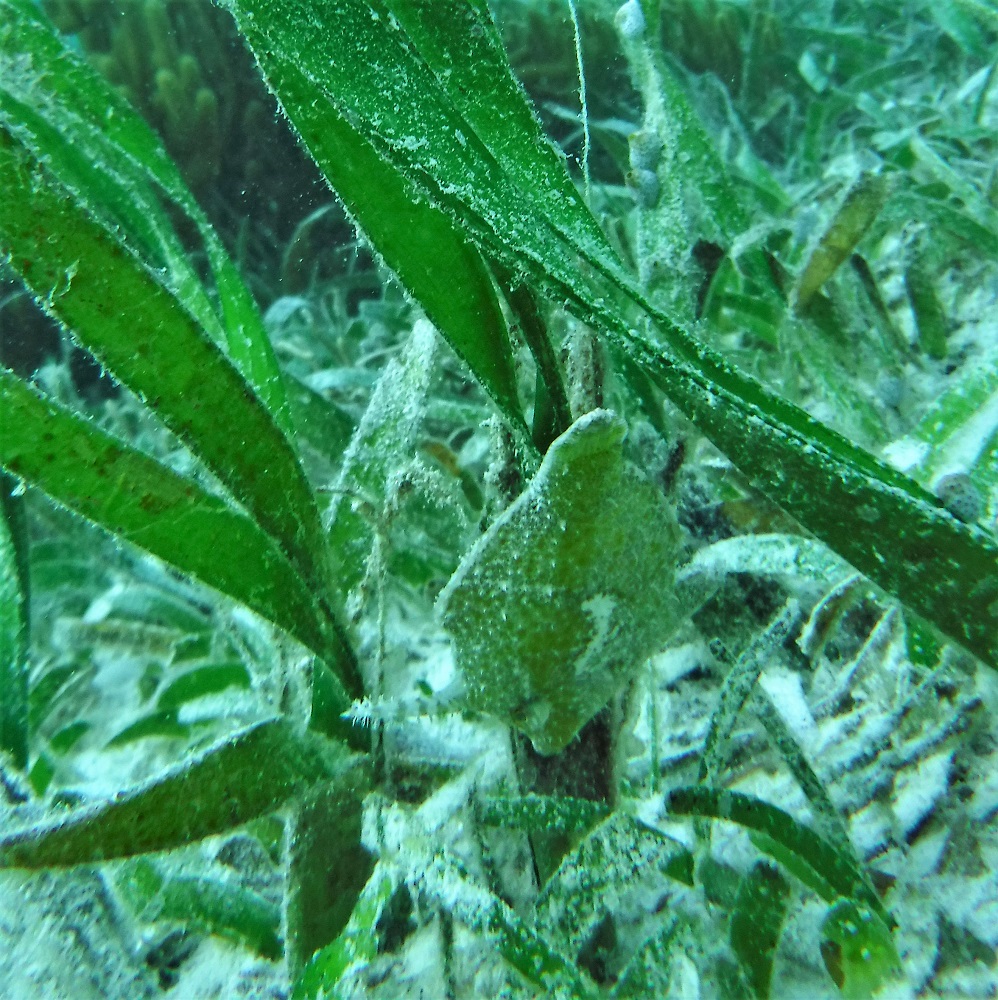
Look hard and you’ll see the incredibly rare diamond filefish (head down, centre of image) we found lurking in the seagrass shallows.

Wakatobi is a magic underwater paradise, and we hope the local people can find ways to fish sustainably so that it will remain as diverse and productive as it currently is.  

Well-camouflaged scorpion fish on the reef.
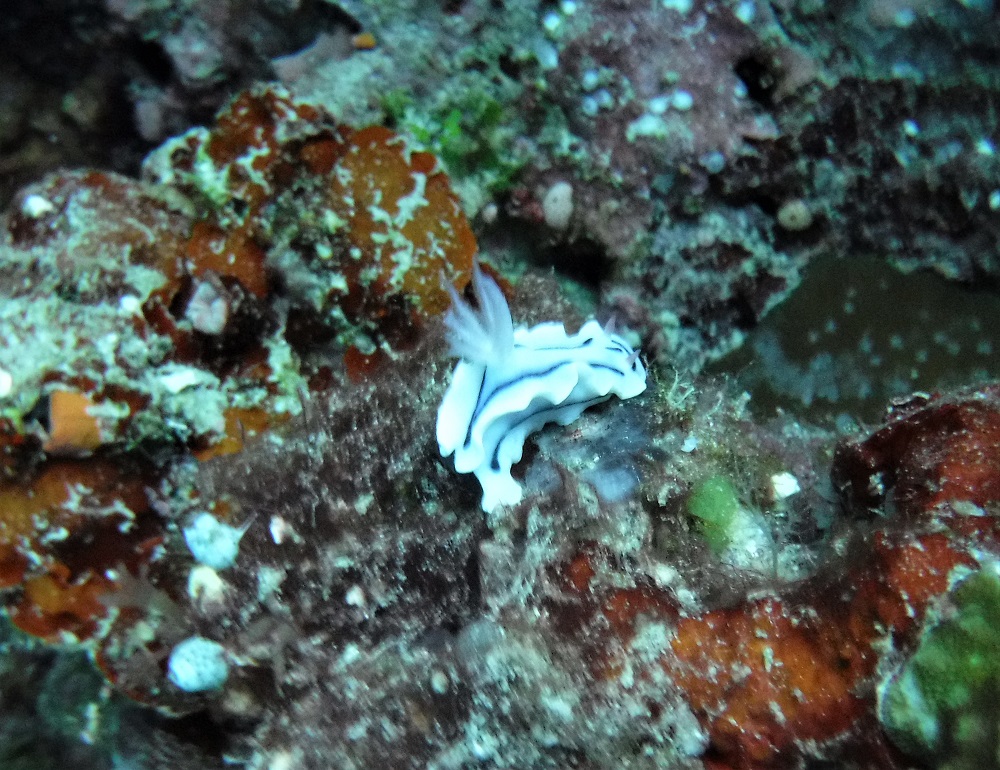
Nudibranch hanging out on the coral.

All alone in Wanci

“And so, if the red light goes on permanently, it’s because it is overheating. That’s normally if the fan is failing to turn on. So then you need to check that it’s on and if it isn’t, just tap it to get it going.” David looked sternly at me.

“Uh huh,” I responded hesitantly. “What fan? I mean, where is it?”

“It’s the one under Lukie’s bed. You just have to stick your finger in there and tap the fan to restart it…”

“Okay…” I sighed. “Look, I don’t think I’ve ever seen that one. Can you show me?”

He touched my arm and started downstairs, keeping me following closely behind. Entering Lukie’s bedroom he straddled the bed and lifted up the mattress, pushing the wooden slats underneath to one end of the bed whilst doing some subtle acrobatics to ensure his weight didn’t break the fragile wood. Crouching on the upturned mattress he stuck his head down the space below the bed and from the dark void came his muffled voice saying something only barely audible.

I balanced gingerly on top of the pile of slats and crawled closer. “What’s that?”

“The fan – it’s just here. Stick your finger in and tap lightly.”

I pushed myself up next to him and stuck my head down the under-bed space, trying to make out the small fan in the semi-darkness. “I can’t see it. I’ll have to go get a torch.”

He straightened up. “Well, it’s just here. Stick your hand in and feel. And then there’s the engine…” He crawled back out into the corridor, leaving the bed a mess, and took the stairs in two steps. I rushed after him. “I forgot to get a new starter battery for the port engine, so it may not start….” He ran his fingers through his hair.

“Okay…” I looked at the gear levers uncertainly. “Then do I just use the starboard engine?”

“Yes, just start the starboard one and then wait until the battery is high enough for you to start the port side.”

Right. Makes sense. “But it is still working, right?”

“Yes, but I’ve had problems starting it the last couple of times. I was going to buy a new starter battery in Ambon, I just forgot.”

“Okay.”

“And if you move the boat, just remember that the anchor winch sometimes shorts out. If that happens, just lift the little lever in the starboard engine room back up again, that’ll reset it.”

“Right.” I sighed again. “Can you show me where that is again?”

“It’s here,” he said, opening the starboard side engine room and pointing inside.

I stuck my head down the engine room. “Where, exactly?”

“You need to crawl in – it’s under the other box, over there.” He hovered above me, his dark shape blocking out the light, a barely visible outstretched finger indicating the direction of the lever. “If you look up you’ll see a little lever. Just push that back up.”

“Right.”

“And the other thing that can go wrong is that if the button gets stuck.” He pressed his thumb against his index finger, simulating pushing a button. “If that happens, just switch off the starboard engine electrics. And then just unscrew the little unit from the wall and unplug it.”

“Hang on, I need to take notes.” I went inside to get my phone. This was going to require a bit of documenting. I started typing. “This is if the button gets stuck when we’re trying to raise the anchor?”

“Yes, if the switch sticks – it should be OK, but remember it used to sometimes stick?”

I nodded, remembering trying to frantically stop the chain from when the ‘up’ button got stuck, shouting “It’s stuck, it’s stuck,” in frustration from the anchor locker until he managed to switch off the electrics to make it stop.

Raising the anchor – squid eggs stuck on the anchor chain in Wakatobi.

“Run the water maker as much as you need – but if you don’t use it, do a fresh water cycle at least every other day.” He looked at me. “We don’t want the membrane to dry out.”

I shook my head and typed: ‘don’t let membrane dry out.’

“And try to keep the batteries above 75% charge. So if there’s no solar, run the engine to charge. Switch the fridge off once cool in the evening, so it doesn’t run all night.”

I nodded again. I knew all about fridge maintenance and battery charging. No instructions required.

He ran his fingers through his hair again. “Lock the doors at night and if you get intruders this is the safety knife.” He pointed up at the sheathed knife fastened above the door leading out into the cockpit.

“Okay… So just stab them with a sharp knife?”

“Well, don’t let them in, obviously. And if they are outside the door, use this torch.” He unclipped the torch secured just to the right of the door. “Shine it in their face – through the door or in the open. That should blind the person looking at you momentarily. Which will hopefully scare them off, buy you some time if someone’s trying to break in…” He touched my arm. “Keep the VHF on, and your best bet is to lock the door and just call the other boats if you’re in trouble.” 

Right. I swallowed. Sounded fine. I looked around us, out over the still water of the inlet, the turquoise waters bordered by dark seagrassy reef patches, the busy shoreline, the fishing boats anchored nearby. Not a bad place to be. We could do this, the kids and I. We could survive for a week without David on the boat, here in Wanci, southern Sulawesi, Indonesia.

“And what about your lift to the airport?” I asked. “Should we organise that?”

He paused. “I guess we should go ashore and do that… If we can find a driver, then you can drop me ashore in the morning at 4 am and I should be able to make it to the airport by 5.”

I grabbed my bag. “OK, then let’s go and organise that now. Kids? Come along! We’re just going ashore to find a lift for Daddy!”

Boats in Wanci. Hopefully we’ll stay afloat while David is gone.

It was all a bit of a rush. David had had a family bereavement and was going to the UK for the funeral. It was 3 pm, we’d just arrived in Wanci, Wakatobi, and he was flying out the following morning at 5:30 am. He had been undecided about leaving for a week, wanting to wait to see what Wanci was like, check that he felt the anchorage was secure enough for him to leave us on our own. It looked fine here – a wide channel, safe holding, a busy town. Several friend boats to keep us company, and some interesting stuff to do in the general area.

The worst thing about travelling so far away from family is that you barely get to see them. The second worst thing is that you may be out of reach in emergencies; that you might not be able to travel back fast when needed. Thankfully we were in a populated area when he heard, had had internet to look up flights, had been able to make it to Wanci in time for him to fly back.

Now it was just a question of making sure that I remembered everything that I had to do, was able to do all his normal chores, and that I had enough knowledge to deal with the most foreseeable problems the kids and I might encounter in our week alone.

After living on this boat for several years, you would have thought that I would have no problems managing on my own. You would have thought that intimate knowledge of all our systems would, by now, be imprinted in my brain, allowing me to effortlessly retrieve any and all information required to deal with any issue at hand. You would have thought that I would be completely competent at the troubleshooting and fixing required to get by on an older boat on a daily basis, that I would have a solid handle on all battery-related questions and breeze through any conversation about how best to deal with a sticky solenoid switch for raising the anchor. You would have thought that I would be competent at changing water-maker filters and doing the backwash, proficient at dealing with plumbing emergencies, a whizz at reconditioning outboard engines and possess a steady touch for repairing scratches to the gel coat.

Alas, for me this trip hasn’t worked like that. To save time and because one person can only do so much, we’ve ended up specialising on the boat, dividing labour between us, with the result that we’ve ended up with sharply demarcated territories. David is, of course (being a weather forecaster and a much more experienced sailor than I), in charge of forecasting and route planning to optimise weather. He’s also responsible for systems and in charge of most boat repairs, although I tend to do the painting. I’m responsible for home-schooling apart from music and coding, and for all provisioning, food planning and storage, as well as most cooking. He researches diesel, I download maths resources. He sits poring for hours over weather charts, I download tempeh recipes and Google the price of wine in East Timor. He discusses batteries and gets samples of dinghy glue endlessly from other cruisers; I swap food storage tips with their wives whilst concocting a new recipe involving copious amounts of eggplant.

In summary, we’re like a super-conservative 1950s western family – he is responsible for fixing and planning, and I parent, cook and clean. It works super well most of the time: I can’t think of many things more boring than batteries; he panics whenever he enters a grocery store and tends to leave with nothing on the list bar one tin of tomatoes. I have no idea how he’s organised the tool cupboard; he can’t find the flour to save his life. We both do our share of unpalatable chores: he unplugs blocked toilets, I school the kids. But it does mean there’s no redundancy in the system, requiring a heavy handover when he suddenly ups and leaves for a week.

I’m not sure he struggled much, though, when I went to New Zealand for a week last August, leaving him and the kids to fend for themselves. He just reduced home-schooling chores, didn’t provision or clean, and lived on fried rice, effectively cancelling most of my jobs. Whereas I’m not sure I can get by with just cancelling battery charging or ignoring if we can’t raise the anchor should we need to move….

Gender roles on boats are strangely old-fashioned – in most cruiser couples I’ve met, the man does the boat maintenance and the woman cooks and does the laundry. The difference between male and female roles seems to be most pronounced on kid boats and I haven’t met any cruising families where the woman is not in charge of home-schooling and has the ultimate say in provisioning, and where the man is not responsible for refuelling. On boats sailed by couples the gender roles are more often blurred, with some men cooking up a storm and some women helming the boat and shouting orders from the cockpit. My theory is that when sailing with a family the two adults are busier (add all the kid-related chores, and cooking for, and cleaning up after, a family, to the normal chores of boat life), and as there is more work to be done, the division of labour becomes more pronounced, each party specialising and thereby saving time overall. After making (and cleaning up after) breakfast and doing the home-schooling, I feel like I have enough work on my plate, and don’t have a lot of energy left to inquire as to the state of the water-maker filter or to second-guess David’s weather routing choices other than a feeble question or two about how seasick I’m likely to get on the next passage. And I imagine that when he comes in sweaty after spending two hours bent over double in the engine room he can’t be bothered looking over my shoulder as I decide where to store the canned peaches or seriously question my new-found use of tea tree oil to wipe down interior mould.
In our case, as he is leaving, it feels like this specialisation of labour has led to an astounding level of incompetence on my part, and I am annoyed with my lack of knowledge, frustrated with my limited ability to diagnose and problem-solve boat-related issues, and angry that I’ve allowed myself to become dependent on David’s knowledge to the extent that I now fear being left alone.

At home division of labour doesn’t mean that one party can’t leave. There, specialist are everywhere and if I have problems starting the car or can’t find the ingredients to cook, I just call the roadside insurance and the pizza shop, respectively, and my problem is solved. At home, I enjoy it when Davis is gone – the kids and I spend all afternoon on the skate park and have TV dinner late, all snuggled up closely on the sofa. Here, in the middle of Indonesia, there is nobody to call, each yacht must be a standalone unit of self-sufficiency, and I’m dreading being left alone. The kids are of course helpful – Matias is adept at driving the boat, dealing with the anchor and setting the sails, and Lukie is an expert at using a winch handle and ties a mean bowline. On top of that, we have friends here – two family boats we’ve been travelling with are in the anchorage, and if I have any problems I know I can call on them.

I dropped him off the following morning at 4 am, returning to the boat housing our sleeping children in the pre-dawn darkness. As I let myself in, my eyes fell on the ‘defence’ torch. I playfully snapped it out of its clasp, weighing the little black cylinder in my hand. I hadn’t ever realised it was there – when I hear a sound in the night, I just roll over and elbow David, mumbling: “I think there might be someone here,” and wait for him to deal with it. I switched the torch on and watched the bright pulses of light illuminate the cockpit.

Hopefully all the information that I had typed into my phone would similarly illuminate my mind, pushing aside the dark fogs of boating-related ignorance clouding my brain and allow me to enjoy this week alone safe and sound on the boat in Wanci.

Wildlife on the way to Wakatobi

“Mummy, jump in now – it’s just here!” yells Matias.

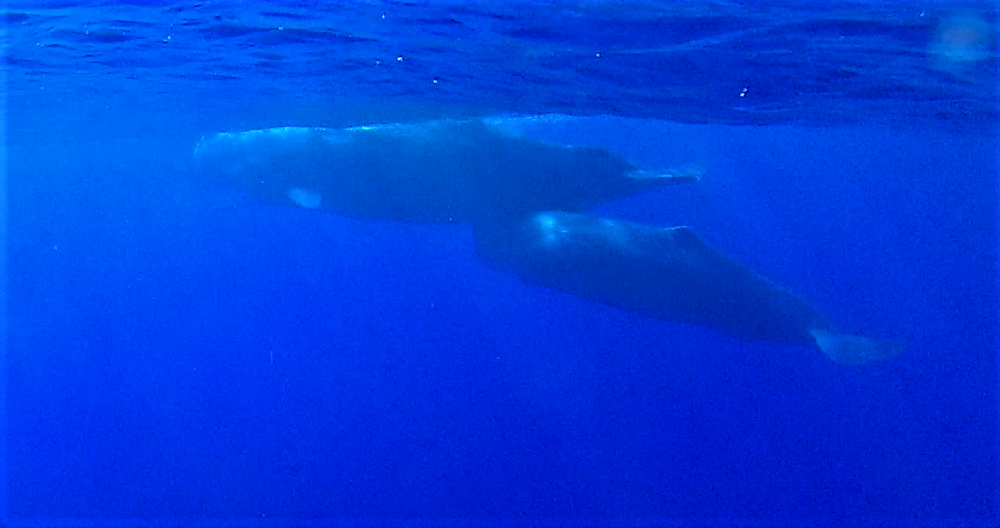
I hold my camera tight to my chest and jump off the boat, starting swimming as fast as I can as soon as I hit the water. With my mask half out of the water, I can see the big dark shape on the surface, and then, suddenly, it disappears from the surface and appears in my underwater vision. A huge shadowy figure swimming below me. I fin as fast as I can towards it, my heart bursting with excitement.

It is more than a thousand metres deep here. The afternoon sun is sending shafts of light down through the clear water, obscuring my view like lace curtains in front of a window, a soft, whitish filter which billows through the water, lightening the dense, dark shape below in everchanging patches as the waves above refract the light through the water column in different directions. Wow. It is so close – and so very large. I swim above the dark creature for five minutes before it slowly dives down and disappears into the blue depths. Pausing, I raise my head to check where the boat is. Time to swim back.

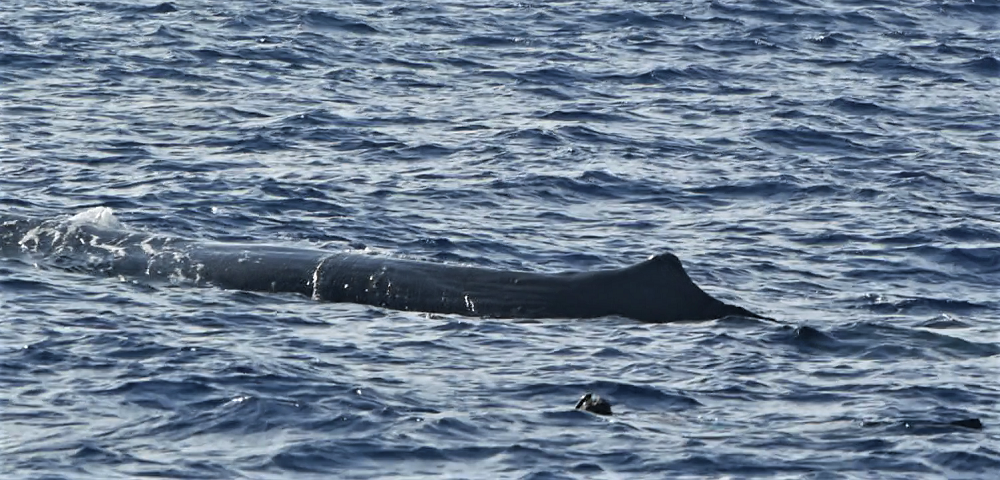
Huge, dark shapes in the water.

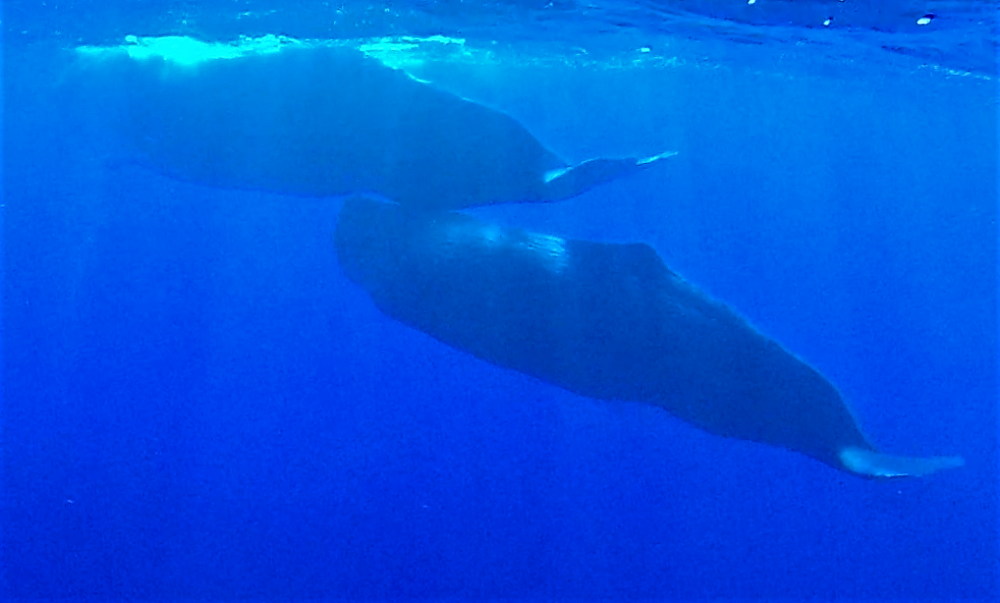
We’re on the last day of the trip from Ambon to Wakatobi in south-eastern Sulawesi, and somehow found ourselves in an area full of sperm whales. The afternoon is getting on, but we’re only 6 miles from the anchorage by Hoga Island, and as the whales don’t seem shy or scared we decided to jump in with them.

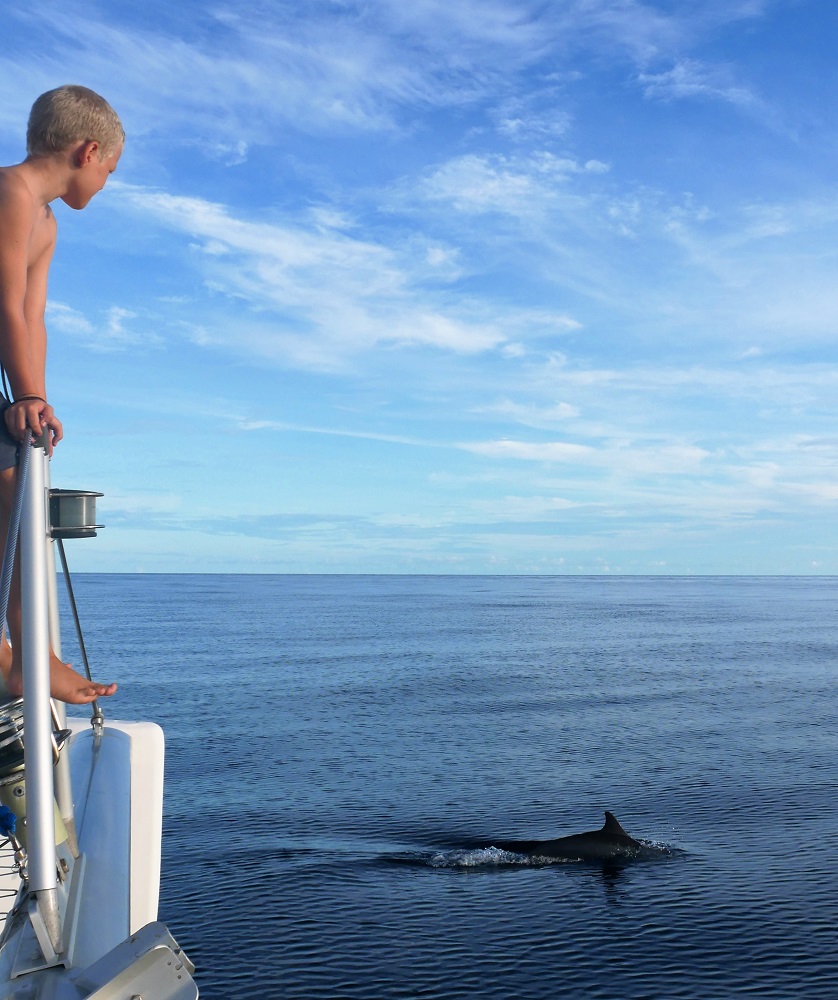
We’re going to Wakatobi because of the famous Wakatobi Marine Park, a large marine sanctuary which provides for amazing marine life. So far our trip has been full of marine mammals. On the first leg, from Ambon to the island of Buru where we stayed for two nights to break the journey, large pods of dolphins came to swim off our bow, playfully frolicking in our wake. At the anchorage at the southern end of Buru Island spinner dolphins came in every morning, huge groups of 20-30 animals trawling through the shallows, leaping out and spin joyfully in the air only to crash down with a huge white-water belly flop.

Bow-riding.

Jumping and frolicking.

Buru is the third largest island in the Moluccas and doesn’t leave a great impression. The anchorage off the township of Namrole is rolly and exposed and the town dirty, rubbish thickly scattered in the roadside ditches, full of foraging chickens, goats and children. We’re there a couple of days before the Indonesian general elections, and the town is full of soldiers, present to ‘keep the peace’. Namrole is sharply divided into a Christian and a Muslim neighbourhood and the two don’t mix much, which probably doesn’t help in terms of minimising conflict.

Local kids on the rubbish-strewn beach in front of the obligatory shipwreck that graces every Indonesian harbour.


Serene goat relaxing in roadside rubbish.

Local children accompanying us as far as the gate signalling the end (or beginning) of the Christian part of town.

Pretty half-built mosque.

Local children swim out to Bob to play.

Heavy weather on the way from Ambon to Buru.

Marine mammals are not the only excitement on the passage. One the way from Buru to Hoga Island we get a visitor when a blue-beaked, exhausted-looking booby hitches a ride for 50 miles. The bird lands on the solar panels at the back where it sits stoically through waves and wind, steadily defecating onto the edge of the dinghy below. When it starts raining it jumps onto the bow of into the dinghy where it spends a while, head in feathers, getting absolutely drenched by the runoff from the solar panels below which it has positioned itself, the accumulated rainwater in the dinghy turning green with bird excrement. After half an hour of solid rain it figures out that it could move somewhere drier, and tries first for a submerge in the unappetising sludge at the bottom of the dinghy before it decides on the outboard engine as a more permanent resting place.

Bird staring me down.

On the dinghy outboard – and not willing to move.

“Go on, get off our outboard.”

Never have we met a bird this tired. It tries to stare us down with its tiny, beady eyes but the eyes keep closing behind the blue wrinkly skin of its eyelids, the head drooping down as it relaxes into sleep, the large red feet clinging onto the bouncing boat. We don’t much like it sitting on the outboard (we don’t want poo on the engine) but it is impervious to our attempts at dissuading it, not moving when we come close or even touch it. In the end, David picks it up and places the indignant but accepting bird gently back up on the solar panel where it relaxes into a long nap, head nestled into its back feathers.

The booby only leaves when we stop to swim with the sperm whales. After realising that we are no longer any help in terms of getting it to wherever it wants to go it flies off impatiently, leaving a heavily stained dinghy and solar panel behind. But we don’t care, we’re too excited about the whales.

David (the small dot in the front is his head) and the whale.

They’re everywhere, mother and calf pairs logging at the surface, the adults easily 15 as long as our boat (14 m), breathing misty sprays and occasionally exuberantly jumping halfway out of the water only to slam back down, sending huge waves of white water off in all directions. After I get back onto the boat, David jumps in next to a pair and stays with them for ten minutes until the mother yawns, at which point David realises how big its teeth are and beats a hasty retreat.

Mother calf showing off her teeth.

Breaching.

Oh the things you see when sailing Mother Ocean – the amazing life that exists alongside, and nowadays largely in spite of, us humans. It is humbling and awe-inspiring to witness these creatures going about their business in their natural habitat – and infuriating how poorly we take care of their ocean. In 2018, a large, dead sperm whale stranded in Wakatobi not far from our encounter with them, making the international news because its stomach was so full of plastic waste there was little space for food. I’m sure at least some of it came from the filthy township of Namrole on the southern coast of Buru.

Sunset off Hoga Island.

Birthday in the ‘Bon

“What do you want for your birthday, Lukie?” I ask.

From his spot by the chart table, David looks at me, eyebrows raised. He’s trying to remind me of the folly of open-ended questions given our circumstances, and I quickly start layering on the caveats. “I mean, you know the score, it has to be something we can get here, something of reasonable quality, which suits your age, not too expensive….” I smile. “I guess you could have a good look around, see if there is anything you fancy?”

“I don’t need to look around, Mummy. I’ve decided.” Lukie looks up from the book he’s reading. “I just want Blutack. Can I please have a big, big pack of Blutack?”

Right. I guess that’s not asking too much. A bumper pack of Blutack. Can you even get Blutack here? I guess they must use something to hang up their posters…  I haven’t seen any stationary stores, but they do have an aisle of paper and pen supplies at the supermarket. At least it’ll be cheap, if I can find it.

“Well, I’ll see what we can do,” I promise. “Thanks, Lukie. And if you see anything else, you know, just let us know…”

We’re back in Ambon to renew our visas early before we travel on to the southern end of Sulawesi. As usual we have three days to wait for the visa, which means plenty of time to provision, eat out, explore Ambon – and hunt down some Blutack for Lukie’s birthday present.

There isn’t much to choose from in terms of presents here, at least not much that a child of Lukie’s age will enjoy. There’s plenty of cheap plastic – action figures, guns, and animals – but they’re the kind you buy in the two-dollar store at home, brightly coloured Chinese wares in crumply plastic packaging backed by cardboard, toys which will fall apart as soon as you open the packet. I’ve seen a roadside plastic toy store where I plan to buy a couple of water pistols, thinking that not much can go wrong with those.

There’s plenty of cheap plastic toys tempting the children of Ambon.

I hadn’t thought of Blutack – but now that he mentions it, I can see the possibilities.

The Blutack craze started on the passage from Banda, a hot and humid 24-hour trip where we plodded along under engine much of the time, just managing to keep clear of most of the heavy thunderclouds lining up in our path. The kids were bored and peeled some Blutack off a picture hanging on the wall, and thus started the Blutack Battles. Hours and hours of fun, using the Blutack as plasticine, shaping little soldiers and setting up armies which attack larger blobs surrounded by mythical creatures. They create and reshape the little figures, the game accompanied by an excited narrative about what the different characters are doing. They are playing a lot of chess at the moment so there is a king and a queen and an army of prawns, which are being attacked by ice gollums and barbarians, the goodies sustaining heavy losses with damage levels plummeting in prolonged attacks at sundown. There are cannons too, and a fortress, possibly inspired by the evidence of historic battle we saw in the Banda Islands. In the end, the good guys always win but not without sacrificing scores of prawns, who lie misshapen and limp in hapless mountains decaying in the strong midday sun.

Heavy weather departing the Banda isles.

There was no moon but plenty of lightning on the way to Ambon – the small shape just left of the lightning striking the water is SV So What.

I could, of course, always try and find some plasticine for his present – but I’m not keen on the prospect of having brightly coloured goo ground into our sheets and textured cushions. Blutack, with its non-descript grayish-blue colour seems safer. But will we be able to find Blutack in Ambon? Can we even fulfil this most basic birthday wish from our youngest? The search is on.

Blutack games.

At least I’ve got access to food. We can buy most things here, so it is with confidence that I ask: “What about the cake, Lukie? What kind of cake do you want?”

“You choose, Mummy.”

Right. Maybe I should just buy some of the local delicacies – in the supermarket here we bought some doughnuts the other day that were topped with fine, brown flakes.

“What is that?” I asked David as he opened the box. “The ones between the chocolate and the coconut sprinkles?”

“It looks like tuna floss.” He sniffed a doughnut suspiciously. “Yep, smells fishy. I’m pretty sure that it’s tuna floss.”

“Really?” cried Lukie, leaning over David’s shoulder. “Can I try one?”

Tuna Floss is a big thing here – it is liberally sprinkled on top of many vegetable dishes in the little rumah makan (eating houses) lining the roadside, and also present in many baked goods, the brown dusty sheen instantly recognisable next to the green bread and the keju cokelat (cheese chocolate, a combination that the kids are roaring to try) topped buns. Keen to know more, we picked up a tuna floss package in the supermarket and read the back apprehensively: ‘Tuna Floss: Inspired by the highly raved about chicken floss, Ayam Brand ™ Tuna Floss is a mixture of tuna fish and spices blended together to produce a luscious spread. Toast your favourite bread and spread generously for a delicious sandwich’. It goes well with rice too, apparently; indeed my impression is that the locals feel that a bit of tuna floss adds depth to almost any dish, although I’ve yet to seen tuna-floss-flavoured ice cream.

Local delicacy: chocolate-cheese topped bread.

Now might be my chance to use the packet we bought – or should I try and get hold of some of the raved-about chicken floss, perhaps? “Should I just make a tuna floss cake, Lukie?”

He shakes his head and looks at me, outraged that I dare joke about such serious matters. “I would prefer a banana cake, Mummy,” he says seriously.

Banana cake – isn’t that a bit boring? That is what we have all the time, using up our never-ending supply of soft bananas. “But we have those all the time. I would like to make you something special – we can get anything here. What about chocolate – you can have a chocolate mud cake, or a vanilla cake, with cream cheese icing?” I offer, keen to spoil him with lavish homebake given I’m in the rare position of being able to bake almost anything.

“Chocolate mud cake, then,” he says.

“And what about dinner? You can have literally anything?”

David shoots me a glance.

“I mean, anything that we can get – so you know, no pork, of course, that means no bacon or ham. And there is obviously no broccoli or capsicums, no snow peas or brussel sprouts…” my voice trails off.

Lukie looks at me. “Can I have either pizza, or lasagne, or chicken curry? Any of those?”

I nod. We can definitely deliver on one of those.

Street art at the local beach.

The birthday is shaping into a success. Now there’s just the question of what to do. We’re anchored in the quiet Baguala Bay, in peaceful surrounds a bit out of town. The water is clean and teeming with fish, and the kids can jump in here any time. We’ve already used some of the glassy mornings to wakeboard, and have been to the beach where the locals gather on weekends to have some water fun and eat from the little fruit stalls lining the foreshore. There are numerous sights in Ambon, and we toy with the idea of visiting a waterfall many miles out of town, or a fortress and an old mosque on the northern shores of the island, but decide against them because they have only received lukewarm reviews on TripAdvisor, and also it would mean many hours of sitting in minibuses in the, frankly unbearable, heat.

In the end we decide on Waterland, a garish and loud water amusement park situated alongside brand-new gated communities for the rich in the hills above Ambon.

Lukie at the waterpark.

The day arrives and the lavish festivities begin – a hot and humid day of heavy rainfall interspersed with searing sunshine where we have pancakes for breakfast followed by an impossibly rich chocolate mud birthday cake with friends before heading off to the waterpark, where the kids and their friends exhaust themselves on the waterslides alongside scores of local uniformed school kids and a few fun-loving adults. The park is heavily staffed, uniformed men and women with whistles who sternly direct the children queuing up for the slides to ensure that there is enough of a break between sliders to prevent total carnage at the bottom. The pool at the bottom of the long, steep slides is a little short, but the situation is rectified by a dedicated staff member whose job it is to run around in waterproof pants bearing a portable crash pad which he extends to protect the squealing children as they come down the slides, full speed, from smashing into the rough concrete wall. It’s a hard job, and hot too, and no doubt he’s saved many lives. After an afternoon of waterpark mayhem we head back to the boat where we skype with family and have lasagne for dinner.

Yeeha!


Smashing into the crashpad.


Race you to the bottom!


Hello Ladies…. Matias bumping into a posse of local school girls at the waterpark.

I’m glad the food worked out because the presents were less successful.
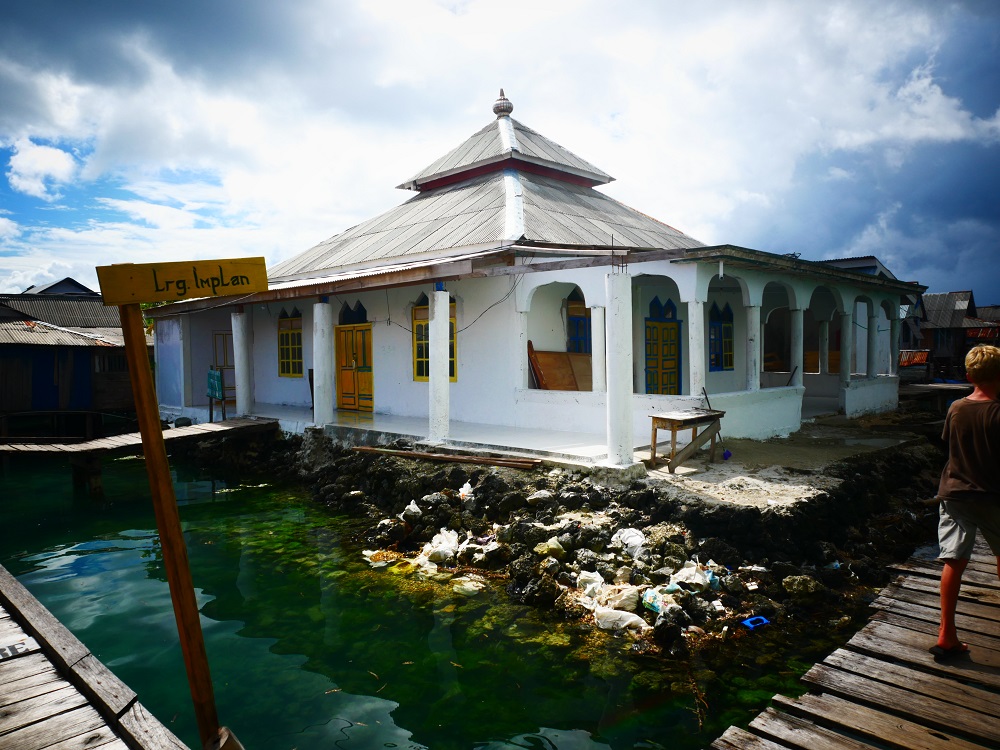
Perhaps not unsurprisingly given the cheap price, one of the two water pistols I bought didn’t work at all, and I was never able to find any Blutack in Ambon. I did, however, dig out a couple of strips from the homeschooling supplies, and by mid-birthday morning we’d already cleaned Blutack off the saloon seats twice and had to shave off Lukie’s hair to get rid of large lumps of Blutack stuck in the blond curls he’d been trying to grow long.

Hijab-wearing thrill-seeker at the waterpark.


Burkhini clad beauty relaxing in the water.