
Merry Christmas from Thailand
Log of our second voyage

“Lukie, on your high school application you can always put: ‘Can fry eggs’,” Matias says.
Lukie looks at him scornfully. “Matias, not just fry eggs,” he says. “Fry eggs well. Fry eggs perfectly.”
I smile. “It’s a good skill,” I contribute. “The perfectly fried egg. Not easy.”
Lukie nod eagerly. “Mummy, if you think about it, I’ve actually learned a lot on the boat,” he says. “When we started the trip, I couldn’t even break an egg without spilling it everywhere. And now I can break them no problem. And I can fry them any way you like – sunny side up, turned over…” He looks proud.
“It’s a good skill for sure,” I say again.
We’re in a marina in Phuket, packing up our belongings to ship to New Zealand. The kids are talking about school applications because Matias has been looking into the different high school options that await him when he gets back. And because some of the potential schools require a resume, he’s been considering what he might put in his. And, one thing leading to another, the kids are now busy composing Lukie’s resume even though none is needed.
It is a popular topic at the moment, kids’ achievements. As school in New Zealand finished for the summer, last week’s Facebook was full of pictures of kids at awards ceremonies clutching certificates and laden down with medals, attesting to their prowess in writing, maths, sports, attitude, anything that you can put a certificate to.
“You can put down that you can skateboard. And that you are a good kite surfer, Lukie,” Matias says.
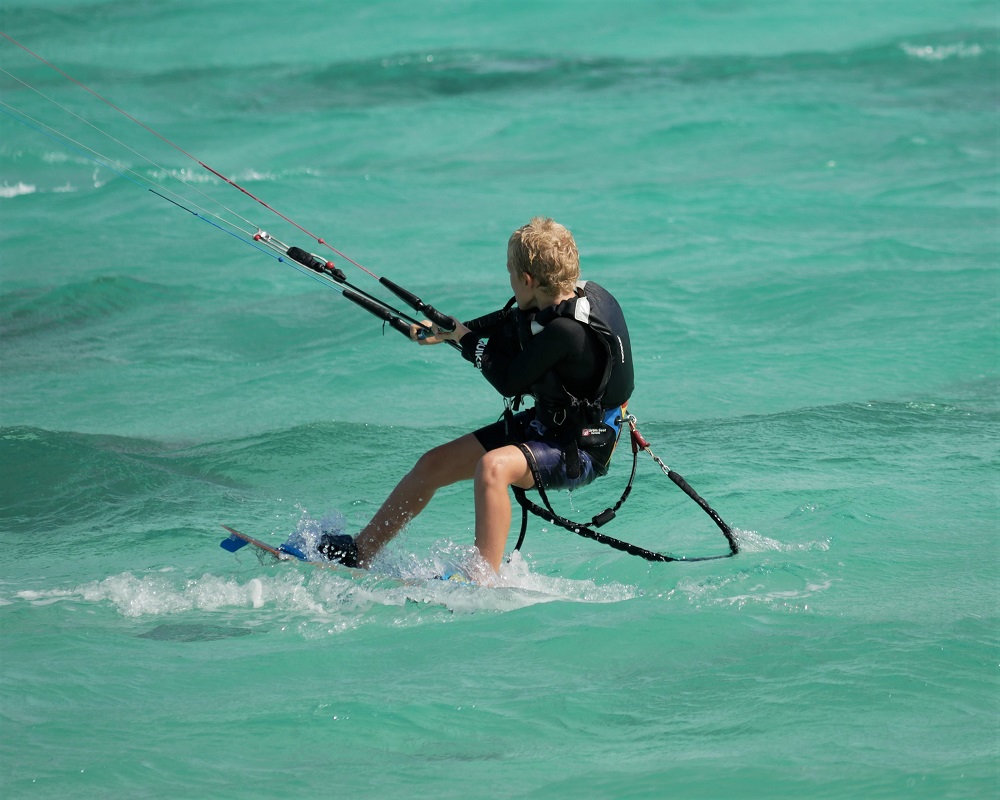
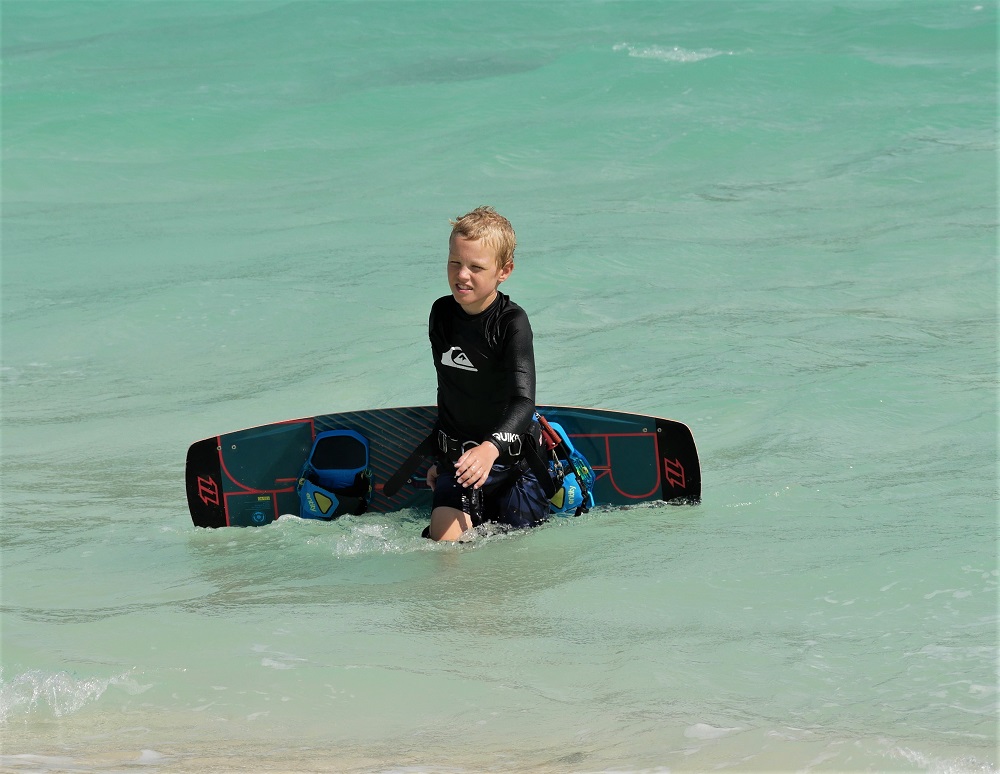
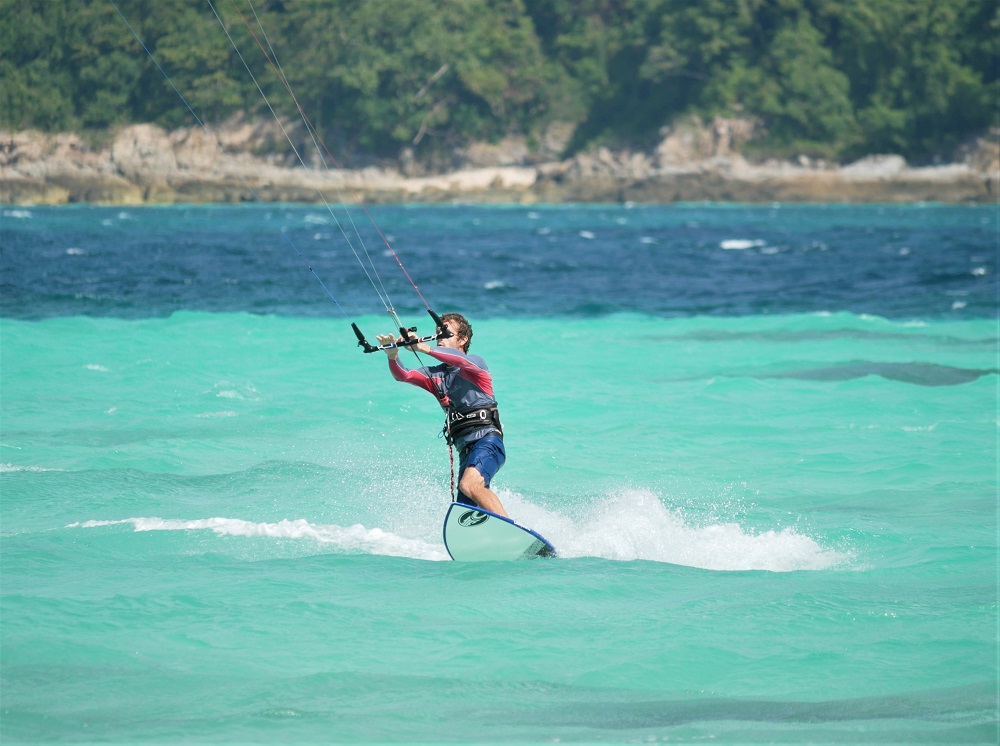
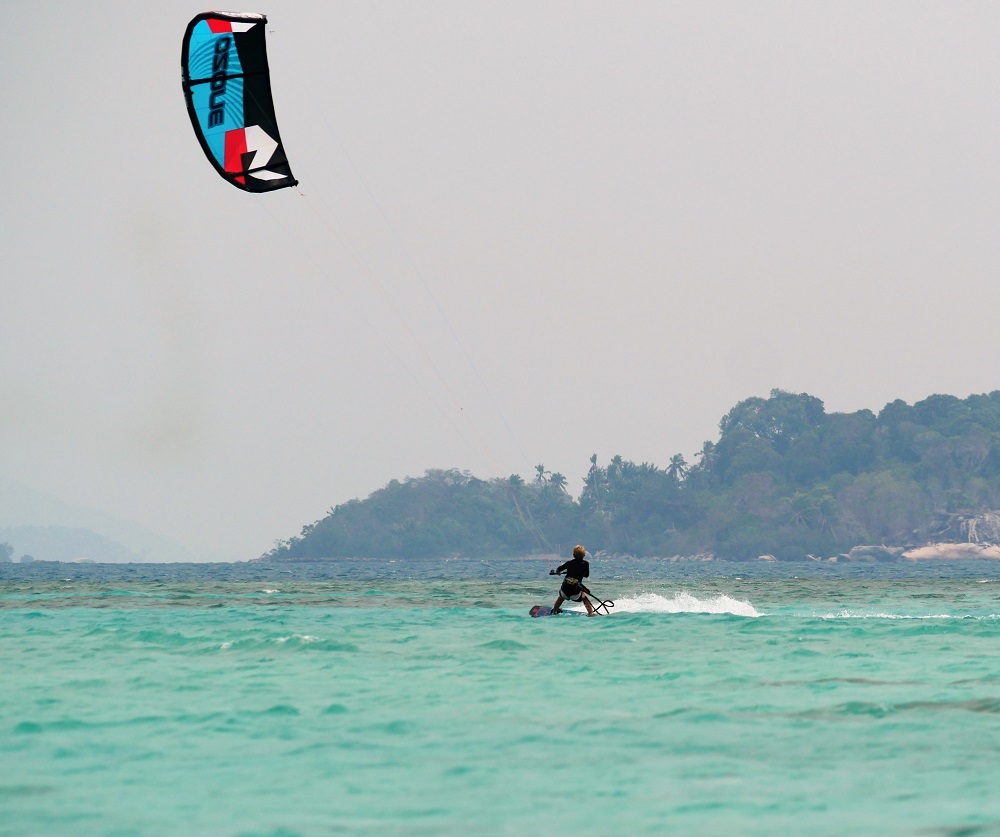
That is true. Lukie has become a proficient kite surfer on the trip, although I’m not sure any school will look favourably at how frequently lately his kiting progress has been at the expense of schooling. On this latest trip to Thailand the windless tropics have been surprisingly windy and as the wind seemed strongest in the morning, we spent weeks choosing to get out and enjoy the elements rather than schooling first up. And once back at the boat after a couple of hours of kiting, everyone is too tired to do more than perfunctory school, if any at all.

But that’s OK. Christmas is nearing, our trip is nearly at an end, and the kids have learned enough academics to take them safely through starting school again back home. And aside from school this sailing trip has taught us so much that will stay with us forever.
There is Lukie’s egg frying, which of course is a big one, and the source of much pride. But apart from that, in terms of food, we have learned a lot. Subtle skills like how to get fresh eggs in Indonesia, how to grow water spinach for months onboard, 100 tasty ways with tuna floss, and when to order a nam prik. Overall, however, the biggest learning curve for all of us have been to get by with the ingredients at hand in places where everything is different to at home. It has been fun to see the kids haggle for unfamiliar produce in foreign currencies, to watch them fill their plates with exotic lunch dishes from a street-side vendor’s display, to hear them discuss their favourite local dishes. The trip has definitely expanded their palates, and now they savour ingredients that would never have passed their lips at home: the searing heat of chilli flakes on a pad Thai, the succulent burst of eggplant in a green curry, the nutty graininess and sharp tang of fried tempeh drizzled with dried fish crumbs.
Perhaps the widening of our culinary appreciation is all about culture. The trip has brought us into close contact with a string of different cultures, which has taught us about tolerance and the diversity of human beings. Spending more than half the trip in Muslim countries, and now cruising around Buddhist Thailand, has given us a deeper understanding of religions other than Christianity and has provided the focus for a lot of school learning about religion and history. Spending so much time amongst subsistence fishing communities has allowed us to experience first-hand the incredible friendliness and generosity of people who have very little. We’ve seen the impacts of extreme overfishing, and, seeing the world from the perspective of fisherfolk, are acutely aware of how little other choice these communities have than to continue to extract miniscule fish from dying reefs. We’ve witnessed the scale of the oceanic plastic pollution and have felt keenly the need for more education of locals in Indonesia around the topic (to our relief, the problem is much less severe as we move north, and here in touristy Thailand the beaches are kept clean by a suite of staff with rakes).
We’ve visited outlaw Papua New Guinea, witnessed an election disrupted by fundamentalist Islamic riots in Indonesia, and are now in Thailand which is a military dictatorship heaving from widespread corruption.
The common denominator in these places is often how little choice so many of the world’s poor have – how few their opportunities, how limited their influence on politics, how inevitable the roll of progress that often changes their culture and environment for the worse.

The other boating families we have met have also taught us about diversity – families from all over the world meeting up on the world’s oceans. Where the rural New Zealand school that the kids go to at home distinctly lacks diversity, out here on the ocean they meet kids from all over the world. You would have thought that mixing with kids from many different cultures would lead to conflict but there are fewer here than at home – what unites boat kids is the friendliness they display towards any children they meet. I guess it comes from actively trying to get on rather than trying to get ahead of someone in a local pecking order – a subtle but important difference to the school community back home. But regardless of the reasons, it has been amazing to have our kids greeted by so many great and friendly kids – an insight into how the world of children could be, how it should be.

Tolerance has also been needed within the family – it is a big change to go from two adults working with kids at school to suddenly spending 24/7 together in a small space, often with challenging conditions like sailing, weather, having to get on in foreign countries, and lately, having to pack up a boat. Not that we don’t argue (I think all boat families do) but we have learned to make up again, to be together and get on even when we’re all sleep deprived and the external pressures are on. Perhaps one of the biggest gifts from the trip is how well we now know each other as a family.
This constant togetherness is without a doubt the hardest bit of living on a boat, but it has also been the biggest joy of the trip. Having so much time to share with the children is amazing, and we’re now so used to being time rich that we take it for granted. Time spent with each other, often not doing much. At home, because of work, time is always short, the lists of things to be done always long, and it has been amazing to have a break from feeling time poor. And it’s been a real privilege to spend so much time with the children, to share their space for an extended period of time.
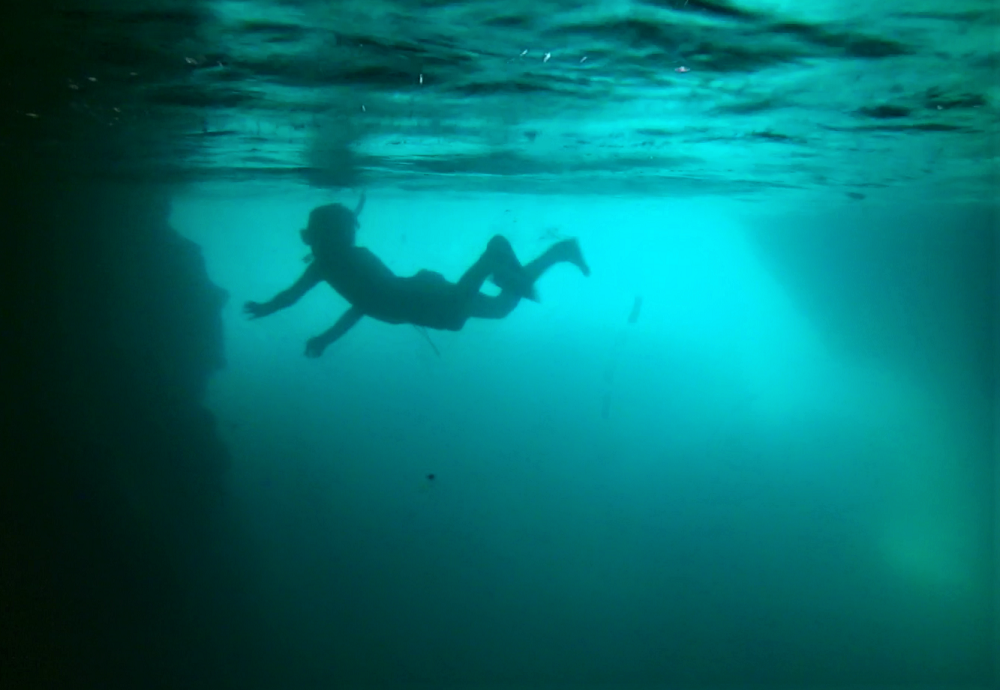
One of Matias’s most common complaints back home was ‘there is never enough time,’ and I hope that providing space and time for him has enriched his life and given him more resilience for the pressures of teenage life and adulthood that await. Our kids have always thrived on having space, their inventiveness and fantasy games making up for the limited scheduled external input that comes with boat life. It has been interesting to watch them grow, seeing how they make worlds of make-believe from almost nothing, worlds within which games will centre for weeks at a time.
And for us as a family, it has been fantastic to have the space to savour the moments that make up life, to have time for lingering, for rambling conversations, for cooking together, playing games, meandering in foreign towns and along unfamiliar terrain, exploring together. A real privilege to be in a position to never say no to a request for attention from our kids.
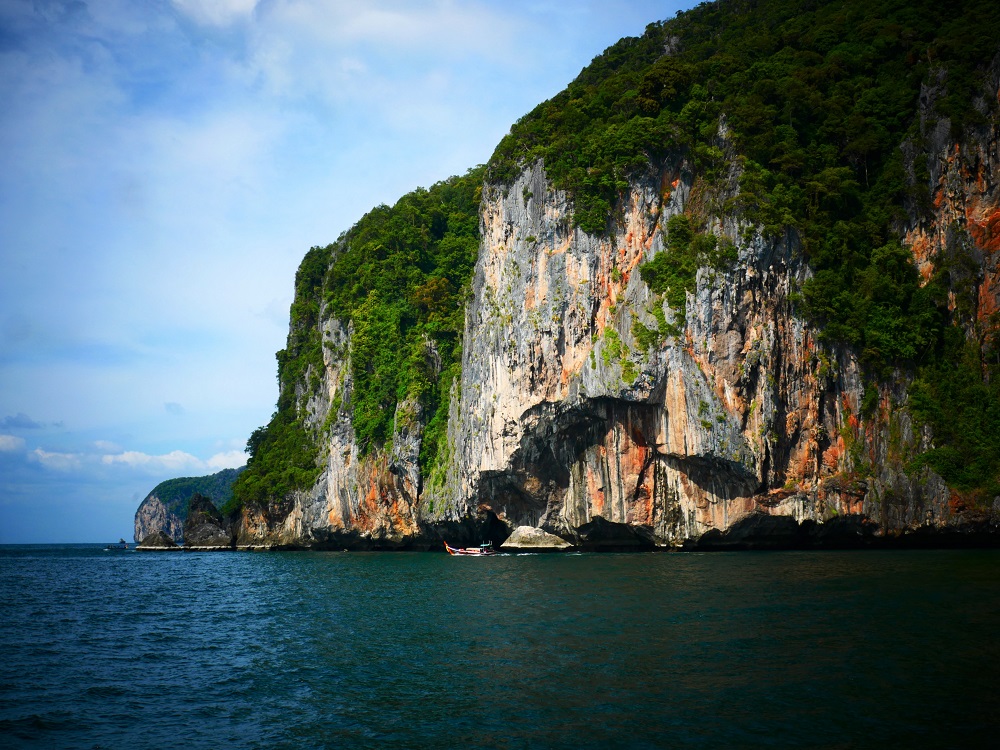
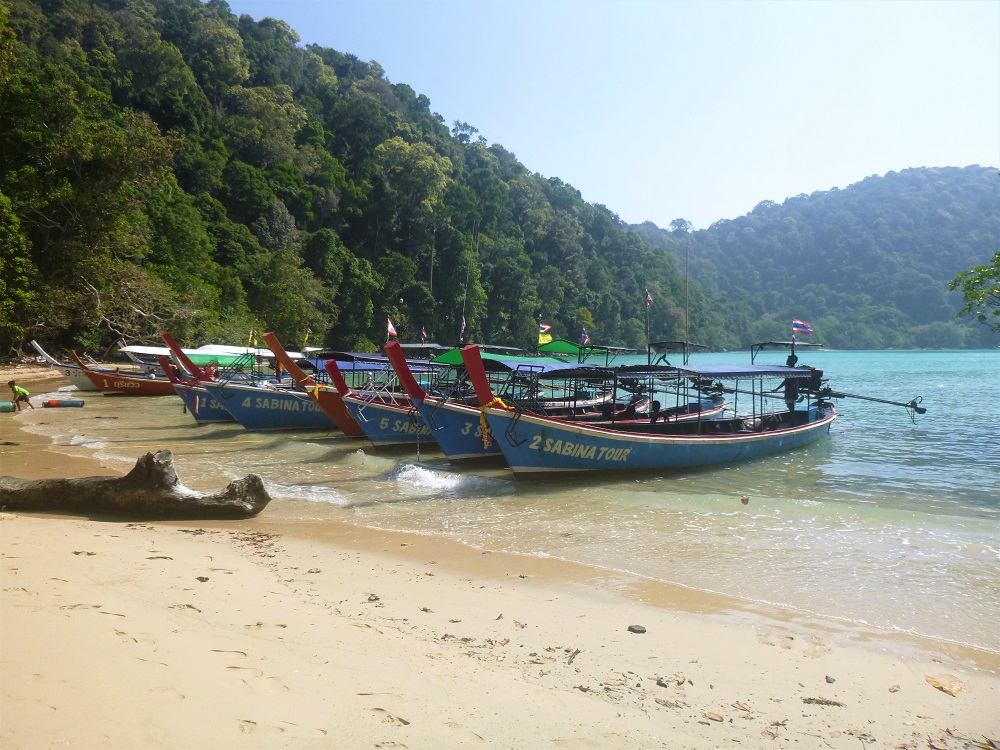
Not that we are lingering at the moment. As the end of the trip is drawing nigh, we have been trying to cram in as much as possible, exploring all that Thailand has to offer. It is an amazing country and a great cruising destination, with hundreds of charter boats gracing the waters near Phuket. We have been kite surfing and swimming, seeing caves and beaches and jungles, snorkelled and done our last bit of tropical diving. And over the last two days we’ve been in this marina in Phuket, busy packing up the bulk of our belongings, which we’ll ship from here today.

After shipping our boxes we will head out to celebrate Christmas and New Year and see some more of Thailand’s beautiful islands.
As I stand and survey the neatly packed boxes, Lukie comes to me and tugs my arm. “Mummy,” he says, “what are we having for dinner?”
“Mie goreng,” I say.
“With egg?” His little face lights up.
I nod.
“I can fry them!”

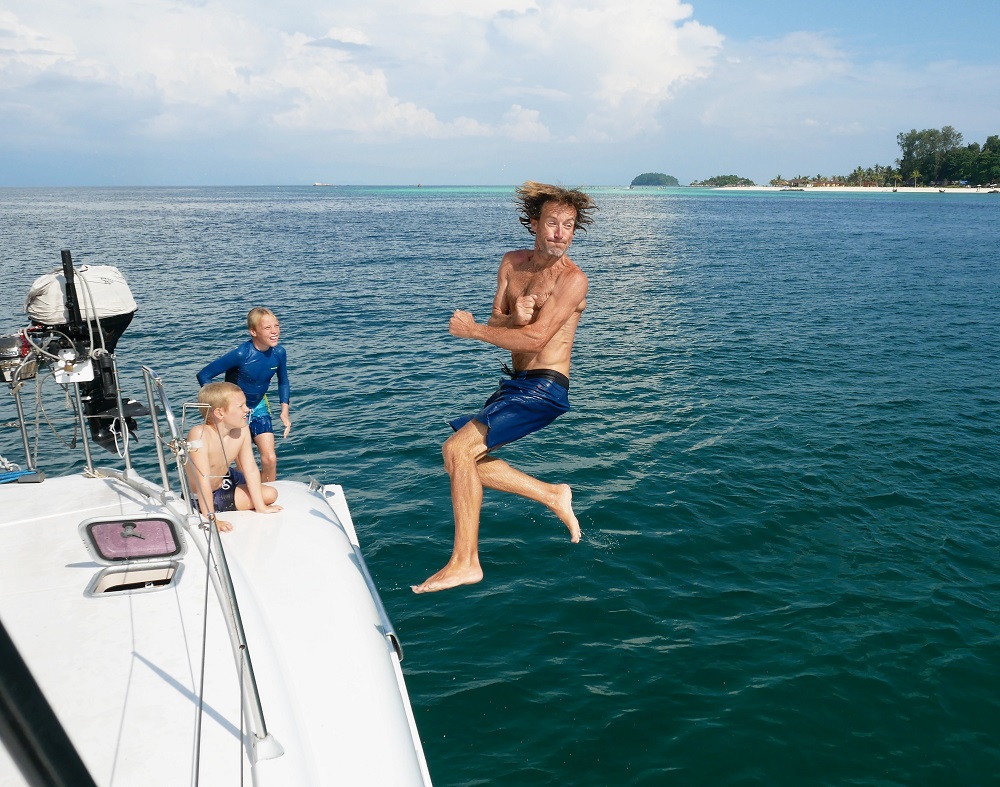
“What is your favourite place – Thailand, Malaysia or Indonesia?” I ask the kids.
“Malaysia is my least favourite,” says Lukie. “It seems to be very developed, mainly cities.”
He looks out from the cockpit, scanning the anchorage horizon. We’re positioned amidst a sea of yachts just seaward of Kuah, the capital of the Malaysian island of Langkawi. Ashore, light buildings cower under heavy clouds which have engulfed the dark green hills of the hinterland. It’ll rain soon. “Indonesia has the best food,” Lukie continues, looking up at me.
“I prefer Indonesia,” says Matias. “I like all the deserted places we went to there. We saw a lot of beautiful islands.” He pauses. “But the Thai script is pretty cool. Way cooler than our normal letters.”
“The food is worst in Thailand,” chips in Lukie. “It is way too hot. But Thailand is the cleanest. Malaysia is sort of in the middle, and Indonesia is the least clean. All that plastic everywhere.”
“So, overall?” I ask.
“Indonesia is my favourite,” says Matias. “Best deserted islands.”
I look at Lukie. “And you?”
“Indonesia for me too,” he says. “Best food. But I prefer how Thailand is cleaner. Malaysia is my least favourite. Although the food here is OK.”
I nod. Always good to hear the kids’ perspective, even if I feel that restaurant menus dominate Lukie’s assessment a little too much.

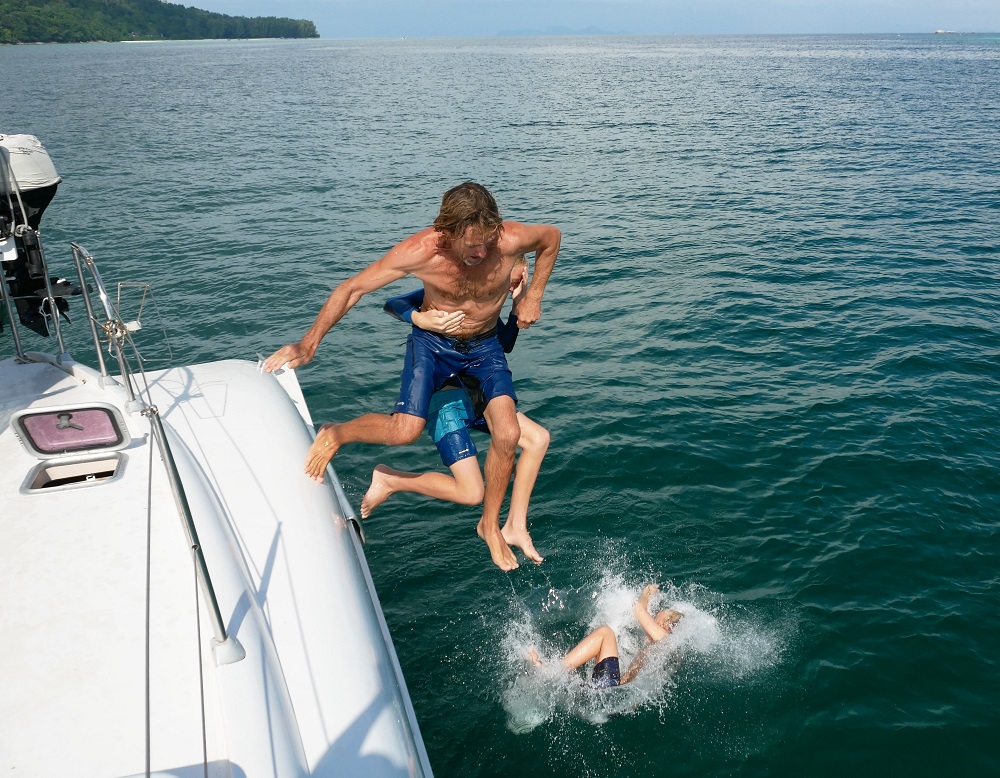
We’ve just come back to Malaysia from ten days in southern Thailand where we visited the small islands around Koh Lipe. We are back in Malaysia briefly to pick up a few more boat parts before heading to Thailand again, for our last five-week trip. Once we return to Malaysia early in the new year, it will be time to pack up the boat and get it ready for sale.
It is a bit unfair to judge the entirety of Malaysia from the little of it that we have seen. Apart from Tioman Island off the east coast of peninsular Malaysia, we’ve only been to the west coast, and we have missed out Malaysian Borneo entirely.


Similarly, we’ve only seen a tiny fraction of Thailand – on our recent ten-day trip we only had time to explore the small islands which are just a day sail from north-western Malaysia. It was a lovely trip, and we fully enjoyed escaping the murky Malaysian waters for a brief interlude of white beaches and turquoise shallows, exchanging sweaty boat work for exploring, snorkelling, diving and kite surfing.


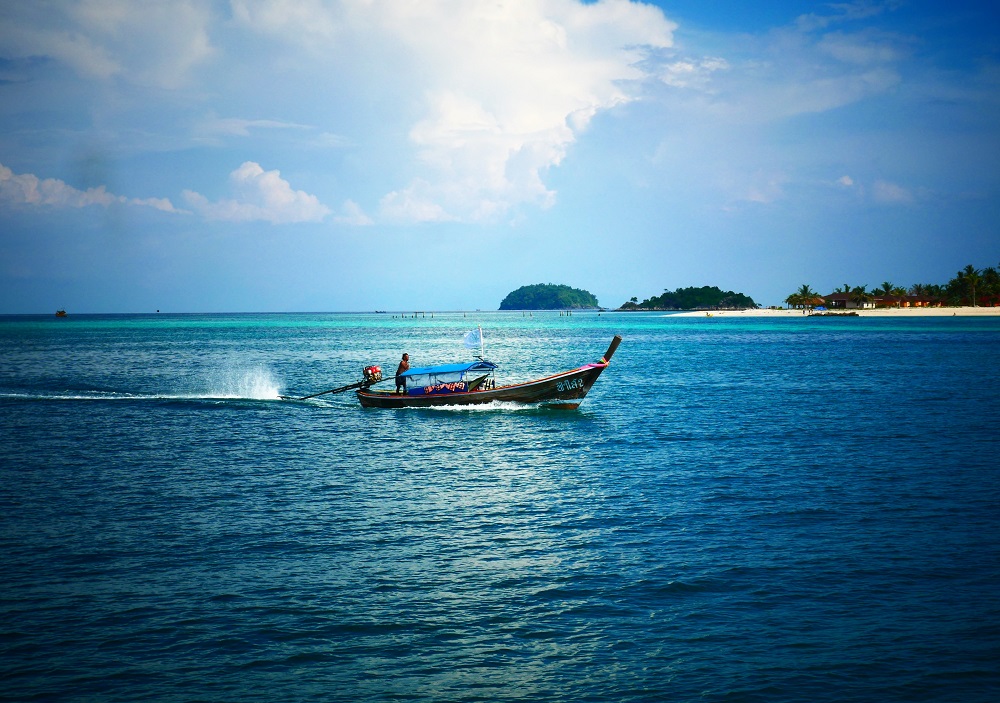
Koh Lipe is Thailand tourist land, the busiest of a group of postcard-perfect islands. It reminds me of Bali in Indonesia – busy with young-ish tattooed tourists clad in little other than swimwear, little restaurants lining the narrow streets, alongside curio shops enveloped in thick incense-laden air featuring tie-dye pants, carved masks, and turquoise jewellery. The air is full of the sound of at least ten different European languages (it’s their winter now, and Koh Lipe is the ideal getaway), mixed in with the sound of ankle-chains chiming and sunscreen being slapped on.
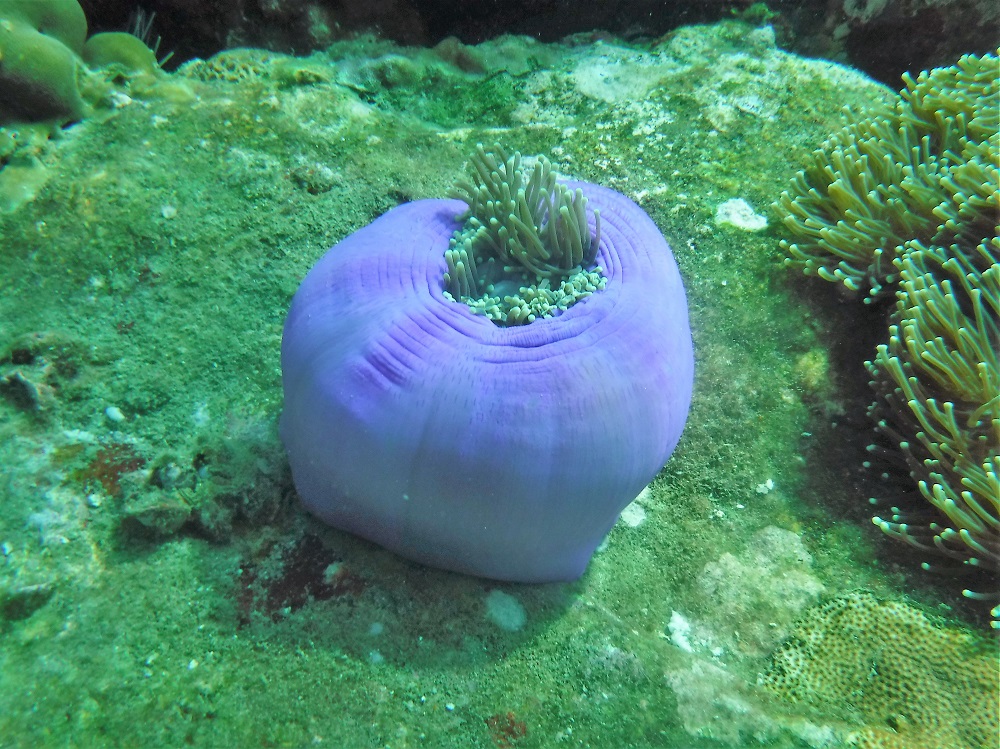
Like much of Thailand it is a diving destination, and although the visibility is not pristine there are some interesting things to see – cryptic scorpionfish, brilliantly coloured soft corals, large moray eels.


And the food – oh the food. I’ve been to Thailand before and remember the deliciously fragrant food well, and on this second visit it doesn’t disappoint. Although one night when we went very local the kids ended up with dishes (spicy minced pork and a red curry) that they found inedibly spicy. (This was where Matias discovered the beauty of the Thai written language. Although he had seen it on signs and menus, he didn’t really connect until he saw the waitress writing down our order on her little pad: “Did you see how she wrote it down, Mummy? She used that script!”) Hence Lukie’s harsh assessment of Thai food – if he had just stuck with Pad Thai, the country would probably top Indonesia in his mind. We’ll see if we can repair the damage when we get back there today: it doesn’t seem fair that the culinary prowess of an entire nation should be dismissed because of one spicy meal.
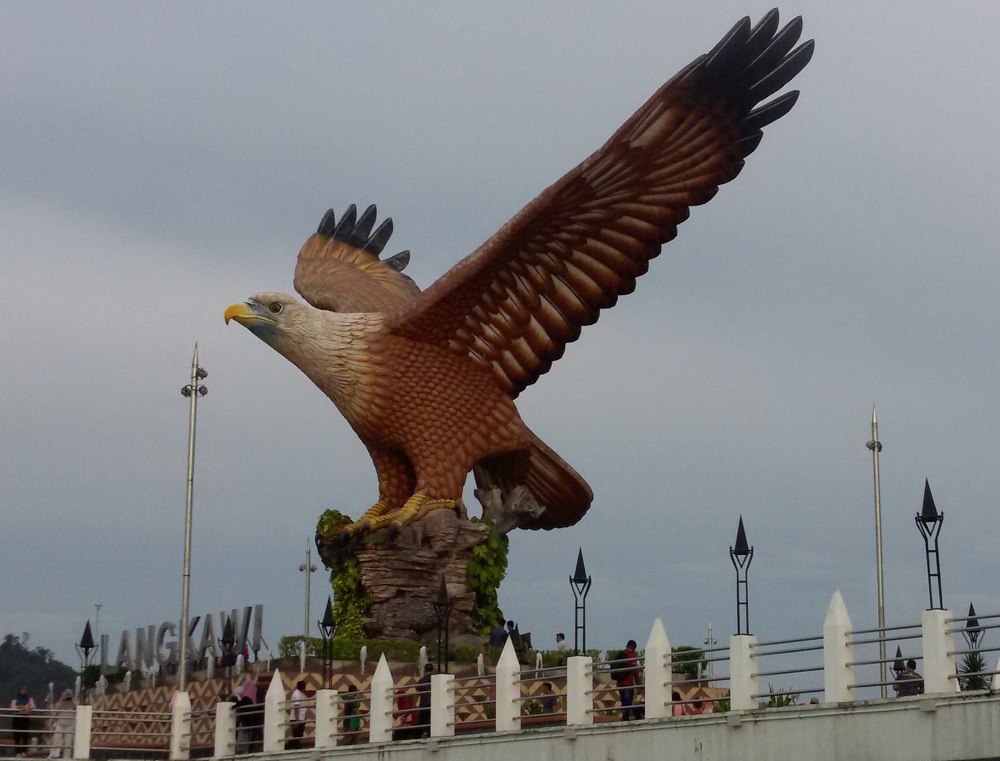

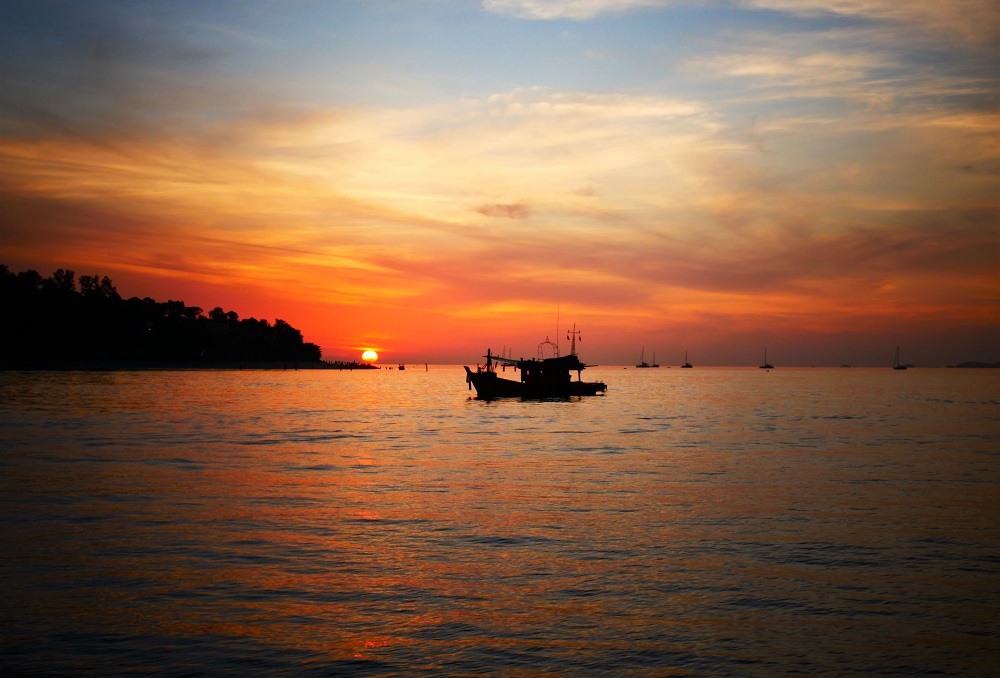
As I feel the first raindrops hit my face, Lukie looks at me. “What about you, Mummy? What do you prefer – Thailand, Malaysia or Indonesia?”
I think for a while. I loved the dichotomy between the crazy chaos of the inhabited areas and the deafening silence of the exquisite wildernesses we found in Indonesia. Loved how we couldn’t get anything we were used to, and so had to learn how to cook Indonesian, and speak Bahasa to get by because nobody speaks any English. I realise that I quite like difficult places – like the challenge of getting by in foreign lands. Malaysia, in contrast, is easy. Everybody speaks English and you can buy most things. It’s a good place to do boat work, although the places we have been to have not been memorable for their natural beauty. Thailand is different again. Stunningly beautiful and very touristy, which makes for easy sailing. People speak English, the food is wonderful and everything is available.

The only South-East Asian country that was never colonised by Europeans, Thailand remains somehow more ‘foreign’ than Indonesia and Malaysia. Utterly different language, culture, religion. Little Buddhist shrines everywhere, and no women with veils, no melodic mosque calls in the early morning. After so long in Islamic countries, the difference is stark and comes in small waves of sudden recognition. The absence of huge, colourful, waterfront mosques. The jet-black shine of a local woman’s hair, no veil in sight. Alcohol and pork on the menu in restaurants. The endless throngs of tourists wearing string bikinis. The switch to Buddhism has some advantages: I am no longer too hot because I can wear shorts and a singlet, without risking offending anyone.
“I don’t know,” I tell Lukie and ruffle his hair, which is starting to feel wet from the rain. “Let’s close up the boat so the rain doesn’t come in. And then, when it stops, we’ll lift anchor and head back to Thailand to see some more before we make up our minds.”
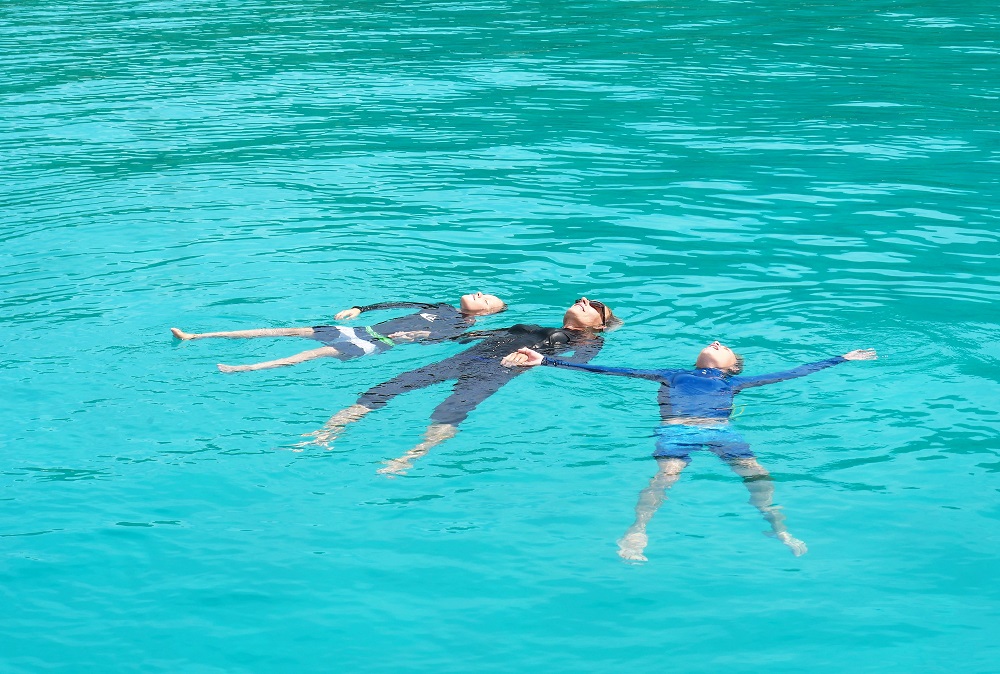
“Mummy, when are we going to be in clear water again?”
I sighed and look out over the horizon of masts spiking the low-hanging dark grey sky. The question, asked by Matias, is fair enough. Since leaving Indonesia we’ve been moving northwards along Peninsular Malaysia’s west coast, hopping from town to town, staying mainly in marinas. We’ve been in marinas in Puteri, in Pangkor, in Penang and in Langkawi. It’s a stark contrast to the deserted islands and crystal waters of the Anambas; here in Malaysia’s marinas, the water is thick and green and often covered in a membranous rainbow oil slick.
I shake my head. “Not sure,” I say, putting my arm around his shoulder. “Maybe in Thailand?”
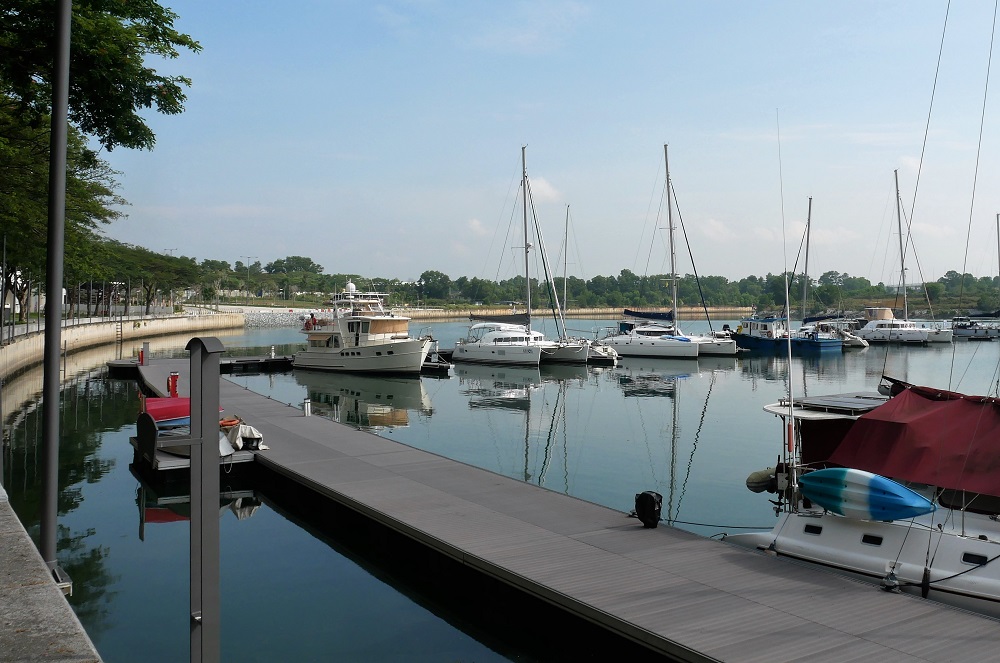
Matias is not a fan of marinas, and I’m not either. They are hot and windless, dirty and crowded, full of insects and bird poop. Unlike anchorages, they are too close to land to allow a cleansing breeze to alleviate the heavy pressure of Malaysia’s 30 degrees C and 95% humidity, leaving us gasping for air whenever we’re on board. At dusk the mosquitoes come out, so every night just as the air cools to a reasonable temperature, we have to close the boat up tightly, our fine-meshed mozzie nets stifling whatever minuscule airflow is present. Not that we can keep the hatches open anyway – it rains almost every night here, so we lie sweating on damp sheets, beady droplets drawing lines on our glistening bodies in the tightly closed-up boat, the only airflow present that propelled by the faintly whirring fans.


Marina living is dirty, too. No matter how fancy the place – how nicely maintained the boardwalks, how neatly swept the paved paths, how immaculately kept the thick green grass – the close proximity to shore brings an endless amount of black child-sized footprints trailing up our white gelcoat from the dock to the cockpit. No matter how many mats I put down and how many admonishments I issue the footprints continue over the cockpit seats and into the saloon. It’s not just our foot soles that are dirty; after more than a year of water living we are used to having white-clean nails but now that time is gone and we find half-moons of shore dirt imposing on the tips of our fingers, wedges of black impossible to dislodge from the children’s toenails no matter how hard we scrub.
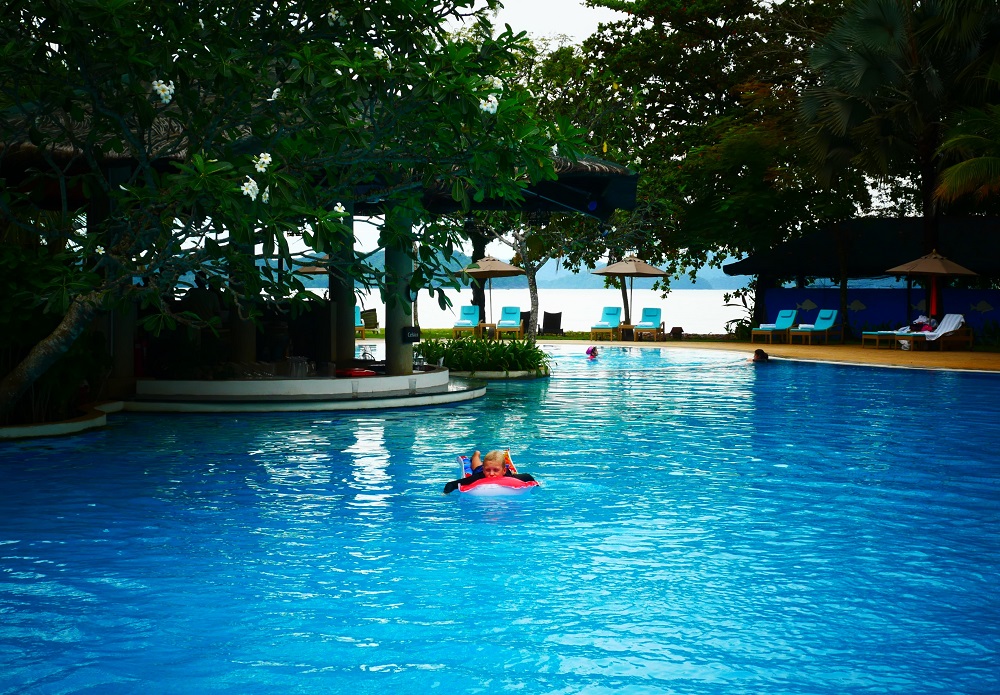
Of course, there are mitigating factors. There are the amenities, the flushing toilets that are nice to use, the one-push-and-its-all-gone a novelty that only fades slowly, approximately at the same rate as our hands soften with the waning of the toilet pumping calluses. Invariably, though, marina toilets are situated too far away – no matter which berth we are assigned, the nearest toilets are never less than a mile away. There are showers, too, with good pressure cold and sometimes lukewarm water under which we stand for long minutes on end, savouring the feel of fresh water cascading over our skin. The drawbacks to the showers are the mosquitoes hanging around in the perma-shade and the mouse-sized cockroaches that lurk in the drain, only to scoot out when I switch on the water, causing my heartbeat to shriek into sudden arrhythmia. On the boat, there is endless fresh water and electricity, which means that we can splurge when doing the dishes and use whatever power tool we want.
The latter is the reason we’re there, and I’m sure that the circumstances flavour my impressions of marina living. We are coming to the end of our journey and there are a thousand small things that we need to do to the boat to get it ready for sale. So, we’ve been hopping along from marina to marina, receiving parcels in one place, shopping for parts in another, settling in to do boat work in a third.

Working on the boat whilst you’re living in it is a bit like living in a house you are renovating – dirty and unpleasant, but cheaper than the alternative. So we put up with the clouds of sanding dust and varnish fumes, the endless drone of power tools, the living space so crowded with tools and brushes that there is no place to sit, the kitchen that is covered in drop sheets and masking tape.
Despite Matias’s dislike of marinas, the kids normally have fun there. Many places have swimming pools and most have large areas covered in concrete perfect for skateboarding. There are other boat kids too, and while the adults work, the kids roam free in large gangs, busily swimming, skating and exploring.

There are, of course, things to see here. You can catch taxis inland and explore tourist attractions, take long walks, visit waterfalls, scale small peaks in the searing heat. But with all the work we have on we tend to limit our excursions to shopping for boat bits, and so the only local attractions we see are busy shopping malls, the touristy beachfronts, and the creatures one finds in marinas.

Of these, the humans are the least charming. Normally, yachties are interesting people. They are the sort of men and women who make their dreams a reality, who get up and go, who are not afraid to grab life by the helm and steer into the unknown. They are people who choose their life rather than fall into it by default, doers not gonnas, the kind of people who are interested in nature and people and culture, who love exploring, who marvel at the wonders of the world. They are self-sufficient and capable, competent and sensible, not afraid of a life lived a bit differently, without too many safety nets. They are lovely people, interesting and interested, and a joy to meet.

Yachties like that tend to stop only briefly in marinas. They come there if they have some work to do on the boat, if they need to pick up visitors, or if they need a place to leave their yacht while they go overseas for a while.
There is another variety of yachtie in marinas, though. These are the ones that are stuck, for one reason or another. On our travels across the world’s oceans we have encountered a few places where people tend to get lost, the Hotel Californias of marinas and sheltered anchorages. St Maarten in the Caribbean is one example – most of the boats we met there never went anywhere. The marinas of Malaysia are the same. Here, unwary boaties find themselves stuck for years and we meet many of them. Presumably once proud and cheerily full of good posture and great spirit, they are now scowling weirdoes, ageing men and women walking with humped backs and a permanent grim expression etched onto their forehead. Their faded clothing and narrowed eyes speak of years spent hatless in the strong tropical sun. They normally walk with a spanner in one hand and a beer in the other and spend their time tinkering away on endless boat jobs whilst remaining pleasantly sozzled on the duty-free beer. They form close-knit groups whose collective waistlines slowly expand in tune with the dwindling of their bank accounts as they meet up at happy hour, red-faced and ruddy, to complain about the lack of skills of the local workforce. From Malaysia there are not many places to go – once you’ve exhausted Thailand, the only way forward here is across messy Indonesia or into the blue of the Indian Ocean, both of which are longer trips requiring planning and a seaworthy vessel, a daunting prospect for many. All this make the marinas of Malaysia places where trips are ended, dreams are packed up, stuffed into crates and shipped home, or just allowed to slip away imperceptibly, fizzling out like the bubbles in a can of beer left open in the strong summer sun.
In our marina hopping north, we’ve met countless yachties who have left the return to shore too long. They don’t tend to enjoy themselves an awful lot and don’t much like where they’re stuck. They dislike Indonesia and Malaysia because the anchorages are deep. Because the people are Muslim. Because the mosques are loud, the women wear burqas. Because the officials are difficult. Because people don’t speak English everywhere. Because you can’t buy cheese in many places and mayonnaise is difficult to find. We listen and nod and wonder if they went to the same places as us, the amazing sites of clear water and wonderful marine life, of beautiful people and incredible sunsets, white beaches and lushly vegetated peaks.
“I didn’t rate Indonesia,” said a woman I met in the marina lounge in Puteri.
“But we saw some amazing marine life!” I said. “Did you see the mantas, the whale sharks, the turtles?“
She shook her head, her mouth set in a permanent downward expression. “We have plenty of good marine life in Queensland where we’re from,” she said. “And there, I can get my cheese!”
I wondered silently why she and her husband didn’t just stay in Australia, where they can buy mayonnaise by the litre and don’t have to meet people of a foreign religion who don’t speak English? Seems a pity to go all this way only to hate every step of the journey because it isn’t back home. After all, what is the point of travelling if you don’t want to see anything new?

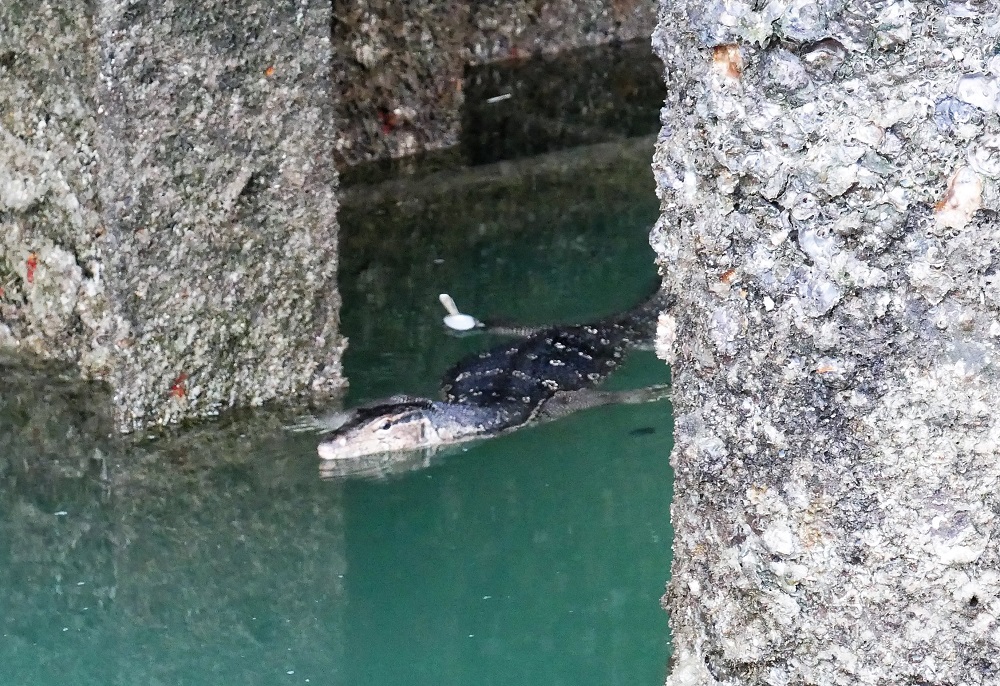
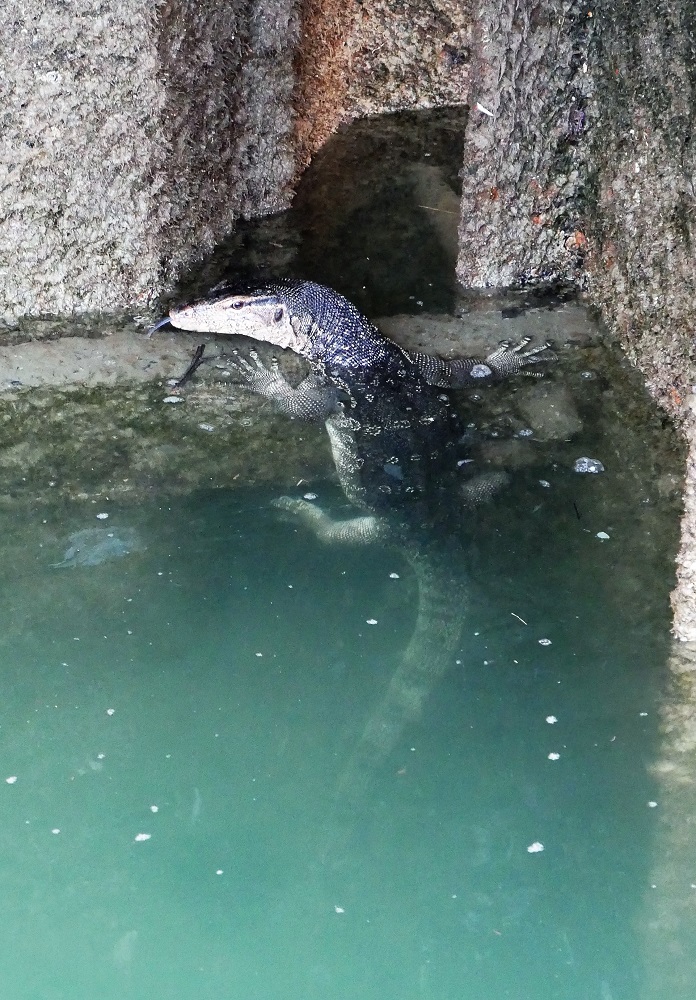
The non-human marina life is a little more rewarding. The green water is full of little fish, whose outlines we can only just make out as they swim centimetres below the surface. More exciting are the large yellow-striped monitor lizards that sit calmly sunning themselves on the intertidal rocks of marina walls. Some of them are over a metre long. Resting motionless they recharge their thermal batteries before slipping silently into the opaque water as we approach, hiding under dark pontoons or swimming languidly about amongst floating plastic rubbish, their large feet trailing behind as the body snakes itself forwards surprisingly fast. In one marina, one of the lizards was floating, bloated belly up, in the thick green water.
“I think he died because he was too fat,” said Lukie, looking up at me doubtfully.

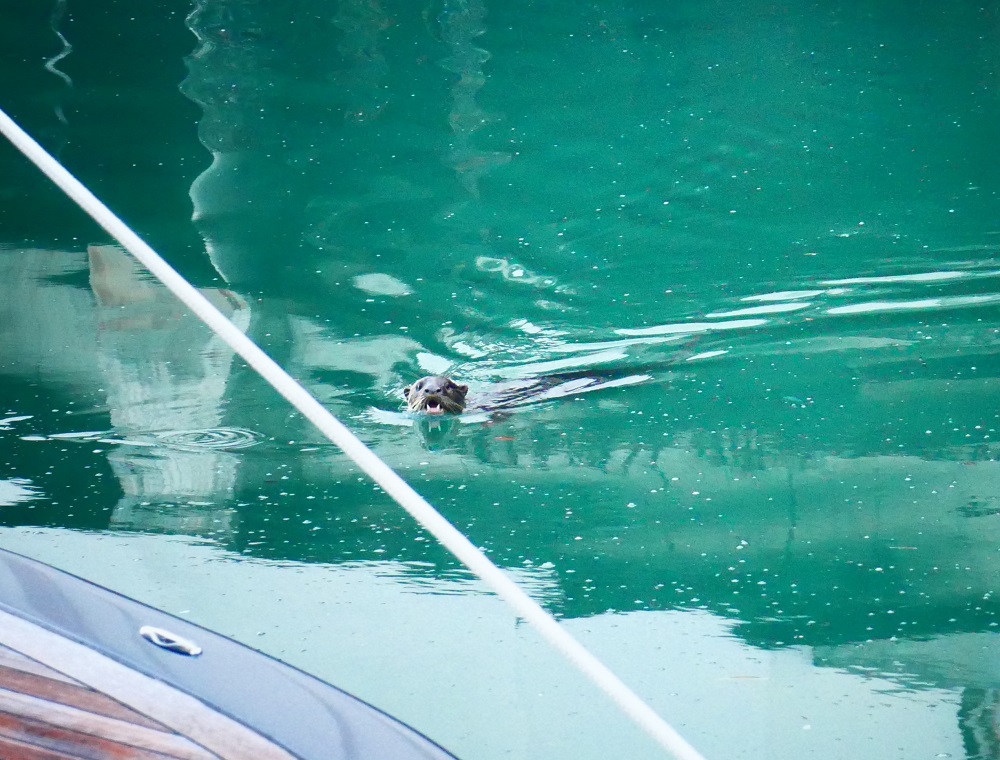
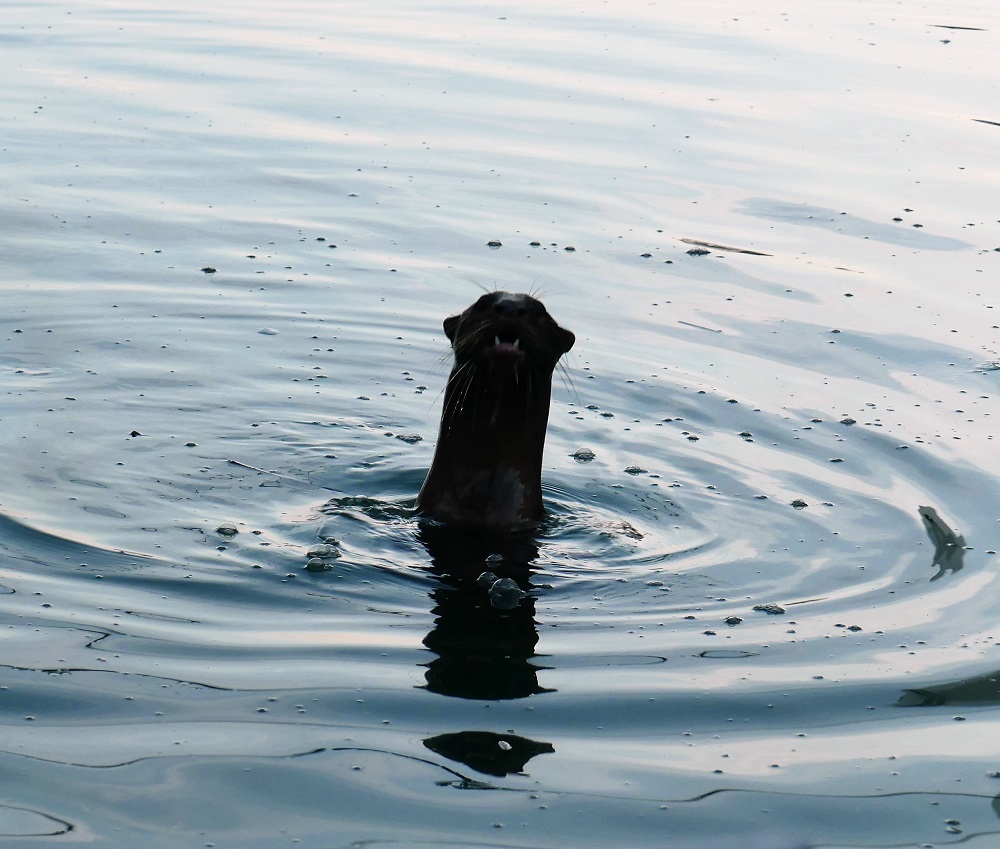
In the marina in Penang, a family of sea otters shrieked loudly, their high-pitched barks competing with the squealing of ropes stretched taut in the resonating marina swell. As we sat watching mesmerised, the otters climbed out onto the pontoon and deposited their fish catch, after which they engaged in loud arguments about who got to eat it, a hissing and screeching fest that only ended when the large marina crows started circling very low. Protesting loudly at the enormous dark birds, the otters slipped into the water, leaving behind a couple of half-eaten fish carcasses and a stinky mess of soft poop slowly spreading over the jetty in the light rain.


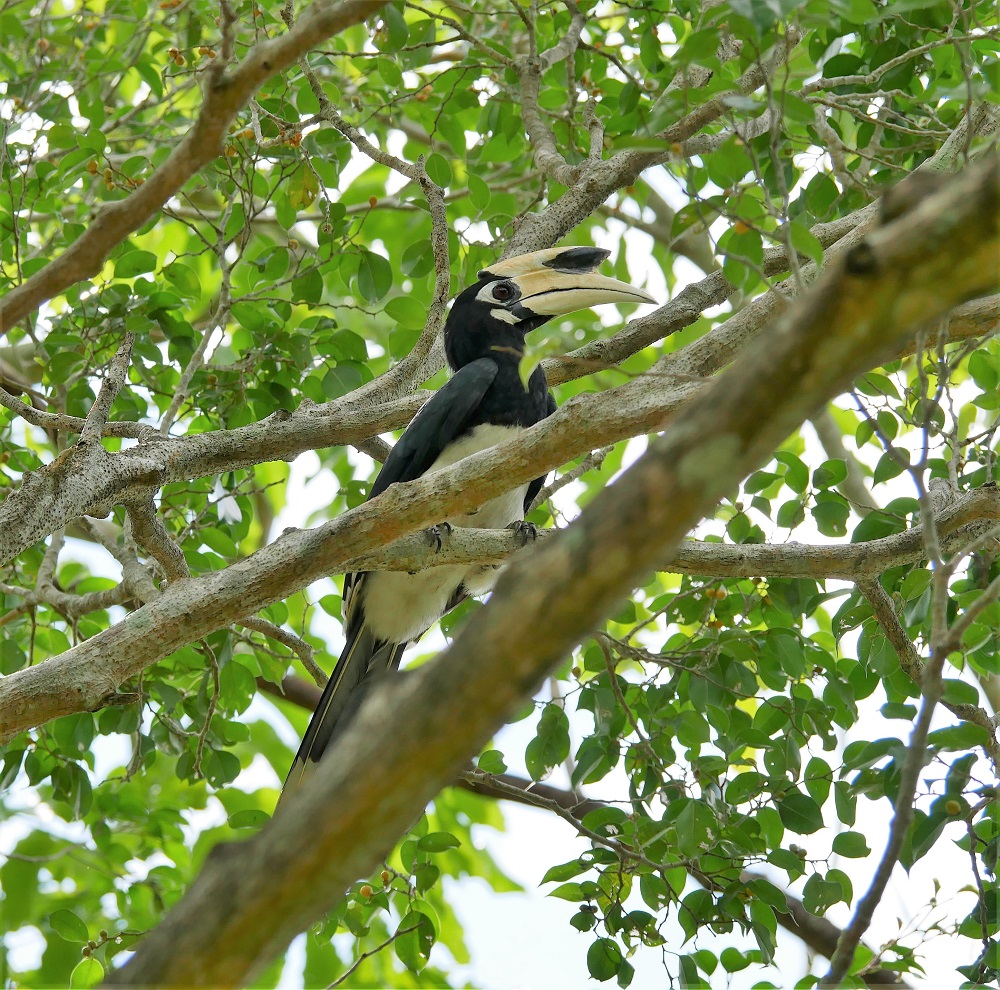
There are birds everywhere. The marinas seem to be colonised by crows rather than seagulls in this part of the world, although colourful hornbills have the upper territorial hand in Rebak Marina, Langkawi. Here, pairs of hornbills flew in tandem, settling loudly into swaying treetops, squawking and screeching as they courted the day away.

On the few anchorages we frequented in between marinas there was amazing life too. In Pulau Paya, just south of Langkawi, a lone dolphin came up to the boat in the early morning as we were untying from a mooring. We often see dolphins in Malaysia, but they tend to be quite shy. This one wasn’t – it wanted not just to ride our bow wave but to play with us. It kept circling the mooring, pushing the float with its snout, looking at us with beady eyes as it came up again and again for breath. When it stayed by the boat even after we drifted off the mooring we jumped in, and to our delight, the dolphin stayed to play. It circled us, whirling up the water, spinning us faster and faster as it wound us in a web of bubbles, its body passing only a few centimetres from our hands. We dived down and it followed, torpedoing itself through the water, spinning and circling us as we slowly floated back up for air. Wherever we swam it followed, doing small leaps out of the water as it sped past us only to slam on the breaks and cut right in front of our bodies when we got too slow. It was full of joy, showing off its superior swimming skills, good-naturedly laughing at our clumsiness as it patiently humoured our attempts to keep up.


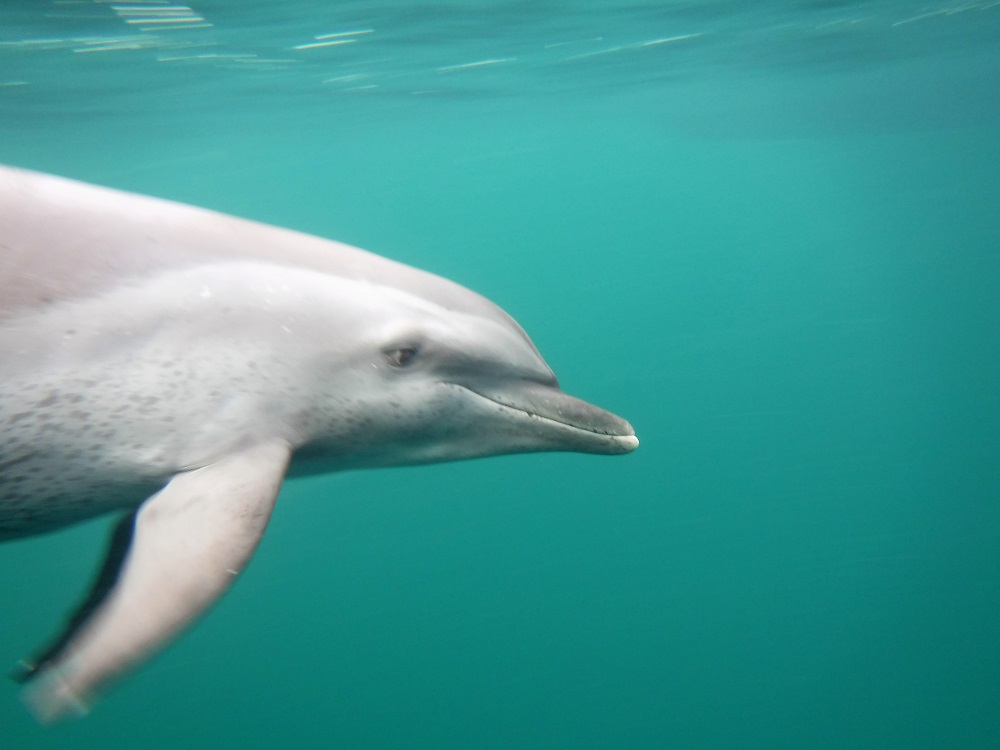
The kids yelped and splashed, frantically trying to outswim the dolphin with front crawl and foamy fins, diving after it with outstretched hands, the dolphin staying just outside of their reach but waiting for them whenever they started lagging. It was hilarious, a dolphin acting like a well-trained playful dog, a bored intelligent mammal looking for friends to share a bit of light-hearted playtime. We wondered what made it so – whether the locals feed it and why it was there all by itself; normally dolphins hang out in playful gangs, not unlike kids at a marina. When we finally left the anchorage it accompanied us for a mile or two, swimming not at our bow but alongside the cockpit, looking up at us beseechingly before peeling off and heading back to its island.

It’s a nice reminder of all the beautiful elsewheres out there. After a solid month of marinas, it is time for us to go off in search of a little nature, a bit of fun. There are boat jobs we can do on anchor and we better do them there, escape the marinas for a while. Otherwise, we might end up all weird and never escape at all.

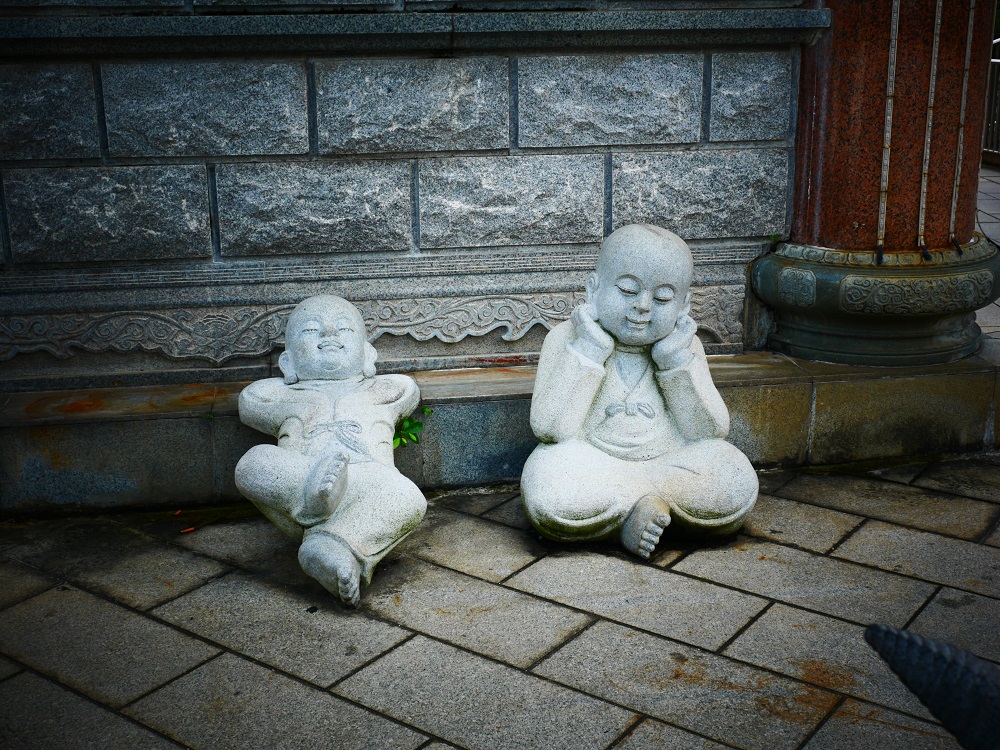
Temples, triads and Chinatown – in Malaysia, the closest you come to the orient is Penang Island. On this little island off the Malaysian west coast, Chinese settlers have been living for centuries, shaping the look, feel, smell and sound of the city of George Town.
Not wanting to miss an oriental adventure we stopped in George Town for four days, soaking up the atmosphere and seeing as much as we could cram in before heading further north to do boat work.
Penang has been a multicultural melting pot since the British got involved in the area in the 1700s. The largely uninhabited island was part of the Sultanate of Kedah when Francis Light of the British East India Company was scouting the area looking for a trading port. He persuaded the Sultan to trade it for military protection against the sultanate’s enemies, the Siamese from modern-day Thailand. After shaking hands on the deal, Francis hopped ashore from his wooden sailing ship, pegged a stick in the ground and renamed the lushly vegetated place Prince of Wales Island. There, he founded the city of George Town, creatively named after King George III. (Back then, blatant flattery was how you curried favour with the monarch, and owing to either very rigid customs or an astonishing lack of imagination successive British kings were called George for more than a hundred busy years of empire expansion, with the result that there are now many Georgetowns in the world.)
As it turned out, Light didn’t have the full backing of his company and the promised military support failed to materialise, which led to the Sultan attempting to take back Penang. Light managed to fight him off and over the years the British East India Company expanded their territory to cover parts of the nearby mainland. The British were embroiled in trade wars with Holland at the time and Light made George Town a free port to lure traders from the Dutch trading posts in Indonesia, which at the time were operating as heavily guarded monopolies. To further spite the Dutch, and to boost business, spice plantations were set up on Penang and not long after it was established, George Town became the trading hub of the region.

Lured by opportunity (Chinese), and brought in by the British to do the dirty plantation work (Indians), settlers arrived, bustling into the compact centre of George Town, bringing along their unique culture, aesthetic, food and religions. The narrow streets of George Town became a fusion of cultures and cuisine, and Chinese and Indian districts quickly developed, supporting temples of every faith. Clans and secret societies blossomed, supporting opium dens and opulent mansions located just a stone’s throw from the more modest tin-working quarter, shoe-making alley and fish-vendor street.


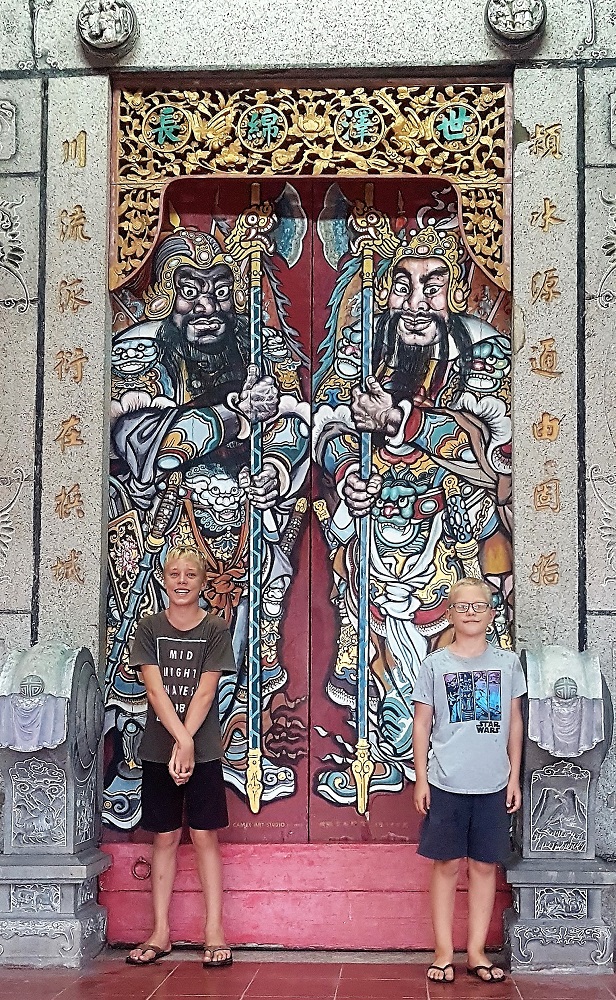
Today’s Penang is of course nothing like that of the past but we still found plenty to marvel about. The current population is 1.8 million people, of which 40% is Malay, 40% Chinese, 9% Indians and 9% ex-patriates from all over the world, with various other ethnicities making up the remainder. In George Town, more than half the population are of Chinese descent, and the old town has a distinctive oriental flavour. Turgid red paper lanterns drip from dark awnings and gilded Chinese lettering spill down the length of heavy wooden doors. Clan houses and temples are dotted everywhere, their elaborate terracotta roofs playgrounds for glittering dragons and scaled serpents, the silhouettes of which jut out sharply against the bright sky. In the temple front yards, intricately carved stone columns hold up heavy roofs and statuesque pudgy midget lions sit atop pillars, fangs bared and jaws parted in silent roars.

George Town is often referred to as a ‘living museum’, and a large part of the old town was conferred protected status when it became a UNESCO world heritage site in 2008. Although 45% of Penang’s population is Islamic, it is the temples rather than the mosques that makes George Town famous. And the town has it all – with a huge Buddhist population (about 36%) and sizeable Hindu (9%) and Taoist / Chinese folk religion (5%) minorities, George Town is home to more temples and clan houses erected for ancestor worship than you can visit.
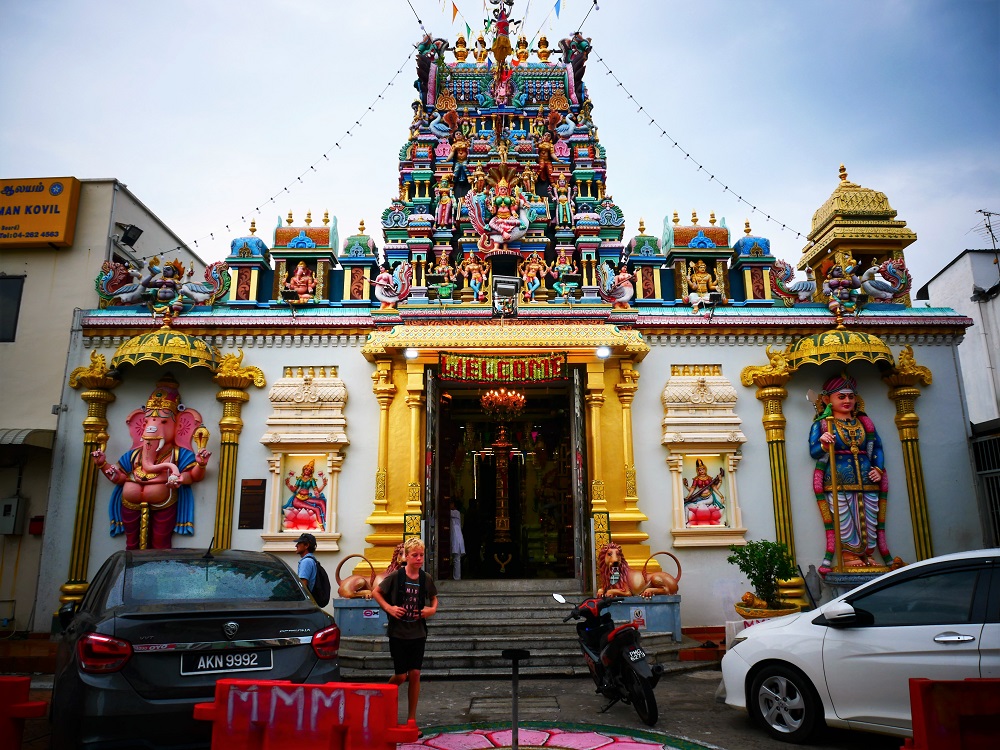

We walk around the narrow streets in the searing heat of the midday sun, dipping in and out of cool, shaded courtyards of old Buddhist and Hindu temples. Slinking into the thick, incense-laden air of plush red temple interiors we view golden Buddhas and shining statues of peaceful-looking ancestors kept behind glass and admire wall paintings of warlike heroes with whiplike goaties raising swords against enemies hiding behind our shoulders. In the Hindu temples, where glitter and chaos rule, we admire the messy, multicoloured plasterwork that is everywhere, recognising the fleshy elephant and blue many-armed deities hiding behind piles of flower and food offerings stacked atop elaborate tinfoil-covered podiums. The temples are alive with worshippers who lie prostrate before carvings depicting ancestors and light incense sticks in the outdoor cast-iron fire pits; incense which they wave around with closed eyes, lips mumbling prayers, before inserting the sticks into the trays of sand lining the altars. Orange-clad monks can be seen from time to time in the Buddhist temples and bearded obese men wearing dhoti barely covering their bulk lurk in the dusty corners of the Hindu temples.


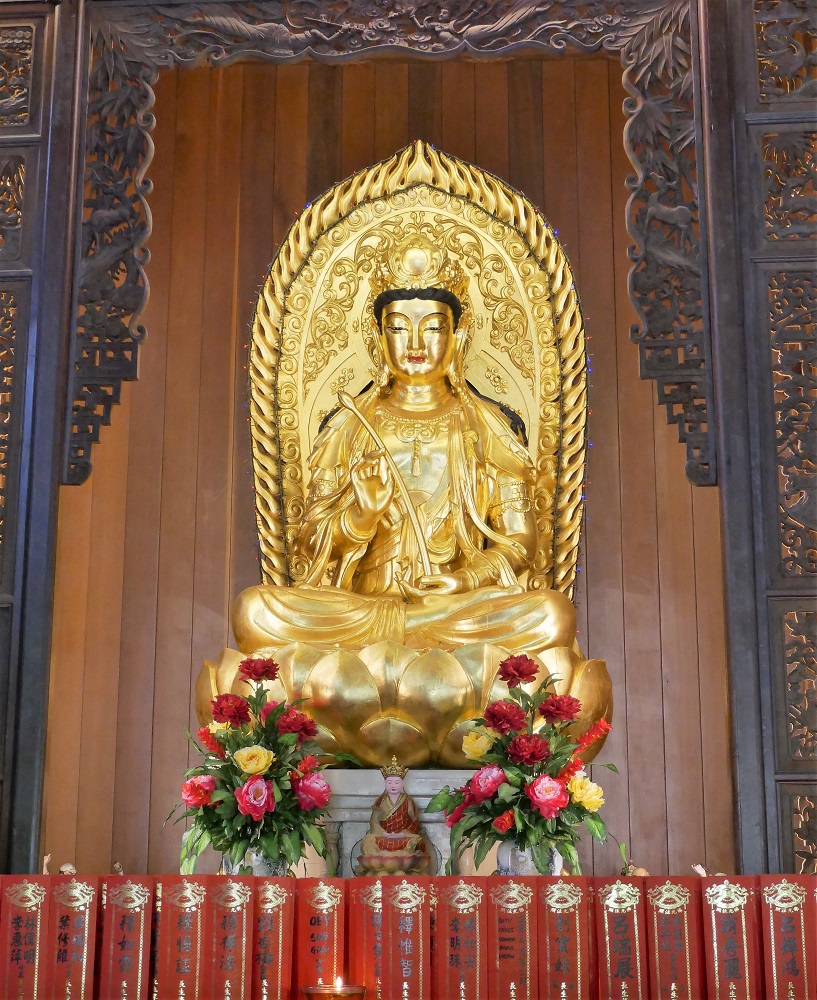
The biggest temple we visit is the hilltop Kek Lok Si temple, a myriad of buildings of worship including a seven-storey Pagoda containing 10,000 alabaster and bronze statues of Buddha, a turtle liberation pond and a 30-metre tall statue of Kuan Yin, the Goddess of Mercy of Mahayana Buddhism. Within the high-ceilinged halls lined with what must be literally millions of bronze Buddha statues, worshippers can buy slow-burning candles which presumably help to channel the prayers upwards into the heavens. Just like the opulent cathedrals of Christianity don’t tally with the message of Jesus, these incredible temples devoted to Buddha, a man who preached about freeing oneself from attachment to wants and worldly goods, seem incongruent. To my (admittedly non-religious) mind, nothing symbolises the painful admixture of lofty religious ideals with our all-too-human psyche better than the erstwhile Catholic habit of buying indulgences and the present-day Buddhist wishing ribbons, where you for only RM1 can purchase ‘booming business’ and ‘successful coupling’, as well as the perhaps more worthy ‘world peace’.


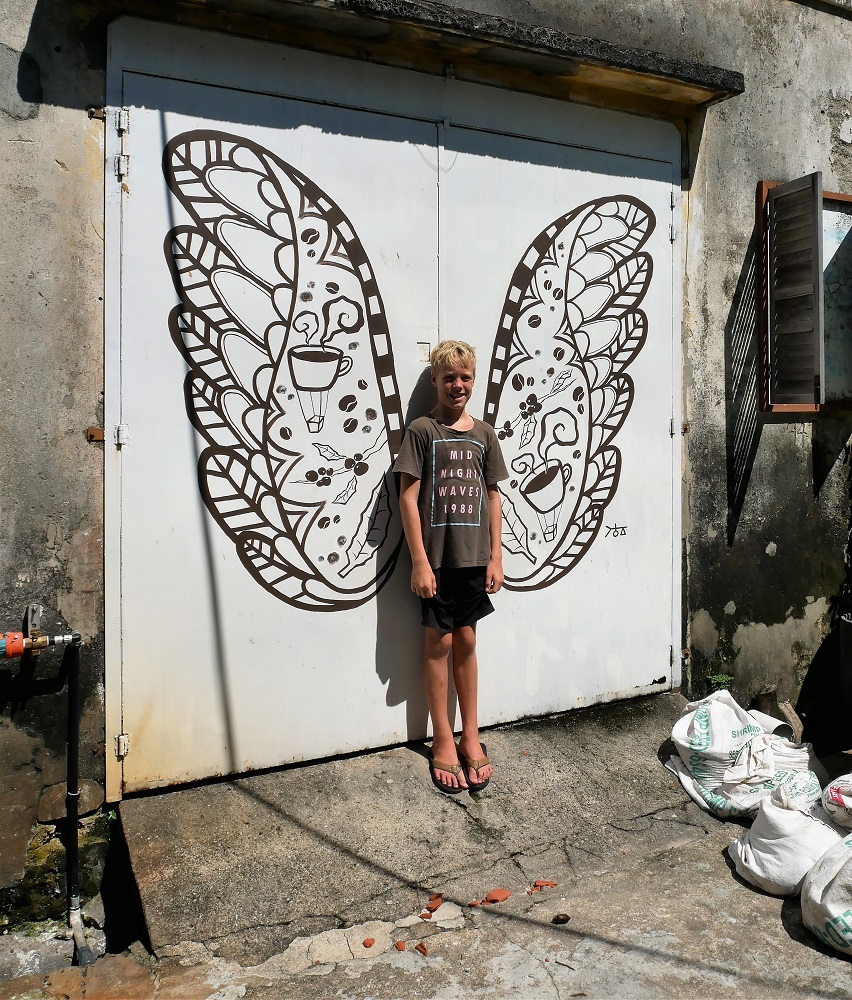
The living museum continues outside on the streets where beautiful murals cover many of the old, peeling plaster walls and wrought iron explanatory signs illustrate the city’s main sites of significance. The smell of food is everywhere, emanating from decrepit-looking hawker stalls clumped together in squares and along main streets from which vendors shout out the exotic-sounding names of their dishes: iconic Penang street food like assam laksa (tamarind-based noodle soup with seafood or chicken), mee curry (coconut seafood noodle soup), char kway teow (stir-fried rice noodles with shrimp), Hokkien hae mee (noodle soup with egg and seafood), wanton mee (dumpling noodles) and roti Canai (a south-Indian fried filled flatbread). At the front of the stalls are the raw ingredients: piles of pig blood sausage, cockles, cuttlefish, fungi and fish, and poorly exposed photos bleached by the sun show the wares, the images of soups in plastic bowls and piles of noodles on stained plates resembling those from a 1980s cookbook. More organised food halls are dotted all over the city; here stalls combine under one large roof, beers can be bought, and tables have numbers to which stallholders carry steaming dishes with proud smiles.


It is cheaper to eat out than to cook: a scrumptious dinner can be had for what amounts to NZ$4 and we sample everything we find. Popular with the kids are the claypot chicken, the roasted duck, and the stalls of Little India where samosas and onion bhaji are sold for pennies. It is Deepawali (Diwali) while we are there, the Indian festival of light, and Little India is fragrant with gajra, the flower garlands worn by Hindu women at festival time. Shops selling gold plating compete for customers with more traditional jewellers and the endless array of stalls selling shiny silken saris and elaborately embroidered salwar kameez in front of which matronly bhindied women stand, running the thick cloth over their knowing fingers whilst they bargain good-naturedly with the stallholder.

All of this is normal business for the town, and the multicultural tourists blend in with the crows of locals. Whilst I don’t normally like tourist places much, here the foreigners fit in, the French, Japanese and Lithuanian mixing effortlessly with the plethora of local dialects and I am grateful for the relaxed dress code that comes with the Chinese which means that I can wear shorts and tank tops on our endless strolls in the 35-degree midday heat.

The cultural and religious tolerance of Penang seems incredible in today’s world, but on our last morning there I witness the limits. The Tesco supermarket near the marina features a ‘non-halal’ section hidden near the back, where bacon, ham and Chinese pork sausages are displayed and the kids and I joyfully pick a ham to enjoy at Christmas. At the check-out, the bhindied salwar kameez-clad woman serving us indicates with her hand for us to pick it up from the roller band ourselves; she refuses to touch the unclean item even though it is triple-wrapped in plastic. I sympathetically ask her if it is hard to deal with non-halal products and she shudders and smiles stoically, obviously determined to do her job despite the revolting, disgusting items bought by ignorant westerners.
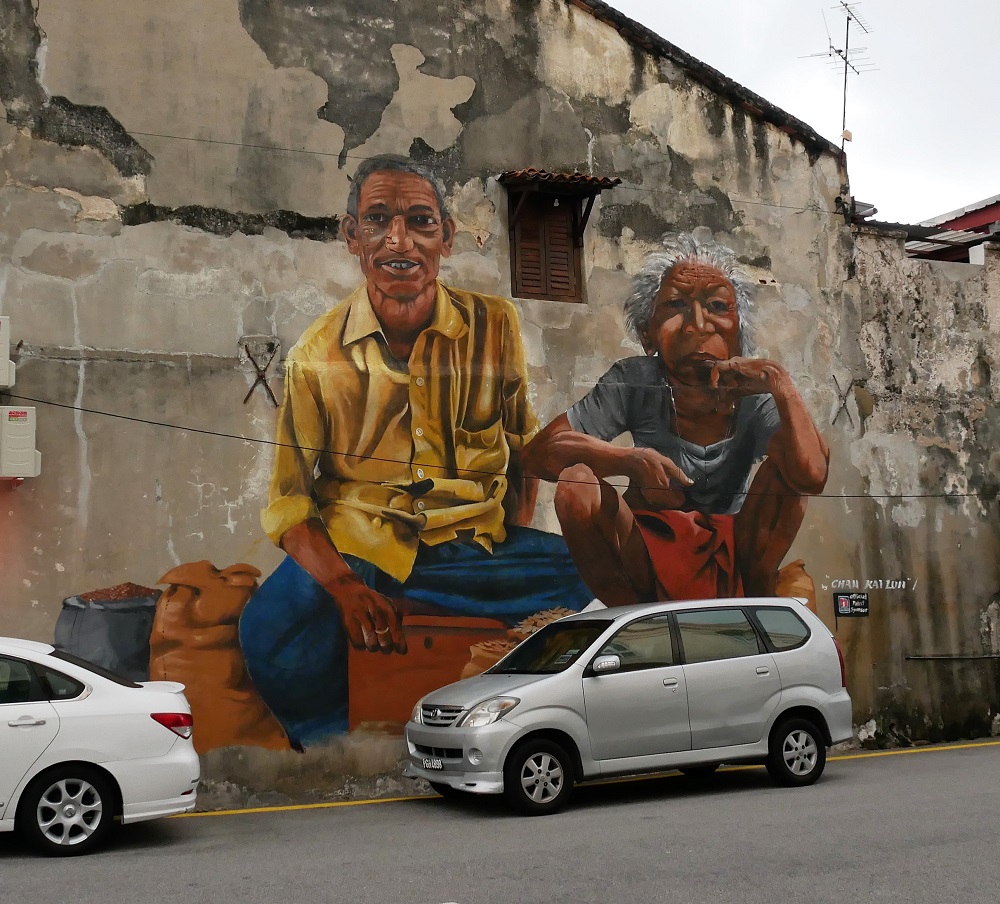

Four days in Penang is not enough, but onwards we must go and the morning after watching the crushing defeat of the All Blacks with a group of flushed, sauvignon blanc-swilling, black-clad Chinese businessmen in one of the marina bars, we slide out quietly, looking back all the while, stealing a last glimpse of the town of temples and tolerance.
Other than accidents, ailments and ash clouds, it has been fantastic to return to the hectic chaos of Indonesia. Coming from Malaysia, the difference is noticeable – Indonesia is messier, busier, more crowded. And, maybe because Indonesia is less developed, the people seem friendlier. In fact, I am sure that Indonesians are the nicest people in the world.
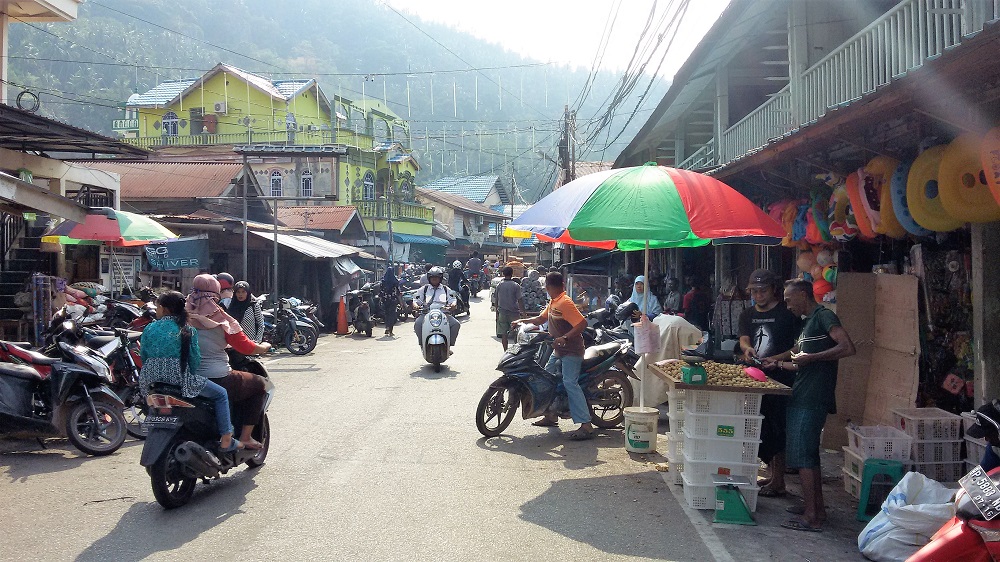
On our first day in the Anambas capital of Tarempa, we shopped for supplies in the shaded fresh market to replenish our bare cupboards with luscious fruits and vegetables and our freezer with tempeh and meat. After carrying all our heavy shopping back through the crowded streets, weaving in and out of the dense foot traffic of masked, veiled women and school-uniformed children, and narrowly avoiding the burning ends of cigarettes flicked from motorbikes by careless riders, we finally reached the dinghy dock. As I put down my heavy bags and lowered the bulky rucksack from my sweaty back, a breathless young woman approached.
“Hello. You speak Indonesia?” she asked, tugging at my sleeve.
“Sedikit,” I said (a little) and smiled.
“Telur Anda ada di pasar,” she says, gesticulating towards the hinter streets.
“Oh,” I said, hand to my mouth. “She says we’ve forgotten our eggs, in the market.” I turned to David. “She’s right – we left them at that stand where we bought the chickens.”
I thanked the young woman profusely and made my way back to the market to pick up the eggs, leaving David to load the dinghy. As I wove in and out between open sacks of flour, large stacks of cabbage and buckets brimming over with onions, sidestepping spitting men wearing prayer caps and small children fingering plastic packaging, the stall holders called out to me. “Telur, telur,” eggs, eggs.
I nodded and smiled and finally got through the chaos to the elderly lady in whose stall I left the eggs. She grinned and made a telephone gesture, pointing towards the open street leading to the docks whilst firing off a rapid stream of Indonesian, indicating how she had called someone to go and find me at the harbour so that I could get my eggs. And there they were, two large stacked cardboard trays, neatly tied up with string, resting on top of a small freezer.

This kind of stuff is typical of Indonesia, where people go out of their way to help you. Crazy, amazing Indonesia, I think, how we will miss you! We have to leave because our one-month visa has run out and it is time for us to head to Malaysia. Which is a bit sad.
Not that there is anything wrong with Malaysia, by all accounts it is a nice country. It’s just that whenever I ask other cruisers about the west coast of Peninsular Malaysia, where we are headed, they always say, “Well, Malaysia…,” scratching their heads, then looking up. “It’s a great place to do boat work!” before launching into detailed descriptions of chandleries, labour availability and re-upholstering options, and long-winded explanations of where to find chemical suppliers, hardware stores and sling lifts.

It’s normally a bad sign when boat work is the most alluring part of a region. But we need to shine up the Bob, and as the repair manager onboard, David quickly gets busy asking probing questions about boat parts and buffing products and I enquire about provisioning and mosquitoes, wrestling my attention away from the quiet anchorage we’re on and vowing never to forget the beauty of Indonesia.
We are going to Malaysia to get Bob the Cat ready for selling. We plan to be back in New Zealand in January, ready for the kids to start the new school year in February, and before that we have a bit of touching up to do, including antifouling, cleaning, and a few cosmetic jobs.
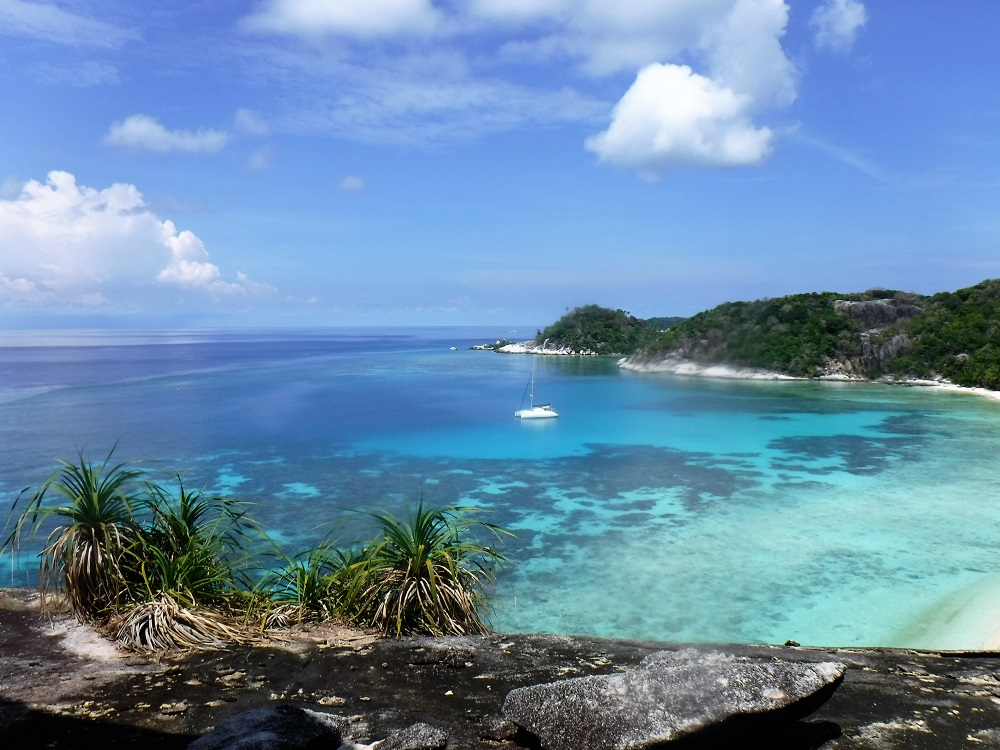

The Anambas has been a fitting final destination – Indonesia doesn’t get much better than here. Of the 225 islands in the island group, only 26 are inhabited, and the region is full of scenic deserted islands featuring white sand and wave-smoothed granite boulders piled up in aesthetically pleasing fashion along points and around corners. The centres of all but the smallest islands are green, coconut palms giving way to taller trees as you descend inland, your progress causing birds to squawk and circle and monitor lizards to slink away from their hot-rock sunbathing positions into deep, dark holes.
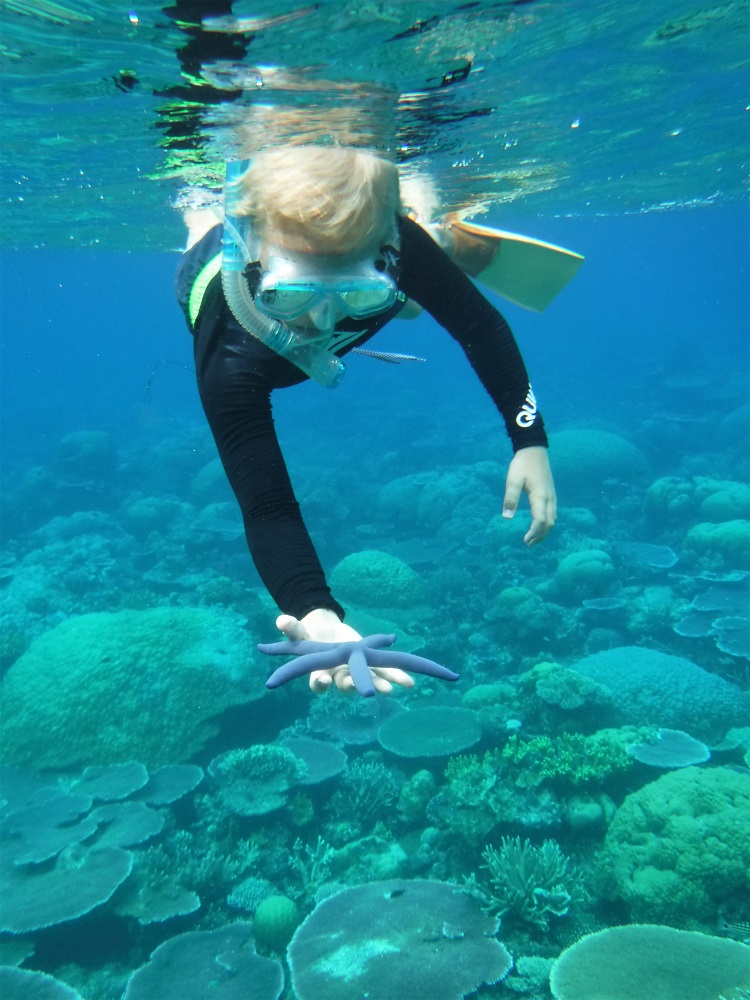
And the water, oh the water. Where the overland visibility suffered because of the forest fire smog, the marine waters were some of the clearest we’ve seen, with underwater visibility reaching 30-40 metres in places, pristine coral and plentiful fish life the backdrop to frolicking sharks, rays and turtles.




Perhaps the weirdest collection of marine life we encountered was at the Anambas Dive Resort, where the eccentric Chinese-Indonesian owner has established an open-air aquarium, a shallow one-hectare pool bordered by brick walls and open to the surrounding sea only through netted vents. In his enthusiasm for large marine life, the owner has been buying fish from the fishermen for years, and when we were there, the pool contained two 2-metre tawny nurse sharks, a 2.5 m shovelnose ray, giant groupers and stingrays, and packs of hungry-looking trevallies. It’s an expensive hobby, explained Hadi, the caretaker at the facility. One huge grouper cost them $400, but it died after three weeks, probably from overheating in the shallow water which could barely contain its girth. At one point, they had 70 blacktip reef sharks in the pool.


“They were just too aggressive,” laughed Hadi. “They ate everything else. All the other fish. Thousands of dollars’ worth of fish.” He looked at us. “So, we had to catch them all, with baited lines, and release them into the sea. Now, we only have one small blacktip. The nurse-sharks, do you know what they’re called in Indonesian?”
We shook our heads.
“Hiu bodoh,” he said, giggling. “It means stupid shark. It’s because they don’t have teeth. So, they are safe for us to keep, they don’t eat the other fish.” He threw his cigarette bud into water where it extinguished with a hiss and turned to show us the grouper and crayfish fattening ponds next to the open-air aquarium. These are another couple of hobbies: the owner is trying to figure out if he can make money from selling live seafood directly to Hong Kong. The dive shop is also just a hobby, set up less as a business and more for the guy to take his friends diving. Financing the whole operation is a refrigeration business run from next door, from where they sell refrigerated storage and ice to the region’s fishermen.

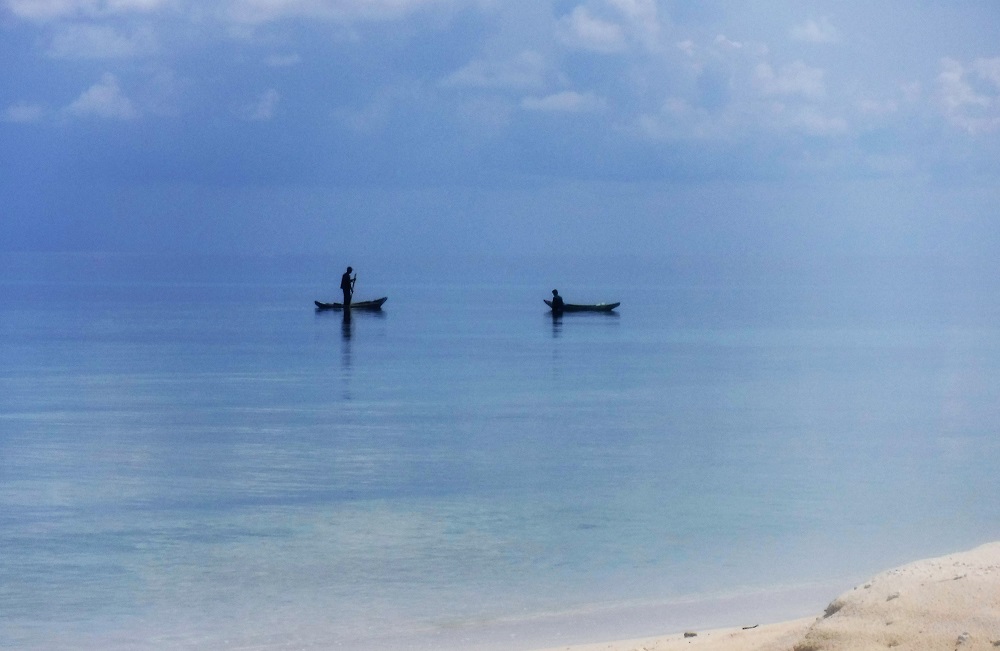
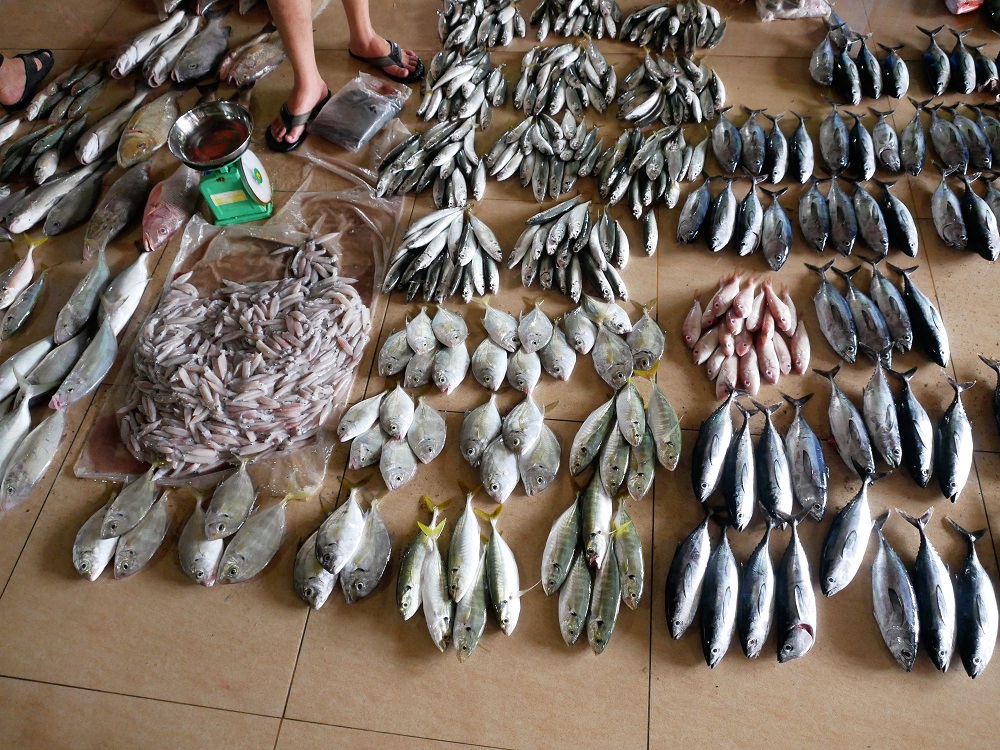
The main earners in the Anambas are fishing and tourism. No matter how remote our anchorage, and how deserted the island, we always saw fishing boats during our time there. And evidence of fishing too – one time we watched with curiosity a middle-aged man as he slowly worked his way around the edge of the bay where we were anchored during the course of a morning. He was in the water, wearing a mask, towing his little canoe along. After having spent about 4 hours in the water, he approached out boat on his way out of the bay, and we hailed him, asking what he was catching. He showed us a bucket of gelatinous globs and we frowned, trying to figure out what it was. Seeing glimpses of brilliant blue, I realised that they were clams – perhaps a hundred boring giant clams. Once we’d waved goodbye to him I jumped in the water and snorkelling the edge of the bay I saw evidence of his harvest: foot-long clam shells scattered everywhere, brilliantly white skeletons standing out against the backdrop of colourful coral on which they had been dropped. There were plenty of them, and I’m sure it’s legal, but still it was a sad sight.


Tourists come from Singapore, Malaysia and further afield, and on our cruise through the islands we saw multiple boats filled with wrapped-up Asian tourists jumping off small boats onto deserted islands.
I know that the whole world is busy showcasing their lives on Facebook and Instagram, but it seems to me that in south-east Asia it is taken to the extreme. One time, we were kitesurfing from a small, deserted island, and a boat load of six tourists arrived, phone and go-Pro in hand, selfie-seekers in paradise. They jumped on shore, each individual an isolated movie-maker, cameras held high, twisting this way and that, seated, lounging and standing in front of the sea, the sand, and our boat in the background. They stayed on the island about half an hour, filming away, during which time not one group shot was taken, nor any conversation had. The purpose of filming done, they hopped back onto the boat in silence and the boat boy drove them off, presumably in search of the next camera-friendly location for instant holiday shot upload to Facebook.

I don’t know where they are all staying – we only see one functioning resort. There is also a half-built eco-resort owned by a French-German couple with a couple of children who live in a tent on a small island near two semi-complete wooden structures which are meant for tourists. I’m not sure what the business plan for the place looks like, but their stated intention is to run a raw-food, survivor-style resort, catering for wealthy western clients keen to pay a fortune to rough it a week to return to nature. Committed raw-foodies themselves, the family survives on fresh fruit and vegetables, raw chicken and fish supplemented by small amounts of uncooked rice. They were very lean but otherwise healthy-looking and explained that for them the lifestyle is less about health and more about avoiding what they cited as ‘the unsustainability of cooking’. We wondered at the illogical turns of the human mind and sighed as we watched the fast supply boat come in laden with vegetables for them, thinking of the carbon burned as a result of them living remotely, as well as the environmental burden of international visitors, the carbon footprint of flights making tourism one of the least environmentally sustainable industries in the world. I guess it just proves that human beings are funny and logic has no real place in our lives.
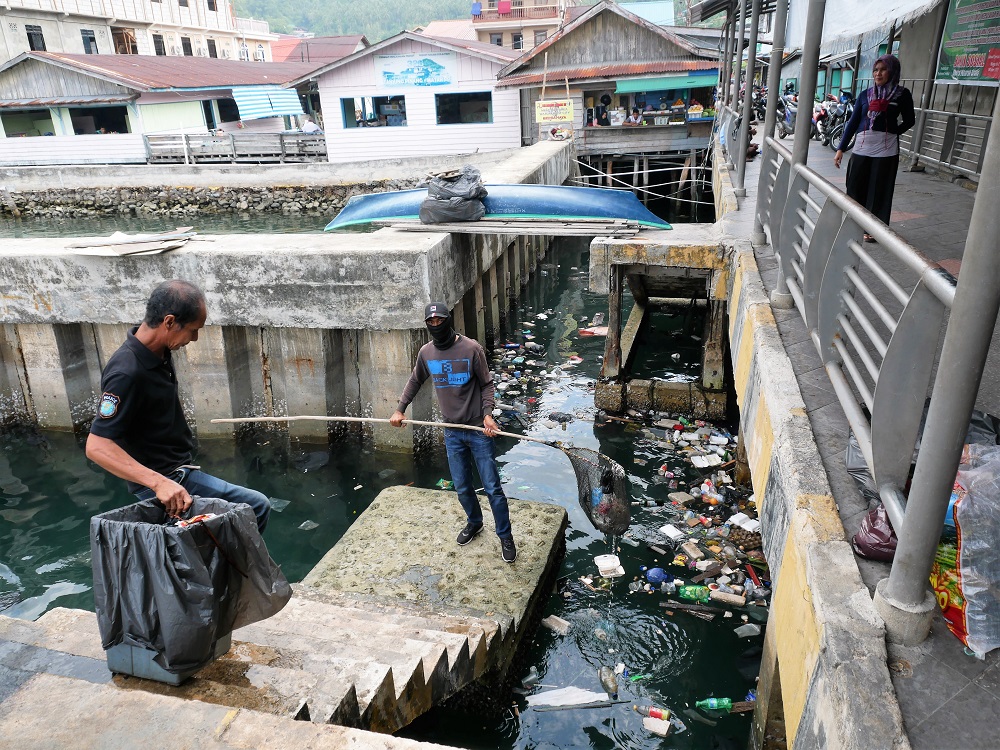
It is a holiday paradise, the Anambas, and we could stay here forever. For Indonesia, the waters are incredibly clean, and in the harbour of Tarempa a team of men were busy scooping up plastic from the harbour a couple of times a day. It is a refreshing sight, and so rare that we stopped to take photos: in our nine months here, this is one of the only times we have seen Indonesians remove waste from the marine environment rather than throw it in. Sadly, the education is limited to the capital and when we anchored in a more remote location, the local fishing boats would come into the bay to sleep at night, and as they chugged back out to sea in the morning they would leave behind a trail of floating plastic detritus. It is hard to understand how those closest to the reefs, the fishers who make their living and get most of their dietary protein from marine organisms, fail to understand that throwing plastic in the ocean is a bad idea.
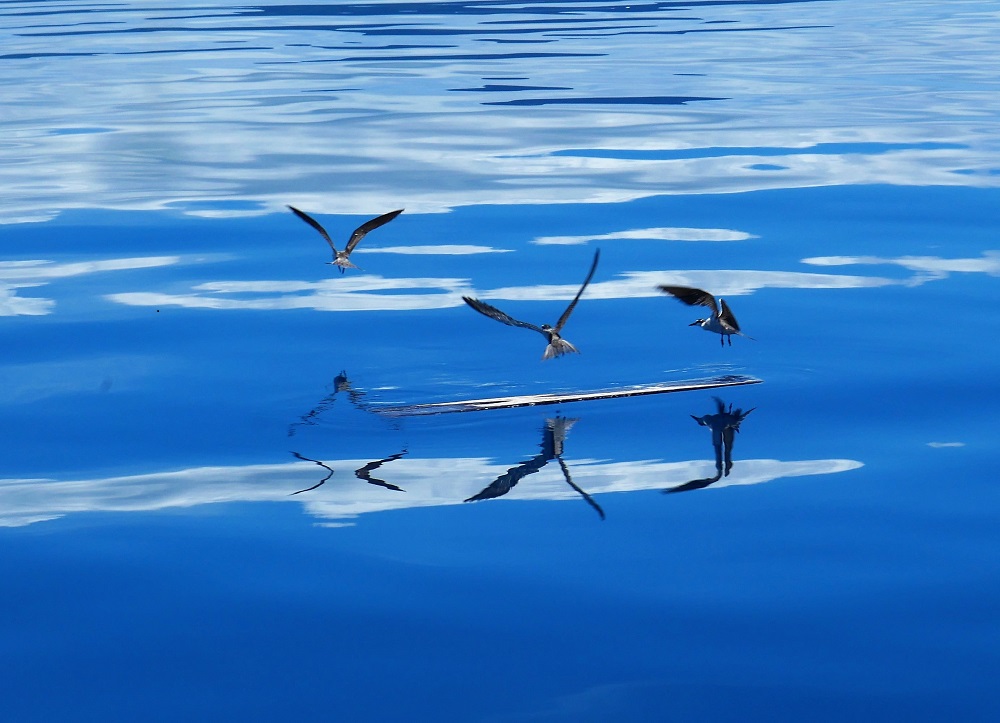
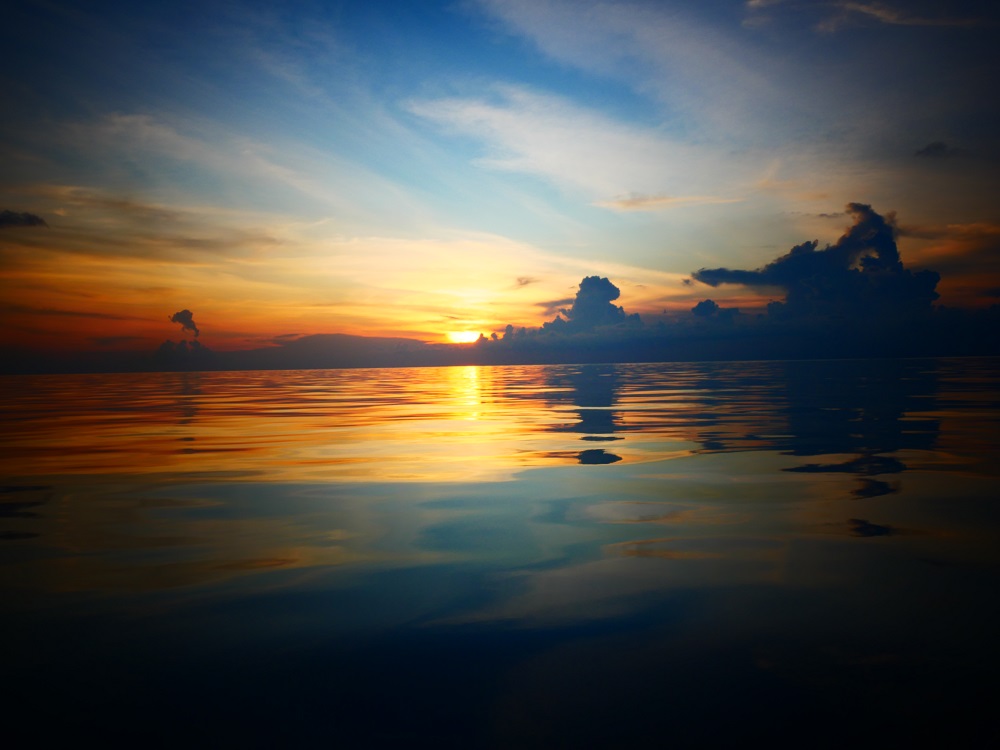
By the time we left the Anambas, the surface haze had lifted and the sun was beating down on a windless sea. After six days with no swimming, Matias’s leg wound had healed enough for us to allow him into the water, and he had enjoyed the last of the brilliant visibility and abundant marine life on a couple of snorkels. We had collected three good rainfalls and had enough water in our tank to make it to Malaysia where our watermaker parts were waiting. So, it being time to leave, we waved goodbye, the final impression of Indonesia stamped onto our retinas a glassy sea reflecting fluffy clouds in the setting sun.

It happened this morning, around nine o’clock. The boys had begged off home-schooling and had already made and eaten pancakes and jumped in the sea for over an hour. Whilst they were in the water a light rain started falling, and they climbed out, rushing inside to dry off and get changed. We had plans to do a walk and David and I were idly considering whether the rain was likely to worsen. He was gazing out over the horizon when suddenly he furrowed his brow.
“Holy cow,” he said, standing up abruptly.
Alerted by something in his tone, Matias stood up, following David’s gaze. “It’s a tornado!” he yelled.
“It’s a waterspout!” said David, awe in his voice.
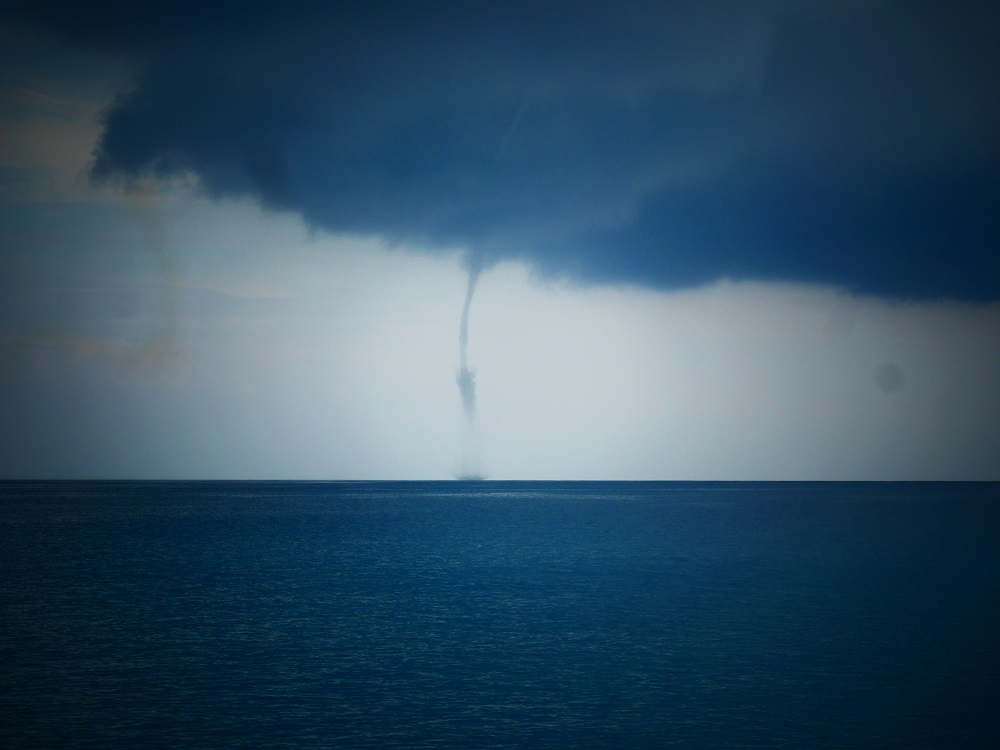
I rushed outside to have a look. About 2 miles off the boat, a thick, black cloud hung low over the teal coloured ocean. As we watched, the cloud’s heavy lower reaches spiralled down towards the sea, and a solid wave of dark grey water rose, sea and cloud connecting in a long, spindly funnel constantly thickening and slimming, snaking its way over the water.
Matias grabbed the binoculars and made for the deck when suddenly he screamed. I looked over and saw that he had fallen on the way out of the cockpit and he sat crouched over, clutching his leg.
“Oh no,” I said soothingly. “Oh, I am sorry, that must hurt.”
“Don’t look, Mummy,” he said through gritted teeth. “It’s really bad. Really bad. I need a Band Aid.”
I ran inside to fetch some paper towel and the disinfecting wound spray while David bent over him. “We need iodine,” David yelled. “And some gauze.”
Dropping the paper towel I went downstairs to grab the medical kit. I ran out and put the box next to David, who was standing over Matias clamping shut a wound with his hand. Blood was pulsing out either side of his fingers, and when he released the pressure to drop iodine into the wound I saw a deep, bloody gash, about five centimetres long, which ran along his shinbone. As the wound opened it became apparent that the shin was cut to the bone. In amongst the blood welling up, I could see some weird white blobby fat tissue. I looked at the scene of the accident – a softly curved plastic edge of the inbuilt seat, no protrusions, no metal, no glass. How on earth did he cut himself on that?
“This will need stitching,” said David tersely.
I nodded. “We’ll have to go to Terempa.” The small township of Terempa, the capital of the sparsely populated Anambas archipelago, was about 20 miles away.
“But what about the waterspout?” said Matias. “We can’t move the boat, we might hit the waterspout!”
“It’s getting closer!” yelled Lukie. “Mummy, the tornado will get us!”
I fetched some steri-strips and as David fastened them and tied a bandage on top, we watched the waterspout progress across the horizon. Snaking this way and that, it wove its way from west to east. The few local fishermen in the bay started calling out from their little kayaks, waving their hands, pointing and shouting. I waved back, indicating that we had seen it and the bay quietened as we all sat passively in a windless void, watching the weather progress, its path governed by gusts local to the cloud.
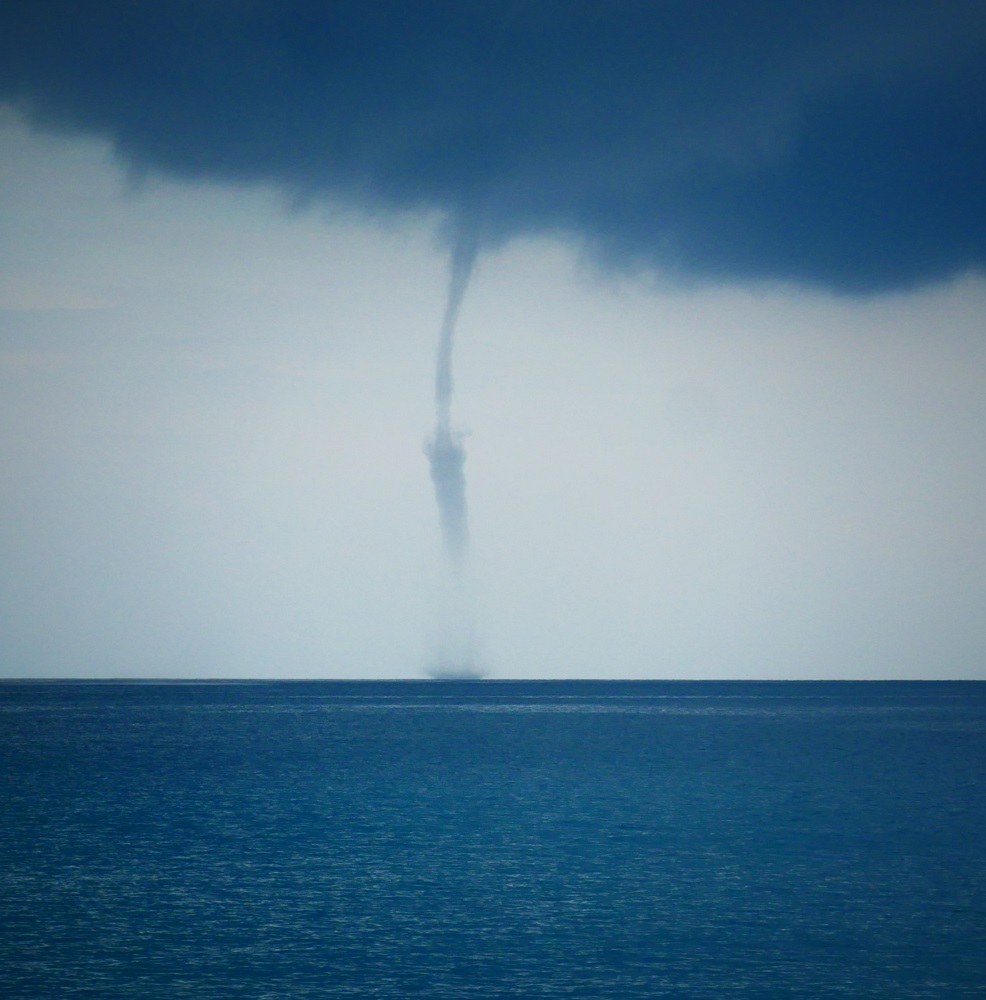
The system stayed a couple of miles away from our bay and within fifteen minutes the funnel-like spout dissipated into a heavy grey curtain suspended between the sea and the cloud. We drew heavy sighs of relief.
I fed Matias a dose of paracetamol and as I closed up the medical kit I reflected how lucky we were that we had any medicines left.
When we had checked into Indonesia three weeks previously, two Customs agents had come onboard to check out the boat. After taking a few selfies with the kids they asked to see our alcohol and medical supplies. We showed them the beer cupboard and I handed them one of our first aid kits and a box of medicine.
The older of the two looked through the packets with a frown on his face. He looked at me seriously over his black-rimmed glasses, holding out a pack of Strepsils.
“Tenggorokan sakit,” I said. Sore throat.
“Expired,” he said, waving the packet at me. “Look.” He pointed to the date stamp which read 21 June 2019. He spoke rapidly in Indonesian to his partner and held out the packet for him to see.
“Yes, but they are still good,” I said. He looked uncomprehending – his English was very limited.
“Bagus,” I said. Good. “Still bagus, tidak rusak.” Good, not damaged.
“Expired,” he said again. He rummaged further into the box and found a packet of Fucidine, an antibiotic cream. Clicking his tongue he held it up, waving it in my face. “Expired!” he said angrily.
I read the faint writing. March 2019. I sighed. “Yes, but still bagus. Not bad, tidak rusak. For infection. Still works.”
He looked at me accusingly and threw the packets on the table. Obviously not good enough.
I smiled. “Bagus bagus,” I said as I quickly gathered the packets with my right hand, holding out my left hand for the box which he was still rummaging through. “No hard painkillers, just paracetamol.”
He narrowed his eyes and spoke more Indonesian to his partner as he loosened his grip on the box.
“Bagus,” I insisted, sternly smiling as I snatched the kit out of his hand and swiftly turned my back to repack it. There was no way I was going to let him have our medicines.
Apparently, Customs and Biosecurity in these reaches take it upon themselves to confiscate expired medicine from yachts, with a view to sell it locally to augment their meagre income. Other yachties are wise to the trick and have a fake medicine box containing a few useless creams to give away, hiding away their real stash of serious medicine. Having never heard of uniformed medicine pilferers I had naively given them a genuine medical kit, and as I handed the pills to Matias I felt lucky that I got to keep my old drugs.
We’ve needed a few medicines while we’ve been in the Anambas. A couple of days after arriving here I picked up a terrible head cold, which saw me suck on out-of-date Strepsils and eat expired paracetamol by the handful. Two weeks later, Lukie succumbed to a hideous tummy bug causing near-instantaneous spray-vomiting of anything and everything he swallowed, for which I was eyeing up the rehydration sachets nestled deep in the pack. And now Matias’s injury, on which David poured lavish helpings of iodine which apparently expired late 2018.
It is obviously time to review our medical supplies and replenish out-of-date stock but that must wait until we are somewhere more developed.
With the waterspout safely dissipated, we made our way to Terempa, the capital of the Anambas to get Matias’s leg sown up.
The rainy weather had only started a week before and for once we were happy to see rain: our water maker had broken. That morning, a week earlier, I woke up in the early hours to a low humming sound. My sleepy subconscious registered a change of tone in the pre-dawn background noise. Was it waves? Or a boat nearby? I opened my eyes wide and reached up to switch off the loud fan that tends to drown all other night-time noises around our boat. Once the fan was off, I could clearly discern a low drumming sound.
Rain! I jumped out of bed. “Rain!” I shouted as I scrambled upstairs. “David! Rain!”
I ran outside and checked the sky. Yep – a monstrous black cloud blanketed the town of Terempa off which we were anchored, the feeble rising sun on the eastern horizon only emitting faint light under the heavy cloud cover. “Rain!” I called again.
A bleary-eyed David stumbled up the stairs, closely followed by Matias.
“Daddy!” Matias shouted. “Rain!” He jumped out on deck and danced, the chilly droplets beading his hair, goose-bumps forming on his arms.
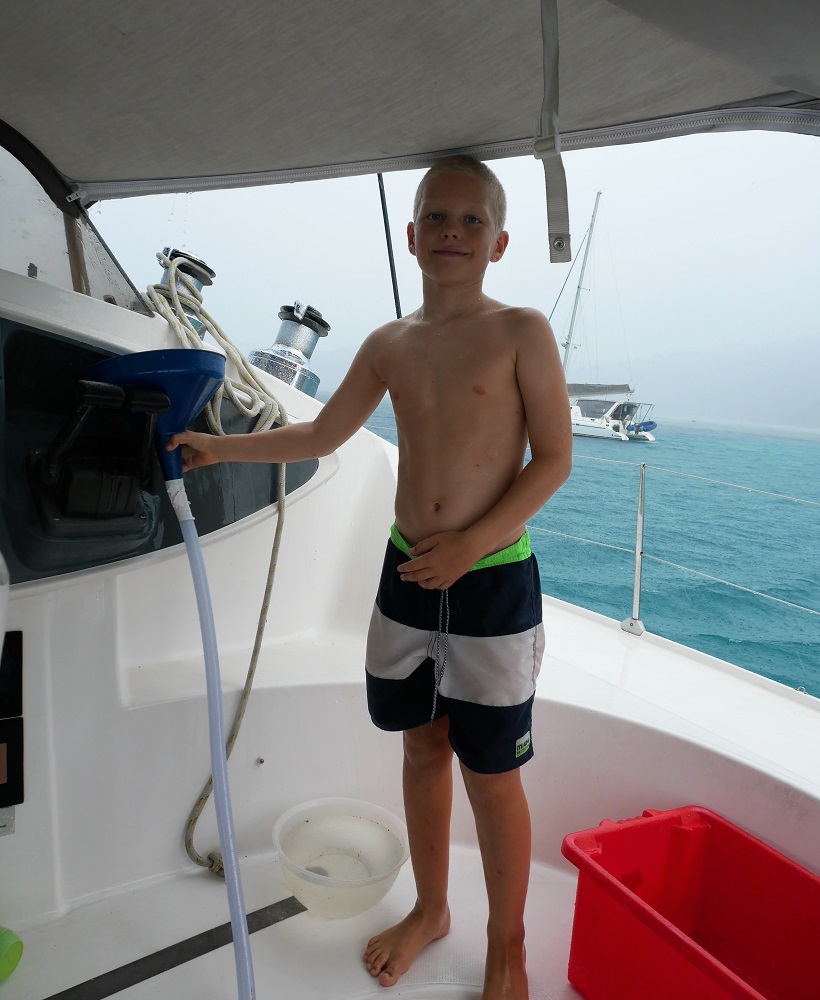
Stifling a yawn, David rubbed his stubble briefly before springing into action. He grabbed a funnel, jumped on deck and started wrestling a large tarpaulin on the foredeck, stringing up corners and stretching it tight.
“Grab that corner, Matias,” he yelled, pointing, his drenched figure dim against the grey beyond. Standing still behind sheets of rain Matias fastened a corner and tied it onto the railing, then fumbled to attach the corner to the halyard while David tied on another corner. Matias jumped to hoist the halyard while David weighted down the front of the tarpaulin and ran to get place funnels and guide translucent plastic piping. Lukas, meanwhile, had come into the cockpit to join me in hauling out fish bins, tubberware and salad bowls, placing containers to catch the rivulets of water dripping from the edges of the bimini. Within fifteen minutes the boat was full of plastic ware and piping and we gathered in the cockpit to dry off.
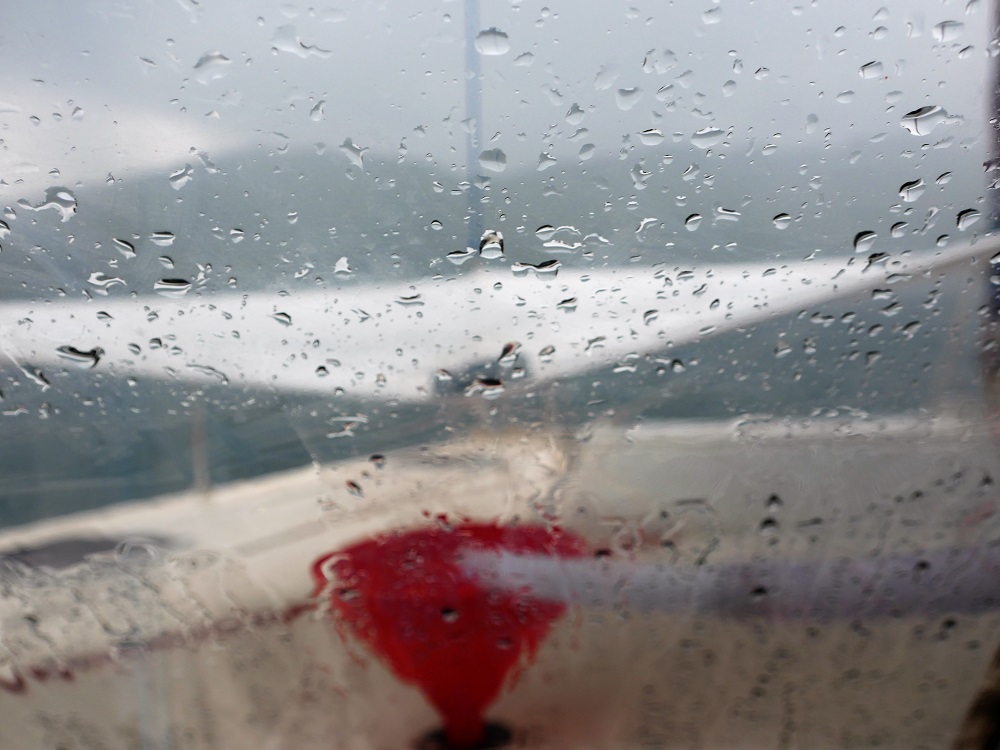
We needed the rain badly. Our water maker had broken two days before, about ten days into our stay in the Anambas, and our water levels were getting low. It was the pump that was broken, and there was no way to get spare parts, or a new pump, in this remote location – the nearest place was Singapore, two days’ sail away.
It wasn’t just us that were getting thirsty. The Anambas island group had not had rain in three months, and in the capital town of Terempa, people were queueing up to buy drinking water, whilst all over the islands, people were digging to find groundwater in ever-deepening wells.
In fact, it seemed most of Indonesia was praying for rain. Uncontrollable forest fires were raging on Borneo and Sumatra, leading to a cloud of low-hanging particulates that suffocated large swathes of the region. The ash cloud had been hovering over north-western Indonesia, reaching into Malaysia and Singapore, causing widespread school closures (600 schools closed in Malaysia alone) and health warnings for pregnant women to gather in air-conditioned government shelters until further notice, lest their breathing suffocate their unborn children.

Located between Borneo and mainland Malaysia, the remote Anambas island group was no exception. In our first week there, the whitish haze steadily increased, the visibility dropping day by day, with fewer and fewer of the archipelago’s islands noticeable from our anchorage in eastern Anambas, until one morning we woke to find the boat suspended in nothingness as we struggled to see a mile through the mist. Every morning, the deck was freckled brown by fallen ash, our feet congealing the dirt into prints that I spent hours scrubbing out with the saltwater hose.
The rainy weather heralded a change, the heavy droplets cleansing the air, the winds pushing the smog away from the islands. By the time Matias hurt his leg, a couple of refreshing rain showers had replenished the water tank, the plethora of tubing, tubberware and tarps steadily leading water from the deck, the bimini and the roof into our hold. When we’re careful, we use about 30-40 litres of water a day, and as the tank holds 800 litres we felt smugly satisfied that we had collected enough to survive for another couple of weeks.
It took us four hours to reach Terempa from where we were anchored when Matias hurt his leg. When we got there, we rushed him into the public hospital. It was a brand new building with a high roof, painted a cheerful blue with white trim. The place was largely empty, the only other patient a middle-aged woman lying on a bed in the corner, a drip attached to her arm. The moment we arrived we were surrounded by staff. A few of the doctors spoke a bit of English and we managed to communicate the situation – there was a wound, we thought it needed stitches. They guided Matias to a bed and a large group of what must have been the majority of the medical staff at the facility formed around him. Two doctors wearing scrubs peeled back the bandage and set to work urged on by the excited chatter of the remainder of the group. Within half an hour the wound was cleaned and stitched and we had been given a course of antibiotics and some painkillers to take home. When we tried to pay, they waved us away, shouting ‘gratis, gratis,’ free, free.
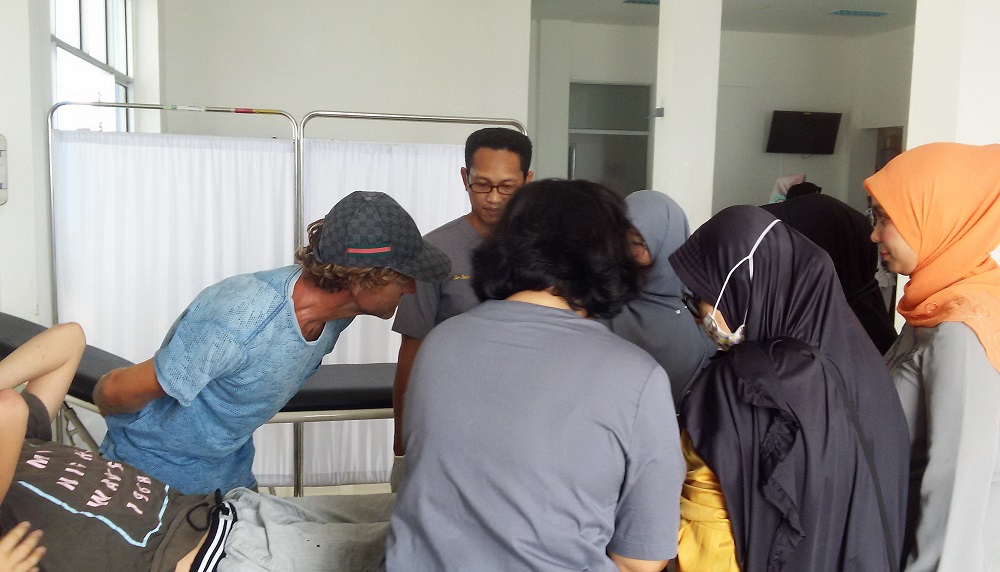
The stitches looked great. When we got back to the boat the rain had started up again and David rigged up the collection system once more, urging all available drops into our tank. We felt relieved that getting medical assistance had proven straightforward and looked forward to leaving the township behind. Tomorrow we’ll head off to see the last of the Anambas.

It is Saturday morning. All is still on Bob the Cat. There is no wind and the only sound is the faint noise of the gentle lapping of tiny wavelets on our hull and the cheery early-morning bird calls emanating from the steep jungle rising beyond the shores of the small bay we are anchored in. The sun is not far above the horizon but the calm day is already hot, the thermometer showing 27 degrees in the shade and rising.
It being a Saturday there is no schooling and the children have already gone to the deserted shore to jump off the large, smooth boulders into the shallow water. They are far enough away that we can’t hear them, and David and I relish the peace by enjoying a quiet cuppa – coffee for him, tea for me. The hot drink increases my body temperature and I shift uncomfortably, my sweaty legs squelching as I rearrange them. I wipe my forehead, mopping up a cascade of sweat before it reaches my eyebrows. Not that it matters – my eyebrows are already white-flecked with salt. The gathering point of all perspiration emanating from my forehead they act like miniature evaporation ponds, with the result that they produce a steady amount of what looks more or less like table salt. I scratch one eyebrow and am rewarded with a snow-like salt fall onto the table below. Great, I think as I absentmindedly gather up the white dust in one hand and reach over to drop it in the sink behind me. Maybe I can market my home-made salt in some organic outlet. Environmentally friendly home-made sodium chloride. I feel another droplet forming just below my hairline, getting ready to trickle down.

For the umpteenth time I wonder whether cruising in some of the hottest parts of the world is advisable for women of the certain age that I’m rapidly approaching. David claims to be hot too, but I seem to notice that mature women such as myself suffer more than their menfolk. Are we the victims of hot flushes or would anybody turn into a salt farm under conditions as inhumanely hot and humid as these?
Hard to know, and it probably doesn’t matter much given there is no changing the outcome. I turn on the fan, its whirring noise interrupting the peace. Darting a quick look at David I see that he too is sighing with pleasure as the air whirls past him, instantly increasing the evaporative heat loss from his sweat-soaked skin, turning his cheekbones into salt farms too.
“It’s hot,” I croak.
“Well, they did warn us.” David grimaces. “Let’s face it. They all said it was going to be hot…”
He’s right. Whenever we would discuss the heat with other cruisers in Indonesia, they all said, “Just wait until you get to Malaysia. Then you’ll know what hot is…” nodding knowingly and tapping their sunburned noses.
Now that we’re here, we understand. Despite the heat waves of Europe, coming back to Malaysia was a thermal shock. It is hard to fathom how people can function in their daily lives in heat like this. On our return from Europe, as soon as we exited Singapore Airport the heat enveloped us – a heavy blanket suffocating our initiative, the oppressive warmth slowed down our movements and muddled our thoughts. In weather like this, just being awake is an effort, and it is hard to accomplish much. After reaching the marina where we had left Bob for a month, we acclimatised slowly whilst getting ready to leave.

Marina life is always uncomfortable compared to being on anchor. Being adjacent to land, there is seldom much wind, which serves to make it even more unpleasantly hot and plagued by mosquitoes at night-time. Marina water is always dirty so a refreshing dip in the sea is out of the question, and nor is it possible to cool oneself by wearing only a bikini: with boats tightly packed in, the distance to even the nicest of neighbours is invariably too short for any level of privacy.
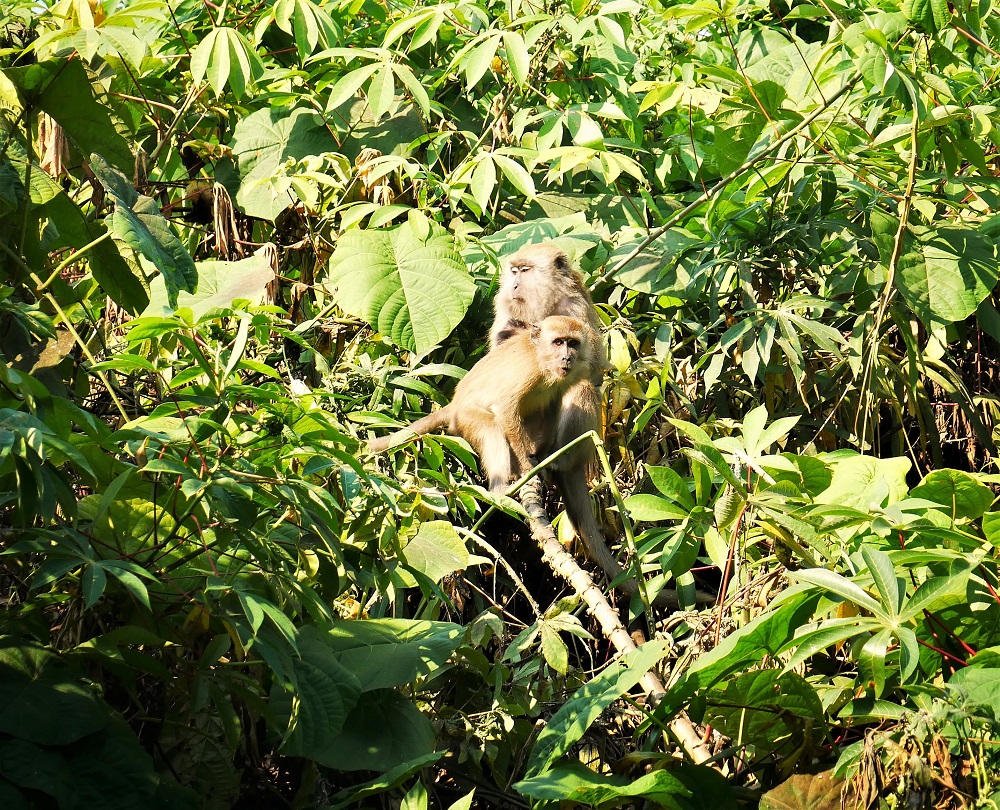
The marina that we left Bob in, Sebana Cove, is a weird place. It is situated just across a narrow waterway from Singapore, in the newly developed part of southern Malaysia called Johor Bahru. Owned by the Sultan of Johor, the marina is part of a large, empty resort the main attraction of which is a golf course. A colonial-style main building featuring high ceilings, stone columns and numerous tiled staircases houses the resort reception, a restaurant, bar, gym and a library. Behind the grand building is a beautiful pool complex with curved swimming pools enhanced by bridges, bubbles and billowing cascades. Neat rows of palm trees line the long driveway which meanders past the undulating, immaculately short-clipped golf course lawns. Birds call from the shady tree-tops and squirrels and monkeys frolic on the roof. The resort accommodation is nicely done cottages recessed amongst large, shady trees.
All of it splendid, immaculately kept, well-staffed – and completely empty. No guests stay in the cottages, no-one dines in the restaurant, and not once did we see anyone other than ourselves in the swimming pool. The golf course is empty, the bar deserted, the lounge chairs vacant. Two staff in dark suits man the empty reception and several waiters dressed in old-fashioned cabin-boy uniforms complete with sailors’ caps walk around aimlessly straightening up a knife here and pushing a chair in there in the bare restaurant. Every night, scantily clad beautiful young women sway in mile-high stilettos hugging the microphone stand as they croon soft pop cover songs to a vacant bar, the sailor waiters their only audience.
“They cannot possibly be making enough money to keep this place open!” I exclaimed to David one night as we were sitting in the bar, us and our yachtie friends the only guests in the establishment.
He looked across the empty bar to the happy hour lounge where the singers were dancing suggestively for a roomful of empty seats. “I guess it doesn’t need to make money if it is owned by the sultan…”
During our time there, the only people we saw at the resort were two Chinese businessmen and the liveaboards from the 10 or so yachts staying in the marina. The marina is incredibly affordable and the facilities nice, so a steady stream of boaties frequent the place, but there is no way the meagre earnings from that will make the resort go around.
Profitable or not, Sebana Cove is a nice enough marina, and it greatly helped our return to the hot boat to have access to a pool and a clean toilet block featuring endless cold showers. To help the resort business we ate in the restaurant and drank in the bar, and the staff seemed grateful for the liveliness we imparted to the echoing halls. The kids swam for hours every day in the pool as David did minor repairs and installed the sparkly boat parts we had bought in Europe while I cleaned, unpacked and provisioned in the air-conditioned supermarkets of nearby towns.
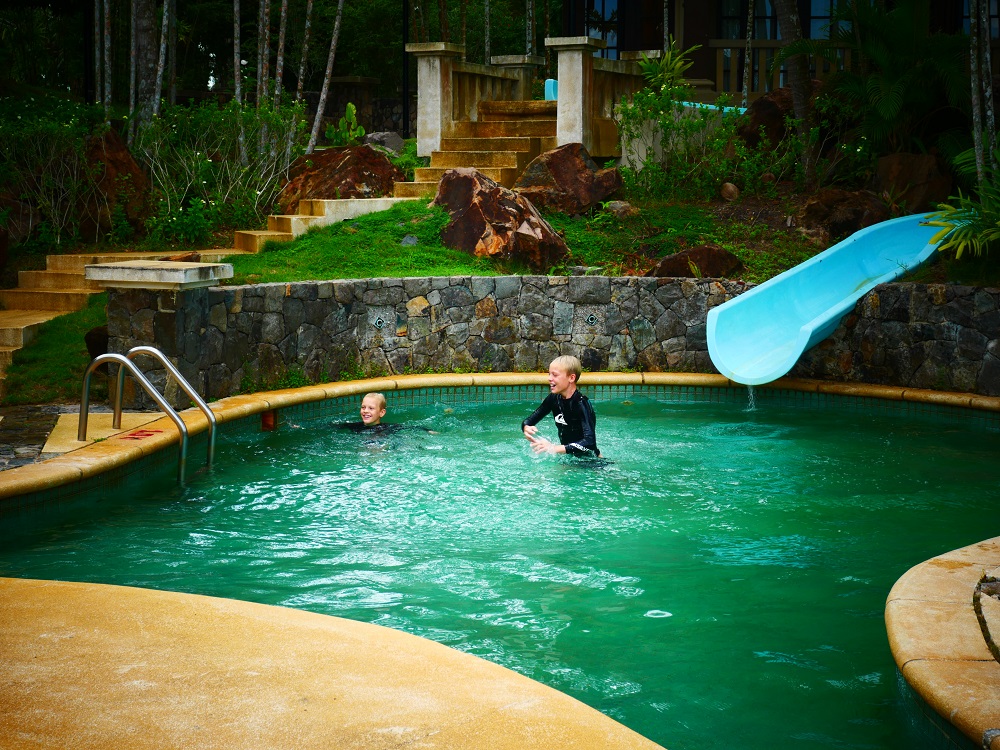
Once everything was installed and all the numerous newly acquired parts (new trampoline, new stove, fresh lightbulbs) had been put to good use, we were ready to leave for Pulau Tioman, a small island off the east coast of peninsular Malaysia where we’d heard of beautiful diving, luscious jungle and white beaches.
Which is where we are sitting now, sweating.
After eight months in Indonesia, Malaysia feels familiar yet different. Being neighbours, Malaysia and Indonesia share their language and the dominant religion of Islam, as well as the Malay ethnicity of the majority of their populations. Yet Malaysia is very different from Indonesia. For a start, it is relatively small where Indonesia is positively massive. Indonesia’s land area is six times larger, and its population number almost ten times that of Malasia. Malaysia is relatively rich in natural resources and as a result, it is now one of the wealthiest countries in south-east Asia, with a GDP per capita that is more than double than that of Indonesia. The two countries have a similar past, both being colonised first by the Portuguese and then by the Dutch, but in Malaysia the British took over from the Dutch in the late 18th century, leaving a lasting influence, including widespread proficiency in the English language, rubber and tea plantations and efficient infrastructure. The Brits imported large numbers of Chinese and Indian people, with the result that 23% of Malaysia’s population is of Chinese heritage and 7% of Indian origin.
Malaysia’s main exports are tin, rubber, palm oil and fossil fuels, and in an attempt to keep most of the petroleum-related earnings within the economy, the country has ambitious plans to double its refining capacities. Thus, near Sebana Cove Marina the huge Pengerang Integrated Petroleum Complex is under construction, the footprint of which will see several villages moved to make way for progress. For a long stretch on our way out to the Strait of Singapore from the marina we see nothing but oil tankers and rig platforms ready for deployment, sights that will likely continue to dominate the horizons of these parts for years to come.

It was a relief to leave the marina and the dusty mainland behind, and the island of Tioman is all that we hoped for, being on anchor off a lovely island with clean water and white beaches feeling luxuriously like a proper return to our normal cruising life.

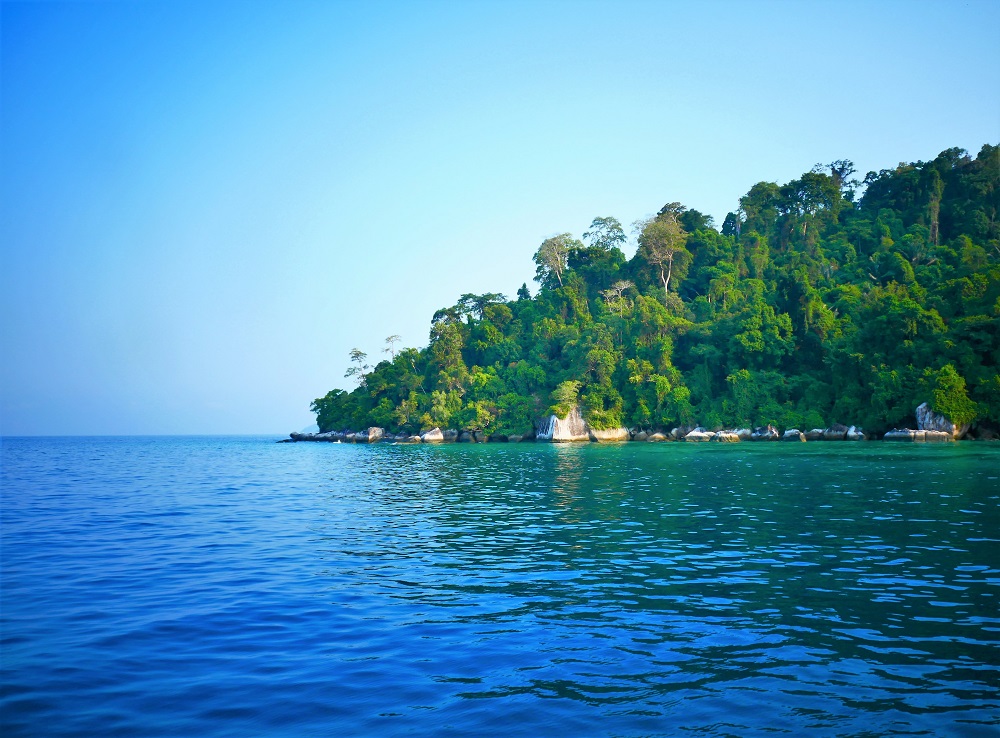
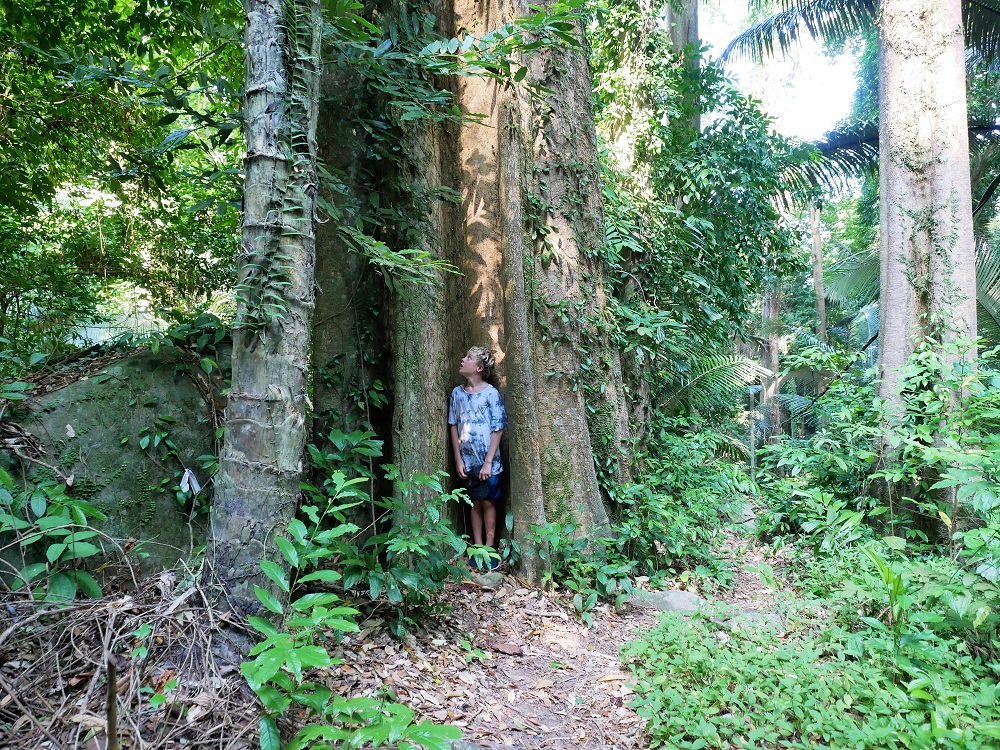
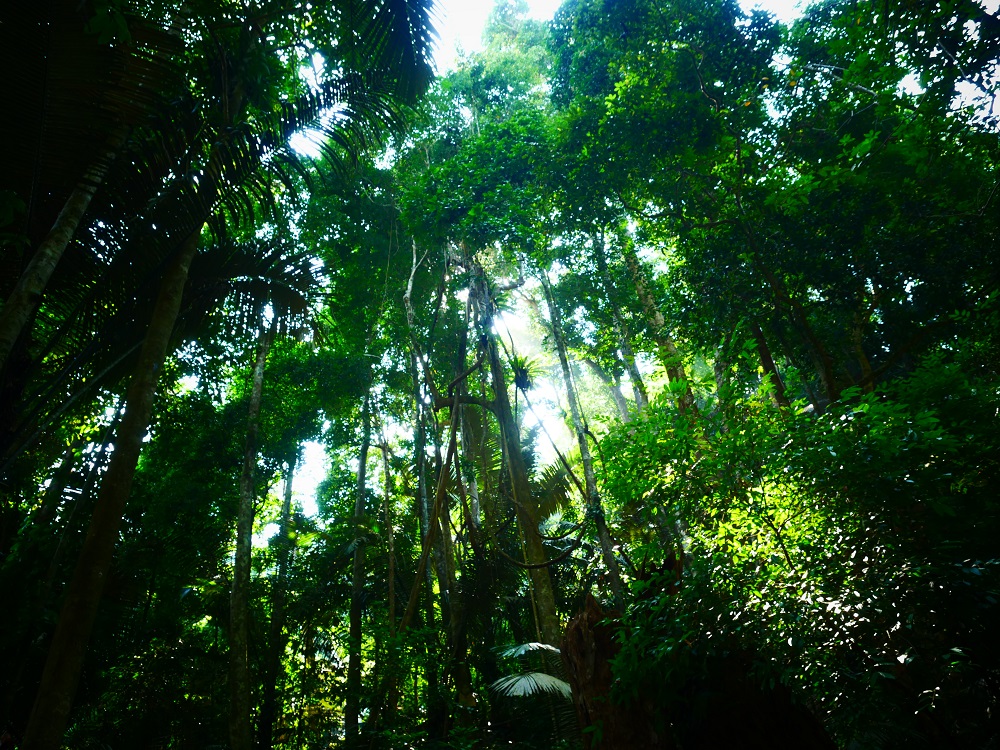
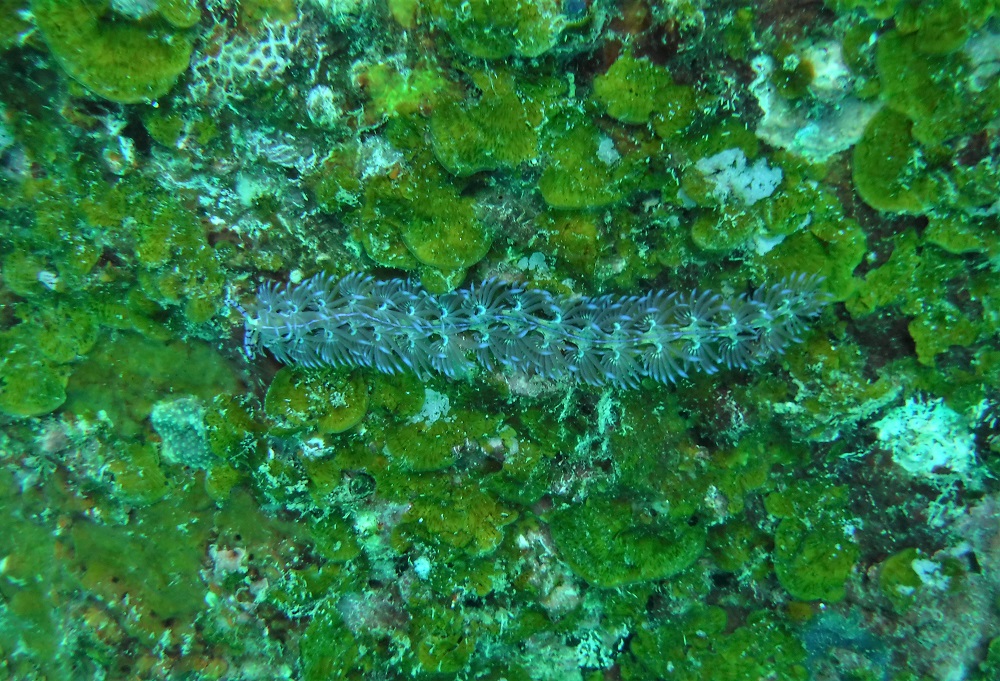
As I sit sweating on the anchorage on this our last day there, I think of what a beautiful place Tioman is. A steep island, the interior of which is entirely covered in thick, old growth, lusciously green jungle, Tioman is full of small resorts catering for tourists from all over the world. White sand beaches line the numerous small bays indenting the coastline and large boulders stacked haphazardly adorn every headland. With a large marine reserve, the island is popular with backpackers and divers, and the water is clean, full of hard and soft corals, turtles, sharks and lots of tiny critters that have divers frothing with enthusiasm.
The island is full of young sunburned Europeans carrying large backpacks on their strong shoulders and Chinese tourists with trendy sunglasses wheeling candy-coloured hard-shelled cabin-luggage along the bumpy pavement. Dive boats zoom around the coastline constantly and boatfuls of snorkellers wearing bright red lifejackets are disgorged hourly along the shallow reefs lining the quiet bays. Ashore, small cafés and restaurants line the waterfront, and the delicious smell of freshly barbecued chicken satay permeates the air. The open-air food court on the river features traditional Malay cuisine, and along the main road there are several Chinese eateries, complete with red paper lanterns and gilded dragon carvings. The singing from the mosques can be heard five times a day but the place is touristy enough that visitors wear bikinis on the beaches and sleeveless tops in town, although the line is drawn at serving alcohol in the restaurants, something that no establishment allows.


Whilst we’ve been here we’ve been diving and snorkelling, fully enjoying being in a place where you can jump into clean water anytime and anywhere. We’ve climbed across the island in the thick jungle, have eaten out and relaxed in the heat, only to jump in the sea once again to cool down. Each day, the hot, windless mornings give way to terrifically windy evenings, when the catabatic winds from the inland mountains sweep through the anchorage cooling us down, the storm-like intensity of which keeps us all awake many a night.
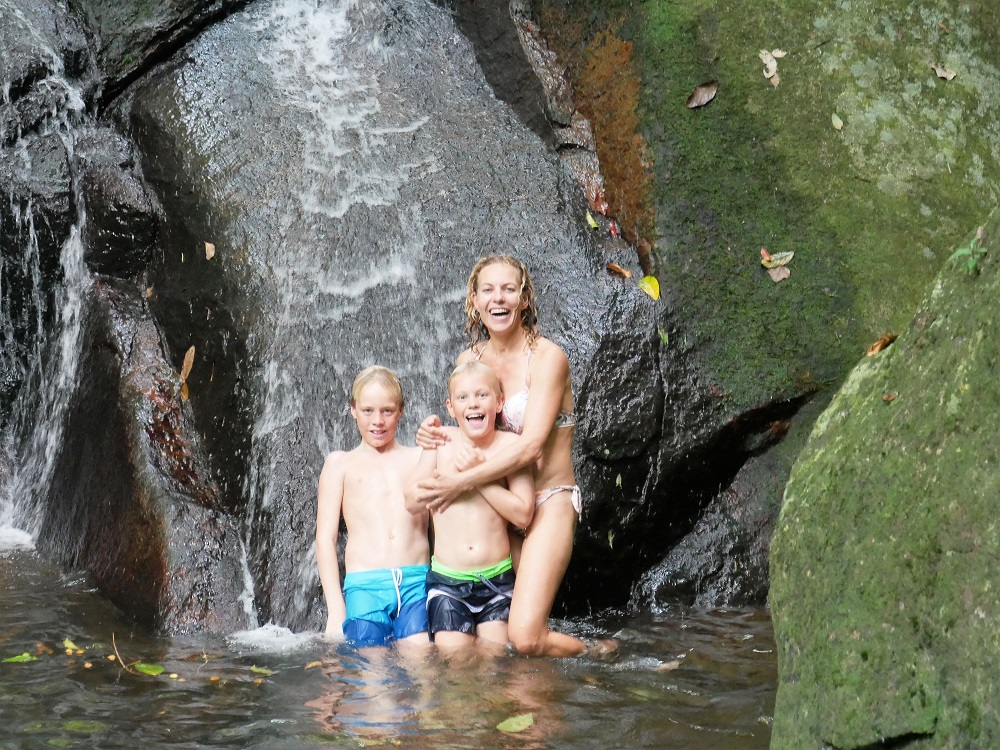
As a first introduction to Malaysia, Tioman has been great. But after just over a week here it is time to move on. We have about a month left until the north-western monsoon starts, and in that time we would like to see the Anambas, a remote Indonesian island group north-east of Tioman. Once the monsoon changes it is time to leave the east coast and head north-west to explore more of Malaysia.
Full of good impressions we leave Malaysia and head back to Indonesia, for one final fling.

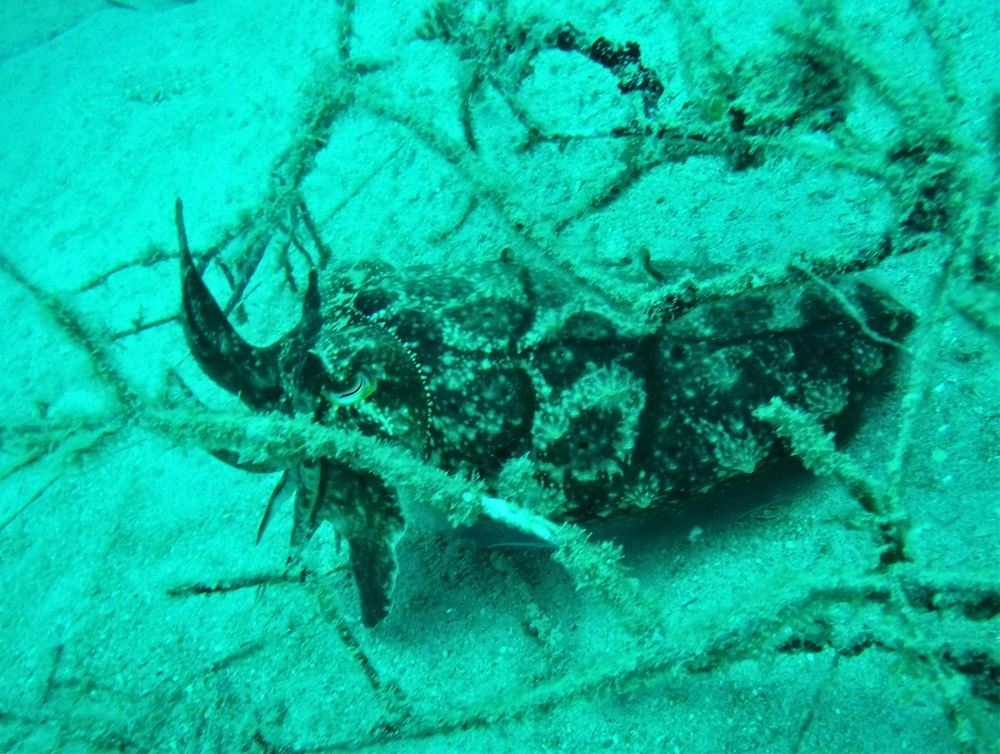

After checking into Malaysia 21 July and a quick pack and clean-up of the boat, we left Bob the Cat safely tethered to the sunny dock at Sebana Cove Marina just across the water from Singapore, where it would stay for a month while we went to Europe to visit family.
We arrived in London on the day Boris Johnson became Prime Minister. It was a brilliantly shiny summer morning, the only clouds on the horizon those caused by the strong sense of political despair felt by roughly half the British public and the entirety of the European media. On this, the second day of a suffocating heatwave that had gripped the European continent, the news headlines alternated between Boris dismay and weather shock; gloomy economic forecasts for a no-deal Brexit interspersed with unsettling weather predictions of record-high temperatures in no less than nine European countries. All over the continent children were warned not to play sports outside, schools resorted to frequent dousing of pupils with cold water, and nursing homes equipped the elderly with hydration packs in attempts to stave off health-related impacts of the heatwave.

After one short night in the UK we flew on to Denmark where we guiltily enjoyed the heatwave. It lasted for almost the entire two weeks we were there, bringing beautiful weather – 30 degrees, sunny, and relatively dry (60% humidity as opposed to the >90% plaguing Malaysia) – but, being unused to the temperatures, Danish people were suffering. Everyone we met was huffing and puffing, wiping their brows and taking frequent showers, some resorting to staying indoors to lie prostrate beneath fans, afraid to go out lest they succumbed to heatstroke.
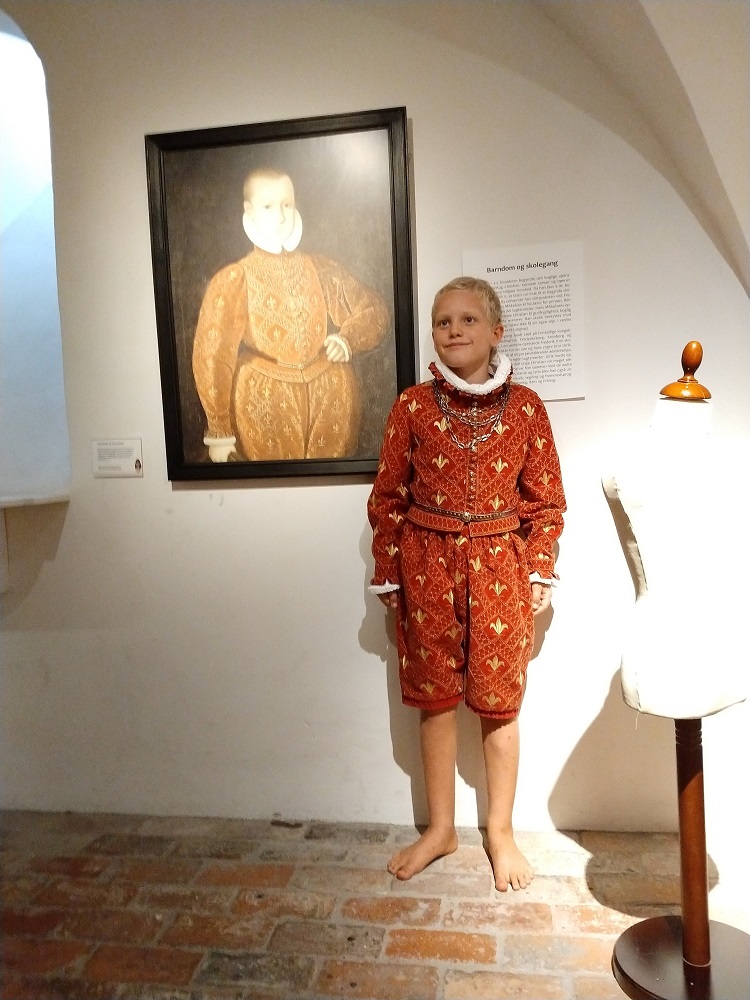
When you come straight from a year sailing in the back of beyond of Papua New Guinea and Indonesia, you fully appreciate the miracle that is Western Europe. Denmark is an amazing country. Orderly and clean, full of good-looking, well-dressed, incredibly affluent people efficiently going about their daily business, following the sensible rules of a highly functioning welfare society. Tolerant and politically moderate, Denmark ranks amongst the first for gender equality in the world. The population recently voted in a new social democratic government led by a young female, 41-year-old Mette Frederiksen. Broadly supported by the population, her government has just put in place what is called the most ambitious climate change-related goals in the world. It is a country of lakes and spongy shores covered in reeds, of villas fronted by green lawns immaculately mown, of well-tended flower beds blooming under the Danish flag, of doves purring and swans quietly grooming along the slow-flowing river shores. Public transport is clean, reliable, comfortable and affordable, with trains, buses, undergrounds and ferries transporting people to and from work and leisure activities with no delays and few malfunctions. Even the poor in Denmark lack for nothing and its citizens are consistently reported to be amongst the happiest in the world. It is a cleaner, wealthier and more politically correct version of New Zealand, these small countries the lone voices of reason in a world increasingly gone mad.

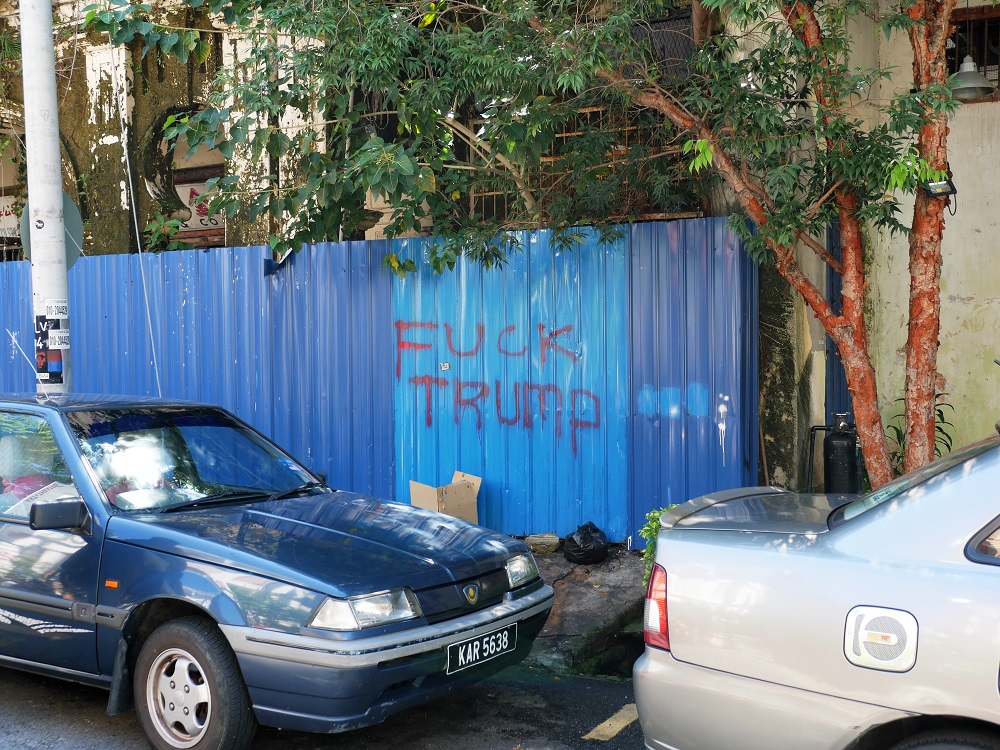
Not that Danish people are always happy. Recently, national demonstrations shook the country when parents took to the streets to demand higher teacher-to-child ratios in the country’s kindergartens, the outrage sparked by national averages of 3.8 children per adult in the age group 0-2 years, and 6.6 children per adult for children aged 2-5 years (in comparison, New Zealand legal minimum ratios are 5 children per adult for 0-2 year-olds and 10 children per adult for 2-5 year-olds, ratios that nobody questions). And when we were there, large parts of the population were gearing up for protests against President Trump, who was scheduled to visit Denmark in the beginning of September. He had requested an invitation and Denmark’s Queen Margrethe had obliged, with the Danish government hoping to further trade talks.

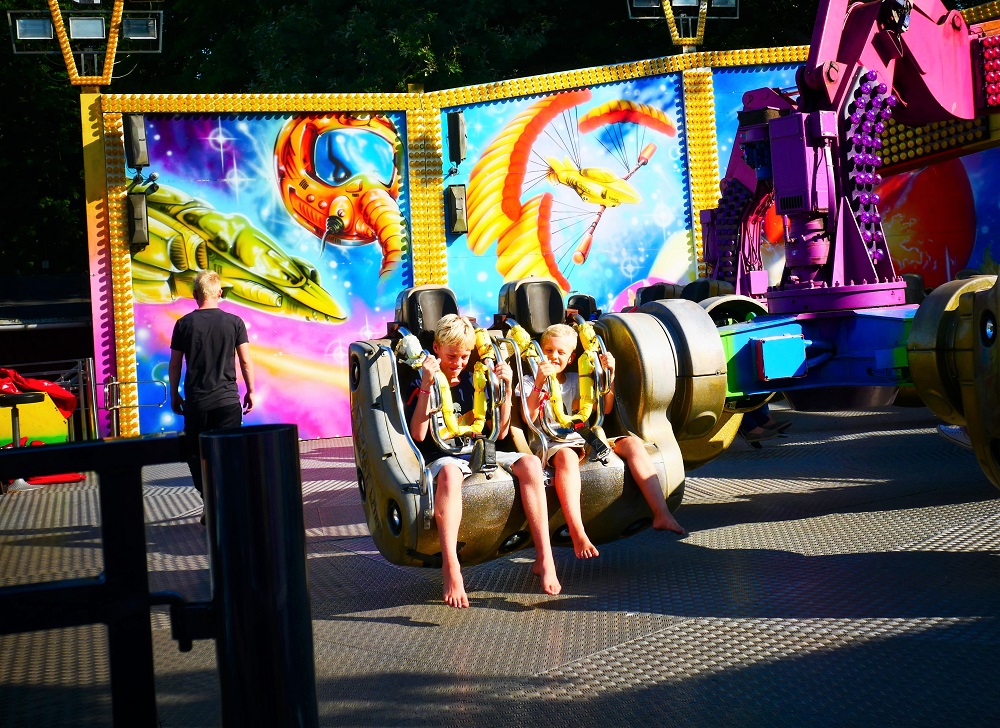
On our two-week-long visit we enjoyed the break from the heavy heat and chaos of Malaysia and Indonesia. We caught up with family, doing small trips that suited the weather – enjoying the heatwave at the beach, seeking shady respite in the lushly green forests, visiting castles and museums and generally revelling in the quiet order and predictability of a modern western country. We went everywhere by public transport, sinking into the soft seats of near-silent, pristinely kept buses and finding seats amidst bikes and prams on frequent early-morning trains busy with commuters. We took full advantage of the sudden access to first-world healthcare and visited dentists and opticians, enjoying the feeling of safety that comes from being seen by professionals. Knowing that we needed to prepare for cooler weather in Scotland, I dragged the children on long, exhausting shopping trips to expensive Danish malls, selecting footwear for ever-growing feet and trousers for longer legs.

After Denmark we went to Scotland to catch up with David’s family. We hired a car in Edinburgh airport and drove alongside the green Scottish hillsides, marvelling at peaks and valleys, at picturesque stone cottages adorned by flower baskets flanking the front doors in small villages, at the neat signs advertising local attractions and the steady stream of tour company buses. Scotland is a place of uninterrupted vistas of miles and miles of land, sea and lake, with no apparent human presence, the only living creatures visible a soaring eagle or two and a few white flecks of sheep against the brown-green tussock. The heatwave had ended and normal Scottish summer begun, which meant rainfall and low-hanging, brooding skies darkening the hills and mirroring in still lochs, the occasional ray of sunshine a luminous shaft descending from the heavens, its reflection almost blinding in amongst the gloomy surrounds.
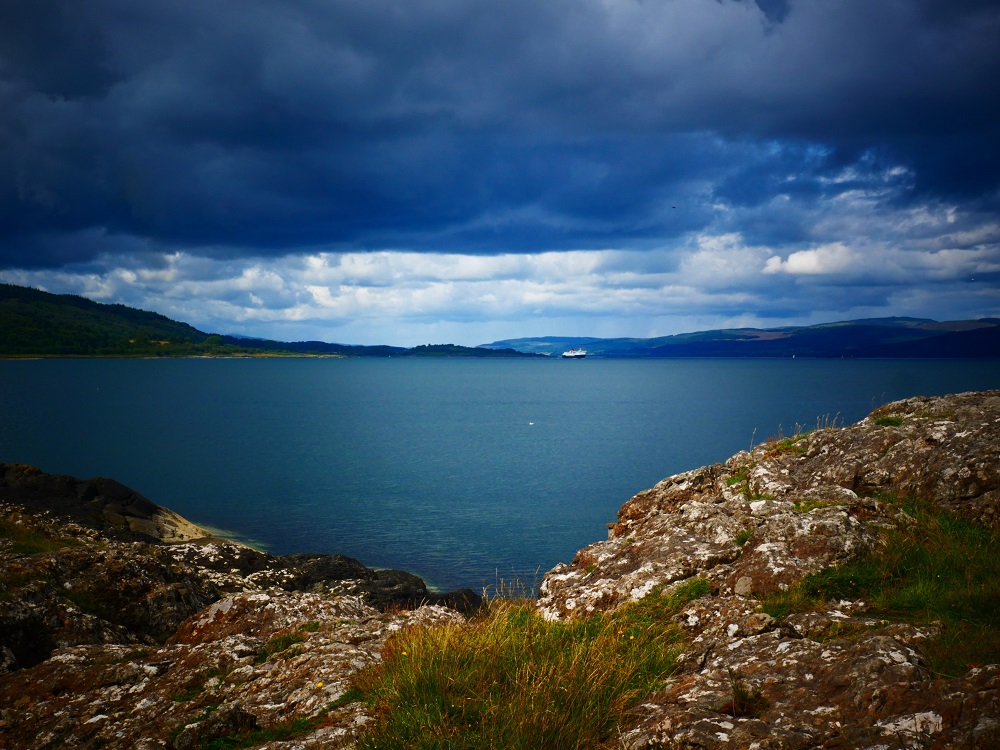
After almost a year in Indonesia, one of the most populous countries on earth, the desertedness of Scotland seemed amazing – we had forgotten what space in nature looks like, how the stillness of uninterrupted scenery expands your breath and quietens your soul. The rain continued for the two weeks we were there, making the rivers cascade down hillsides with tremendous force, the forest undergrowth spongy and the mushrooms plentiful, and we headily picked our way through fields of orange chanterelles, marvelling at their abundance.
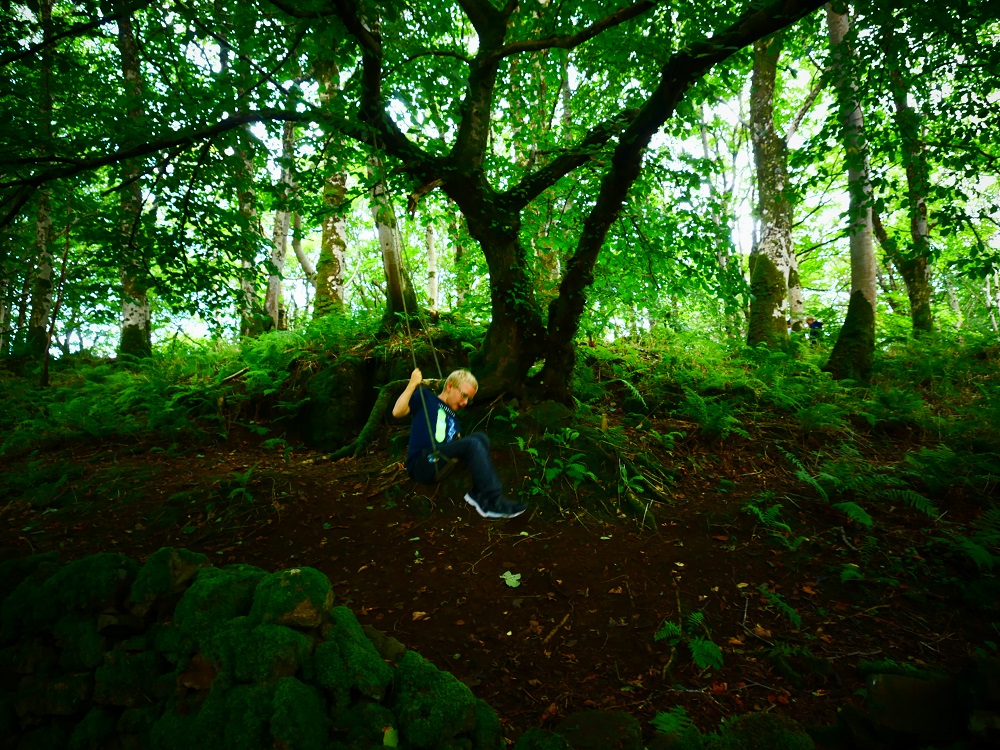
Food shopping in modern, western supermarkets was a revelation, the overwhelming choice of dew-dropped, fresh and fragrant produce almost alarming. Upon leaving Malaysia we had wowed to eat as little rice and as few eggplants as possible whilst away, and so we gorged ourselves on new potatoes, succulent berries, dark green broccoli and crunchy capsicums. The ubiquitous plastic wrapping of fruits and vegetables was a bit of a shock – we had expected to find less plastic in Europe than in Indonesia but in reality Danish and UK supermarkets were overwrapping food to an almost absurd level, the rise of convenience foods leading to customers buying ten slices of salami double packaged rather than a sausage to slice themselves, and apple pieces preserved in juice embalmed in plastic to avoid the inconvenience of having to chew a whole apple. Seemingly unaware of the irony, organic food labelled ‘better for the planet’ was triple wrapped to distinguish it from the less worthy mass-produced vegetables, and all the supermarkets proudly advertised that they were ‘plastic bag free’, selling durable multi-use plastic bags at the check-out to ensure that customers could blithely double their ecological footprint through needless generation of plastic waste without denting their feeling of virtuousness.

With family we visited castles and woods, the kids rolling down hills of green grass and sliding around on rocky intertidal shores heavy with slimy bladderwrack, catching crabs and caterpillars, and dipping their toes in the chilly dark waters of quiet lochs. We cooked and baked, celebrated birthdays with lavish spreads and sparkling wine and generally enjoyed the cool weather and beautiful surrounds.

We left after ten days of marvellous family time and began the long drive to London, swiftly leaving the emptiness of Scotland behind and entering the hustle and bustle that is UK motorway driving. The satnav in the hire car hilariously broadcast directional advice in imperial units, telling us to veer left ‘in seven-tenths of a mile’, and ‘take the third exit on the roundabout in 200 yards’, only just stopping short of advising us how many inches remained to our destination. As we drove south, David stopped at multiple hardware shops and chandleries, coming back to the car mumbling about ‘hardware regret’, the worry that whatever he didn’t buy in this land of plenty would be the part he would need the most upon our return to Malaysia. I understood perfectly, suffering as I did from not dissimilar bikini-related fears that in months to come I would be bedevilled by contrition and bemoan my frugality and the consequent lost opportunity of shops full of clean, new swimwear. Learning our lesson, to ensure that we wouldn’t suffer from ‘cheese regret’, we stopped in a supermarket on the to our final hotel just before Gatwick Airport to load up on cheese and salami, asking the baffled concierge at the hotel if they could please store ten kilograms of dairy and cured meats in their commercial refrigerator.
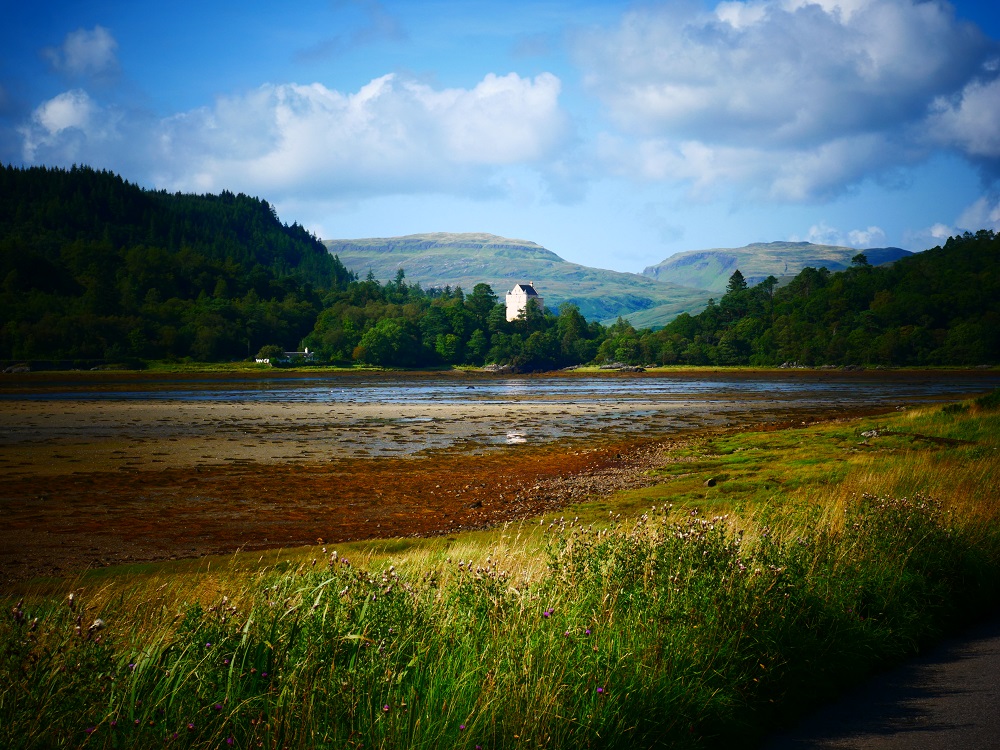
The political tumult continued during our visit. Trump made headlines by requesting discussions of a potential purchase of Greenland, part of the Danish realm, on his upcoming state visit to Denmark. The Danish Prime Minister labelled the notion ‘absurd’, following which the wounded president tweeted the cancellation of the visit, calling Mette Frederiksen a ‘nasty woman’, enraging the Danish public and giving rise to numerous cruel caricatures depicting an overgrown baby Trump throwing a tantrum. Meanwhile, in Britain, widespread public fears of the potentially dire consequences of a no-deal Brexit were fuelled by leaked cabinet reports discussing worst-case scenarios of food and medicine shortages come Brexit day.

As we flew out, the weather forecast was once again headline news, with more heatwaves looming. Boris was in Europe trying to sweet-talk EU leaders into a deal involving removing the Irish backstop, arrogantly predicting that he would manage to achieve what Theresa May’s government had not. Not unexpectedly, the big M’s of Europe, Merkel and Macron, failed to send the hoped-for signals and Boris, who came to office only a month earlier promising that the likelihood of a no-deal Brexit was minuscule was forced to backtrack and admit that perhaps his government too would fail to secure a deal. Meanwhile, in Denmark a fast-growing diplomatic crisis had been averted by Mette Frederiksen calling up Trump, managing to sweet-talk him to the extent that he relabelled her ‘a tremendous woman, a wonderful woman.’ Reading the headline just before entering the plane we drew a sigh of relief (the world war endangering my Danish relatives seemingly averted), relaxed in our seats and prepared ourselves for returning to the heat and hustle of Malaysia.
It had been an amazing trip, and wonderful to spend treasured time with family. The older you get, the harder it is to live far from kin, and as always we were sad to leave. As the plane took off we hoped for a good future for Britain and wished Europe good luck in what can only be described as tumultuous times.
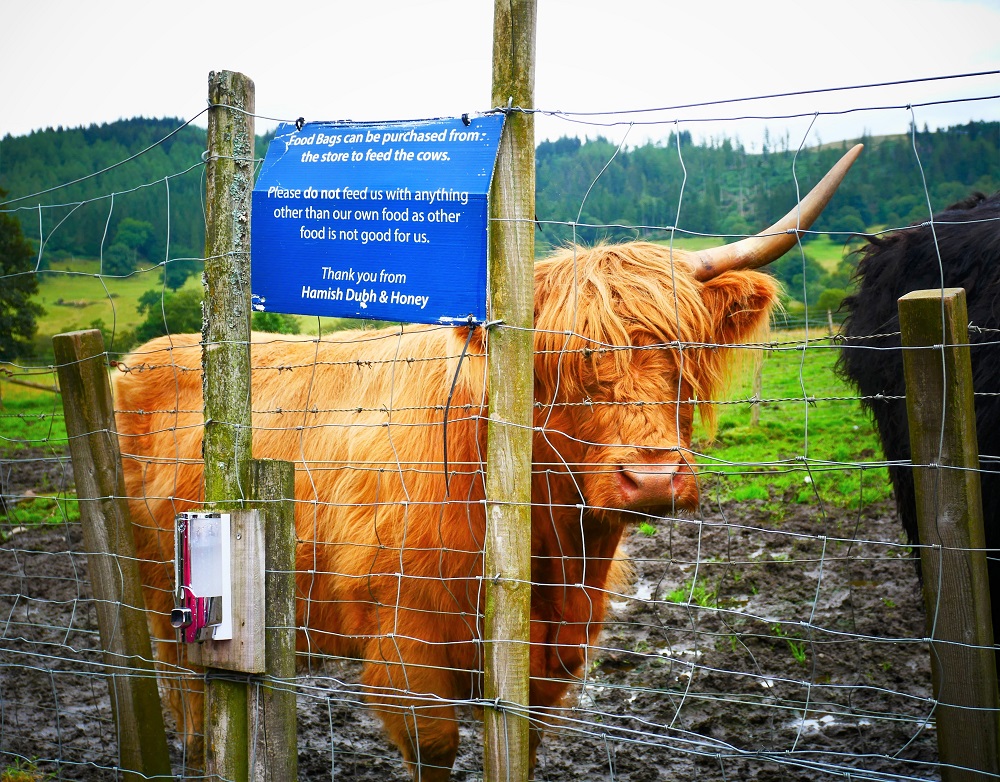
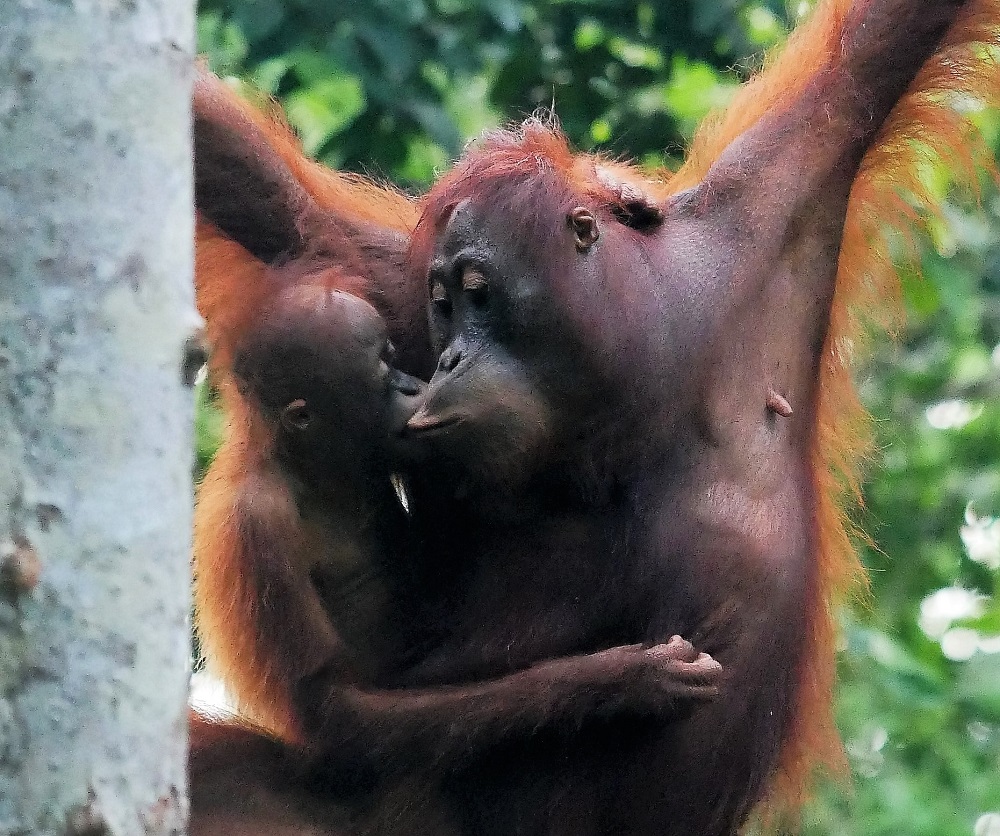
There are certain things in life that you just don’t want to miss, and for us, a family of wildlife lovers travelling through Indonesia, seeing the orangutans of Borneo was one of them:
“Look, Mummy, there it is,” whispered Lukie as he pointed the binoculars up at a treetop some 30 metres away. “It’s huge!”
The tree shook as the giant shifted its weight, the slender trunk bending precipitously.
Matias touched my arm. “There’s a baby too. Can I please have your camera?” he begged. “I really want to take a close-up picture, and your zoom is better than mine.”
I focused the camera on the dark shape in the treetop, using the zoom to get a better view. Up close I could see the beady black eyes, the soft unkempt orange fringe lining the wrinkled dark face, the fuzzy baby clinging onto long strands of chestnut fur. They were looking straight at me, peacefully noting our presence with no apparent alarm.
“They’re wonderful!” I said before handing the camera to Matias.
The mother turned her head and stretched out one enormously long left arm to grab a branch of a nearby tree. She leisurely leaned her full body weight towards the new tree and grabbed hold of a branch with her left foot, leaving her hanging casually outstretched between two tall trees, her baby encircling her waist with its long arms.

We were on a klotok, the onomatopoeically named brightly painted local houseboats used to take nature lovers up the Kumai River to the Tanjung Puting National Park in Borneo. Aria, our guide, had spotted the orangutans from his seat at the front of the boat and signalled for the driver to stop so that we could have a good look.
Quietly we sat there watching the sizeable orange shape calmly staring back at us through the jungle foliage. She was on the northern side of the river, which is not part of the National Park.
“Can she cross the river, to get to the National Park?” Matias asked Aria.
Aria explained that orangutans don’t swim across the river and that the female and her baby were therefore stuck in the unprotected narrow band of vegetation shielding the river from the millions of hectares of ever-expanding palm oil plantations destroying the Borneo jungle of the hinterland.
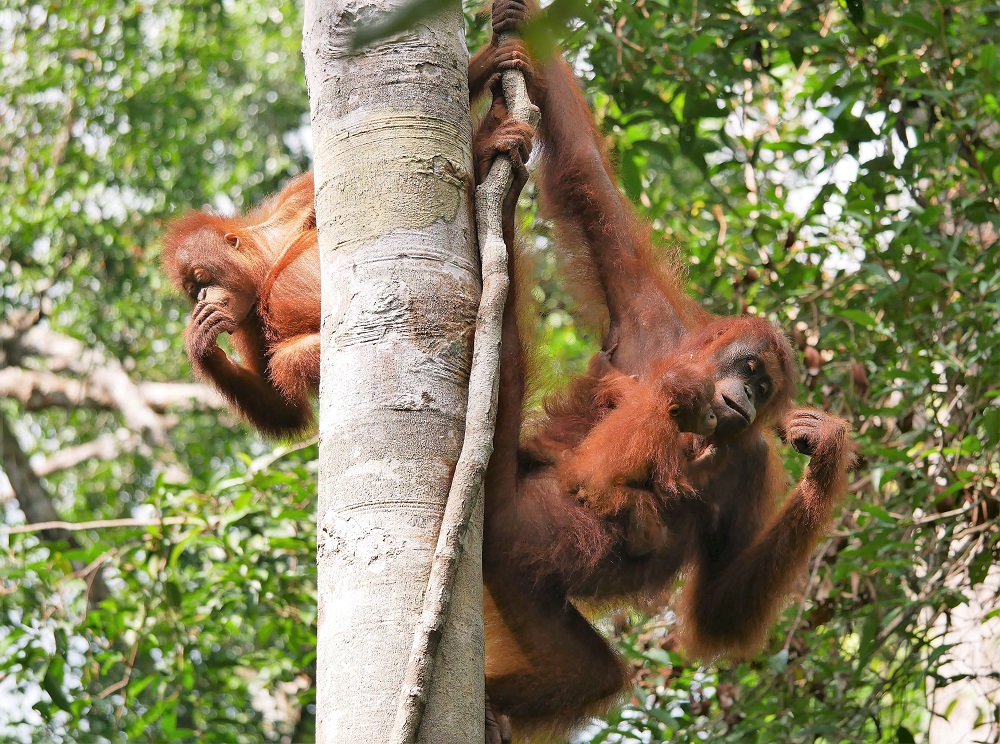
We had come to Borneo on our way north from Bali. The third largest island in the world, Borneo is smaller only than Greenland and New Guinea. The southern roughly three-quarters of the island belongs to Indonesia and the rest is Malaysian apart from the tiny Sultanate of Brunei. In Indonesian, Borneo is called Kalimantan, a word rooted in the Sanskrit term for ‘burning weather island’, referring to the searing heat and dense humidity of this equatorial jungle-clad location. It is just the kind of climate that an orangutan prefers.
We had arrived in Kumai the day before, anchoring in the peat-stained dark brown river off the town of Kumai after a four-day passage from Bali that I would call nightmarish but which David merely labelled ‘stimulating’. We had good wind and an incredible amount of traffic leading to tense night watches where I sat, knuckles white, gripping the binoculars, frantically trying to make out which of the tiny, deceptively faint flashing lights were fish attracting devices (FADs) and which were fishing boats, and whether we were on a collision course with the incredibly bright lights dotting the horizon which might be squid boats, tows, cargo vessels, tankers or a healthy mixture of all four.

The passage took us through a huge fleet of a thousand or more squid boats, parked up in dense clusters on the extensive shallow sea to the far south of Borneo, their bright lights ruining my night vision as they lured unsuspecting cephalopods to the surface, their presence crowding my radar screen.
Deciphering the meaning of different lights on night passage can be hard. Squid boats are generally stationary and intensely lit, but when they move they display the typical Indonesian fishing lighting (i.e. random cheerfully coloured flashing lights). The FADs and small fishing boats are hard to make out because they do not show up on the radar, and their faint multi-coloured blinking lights were hard to make out in the luminous sea of squid boats lighting up the moonless sky like a first world city. Cargo boats and tows can be distinguished from the squid boats by the fact that they are moving and generally use standardised lighting (i.e. showing starboard and port colours) and some of them are even on AIS, an extra bonus. Combine this confuddling mass of innovative approaches to lighting with intense sleep deprivation and a fast-moving sailboat and you get one of my versions of a passage nightmare (there are others: upwind sailing, no-wind sailing, nearshore sailing….).
I don’t mind moving through a sea full of boats in the middle of the night (OK, that’s a lie – I do mind, but not as much) when using the engine. But on this passage we were sailing dead downwind in a respectable breeze with a goosewing sail configuration (mainsail on one side, genoa on the other) which leaves very little leeway for manoeuvring, as any deviation from course could lead to a crash jibe. This meant a narrow 10 degrees of downwind leniency on the course steered, and my only option for bailing in a potential collision situation was to head upwind, which given a catamaran’s tendency to drift rapidly downwind as it is sailing along, is never a great option for avoiding oncoming traffic. All this meant night watches spent nervously weaving my way through the never-ending squid fleet, dodging one vessel only to see five more ping up on the radar, the whole affair leaving me so traumatised that once my watches had finished I had trouble sleeping, and when I did fall asleep it was a broken, uncomforting rest, harrowed by vivid dreams of terrifying head-on collisions with spiky squid boats.
“It’s not so bad,” said David cheerfully after the first night. “I prefer squid boats to FADs. At least they are stationary, which means that you can easily avoid them.”
“Sure,” I sighed. “I just prefer open ocean, with no squid boats, no long and poorly lit tows, no small but lethal FADs….”

Despite the stimulating sailing conditions we got there and as we approached Borneo the weather became hot and humid and the seas stilled, until on the fourth morning we arrived at the flat, brown expanse of the Kumai river mouth. I was expecting a mountainous interior but southern Borneo is flat as a pancake, a large low-lying semi-inundated peatland covered in dark short jungle.
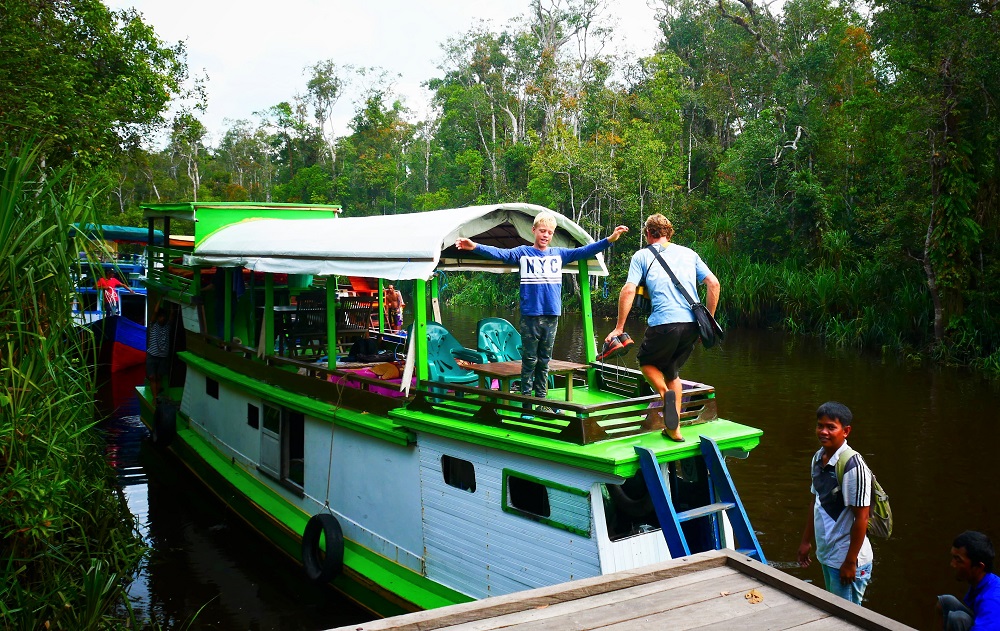
To see the orangutans we organised a three-day trip up the Kumai River to the Tanjung Puting National Park on a slightly dilapidated bright green klotok complete with a captain, a cook, a boatboy and a wildlife guide. The river is full of these picturesque houseboats, travelling slowly up the still waters, brightly coloured dots against the vivid green walls of nearshore vegetation. Our klotok was at the cheaper end of the spectrum, and after a few hours of travelling up the river we realised why.
“Ours is a klo-bang-tok,” said David, commenting on the unhealthy sounding engine which had a tendency to stall whenever we slowed down, causing no end of hassle for the captain and the boatboy who then had to work furiously to restart the thing. During the lengthy restarting procedure we would drift perilously down the river, our cook and boatboy shouting loudly to alert oncoming klotoks to our compromised engine so that they could take appropriate evasive action.
“We’re the slowest boat on the river!” exclaimed Matias jubilantly as yet another klotok overtook us, and he was right, but it didn’t matter – the toilet was tolerable, the beds comfortably enshrouded in dense mosquito nets, the food wonderful, and our slow progress meant that we got to see everything in slow motion, sometimes netting a view twice when engine failure forced us backwards.

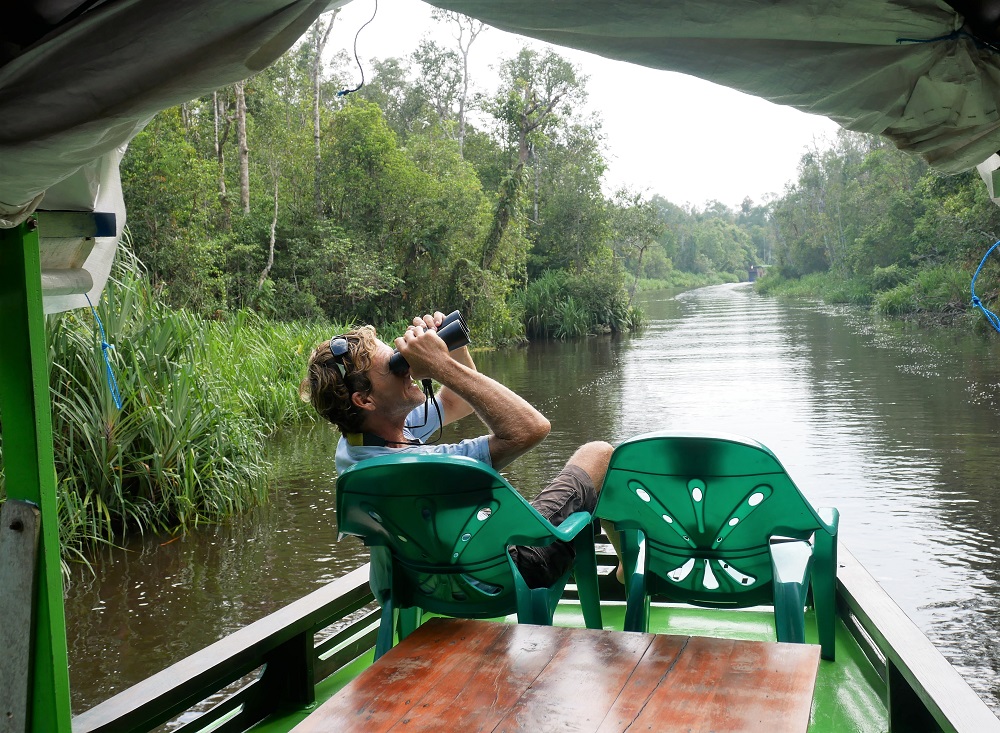

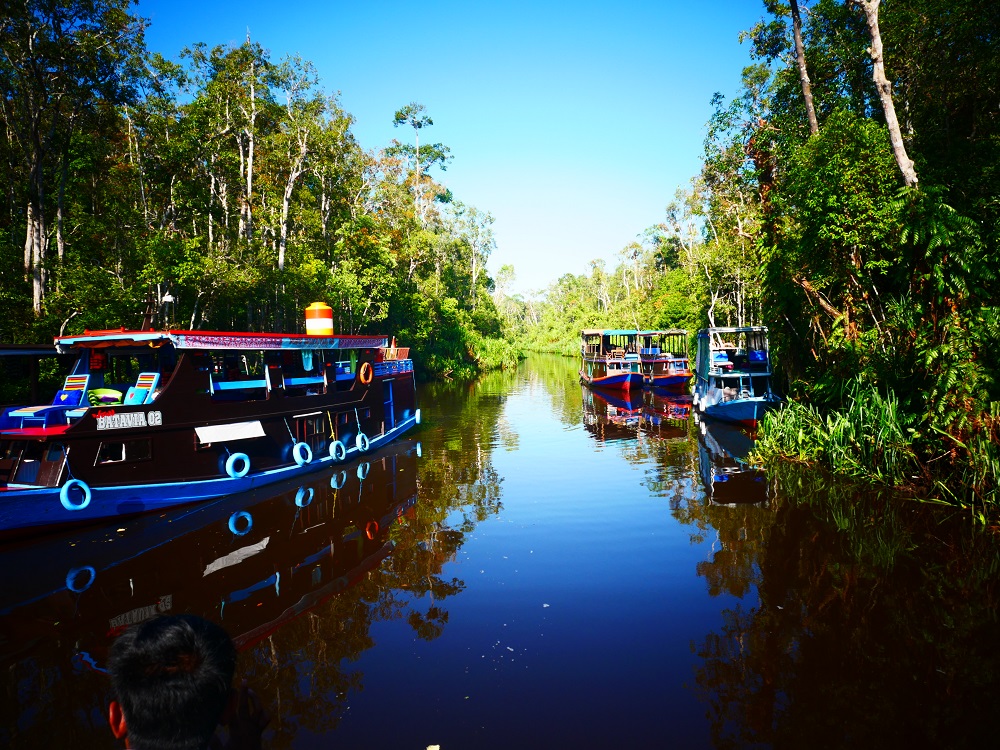
The klotok trips up the river Kumai take visitors to the Tanjung Puting National Park. Orangutans are everywhere in the south Kalimantang jungle but are more concentrated in the 400,000 hectares of forest of the national park, which was first protected in the 1930s by the Dutch colonial government to protect the resident orangutan and proboscis monkey populations of the area. It became a UNESCO Biosphere Reserve in 1977 and a national park in 1982.
In Tanjung Puting’s Camp Leakey is an orangutan rehabilitation centre. The centre was established in 1971 by the world’s first orangutan researcher, Dr Galdikas, to provide a site where orangutans rescued from captivity (e.g. casualties of the palm oil plantation expansion entering the commercial pet trade) could be re-established successfully in the wild. Orangutans enter captivity mainly as babies when their mothers are killed for bush meat, as agricultural pests, or in the palm oil plantations that are rapidly expanding and overtaking the jungle. The locally run Orangutan Foundation International organisation rescues the captive orangutans and brings them to the rehabilitation centre for care, and to date more than 300 ex-captive orangutans have been released into the wild of the park.
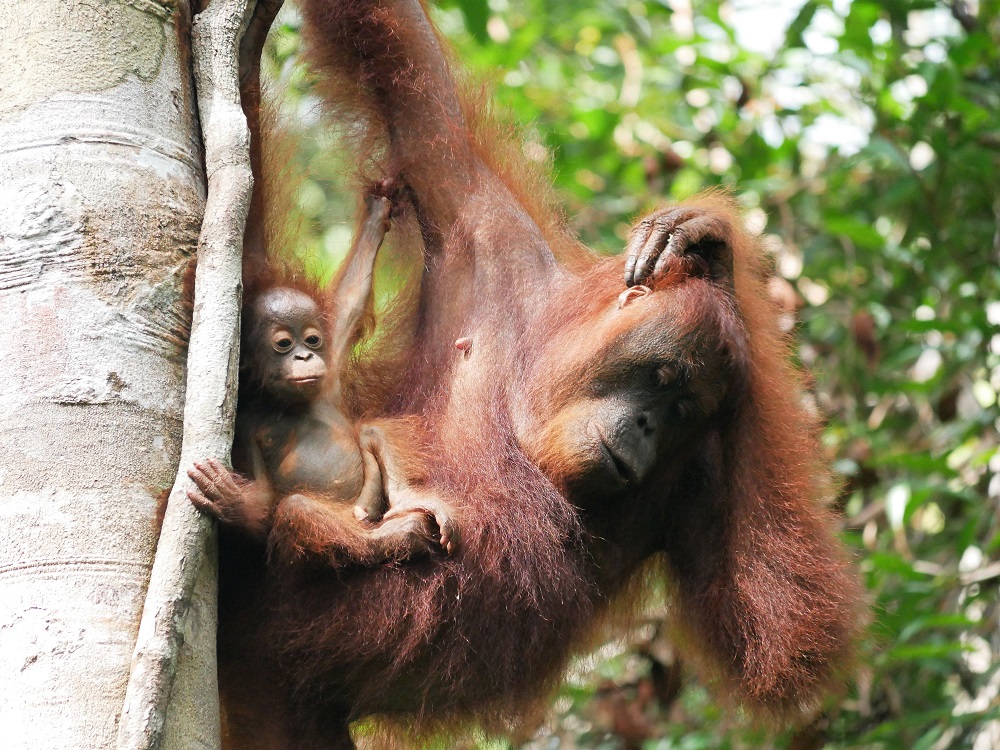
The rehabilitation involves health care as well as teaching juvenile orangutans how to get on in the wild. Orangutan babies live with their mother for 5-6 years in the wild, during which time she teaches them social interaction as well as how to forage and which plants and insects are safe to eat. At the rehabilitation centre, human carers replace the mother and attempt to teach the juvenile orangutans self-sufficiency.

To ensure that the released animals do not impact adversely on the wild population of the area, three feeding stations have been established in the national park to supplement the food that the ex-captive animals find in the wild. Here, the park rangers provide food like bananas, sweet potatoes and sweetcorn once a day, and if any of the rehabilitated animals are struggling for food, they can come and avail themselves of a free lunch. The feeding stations provide an excellent opportunity for tourists to view the orangutans up close, and the wildlife tours from Kumai bring scores of visitors up the river every day, wildlife lovers who stand sweating with us in the humid jungle, absently swatting away mosquitoes as they gawp at these fascinating animals.
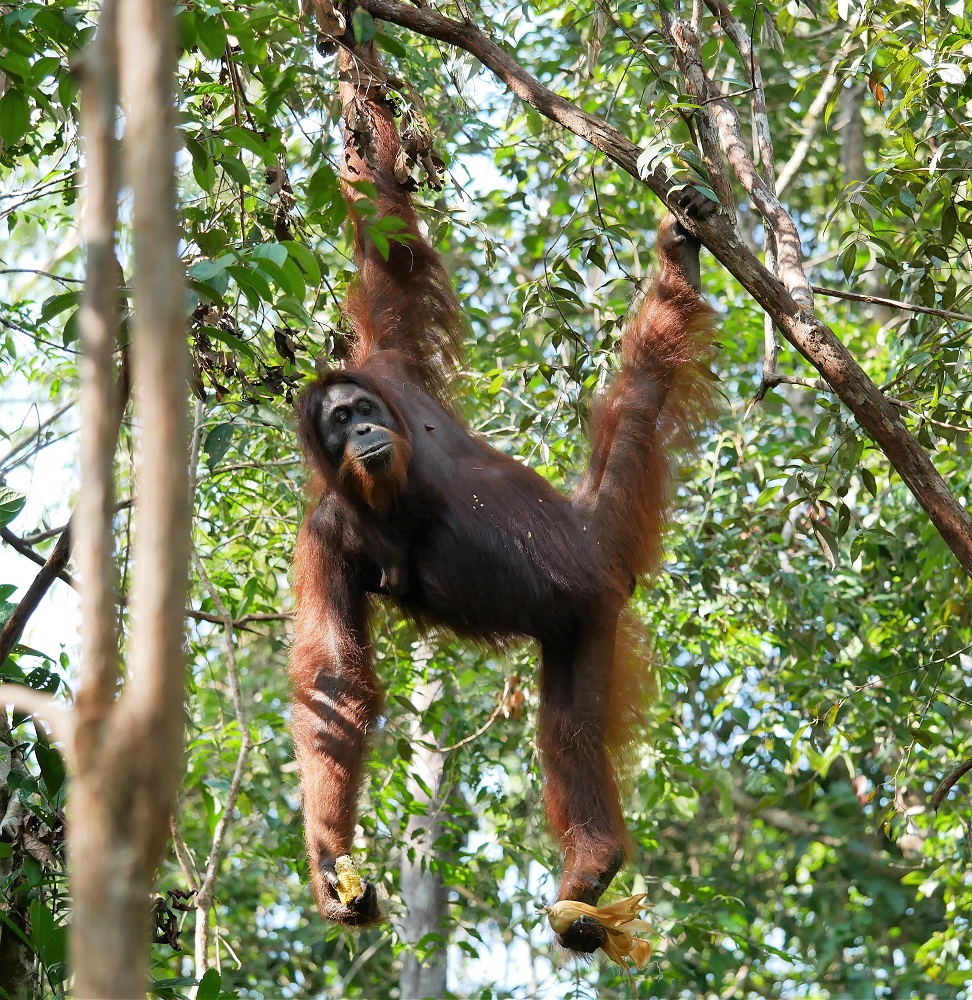
Orangutans look amazing. They are like huge, furry humans with incredibly long arms and thick, heavyset chests crowned with massive shoulders atop a short, spindly, bowlegged bottom culminating in large, hand-like feet. They are incredibly hairy, rippling muscles showing under a thick, fuzzy, orange fur. On the ground they walk either upright with a knees-out-bowlegged gait or on all four resting their heavy upper body weight on their knuckles, but really they are very rarely on the forest floor, preferring instead to spend their life in the treetops. Here they are incredible to watch, a blur of orange fur moving swiftly through the foliage, swinging from branch to branch like Tarzan (although I guess strictly speaking he got it from them), moving fluidly from tree to tree using their weight to pivot the treetops as they swing backwards and forwards, increasing momentum until sufficiently close to the next treetop to grab hold and swing over. They comfortably spend hours just hanging from branches, their long furry limbs sharply outlined against the bright sky beyond the canopy.

Unlike other apes, orangutans are solitary, and natural interactions between individuals are limited to brief mating events, the lengthy dependency of young on their mother, and loose gangs of youths who hang together before they start reproducing.
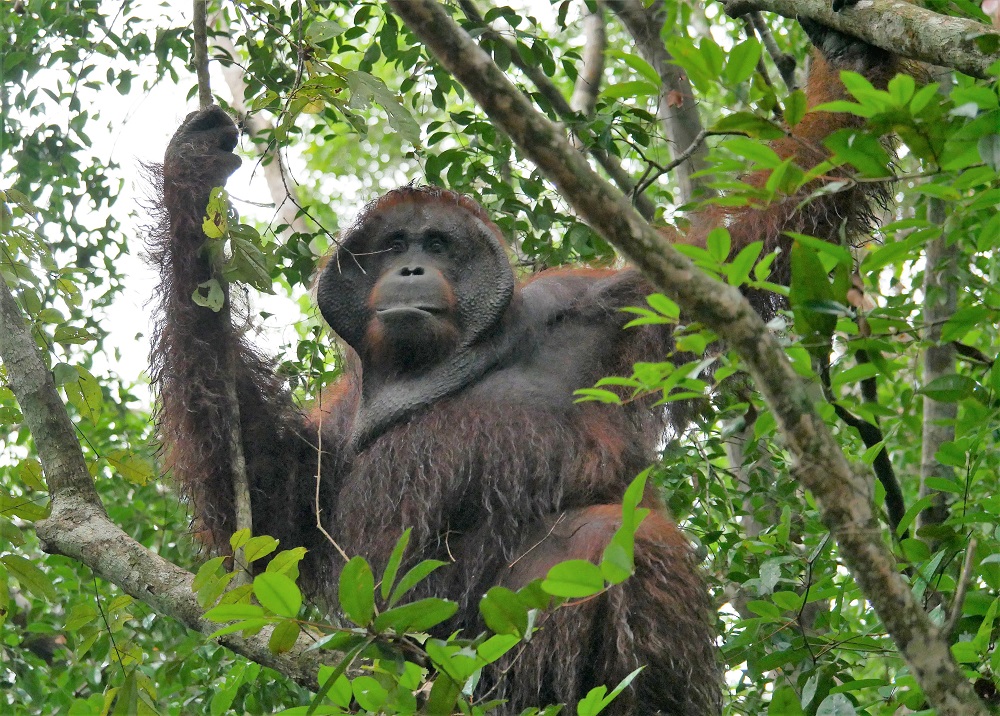
This means that the interactions we witness at the feeding stations are those between animals who don’t naturally have much to do with one another. Only a few of the released animals come back for food, but each of the three feeding stations is dominated by a huge alpha male who monopolises the supplies, stoically chewing his way through immense piles of bananas, yams and sweetcorn, and only leaving the feeding platform once he is absolutely stuffed. The alpha males are recognisable from their huge size – they are about twice as big as the biggest females – as well as by the large cheek pads which makes their face imposingly wide compared to females and subordinate males. The alpha male is the first to eat, and whilst he is stuffing his cheek-pad-enhanced face the rest of the orangutans sit hiding in treetops, hungrily waiting for an opportunity to sneak down and steal some food. Occasionally the alpha male will let females with babies come down to get some food, but he never tolerates the approach of another male, and when one approaches he gets up slowly and starts to knuckle-walk towards them, showing off the scarily full breadth of his shoulders. The dominant male hogging the food clearly upsets some of the rival males, who sit screeching in the treetops, tearing off branches and throwing them down in an attempt to provoke a reaction, but to no avail – the big guy sits calmly ignoring them, secure in his power, safe in his dominance, stoically eating through another kilo of fruit even though his rather solid shape would suggest that he ought to start limiting his carbs.


Once the alpha male has had his fill and has left the feeding station, the subordinate males and low-ranking females come down to eat. Only the largest females dare eat on the platform, the rest steal food, nervously looking right and left and keeping a hold of a branch so they can retreat rapidly. On the platform they stuff their faces and gather as much as they can hold in their mouths, hands and feet, like bulimics stocking up for a late-night binge, before fleeing rapidly, their escape slowed down by their full hands and feet. The near-naked babies cling to their mothers’ long fur and older juveniles keep one hand on the mother always, a lifeline to instant protection and effusive motherly love.
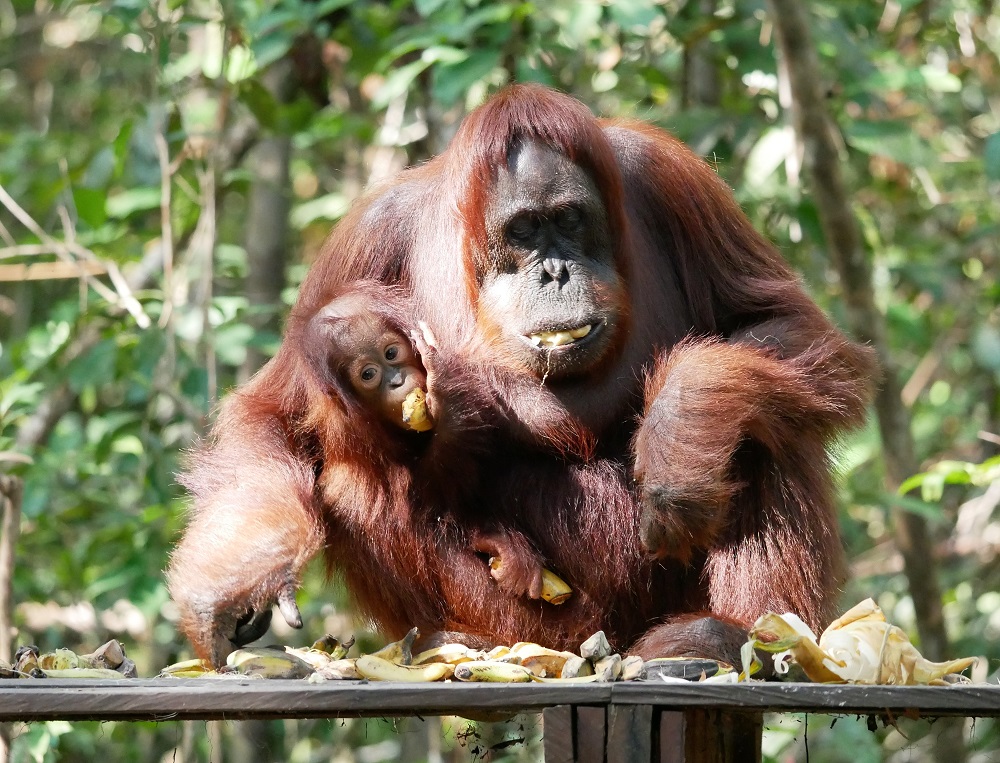

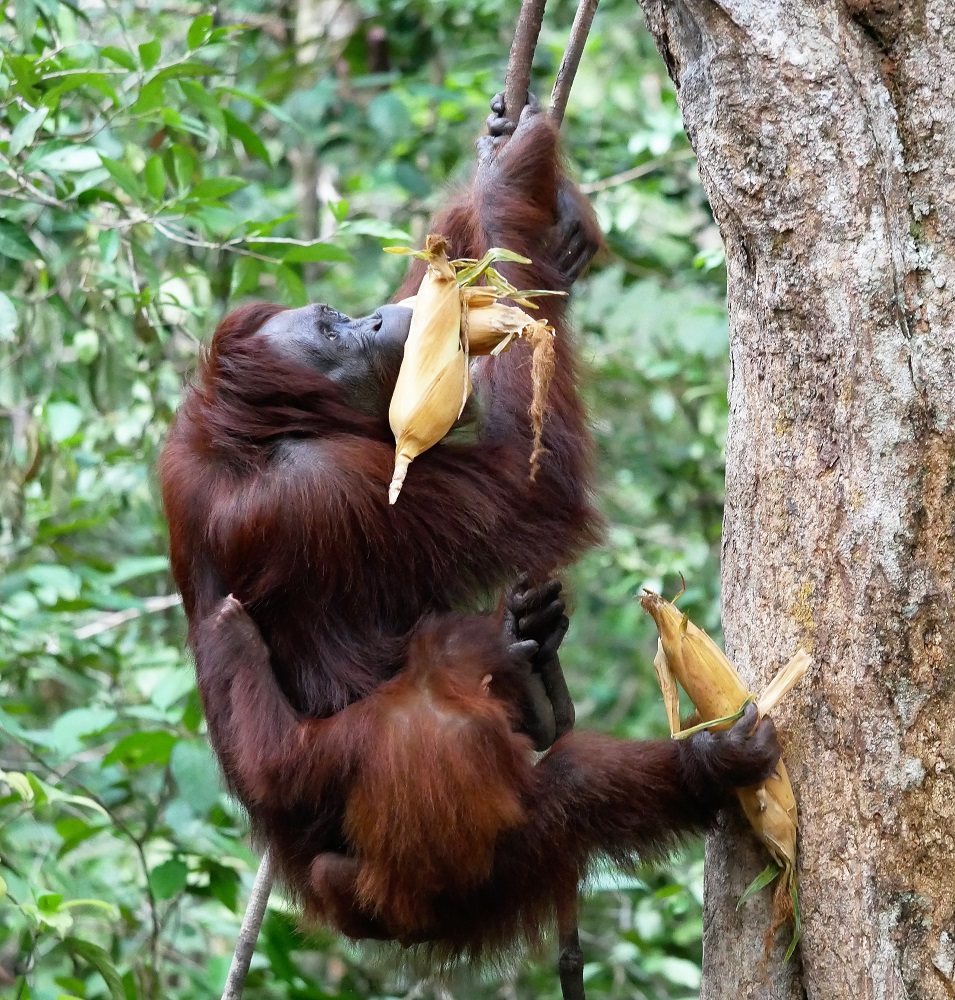

It is not only orangutans enjoying the feast – a fast-moving ex-rescue gibbon also comes down to steal some food, running along the platform bananas in hand before quickly climbing to the safety of the spindly branches of a nearby treetop, and a troop of longnosed wild boar gallop in and start excitedly sniffing the undergrowth, excitedly hoovering up the leftovers.


Occasionally the alpha male will return to the platform for another snack after seeing how popular the food is, slowly moving this way and that to chase off anyone else enjoying the event, making sure that his is an absolute monopoly. It is incredibly funny to watch, an ape soap opera featuring characters with different personalities – the bullying chief, the mocking subordinate, the nervous young mothers tightly grasping their fragile-looking babies, the seasoned mothers of two moving with more confidence – so human-like that we all recognise them: after half an hour of witnessing the overt display of stubborn patriarchal dominance the lady next to me quips that she’s pretty sure she’s worked with that guy in the past, and the female colleague with whom she is travelling laughs in agreement.
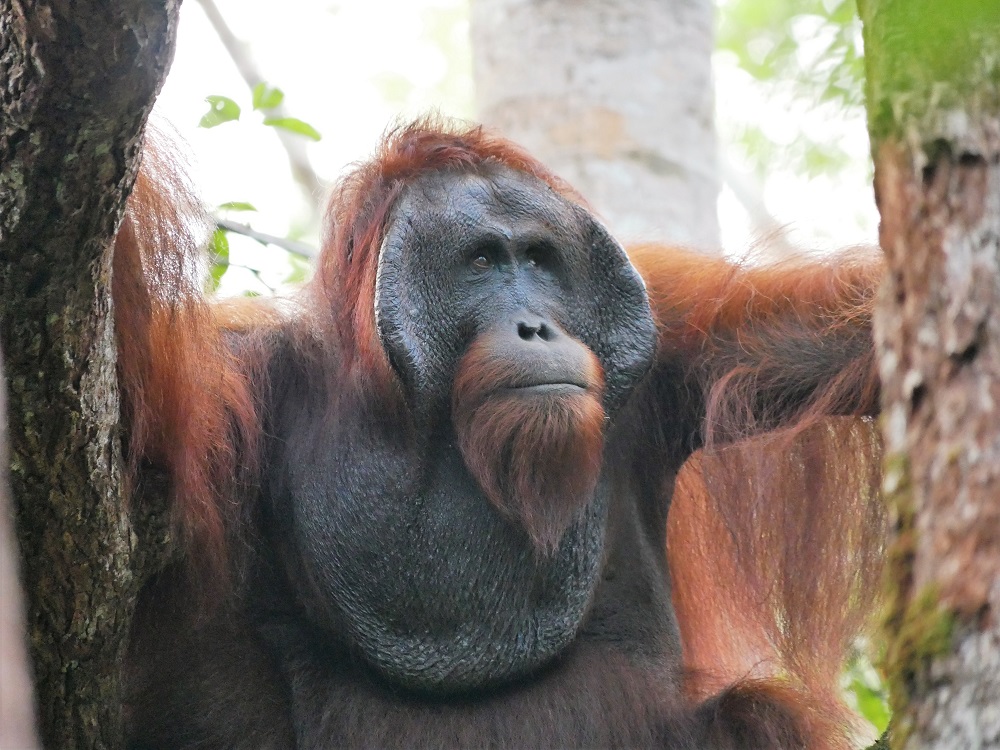
The jungle is full of interesting creatures. From the klotok we saw macaques and one afternoon, Aria spotted a troop of proboscis monkeys lounging in a tall tree. Named after their prominent facial protuberances, the proboscis monkeys are hilariously discontent-looking, a group of sour-faced, potbellied semi-humans sitting quietly, little fur hats and scarves framing their hairless faces dominated by noses that would put Pinocchio to shame. The males’ Yassir Arafat noses are long, bulbous and overhanging, and the females’ sharply pointed beaks would make Cleopatra pale. They look cheated, glum and resigned to their fate as they sit there in the top of a tree, their skinny arms and legs casually holding onto fragile branches, their long furry tails trailing below them.

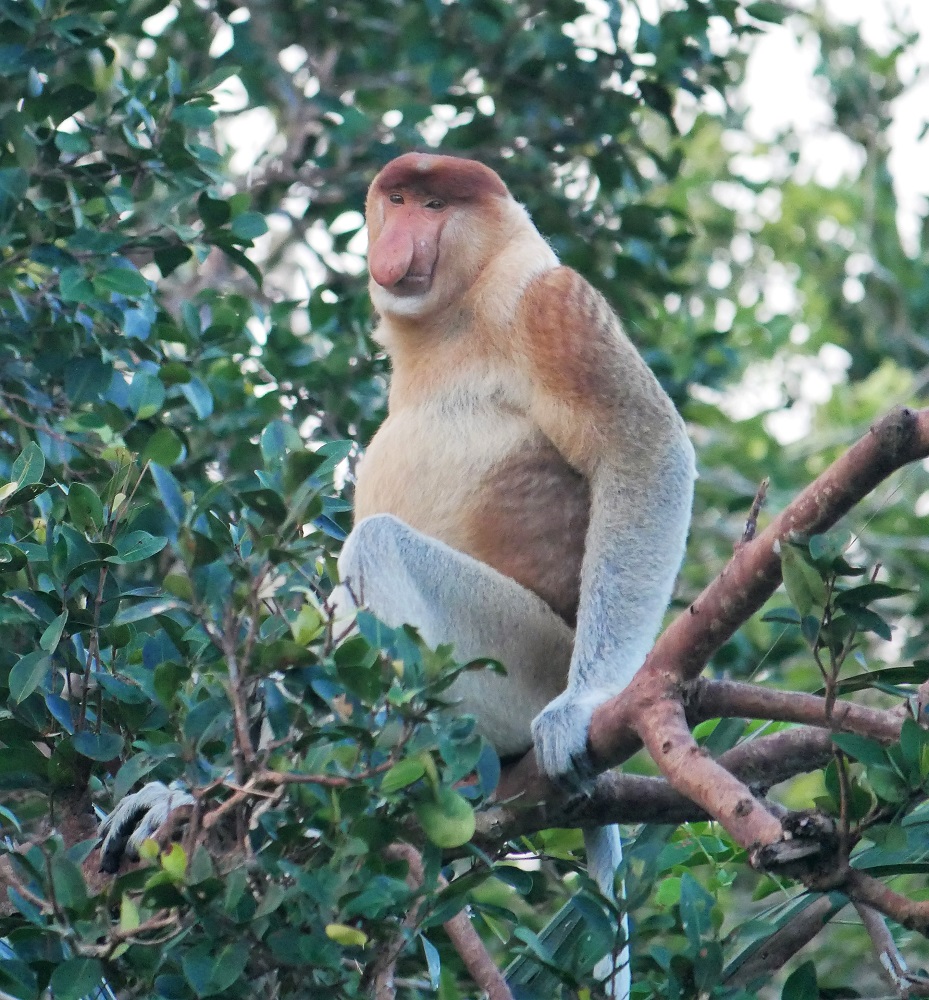


At night we went trekking in the jungle, the kids excitedly following Aria our guide as he showed us huge bird-eating spiders and small spider-eating birds, using a long twig to lure hairy tarantulas the size of a grown man’s hand out of underground caves and a torch to illuminate furry caterpillars dripping from vegetation and birds curled up into balls hiding in tree holes, as well as the ominous tracks of wild boars.
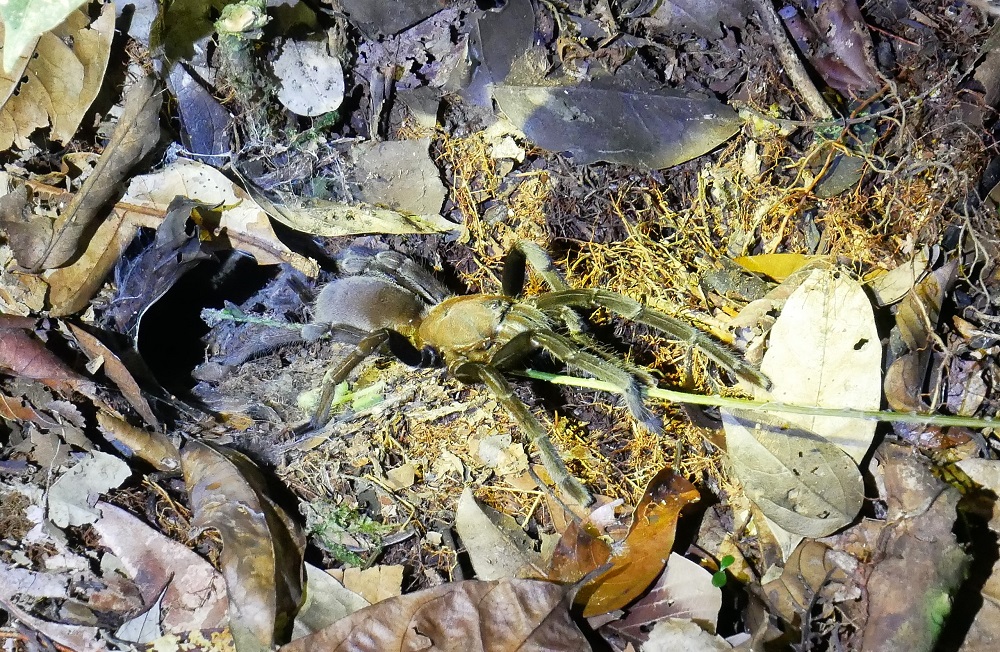
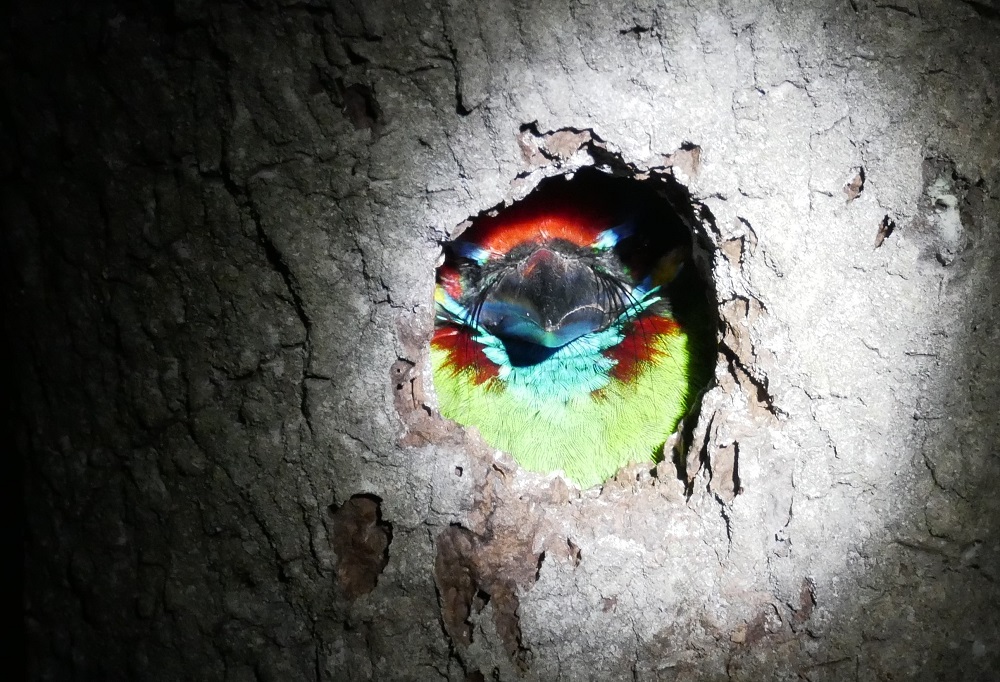
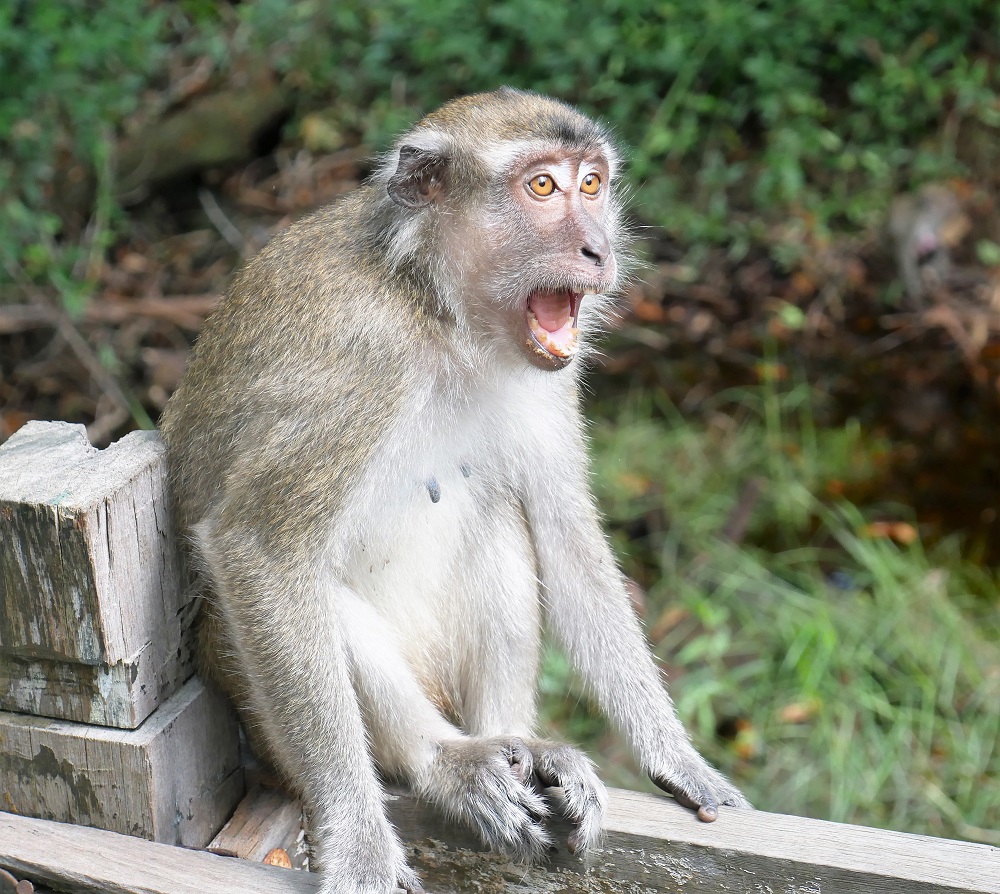
The Borneo rainforests are magic and teeming with life, but sadly they are diminishing at an alarming rate. The critically endangered orangutans only live here and on the island of Sumatra and the populations are declining fast: 60% of Borneo’s orangutans have perished over the past 60 years. Around 45,000-69,000 orangutans remain in Borneo and these populations are projected to continue their drastic decline. The main threat to the Borneo population is logging and forest fires, at the root of which is the rapid conversion of tropical rainforest to lucrative palm oil plantations. Palm oil is used for cooking, cosmetics, mechanics and biodiesel, and Indonesia is the world’s biggest producer and consumer of the commodity, providing roughly half the world’s supply. A major economic earner for the country, palm oil contributed 11% of Indonesia’s export earnings in 2018 and production is projected to increase dramatically over the coming years as more rainforest is cleared. The oil is everywhere in Indonesia – it is the only cooking oil that you can buy in all but the large cities in Indonesia and the biodiesel is sold at all petrol stations.

Palm oil is unavoidable in Indonesia and we sharply feel the irony when, after visiting a national park museum which documents the wildlife destruction caused by the insidious spread of palm oil plantations, we head back to the palm-oil fuelled klotok and eat our delicious lunch of fish deep-fried in large vats of palm oil.

It’s a sad state of affairs and when the guide suggests that the kids each plant a tree in the reserve to help maintain the forest they jump at the opportunity. In fifteen years the trees they planted will be more than 2 metres tall and we hope that the habitat left will be enough to sustain the orangutan populations.
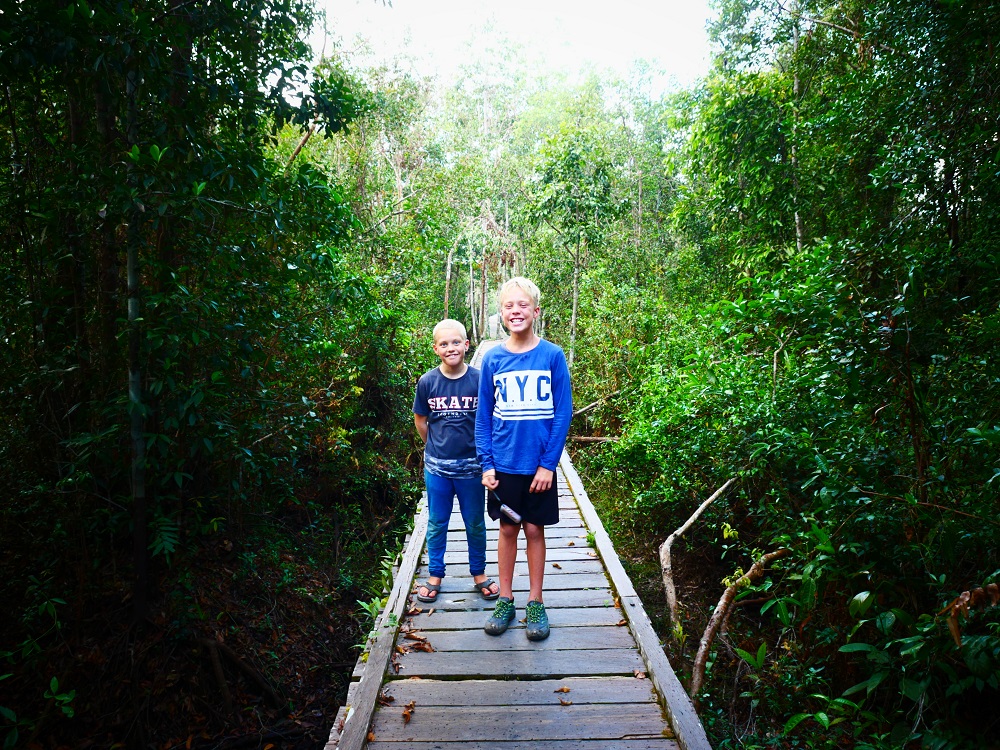
The town of Kumai is not particularly charming, and after stocking up with diesel and vegetables we left Kalimantan behind. As we sailed away from the island we mentally readied ourselves for another run in with massive squid fleets as we headed west. We were super happy to have seen the orangutans but, like so many times before here, once again feeling like we got there just in time. Oh Indonesia, land of ever-diminishing rainforests, orangutan populations and squid stocks, what will become of you?

 SV Bob The Cat