Beautiful Bequia

OLYMPUS DIGITAL CAMERA
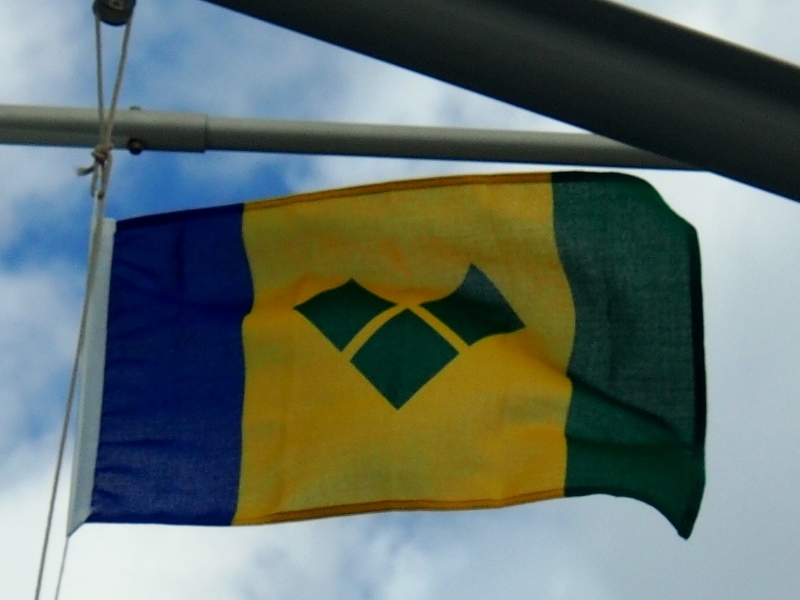
St Vincent and the Grenadines flag

In our trip to the Grenadines, we decide to bypass St Vincent (which has a reputation for being somewhat unsafe) and aim for the island of Bequia for our first stop. The largest of the St Vincent dependencies, Bequia is a small island just south of St Vincent home to about 6000 people; the descendants of African slaves, Scottish and French settlers, and New England whalers. Whale hunting from small local skiffs still takes place off the island whenever the opportunity arises.

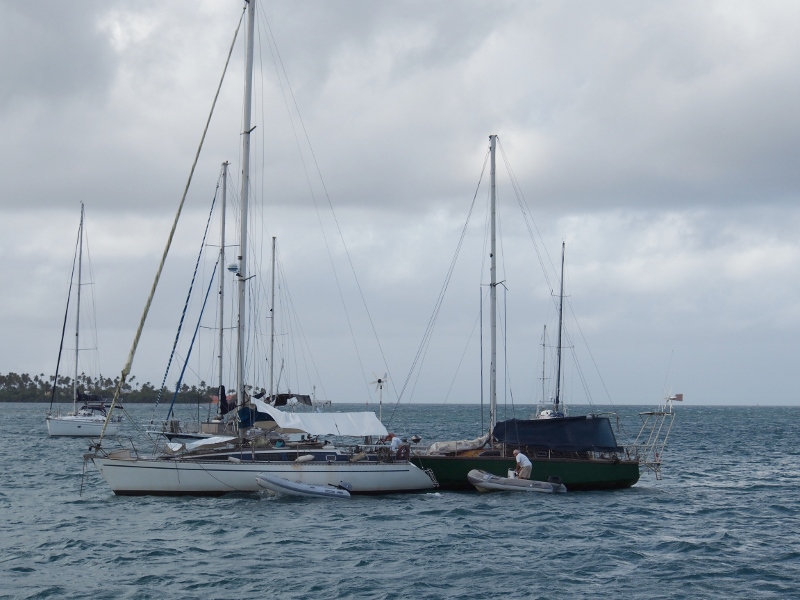
We arrive in Port Elizabeth which is moderately busy, with boats anchored close to one another on both the southern and northern edges of the bay. The island is known for its friendly locals, beautiful scenery, quaint towns and great marine life.
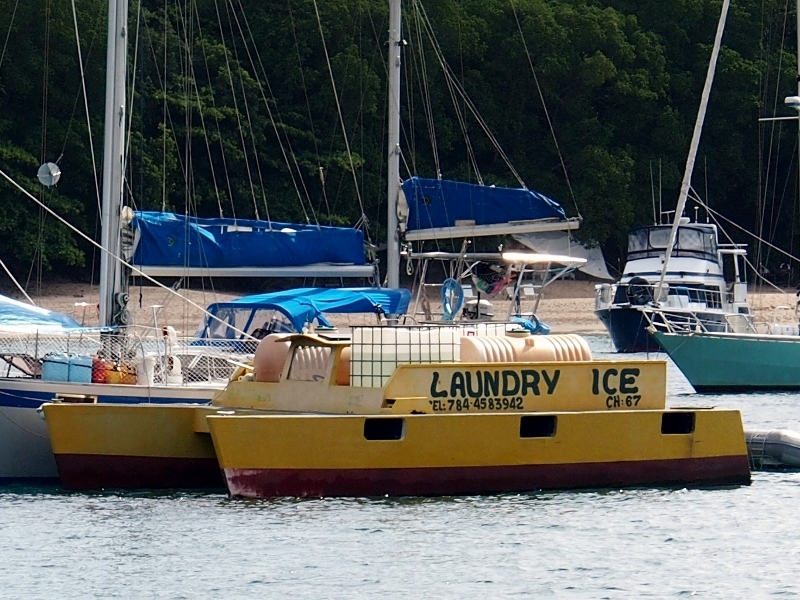
The laundry, ice, water and diesel service boat

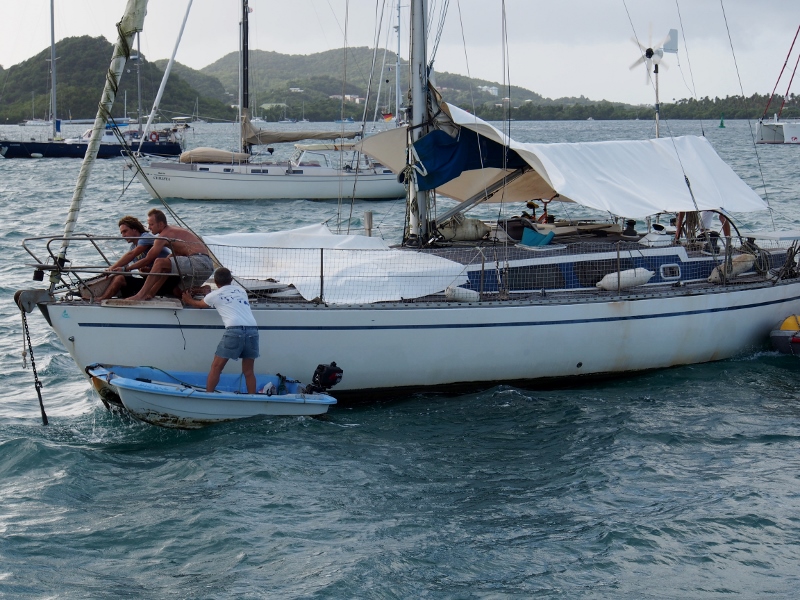
Port Elizabeth certainly has amazing services for yachts. Name whatever you desire, and there’ll be a boat providing it to you. We spot the all in one laundry, ice, water and diesel service boat, and call them on channel 67 and request a laundry pick up. Next day they deliver clean, neatly folded fragrantly smelling clothes. There is also a baguette and croissant boat, which takes bakery orders and delivers the goods fresh for breakfast. A rasta dude offers to clean the boat until it ‘shines like a newborn baby’. He has lived in Sweden for many years and has a special cleaning product which he bought from a guy from Frankfurt. He paddles out on a standup to offer his services to yachts, and as the wind picks up we give him a tow back from a hard day’s work. The locals are friendly and act with quiet dignity, and we get a sense that the place is not as poor as St Lucia. Here good services are offered at a premium price and the many tourists are happy to pay. The result is a thriving place full of happy tourists. We meet many people from hotels, who all came here on the recommendation of someone.

Cleaner dude catching a tow from our dinghy

There is great snorkelling just by the boat – seagrass bed, with pipefish, strange eels, and an octopus changing colour as it tries to outswim us – white over the sand, green stripes over the seagrass bed, a thick cloud of ink coupled with a darker shade in a last ditch attempt to deter us. A long nosed pipefish does the same, and we follow it for a great distance, watching it change its hue to blend in with the bottom. A graceful stingray glides by, and we spot a lumpy searobin, curiously ugly, walking along the bottom on its little legs. When we dive down it cowers and fans out a beautiful set of wing like fins, edged with iridescent blue, to try to frighten us off.

On the reef next to the little beach that we’re anchored next to, we see a delicate beige eel with daint white spots, sliding over the rocky reef, looking for coverage as our shadows darken its path.
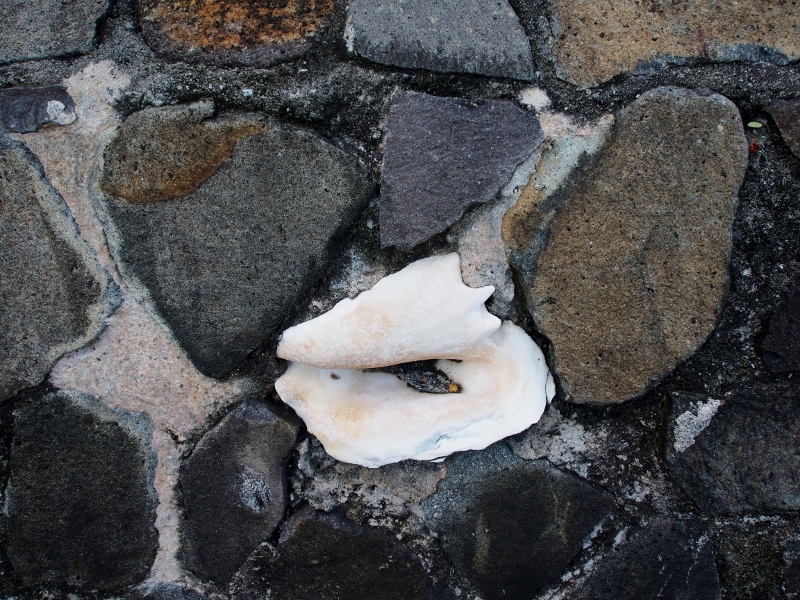
Conch shells inset into the stone wall lining the bay walkway

The town is pretty and full of character. Set on a steep hill, the main road lines the waterfront, with colourful houses dotted on the hillside behind. A narrow strip backed by colourful flowering trees and cosy looking restaurants lines the southern end of the harbour where we’re anchored. Conch shells are everywhere, and one day for lunch we try a conch roti. A bit chewy, but Lukie loves it… A restaurant on the waterfront has furniture made from whalebone, so you can sit and sip your cold beer, your backside planted on the vertebrae of a whale.
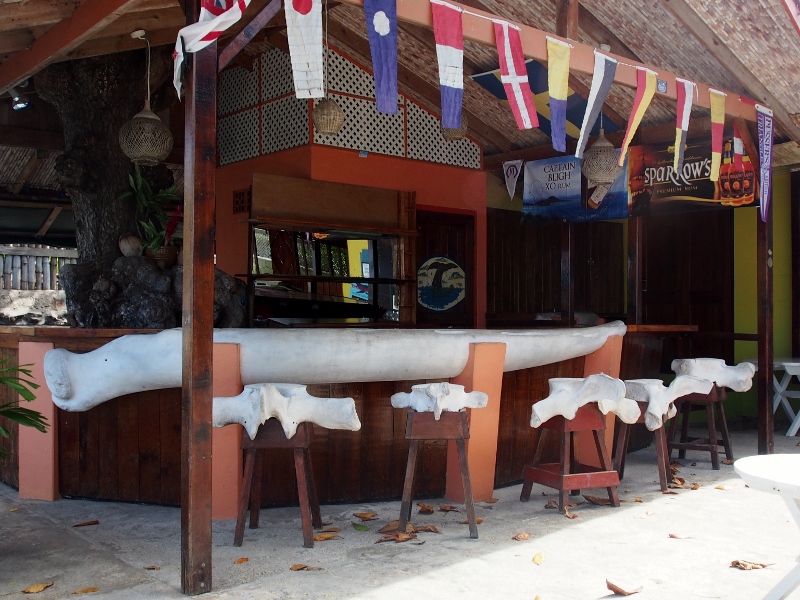
 

Whale bone seats in waterside restaurant

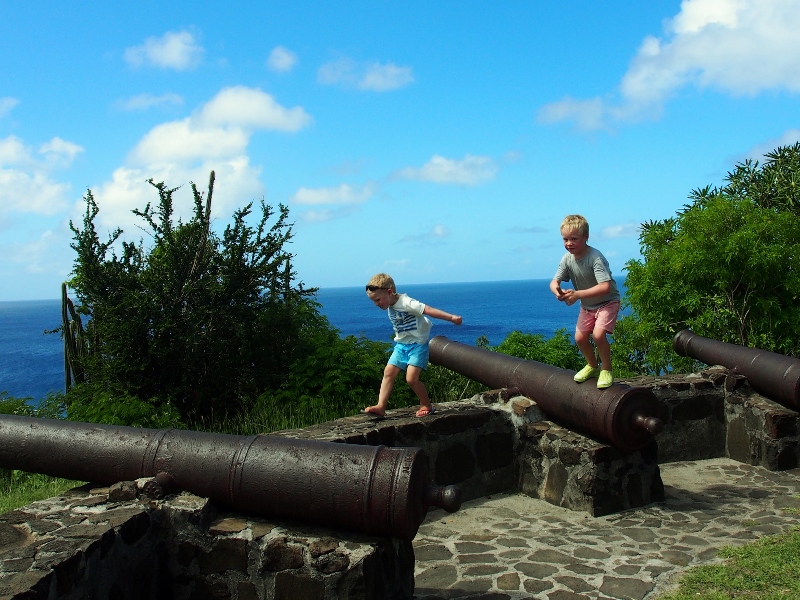
On the northern hill overlooking the bay and the sea beyond sits a small fortress, complete with black canons pointing out the sea. Apparently of the five canons two were French and three English  – the two nations fought each other fiercely and would take turns shooting down each other’s warships, but stuck to their separate canons.
OLYMPUS DIGITAL CAMERA

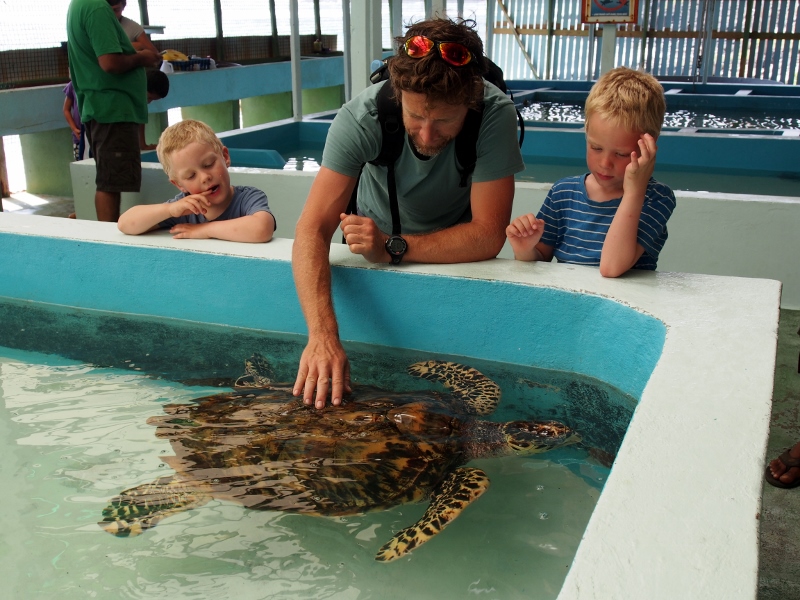
The next day we visit a turtle sanctuary, a facility on the other side of the island where they collect baby Hawksbill turtle and rear them to 5 years of age in captivity. The Hawksbill turtle is threatened with extinction and a local Bequian named Orton ‘Brother’ King decided to help the population by increasing the chances of survival of a few of the thousands of juveniles that they get on the island each year. In the wild, the survival of Hawksbill turtle is less than 0.1%, but at the sanctuary they get rates of about 30%.
18 year old turtle
18 year old turtle

Each year, they protect the eggs laid by local turtles until they hatch, and then they capture about 250 juveniles as they crawl out to the sea. They rear them to about 5 years of age where their survival rates in the wild are good and then set them free. The facility is located on the Atlantic side of the island, so there is a plentiful supply of fresh clean water which they pump in daily to change the water in the tanks. The juveniles are tiny, and surprisingly clumsy, promptly bobbing up every time they try to dive down. Apparently, in the wild they don’t really dive until they are at least a year old, where they become less positively buoyant. It is a valiant effort, but apparently Orton is retiring next year, and the future of the sanctuary is uncertain. Bycatch in local fisheries is the major cause of death of the Hawksbill turtle in the wild, and global organisations such as the WWF have initiatives underway to encourage fishermen to change hooks to some less dangerous to the turtles. They are beautiful animals, the descendants of a group of reptiles that have swum in the Earth’s seas for 100 million years. We hope the initiatives to save the turtles are effective; it is a shame if they were to go extinct on our watch.

Teenage hawksbill turtle

Teenage hawksbill turtle


Rainbows, pirate ships and boat boys


St Lucia flag
St Lucia flag

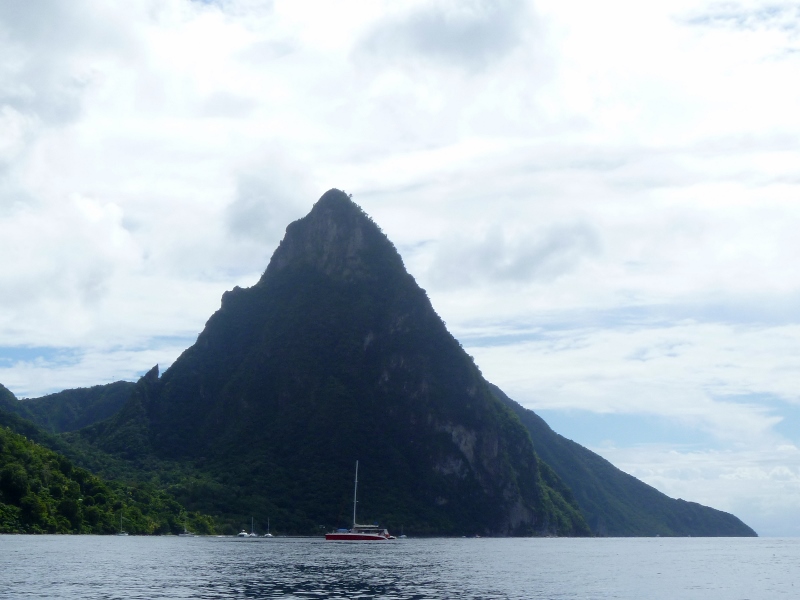
Our impressions of St Lucia are brief as we only spent two and a half days there, hopping down the leeward coastline on our way to the Grenadines. It is a spectacular island – steep volcanic terrain, even more pronounced than on Martinique, covered in the same dense lush jungle. Hillsides plunging directly into the sea, with few bays, depth increasingly rapidly offshore.

OLYMPUS DIGITAL CAMERA
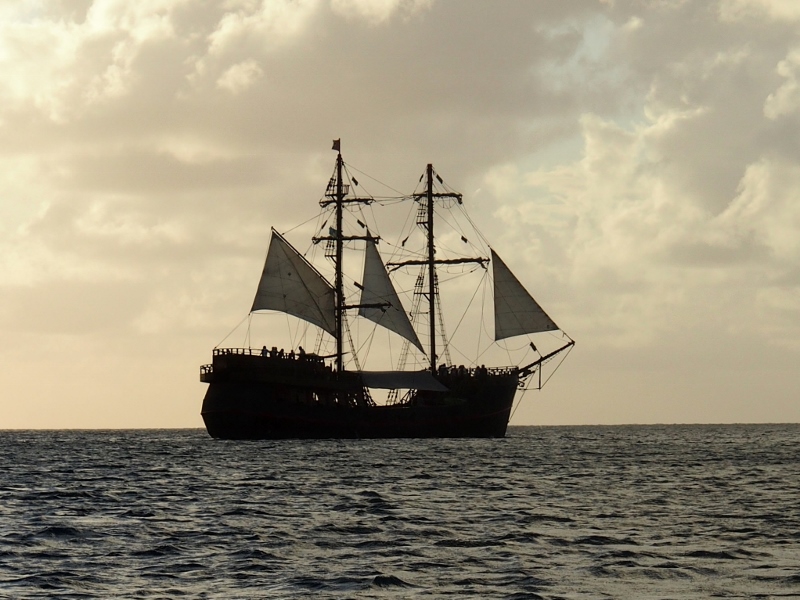
Pirate ship

We arrive late afternoon in Rodney Bay at the north end of the island where we clear customs and stay for a night. The boys shout in excitement when they see what looks like a real pirate ship cruising by, music blasting from it. Lukie is envious of the pirates because they are having such a fun party, and we promise him that we will dance and party on his birthday.

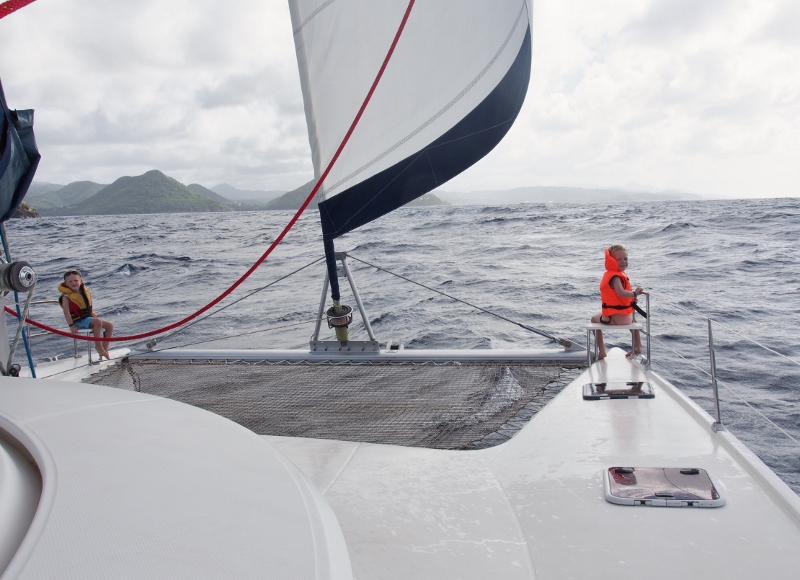
The boys in their favourite sailing positions, spotting St Lucia ahead

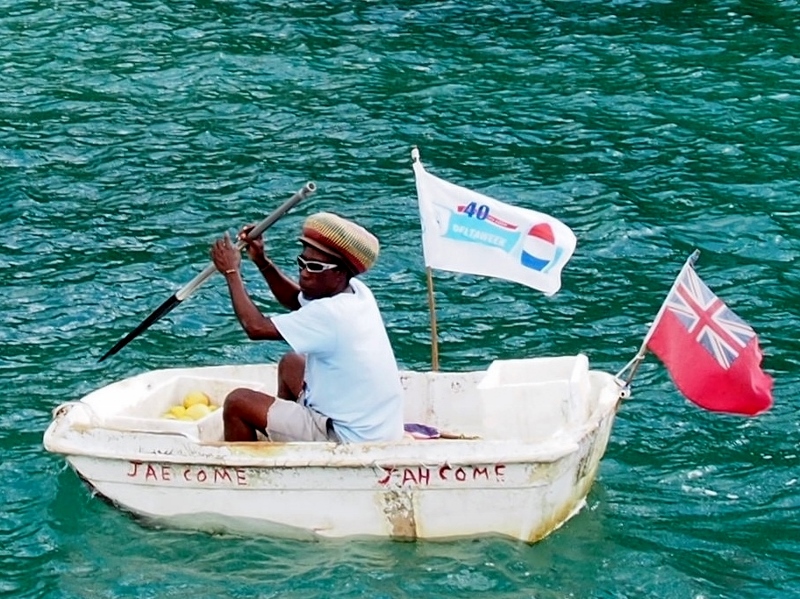
The following day we sail south to Marigot Bay, a sheltered bay famous for its beauty. As we enter the bay we meet our first boat boy –young men zooming around in dinghies, hanging around on the lookout for incoming yachties, offering mooring bouys, sightseeing trips, t-shirts, tourist trinkets, fruits and vegetables, and anything else that you may desire. Their boats range from kayaks and tiny rowing boats to fancy dinghies, the latter apparently often stolen from past visitors. Some are chilled dudes paddling around peddling a bunch of bananas, hoping to make a buck, whereas others zip about with massive outboards, carrying iphones in waterproof pouches around their necks, in constant communication orchestrating the movement of boats and services across the bay. Outboards are clad in colourful t-shirts to shield them from the sun, which gives each boat its own cheerful personality.

OLYMPUS DIGITAL CAMERA
Fruit and veg boat boy

St Lucia is significantly poorer than Martinique, and has a bloodier past. The local Caribs were particularly fearsome, and fought off colonisation from Europeans for a good 200 years after their first ‘discovery’ by Columbus. Like Martinique, the island was fought over by the English and French, and St Lucia managed to change hands no less than 14 times before it finally became English in 1814. As a result, the local Patois language is very French in origin. Slaves were imported for sugarcane plantations, and the population is now predominantly of African origin. St Lucia became independent in 1979, and the economy is now based mainly around agriculture (bananas, coconuts, cocoa, citrus), as well as a developing tourism industry.

Because of the poverty, crime is more common here than in Martinique. We try to stick with one boat boy at a time, establishing a relationship and paying fairly for their services in the hope that that will protect us from break-ins. After all, they live of yachties, and have a strong interest in the island having a safe reputation. Peter, the boat boy we meet in Soufriere, tells us about his life, pointing out his house on the shoreline. He is young, not more than 25, and already has a flash dinghy with a large outboard, and an iphone around his neck. He tells us that he sits in his boat on the lookout for yachts most of the time each day, and we imagine his life, getting by on whatever he can make out of the passing boats.

After our anchor dragging sagas (perhaps more imaginary than real, but I’d never admit that) we want a mooring, and negotiate the price with the ‘Boss Man of the Balls’. Having paid a steep EC$80, we get our ball, and a good night’s sleep.

Rugged volcanic coastline of Soufriere

The next day it rains relentlessly, although we manage to glimpse a few rainbows when the sun pokes out briefly. After buying a bit of fruit and veg from a passing boat boy, we head south to Soufriere, with the plan of tanking up with water before heading for the Grenadines where water is scarce. At Soufriere the local boat boys seem hopeful that we can get water on the town dock, but an official bearing a radio clearly doesn’t rate our chances. A serene rastafari sits in lotus position on the dock, but we don’t feel similarly patient and give up in favour of going to visit the famous local bat cave, paying Peter the boat boy handsomely for showing us. The cave rises from the sea, a narrow fissure in the rock, its almost vertical walls covered in bats. You can smell them some distance away from the entrance, and fish flock underneath, eating the droppings. Strong tidal rips rush past the cave around the point, and we don’t fancy our chances snorkelling here.

Peace before the flying ant storm

So we move around the corner to the bay just north of Soufriere and spend the afternoon playing in the water of a marine reserve. The boys each buy a bamboo catamaran off a passing boat boy. All seems peaceful until shortly after dusk, when we are inundated with millions of tiny flying ants. They are attracted by the light so we shut all hatches and huddle in the dark, and decide to go to bed early. The following day we set out for the island of Bequia in the Grenadines early – we are off the mooring at 5 am, ready for our 10 hour long trip. En route we spend hours cleaning the tiny ants, now mostly dead, off the deck. There is little wind, so not much else to do, and once we’re finished, David makes bagels for lunch.


Drama in the shallow bay

We’ve had some exciting times on anchorages. The boat came with a Danforth Anchor and one squally evening it began dragging off the anchorage at Marin in Martinique. It was dark, thunder roaring and flashes of lightning illuminating the sky, rain pelting us almost horizontally when we noticed that we were getting suspiciously close to the boat behind us. Soon we were soaked as we deployed the anchor again and again, trying to get it to bite and hold the boat in the 30 knots of breeze. Eventually it took, and we spent a sleepless night checking our position every time we heard a gust of wind.

The next day we promptly went out and bought a CQR anchor, which was heavier than the old one and also of a design that is better for gripping on muddy and sandy bottoms.

The morning we left Martinique I was sitting inside with the kids whilst David was working in the cockpit. A wind rose and as I was closing the saloon hatches to ward off the rain, David shouted for me to come on deck where I was met with  the sight of a small keelboat drifting rapidly towards us. There was nobody on board, and she was dragging side on exposing the largest possible surface area for collision with the numerous boats anchored downwind of her. It was soon clear that she was going to miss us but she was on collision course for the boat behind us. An elderly guy roared up in a dinghy, and David jumped in our dinghy to try and help him stop the boat and warn those downwind. At this stage others had seen and soon a whole group of worried men in dinghies were zooming in, shouting frantic instructions in French, grabbing on to the railing of the boat and boarding it. None of them appeared to be the owner, and two guys started frantically pulling out the anchor by hand. A few metres from the downwind boat, they tried to put the anchor back in, whilst others were fending off the boat they were about to smash into, which also didn’t have anyone on board. Finally someone must have found the keys, because the engine started and they moved upwind.


Two boats collide
Two boats collide

A good ending to what could have been tragic, a near miss that could have been two smashed up boats. It could easily have been our boat that was dragging whilst we were out on one of our numerous trips, or we could have been the boat downwind that a dragging boat slams into. When you’re on board you at least have the power to move the boat, but what if it drags while we’re on shore, or when we’re asleep? David laughs, but this is the first time I’ve been responsible for a mobile home. I guess I just have to get used to it, but it is quite different from a house, anyway.


Rescuers trying to hoist the anchor on the drifting boat

It makes me paranoid, and every time we set anchor I spend a long while after checking that we are not dragging. And then checking again when a strong gust of wind passes over us. It’s becoming a standing joke – we arrive in a new place, set the anchor, David goes in the dinghy to check us in with customs, and the kids and I start panicking about dragging. Bob, the drag queen. Invariably when he gets back to the boat, I have the engine running and the children are jumping around excitedly shouting ‘we’re dragging, Daddy, we’re dragging’. We normally aren’t, but as you swing around a mooring the angles can make you seem much further from other boats one minute than the next. Regardless, I’m always relieved when David comes back, because it’s not easy for me to get the anchor up on my own (you need one person at the back to drive the boat, and one on deck getting the anchor and chain up), and I can’t trust the kids to hold the boat or pack the anchor chain. So when there is no other crew on board, my only option might be to keep my position and wait patiently until David comes back.

That same night, we anchored in another spot, and set the anchor alarm to go off if we moved more than 60 m from our spot. It is hard to know what distance to set the alarm to, as the boat will naturally swing around on an anchorage as the wind and current changes. The following morning, as we were leaving, we could see that we had indeed dragged about 30 or so m – not enough to hit the boat behind us, but enough to leave me unsettled. Whenever we anchor now, the kids and I always dive on the anchor and mark the spot, and then check again half an hour later – that passes the time until David is back from customs, and at least we have something verifiable to report, rather than just guesstimates or rough bearings. Just so he’ll take us seriously, that’s all.

Au Revoir, Martinique

OLYMPUS DIGITAL CAMERA

We’re leaving Martinique, to spend a couple of weeks in St. Vincent and the Grenadines. So it is au revoir to the town of Marin, at the southern end of the island, where we’ve been based for the last two weeks. Being a large yachting centre, Marin is a good place to get work done and buy spare parts, but we’re looking forward to seeing some other places.

Martinique is lovely, though. Like many of the islands, it is perched on an underwater mountainous ridge which forms an arc around 900 km long. The highest point of the island is Mount Pelee in the north, a volcano that last erupted in 1902 where it killed 30,000 people, razed the then capital city St. Pierre to the ground, and caused general economic mayhem. The steep hill sides are covered in lush green tropical vegetation and most of the coastline is rocky, with little sandy bays dotted here and there. Like all islands here it has a windward (Atlantic) side, and a leeward (Caribbean Sea) side; we’ve only explored the leeward side so far.

OLYMPUS DIGITAL CAMERA

The island is thought to have settled by humans for a long time, with waves of people reaching the Antilles from South America. Remains (including pottery) have been found from a people called the Arawaks who fished as well as cultivated the land. Their peaceful existence was interrupted around the 12th century, when the bloodthirsty Caribs arrived from South America, killing and eating most of the Arawaks (the origin of the word ‘cannibal’ is thought to be the Indian name for Caribs: Kalinas).

OLYMPUS DIGITAL CAMERA

Christopher Columbus came to Martinique in 1502, and named it Madinina, ‘Island of Flowers’, a name thought to be of Carib origin. However, because of the hostile Caribs and their pet (fer-de-lance) snakes the island got a bad reputation and was not settled by Europeans until 1635 when a couple of Frenchmen founded Fort St Pierre. Subsequently, the island was conquered by the English and retaken by the French a couple of times, but all the fighting stopped in 1814, and the island is now a French Overseas Department.

OLYMPUS DIGITAL CAMERA

When sugar cane plantations took off at the end of the 17th century, African slaves were brought to the island, and of the current population of just over 400,000, 90% is mixed race of African origin. There are only about 4000 descendants of old Carib roots left. The two languages are French and French Creole.

OLYMPUS DIGITAL CAMERA

Being in a French place has numerous advantages, most of them to do with food. Wonderful baguettes, pain au chocolats, croissants on sale everywhere. Great coffee, and great quality wine, much cheaper than in New Zealand. Alcohol is exceptionally cheap here, the cheapest by far being the 3 litre rhum foilpacks for only 15 euro. French cheeses: unpasteurised camemberts, nutty emmentales, sweet fromage frais. Jambon crue and about 50 varieties of salami in every shop; even foie gras is for sale in the supermarket.

OLYMPUS DIGITAL CAMERA

Despite all the cheap unhealthy food, people look fantastic. On one of our numerous shopping missions, we went to a mall in the capital Fort de France. Never have I seen so many stylish women. Slim and tall, all shades from bronze to black, teetering about on incredibly high stilettoes looking like they’ve just stepped out of Vogue. A stark contrast to shopping malls in New Zealand which tend to be the gathering places for overweight poorly dressed people.

OLYMPUS DIGITAL CAMERA

And then the annoying bits. The French can be incredibly rude; the concept of service seems completely alien to most of the marina shop keepers. When you walk into a store you are greeted with an irritated sigh as the owner puts out his cigarette out front and reluctantly follows you in. It feels like we are ruining their day by choosing to buy something in their shop, like they’re doing us a great favour by receiving our money. The born and bred locals are friendly and will stop and help you find your way in the street, it is only the French who have recently made their life here who seem afflicted – but being in a marina town, those are the people we meet. Not that I can speak, being Danish – I still cringe for my lovely Mexican friend Nuria: we met at the University of Stirling from where she got a scholarship to go to Roskilde University for three months. She came back humiliated and astonished by the unfriendliness of Danes . I guess I have just forgotten the European way because Kiwis are so friendly.

OLYMPUS DIGITAL CAMERA

Above all, the French here hate Americans, and often if we get treated badly it’s because they hear us speak English and assume we’re from the US. Which seems a bit unfair as Americans generally love the French and treat foreigners that visit the US with respect, enthusiasm and interest. The charter companies tell us that the cool French reception is the reason there are so few American tourists here – faced with unfriendly Frenchies, they simply go elsewhere for their holiday. A great shame for the locals, who could earn good money from more tourism.

OLYMPUS DIGITAL CAMERA

The upside is that we get plenty of practice for our French, which is great. In fact, the whole family is turning trilingual; guys coming to the boat swear freely and the children now happily chant ‘Merde! Putain!’ whenever something goes wrong. In my quest for better service, I have made a point out of speaking Danish to the kids when we’re out and about, to show the world we’re European. Although that did backfire when the local chandlery got us a Dutch flag rather than the New Zealand one we ordered. I think the guy in the shop assumed that as Zeeland was somewhere in Holland we meant a Dutch flag. ‘New Zealand, Holland, what’s the difference?’ he shrugged when we politely pointed out it was the wrong flag.

OLYMPUS DIGITAL CAMERA

It is also strange to stock up in another language. I’m trying to decipher what is actually in the cleaning products, the food, and even the fire extinguisher puzzles me (it says that it contains Eau Pulverisee: pulverised water ?!?). Sunblock is only available in the pharmacy, and there just in tiny high-end bottles, when what I really want is an industrial size container with a pump dispenser, like you get in New Zealand.

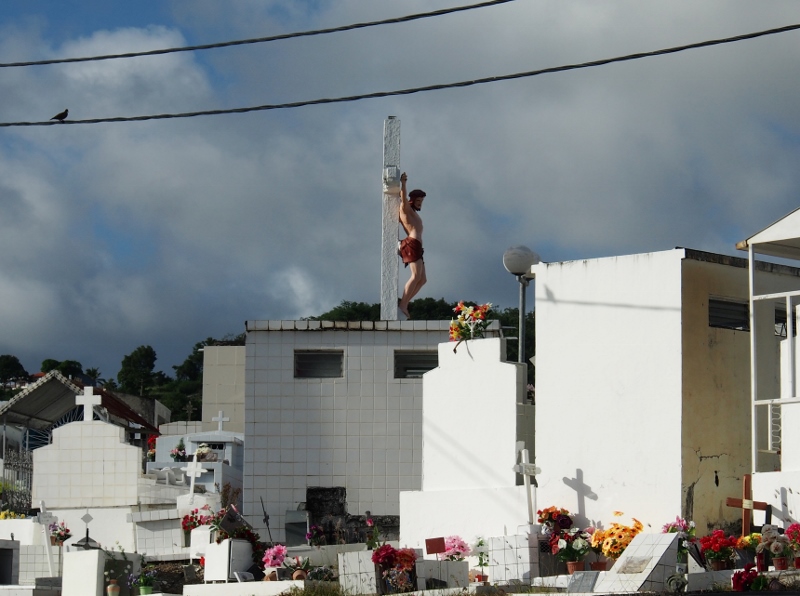
OLYMPUS DIGITAL CAMERABut it is so beautiful. Little towns with big churches and beautiful narrow streets. Amazing graveyards packed full of shiny white shrines decorated with bright flowers, and even a crucified Jesus. Colourful buildings dotted on the hillsides. Incredible vegetation – palm trees, cactus trees, frangipani and other tropical flowers in abundance dotting the landscape with sharp pinks and purples. Weary cows resting alongside the road, just along from the sugar cane fields. Coconut trees lining the back of the white beaches. Crabs everywhere, holes of all sizes lining the beach and beyond, their inhabitants scurrying away when our shadows fall on them. Lush mangroves reclaiming the sea. Underwater landscape like you wouldn’t believe – corals, seagrass, fish, colourful life everywhere.

OLYMPUS DIGITAL CAMERA

It’s been 23 years or so ago since I was last here, but it is still just as beautiful. We’ll depart tomorrow, but will come back before we leave the Caribbean, and have a look along that windward coast.

Bob the Cat

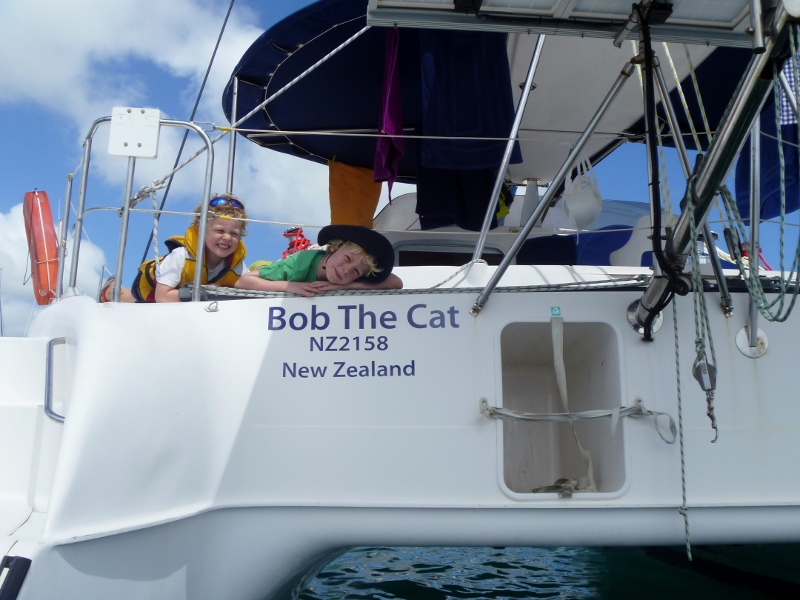
Stern view of Bob the Cat

I should probably describe the boat a bit. She is a 46 foot Fontaine Pajot Bahia catamaran from 2004 – the charter version of the boat, which means lots of berths and heads (toilets), and in her former life as Alize V, she spent most of her life in a charter fleet. Each hull contains two double cabins with ensuite toilet / shower, and two additional single berths, one in the corridor and one in the far forward cabin. So if we wanted to we could sleep 12 people, although the forward cabin is only really suitable for a person of slight build with no tendencies towards claustrophobia.

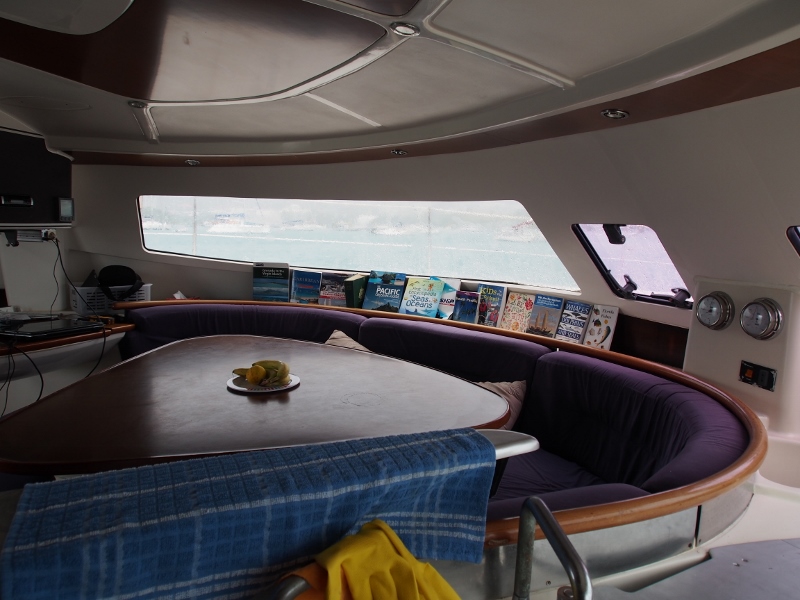
Saloon dining table
Saloon dining table

Up above between the two hulls is the saloon, with a chart table, a galley (kitchen) and a sitting area large enough to seat 10 people comfortably around a big triangular table. The galley is small, with two sinks, a freshwater and a saltwater tap, a three stove gas cook top, a small gas oven, and a large fridge/freezer. All compacted into an area of about 2 m2, so there is only room for one person at a time. The top of the fridge doubles as a small bench top, the lid of the garbage bin as a cutting board. Whilst frustratingly tiny, it does have a wonderful view out over the deck and the water beyond.

David driving the boat

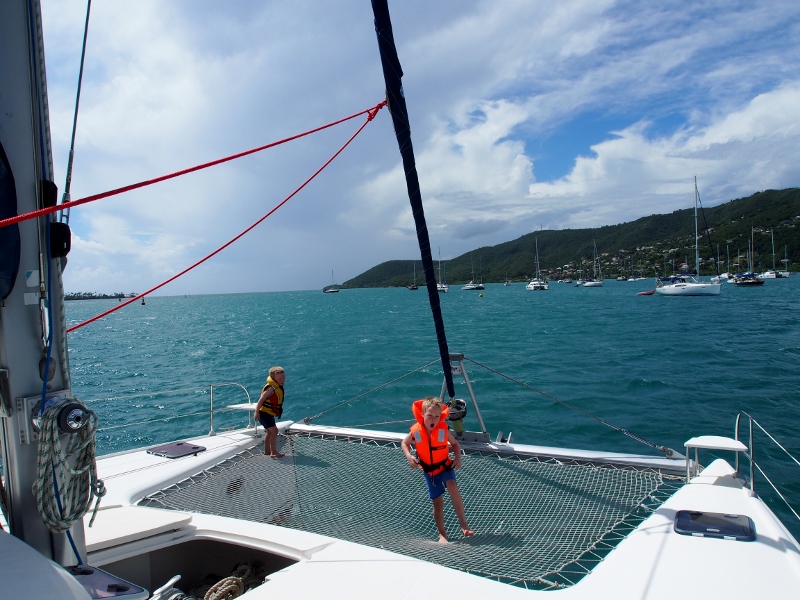
The saloon opens straight out to the cockpit, where there is an outdoor table and seating, as well as the steering wheel and instruments. There is access to the engines as well, with one engine locker on each side. Storage lockers are under and at the back of the cockpit deck. To get on deck from the cockpit you have to step up about two feet, so there is little danger of the kids accidentally falling out. At the bow (front) of the boat a trampoline is strung between the two hulls.


Me driving the dinghy

We got a catamaran because they are spacious and comfortable, and we’ve found it a great boat. Plenty of space to sleep us and visitors, lots of storage, and a trampoline to entertain the kids when they feel jumpy. Easy access to the water, with steps at the back of each hull leading down to the water’s edge, and a flip down ladder on one side for climbing in and out. When not in use, the dinghy is suspended at the back between the two hulls, under a large solar panel.


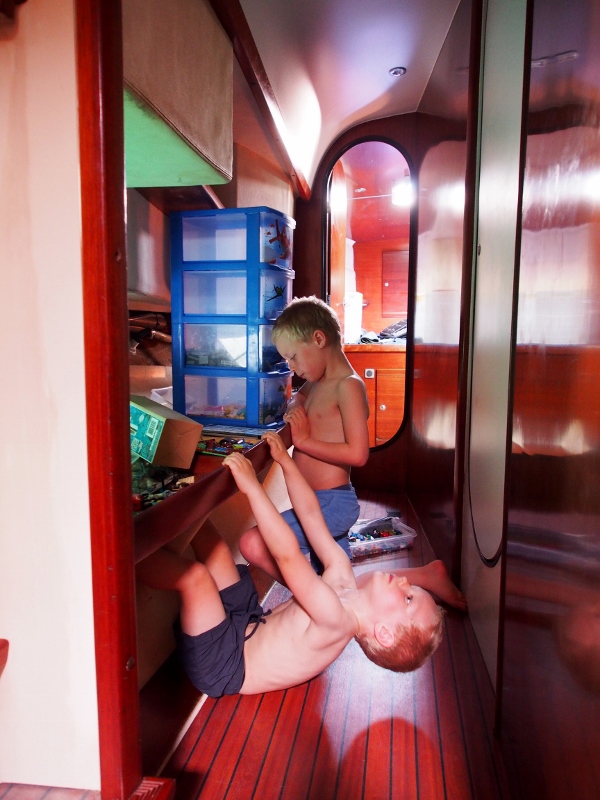
The Lego is stored, and used, in the spare starboard corridor bunk

Another upside to a catamaran is how comfortable they are when sailing. Because they sit flat in the water rather than lean over like a keel boat, the kids can play with lego, draw or write as we’re sailing. It also means that we don’t have to be as careful to stow everything when we take off as you would be on a monohull; things tend to stay in their place even when we’re in a bit of swell, so we don’t have to tie everything down, and we can easily boil the kettle even when sailing upwind. The 180 degree view out front from the saloon helps minimise seasickness when inside, as you can clearly see a large stretch of horizon.

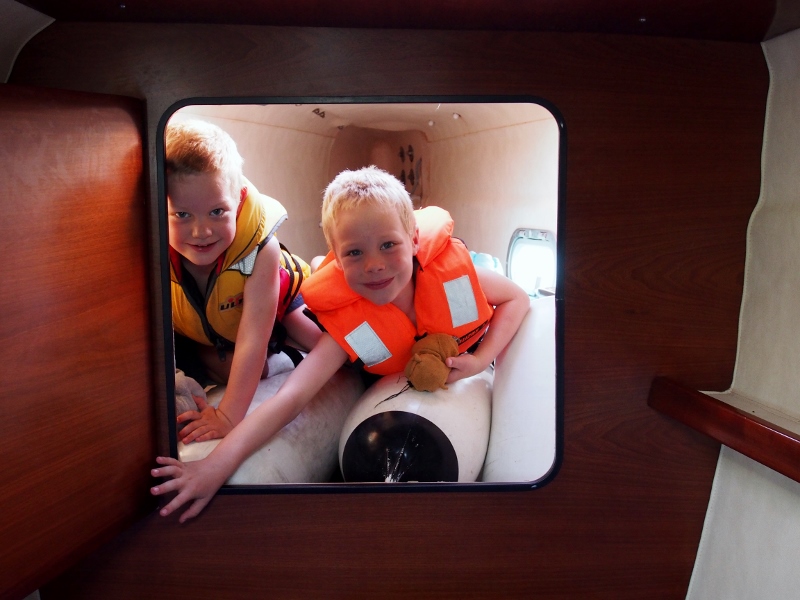
Each cabin and each toilet has an overhead hatch, as well as one or more side hatches, which helps keep the air flow when at anchorage. The larger ones you can crawl in and out of, and the kids spend hours playing hide and seek, jumping in and out of hatches, pretending to be on a spaceship travelling at hyperspeed through a watery universe.

Kids in the forward cabin, normally used for fender storage

Storage is everywhere, with tins, beans, UHT milk and flour below bunks and seating. We store kitegear in one forward cabin, and fenders in the other. We inhabit the port hull, and the starboard one is presently filled up with Lego and tools, but will be awaiting guests keenly once tidied. For the moment everything is a mess most of the time, with tools, books and lego cluttered around, and towels and swimwear streaming in the wind from the cockpit.

In essence she is like a big, slightly damp caravan on water, somewhat battered but in good repair. Locker door handles are rusty, the cupboards bear permanent marks from pots stored years ago. The dark blue cushions are bleached by the merciless sun, the bathroom mirrors streaked in places where the backing has worn away. Here and there the gel coat is chipped, and we’ve had to replace several ropes that had worn through dangerously. David has been working ceaselessly fixing bits and bobs, from a broken toilet to a leaking hatch, replacing a set of worn out steering lines, affixing a ceiling that was dragging down. Where we need it, we get outside help – a new sailbag is being made for us, the broken VHF is being fixed, a fresh trampoline on order.

The tramp in use
The tramp in use

Sailing wise, she is not a high performer, although we’ve been pleasantly surprised at her speed. The sails were brand new when we bought her, and we’ve been easily cruising at 7 to 8 knots. This will be important on passages between islands (the distances here in the Caribbean are quite short, but in the Pacific they’ll be much greater) where gain in speed will cut the travel time, possibly by days. A typical catamaran, she doesn’t sail too well upwind or downwind: she is reasonably fast, but can’t point into the wind, or away from it.

As soon as we get the VHF sorted, we’ll head away for a longer trip, and test her out some more. I’m looking forward – the small forays we’ve done so far have whetted our appetite for more.

Water time

P1040093 (600x800)

P1040139 (600x800)P1040123 (800x600)

P1040122 (800x600)


We decide to take off on the boat for the weekend, to enjoy the island a bit and have a break from work. At the same time, we can test the watermaker and do some man overboard drills with the kids.

We sail north west, sticking to the leeward side of the island, up to Anse d’Arlet: a white sandy bay backed by coconut palms behind which the lush green hills rise almost vertically, covered in rainforest from top to toe. Treacherous lobster pots are everywhere along the coastline, often marked by only a transparent water bottle as a float. Virtually impossible to see until we are very close, so we have to keep a constant lookout whenever in shallow water.

The kids initially jump on the trampoline, and are in and out of the forward hatch, playing some sort of hide and seek. When we get further offshore at the southern end of the island they start feeling a bit queasy, and I put on their seabands – elastic bands with a pressure point to put on the wrist, which seemed to work well to reduce seasickness last time we went sailing. Matias goes down below for a sleep and Lukas relaxes in the cockpit, looking for dolphins. He spots an island which looks like Darth Vader’s mask half submerged, names it ‘Skull Rock’, and tells us stories about its rich and varied past. Spirits are high despite the slight seasickness which they shrug off as tiredness, and everybody has plenty of appetite for lunch.
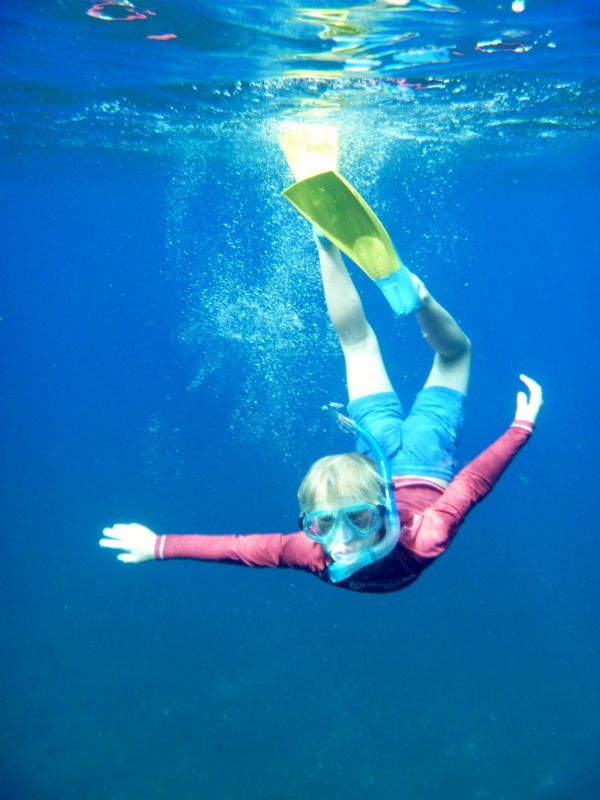
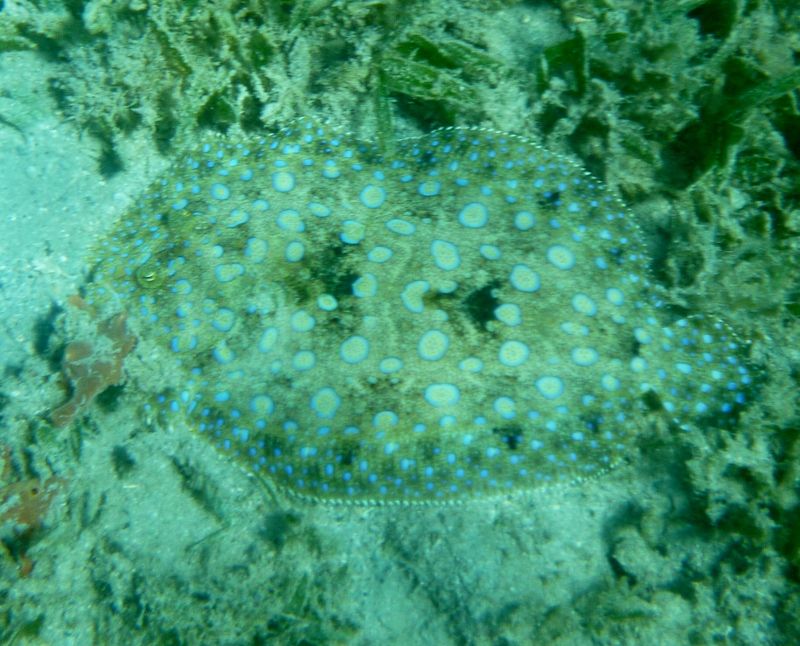
When we get to Anse d’Arlet we jump in the water and head to the nearby rocks for snorkelling. The water is clear and dotted with tiny demoiselles that flock around us instantly, and the children are mesmerised by the huge barrel sponges, the swaying anemones, the bright blue angelfish – as well as the French guy swimming past bearing an enormous speargun. We see seagrass and cute flatfish blending in with the sun freckled sea bottom, trying to fool us into believing that the black marks on their back are the eyes of a gigantic animal. Soft corals give us a friendly wave, wonderful yellow trumpetfish glide silently past. Wrasse are feeding on algae, whiting blend in with the white sand near the beach. Purple fanworms retract swiftly when we gently brush them, but a turtle seems unfazed when we dive down to get a closer look.
Friendly turtle
Friendly turtle
Camouflaged flatfish


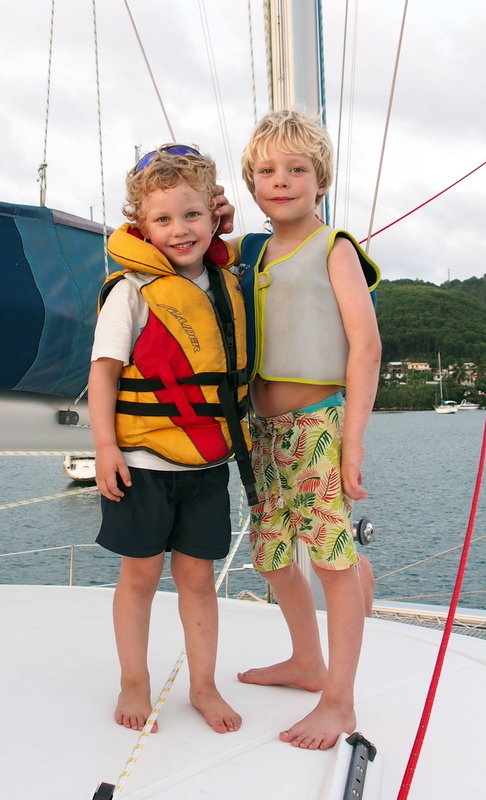
We subject the children to a swim test, which involves them jumping in and swimming around the boat, wearing their lifejackets. Our safety rule is that they have to wear lifejackets when on deck – inside the cockpit they can go without, but whenever they are jumping on the trampoline, crawling on the roof, diving in and out of hatches, they have to wear the jackets. So far they have been great at remembering, and even Lukie is able to swim unaided around the boat, which is about 50 m. The water is calm and nobody is panicking, so a bit different from a real man overboard situation. But a good start.

Dirty boat

In case anyone out there is feeling jealous of our glamorous new lifestyle, here’s the ugly truth about what it’s like cleaning a boat that’s been closed up in the tropics for a year. It’s disgusting.

Over the last three days, I’ve been working my way around the inside of the boat, cleaning cabins, toilets, kitchen storage spaces, bilge pump areas. This means wiping down walls and floorboards, removing mattresses, cleaning the under bunk storage spaces. Lifting up floorboards, discovering standing water, strongly yellow of colour, with dead cockroaches floating in it. ‘Why is there pee under the floor, Mummy?’, asks the kids. David just asks me to taste whether the water is salt or fresh – he is worried about a saltwater leak. I can’t bring myself to taste it.

The worst is what looks like pubic hair, absolutely everywhere. Under floors, in storage space, floating in the bilge pump water, glued to bathroom walls, stuck in a bit of grease on the engine. In the sink, the cutlery tray, attached to the window. Thousands of strands of short, curly black hair. I realise that it is most likely just the head hair from a prolifically moulting French or afro-Caribbean previous charter guest. Even so, it is still gross, and hard to clean, as the little hair stick to cloths and are not easily rinsed off.

It is hot, 32 degrees in the shade. So I’m cleaning in a bikini, trailing a strong sour vinegar (our main cleaning agent) smell behind me, only occasionally sticking my head out a hatch to breathe some fresh air, and see the beautiful scenery around me.

Through all this, the kids are amazing. They are heads down in Lego, off in their imaginary world, while we work away. As I clean I listen in on their conversation, bringing to life the Lego figures, constructing outrageous plots, a hybrid tale mixing Starwars, Captain Underpants and sailing. Luke Skywalker is on the beach, and then he meets some pirates, led by Wedgie Woman. He fights bravely, alongside his apprentice Lloyd, Jabba the Hutt’s illegitimate son who can change from a slug into a human and back again as and when it suits him. A panda bear is in there too, fighting on the goodie’s side. Too hard to follow, really, but wildly entertaining. It strikes me how perfect these two boys are for this trip – so adventurous, independent and imaginative, so good at initialising their own games, at playing with nothing more than a few Lego figures. They have amazing attention spans and can keep a game going for days on end. They rarely need organised activities, are never bored, and haven‘t once asked for TV or the computer – they are just off in their imaginary world. And they get on so well, hardly ever fighting.

We feel lucky. Soon the cleaning will be over, we’ll go for a sail, and show the kids what it’s really supposed to be like. But in the meantime, everybody are still happy and coping, even as we’re stuck on a mooring, cleaning a filthy boat.


OLYMPUS DIGITAL CAMERA