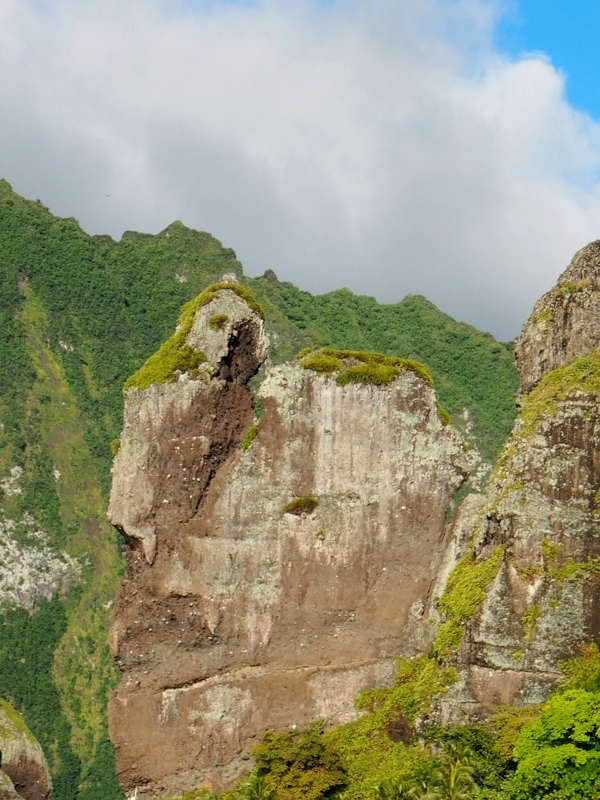
What a place to make landfall after crossing the longest leg in the Pacific! The island of Fatu Hiva rises vertically from the sea, jagged hillsides softened by vegetation with razor back ridges of sharp rock poking out. Everywhere you look there are sheer rock faces and tall columnar rocks resembling figures and faces, poking out like guardian gods overlooking their island. It is easy to see where the inspiration for the famous petroglyphs (stone carvings done on rock faces) and tiki (statues carved from stone or wood) came from – nature here is full of them.
About 1400 miles northeast of Tahiti, the Marquesas are the northernmost part of French Polynesia. There are 10 main islands in the Marquesas, lying in a 350 km chain from north west to south east. Fatu Hiva is the youngest and southernmost of the islands; at only 1.3 million years it is a mere baby compared to most other landforms in the world. Surrounded by water depths of 3000+ metres the Marquesas were formed in huge seabed volcanic outbreaks, the islands rising vertically from the bottom to the sharp tips of the numerous ridges of their volcanic shapes. I have never seen a landscape so incredible, young, steep and sharp, with none of the rounded edges that older age and weathering bestows on mountainous islands. Because of the height of its volcanoes (the tallest of which is 960 m above sea level) Fatu Hiva gets a lot of rain for the Marquesas and I imagine that its rocks will soften in a couple of million years as the water takes its toll.
We are anchored in the ‘Baie des Vierges’ (Bay of Virgins) off the small town of Hanavave. Originally named ‘Baie des Verges’ (Bay of Penises) by the first French settlers to celebrate the large phallic rock protrusions that line the bay the name was later changed by missionaries keen to suppress any improper thoughts in this remotest of locations.
Madonna or penis?
Fatu Hiva used to support quite a large population, but nowadays there are only about 600 people on the whole of the island, half in Hanavave and half in the southern village of Omoa. The island was made famous by Thor Heyerdahl in his book ‘Fatu Hiva’ where he chronicled his failed attempts to live off the land in this tropical paradise with his young wife Liv (she ended up getting elephantitis and nearly died before they aborted the attempt and went back to Norway).
The Marquesas were known as ‘Te Henua Ehana’ (the Land of Men) by the Maohi (eastern Polynesians) who first settled on them around 300 BC from Samoa. The Marquesas islands were amongst the first to be settled in French Polynesia, and it is from here that subsequent settlement of Hawai’i, Easter Island (Rapa Nui) and the Cook Islands, and onwards to Aortearoa, New Zealand, occurred. As a result, the Maohi language is closer to Hawaiian, Cook island and Maori than to Tahitian.
The first Europeans to find the Marquesas were the Spanish, with Alvaro de Mandana spotting Fatu Hiva in 1595. He named them Las Marquesas de Mendoza after the wife of his benefactor the viceroy of Peru, and the Spanish continued to keep the island group a secret to prevent the English from conquering them. Living on small islands with limited resources overseen by forbidding gods had turned the Marquesans into one of the fiercest communities in the Pacific and their heavily tattooed warriors practised both cannibalism and human sacrifice. Predictably, the first encounter with the Spanish was a disaster and Mendana killed Marquesan people on sight after an initial unfortunate incident with some warrior canoes, leaving behind a bloody trail of more than 200 dead Maohi. Subsequently whalers introduced syphilis, alcohol and smallpox, and of the initial population of about 80,000 Marquesan Maohi in 1800 only 15,000 remained when the French took over the Marquesas in 1842. Today the population of the Marquesas is about 8000, mostly of Maohi descent.
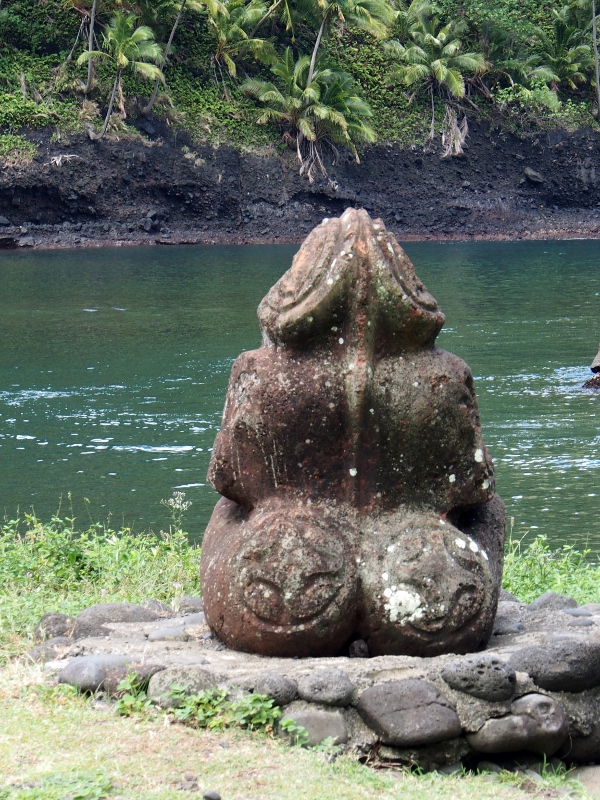
All over the islands are scattered archaeological remains, mainly of me’ae (temples), tohua (meeting places) and male and female tiki representing important ancestors that ruled before Catholicism took hold.
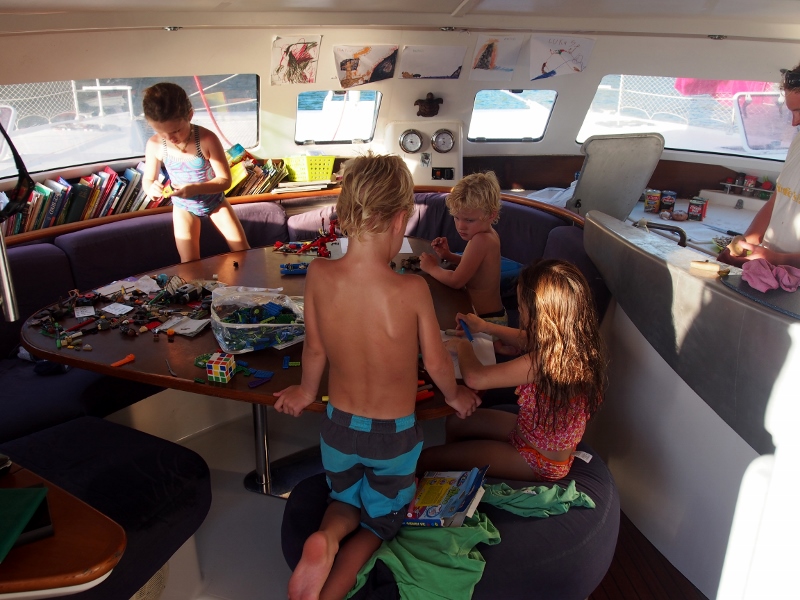
Kids at play
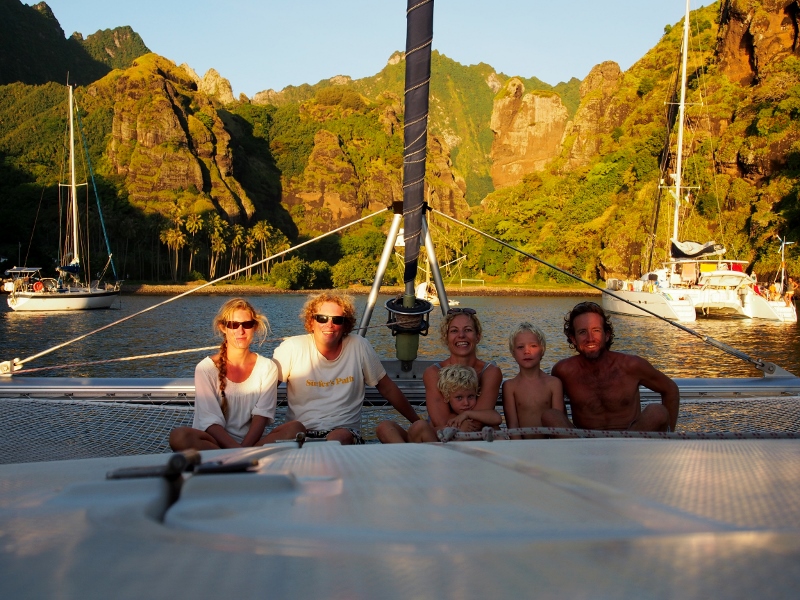
On Fatu Hiva we meet the ‘Family Circus’, two parents and their six kids travelling around the world on their 47 foot catamaran. We join forces to hike to the waterfall behind the town of Hanavave and Lukie and Matias become great friends with Alina and Amaia, who are 6 and 7. The following day we all take their boat over to the other village on the island, Omoa, and some of us walk back to Hanavave over the imposing ridges, gorging on magnificent views of the island and the sheer cliffs. Walking out of town is like entering some half-forgotten jungle out of a Tintin cartoon, where cannibals roam and carved statues representing stern ancestors lie scattered on the forest floor next to altars used for offerings to appease the gods. It is lush and green, all but the steepest hillsides covered in grasses, trees and ferns, curling vines climbing up and up towards the sun. In the two small villages and along roads and paths colourful flowers and fruit trees are everywhere – giant pomelo grapefruits, starfruits, breadfruits, rambutans, mangoes, cashews, bananas and impossibly tall coconut trees towering overhead. Coconut lies drying on roadside racks everywhere, waiting to be turned into copra to be used for livestock feed or coconut oil production.
Coconut drying
A family is offering fruit for sale at the wharf but it appears they don’t want money for their wares, instead preferring to do trade. I guess money is not that valuable in a place like this; what would you spend it on? The woman wants hairbands, mascara, perfume, lollies, sunglasses or flip-flops, whereas the men ask for fishing hooks and line, snorkelling masks and fins, or wet weather gear for fishing. Sarah and Steve visit a local carver, and find that his beautiful statues can be part traded for goods too only we don’t have any of the things he wants so they settle for a cash price for a magnificent tiki.
Just after we arrived
After three days at Fatu Hiva we set sail to go to Hiva Oa on 20th April – it is time to check in, hoist the French flag and do a bit of grocery shopping.
Day 15 is Lukie’s birthday. The clocks changed overnight (our third change so far on this passage), so the kids are up bright and early, 5 am new time, eager to start the celebrations. During the night we were literally pelted with flying fish and Lukie has one fried up for breakfast, which he devours in one big gulp.
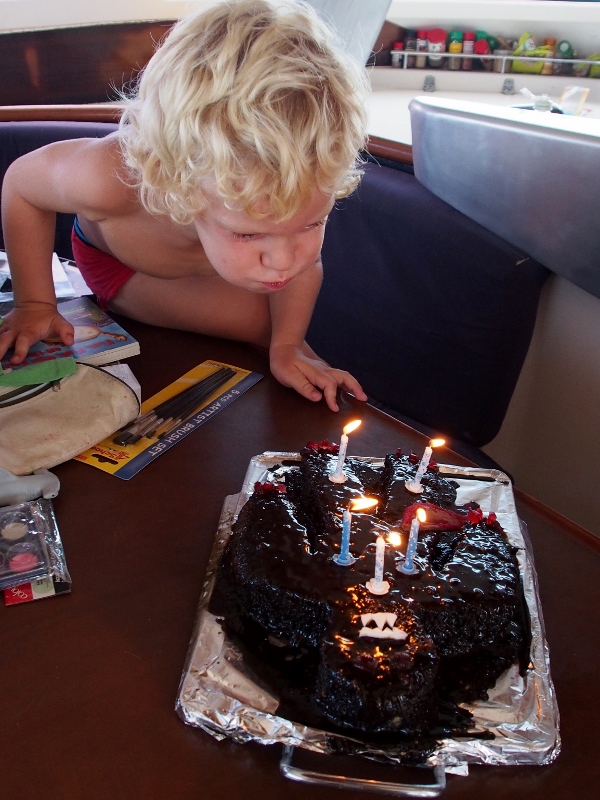
At morning tea time we have the Hulker cake, which looks awesomely scary, orange luminous eyes staring from a skull like darkened face, blood dripping from his claws, fangs bared in a wicked snarl. After that there is a complicated treasure hunt for lollies, followed by painting with the new water colours from Grandpa and Gu.
Hulker cake!
Lukie ordered mahi mahi for dinner, so we got two lures out and the fridge on in anticipation. Failing that, Steve says he knows some pretty good recipes with corned beef…
The chart plotter is beginning to show ‘Time to Arrival’, a feature which switches on when it reckons there is hope that we’ll eventually get to our destination, and its appearance lifts our spirits to a level befitting those that have just eaten an entire jar of nutella disguised as a Hulker.
We feel good – the kids are happy, the sun is shining, and there is new Lego to build. At the end of Day 15, we’ve logged 2433 miles, with 557 miles to go, we’re definitely getting closer. Day 16
The sunny conditions continue on Day 16, but the batteries remain stuffed – they are clearly on their way out, and no amount of charging is going to fix them now. They’ll likely last until we get to the Marquesas, but probably not much longer, so we’ll have to seek out replacements at the earliest opportunity.
Like the batteries so the crew – everybody is exhausted, apart from the kids who can sleep as much as they like. We hear from the network that a boat we know has lost their autopilot only a couple of days out from the Galapagos. It’s a family with three children aged 1 to 6, and we feel for them. Fortunately they have three crew, so five adults in total to share watches, but it is still a long, long way to helm a boat, hundreds of hours to keenly look out to sea, keeping up the concentration, easily dwarfing any fatigue we’re feeling at this stage.
It is a weird thing spending this long at sea. For more than two weeks now all we have seen is water in various states of turmoil, deep dark blue capped by white foam, rising and falling, rolling us one way and then the other. We have quite forgotten how land looks; it will be a shock to suddenly see the solid shapes of islands rising before us, strangely immobile after all this fluidity. At the moment life is tiny, restricted to being bounced around day after day, clinging onto furniture and doorways as we move, legs always positioned wide apart to ward off falls. The familiar sick feeling in the tummy when it’s time for night watch, the bitter taste of coffees and teas gulped before spilling in the hope they’ll impart a bit of alertness. The days are segmented by meal times, and food takes on a disproportionate importance simply because it is one of the few things that happens in a day. Fortunately there is still some good stuff left – watermelons and pumpkins in particular …
But our universe will soon expand. We’re doing good speed: at the end of Day 16 we have logged 2591 miles and have 389 left to go, so it looks like we’ll arrive Thursday (Day 19) sometime.
Day 17
The wind has dropped and we’re snailing along at 5 – 7 knots, giving us an opportunity to open all hatches, letting in some dry air to dispel the fungal growths that emerged after the thorough soaking of the heavy rains. The sun is out in full force, treating us first to a glorious sunrise and then later to batteries virtually bursting with charge. We stare at the little panel displaying the charge with wonder, 14.2 volts! Maybe this will turn them around…
With the slower pace comes a time warp – for the last three nights the chart plotter has been predicting an arrival time in about 68 hours every time I emerge for my night watch, the time seemingly unchanging regardless of the passing of days and hundreds of miles. A bit disheartening, but with sunshine like this the thought of staying out here, forever 68 hours from land, is not too bad…
At the end of Day 17 the log estimates that we have travelled 2706 miles, however for much of the day it seems to have been under reading substantially – maybe the little propeller that records the speed has become fouled. We place more faith in the GPS, which estimates that we have 239 miles left to go.
Booby time
Day 18
We’re nearing land, and bird life is increasing. During the day we see several terns off in the distance, as well as a frigate bird. In the early evening a booby comes to check us out, circling around us for about an hour, assessing whether to dare to make footfall. It approaches the bow several times, cocking its head to get a good look at us, making half hearted landing attempts only to abort them at the last minute, dissuaded by the railing, the child netting or perhaps our presence. Then it circles again a couple of times, renews its courage, and attempts a daring landing on the mast, tail feathers spreading, feet splayed. Close up to the swinging mast it loses its nerve, wings flailing desperately, and backs off again. It is entertaining to watch, but after an hour it tires and decides to fly off and roost somewhere else. It is the first bird that has come to visit – the pure ocean birds show no interest in us at all, merrily going about their fishing activities some distance off. In contrast, the land roosting birds such as frigates and boobies always gather around the boat, attracted as they are to solid ground.
We’re reading David Lewis’s ‘We the Navigators’, a detailed account of Polynesian navigation techniques. Whilst land roosting birds are a sign of land, one isolated booby or frigate bird is not a certain indicator, as individuals can roam far away from land. Groups of them, however, only tend to occur within commuting distance to land, so as a rule of thumb, if you see three or more of one species you’re within 50 miles of land. Which we aren’t, yet, but after assessing arrival times we’ve decided to land at the island of Fatu Hiva instead of at Hiva Oa as planned – the wind angle has seen us go further south than necessary for Hiva Oa and our existing course will take us straight to Fatu Hiva. It is a bit risky as we’re supposed to clear in at Hiva Oa, but yachties have been permitted to anchor there for a night or two in the past. And it cuts our travel considerably, giving us a firm arrival time of tomorrow, which is what our tired bodies need.
We’re bored, out of fresh food and one thing and another leads to the initiation of a corned beef challenge whereby each of us have to cook a meal using corned beef, with the others scoring the meal according to strict criteria. David enthusiastically concocts some Moroccan spiced corned beef falafels which he serves with a pumpkin tagine and rice, and the rest of us eat in impressed silence, mentally racking our brains for recipes to top this effort. The problem is not so much the taste as the consistency; the brand of corned beef that we have (hailing back to the French supermarkets of Martinique – it’s not a favoured ingredient so tends to languish unused in the bottom of the cupboard) is rather liquid, making it hard to recreate the texture one normally associates with meat. Still, it has to be used, and now is as good a time as any…
The wind has dropped further and we’re not moving fast, but even so the GPS reports only 92 miles to go at the end of Day 18. Day 19
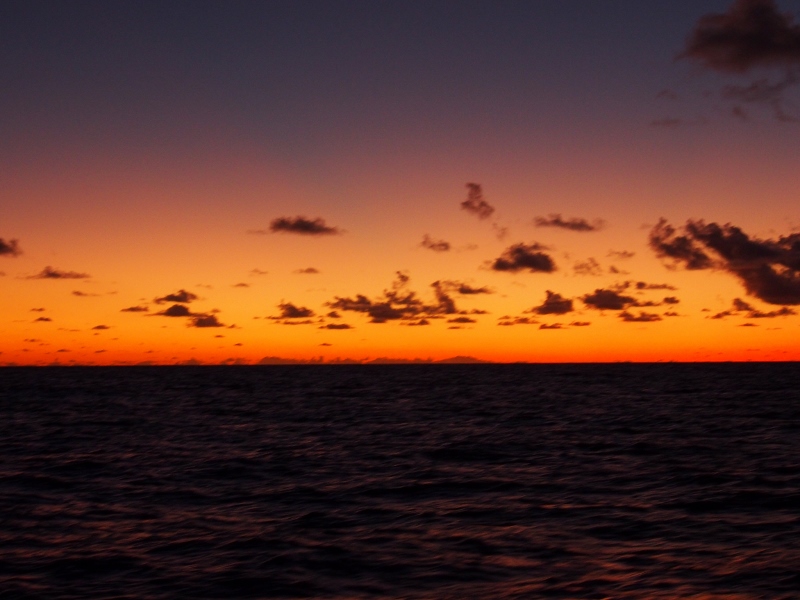
Our first glimpse of land is at sunrise on Day 19, when the island of Fatu Hiva appears in the distance ahead in the shape of three volcanic lumps rising out of the dark sea. The previous night we noticed low clouds on the horizon ahead which signalled land, but we were still too far out to glimpse the islands.
Land lookalike clouds on the horizon
There is no wind so we’re motoring the last day, carefully monitoring the diesel supply as we go, but it appears that we are not using much. In fact the gauge shows a steady increase in fuel throughout the day – we started on a quarter of a tank, and by 2 pm the gauge is showing a full tank! A dip stick confirms that we haven’t, in fact, made diesel, and we add a bust fuel gauge to the list of upcoming repairs.
The windless conditions have the sails flapping and banging and when we’re 25 miles from land the clew on the mainsail goes, the ring attaching it to the boom breaking. It’s not too big a deal; we’ll be able to improvise a fix until we reach sail supply facilities in Tahiti. We hear of worse misfortune on the high sea when the boat Kia Ora, a husband and wife team with whom we’ve been keeping in close contact during the crossing, email us relating how they’ve lost the use of their mainsail. The sail had got stuck when they were trying to lower it meaning that Ken had to climb the mast to cut the haliot. Fortunately the wind was light and the sea calm, and he escaped unscathed. But in any type of weather a mast climb can so easily go wrong, especially when people are exhausted and stressed to the max through weeks of sleep deprivation.
First sight of land at dawn
All the cruisers that we’ve met seem to keep night watch, mainly to keep an eye out for oncoming vessels (the chances of spotting other dangerous items such as shipping containers, floating logs and whales are exceedingly low and most cruisers accept the risk of bumping into these). Good night watching certainly proved invaluable on the nearshore legs we did in the Caribbean, where we found ourselves in close proximity to, and on collision course with, other vessels more than once. You would have thought that large commercial vessels such as tankers or fishing boats keep an eye out, but they tend in fact to rely more on instruments than on the human eye, and most radars won’t pick up a small yacht. I guess the big ships know they’ll come out ahead in any collision, whereas yachties keep a keen eye out precisely because they are likly to sink if they hit anything.
However, in vast areas like this leg of the Pacific where you are gone for weeks on end and there are no heavily used shipping lanes there is an argument for just putting on the autopilot, the radar and the AIS and just go to sleep (AIS: automatic identification system, mandatory for commercial vessels and often used by blue water cruisers, emitting signals which allows others to identify the vessel and ascertain its course and speed). With the appropriate alarms set, you can be woken up if anything shows on the radar or the AIS, or if the speed of the boat changes noticeably. There is no doubt that some cruisers do this, especially single-handlers of course, but I doubt that all double-handlers, like couples, can truthfully say that one person is awake and keeping a look out the entire 3000-odd miles from the Galapagos to the Marquesas.
The advantages to canning the night watches is that the major risk that sleep deprivation poses to judgement, decision-making ability and reaction time is reduced substantially. Imagine Ken going up that mast on a rolling boat on a good day – it is risky, but he is secure in his harness, holding on tight with his strong leg muscles, clinging on to the sharp tools with one hand, gripping the mast with the other as he sits there, 50 metres up, swaying wildly. Now imagine him doing it after more than two weeks of no more than two hours of sleep in a row, bone tired, shaky with fatigue, hoisted up by his wife who is equally exhausted, her heart beating wildly, hands wet with cold sweat, thoughts of what would happen if her grip slips swirling in her mind… She wrote that she passed out briefly when it was all over.
It certainly would be interesting to try to quantify the risks of sleep deprivation versus relying on instrument alarms during the night; it sure would transform ocean crossings if it turns out to be just as safe to sleep as to stay up. Whether we could really fall asleep knowing that no one is watching is another matter…
Happy to see land
Anyway, we no longer have to worry about such matters; the longest blue water crossing in the world is behind us. After the kids doing somersaults on the tramp the entire afternoon, we arrive at the Baie des Vierges on Fatu Hiva at 5:15 pm. It is a still evening, the bay is beautiful, and we’ve got corn beef pasties ready to go in the oven. Tonight, for the first time in 19 days, we will all get at get a full night’s sleep. What more can you ask for?
Day 8
Food takes up a fair amount of time when on passage. Thinking about food, planning and preparing meals and checking fresh produce to ensure that nothing goes to waste. We stocked up well from the fresh fruit and veg market in Santa Cruz, buying tons of stuff and hoping it wouldn’t go off before we could use it. Having talked to other cruisers and read up a bit about how to store fresh produce, we decided to buy about 50 green tomatoes, store them out of the sun, and see if they would keep. We stored them in the forward cabin in baskets on the shelf, but after two days it was clear that they were ripening rapidly. Then we moved them into a clothes cupboard to see if complete darkness would retard ripening. Which it sort of did, only some of them were beginning to go off – any initial blemish seems to rapidly develop into mushy disease. Saying that, a lot of them are still good, and it certainly feels magic to still be eating bruscetta with fresh basil on Day 8.
The usual large quantities of cabbage and carrots are still going strong in the fridge, and this time we also managed to stock up on hard avocadoes, beetroot, a large pumpkin and several unripe watermelons, who will taste great in the weeks to come.
The fridge has its own joys. It’s been running fine, but when the batteries get low it goes into standby mode, switching itself off. It’s been very cloudy for the last couple of days which means that there is not enough solar power to recharge the batteries completely, and so when I get up for my night watch the fridge is normally off. This makes it difficult to keep fish, and sadly the last bit of the skipjack tuna went off. We bought several packets of fresh white cheese in the Galapagos, and I hope they’re still ok, cheese being one of the things we miss a lot out here in the tropics. But even if it does, we’ve got plenty to eat – dried beans and lentils, tins of chicken, and tasty morsels like pesto with sundried tomatoes and terrine du canard which I think we’ll save for the last week…
Day 8 was Easter Sunday, and to celebrate we opened a tin of New Zealand butter (Sarah and Steve kindly brought out a couple of tins, and it tastes great) with freshly baked rolls, avocado, tomato, basil and cheese. Not bad for the middle of the Pacific… After lunch, the children did a lolly (in lieu of chocolate eggs which wouldn’t last in this heat) hunt and gorged themselves on their finds.
We’re going fast now: at the end of Day 8 we’d done 1150 miles, our first 200 NM day, and David is stoked.
Pumping water out of the stern compartment
Day 9
We’ve had a few water leak issues. The first is the water filter hose which has come off, causing a big leak under the kitchen sink, which has seeped down to the starboard hull corridor. It takes a while to clean up, but at least we discovered it quickly (the freshwater pump kept running, indicating the water was on somewhere), and overall not too much water was lost. There is also a mysterious gathering of greenish water in the port hull bilges, which we dry up, uncertain what caused it. Could be a leak from the shower (it smells soapy), or perhaps some of the water that’s been coming in the hatches in the head, which we kept open to ensure there is enough air for the kids to sleep.
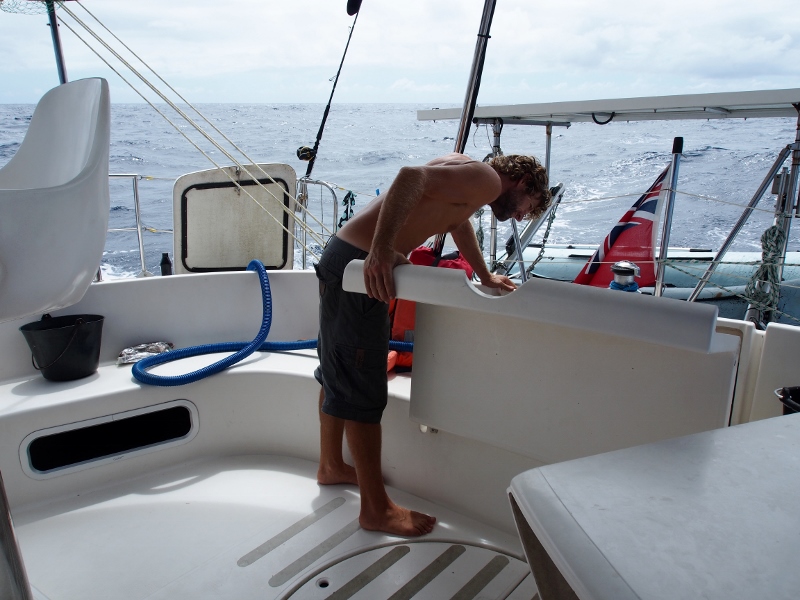
Then, during one of the engine checks, David discovers that there is water in the compartment behind the engine on the port side, under the steps. Lots of dirty salt water, which we proceed to pump out with a hand pump. On the starboard side, the situation is even worse: here, the engine compartment is flooded too, the automatic bilge pump seemingly blocked. It takes hours to pump out the back compartment, which we estimate contains more than a hundred litres of water. David reckons it may have come in through a small repair at the back, and he spends a while trying to bung it up again. Just goes to show: even when not using the engines, we still have to check them – a little more water, and we could have lost the starboard engine (which, by the way is working brilliantly since the clutch repair). Thankfully, none of the leaks are grave, as long as we keep an eye on the back compartment for the rest of the trip we can pump it out as necessary…
Sarah pumping
We’re still flying, clocking another 200 mile plus day – at the end of Day 9, we’ve got 1668 miles to go. Day 10
Day 10 is full of glorious sunshine, which is a relief as the batteries badly need recharging. The wind has eased a bit and we can open the hatches without getting soaked, letting the sun into the cabins. The water leaks are under control – no significant amounts of new water has entered anywhere, which is great.
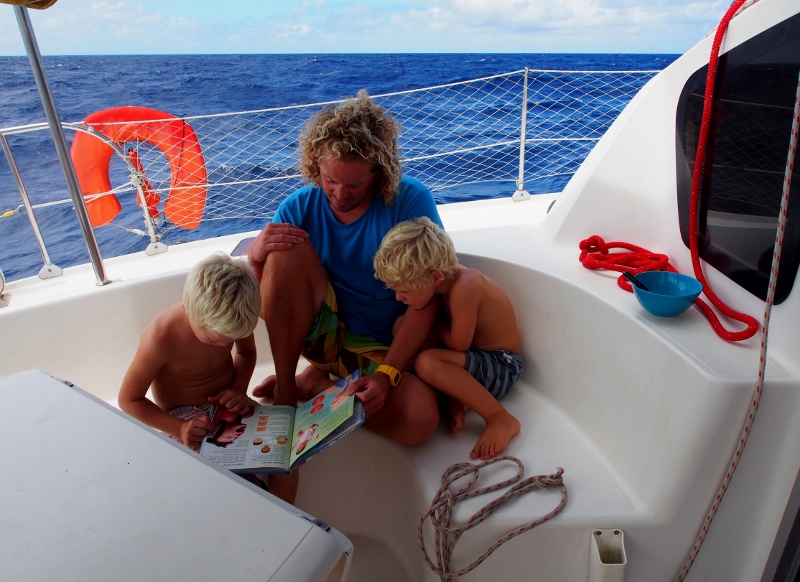
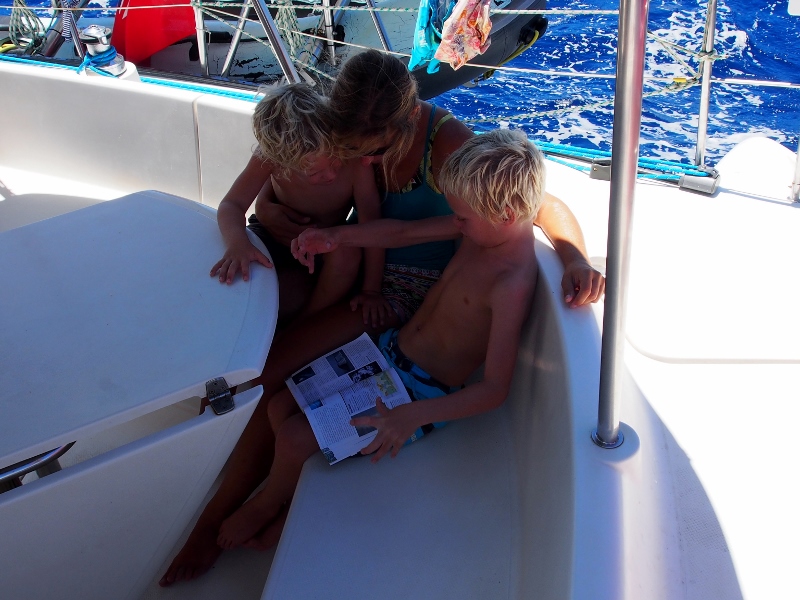
Animals abound too, which is nice – apparently it is a bit of marine desert out here, and we certainly haven’t seen nearly as much wildlife on this passage as on our travels near islands. We catch a mahi mahi just as Steve has started cooking dinner, and quickly put the pasta sauce in the fridge – fish is best eaten fresh, and it is utterly delicious. During the night a squid manages to climb on board, and Sarah finds it trying to hide in the cockpit as she starts her night watch. The following day around lunch time, just as we pass the halfway mark, a huge sperm whale swims past, only 50 metres from the boat. It breathes heavily, spouting water again and again before arching its back, flicking up its tail and diving out of view. It is Luke and Matias’s first sperm whale and they eagerly leaf through the marine mammal book with Sarah, learning all about the species.
Looking up sperm whales
We are keeping contact with a couple of boats that left the Galapagos around the same time as us, and through them we hear news of the rest of the fleet. Apparently most went further south than us, and some got hit by quite heavy squalls. One boat lost its main- and mizzen sails, and is now proceeding only with a genoa. A few others have some sort of engine trouble, and all are complaining that the lack of sunshine means that they are seriously short on batteries. Nobody is in serious trouble, but, like us, most have a few issues. We imagine what it must be like for some of the people we met. One couple was sailing from Galapagos to Hawaii, with three crew – a 40-odd day passage, they reckoned. They have no watermaker, and so will be on strict water rations for the duration of the trip. Most of the people we met were cooking meals for most of the trip before they left, to store in the freezer, because cooking is hard on a monohull while underway. In comparison our trip is really rather luxurious, with our sit down meals and renewable water resource. At the end of Day 10 we have 1470 miles left to go.
Taking some time out
Day 11
Day 11 is eventful in a remote sort of way. The wind is easing and we’ve slowed down somewhat, averaging 7-8 knots, which makes for very comfortable sailing. We promptly open the front hatches to celebrate, only to shut them a short while later when the first shower starts. David has a rainwater shower – we’re permanently low on battery because of the thick cloud cover, and as a result we can’t afford to run the watermaker, hence the opportunistic use of rainwater. The kids join in, putting on their board shorts and lifejackets and running around on deck, sliding on their backs and generally enjoying a rinse off and runaround combo. Every hour or so they bring in another flying fish – the poor fish land on the deck as they fly out of the water in a desperate attempt to avoid us. There are little white birds out here too, darting in and out of the water. It is amazing that they can live so far from land.
Rainwater shower
Just after lunch we get an email from Julie and Ken off the boat Kia Ora – apparently another boat from the fleet is sinking after some large waves somehow caused them to break their rudder. A schooner is on the way to rescue the owners, and another vessel is standing by. We’re only about 24 hours away so offer our assistance, but apparently the situation is under control.
A stark contrast to our peaceful rain play, what a horrible thing to have happen. Julie warns us to look out for the waves and gives us a location and a bearing, but according to her they were 8 feet – which doesn’t sound bigger than what we had two days ago, certainly not enough to smash a boat up. All very strange. We feel for the owners and hope they have insurance – imagine watching your life savings and retirement fun plan sinking below the waves, if that was what it was – we don’t know them. It will be a traumatic event, and brings into focus how serious this ocean crossing business is. It is great that communications are so good that other boats can come to the rescue immediately. At the end of Day 11 we have 1200 miles to go. Day 12
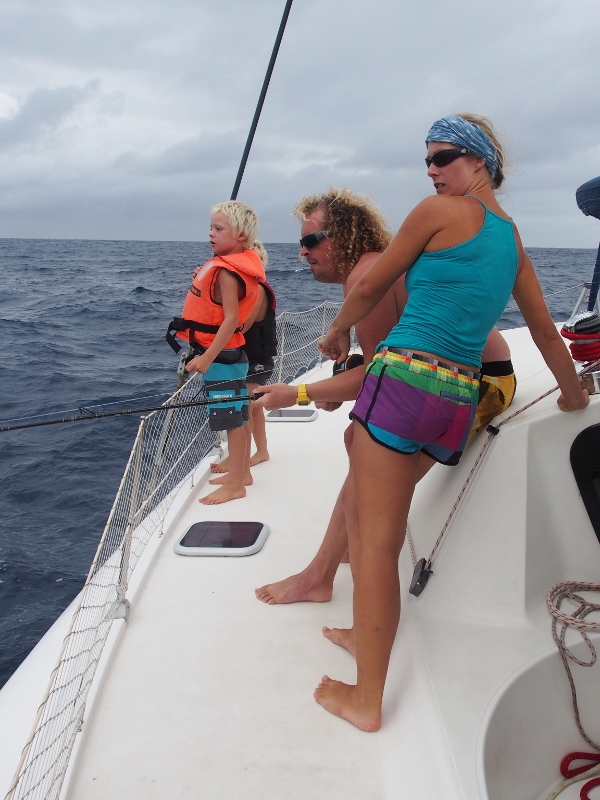
Reeling it in…
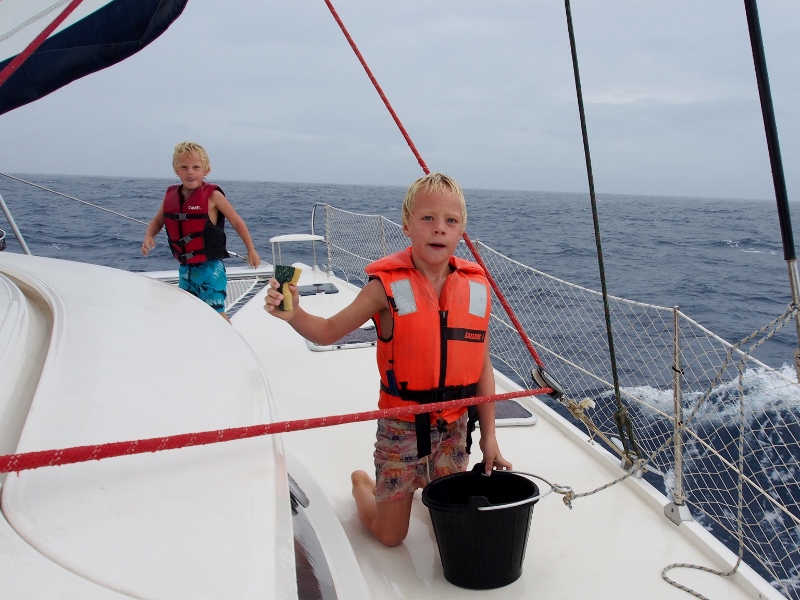
Rain is the flavour of the day with squalls rolling in, blanketing us in rain, and then disappearing again just as another one appears on the horizon. We have more rainwater showers, wash some clothes, and the kids pretend to be Jedi cleaning up their spaceship. ‘We don’t get much time to clean between missions’, Lukie explains to a slightly baffled Sarah. The rest of the day is spent sheltering in the cockpit, baking cookies and discussing possible substitutes for baking powder – we’ve somehow managed to misplace the supply we bought in the Galapagos, and it is seriously hampering the style of our cookies. In the end I try a mix of baking soda and lemon juice which turns out successful, and we have another batch of oatmeal cookies to brighten night watches.
The tuna
Just before dinner, as usual, Steve reels in a huge skipjack tuna, round, fat and glistening.
Washing the spaceship
The wind is shifty, coming and going with squalls, and again there is zero solar charge to the batteries. We’re pretty sure they are on their way out, because even if we charge them using the engine they drain right back again within a couple of hours. We resolve to be vigilant and charge using the engine to try to keep the fish fresh – it is large and could easily feed us for three days.
There are now 1121 miles to go, and overall we’ve logged 1892 miles since we left the Galapagos. Day 13
On Day 13 the wet weather continues. After filleting the tuna we hang the carcass over the edge in the hope it would attract some sharks, and I half expect to find a tiger shark on the back step when I get up for my night watch. But the carcass is still there, although picked rather cleaner than it was when we put it in. So much for amazing shark senses…
During my night watch we have several heavy squalls roll over us, large continents of rain drifting across the radar screen, Bob headed boldly into the centre of something the size of Africa. Lightning is going off all around, and I count like a kid till the thunder booms, drenched to the bone. My raincoat was showing patches of mildew after a rain shower in the Galapagos and when I scrubbed it the waterproof coating must have come off, so now it just acts like a big sponge soaking up water to ensure maximum discomfort.
Around 6 am the kids come up, but I can’t come inside to make them breakfast or start homeschooling for a while as the weather is too bad for me to leave the helm – the wind keeps changing, and I’m constantly on the edge of reefing, caught between the desire to move fast to get away and concern when a gust hits 20 knots. David doesn’t get much sleep, he is constantly up to check that whoever is on watch hasn’t drowned in all the rain.
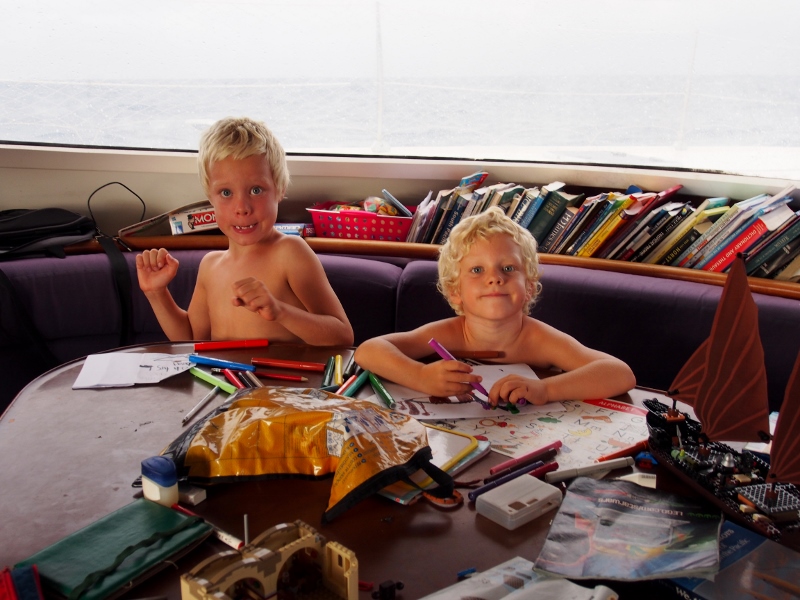
Indoor pursuits
When I finally come inside the kids are sitting quietly doing their homeschooling all by themselves, Matias having written some maths problems for Lukie, bless him. After the first couple of difficult days they are coping admirably with landlessness, although they have started to ask how much further we have to go. We got lots of kid’s movies from other families we met, and they get an episode of a Star Wars cartoon most afternoons, which is generally enough to inspire Star Wars games for the remainder of the time.
Passing time in the rain
The state of the batteries is becoming a concern, and it is clear that we won’t be keeping the fish for more than one day – we don’t have enough diesel to charge the batteries every two hours, and the autopilot and radar must remain the preferred power users, putting the fridge last in line.
All this weather is good for speed, though, and at the end of Day 13 we have 920 miles to go according to the chart plotter and have logged 2085 miles since leaving Galapagos (the discrepancy between the two is caused by current – the logger measures the boat speed, the chart plotter the distance we move over the ground). Day 14
Day 14 is the day of the flying fish. Steve has a flying fish land in his face during the night, causing him to run upstairs to Sarah who’s on watch, complaining of a bed covered in scales and slime, adding to the already damp odours. Later, when the kids get up Lukie finds another flying fish on the trampoline. They are amazing creatures; with their translucent wings extended they can fly for up to 1 km.
Holding up his catch…
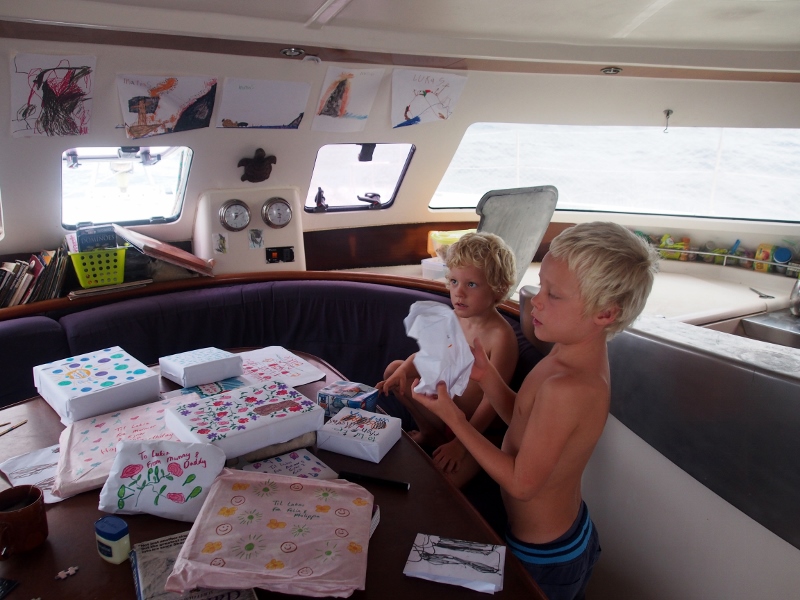
We’re getting ready for Lukie’s birthday tomorrow, wrapping presents and baking. The hardest will be to make the cake – he wants it in the shape of a black Hulker, one of his imaginary animals. Hulkers are rare, and come in many different shapes, but the black ones look somewhat like gorillas, only they have long claws and noticeable tusks, and yellow eyes. And they carry knives… Not easy to recreate, but Matias (who is party to more Hulker talk than us) has drawn us a fierce looking monster we can use as the template. The hardest will be to make the black fur, but after some initial experimentation we feel confident that a mix of nutella and blue and red fod colouring will yield at the very least a dark shade of grey. After days of rain we’ve finally managed to outrun the bad weather and are basking in glorious sunshine. The sky is blue, with light fluffy clouds scattered here and there, the sea shiny and teeming with flying fish, dolphins splashing in the distance. The fridge is switched off now, in an attempt to save power, so we’re on a race to use perishable ingredients like cheese and ham. So it’ll be cheese scones for lunch followed by Spanish omelette for dinner. At the end of Day 14, we have logged 2257 miles, and have 743 miles left to go.
Day 1
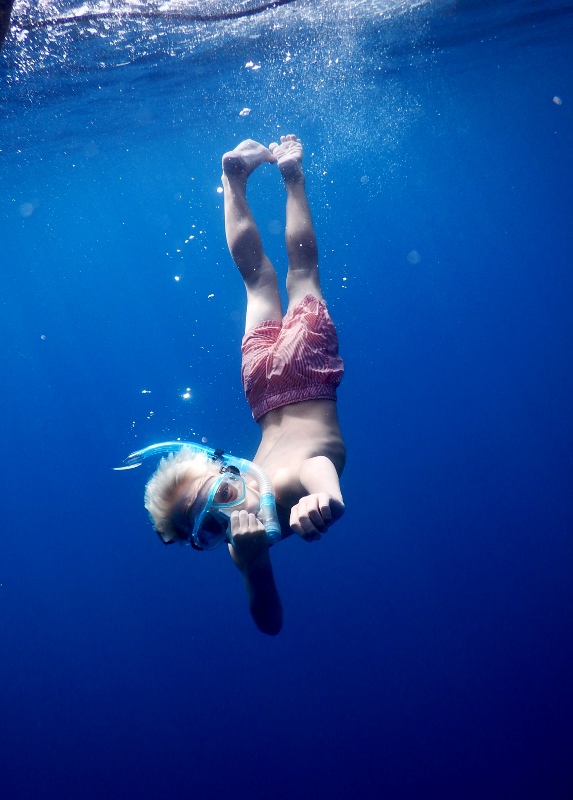
Our first day at sea is painfully slow. What little wind there is comes from straight ahead, and the current is retarding our speed by a knot and a half. We motor sail for the entire day, with only a brief stop to go for a swim – predictably, the boat is fouled again, so we scrub tiny barnacles and dense algal tufts off for half an hour, hoping to increase our speed. A beautiful kissy-fish (Lukie’s term, some sort of surgeon fish lookalike) hangs upside down just under us, no doubt hoping we’ll protect it against predators. It is an eerie feeling swimming in water that is deeper than 1000 metres; when looking down all we see is endless blue, the sun’s rays disappearing below us. Whatever monsters are lurking leave us alone however, and we climb back onboard unscathed, soon resuming our slow progress.
In the deep blue
Day 2
On our second night we have a pleasant night motor where we’re joined by about ten ‘ghost gulls’ – the nocturnal Galapagos swallow tailed gulls – who fly eagerly alongside the boat, glowing eerily in the green starboard light. They make a strange creaking, clicking kind of noise and we wonder how they manage to hunt in the thick darkness, and also where they spend their days – do they sit and sleep on the water surface, or do they fly all the way back to land? (Not that we’we managed to move more than about 140 miles in a day and a half, but still).
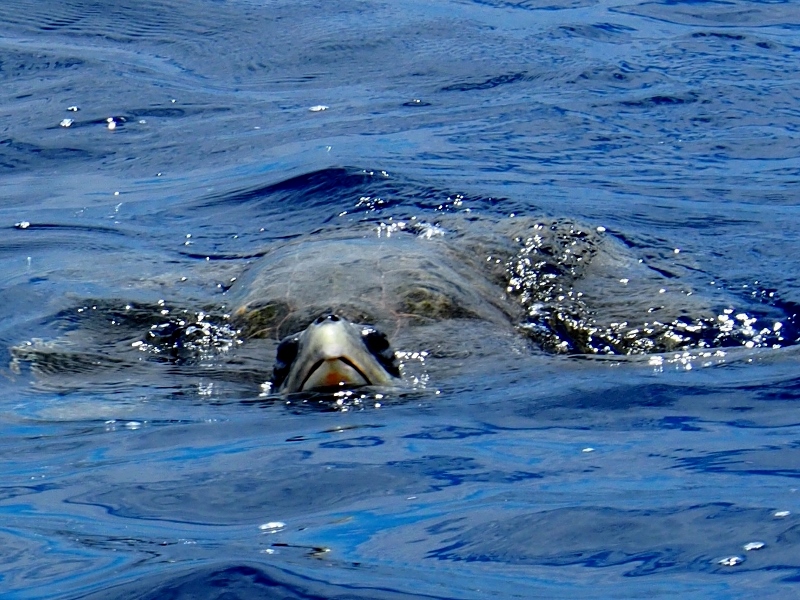
The doldrums continue on our second day, and we stick to motoring apart from a brief break when David discovers we’ve used far more fuel than he anticipated, after which he resolutely switches off the engine. So we go for a swim, next to a curious turtle who seems to be hunting the tiny fish that hang around our prop. Once we get back on the boat we sit bobbing up and down, making total speed of about a knot thanks to a favourable current switch. Predictably, after about half an hour of this, the engine goes back on – not moving at all is unlikely to get us to the wind, and we really need to get moving by wind soon. It looks like we’ve missed the convection zone – we can see the clouds and lightning in the distance but we haven’t managed to get in front of it where the wind will be as we were hoping.
Curious turtle
David is frustrated, he hates slow sailing, and the rest of us mentally count through our food reserves, reassuring ourselves that we can definitely last a month or longer if we have to. The kids are bored and bicker a lot, so we play endless games of cards, board games and read Harry Potter until my voice gets hoarse. Day 3
On our third day we finally get some wind as we catch up with the convection zone. When my night watch starts at 4 am I switch off the engine and go along at 5 to 6 knots. The moon has gone down, the night is black and the ghost gulls fly calmly alongside, creaking quietly to one another as we sail away from the tranquil sunrise. We are able to sail the whole day, which is just as well because we are running low on fuel and will have to reserve what is left for charging batteries, maneuvering in bad weather and the like.
When making lunch we check the fridge and realise that several vegetables are about to go off – the fridge works fine, but because the cooling unit is inside, a lot of moisture gathers, and wet carrots don’t tend to last. The green tomatoes we had hidden away in a cabin hoping they were going to last for weeks all seem to be ripening rapidly, so we gorge ourselves on bruschetta for lunch. When we fail to land a hooked fish a while later I am almost relieved – we need to eat the cauliflower and a fish could wreck my cauliflower and potato curry plans…
At the end of Day 3 we have travelled about 340 miles. Day 4
By the end of Day 3 the steady wind is replaced by patches of rain. On my night watch lightning illuminates the sky ahead, and suddenly we’re in the middle of a raincloud – shifty winds and a bucket of rain, followed by windy patches and more rain. At least we’re moving, and after lunch the weather clears up, settling into what could be the edge of the trades – steady winds that see us moving steadily along our course. At the end of Day 4 we’ve gone about 420 miles.
Heavy weather
Day 5
The days are starting to blur into one another, with people asking ‘is it Saturday? How long have we been gone?’ Only the kids and I know it’s not; we homeschool Monday to Friday and so have a better grasp of time than the others. We are in the proper trades now, and moving swiftly – at the end of Day 5 we’ve covered 570 miles. Sarah and Steve have been a bit under the weather, we suspect it is a mild version of a bug that started with Matias back in Isabella (requiring a lot of urgent washing at the time), and which David had just before we set off from Santa Cruz. We bought lots of hospital grade alcohol before leaving, and are now using it liberally to wipe down surfaces, although I suspect there are no more people to infect, Lukie and I probably having been exposed already. (On April’s Fool Day the kids kept playing jokes on David like: ‘Daddy, I’m really sorry, I had a bad tummy and pooped all over your bed, some hit the wall’, enjoying watching his face sink before they collapsed into giggles, yelling ‘April’s Fool!’ – oh the joys of childish humour…).
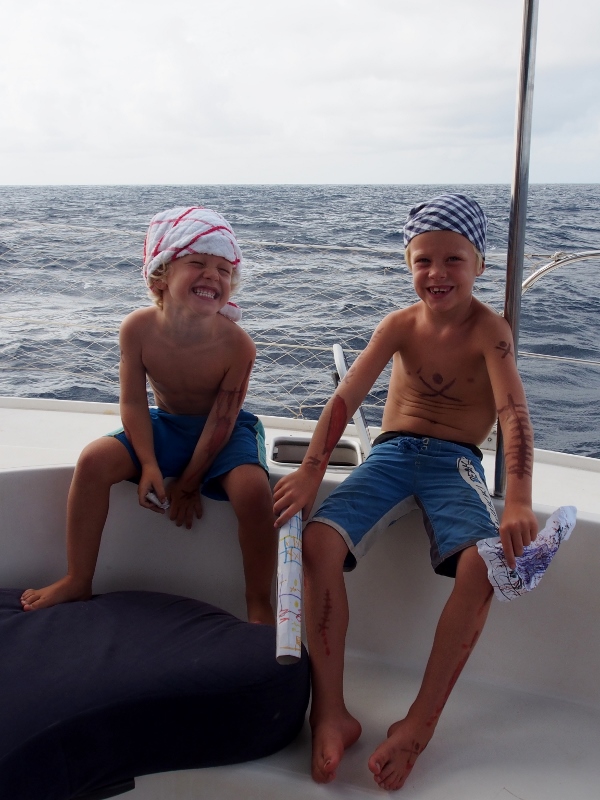
Fierce pirates
Day 5 is Pirate Day and David and the kids decorate themselves with painted on scars, bleeding wounds and tattoos and make cutlasses, compasses and sextants out of cardboard. Lukie even invents a Pointer, a device that shows us where to go, which sounds useful, especially as Matias seems to think we should be heading East.
The GPS shows a time change after lunch, and we adjust our clocks accordingly – we certainly notice we are moving west, the sun rising later each day, and it is satisfying to see it reflected in real time. Day 6
We keep flying through Day 6, steady winds interrupted by occasional showers. The seas are a bit bigger than earlier and we have to close all hatches which creates a stuffy, hot atmosphere indoors. The only hatches open are those in the heads; it doesn’t matter if water gets in there. The bow keeps crashing into the waves, and water pours into the heads, but we need some fresh air to sleep.
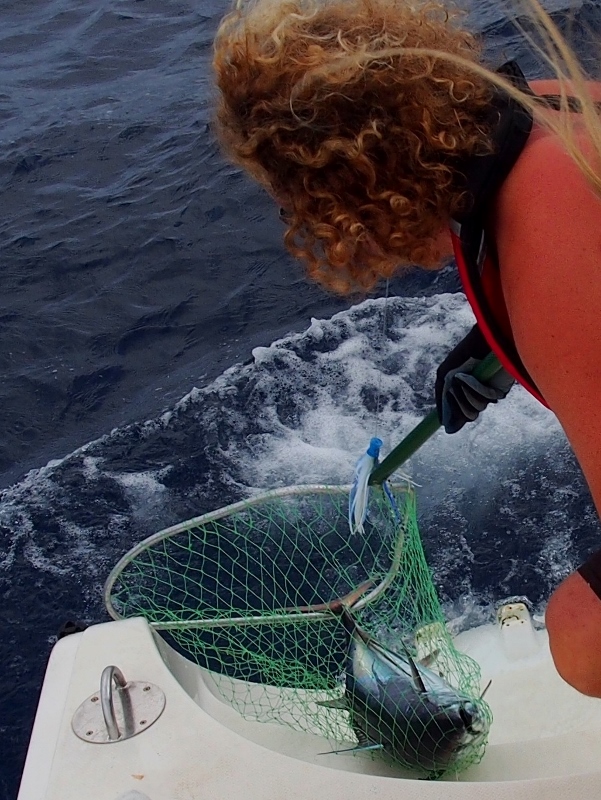
We catch a skipjack tuna in the morning, Steve managing to net it expertly before he’s even had breakfast. We have a bit for lunch and it is delicious – just as well, given there’s enough of it to feed us for three days…
Netting the fish
Much of the rest of the day is spent with me reading Harry Potter, Steve and the kids curled up next to me, wide-eyed and enthralled. The kids use pencils as wands as they cast spells on each other, Lukie swiftly killing a unicorn and eating its heart – he has obviously crossed over to the Dark Side already.
At the end of Day 6 we’ve travelled 755 miles
Day 7
One week gone, and quite fast at that. It is funny how quickly you get used to being on passage, how easily we enter the routine. We’ve organised the nights so that David does the first watch, from 8 pm to midnight. Sarah and Steve take turns doing the dog watch, from midnight to 4 am, and I do from 4 to 8 am, home schooling the children from after breakfast (they wake up around 6) to about 8 am when everyone else gets up. The midnight watch is the hardest, hence why we’ve got two people sharing it – that way they can each get a full night’s sleep on alternate days.
It seems to work although it isn’t easy to sleep before and after watch, in the hot, stuffy cabins, vibrating as the boat surfs down the waves, loud bangs and crashes as we slam into the sea. We are all tired, that queasy, hungover kind of feeling that arises from a mixture of sleep deprivation and motion sickness, but we mostly manage to nap a bit during the day to make up.
The general tiredness leads to a slight unravelling. During night watch, Sarah sees a shape slither across the cockpit through a corner of her eye. At first, she thinks it’s a rat, but then when it appears elongated she becomes convincd it is a marine iguana the kids have smuggled on board. She is busy trying to figure out how to deal with the Marquesan authorities about the smuggling of endangered species when it occurs to her to catch it before it enters her and Steve’s cabin through the cockpit hatch – which is when she realises it is in fact a flying fish.
Steve, on the other hand, is having weird and lucid dreams. In the latest, he dreams that he has just spent his life savings on a boat. This boat, a ‘Spewman 38’, is everything the name implies, managing to roll insanely even on calm anchorages, and he wakes feeling terrible that he has wasted all his money on a dud of a boat. The only upshot, apparently, was that it came complete with a patio, barbecue, jacuzzi and pizza oven built in.
Which leaves me wondering what we’ll be like after two more weeks – chilled and at one with the immense ocean we’re crossing, or completely barking mad…
At the end of Day 7 we have done 950 miles on the log, 970 over the ground or 2070 miles to go (GPS reading).
We spend half of Saturday morning at immigration trying to get our exit documentation, and the rest provisioning: fresh fruit and veg from the marvellous market, where silent women sit cross-legged displayng their produce in neatly packed one-dollar bags, and last minute cheese and tortillas from roadside tiendas. On the way back to the boat David pops into an internet cafe to check the latest weather models, only to emerge hours later declaring that we might be best off leaving straight away. Apparently the windless forecast is worsening and a pattern of convection travelling south west is emerging which is travelling about the same speed as a boat. If we leave right away we might be able to get ahead of the rainy, windless conditions associated with it.
So we quickly check everything: water tanks, diesel, spare water, emergency grab bag, and finding all in good order apart from the spare water tanks which have leaked a little, we pull anchor at 5:15 and set off to sail the 3048 nautical miles to the Marquesas. We’ve only got enough diesel to motor about 700 miles, so we seriously hope the wind will kick in, despite the forecast. We’re reckoning that it will take somewhere between 21 and 28 days, and it feels strange to leave land knowing we might not get off the boat for another month.
This e-mail was delivered via satellite phone. Please do not add large attachments in replies.
We are looking for crew to sail from Tahiti to Tonga, about 1100 nautical miles.
If anyone fancies a sea break in the tropics, we are in need of crew to help us on a passage from Tahiti to Tonga, approximately two weeks with stops at the Cook islands and possibly elsewhere on the way. Tentative dates are 15 June to 30 June. We’ll provide food and comfortable cabins on our 46 foot catamaran, you just bring books and fish recipes… You have to be prepared to do night watches, sailing experience would be useful…
We can’t use facebook easily from now on as we’re about to embark on a large trip (limited data), so please email david.johnson@myiridium.net if you or anyone you know are keen (couples welcome). NB: must like kids, Matias (7) and Lukas (4) are part of the deal
Our last stop in the Galapagos is Isla Santa Cruz. Santa Cruz is the most developed island with the highest population, but it still offers plenty of scenery and wildlife. In terms of Galapagos time, the island is middle-aged which means no active volcanoes but a lava strewn coastline and plenty of evidence of past eruptions.
Lukie feeding a tortoise a guava from the forest floor
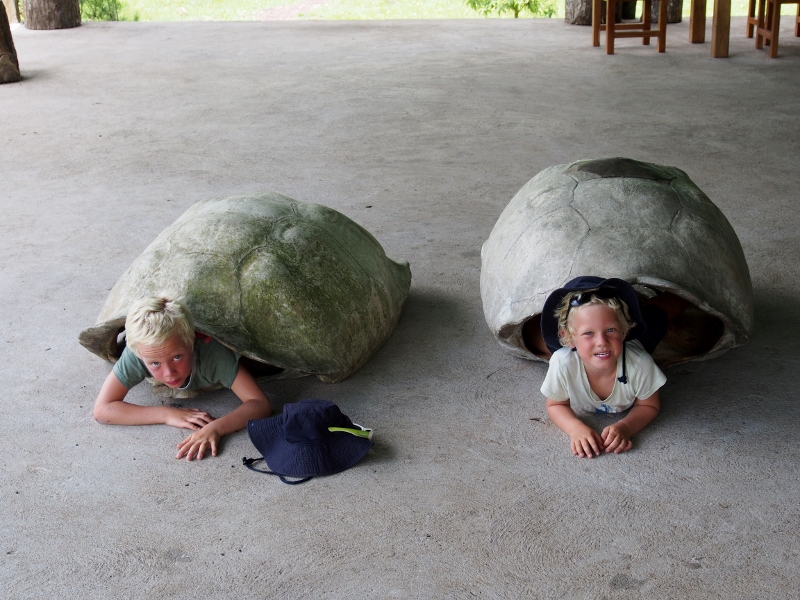
As usual in the Galapagos there is lots to see here. We visit the highlands and see gorgeous giant tortoises, dark, round and shiny, roaming around unhindered on private farmland. There are lots of remnants of the island’s violent volcanic past, and we climb down steep stairs leading into dark, dripping lava tunnels running a hundred metres underground. The tunnels were formed when the outside skin of molten lava running down a hill solidified, leaving behind a tunnel. Strange cactus trees dot the landscape, but up in the highlands the land is green and fertile, with lush grasses and huge trees. The most remarkable are the overgrown dandelions – the Scalesia (a relative of the dandelion) forests grow in altitudes of 400-500 m on Santa Cruz, where they play an important ecological role through the trapping of rainwater and the provisioning of habitats for birds and other plants. In the lush tropical climate they take a rather different form than the dandelion we know from our lawns at home…
Scalesia forest dripping with moss
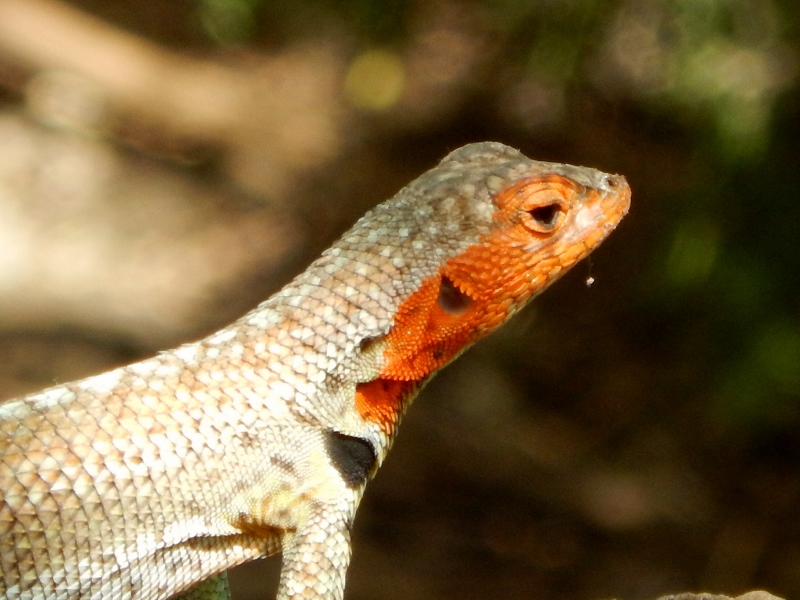
Behind Puerto Ayora, the main town, is the Charles Darwin Research Centre which used to house Lonesome George, the last surviving tortoise of the species from Isla Pinta, who sadly died last year without reproducing, meaning that his species is now extinct. The tortoise populations of many Galapagos islands were decimated by pirates, whalers and other seafarers, who would pick up the hardy giants to store live onboard ship until fresh meat was required. Human habitation and introduced species such as goats and pigs are now the main threat, the latter munching up vegetation and destroying habitats of the tortoises. The Charles Darwin Research Centre still houses plenty of other species of giant tortoise, but unfortunately there are no signs explaining where the different species are from, so we come away none the wiser. They have a breeding programme for terrestrial iguanas too, which are bright orange and lovely to see, munching away as they are on thick leaves whilst trying their best to climb out of their enclosure.
Land iguana
The main marine life of note is sharks – lot of them. They are all around the boat, some of them rather big, and we hesitate in letting the kids jump off. We visit Tortuga Bay, a surf beach, where the kids play with their boogie boards until they notice they are surrounded by about twenty baby black tip reef sharks basking in the shallow water. When a big one comes along and we can’t see whether it is a harmless white tip or a fierce Galapagos, we yell for them to come out of the water quick smart.
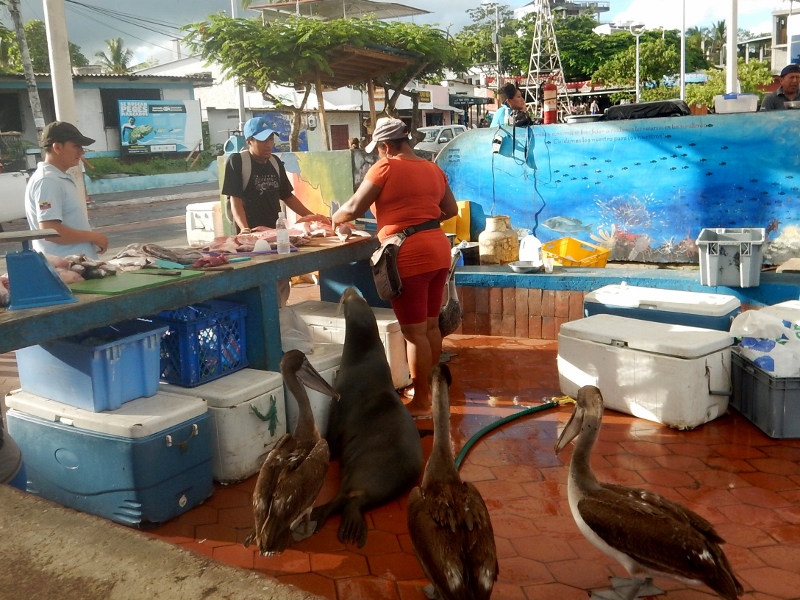
Local fauna competing for scraps at the fish market
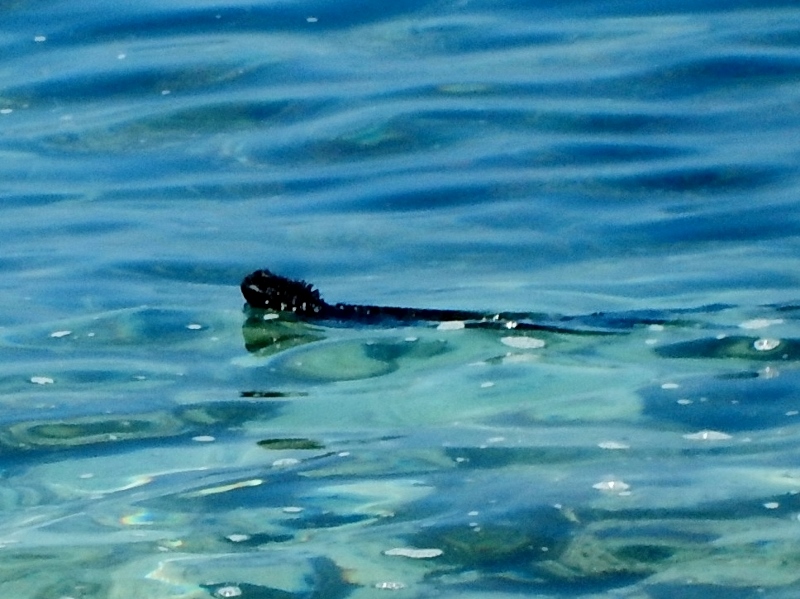
Marine iguanas are everywhere too – all over the black rocks, swimming next to the boat on the anchorage, even begging for scraps (!?! – we thought they were carnivorous) at the fish market. More frequent beggars at the fish market are the sealions and pelicans who are fighting for attention from the ladies who expertly fillet the fish, brushing off the sealion snouts which are popping up everywhere, way too close to the sharp knife.
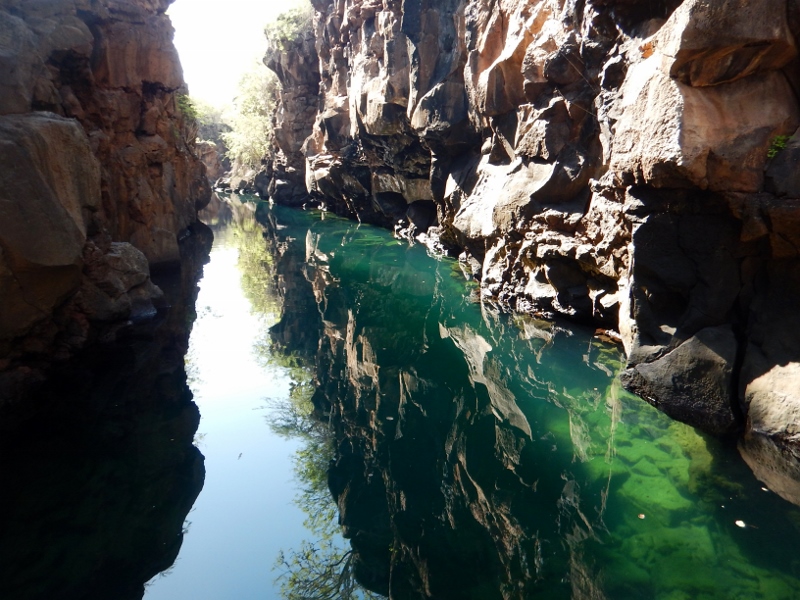
Las Greitas
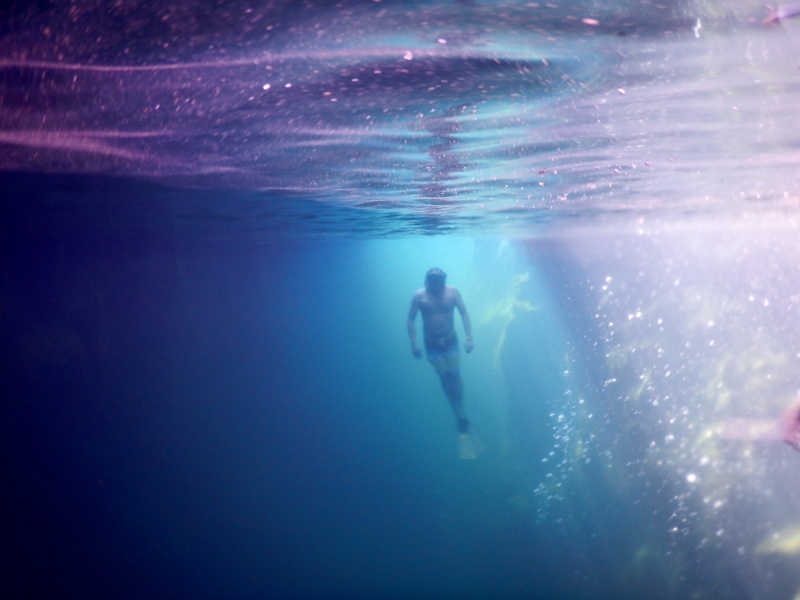
Close to the town is a snorkelling site called Las Greitas, vertical walls of volcanic fissures isolated from the sea apart from by some underwater caves which has led them to be filled with brackish water where hundreds of fish are trapped. The water is crystal clear and the rocks plunging down offer some dramatic underwater vistas down to the deep dark caves below.
Steve coming up for air at Las Greitas
We’ve met lots of cruising families in the Galapagos, and here in Santa Cruz we meet Jen and Matt and their two boys Conrad (8) and Mark (7). The boys are loving having someone to play and talk Lego with while the grownups discuss passage coping strategies, dinghy outboards, sail drives and home schooling.
The vegetation is dominated by tall cactus trees at sealevel
It is great to meet other families to hear about their experiences and plans, how life away from land has felt for them, which places they have enjoyed and why. Most of the families we have met have already been away for two or three years, and many of the kids know no other life than that on a boat, the whole family loving life at sea. Some of them are thinking they will settle down and sell the boat soon, becoming landlubbers for a while. The main reason for wanting to go terrestrial seems to be to earn more money to enable a return to cruising. Others want the kids to go to school for a while, although all the children seem to be doing fine academically. They all seem quite wealthy; we were expecting more hippy families, but haven’t met any so far, most of these are professionals who saved up and sold their house back home and who manage to live cheaply thus prolonging the time until they have to return home.
Boat kids playing in the surf
All the families have lots of gear, and we feel pretty bareboat in comparison. Bikes, toys from home, washing machines, running freezers and lots of solar and wind power to pay for it all. I guess if you’ve got children growing up on a boat you kit out your boat like you would a house, and I suffer a brief but severe bout of washing machine envy, lamenting about all the hours we spend searching for laundries when we could be snorkelling or exploring mountains.
All the cruisers we meet are headed almost the exact same route as us which means that we’ll catch up frequently along the way. And they are almost all heading to New Zealand, hoping to spend the summer there to sit out the cyclones, and then head onwards to wherever they are going. It is great that we’ll keep meeting the same people for the next 7 months, and wonderful that we are likely to catch up in New Zealand as well.
No sealions on the boat here, just pelicans…
As usual, it is not just about sightseeing and socialising. David has successfully managed to repair the clutch which will be handy for the near reef navigation we’ll be doing in the Tuamotus, and we have to fill gas bottles, do laundry, and stock up with fresh stuff for the long, long trip to the Marquesas which is coming up. The forecast for this next leg is looking particularly awful, with no wind at all, and it is likely we’ll have to go rather far south to meet some trades so that we can get a bit of wind in the sails, turning what should be a 21 day sail into a possible 28-30 day adventure.
From now on we won’t have Facebook access, but will update the blog via satellite – so if you want to check our progress and read how we pass our time, just go directly to the blog website :).
Isabela is completely different from San Christobal. The largest island in the Galapagos group, Isabela is much larger than San Christobal, and gets a lot more rainfall. All the Galapagos islands are basically volcanoes that erupted out from a number of hotspots below the seabed. The tectonic plate that the islands arose from is moving quite rapidly, about 3 cm eastward a year, and as a result the oldest islands tend to be on the eastern end and the youngest at the western end. The typical life cycle of an island is that it starts out young and hot and inhospitable, then it cools down and its volcano(es) quieten down and the island is colonised by plants and animals. The higher the elevation of its volcano, the more rain the island receives, and the more lush its vegetation and abundant its animal life. As it ages, the island starts sinking under its own weight, so older islands are flatter and receive less rainfall. At the end of its lifecycle, only the tip of the volcano will stick out of the water, the rest of the island lost beneath the waves.
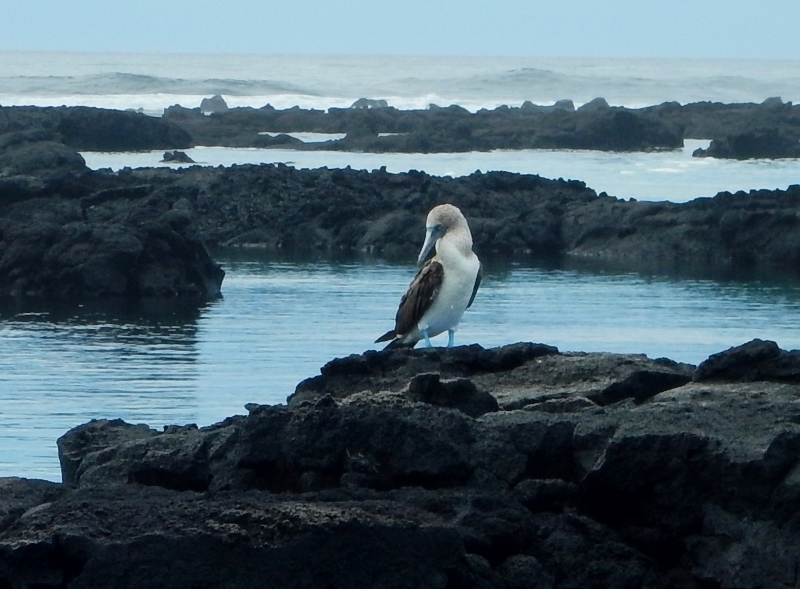
Blue footed booby
There are birds everywhere here: pelicans, frigate birds and boobies diving for prey or roosting on the black rocks, Lava Herons stalking crabs and small fish in rock pools, flamingos in the saltwater ponds behind the township, and the Galapagos penguins bobbing on the water surface or zooming through the water. The blue footed boobies fish in flocks of hundreds, synchronising their dive bombing so that each bird hits the water at the same time, creating an enormous splash that has us jumping the first time it happens next to the boat. It is an impressive sight and we wonder whether they ever mistake a snorkeller for a flock of fish – imagine hundreds of sharp beaks suddenly piercing the water above you as you come up for air.
Synchronised diving
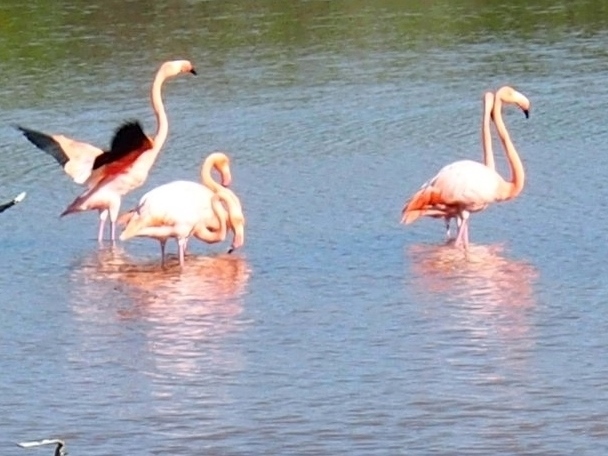
Just behind the town of Puerte Villamil are saline ponds with a lovely boardwalk through. Iguanas swim in the red water, and delicate pink flamingos stand seemingly immobile for what seems like hours, only occasionally stretching their wings a bit. They are beautiful birds and fascinating to watch; when they swim they look almost like swans with the long pink necks curved above the waterline.
The boardwalk ends at the giant tortoise breeding centre where the two subspecies of the island can be seen – there are still wild populations deep in inaccessible national park territory, but we only manage to see one wild one, at the top of Volcano Sierra Negra. Their shells are different from those of Isla Christobal so we can clearly see evolution in action – it is thought that all the giant tortoises arrived here as one species from South America, likely floating on a raft of vegetation created from a flash flood, and that the diversification into different species for each of the islands occurred over thousands of years.
Sleeping fur seals
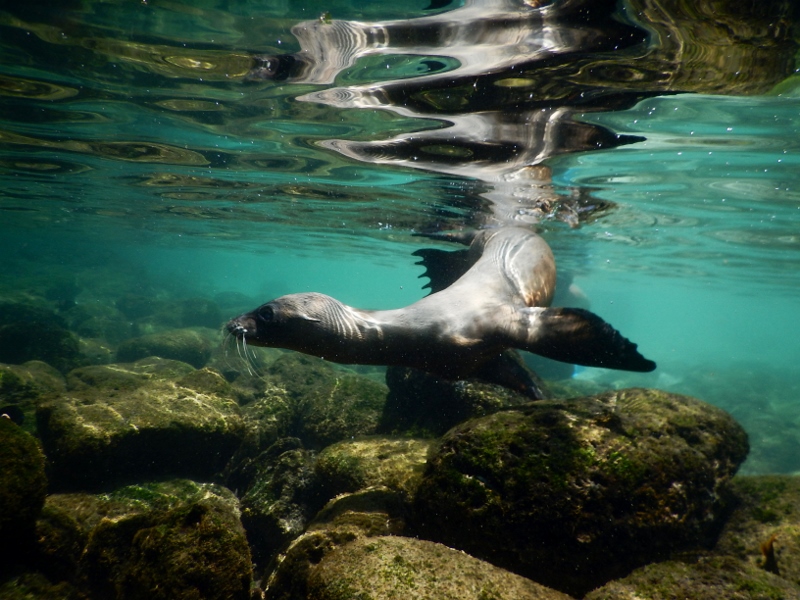
East of the town and next to the pier where we land our dinghy is another boardwalk, this one through mangroves. Marine iguanas are everywhere, sunning themselves on the warm wooden walkway. They are not shy at all and just stare at us impassively as we tiptoe around them and gingerly step over their steaming bodies. At the end of the walkway is a snorkel site where a sealion comes to play, performing underwater acrobatics, whirling and zooming and spinning all around us. We try to mimic him, clumsily diving down and spinning upside down, and he appears to appreciate that, outdoing our every manoeuvre until we exit the water.
Sarah and the sealion
Numerous tiny Galapagos Penguins swim in the anchorage or sun themselves on the hot black rocks around the jetty. They are here, at the equator, because the Humboldt current from Antarctica cools the water enough for them to colonise the islands, and have adapted to the heat by reducing their body size, so they are truly small, about the size of a slim adult duck. They are amazing under water, zooming in and out of the rocks and mangroves, in hot pursuit of the tiny fish that hang out in big schools just below the surface. It is incredible to see mangroves, hard corals and penguins in the same swim, or to see a penguin sitting on a rock just next to a cactus.
Galapagos penguinAttempting to sneak on board
There are not as many sealions here as where we were staying in San Christobal, and we manage to ward off colonisation attempts with some success. A small female still decides that the boat is for her, and one afternoon after a day out we came back to find a nice pile of poop just in front of the cabin door – she must have hauled herself all the way into the cockpit, spotted the nice toilet shaped depression in the floor, and decided that that was the place. After we spray a bit of water on her to chase her off, and tie up the fenders in a new configuration, and it works: she stays away.
Apparently there are Galapagos Sharks in the bay, and Matias spots tiny baby black tipped reef sharks around the boat, only about 30 cm long but still unmistakably sharky.
Iguana in pink saltpond
The atmosphere here is very different to the smooth efficient tourist machine of San Christobal. The town of Puerto Villamil is tiny and sleepy, and you get the impression that everybody is very relaxed. Relaxed almost to the point of inertia: tour boats don’t turn up when promised, trips are cancelled for no good reason, laundry is not ready when promised. Sarah comments that they seem ‘rather complacent about tourism’ and it is indeed a shame that they don’t make more of an effort – when you pay the equivalent of NZD 140 to go on a snorkel trip, you expect the boat to turn up, and we certainly wouldn’t recommend the guys we went with to anyone after spending half a morning waiting and the other half showing receipts to demonstrate that we’ve paid when they claim we haven’t. In the end we feel bound to pay another US $150 although we are quite certain that we did pay the first time around and have receipts to prove it, because otherwise the girl who lost the money will have to pay them out of her own pockets. We book a horse ride to the volcano Sierra Negro and are told to meet the truck that will take us to the start of the trek at 7:15 am, only to sit waiting for an hour until he turns up with the ingredients for a fruit stall which he has to set up before we can get going.
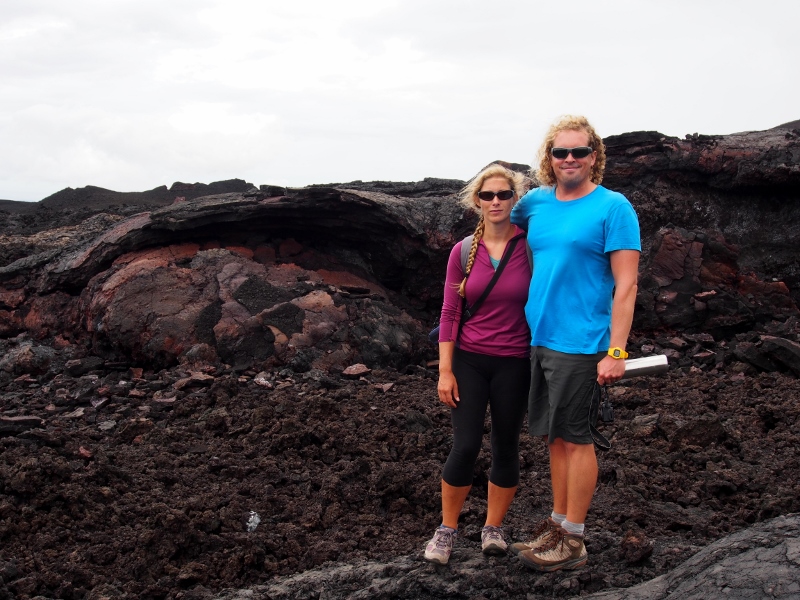
Sarah and Steve at the top of Volcan Sierra Negra
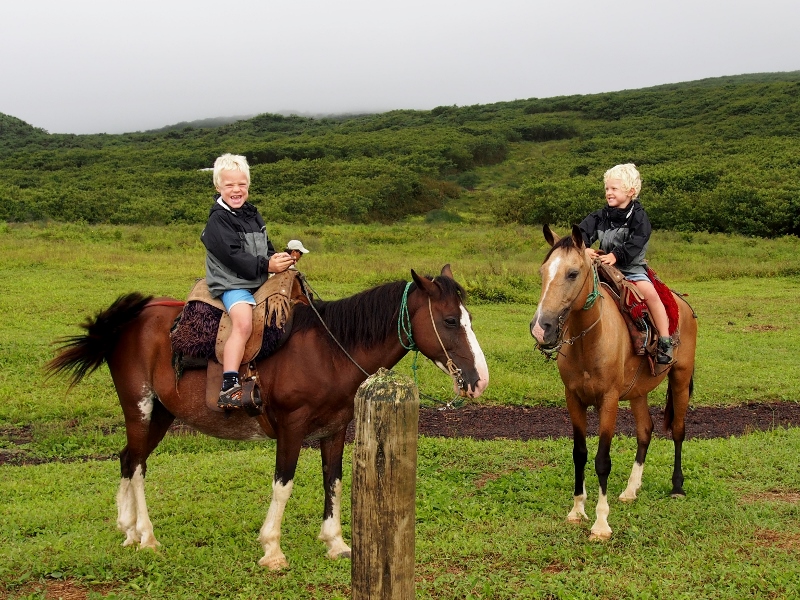
Mind you, the volcano is amazing – it last erupted in 2005, and previous eruptions took place in the 1970s and 1960s. After a truly terrifying truck drive with our lunatic taxi driver doing 120 km/h along wet roads as we scream to him to slow down up the lower parts of the mountain we arrive to get on our horses, and trot up the trail at a stately pace. Lukie and Matias are stoked to be on a horse like real knights and Matias keeps leaning forwards to pat his horse and whisper into his ears. The horses are hilarious, refusing to do anything we ask them to, not heeding any known commands. The guide keeps asking us to hurry up, but the horses seem to just go one speed on the way up. We ride for half an hour next to the huge crater at the top, looking down into the eerie black flat lava landscape that stretches for 3 km. Once at the top we dismount and climb down to view Volcano Chico, a parasite volcano that went off in 1963 and again in 1979. Here lava tunnels are running down the hills and vents are everywhere, showing as big cracks in the surface out of which hot air flows. We can see the succession of plant colonisation, with the latest lava only colonised by lichen and earlier eruptions slowly covered in cacti, mosses and eventually ferns.
On our way down the horses keep slipping on the muddy path, and the guide’s horse falls over, throwing him off. The kids’ horses keep breaking into runs, eager to get back down the mountain, and Lukas’ horse stages some vicious attacks on the other horses in its quest to get ahead.
We leave San Christobal to sail to Isabela, another island in the Galapagos group, on Friday afternoon. It is an 80 mile trip and there is no wind, so we decide on an overnight passage to give us enough time to arrive in daylight.
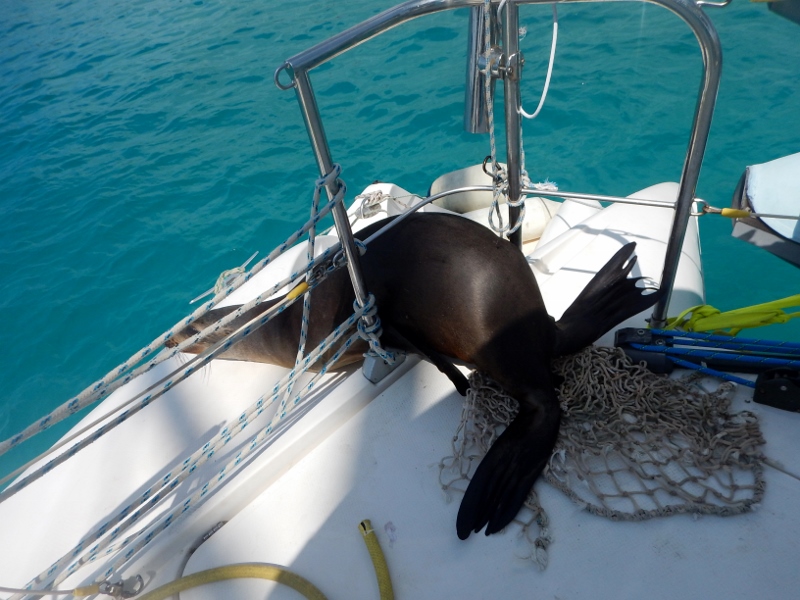
It is hard to leave Isla San Christobal, not least because one of Kevin’s female friends has moved in. On our last day in on the island we go for a goodbye snorkel at La Loberia where we swim with sealions, eagle rays and turtles in crystal clear water. When we come back to the boat we find her fast asleep next to the lifejackets in the cockpit. We try the usual clapping but she just bares her teeth and snaps at us, advancing in a vicious attack to ward us off. This works well for her until we gang up together and clap in unison, when we manage to get her out of the cockpit, her bottom only just fitting through the railing as she slips out to the steps – for a crazy moment we fear that she is stuck. She refuses to jump into the water, and no matter what we do (clapping, shouting, saltwater hose, buckets of water) she remains on the steps –indeed she appears to relish the cooling effect of the water that douse her with. In the end we give in and start the engine, hoping that she will jump off once she senses we’re moving. She doesn’t, of course, and about a mile out of San Christobal we get worried about translocating a native species and turn the water hose onto her, spraying her face until she gets the message and leaps off. She continues to pursue the boat for a while, hoping no doubt to jump on again for the night, but we manage to keep her at bay.
Stuck?
Half an hour later a larger specimen (Kevin?) comes up and hangs in the water around the boat for the evening. There is no wind, and we drift along in the current at about 3 knots, looking at birds hopping along the glassy water surface and weird configurations of jellyfish drifting past just under the surface. There are devil rays everywhere, pairs of wingtips breaking the surface rhythmically as they move along just under the surface. Something big may be chasing them, because occasionally they jump right out of the water, landing with a huge splash. Minke whales appear about 100 m off the boat, breathing loudly in the still afternoon and breaching again and again. Kevin darts forwards and backwards, swimming on his side and his back, breathing in tune with the whale and occasionally emitting loud honks just to remind us of what we will be missing when we leave him behind. Just before dark we see dark brown fins sticking out of the water, seemingly waving at us, and gather to have a closer look – is it more of Kevin’s lot, waving goodbye, or perhaps a couple of sharks? It turns out being three huge sunfish swimming merrily towards San Christobal, their fins breaking the surface as their disc like bodies glide along seemingly unhampered by their lack of tail.
Sunfish, fin breaking the surface
Once dark, we hear loud splashing but we with no moon it is impossible to investigate whether it is dolphins or fish. In the morning about ten large bottlenose dolphins approach to frolic around the bow, and we slow down the boat and jump in the water to have a look. The dolphins swim right up to us and dart in and out between the hulls of the boat as we hang onto the swim ladder and watch. Almost immediately a couple of Galapagos sharks appear, edging closer and closer. The dolphins seem unconcerned, but when the sharks increase in number and some big ones come along we decide to get back onto the boat.
As we approach Isabela we see another large whale, possibly a Bryders, and numerous turtles and seabirds greet us.
There is a real sense of abundance in the ocean here – a feeling that there is enormous biomass below and all around us, and that if we cared to jump in we would see the water thick with life. We can only wonder what it would have been like before whaling, fishing and shark finning. The Galapagos used to be home to many whaling stations, and the whale populations here (as elsewhere) were decimated. Compared to the relatively impoverished oceans we are used to, the life here is pretty incredible. Imagine what it would have been like back then, a veritable overabundance of ocean life around these arid and inhospitable volcanic islands.
There are 13 major and six smaller islands in the Galapagos, as well as numerous tiny ones. Isla San Christobal is one of the five inhabited islands, the others being Isla Santa Cruz, Isla Isabela, Isla Baltra and Isla Santa Maria. San Christobal is the only island with fresh water; it is the fifth largest island in the Galapagos but has the second largest population.
Lava gull
As part of our Autografa (visiting permit) we are allowed to visit Isla San Christobal, Isla Isabela and Isla Santa Cruz only.
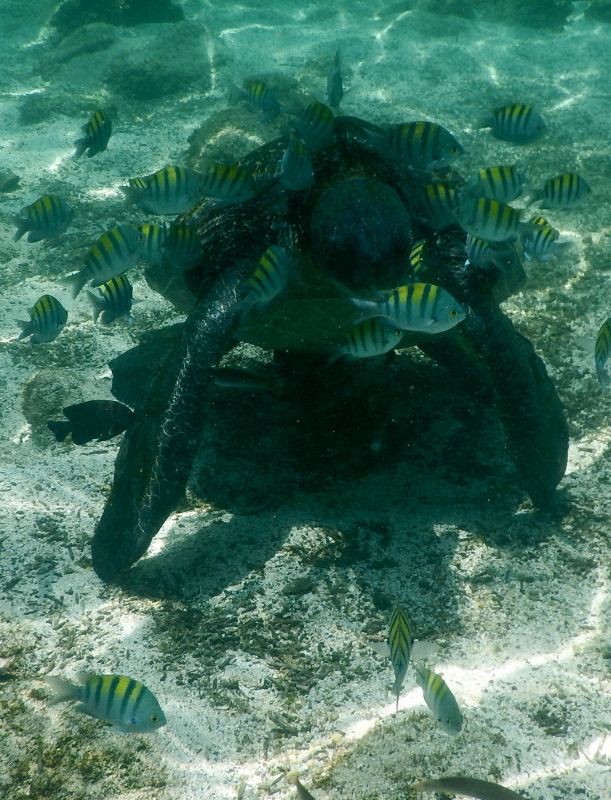
We are anchored off the main town on San Christobal, Puerto Baquerizo Moreno. It is a charming town – clean, full of wildlife and displays about the amazing life found on the islands. People are very friendly, offering valuable advice, and there are little shops offering dive and snorkelling trips everywhere, as well as general tour operators who arrange trips to view the terrestrial attractions. Friendly taxi drivers take us all over the island. The first day we explore La Loberia, a rocky shore site with a small beach where we see the famous marine iguanas and snorkel with turtles and baby sealions. The sealions are amazing underwater – clumsy on shore but once in the water they zoom all around us. The babies are friendly and nip at our feet, and we have to keep a close eye on the kids to ensure that they don’t accidentally touch them – once a pup smell of humans, it is often rejected by its mother, and you are not allowed to touch any animals on the islands. There are giant turtles everywhere, sitting placidly on the bottom, some being cleaned by fish and others just chilling.
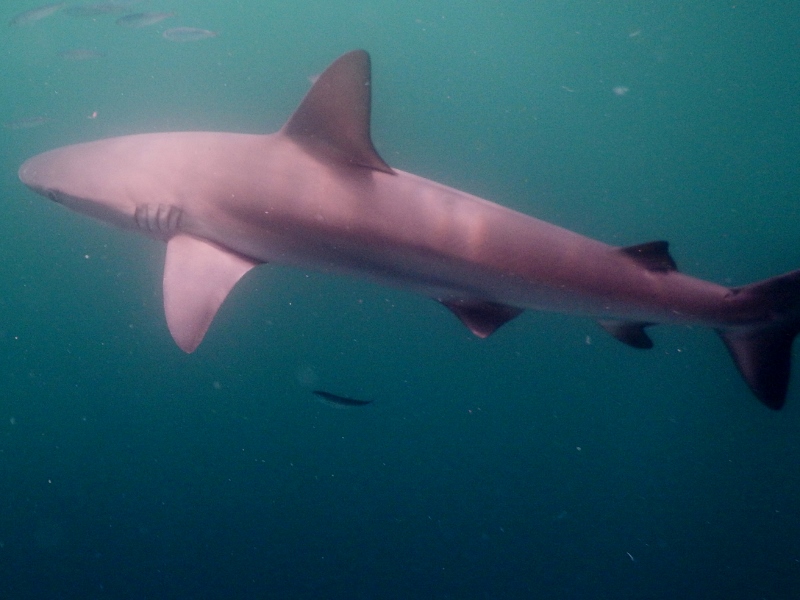
Galapagos shark
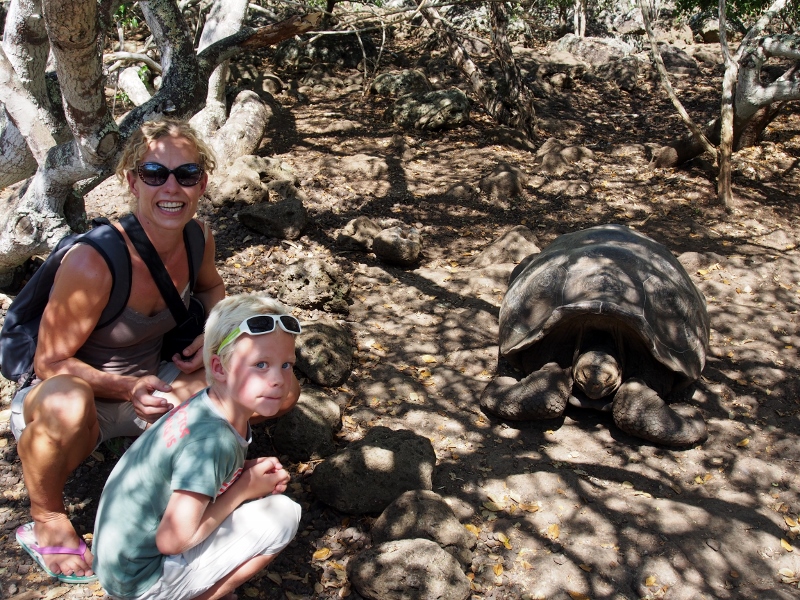
The next day we go to La Galapaguera and see the giant land tortoises and the island’s breeding center for them. It is estimated that there used to be about 100,000 tortoises on San Christobal but a survey in 2005 counted only 2800 living on the island by then. They are majestic, huge and slow, wrinkled and beady-eyed, with big clumpy feet at the base of their quite skinny legs. The shells are enormous and must be very heavy. We see the babies that are bred at the site: tiny, shiny black little things. It is hard to imagine that they grow into such giants – they are kept in a small enclosure from they hatch till they are 5 years old, after which they are released into the wider reserve. The wardens collect eggs from nests made by the females, bring them to the breeding centre and incubate them, achieving 60% survival, which is much higher than in the wild where the eggs and young easily fall prey to birds, snakes and rats.
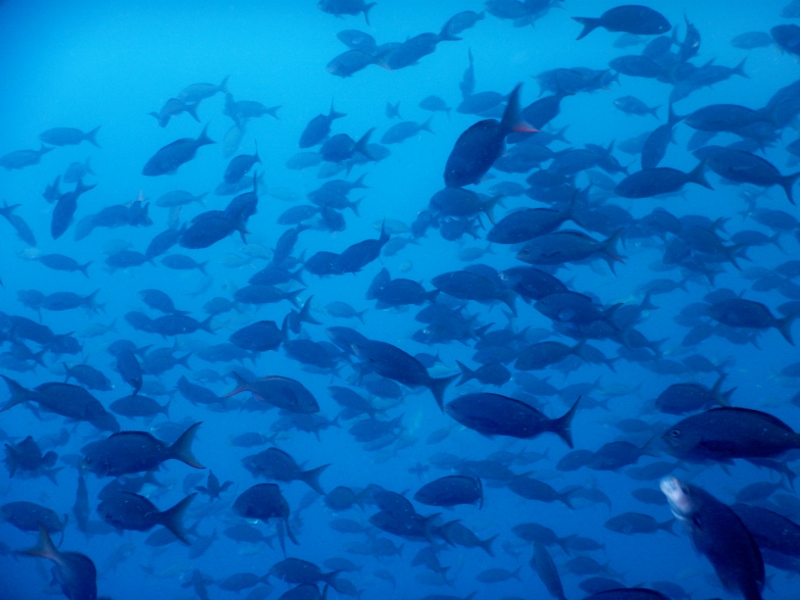
On the Wednesday, we take a snorkel trip out to Leon Dormido, a huge rock sticking out of the ocean about an hour’s boat ride away. The site is famous for sharks, and we see several Galapagos sharks as well as black tipped reef sharks, rays, turtles and wonderful sponges, anemones and corals lining the sheer cliff face dropping vertically below us. On top of the rock are frigate birds blowing out their red sacs and pelicans, as well as sleepy sealions and marine iguanas basking in the sun.
On the trip we also visit Cerro Brujo, a beautiful white sand beach amidst lava rocks, where marine iguanas, sealions and numerous seabirds frolic. Here we see a Lava Gull, a species endemic to the Galapagos, of which there are only 400 breeding pairs left. The children play with Laura, a girl from Chile who is visiting on a holiday with her mother.
Everywhere we go there are animals, rare, wonderful, loud and colourful in-your-face animals, going about their lives. It is amazing to be in a place where the creatures that were here originally are afforded such a high status, and where everybody genuinely try to do their best to look after them and their habitats. There are several conservation success stories – the Sally Lightfoot crabs used to be threatened by are now rebounding nicely, thanks to a huge effort. The Lava Gull is still considered At Risk, but numbers are coming back. Lonesome George died, and with him his species disappeared off the earth forever, but the other species of giant tortoises now have healthy populations.































 SV Bob The Cat