By the time our agent’s representatives come to the boat soon after we anchor we have been inundated by a large sealion. First she tries to fit on the bottom starboard step, but she is slightly too big and can’t seem to find a comfortable spot for her head to rest on. When the water taxi arrives with the agent, she reluctantly slides into the water when they clap their hands, only to grumpily heave herself onto the port stern where she decides to go for the second step up to avoid the swimladder. A good plan; it fits her perfectly.
The agent’s representatives explain what is to happen. In exchange for bundles of cash they arrange for Customs, Immigration and the Quarantine team to visit, a contingency of nine people who arrive by water taxi around 2 pm. While David is questioned by the local coast guard about the number of lifejackets and flares on board and about where we’ve been and for how long, the rest of us scribble furiously to fill in multiple copies of immigration forms. Meanwhile, a diver inspects the bottom of the boat, another official takes air samples and a third person checks our cupboards and cabins for introduced plants and pests. When they are all satisfied that we are clean and in possession of proper documentation for where we’ve been, they ruffle the childrens’ hair, mumble something about blondies, and depart. Only the Marine Park official now remains to visit – he had something else to do when the rest came and will come to check us later, although after he misses two appointments we are told that he won’t in fact turn up. He is the person who was supposed to ascertain that we won’t harm the marine life through our visit, and check our black water system and the rubbish set up. David is terribly disappointed – he was looking forward to the poo tank inspection; after all the trouble he went through to put it in, he craves an admiring glance and a low whistle from an impressed official.
Soon after they leave, we are colonised by another two sealions. They clamber onboard, lifting themselves heavily out of the water and flop down, seemingly exhausted. They literally can’t keep their eyes open, some of them seem to fall asleep whilst trying to look at us, they just keel over mid-eye contact and start snoring. They pee copiously whilst asleep and soon the back steps are covered in brown urine. They are a bunch of moody teenagers: when we step onto the back steps they lift their heads and snarl at us, honking and braying much like the Wookie Chewbacca. A large male comes over, ousts a smaller female and promptly falls asleep. When new sealions approach, our grumpy male snaps at any males, but allows females to come onboard as long as they keep to the other steps. At one point we have three on one side and one on the other, a nice arrangement of bunk beds to put up young males and their burgeoning harems while the larger males roam the shorelines.
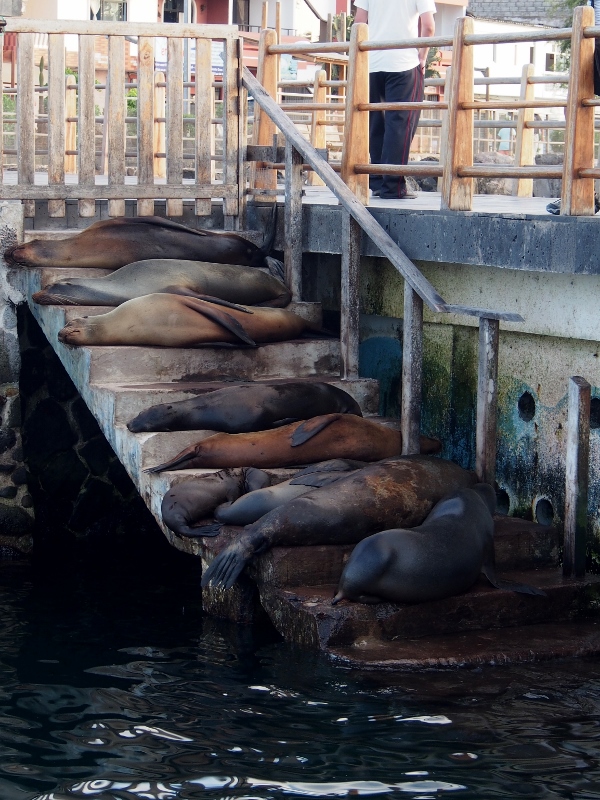
Finally, tired of waiting in vain for the Park official, we hail a water taxi around 5:30 pm to go ashore for dinner, and step gingerly over our hostile looking colony. Ashore they are everywhere: lining the beaches, asleep on the steps by the jetty, zonked out on the park bench. We spend some time watching a tiny baby roaming the beach colony braying confusedly for her mother – it manages to traverse the entire beach, emitting heart piercing cries, but no mother comes forth.
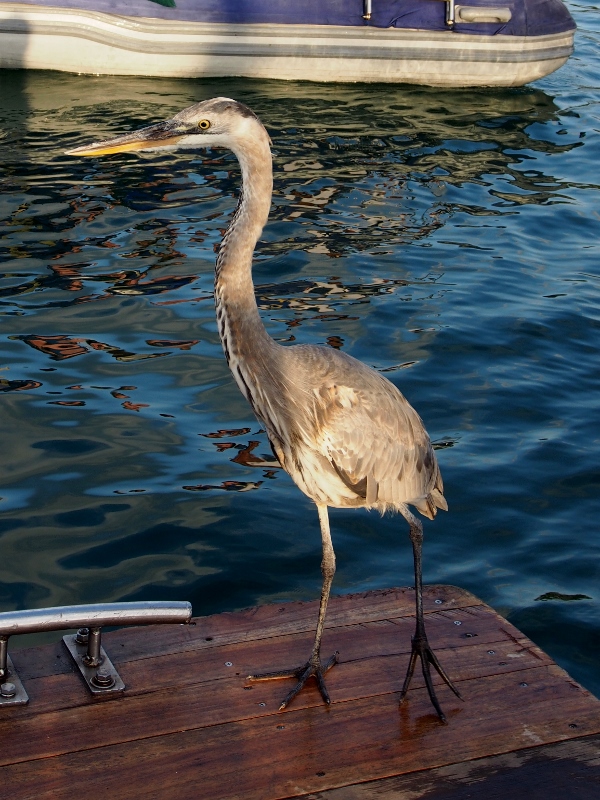
On the jetty a large heron stalks newcomers, and on the rocks lining the beach are black iguanas and Sally Lightfoot crabs catching the last rays before sunset.
It is amazing to be in a place where the animals are, if not in charge then at least given space to be, and it seems impossible that we can’t have that elsewhere – imagine how incredible New Zealand would be if there was space for native birds to roam the streets of towns.
Our first day on passage to the Galapagos is windy and full of wonderful sea life.
Just offshore of Las Perlas we meet a pod of Bryde’s or Minke whales – we can see the sickle shaped dorsal fin and long, dark bodies, as well as lots of tallish blows all around the boat, the closest perhaps 50 m away, and reckon that they’re probably Bryde’s, but could the slightly smaller Minke. The whales huff and puff along with us for a while before disappearing out of sight.
Later on Sarah and Steve spot a huge brown turtle from the trampoline, swimming straight under the center of the boat and coming up in the wake behind. It is hard to know what species, but we reckon maybe it is a large hawksbill.
We catch a mahi-mahi for dinner, and dolphins follow the boat for a while perhaps hoping for some leftovers, before they duck off for a while. Later on they return to join David for most of his evening watch and appear again the following morning.
During the night the wind comes up, and we put a second reef in the main around 4:30 am. Half an hour later the wind is gusting up to over 30 knots and as the autopilot goes crazy David takes over the helm until we have enough light to do a third reef. He manages to coax a whopping 15.4 knots out of the boat before we decide to take the mainsail down altogether, and just run downwind on handkerchief sized genoa, which still sees us reach 10 knots of boat speed.
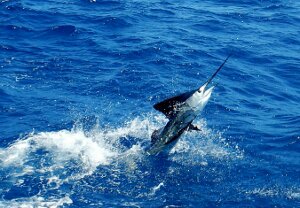
After breakfast, Steve spots a huge dark brown shark just off the stern, and later on when we get a strike on the fishing line and see a big dark shape we reckon that a shark is following our catch. But it turns out that the dark shape IS our catch – a huge white marlin! We are reluctant to struggle with a fish this size only to throw half the meat away when it goes bad, so we decide to let it go, only we’re not quite sure how to get the hook out of its mouth. Steve tries to tire it out and David positions himself on the back steps, hoping to catch a hold of its bill and yank out the hook. But it looks too big for us to try to manhandle it, and in the end we cut the line, hoping that the hook won’t impair this beautiful giant for long.
The water has turned from the muddy brown green Panama sludge to clear blue and we´re back in the the land of wonderful visibility again.
After all the initial wind, we hit the doldrums on day two when there is absolutely no wind at all. We switch on the motor as otherwise we’ll come to a standstill, swept along only by the current.
The sea is oily and slick and the swell rolls along in nice evenly spaced hills of elevated sea, keeping us in constant motion, up and down, side to side.
We take the opportunity to clean the hull of the boat again, and discover 15 new or previously unfound barnacles, which are swiftly disposed off. If we want to guarantee a troublefree entry into the Galapagos, we’ll obviously have to do it again just before entry, they seem to attach so fast. But I guess that won’t be a problem in these windless conditions.
The upside is great calm conditions for viewing sealife. Which in this particular location is dolphins, following the boat just before sunrise, doing acrobatic shows jumping high into the air just before sunset. There must be at least a hundred in the pod, striped dolphins doing a ballet for us.
We´ve been becalmed for two full days when the wind finally comes back. It is great to be sailing again, to be going fast, wind in our faces, spray in our hair.
Not that it’s been bad to stand still, it’s just very very hot when there’s no wind, but we’ve made good use of the time, cleaning the hull again and insect spraying like people possessed.
But now we’re flying again, estimated arrival in Galapagos Sunday morning. We’re not the only ones flying, birds are coming out to greet us, including blue footed boobies and swallow tailed gulls, species only found in the Galapagos. There are only about 2000 – 3000 pairs of the nocturnal swallow tailed gull in the world, and we feel privileged to be greeted by them in bird.
On the last night before arriving, we cross the equator around midnight. The kids were very excited at the prospect and wanted to be woken up, but end up unable to leave their warm beds. The rest of us open a bottle of bubbly and celebrate how far we´ve come.
We finally arrive in San Christobal midday Sunday. Like ancient seafarers, we’ve had many signs that land is near with lots of endemic Galapagos bird species coming to visit. The longest staying visitor was a red-footed booby, which landed on the port bow around 9 pm, and decided to spend the night, perched on the railing, only leaving well after sunrise.
We spend much of the last day cleaning the boat – the hull during a lull in the wind, the deck a while later, and the inside on the morning of our arrival. We are fretting a bit because we have heard of authorities turning away boats recently, and we take great care to ensure we’ve followed all our agent’s instructions.
You pay quite a bit for an agent, but can’t deal with the port authorities without one, and they do make your life easier. We’ve received specific instructions: put up a sign saying ‘Don’t throw garbage in the sea’, sort your rubbish into recyclables, organics and landfill and put up clear signs about what goes in where, make sure the engine room and the hull are both spotless. Have five photocopies of every boat document and passport ready to hand over.
We’ve done it all, and feel nervous if ready as we slowly sail up the coastline.
It’s not only the birds that are friendly:we spot several turtles and playful sealions folow the wake of the boat as we approach. Indeed, the sealions seem very friendly: when we reach the anchorage we spot them perched on the stern of the yacht anchored in front of us, and as we sit there watching we see it clamber into the cockpit…
Can’t wait to come back to one of those after a day out…
Archipelago de las Perlas is stunning if murky. Apparently there are whale sharks, manta rays and humpback whales here, but the visibility is such that even if they were right next to us we wouldn’t have seen them. The whole way from Panama City to Las Perlas we notice patches of reddish brown water interspersed amongst the general green blue stuff so we assume that there are lots of algal blooms going on at the moment. When we meet several schools of brownish rays swimming close to the surface I jump in with a mask on to have a closer look, but find that I can’t see anything – the visibility is about 3m, similar to the pea soups I used to dive in in the UK. Very productive waters creating perfect conditions for large filterfeeders like mantas and whale sharks, but not so good for snorkelling. Judging from the photos in the guidebooks these murky conditions don’t persist throughout the year: most of the photos show white sandy beaches lined with turquoise waters through which you can clearly see the reefs. Perhaps the productivity comes from the shutdown of the Humboldt current which occurs from January to April every year, with clearer waters persisting the rest of the year.
We don’t mind too much as there is still plenty to see. Fish and rays are everywhere, and hundreds of seabirds relentless dive-bomb the sea, creating splashes everywhere along the horizon. We catch an albacore variety and a mahi-mahi on our first day – the albacore has the most blood red meat I have ever seen in a fish. Steve cooks it up for lunch with lots of salt and pepper, and the meat tastes just like a pepper steak. The mahi-mahi is wonderful as usual, seducing even Sarah who normally is not that fond of fish and she pronounces it the best fish she has ever tasted. Hopefully we’ll catch some more of those…
The first night in Las Perlas we anchor in a small bay near a beach which has lots of iguana tracks on it, but we can’t find them even when we return the following morning to see if they are creeping out into the sunshine to warm up. On a snorkel attempt we are attacked by savage blue bottles, and both kids and I get badly stung. The following day Sarah and I don wetsuits, leggings and long sleeved rash vests and clean the hull of the boat on anchorage in five metres of water – we can’t see the bottom, or each other, but when peering closely can just about make out that the hull is relatively clean. David and Steve have both got back twinges from the heavy carrying done when shopping in Panama and so they get to rest from cleaning for a while – we want a totally healthy crew for the passage to Galapagos.
Bob has to be spotless for the Galapagos – upon arrival inspectors will come aboard and check that we are thoroughly clean, have ecological soaps, no insects or vermin, comprehensive rubbish plans with elaborate instructions for separating out organics, recyclables and landfill, and divers will be deployed to check every inch of the hull for organisms hitching a ride. They frequently turn away boats with any fouling on them and our antifouling has never been in great shape owing to a poorly done patch-up job done before we bought it. At some point soon we will have to get the boat out of the water, sand it back down to the fibreglass and reapply antifouling, but we will wait with that until we get to New Zealand. Which means a lot of frequent cleaning to keep stuff off until we pass the test in the Galapagos – the time in Panama City has added several barnacles which we mercilessly knock off. With a thoroughly clean hull we are ready to take off, but we will stop again 40 to 60 miles out from Galapagos and give it another once-over to ensure we pass the test.
It is not only the hull that needs cleaning, the decks are absolutely filthy from Panama smog, and we hose and scrub the dirty footprints off two days in a row to get it back to just ordinary dirt.
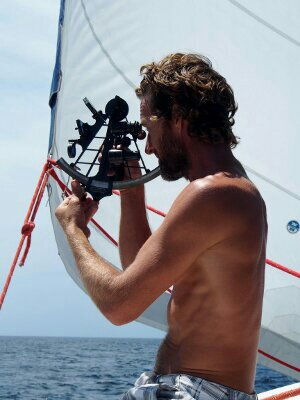
The final morning that we are leaving, Sarah and Steve check the brass sextant from 1933 that David’s Uncle Dave who used to be in the merchant navy passed onto David. We are proud to bring the sextant back to sea, and think much of Dave and Mairwen as we dust it off and practice doing the sightings – it is wonderful to have a treasured instrument like that from close family with us on our first crossing of the Pacific Ocean. Steve plans to practice the sextant navigation on the seven to ten day trip to Galapagos, and then try out some blind (i.e. no GPS) navigation on the three week trip from Galapagos to the Marquesas Islands.
At 9:20 we set off in buoyant spirits, clean boat and excited crew, ready for the long passage to the Galapagos. The weather forecast is for good breeze the first 24 hours but doldrums interrupted by thunderstorms after that – the typical weather pattern for this part of the world in a weak El Nino year like this one. Hopefully we’ll get some wind, but I guess we can always jump in and clean the hull on a quiet day…
On the passages, we can only update the blog via satellite link, which means few if any pictures, but there normally isn’t much to take pictures off anyway when we’re underway. We’ll aim to keep posting updates of our progress every few days.
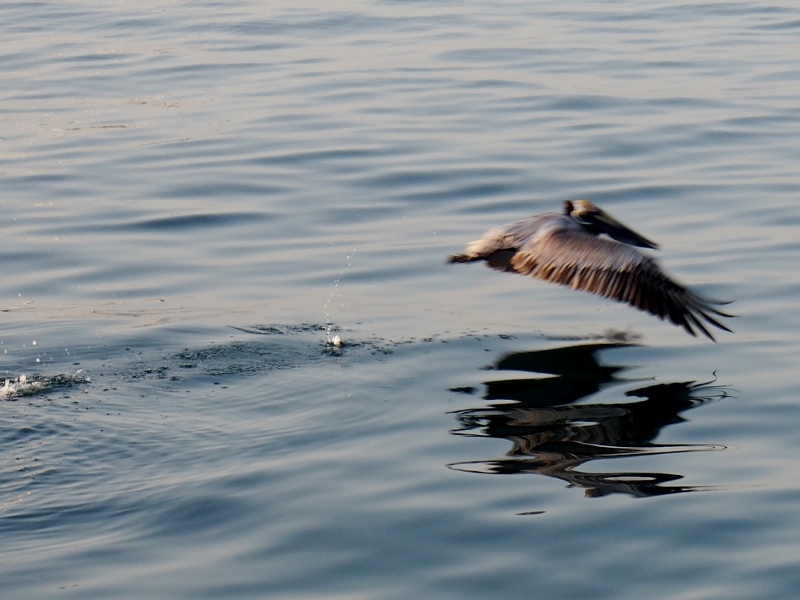
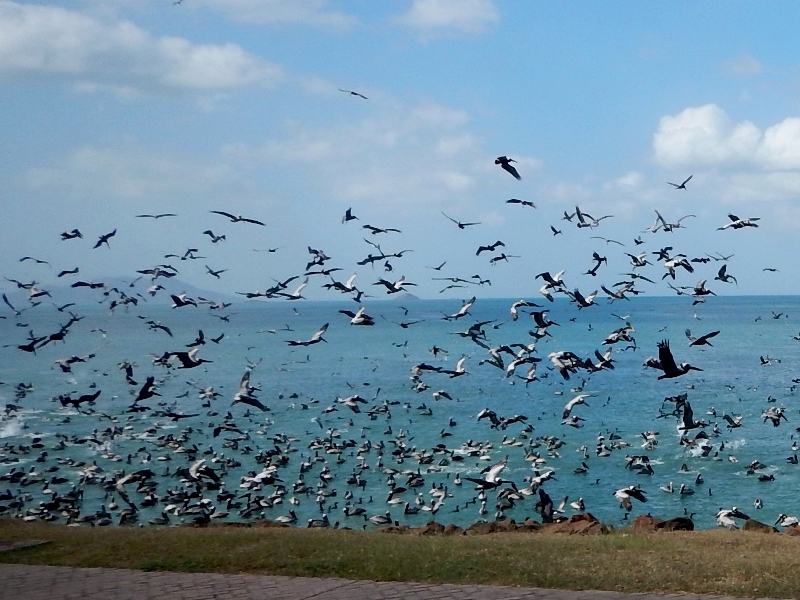
Panama City is full of pelicans. They are everywhere. Apparently half of the world’s population of brown pelicans live along the Pacific coastline of Panama, a fact easy to believe when you see them swarm in the air and flock on the rocks. They bob gently up and down in the water next to the boat at the anchorage, seemingly asleep, only to get overtaken by a sudden burst of energy, flapping their powerful wings a couple of times and soaring high up into the air. When just cruising they glide only inches above the water surface admiring their mirror image hovering below. When fishing they fly higher, darting first one way then the next, taking a sharp downward turn when spotting prey pointing the long beak and plummeting into the water with a huge inelegant splash, extending their neck back up to gulp down their catch.
Ready to landTaking off…
There are other birds here too – cormorants, seagulls, ducks, frigate birds and lots of others we can’t easily identify. Under the water’s surface rays chase up the little bait fish and boil-ups erupt here there and everywhere around the boat, attracting the diving birds.
There are downsides to the pelicans – one lands in the child netting just next to us as we’re sitting chatting after dinner one night, a huge longbeaked beady-eyed monster staring at us up threateningly before falling backwards in the water. Another couple successfully manage to cover the boat in their liquid, brown, fishy smelling poop as they fly overhead, the children ducking for cover, shouting ‘Pelican poo, run!’.
Hopping out of the water
We have a fair amount of provisioning to do, and take the bus to a huge mall where you can anything the materialistic heart desires, including the vast quantities of food that we need to sail across the Pacific. A fraction of a typical shopping list: 25 kg of pasta, 29 kg of rice, 50 litres of milk, 200 cans of beer, 140 litres of water, 100 oranges.
Flocking
After all the fretting about the starboard engine, it seems to have healed itself in that curious way that these things sometimes do. We test it thoroughly, and find no fault with it. Reluctant to tamper in case that makes it worse, we decide to leave it be, and hope for the best.
Should have been a pelican
On our last day we visit Casco Viejo, the old city, which dates back to the early 1700s where the city was rebuilt in a new location after the pirate Henry Morgan sacked the previous one. Large parts of the city has been renovated, and the old buildings are shiny and stunning, the jewel amongst them being the Cathedral, Iglesia de San Jose, which is simply wonderful.
From Iglesia de San Jose
Panama is an incredible country. Treating it like just a necessary evil on the way from the Atlantic to the Pacific we weren’t expecting much other than mosquitoes, heat and dirty big city hassle. But it has proven to be a wonderful place – the beautiful San Blas islands on the Atlantic side, the dense jungle adventures in Shelter Bay, and the beautiful old town in Panama City.
We would like to stay longer – there is much we didn’t see. Laden with supplies and low in the water, however, Bob the Cat is ready to move on. Tomorrow we are leaving for the Las Perlas islands 30 nm off Panama City, where we’ll spend a night or two before our onward journey to the Galapagos Islands.
Just over a hundred years old, the canal stretches 80 km from Colon on the Atlantic side to Panama City on the Pacific side, providing a convenient shortcut for the around 13,000 vessels per year that pass through it. The Canal consists of three double locks on each side, taking vessels up 26 m to Lago Gatun, a large artificial lake created in the middle.
The Panama Canal
The canal was started by the French in the 1880s, but the project was abandoned when it became clear how difficult it would be to carve a canal through a continent overgrown with jungle. At this stage it is estimated that approximately 22,000 workers had lost their lives mainly from yellow fever and malaria. Costs had escalated and it was clear that the original plan of carving a canal at sea level was going to be prohibitively expensive. In 1905 the Americans took over the project, created an artificial lake in the middle and designed and built the double locks that carry ships up to the lake level.
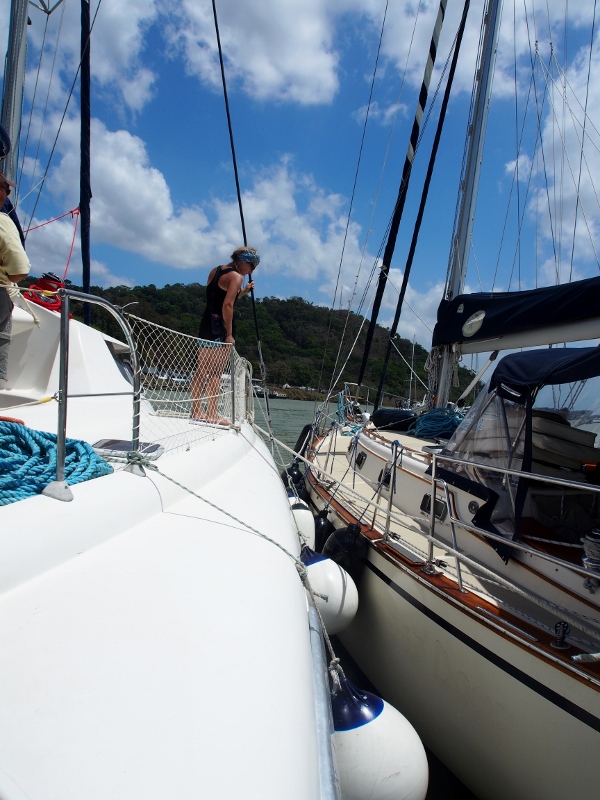
For those passing through the Canal, the tricky part is the locks, or rather avoiding hitting the concrete walls or other vessels whilst in the locks. During lock filling and emptying boats are kept in the middle by lines affixed to either side of the canal, with line handlers on the boat adjusting the tensions on the lines to keep it in the middle. Small boats are required to raft together to save space so that each lock can be filled as best possible.
Each vessel passing through the canal has to have an official advisor on board, as well as four line handlers in addition to the skipper. The advisors are assigned by the authorities and board vessels prior to entering the canal. The line handlers can be crew or you can hire them.
We take off about noon from Shelter Bay Marina on the Colon side, after a busy morning getting ready with last minute supplies, obtaining the heavy duty lines and fenders required for the canal, and meeting Dave, an cattle rancher from Wyoming who has kindly agreed to help us line handle. We have to be at ‘The Flats’ close to the canal entrance at 1 pm where our advisor will come on board and tell us when to go and where.
Cowboy Dave is a useful line handler – this is his third canal crossing, making him vastly more experienced than any of us. He flew out from the States at the beginning of February to help a friend through the canal, and has gone through an additional two times since just for the fun of it.
Lock line thrower
As soon as we exit the marina it becomes clear that there is something gravely wrong with the starboard engine. It starts fine, but won’t go into gear at all. Which means that we have quite restricted maneuverability, and Skipper Dave thinks that we may struggle to keep up to the 6 knots of boat speed that we signed up for (they schedule you according to the speed you can make, and won’t allow vessels to drop below 5 knots). Rather than turning around and wasting all the money we’ve already spent on canal paperworks we decide to continue to The Flats and see if we can troubleshoot it on the way. With the wind behind us, if we push the port engine to the max, we can make just above 6 knots. But it will be hard to keep the boat safe if we can’t use both engines – a catamaran easily gets blown around, and with only one engine we won’t have as much control as we’d like. Cowboy Dave happens to know a bit about diesel engines, and he and Skipper Dave soon diagnose a slipping clutch. It seems we only get a little bit of forward thrust from the engine, but it works fully in reverse. Which is a relief – if we can reverse with both engines, we can manoeuvre reasonably well.
After much discussion we think it is safe to enter the canal and decide not to tell the advisor about being down an engine unless they are rafting us up in a configuration that we think may be dangerous.
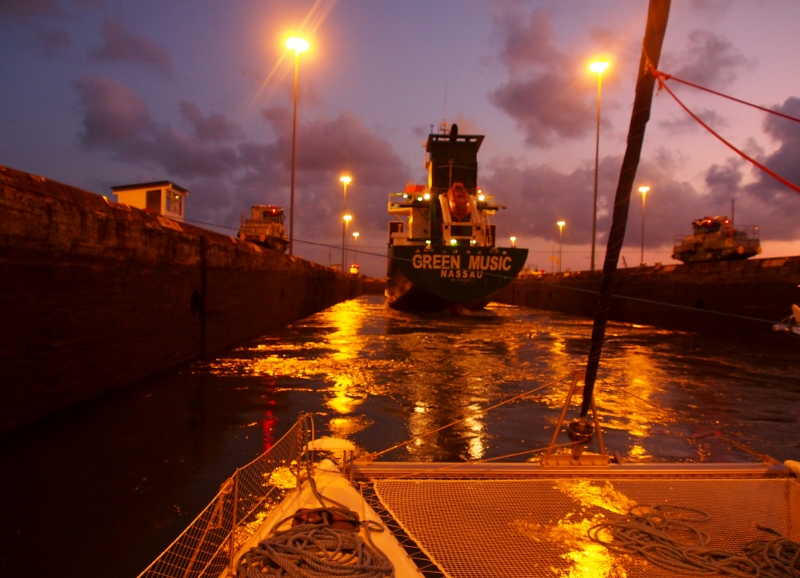
When we look up from these intense discussions we see that there are quite a few yachts anchored on the flats. Whilst we’re waiting for the advisor, the some Dave knot nerd bonding goes on: Cowboy Dave demonstrates his backwards bowline and butterfly rope coiling technique and Skipper David shares his Portuguese bowline. Roy the Advisor finally arrives to disrupt some jolly rope tying and engine fretting, and points out the larger vessel that will be in the lock with us, a green monster with ‘Green Reefer’ painted on its side and ‘Green Music’ on its back; hopefully the skipper is sober. On the way to the locks it is decided that we and a small American keel boat full of young Israelis will raft up either side of a large motorboat.
Lago Gatun
It is strange to be rafted, but at least next to a large powerboat we don’t have to worry about our engine, he’s got enough power to drive for the three of us. It turns out that we don’t have to worry about the line handling either – the powerboat is so large that they are best placed handling the lines. Guys on the docks throw us monkey fists, thin lines tied up in a decorative knot which we then tie to the larger lines that we’ve hired. Apparently the line throwers get extra points for hitting crew or solar panels so we duck behind the matresses we’ve strapped to the panels for the purpose, grab the lines as they settle down, and pass them on to the hired line handlers on the powerboat.
Green Reefer in the night
Once the four lines are tied onto the walls, the gates close behind us and the lock fills rapidly, the line handlers pulling in rope slowly to ensure that our raft stays in the middle of the lock. When full, the lock opens ahead and we drive into the next one, which rapidly lifts us an additional 8 m above sea level. It is dark once we’re through all three locks, and we untie from the raft and motor to the mooring on Lago Gatun where we’ll spend the night. I’m rushing to finish dinner so that it is ready – you’re supposed to feed your advisor, but Roy politely declines and jumps onto a pilot boat as soon as we’re tied up to the mooring.
To ensure that they would not get in the way in case all adults needed to line handle, we’ve hooked the kids up to a DVD on the computer – the first one they’ve had since we’ve been on the boat. It works: they come out to have a look while we’re in the locks, but spend the rest of the time howling with laughter at Winnie the Poo.
Plugged in
The evening on the lake is wonderfully quiet and we all have a good sleep. The following morning we get up early in anticipation of a new advisor coming on board at 6:30, but he doesn’t arrive on time and we have time to get to know the Israelis who are tied up to the same mooring. They and Cowboy Dave share stories about the US Coast Guard turning yachts away from Cuba.
The lake is huge, with an intricately curly shore of dense jungle dropping straight into the lake. On previous trips through the Canal Cowboy Dave has seen sloths in the treetops and Sarah eagerly peers through her binoculars as we motor along the lake shore but sees none. There are thousands of birds – pelicans, frigate birds, and some small grey and white things, all plummeting into the lake waters for fish. The water starts out blue green but as we get into the narrower section near the Pacific lock end, it goes a deep muddy colour.
Sloth hunting
Our second advisor, Oscar, is just as nice as Roy and considerably hungrier. I spend most of the morning preparing teas, coffees, scrambled eggs, coffees, teas, cookies, coffees, teas, lunch, coffee, tea and more snacks. The motor boat went all the way through the canal the night before, so we raft up only with the Israeli boat and enter the first lock going down towards Lago Miraflores and the last two locks. It is weird going down, the locks empty quickly and Cowboy Dave and Steve do some expert line handling on the port side keeping us safely in the middle of the lock, the Israelis handling the starboard lines.
Rafted up
And then suddenly it’s all over, and we’re out of the locks. We untie from the Israelis, heave a sigh of relief and motor slowly on our port engine towards the anchorage in front of Panama City. We’re back in the Pacific, and a straight line on the chart plotter shows only 6500 nautical miles to New Zealand. It’s wonderful to be back in our own ocean, now all we have to do is to provision, and then of course the small matter of fixing the starboard engine clutch…
Cowboy Dave stays another night and tells us stories of his incredible travels, hunting in Mongolia, sheep shearing in New Zealand – what fantastic adventurers one meets when travelling. We are sad to see him go when he leaves the next morning but who knows – maybe we’ll visit him in Wyoming one day…
The Kuna Yala (San Blas in Spanish) island group is a vast archipelago on Panama’s Caribbean coast, consisting of more than 340 islands. This vast island group is home to the Kuna Indians who have managed to preserve their culture and traditions the best out of all the tribes in the Americas. The Kuna govern the island group autonomously and have very strict rules to keep their culture intact, including a complete ban on foreigners settling there or intermarrying into their community. They welcome yachting visitors, but have rules around the interactions and what visitors are allowed to do. No gathering of lobsters or shellfish, no scuba diving, no gathering of coconuts, and the payment of fees if you want to set foot on the islands.
Steve on deck
The islands are generally small, with sandy fringes and densely covered by coconut palms inland. The water is crystal clear and full of fish and turtles. We do an overnight sail from Shelter Bay Marina to the eastern part of Kuna Yala and anchor at Holandes Cays in a sandy bay amidst a group of small uninhabited islands.
Lukie
The snorkelling here is great, with vast seagrass beds surrounding the small islands, and an outer coral reef lining the cays. Lukie, Sarah and I venture to the outer reef, but the current is swift making it almost impossible for Lukie and I to keep our ground. The more he clings to me, the greater our drag (he wants to sit on my back, which doesn’t really make us very hydrodynamically streamlined), the faster we are swept downcurrent. But we manage to see some pretty corals and nice fish before we give up and drift back to the boat. On the way back we see a large green turtle with two remoras attached, one on its head, one on its back. Pretty similar to my swimming experience with Lukie, only without the family connection and the unconditional love that comes with it. We also see a ray, with a fish shadowing it – wherever the ray goes, the fish swims too, hovering on top of the dark shape of the ray.
Matias has gotten the cold that Alex was getting over, and has a feverish first day in Kuna Yala, spending most of the day in bed. Poor thing – it is incredible how children pass these things on – they haven’t had a cold since we left the cousins in England, and as soon as they interact with a child that has the remnants of a cold, they get it.
When the local family come by in their little boat, we buy the beautiful molas they sell, fantastic embroidery that is the signature of the islands. We are pleased to support the local economy, and the molas will look great on the boat, cheering up the dark wooden walls of the cabins. When another boat comes by asking for water we fill up their tank. After months of speaking French, it is strange to now switch to Spanish – French words keep propping up in my head, and I have to make a real effort to suppress them and focus on the Spanish.
The next day we go to Dog Island to snorkel the wreck of a cargo ship that sunk just off the little island in the 1950s. In just 3 to 6 m of water, the wreck is beautiful, teeming with fish, corals and sparkling red and orange sponges. In the afternoon we head off to the nearby Chichime Cays, where we snorkel some more, spotting rays, cuttlefish and lots of groovy corals.
We are relieved to report that the fishing luck continues in Christophe’s absence. On the morning we arrive in San Blas we catch a black fin tuna first thing, and the next day we get a Spanish Mackerel on our way from Dog Island to the Chichime Cays. Lukie reels in the Spanish Mackerel, eagerly asking for ‘mushimi’, his word for the sashimi that we eat immediately after catching a fish. We feast on beautiful fish for dinner both nights, and feel lucky.
Lukie with his mackerel
Early on Friday we set sail to go back to Shelter Bay, and we have a pleasant day sail back, with lots of flying fish, boobies, and a couple of strikes on the lure (but no catch). We arrive late afternoon, relaxed and ready for the canal.
In Shelter Bay Marina, we bid Christophe farewell, and welcome Sarah and Steve on board.
It takes a couple of days to get the paperwork to go through the canal. We have engaged an agent who takes care of getting us through immigration, obtaining our cruising permit so we are allowed in the canal, and engages a boat measurer to ensure that we really are the size we say we are. After a couple of days of waiting the measurer turns up, and finds that we are 47 foot (inexplicable growth – we’re only supposed to be 46, but it doesn’t make any difference as long as we’re below 50), and we are given a transit date of 21st of February.
Leafcutter ants
There is plenty to do while we’re waiting. Like shower – I cannot describe how incredible a hot shower is after three months on a limited water supply on a boat. We wash and wash and wash, and when I comb my hair a whole handful comes out. I’m hoping that will help with the frizz, but unfortunately there is still plenty left.
Jungle
Next to the marina there is a bit of jungle, which hides a dilapidated old military fortress (Fuerte Sherman) built by the Americans in 1911 to help them defend the Atlantic side of the Panama Canal. The site was later used to train American troops for jungle warfare in preparation for the Vietnam War. It is an eerie place: deserted military buildings, including what looks like prison cells, overgrown by lush green jungle about five stories high, vines crawling up the walls, bats residing in the long dark corridors inside, spiders adorning every nook and cranny. It is like a scene out of Lost, set to the soundtrack of frustrated howler monkeys who groan, shout and moan like a zombie army. In the jungle we go hunting for sloths and find some monkeys and a toucan, the latter emitting an unusual sound that I guess I from now on will know what is. There are also flocks of birds of prey, gliding overhead looking for easy prey, eyeing up Lukie as he crawls up the overgrown steps of the ruins, marvelling as he is at the beautiful black and green butterflies, as well as armies of leafcutter ants, slogging uphill with their loot all day.
Eerie army ruins
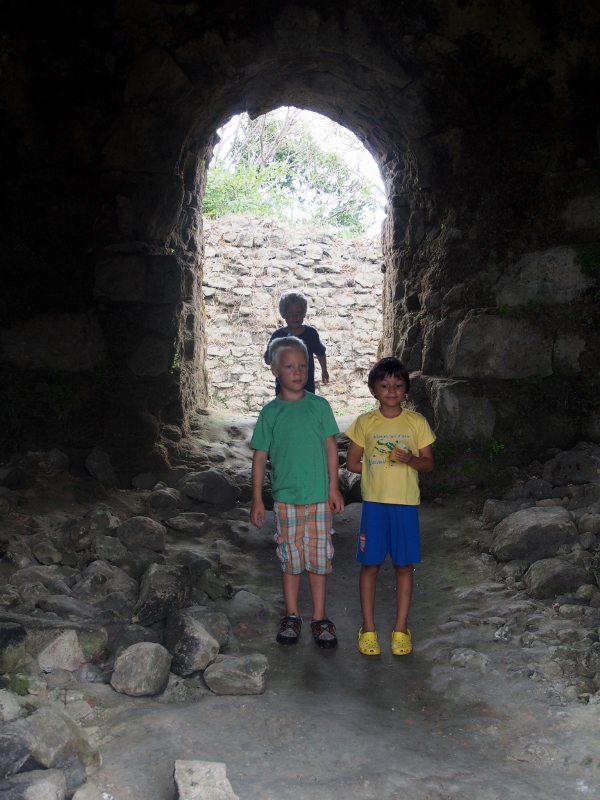
In the marina we meet Alex, who is six and has lived on a boat for a while. He and his family are heading to Australia, so we’re likely to meet up again and again on the way across the long Pacific. His first words to us are ‘I’ve got Lego Starwars’, and as a result he is enthusiastically welcomed on board by the boys. Soon he, Lukie and Matias are inseparable. They play in the pool, on the dock, on each other’s boats. On Matias’ birthday Alex comes over for cake and then comes on a trip to Fuerte San Lorenzo, a World Heritage Site built in 1595 when the Spanish wanted to protect their Caribbean coastline against the onslaught of pirates. The Fuerte is a picturesque site, situated on the steep banks of the Rio Chagres, overlooking the entrance of this strategically important river to the Caribbean Sea. The fort was the site of many a battle and was frequently conquered by the English: in 1596 Francis Drake seized the fort, and Henry Morgan took it in 1671 on his way to burn down Panama. The Fuerte is in the Parque Nacional San Lorenzo, a beautiful national park with lots of wildlife.
Visiting ruins
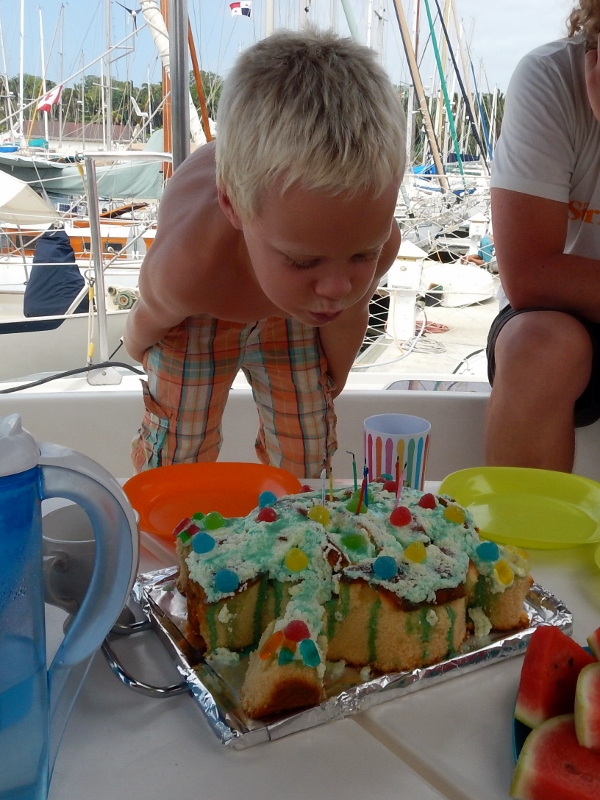
Matias has a good birthday. He gets lots of books and art supplies for presents, as well as a large Lego Polar Explorer with polar bears and huskies pulling a sled. We bought it for the wildlife and the huge icebreaker, and are embarrassed to discover that the purpose of the expedition seems to be polar mining! So we chat a bit about how some places are best left wild, and Matias sets about adding more lights to the icebreaker so that displays the correct lighting for a vessel of its size… He is stoked to have new books and new Lego and keeps telling us how pleased he is with all his presents, saying that he is almost jealous of himself!
Birthday boy hovering over melting cake
Once we have the date for the canal crossing, we decide to go for a quick trip to San Blas to have one last swim before the canal crossing and the long ocean passages thereafter. It has been nice to be at Shelter Bay marina – it is the first time we’ve been in a marina, and it has been great to meet other cruisers and get to know more people. There are lots of families with children of all ages here, and it is great to talk to people who are in the same situation as us. We discuss homeschooling, safety on board, nutrition on passages, and share tips, charts and books. Some of the children have been living most of their life on boats – they’re the ones you can find crawling up the mast at 7 am in the morning, or speardiving for crays on anchorage. They are all great kids, and it is lovely to meet them and their parents – so many exciting, alternative lives, so many stories…
We have a lovely but quite slow voyage from Aruba to Panama. Quiet seas, little wind, but on the upside no seasickness. Nice and relaxing, if a tad slow – but a thousand times better than the horror stories that we have read about that stretch of sea, so we consider ourselves lucky.
Sun rising over a quiet sea
Christophe continues to bestow upon us incredible fishing luck. Each morning he gets up, stretches languidly and announces which fish he would like for dinner. And then, during the day sometime, we catch the species he was after. First we land a decent sized yellow fin tuna, and then a massive wahoo, at 1.3 m measuring about the same as Matias. (It possibly isn’t Christophe, could be the new lure, but whatever it is we are not complaining.) Out shopping mission in Aruba found the supermarket closed, so we didn’t stock up on any fresh protein. With Christophe on board we have worked our way through the edible species, with a tunny, a spearfish, and rainbow runner, a tuna and a wahoo. Occasionally it goes wrong, like when he asks for a dolphin fish (mahi-mahi) and we see dolphins, but you can’t expect complete obedience from the ocean…
We see incredible fish boil ups coming off Aruba in the sunset, flocks of birds hovering above water in turmoil, large fish literally jumping out of the water, the prey of something huge or the predators of something small, we are not sure which.
Seas in turmoil
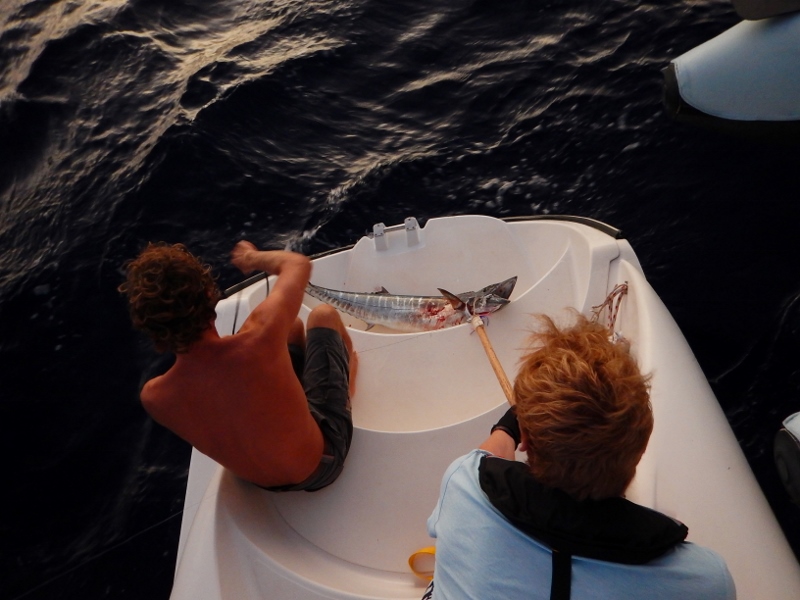
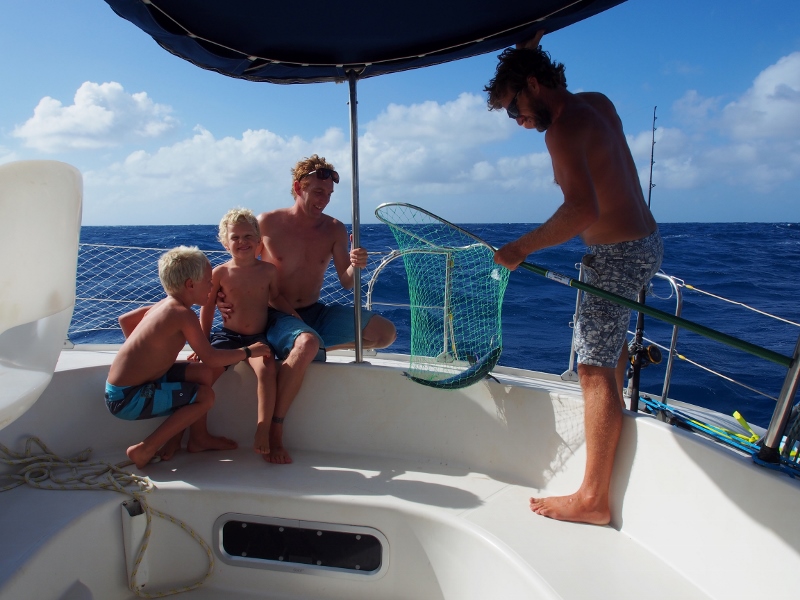
We have the fishing down pat now. As soon as we hear the reel go, someone shouts ‘fish!’, and the action starts. I slow the boat down, turning it into the wind and taking in the genoa, Christophe helping. David reels the line in. The kids get the fish knife, the net, the gaffe, the white rum to kill the fish (pouring it down the gills leads to what we hope is a gentle death). Christophe dons the lifejacket, the leash and the gloves, and climbs down to the lowest step, hooks himself on, and gets ready to gaffe or net the catch on board. After butchering our first couple of catches in the cockpit and cleaning up blood and fish guts from the lockers for a good hour afterwards, we’ve moved the cleaning to the back step, which seems to work well in these small seas anyway.
Wahoo!
The problem with fish is that we need to keep them very cold. The wahoo is so big that we bag it in binbags, each fillet weighing about 7 to 8 kg. It is hard to keep 15 kg of fish just above freezing temperature, and we have to run the engine a fair amount to keep ice on the elements.
The kids are well settled into the routine of passages. They do their homeschooling early in the morning with me while I do the dawn watch, and the rest of the time they draw, play, and participate in boat life. Their play centres heavily around fishing, they draw endless cut out fish figures and lures, re-enacting all the excitement of our recent catches. Once they’ve finished catching the fish we hang them up on Matias’ Wall of Fish, a catalogue of fish which adorns the corridor wall near his bed.
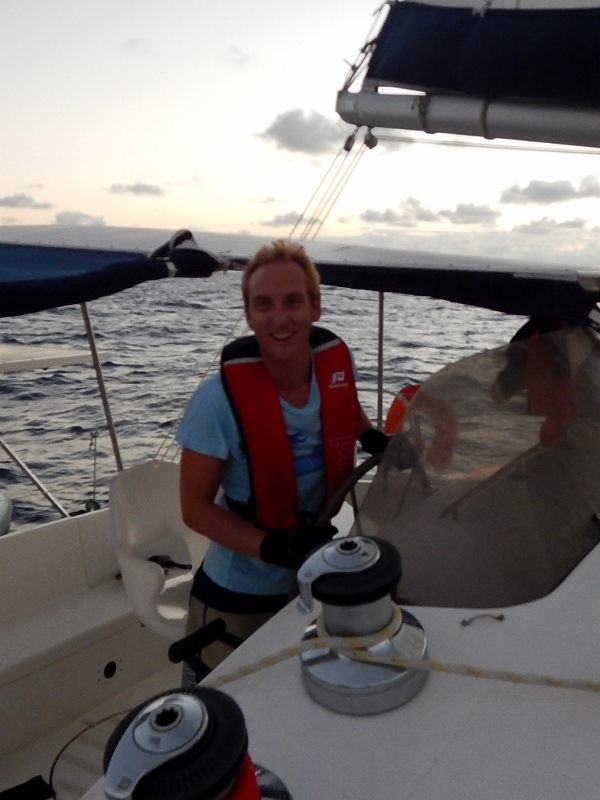
Christophe driving the boat
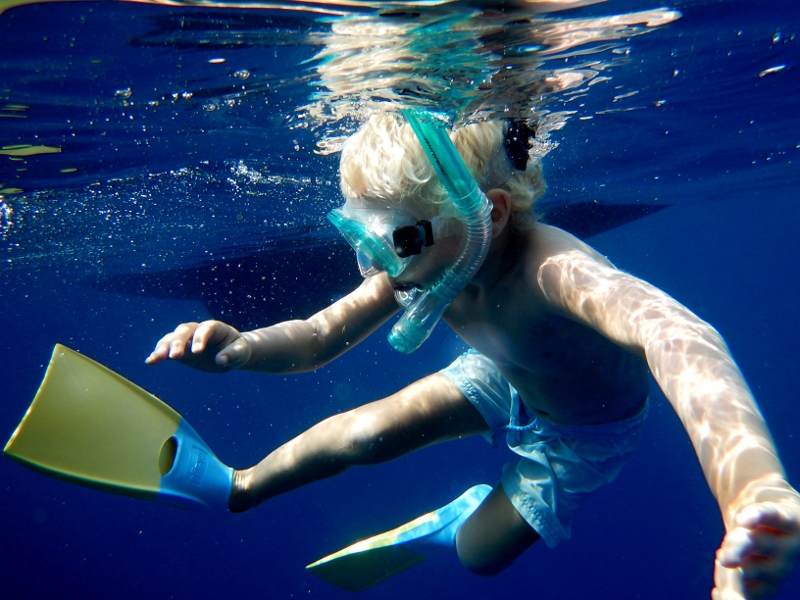
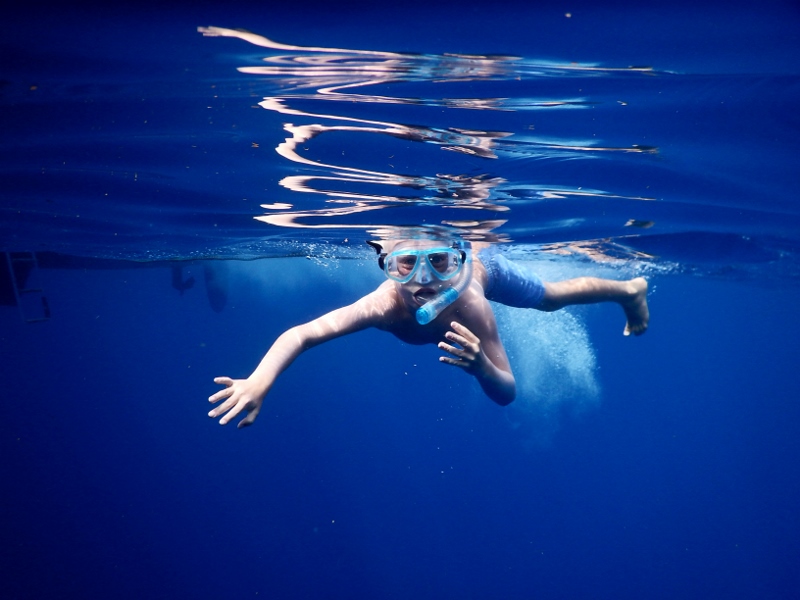
The wind is very light, and in the beginning we fear that we won’t be able to get Christophe there in time for his flight. The third day is completely windless and we turn on the engines and motor through the oily slick water. After lunch we stop for a swim, peering into the eerie blue of the thousand metres of water below us. On the water surface small triangular shapes are blown towards the swimmers, tiny Portugese Man of War jellyfish sailing across the ocean. They can sting nastily, so everybody jumps out of the water quicksmart.
Lukie in the deep end
Matias in the deep blue
While motoring along later, David hoses down the kids while they are jumping on the trampoline using the salt water pump, keeping them entertained and cool.
Cooling off on a windless day
It is a long time to go without land, but we don’t feel boat fever, spotting the landmass of Columbia from time to time as we sail along. For most of the passage however, we are surrounded only by the sea, clouds, and the beautiful rising and setting of the sun and the moon.
Sunset
All that peace is rudely interrupted on the approach to Panama. It is around 2 am when the radar screen starts displaying a lightning show of vessels, some stationary, some moving. We are too early in our approach and decide to heave to out by the offshore anchorage, to wait for sunrise before we attempt the approach through the breakwater. Huge ships lie anchored here, presumably awaiting permission to transit the canal. At first light we head in and find Shelter Bay Marina along the northern end of the breakwater. They don’t respond on the radio so we find a berth and tie up, exhausted to the core from the sleep deprivation of passages.
Now all we have to do is to find out how to transit the canal and get the necessary permissions.
We end up spending three days in Aruba, leaving before nightfall on Sunday 8th February. Initially we were planning to leave on the Monday, but the forecast is for very light winds on the passage to Panama and we want to get a head start before the winds drop. Waiting for good winds is not an option; we have to make sure Christophe is in Panama for his online flight on the morning of the 14th.
Aruba customs dock
When we first arrive it is so windy that we consider deploying two anchors, but we find a relatively sheltered spot and decide to stay there for the first night so we can go to town and find a supermarket. The large spearfish is still feeding us for one last fish curry, and we manage to find some fellow sailors to gift some bags of fish to, to reduce the waste. It is not easy to keep the refrigerator running enough to keep fish, and we had to turn the engine on to recharge the batteries to keep it cold enough on the way here, leading to a domestic role reversal. Normally David is after me like a hawk asking me to turn down fridge time, but, eager to keep his catch cold, he suddenly wants to run it around the clock. The sausages in there must be resentful about being considered unworthy of fridge time; in protest they decide to go off. I’d provisioned meat for four evening meals and so far we’ve only used meat once because of all the fish we’ve caught, so I suppose it’s inevitable that some will go off.
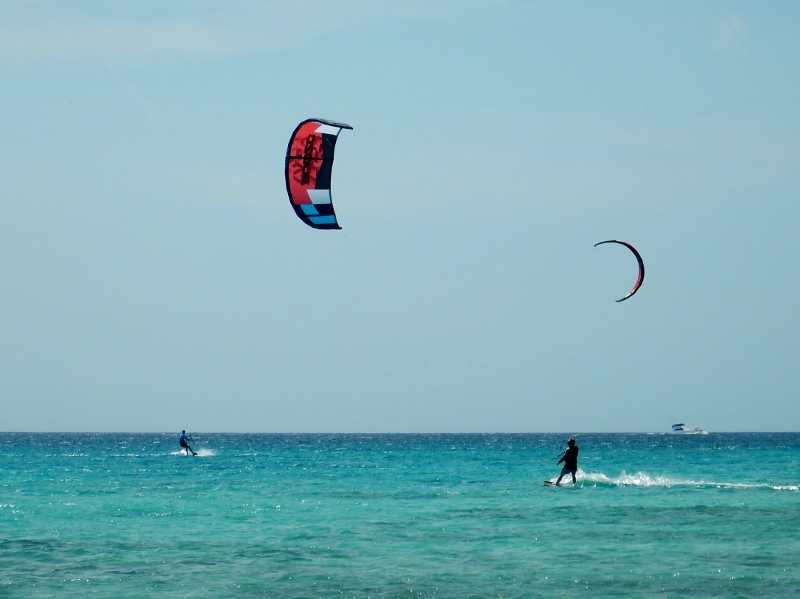
The day after arrival we move to Arashi Bay on the northwestern side of the island. The kids are enjoying access to land again, and they spend hours playing on the beach with their boogie boards, snorkelling gear, and the various local and tourist children around. Christophe, David and I take turns kitesurfing, all enjoying getting some exercise. Being very windy most of the time, Aruba is a sought after spot for wind- and kitesurfing, and we fully enjoy the vast expanse of turquoise water just next to the golden beach, even if the winds are a bit gusty.
Surrounded by ArubiansGilded lions in Oranjenstad
Aruba is quite different from the other Caribbean islands that we’ve visited. Just off the coast of Venezuela, the island was first settled by a tribe of Arawak Indians from Venezuela called the Caquetios who migrated here around 1000 AD to escape attacks from the fearful Caribs. The Caquetios lived peacefully on the island for centuries, isolated by the big distances and strong winds from the remainder of the Caribbean but keeping strong cultural links with what is now Venezuela. The first Europeans to spot the island were the Spanish, who plundered it for slaves to ship to Hispaniola but otherwise established no real presence. In 1636, near the end of the 80 year war between Spain and Holland, the Dutch took possession of the island. In contrast to the volcanic islands further north in the Caribbean, Aruba was a riverless, sandy coral island with no arable land, so sugar plantations were never established and no African slaves were imported. In 1824 some gold deposits were discovered on the island, and a boom of gold mining kept the economy of the island going until 1916 when the mines were exhausted. Soon after, oil refineries were established on the island, and Aruba prospered from the refining business until the mid-eighties. The island also saw a steady increase in tourism from the 1950s onwards, with several luxury hotels built in the 1970s and 80s. Nowadays, the tourism industry is booming, with visitor numbers increasing annually, and Aruba is prosperous compared to most of the islands we’ve visited further north. The island is part of the ABC group (Aruba, Curacao and Bonaire) governed by Holland, and like St. Maarten, Aruba is recognised as a separate country within the Kingdom of the Netherlands.
The feel of Aruba is very different to the Caribbean islands further north. Just 29 km north of the Venezuelan coast, there is a strong Latin influence, and most people look South American and speak Spanish. There are no black Caribbeans here but plenty of descendants from the Caquetios, who initially were described as giants by the Spanish because of their tall stature. The tourists are mainly American and Dutch who come here for the endless sunshine, lack of hurricanes, turquoise clear waters, and steady winds for windsports. Because it is so out of the way of the rest of the Caribben there are few yachties here and we count less than twenty boats. We are here as a convenient stop for some kitesurfing before Panama, and the the other boats we meet are on their way to cruise Columbia.
The waters are clear and teeming with fish and we effortlessly catch a rainbow runner on our way to the kite spot, which we unfortunately are forced to ditch after establishing that they have ciguatera in Aruba. Ciguatera is a toxin which accumulates in fish higher up the food chain near coral reefs, and although rainbow runners are mainly pelagic predators and so at a low risk of accumulating toxins, they are still considered potentially risky. Some people we meet here have eaten the local barracuda (a fish generally avoided because of its ciguatera risk) and we gather that the risk is low, but still decide to err on the side of safety, not really wanting to add poisoning to the potential woes of our next crossing. Not that we can necessarily choose to avoid all toxins: the Aruban dump is on fire, spilling thick, black smoke over the horizon.
On anchorage at night the boat is surrounded by squid, who gather by the lights, and we are annoyed not to have a squid jig. Spurred on by our fishing luck, David and the kids spends most of our last morning in Aruba snorkelling for conch, but they have no luck. Fish everywhere, but no slugs.
We pull anchor around two and head back to Oranjenstad to find a supermarket and check out of Customs, and head into the sunset on our way to Panama just before nightfall.
As there is plenty of wind the trip from St Martin to Aruba ends up taking just three and a bit days.
We ease Christophe into it on the first day, flying only the genoa and taking it nice and slow, trailing the fishing lure behind the boat. We get plenty of strikes: the first two barracuda, and then a Little Tunny. The tunny is not quite big enough for dinner for all of us, so we throw in the lure again, and soon a huge mahi mahi bites. I slow the boat down, David starts reeling in the fish, and Christophe is perched on the back step with a big net and a gaffe, ready to land it. The net is too small for the fish, so they decide to try to grab the line and just throw it into the cockpit, because mahi mahi are famous for jumping off a gaffe unless it is embedded in just the right spot. But the fish is strong, and the line is sharp, cutting their fingers to shreds. After a long struggle the fish manages to leap off the hook and swims away. Bitter disappointment is followed by a long discussion about what we can do to actually land a fish that size next time: net handlers should wear gloves, hit the fish hard with the gaffe, or just grab the line and throw the fish into the cockpit.
The tunny
Luckily we still have the tunny, so there is still fish for dinner. It doesn’t taste great, but we dutifully eat it whilst discussing the one that got away. The taste is not improved by the lack of lemon – the boys used all our limes on T-punch the first night, leaving none for fish.
The next day, Christophe announces that he had a vision during the night, and that he now knows how to land the giant fish that we will surely catch. All day we troll, and about three o’clock I give in and make a beef stew. Just as I’m putting on the potatoes for the mash, excited shouts greet me from the cockpit – another fish! This one is huge, and we stuff around for most of an hour trying to slow the boat down and keep the direction in the 3 metre waves, reeling it in bit by bit, until it is finally close enough for us to make out that it is some sort of spearfish, huge, jumping out of the water.
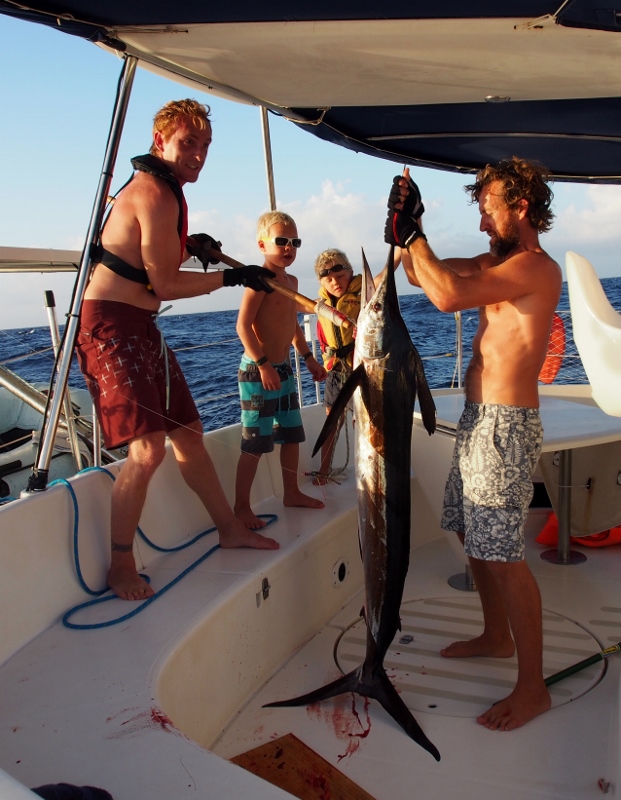
All the excitement of fishing is a bit much for Matias, who bursts into tears as we’re reeling the fish in, worried as he is that the fish will win and pull Daddy or Christophe over the side. He helpfully goes inside to fetch the scissors so that we can cut the line if we have to. We are all pretty convinced that we won’t be able to land it, but Christophe is calm and confident, having practiced the moves in his dreams. And sure enough he gaffes it, and David pours half a bottle of rum into its gills, killing it instantly. At about 20 kg it is an impressive fish, which will feed us for days.
Our biggest fish yet – enough food for days
On the third day, the wind comes up, the sea is big, and the sailing becomes exhilarating. Always a racer, David tries to improve our top speed on the log and gets up to an impressive 12 knots, before he puts it back on autopilot. The autopilot takes up the challenge, and effortlessly hits 12.4 knots on my night watch. Not one to be beaten by a machine, David gets it up to 12.7 shortly after sunrise. As the wind comes up the autopilot trumps him with 13.5, after which he takes the helm again and reaches 13.7, surfing down a huge wave. At this stage I insist on a third reef in the main, and we lower the speed to something more sensible.
As always, the boys are amazing. They handle the passage well, not frustrated by the lack of land, but rather excited to play endless card games with a patient Christophe. We are all seasick the first couple of days, and spend all our wakeful hours outside, but by day three they are well enough to do some home schooling, most of which we do as part of our card games. On the fourth morning they are playing inside and seem to have fully adjusted.
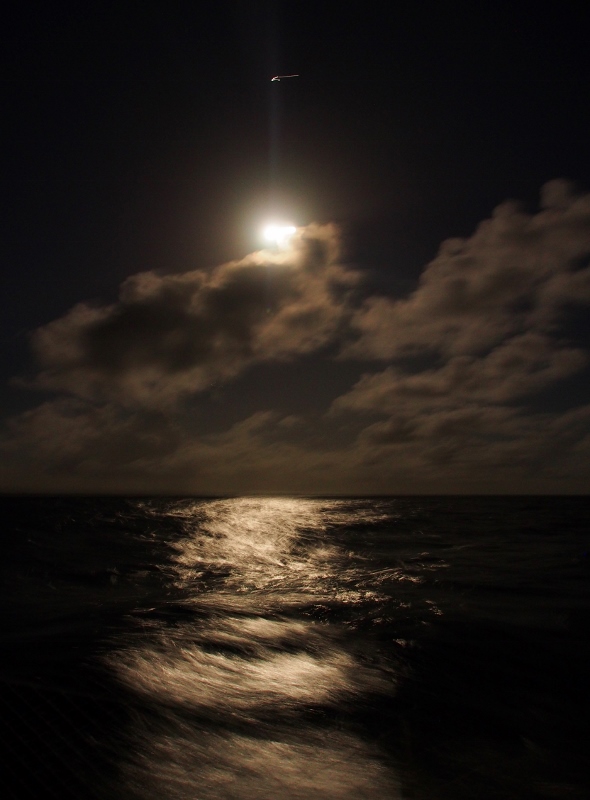
Our night watches are aided by a lovely full moon illuminating the sky so much that we don’t even bother running the radar; we’ll easily be able to spot any ships passing. But there are no ships; on the whole trip we only spot two, both container ships.
Full moon on nightwatch
Because the wind is up and the sea big, David only really catnaps, waking up to check that Christophe and I are doing alright on our watches throughout the night. Being the skipper is a bit like having a baby – lots of responsibility, no sleep, and nobody to lean on because others can’t really breastfeed in your stead. The precious few moments he gets to lay down during the day it is often too hot to sleep, so when we arrive in Aruba he is seriously sleep deprived. Now we just have to watch out for post passage depression….

























 SV Bob The Cat