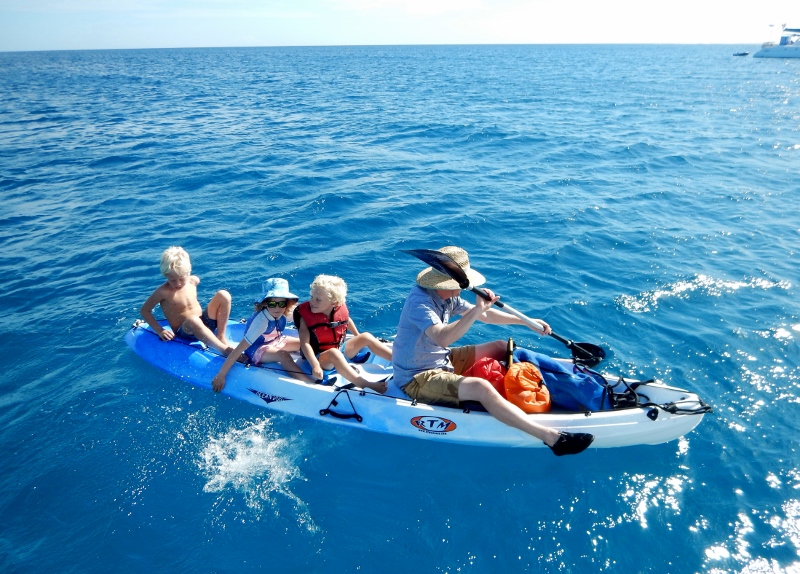
Tonga with the McDermers


DSCN4622 (800x574)

After a couple more cold days of passage we finally arrived at the island of Tongatapu in the Kingdom of Tonga on 1st of July. Actually, we arrived on 30th June, but given that we lost a day on the passage due to Tonga’s recent hop over the international date line, it became the 1st of July.

After mooring up at the Nuku’alofa ferry terminal as instructed by Port Security, we spent the first day waiting for hours for Customs, Quarantine and Biosecurity officials to come on board. In the end a friendly taxi driver eager to move things along so he could give us a ride into town called up the Customs officials, telling them that we were in a hurry because Ed had to catch a flight. Thus prompted, they appeared within half an hour, one official after the other, each presenting numerous forms for us to fill in and sneakily stealing our pens.

Bye bye Ed
Bye bye Ed

“You are lucky to be here now”, said the Quarantine official, deftly placing one of our pens behind his ear. “Everybody is getting ready for the King’s coronation. You will see lights all along the shore from here to downtown”. He patted his round belly, shook our hands, and stepped back onto the dock.

“It is a good time to come”, said the Customs man, pushing his polaroid sunglasses up on his forehead and offering a brief smile as he stuck one of our pens in his shirt pocket. “We are doing much celebration for the coronation of the King. You will see dancing and parades in town every day”. He stuck his feet back into his brand new boots, pulled the boat closer to the dock and jumped off.

“You will stay here for a night”, said the Biosecurity lady, placing one of our pens in her handbag and snapping it shut. “You will go into town and see the school children dancing”. She smiled broadly and waved her hand as she stepped off the boat.

We rewarded the taxi driver who facilitated our entry with the ride into the Office of Immigration in town. At the office we queued for an hour before finally getting seen and presented with a stack of forms to fill in. We asked if we could borrow a pen, but they didn’t have any, so Ed ran to the supermarket to buy some more which we clutched to our chests whilst on their premises.
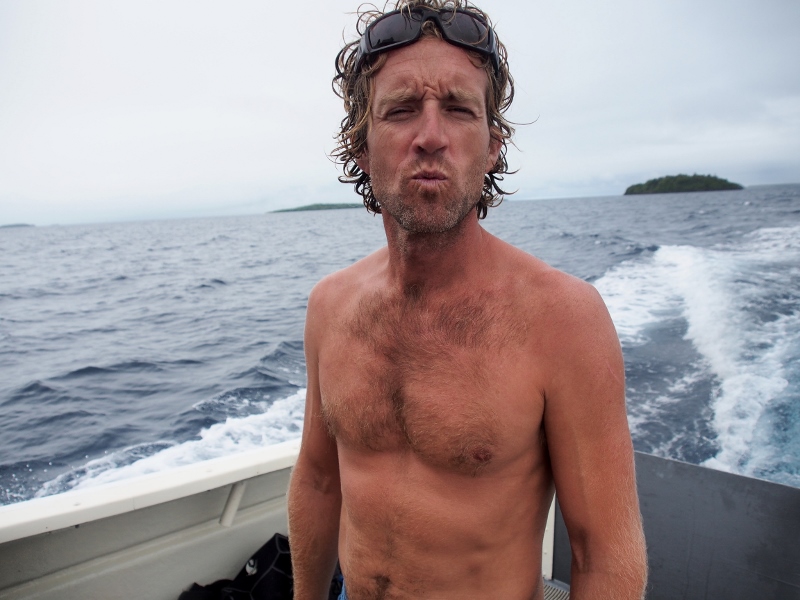
OLYMPUS DIGITAL CAMERA
Don’t steal anymore of my pens


The town was decorated to the nines, the white and red Tongan flag flying from every corner, rich silky red and white ribbons smothering fences and bushes, photos of the portly king and his family, benignly smiling, staring down at us from tall building facades. Everywhere school children were walking, dressed in their starched uniforms and excitedly waving flags.

OLYMPUS DIGITAL CAMERA
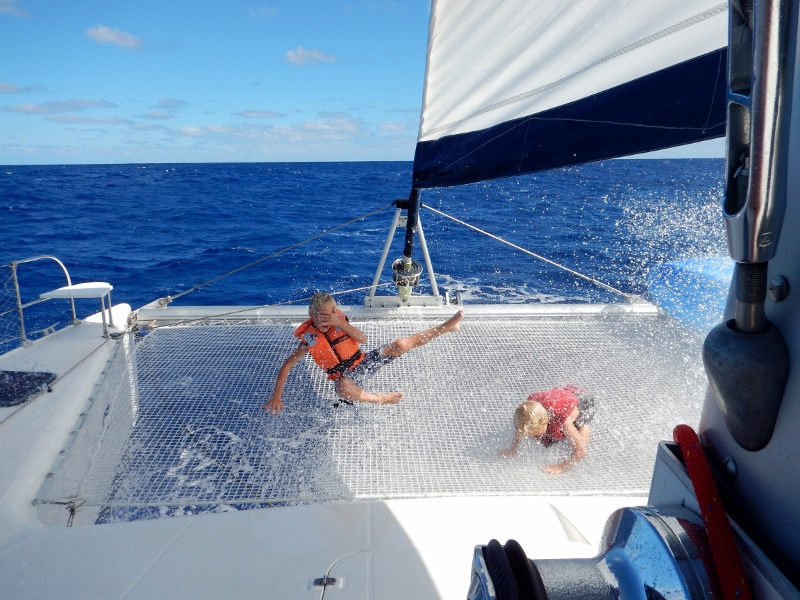
Dougie on the tramp


The following day we moved to an anchorage some distance from town to await the arrival of our friends Kate and Andy and their children Grace and Dougal, who were coming to stay with us for a week. Whilst waiting we happened upon Rob and Rachel Hamill and their three children, friends of friends freshly arrived from New Zealand, who were anchored right next to us. Their youngest son, Ivan, is eight, and the boys were soon busy playing.

Stroking kingfish
Stroking kingfish

The next day it was raining solidly, and we huddled up inside for most of the day, Ivan and his older brother Declan coming over for a play until the ferry brought the McDermer family over late in the afternoon. After a brief night of catching up, we set off early the following morning towards Vava’u, the northernmost island group in Tonga, where we hoped to find some sun.  Unfortunately, the weather gods were unkind and we ended up with a truly horrible sail, the boat sailing into a head wind, bouncing and slamming into rough seas. To ease the journey, we decided to stop in the Ha’apai group on the way, cutting the journey from 150 to 70 nautical miles, but even this distance ended up taking us a full 24 hours.

OLYMPUS DIGITAL CAMERA
Grace and ‘Tias, swinging from ropes


“I can make breakfast”, said Kate as we took off from the anchorage early in the morning. “How about I make some French toast for everyone?”

“It’s going to be rough”, I said. “Let’s just make some toast, we’ll have a head wind and we might all get a little seasick”.

“I never get seasick”, she said, entering the galley. She started cutting bread and put the kettle on, humming a tune.

We rounded the corner and entered the open sea. Bob was rolling and jumping, heading into a confused sea. Ten minutes later Kate appeared in the cockpit, looking a bit pale. She sat down, keeping her eyes firmly on the horizon.

“I don’t think I can go back inside”, she said.

Andy tried ducking in to fetch some sunglasses, and reappeared quickly, deciding that outdoors was much easier to handle.

Grace had an even worse time of it. Within half an hour she was listlessly hanging over the side railing throwing up her breakfast, Andy holding her back from the heaving seas, pulling her hair away from her sweaty forehead. Never one to complain, moments later she lay down quietly in the cockpit, deadly white face, eyes closed, vomit all over her jacket.
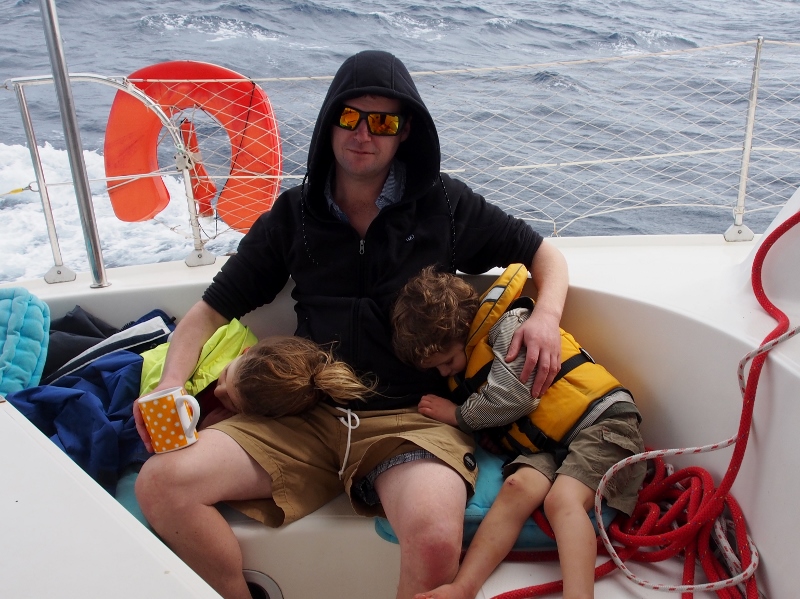
OLYMPUS DIGITAL CAMERA
Sick children


We distributed seasickness tablets, and Grace immediately vomited again, her yoghurt spill mixing in with Dougal’s cracker-strewn vomit, the blend slowly dripping down through the holes in the floor into the sea. Uncertain about whether she actually digested the pill or not we dared not give her another, and so there was no respite for poor Grace for the next 23 hours as the boat rolled and jerked its way north.

“Daddy, this isn’t what you showed me in the pictures”, she whispered, leaning back to lie on Andy’s lap with her eyes closed. Dougal on the other side quietly whimpered that he would like to go home to Raglan now.

OLYMPUS DIGITAL CAMERA
Andy with the yellowfin


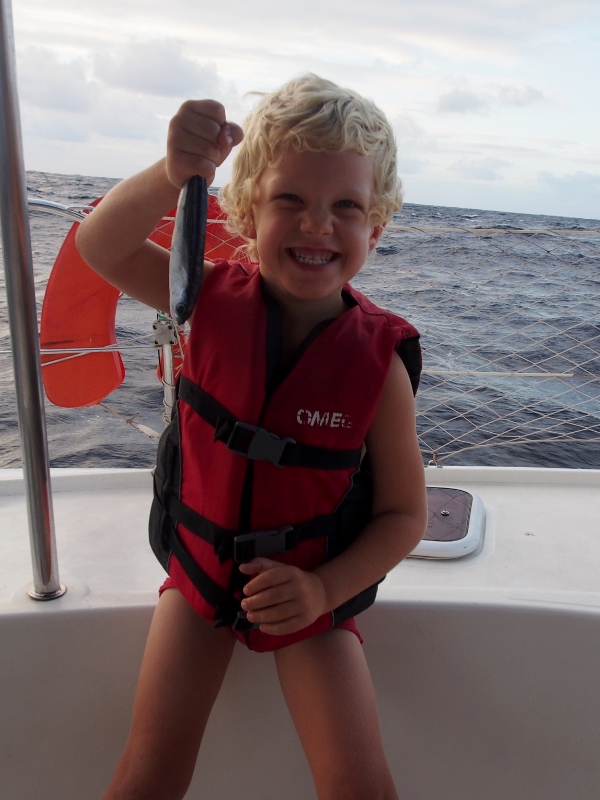
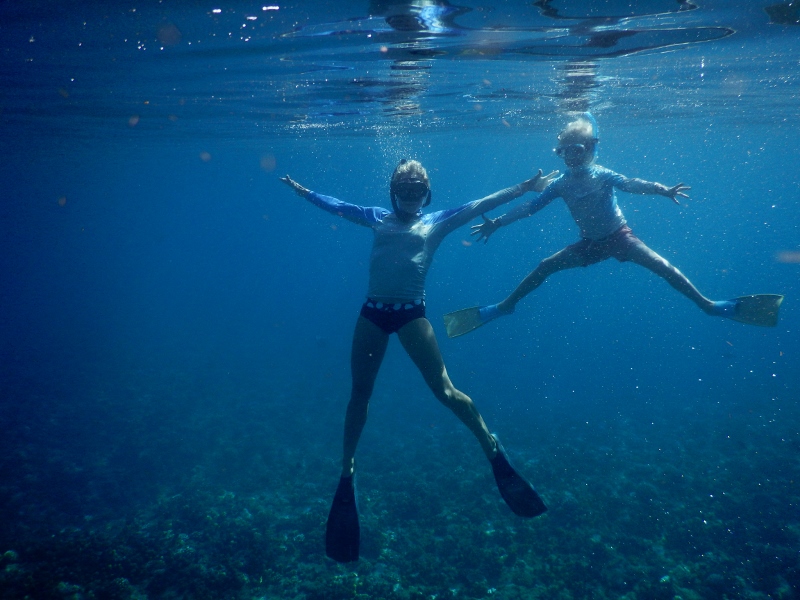
The only upside on the trip was some fantastic fishing, landing us both a bonito and a yellowfin tuna, a bonus for Andy who is a keen fisherman. Around lunchtime the following day we finally arrived at the anchorage, a small deserted island at the northern end of the Ha’apai group. Grace perked up once the boat was still, and we all enjoyed snorkelling, kayaking and deserted islanding for a day before attempting once more to head to Vava’u.

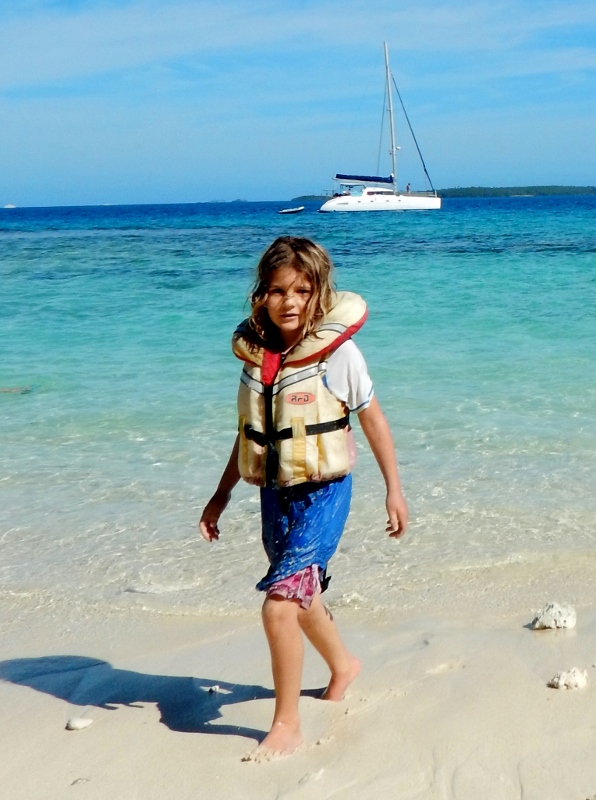
Grace snorkelling
Grace snorkelling
Happy once she's off the boat
Happy once she’s off the boat

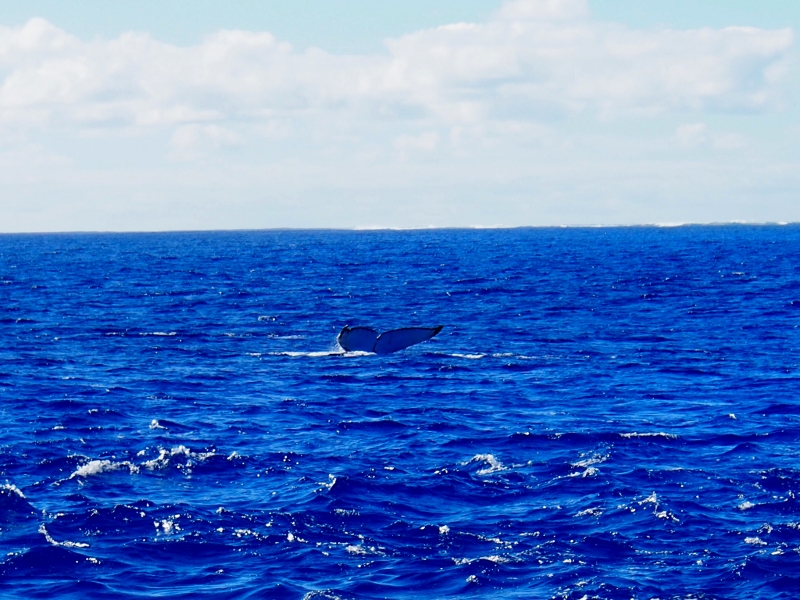
A great improvement on the first trip, the second voyage was a calm beam reach in flat seas, but poor Grace was still violently ill, lying shaking in the cockpit the entire day, wrapped in a large blanket, unable to move apart from periodically getting up to vomit. Fortunately everybody else were feeling good, excited about yet more successful fishing (a skipjack tuna) and the sighting of several humpback whales, promising for our whale watching plans for Vava’u.
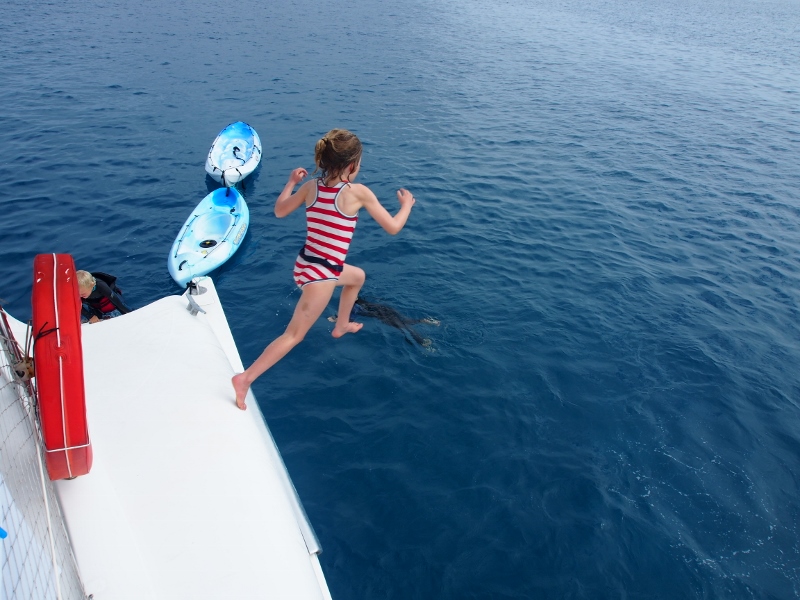
First jump off the boat

And finally, just as the sun was setting, four days after their arrival in Tonga we arrived in Neiafu, the check in port in Vava’u. Grace breathed a sigh of relief on spotting the picturesque little limestone islands dotted through flat calm waters in Vava’u, and flashed her first smile since arriving on the boat. We had three days to explore Vava’u before they had to fly back to Tongatapu where Kate’s extended family awaited them.

So the following morning we checked in, and then upped and left, in search of some snorkelling, beaches and whales.
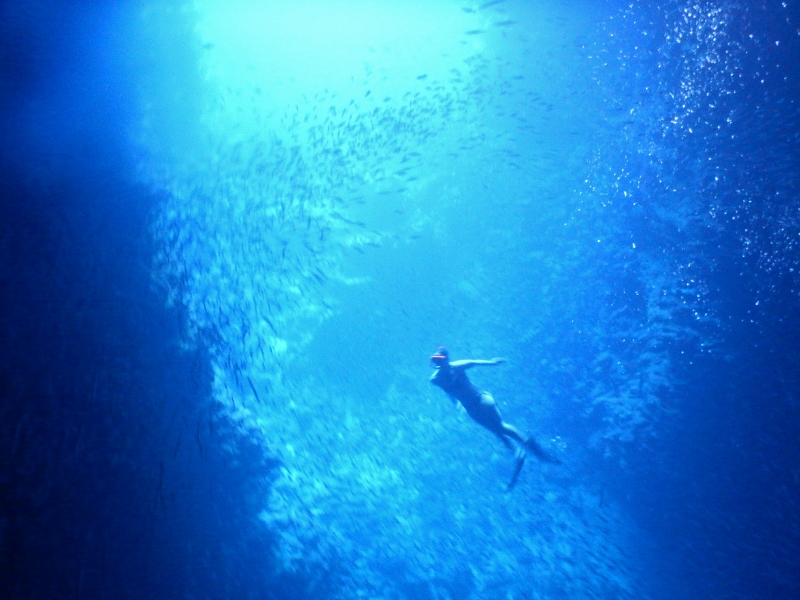
Kate in the cave
Kate in the cave

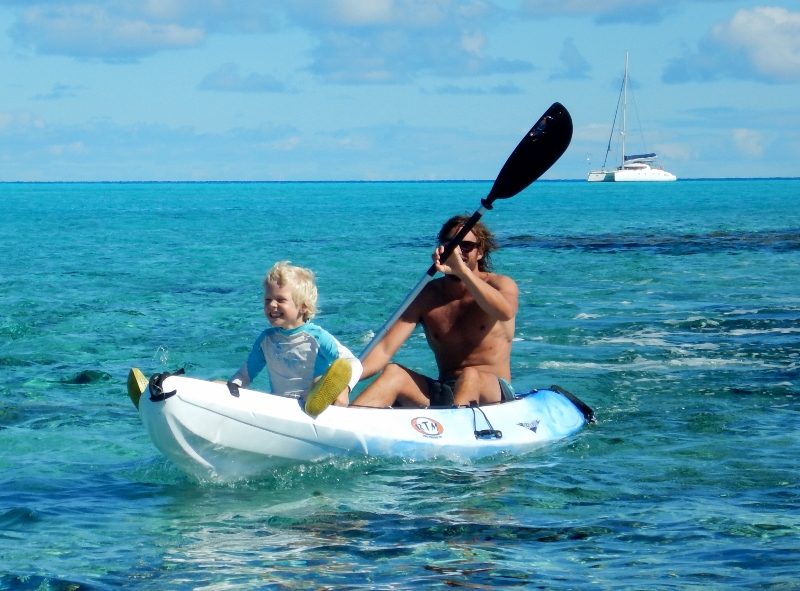
The snorkelling was exciting, a wide-eyed Dougal holding onto Andy’s hand as they explored undersea caves filled with balls of baitfish, the grown-ups exploring the famous Mariner’s Cave that you can only access by diving through a tunnel in the rock face. The kids played on the beach for most of a day, finding coconuts and lizards, and the last day of their visit we went whale watching with a local tour operator.
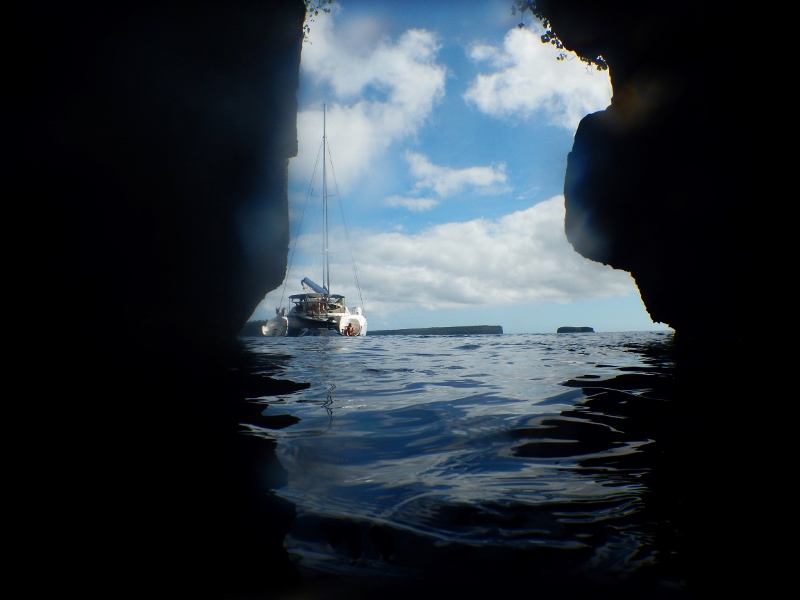
Bob from the cave
Bob from the cave
Mariner's cave
Mariner’s cave


Tonga is famous for its humpback whales, which arrive in droves from Antarctica to mate and breed in the warm tropical seas around the island group in the months of July to September. Whale watching is a big part of the tourism in the Ha’apai and Vava’u island groups, where operators offer ‘swim with the whales’ experiences, and we were hoping to get a chance to see the gentle giants underwater whilst in the area.

Bait ball in the cave

We’d seen whales a couple of times since arriving in Tonga but not close up – regulations stipulate that private boats are not allowed within 300 m of whales, with fines rising up to $10,000 if local authorities find you closer. Ostensibly the rules are there to protect the whales, but I’m sure there’s an element of protecting the local businesses too, which is fair enough. There are a lot of yachts in Vava’u, and I’m sure that the numerous daily tour boats full of tourists eager to swim with whales offer quite enough disturbance without everybody else jumping in too. Any regulations around the operations are welcome in my opinion.
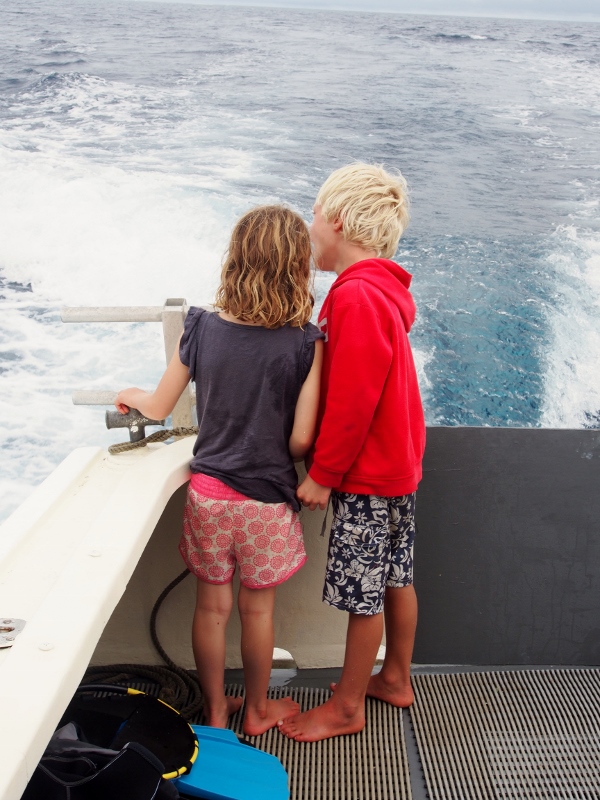
Grace and 'Tias on the whale boat
Grace and ‘Tias on the whale boat

So we chartered a whale tour with Dolphin Dive, with the lovely guide Aurelia and skipper Villi. After a bit of searching, we soon found whales, and we jumped in several times with a couple of young males. After they disappeared, we saw a large group of whales some distance off, and went to investigate. As we got closer we were treated to the most amazing surface display, with huge males jumping gaily, fin slapping and fully breaching, crashing down with enormous splashes that sent white water high in the air. They didn’t seem to mind the presence of the boat, seemed to barely notice us, engrossed as they were in their jumping frolic. Aurelia told us they were in the middle of a ‘heat run’, where lots of males follow a female, competing for her favour. Feverishly, we rushed to get our wetsuits on so that we could enter the water to swim with them.

OLYMPUS DIGITAL CAMERA


“Get in, now, hurry up” shouted Aurelia. She quickly shoved her snorkel into her mouth and slid from the back step of the boat into the water. “Come in”. Immediately she started to swim towards the whales.

The group of humpbacks were just off the boat when she got in, but they moved quickly and unpredictably. We scrambled in, swimming as fast as we could. We scanned the water, but saw just endless blue which we powered through quickly, out of breath, trying to keep up with Aurelia. She stopped, trying to kick herself up on the surface to see where they were. Head in the water we heard only our own fast breathing and the beating of our hearts, but as soon as we lifted our heads from the water we heard the loud splashing of breaching and the hiss of heavy breaths. We kept swimming furiously until we suddenly saw shapes appearing in the deep blue – we were surrounded by giant creatures. Huge and heavy, encrusted with barnacles, they eyed us curiously with beady eyes, gently gliding through the water, turning with a slow flick of a giant tail. From the depths emerged another group and we found ourselves hovering just ten metres above five or six whales, rolling and frolicking around. A huge male, a good 14 m long, swam up to another, almost touching his deeply grooved, white underside to the others dark grey back, then turned towards the depths and disappeared. Another one decided to surface for a breath, almost hitting Kate who was floating, too stunned to move, right where it came up to lift its large, knobbly head all out of the water, perhaps to check her out.
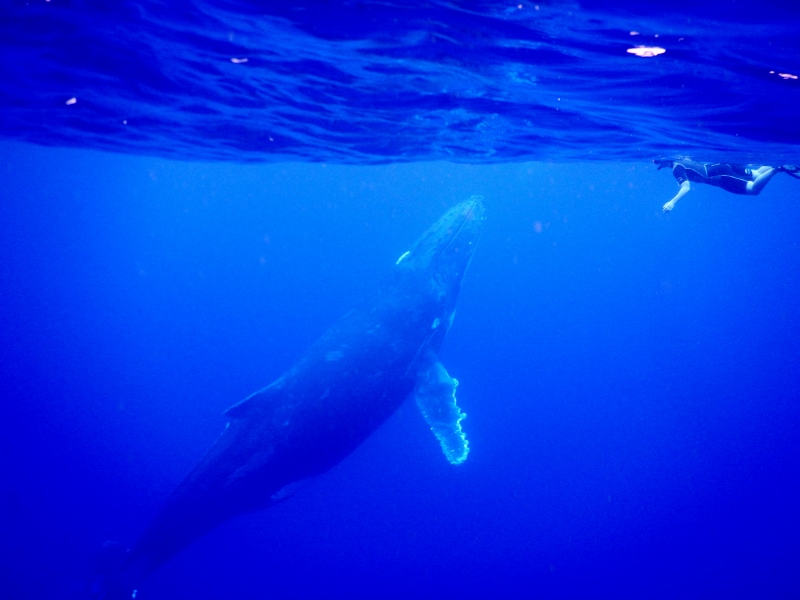
DSCN4849 (800x600)
Kate and the whale


Whale leaving Kate behind

Their moves looked slow and deliberate for their size, but for us tiny creatures next to them they seemed to move very fast. After a while they decided to move, and with one small flick of the tail each one of the huge, 35 ton animals sped off, disappearing. All at once it was over, they were gone, continuing their furious pursuit of the female.
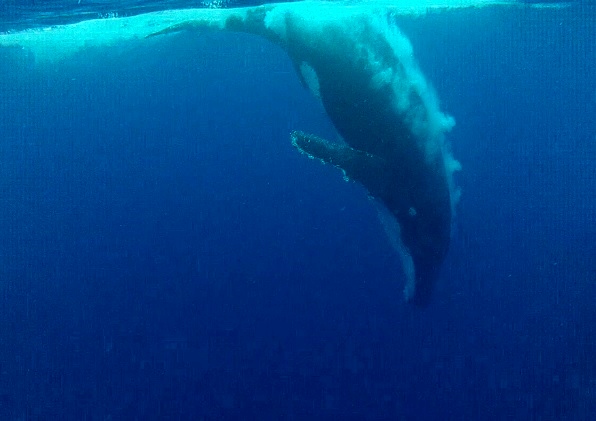
whale7 (596x421)

“Woohooo”, shouted Aurelia from the surface, fists pumping. We all cheered and she raised her hand to wave to Villi, who was leaning over the steering wheel grinning broadly as the boat made its way towards us.

Later, back on the boat, Aurelia told us we’d been very lucky.

“Amazing. The first heat run of the season, the first large groups of whales in the season, the first great breaching of the season”. Just as excited as us, she explained that they don’t normally meet large groups of whales until much later on in the year, and that they only very rarely get to be in the water with them, the whales normally choosing to move as the boat comes up.

whale3 (458x310) whale5 (637x435)

What a week we’ve had with the McDermers. Rain and sunshine, sailing and anchorages, rough seas and flat waters. Freshly caught fish for dinner every night, deserted island with beaches for the kids to play on. Dark caves for snorkelling in, and huge whales to swim with. Thank you so much for coming, guys, it was wonderful to share all this with you!
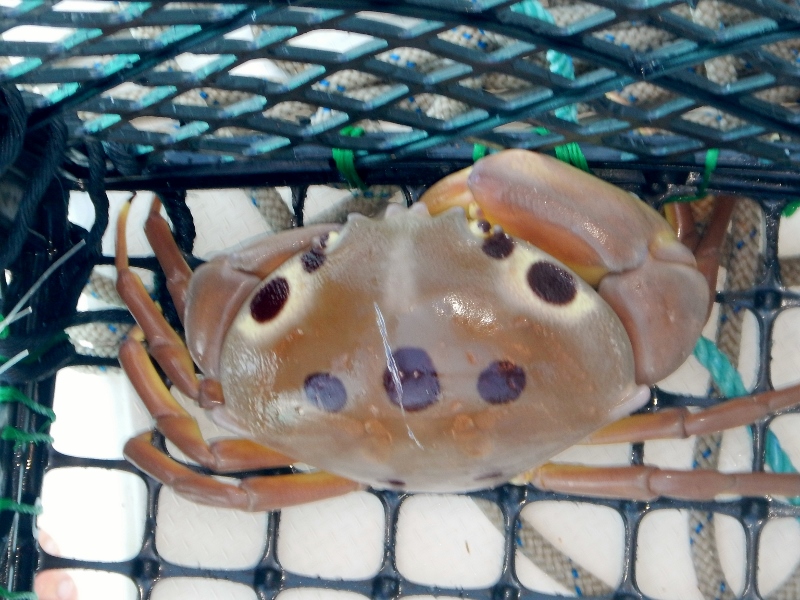
Mummy, what’s for dinner?

Mummy, I don't really like crab anymore...
Mummy, I don’t really like crab anymore…

“Daddy, I really want to go back to New Zealand”, says Lukie, sidling up to David in the cockpit.

In the kitchen, my heart lurch. Is he secretly hating the boat life, and hasn’t summoned up the courage to tell us until now? Is he missing his old buddies from kindergarten, or mourning the fact that he would know several Maori proverbs by now had he been at home? Is he aching to play soccer or do karate, and resentful that all the sports we offer have water as a main ingredient? Come to think of it, what are we doing to the poor kid, keeping him on a small boat, crossing vast oceans, exploring deserted islands – it’s what I would have wanted to do when I was a child, but do kids even want those kind of adventures nowadays?

“Well, that’s where we’re headed to, eventually”, David offers levelly, putting Lukie on his lap. “Why do you want to go back to New Zealand?”

“Because there’s pizza there. And lasagne”, Lukie beams. “I really want pizza. And meat lasagne”.

Phew. Not old friends, team sports or proper schooling then. Just Lukie’s singlemindedly overwhelming focus on food. We can fix this, or ignore it, offer him a boat substitute like, ahem, tinned corned beef or maybe even baked beans if he is lucky and we have any left.

I turn back to preparing dinner –mahi mahi  caught yesterday, served with rice and a salad, if a mixture of cucumber and cabbage can qualify as a salad. Considering my options for making the salad even vaguely edible, I decide to put an Asian twist on it with a few chopped peanuts and a sweet and sour white vinegar dressing. One thing you learn on a boat is to love cabbage, it being the only vegetable that remains edible after about a week of doubtful refrigeration. I should email my mum for some recipes I think idly – the Danes love cabbage and I have yet to have a meal there in recent years without some sort of brassica thrown in.

Lukie comes inside. “Mummy, what are we having for dinner?” he asks, leaning heavily over the seat that abuts the kitchen, sticking his hands over the dishes drying in the rack to try to steal a peanut out of the packet in my hand. On the boat he has taken to supervising the cooking when he is hungry, eagerly eyeing up all ingredients, listing all the things he’d like us to put into today’s dish.

“We’re having fish. The mahi mahi that we caught yesterday”, I say. “With rice, and a salad”.

His face crumples. “Oh, mummy, it’s not fair!” he whines. “Why do we have to have mahi all the time? And rice, you know I don’t really like mahi anymore, I prefer tuna. And I don’t really like rice”. He glares at me, and when I shrug stomps out to the cockpit where I hear him complaining loudly to David.

Poor Lukie. My children seem to be starting puberty at around the age of five. For Matias the main frustration used to be school; for Lukie it is obviously food. It’s not fair. Imagine having to dine on fresh gamefish every day.

Another fish steak to be eaten...
Another fish steak to be eaten…

Just as well that he is fed up with rice, though, because we are running out – we have been trying to empty the larder for a good clean-up, and the rice stores from Panama are getting lower. Soon we’ll only have brown rice left, and then he’ll really have something to complain about – rice that actually tastes of something, eughh! Imagine the horror.

I absentmindedly swat a cockroach that gamely creeps over the fridge top as I resume my dinner planning. It’s unusual to see them during the daytime: are we getting more? Resolutely pushing aside the thought of the Cockroach Problem, I check the clock. It’s 5 o’clock, I should get on with it. Cooking takes a long, long time on a boat, and even if you only have to make rice and a salad it pays to start early. Just turning on the gas is infuriatingly difficult. The stove has three burners, one big and two small, placed just close enough together to ensure that you can’t really use more than two at a time. For some reason the big burner won’t light easily, requiring you to hold down the gas button for anything up to ten minutes before it will keep going on its own. I’ve resorted to using the smaller burner, which means that it now takes about 40 minutes to boil the kettle. But that won’t do for rice, and so I turn to the big burner with a determined glare, shake my shoulders loose and relax my jaw, ready to think nice thoughts for the next ten minutes while trying to light it. The annoying thing is that it changes randomly – sometimes you have to hold down the gas button for only two seconds, sometimes for much longer, leaving you wondering whether you are wasting your time with extra button-pushing whenever you spend more than 2 seconds. Would it stay on if I release the button now? Should I let go? Part of the crazy unpredictability of boat life, not ever knowing what kind of switch-on-the-stove experience it is going to be. Don’t say we don’t have any fun here in the galley.

Experimentally, I let go of the button, and immediately the burner switches off. Seems we are in for a long one, this time. Swearing under my breath I close the window in case that has any bearing on my success and light it again.

At least the oven is easy to light. Other than that, it is a pretty useless appliance, though, sporting a top temperature of about 120 to 150 degrees C, with the added interesting physics-defying characteristic of having more heat on the bottom than on the top. Normally, hot air rises, but I suspect that the break in the seal on the oven door causes high heat losses, with whatever managing to brown on the bottom doing so simply because they are physically licked by the gas flames. There is one spot, in the front left corner of the baking tray, where everything burns on the bottom in about 10 minutes. Experience has taught me to leave that spot free, a blackened corner of the otherwise metallic baking tray.

Regardless of the cause, both pizza and lasagne came out disastrously bad, to Lukie’s great discontent. We can just about make scones and bread, that is if you don’t mind your rolls burnt on the bottom and squidgy raw on top. Not that I have any ingredients left for that either – they don’t seem to be selling baking powder in French supermarkets and as we’ve spent the last three months in French Polynesia and have none left from Panama, I have had to resort to using baking soda and vinegar for scones instead. Which resulted in completely yellow scones with a strong aftertaste of rotten egg, the terrible byproducts of incomplete acidification of the baking soda. They were so bad that both kids refused to eat them (“Mummy, I don’t really like scones anymore”), and Ed, David and I only just managed to swallow a few bites before we had to throw them overboard. Where fish flocked eagerly only to turn away in disgust once they’d had a bite, letting the remainder sink slowly to the bottom. Obviously fish aren’t great fans of baking soda either.

After that I spent my night watch making a yeast dough in the dark, peering out over the dark wavy seas through the galley windows to keep up my watch whilst congratulating myself on my multi-tasking talents. Just after sunrise, as I was shaping out the rolls to bake in the tender yellow light, I discovered that bugs were dotting the dough like poppy seeds – black little beetles looking disconcertingly like baby cockroaches interspersed with pale yellow elongate maggots writhing busily around. Great. After hurling the dough overboard, I emptied one flour packet after another into a baking dish, and discovered them all to be alive with creepy crawlies. So I threw our 15 kg of flour ecosystem and associated lifeforms into the ocean and wiped the larder clean of any contaminated flour dust. The bugs get in on the packaging, and when we can, we buy flower in paper bags lined with plastic, as they seem on the whole to be bug free. But the Carrefour in Tahiti only carried the standard paper bags, so we loaded up on that.

I only really like flying fish...
I only really like flying fish…

5:15 pm. “Is it going to work?” I mumble, hesitatingly letting go of the gas knob, and am rewarded by a smooth ring of flames, boldly holding their own. Result! I can proceed to chopping the salad. I open the fridge, fastening the heavy fridge lid on the hook suspended above the window to hold it upright whilst I rummage in the depths for the cucumber and cabbage, shutting the top again quickly to minimise cold loss once I’m done. I place the cutting board, cucumber and cabbage on the closed fridge top, ready to chop. The cucumber is suspiciously slimy, and I wonder if I can save it – given how hard they are to get, it is heart-breaking to have to throw vegetables away.

“Mummy, can I please have some cold water?” It’s Matias, standing at the kitchen counter, holding out his empty cup.

“Not now, please”, I sighed. “Let me just chop up these veggies first”.

To avoid heat loss, boat fridges open up vertically, the theory being that this keeps the cold air gathering in the bottom of the fridge, far from the escape opportunity reserved for warmer air up top. In our galley, the fridge top doubles as the bench top. Which makes perfect sense until you actually try to cook in a kitchen where you can’t access the fridge whilst doing any prepping, or having anything on the bench top.

The fridge top is too heavy for the kids to be able to open themselves, and as the tap water could be anything from lukewarm to bath temperature, the only really potable water is kept in a jug in the fridge.

“But mummy, I’m thirsty, I’m dying of thirst”, he cries, looking parched.

“OK, OK”, I snap, grabbing the cutting board and the sharp knife and placing them carefully on the narrow divider backing the sink between the kitchen and the saloon. The knife balances precariously close to Matias’s face and I hesitate, think better of it, and grab them back only to place them at an incline on top of the dirty coffee cups in the sink. As if aware that there is an opportunity to create some mess in the kitchen, the boat immediately lurches, causing the cucumber to roll off the board into the coffee pot, scattering coffee grinds everywhere.

“It’s OK, I can wash it off”, I mumble through gritted teeth, before opening the fridge, balancing the heavy lid on my shoulders whilst I grab the water jug. As usual, the jug is overfilled, making it impossible to lift without spilling water all over the bottom of the fridge.

“David”, I cry shrilly. “Stop overfilling the jug, it ends up all over the fridge”.

David comes in to stand in the door of the cockpit, lifts one eyebrow and shrugs, watching me edging my shoulder out from under the fridge top which falls heavily down, slamming loudly.

“It’s because of the filter”, he says, “it just takes too long, and I always forget it”. He’s installed a new water filter which makes the cold water tap excruciatingly slow, which means that we often leave the jug or the kettle under the open tap for the half hour it takes for it to fill. Only by the time it is half full we’ve often forgotten that the tap is on, leaving it until someone notices that it is running over.

“I know”, I mumble apologetically as I start to fill Matias’s cup.

“Here you go”, I said, handing him the cup. “Hold on with two hands, it’s bouncy”.

Washing the coffee grind off the slimy cucumber I decide to defer the cleaning of spilled water to some point in the future when I have more time. It takes a while to clean it up properly, anyway.  You see, boat fridges, or at least the unsophisticated boat fridge that we have, have the cooling system on the inside of the fridge, a unit that drips unrelentingly as water condenses. Which means that the fridge is constantly full of water. There is a drain, but it is conveniently situated at the higher end of the sloping bottom, as if to ensure that there is always a slimy one centimetre layer of bacteria-ridden liquid slushing around the undrainable parts of the cool box. All items in the fridge thus have to be kept off the bottom in tubberware lest they get into contact with this water which acts to turn any firm, fresh vegetable into a dark mouldy mush within hours.

I finish chopping the cucumber and take the cabbage out of the bag. 5:30, time to check the rice. At least we’re not having pasta – bringing the vast quantities of water to boil that a dinner portion of pasta requires takes a good 40 to 50 minutes, more when the gas is running low. The rice is still hard to the bite, so I leave it on for a bit longer whilst I go on chopping the cabbage.

Lukie comes in again from the cockpit, bearing his mug. “Mummy, can I please have some cold water from the jug?” he asks, just as I finish chopping up the cabbage.

I triumphantly shove the chopped cabbage into the salad bowl. “Of course you can”, I smile, placing the salad bowl on top of the rice pot and open the fridge again. Hearing the fridge open again, Matias comes back in.

“Can I please have some more”, he asks. “What are we having for dinner, Mummy?”

With a sigh I open the fridge again. “Fish and rice. With a peanut sauce for the fish”. I turn to look at him, holding out my hand for his cup.

“But Mummy, you know, I don’t really like peanuts anymore”, he wails.

I turn my back, count to ten and resolve to make spaghetti with sausages tomorrow.

Beveridge Reef

Have arrived, must jump
Clearwater jumping

I was sitting in the cockpit in that queasy half sick overtired state that characterises my night watches, all rugged up in my jeans and my skiing jacket, bracing myself against a cold southerly breeze. It was a couple of hours before dawn on the last night before we reached Beveridge Reef and it suddenly dawned on me what a terrible idea it was to go looking, on purpose, for a shallow subsurface reef in the middle of a deep ocean.

Our ‘safe waypoint’, somewhat to the south west of the green splodge that indicated Beveridge on the chart plotter, was about 15 miles to the southwest of our current position. Next to the green blob was a footnote, stating that the reef could be somewhere else, that in fact it had also been reported to be 3 miles to the north east of the position marked on the chart. The ‘safe waypoint’ that we had was from a mud map displayed in an unpublished cruising guide compiled by yachties that had travelled this part of the world in the past; the mud map had been scribbled by a brave cruiser who ventured into the lagoon in 2010, where he drew a rough chart marked with a couple of safe waypoints for the approach to the reef.

And, although grateful for the chart which we’d definitely need to negotiate this reef safely, I was beginning to wonder just how much we could trust it. Beveridge Reef is a sunken atoll, a barrier coral reef which just breaks the surface of the water at low tide, surrounding a calm, sandy lagoon. It is in the middle of nowhere, 130 miles from Niue, 400 miles from Tonga, an oblong circle of shallow calm rising abruptly from a deep and often rough ocean. We really wanted to go there, to see a lagoon in the middle of the deep ocean, to go where not many others go and cast down our anchor in the middle of the Pacific for a restful night or two on the way to Tonga.

As incredible as it doubtless is to experience the reef amidst the sea, it dawned on me sitting there, well before dawn, that we’d have to get bloody close to actually see this thing. With no land breaking the water surface, no vegetation, sand dunes or hills raising the land above the waves, Beveridge can only be detected by the thin line of savagely breaking waves that marks the edges of the reef. Being so far from other land, surrounded as it is by seas of more than a kilometre deep, it crops up unexpectedly, and the reef has wrecked scores of boats before modern charts and navigation techniques. In fact, it still does wreck boats, as evidenced by the mark denoting the wreck of the tuna boat “Liberty” on the 2010 mud map. The fishing vessel stranded in 2006 where it must have strayed too close to the breaking waves of the reef in a rough storm, only to get tossed over to the inside of the jagged edges of the sharp coral platform that lines the lagoon.

And here I was, alone in the cockpit at 4 am, staring into the impenetrable pre-dawn darkness, eyes squinting against a stiff breeze, chilled to the core by the icy southerly winds that had plagued us for the last couple of days. According to the note on the chart plotter, the reef could basically be anywhere near here, and so I sat motionless, peering into the vast darkness trying to detect lines of white water, straining my ears listening for the sound of crashing waves or a crashing hull, hoping that the former would come first.

The kids got up and I briefly left my station to fix them some breakfast, and around 7 am a dead tired David poked his head out the cockpit. “Any sign of it yet?” he asked in a weary voice, hoarse from having been up for nights on end negotiating rough weather. I answered that, no, I haven’t seen it yet, but that that was no real surprise given there hadn’t really been enough light for me to see it even if I was right on top of it. Although at this stage a thin yellow line was starting to hold its own in the rough location of the reef amidst the scatter of wave noise on the radar screen, a comforting sign that the modern instruments were helping us somewhat.

Ed jumping in for a surf

And sure enough, before long we could see a thin line of white water, and as we edged closer the incredible sight of a calm, turquoise lagoon appeared behind the waves in the middle of the rough sea. We motored on, carefully staying beyond the back of the peeling waves, eyeing up the pass to the lagoon, when suddenly we heard a loud breath and saw a sperm whale logging on the surface, just 100 m off the boat.

Humpback whale gliding back down below

“Whale!” the kids shouted excitedly, jumping up and down on the trampoline, pointing towards the square, dark shape and we all watched as the gigantic creature took another breath and disappeared below the surface.

Ed and Lukie exploring Beveridge, Bob in the background

After hanging around for a while to see if it would reappear (it didn’t), we motored through the relatively mild pass and made our way to the lee side of the lagoon to anchor. Beveridge Reef is a strange place. The water is 10-15 m deep all throughout the lagoon, and along the edges the sand abruptly rises to form a wide, shallow (~3 m) sill, providing a light blue border all the way out to the browny coral reef where the huge waves crash down. Rarotongan myth has it that there used to be an island there, which got swept away by a hefty cyclone that washed away soil, sand, people and vegetation. Which is entirely possible, given the fierce tropical cyclones they get here – imagine that!

Bob on the sill
Bob on the sill

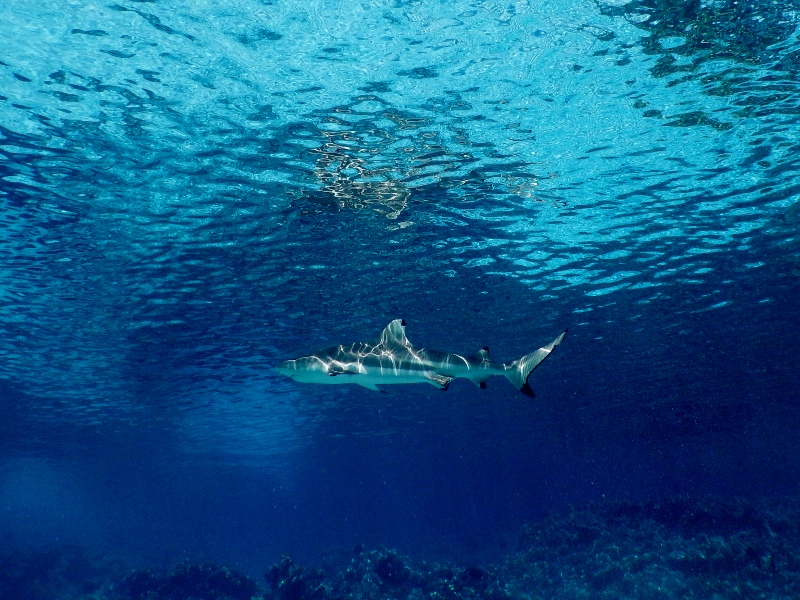
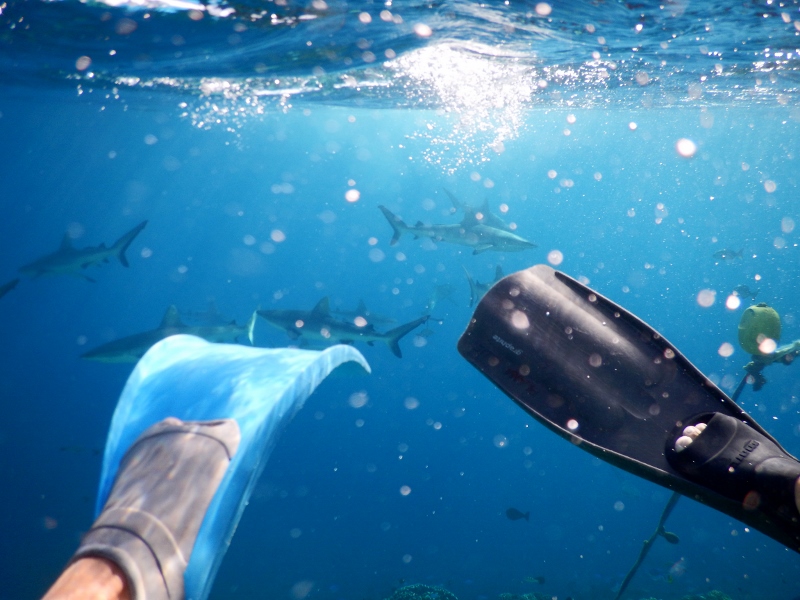
We anchored on the edge of the sill, Bob hanging suspended into the darker blue water of the deeper part. The water was like a swimming pool – crystal clear, with visibility of over 50 m, providing sweeping views over the lovely sandy bottom and the slope down to the deeper part of the lagoon which was dotted with small coral outcrops. Stingrays and grey reef sharks quickly came up to investigate, making us a bit nervous about jumping in – greys can sometimes be dangerous and they did seem quite curious, coming up to the swim ladder to check us out.

The longliner 'Liberty'
The longliner ‘Liberty’

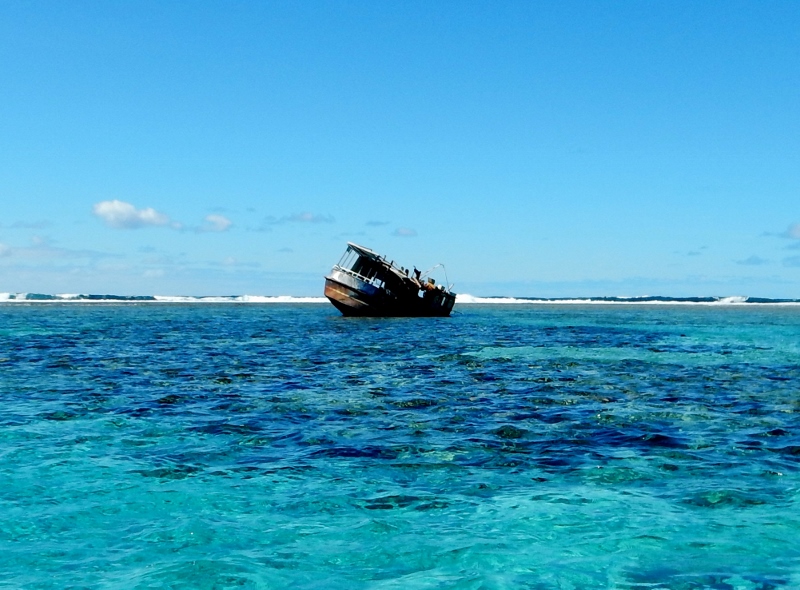
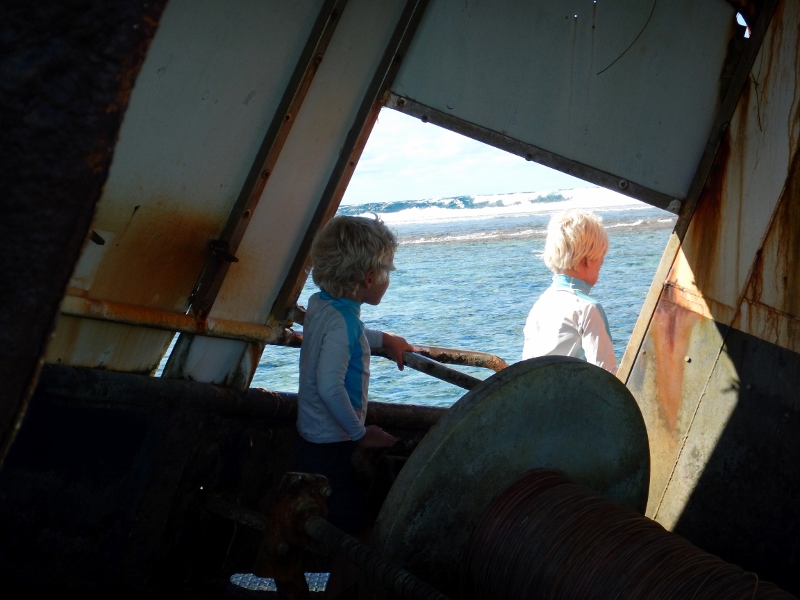
The following day we took the boat over to the wreck of the tuna boat that is lying on the edge of the reef on the eastern end of the lagoon. Clearly visible from miles away, the intact wreck lies on a slight angle, bow deeply embedded in the reef, stern poking out, a big square eyesore. It was a strange place, a deserted rusty reminder of mankind on an otherwise undisturbed reef. We climbed on board the boat, hanging onto the rusty frames to keep ourselves upright on the steeply inclined and very slippery deck, taking in the longline still on its coil, the toilet deep in water and the cockpit full of crabs emerging from cavities that used to hold instruments. It must have been a big storm to throw a boat that size right over the shallow reef, or perhaps she was already inside the lagoon, seeking shelter from heavy weather but failing to find it? How horrible for the crew, perched on the battered structure in the middle of nowhere, in calmer seas once the storm was over but with no land in sight. We wondered about their fate, whether help came, and if it did, from where – Niue? How long would that have taken?

Exploring the wreck
Exploring the wreck

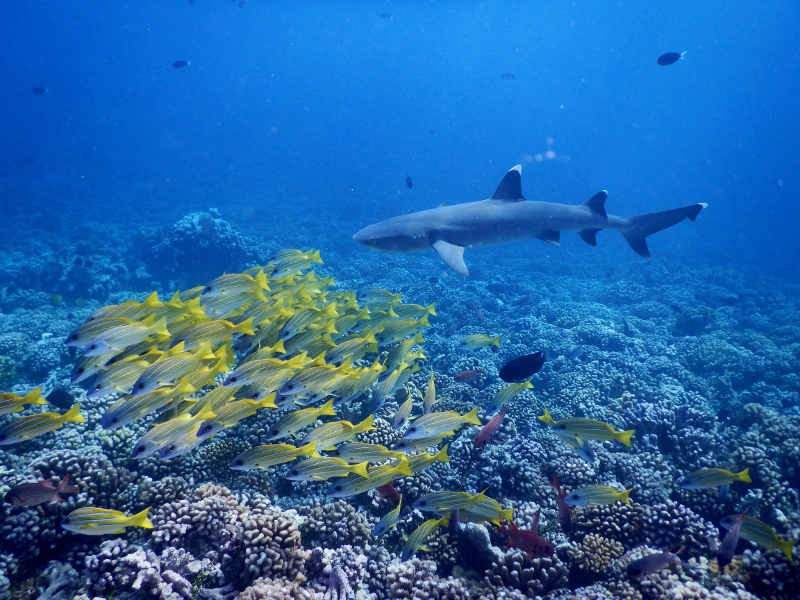
Cruising around the coral surrounding the wreck were a group of white tipped sharks, and we wondered whether the grey sharks came up to have a look at the wreckage, and how the stranded crew would have felt about having them circling the boat.

White tips crowding in a cave

Beveridge Reef was first reported by Europeans in 1847 when the British Captain Lower-Tinger of the brigg Beveridge sighted the reef and promptly named it after his ship. Subsequent European visitors to the reef reported numerous wrecks, the testimony of the unhappy outcomes of less fortunate guests. There are meant to be more wrecks on the reef than the ‘Liberty’, but we couldn’t them – the strong waves and hungry sharks must quickly remove evidence of shipwreck.

Grey shark
Grey reef shark

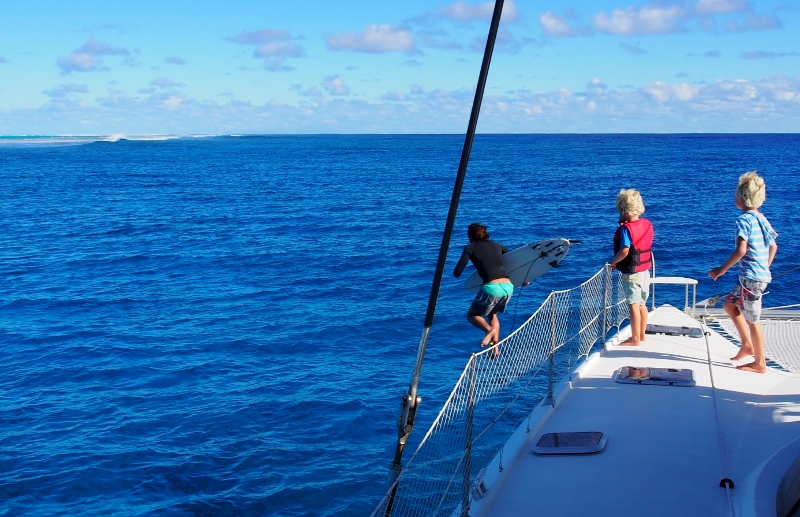
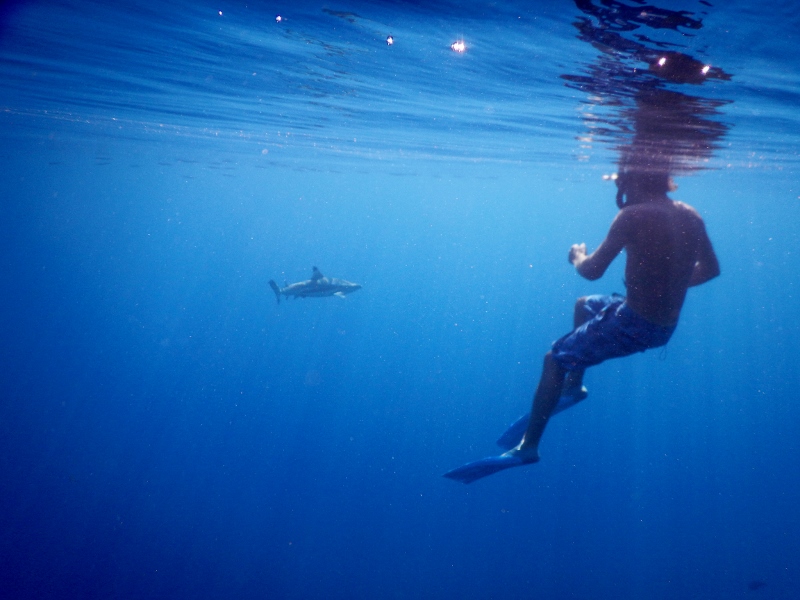
Back on the anchorage David snorkelled for conch but exited the water quickly once the grey sharks started showing interest, and just after lunch we pulled anchor to head out to Tonga. The visibility in the pass looked amazing, and Ed and I tried hanging off the swim ladder as we were drifting slowly through, but we both jumped out quickly when a group of grey sharks came up to check us out. Just outside the pass two humpback whales were frolicking, and we wondered if perhaps the lagoon was a breeding site for humpbacks, and if that was why the greys were so interested in medium sized shapes swimming close to the surface – perhaps they routinely attack humpback calves? The whales were amazing, lying breathing slowly on the surface, sending big spouts of water everywhere, gently rolling around before at last they dipped under, flicking their tails in the air. We watched them for ages, and as they were swimming close to the reef Ed noticed how nice the wave was looking, and he decided to jump in for a surf.

Ed on the break
Ed on the break

On our way to Tonga: passage to Beveridge Reef

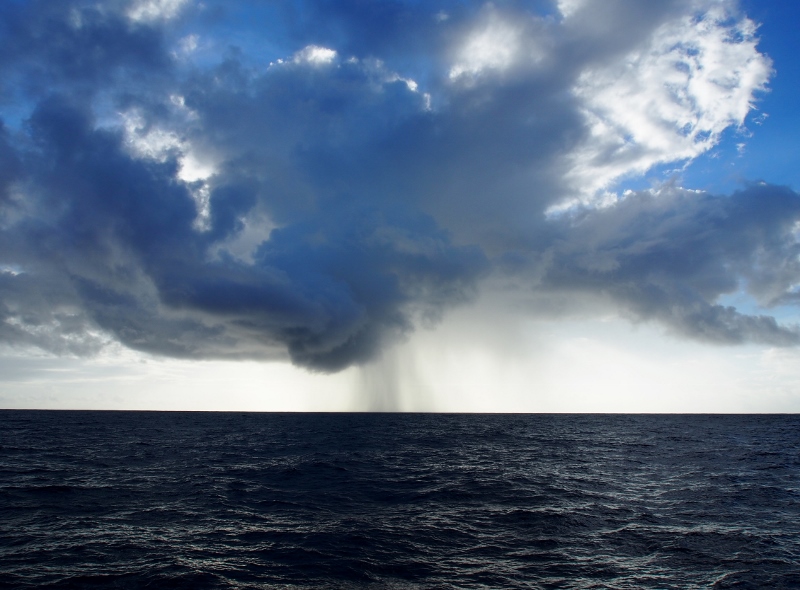
Dawn showers
Dawn showers

“Mummy, I don’t feel too good”. A pale-faced Matias staggered out of the saloon, clutching his belly, and collapsed onto the cockpit seat. “I think I’m going to vomit”, he gasped, lying back and closing his eyes. I quickly opened the locker and rummaged around for a bucket.

“Take this”, I said. “If you need to be sick, just do it in the bucket”.

Moments later he retched. Ed, sitting listlessly next to him, turned his head away, a pained look on his face. I gulped, feeling the cold sweat gathering on my forehead as I staggered to the side of the boat to empty the sloppy bucket into the heaving sea.

On the tramp in heavy seas
Wet tramp in heavy seas

It was day one on our 800 odd mile trip from Mopelia to Beveridge Reef, the last stop before Tonga. The seas had risen to a good 3.5 m and the boat was slamming into the waves on a solid beam reach, jerking and heaving which made any movement hazardous. I had made a few forays inside in attempts to start dinner, but had had to come outside for air when nausea overwhelmed me. It didn’t help that Lukie had been playing in the far forward cabin, leaving the hatch ever so slightly unlatched, exposing a tiny gap in the otherwise water tight barrier of the large O-ring lining it. The waves were slamming over the bow, and in a matter of the 20 minutes it took for us to notice that the hatch wasn’t fully shut, the fenders, mattresses and cushions in the cabin were soaked and water had starting running down the door into Lukie’s cabin, onto his bed. We badly needed to get the mattresses and cushions out on deck to dry, but after just one trip into the airless cabins below to retrieve some soaked smelly cushions I collapsed in the cockpit, too sick to dare going back. Even David looked a bit peaky as he struggled up with a mattress.

Ed staggered up with effort, holding onto the table with both hands as he bent over to steady himself. “I think I’ll take a seasickness tablet”, he said.

I went downstairs and got some for myself and Matias as well. It was rough – it was only the second time in my life I’ve needed to take seasickness medication. The first time was on the Cook Strait ferry on a day so stormy that the ferry had been cancelled for the whole morning, which made me so scared that I popped a pill before we drove on. I fell asleep before we could get out of the car, and spent the rest of a crossing in a daze, trying to look somewhere else as the passengers all around me sat bent over, clutching their sick bags, staff running up and down the aisles between the seats with big black binliners to pick up the spoils in between sweeping vomit off the floor with big mops. I was hoping that the pills would have a similar effect now, put me to sleep so that I could wake refreshed and decidedly non-nauseous for my night watch.

We struggled through dinner and immediately after clearing the table Ed, the kids and I collapsed into queasy sleeps, leaving David alone in the dark cockpit to steer Bob safely through the swell.

Wrestling
Wrestling

It was our first longer passage for a while, but it seemed that it hadn’t taken long to sink back into the old familiar state of nauseous exhaustion that goes with the territory. Some people love passages – being out there, in the middle of the sea, at the mercy of Mother Nature and her whims, following the slow, gentle rhythm of the sun, stars and the moon, rising and setting, the boat bopping up and down on an endless sea. I certainly feel wonder and gratitude that life is big enough to allow for all this and that we are here witnessing whales swimming over fathomless depths, dolphins jumping at our bow, winds propelling us across a dark and deep ocean. But, on passage, all these feelings of wonder are always tarred with a slight queasy feeling, a heavy fatigue, a hungover, start-of-a-cold kind of feeling that lingers no matter how much I sleep or how many sunrises I witness.

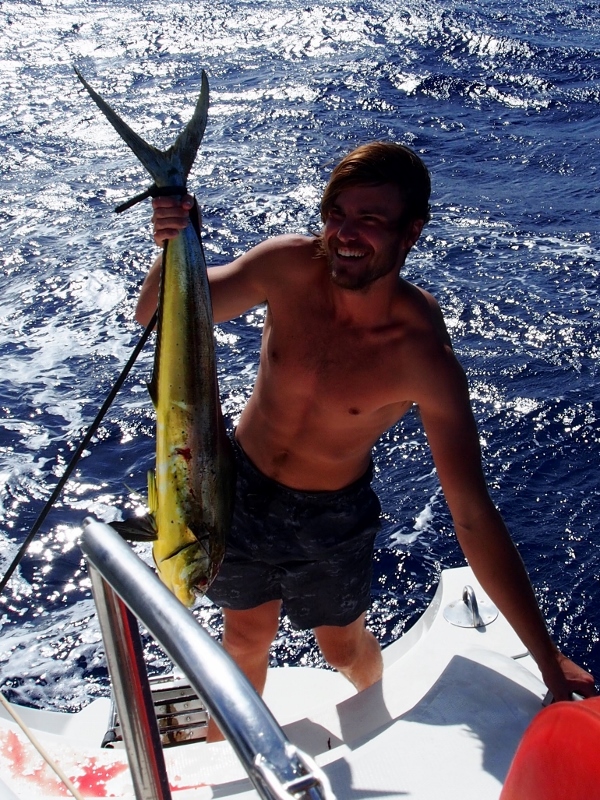
Ed with a mahi mahi we caught

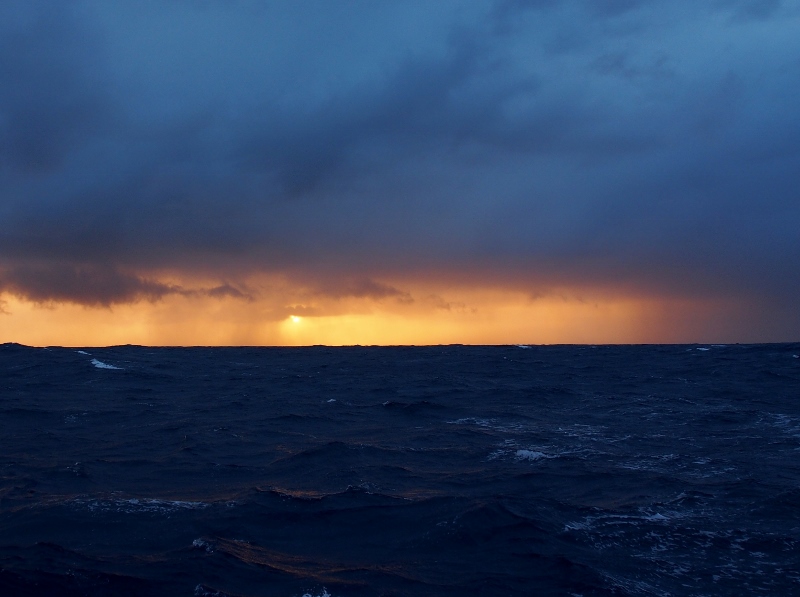
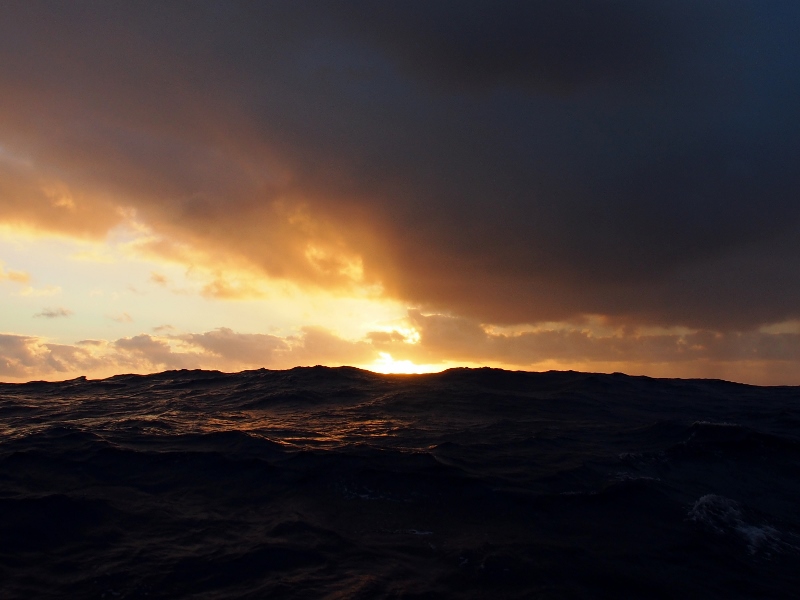
The swell lessened a tad over the next two days but the motion remained unfriendly, and by the third night we were all really tired. A series of squalls were beginning to roll over the horizon, and we put a third reef in the mainsail in preparation for a rough night. I woke up around 10:30, worried by the whistle of howling winds and the banging and crashing of the boat slamming into the waves. I could hear David reefing the genoa, and moments later he got Ed up to help him get rid of the mainsail altogether. I turned over in bed, hoping to fall back asleep before it was my turn to stand out there for four hours braving rain shower after rain shower. When I got on watch at 4 am the wind was all over the place, gusting to 30 knots periodically, and we were bouncing along on big seas under a stamp sized genoa. The sun rose in the midst of a squall, sending its beautiful yellow rays out from gaps in a black thundery cloud, the sun itself periodically blotted out by the large seas.

Sun over heavy seas
Sun over heavy seas


It turned into a nice day, and we managed to dry the boat out and catch a bit of sunshine before starting the preparation for the large forecasted front that hit us late the next day. As the clouds thickened moisture condensed everywhere, and inside the boat floors and walls were dripping, the children skating along on bare feet, shouting “Yipee!”. We reefed the mainsail right down again just in time for the stiff breeze and icy rain that hit after dinner. After the front the wind swung around to the southwest and we continued the roughly 250 miles to Beveridge beating into a merciless swell. Every time the boat gained a couple of metres it slammed into the next large wave, causing big bangs and crashes to reverberate through the hulls, leaving us all heavily seasick and thoroughly unrested. The weather had changed too.

David using a rare sunny spot to do some celestial navigation

“Mummy, where is my jumper, and my rain coat?” said Lukie, poking his head up into the cockpit early in the morning, in his usual bare-chested attire. “I’m really cold, and I want a jumper”. His hands were icy cold and for the first time on this trip I had to go rummage in dusty cupboards for our jeans and woollies. Both boys had grown so much since we were last in the cold that their jumpers were now stumpy on them, but they were still excited – any jacket is still a good cape and we haven’t had capes for ages.

Once over the seasickness...
Once over the seasickness…

On our way to Tonga: Mopelia

OLYMPUS DIGITAL CAMERA

It is 1300 miles between Bora Bora and Tonga, and we were fortunate to have Ed, a friend of a friend from Australia, to help us on this stretch. To break up the trip we first did a 24 hour sail to Mopelia, one of the westernmost islands in French Polynesia where we were going to sit out a forecasted front. A small atoll 130 miles to the west of Bora Bora, Mopelia is more similar to the Tuamotus than the rest of the Society Islands, with no central island but only small motu dotting the reef edge, surrounding a light blue lagoon. The sail there was tiresome, with rain and less than optimal wind directions, and with one jibe and another we covered almost 200 miles before reaching the narrow pass leading into the lagoon.

OLYMPUS DIGITAL CAMERA

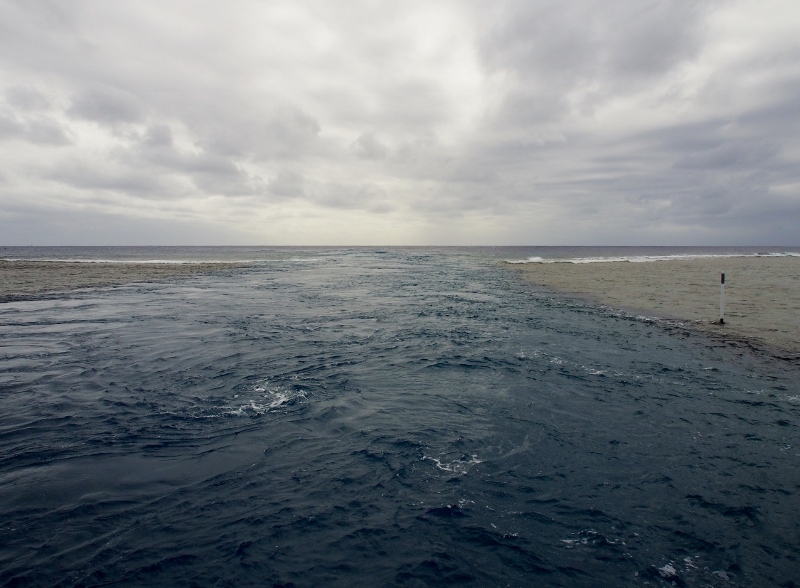
When we got there we hovered for a while on the outside of the pass, hesitating. Mopelia’s pass is famously impassable, and our view from the boat lived fully up to our worst expectations: white water frothing over the sill, whirlpools along the sides and standing water on the outside where the ocean swell met the currents gushing out. At just 15 m wide, the length of our boat, the pass was too narrow for us to turn the boat around, so once we entered we would have to be committed to keep going until we were through to the lagoon. We had already delayed our departure from Bora Bora by a day because we were worried that the large swell would fill up the lagoon with water from waves crashing over the reefs, causing a strong outgoing current giving little respite even on an incoming tide. But it still looked like it was running strong.

Ed's face when he saw the pass
Ed’s face when he saw the pass

“Are we going in? Isn’t it too strong?” I asked nervously, not certain I really wanted to be there, the pull of the alluring flatness of the lagoon not quite trumping my fear of crashing onto the jagged reef edges poking up through shallow water on either side of the pass.

“I’m just lining us up”, David said, squinting at the reef through his polaroid sunglasses. “Only checking that we can motor against the current”.

I rushed inside attempting to have a look at our aerial imagery from the lagoon, but before I could switch on the computer, I felt the boat lurch and saw that he was starting the entry. Ed and I jumped to the bow to spot for the reef edge and anything else rising to the surface, calling out helpful advice like “getting awfully close on port, veer to starboard, quick!” and suchlike, even though it was doubtful David could hear a word we were shouting over the roar of the breaking waves and the rush of the maelstroms that were trying their best to suck us down.

The pass - the width was the length of our boat
The pass – the width was the length of our boat

Just before the end of the pass we spotted two submerged buoys that somebody had sneakily popped in the channel just to snare the lucky vessels that manage to make their way through the whirlpools, but by amazing feats of communication (a roar of “Neutral!! Buoys in the water!!!” from myself and Ed in unison) we cheated the evil locals or whatever crazy persons had placed them there, wiped our sweaty hands off on our t-shirts and congratulated ourselves on getting through to the lagoon.

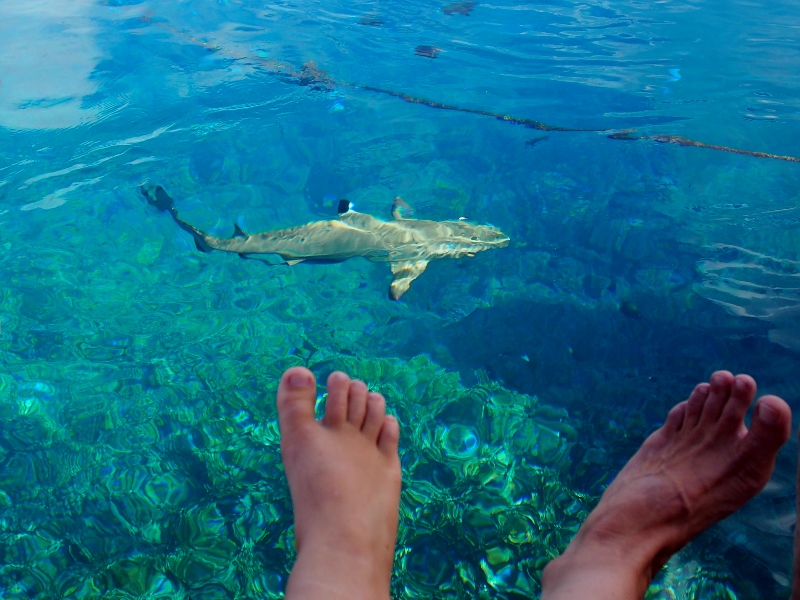
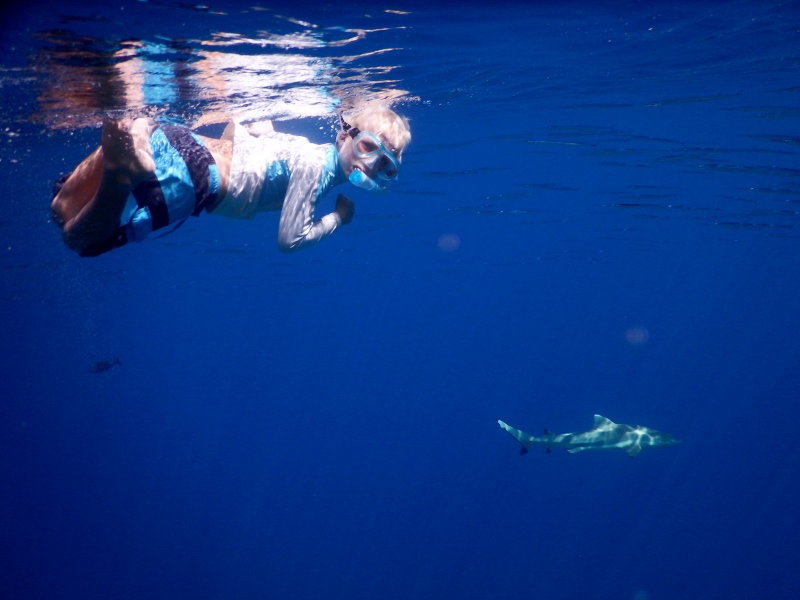
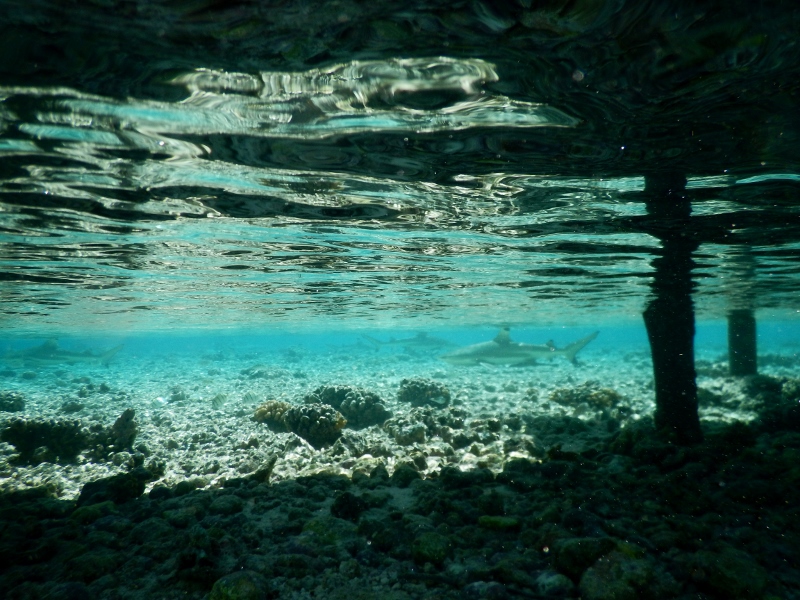
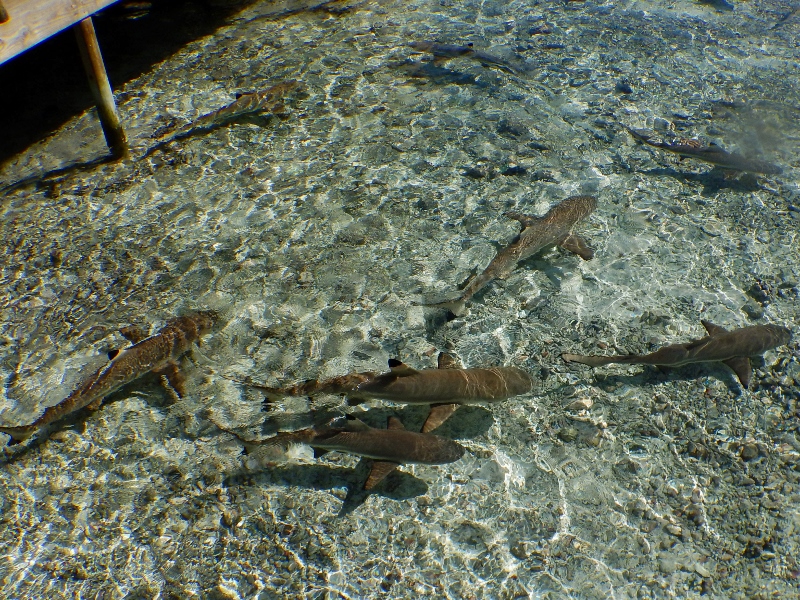
Which was lovely and calm, a welcome change from the pass, and we leisurely motored across to the other side and threw in our anchor. As soon as we were anchored about 10 black tip reef sharks showed up, circling the boat hungrily, and I hesitatingly jumped in to check the anchor – they are not meant to be dangerous and we have never felt them to be interested in anything our size, but we’d never had them show that much interest in us at anchor before? Reassuringly, once I jumped in they scattered, leaving the kids confident enough to start their ‘we’re-on-a-new-anchorage’ jumping session.

OLYMPUS DIGITAL CAMERA

Another boat was at anchor there; despite our outstanding heroism we were obviously not the only ones brave enough to dare the pass, and on the shore we spotted people walking around. When we dinghied in we met a young man living there, who explained that he and his family had moved there three years ago from Ra’iatea.

Conch spaghetti for dinner
Sunset in Paradise
Sunset in Paradise

“Welcome to Paradise”, he said, in surprisingly excellent English, with a broad sweep of the hand indicating the light blue lagoon, the white sand, the swaying coconut palms, and the loudly squawking seabirds filling the sky.

We thanked him and chatted for a while. Apparently the sharks hang around boats not because they are trying to finish off anyone that managed to survive the pass, but because his family normally clean their fish catch on the boats in the lagoon, feeding the scraps to the sharks, thus training them to circle any boat entering the lagoon aggressively. He said they get about 70 yachts visiting a year, and then excused himself – he had to leave to go fix a broken truck. Slightly surreal – truck? Road? This was a tiny place, but I guess they must use them for copra farming.

Playing with hermies

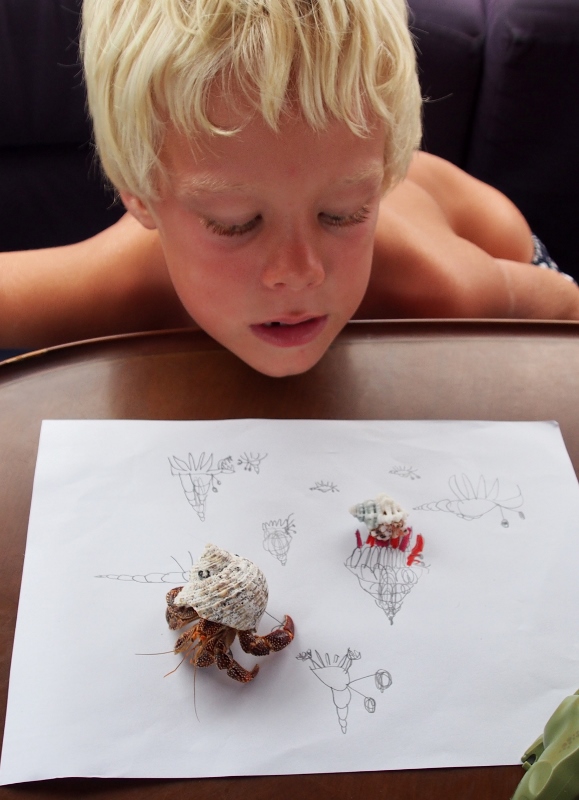
The kids collected some hermit crabs from the beach which we allowed them to keep on the boat overnight. They quickly turned all paternal, naming the smallest one Baby Butter and making elaborate Hermit Habitats for them to spend the night in. They were cute – all pale and delicate, with long slim quite hairy legs, cautious eyes on slender stalks and engaging sideways wobbles. The biggest one was initially called Micro, but after some enquiries it got changed to the more appropriate Mega, and I happily ticked off that box in the home-schooling curriculum. Once presented with an outstanding choice of empty shells in the Hermit Habitat, several of the crabs changed their shells for the bigger, better and shinier options provided, possibly because they were dead scared and hoping to slip away unnoticed in a new disguise.

Hermits
Hermits

The big rainstorm hit the next day, leaving Ed, the kids and I thoroughly seasick as Bob pulled her best moves on the 1 m swell that suddenly appeared on the anchorage.

Rainstorm
Rainsquirt

“A bit wobbly, innit?” offered David brightly about midday, surveying us, his green-looking crew, picking over our lunches. “Let’s move to somewhere more sheltered”.

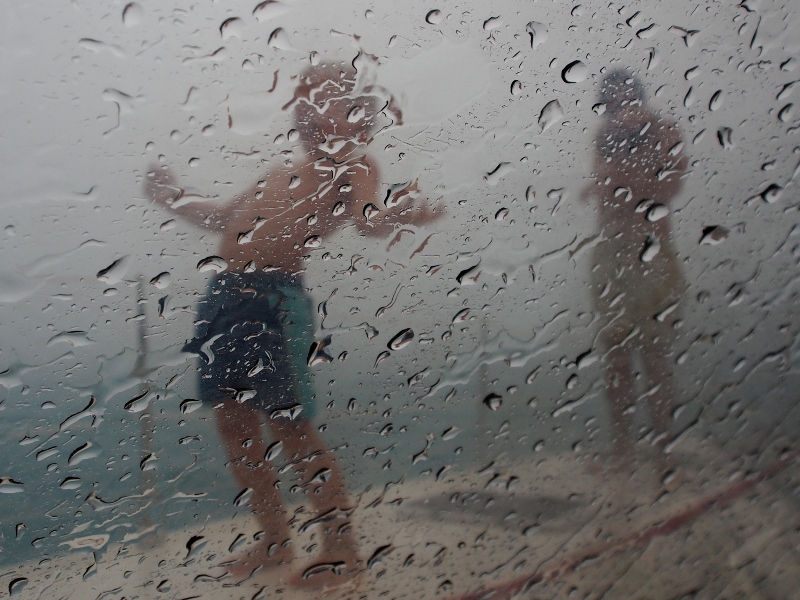
Lukie and Ed having a wash on deck during rainstorm

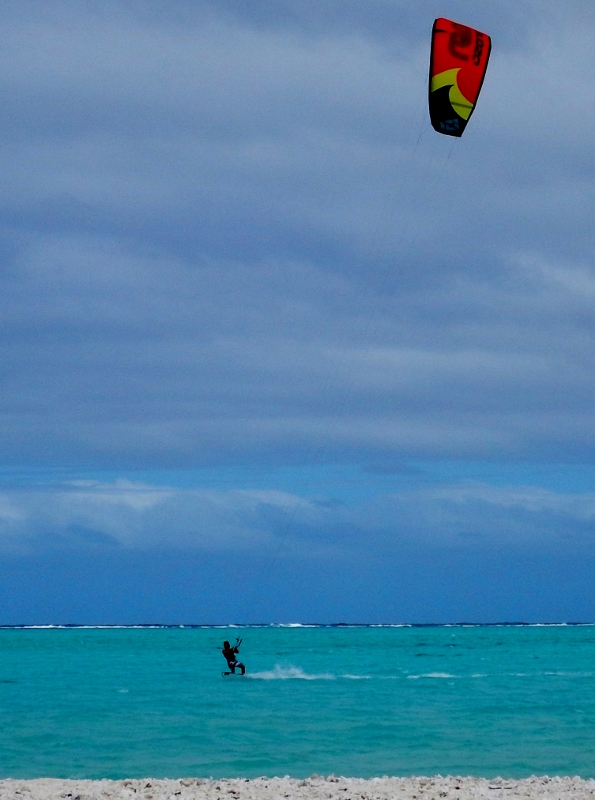
So after lunch, in the horizontal rain and stiff breeze, we pulled the anchor and moved to the other side of the bay, Ed and I shivering in our buoy-and-reef spotting positions on the bow, awash with the waves that we’re determinedly motoring into. The other side was lovely and calm and by the time we got there the rain had stopped and so we managed to have a couple of kitesurfs before pulling anchor to leave for our next stop en route to Tonga the following afternoon.

David kiting
David kiting

Which left only the dreaded departure, through the now furiously fast-flowing pass.  At this stage, the increased swell had added the new and interesting dimension that large waves were now breaking on top of the outgoing current on the outside, and as we approached the heavy chop filling the impossibly narrow channel, David and I exchanged nervous glances before I averted my eyes and crossed my fingers as he put down the throttle, expertly navigating Bob through as she was being pushed this way and that, precariously close to the ragged reef edge and over submerged buoys at worrying speeds.

Once through, we steadied our shaky hands and started thinking of our next stop, Beveridge Reef – a sunken atoll in the middle of nowhere, 160 miles from Niue and 400 miles from Tonga.

OLYMPUS DIGITAL CAMERA

Bora Bora: farewell Pete, welcome to Ed

Bora Bora
Approaching Bora Bora

“Apropos, Apropos, this the Bob the Cat”.

“Apropos, Apropos, this is Bob the Cat”. No reply. Matias shakes his head, handing me the VHF.

“It’s not working, mummy”, he exclaims.

It is a bright blue afternoon, hot and windy, the white sand of the idyllic atolls around us gleaming in the sun. We’re anchored in a shallow part of the lagoon on the western side of Bora Bora, and Matias and Lukie really want to play with Jacintha, the 8-year old from the neighbouring boat Apropos. We’ve met Jacintha and her parents Karen and Jim from time to time since the Marquesas, and the boys are excited to play again.

I hold down the transmit button on the VHF. “Try now”, I say, miming “Apropos, Apropos, this is Bob the Cat”.

“Apropos, Apropos, this the Bob the Cat”, he repeats.

A crackle, and then we hear Jacintha’s voice: “Bob the Cat, this is Apropos”.

“Apropos, this is Bob the Cat”.

“Bob the Cat, this is Apropos”.

And so it goes for a while – I gently suggest they change to channel 14 for this enlightening conversation and leave them to organise their play date. It’s great for the boys to see familiar kids; when we left Jacintha last in Rangiroa, Tuamotus, they had several good games on the go and we were hoping to bump into them again.

OLYMPUS DIGITAL CAMERA
Fun on the tramp


And here we are, in Bora Bora, the quintessential tropical island. Bora Bora looks just like a postcard – steep green hills surrounded by a blue lagoon, the edges of which are dotted with tiny palm-fringed motu.  It is without a doubt the most touristy island in French Polynesia and caters mainly to the excessively wealthy. In our few days here we’ve gotten the gist of the version of a tropical Pacific holiday paradise sold by the major hotel chains – rows of cute little thatched huts on stilts, tastefully furnace, extending out over coral reefs into the turquoise lagoon. Reclining sun chairs on the small wooden decks out front, fish gathering in the shade around the concrete pilings holding up the long jetty. Newspaper of your language of choice discretely tucked under the door in the morning, dinner in the evening at the restaurant at the end of the pier, overlooking the lagoon. It is lovely, calm and laid back here, with a lingering expensive aftertaste.

DSCN4283 (800x600)
View of Bora Bora from a small motu on the reef


On our first day in Bora Bora we picked up Ed, who will sail with us to Tonga, and then left for the eastern part of the lagoon to spend his first and Pete’s last day looking for large marine animals, the only part of the standard Bob the Cat experience package that we hadn’t been able to deliver on yet. Luckily, Manta Reef on the east side of the island did what it said on the packet, sporting a large manta ray patient enough to let us snorkel with it for a good half hour before it disappeared.

Manta ray
Manta ray


Matias edging closer to manta ray

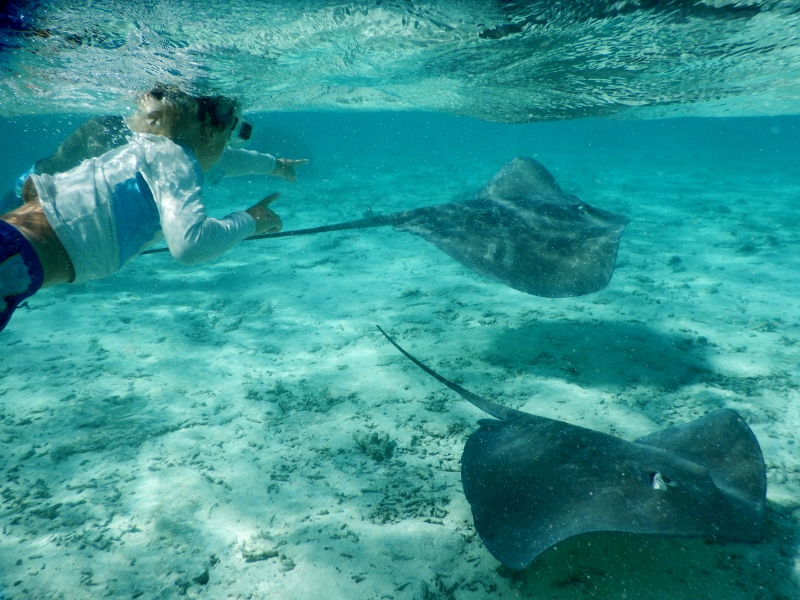
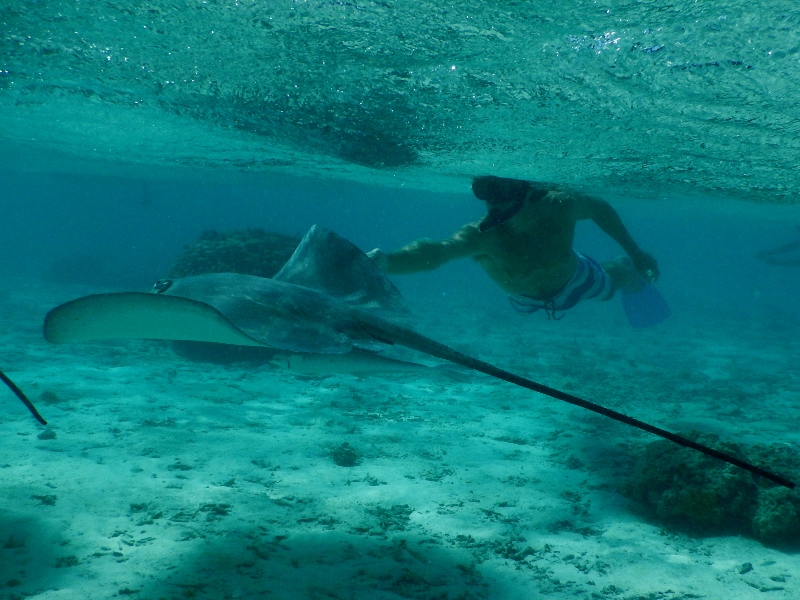
Thus satisfied, we dropped Pete off at the airport the following morning and went to anchor on the west coast of the island, joining Jacintha and her parents. It was a lovely spot, not far from the shallow area where the tour boats gather to feed the stingrays, a surreal experience that we promptly gate crashed the morning after. In a sandy bay with water shallow enough to stand up in, seven tour boats were anchored, guests hanging over the edges, cheering as buff young men and one small woman wearing traditional tattoos, sumo top knots and tiny loin cloths stood waving their hands around like magicians, distributing small fragments of fish to clusters of hungry rays flocking around them. As the guides waved their arms, the rays rushed over to suck at the fish, almost jumping out of the water.

Matias with a stingray
Lukie with a stingray
Lukie too


Some of the tourists joined in the water fun, snorkelling around taking photos of the rays. As I jumped in and followed a pair of rays I suddenly found myself confronted with a solid pair of male buttocks only scantily covered by a purple loincloth. The owner, a tattooed Bora Bora sumo-wrestler complete with topknot, had rays swarming all around him. Straight in front of my eyes was one confused specimen enthusiastically sucking onto the thin strip of cloth wedged between his butt cheeks. Attempting retreat, I furiously flailed my arms, slapping (surprisingly slimy) rays to the side and hoping desperately to avoid physical contact between my face and his private parts, slowly making way through the thick soup of hungry rays despite their best attempts to push me forwards. I decided that it was probably best to keep a distance to the tour operators, and sat back to watch a tiny female guide not far away, entirely overwhelmed by huge rays, ten of which were vigorously attacking her, shimmying out of the water and up her body in an attempt to get more food. Elegantly bending backwards until her face was almost under water to the accompaniment of sweet ukulele tunes from her fellow tour guide, she provided great photo opportunities for the applauding well-nourished tourists on her boat.

Shark with remora followers
Rays aplenty
Rays aplenty


Several round black tip reef sharks were cruising around too, each with two or more remoras shadowing them, ever alert although rather full-looking – imagine their lives: free food on offer for a couple of hours twice a day, 365 days a year. Given this abundance of food, it is a mystery to me why the rays seemed to be starving, but the sharks kept their impulses under control and stuck to quietly patrolling the grounds, ensuring that everything was in good order, much like police at a music festival keep their keen eyes on intoxicated teenagers.

DSCN4389 (800x600)


The kids were excited to see the rays, although a little apprehensive.

“Wasn’t there a man that died from being stung by a sting ray?” asked Lukie, brow knotted, just before jumping in.

“Yes”, I replied, “but don’t worry, I’ll hold your hand”. And off we swam, rays brushing up against us on their way to the near naked guides, Lukie extending his hand to touch one as it tries to manoeuvre in on a group of fish-dispersing tourists.

David with ray
David with ray

The rest of our time on Bora Bora was spent on more mundane tasks: doing laundry and provisioning for the trip to Tonga; spending hours in vain trying to use the wifi of various establishments for weather and blog updates. When a rain storm delayed our departure for Tonga by a day, we went back to the bay where Jacintha’s boat was anchored.

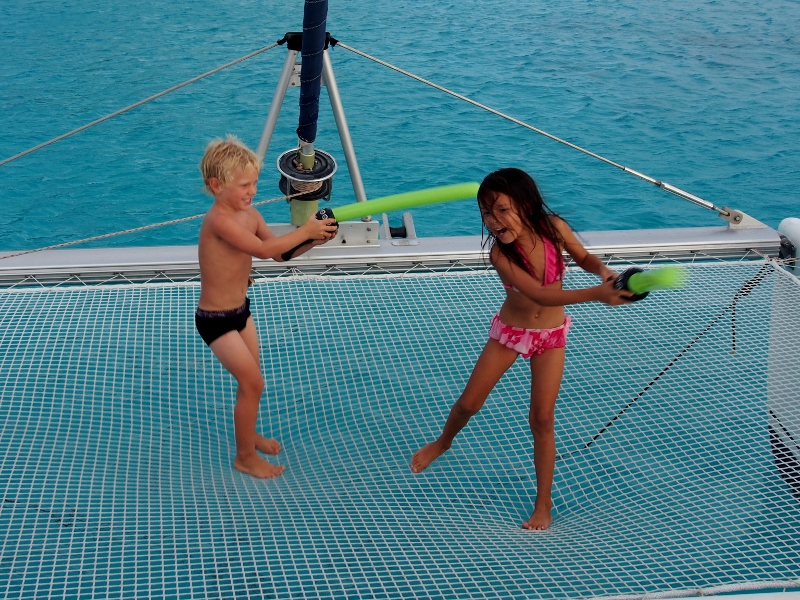
And now, to the boys’ delight, she is coming over, armed with her swim suit and ideas for a new play for them to perform to interested adults, this one a fusion of Star Wars and Oliver Twist.  Jacintha has become an avid Star Wars fan since we saw her last and her and the boys spend hours debating the finer points of Anakin’s turn to the dark side, interspersed with enthusiastic light sabre fights on the trampoline and a fair bit of water play. It is great to have an old playmate around, and before we leave we make firm plans to catch up with Apropos in Tonga.

Fearsome Jedi
Fearsome Jedi


Ra’iatea and the marae at the centre of the world

OLYMPUS DIGITAL CAMERA

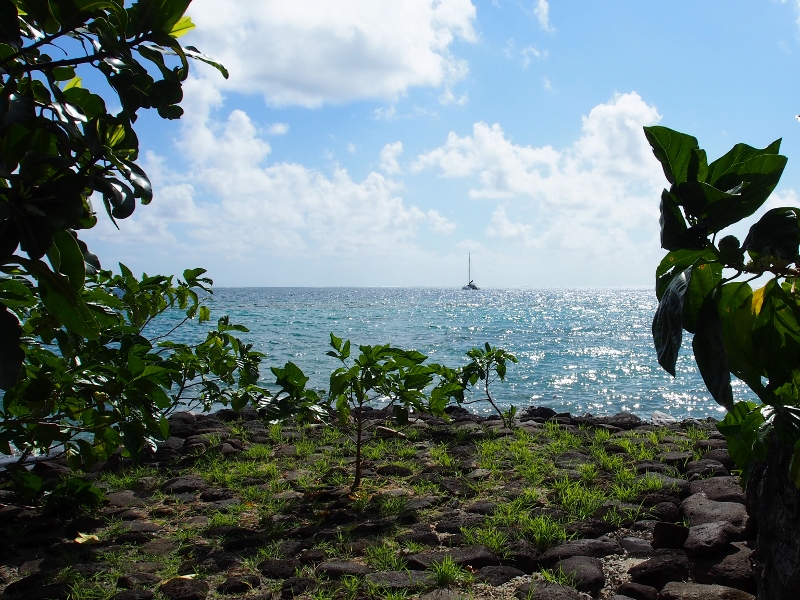
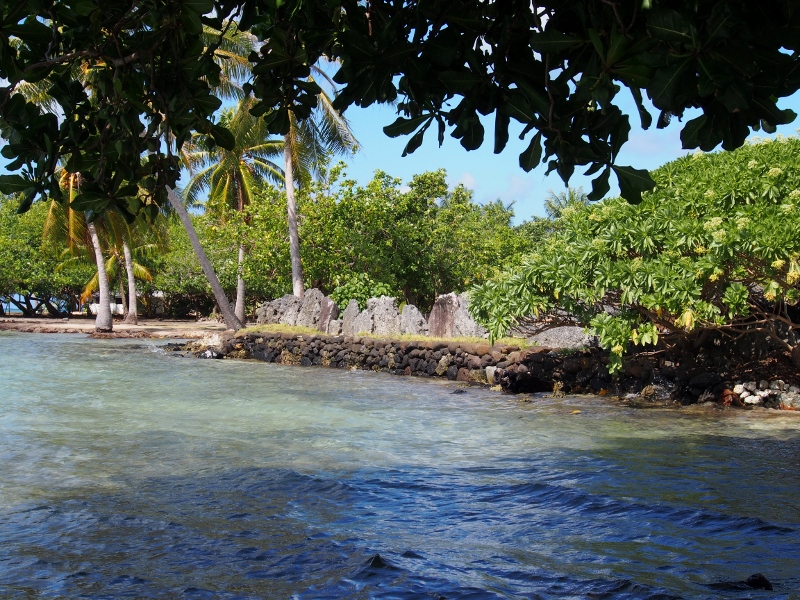
The mid-morning air is still and hot, with a faint smell of smoke. The sun is blazing down on the black basalt rocks in the large paved area where we stand just behind the water’s edge. The shallow water next to the ancient rock wall is calm and flat, but looking out we can see the thick foamy layer of white waves on top of the reef behind the blue-green lagoon. The sound of the pounding surf hums in the background, mixing with bird song and the clucking of numerous chickens that run wild in amongst the stones, pecking at crabs hiding in the sand between the rocks in the shade of large trees.

OLYMPUS DIGITAL CAMERA
Hiding in a tree on the marae


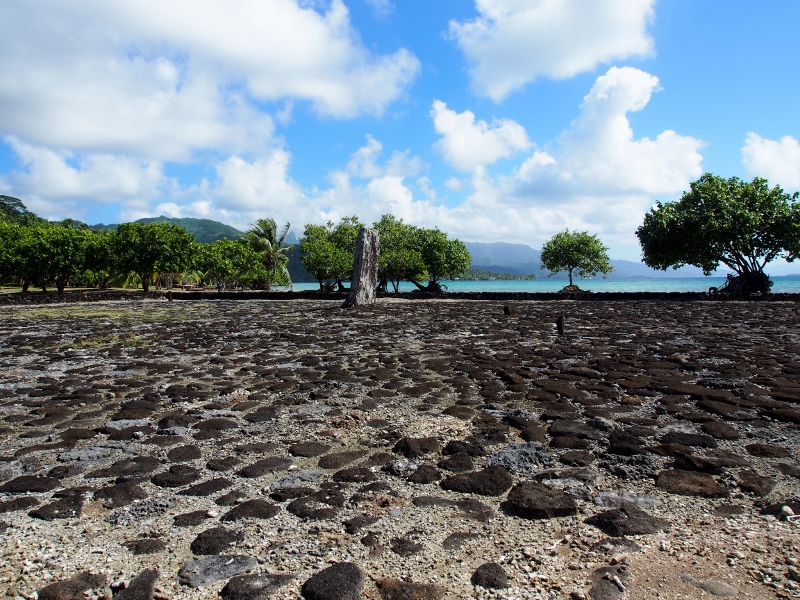
The flat coastal strip, a narrow border between the shallow lagoon and the steeply vegetated hills, is dense with rock foundations, carefully positioned by ancient hands to please the gods that ruled their world.

This courtyard was built in the 14th century, from basalt and coral rocks supplied by local families on the orders of the priests of the cult of Oro, the god of war. Using huge fossilised coral slabs standing erect and forming a jagged edge, they fenced off one end of the paved areas to demarcate an especially sacred area for the gods and ancestors. Where we are standing, thousands of people have stood in the past, focusing their hopes and aspirations into prayers to stern and demanding gods.

It’s a spine-shivering experience to be here, the religious centre of the Polynesian Pacific. We are at the Taputapuatea marae, the most important temple in all of Polynesia, on the island of Ra’iatea in the leeward Society Islands of French Polynesia. Ra’iatea used to be known as Havai’iki Nui, and legend has it that it is here that at least some of the waka (canoes) that arrived in New Zealand came from. The Taputapuatea marae was so important that each waka that took off from Ra’iatea to colonise new lands brought with them a stone from here to imbue special powers into the marae that they would erect in their new home. Ari’i (chiefs) from the Australs, the Cook Islands and New Zealand would come back for centuries to this location for important ceremonies.

Bob parked in front of the marae

As we stand here we imagine them taking off, full of hope and fear, blessed by Oro or maybe ousted by his adherents – who will ever know? We imagine their two-masted double hulled waka packed to the max with people, water, tools, weapons, provisions and animals for a new life on distant islands yet to be discovered. We imagine the months at sea ahead of them, with storms and doldrums, their only shelter a small thatched hut joining the two hulls of the vessel; the only shade from the hot sun the triangular sails woven from palm or pandanus leaves.

It seems incredible that New Zealand was colonised by people from here, so far away. Incredible that the relatively small waka that we see drawings off could handle the journey south, and that they would face the hardship of a return journey to come back for ceremonies thousands of miles away. Incredible that we’ve been to the Tuamotus, where they have a legend about the Tainui waka, which, when it arrived in New Zealand, landed close to Raglan where we live. The Tuamotu legend features identical names of the waka and the chief on board as the Maori legend, suggesting that Tainui did indeed leave from those barren atolls. And incredible that we’re now here in Ra’iatea where at least some of the other waka left from, that we’re at the marae at the centre of the Polynesian world, at a site where thousands of direct ancestors of New Zealand Maori have stood before us.

For these people the marae was the meeting ground between humans and the divine. Archaeologists have dated the remains of the Taputapuatea marae to the 14th century, but it is likely that what we see now replaced older, more transient structures, and that the site was a place of worship for centuries before anything permanent was built.  Drawings from the early European visitors to Polynesia indicate that the houses on the marae had no walls but instead had poles onto which thatched roofs were perched, with one or more rows of upright coral slabs separating the ahu (sacred part) from the rest. The fare ia manaha, the most sacred house on the marae, housed the most sacred icons, the to’o (images of gods) and ti’i (tiki in Maori and Marquesan: images of deified ancestors). This fare was so important that a human sacrifice was required for its construction, the remains of the victim buried under the central part of the house. Towering above the marae were unu, tall wooden fork-like totems, carved with images of ancestors, gods or animals, which were erected along the edges of the ahu. Special human sacrifice marae had special forked unu, without carvings or designs, erected alongside the stacked skulls of the victims. Other houses on the marae were for the dead (fare tupapa’u), where the bodies of deceased people of importance were held, sometimes for many days, before being taken away and buried. The marae also included numerous round-roofed buildings for canoes, with special structures for each of the many types of waka.

Ancient courtyard
Ancient courtyard

We’re interrupted in our contemplations by the kids – they’ve found a huge hermit crab in one of the ancient ahu, and after we finish looking at that it is time for lunch. It is hot and they’re thirsty and hungry, so we sit down in the shade of a large tree and have a picnic, in this peaceful location that harbours such a chilling and gruesome past.

OLYMPUS DIGITAL CAMERA

We’ve been in Ra’iatea, in the leeward group of the Society Islands, for a couple of days, having sailed here overnight from Mo’orea, a calm, moonlit passage for Pete’s first night watch. Ra’iatea is, right next to the island of Taha’a, two ancient volcanoes forming separate islands encircled by one common lagoon. After Tahiti, Ra’iatea is the second largest of the Society Islands, but it is very quiet – there are no beaches here, so not many tourists, although there are a few sailboats.  Legend has it Ra’iatea was one of the first islands to be settled in the Societies, probably by people from Samoa. In ancient times Ra’iatea used to be the religious and political centre of the Societies, and it is thought that Tahiti was settled by people from here. Only when the Europeans arrived with their ships, finding Pape’ete a better harbour, did the capital of the Societies shift to Tahiti.

Matias playing with a cat on the beach

Our first night here we tied up to the wharf at the main town of Uturoa, a useful place next to supermarkets and sailmakers where cruisers often come to stock up. Unfortunately the conveniences come with a downside, and we were told to tie ourselves on tightly as the local youths have in the past untied yachts in the middle of the night, no doubt laughing their head off as they watched them drift towards the reef in the darkness. As it happens, the Australian boat next door ends up being broken into and having a laptop stolen during the night, but fortunately we’re spared – it’s possible that the lights we leave on all night for the kids may have deterred intruders.

Despite all this, Uturoa is heaven to us – we get minor repairs done on both our sails and even get – Hallelujah – a bottle of gas for cooking! So now we are truly free of worry – we were uncertain that we had enough gas to get us to Tonga, but because of the Tahitian gas strikes we couldn’t find any gas anywhere. Now, with gas, we can bake and do all sorts of frivolous things. I’m sure Ed doesn’t realise how close he got to eating cold tins (corn beef with sweetcorn? Artichoke hearts with beetroot and SPAM? – I’m sure we could have made it delicious), but at least now he is assured fresh bread on the passage to Tonga.

Lukie on the river
Lukie on the river

And there are other attractions to Ra’iatea too. On our way back from the marae, the boys and I kayaked up the Faaroa River, gliding swiftly over the still, green waters, our turbulence disrupting the perfect reflections of the dense jungle surrounding the river banks. The river is lined with miro trees, and whilst we were sitting amidst buzzing dragonflies admiring the scenery, their perfect yellow flowers dropped all around us like snowflakes, sending out ripples as they landed softly on the water.

Miro tree flower in the calm river


It has been hot, and we have been spending as much time as possible in the water. In the pass near Uturoa the kids and I explored a motu full of friendly cats and chickens gorging themselves on coconuts and crabs. When we snorkelled the pass, David and Pete collected spider conch and another seasnail, leading to culinary delights such as fried conch for lunch and rubbery slug curry for dinner. On our way out of Ra’iatea, Pete had a few more surfs in the lagoon off Taha’a island while David and I drift snorkelled with the kids, admiring the luminous green corals that shine with a phosphorescent hue.

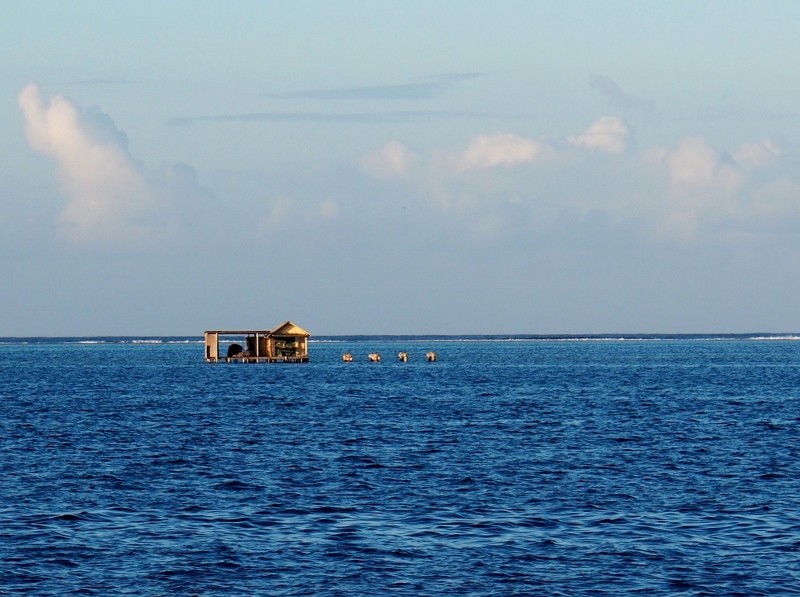
Tiny house iin the middle of the lagoon

And then, as usual, it is time to leave, to get to Bora Bora to pick up Ed. And so we leave to head east, like many double-hulled waka have before us, only stocked with butane gas and tins rather than firewood and live chickens.

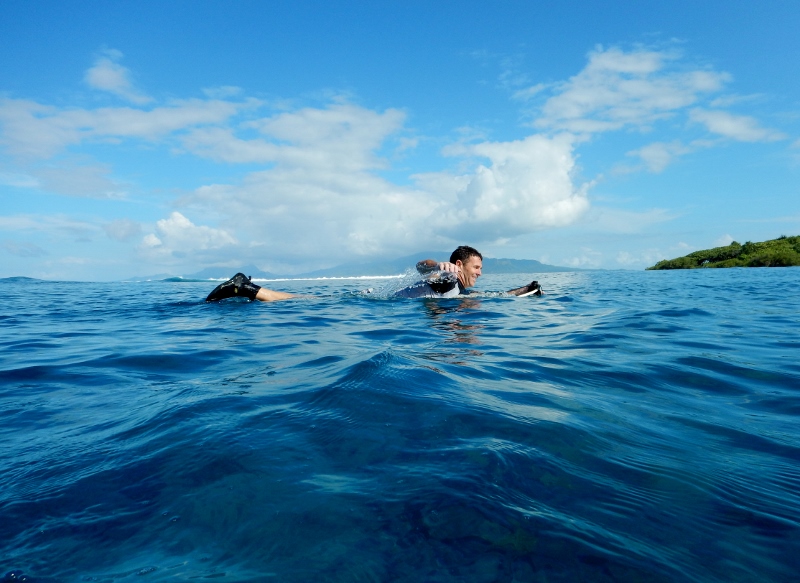
Pete heading for a surf

Mo’orea

View of Opunohu Bay, Mo'orea
View of Opunohu Bay, Mo’orea

‘Mummy, when are we going to be there? I can’t walk anymore”. Matias is dragging onto my hand, trying to bring us to a standstill in the middle of the winding road leading steeply uphill. I sweep at the swarm of mosquitoes covering my forehead and squint up at the imposing mountains rising above us. It is cool in the shade but we’re being attacked by mosquitoes; whenever I look down I can count about 20 of the buggers on each of my legs, sucking contently.
We’re about half way to the famous marae (stone temples) of Opunohu Bay, the fertile valley on the north side of the island of Mo’orea. It is a 9 km walk round trip, leading first to the marae, and then to the fabled Belvedere, the panoramic view of the two bays that adorn the north coastline of the island and Mount Rotui, the tall, rugged mountain that separates them.

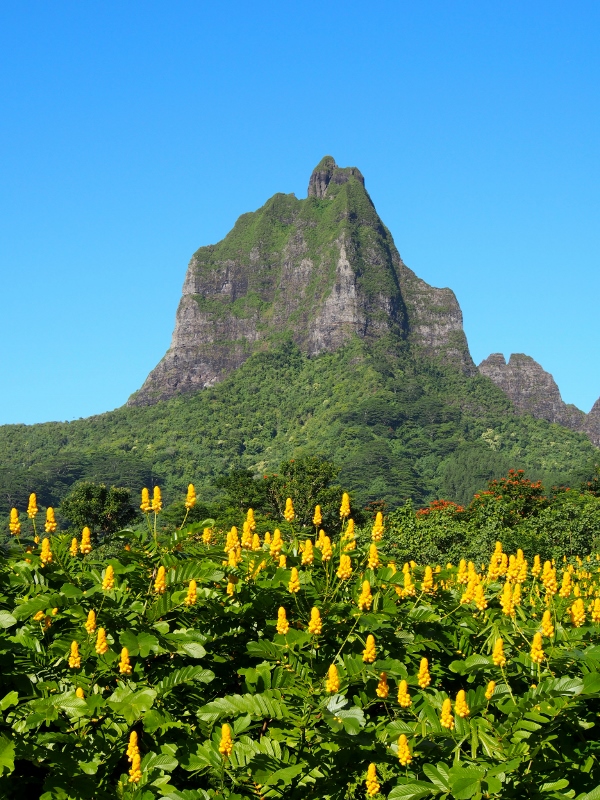
Rugged highriser
Rugged highriser

Part of the group of islands known as the Society Islands, Mo’orea is a young (1-2 million years old) volcanic island with steep hills surrounded by a barrier reef. Mo’orea (meaning yellow lizard – apparently the name of the chief family at the time the Europeans came, prior to that it was known as Eimeo) is clearly visible from Tahiti and the sail there took us only a couple of hours.

Modern warriors paddling towards Tahiti

Settled by the Polynesians in the same wave as Tahiti around 200 BC, Mo’orea was first sighted by Europeans in 1767. When they arrived the island was heavily populated, but within a hundred years the Polynesian population was decimated by the usual mix of weapons, disease and alcohol that the Europeans brought with them. Dozens of marae are still scattered in the valleys of the island, the remains of the dense populations that used to live here. It is these temples that we have stopped in Opunohu Bay to see, but as it is nearing lunch time Matias’s enthusiasm for the ancient ruins is diminishing proportionally to his rising hunger.

The marae
The marae

We finally reach the marae, square stone platforms built into the hillsides on which temples used to stand, ancient altars still visible in amongst the trees overgrowing the site. I get out the snacks and the complaining stops for a minute or two while we view the information panel that details the ancient archery competitions that used to take place here, the kids transfixed by the illustrations of the warriors that once dominated the island.

Prefers driving to walking...
Prefers driving to walking…

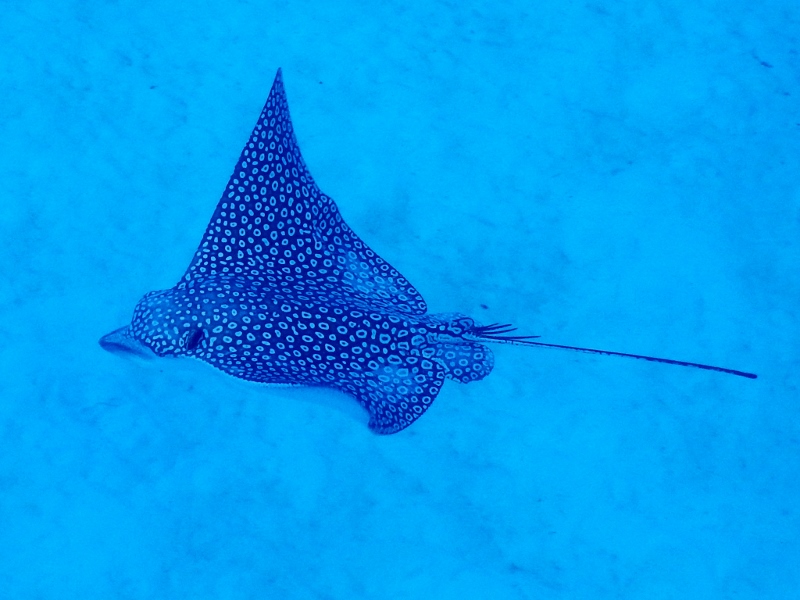
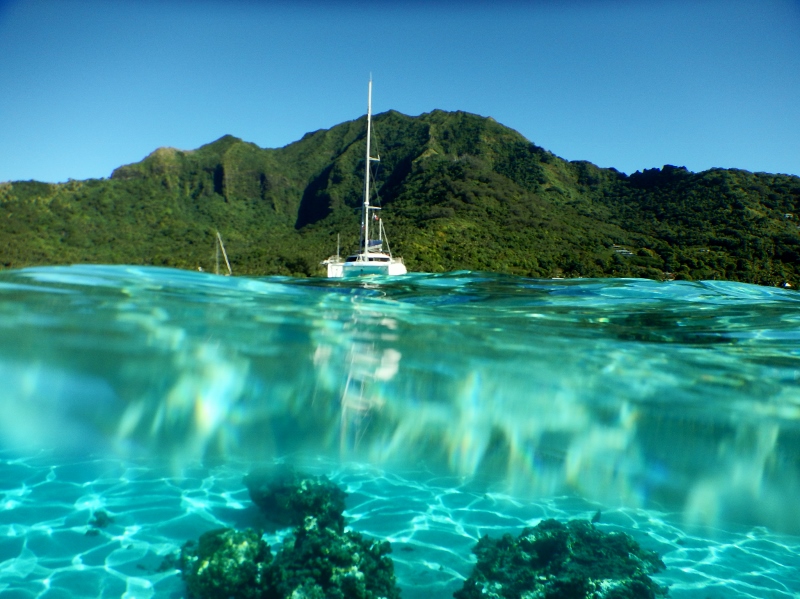
For the last couple of days we’ve been exploring the aquatic side of Mo’orea. It is a stunning island – steep and lushly vegetated, surrounded by a turquoise lagoon sporting clear waters and healthy coral. When we first arrived, we anchored on the eastern side, at Teavaro Bay which is a lovely stretch of lagoon with the view of Mo’orea’s steep bushclad hillsides on one side and sweeping views of Tahiti enveloped in clouds on the other side. Strong currents were flowing near the reef, and the boys had to hang onto ropes tied off to the end of the boat in order not to get swept away. The visibility on the eastern side of the lagoon was amazing – gin viz as my old diving buddies would say – and rays were everywhere. Light and dark eagle rays with their delicate ringed spots and peculiar beaked head, as well as black stingrays, gliding through the water just above the bottom, coming up only to check us out briefly.

Eagle ray
Eagle ray

The southern end of the eastern bay is famous for its snorkel trail which takes visitors from a small motu to the edge of the reef. On our visit we soon found out why there is a trail – the waves crashing over the reef created a sweeping current which we have to cling onto the ropes joining up the buoys of the trail to pull ourselves forward against. The area is a reserve and home to several black tip reef sharks and stingrays which turned up in great numbers as we were nearing the shore at the end of the trail, circling us hungrily. And sure enough, when we climbed out of the water we discovered that a tourist operation is conducting a snorkel tour complete with shark and ray feeding next door.

Eagle ray
Eagle ray

I’m not sure about the wisdom of staged shark feeding – it disrupts natural behaviours and teaches sharks to associate humans with food. Apparently there have been some recent accidents at a shark feeding operation near Opunohu Bay on the north side of the island where a child was killed and an adult injured by over-excited lemon sharks during a feeding session.

Stingray
Stingray
DSCN4088 (800x600)
Matias and I embracing the sea

In the afternoon of our second day we picked up Pete from the ferry dock. It is great to see him, and here, surrounded by rugged mountains and turquoise sea, he and David are soon back in the old groove, deep in work discussions with a bit of philosophy thrown in. There is time for leisure too, and Pete goes for a quick surf on a local break on the way to Opunohu Bay while the kids and I chase a ray out the back of the boat.

Pete's jump off the boat
Pete’s jump off the boat

The archaeological site in the valley behind the bay is the last stop before we head off to the island of Ra’iatea where we’ll spend a couple of days before sailing on to Bora Bora to meet Ed.

Green hills and turqouise seas

And the site is worth a visit, despite the mozzies and the whinging children. After a pack of crackers and some carrot sticks even Matias is ready to head on, and after the marae we make it all the way to the lookout where we rest for a while, refreshed by the glorious view of mountains and inlets, steep hillsides and bare rock backed by flat deep blue water. It is easy to understand why this valley was densely settled in ancient times, stone temples scattered amongst more temporary dwellings. It is a magical place and worth a long walk, even for two tired little boys.

The view from the Belvedere


Tahiti – back to civilisation

DSCN3766 (600x800)

Our arrival in Tahiti heralds a much needed return to civilisation after months in the wilderness – time for boat repairs, showers, laundry, baguettes, yoghurt and cheese.
When we arrive in Tahiti it is windy and wet, and every day while we’re there the skies seem to discharge a huge downpour or two. Which makes quite a nice change from the dry Tuamotu islands that we come from, but is not conducive to drying all the laundry that we have saved up for this fabled place of washing machines. That’s what cruising in remote locations is like – we are over the moon to arrive in Tahiti, not because of its impressive volcanoes or lovely sandy beaches, nor for its nice snorkelling or cultural importance as the heart of French Polynesia. But because it has washing machines. Which sounds silly, but is rather incredible when you’ve been living on a hot boat in the tropics without access to much water or any laundry facilities for two and a half months.
It is not only laundry we have to do here, although we do have endless sheets, undersheets, pillows and towels that need a good hot wash to sterilise them after months of sweaty sleep and infected coral cuts. We have to install the new batteries that are waiting for us in Taina Marina just out of town. We also need to get a cooking gas refill, and to provision for the next four months of cruising in less-than-wonderful retail locations such as Tonga and Fiji. And then there are all the small jobs – reinstalling the water filter which fell out halfway across from Galapagos to the Marquesas. Fixing a broken handle on a hatch to prevent further leakage. Repairing the port engine clutch which has just started slipping. Downloading kindle books for Matias who is reading faster than our limited internet access can provide (doesn’t say much – currently we have access to download a book about twice a month). Answering emails after a month without internet. Buying new clothes for the rapidly growing children. Showering.

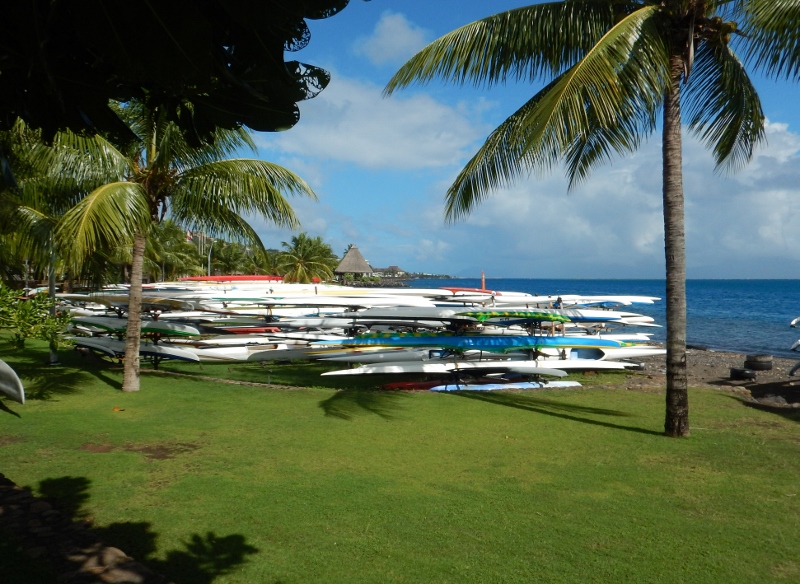
Waka on the Pape'ete waterfront
Waka on the Pape’ete waterfront

We start by going to a half-finished marina right in the centre of town, a lovely location just in front of the huge cruise ships with names like ‘King of the Sea’ that park up to disgorge passengers into Pape’ete where their shopping experience awaits. It is a great place for a marina, right in front of the main drag, within walking distance from the market, the shops and the mobile food stalls – the roulottes – that serve delicious French and Chinese food to hundreds of people every night. We go out eating two nights in a row and revel in the fresh, crunchy vegetables of the chow mein, the roquefort sauce and pommes frites, the bread that we didn’t have to bake ourselves.

View of the cruise ship from the marina in Pape'ete centre
View of the cruise ship from the marina in Pape’ete centre

Because the marina is not fully operational we only pay half price, which is fair given we only receive half the services of a normal marina. The toilets are a good kilometre from our berth, which is not great for the childrens’ perpetually urgent toilet calls, and the washing machines are not operational. But they have internet, showers and shore power, all of which are amazing. I finally upload the blogs from the Tuamotus and manage to answer some of my emails, David looks up clutch repair options and second-hand kayaks online, and Seb and Val do their best to avoid looking at their work emails. We spend half hours just standing under hot water flowing down, soaping ourselves down, washing and combing hair, marvelling at how nice it is to feel clean. Not that it lasts long – it is incredibly hot and humid here and as soon as we step out of the shower we’re covered in sweat, but still. It is also fantastic to have a fully operational fridge after months of battery problems, and it came at just the right time – we caught a big skipjack tuna the day before coming into Pape’ete and continued refrigeration means we can actually eat it rather than throw half of it away.

Lady selling vegetables in the Pape'ete market
Lady selling vegetables in the Pape’ete market

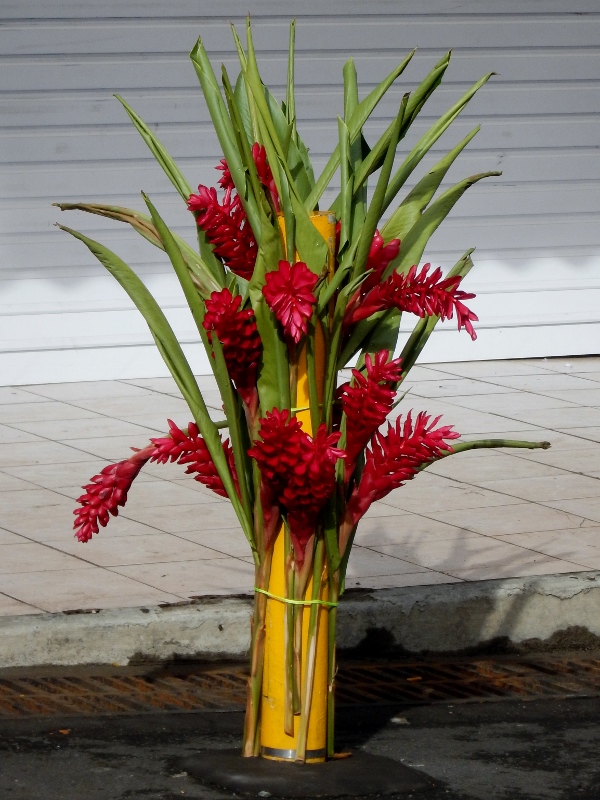
Downtown Pape’ete seems a nice place with its brightly lit waterfront featuring parks and paths planted with beautiful trees and flowery bushes. Flowers are indeed everywhere here – fragrant bouquets for sale in the market, individual flowers decorating the hair of most women, necklaces of tightly bound flowers and leaves adorning tourists and locals alike, big colourful flowers woven into artful arrangements tied to lamp posts and fences.

DSCN3748 (600x800)
After two days spent exploring the centre of Pape’ete we say a sad goodbye to Seb and Val who are flying back to New Zealand. The children are sobbing on our way back from the market where we said our goodbyes and as soon as we get to the boat Matias starts writing them letters, including a message in a bottle which we will post with firm directions to head south west when we get to open water. Hopefully it’ll reach them in New Zealand.

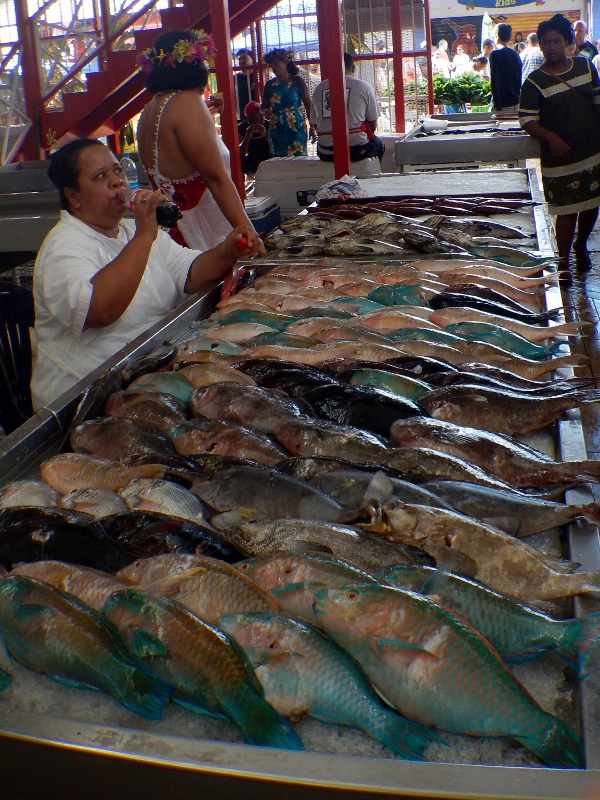
Parrotfish, anyone?
Parrotfish, anyone?

After their departure it is time to get back to business, and we move the boat to Taina Marina where access to supermarkets is easier and where we have boat batteries arriving. Taina is a bit further from town but sports a massive Carrefour nearby where I spend most of my time over the next two days rapidly spending any money we might have saved whilst in the isles of no shops further east. Several times a day I risk my life and sanity pushing a dangerously loaded and spectacularly uncooperative shopping trolley up the steep hills to the narrow bridge over the bumpy footpaths from the Carrefour to the marina. The trolley tries its best to kill me, slaloming rapidly down the hills attempting to shake me off, refusing to go over curbs leaving me stranded in the middle of traffic, and veering dangerously close to the water’s edge on the rough boardwalk of the marina. Despite this, the kids and I triumphantly continue to bring back supplies until we are fully stocked and ready for the imagined food horrors of non-French Polynesia.
The rest of the time in Taina is spent doing unbelievable amounts of laundry, paying astronomical prices for the privilege. The lady in the office is incredulous when I come to get change for the laundry again and again but I don’t care how much money we spend – I just want clean sheets and towels. And a clean boat – after months of visitors it is time for a thorough clean-up and cockroach eradication effort, both utterly futile but nevertheless necessary. Kind of like all housework I guess – a fleeting sense of achievement and then back to square one to do it all again…

Pape'ete church
Pape’ete church

David is busy with the batteries, the hatch handle, the clutch and the water filter but finally after two days of solid work we emerge victorious, boat fixed, clean and fully loaded with French delicacies, crew scrubbed clean in endless showers, sheets and towels dry and fragrantly sterile. The only thing we haven’t been able to do is to get more cooking gas. There is a strike on at Tahiti Gas, and no cooking gas is available here or in the Society Islands. So far, the strike has been going for three weeks with no sign of an agreement emerging, and thousands of Tahitians are out of gas and likely to remain so for the foreseeable future. Not getting a gas refill is a bit of a problem for us, as we are doubtful we have enough to get us and Ed comfortably to Tonga, our next likely refill option. But there is little we can do – there is no gas – and so we resign ourselves to rationing the gas strictly from now on whilst looking out for refill opportunities wherever we go.
And then, after five hectic days is Tahiti, and without having seen much of the island at all, we are ready to go. Tahiti hasn’t got a very good reputation as a cruising destination and we are keen to head to Mo’orea where the waters are clear and the pace relaxed. We’ll meet Pete in Mo’orea, and then make our way towards Bora Bora where we are meeting Ed who will sail with us to Tonga.

Mo'orea as seen from Pape'ete, Tahiti
Mo’orea as seen from Pape’ete, Tahiti

Tuamotu sharks

Curious blacktip reef shark
Curious blacktip (missing) reef shark

The Tuamotu atolls offer the most amazing snorkelling and diving we’ve ever had, and we are so happy to be here to see it all. 20+ years ago when I was diving in the Caribbean they used to have amazing fishlife and corals but this time around we didn’t see the same diversity and abundance of life there. The lesser populated Tuamotu islands is by far the most pristine place we’ve ever been, and we hope that their relative inaccessibility will act to preserve the untouched character of the atolls, and the incredible abundance of fish life.

DSCN3070 (800x600)

By far the most exciting novelty of the Tuamotus to us is the number of sharks here. Blacktip reef sharks, whitetip sharks, grey reef sharks, tawny nurse sharks – they are all here, everywhere.

Matias trying to get closer


The grey reef sharks tend to hover down deep, the white tips a bit higher, and the black tip reef sharks and tawny nurse sharks come to the shallows and very close to snorkellers.

Waiting for food
Waiting for food

When swimming past they ignore us, acting completely unafraid. In Fakarava South they feed the black tips to make them come in, and some of them have damaged dorsal fins, probably from too close contact with a boat propeller.

White tip cruising by

It is incredible to be able to just jump in the water and swim with sharks – this is the first place where we’ve ever been able to do so. Initially we were nervous, but the sheer numbers of divers and snorkellers enjoying close contact with sharks in Rangiroa convinced us that it was safe.

David checking out a black tip reef shark in shallow water
David, armed with a piece of PVC pipe, checking out a black tip reef shark in shallow water

Taking their cue from the adults, the kids don’t seem scared at all; rather they are fascinated by the sharks initially and then quickly lose interest – they have no idea how special it is to be able to swim in the middle of a swarm of sharks.

Matias checking out a shark
Matias checking out a couple of shark
Lukie enjoying a black tip

DSCN3385 (800x600)

DSCN3201 (800x600)
Shark in the foreground, me in the background


Us grown ups don’t lose interest – the sharks are always exciting. Although we soon stop pointing them out to each other when snorkelling: there are just too many, and at the end of our time in the Tuamotus we have become completely casual about them – oh, it’s just another blacktip.

DSCN3264 (800x600)

Lukie and I on the jetty with sharks cruising by underneath

The amazing visibility helps too. In the Fakarava South pass we can see the large groups of grey reef sharks gathering at 20 m from the surface. When skindiving, we can get as close as 5 m. On scuba you can get a bit closer and spend a while longer looking at them, but those of us that stick to snorkelling don’t feel like we’re missing out.

DSCN3376 (800x600)

DSCN3104 (800x600)

Lurking in the shallows


Lukie running away from shark in the shallow waters


They are feeding them at the south pass in Fakarava, so they gather in huge numbers in the shallow water pool they call the swimming pool where the kids swim, as well as around the small restaurant on stilts.

Sharks lurking in the shallows by the restaurant where we have lunch
Gathering in the shallows below the restaurant

Of the sharks we saw, only the grey reef sharks have any reputation for danger. In Fakarava south pass there were walls of grey reef sharks down deep, at least three groups of 25-30 sharks just sitting there, nose into the current, waiting for something to happen.

David and I beating a hasty retreat when a group of grey reef sharks start showing interest

At one point they come up shallow and act a bit aggressively towards David and myself in the shallows, and we rush back to dry land. The behaviour of the sharks around the boat on anchorage change around the same time, and we figure that the film crew that are here filming a documentary about the pass are probably baiting them to get some exciting footage.

Grey reef shark
Grey reef shark

In Tahanea we use their methods when Seb spears a fish to use for bait for our cray pot. When we fail to attract crays, we decide to reuse the fish as shark bait, and Val gamely sets up her GoPro on the swim ladder and hangs the carcass over the back step.

Baiting the waters - despite appearances Lukie is not trying to push Val in...
Baiting the waters – despite appearances Lukie is not trying to push Val in…

The blacktips approach immediately, and after circling the bait for a good five minutes they start striking it.

OLYMPUS DIGITAL CAMERA sharkgopro2

We leave the Tuamotus a bit too soon – there are so many atolls, and it would have been amazing to spend longer here, see more, meet more sharks. It is truly remote and a destination that only cruisers and a few wealthy tourists ever get to see. We feel privileged that we got to see it, and to show our children what pristine coral reefs look like. We hope with all our hearts that the atolls survive the next century with all the changes that global warming and associated sea level rise and ocean acidification will bring.

Long may they survive