“I finished my letter to Santa”, said Lukie, holding out a piece of paper.
I glanced down.
Dear Santa. I wood lik a skwid. I wood lik a dragin. I wood also lik a hamstr. From Lukas.
“Well, that’s clear”, I said. “At least he knows what you want for Christmas. Now fold it up, and put it in tomorrow’s pocket on the calendar”.
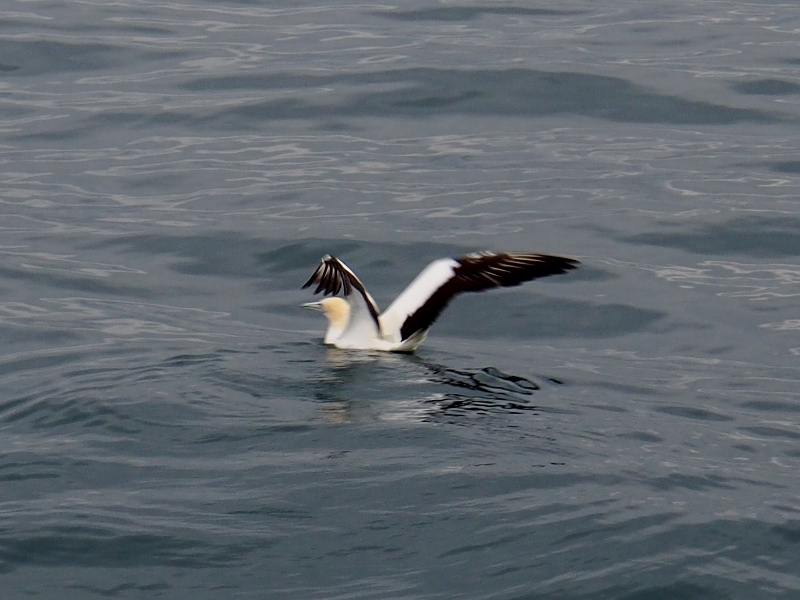
Gannet resting on the quiet grey sea
Lukie carefully folded his letter and stuffed it into the calendar.
“Now Santa knows what to get me!” he beamed. “He may drop it off tonight – perhaps tomorrow we will find the presents on the deck.”
Trampoline antics on the way to NZ
We were on day three of the sail from New Caledonia to Opua in New Zealand, and, it being the beginning of December, the frantic letter writing to Santa had commenced once again. Matias was writing endless enquiries into the mechanics of Santa getting on board with advent presents in the middle of the ocean, and had also branched out into asking all sorts of personal questions about Santa’s life in general, leaving carefully crafted boxes for multiple choice options and a pencil to make it easy for Santa to reply. Lukie just wrote long lists of what he wanted for Christmas, spurred on by the fact that the first request (a squid) had promptly landed on the deck the morning after he asked for it. Undeterred by my warnings that we were unlikely to be allowed to import a dragon or a hamster into New Zealand, the list got longer and longer, the requests more and more outrageous.
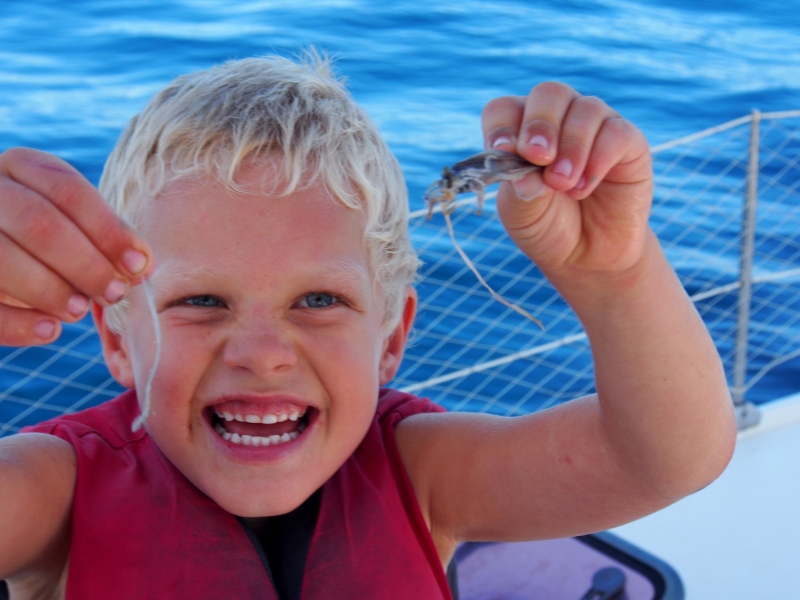
Lukie with the squid from Santa
The trip to New Zealand is meant to be awful, with many cruisers meeting fierce winds and heavy seas, but our passage proved uneventful, no doubt thanks mainly to David’s extensive experience with weather forecasting. After five days with good winds and a relatively calm sea, we sighted land just before midnight on Thursday. At sunrise the wind was completely gone, and in a magic moment a welcoming pod of dolphins amused themselves in our bow wave, clicking and squeaking so loudly as they glided through the oily still waters that I could clearly make out the message.
Nau mai, haere mai ki Aotearoa.
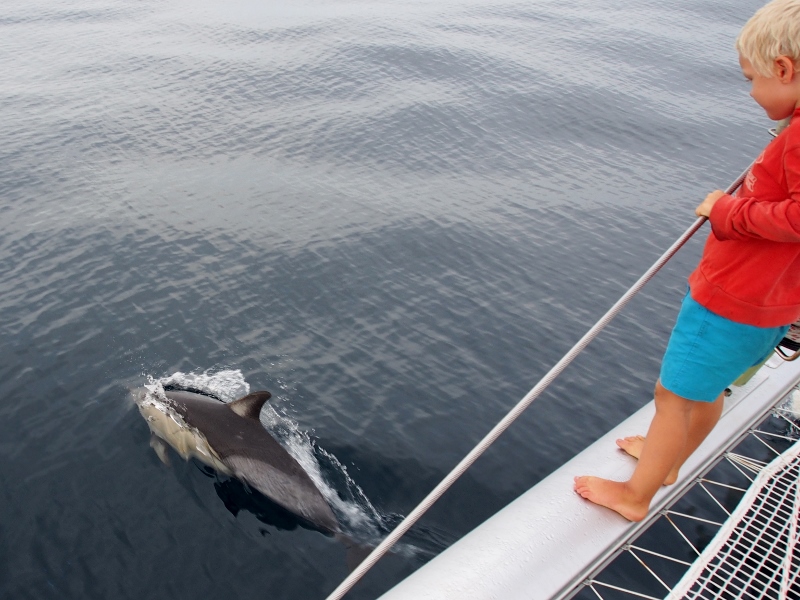
Dolphin welcome
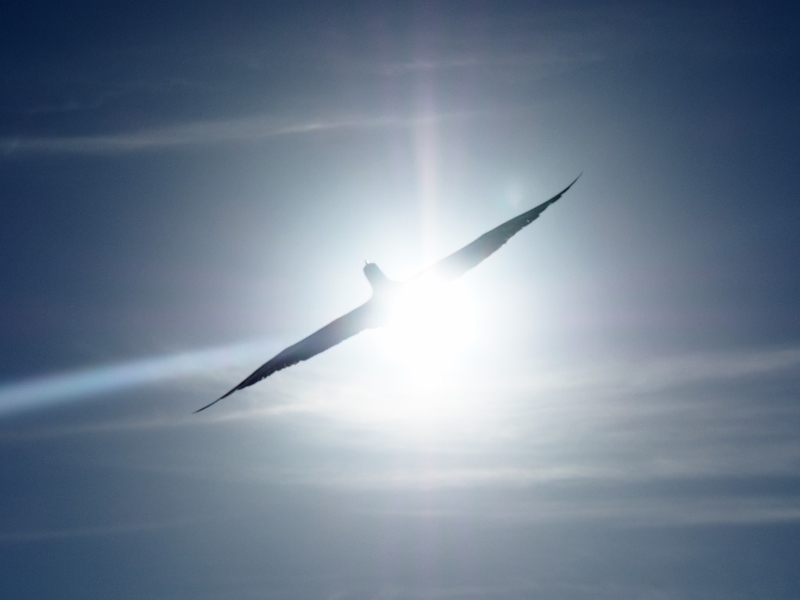
Albatros circling the boat
We spent all of Friday slowly motoring along the rugged coastline with occasional showers and chilly air greeting us on our return to the land of the long white cloud. Finally, just after dinner on Friday evening, we pulled into Opua marina and tied up to the quarantine dock. We had made it, crossed the last bit of ocean, brought Bob home. We breathed out, had a celebratory drink and then went to bed, savouring our first blissfully uninterrupted sleep for six nights.
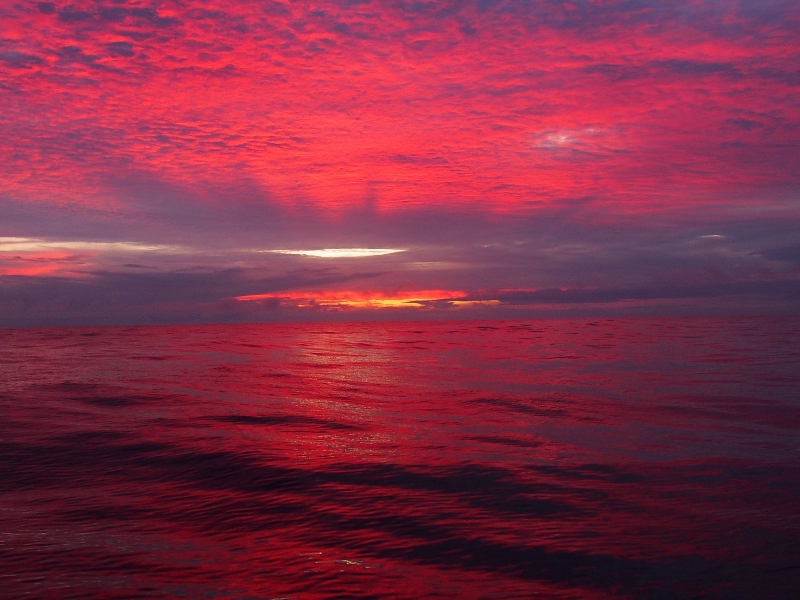
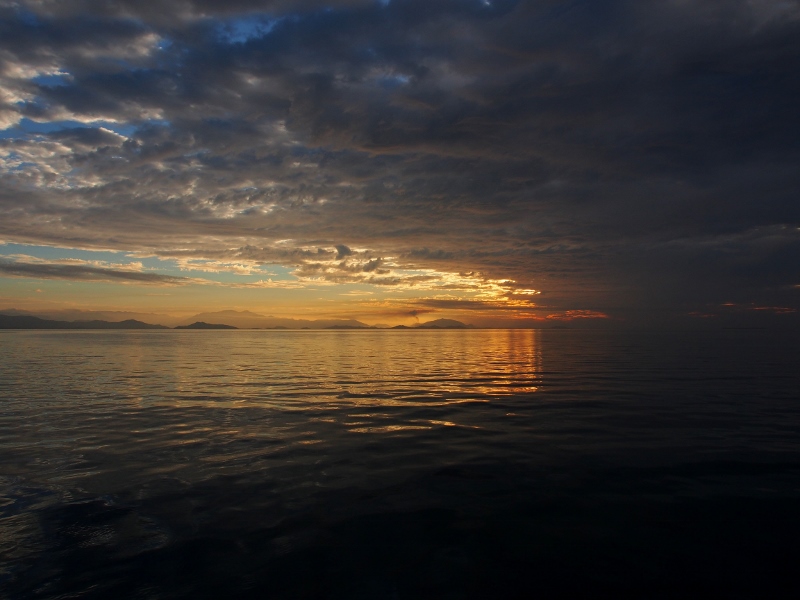
Sunrise over oily seas
This voyage has been the most incredible adventure of our lives.
We have seen natural wonders and encountered creatures splendid beyond belief, at close hand in their natural environment. We have visited places of magical beauty and learned about culture and customs of which we knew nothing prior to setting out. Our children have run around free on deserted islands, frolicked in sand dunes, climbed coconut trees and swum in deep and shallow seas, in clear and murky waters. They have played with kids from tiny villages on remote islands with whom they shared no language, and met children on boats from all over the world. They have been to places dripping with history and have learned much about the links that join our ancestors to the forefathers of the people who inhabit the corners of the earth.
We come back with our souls enriched by the countless sunrises we’ve witnessed, and the special moments we’ve shared with people from faraway lands, whose daily lives became enmeshed with ours sometimes for short times, sometimes for longer. We have made fantastic friends and so many memories that our hearts are full and our heads overflowing.
If, in the end, life is reduced to a string of feelings, of memories, encounters and experiences, this year has provided enough to give texture to our lives for a long while. The oceans are vast and we are overjoyed that we were fortunate enough to be able to take some time and see first hand a big bit of water and some islands, and share the wonders and magic of nature and farflung destinations with our children.
Not really ready to leave the adventure behind, we will remain on Bob the Cat until after Christmas, but this blog will end here, with our safe arrival home. Kia ora, Aotearoa, it’s been a long time.
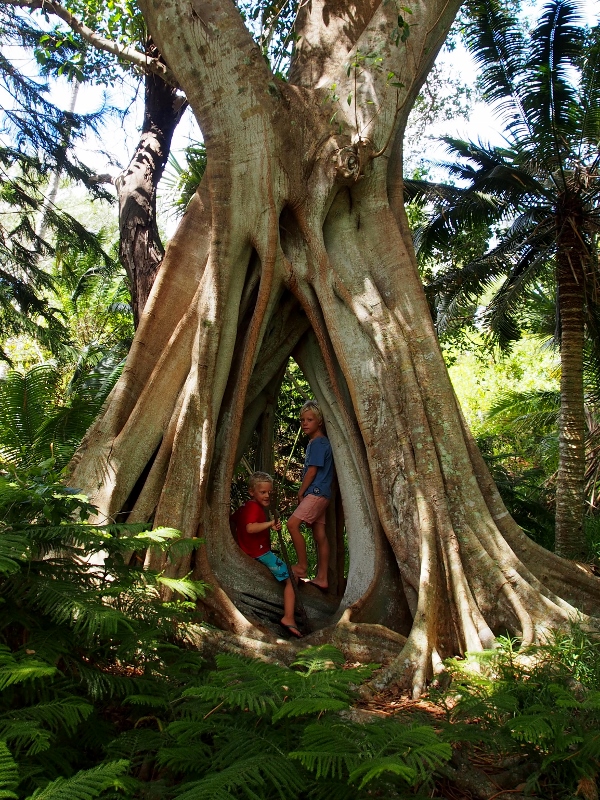
Dinosaur cave in the prehistoric forest, Ilot Casy
Matias?”, I said.
He swallowed a bite of food and faced me. “Yeah?”
“What is the thing you are most looking forward to when we get back to Raglan?”
He thought hard for a while. “Bob”, he said. “I miss Bob”.
Bob. The real cat. Who had probably forgotten all about us, happy as she was with the company of Thea, who was house sitting for us.
“Yeah”, I said. “I miss her too”.
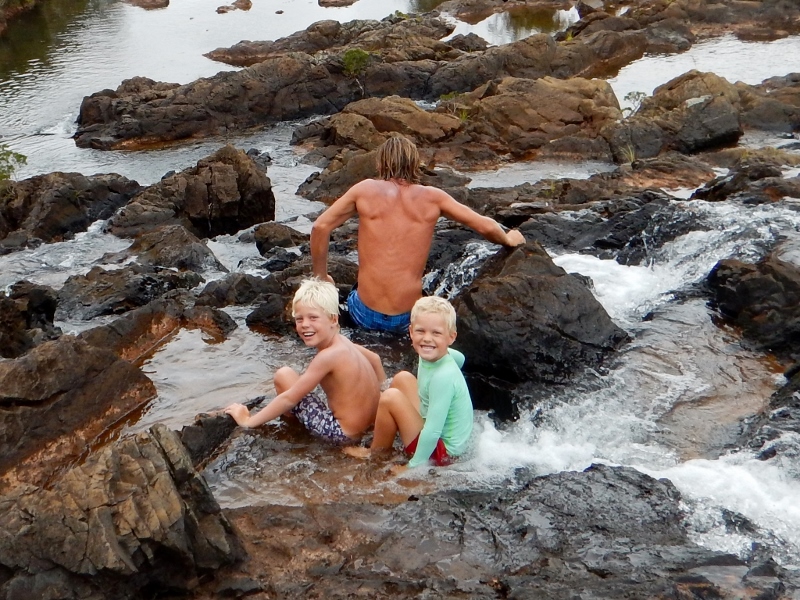
Relaxing on the rocks in Yate River
“What about you, Lukie”, said David.
“Erm. I’m looking forward to getting back to my lightsabre, you know, the one that pulls out, do you remember that one, Daddy?” Clutching an imaginary lightsabre with his two hands, Lukie hissed, fighting off an invisible Sith launching a surprise attack on our dinner table.
Muddy shores
“What about you?” Matias asked. “What are you looking forward to, Mummy?”
I thought for a while. “Having a washing machine”, I said. “And an oven that works. And a fridge that is dry”. A bit sad, really, that it was all appliances, but when you spend all your days in a beautiful place doing wonderful things, handwashing and cooking in a campervan type kitchen remains the only things to be dissatisfied with.
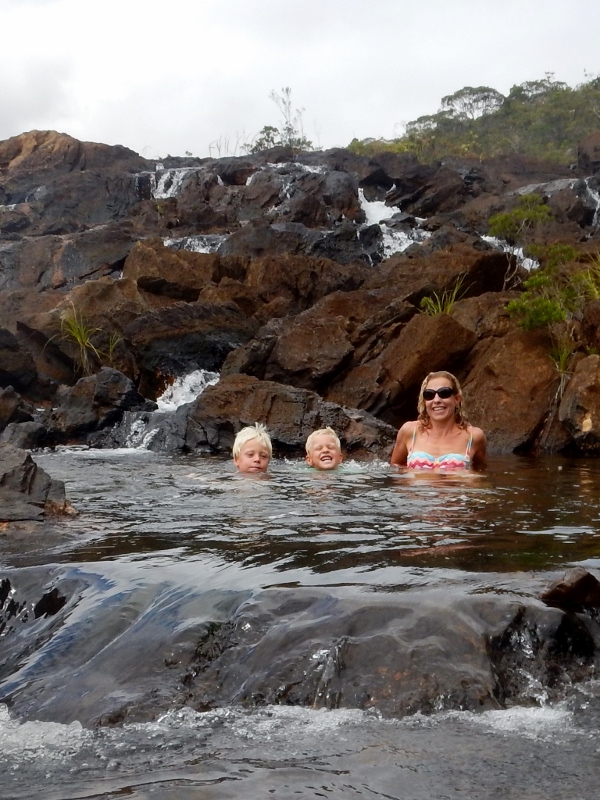
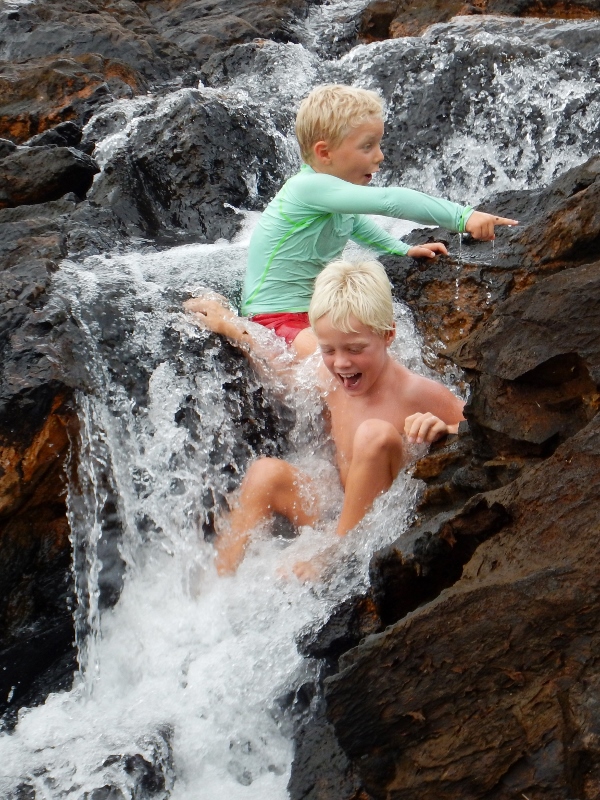
Relaxing in a natural infinity pool, just below a waterfall, Bay of Prony
“You know, we can easily get that on the boat”, David said. “I mean, we can just install a washing machine and a new fridge and oven – we don’t have to go home to get that”.
“I know”, I sighed. “I never said I wanted to go home…” I took another bite of my lunch.
“But I also do miss our friends, of course”, I added. “And the vacuum cleaner”. I rested back in my seat, imagining a vacuum cleaner, just sucking up the dirt, hair and sand. No more dustpan and dirty brush, hairs sticking to the bristles, crumbs hiding in the depths. I smiled.
Strange rock skipper clinging onto rocks above water in Ilot Casy
“What about you?” I asked David. “What are you looking forward to?”
He leaned forward. “Internet”, he said without hesitation. “Unproblematic, instantaneous internet, available around the clock. So I can get weather, and news, and look up random stuff when I feel like it”.
So there it was, the luxuries of home, spinning their web to reel us back in from foreign shores. Given how much we loved life on the boat it was good that we each had something to look forward to, something to take the edge off the sadness of trading in a mobile life full of freedom and adventure for the daily grind of work and school.
Hot pool in Prony Bay
We were back in Noumea after having a spent a few days in the southeastern end of Grande Terre on our way back from the Loyalty Islands. Where the islands of New Caledonia are light and sandy, surrounded by clear waters and sharp coral reefs, the mainland of Grande Terre is heavy and severe, steep slopes covered in verdant jungle rising from a mangrove fringed shoreline plunging into untold depths of muddy water. Little inlets carve up the coastline where rivers discharge their load into the sea, and on our way back we visited deeply carved riverbeds sporting dried out rapids in Anse Toupeti, Yate and the Bay of Prony, three large bays providing calm anchorages off dark sand beaches backed by steep jungle.
Waterfall play, Bay of Prony
In the Bay of Prony we anchored off the idyllic Ilot Casy and explored the prehistoric Cycad forests growing there.
“Watch out, Lukie, there’s a dinosaur behind that tree”, shouted Matias, leaping over some enormous tree roots to get to a vantage point up the hillside.
“But I can’t, Matias”, cried Lukie. “I’m getting attacked by a giant dragonfly”. Grabbing a stick, he fought off an enormous flying predator.
“Weirdos”, said David.
I nodded in agreement. “But it is quite prehistoric”, I ventured, “I can understand where they got the idea from”.
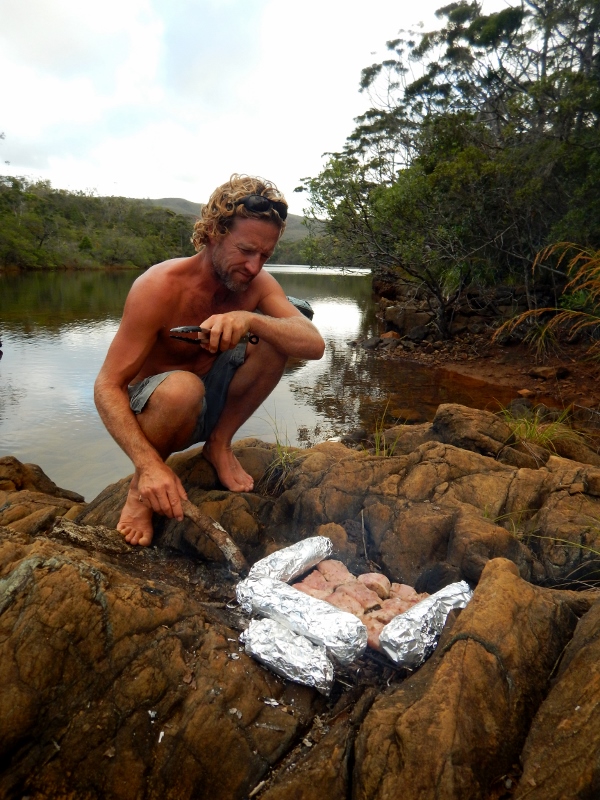
Freshly caught fish and baguette cooked over open fire
A precursor to flowering plants, cycads are ancient. Resembling a cross between a fern and a palm tree, these prehistoric plants have survived unchanged for over 200 million years; it is thought that they were grazed by herbivorous dinosaurs once. Interspersed with tall araucaria pines and truly enormous pandanus trees whose thick knotted roots made walking difficult, the cycads fully completed this alien, beautiful forest, thriving just metres back from the white sand beach.
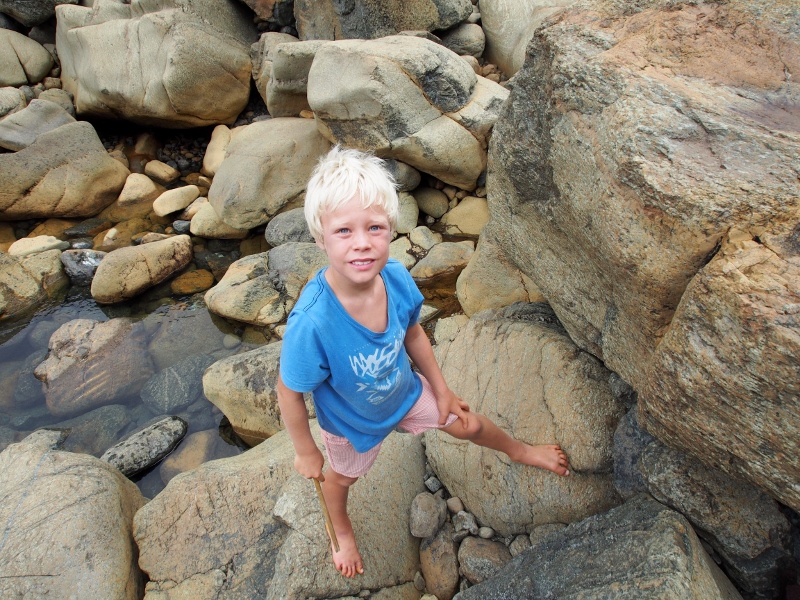
Rock explorer Matias, Yate River
Stunning and vulnerable – about a third of the island was burned down when a yachtsman inadvertently left a fire unattended on the island twenty years ago. The damage is still clearly visible, providing an astounding change from the established forest, with the burned bit resembling a minesite, its unvegetated dirt mounds stretching from the sea to the hilltops. A sign said that the vegetation is expected to establish fully over time, and in the meantime visitors were reminded to mind their fires.
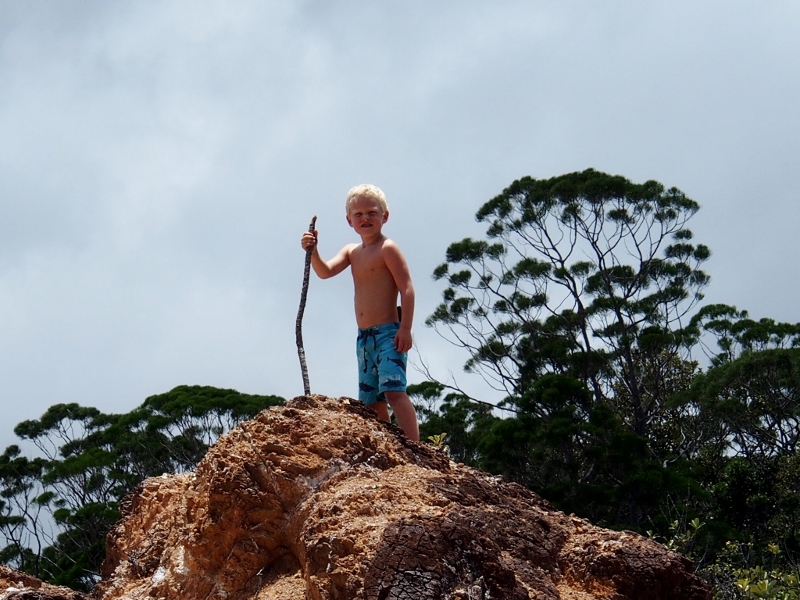
Lukie perched atop dirt mount rendered unvegetated by fire 20 years ago
For a couple of days we frolicked in rivers and bays, lounged in natural hotpools and washed under cool waterfalls, and climbing hillsides and cooked fresh fish over open fire. But soon enough it was time to return to Noumea, to provision and tank up with diesel and water, before setting off for New Zealand.
Johnson boys sliding down a waterfall in Prony Bay
There is so much to see in New Caledonia, so much diverse and wonderful nature, so many friendly people. But the weather is looking favourable for heading to New Zealand tomorrow, and so we will depart, even if there is still lots to see here. If the winds remain fair and we don’t stop in Norfolk Island we should be there in five to seven days; if we stop at Norfolk it may take us seven to nine.
Time to leave – our tricoleur is turning into a deux coleur…
“Expelliarmus”, shouted Lukie, pointing his finger at Matias, who promptly dropped onto the trampoline, clutching his chest.
“Expelliarmus bombus”, repeated Lukie. “You are injured now”.
Matias lifted a slim twig with shaky hands. “Intertrudent”, he croaked, and immediately Lukie began to slowly sink down, his face twisted in agony, until he was lying prostrate on the foredeck.
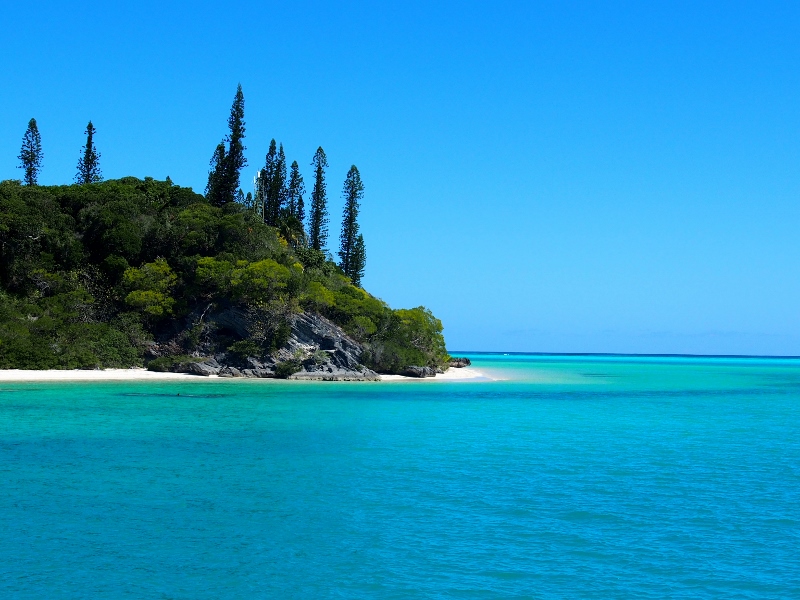
Headland opposite Vao, Kunie
I continued scrubbing the deck around him. “What’s ‘intertrudent’?” I asked.
Lukie lifted his head off the deck. “It’s what you say to a person, or an animal, and they dissolve. If it hits a thing, then it just bounces back, but people disappear”.
“Who are you guys?”
“Matias is Harry Potter, and I’m a small animal called a Lython. It’s a scaly lizard that walks on two legs, like a snake but with legs”. He sat up and indicated a small creature with his hands. “I’m blue and grey, and have green eyes, with black dots”.
“I see. And what do you do, what do Lythons do?”
“Lythons save people and stuff, and I can even fight Voldemort, by kicking him in the face”, he said seriously, kicking in the air to demonstrate. “I don’t use a wand, I can use my hands, like Dobby the House Elf, but Matias has to use a wand. Hedwig is on my shoulder, she likes sitting on me”.
“So now that you have been ‘intertrudented’, how do you get back?”, I asked.
“You have to drink some of Matias’s potion. Then you come back to life”.
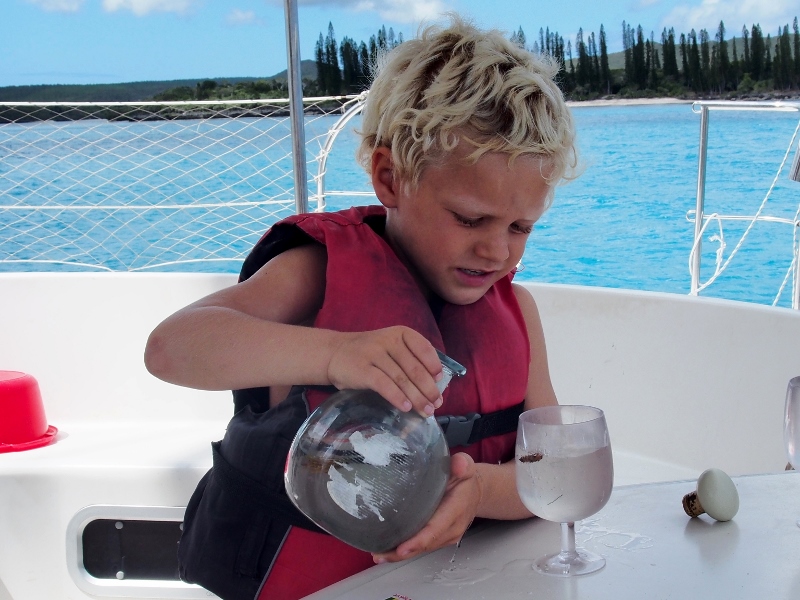
The potion was brewing in a large red cauldron on the back step – apparently it needed to steep for hours in the sun for all the ingredients to infuse correctly. Some older potions had already been decanted into glass bottles which stood waiting in the shade, ready solutions for a wizard in a fix.
The Lython pouring some potion
We were in the Isle of Pines, an island 30 miles south east of Grande Terre in New Caledonia. The children were going through a Harry Potter craze as Matias was reading his way through the books and I was reading them out to Lukie, the two of us forever trying to catch up with Matias’s nightly progress. Since we’d been here, the kids had spent hours every day writing potion recipes and collecting the required ingredients, carefully adding them in the prescribed order, steeping, stirring and dissolving ashes and twigs, crab shells and feathers. No matter what the original ingredients, Matias’s potions invariably ended up an unpleasant dark yellow colour.
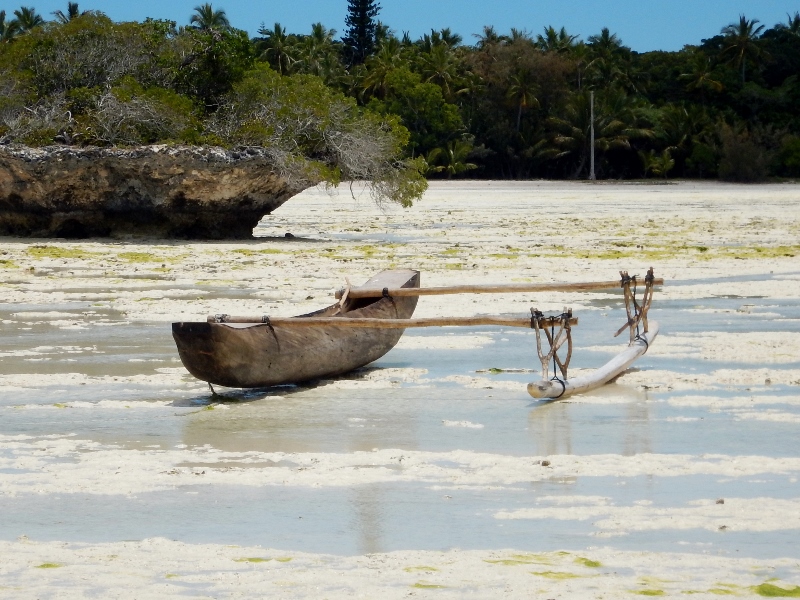
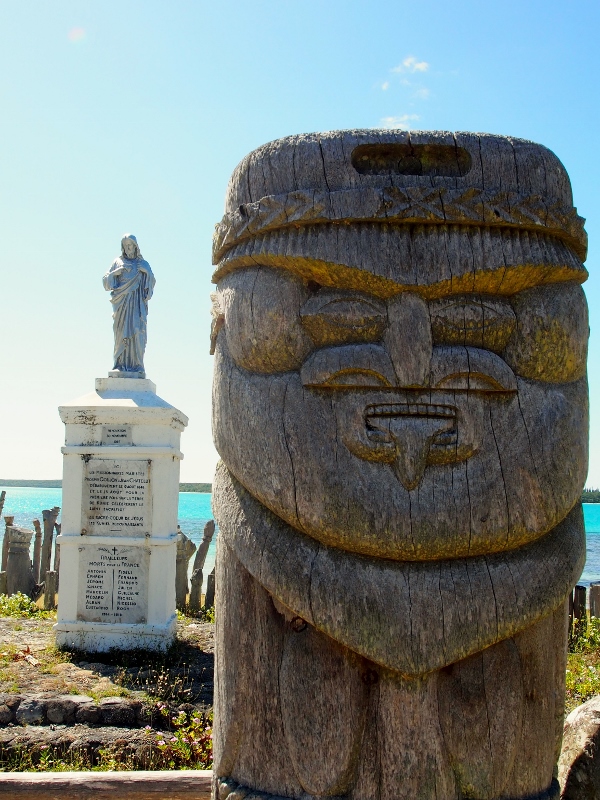
The Isle of Pines, or Kunie as it is known to the indigenous Kanaks, is a remarkable place. Named by Captain Cook for the tall araucaria pines which tower along the impressive coastline, the small island (17 km long, 14 km wide) is home to 8 Kanak clans who, when the Europeans arrived, were the only New Caledonians who could still sail, effortlessly navigating their 40-foot piroques (French name for the double outrigger canoes) using traditional melanesian techniques.
Small outrigger waiting for the tide to fill
In 1872 the island became a convict settlement for political prisoners from the Paris Commune uprising in France, and later on Kanaks who had been involved with an uprising against the colonial powers were imprisoned there as well. The prison closed in 1911, after which the administration of the island was handed back to the Kunies.
Matias – soccer on the beach
We first arrived into the beautiful bay of Kuto, an idyllic aquamarine inlet framed by a long white beach, backed by majestic araucarias and the impressive Pic N’Ga, a 262 m peak. Little mushroom islets lined the edges of the bay, rock stacks that had been eroded away from the headlands forming dangerous looking overhangs that looked like they were only one erosive wave away from dislodging huge chunks of heavy rock into the sea.
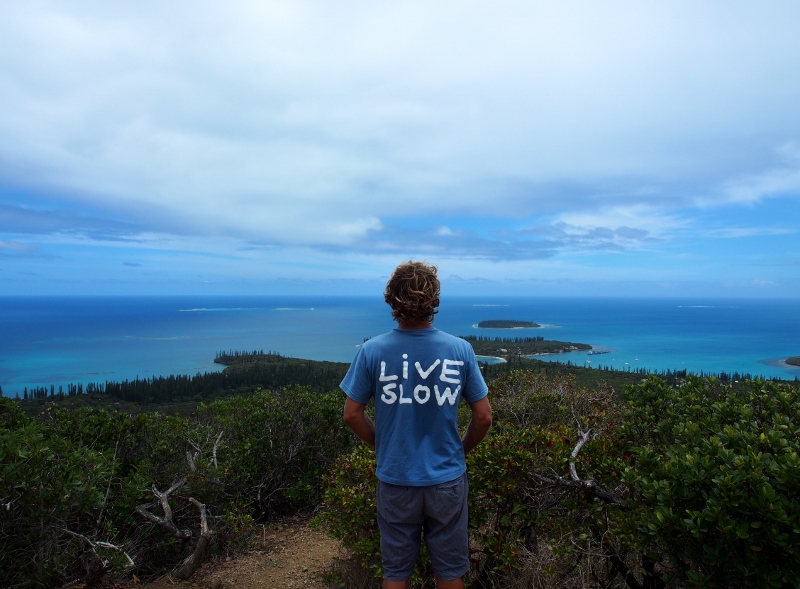
David at the top of Pic N’Ga, looking out over southern Kunie
After a couple of days swimming in the clear waters of Kuto Bay, playing soccer and rugby on deserted white sandy beaches and climbing the dusty hillside to reach Pic N’Ga we moved around the corner to Vao, the main settlement of Kunie.
The trip there was tense. The waters surrounding Kunie are shallow and sharp reefs lurk just below the water surface in the uncharted bay of Vao. Our cruising guide had a couple of waypoints which we followed tremulously, me stationed on the bow looking out over the turquoise expanse of shallow water, squinting through my polaroids for the deepest route through to the anchorage.
Matias
Despite the breathtaking beauty of the place, there was only a handful of boats in Kuto, and no other boats visited Vao while we where there.
“Maybe sensible people stay away from uncharted waters full of reefs”, I reflected to David once we had safely anchored.
“How boring”, he said.
Old meets new in Vao
Vao is home to a fresh fruit and vegetable market and a nice little church, as well as several rowdy puppies and curious children that followed up enthusiastically up the road. Across from the town is a little headland with a few caves and lots of dead crabs and seasnake skins, cherished ingredients for seasoned potion makers, as well as a couple of araucarias which yielded valuable pine tree sap, perfect for fashioning stoppers for potion bottles.
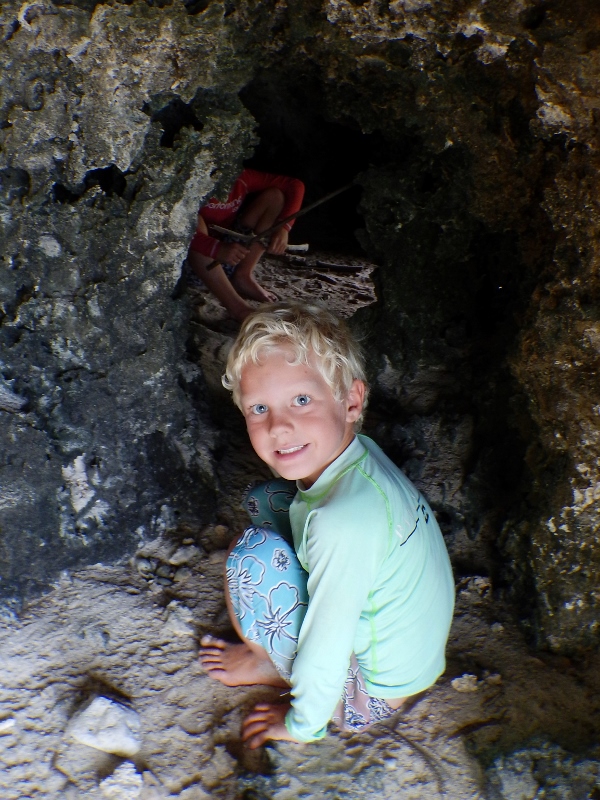
Cave wizards
After a day there, David cast his gaze north, towards the fabled bays of Gadji, where a group of idyllic islands sit just off the northernmost point of Kunie island.
“We can do this. Nothing like a bit of a challenge”, he said merrily. Glancing over his shoulder at the cruising guide I read the comment highlighted in red next to the route north:
DANGER – THE DEPTHS ON THIS PHOTOCHART ARE THE DEPTHS BETWEEN THE CORAL READS. MANY ISOLATED CORAL HEADS SCATTERED ALONG THIS ROUTE ARE NEARLY AWASH AT LOW TIDE. MAKE THIS PASSAGE ONLY WITH GOOD LIGHT AND GOING AGAINST THE CURRENT WITHIN 3 HOURS OF HIGH TIDE AND STEER TO AVOID THE REEFS.
So it looked like it was going to be a tricky passage to get up north as well. Back to the bow for me, and there I remained as we hugged the rugged coastline, marvelling at the mushroom stacks popping up all over the place, admiring the tall outline of the pines on the many narrow headlands, and shouting loudly whenever we neared the opaque turquoise waters indicating dangerously shallow sandy flats or the browny yellow stretches suggesting that a coral reef was just below the surface.
Lukie fresh from the water
Just north of Kuto a wildfire was raging in the hinterland, and as we sailed slowly past we witnessed the sole helicopter tasked with putting out the fire as it came out to sea to fill the enormous bucket hanging off it with seawater, disappeared back into the dense smoke only to reappear minutes later as a small yellow fleck growing gradually in size, coming back to the sea for a refill. It seemed a hopeless task, a huge fire raging on a dry hillside densely clad in tall pinetrees, and only one little yellow helicopter to put it out. As we passed, we watched it refill six times, but we saw no discernible reduction in the size of the fire.
Filling up
The smoke darkened the sky behind us as we rounded the corner and entered the most beautiful anchorage in the world at Gadji, a shallow, serenely aquamarine bay surrounded by small limestone islands covered in dense dark green vegetation, the requisite mushroom islets trailing obligingly into the bay after each headland.
Mushroom rocks
Our friends Bruce and Lynne were at Gadji too, and we spent our days with them, diving and snorkelling in the clear waters, spotting turtles and sharks hovering over beds of pristine corals full of fish. Out of the water we visited white beaches and climbed dark jagged limestone rocks, watched slender herons on expansive intertidal flats of silty white sand and spotted peregrine falcons perched atop tall trees. The kids continued their hunt for ingredients, recipe in hand, and brewed more and more elaborate potions, Lukie’s final effort requiring a staggering 9 billion crab eyeballs (which we eventually had to substitute for sand grains – should work).
Look, mermaid hair – just what I need for my potion!
“Lynne, I’ve made you a potion”, said Matias, proudly proffering a bottle filled with a cloudy yellow-brown liquid to Lynne as her and Bruce came over to our boat one evening for a sundowner.
“Great”, she said, holding the bottle out with two fingers and eyeing the solution nervously. “What does it do?”
“It’s for bravery, if you drink a tiny drop, you’ll become braver than anyone else in the world”.
“That is a great thing to put in a potion. Thank you so much”, she said graciously. “I’ll drink a drop whenever I need to be brave”.
She would need bravery to drink it, based as it was on salt water and decomposing twigs, but I guess superpowers come at a price.
Coral gardensBirds on the sandflats
The following morning we pulled anchor, ready for the overnight sail to Ouvea, the northernmost of the Loyalty Islands, a group of islands 40 nautical miles to the east of Grande Terre. As we sailed out of the anchorage, the wildfire was still raging on the mainland behind us. Now on its sixth day, the thick black smoke was still rising, effortlessly transforming into dark grey clouds slowly trailing their way north in the light winds, overhanging the anchorage and blocking out the sun. The water in the anchorage was covered in burnt pine fragments which fell out of the sky, and as we motored north David got out the deck hose, cleaning them off as we broke away from the clouds and into the sunshine.
“These buggers are probably losing us at least a knot”, David said, holding up a huge tuft of brown-green slime. He took off his mask and climbed on board. “We’ve gotta find a better way to clean it”, he sighed.
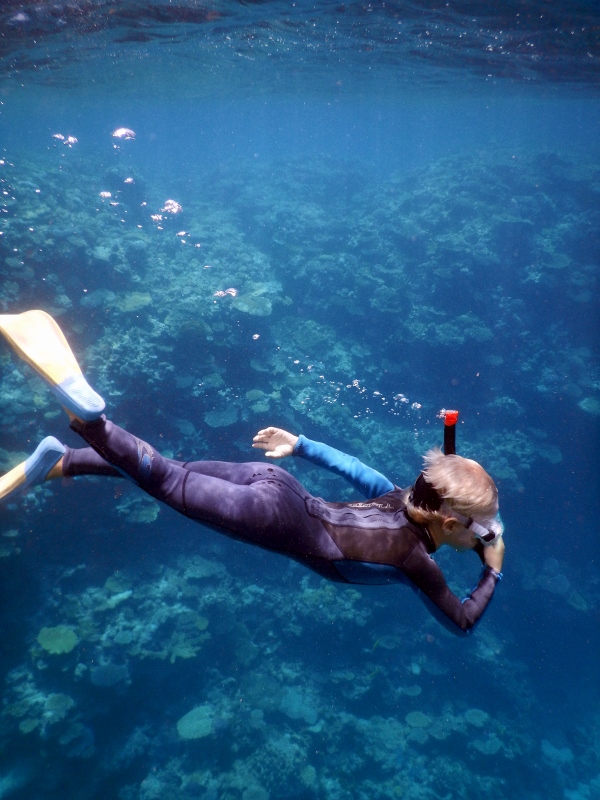
He had just surfaced from scrubbing the hull of the boat – he had been at it for about an hour, and there was still plenty of cleaning left. The state of Bob’s biofouling had progressively worsened over the course of this trip, and she now needs trimming rather regularly.
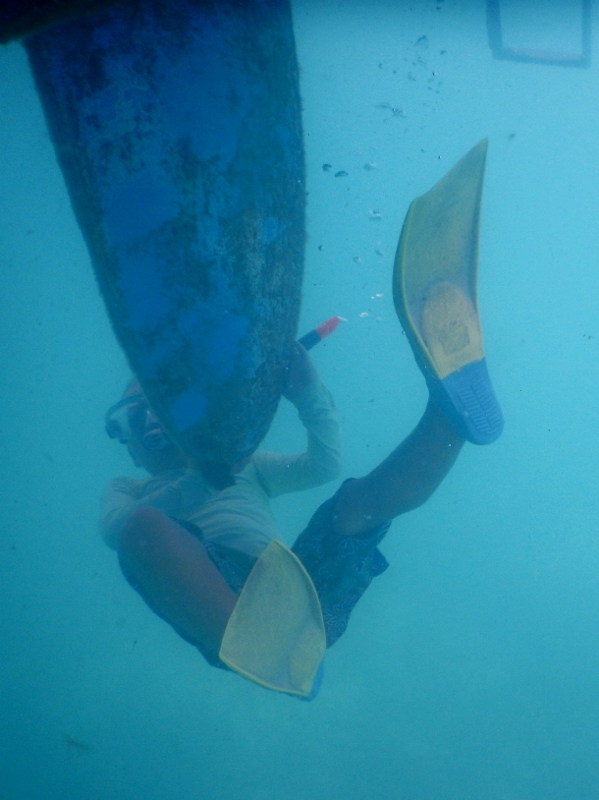
Must dive lots when cleaning – Lukie on his way to the rudder
When we first bought the boat it had been newly antifouled, but it was a dodgy job done for the sale: she had just been lifted out and painted without scraping off the old antifouling, and the result was a terribly knobbly surface, rather like a house-owner neglecting to clean the walls prior to painting, choosing instead to paint over old peeling wallpaper and dustballs, embedding underlying imperfections firmly into a new layer of sticky paint.
Antifouling works by providing a smooth, clean surface containing compounds that are toxic to marine life, and acts to prevent the settlement of organisms and to retard the growth of those that do settle. But on our Bob you could see patches of flaky layers of old antifouling underneath the top coat, and on occasion they had even painted over barnacles, the result a roughened surface perfect for new organisms to attach themselves to. We knew all of this when we bought her, the survey report having pointed out that the antifouling was a job that needed redoing.
Fouling on boats is a problem because it aids the dispersal of marine organisms around the world; marine invasive species spread mainly via boat hulls and the ballast water that large ships take on board when they are empty of cargo and which they discharge again upon reaching a port where they are to pick up goods. And having tons of marine organisms attached to your hull also slows you down immensely by increasing the weight and drag of the boat through the water, changing the hull from hydrodynamically smooth to bulky and rough, like going from a shining race car to a combivan with weed and washing hanging out the windows.
Properly applied antifouling works a treat, although the toxic compounds contained in the paint do leach into the water, causing environmental problems in areas where there are lots of boats, or where boats are being cleaned.
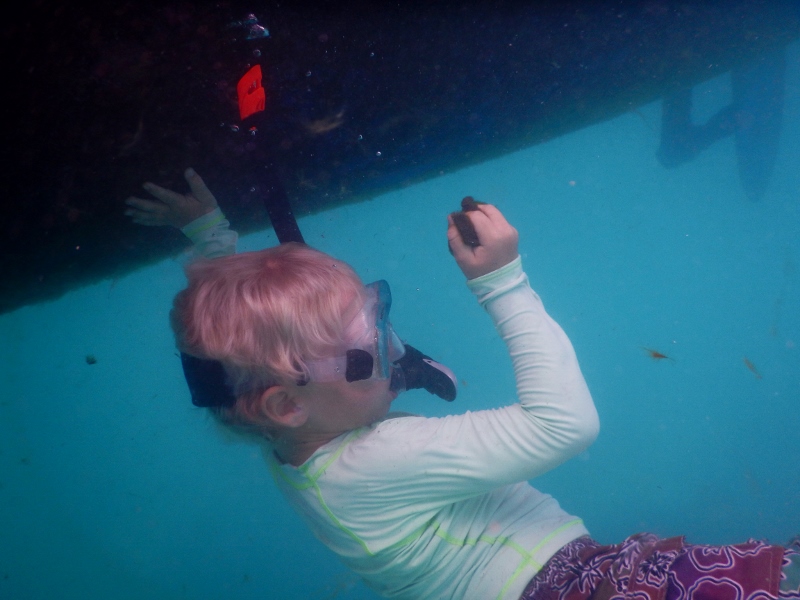
Matias cleaning the furry prop
When we pulled the boat out in St Martin around Christmas last year, we knew that we should really get the job done again, and properly this time – stripping back to the gel coat and re-applying new antifouling on a nice, smooth surface. But that would have taken a week at least, and cost us about $10,000, so we decided to make do with the patchy job – it was only a couple of months old, by then, and there was no growth on it yet, after all.
Predictably, the state of growth changed over time, each week of sea time adding more growth, as our antifouling gradually wore off every timed we cleaned the boat. In preparing for entering the Galapagos Islands the cleaning grew decidedly frantic: the Galapagos Biosecurity officials dive on each boat that enter their waters, and if you have any growth at all on your hull, you’re sent 40 nautical miles offshore and told to clean it off before re-entering. So on the west side of Panama we cleaned and scrubbed, and on the passage to the Galapagos we stopped at intervals to scrub some more, with the result that when we entered the Galapagos the hull was spotless, but sadly also completely devoid of antifouling.
With no antifouling left, organisms attached with increasing ease, and over time it is taking more and more effort to get them off. When we first started this trip we would clean the hull with a light scrub with a cloth or a soft sponge. Now we scrub with an industrial strength Scotch-Brite, scrape with old credit cards and scour with heavy duty plastic bristled brushes creating new scratches for organisms to attach within with every clean. Cleaning the boat used to take fifteen minutes, an effort we’d have to repeat every fortnight; nowadays it takes hours and by the time we’ve finished the growth has begun back at the start and we could start again if we had the energy.
Lukie cleaning the rudder
We now have an amazing array of organisms attached to the hull, a thriving ecosystem hanging off our bottom, trailing in the seas behind us. Within this ecosystem are many niches, filled with an astonishing variety of life. On the outside of the hulls, where sunlight abounds, the environment is optimal for algae. Right at the waterline, where the sun is strongest, grows green algae, long filaments of which hang down in a Rapunzel-like curtain. A sub-niche has appeared just below the toilet outflows where increased nutrient levels have boosted growth rates, resulting in foot-long filaments floating elegantly away from the boat. Below the shiny green locks comes the brown tufty algae, the holdfasts of which are near impossible to get off no matter how hard we scrub, their tiny slimy protrusions emanating from every single one of the many grooves and cracks in the numerous layers of hull paint now exposed. Further down still, where light levels are lower, goose-neck barnacles cling on, along with tiny oysters which have embedded themselves on the surface with the result that they are near impossible to prise off, even with a screwdriver.
On the inside of the hulls, the fouling is dominated by a film of tiny translucent hydroids and stalked bryozoans which can be wiped off relatively easily, but settle back almost immediately. In between these are a smattering of white encrusting worms, sponges and ordinary barnacles, all happily filter-feeding in the warm, nutrient rich environment surrounding Bob the Cat on an average day. Whenever we’re at anchor surgeon fish will come and start grazing on our keel, nipping algae off with their sharp little teeth, the grazing sound transferring through the hull, a rasping, scraping sound accompanying our every move on board, lulling us to sleep at night.
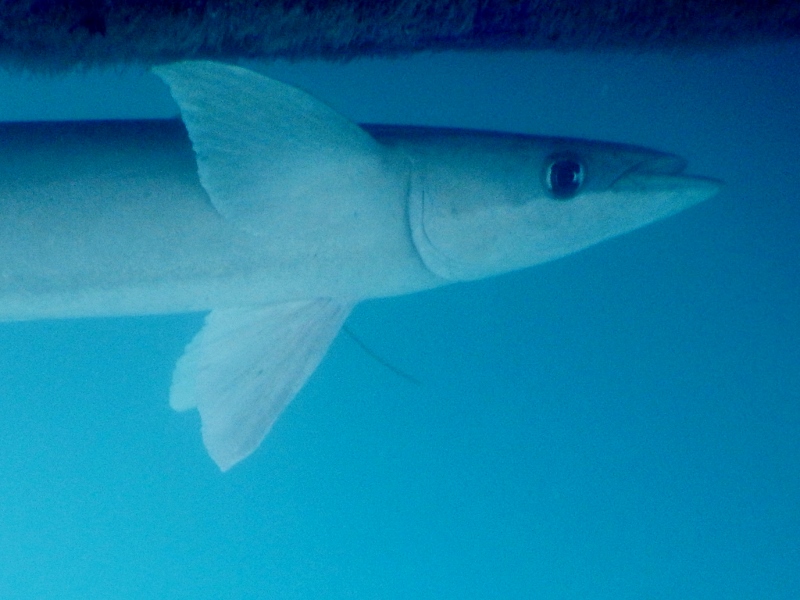
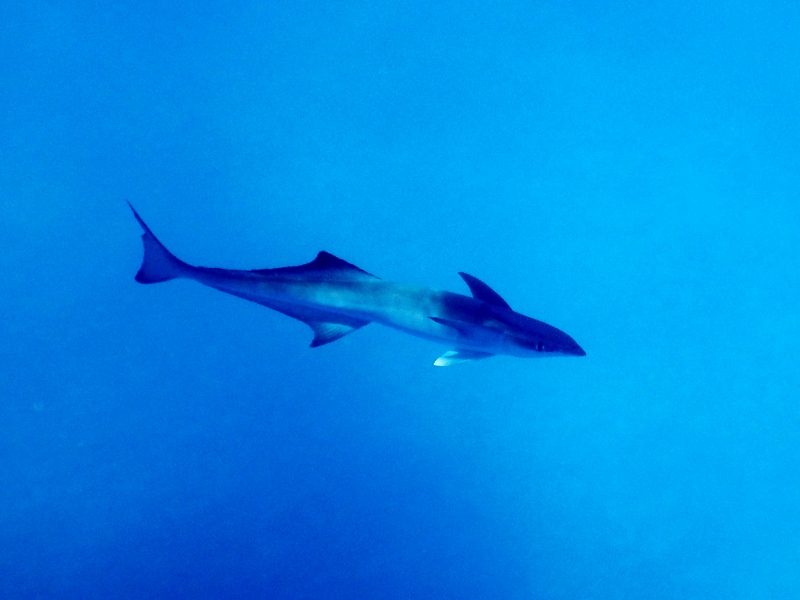
By far the largest organisms we carry are the remora, who attach themselves for a couple of days to feed off scraps and other outfall or to hitch a ride to more lucrative destinations. Up to a metre in length they cling on by the base of the keel with the strange sucker at the top of their heads (meant for attaching to sharks or manta rays), eyeing us cautiously as we clean around them, only bothering to move when we dislodge a particularly succulent looking goose barnacle which they rush over to gulp up with relish.
Remo, our one-metre long resident remora, clinging onto the hull next to the base of the keel
Sadly, we haven’t discovered any edible organisms yet – if only a few paua (abelone) would attach we would happily provide them substrate until they reached harvestable size – hell, we’d handfeed them, carefully proffering nutritious strands of algae for them to gorge on. Ditto for any pearl oysters that might happen to attach. But so far no valuable organisms have joined us.
Biosecurity New Zealand had a stall at the Musket Cove Regatta in Fiji, where they warned us that the boat has got to be spotless to get into New Zealand. When I mentioned that that might be, er, a bit of a problem, the friendly lady conceded that ‘a light algal film’ would be acceptable.
“But absolutely no animals”, she said, fixing me with her gaze from under her khaki Biosecurity NZ cap. “We don’t want barnacles, or any shellfish, or any other animals”.
We’ll definitely have to get rid of the remora, then.
You’ll have to go before we reach New Zealand, Remo
I’m not sure what to do about all the hydroids either, as they seem to come back the moment we stop scrubbing. They’re quite persistent animals, and we’ve even found them growing happily within our toilet bowls, filterfeeding happily away until we go stymy their attack with a dose of vinegar and the lethal twist of a toilet brush. I guess we’ll have to attack both hulls and toilets with a vengeance before departing from New Caledonia, armed with screwdrivers, chisels and brillo pads, and then sail as fast as we can to New Zealand, hoping that no organisms manage to attach themselves on the way. David will be happy, finally an excuse to go as fast as we can…
Lukie under the hull – diving is more fun than cleaning, really
I looked back at him from my spot on the bow where I, the gong-spotter was perched, vigilantly looking out from my station. Matias was standing by the cockpit, pointing excitedly out to sea.
“What is it, did you see a gong?” I called, walking back towards him.
We’d been looking out for ‘gongs’ for days now, hoping to spot one of the many dugongs that call the New Caledonian lagoon their home. David had seen several when kite surfing over seagrass beds, and the kids and I were keeping a keen out, hoping to see a friendly ‘gong’ off in the distance as we sailed past.
Looking out for ‘gongs’ from the shore
There are an estimated 1000 dugongs in New Caledonia, all of them lying about in the shallow lagoon waters, lazily chewing vast quantities of seagrass, protected from the coldish water by their thick layer of blubber. They used to be hunted here (“taste like veal”, said the man at the marina office), and the population is still considered fragile. Large and docile, dugongs take ages to reach sexual maturity, and in the sixty-odd year lifespan of a female she will give birth to only five or six young. They are vulnerable to boat strikes, and to degradation of seagrass beds, seagrass being their only food source.
“No, I think it was a turtle”, said Matias. “But it was big”.
Gently gliding over the reef
I slumped and headed back to my station. We’d just left Noumea, where we’d spent a couple of days doing stuff on the boat, provisioning, and hanging with some fellow cruising families who were now headed back to Australia. We were going to the southern lagoon to see for ourselves the beautiful pristine waters and deserted island that lie within the southern end of the barrier reef that surrounds New Caledonia.
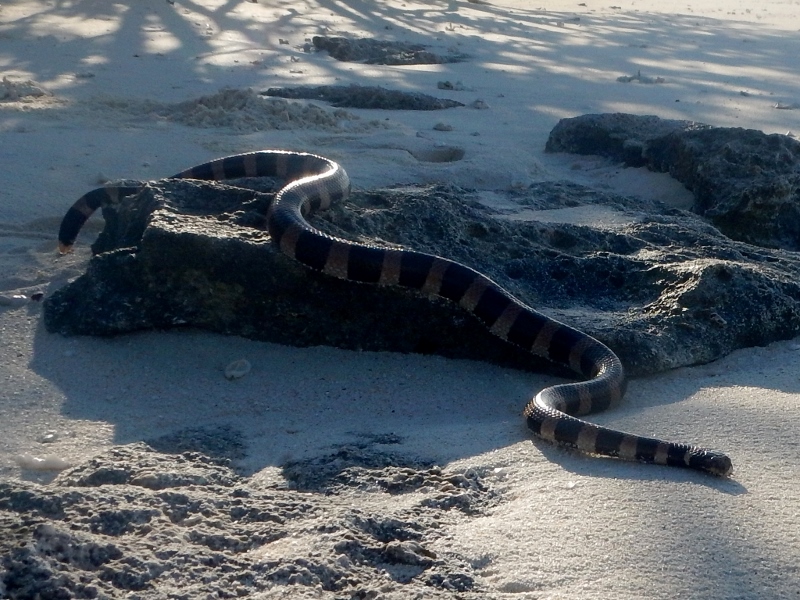
Snake swimming
When Vida and her family had left four days earlier, Matias had asked when the next visitors was going to come, and we had told him that this was it, nobody else was coming. Our trip was coming to an end, New Caledonia was our last stop before New Zealand, and in a month or so we would start looking for a suitable weather window for going back home.
“I want to stay in the sun”
“But I don’t want to go home”, he said. “I want to stay on the boat”.
“I know”, said David.
We all felt that way, a sadness that our year away was about to end. Ridiculous, given that we still had more time left exploring New Caledonia than most families get for their holiday in a whole year, followed by some nice cruising time in the north of New Zealand before throwing ourselves back into work in the new year.
“But it will be fun, seeing Bob again. She’ll be missing us. And going back to school”, I said feebly. “Riding on the bus with Lukie, playing with your old friends in Raglan.”
“Also, don’t forget, we’ve still got another month here in New Caledonia before we head back to New Zealand, and then a month sailing around there before we go back”, David added. “Let’s make sure we enjoy our last while here”.
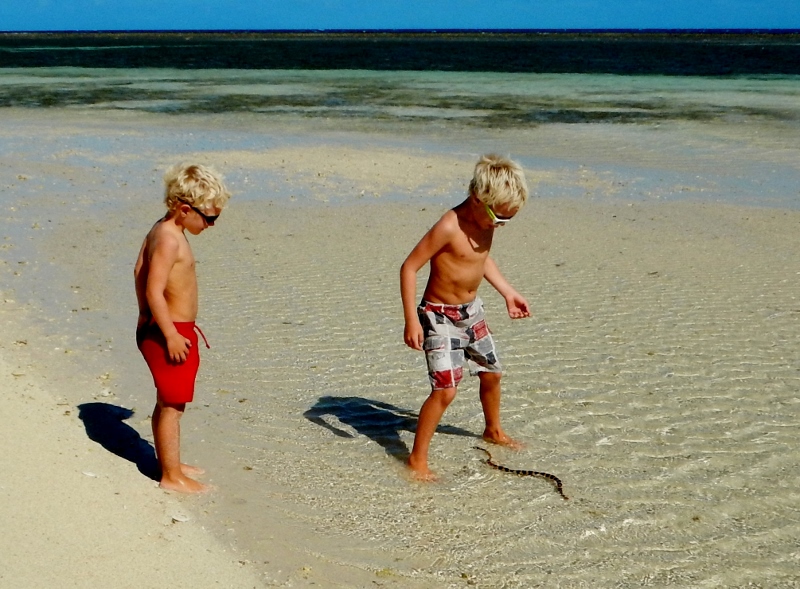
Seasnake tracks on the beach
And there certainly was a lot to enjoy in this calm, windless week full of endless sunshine. The barrier reef surrounding New Caledonia is huge, second in size only to Australia’s Great Barrier Reef, teeming with a stunning variety of marine life. There are only a few islands in the southern lagoon, each of them chockers with seabirds and seasnakes, and surrounded by pristine coral reef teeming with turtles and sharks.
Red fan coral
Our first point of call was Ilot Amedee, a small islet that we had first visited three years ago. A popular day-trip from Noumea, Ilot Amedee is a tiny island sporting an impressive, gleaming white lighthouse, 56 m tall, provided by the government of his Grace Napoleon III, Emperor of France, to help ships laden with French convicts navigate their way safely to Noumea.
Ilot Amedee lighthouse
When we arrived, Amedee was heaving with visitors. About a hundred tourists were packed onto the tiny island – some lying on sunloungers on the beach, some snorkelling the shallow seagrass covered bay, and some eating icecream on the shaded terrace overlooking the beach.
Seasnake on Ilot Amedee
We anchored at about 2:30 pm and had just made it ashore when the ferry boat hooted, proclaiming its imminent departure, and the sun reddened visitors all queued up reluctantly to go back onboard, back to Noumea. By 3 o’clock they were all gone, and we had the island and the stunning calm bay all to ourselves, that is if you don’t count the seasnakes and the keen remora which soon sucked onto our hull, deciding that we were a place worth hanging onto.
Our resident remora
Despite the huge numbers of boats in Noumea, there were few yachts in the southern lagoon. We left Amedee the morning after, our keen remora hanging on for the ride, and sailed on to Ilot Kouare, the islet furthest south within the charted part of the lagoon.
Lukie pulling in the dinghy, ready to go ashore
There were two other boats there when we arrived.
“What are they looking at?” said David.
He was sitting on the back step on the boat, putting on his snorkelling gear, ready to jump into the water. On our trip to Ilot Kouare he had noticed that the port rudder was behaving a bit funny, and now that we were anchored he wanted to jump in and have a quick look at it.
“I’m not sure”, I said. “They’re all pointing into the water”.
David watched them for a while longer, shrugged, and then jumped in. He took a deep breath and dived down under the port side hull.
I kept watching the other yacht. One of the guys walked towards the bow of the boat, lifting his hand above his head, waving at me. When he was sure he had my attention, he placed his right hand on top of his head, a fin, the universal sign for a shark.
Oh.
David with his shark-stick
“David”, I called. “David, get out, there’s a shark!”
“Shark”, the guy from the other boat called. “Big shark”.
David surfaced next to the boat. “Eh?”
“Shark”, I said. “Get out. The guy saw a shark”.
He climbed out, wiping down his dripping hair.
“Well, there’s nothing obviously wrong with it”, he said, his mind still on the rudder.
No more water time for Lukie, too many sharks
Once he was safely on board, the boys and I dinghied over to the other boat, a French registered monohull full of Australians.
“It was big, 5-6 feet”, the man said. “Brown. I reckon it was a bull shark, or a bronzie”.
“Well, thanks for shouting out”, I said. “My husband was in the water, checking out our rudder”.
In May this year, a snorkeller had been killed by a bull shark at this island. Perhaps the shark was still hanging around. No more water fun for us in this location.
We stayed for a night at the island, kayaking over the colourful reef surrounding the small ilot, walking on the bright white sandy beach, spotting turtles and reef sharks in the shallow from the safety of the beach. Back on the boat we sat sweating in the sun, eyeing our remora enviously as it swam and glided through the turqouise waters, blissfully unaware of the lurking predators circling the anchorage.
“Is the shark gone?”
The next morning we upped anchor and left for the lower half of the southern lagoon. Because so few boats venture down there, the lagoon south of Kouare is not well charted, so I kept to my lookout post at the bow of the boat, looking out for the treacherous subsurface reefs that dot the lagoon. Resembling tiny pancakes against the background of a dark blue dinner plate, these circular reefs rise abruptly from the 30 or so metres of the lagoon to just under the surface. Fortunately they are easily spotted in calm weather by their bright green-yellowy colours, a stark contrast to the deep blue colours of the deeper waters, and we reached Ilot N’da without running aground.
Shipwreck at the edge of the southern lagoon
Like all the islets in the southern lagoon, Ilot N’da was devoid of humans but home to scores of seasnakes slithering happily along on the beach, heating up in the warm sun, swimming merrily in the shallows and snaking along in the deeper water under the boat. On the beach were large, angry crabs striking a threatening pose as we came close, eyes raised on stalks, claws in the air, their black underbodies exposed as they bravely chased our shadows. Ospreys nested on the far side of the island and hundreds of black noddys roosted in the trees in the midday heat, only to head out to sea again for an afternoon feed.
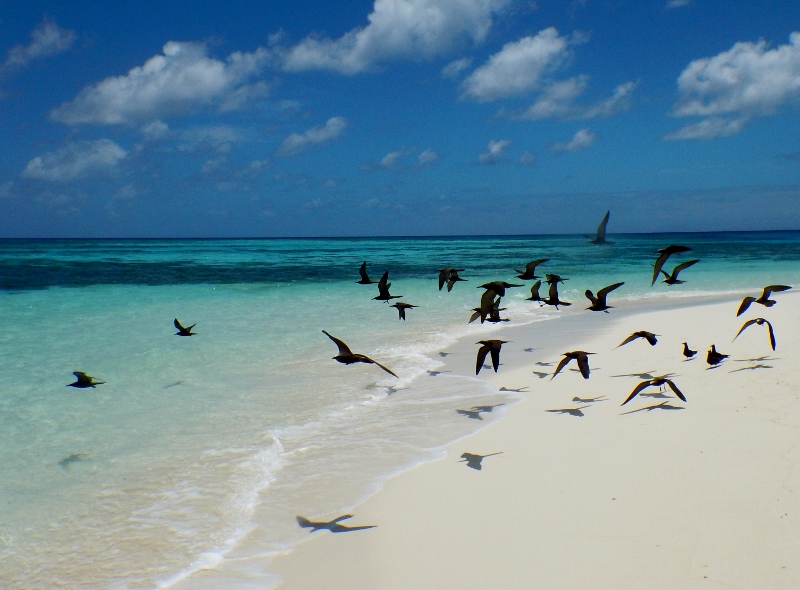
Noddies heading out to sea
We spent three days at Ilot N’da, enjoying the spectacular snorkelling of two nearby pancake reefs, playing rugby on the beach blissfully unaware of the results from the Rugby World Cup final, and cooking our dinners on a camp-fire at the edge of the snake-grass. Every night at sunset the black noddies would swarm back to the island in their hundreds, the birds elegantly silhouetted against the spectacular sunsets.
Cooking damper
Under the boat, our remora was joined by Trev, a giant trevally who discovered us as a good food source and did laps between the reef and the boat, coming back to check whether there was any new food with astonishingly regularity.
Bob in the blue of the very southern end of the lagoon
When the wind changed to the east we headed to the very southern end of the lagoon, anchoring for the day in the light blue-green waters. The water was clear and the nearby reef full of giant clams, which, although legal, we refrained from eating out of respect for their slow growth rates and heavily fished status.
Boobie attack
In the evening we headed back to a suitable night anchorage off Ilot Koko, a bird reserve closed for landing. Ilot Koko is one of only two islands in New Caledonia which is the home of the extremely threatened Fou Ra Pieds Rouge seabird (‘crazy bird with red feet’). From the boat we watched the swarms of birds rising from the dry branches in the centre of the small islet, and imagined the noise they would make. On the anchorage the boat was soon swarmed by boobies and frigate birds coming to check us out, the boobies trying to attack the wind vane on top of the mast in between swooping down low to take a closer look at the carcass of the dead tuna which was lying on the back step. Rarely have we seen so many birds, and never have they shown so much interest in us.
Boobies attacking our mast
We didn’t get to see a ‘gong’, but with all that other interesting life around we hardly missed it. What an incredible place the southern lagoon is, packed with boobies and snakes, turtles and sharks, clownfish and corals.
“I want boobie, I want boobie”, said Alec, approaching Gabe as she sat on the beach.
“Oh, look Alec, Daddy is coming back”, said Gabe, pointing to two small kites on the horizon quickly gaining in size.
I shaded my eyes and looked out over the dark blue water. There they were, Andrew and David, leaving the white breakers of the reef behind, crossing the deep waters. They had only just gone out to kitesurf the wave breaking on the reef some distance off Tenia island where we were anchored. “Already?”, I said “that’s a bit weird. Maybe it’s too windy”.
“I want boobie”, insisted Alec, pawing at Gabe’s wetsuit, his voice rising. “I want boobie, I WANT BOOBIE”.
Alec in the shallows
We were sitting on the beach looking out over the anchorage. The big kids were making sand sculptures at the edge of the water, shrieking loudly whenever the gently lapping waves would overturn a newly created wall. There were only a few boats on the anchorage; it was too windy for most people to want to sail around, let alone anchor off a flat, windswept island offering little protection against the prevailing wind. The strong breeze lent a chilly note to the air, and we were fully rugged up, wearing rash vests and wetsuits.
The kites came rapidly closer; they were now across the reef and into the flat waters of the lagoon surrounding Tenia.
“Looks like they want to land”, I said. “I’ll go over and help”.
Andrew ready to go kiting
Bracing myself by folding my arms across my chest I made my way around the sandspit, abandoning the windless comfort of the leeward side for the chill embrace of 25 knots of wind just around the corner. By the time I came to the sandspit, the sound of Alec’s cries for boobie were long drowned out by the roar of the wind. Andrew was already standing there, waiting for me to land the kite.
Making sand sculptures
“What happened?”, I shouted as he lowered the kite towards me. “Was it too gnarly out there?”.
“Shark”, he shouted. “It was a big shark. David saw it on the surface, and we didn’t want to hang around”.
Andy braving the shark infested waters
I shuddered. New Caledonia was teeming with sharks; the French Protectorate had recorded 19 shark attacks since the year 2000, many of them with a fatal outcome. Most attacks were on spearfishers hauling around their bloody catch, but in 2011 a 15 year old kitesurfer had been killed by a tiger shark after losing his board in a pass not dissimilar to the one off Tenia – experts reckoned that the shark confused the boardless kiter with a bird.
“So, if you guys want to go…”, said Andrew. “It’s nice and flat in the lagoon”.
Right.
I guess the big sharks don’t come into the shallows, they hang around waiting for large pelagic fish to come swarming through the pass. The bottom in the lagoon was mainly coral; the tide was on its way down, but there was still enough water cover to kitesurf, as long as you didn’t lose your board and got dragged over the sharp coral. In any case I was wearing a wetsuit. And we had come here to kite. The weather was perfect, a six metre kite plenty of power.
“OK”, I said. “I’ll go tell Gabe, she’s just feeding Alec”.
Skipper Alec
Our friends from Raglan, Andy and Gabe, and their two children Vida and Alec, had arrived in New Caledonia the day before. After provisioning, we’d left Noumea in the afternoon for Ilot Maitre, a nearby island where we anchored overnight. We’d gotten up early in the morning to watch the France – New Zealand rugby match at the local resort, with a group of increasingly despondent Frenchmen. When the score approached 40-13 New Zealand-France, the man seated next to me threw his hands in the air, grabbed his cigarette packet and got up.
“C’est terrible”, he said. “Quelle horreur. I am so depressed. I go now.”
I smiled in sympathy. Behind us the children were chanting “Go the All Blacks, the All Blacks are winning, go the All Blacks”, interspersed with the odd request for boobie. I didn’t blame him for leaving – who would want your nose rubbed in your humiliating defeat by a bunch of kids?
Sailor Vida
After the rugby we’d sailed to Tenia, anchored, and swiftly made our way ashore to go kiting, David excited to finally go wave sailing after a while of only flat water. Only to have his waves ruined by a shark.
When doing anything in the ocean here, as in a lot of places where we’ve been, we are always aware that there could be sharks around. As long as we don’t see them it is easy to pretend that they are not there and bask around in the water feeling safe and secure, even though we know that we would be unlikely to see a predatory shark before it bites us, the surprise being a key element of their attack strategy. The feeling of safety vanishes completely when you see them, when you can no longer pretend that they are not there and the cocoon of imagined safety bursts. It would be crazy to ignore a shark once you’ve seen it, to stay in the water with a large predatory beast, even if we know logically that most victims of shark attacks never see their attacker. We’d snorkelled with reef sharks on our travels, but had we seen a bull shark, or a tiger shark, we would have jumped out faster than quick.
Mermaid Vida
As it turned out, Gabe and I had a good time on the flat waters of the shallow lagoon, whizzing around on our six metre kites watching fish scatter to all sides as the shadow of the kite fell upon them, Alec staring forlornly out from the beach, waiting patiently for his boobies to return. We didn’t see any big sharks, only the gray shadows of small reef sharks cruising the sandy channels of between the magnificently coloured coral, the blues and purples and yellows and greens turning the lagoon into a blur of colours.
Gabe kiting
We stayed at Tenia for five days, the men managing to bravely / foolishly ignore the shark they had seen on the first day and return again and again to the break, having a ball on the wave. As the wind lessened over the course of the week, more kitesurfers and windsurfers appeared, but there was still plenty of space for us all in the vast lagoon.
The kids frolicked for days on end in the shallows, snorkelling the nearby reef, jumping off the kayak, making glue for sculptures out of liquified sand, Alec busily ferrying water from the sea to the sculpture factory for hours on end at the orders of the older children.
Have sand, want boobie
“We need more water, more water”, yelled Matias, who was busy mixing the sand.
“Water, more, water”, panted Alec, running as fast as he could on his little stumbly legs, tongue out, balancing his little water bottle in his hands, carefully emptying out water where instructed.
“We need more powder, get more powder”, shouted Vida from the nearby dune, her and Lukie busily grabbing tubberware full of soft, dry sand and running it down to the factory.
Thus occupied, the kids played for hours on end by the water’s edge, only interrupting their play to come eat – snacks of juicy pineapple, crackers and emmental, dried fruit, lunches of rice salads with parboiled haricots verts and crunchy cucumbers, or sandwiches, stuffed with french cheese and cerrano ham, fresh succulent tomatoes, crispy lettuce and French dijon mustard mayonnaise.
“I want boobie, I want boobie”, wailed Alec, not satisfied with the solid food, his voice rising with despair as he pushed away the proffered carrot sticks and orange wedges. “I want boobie, I WANT BOOBIE”.
Playing rugby on the sand
The French know how to take care of and equip their deserted islands. Many of the little ilots dotting the lagoon are marine reserves, sporting pristine coral teeming with fish and turtles, dugongs hiding out in the deeper seagrass beds. Mooring buoys are provided in the ones closest to Noumea, making it easy for day boats and yachts to visit and reducing the damage done by anchoring. Compost toilets and fire pits with chained down picnic tables and fire grilles are scattered over the islands, and firewood is delivered daily or weekly depending on the number of visitors expected. It is free to camp here, and one could have an awesome, cheap camping holiday, kitesurfing and snorkelling, sleeping in zipped-up tents (to prevent warmth seeking seasnakes from entering) – all you would have to bring is food and water.
Alec tending to the fire
One evening on Tenia we had a bonfire in one of the firepits provided, feasting on French saucissons, crunchy salad and freshly roasted corn on the cobs, the kids piling into the dinghy in the dark to go back to the boat, full of sausages, sooty tribal patterns in their faces, sand in their hair.
Cook-out on Tenia
Despite not seeing them for a year, it didn’t take Vida long to acclimatise to the boys.
“I LOVE Star Wars”, she said, after a briefing session watching excerpts from Movie III staged by the boys to familiarise her with their play. “The light sabres are SO cool”.
In the evening, before falling asleep, she would lie in her bed reading Matias’s Captain Underpants book, appearing freshly faced the next morning with quotes. “Pee on your socks for warmth, they changed the sign”, she chuckled, showing me a page in the book.
“Sorry, Gabe”, I said, “didn’t mean to introduce toilet humour to your family”.
“I want boobie, I WANT BOOBIE”, cried Alec somewhere in the background, distracting Gabe from a reply.
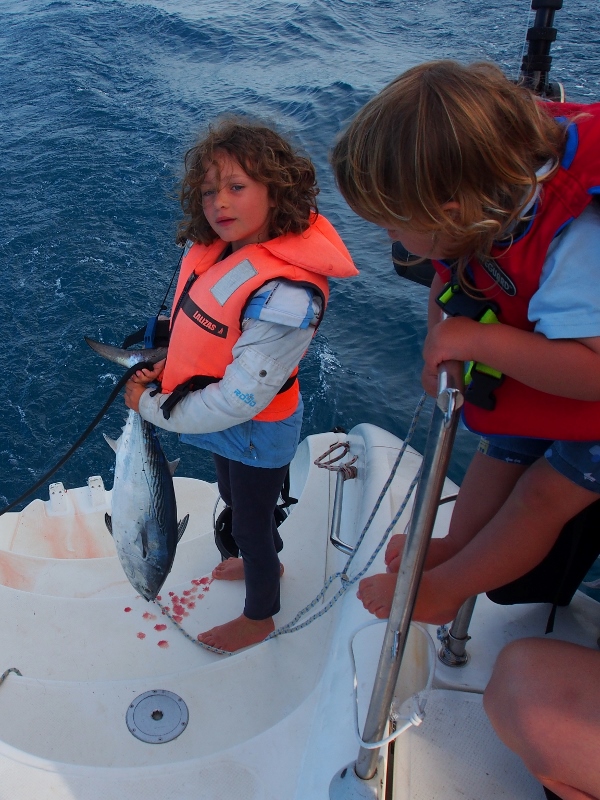
Look, I caught a tuna!
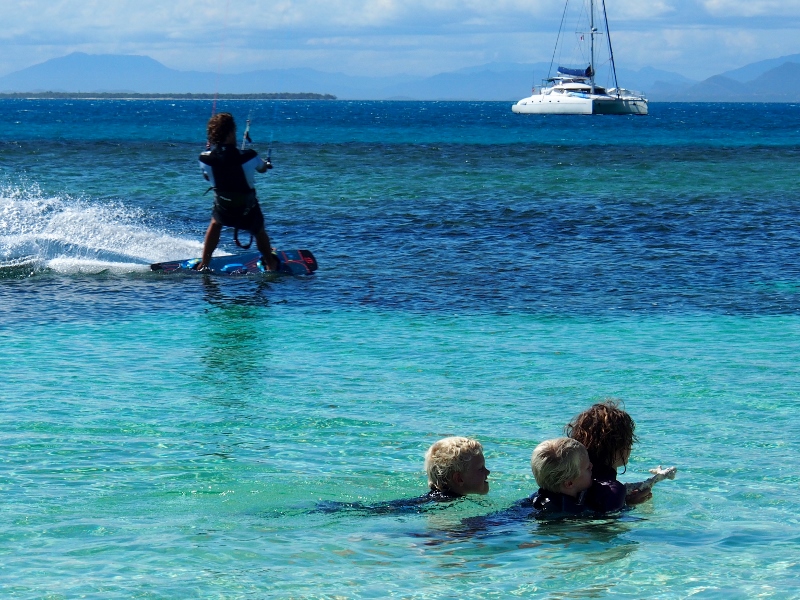
Once the wind died down a bit, we went back towards Noumea and stopped at Ilot Koue for a last day of kitesurfing. A tiny stretch of creamy sand scattered with white bleached corals and clinging succulent vegetation fighting to hold down the sand, Koue has only a few trees scattered on the raised platform of the centre of the island, and is surrounded by a turquoise lagoon fringed by a reef teeming with life, topped with a stretch of beautifully flat water to kite in a fresh seabreeze. The sun was fierce and the kids were splashing in the water as we took turns speeding across the shallows on our kite boards, just inches away from where the kids were peacefully playing in the shallows. At the end of a day there in the hot sun we were all red-faced and roasted, finally feeling warm after a week of chilly but enjoyable winds.
Bob anchored in the right spot, water fun for allGlassy sunrise off Ilot Koue
On our last day, a hot windless hazy morning, we went to Ilot Nge to show Vida the incredible sealife there. As we approached the mooring buoys through the glassy waters of the early morning we saw turtles and sharks, huge remora, giant trevally and large coral trouts gliding through the crystal clear waters. We soon went snorkelling, and Vida was ecstatic to see a turtle, snorkelling above it as it glid gracefully through the water just above the seabottom for hundreds of metres, weaving in and out of seagrass groves, stopping to visit small coral outcrops on its way away from the shadows following it around on the surface.
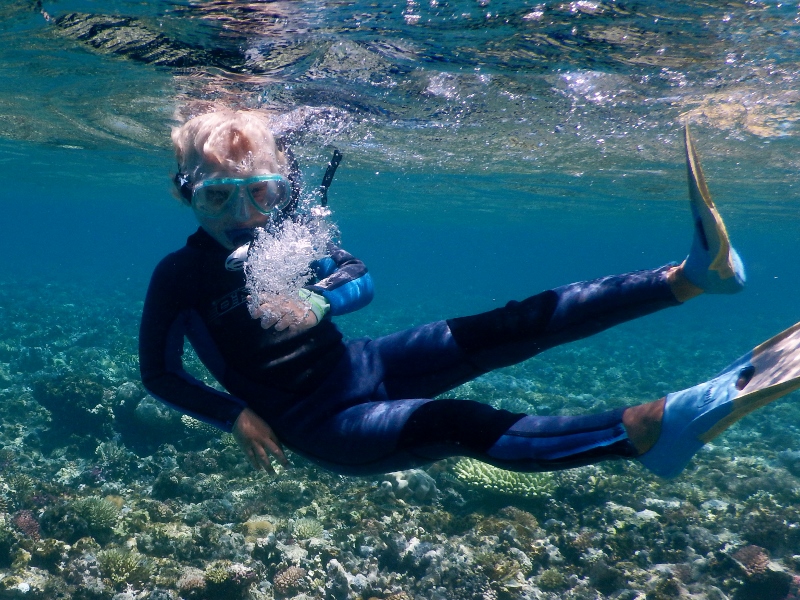
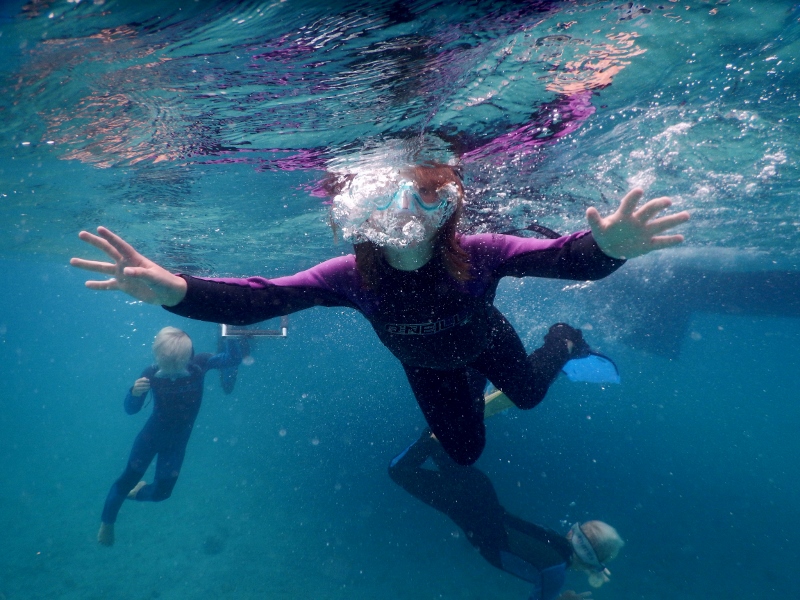
Vida and the boys snorkelling
We celebrated our last night with a bonfire on the beach, roasting potatoes in the hot coals and chargrilling vegetables on a grille handily provided by the French authorities. The kids rummaged around the area and quickly turned into Indian savages, their faces covered in soot, feathers in their hair, bones and fish carcasses tied to their belts, fierce expressions on their faces, tent pegs in their hands as weapons, Alec’s facade the only one crumbling as the night wore on.
“Are you sure we should go today?” I asked.
David shrugged. “It won’t make a lot of difference if we delay it, this weather pattern will last to next week”.
I gulped. It had been a very rough passage from Fiji to Vanuatu, and I had been sicker than ever before, unable to do much but sit in the skipper’s seat and stare feebly at the horizon. It wasn’t that it was super windy, although we had been hit by a front or two; it was more the angle of the swell, the confused seastate tossing us around, jerking and slamming us one way and another until we were all covered in bruises.
“Well”, I said. “I guess we might as well go, then. I’ll take some seasickness pills, and give Matias some, too”.
And so we went, and in the end the seasickness wasn’t too bad, the pills keeping the nausea at bay for both Matias and myself. It was rough, though, waves crashing over us so frequently that it was impossible to sit in the cockpit without getting completely soaked. David kept maintaining that it really wasn’t that rough, that it was just the angle of the swell. But as far as I can remember, we’ve never before had so much water entering the cockpit.
Grey upon grey – our approach to Grande Terre
On the second day Grande Terre of New Caledonia appared on the horizon, misty rocks rising steeply out of the dark grey water. Apparently Cook named it New Caledonia because it reminded him of the Scottish highlands, and on our approach we could see why – dark, rugged, green hills set against a background of the bleak grey sky. We were further south now than we had ever been and the weather was cold, a chill southerly breeze blowing. I went inside and got out the woollies – we hadn’t needed them until now, but there was a limit to what we could stoically endure – and we rugged up, in layers topped with our offshore jackets.
All rugged up in the rain
…but the locals don’t appear to feel the cold…
New Caledonia was first settled by the Lapita people (named for a site on Grande Terre where their pottery was found) who arrived from Vanuatu arund 1500 BC. Captain Cook spotted Grande Terre in 1774, and a few English and American whalers and sandalwood traders settled down in the area in the 1800s. Missionaries arrived soon after, both Tongan protestants and French Marists. The indigenous people, the Kanaks, were meanwhile stolen in large numbers and sent to work as slaves overseas as blackbirders.
In 1853 Napolen annexed the country, ostentiably to protect the Catholic missions there, but really to claim the land and establish a penal colony on Grande Terre to ease up space in France’s overfilled prisons.
As settlers began to spread skirmishes between Europeans and the Kanaks became more common until they culminated in the Revolt of 1878. Following the revolt the Kanaks were brutally suppressed by the French regime.
With World War II came the allies, with US forces setting up camp in Noumea from where they would lead attacks on the Japanese in the Philippines and Coral Sea.
After the war New Caledonia was changed from a colony to a French Overseas Territory, and Kanaks were finally recognised as citizens and the wealthier Kanaks given the vote. Great nickel reserves were found on Grande Terre, leading to an economic boom in the 1950s and 1960s; today New Caledonia remains one of the world’s largest nickel producers.
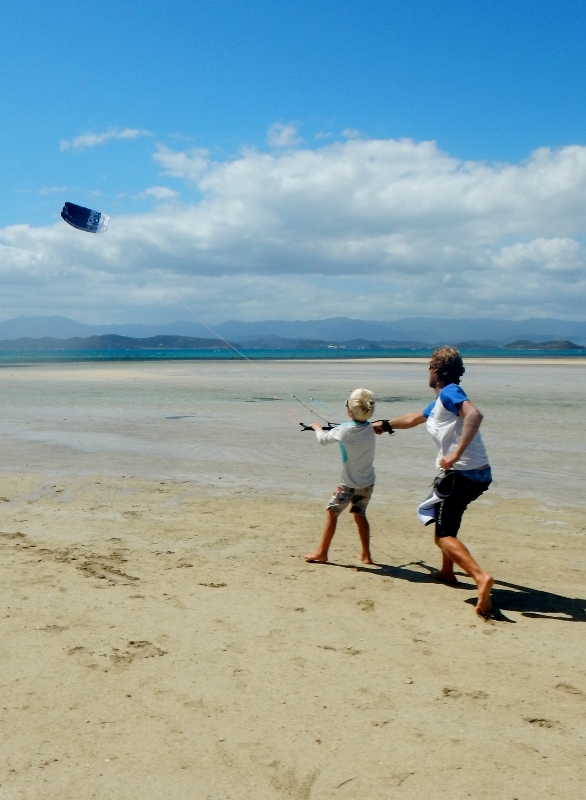
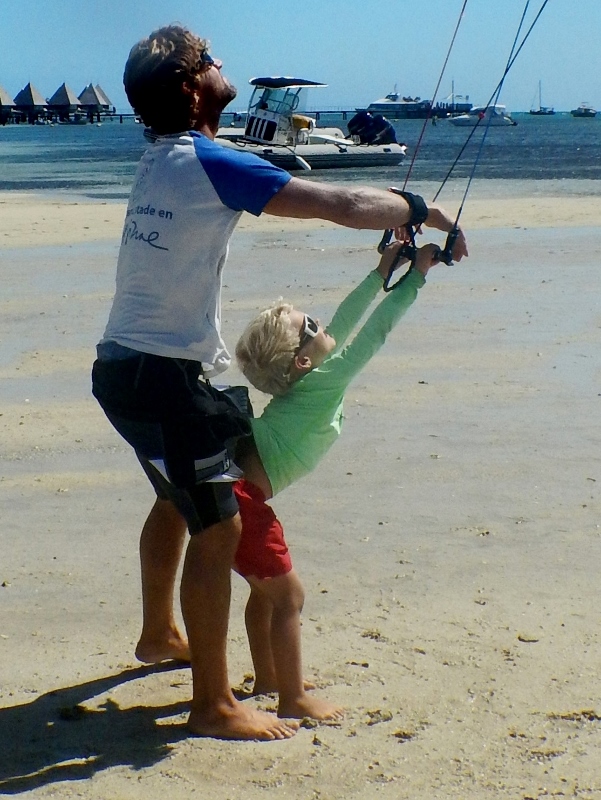
Matias with the trainer kite
With the improving economy came decades of bitter strife and bloody fighting between the Kanak independence movement and the French. Finally in 1988, the French Prime Minister Michel Rocard brokered the Matignon Accords, under which it was agreed that the French would support education, construction and infrastructure to help the economy of the territory, and that a referendum on full independence would be held in the future. The referendum was held in May 2014; the outcome was that New Caledonia remains French Overseas Territory for the time being.
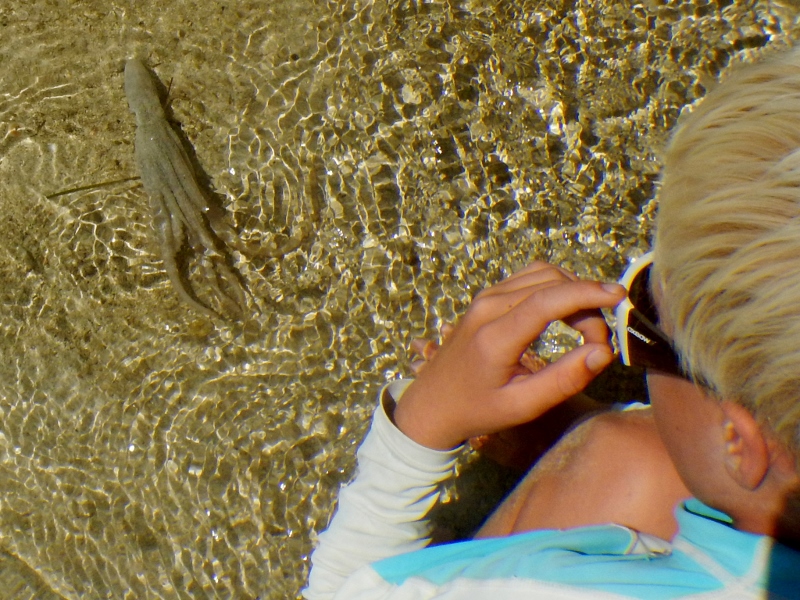
Too little to hold the kiteMatias with an octopus in the shallows
After spending a couple of days checking in and stocking up on parmesan, baguette and terrine du campagne, we left Noumea to spend some time on Ilot Nge, a wonderful little island about an hour’s sail from Noumea. The island has a great sandspit from which to launch a kite and wonderfully flat water behind the beautiful reef that surrounds it. The whole area is a marine reserve, and turtles and sharks came to greet us as we moored up on the buoys helpfully placed on the seagrass just off the beach.
Giant trevally under the boat
A giant trevally and three remoras soon took up permanent residence under the boat; whenver we jumped in the water they would swim towards us in a hopeful manner, perhaps thinking that we were going to feed them.
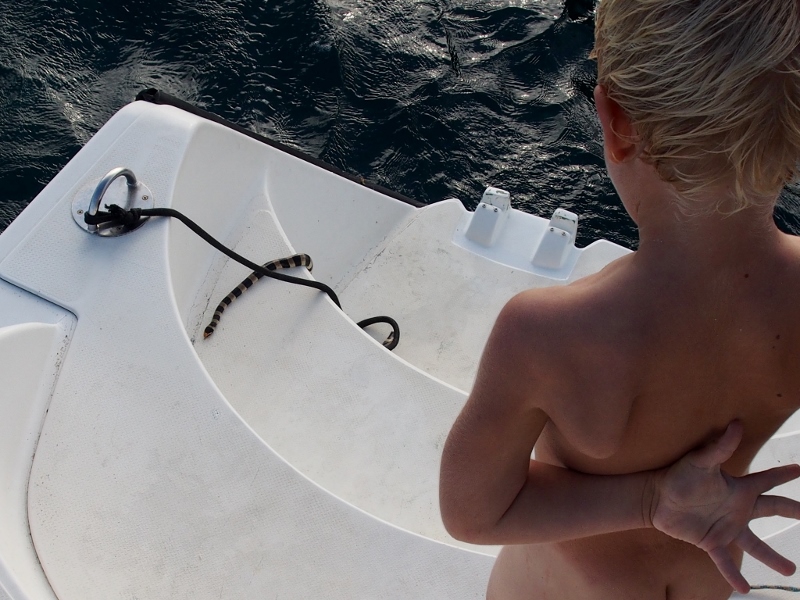
Seasnake aboard
Seasnakes were also showing some interest in us, swimming up to us in the shallows, snuggling up to the fire we lit on the beach, and one even climbed onto the boat one evening, making me nervous about what I could expect to find in my bed the next morning.
Seasnake venom is the most toxic venom known and one bite from a seasnake can easily kill a grown person. However, the snakes are quite small, and their mouth can’t gape over much, so in reality the risk of getting bitten by one is rather low, although we did have to issue stern warnings to the kids to leave them alone.
Get out, it’s dangerous!
Beach cook-out in Ilot Nge
When kitesurfing over the seagrass beds, David saw a couple of dugongs, huge brown shapes sitting near the surface calmly chewing the seagrass cud. Large turtles were cruising the bay, coming up for air every 20 minutes or so. What a place – we’re looking forward to spending the next month or so here!
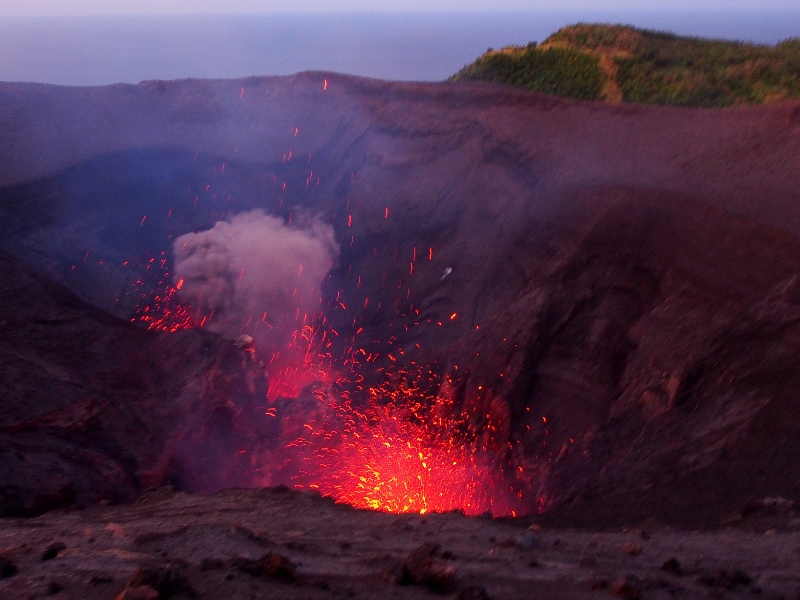
Grabbing my hand he pulled me away from the dark edge and stopped to watch from a safe distance, ready to run if necessary. The mountain roared and crackled, shooting up scores of glowing rocks from its molten interior, the luminous fragments thrown high up into the sky only to drop back down into the crater against the background of sparks fanning off in all directions. Billows of thick black smoke rose and fragments of ash and dust blew up and around, landing in our faces and covering our clothes. It tasted of sulphur and sand, a sour, gritty paste coating our nostrils and mouths.
Smoke rising
We were perched on the rim of the caldera of Mount Yasur, cautiously peering into the famously active volcano that keeps the southern end of the Island of Tanna in Vanuatu warm. We had come here for a quick stop over on our way from Fiji to New Caledonia mainly to view the amazing volcano and to spend some money in the area which was devastated by Cyclone Pam in March this year.
Wow, it’s a real volcano, ocean in the background
Our first sight of the Mount Yasur volcano was on our approach into Vanuatu, where, on my early morning watch, I had seen the blaze lighting up the sky in the predawn light, a pinkish orange hue spreading from the top of the mountain to nearby clouds. Tired and miserably seasick, the light first had me confused – we were heading west, so the sunrise was supposed to be behind us – what was that red glow, then, dead ahead? A giant bush fire? Only once I could make out the shape of the terrain did I realise it was the volcano, spitting out flames as if to challenge the rising sun.
The beach at Port Resolution
Vanuatu is incredibly geologically active, sporting earthquakes, volcanoes, crustal uplift and subsidence in abundance within its 83 islands. When entering the anchorage at Port Resolution at the southern end of Tanna we saw steam rising from the sides of the bay, the seawater bubbling away at the margins of the rocks where a hot spring resided. Port Resolution was named by Captain Cook when he anchored in 1774, but the spot where he anchored has since been uplifted and now forms a shallow, treacherous reef.
Cook wasn’t the first European to visit; before him came Pedro Fernandes de Queirós who spotted the largest island in the group in 1606 and claimed it for Spain. Following him, the islands were rediscovered by Bougainville in 1786. However, it was Cook who charted the island group first and named the archipelago nation New Hebrides, a name that stuck until independence when it was renamed Vanuatu, from vanua (land / home) and tu (stand).
Vanuatu has been inhabited since the first Austronesians came to settle the volcanic island group from the Solomon Islands about 4000 years ago. Ni-Vanuatu (Vanuatu people) lived in relatively isolated small villages based around kinship, and warfare with neighbouring clans was common, occasionally with the aim of capturing a male or two for the coming week’s dinner. Religion was based on the worship of ancestors, and magic was eagerly practiced to ward off evil spirits. Into this society arrived increasing numbers of Europeans in the 1800s – at first Brits from Australia, later French people associated with the increased French interests in New Caledonia. With the Europeans came the usual disastrous mix of disease and weapons, which combined with blackbirding, the forced removal of adult males to work on plantations in Fiji and New Caledonia, acted to decimate the Ni-Vanuatu population. Overall, the native population plummeted from estimates of more than 1 million people prior to European contact to about 41,000 in 1938.
As colonial interests ramped up in the region, Vanuatu was claimed by both France and Great Britain. The two nations fought for many years over the control of the islands before they finally agreed on a British-French combined management of the archipelagoing in 1906. An independence movement arose in the 1970s, and after the brief Coconut War of 1980, the Republic of Vanuatu was founded.
It must have been quite a feat to unite such a diverse area. Vanuatu sports an impressive 113 distinct Austronesian languages, evolved because the mountainous terrain cuts off contact between adjacent villages. It is the most language dense area in the world, each language spoken by an average of only 2000 people. The offical languages are English and French (which nobody speak) as well as the pidgin language Bislama, which is phonetic English spoken with a French sentence structure and combined with Melanesian grammar. Bislama is hilarious, reminding us of the language spoken by the Gungans in Star Wars. Overfilled is ‘fulap tumas’; please is ‘plis’; thank you is ‘tangkyu’; very sorry is ‘sori tumas’, and a ladies bra is called a ‘basket blong titi’. Finally here are some people who can understand our boys when they are immersed in their Jar Jar Binks impersonations.
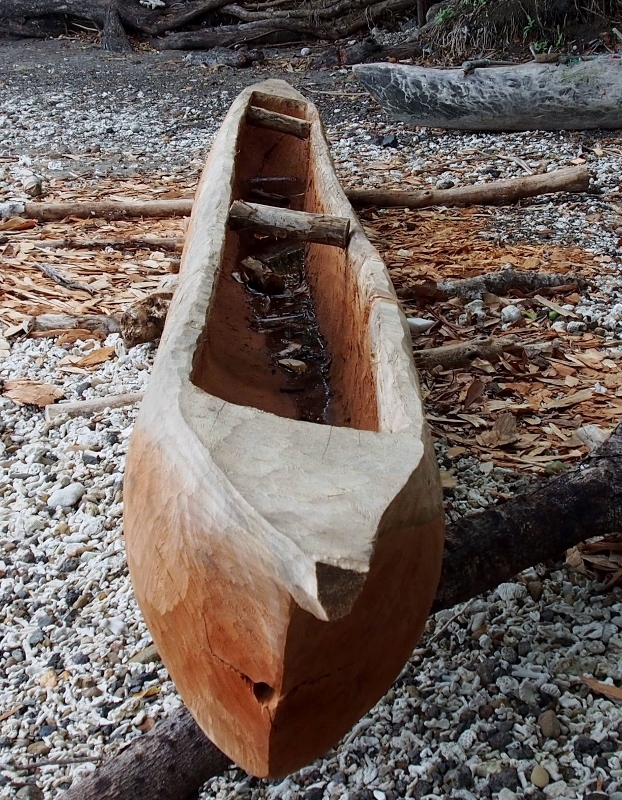
To the newcomer, Vanuatu is an incredible place. Steep rocky islands covered in lush vegetation topped with steaming volcanoes spitting out ash and fire. Third world villages with chicken, pigs and dogs rummaging in amongst houses made from Pandanus mats thrown over a wooden framework, cooking fires out the back. A water pump, donated by an Australian aid project, in the centre of the village, in constant use, swarmed by half naked, snotty nosed children with big tummies and flies in their eyes, clutching their aluminium pots. Solemn men fishing in the bay just off the village, in tiny, hand-made dug out outrigger canoes which they paddle with expert deftness. One came to ask us for fishing line (‘string’), and we happily gave him a wad of 60-pound line which would see him catch some big fish if only he could get his hands a bigger boat to allow him to go into the deeper, rougher water on the outside of the bay.
Local fisherman
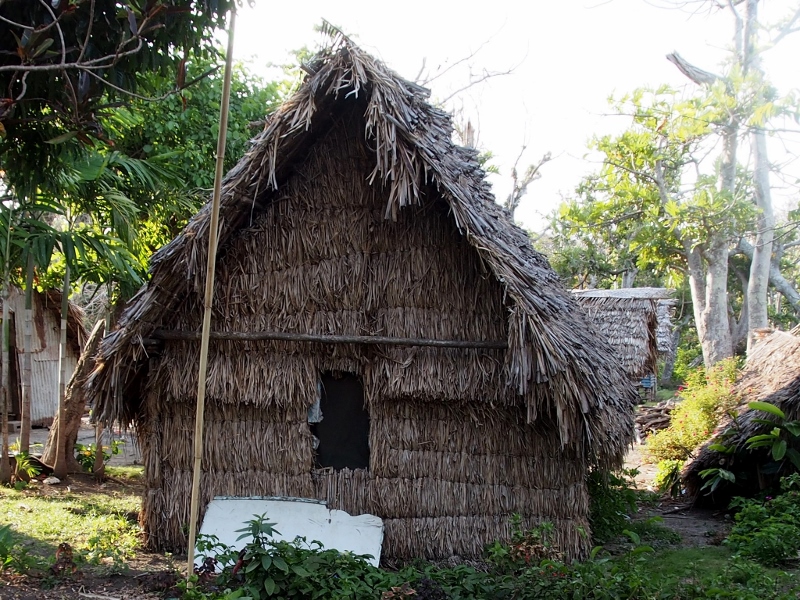
The poverty is palpable, with men and children wearing tattered, dirty t-shirts bearing strange slogans from foreign countries, donated by a charities to foreign aid projects. Although only slightly worse off than Fiji in terms of GDP, Vanuatu seems to us orders of magnitude poorer; perhaps it is the effect of the recent cyclone, or simply that our impressions of Fiji were biased by the wealthy resort islands with locals employed in the tourism industry. Or perhaps it is the houses – erected quickly and cheaply, ready to be blown away in a cyclone, the clusters of woven huts remind me of villages in Africa, only there the houses are sturdier. Villages are still very traditional, with sharply segregated roles and separate areas designated for men and women.
“This is where the men sit to drink kava”, said Miriam, the kindergarten teacher who was kindly showing us around the small village just behind Port Resolution. She pointed towards the village namakal, a little covered area where men drink kava.
“What about the women?” I asked. “Do they drink kava?”
“No, we’re not allowed. Western women can, but not Ni-Vanuatu”.
Miriam’s niece, Shirley
We continued walking, the path weaving right in front of the namakal.
“Women can walk this way only during the day”, she said. “When the men gather to drink kava, one hour before sunset, we have to walk the other way” she gestured to a path going off to one side “so that we don’t see them. We’re not allowed to look at men drinking kava”.
“Why can’t women drink kava?”
“Because kava makes you lazy, and the women are too busy to be lazy – we have to look after the children, grow the vegetables, cook the food. We don’t have time to be lazy like the men do.”
Vanuatu women are not allowed to stand higher than a man either, or to walk over a fire, because it’s smoke may rise higher than a man. Within the village are areas set aside for women to use when they menstruate, and during their entire pregnancies they are confined to a hut.
Nearly finished dug-out canoe on the beach
Miriam’s situation wasn’t easy.
“My husband left me, for a woman in Vila”, she said. “But my brothers and sisters helped me, and I stay with them”. She is one of nine, six brothers and two sisters, the brothers remaining with their mother in the village, the sisters married off and living on their husband’s compounds.
“Your English is good”, I commented. We had come to the village looking for her brother, Stanley, who arranged for volcano tours for visitors. Miriam had approached us as we stood there, looking lost, and had offered to help. A small, wiry woman of perhaps 35, clad in a loose, flowery dress, she had offered to show us the village whilst we waited for her brother. We gladly accepted – you need a local guide to enter a village, and we were keen to explore the settlement.
“I completed grade 7. After that there were no more money for school, my father said I had to start working. I’ve been teaching kindergarten at the school for more than ten years now”. She stopped on the path and turned to look up at me. “We never used to get paid, the government only pays teachers of Grade 1 up. But the community gathered some money, and now I get paid a bit”.
We asked about the cyclone.
“We all stood together, in that house.” She pointed towards a collapsed house, mats hanging off the wooden framework. “It was raining hard. It was very, very windy. A lot of damage to the village.”
Matias and Stanley Jr. in front of the house where the family sheltered during Cyclone Pam
Cyclone Pam hit Vanuatu hard, in particular Tanna. A total of 15 or 16 people died in the cyclone, and thousands were injured. The storm formed in early March east of the Solomon Islands from where it tracked south, strengthening until it reached Category 5 Cyclone Status in mid-March, with winds peaking at 250 km/h as it directly hit Tanna Island and its more northerly neighbour, Erromango. The cyclone crippled Vanuatu’s infrastructure, compromising telecommunications and destroying hospitals, schools and water supplies. It was estimated at the time that 98% of the nation’s buildings were damaged by the storm.
In Miriam’s village in Port Resolution Bay the damage was still visible – uprooted trees, damaged huts, washed away roads. Miriam told us how they received help in the form of rice, as all their crops were destroyed.
Back on the boat we gathered all that we had that might be useful and donated it to the village – tins of food, books, pens, paper, clothing for children and adults.
Village dwelling
Miriam’s village is modern, a brand new concrete school building erected after Cyclone Pam, a UNICEF tent on campus. Just around the corner is a village where locals live according to kastom – a set of traditional customs and taboos. Here men wear only nambas (penis wrappers) and women just grass skirts, living life much the same way their ancestors did a thousand years ago. In these kastom villages Christianity was spurned in favour of the infinitely more exotic John Frum religion, a Cargo Cult (a movement seeking to obtain material wealth through magic) centred on the belief in a mythical messianic figure named John Frum promising Melanesian deliverance. The phenomenon started in the 1940s when US forces landed on the islands, stirring the imagination of islanders with their seemingly unlimited material wealth, fresh supplies (cargo) being air dropped as if by magic every week or two. The cults arose when charismatic leaders had kava-induced visions commanding them to persuade followers that the worship of certain “Americans” (like the mythical John Frum) would lead to unlimited material wealth like that enjoyed by the American forces. All they had to do to obtain the goods was to mimic the day-to-day activities of the US soldiers, leading to a host of men in Tanna performing military drills with sticks for rifles, sitting in makeshift control towers wearing coconut headphones and waving landing signals on quickly cleared runways in the jungle in the belief that this would attract the cargo. Although less popular now than 50 years ago (some adherents impatiently dropped off when the promised wealth failed to materialise), John Frum today is both a religion and a political party with a member in Parliament.
Lukie on the beach just around the corner from a kastom village
Even more peculiar is the Prince Philip Movement on the other side of the island, where villagers of the Yaohnanen tribe worship Prince Philip, believing him to fulfill the ancient myth of the pale-skinned son of a mountain spirit who ventured overseas to look for a powerful woman to marry. When Prince Philip visited the island with the clearly important Queen Elizabeth in 1974, villagers rejoiced at the opportunity of seeing their deity firsthand.
It is easy to laugh at these practices, but I guess most religious beliefs are hard for outsiders to understand. Cargo Cults certainly served a purpose to reinforce social relationships that were under stress in a changing world, and even if the cargo never materialised, who can blame them for hoping? When asked how long they were going to wait for, a local man allegedly replied back in 2003 “We can wait for much longer. Christians have been waiting for thousands of years, we’ve only been waiting for 63”.
Back on the volcano magic was certainly in the air as darkness fell, obscuring the sharp drop-off immediately in front of us and leaving us suspended in thick blackness, peering at the spectacular light show on offer. Thunder roared and crackled as luminous rocks the size of cars, nay buses, were spat out high when the mountain belched again, glowing sparks spraying the heavens. Oddly, the scene felt safer in the dark when we couldn’t see how just close we were to the abyss into the inferno. Had the mountain been almost anywhere else in the world solid bars would have kept tourists from plummeting into the depths, but this being Vanuatu there were no railings to cling onto and no lit path to follow on our way back down the mountain. So we stumbled down using our dim head torches, stubbing our toes against fresh lava deposits, Lukie falling over once or twice, until we finally reached the car park where Belbup, our driver, was waiting to take us back to Bob in Resolution Bay.
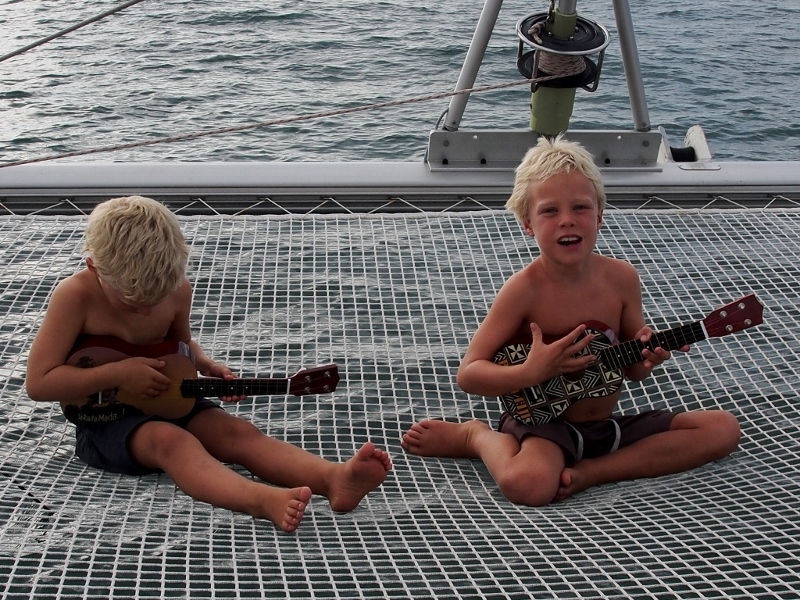
Two man band – thank you Noah and Kai for the ukuleles
“Mummy, why is there not very much food?” whispered Lukie, leaning forward across the table. “Is this all we’re going to get?”
“No”, I whispered back, “don’t worry, we’ll get more”.
We had told the kids that it would be fine dining, that there would be no kid’s meals, no pizza or chips. But it was a bit later than our normal dinner time, and Lukie was starving.
The waiter finished pouring the water and left.
Four prawns lay beautifully displayed in the centre of a square plate, smothered in a masala sauce, delicately decorated with thin strips of carrot, cucumber and coriander. They smelled delicious.
“Mummy, can I please have a prawn?” asked Lukie. “Or maybe two, maybe I can have Matias’s, he doesn’t like prawns”.
“Let’s save the extra one for Daddy”, I said. “It’s his birthday we’re celebrating”.
We were at the exclusive ‘1808’ restaurant, at Castaway Island Resort in the Mamanuca Group of Fiji, splurging on a gourmet meal out to celebrate David’s upcoming birthday. His birthday is tomorrow but as we’re leaving Fiji today, we thought we’d have a meal out whilst having access to a nice restaurant.
Us with Bob in the background
And it certainly was an inspiring dining experience, fusion Asian Pacific cuisine executed over a camp-out kitchen set up in the sand, overlooking the sea, the dishes arriving as they were cooked, all locally inspired sensational bursts of flavour and texture such as seawater confit of pork belly, lemongrass tea chicken with coriander salsa verde, and sizzling Yagara pepper beef. We’d had a wonderful day at the island, snorkelling the pristine reef, watching superyachts and seaplanes whizz by, relaxing one final day. And now this incredible meal to round it off with, easily the best food we’d ever had in our lives.
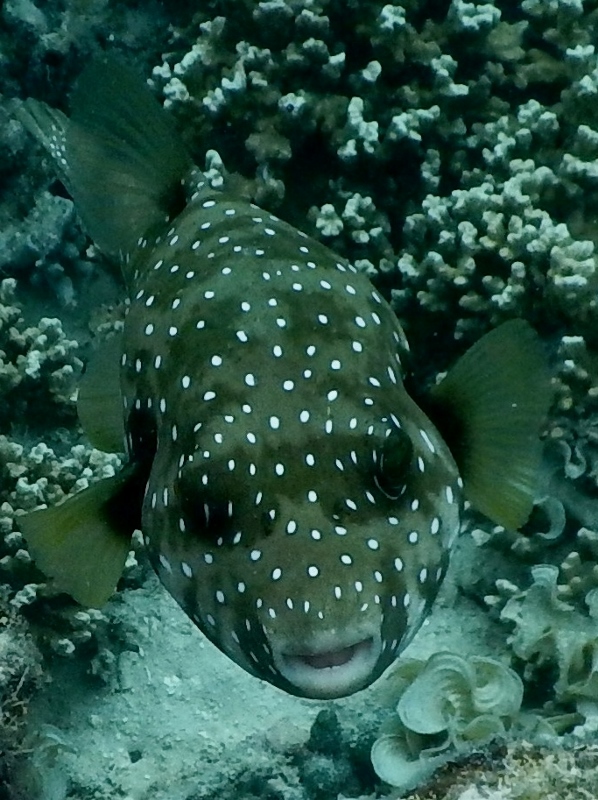
Timid white-spotted puffer
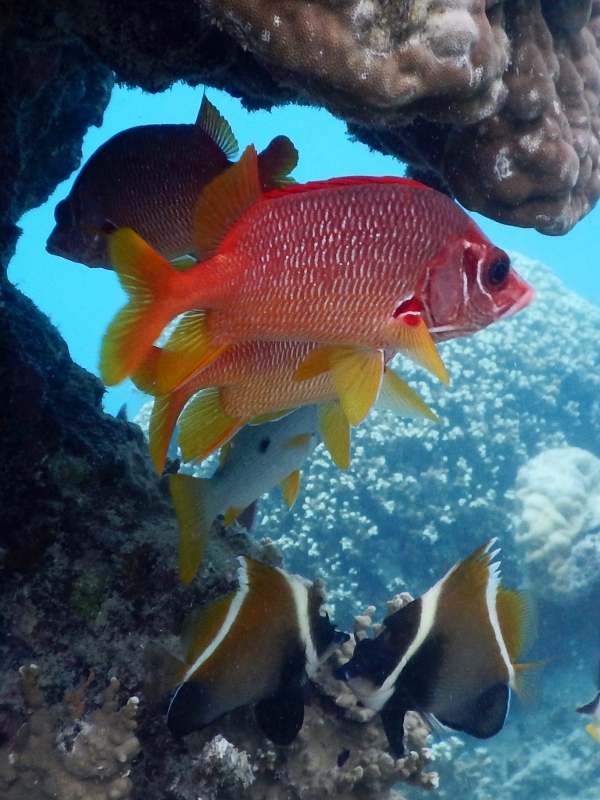
Colourful fish assembly
We were on our way to Nadi, to provision for our upcoming passage before checking out. Originally planning to go to New Caledonia, we’d made a last minute decision to stop over at Vanuatu to see the famous active volcano at Tanna on our way to New Caledonia, making the trip three nights rather than four. The weather was looking good for a departure on 2nd October, steady winds, fast sailing on a nice beam reach.
Spotted eagle ray
Defensive damsel on the attack
Since Alexis and Cara left us we’d been relaxing in Blue Lagoon, swimming and snorkelling, and had watched Wales beat England in the rugby at the local yacht club. Huge super yachts had arrived there and anchored some distance away and we watched the kerfuffle as the resort staff got ready for the ‘cultural welcome’ for the owners. One of the huge ships anchored looked like a research or navy ship, decked out as it was with a helicopter and a crane. The staff told us that this was the ‘shadow ship’ of the other yacht, the vessel bearing the toys for the owner to enjoy – the water skiing boat, bigger than Bob, being the tender, the helicopter for the scenic rides, the sports equipment to ensure a great experience for the owner without him having the inconvenience of having to interact with lowly helicopter mechanics and kite surfing instructors during the remainder of his stay.
Different world – I wonder how much fossil fuel they burn up in a year, two huge vessels chugging along from one desirable destination to the next, ready for the owner to descend upon them whenever he or she gets a break in their busy schedule.
Toy bearing ‘shadow ship’, complete with helicopter and crane
In any case, I hope they enjoy Fiji as much as we have. It has been an incredible place, full of beautiful islands and underwater treasures. But the best thing has been the people – the incredibly friendly islanders, the cultural melting pot mixing Indians, Fijians and on the mainland also Chinese, resulting in breathtaking diversity on the streets and buses, delicate Indian ladies adorned in sparkly jewellery and glittery silk saris next to huge Fijian mamas sporting the signature short cropped afro and sober church wear. The food at every street vendor is wonderful – delicious curry bites dipped in hot sauce, a street version of the Indo-Fijian fusion cuisine, without the refinery of the 1808 restaurant but still tasty and at a fraction of the price.
Sparkling saris for sale
Oh, Fiji, we’ll miss you and are sad to leave – we have so enjoyed visiting here, getting to know the culture a bit, visiting villages on remote islands from east to west. Moce, and Vinaka for your hospitality.














































 SV Bob The Cat