Bob the Cat

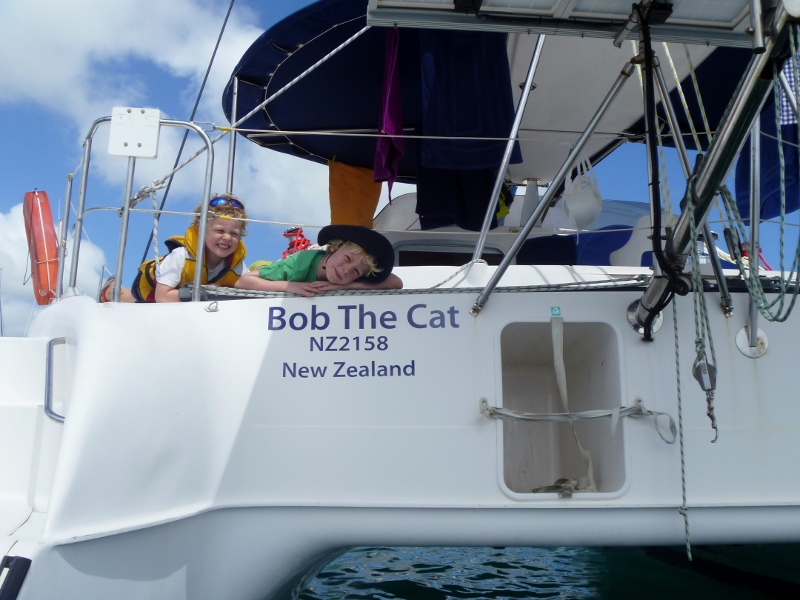
Stern view of Bob the Cat

I should probably describe the boat a bit. She is a 46 foot Fontaine Pajot Bahia catamaran from 2004 – the charter version of the boat, which means lots of berths and heads (toilets), and in her former life as Alize V, she spent most of her life in a charter fleet. Each hull contains two double cabins with ensuite toilet / shower, and two additional single berths, one in the corridor and one in the far forward cabin. So if we wanted to we could sleep 12 people, although the forward cabin is only really suitable for a person of slight build with no tendencies towards claustrophobia.
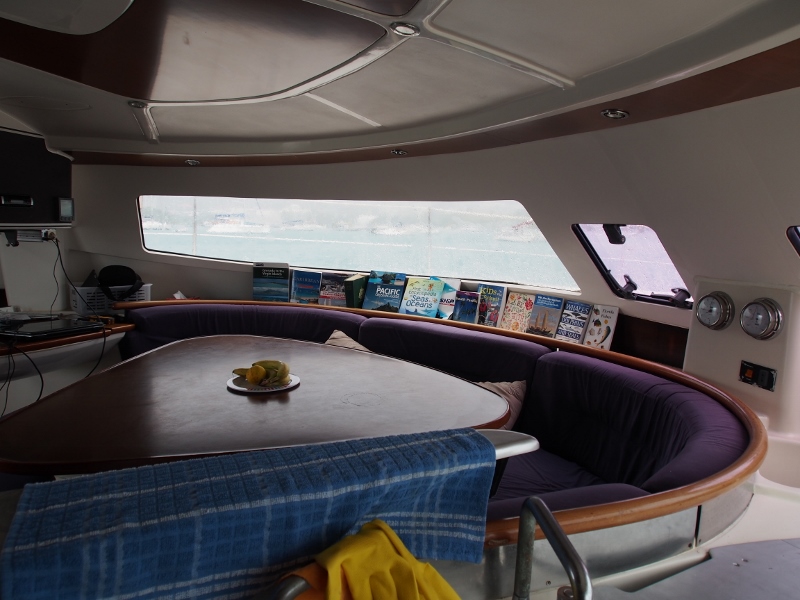
Saloon dining table
Saloon dining table

Up above between the two hulls is the saloon, with a chart table, a galley (kitchen) and a sitting area large enough to seat 10 people comfortably around a big triangular table. The galley is small, with two sinks, a freshwater and a saltwater tap, a three stove gas cook top, a small gas oven, and a large fridge/freezer. All compacted into an area of about 2 m2, so there is only room for one person at a time. The top of the fridge doubles as a small bench top, the lid of the garbage bin as a cutting board. Whilst frustratingly tiny, it does have a wonderful view out over the deck and the water beyond.

David driving the boat

The saloon opens straight out to the cockpit, where there is an outdoor table and seating, as well as the steering wheel and instruments. There is access to the engines as well, with one engine locker on each side. Storage lockers are under and at the back of the cockpit deck. To get on deck from the cockpit you have to step up about two feet, so there is little danger of the kids accidentally falling out. At the bow (front) of the boat a trampoline is strung between the two hulls.


Me driving the dinghy

We got a catamaran because they are spacious and comfortable, and we’ve found it a great boat. Plenty of space to sleep us and visitors, lots of storage, and a trampoline to entertain the kids when they feel jumpy. Easy access to the water, with steps at the back of each hull leading down to the water’s edge, and a flip down ladder on one side for climbing in and out. When not in use, the dinghy is suspended at the back between the two hulls, under a large solar panel.
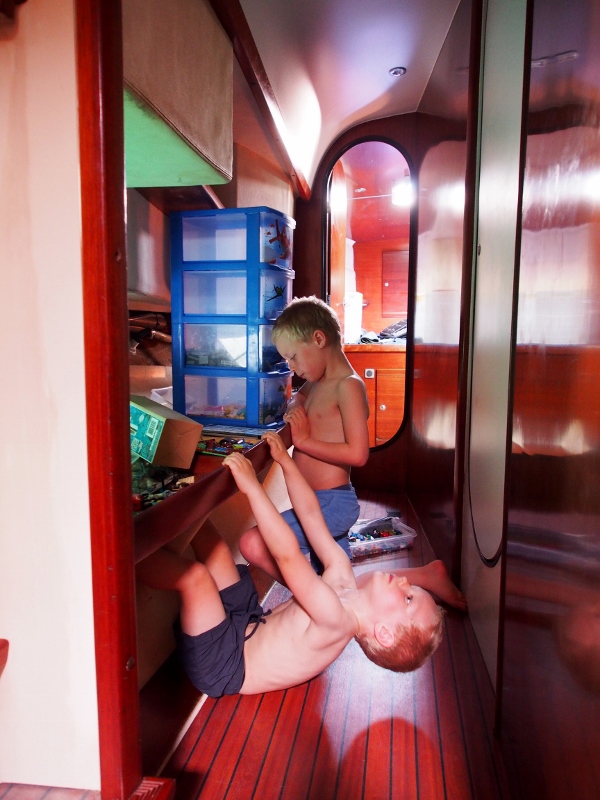


The Lego is stored, and used, in the spare starboard corridor bunk

Another upside to a catamaran is how comfortable they are when sailing. Because they sit flat in the water rather than lean over like a keel boat, the kids can play with lego, draw or write as we’re sailing. It also means that we don’t have to be as careful to stow everything when we take off as you would be on a monohull; things tend to stay in their place even when we’re in a bit of swell, so we don’t have to tie everything down, and we can easily boil the kettle even when sailing upwind. The 180 degree view out front from the saloon helps minimise seasickness when inside, as you can clearly see a large stretch of horizon.

Each cabin and each toilet has an overhead hatch, as well as one or more side hatches, which helps keep the air flow when at anchorage. The larger ones you can crawl in and out of, and the kids spend hours playing hide and seek, jumping in and out of hatches, pretending to be on a spaceship travelling at hyperspeed through a watery universe.
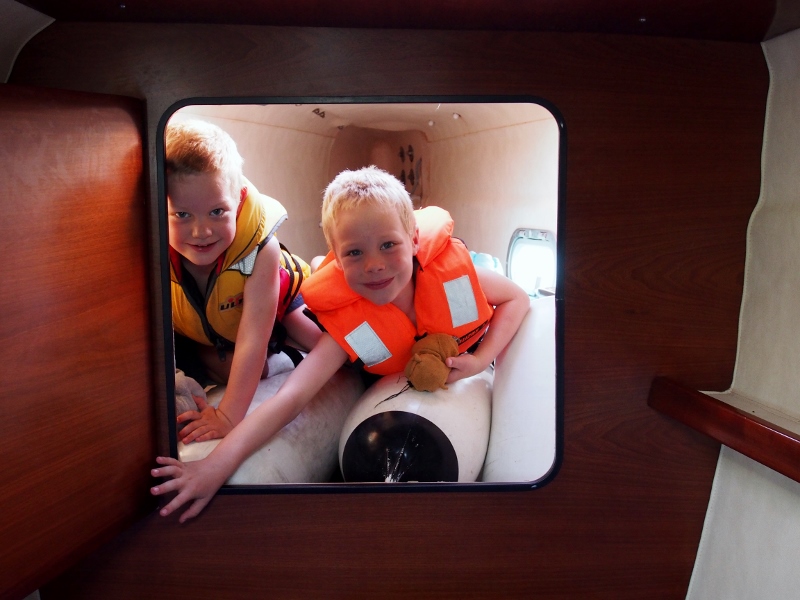
Kids in the forward cabin, normally used for fender storage

Storage is everywhere, with tins, beans, UHT milk and flour below bunks and seating. We store kitegear in one forward cabin, and fenders in the other. We inhabit the port hull, and the starboard one is presently filled up with Lego and tools, but will be awaiting guests keenly once tidied. For the moment everything is a mess most of the time, with tools, books and lego cluttered around, and towels and swimwear streaming in the wind from the cockpit.

In essence she is like a big, slightly damp caravan on water, somewhat battered but in good repair. Locker door handles are rusty, the cupboards bear permanent marks from pots stored years ago. The dark blue cushions are bleached by the merciless sun, the bathroom mirrors streaked in places where the backing has worn away. Here and there the gel coat is chipped, and we’ve had to replace several ropes that had worn through dangerously. David has been working ceaselessly fixing bits and bobs, from a broken toilet to a leaking hatch, replacing a set of worn out steering lines, affixing a ceiling that was dragging down. Where we need it, we get outside help – a new sailbag is being made for us, the broken VHF is being fixed, a fresh trampoline on order.
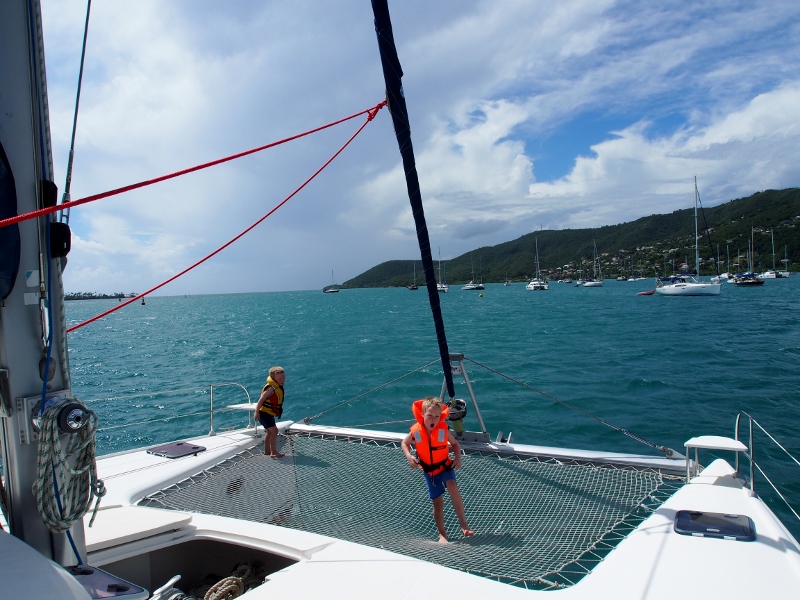
The tramp in use
The tramp in use

Sailing wise, she is not a high performer, although we’ve been pleasantly surprised at her speed. The sails were brand new when we bought her, and we’ve been easily cruising at 7 to 8 knots. This will be important on passages between islands (the distances here in the Caribbean are quite short, but in the Pacific they’ll be much greater) where gain in speed will cut the travel time, possibly by days. A typical catamaran, she doesn’t sail too well upwind or downwind: she is reasonably fast, but can’t point into the wind, or away from it.

As soon as we get the VHF sorted, we’ll head away for a longer trip, and test her out some more. I’m looking forward – the small forays we’ve done so far have whetted our appetite for more.
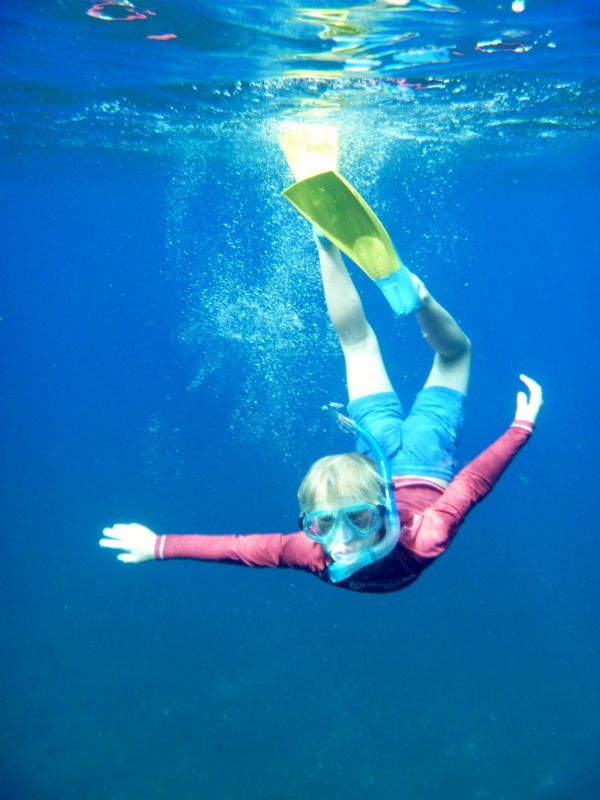
Water time

P1040093 (600x800)

P1040139 (600x800)P1040123 (800x600)

P1040122 (800x600)


We decide to take off on the boat for the weekend, to enjoy the island a bit and have a break from work. At the same time, we can test the watermaker and do some man overboard drills with the kids.

We sail north west, sticking to the leeward side of the island, up to Anse d’Arlet: a white sandy bay backed by coconut palms behind which the lush green hills rise almost vertically, covered in rainforest from top to toe. Treacherous lobster pots are everywhere along the coastline, often marked by only a transparent water bottle as a float. Virtually impossible to see until we are very close, so we have to keep a constant lookout whenever in shallow water.

The kids initially jump on the trampoline, and are in and out of the forward hatch, playing some sort of hide and seek. When we get further offshore at the southern end of the island they start feeling a bit queasy, and I put on their seabands – elastic bands with a pressure point to put on the wrist, which seemed to work well to reduce seasickness last time we went sailing. Matias goes down below for a sleep and Lukas relaxes in the cockpit, looking for dolphins. He spots an island which looks like Darth Vader’s mask half submerged, names it ‘Skull Rock’, and tells us stories about its rich and varied past. Spirits are high despite the slight seasickness which they shrug off as tiredness, and everybody has plenty of appetite for lunch.
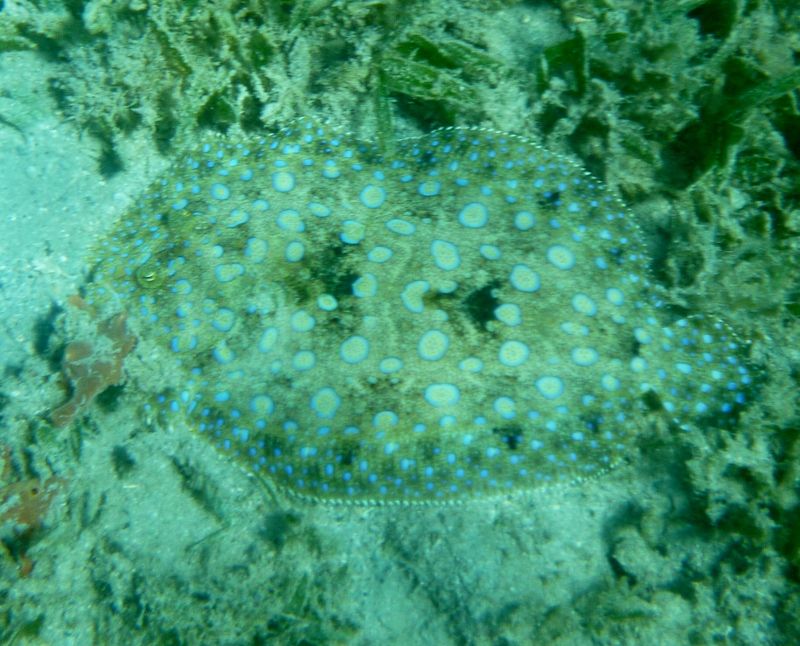
When we get to Anse d’Arlet we jump in the water and head to the nearby rocks for snorkelling. The water is clear and dotted with tiny demoiselles that flock around us instantly, and the children are mesmerised by the huge barrel sponges, the swaying anemones, the bright blue angelfish – as well as the French guy swimming past bearing an enormous speargun. We see seagrass and cute flatfish blending in with the sun freckled sea bottom, trying to fool us into believing that the black marks on their back are the eyes of a gigantic animal. Soft corals give us a friendly wave, wonderful yellow trumpetfish glide silently past. Wrasse are feeding on algae, whiting blend in with the white sand near the beach. Purple fanworms retract swiftly when we gently brush them, but a turtle seems unfazed when we dive down to get a closer look.

Friendly turtle
Friendly turtle
Camouflaged flatfish


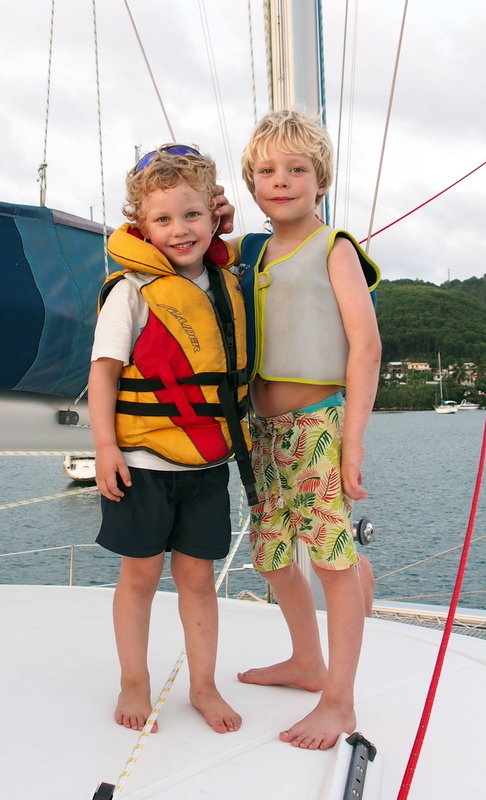
We subject the children to a swim test, which involves them jumping in and swimming around the boat, wearing their lifejackets. Our safety rule is that they have to wear lifejackets when on deck – inside the cockpit they can go without, but whenever they are jumping on the trampoline, crawling on the roof, diving in and out of hatches, they have to wear the jackets. So far they have been great at remembering, and even Lukie is able to swim unaided around the boat, which is about 50 m. The water is calm and nobody is panicking, so a bit different from a real man overboard situation. But a good start.

Dirty boat

In case anyone out there is feeling jealous of our glamorous new lifestyle, here’s the ugly truth about what it’s like cleaning a boat that’s been closed up in the tropics for a year. It’s disgusting.

Over the last three days, I’ve been working my way around the inside of the boat, cleaning cabins, toilets, kitchen storage spaces, bilge pump areas. This means wiping down walls and floorboards, removing mattresses, cleaning the under bunk storage spaces. Lifting up floorboards, discovering standing water, strongly yellow of colour, with dead cockroaches floating in it. ‘Why is there pee under the floor, Mummy?’, asks the kids. David just asks me to taste whether the water is salt or fresh – he is worried about a saltwater leak. I can’t bring myself to taste it.

The worst is what looks like pubic hair, absolutely everywhere. Under floors, in storage space, floating in the bilge pump water, glued to bathroom walls, stuck in a bit of grease on the engine. In the sink, the cutlery tray, attached to the window. Thousands of strands of short, curly black hair. I realise that it is most likely just the head hair from a prolifically moulting French or afro-Caribbean previous charter guest. Even so, it is still gross, and hard to clean, as the little hair stick to cloths and are not easily rinsed off.

It is hot, 32 degrees in the shade. So I’m cleaning in a bikini, trailing a strong sour vinegar (our main cleaning agent) smell behind me, only occasionally sticking my head out a hatch to breathe some fresh air, and see the beautiful scenery around me.

Through all this, the kids are amazing. They are heads down in Lego, off in their imaginary world, while we work away. As I clean I listen in on their conversation, bringing to life the Lego figures, constructing outrageous plots, a hybrid tale mixing Starwars, Captain Underpants and sailing. Luke Skywalker is on the beach, and then he meets some pirates, led by Wedgie Woman. He fights bravely, alongside his apprentice Lloyd, Jabba the Hutt’s illegitimate son who can change from a slug into a human and back again as and when it suits him. A panda bear is in there too, fighting on the goodie’s side. Too hard to follow, really, but wildly entertaining. It strikes me how perfect these two boys are for this trip – so adventurous, independent and imaginative, so good at initialising their own games, at playing with nothing more than a few Lego figures. They have amazing attention spans and can keep a game going for days on end. They rarely need organised activities, are never bored, and haven‘t once asked for TV or the computer – they are just off in their imaginary world. And they get on so well, hardly ever fighting.

We feel lucky. Soon the cleaning will be over, we’ll go for a sail, and show the kids what it’s really supposed to be like. But in the meantime, everybody are still happy and coping, even as we’re stuck on a mooring, cleaning a filthy boat.


OLYMPUS DIGITAL CAMERA