“Mummy, I’m breathing out steam,” says Lukie from his cabin, where he is rummaging around for a clean jumper to wear.
David shoots me a glance. “Definitely time to leave,” he says. “Before it gets any colder!”
The last day and a half it has been getting progressively colder, with icy southerly winds relentlessly blasting the bay, only occasionally interrupted by heavy rainfall.
We’ll leave Opua after lunch today, hoping for fair winds and following seas. The reality looks more like moderate to strong winds, but nothing too extreme, and certainly nothing we haven’t been out in before. The first two days we’re expecting 25-knot winds, but as we’ll be sailing downwind it shouldn’t be too uncomfortable. During the strong winds, we’ll be in the wave shadow of New Zealand where the seas won’t exceed 3-4 m. On day 3, the forecast is moderating, bringing lighter winds and smaller seas.
Lots of boats are leaving today and tomorrow, the little community of sailors brought together in a small Northland marina spreading out over the vast Pacific, some heading to Tonga, some to Fiji, and some to New Caledonia.
Like most of the other yachts, we plan to stop at Minerva Reefs on the way. These are two mostly submerged atolls located about 150 nautical miles south of the southernmost bit of Fiji. Yachts commonly anchor up in the calm waters of the lagoon for a night or two, getting some much-needed sleep. It will take us 4-5 days to get there, and then another 2-3 days to Savu Savu, our destination port in Fiji.
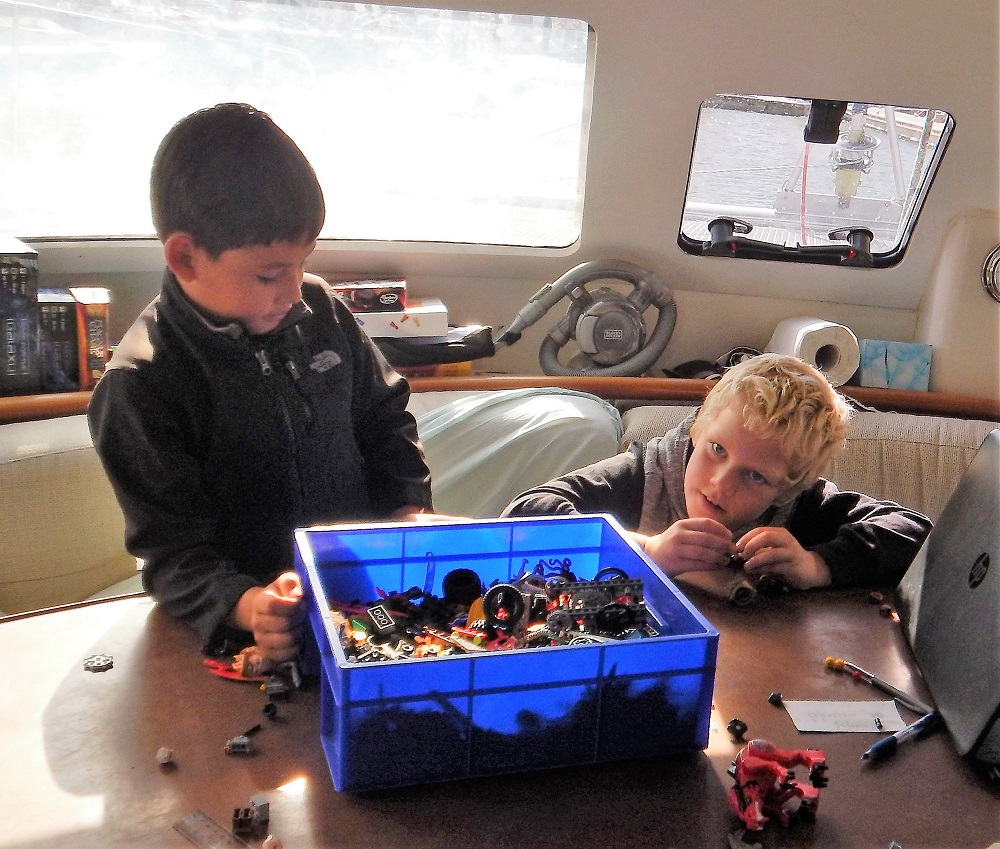
Do you like Lego starwars?
On this their last morning, the boys are saying farewell to their new friend Martin, a 10-year-old Peruvian boy who is heading to Tonga next week. He and the boys immediately bonded over common interests, with their initial meeting going something like this:
Martin: “Do you like Lego Starwars?”
Lukie: “Yes! We have Cad Bane!”
Martin: “Me too!”
Lukie: “Do you have many lightsabres? My brother has a General Grievous. Let’s go to our boat and play”.
And off they go, deep in conversation, shoulder to shoulder, heads huddled together, discussing the intricate details of Lego Starwars.
LEGO. Uniting boat kids all over the world.
Now, however, the time has come to leave, and we say our goodbyes, promising to stay in touch, hoping to meet again when they get to Fiji later in the season.
The sky is blue and the sun shining. Millions of reflected diamonds glitter on the sea surface changing shape as they ride the waves, forwards, forwards towards distant shores. We ride amongst them, happy to finally be off.
Time is dragging on, and we’re still in New Zealand. In Opua, to be specific, stuck waiting for better weather.
The on-screen weather forecasts are still red-stained horrors, but David now has a cunning plan.
“We’ll leave on Saturday,” he states firmly. “We’ll sail north as quick as we can, on the back of this big low.” He gesticulates at the screen and I lean in. The forecast for Saturday shows an enormous dark red patch just north of New Zealand. When I squint my eyes, I can just make out the numbers in the legend of the colour bar at the bottom of the screen. Dark red equals 7 m waves. Goodness.
“We will go here.” He points to a thin path of light blue screen separating two large red blobs. I squint again. Blue equals 3-4 m seas.
“So, if we stay at the back of this low, and head northeast, we’ll be able to get to here fast – there’ll be plenty of wind, but at least it’ll be downwind sailing.”
“And then,” he continues, “we will get to here, and slow right down, waiting,” – he points to a blue patch on the following screen – “until this other low has passed through ahead. Once that’s gone, we’re sweet.” He smiles.
I gulp. It seems like it will be a bit tricky, staying on the thin blue path of relatively calm sea in amongst all that red, raging ocean, keeping firmly to the ridge between two abyssal weather lows. I don’t want to be negative, but it sure doesn’t sound like the perfect weather window.
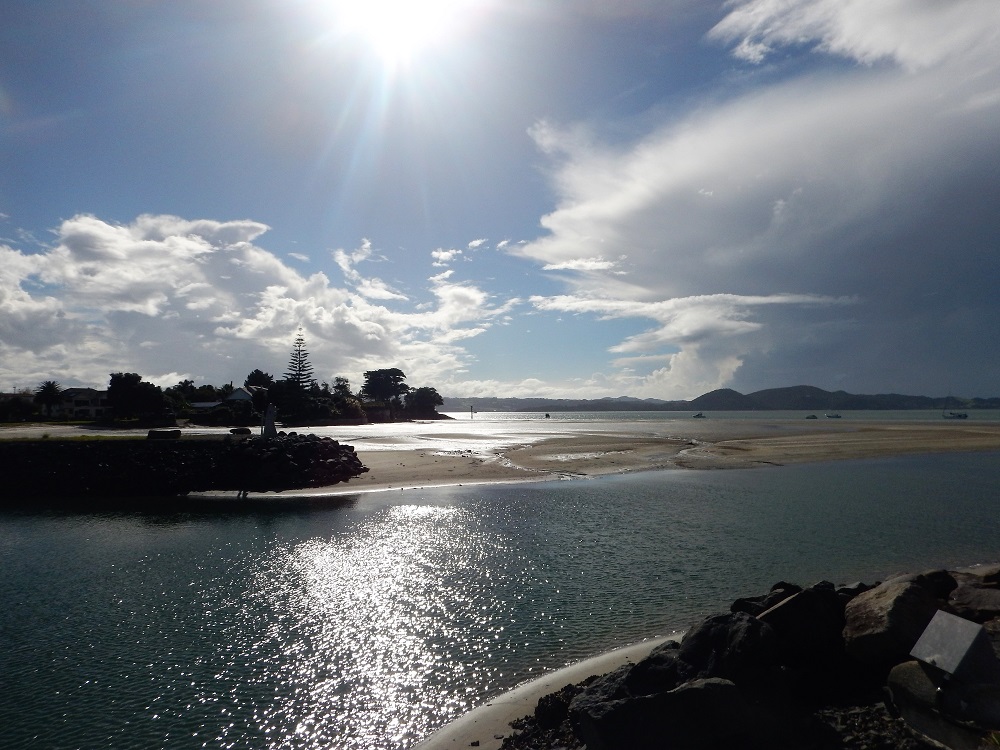
On the other hand, the weather here isn’t optimal either. We’re anchored just outside the Opua Marina, in the channel at the mouth of the Kawakawa River. This morning, our barometer seems stuck on ‘Depression – low’, and the Northland sunshine is frequently interrupted by blasts of wind and rain.
The frequent change of wind combined with strong tidal flows and large freshwater discharges makes for a tricky anchorage. When we first signed in at the marina office they warned us about the many large logs that frequently drift through the channel, smashing into boats as they float past. Inside the marina, suspiciously immobile twigs stick out of the water, suggesting larger hidden logs firmly embedded into the mud under the murky water surface. And two days ago, we watched the haul-out of a huge log which had been towed into the marina for recovery before it crushed any boats.
A 3 m long log hauled out of the anchorage.
I’ve been sleeping lightly, listening out for any crashing noises that indicate an incoming log attack.
As it turns out, it isn’t just floating logs posing a danger to anchored boats. This morning, as we sat quietly doing home-schooling, snug inside as the wind howled outside, David noticed that one of the neighbouring boats was getting closer.
“Do you reckon that boat is dragging?” he asked, pointing.
The boat, a nice-looking catamaran, did seem a lot closer than it had been earlier in the morning.
“Maybe it’s just stretching out the chain,” he said.
“That’s the one with the little kid on it a couple of days ago, isn’t it?” I asked.
“Yeah. Apparently, they’ve been anchored here for a couple of months.“
“Well, then they can’t be dragging, really – not if they’ve been here for a couple of months. Don’t worry.” I turned my attention back towards Lukie’s math problem.
A minute later Matias jumped up. “Daddy, it’s definitely getting closer! Look, it used to be ahead of us, and now it is at the same level as us.” He pointed.
And as we all focused on it, it became clear that the boat was definitely moving, slowly but surely, heading straight for the vessel moored behind us.
David rushed outside. “Come on,” he shouted. “Get in the dinghy, we have to get onto it!”
Matias and I scrambled into the dinghy, and we hurried over to the dragging catamaran. David jumped on board and started desperately trying to start the engines. Matias and I left him on the drifting vessel, rushing back to Bob in the lashing rain to get some fenders, hoping to minimise the damage from the impending collision.
We delivered the fenders, Matias jumping on board to drag them up.
“Get the dinghy away from the boat,” yelled David. “We don’t want it getting crushed. We’re going to end up on that boat, or on the mud. Go get a phone, call for help!”
Heart beating rapidly, I returned to our boat and called the marina to explain the situation. Through the thickening droplets on the cockpit clears, I could see David and Matias as they struggled in the wind and the rain on the deck of the dragging boat, which was now colliding with the boat behind.
Having finished the call, I jumped back in the dinghy and raced through the freezing wind to bring David his mobile. The dragging catamaran was now close to the mudbank, astern of the boat it collided with.
“Matias found the spare anchor,” he yelled. “So, we’ve stopped, for now.”
Dragging boat stopped just before crashing into the mud bank.
“Mummy, this boat got scratched on the side, when we banged into that other boat,” shouted Matias.
David reached for his phone. “The guy left his phone number here.”
He dialled. “Yeah, hi. I’m on your boat. It’s dragging on the anchor…”
I turned the dinghy, to get back to Lukie who was nervously waiting on our boat, and we watched from our sheltered cockpit as the boat owner came racing in his dinghy, closely followed by the marina officials. He got the engines started and Matias and David helped him raise the two anchors. The boat now under control, the marina officials peeled slowly away.
David and Matias helped the owner take the boat into the marina and secure it safely in a berth. The guy had been checking the anchor two days previously, where it had been set well in the thick mud. He, his wife and his young daughter have just moved onto the shore, as they’re expecting another child imminently and want to be on land for the delivery. He explained that in his time here, he has helped rescue several other dragging boats on the anchorage.
Dragging boat tied up safely in the marina.
“It must be the tide,” says David. “As it switches direction, the anchor rolls over, and then once it’s on its back there is nothing holding it firmly into the mud. It just gets pulled along…”
Back in the warm cabin of our reassuringly stationary boat, we warm up with cups of hot milo. As the wind howls outside, rain lashing against the windows, we reflect on lessons learned. It’s probably a good idea to have a phone number clearly visible in the cockpit of your boat, in case someone else has to jump on board to save it. And having a secondary anchor ready to go is essential too.
Lukie takes a big sip of his milo. “Mummy,” he says. “That’s the longest break in home-schooling that we’ve ever had!”
“Yeah,” I sigh. “And the most excitement we’ve had in one morning for a while. Now back to your maths….”
Being on anchorage is not without risks, and navigating a thin blue path across a red ocean certainly seems more attractive as time, and boats, drag on.
“Well, it basically comes down to the model,” says David. “I mean, GFS shows a nicer run than the ECMWF. Look at this trough here, that could be really unpleasant, but it is much smaller on GFS.” He gesticulates towards the screen, where an ominous-looking reddish-yellow blotch is working its way slowly across the screen north of New Zealand, right on the path to Fiji.
In the world of weather, I’ve learned that red is never good. Red stands for precipitation, high winds, big seas, seasick kids, shivering adults. Red is always unpleasant.
We want good weather
He turns his back to me again, poring over the laptop. “But the problem is, if we stay, we don’t know quite when the next window will be. I mean, there’s some nice stuff coming next Wednesday, but then that is long-range and could easily change. Might not be much better.”
He continues tapping and more pictures appear, one long-range forecast replacing another as he runs through the models.
After quickly scanning the images for red bits, the kids and I leave him ruminating about ridges, high-pressure systems, lows, fronts, northerly winds, rain, statistical probabilities, and model accuracies, and walk slowly along the pontoon in the brilliant sunshine. Around us gulls screech, wind generators purr, and rigging flaps against masts in the wind. The water glitters, and as I approach the dock I can smell the chocolate muffins from the marina café.
Inside the toilet building is a group of women, chatting.
“Well, we were going to go tomorrow…,” says a small elderly lady. “But then when we checked the latest forecast it doesn’t seem so good. It looks like we’ll end up motoring and then hitting rain and hard winds. So now we’ve decided to postpone till next week.” She checks her silvery hair in the mirror, wiping an invisible strand off her face.
“I don’t know,” adds a younger, tanned woman, toothbrush in her hand. “We just want to get there now, so we’ll go. Heaps of boats are checking out. The forecast may change.”
They both turn towards me. “What about you?” asks the younger woman. “Are you still leaving tomorrow?”
I shrug. “It doesn’t look great now. But on the other hand, we’re going a bit stir crazy, and maybe we should just go. We’ve also still got one last repair to finish…”
They nod, and as the younger woman starts explaining about their ongoing sail repair, I slip past them into the shower cubicle.
Kid shenanigans with Dusty and Ace
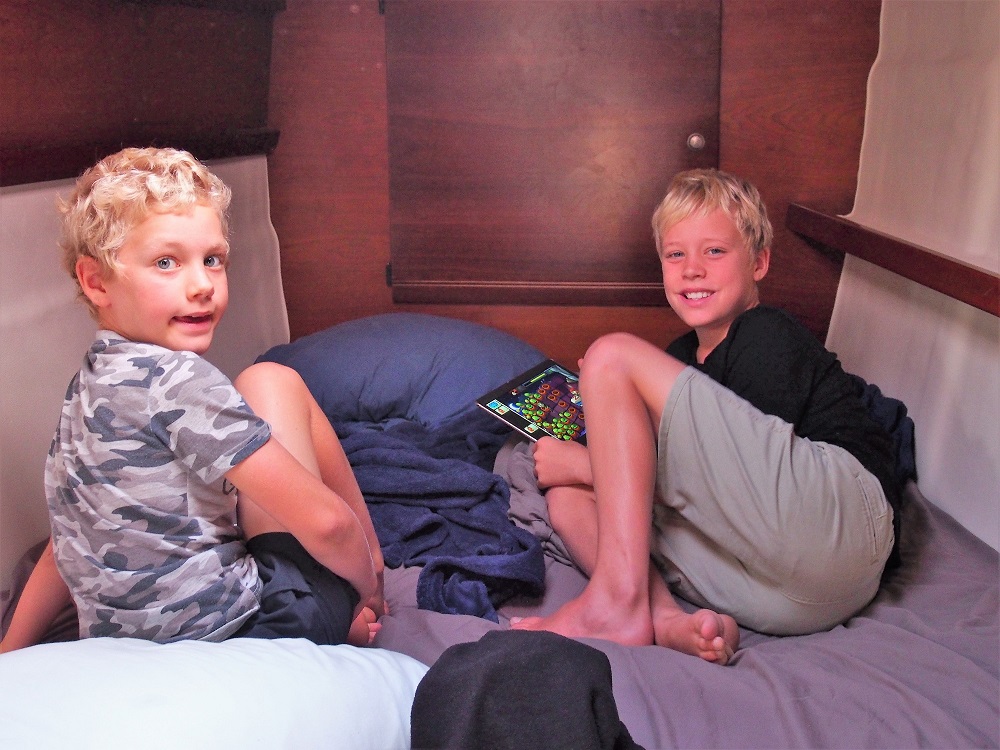
Boys on a boat
It’s hard to know when to go. We’re at Marsden Cove Marina where we were planning to check out from after finishing the Latest Repair. After a good week up north, including catching up with Jazz, Ian, Dusty and Ace, we were planning to leave for Fiji 17 or 18 May, but now both the Last Repair and the Weather look less than straightforward.
The Last Repair came about as David noticed that the anchor chain was looking very rusty.
“Let’s change the chain,” he said cheerfully. “We’ll get 10 mm chain instead of 12 mm, which will lighten up the boat. I’ll order it for Whangarei and we’ll just nip into the marina to get it, put it on and then check out and leave.” He smiled. “Easy peasy.”
David doing the Last Repair
But as we should know by now, no boat repair is ever easy.
We went upriver to central Whangarei and picked up 60 m of 10 mm chain and a new sea gypsy (the thing that the chain sits on as the anchor is winched up or down). After we’d gotten rid of the old 12 mm chain and left Whangarei again, we checked into Marsden Cove Marina to finish off the job and leave a day later.
And this is where trouble started. David set to work exchanging the gypsy only to discover that the clutch underneath was irreparably jammed. This meant that he had to order a new clutch, and spend a day trying to hack and drill off the old, bent clutch without damaging the shaft in the middle. Once the clutch was off, it appeared the shaft was only mildly damaged. Now, as the days and weather windows are passing, he has set to work putting the thing back together again.
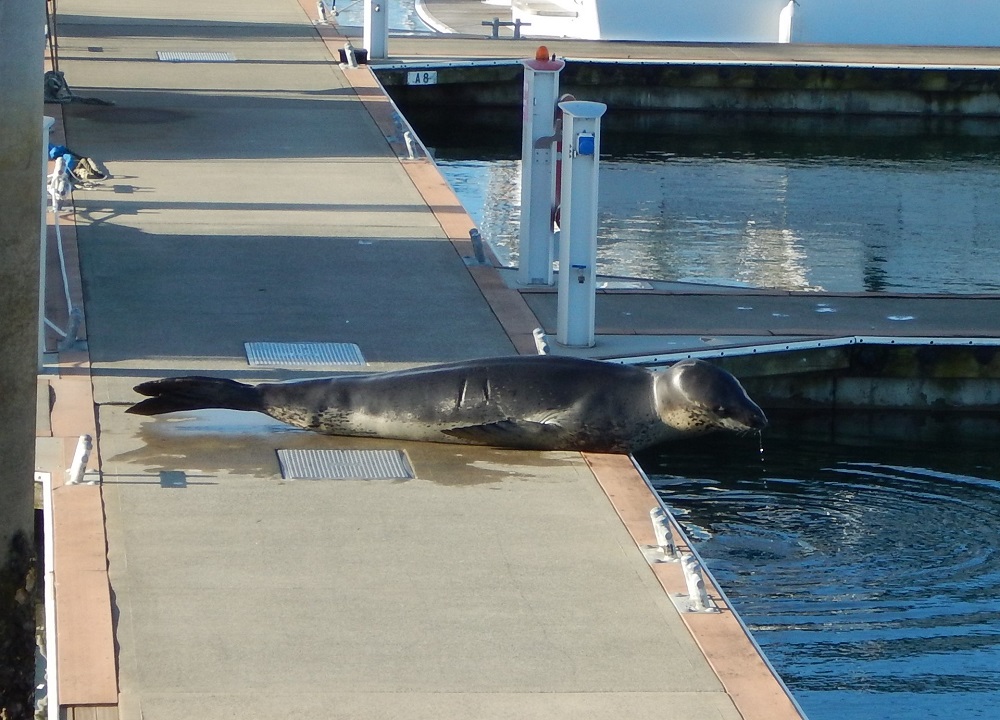
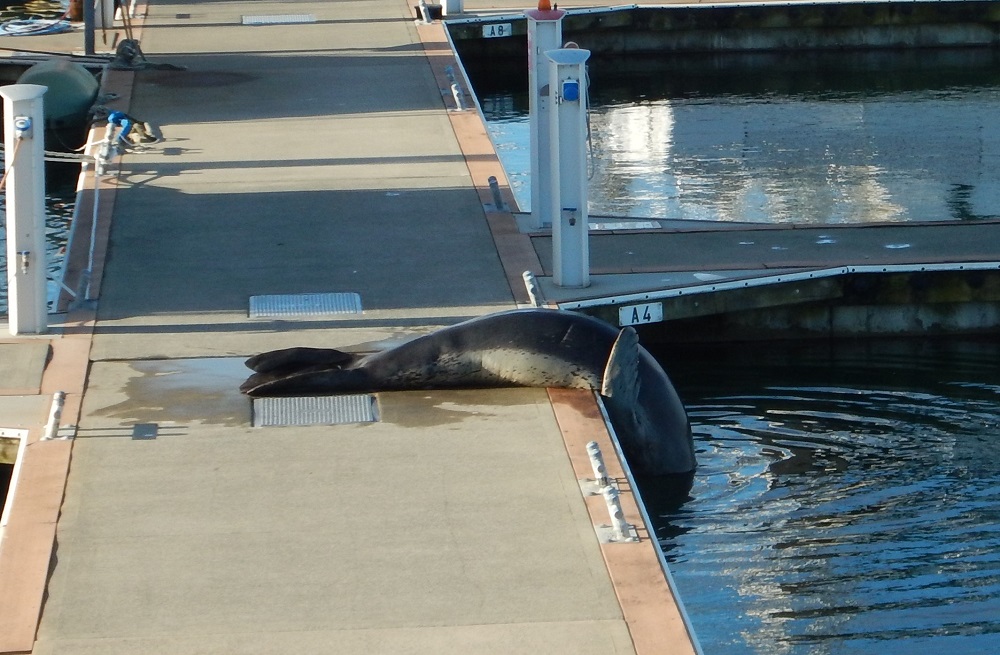
During the days, the kids and I have been wandering around trying to spot the enormous leopard seal that hangs out at the marina. Big signs everywhere warn people from approaching the seal.
Marino, a kid on a neighbouring boat has seen it many times over the two weeks he’s been here.
“It’s huge, at least 12 feet long,” he warns. “It hangs out on the pontoons, you see it everywhere. It lays in the sunshine during the day to heat up.”
The boat next to us had its inflatable dinghy punctured by the beast one recent night. Now the owner keeps the dinghy on the dock.
“It was scary,” he recounts. “One night as I was going to the toilet it was lying straight across the path. You’re not supposed to approach it, and I’d seen what it had done to my dinghy. But I had to get to the shore…”
“What did you go?”
Poor man. Bursting bladder, heinous beast half-hidden in the darkness, blocking the way to the toilet block, baring its fangs as he gingerly steps off his boat, roaring at him as he comes nearer. Enough to make you pee your pants. He ended up fumbling in the dark, attaching his water hose two feet away from the monster, eventually succeeding in scaring it away by hosing it down.
As we hear more stories about the seal it grows in our imagination, and the day before when David lowered the dinghy to go get gasoline at the fuel dock I nervously stepped onboard, ready to fight the behemoth should it attack us en route. But we finished our dinghy mission without a sighting and quickly hoisted the inflatable out of reach as soon as we got back.
Finally, on this sunny afternoon on our way back from the beach we spot the seal. There she is, lying prostrate on pontoon ‘A’, sunning herself. She’s not quite the 12-foot reported giant; we estimate her to be more like 8 feet. But still a large animal. While we watch from a safe distance she rolls and sighs, grunts and puffs. Once she’s had enough of the sun she sticks her head into the water as if to scout the fish life, and then after a couple of minutes her body follows, slowly gliding into the dark water like a giant slug.
Warming up in the sun
Upon returning to the boat I send a photo of the seal to the good folk at http://www.leopardseals.org/, who almost immediately confirm that we’ve spotted Owha, the NZ resident leopard seal who roams around Northland. Normally found in Antarctica, leopard seals occasionally visit New Zealand, and this individual has been doing her solitary rounds here for some years now.
Slipping into the water like a large slug
Feeling like we’ve seen all the sights and availed ourselves of the amenities, surely it is time to leave Marsden Cove Marina behind?
I put the question to the skipper.
“I reckon we shouldn’t go to Fiji now,” David says. “We’d be sure to hit that convection zone, and both models are now agreeing that it is straight in our path. It’s a pity, because it’s looking like there’ll be much more energy around next week, so we will have to sit out some rain.”
I look over his shoulder. Next week’s weather screen is a sea of red, the NZ contours barely visible below what could be mistaken for a great splatter of blood, as if the weather gods are planning the sacrificial slaughter of a large animal in the heavens above.
“Besides,” he says. “I have one last repair that I would like to get done before we set off for Fiji…” He smiles. “We can go to Opua, do the Last Repair, and then leave for Fiji from there.”
And so we leave Owha the leopard seal behind, onward on our journey to do the Last Repair and wait for clear blue skies and clear blue screens.
Hoping for upcoming fair weather as we leave Marsden Cove
“If this isn’t good enough then I’m registering her in Canada,” David says, straightening up, hands on his lower back. “Or Belgium. Nowhere else has these stupid regulations.”
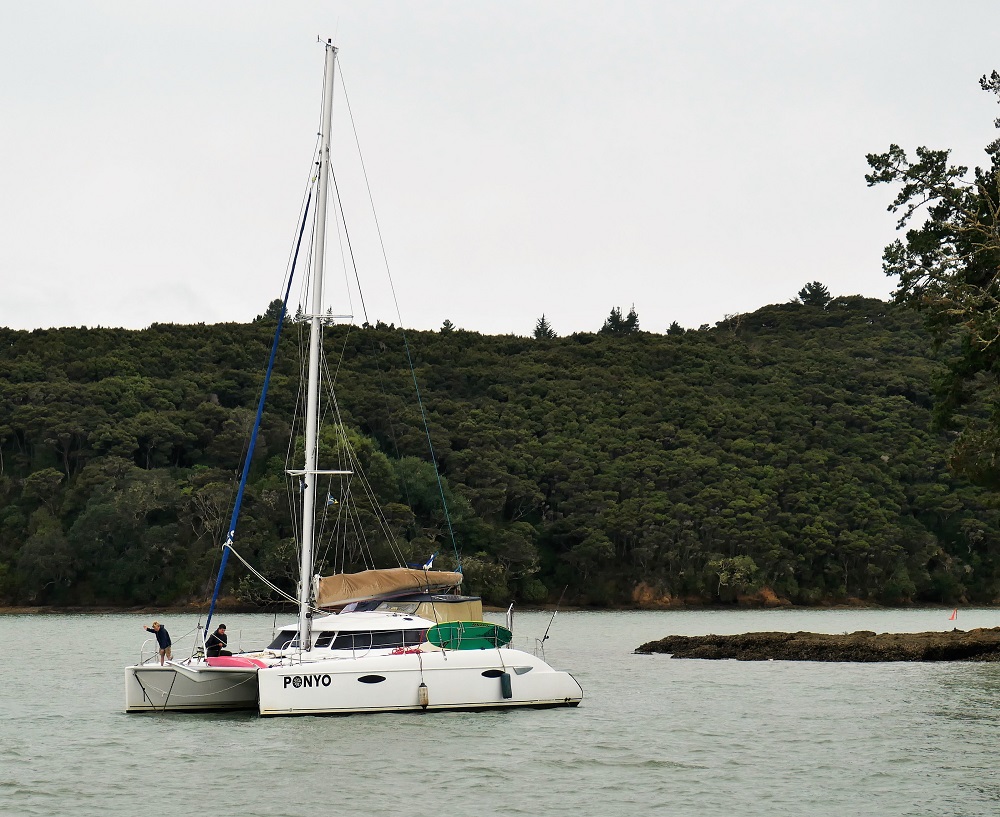
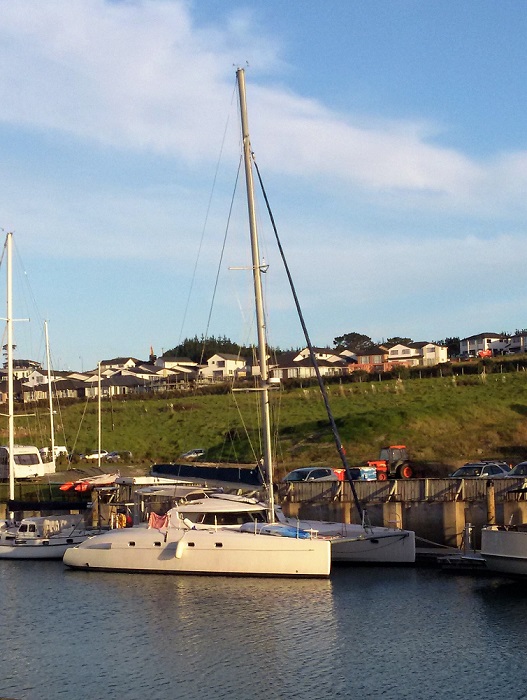
We’re in Fairway Bay Marina, where we’ve kept Bob the Cat, our boat, for the last year. Having rented out our house and quit our jobs, we moved onto the boat ten days ago. The plan is to sail north into the sunshine and then see where the wind blows us.
Bob the Cat in Fairway Bay Marina, north Auckland
However, since we moved onto the boat, David has been working nonstop on the boat. Sawing, screwing, sanding, securing, sweating, swearing – anything beginning with an ‘s’, really, and some drilling to boot.
Getting ready to leave New Zealand has proven a big job.
First, we have to pass the Yachting New Zealand Category 1 safety regulations. This means we must satisfy the mandatory conditions deemed necessary for vessels heading offshore by Yachting NZ. As a New Zealand registered vessel, we are not allowed to leave the country without a certificate saying we’ve met the requirements. When clearing out, the certificate must not be more than a month old, so every time a New Zealand flagged boat leaves for the islands, it’s got to be recertified.
If it sounds a bit onerous it is because it is. The regulations involve a three-page-long list of mandatory safety equipment and satisfactory vessel condition, covering things like fire extinguishers, life jackets, knives, buckets, rigging, navigation equipment, spare rudders, bilge pumps, life buoys, etc., as well as the presence of bunks to sleep on, cooking equipment, toilets and holding tanks.
It is fair enough that they require us to be well equipped and prepared as it is the NZ military that will have to come rescue us should we get in trouble on the way to Fiji. But the list is surprisingly long, and despite us safely having crossed the Pacific, the world’s largest ocean, in 2015, successfully carrying the family 12,000 odd nautical miles, we find that David needs to do some shopping. A lot of shopping.
He buys inflatable buoys, new fire extinguishers, and a storm jib. New flares, smoke alarms, life rings. Emergency beacons, sea anchor, lanyards. He has the life raft retested and repackaged. He gets a fourth reef put in the mainsail and a repair done to the genoa. He installs jacklines from the cockpit to the mast, and further to the bow. He works till midnight, when he finally rolls into bed, covered in sawdust, white paint, and black gunk.
An inspector has to come onboard to check out that we satisfy the requirements, and he finally arrives on the morning of Day 9. He walks through the boat asking questions, checks the rigging, the sails, the bilges, the galley, the heads, the cupboards, the flares, the engine compartment, the deck. He ticks his long list and quizzes us about experience and plans. It takes three hours to cover it all, but finally, he declares us good to go, pending a few additions. We need a sign in the galley saying: ‘Turn gas off at bottle’, and we need to write ‘Bob the Cat’ on our buckets.
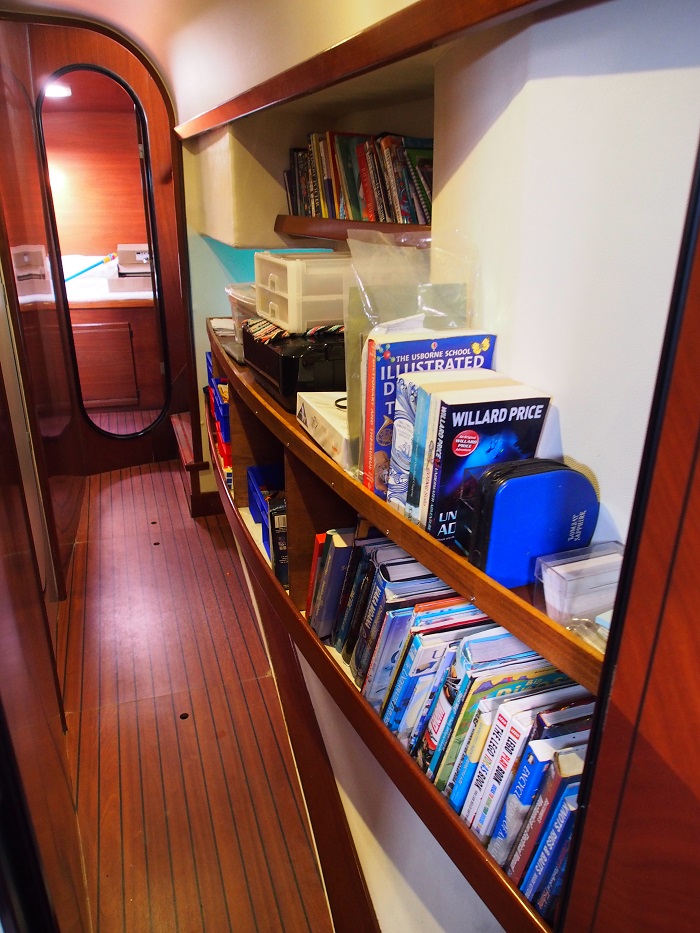
In addition to all the safety gear, David has been implementing a score of other improvements. New batteries replacing the old tired ones. A new 65-litre 12-volt freezer. A small washing machine installed in the front starboard head. A starboard shelving system where we can store all the home-schooling equipment, the books, and the lego. We call it ‘the library’.
The library.
The messiest job was without a doubt reattaching the windows in the saloon. He had to break the old sealant, edge off the curved plexiglass, clean off any residue of fixant and then reattach it using the most incredibly gooey fixative. The old sealant is powdery and jet black, leaving black small black bits scattered all over the boat, black dust in every crevice, and black footprints covering the deck.
Not that all the ‘s’ jobs are David’s. I’ve been busy stowing, sorting, storing, shopping, sweeping, stressing, and sighing. Stowing all the gear we brought with us into the boat storage spaces, attempting a logical order so that we have a chance of retrieving stuff when we need it. Sorting through games, toys, clothes, medicines, ensuring that the accessibility of items matches their likelihood of being needed.
Shopping for supplies to take us through the remote Pacific islands we’re heading for, places where muesli, marmite, and mayo won’t be easy to get. After three massive shopping trips involving bursting trolleys and disbelieving check-out ladies, the provisioning is all done. Or maybe overdone – I tend to over-provision as if by stocking up till bursting I can reduce future uncertainties.
These kids won’t starve.
It’s weird, really. When provisioning, a switch inside of me flicks, and I start the hoarding. Extreme, almost compulsive hoarding – frequenting any shop I can get to, sniffing up and down aisles, grabbing any and all items that my not insignificant culinary imagination can see a potential use for. I’m sure it is some sort of normally dormant primaeval instinct, which erupts once I know that my last day in a well-stocked supermarket is nigh.
So, by the time I finish provisioning, we’re bursting. All under- and behind-seat storage is jam-packed with tins, jars, and packets which fall out whenever anything is opened. We have tinned tomatoes, sweetcorn, beans, peas, beetroot, coconut milk, and fruit in syrup. We have dried beans, chickpeas, and five types of lentils. We have rice, pasta, flour, couscous, polenta, milk powder. Jars of olives, sundried tomatoes, mustard, jam, mayonnaise. Flour and raisins, olive oil and wine, honey and baking powder. Our fresh produce fills the fridge to the rim, including feta and chorizo to last us months.
Full under-seat storage.
We have enough food to cover the needs of a twenty people overwintering in Antarctica or expeditioning into the Amazonian interior. We have enough to cater for a UN assembly or the upcoming royal wedding. There is no chance my family will starve in the next six months.
It’s not just with food that we’ve possibly overdone it. Leaving from New Zealand allows us to bring all our stuff, so the boat is now stuffed with guitars, kite gear, games, surfboards, lego, books, clothes, and linen. Add to that a ton of water and 500 litres of diesel, and all the extra weight is definitely showing: Bob the Cat is bulging, obese, lying so low in the water she is barely afloat.
Apart from sorting and shopping, I’ve been cleaning. Mopping up the saturated sawdust clinging to all surfaces in the cockpit centre locker. Brushing up black powder from the window change. Wiping off the endless smudged footprints that appear as if out of nowhere on the white deck.
Shore life is always dirty, and boat-based repairs or improvements are even worse. Every time the kids come aboard they bring with them sand, dirt, leaves, twigs, and pebbles. Everywhere David touches he leaves black handprints. To keep the boat looking fine for the Category 1 Inspection (first impressions and all), I scrub the decks on hands and knees for hours, only to straighten up and spot a new set of small black footprints back where I began.
Black feet aside, the kids seem to have settled straight in. I was a bit worried they would miss school friends and routines, especially as they’ve been sitting in Fairway Bay Marina with both parents busy fixing, cleaning, storing, provisioning. But they seem OK – I asked Matias how he felt about being on the boat and he said, ‘I love it.’ Just as well that they are the kind of children that look forward rather than back.
Playing with friends on the beach.
Not that we haven’t taken them out – apart from countless supermarket visits where they’ve been in charge of steering dangerously overloaded trolleys through the aisles, we’ve visited local beaches and swimming pools. It has also helped that there have been friends around. We’ve been catching up with Nico and Sascha and their children Khai and Arix, who used to go to school with Matias and Lukas. They have been living on a yacht in Gulf Harbour Marina for a couple of months, and the boys were thrilled to catch up with them
Heading north into the fog.
.
On day 11 we finally leave Fairway Bay Marina, gently gliding over glassy water through the early-morning fog. We’re on our way – heading north, Whangarei first, and then when weather permits to Fiji.
We’ve moved onto what will be our home for a year. A lovely 46 foot catamaran, in Martinique, French Caribbean, which we plan to sail back to New Zealand. For an unsighted online purchase, the boat is surprisingly fine; there is work to do, but no more than we expected.
The kids have been awesome, entertaining themselves as we rush around stocking up on essentials, like linen, food, fresh water, mozzie lotion, tools, cooking utensils, and anything else one needs to turn a bare boat into a family home. It is clear the endless shopping was not quite what the children expected from the year away (‘Are we going to go shopping again today, Mummy? When can we go sailing?’ ), but they are patient, and haven’t expressed any disappointment so far. Mind you, there is plenty to see, on land. We drove to the capital city last week, and found the main road flooded, all traffic barred. On our way back we took a back road along a river, and when rounding a corner, we drove straight into a group of red crabs crossing the road, killing a couple as we desperately hit the brakes.
We’ve had some fun on the water too – shops are closed on Sundays, after all, and today was a public holiday. So we’ve been for a couple of beach trips. Today we took the boat around the corner to a beach for a snorkel, celebrating her renaming. Gone is ‘Alize V’, now it is our boat: ‘Bob the Cat’ in memory of Bob, our cat, left behind in Raglan. We had a great time, the kids frolicking in the water, until Matias touched a rock and started screaming that his hands were on fire. We think he might have touched a stinging red sponge, so rushed him back to the boat for vinegar soaking and painkillers, and had to spoon feed him dinner, as he couldn’t use his hands at all. Useful lesson learnt: don’t ever touch any rocks when snorkelling.
The water is amazing, the best way to cool down, but never too chilly. It is incredibly hot here, 30 degrees, and we are covered in sweat pretty much all the time. The heat is overwhelming below deck, we’ll need to install fans in all the cabins, otherwise we’ll never get a good night’s sleep. We sleep with all hatches open, waking up frequently to jump out of bed to close them all when a rain shower passes over. All modesty is gone and we’re stripped down to underwear or swimwear round the clock – we look a bit out of place with our pasty white bodies, covered in sunscreen, sweaty English speaking ghosts on an island of tanned cool Frenchies…
The mosquitoes are fierce, and apparently several boaties here have caught chikungunya, a nasty mosquito borne disease that lasts for many weeks. So we were glad to move out of the marina onto a mooring yesterday; the further from land, the fever mosquitoes. We still get all the sounds from land, last night a calypso band played until the early hours of the morning, keeping me company as I opened and closed hatches throughout the night.
It’s a big change being here, and a whole year of adventure to go…









 SV Bob The Cat