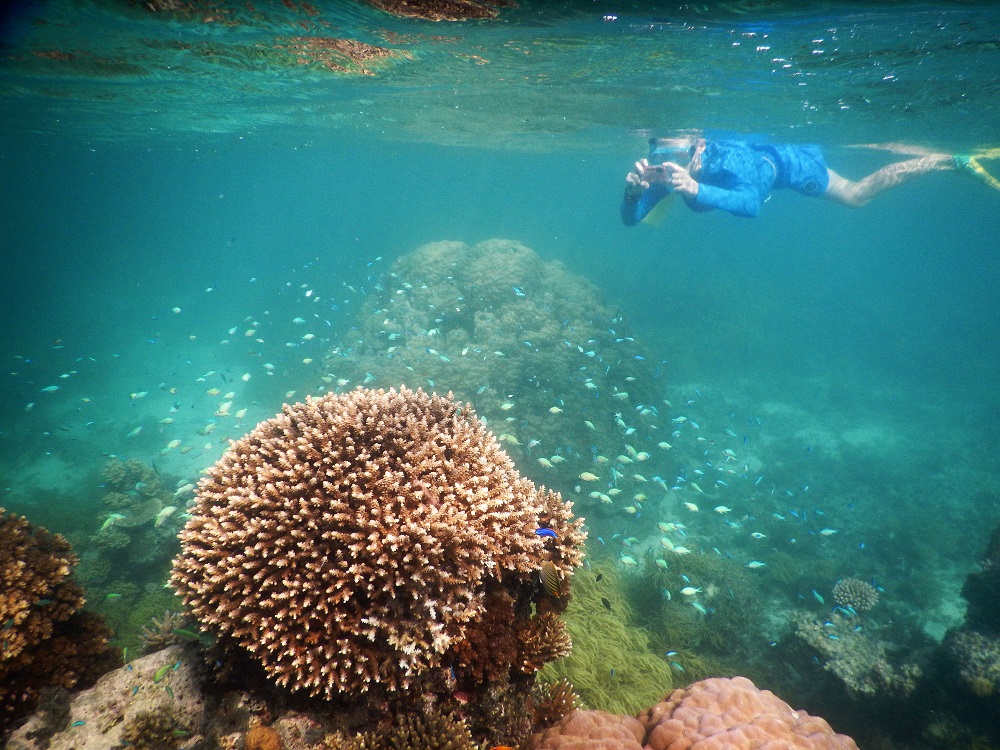
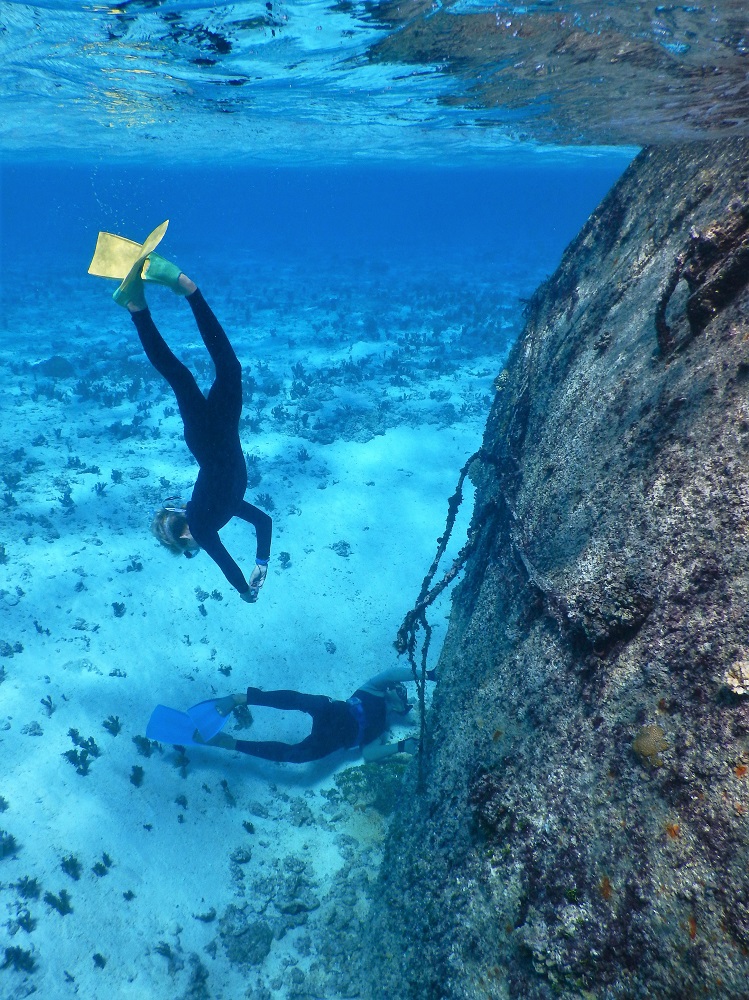
Three days ago I was in the Fiji Bay of Islands. I saw crazy islands, two octopus, cool underwater creatures and amazing plants as well as awesome inlets.
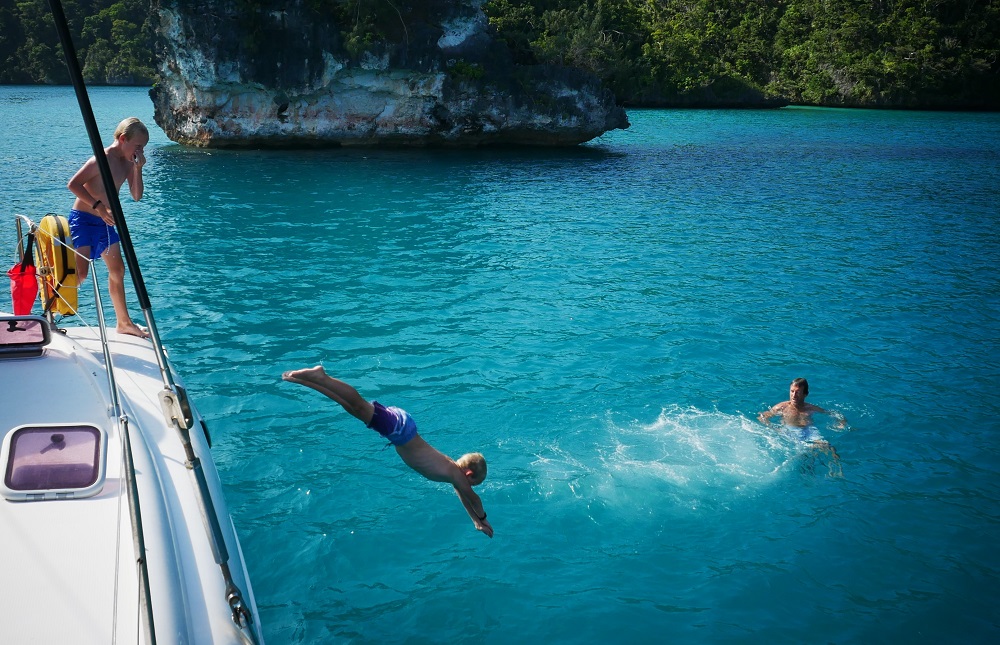
Me diving.
But first I need to tell you the basic thing. It feels like you are a documentary person, getting to see crazy, amazing, beautiful things and places.
Just six days ago I did a night snorkel. As soon as I got in the water I began to feel cold. I tried to see something but I couldn’t because it was so dark! The only way to see was to look in the beam of the torch. When I looked away from the torch beam I began to feel scared. I also found that when I dived down I felt warmer!
Mr Pinky.
When I looked really closely at the coral I could see little tentacles waving like little arms. At night coral filter feed but in the day time they don’t. We also saw my old friend Kelt.
Kelt.
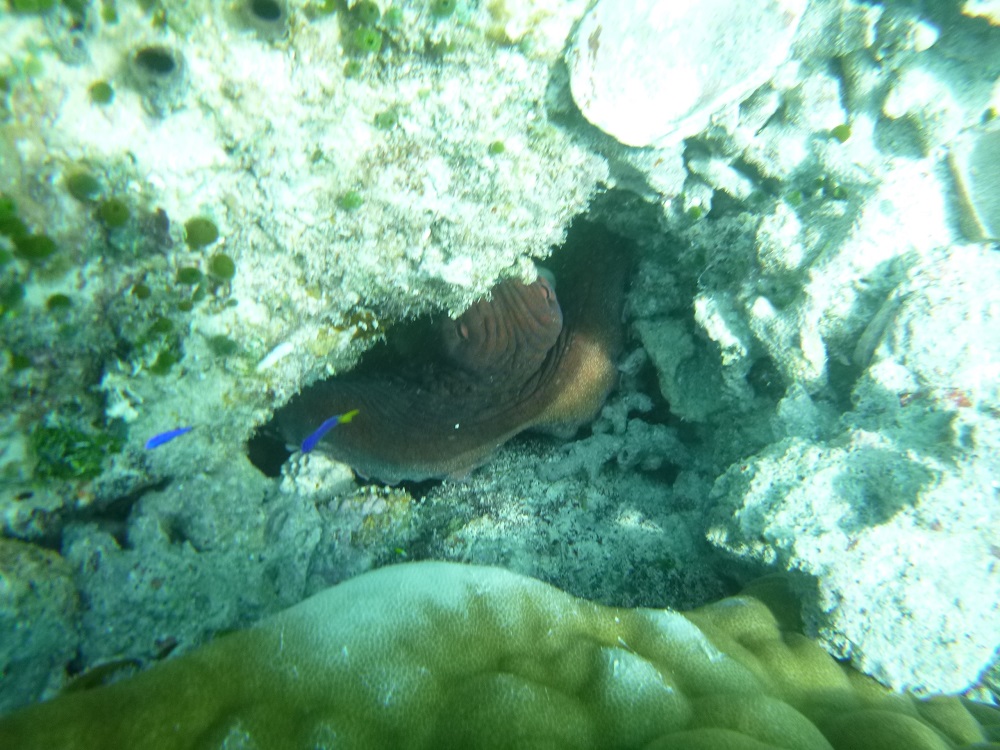
Kelt is the most camouflaging coolest octopus. He hides in a coral. When you come close he turns red-because he is angry that you are invading his house.
The Bay of Islands is one of the coolest places on earth.
“Arghh,” says David. “One pooed on me, look!” He points to a dark splatter on his white board shorts.
“Gross,” I squeal. “Urgh, wipe it off! I guess we’re sitting just under them. They’re like furry birds, with claws.”
“Or like binbag-wearing possums,” says David. “Hanging like flies caught in a spider web, all wrapped up.”
“And they look ridiculous when they fly, like surprised beavers suspended in the air. Look at the feet sticking out the back!”
We can ridicule, but shrill shrieks reverberate through the air, echoing in the tight bay. The trees on the hillside rustle and move, branches rebounding with lightening loads. Above us, the sky darkens prematurely as thousands of winged creatures take flight at once, leaving the safety of the trees, soaring to the skies, and scattering wide against the backdrop of the setting sun. The air is heavy with ammonia, a thick smell of crowded animals that burns the inside of our nostrils.
Wedged in between the mangrove roots, the dinghy cannot move, and we sit craning our necks just under the steep, forested hillside, taking in the sky as it comes alive with dark, menacing shapes. Never before have we been so close to so many large animals moving at once. It is like a huge colony of roosting birds all taking flight from the same tree, at the same time.
It is dusk, and we’re in the Bay of Islands in Fiji, which is located on the north-western side of Vanua Balavu, a large island in the northern Lau Group. We’re watching the local fruit bats taking off for a night of festive foraging.
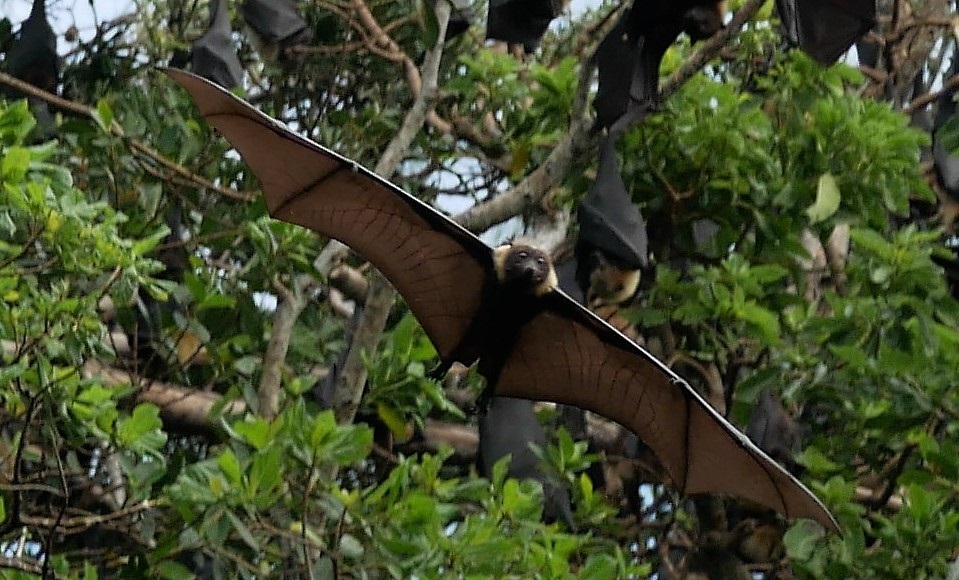
Menacing, winged possums…… looking stunned, feet hanging pointlessly out the back.
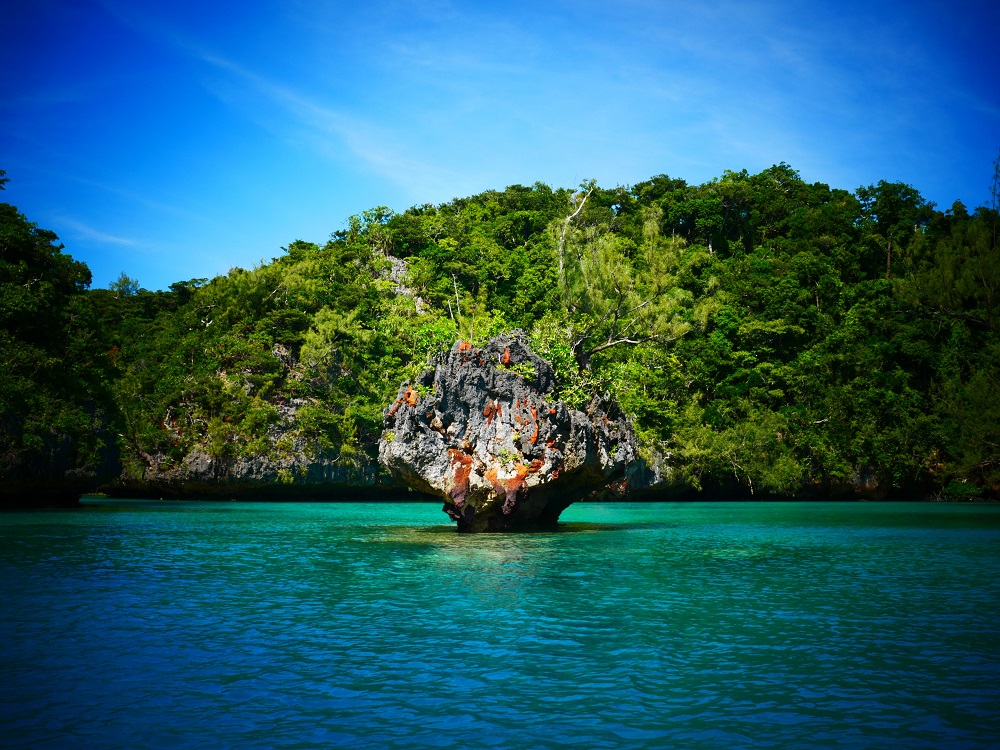
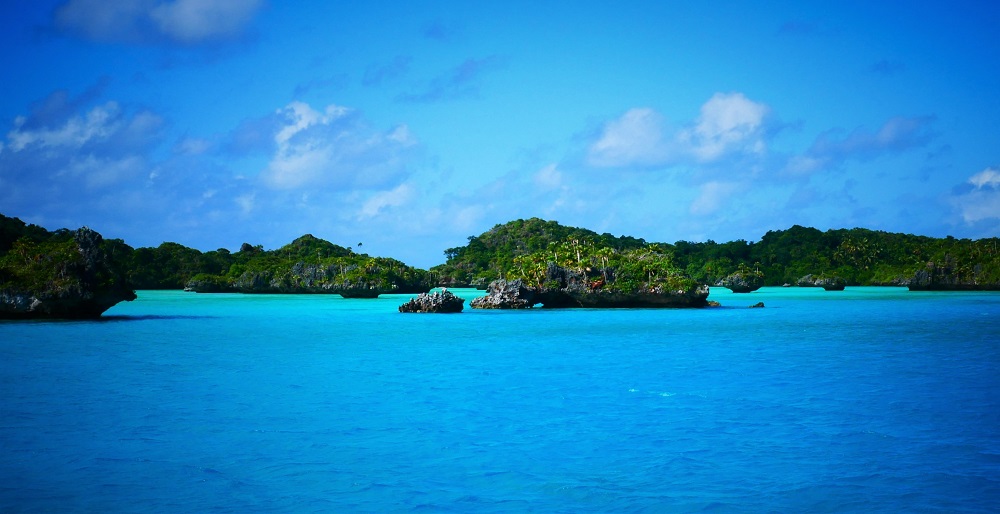
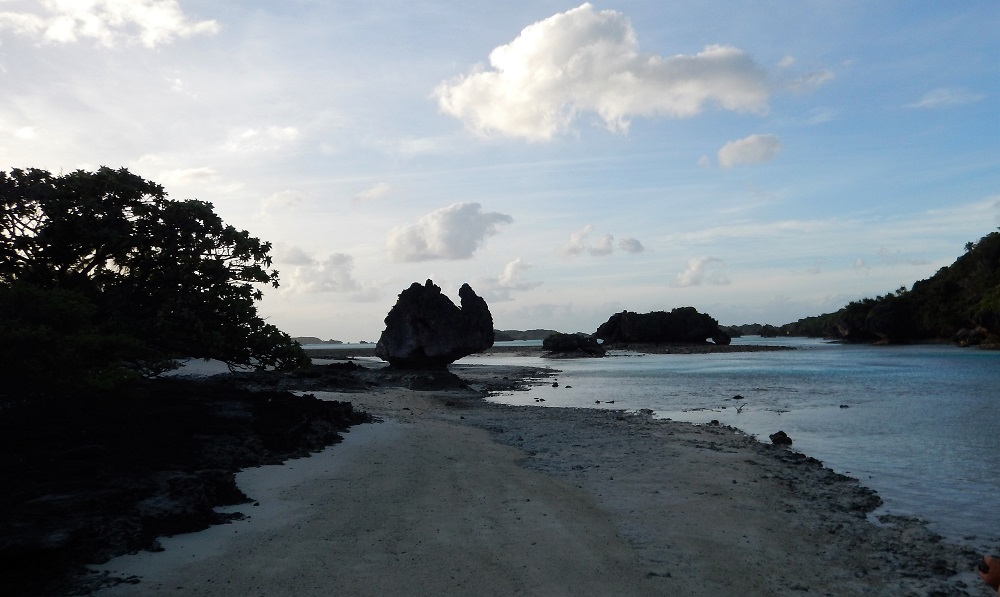
As the name suggests, the area is full of islands – uplifted limestone reef islets and larger, volcanic outcrops. It is spectacular scenery. Dramatic vertical rock faces surrounded by bush, overlooking crystal-clear bays, the water changing from deep green depths to aquamarine shallows. The imposing limestone walls and islands are dark grey, severe and full of jagged edges and sharp outcrops, the sort of landscape that will wreck ships, puncture inflatables, and cut your feet to shreds if you venture ashore.
Dramatic islets against a backdrop of forested hillside.Bob in Bat Bay.
There are hundreds of islands here of all sizes and we explore for days on end, slowly making our way along the shoreline, discovering shallow passages leading to hidden turquoise swimming holes, sandy-bottomed inlets bordered by vertical green walls, overhanging vegetation touching the water. Crevices, caves and fragile limestone bridges are everywhere, hiding dark secrets and screeching animals. It’s a fairy-tale landscape, heavy and lush, and far from the tropical beachy feel of Fulaga. Here, rather than superyachts, one expects headhunters, King Kongs or similarly sinister creatures to appear at the top of each hilltop – surely such beauty must come at a price.
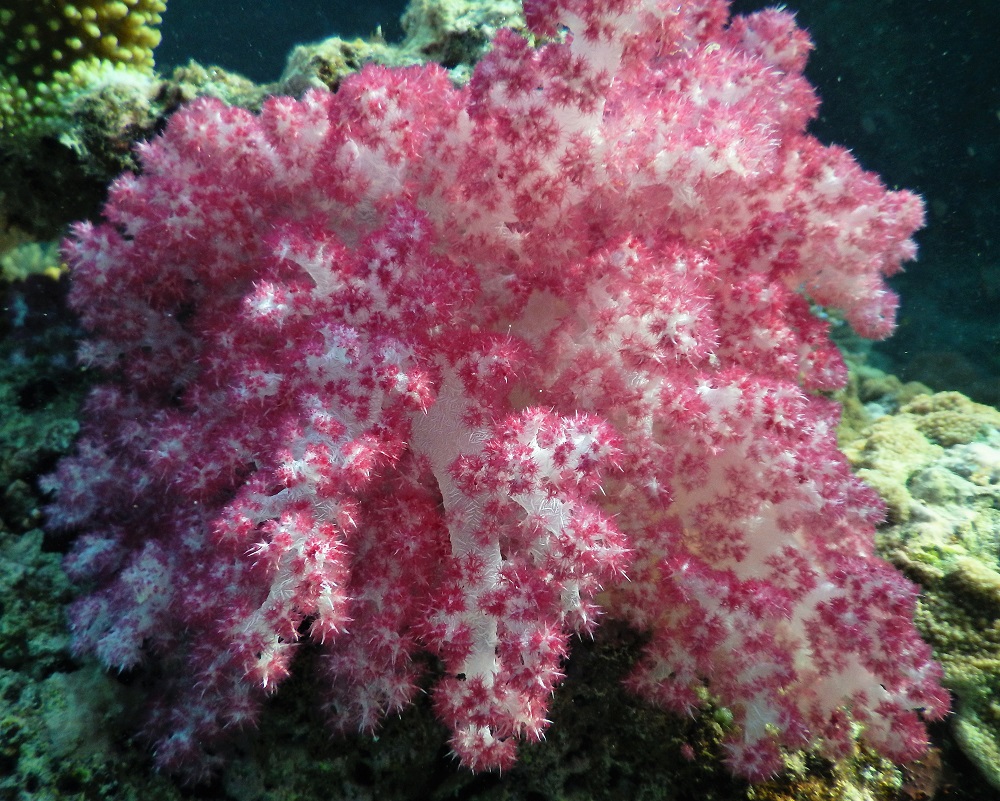
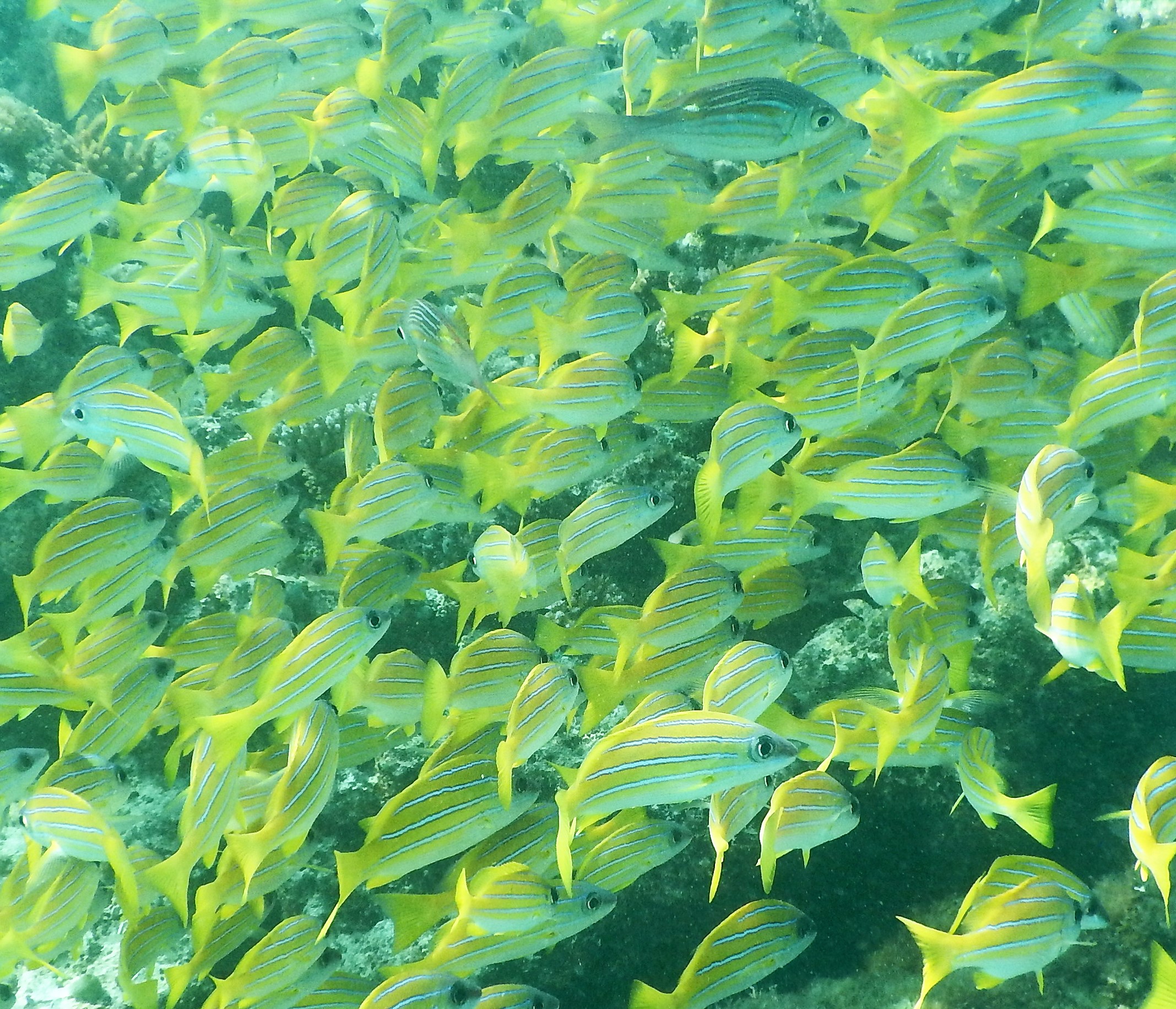
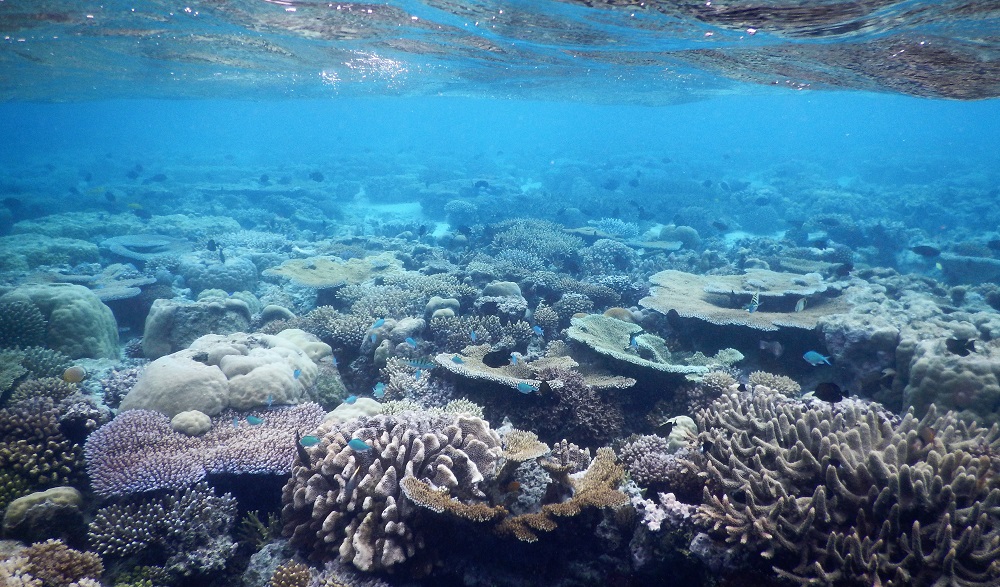
Underwater is beautiful too. Shallow rocky outcrops are home to coral reefs teeming with fish, turtles and baby blacktip reef sharks. Soft, colourful corals sway gently in the underwater currents. Octopi hide in numerous crevices, pretending to be rocks as we approach only to turn a deep dark red colour just before sliding back into their hole once they know we’ve spotted them.
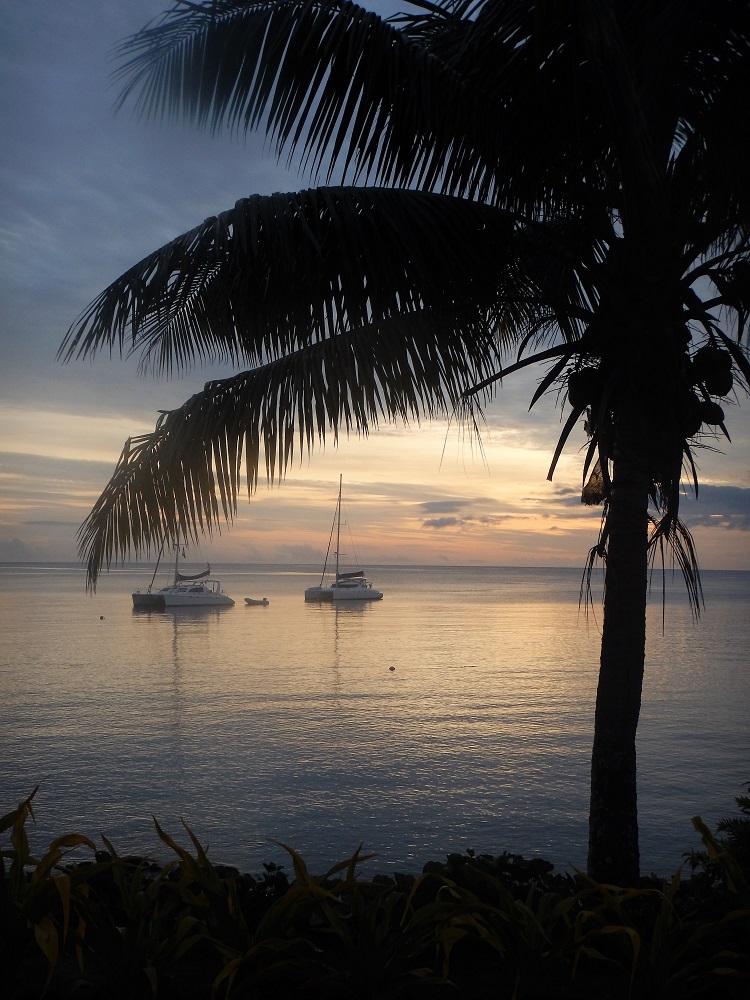
It is peaceful here. Although in the more accessible part of the Lau Group, we at first share the anchorages with just a couple of boats, and later we are on our own for a few days before a few more yachts arrive.
So we paddleboard and kayak and swim, exploring every nook and cranny, whooping with delight as we discover more hidden treasures, life somehow feeling extra exciting against such a breathtaking backdrop.
Lagoons leading into more lagoons, with tiny, sharp islands everywhere.
The kids are reading Lord of the Rings and are deep into games wherein Matias is a stubby, brutish, heavyset dwarf named Thorin and Lukas a benevolent, charismatic Elf called Thamior. This odd pair travels together in far-flung mythical lands, retrieving treasures and fighting evil. The games are oddly fitting with the powerful scenery: one could easily imagine a longboat carrying Orc-fleeing Elves paddling by in search of a spider-ridden cave to hide in, the underwater part of which might just reveal the gleam of an ancient golden goblet with magical properties.
The fruit bats add to the sense of darkness within beauty. Although they’re cute there is nevertheless something a bit menacing about bats – perhaps it is the Dracula association of vampire bats, perhaps just their chilling combination of mammal, bird and insect features.
Strange fruit hanging…
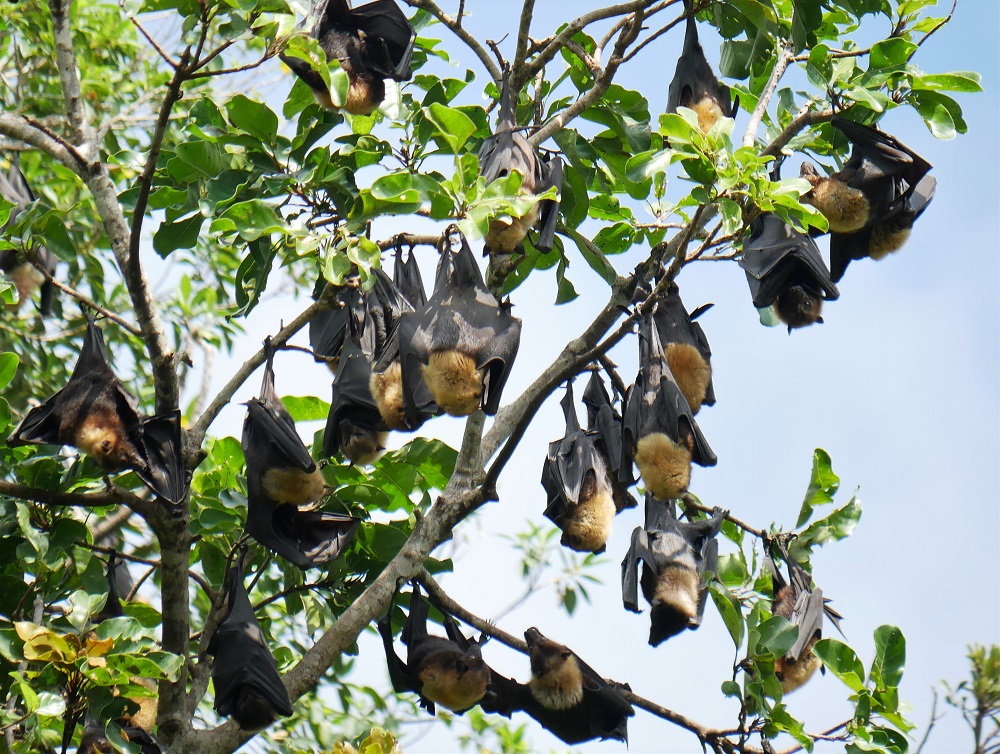
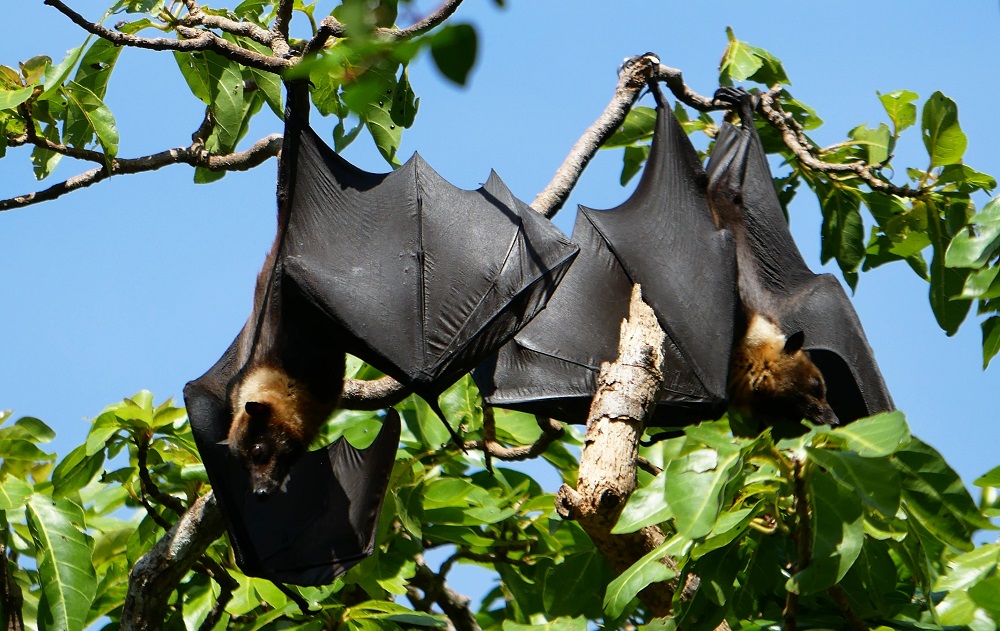
Their sleeping spot is not far from where we’re anchored, a hillside where black plump shapes hang from every tree like sinister overripened fruit, the branches bending under the load. A heavy musky scent hangs in the still air, the smell of thousands of mammals crowding a small space. They stir from their slumber whenever we approach, screeching and scratching, their sleep cocoons opening and faces and claws emerging. They stretch their umbrella wings, the shiny fabric tightening over the finger spokes. Beady black eyes fix us suspiciously, their ears erect, alert, twitching at every sound we make.
When we stay, they get more agitated and some take off like parachuting possums, strange furry fox faces and portly tummies attached to bird-like wings, tiny clawed spider feet sticking inelegantly out at back. Some have tears and holes in the wings through which we can see the sky behind. They circle and chatter and land on another branch, folding their wings, and clumsily climb through the trees using their feet, like giant grasshoppers navigating twigs and branches. Once in a suitable spot, they let themselves fall heavily, head down, their shiny black blanket wings tucked tightly around them.
I love watching their interactions – they squabble and bicker, scratch and twitch, bare their teeth and snap at their neighbours. Most look utterly exhausted, heavy with fatigue, and we feel guilty for approaching during their sleep time.
A male, hanging on by one foot.Why are you disturbing us?Just need to fold my wings, then I’m ready to go back to sleep.
At dusk, the hillside brightens and the sky darkens as they take off in great swarms, squeaking bat cries resonating between the hills. They fly off in all directions, over hills and water, in search of fruit trees ripe for pillage. We’re not sure exactly where they find fruit in the quantities required to nourish such extensive numbers, but presumably, papaya is a staple.
Plump, furry flying possum.
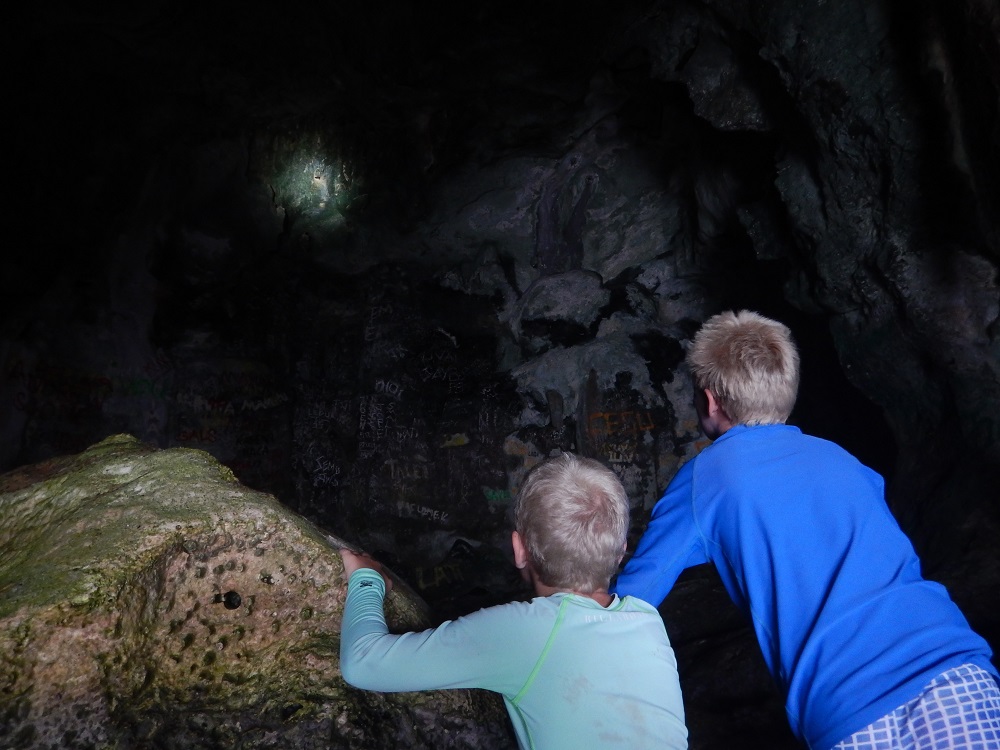
Inside a large, partially submerged cave we find microbats, who click and squeal as they echolocate in the darkness above us. Much smaller than the fruit bats they are difficult to make out and at first we think they are birds, but when we shine a torch we can make out the jagged edges of their wings.
Exploring dark caves.Microbats at the cave ceiling, illuminated by our torchlight.
In addition to bats and bays, there are a few beaches which we explore with other boats, lighting fires in the evening to cook damper around a stick or fish on a rack. As soon as night falls we are attacked by sandflies and have to flee back to the safety of our boats, anchored far enough from shore to prevent insects.
Damper on sticks over open fire.
After nine days in the Bay of Islands, we reluctantly leave. We’re low on cooking gas, and David is running out of beer, so we decide to go to Suva, Fiji’s capital, for a quick provision before heading to Kadavu south of Viti Levu.
We’ve had an incredible time in the Lau and are so happy we managed to get here – it is remote and different from anywhere else we’ve been, full of pleasant locals, amazing scenery and wonderful wildlife. One of Fiji’s hidden treasures, and how lucky we are to have seen it.
Hello there, says Mr Island Head. His body sank so he can’t walk anymore, but he can still see boats like ours.
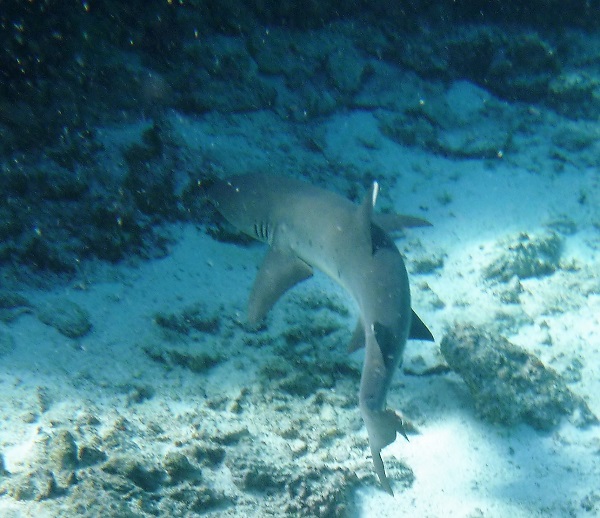
Shark.
While we were at Fulaga we saw about 100 sharks and they weren’t afraid of us at all.
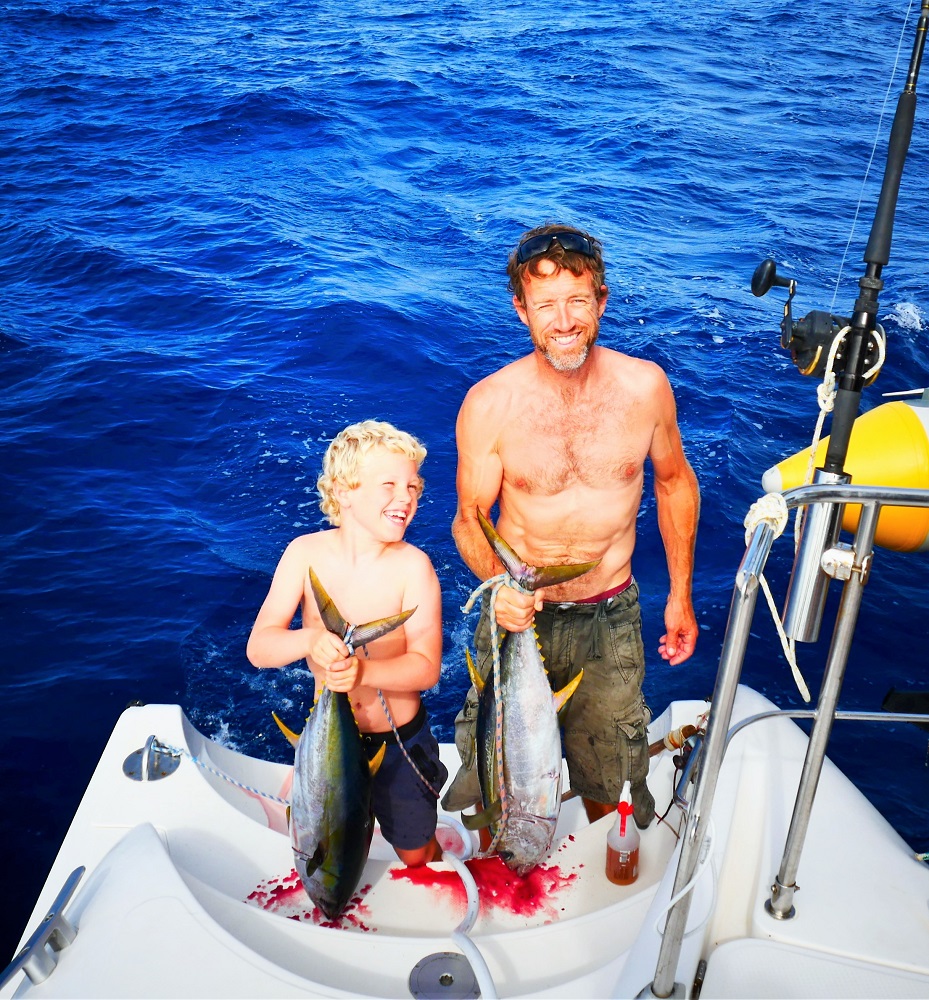
We got so many fish a few days ago, we got a wahoo, three dog tooth tuna and two yellow fin tunas.
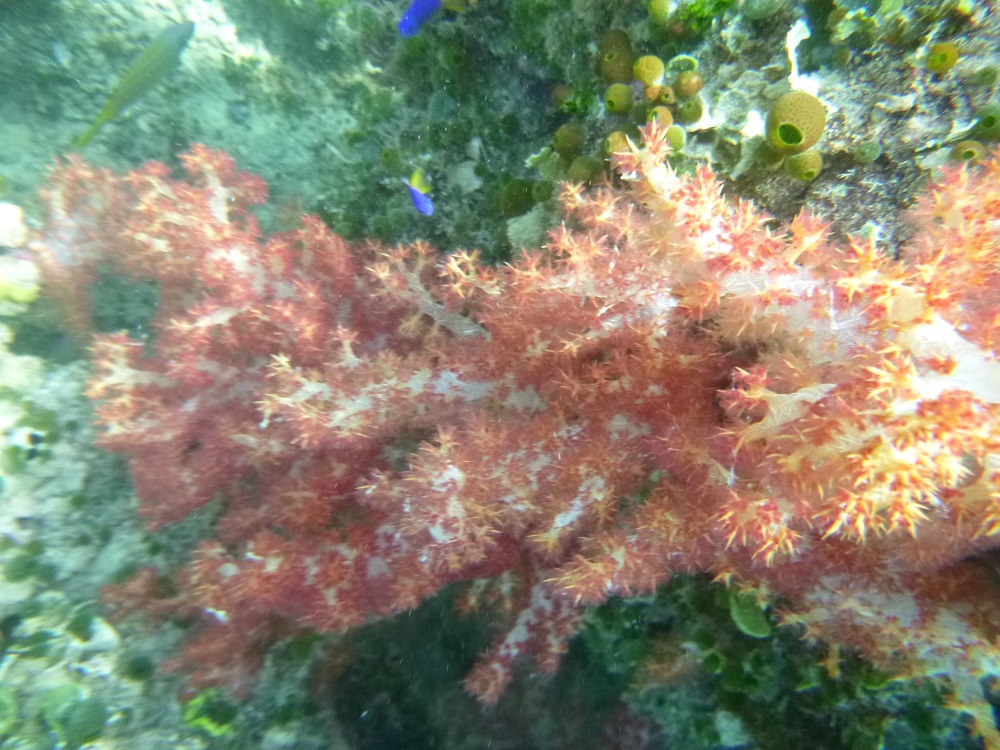
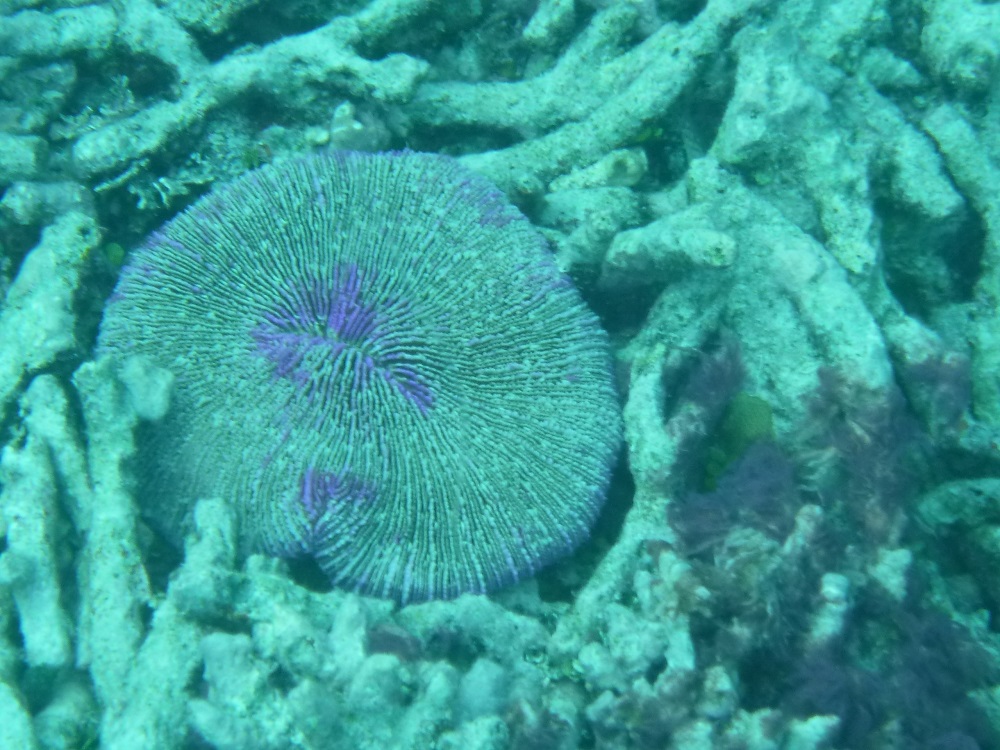
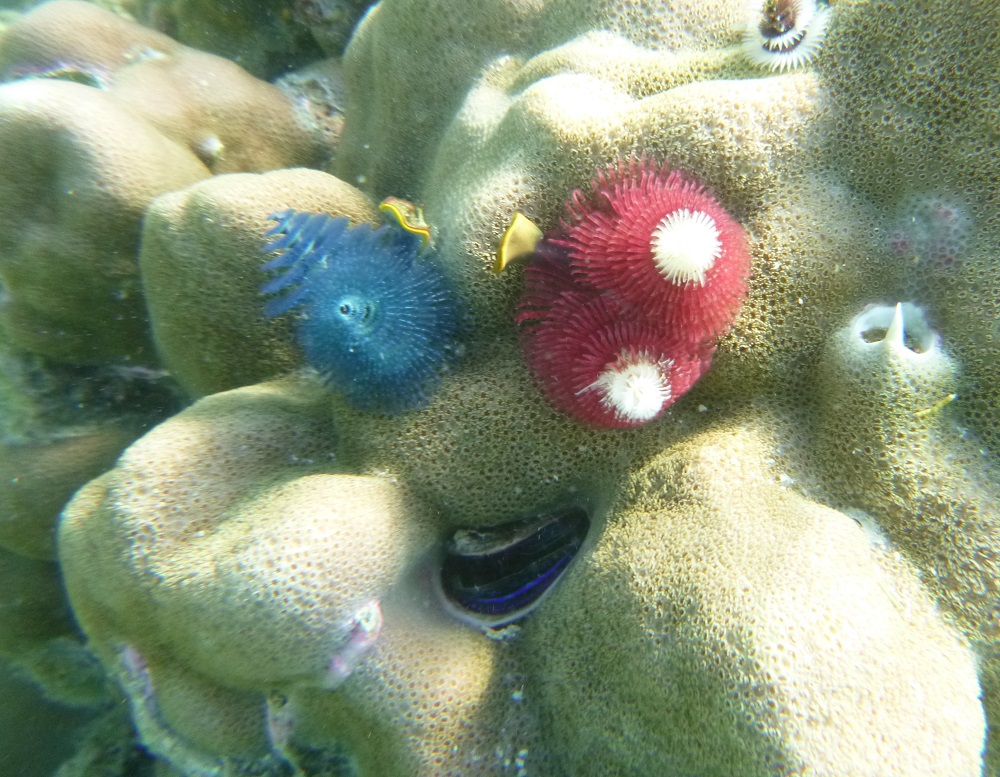
When we went snorkelling we saw mushroom coral, tree coral and many amazing more.
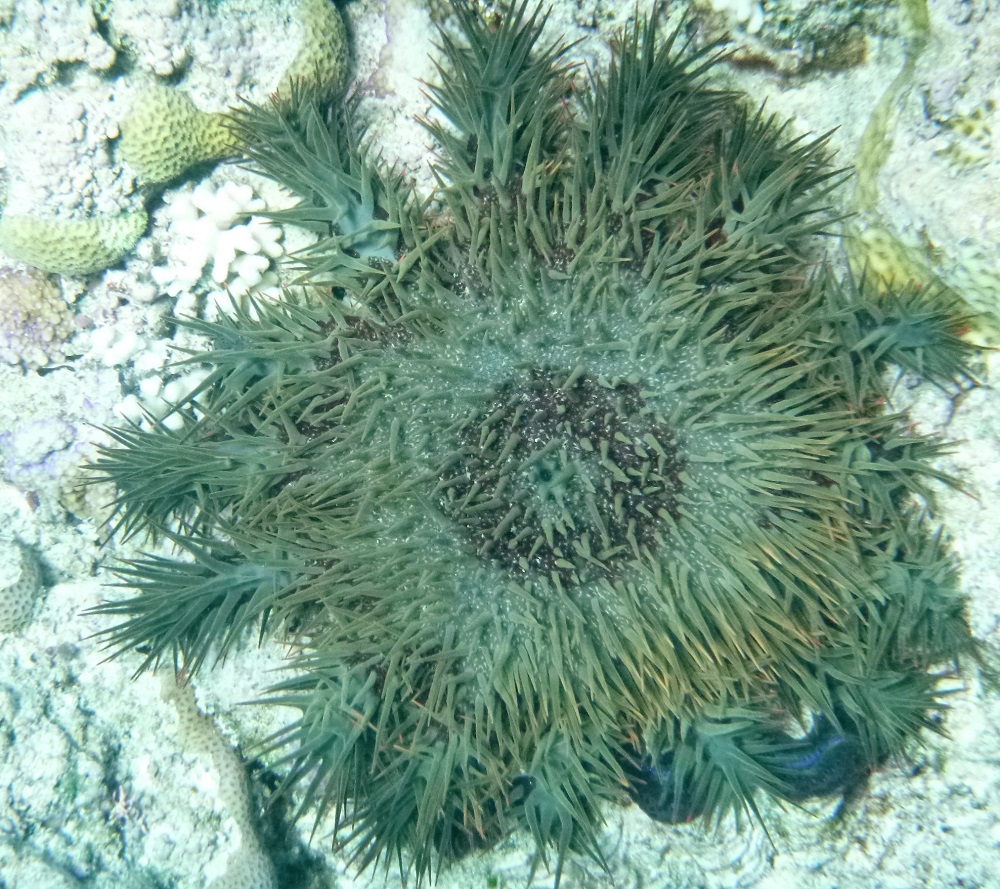
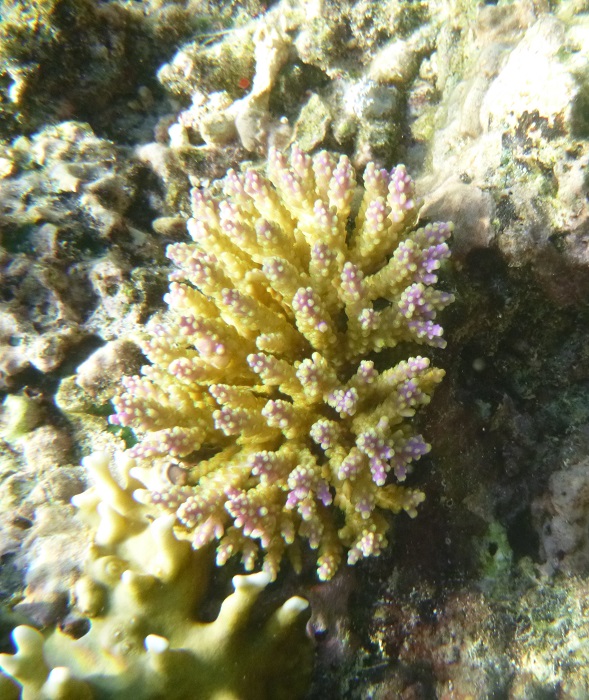
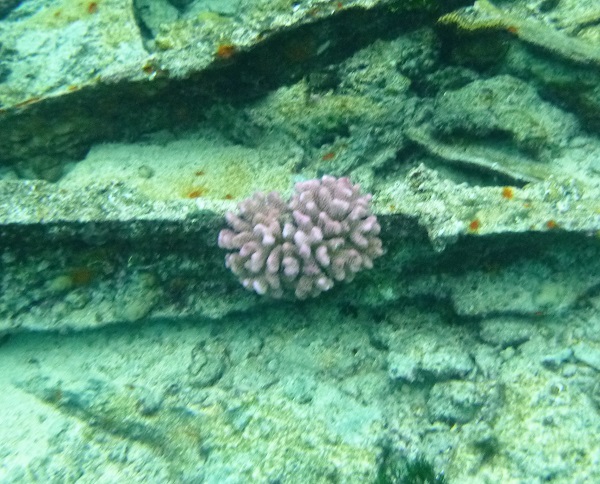
Weird soft pink coral.Crown of thorns eat coral.Mushroom coral.
On shore we got so many veges and then suddenly one of them was alive! He ran away, and it took a few days to catch him, and here he is, Mr Eggplant Elf!
Mr Eggplant Elf.
Now we are at Fiji Bay of Islands and we are in an awesome place to jump in, snorkel, and have fun. Every day we jump in the water and snorkel the bommie of coral right next to us. Right next to the bommie there is an octopus under a brain coral.
I feel miserable. My eyes ache like they have been subject to a sandfly attack. They are swollen, itchy and running. I’m sneezing again and again, my nose dripping with moisture. Clutching a tissue to my eyes, I hobble outside. “We have to get rid of it,” I sniffle, looking imploring at David.
“Okay, okay, we’ll eat it today,” he says emolliently. “But, it’s the only fruit we can get here, and you may just be getting a cold?”
I shake my head vehemently. It’s the papaya, I know it.
I developed an allergy to papaya when travelling in Africa when 18. It started out innocently enough, with slightly itchy eyes after I’d eaten the fruit. But soon it developed into a full-on condition, where I would react with violent sneezing, and runny, itchy eyes even when a papaya was within 10 m of me, particularly in enclosed spaces. Ever since then, I’ve avoided the fruit, and haven’t had a problem.
But desperate times call for desperate measures, and because we’re dangerously low on fruit and vegetables, I foolishly agreed to take one onboard for the kids and David to eat.
We’re in Vanua Balavu, in the northern end of the Lau Group in Fiji. Our trip north from Fulaga was swift and brutal. With 20-25 knots of breeze we were flying along at 8-10 knots. The side-on swell slammed us relentlessly, and we had to put foam in the liquor cabinet to keep the bottles from crashing.
The fishing made up for the uncomfortable conditions, and we hauled in yellowfin tuna aplenty, giving fish to every village we passed and filling up the freezer and fridge to boot.
Just as well that we’re catching fish, because food-wise, we’re running a bit low. By now we’ve run out of anything fresh apart from one lone pumpkin which lies rusting in a special locker, and a couple of shrivelled lemons rapidly deteriorating in the fruit net. Long gone are even the most long-lived, carefully rationed vegetables. We’ve eaten the carrots, crunched through the cabbage, stewed or roasted the eggplants. Cucumbers and lettuce went within the first week, oranges and apples lasted two and a half weeks. Now, four weeks since we last stocked up, we have nothing fresh left.
In Vanua Balavu, we head straight to the largest village of Loma Loma in the hope that we can provision a bit. There are two small shops in the settlement. The supply boat has just been in, and as we enter the first shop, a small, blue building on the waterfront, on Saturday morning, the owner is busy opening cardboard boxes and shelving supplies. A quick scan of the shop reveals the basic staples available in all Fijian villages – Punja Breakfast Crackers, Maggi Chicken Noodles, jam, soap, shampoo, razors and sanitary products. Optimistically, I ask about vegetables, eggs, refrigerated goods. The proprietor just shakes his head sadly. There is a vegetable market, but only on Friday mornings – we’re a day late. There is a guy who bakes bread in town, but he’s run out of flour – the new supplies having only just gotten in on the boat. There are no refrigerated goods. There are eggs, but not in his shop. Try the other one.
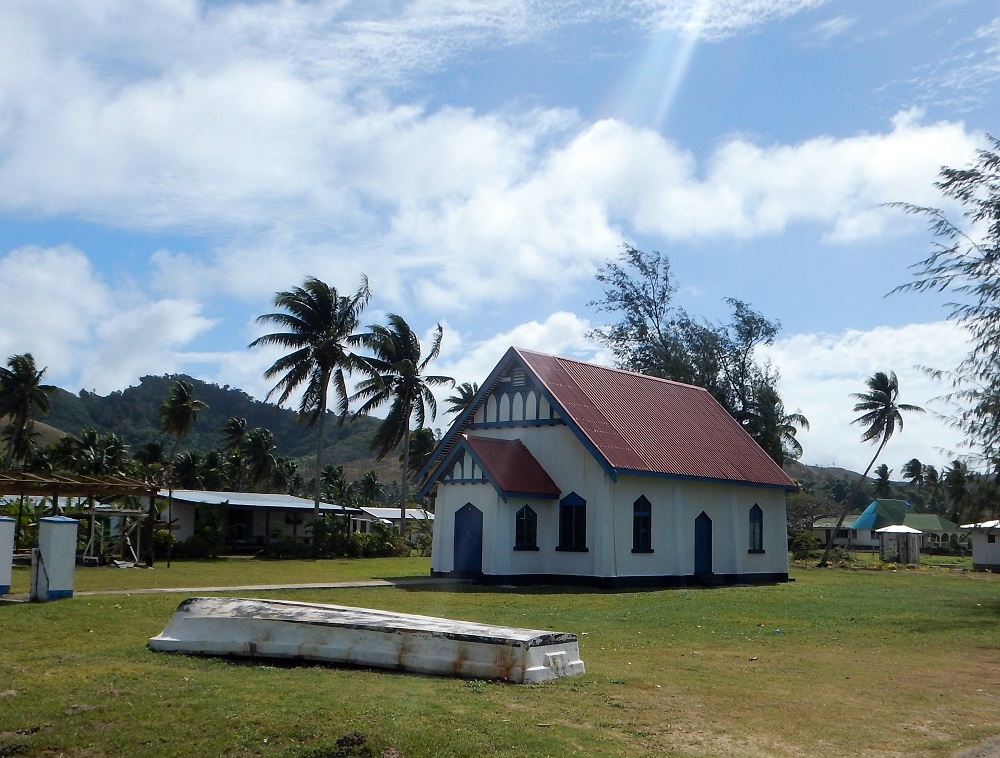
Nice church, but not a lot in the shop behind.
The second shop is behind the church. No signs mark it as a commercial establishment, but the veranda is clear of personal effects and when we squint we think we can see packets behind the slatted windows. We enter hesitantly.
It is indeed a shop, a dark room with a U-shaped counter backed by dusty shelves. An elderly Indian gentleman stands bent over an accounts book, entering columns of numbers. His wife is busy unpacking large, cardboard boxes.
“Bula,” I say, smiling politely. “Do you have any eggs?”
She wiggles her head, the ubiquitous Indian sign for ‘yes’, and points towards a box.
My heart lightens. Eggs. That is great.
Emboldened, I ask: “What about vegetables? Pumpkins, cabbage? Or even garlic?”
The man looks up. “No,” he answers sorrowfully, closing his booklet. “We ordered garlic, but it never arrived. But we have potatoes. And onions.”
“We also have peanut butter,” interjects his wife, holding out a jar of Kraft Smooth. “And cookies, and strawberry jam.” She gestures towards the shelf lined with brightly-coloured jars and plastic-wrapped cookies.
We settle for eggs, potatoes and some coconut cookies. In our desperation, we accept a papaya from the shop keeper’s garden, even though I know I’m allergic.
“Look on the bright side,” says David as we walk back to the dinghy. “If we had arrived yesterday, we could have gone to the market, and would have cabbages, but no eggs, because the boat wouldn’t have gotten in yet. At least we got eggs!”
I nod, and ponder our current situation of vegetable shortage, racking my brain for tasty recipes involving tinned and preserved goods.
The life of the cruising cook is one of uncertainty. Whilst in other situations, uncertainty may be the spice that makes life worth living, on a boat it most frequently leads to a spice shortage. Our food situation seems to be a repeated cycle of hoarding and bingeing, a bulimic cycle of deprivation alternated with plenty.
The problem is that when sailing, you don’t know exactly when your next stocking up opportunity is going to be. Will there be a market at the next island? Will there be a store where one can buy dry goods? Eggs? Will the villagers trade money or goods for local greens? Or will there be only coconuts, papaya, and possibly bananas?
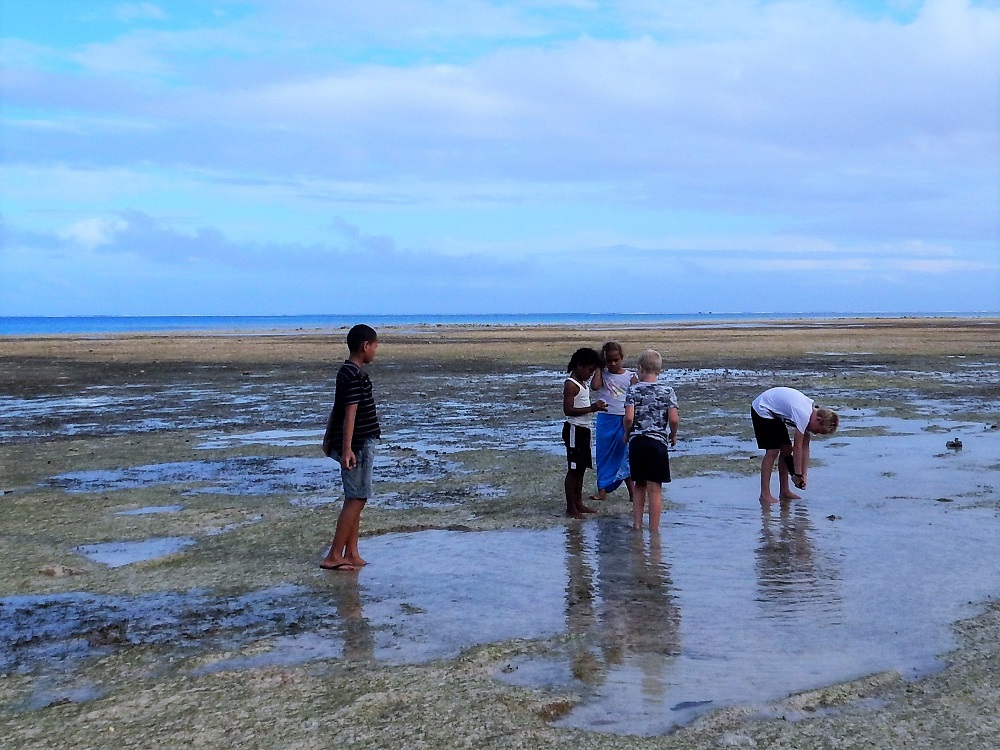
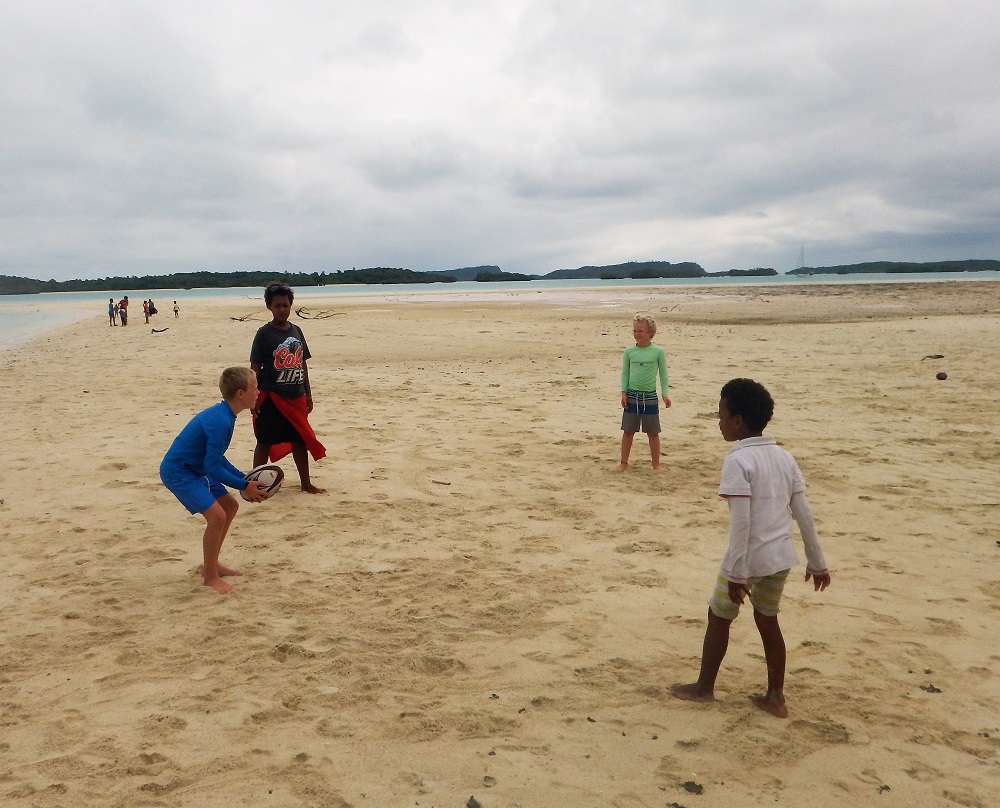
Scouring the tidal flats with local kids.
Now, as previously described, I have stocked up, and we won’t starve. But when you’re living on a boat you occasionally want a bit of indulgence, a few delightful morsels to brighten your afternoon.
Boat cooking is a perpetual fight to stave off the hungry hordes. Meals hold off mutiny, provide a break in the routines, nourish our tired bodies, worn out from snorkelling and trekking, playing and sailing. They become a focal point. “What’s for dinner tonight?” is often the first question my perpetually hungry kids ask in the morning and David is frequently forced to listen patiently for an hour or so while I work out the ever-diminishing choices.
Before we left New Zealand, we had a month where we had to be ready to leave at a moment’s notice in a good weather window. So, whenever I could, I hoarded. I stocked up on fresh meat, vegetables, dairy at the nearest supermarket. I loaded eggs and fresh bread into my trolley. I carried last-minute muesli supplies back to the boat by the armful. I got ready for the two-week passage to Fiji. I planned at least four interesting meals cooked from fresh food that we could have first up, and then after that an assortment of meals containing longer-lasting or less-fresh ingredients. Some of the meals were appropriate for foggy mornings or chilly evenings, and I stocked a variety of spicy condiments to dress the fresh fish that we would catch.
And then, as the days passed and we didn’t leave, we slowly started eating into the supplies. Which is fine. I mean, I always knew we weren’t necessarily leaving at the first opportunity. And, let’s face it, we don’t need great meals on the passage, we can just have OK meals. So, we ate the chicken, the mince. We devoured the green beans and the eggplant. Soon, there were only three tomatoes left.
And then the dilemma started. Should we binge on the rest of the fresh while we could, eat the rest of the veggies as quickly as possible, have healthy, vitamin-filled meals, and then hurry out to stock up with fresh, to David’s disbelief? Or should we try to eke out the supplies, carefully rationing the vegetables so that we could just stock up right before leaving? Should I cut up one apple for the four of us for mid-morning snack or encourage the kids to have one each? Should I put four plump, juicy capsicum slices in Matias’s sandwich or just a smidgen of grated carrot? Would the aubergine last another day, or would it be best to eat it now but then have less variety for the journey?
Once in Fiji, we stocked up again, and for the trip to the Lau Group we carried as much fresh produce as we could. But by the time we get to Vanua Balavu it is all gone, finished, devoured, and digested, apart from aforementioned pumpkin and the newly acquired papaya.
Now, we do have tinned vegetables and half a pack of frozen peas. Tinned tomatoes, sweetcorn, peas, beans, beetroots, fruit, and some disgustingly slimy mushrooms. And preserved vegetables too – sundried tomatoes, pickled capsicums, gherkins, olives, sauerkraut, pesto. When the fresh ran out, we started on the preserves, finely slicing up precious chargrilled capsicums and sundried tomatoes, sprinkling sauerkraut like fairy dust on all dishes.
The hardest thing is not buying and storing the fresh food. It’s knowing when to use it by, judging the vegetables by their cover, opening bags and sniffing contents, feeling up firm shapes, checking for rot, slime, mould. Will the spinach go mushy if I leave it one more day? Will the oranges go dry, the apples floury? Can I stretch the pumpkin out to next week, or will it deviously look all great and then, once I open it, reveal a mouldy interior, leaving me wishing we’d eaten it straightaway? Are the eggs going to be firm and fresh or dubiously watery when I crack them?
The upside is that food shortages make for good eaters. The kids, being aware that we have nothing left, enthusiastically gulp down any vegetable we throw at them. Eggplants have never been a favourite; now they’re savoured. Freshly chopped cabbage promotes instant drooling. When Matias eyes his peas suspiciously (he’s never been a big fan), I just say it is the only thing we’ve got, and he drizzles them with lemon juice and gets on with it.
“Mummy, actually sauerkraut goes well with tuna,” he remarks after trying out a bit of sauerkraut in his tuna curry. “It tastes kinda salty, sour, like lemon juice.”
Lukie reaches across for the jar, scattering a big scoop on top of his plate. “Sauerkraut goes with everything,” he says authoritatively, biting into a forkful.
As we are running out, I find myself limiting the vegetable intake, pushing cheap carbohydrates for snacks and saving vitamin-filled foods for lunch and dinner, carefully rationing the intake so that the kids only get just enough to not develop scurvy. They have never eaten so badly before, endless amounts of crackers, pancakes, peanut butter sandwiches, and they savour every moment.
The approach of leaving everything till the last possible use-by-date leads to some seriously repetitive meals. When the cucumbers were about to go off, we had cucumber sandwiches for lunch, cucumber salad for dinner, and cucumber slices for snacks. Then it was three days of spinach, and after that, a week of eggplants – in stews, curries, on pasta, chargrilled, and oven baked.
At home, vegetables in the fridge are prone to drying out – salad will go limp, eggplant wrinkly. Here, the veggie fridge is wet. To prolong the fridge life of vegetables we have to guard them against the moisture – store them in plastic bags, wrap them in paper towel or (as I’ve taken to lately, now that we’ve run out of paper towel) the kids’ not-so-good drawings. Every item has to be checked every two days, and meal plans altered to accommodate what is deteriorating the quickest.
Back in Vanua Balau in the northern Lau, once we’ve filled up with eggs, we anchor off the village of Susui. After the sevusevu ritual is complete, they ask for a donation for rebuilding their church which was destroyed in Cyclone Winston. Thinking strategically, I smile and say that of course, we would love to donate. And then mention that we really need vegetables and that if they have anything extra, we would love to buy them off them. They smile too and promise that the ladies of the town will go pick some stuff from their gardens.
The following day we are presented with a plentiful bounty, freshly harvested. The price is a bit outrageous, but I really don’t care. The lady seems happy enough to sell them and we are desperate. Pumpkin, eggplant, lemons, spinach and coconuts. Enough to last us for weeks. We pay for the vegetables and donate extravagantly towards the church rebuild, leaving the village with everybody happy.
Yay, fresh fruit and vegetables again!
Whilst I scan my brain for more recipes involving pumpkin, I start mentally preparing myself for when we have to leave Fiji, sailing to Vanuatu which, somehow, I don’t imagine is great in terms of provisioning. Deciding that a wise woman knows when to ask for help, I put a notice on the ‘Women who Sail’ Facebook page, asking about provisioning in Port Vila, the capital. Within an hour, my inbox is filled with responses. I immerse myself in the replies, and after spending an afternoon online I know the best places to buy meat, salami, spices, groceries and fresh in all major centres of Vanuatu. I have also learned that bats are a staple easily obtainable in most Vanuatuan village markets and received advice on how to cook them (plenty of garlic, apparently). Getting further sucked into the online abyss, I download the Paprika recipe management app, which allows you to scrape any online recipes and store them offline (I immediately store a couple of tuna recipes, along with some advice on how to cook polenta, which I’ve been struggling valiantly to make edible lately, wondering how one eliminates the bitter aftertaste. Apparently, adding parmesan does the trick). I go all out and join the ‘Cooking on a Boat’ Facebook group, where enthusiastic boat chefs post daily food porn depicting their freshly prepared feasts (think fresh crab cakes in Maine, strawberry-drizzled hotcakes with whipped cream off Portland, Oregon, carrot cream soup with a sprig of tarragon in the Mediterranean). A mix of chefs and ordinary cruisers alike, the group soon comments on my Vanuatu provisioning enquiries with tips for preserving vegetables, eggs (waxing), butter (a process known as ‘brining’), and even cheese (cover it in oil, apparently).
A big change from my usual online shopping where a world of choice is only a click away, delectably fresh produce conveniently delivered at my doorstep within hours of ordering. Still unsure of how much of my time I want to devote to cooking (will I ever preserve eggs? Probably not. And cheese preserved in oil surely sounds like a recipe for botulism?) I am nevertheless grateful for the advice. With the remote places we’re heading, it may just be time to step up my game, learn some new skills.
But first, I need to find that papaya and throw it into the sea…
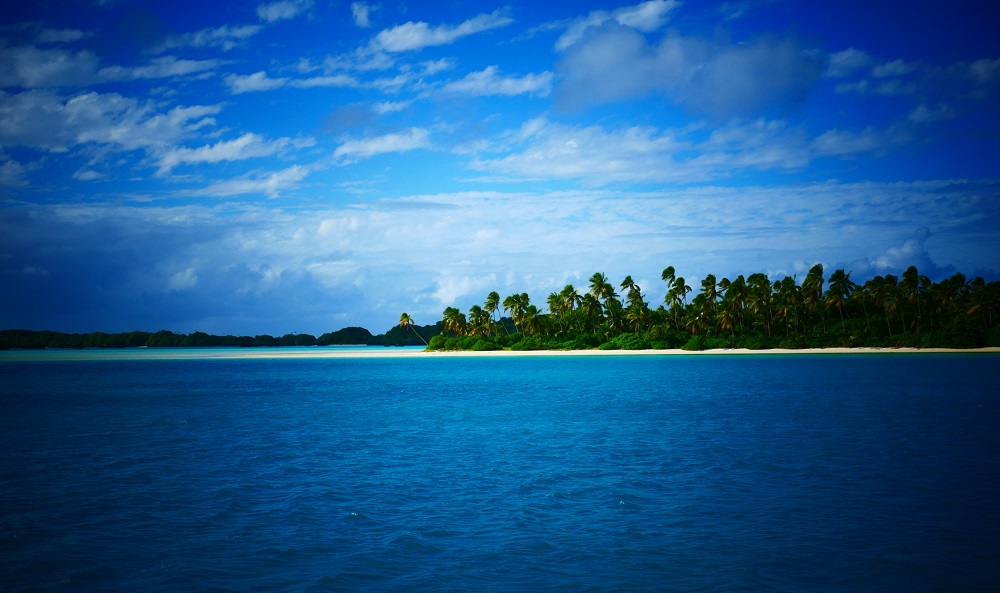
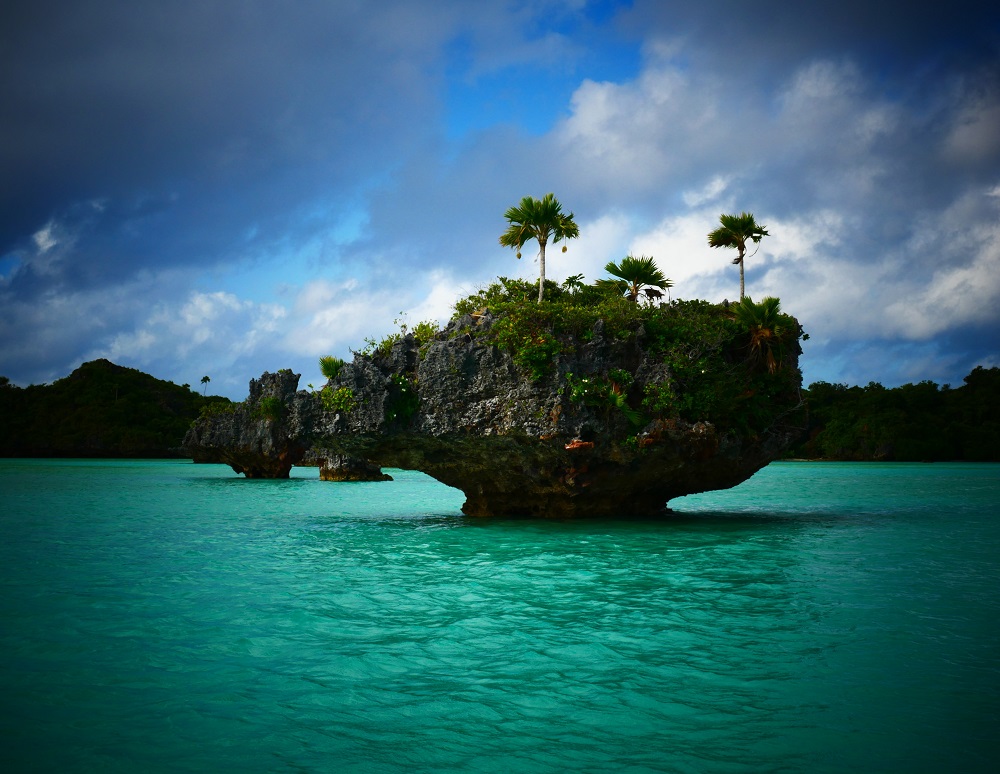
The locals are not the only great thing about Fulaga. The island is one of the most beautiful places I’ve ever seen. It is vivid and glossy, saturating the senses, every glance a photo opportunity. The crescent-shaped island is enclosed by a huge circular lagoon, bordered by wave-pounded reefs. Small uplifted limestone mushroom-shaped islets dot the lagoon, little tufted heads topped by unkempt coconut palms and pandanus, their necks carved by the tidal flows, their shoulders shrouded in aquamarine shallows. It is a picture-perfect tropical paradise – turquoise water, white coral sand, impossibly blue sky, and vividly green inland vegetation dripping with coconuts.
Limestone islet topped with palms.
Although the Lau Group has been inhabited for more than a thousand years, it is largely untouched by tourism and development, partly because of deliberate government effort to protect the culture of the islands and partly because the area is so hard to reach. Located halfway to Tonga and roughly 200 km south east of Viti Levu, to get to the Lau one must sail against the prevailing winds through swelly seas. Each island is the remnant of an individual volcano, so passages between the islands are in the open ocean, and the passes to enter the peaceful lagoons are most often narrow and raging with tidal currents, rendering any island-hop a non-trivial activity requiring careful planning. The reefs and lagoons are all poorly charted, so once inside the lagoon, a good look-out is essential if one is to avoid crashing into one of the numerous coral heads that lurk treacherously just below the water surface. For many years, tourists (including yachties) were not allowed in the Lau Group, but in the last decade it has become easier for boats to visit, and nowadays there are weekly flights from Suva to one of the northernmost islands.
Fulaga is located right at the southern end of the Lau Group, in the most remote part. The vast lagoon is perfect for yachts, with a multitude of superbly calm and scenic anchorages and easy access to the three island villages. Little sandy beaches appear at low tide everywhere, and the limestone islets are so picturesque that we marvel at the turn of every corner.
We spend close to three weeks in Fulaga, three weeks of soaking in the scenery, exploring and hanging out with the villagers and the other yachties.
Lukie snorkelling.
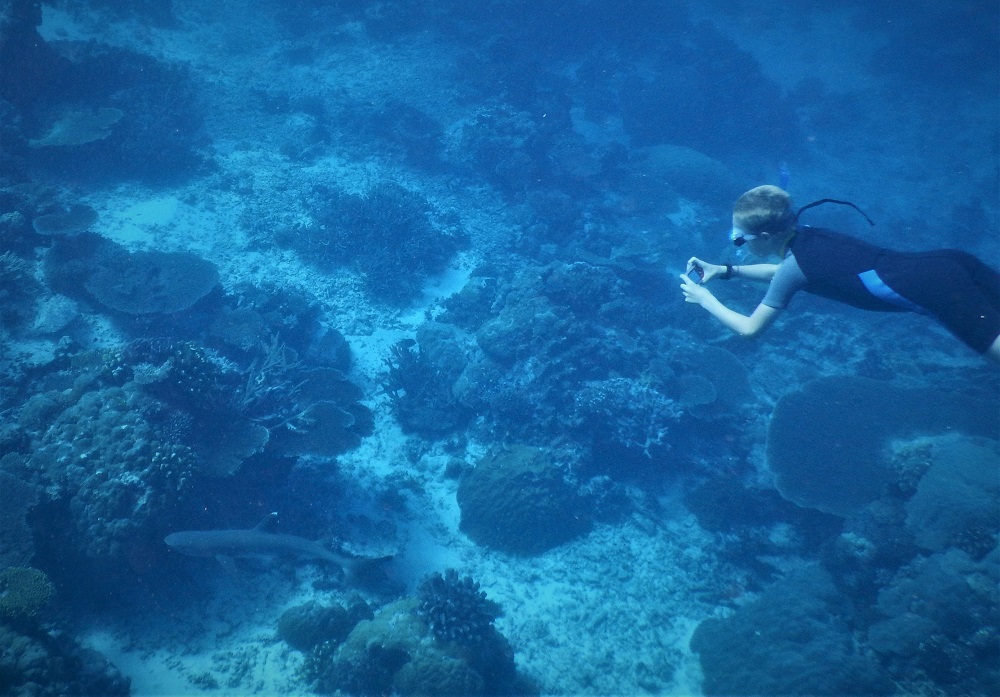
Matias chasing whitetip reef shark, camera in hand.
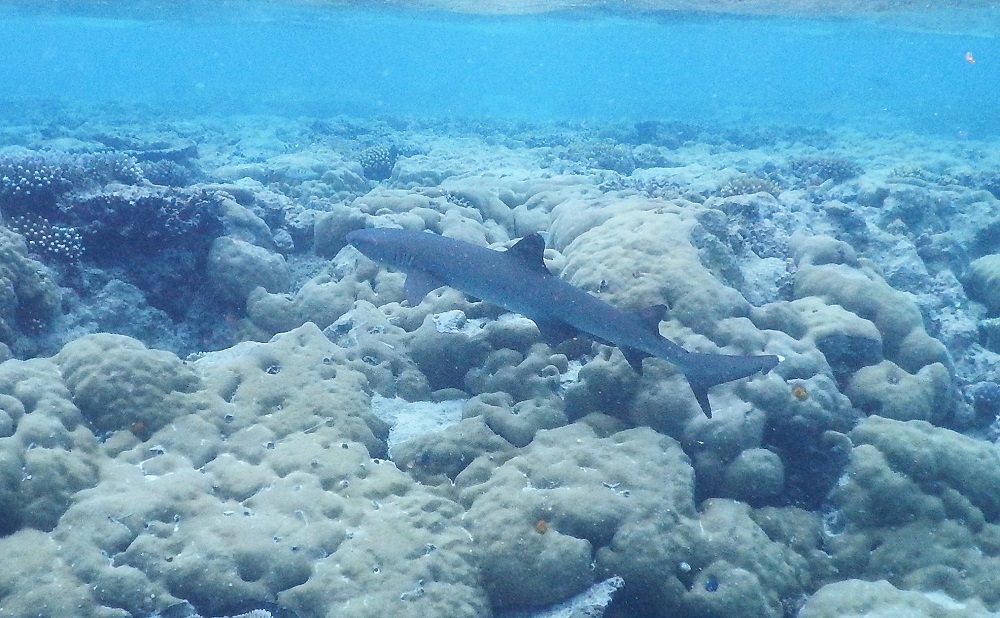
There are small coral bommies in the lagoon, but the best coral is out by the pass, and we snorkel the pass again and again, drifting along over exquisite coral gardens on an incoming tide. Everything is pristine, with giant trevallies, reef sharks, turtles and large schools of mean-looking barracuda and grumpy groupers with severe underbites slowly cruising atop coral and anemones, puffed up guards patrolling a garden of infinite crop varieties. Along one ridge is a big outcrop of cabbage coral, great green discs opening like lettuce leaves. Along another is a patch of staghorn coral, home to thousands of tiny, jittery damselfish who nervously duck for cover as we slowly approach. Around the corner is an assembly of curled-edged anemones shielding brightly coloured clownfish that stare up at us defiantly, safe in the arms of their poisonous friends.
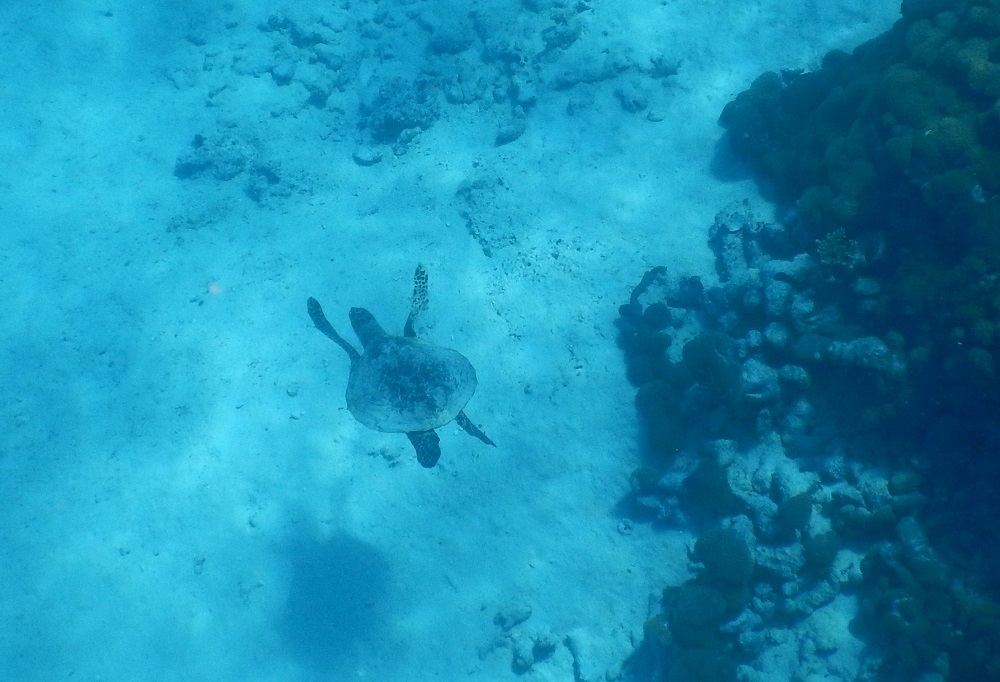
Cabbage coral.Fleeing turtle.Shark on the prowl.Infinite underwater variety.Fulaga pass seascape.
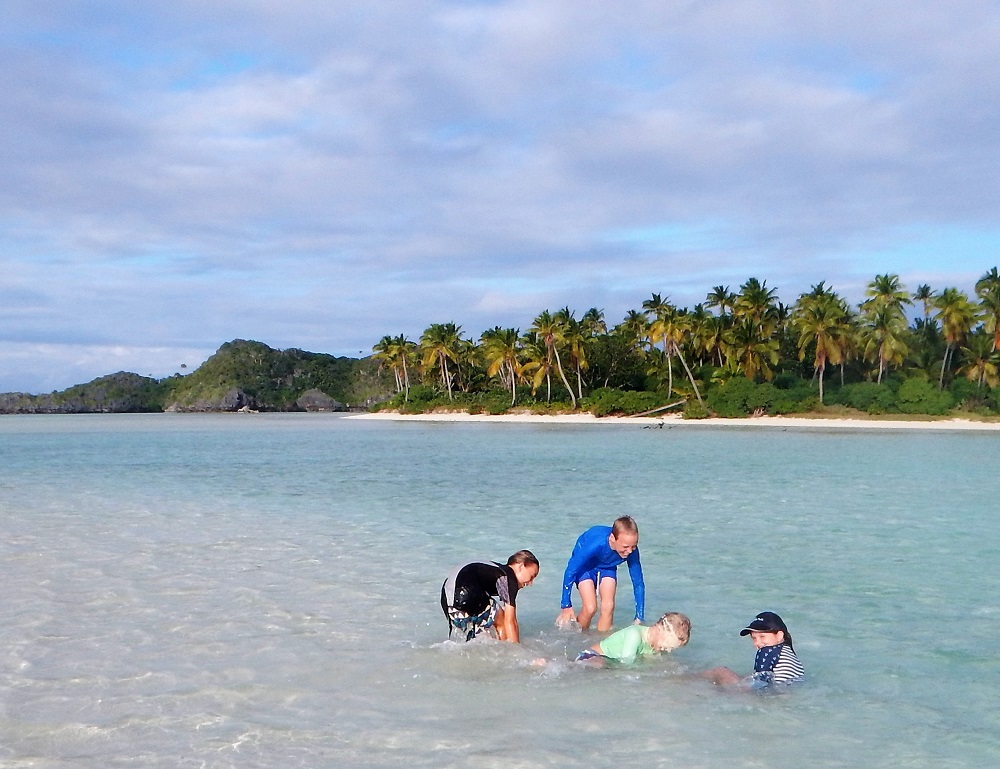
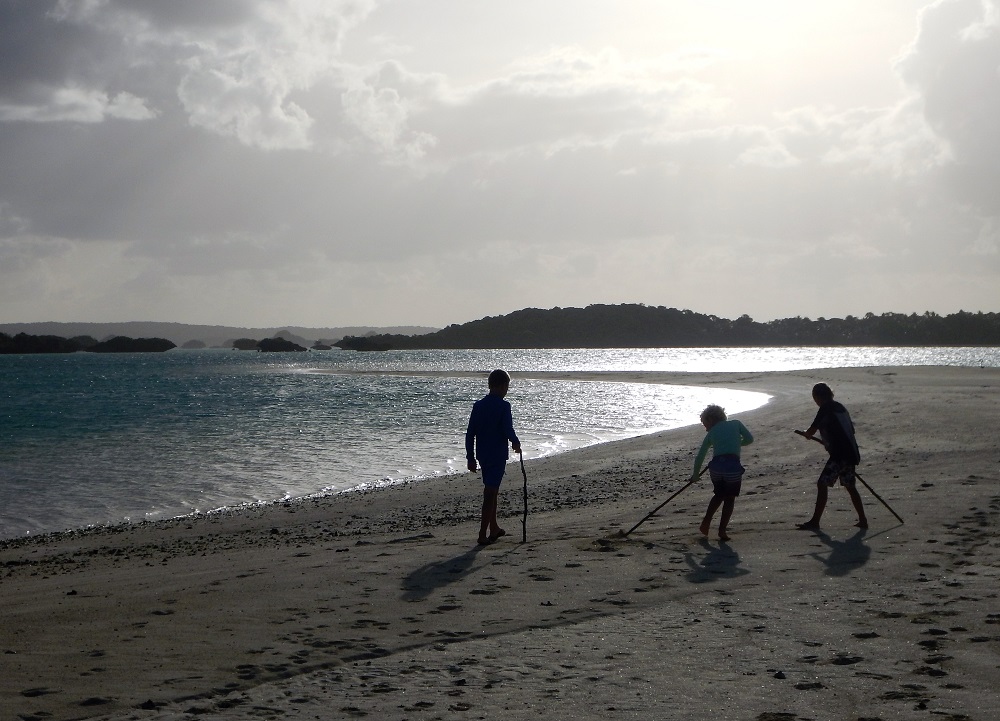
There are two other boat families here, and the kids enjoy endless playdates on the beach and on the boats. They swim and run and walk everywhere together, playing imaginative games involving few ingredients other than water, sand, coconuts, twigs. When it is windy, we use the sandspit for kitesurfing, the kids attempting to learn or just playing in the sand or water for hours on end while the grown-ups enjoy the rarity of flat water and a beach to launch from.
Matias – budding kitesurfer?
During one of their beach forays they find a shark on the beach, Lukie running breathlessly towards me on the sunlit beach, wide-eyed with excitement:
“Mummy, there’s a shark, there’s a shark on the beach!”
Close behind him are the rest of the kids from the anchorage, clad in their rash vests, flushed with heat, sand sticking to their wet legs.
I follow them into the sun, around the sandspit and see the baby shark. It’s a tiny, dead blacktip reef shark lying limp on the golden sand by the edge of the high tide vegetation.
“It’s been stabbed in the head,” says Lukie gravely. “Look, it’s got a hole in the head.”
He points to where the blood is still fresh. The kids all gather around as I examine the shark.
“Yeah,” I say. “It must have been one of the villagers, they probably don’t want sharks around in the shallows.”
They nod solemnly and start preparing for the funeral, digging a hole in the sand, gathering palm leaves and a coconut shell for the headstone.
Water frolic.
Hunting coconuts.Cruising kids: sand drawing.
But all is not innocent play at Fulaga. During our second week there, the western world intrudes onto this remote location, wreaking tumultuous, tragicomic havoc.
We first know of the trouble when from the boat we see a boat full of villagers assembling on the sandspit where we’ve been kiting all morning. It is lunchtime, and the four kiting yachts have all left their kites on the beach, multi-layered brightly-coloured half domes perched on the white sand, quivering in the strong breeze. The villagers walk amongst the kites, some sit in the shelter of one.
Shortly after, Rick our anchoring neighbour, heads to the sandspit, no doubt to find out what is going down. As we finish our lunch we watch him deep in conversation with the locals. David decides to dinghy over there to see what is up, and a couple of hours later he comes back with a crazy tale.
When Rick came ashore the locals said they would like a chat about some stuff they had found on the beach, some plastic packets with a cow print on the side, and a Nike logo. They would like to know what it was, and would he mind having a look at it?
Assuming they had found some rubbish that a careless yachtie had let blow overboard, Rick agreed to have a look and mentally prepared an apologetic speech about how he would talk to all the cruisers to ensure that this would not happen again. Still ruminating over his response, he was surprised at what they brought him.
“It was like a slim white brick,” he explained over drinks the following evening. “Vacuum-packed, with a Nike logo on the inside, and then wrapped in several layers of clingfilm, and taped up. A longhorned cow logo was on the outside.”
“Almost like it was meant to be disguised as milk powder,” said David, who saw the packets when he followed Rick ashore. “It was strange – like a brick, but then there were these weird puncture holes in the side of the pack.”
“Yeah, I reckon that’s where they’d sucked the air out, created the vacuum,” said Rick. “So, I told the guy that I didn’t know a lot about these things, but that to me it looked like drugs. After all, white powder, vacuum packed… And they said they had found 28 packets, just washed up on the beach, scattered all over at low tide.”
He sipped his beer. “One of the guys bit into the corner of a packet, to see what it tasted like. He said his mouth went kinda numb.” He put down his beer, laughing helplessly. “I mean, imagine…”
“Anyway, I told them that in my opinion they shouldn’t open the packets or try to eat any more of it. They should store them somewhere and immediately contact the police and get the stuff off their hands.” He ran his fingers through his hair. “Just think, what if someone comes looking for it?”
Drug lagoon – innocently beautiful on the surface.
When we next visit the village, the talk is about nothing but the powder. Our host Mishiyake had found an additional 7 packets on the beach by the village. One of the head villagers had called the police, who arrived in a helicopter to collect the 35 packets. A couple of days later, the police confirmed that it was 35 kg of pure cocaine.
There was no doubt that the locals were in unfamiliar territory, out of their depth, and crazy rumours were circulating.
The head village guy claimed that the drugs were worth $408 billion, at which David laughed.
“That’s more than twice the GDP of New Zealand!” he chuckled. “It is worthless here, but you’re right, it would be worth a lot of money for the person who managed to get it into Australia. Maybe not quite billions, though…”
Asking us how people use cocaine (smoking? sniffing?) they told us about how they’d heard of a village in Papua New Guinea where all the villagers had been brutally gunned down by drug lords after some locals had found similar packets.
Everybody agreed that it would have been a yacht dropping the packets – either to some pre-determined destination for others to pick up, or in panic after some sort of scare. Presumably bound for the lucrative markets of New Zealand or Australia, the intention was probably for another boat to pick up the goods and transport it further west.
Discussions about the yachties were rife. Who had dropped it? Were they still in Fulaga? Or had they fled? Was anyone acting suspiciously?
“What about that guy, on that other boat?” said one of the villagers. “He looks like someone who uses drugs. I mean, he talks in a funny voice?”
Realising that he’s just picking on the guy with an unfamiliar accent who didn’t come to church, we reassured him that whoever dropped it has probably left the island by now. We were a bit surprised that the police didn’t even bother interviewing the yachties, but at the same time we felt sure that whoever brought it in is not still in the lagoon – I mean, they couldn’t have predicted how ineffectual the police response would be, could they?
After a few hours of discussion, outrage and fear were replaced by humour, and the villagers joked how instead of raising a measly couple of thousands in the church fundraiser, they could erect a whole new building if they had just kept a packet and gone to Suva to sell it. At this stage, the monthly supply boat was several weeks late, and the island was completely out of kava, which cannot be grown in the poor, sandy soils of Fulaga. With all the recent festivities they had pounded the last root to a dusty powder and drunk the last drop of the resulting brew, and as they were getting increasingly desperate they laughed that they should have kept a couple of packets to use in lieu of kava for a kava-drought emergency.
“But we don’t use drugs,” said Mishiyake seriously. “Not like in New Zealand, Australia.”
“No, no,” we say. Not if you disregard kava, anyway.
True, kava has about the opposite effect to cocaine – it is a mellowing drug, causing relaxation, slower breathing, inducing a trance-like state. It has antiseptic properties and is a known antidepressant. So all in all probably better for society than either alcohol or cocaine.
We reflect on how to the villagers we must seem like we’re from outer space, impossibly rich, from another world. With our fancy boats, our ability to go anywhere, our deep pockets and willingness to buy expensive tins and tourist curios. Like most well-meaning yachties we have brought along what we consider worthy presents to local communities: school supplies, fishing line, teabags and biscuits to give out. Some have brought reading glasses and brassieres from New Zealand charities. David and Rick spent a day in the village trying to help them repair an outboard that had seized.
Although happy with anything we bring, what our contacts really want is kava and American action movies. On Mishiyaki’s visit to our boat, we transfer New Zealand dub reggae and two Tom Cruise movies to his phone for which he is profoundly grateful even though the sound only works on one of them. Despite living so remotely he is already hooked on the best of western culture and his view of our reality is tainted by the Hollywood movies he plays on his small smartphone.
It is a time of rapid change for the inhabitants of Fulaga. Ten years ago, only three boats visited the island in a whole year; this year they are predicting 150 will come, and the lagoon is awash with cocaine. Villagers are still living a subsistence lifestyle but increasingly exposed to the wider world, for better or for worse.
By the time we leave Fulaga there are cobwebs on the transom and fouling on the anchor chain. Apart from forced stops for repairs, we’ve never stayed as long in one place before in our cruising life. We could easily spend another couple of weeks there but decide to head north when the winds turn to the east, grabbing a good weather window while we can. It’s been a great place to visit, and we wish the villagers the best with their escalating interactions with the modern western world, hoping that they can maintain their tight-knit community in the face of modern pressures.
Postscript:
After we’ve left Fulaga we hear from other cruisers that a couple of days after the Fulaga find, a boat called Shenanigans got busted in Suva with several kilos of cocaine. On board was a man and a woman, and when boarded the man tried to take his life, leaving the woman to deal with the authorities. He’s now in intensive care, and she is in prison, awaiting trial. We assume that they were somehow involved, although we still don’t understand the exact details. Had they been picking it up in Fulaga, and missed most of the load? Or were they the ones dropping it off, keeping only a few kilograms for good luck? We’ll never know…
Rick emailed to let us know that a few days after we left the Fulaga chief died. He was 92, so not a tragedy, but the villagers are distraught. Being an important component of any official gathering, kava is essential for funerals, and the supply boat still hasn’t arrived. The men are reduced to going around the three remaining yachts, begging for supplies, and we hope they got enough to carry out the required ceremonial grieving.
“Mummy?” whispers Matias. “Can you help us get something to eat?”
He gestures towards the line of boaties queueing up for the food table. Around them, the local Fijian villagers are all sitting, leaning back in the grass, chatting, and waiting for the guests to get their food before they eat themselves.
“I don’t know what all the things are, and I don’t know how to eat it either when there are no plates and no fork,” Matias whines. “How do I use this basket?” He impatiently shakes a small woven palm leaf basket in the direction of the food table. The other boat kids cluster around us uncertainly.
I guide them towards the end of the queue and slot them in behind a suntanned elderly couple, a procession of small tanned blond kids politely holding their baskets in front of them, imploring the Fijian women manning the food table to dish out some of the delicacies on offer.
It’s the afternoon of a pork feast put on by the local village for the cruising yachts. We’re on the island of Fulaga at the southern end of the Lau Group in Fiji. A remote location, the only foreigners that visit the area come by yacht, and presently there are 12 yachts spread over the huge lagoon. The island is home to three villages, and the largest, Moana-i-Cake, has organised to cook a pig in a traditional earth oven at a sandspit in the lagoon, which they serve to the villagers and cruisers in a day of festive interaction. The cruisers raise $200 to pay the villagers for the pig and contribute baking and salads.
Local kid with the trainer kite.
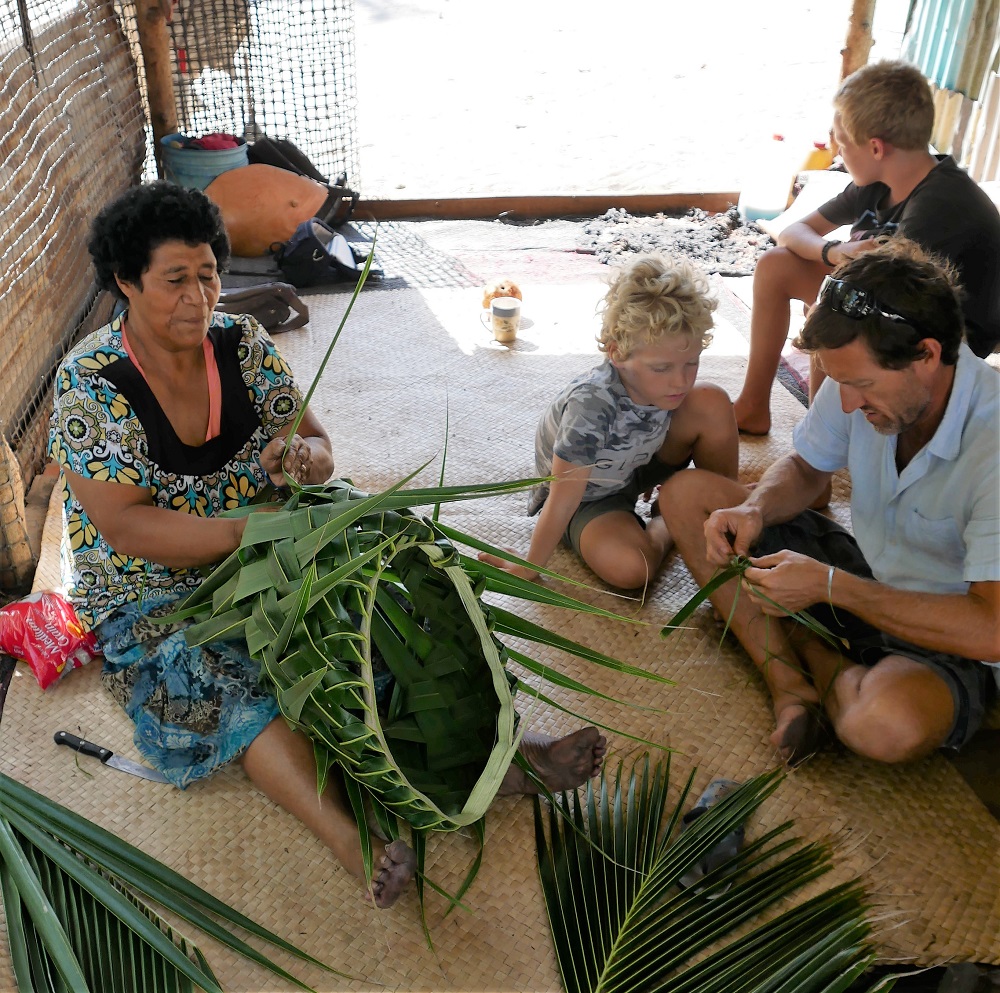
It is a great feast. The local village children all take part, and Matias and Lukie play endless rounds of soccer and rugby, tumble about in kayaks, throw frisbees and play tag, their blond heads disappearing in a cloud of black afros. The village men started the earth oven the night before, and the pig was put to roast with cassava and yam early in the morning. Yachties have been busy ferrying locals from the village to the sandspit since mid-morning, a 20-minute trip by boat. Once everyone has arrived, the Fijian matrons start weaving palm leaf mats for shade and to sit on, baskets to use for food preparation, and basket-like plates to eat from. Within half an hour a comfortable temporary settlement has been set up on the remote sandspit, and the men tend the oven while the ladies gossip and prepare food in the palm leaf baskets.
We’ve been in Fulaga for three days. It took us two days and a night to get here, a hard trip against the prevailing tradewinds. Early afternoon on the second day we approached the narrow pass and motored in against the swift outgoing current, marvelling at the peaceful glory of the calm lagoon.
Like everywhere in Fiji, visitors must sevusevu on arrival. Sevusevu is a mandatory offering of kava roots to the village chief, which is done by any visitor in Fiji, trading the mild narcotic that seems to form the basis of social life in Fiji for the permission to anchor off the island, swim in the waters and walk on the land. For our trip around Fiji, we have seven bundles bought from the market at Savusavu, one for each island we anticipate we’ll visit. Because we’ve caught an abundance of fish on the way, in Fulaga we also carried three fish as a present.
Dilapidated village post office.
The village is tidy, with small corrugated iron houses separated by grass and sandy paths. Situated right by the water’s edge, the houses overlook the white sand and light blue waters of the lagoon. Coconut palms and papaya trees are everywhere, and ornamental plants adorn several of the small house yards. Wispy trails of smoke snail up from little covered cooking enclosures attached to the houses. When we came to sevusevu, barefoot children were playing everywhere: a game of volleyball was underway in the village centre and small children ran trailing sticks in the dust, smiling shyly at us as we made our way to the chief. Adults stood around and chatted, calling out to each other between houses.
Weaving with Una.
We were soon enveloped in a small group of adults and children who escorted us to the chief’s abode. Our kava and fish offering was received in the traditional ceremonial fashion, with speechmaking and lots of clapping with cupped hands. In Fulaga, each visiting yacht is allocated a family who remains the point of contact for the duration of the stay and we were allocated a lovely grandmother called Una and her male relative Mishiyaki. After the chief’s welcome we were escorted to her house, where we sat cross-legged on the woven pandanus mats that cover the vinyl flooring, drinking coconuts, talking about children and fishing, agreeing that the next fish we catch should go to her rather than to chief and that we’ll come to church on Sunday and have lunch with the family afterwards.
Beachfront property: the view from Una’s house.
On the Sunday we attend the mandatory church session, all wearing our Sunday best. Church and kava seem to be the focal points of the community; the church is the only brick building in the village and the kava bowls are cut from the finest wood. Within the church, the whole village is assembled, and as the service starts the small building is saturated with multi-part harmonies, the men’s bass oscillating along the floor, the ladies’ sopranos dripping off the ceiling. A small triangle beats the rhythm and is the only instrument used.
The sermon is mainly in Fijian, but towards the end a small, animated woman stands up by the pulpit and delivers an address in thundering English, reaching out to the yachties by relating Jesus our Lord the Saviour to a safe anchorage in a storm, our only way past damnation to eternal life.
“If you will not receive our Lord, you will die,” she yells hoarsely. “Only through Jesus Christ can you live forever!”
She surveys us with furrowed brow, a room full of scared mortals, dressed in our finest, reaching for eternal life and hoping to bypass death.
I hum along to the singing when it starts up again.
The following week is the village meke, a church fundraiser organised as a singing dance-off competition, where representatives from the three villages on the island and from the neighbouring island Ogea compete and raise money at the same time.
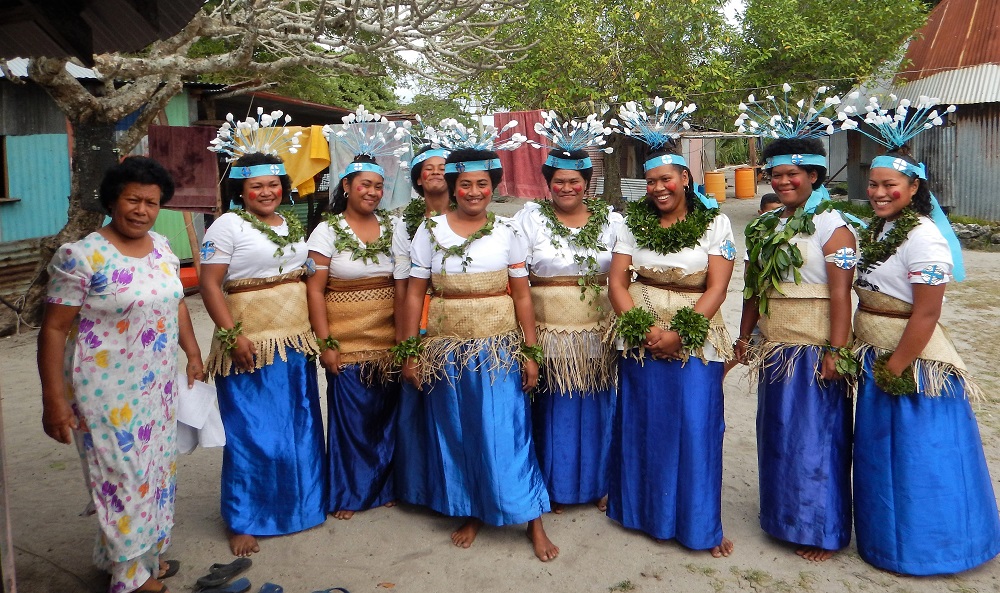
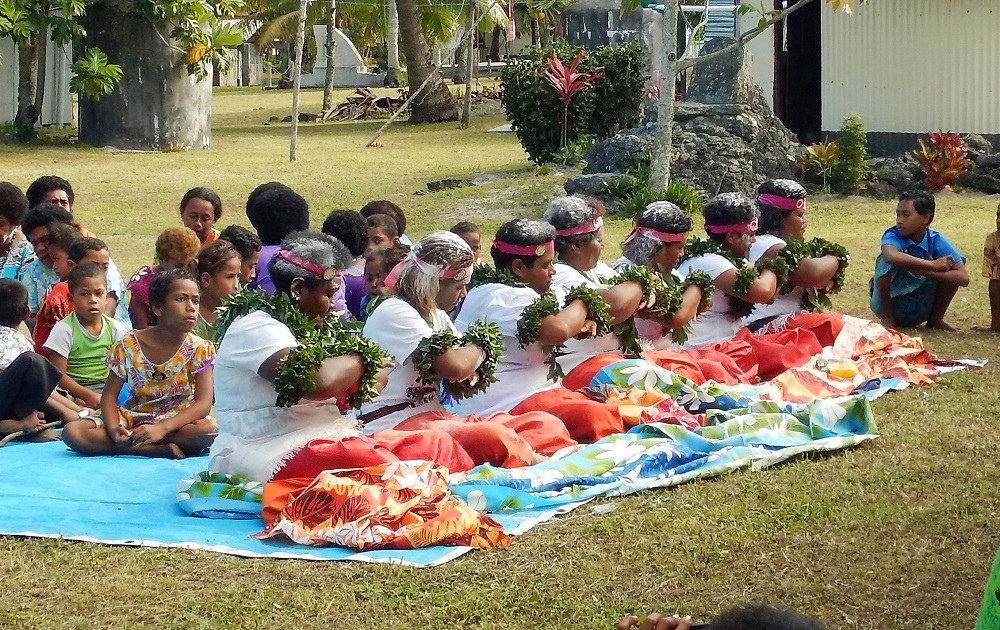
Team Ogea in all their glory.
It is probably the weirdest show I’ve ever seen.
Our host family is from Ogea, and so we cheered on Team Ogea, photographing the splendid glory of the blushing dancers as they appear, wearing a mixture of woven pandanus and bright blue ribbon and cloth, with tinfoil adornments, greenery necklaces, and stick pompoms in their afros. After a singing procession to the village centre, each team must sing and dance to the assembled host village. During the second song, opposing teams start interfering with the dancers, and stout matrons come forward to spray baby powder into their hair and wrap them in long swathes of cloth. The fragile beauties sing unperturbed on during this ritual humiliation, bravely attempting to breathe through the clouds of powder, and as they are steadfastly ignored, the hecklers become progressively more outrageous. Before long the elderly women are draping leopard-printed underpants around the heads of the male singers, gyrating wildly, rising and stooping as they stomp towards the village chief, aggressively pointing sticks. Younger men dance forwards to present gifts to one or more of the dancers, attempting to kiss them and carry them off only to be indignantly fought off. The audience howls with laughter, hoot and shout before they break down again, tears streaming down their faces as they try to control their mirth.
Competitors covered in baby powder.
This continues for song after song, and the assembled yachties look on in wide-eyed surprise, feebly joining in the laughter as our host families join the general chaos.
Halfway through the dancing, we have a break to have lunch with our family.
“Malene, try this.” Sarah, an Ogean woman with great English offers me a plate. “It’s sea cucumber, delicious. Stuffed with fish and coconut cream. Delicacy.”
I put a small portion on my plate, and as soon as I bite into it I regret it. I’m not bad with weird food, but this is probably the worst thing I’ve ever tasted. My eyes water with revulsion as I try to swallow a piece of fishy jelly with an aftertaste of rotten seafood, my body shuddering as I barely manage to keep it down, the small hair rising on my arms. I quickly stuff some boiled cassava into my mouth, hoping to drown out the flavour, and gulp some coconut milk to help the dry cassava down.
“How do you like it, Malene?” asks Sarah, eagerly leaning over.
“Gweat,” I utter through the cassava mouthful, showing a thumbs-up. “Dewishous.”
She grins, and for a moment I think this is a trick, played on unsuspecting visitors. Is that a fake smile? Did she eat any herself? Is this part of the general fun of the day? Will they all fall over, laughing helplessly, mimicking our grimaces, after we leave? I wipe the conspiracy thoughts from my mind and glance over at David, whose eyes are bulging as he is trying to swallow.
Lukie taps me on the knee. “Mummy,” he whispers. “The sea cucumber…”
I nod slowly, unable to look at his plate. Eyes down, I swallow again as it dawns on me that I may have to eat his portion too. The awful taste still fills my mouth, my nostrils, unpleasant waves of rotten sea invertebrate reflux washing over my palate, threatening to drown me.
Lukie taps me again, sticking his face in front of mine, his breath stinking of decaying fish. So he too tasted it. Poor kid, it will probably put him off seafood for a lifetime.
He taps me again, his nose almost touching mine. Eyes wide, he surveys me beseechingly. “The sea cucumber,” he whispers again.
“Yes,” I croak.
“Can I have some more? I really like it!”
Strange kid.
How do you like the beans, Mishiyake?
I get my revenge on our last night at Fulaga, where Mishiyake comes to our boat and ends up staying for dinner. Not having planned for dinner guests, I dish out what I’ve prepared for ourselves: refried beans with homemade tortillas and sweetcorn, and a bit of sashimi tuna on the side, the fish a present from a neighbouring boat.
Mishiyake eyes the pale brown glutinous mass of beans suspiciously.
Noticing, I place a dollop on his plate. “And here you go,” I smile. “Black beans, mashed up!”
He smiles uncertainly, and doses lots of chilli sauce and cheese on top, cautiously taking his first bite. His face freezes at first, but after a while, he manages to chew and swallow. He drowns the small pile of remaining beans in more chilli sauce, adds more cheese, and slowly, slowly manages to finish it all. When he’s done I urge him to have more, but he adamantly refuses.
Pandanus mat weaving.
Food aside, it has been an interesting time of village interactions. Staying for three weeks in one place means that we’ve met Una and her family a number of times, and by the time we depart we are comfortable in each other’s company, sharing laughs and affection. We have spent time together in our present, and it strikes me how, despite our different frames of reference, cultures, pasts, and futures, we still connect so easily, sharing the basic stuff of humanity – the joy of children, the drudgery of housework, the excitement of fishing, celebrations, our fear of dying – and, of course, our aversion to unfamiliar food.
For the last couple of days, we were at a reef surrounded island called Taveuni. We went to a reef and saw many fish and coral. On the reef, we saw lots of fish that we had never seen before and odd colours of coral. Check out the one below!
Strange coral.
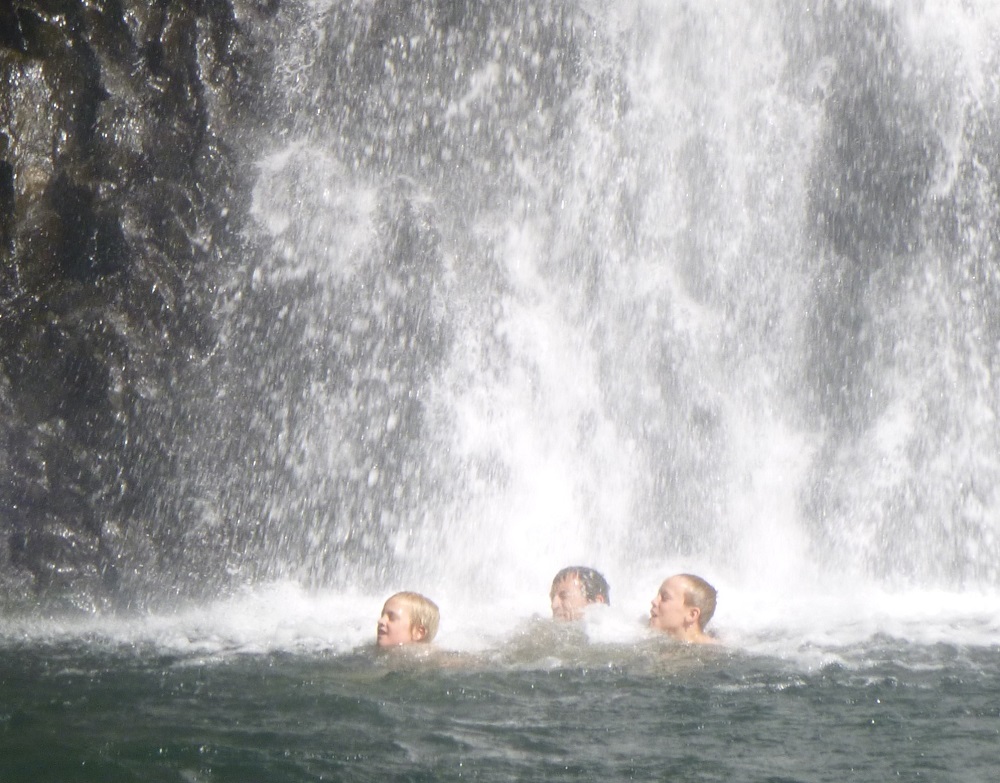
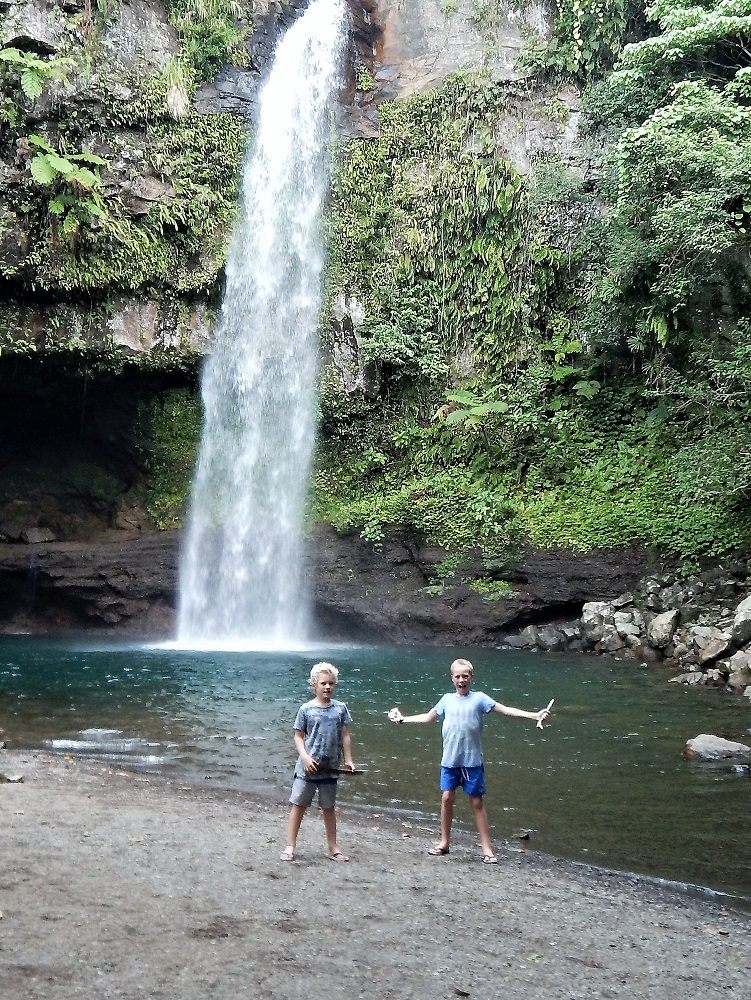
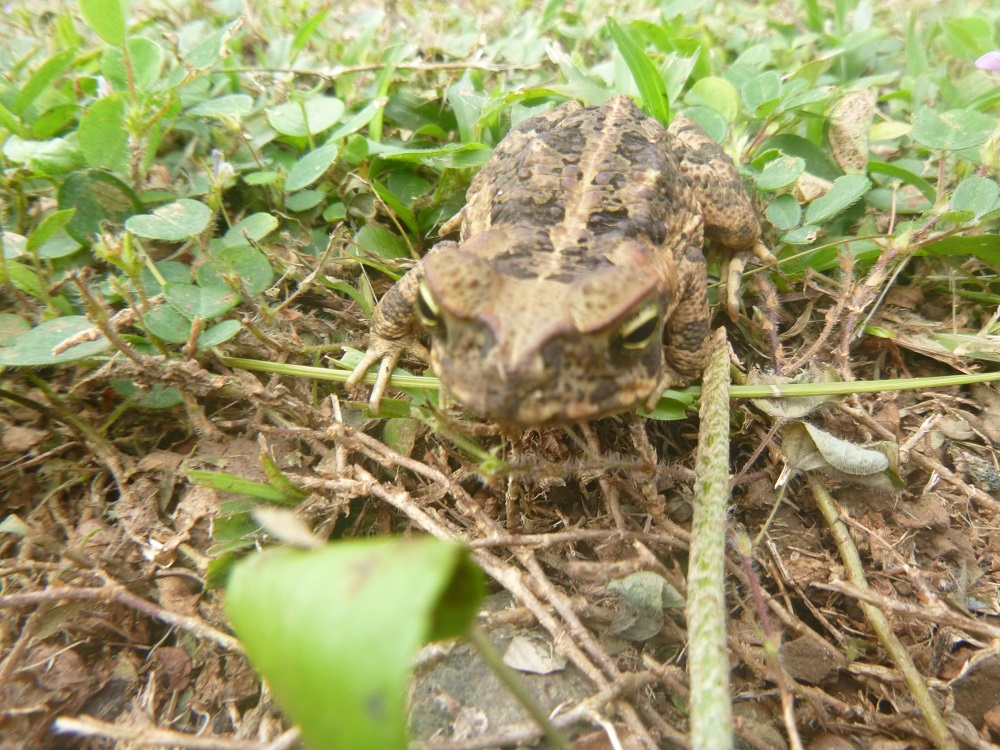
Now we are on shore and we will go to a waterfall (three waterfalls) and hopefully swim in them all. On the path we saw frogs and toads and a crab in a small hole. The waterfalls were cold but that did help against the heat of Fiji. You could go right underneath and get smashed by the water falling on top of you.
Falling water.
To get back to the boat was a challenge. It was so shallow, so we had to row and walk the dinghy off the shallow place into the deep area where we could motor out the rest of the way to the boat.
We arrived into Fiji just before the weekend and it took five days for us to get our Fijian cruising permit, five hot days where the boat was not allowed to leave the mooring in Savusavu. There was no wind, and although the town is nice enough, we were ready to leave when the permit came through. Savusavu is very sheltered, and when there is little wind it gets oppressively hot – the kind of heat that envelops you, sits heavily on your chest and flattens you into gasping, weary submission.
So, the moment the cruising permit comes through we are off, heading for Taveuni, the Garden Island east of Vanua Levu, where we know there is diving and kitesurfing and clean waterfalls.
After just a short trip across the ripping Somosomo Strait Taveuni appears: steep hills clad in dense vegetation, sharp peaks covered in mist, coconut palms lining the coast. A lush green jagged outline, appearing moist and cool to our overheated eyes.
We visit Paradise, a yacht-friendly resort with mooring buoys conveniently located just off their well-manicured gardens. The moorings are crowded with other yachts, all fast boats that are doing the ARC around the world rally and have just arrived from Tonga via the Lau Group.
They have been moving at breakneck speed – around the world in 16 months, stopping a few spots in each country, checking through customs in large groups, all organised by the rally. Normally, you have to clear into Fiji on the mainland (the large islands Viti Levu or Vanua Levu) but rallies like these gain permissions to clear in at the Lau Group so they don’t have to go back down against the wind to reach there like we will have to.
Only larger boats can make the tight round-the-world rally timeframe, and most of the boats in the anchorage are worth a great deal, their owners perma-tanned top achievers out to tick off a global circumnavigation, the kind of people who ‘do’ countries rather than visit them. They have had several expensive yachts run aground when trying to enter the notoriously poorly charted Pacific reefs in less than optimal light, and we chat for a while and get some waypoints for where they smashed into reefs around the Lau Group, the place we’re headed to next
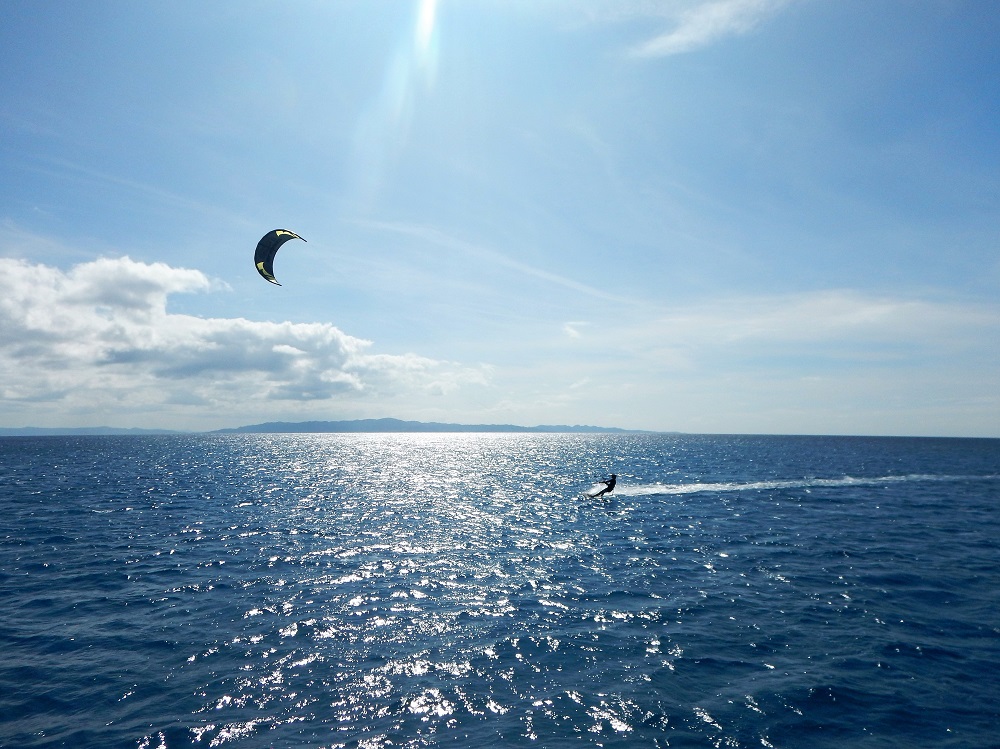
After one night in Paradise, we continue our way north along Taveuni’s west coast, stopping for a couple of nights a couple of miles north, and then onwards until we finally reach a cooling breeze when we get to Matei at the top end of the island. Here, the hilly island no longer shelters us from the fresh tradewinds, and we enjoy a steady breeze, perfect for kitesurfing, and clear waters with great coral, perfect for snorkelling and diving.
Kiting off Matei.Matias hunting for the perfect photo.
Lukas hanging on the surface.
Located right on the dateline, Taveuni is full of inland wonders too – jungles, waterfalls and verdant bush, light rain showers, fragrant flowers, strange frogs croaking, and colourful birds calling. We visit a natural waterslide where we zip down the shallow-gradient section of a waterfall, zooming over the slippery smooth rocks, pushed along by a torrent of clear, cool fresh water. The kids go, again and again, wearing the bottoms of their shorts thin, yelling and whooping as they whizz past, screaming as they land in the deep pool at the end.
Waterfall shower.Getting ready for the drop-off.Sliding down the waterfall.Waterfall fun.
80% of the surface area of the island is a forest sanctuary, set up by foresightful locals deciding to bank on ecotourism rather than logging. The steep hills make for wonderful waterfalls, and we are amazed at the lush bush bordering the clear waterways, heavy epiphytes dripping off trees and fragrant flowers lining the walkways, making the jungle look like a soft green padded mattress with colourful dots from afar.
The downside to the lush natural beauty of Taveuni is endless stinging critters: mozzies, jellyfish, even famously poisonous plants, which leave us itchy and raw, covered in inflamed pink spots. The deep coastal waters near Paradise where we initially jump off the boat are like jellyfish soup, tiny little stingers that launch vicious attacks on any skin not covered by clothing. The stings swell up and itch for days, hurting so bad that Matias starts snorkelling in jeans, and I resort to a full-length, luminous turquoise lycra suit, a disco-queen remnant from the 1990s which only comes out of the cupboard in absolute emergencies. As I glide over the reef in my turquoise splendour, tiny striped cleaner wrasse stare at me in stunned silence before they timidly come up for a nibble, perhaps mistaking me for a mutant whale, and I can just imagine their conversation:
Baby cleaner wrasse: “Wow, Daddy, what is that? I’ve never quite seen one like that before. It’s huge and shining!! So blue!!! What is it?!?”
Daddy wrasse, looking up at large looming turquoise shape outlined sharply against the water surface. “I don’t know, Son. Never seen the like of it. Very shiny indeed. I’ll tell you what, though, whatever it is it’ll need cleaning. So, go on, do your thing, wriggle up, do the dance, and start nibbling!”
Not wanting to hurt their feelings or delicate skin, I gently wave the tiny wrasse aside, blowing out my snorkel, splashing my fins, trying to signal that I’m on the move and don’t want a clean, and the little fish rush back down to attack a patiently waiting parrotfish which looks annoyed at having its staff distracted by cheap bling.
Disco Diva confusing the local wildlife.
But all good things must come to an end. Taveuni, our first destination in Fiji, has been a beautiful place to visit, a vivid green jungle island fringed by colourful reefs.
Tomorrow, we’re off for the remote Lau Group in the south. We saw some of the islands from afar as we came up from New Zealand but weren’t allowed to visit until we’d cleared in with the Fijian Customs. It’s meant to be an amazing place, full of deserted islands, far-flung villages devoid of tourists, clear waters off the beaten track. There will be no provisions to be had down there other than the odd coconut, and no phone reception or internet, but plenty of visiting with village Fijians, snorkelling, kitesurfing and playing on beaches. We’ve been wanting to go for years and are looking forward to seeing it.
Say hello to Mr clam! I found him while snorkelling, like his afro?!?!!!
BZZZZZZZZZZZ!!!!! Whoa! Fish on. We reeled in the lines and found that the lines of the rods had been tangled up in each other and each hook had a little skip jack tuna on them. Sadly, I had no time to get them in a photo.
Today we arrive in Fiji and I can’t wait to get ashore and see what it’s like! To be allowed in their country (Fiji has dozens of islands) we need permission, so we must answer questions or something like that. I don’t really understand what customs and that stuff is so I’m not a lot of help. This is what I want to do when we arrive… WHOOOO!!!!! HOOOOOO!!!!!!!!
A shark at Minerva Reef,Some pink coral I saw at Minerva Reef.
A few days ago, we were on a reef in the middle of nowhere called MINERVA REEF and we saw coral, a shark, and crays which we tried to catch. I took lots of pictures.
I was afraid of the shark even though he or she did not mind me that much. The crays had three different tastes, one tasted like nothing, one tasted sweet and one tasted so sweet that I could not eat it! Imagine that!
Ship wreck at Minerva Reef.
At Minerva there was also a shipwreck that we explored and pointed a lot at all the things we saw. There was a coral bommie (a clump of coral) close by so we explored and found crays everywhere, but we couldn’t get them all.
Goodbye for now, I’ll write more when I have seen more of Fiji.
“Copra Shed Marina, Copra Shed Marina, this is Bob the Cat.” David lowers the VHF and squints into the sunlight.
“Copycat, this is Copra Shed Marina,” says a pleasant female voice.
“Copra Shed Marina, this is Bob the Cat,” says David. “We are arriving from New Zealand, will be with you at 1400 hours and will be ready to check in with Customs then.”
“Copy that, Copycat. That is fine. They will be ready for you.”
“OK. Bob the Cat says thanks for that.”
“Copycat, we need to know: did anyone die onboard the vessel since leaving New Zealand?”
David holds the VHF out in front of him, squinting at it quizzically. “Erm, no, all onboard Bob the Cat are alive,” he answers, raising his eyebrows at me. “And well. We are all well. I can confirm that all crew survived the trip.”
I laugh. It’s a weird question. There is a boat called Copycat – we left them behind in Opua. They were headed for Tonga I think. And why are they asking if anyone died? Maybe they are required to ask about death onboard – but, I mean, how often does it happen that a boat is trying to gloss over the loss of a crew member, deciding not to mention their absence when reaching the destination? I guess it happens.
“Oh, those kids we checked out of New Zealand? Well, they decided not to come in the end…” Meanwhile, couple furiously looking for a good, deep bit of ocean to dump the bodies.
Not us. We are well. The sun is beating down, the humid air is about 30 degrees C, and the number of coconuts floating in the water has been steadily increasing for hours. We can see little green islands in all directions, barricaded by white surf.
Where is that land?
It’s been 12 days since we left New Zealand, 12 days since we last saw land. As we draw closer to Savu Savu, our port of entry in Fiji, we can make out the coconut palms, hear the roar of chainsaws and smell cooking fires. Little cars are visible, driving along a coastal road. Small buoys mark a coral reef. Resort huts sit unobtrusively amidst coconut palms, just off the yellow sandy beaches.
Can I have this for breakfast?
I breathe out and stretch. Oh, how wonderful to have arrived.
It’s been a good trip.
The sail from New Zealand to Minerva Reef went well. Out and onwards we flew, the wind filling our sails, the waves banging and crashing, shaking and stirring us. The ocean is a world of perpetual motion, of heaving seas and changing winds, and after a couple of days, it was hard to fathom a still existence, a stable platform, a quiet space. A tiny white dot on a huge blue sea, we were propelled onwards, surfing down the steep waves, rocking and rolling in the heavy swell. It took us six days to reach Minerva, daylight worlds of blue on blue, grey on grey and nights of silvery black.
The seas were reasonably heavy and so I suffered from relentless malaise: seasickness blending with fatigue into a permanent low-lying nausea impossible to shake. An all-day sickness only somewhat suppressed despite the promises of SeaLegs Prevent Travel Sickness, May Cause Drowsiness, Avoid Driving or Operating Machinery, a directive we can’t exactly follow although the autopilot did the lion’s share of the driving.
We fell into a pattern of David watching from 6 pm to 1 am, me from 1 to 7 am, with shorter daytime stints. During my night watch I swallowed endless cups of bitter instant coffee and savoured the powerful effect of caffeine for the unseasoned user: instant alertness, uplifted spirits, optimism, and a feeling akin to happiness and love spreading as the magic black fluid flowed through my veins.
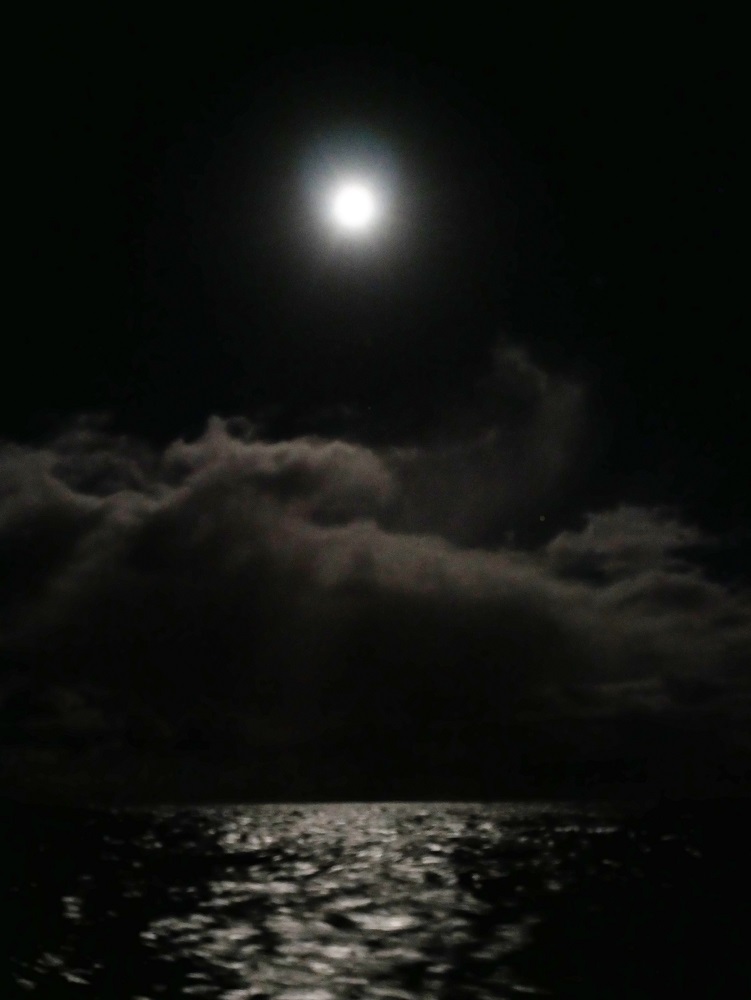
The nights were amazing. Our passage was illuminated by a full moon spreading cool light and spawning ghostly luminous moonbows arcing over the silvery sea, kissing the undulating horizon, backed by blackness and the fizzy whizz of shooting stars.
Full moon on passage.
Night watches are always painful for a committed sleeper like myself. On the nights when it is busy, where sails need constant adjustment, and the wind is quickening and waning as rainstorms darken the horizon, I wish for calm seas and light winds, space to read. But on the quiet nights fatigue threatens to overwhelm, and I resort to pacing the deck to stay awake, longing for sense-sharpening action to invigorate my sleepy mind.
After five long nights, on the sixth morning after leaving New Zealand we found ourselves at both ends of the rainbow, with colours transparently overlaying the rough sea, going almost full circle, beginning and end converging on our boat. Finally, we could see Minerva Reef in the distance – a barely perceptible thin line of white foam grazing the sea surface. As we got closer we could faintly make out the roar and see the turquoise lagoon water, a sandwich of light blue on white.
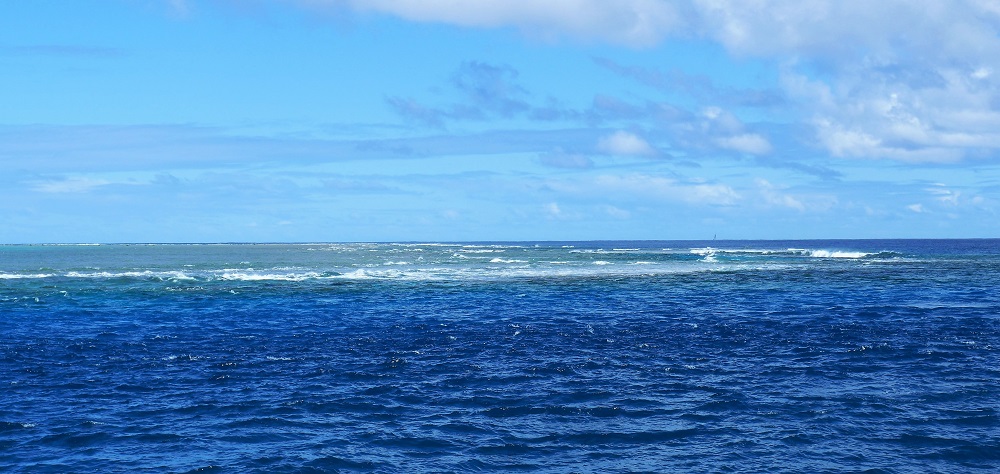
A lake within an ocean, seabed rising from more than a thousand metres depth to just below the surface, hundreds of miles from nearest land.
Minerva is an incredible place. A calm crater lake within a turbulent ocean, a near-perfect circle of ragged reef enclosing light blue waters fading to turquoise in the shallows along the edges. The depths rapidly rose from thousands of metres to 50, 40, 30 as we approached the pass, and we made out way through to the shallow lagoon against the swift outflowing currents.
We anchored up near the light-blue edge and had our first calm lunch in the sunshine. Three other yachts were already there, gently lolling on the still blue waters. Being on anchor was wonderfully calm, the nausea dissipating instantly, and Matias had his first full meal since we left New Zealand.
We stayed at Minerva for four days, sitting out some heavy weather approaching from the north.
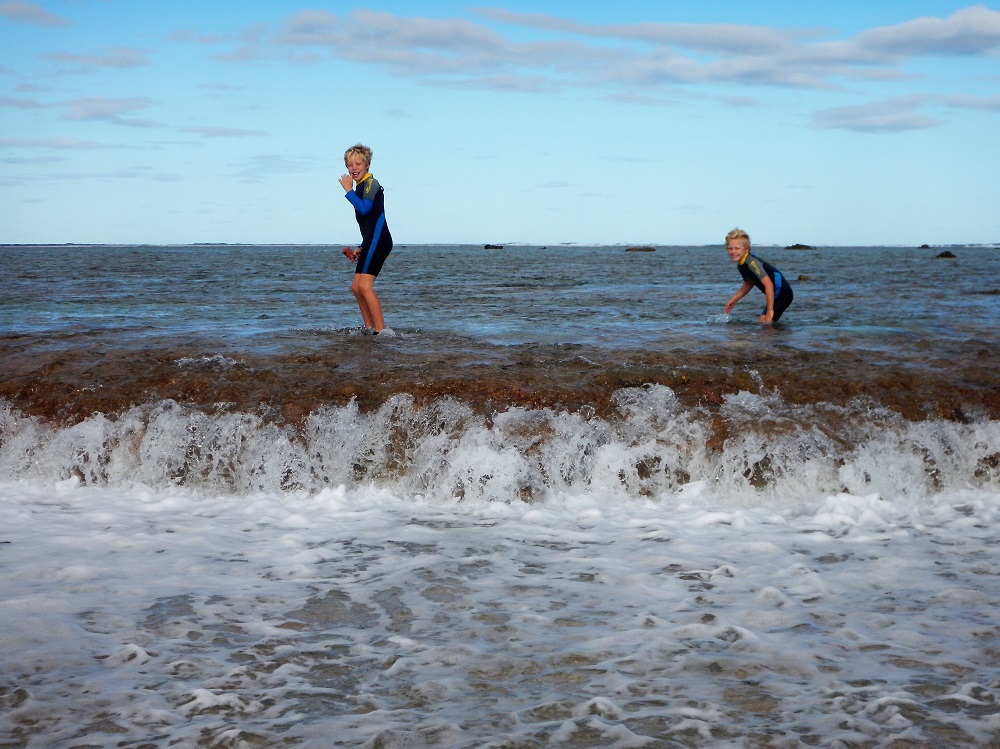
During our time there we braved the low-tide reef flats, through the two-foot-tall waterfall created by the surrounding ocean spilling over the edges into the lagoon at low tide. The kids played in the shallow pools, hands and feet pushing hard, stilling their bodies towards the powerful inward surge.
On the inside reef edge – at low tide the water pours into the lagoon from the surrounding sea.
A Japanese fishing boat wreck is shattered in many pieces just inside the reef, and on our snorkels, we found corals, colourful fish, and reef sharks. David picked up crayfish after crayfish, and in the evenings, we had crayfish every which way before retiring to blissful 10-hour stretches of uninterrupted sleep.
Lukie pointing, Matias taking photos of underwater Minerva shipwrecks.
Matias photographing…Lukie chasing sharks…… and David gathering food.
After two days in Minerva the violent storm we wanted to avoid shook up the water and we felt like we were on passage again – the wind howling, the waves rushing past the boat. As the storm raged on, the New Zealand to Tonga rally boats that left Opua two days after us started dripping in, wet, pale, and beaten after braving gale-force head-on winds.
When the rain stopped we left, hoping to make it to Fiji before the next patch of heavy rain.
Leaving rainshowers behind – sandwich sky in Fijian waters.
And as usual, David got the weather just right. The trip from Minerva to Fiji was wind- and rainless, the Pacific living up to its name, ocean and sky converging into one grey mass, oily seas with a slow-rolling large swell gently lifting and lowering us. It was a calm trip, devoid of action, involving only little sailing.
Heaven and ocean merging.
As we moved further north we moulted, shedding sleeping bags and heavy-weather gear first, then blankets, and long-sleeves, and last t-shirts. Finally, we’re back in the tropics, the kids just wearing board shorts and sunscreen, David bare-chested on night watch.
And now we are close to Savu Savu. I lean back in my seat, letting the sun’s rays warm my skin, the light wind only adding a slight cooling effect.
As trips from New Zealand go, this one has been quite good – mainly downwind and with a calmish anchorage in the middle to sit out a storm. Still, it feels like an achievement to reach Fiji, and as I sit basking in the hot sun, I ponder the value of contrasts and of overcoming obstacles. On a boat, you live day to day, and the getting there is much of the journey, an essential part of the trip. Being on anchor wouldn’t be as sweet if we hadn’t just spent days at sea. Sleeping wouldn’t be as glorious if we hadn’t been wakeful for so long. Calm weather wouldn’t be as sharp a relief if we hadn’t just been through a storm. Reaching the searing heat of the tropics wouldn’t be as comforting if we hadn’t escaped the cold. The contrasts somehow sharpen the image, enhance the joys of everyday existence.
I hope the crew of Copycat are alive and feeling joy too.



































 SV Bob The Cat