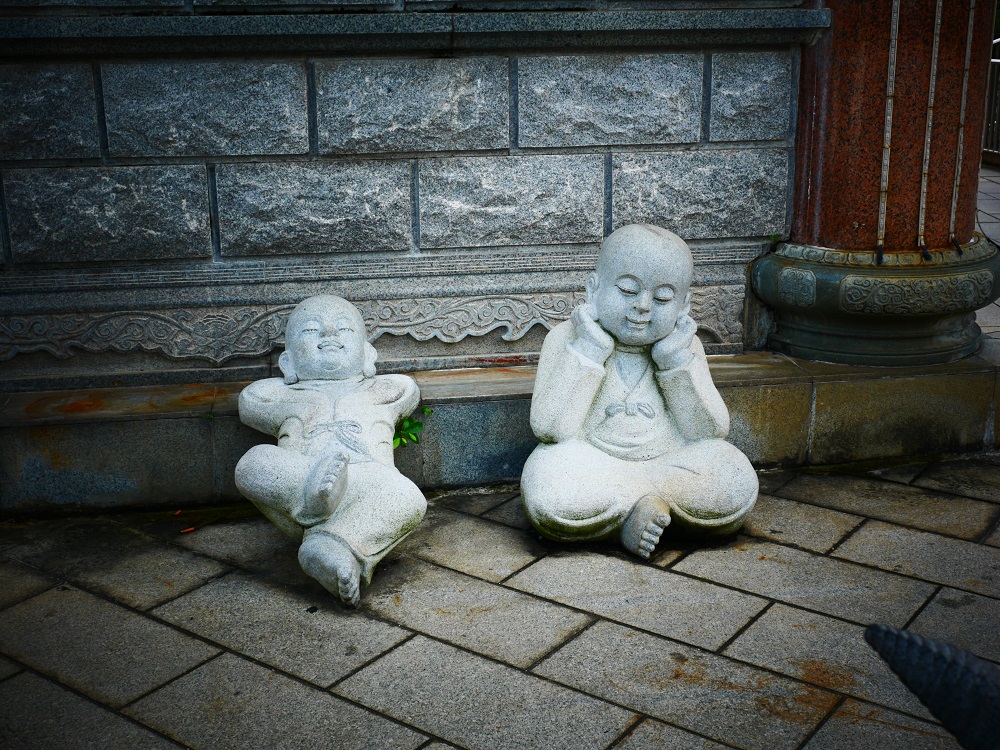
Temples, triads and Chinatown – in Malaysia, the closest you come to the orient is Penang Island. On this little island off the Malaysian west coast, Chinese settlers have been living for centuries, shaping the look, feel, smell and sound of the city of George Town.
Not wanting to miss an oriental adventure we stopped in George Town for four days, soaking up the atmosphere and seeing as much as we could cram in before heading further north to do boat work.
Penang has been a multicultural melting pot since the British got involved in the area in the 1700s. The largely uninhabited island was part of the Sultanate of Kedah when Francis Light of the British East India Company was scouting the area looking for a trading port. He persuaded the Sultan to trade it for military protection against the sultanate’s enemies, the Siamese from modern-day Thailand. After shaking hands on the deal, Francis hopped ashore from his wooden sailing ship, pegged a stick in the ground and renamed the lushly vegetated place Prince of Wales Island. There, he founded the city of George Town, creatively named after King George III. (Back then, blatant flattery was how you curried favour with the monarch, and owing to either very rigid customs or an astonishing lack of imagination successive British kings were called George for more than a hundred busy years of empire expansion, with the result that there are now many Georgetowns in the world.)
As it turned out, Light didn’t have the full backing of his company and the promised military support failed to materialise, which led to the Sultan attempting to take back Penang. Light managed to fight him off and over the years the British East India Company expanded their territory to cover parts of the nearby mainland. The British were embroiled in trade wars with Holland at the time and Light made George Town a free port to lure traders from the Dutch trading posts in Indonesia, which at the time were operating as heavily guarded monopolies. To further spite the Dutch, and to boost business, spice plantations were set up on Penang and not long after it was established, George Town became the trading hub of the region.

Lured by opportunity (Chinese), and brought in by the British to do the dirty plantation work (Indians), settlers arrived, bustling into the compact centre of George Town, bringing along their unique culture, aesthetic, food and religions. The narrow streets of George Town became a fusion of cultures and cuisine, and Chinese and Indian districts quickly developed, supporting temples of every faith. Clans and secret societies blossomed, supporting opium dens and opulent mansions located just a stone’s throw from the more modest tin-working quarter, shoe-making alley and fish-vendor street.


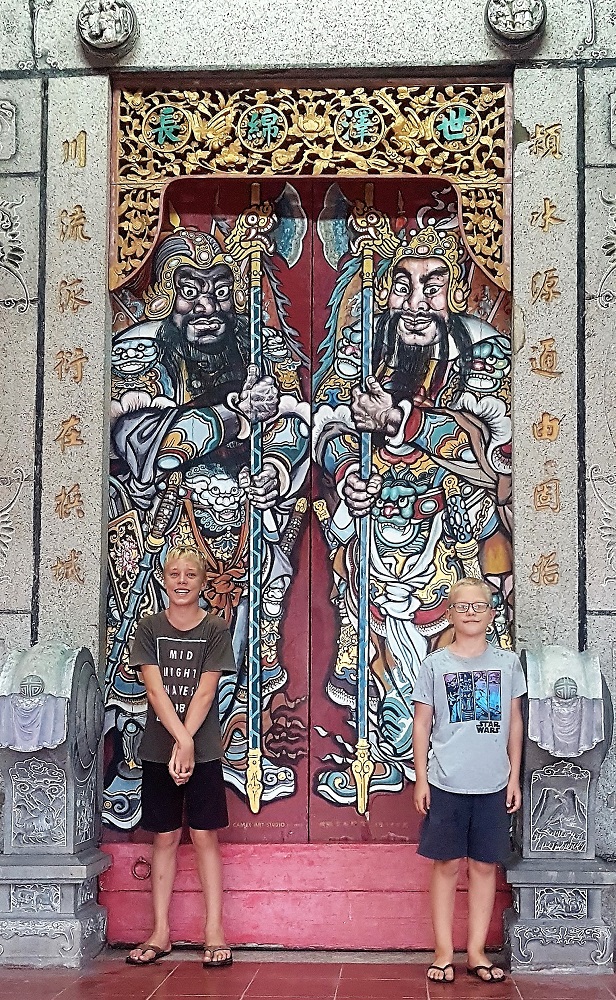
Today’s Penang is of course nothing like that of the past but we still found plenty to marvel about. The current population is 1.8 million people, of which 40% is Malay, 40% Chinese, 9% Indians and 9% ex-patriates from all over the world, with various other ethnicities making up the remainder. In George Town, more than half the population are of Chinese descent, and the old town has a distinctive oriental flavour. Turgid red paper lanterns drip from dark awnings and gilded Chinese lettering spill down the length of heavy wooden doors. Clan houses and temples are dotted everywhere, their elaborate terracotta roofs playgrounds for glittering dragons and scaled serpents, the silhouettes of which jut out sharply against the bright sky. In the temple front yards, intricately carved stone columns hold up heavy roofs and statuesque pudgy midget lions sit atop pillars, fangs bared and jaws parted in silent roars.

George Town is often referred to as a ‘living museum’, and a large part of the old town was conferred protected status when it became a UNESCO world heritage site in 2008. Although 45% of Penang’s population is Islamic, it is the temples rather than the mosques that makes George Town famous. And the town has it all – with a huge Buddhist population (about 36%) and sizeable Hindu (9%) and Taoist / Chinese folk religion (5%) minorities, George Town is home to more temples and clan houses erected for ancestor worship than you can visit.
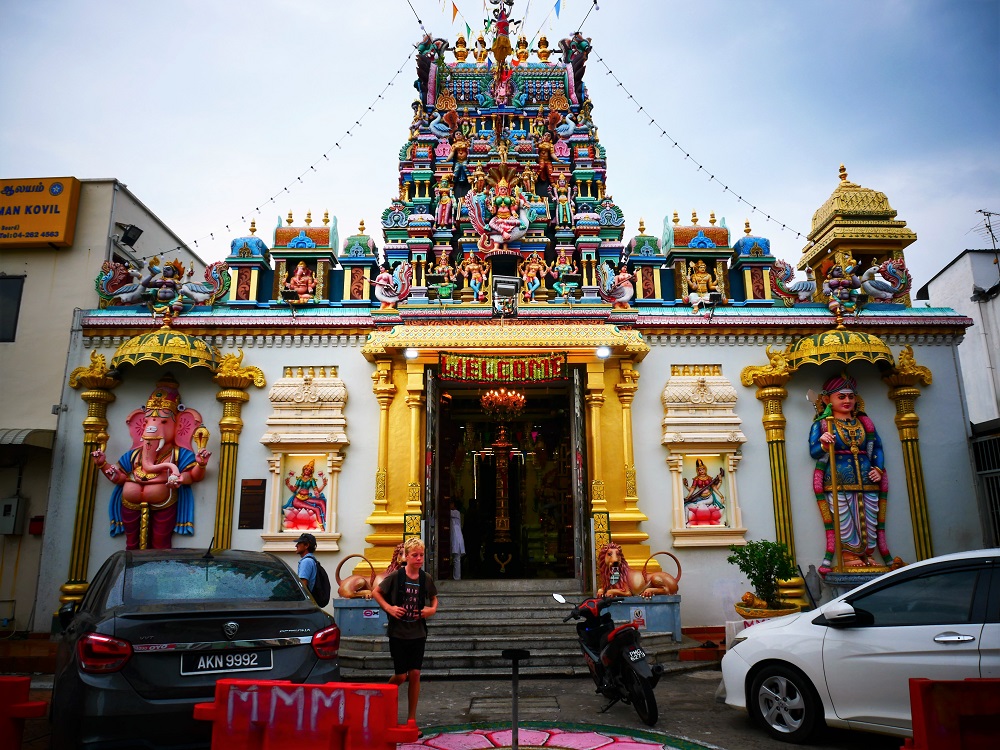

We walk around the narrow streets in the searing heat of the midday sun, dipping in and out of cool, shaded courtyards of old Buddhist and Hindu temples. Slinking into the thick, incense-laden air of plush red temple interiors we view golden Buddhas and shining statues of peaceful-looking ancestors kept behind glass and admire wall paintings of warlike heroes with whiplike goaties raising swords against enemies hiding behind our shoulders. In the Hindu temples, where glitter and chaos rule, we admire the messy, multicoloured plasterwork that is everywhere, recognising the fleshy elephant and blue many-armed deities hiding behind piles of flower and food offerings stacked atop elaborate tinfoil-covered podiums. The temples are alive with worshippers who lie prostrate before carvings depicting ancestors and light incense sticks in the outdoor cast-iron fire pits; incense which they wave around with closed eyes, lips mumbling prayers, before inserting the sticks into the trays of sand lining the altars. Orange-clad monks can be seen from time to time in the Buddhist temples and bearded obese men wearing dhoti barely covering their bulk lurk in the dusty corners of the Hindu temples.


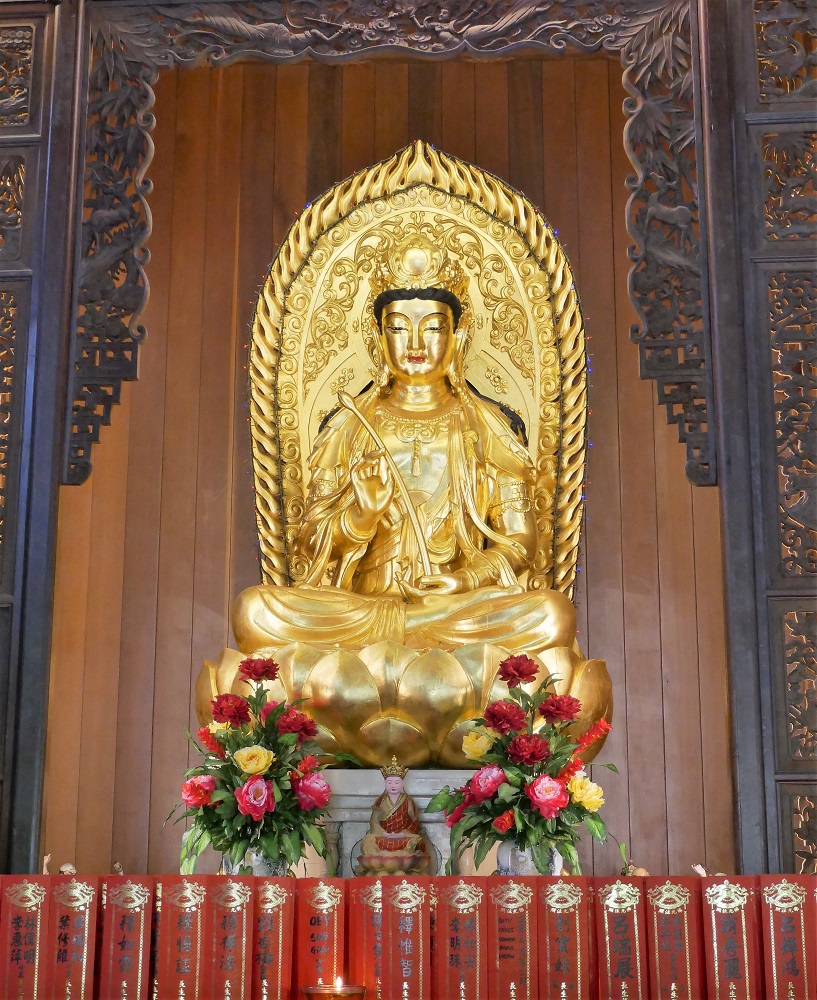
The biggest temple we visit is the hilltop Kek Lok Si temple, a myriad of buildings of worship including a seven-storey Pagoda containing 10,000 alabaster and bronze statues of Buddha, a turtle liberation pond and a 30-metre tall statue of Kuan Yin, the Goddess of Mercy of Mahayana Buddhism. Within the high-ceilinged halls lined with what must be literally millions of bronze Buddha statues, worshippers can buy slow-burning candles which presumably help to channel the prayers upwards into the heavens. Just like the opulent cathedrals of Christianity don’t tally with the message of Jesus, these incredible temples devoted to Buddha, a man who preached about freeing oneself from attachment to wants and worldly goods, seem incongruent. To my (admittedly non-religious) mind, nothing symbolises the painful admixture of lofty religious ideals with our all-too-human psyche better than the erstwhile Catholic habit of buying indulgences and the present-day Buddhist wishing ribbons, where you for only RM1 can purchase ‘booming business’ and ‘successful coupling’, as well as the perhaps more worthy ‘world peace’.


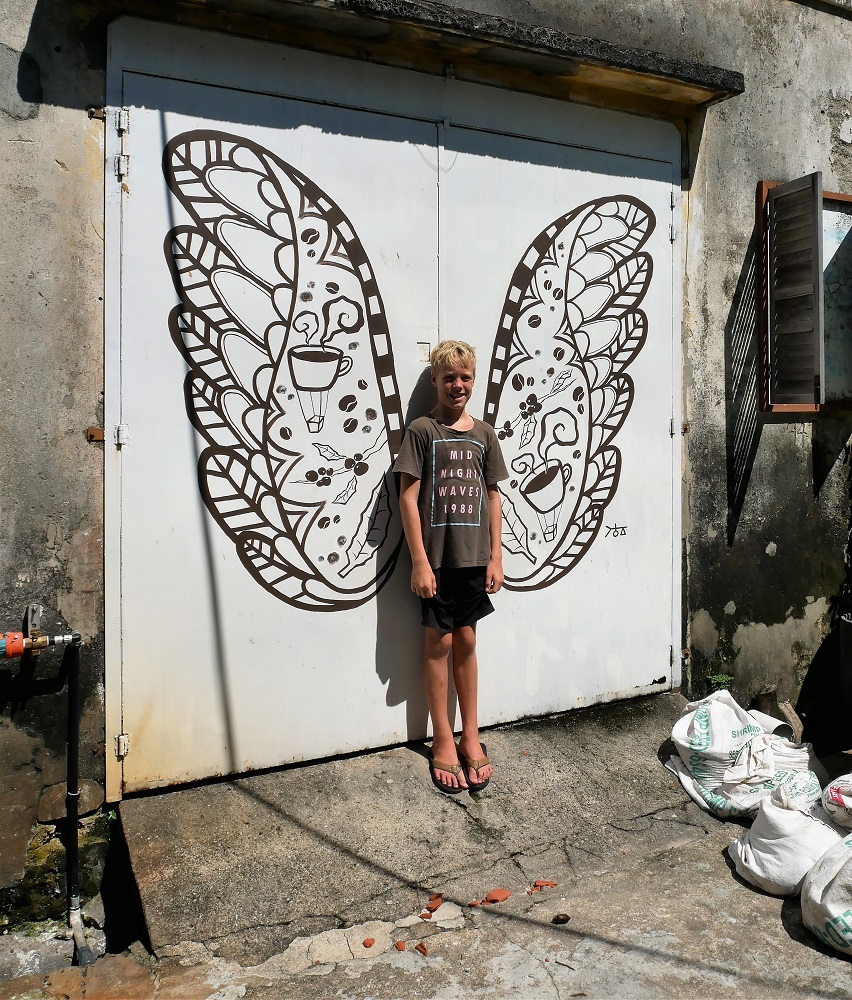
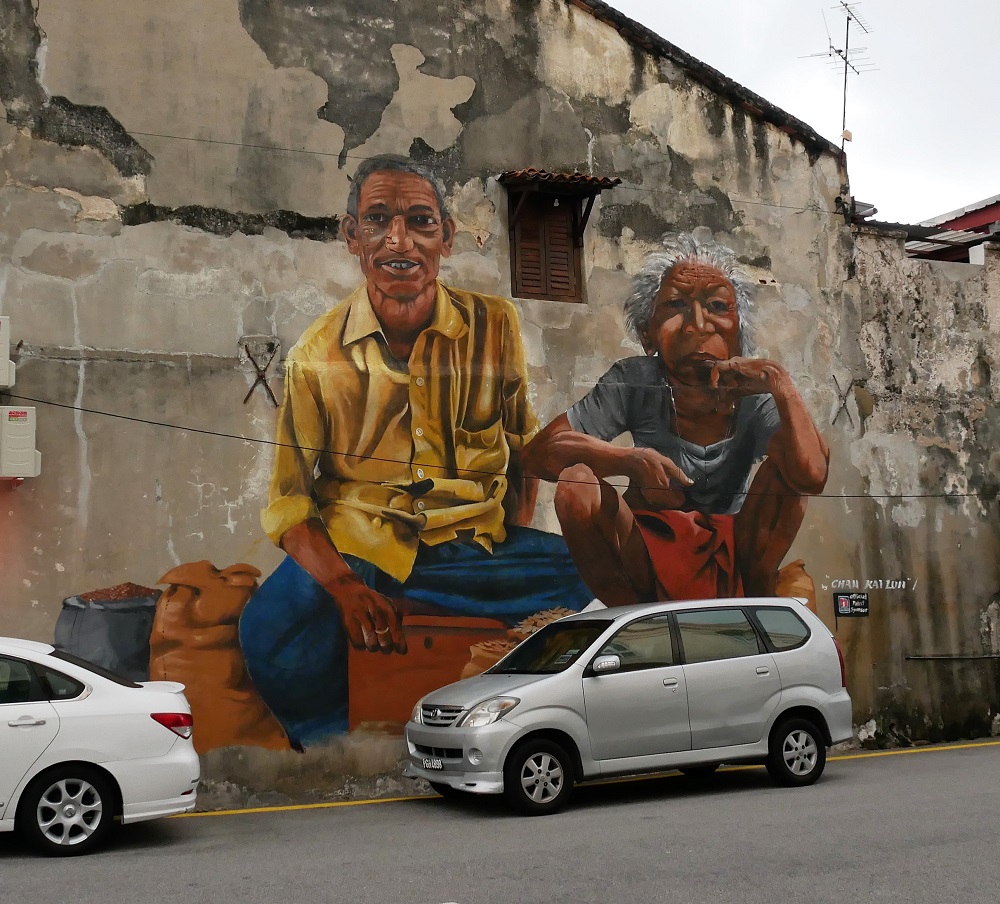
The living museum continues outside on the streets where beautiful murals cover many of the old, peeling plaster walls and wrought iron explanatory signs illustrate the city’s main sites of significance. The smell of food is everywhere, emanating from decrepit-looking hawker stalls clumped together in squares and along main streets from which vendors shout out the exotic-sounding names of their dishes: iconic Penang street food like assam laksa (tamarind-based noodle soup with seafood or chicken), mee curry (coconut seafood noodle soup), char kway teow (stir-fried rice noodles with shrimp), Hokkien hae mee (noodle soup with egg and seafood), wanton mee (dumpling noodles) and roti Canai (a south-Indian fried filled flatbread). At the front of the stalls are the raw ingredients: piles of pig blood sausage, cockles, cuttlefish, fungi and fish, and poorly exposed photos bleached by the sun show the wares, the images of soups in plastic bowls and piles of noodles on stained plates resembling those from a 1980s cookbook. More organised food halls are dotted all over the city; here stalls combine under one large roof, beers can be bought, and tables have numbers to which stallholders carry steaming dishes with proud smiles.


It is cheaper to eat out than to cook: a scrumptious dinner can be had for what amounts to NZ$4 and we sample everything we find. Popular with the kids are the claypot chicken, the roasted duck, and the stalls of Little India where samosas and onion bhaji are sold for pennies. It is Deepawali (Diwali) while we are there, the Indian festival of light, and Little India is fragrant with gajra, the flower garlands worn by Hindu women at festival time. Shops selling gold plating compete for customers with more traditional jewellers and the endless array of stalls selling shiny silken saris and elaborately embroidered salwar kameez in front of which matronly bhindied women stand, running the thick cloth over their knowing fingers whilst they bargain good-naturedly with the stallholder.

All of this is normal business for the town, and the multicultural tourists blend in with the crows of locals. Whilst I don’t normally like tourist places much, here the foreigners fit in, the French, Japanese and Lithuanian mixing effortlessly with the plethora of local dialects and I am grateful for the relaxed dress code that comes with the Chinese which means that I can wear shorts and tank tops on our endless strolls in the 35-degree midday heat.

The cultural and religious tolerance of Penang seems incredible in today’s world, but on our last morning there I witness the limits. The Tesco supermarket near the marina features a ‘non-halal’ section hidden near the back, where bacon, ham and Chinese pork sausages are displayed and the kids and I joyfully pick a ham to enjoy at Christmas. At the check-out, the bhindied salwar kameez-clad woman serving us indicates with her hand for us to pick it up from the roller band ourselves; she refuses to touch the unclean item even though it is triple-wrapped in plastic. I sympathetically ask her if it is hard to deal with non-halal products and she shudders and smiles stoically, obviously determined to do her job despite the revolting, disgusting items bought by ignorant westerners.

Four days in Penang is not enough, but onwards we must go and the morning after watching the crushing defeat of the All Blacks with a group of flushed, sauvignon blanc-swilling, black-clad Chinese businessmen in one of the marina bars, we slide out quietly, looking back all the while, stealing a last glimpse of the town of temples and tolerance.
 SV Bob The Cat