
It happened this morning, around nine o’clock. The boys had begged off home-schooling and had already made and eaten pancakes and jumped in the sea for over an hour. Whilst they were in the water a light rain started falling, and they climbed out, rushing inside to dry off and get changed. We had plans to do a walk and David and I were idly considering whether the rain was likely to worsen. He was gazing out over the horizon when suddenly he furrowed his brow.
“Holy cow,” he said, standing up abruptly.
Alerted by something in his tone, Matias stood up, following David’s gaze. “It’s a tornado!” he yelled.
“It’s a waterspout!” said David, awe in his voice.
I rushed outside to have a look. About 2 miles off the boat, a thick, black cloud hung low over the teal coloured ocean. As we watched, the cloud’s heavy lower reaches spiralled down towards the sea, and a solid wave of dark grey water rose, sea and cloud connecting in a long, spindly funnel constantly thickening and slimming, snaking its way over the water.
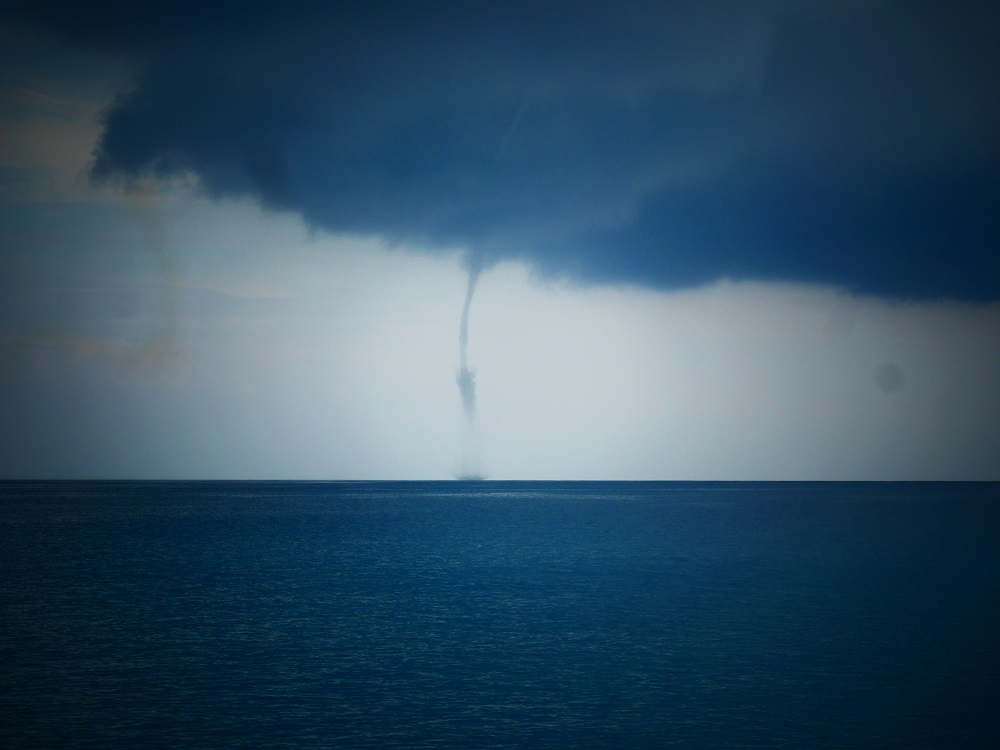
Matias grabbed the binoculars and made for the deck when suddenly he screamed. I looked over and saw that he had fallen on the way out of the cockpit and he sat crouched over, clutching his leg.
“Oh no,” I said soothingly. “Oh, I am sorry, that must hurt.”
“Don’t look, Mummy,” he said through gritted teeth. “It’s really bad. Really bad. I need a Band Aid.”
I ran inside to fetch some paper towel and the disinfecting wound spray while David bent over him. “We need iodine,” David yelled. “And some gauze.”
Dropping the paper towel I went downstairs to grab the medical kit. I ran out and put the box next to David, who was standing over Matias clamping shut a wound with his hand. Blood was pulsing out either side of his fingers, and when he released the pressure to drop iodine into the wound I saw a deep, bloody gash, about five centimetres long, which ran along his shinbone. As the wound opened it became apparent that the shin was cut to the bone. In amongst the blood welling up, I could see some weird white blobby fat tissue. I looked at the scene of the accident – a softly curved plastic edge of the inbuilt seat, no protrusions, no metal, no glass. How on earth did he cut himself on that?
“This will need stitching,” said David tersely.
I nodded. “We’ll have to go to Terempa.” The small township of Terempa, the capital of the sparsely populated Anambas archipelago, was about 20 miles away.
“But what about the waterspout?” said Matias. “We can’t move the boat, we might hit the waterspout!”
“It’s getting closer!” yelled Lukie. “Mummy, the tornado will get us!”
I fetched some steri-strips and as David fastened them and tied a bandage on top, we watched the waterspout progress across the horizon. Snaking this way and that, it wove its way from west to east. The few local fishermen in the bay started calling out from their little kayaks, waving their hands, pointing and shouting. I waved back, indicating that we had seen it and the bay quietened as we all sat passively in a windless void, watching the weather progress, its path governed by gusts local to the cloud.
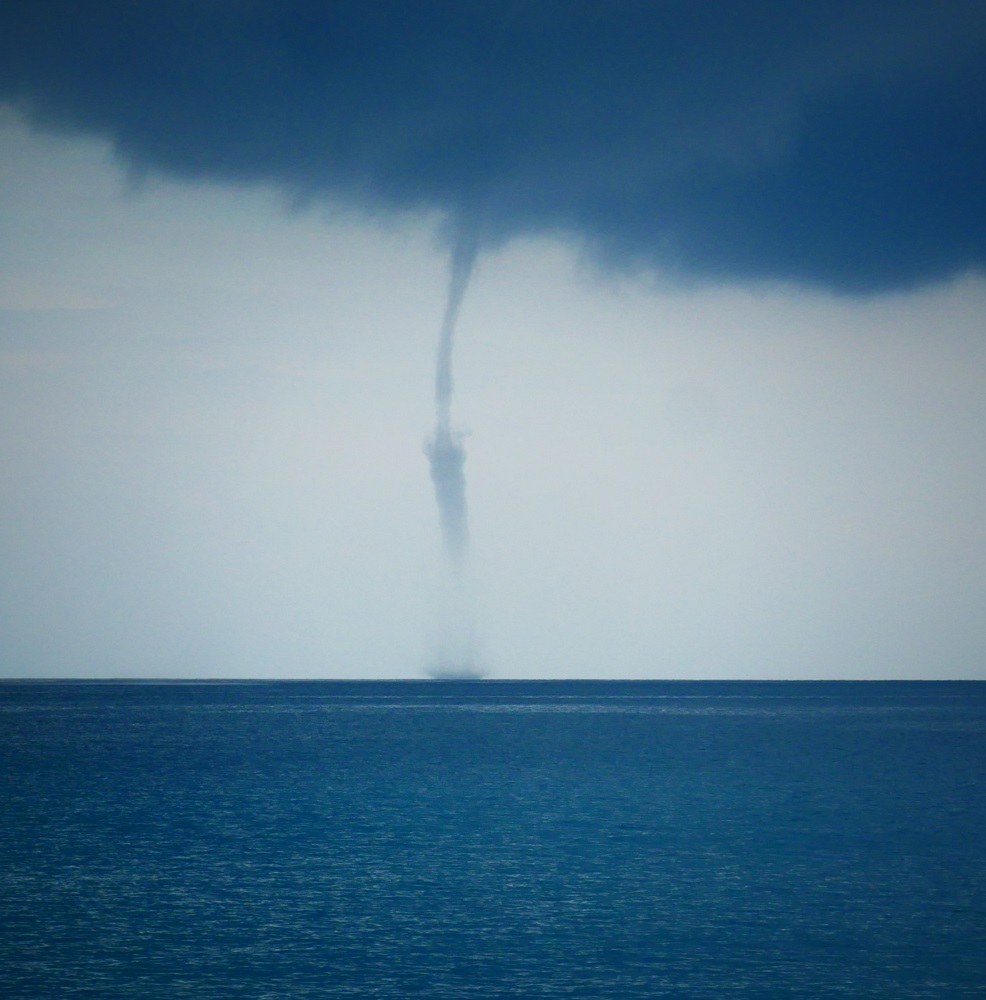
The system stayed a couple of miles away from our bay and within fifteen minutes the funnel-like spout dissipated into a heavy grey curtain suspended between the sea and the cloud. We drew heavy sighs of relief.
I fed Matias a dose of paracetamol and as I closed up the medical kit I reflected how lucky we were that we had any medicines left.
When we had checked into Indonesia three weeks previously, two Customs agents had come onboard to check out the boat. After taking a few selfies with the kids they asked to see our alcohol and medical supplies. We showed them the beer cupboard and I handed them one of our first aid kits and a box of medicine.
The older of the two looked through the packets with a frown on his face. He looked at me seriously over his black-rimmed glasses, holding out a pack of Strepsils.
“Tenggorokan sakit,” I said. Sore throat.
“Expired,” he said, waving the packet at me. “Look.” He pointed to the date stamp which read 21 June 2019. He spoke rapidly in Indonesian to his partner and held out the packet for him to see.
“Yes, but they are still good,” I said. He looked uncomprehending – his English was very limited.
“Bagus,” I said. Good. “Still bagus, tidak rusak.” Good, not damaged.
“Expired,” he said again. He rummaged further into the box and found a packet of Fucidine, an antibiotic cream. Clicking his tongue he held it up, waving it in my face. “Expired!” he said angrily.
I read the faint writing. March 2019. I sighed. “Yes, but still bagus. Not bad, tidak rusak. For infection. Still works.”
He looked at me accusingly and threw the packets on the table. Obviously not good enough.
I smiled. “Bagus bagus,” I said as I quickly gathered the packets with my right hand, holding out my left hand for the box which he was still rummaging through. “No hard painkillers, just paracetamol.”
He narrowed his eyes and spoke more Indonesian to his partner as he loosened his grip on the box.
“Bagus,” I insisted, sternly smiling as I snatched the kit out of his hand and swiftly turned my back to repack it. There was no way I was going to let him have our medicines.
Apparently, Customs and Biosecurity in these reaches take it upon themselves to confiscate expired medicine from yachts, with a view to sell it locally to augment their meagre income. Other yachties are wise to the trick and have a fake medicine box containing a few useless creams to give away, hiding away their real stash of serious medicine. Having never heard of uniformed medicine pilferers I had naively given them a genuine medical kit, and as I handed the pills to Matias I felt lucky that I got to keep my old drugs.
We’ve needed a few medicines while we’ve been in the Anambas. A couple of days after arriving here I picked up a terrible head cold, which saw me suck on out-of-date Strepsils and eat expired paracetamol by the handful. Two weeks later, Lukie succumbed to a hideous tummy bug causing near-instantaneous spray-vomiting of anything and everything he swallowed, for which I was eyeing up the rehydration sachets nestled deep in the pack. And now Matias’s injury, on which David poured lavish helpings of iodine which apparently expired late 2018.
It is obviously time to review our medical supplies and replenish out-of-date stock but that must wait until we are somewhere more developed.
With the waterspout safely dissipated, we made our way to Terempa, the capital of the Anambas to get Matias’s leg sown up.
The rainy weather had only started a week before and for once we were happy to see rain: our water maker had broken. That morning, a week earlier, I woke up in the early hours to a low humming sound. My sleepy subconscious registered a change of tone in the pre-dawn background noise. Was it waves? Or a boat nearby? I opened my eyes wide and reached up to switch off the loud fan that tends to drown all other night-time noises around our boat. Once the fan was off, I could clearly discern a low drumming sound.
Rain! I jumped out of bed. “Rain!” I shouted as I scrambled upstairs. “David! Rain!”
I ran outside and checked the sky. Yep – a monstrous black cloud blanketed the town of Terempa off which we were anchored, the feeble rising sun on the eastern horizon only emitting faint light under the heavy cloud cover. “Rain!” I called again.
A bleary-eyed David stumbled up the stairs, closely followed by Matias.
“Daddy!” Matias shouted. “Rain!” He jumped out on deck and danced, the chilly droplets beading his hair, goose-bumps forming on his arms.
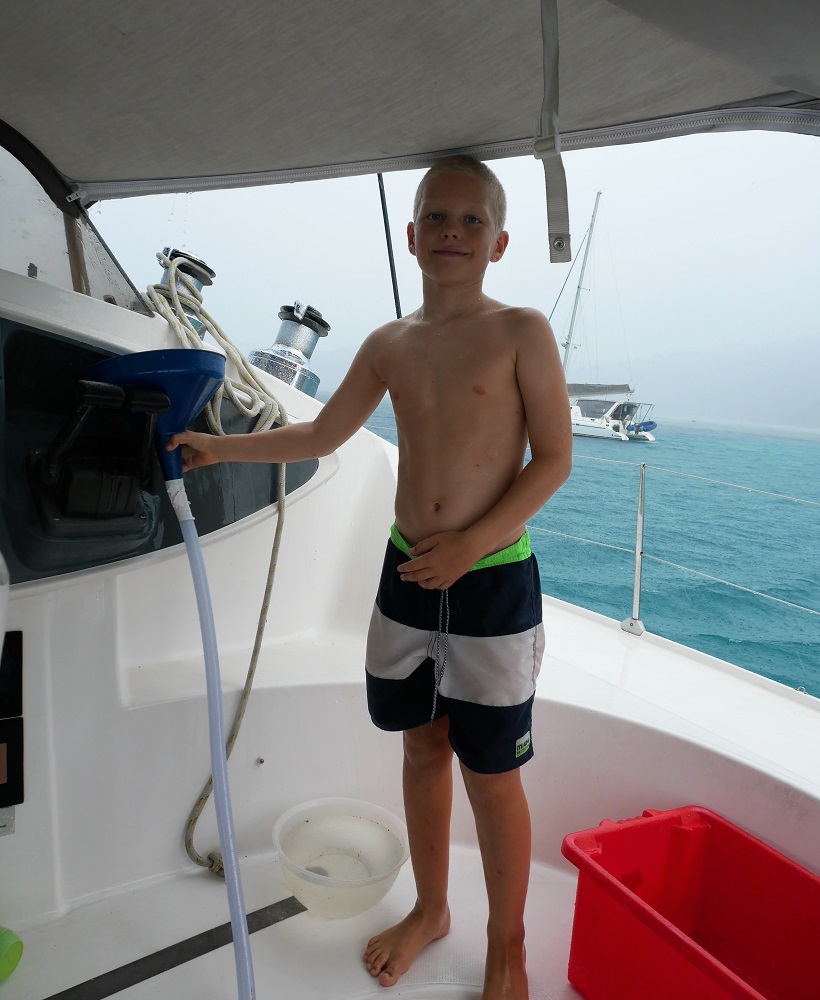
Stifling a yawn, David rubbed his stubble briefly before springing into action. He grabbed a funnel, jumped on deck and started wrestling a large tarpaulin on the foredeck, stringing up corners and stretching it tight.
“Grab that corner, Matias,” he yelled, pointing, his drenched figure dim against the grey beyond. Standing still behind sheets of rain Matias fastened a corner and tied it onto the railing, then fumbled to attach the corner to the halyard while David tied on another corner. Matias jumped to hoist the halyard while David weighted down the front of the tarpaulin and ran to get place funnels and guide translucent plastic piping. Lukas, meanwhile, had come into the cockpit to join me in hauling out fish bins, tubberware and salad bowls, placing containers to catch the rivulets of water dripping from the edges of the bimini. Within fifteen minutes the boat was full of plastic ware and piping and we gathered in the cockpit to dry off.
We needed the rain badly. Our water maker had broken two days before, about ten days into our stay in the Anambas, and our water levels were getting low. It was the pump that was broken, and there was no way to get spare parts, or a new pump, in this remote location – the nearest place was Singapore, two days’ sail away.
It wasn’t just us that were getting thirsty. The Anambas island group had not had rain in three months, and in the capital town of Terempa, people were queueing up to buy drinking water, whilst all over the islands, people were digging to find groundwater in ever-deepening wells.
In fact, it seemed most of Indonesia was praying for rain. Uncontrollable forest fires were raging on Borneo and Sumatra, leading to a cloud of low-hanging particulates that suffocated large swathes of the region. The ash cloud had been hovering over north-western Indonesia, reaching into Malaysia and Singapore, causing widespread school closures (600 schools closed in Malaysia alone) and health warnings for pregnant women to gather in air-conditioned government shelters until further notice, lest their breathing suffocate their unborn children.

Located between Borneo and mainland Malaysia, the remote Anambas island group was no exception. In our first week there, the whitish haze steadily increased, the visibility dropping day by day, with fewer and fewer of the archipelago’s islands noticeable from our anchorage in eastern Anambas, until one morning we woke to find the boat suspended in nothingness as we struggled to see a mile through the mist. Every morning, the deck was freckled brown by fallen ash, our feet congealing the dirt into prints that I spent hours scrubbing out with the saltwater hose.
The rainy weather heralded a change, the heavy droplets cleansing the air, the winds pushing the smog away from the islands. By the time Matias hurt his leg, a couple of refreshing rain showers had replenished the water tank, the plethora of tubing, tubberware and tarps steadily leading water from the deck, the bimini and the roof into our hold. When we’re careful, we use about 30-40 litres of water a day, and as the tank holds 800 litres we felt smugly satisfied that we had collected enough to survive for another couple of weeks.
It took us four hours to reach Terempa from where we were anchored when Matias hurt his leg. When we got there, we rushed him into the public hospital. It was a brand new building with a high roof, painted a cheerful blue with white trim. The place was largely empty, the only other patient a middle-aged woman lying on a bed in the corner, a drip attached to her arm. The moment we arrived we were surrounded by staff. A few of the doctors spoke a bit of English and we managed to communicate the situation – there was a wound, we thought it needed stitches. They guided Matias to a bed and a large group of what must have been the majority of the medical staff at the facility formed around him. Two doctors wearing scrubs peeled back the bandage and set to work urged on by the excited chatter of the remainder of the group. Within half an hour the wound was cleaned and stitched and we had been given a course of antibiotics and some painkillers to take home. When we tried to pay, they waved us away, shouting ‘gratis, gratis,’ free, free.
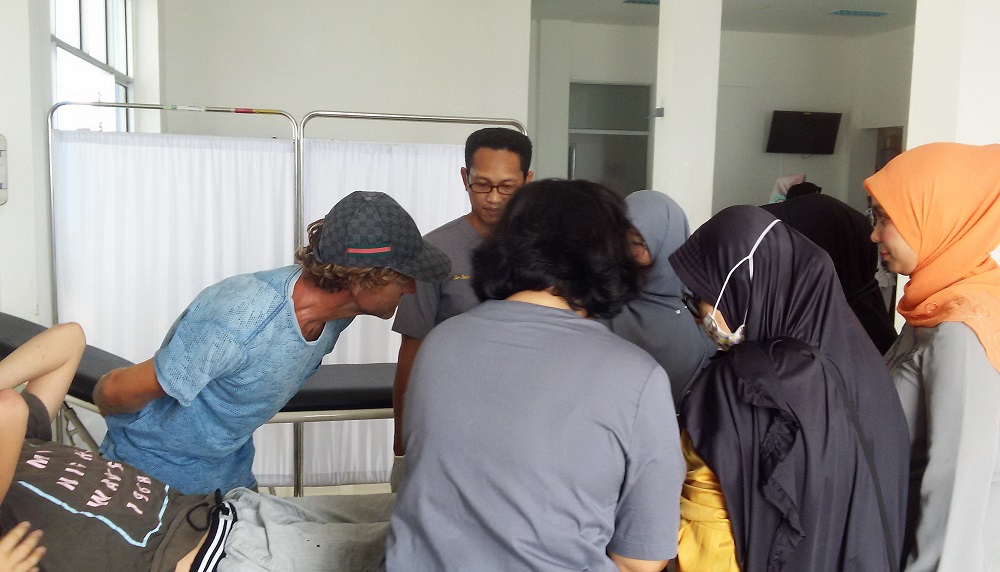
The stitches looked great. When we got back to the boat the rain had started up again and David rigged up the collection system once more, urging all available drops into our tank. We felt relieved that getting medical assistance had proven straightforward and looked forward to leaving the township behind. Tomorrow we’ll head off to see the last of the Anambas.
 SV Bob The Cat