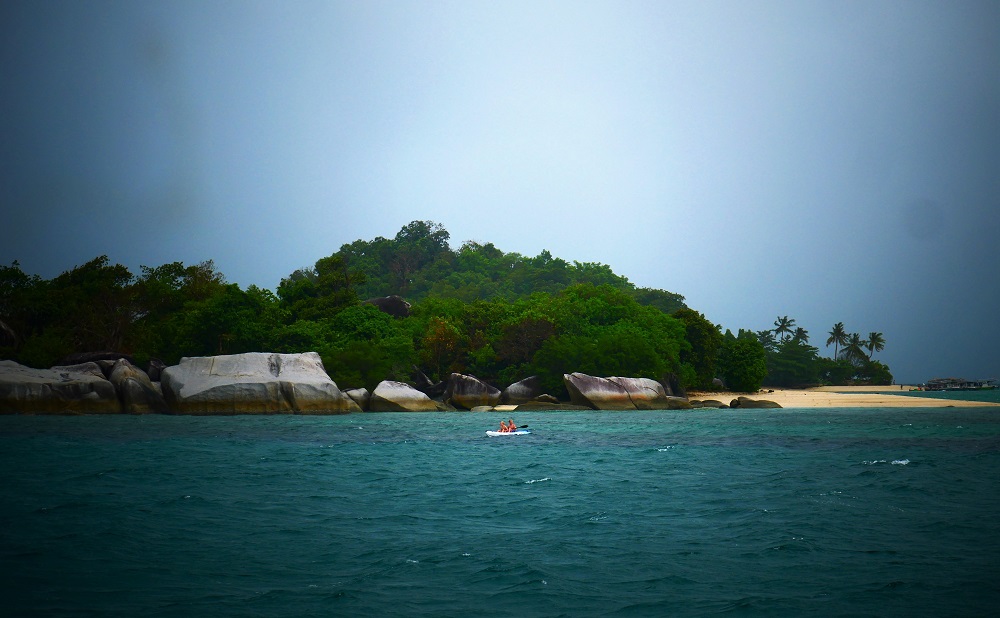
There are giant rocks around the islands of Belitung.
Our last stop in Indonesia was a hundred times better than I
thought it would be. I never thought we would see dragons after Komodo island,
but I was wrong.
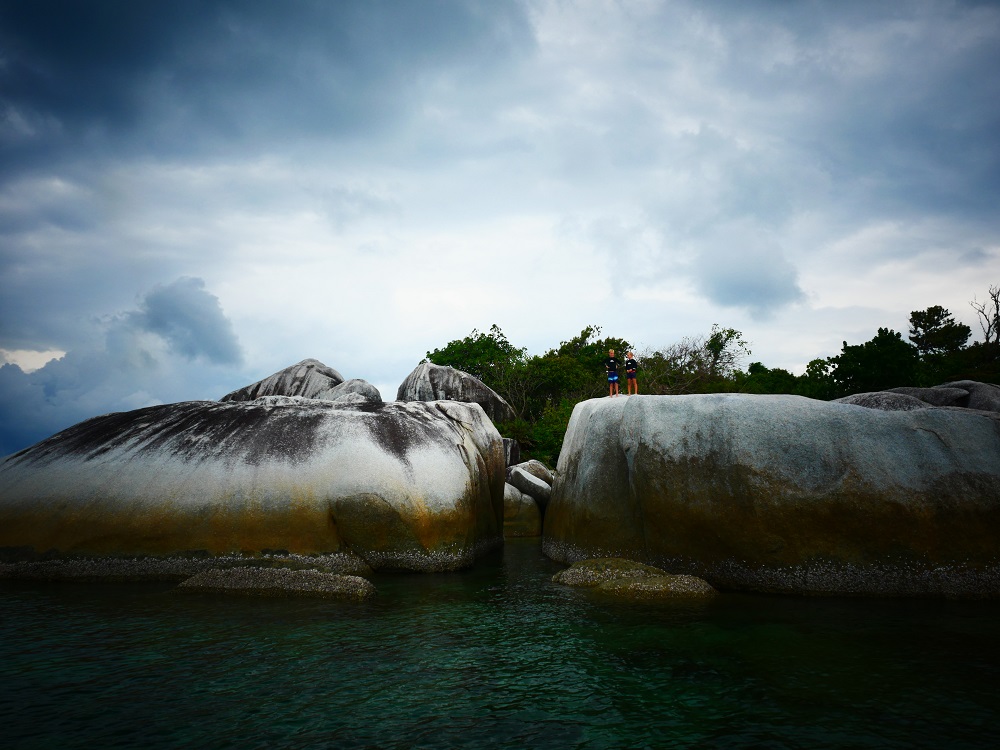
There are big rocks everywhere in Belitung.
Last week, Lukie and I decided to go ashore to play on an
island covered with big rocks. We were in a place called Belitung, a group of
islands in central Indonesia that we had stopped at on our way from Borneo to
Malaysia. Belitung is a beautiful group of atolls with smooth, white rocks surrounding
the small sandy islands filled with deep green forests. As soon as Lukie and I saw
the islands we went wild. We both wanted to go ashore to play pirates or
Jurassic Park.
Kayaking to Dragon Island.
We were anchored next to the biggest one. Our island had massive
rocks surrounding it as if a giant had carelessly dropped them, and a beach on the
opposite side. In the middle of the island there was a small forest.
When we got there, we dragged the kayak up the beach and ran
around, letting out all the energy we had stored up on the three-day passage from
Kumai. It had been a while since we had been on a sandy island, and this one
was amazing: the rocks on the island were massive and one had a stone ramp
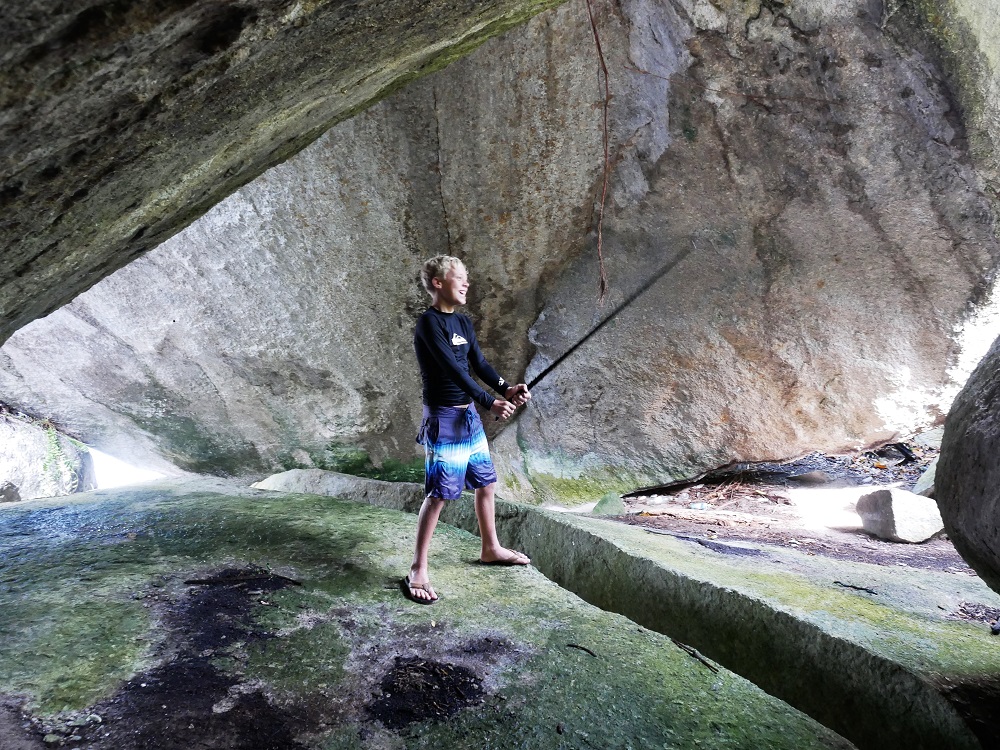
going up it. You could jump over gaps onto other rocks and hide in caves. One cave was full of bats!
Me in the bat cave, ready to fight Lukie.
Lukie and I were climbing around the rocks when he wanted to
play Lord of the Rings, so I hid in the forest which was full of rocks, vines
and trees, to get away from his monster. After a while of sneaking around in
the forest I wanted to leave but a rustle of leaves told me not to. I looked
around to try and find the source of the noise. Was it coming from under a rock?
No, nothing there.
I started to run up some rocks to get to Lukie who was calling
my name. On the way to him I went through some boulders to remain hidden.
Suddenly, something appeared in front of me. I nearly fell off the rock with
surprise. I ran up to Lukie, my heart racing.
“Lukie! Guess what I found!”
“Shush Matias, Mummy wants a photo.” Our mum was just off
the rocks in the dingy with her camera.
“I found a monitor lizard!”
“No way? You’re lying!”
A monitor lizard is sort of like a Komodo dragon, just smaller and more grey or black. The one I saw was about 30 cm long.
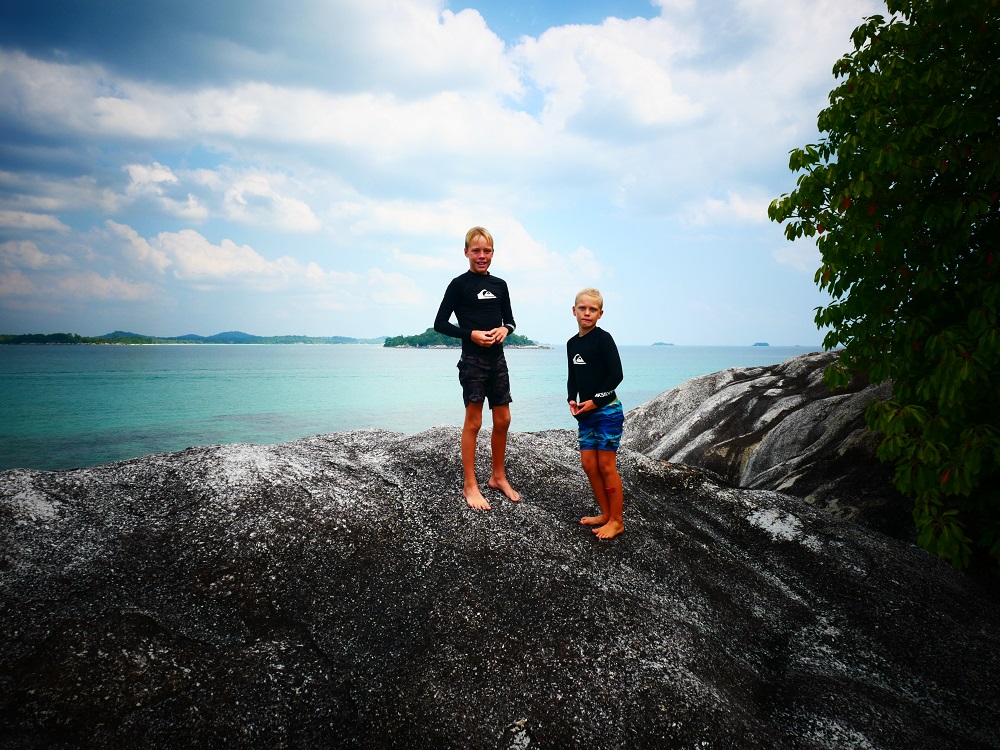
Lukie and I on the large rocks.
My Mum said it was lunchtime and we promised we would come soon
in the kayak. But we shouldn’t have stayed. As soon as she had left it started
to rain and it became very windy. Lukie and I attempted to kayak back to the
boat but we were pushed downwind and ended up on the beach. Rain started to
pour down so hard it hurt so we tried to find shelter:
First we hid under an overhang with water pouring off it.
The water fell so heavily it was like a massage. We played with shells under the
waterfall for a while but then we got cold.
Then we moved to a little overhang high up near the bat cave.
We had to climb up there but we didn’t want to stay because it was too slippery
and it was a 10-metre drop at least if we slid off. The overhang wasn’t rain
proof, so we had to find somewhere else.
Last we went into the bat cave, which was full of tiny bats
the size of a baby’s fists. There was a lot of bat poo and it smelled strange, so
we left.
Once the rain had stopped we left the cave and on the way
through the forest we found a blue egg which was half broken. I picked it up
and showed it to Lukie. It was very leathery and had some yellow, runny yolk in
it. I thought it was probably a monitor lizard egg so we didn’t keep it, just
in case the mother would come and eat us.
We went onto a stone platform near where I had heard the rustle.
This time we didn’t hear anything but we saw the culprit. A big lizard was
looking at us, it was about a metre long: a monitor! It darted towards us like
a slingshot bullet and disappeared behind the rock we were looking from, which
was only about a metre away. We shot off the stone platform onto the beach,
quickly putting the kayak in the water. The wind had calmed down so we managed
to get back to the boat.
A few days later we went back to the monitor lizard island to
look for it again. This time our Dad was with us. At first, we heard the lizard
but didn’t see it. My Dad was scrambling over the rocks and I climbed after him.
When I reached him, he said that he had seen a monitor run under a rock. After
a bit of climbing we jumped down next to the hole and looked in. I saw it run
further into the cave and then it was gone. I got my camera ready and pointed
it in the hole.
“Matias, give your camera to me, I have an idea.” My Dad turned
on the flash and took pictures of the hole. After a couple of shots, we decided
it had escaped. I was a bit disappointed because I wanted to prove that I had
seen it and I wanted a photo.
Belitung was our last stop in Indonesia. There, we did
quarantine and harbour master and everything else we needed to do to leave the
country because we were going to go to Malaysia so we could fly to Europe to
see our family.
We were leaving Indonesia: NOOOOOOO!!!!! I am going to miss
the food, the animals and our friends. Well, some of our friends are in Malaysia,
so we will hopefully see them there.
There are certain things in life that you just don’t want to miss, and for us, a family of wildlife lovers travelling through Indonesia, seeing the orangutans of Borneo was one of them:
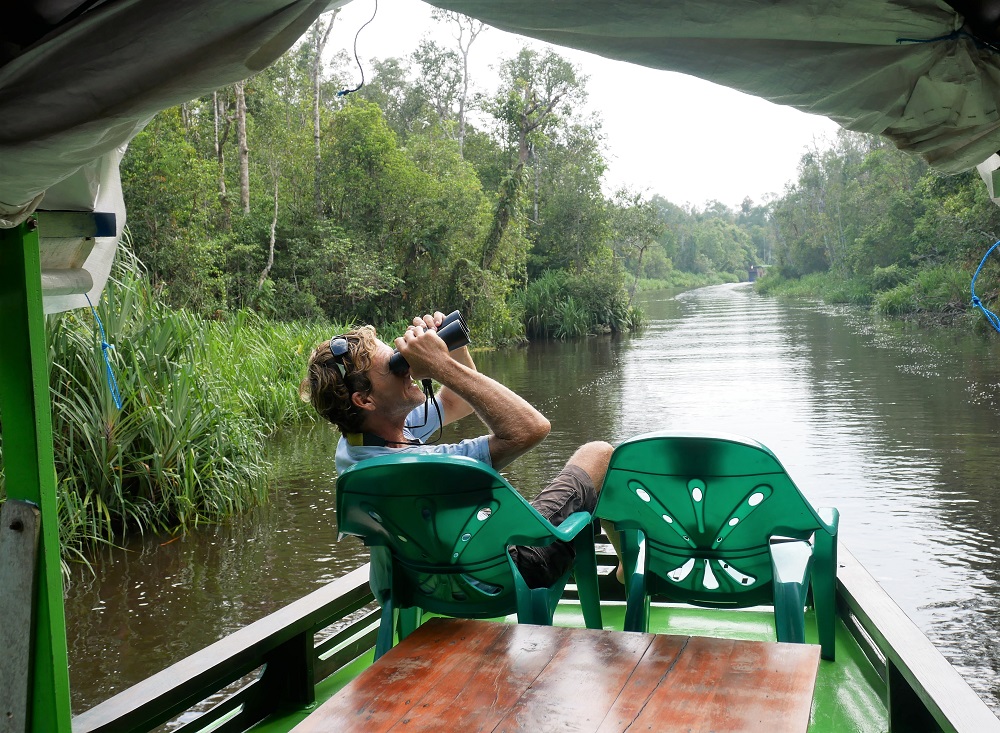
“Look, Mummy, there it is,” whispered Lukie as he pointed the binoculars up at a treetop some 30 metres away. “It’s huge!”
The tree shook as the giant shifted its weight, the slender
trunk bending precipitously.
Matias touched my arm. “There’s a baby too. Can I please have your camera?” he begged. “I really want to take a close-up picture, and your zoom is better than mine.”
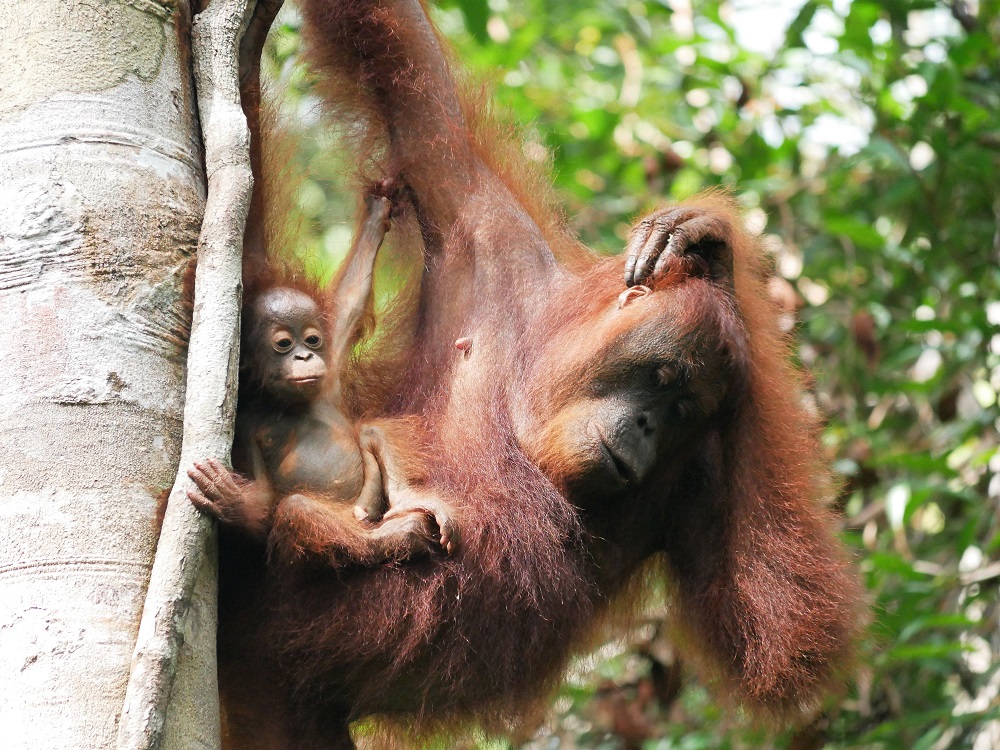
I focused the camera on the dark shape in the treetop, using the zoom to get a better view. Up close I could see the beady black eyes, the soft unkempt orange fringe lining the wrinkled dark face, the fuzzy baby clinging onto long strands of chestnut fur. They were looking straight at me, peacefully noting our presence with no apparent alarm.
“They’re wonderful!” I said before handing the camera to Matias.
The mother turned her head and stretched out one enormously long left arm to grab a branch of a nearby tree. She leisurely leaned her full body weight towards the new tree and grabbed hold of a branch with her left foot, leaving her hanging casually outstretched between two tall trees, her baby encircling her waist with its long arms.
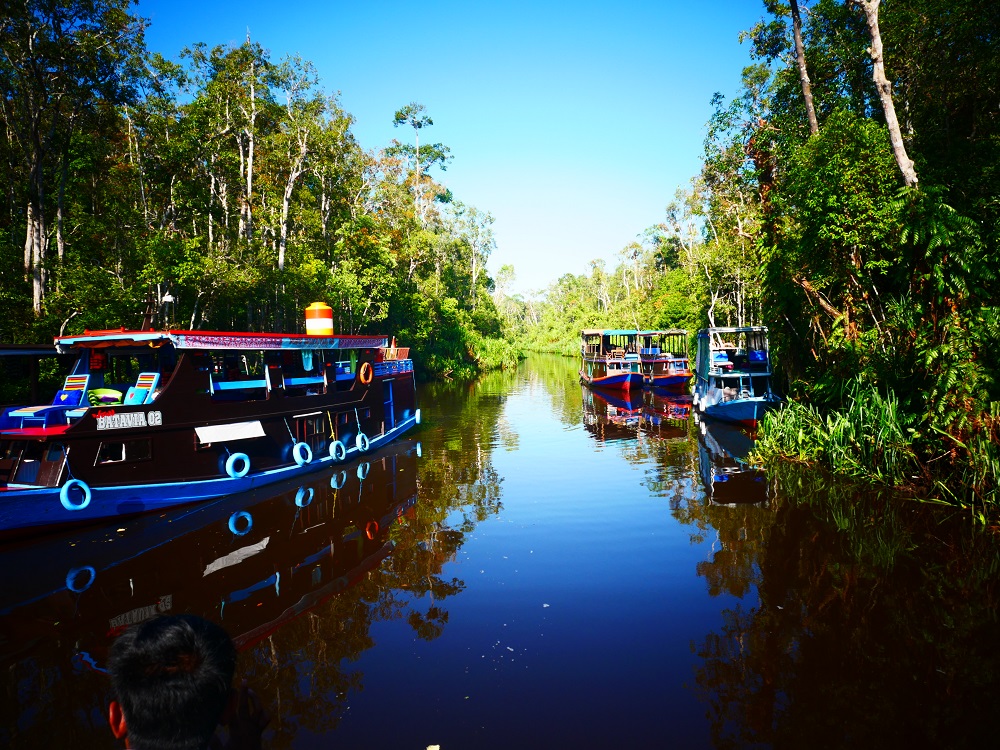
We were on a klotok, the onomatopoeically named brightly painted local houseboats used to take nature lovers up the Kumai River to the Tanjung Puting National Park in Borneo. Aria, our guide, had spotted the orangutans from his seat at the front of the boat and signalled for the driver to stop so that we could have a good look.
Quietly we sat there watching the sizeable orange shape calmly
staring back at us through the jungle foliage. She was on the northern side of
the river, which is not part of the National Park.
“Can she cross the river, to get to the National Park?” Matias
asked Aria.
Aria explained that orangutans don’t swim across the river and that the female and her baby were therefore stuck in the unprotected narrow band of vegetation shielding the river from the millions of hectares of ever-expanding palm oil plantations destroying the Borneo jungle of the hinterland.
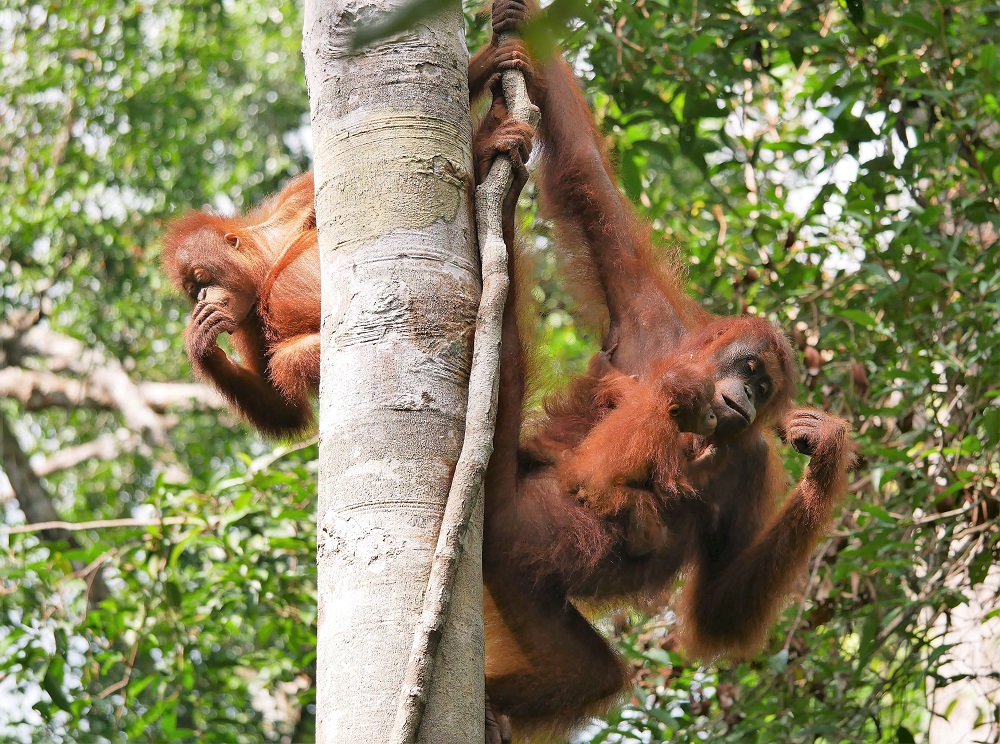
Just hanging around.
We had come to Borneo on our way north from Bali. The third
largest island in the world, Borneo is smaller only than Greenland and New
Guinea. The southern roughly three-quarters of the island belongs to Indonesia
and the rest is Malaysian apart from the tiny Sultanate of Brunei. In
Indonesian, Borneo is called Kalimantan, a word rooted in the Sanskrit term for
‘burning weather island’, referring to the searing heat and dense humidity of this
equatorial jungle-clad location. It is just the kind of climate that an
orangutan prefers.
We had arrived in Kumai the day before, anchoring in the peat-stained dark brown river off the town of Kumai after a four-day passage from Bali that I would call nightmarish but which David merely labelled ‘stimulating’. We had good wind and an incredible amount of traffic leading to tense night watches where I sat, knuckles white, gripping the binoculars, frantically trying to make out which of the tiny, deceptively faint flashing lights were fish attracting devices (FADs) and which were fishing boats, and whether we were on a collision course with the incredibly bright lights dotting the horizon which might be squid boats, tows, cargo vessels, tankers or a healthy mixture of all four.
Squid boat on anchor.
The passage took us through a huge fleet of a thousand or
more squid boats, parked up in dense clusters on the extensive shallow sea to
the far south of Borneo, their bright lights ruining my night vision as they
lured unsuspecting cephalopods to the surface, their presence crowding my radar
screen.
Deciphering the meaning of different lights on night passage can be hard. Squid boats are generally stationary and intensely lit, but when they move they display the typical Indonesian fishing lighting (i.e. random cheerfully coloured flashing lights). The FADs and small fishing boats are hard to make out because they do not show up on the radar, and their faint multi-coloured blinking lights were hard to make out in the luminous sea of squid boats lighting up the moonless sky like a first world city. Cargo boats and tows can be distinguished from the squid boats by the fact that they are moving and generally use standardised lighting (i.e. showing starboard and port colours) and some of them are even on AIS, an extra bonus. Combine this confuddling mass of innovative approaches to lighting with intense sleep deprivation and a fast-moving sailboat and you get one of my versions of a passage nightmare (there are others: upwind sailing, no-wind sailing, nearshore sailing….).
I don’t mind moving through a sea full of boats in the
middle of the night (OK, that’s a lie – I do mind, but not as much) when using
the engine. But on this passage we were sailing dead downwind in a respectable
breeze with a goosewing sail configuration (mainsail on one side, genoa on the
other) which leaves very little leeway for manoeuvring, as any deviation from
course could lead to a crash jibe. This meant a narrow 10 degrees of downwind
leniency on the course steered, and my only option for bailing in a potential
collision situation was to head upwind, which given a catamaran’s tendency to
drift rapidly downwind as it is sailing along, is never a great option for
avoiding oncoming traffic. All this meant night watches spent nervously weaving
my way through the never-ending squid fleet, dodging one vessel only to see
five more ping up on the radar, the whole affair leaving me so traumatised that
once my watches had finished I had trouble sleeping, and when I did fall asleep
it was a broken, uncomforting rest, harrowed by vivid dreams of terrifying head-on
collisions with spiky squid boats.
“It’s not so bad,” said David cheerfully after the first
night. “I prefer squid boats to FADs. At least they are stationary, which means
that you can easily avoid them.”
“Sure,” I sighed. “I just prefer open ocean, with no squid
boats, no long and poorly lit tows, no small but lethal FADs….”
One of the many tow boats heading out of Borneo.
Despite the stimulating sailing conditions we got there and
as we approached Borneo the weather became hot and humid and the seas stilled,
until on the fourth morning we arrived at the flat, brown expanse of the Kumai
river mouth. I was expecting a mountainous interior but southern Borneo is flat
as a pancake, a large low-lying semi-inundated peatland covered in dark short
jungle.
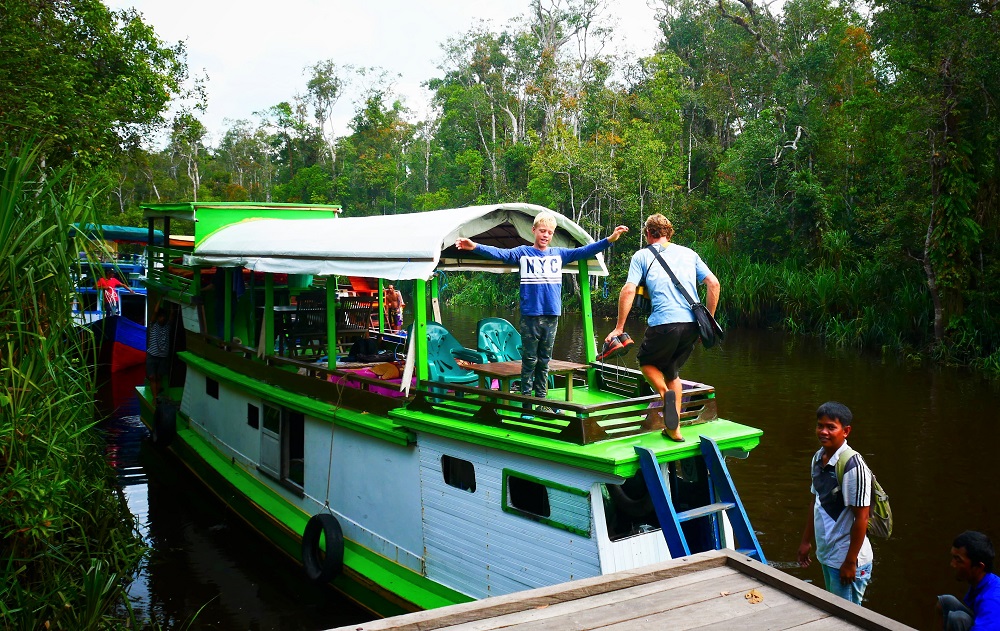
Boarding the klo-bang-tok.
To see the orangutans we organised a three-day trip up the
Kumai River to the Tanjung Puting National Park on a slightly dilapidated
bright green klotok complete with a captain, a cook, a boatboy and a wildlife guide.
The river is full of these picturesque houseboats, travelling slowly up the
still waters, brightly coloured dots against the vivid green walls of nearshore
vegetation. Our klotok was at the cheaper end of the spectrum, and after a few
hours of travelling up the river we realised why.
“Ours is a klo-bang-tok,” said David, commenting on the
unhealthy sounding engine which had a tendency to stall whenever we slowed down,
causing no end of hassle for the captain and the boatboy who then had to work furiously
to restart the thing. During the lengthy restarting procedure we would drift
perilously down the river, our cook and boatboy shouting loudly to alert
oncoming klotoks to our compromised engine so that they could take appropriate
evasive action.
“We’re the slowest boat on the river!” exclaimed Matias
jubilantly as yet another klotok overtook us, and he was right, but it didn’t matter
– the toilet was tolerable, the beds comfortably enshrouded in dense mosquito
nets, the food wonderful, and our slow progress meant that we got to see
everything in slow motion, sometimes netting a view twice when engine failure
forced us backwards.
The kids relaxing in their aft double bed.David looking for wildlife from the klotok bow.River vegetation.Klotoks lining the river.
The klotok trips up the river Kumai take visitors to the Tanjung
Puting National Park. Orangutans are everywhere in the south Kalimantang jungle
but are more concentrated in the 400,000 hectares of forest of the national
park, which was first protected in the 1930s by the Dutch colonial government to
protect the resident orangutan and proboscis monkey populations of the area. It
became a UNESCO Biosphere Reserve in 1977 and a national park in 1982.
In Tanjung Puting’s Camp Leakey is an orangutan rehabilitation
centre. The centre was established in 1971 by the world’s first orangutan
researcher, Dr Galdikas, to provide a site where orangutans rescued from
captivity (e.g. casualties of the palm oil plantation expansion entering the commercial
pet trade) could be re-established successfully in the wild. Orangutans enter
captivity mainly as babies when their mothers are killed for bush meat, as agricultural
pests, or in the palm oil plantations that are rapidly expanding and overtaking
the jungle. The locally run Orangutan Foundation International organisation rescues
the captive orangutans and brings them to the rehabilitation centre for care,
and to date more than 300 ex-captive orangutans have been released into the
wild of the park.
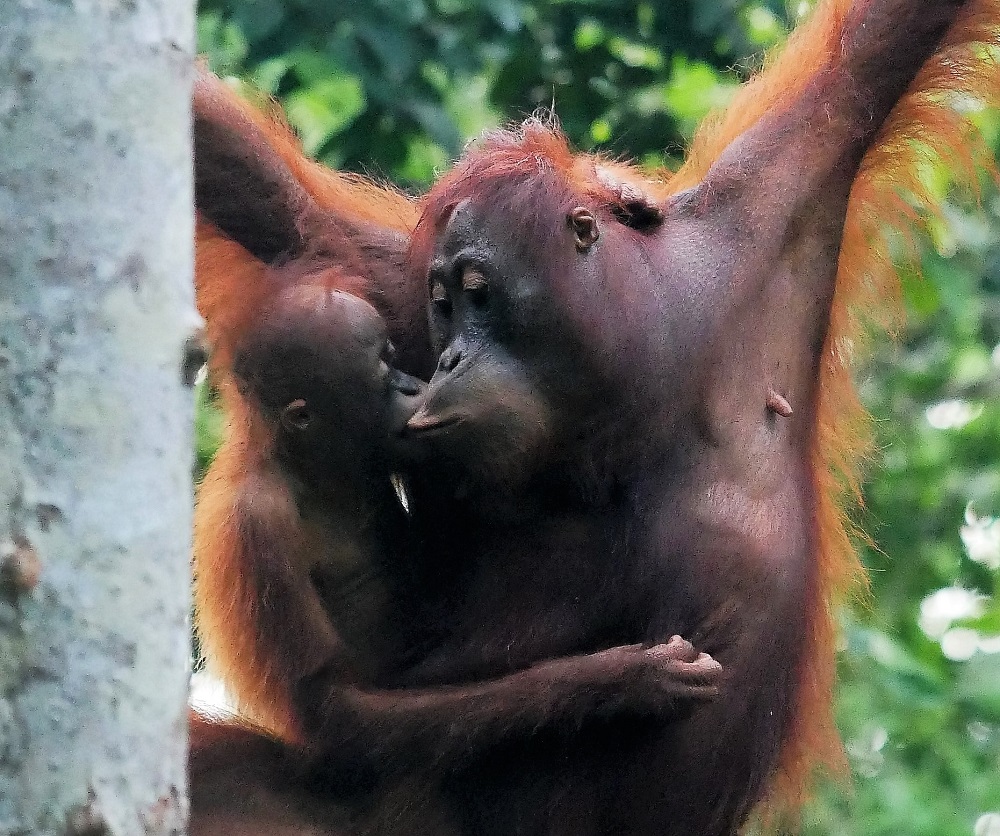
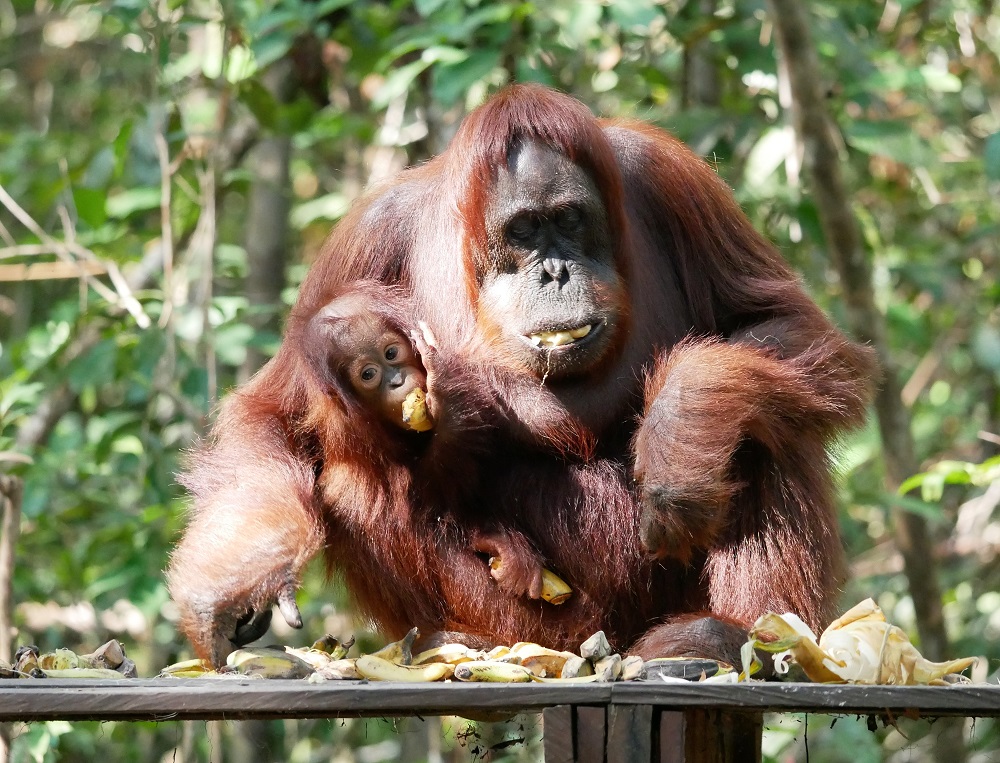
Near-naked baby resting atop Mum’s belly.
The rehabilitation involves health care as well as teaching juvenile orangutans how to get on in the wild. Orangutan babies live with their mother for 5-6 years in the wild, during which time she teaches them social interaction as well as how to forage and which plants and insects are safe to eat. At the rehabilitation centre, human carers replace the mother and attempt to teach the juvenile orangutans self-sufficiency.
Tired mother taking a break from teaching her young.
To ensure that the released animals do not impact adversely
on the wild population of the area, three feeding stations have been established
in the national park to supplement the food that the ex-captive animals find in
the wild. Here, the park rangers provide food like bananas, sweet potatoes and
sweetcorn once a day, and if any of the rehabilitated animals are struggling
for food, they can come and avail themselves of a free lunch. The feeding
stations provide an excellent opportunity for tourists to view the orangutans up
close, and the wildlife tours from Kumai bring scores of visitors up the river
every day, wildlife lovers who stand sweating with us in the humid jungle,
absently swatting away mosquitoes as they gawp at these fascinating animals.
Just hanging around: a subordinate male lounging in the jungle foliage.
Orangutans look amazing. They are like huge, furry humans
with incredibly long arms and thick, heavyset chests crowned with massive
shoulders atop a short, spindly, bowlegged bottom culminating in large,
hand-like feet. They are incredibly hairy, rippling muscles showing under a
thick, fuzzy, orange fur. On the ground they walk either upright with a
knees-out-bowlegged gait or on all four resting their heavy upper body weight
on their knuckles, but really they are very rarely on the forest floor, preferring
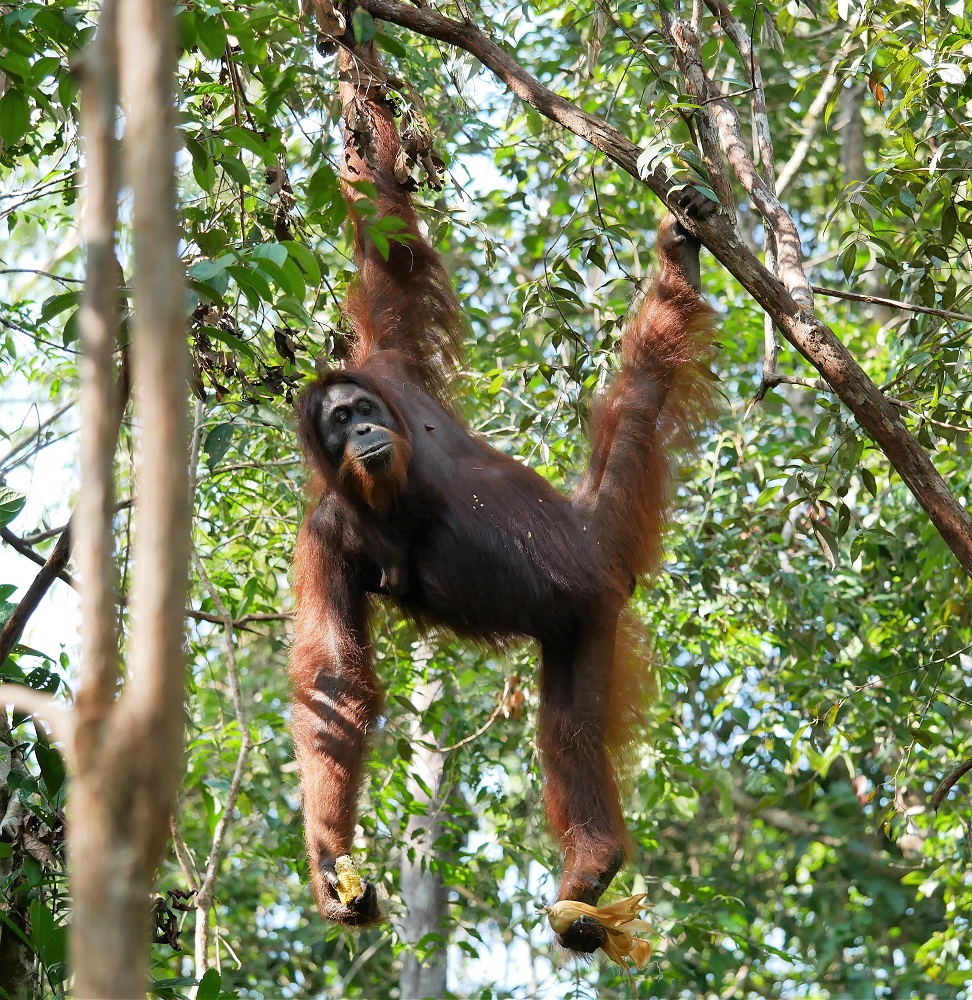
instead to spend their life in the treetops. Here they are incredible to watch,
a blur of orange fur moving swiftly through the foliage, swinging from branch
to branch like Tarzan (although I guess strictly speaking he got it from them),
moving fluidly from tree to tree using their weight to pivot the treetops as
they swing backwards and forwards, increasing momentum until sufficiently close
to the next treetop to grab hold and swing over. They comfortably spend hours just
hanging from branches, their long furry limbs sharply outlined against the
bright sky beyond the canopy.
Furry limbs silhouetted against the sky.
Unlike other apes, orangutans are solitary, and natural interactions between individuals are limited to brief mating events, the lengthy dependency of young on their mother, and loose gangs of youths who hang together before they start reproducing.
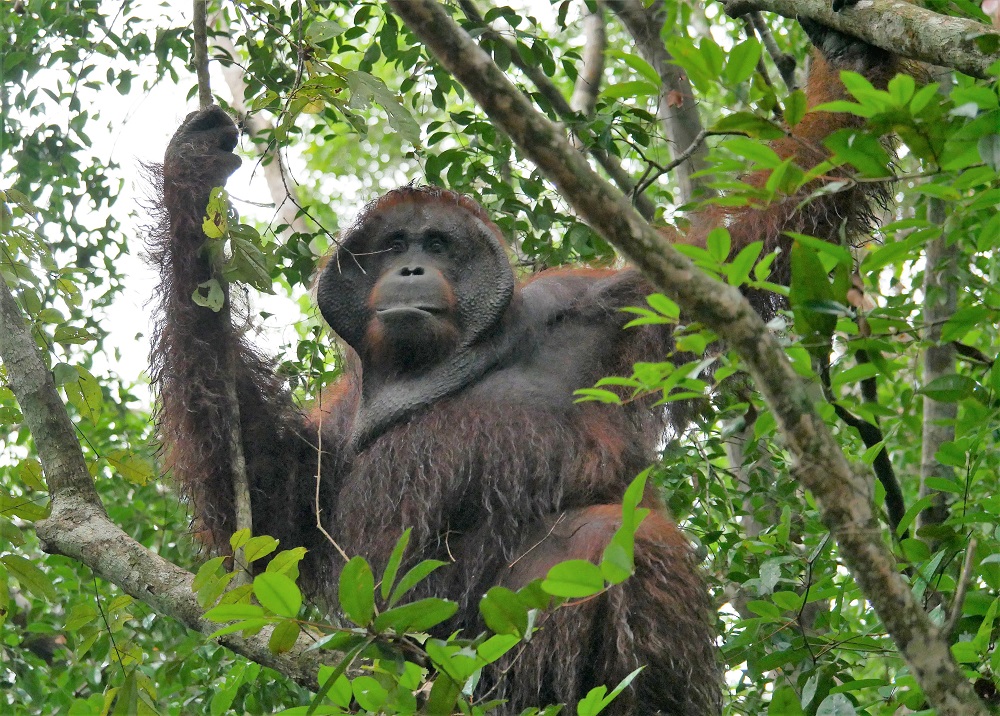
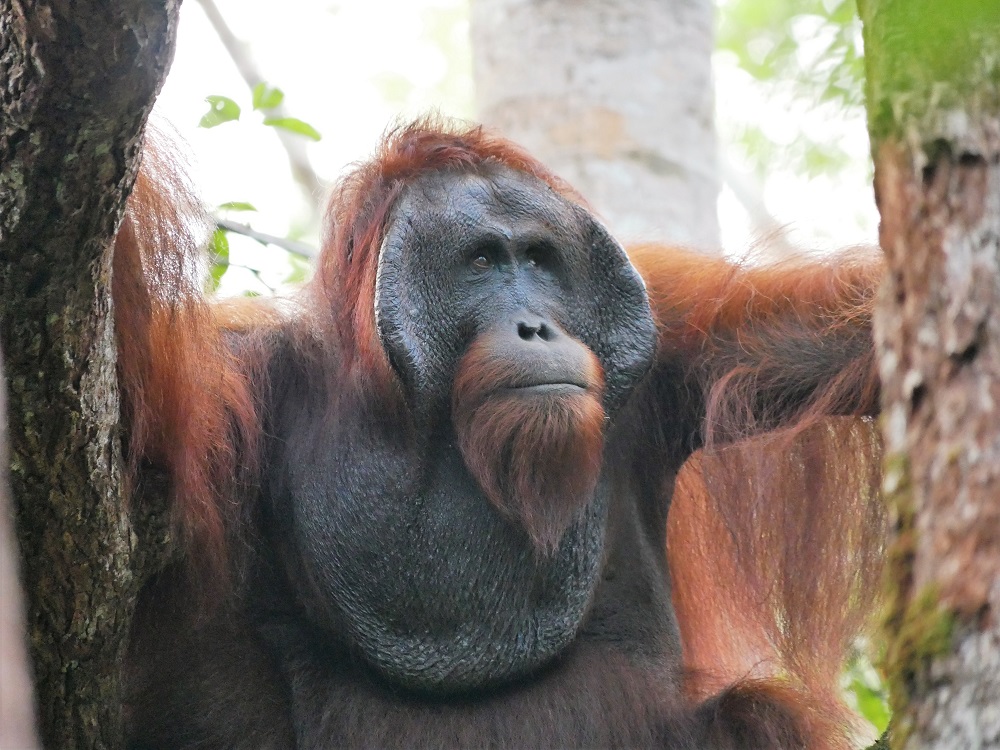
Large alpha male in the treetops.
This means that the interactions we witness at the feeding
stations are those between animals who don’t naturally have much to do with one
another. Only a few of the released animals come back for food, but each of the
three feeding stations is dominated by a huge alpha male who monopolises the supplies,
stoically chewing his way through immense piles of bananas, yams and sweetcorn,
and only leaving the feeding platform once he is absolutely stuffed. The alpha
males are recognisable from their huge size – they are about twice as big as
the biggest females – as well as by the large cheek pads which makes their face
imposingly wide compared to females and subordinate males. The alpha male is
the first to eat, and whilst he is stuffing his cheek-pad-enhanced face the
rest of the orangutans sit hiding in treetops, hungrily waiting for an
opportunity to sneak down and steal some food. Occasionally the alpha male will
let females with babies come down to get some food, but he never tolerates the
approach of another male, and when one approaches he gets up slowly and starts
to knuckle-walk towards them, showing off the scarily full breadth of his
shoulders. The dominant male hogging the food clearly upsets some of the rival
males, who sit screeching in the treetops, tearing off branches and throwing
them down in an attempt to provoke a reaction, but to no avail – the big guy sits
calmly ignoring them, secure in his power, safe in his dominance, stoically
eating through another kilo of fruit even though his rather solid shape would suggest
that he ought to start limiting his carbs.
Just one more wafer thin mint…Terry the alpha male from feeding station three enjoying his sweetcorn and a tub of milk. The alpha male: large cheek pads, huge shoulders, long arms, thick fur.
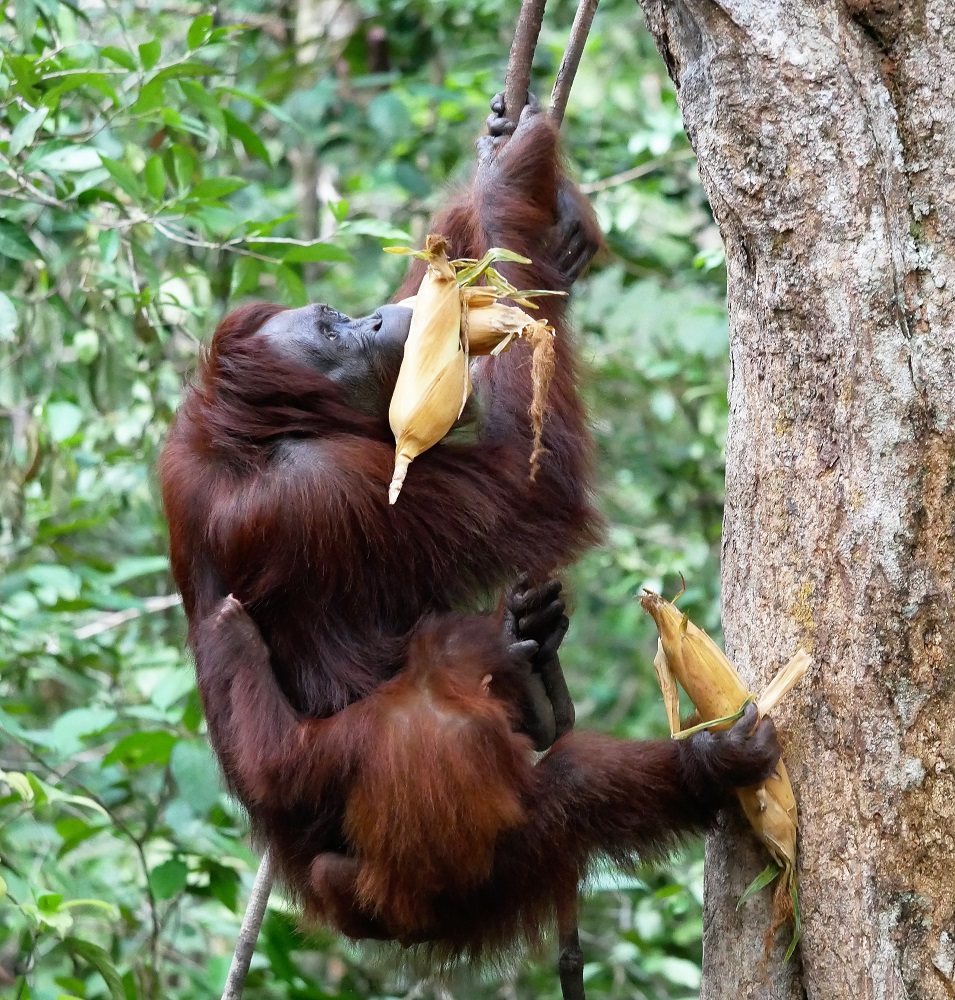
Once the alpha male has had his fill and has left the feeding station, the subordinate males and low-ranking females come down to eat. Only the largest females dare eat on the platform, the rest steal food, nervously looking right and left and keeping a hold of a branch so they can retreat rapidly. On the platform they stuff their faces and gather as much as they can hold in their mouths, hands and feet, like bulimics stocking up for a late-night binge, before fleeing rapidly, their escape slowed down by their full hands and feet. The near-naked babies cling to their mothers’ long fur and older juveniles keep one hand on the mother always, a lifeline to instant protection and effusive motherly love.
Brave older female eating on the platform.Timid younger female attempting a wild flight with sweetcorn.Another female with young attempting to transport hoarded sweetcorn into the safety of the trees.Young baby, safely ensconced between Mum’s legs, on the feeding platform.
It is not only orangutans enjoying the feast – a fast-moving
ex-rescue gibbon also comes down to steal some food, running along the platform
bananas in hand before quickly climbing to the safety of the spindly branches
of a nearby treetop, and a troop of longnosed wild boar gallop in and start
excitedly sniffing the undergrowth, excitedly hoovering up the leftovers.
Quick mission: gibbon getting some loot.Safely back in the trees.Wild boar munching on some sweetcorn leftovers.
Occasionally the alpha male will return to the platform for
another snack after seeing how popular the food is, slowly moving this way and
that to chase off anyone else enjoying the event, making sure that his is an
absolute monopoly. It is incredibly funny to watch, an ape soap opera featuring
characters with different personalities – the bullying chief, the mocking subordinate,
the nervous young mothers tightly grasping their fragile-looking babies, the seasoned
mothers of two moving with more confidence – so human-like that we all
recognise them: after half an hour of witnessing the overt display of stubborn
patriarchal dominance the lady next to me quips that she’s pretty sure she’s
worked with that guy in the past, and the female colleague with whom she is travelling
laughs in agreement.
King of the treetops – those that can bear his weight, anyway.
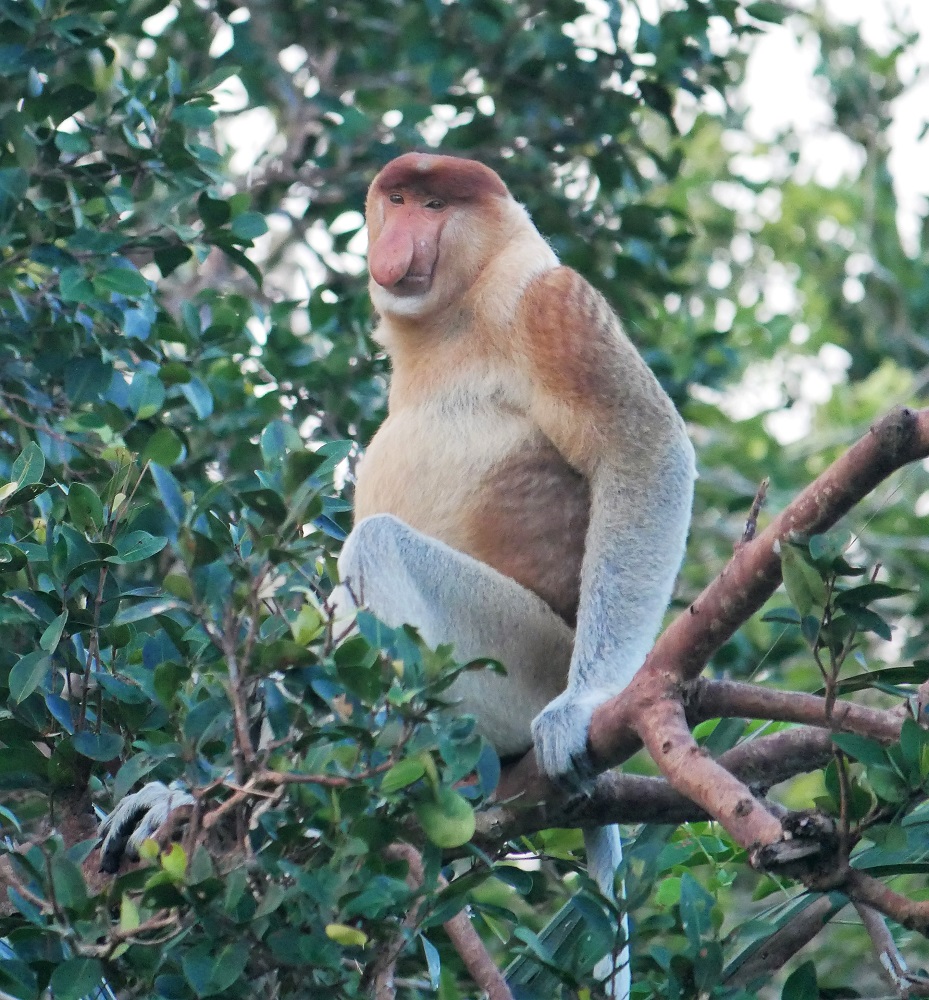
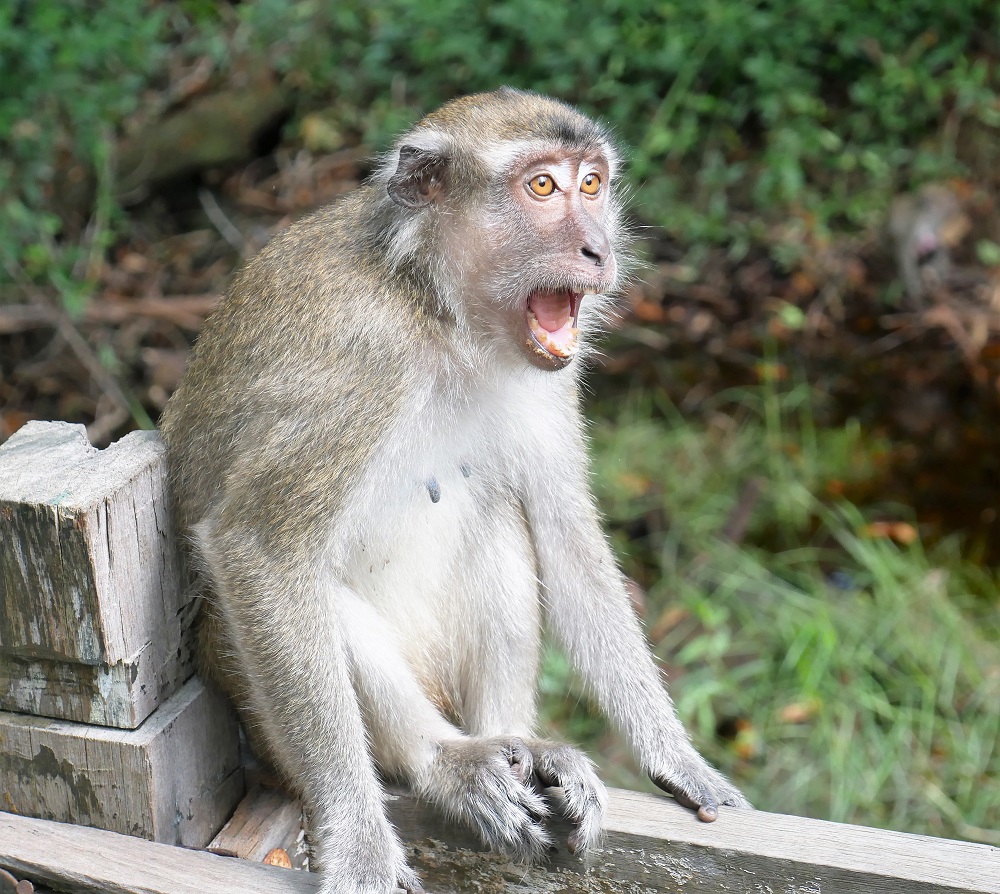
The jungle is full of interesting creatures. From the klotok we saw macaques and one afternoon, Aria spotted a troop of proboscis monkeys lounging in a tall tree. Named after their prominent facial protuberances, the proboscis monkeys are hilariously discontent-looking, a group of sour-faced, potbellied semi-humans sitting quietly, little fur hats and scarves framing their hairless faces dominated by noses that would put Pinocchio to shame. The males’ Yassir Arafat noses are long, bulbous and overhanging, and the females’ sharply pointed beaks would make Cleopatra pale. They look cheated, glum and resigned to their fate as they sit there in the top of a tree, their skinny arms and legs casually holding onto fragile branches, their long furry tails trailing below them.
Glum male proboscis monkey.Sharp-nosed female.Contrast profile of female proboscis monkey. A troop of proboscis monkeys darkening the trees.
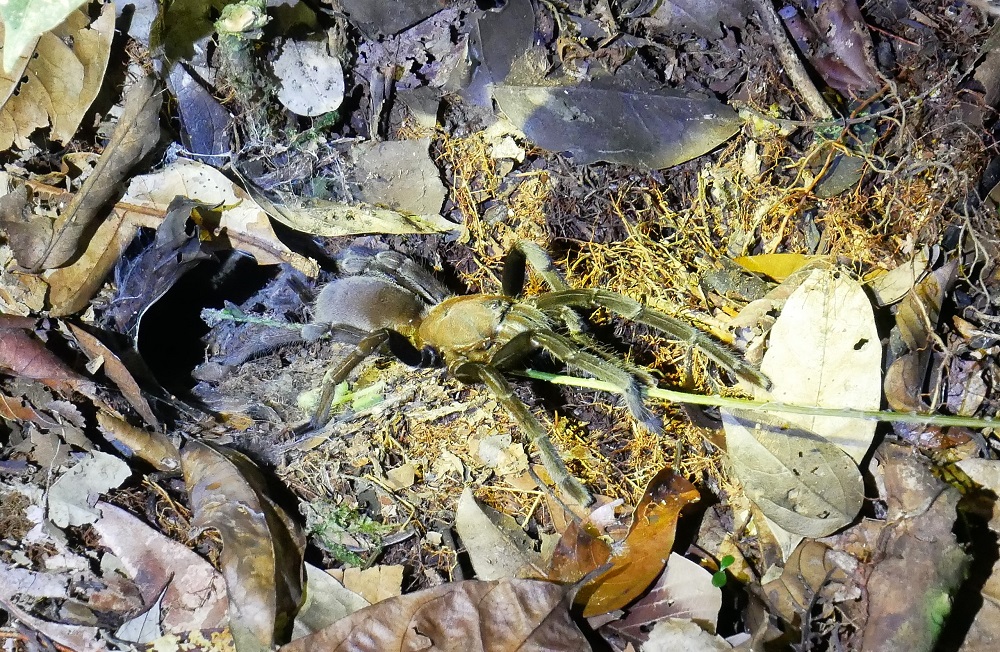
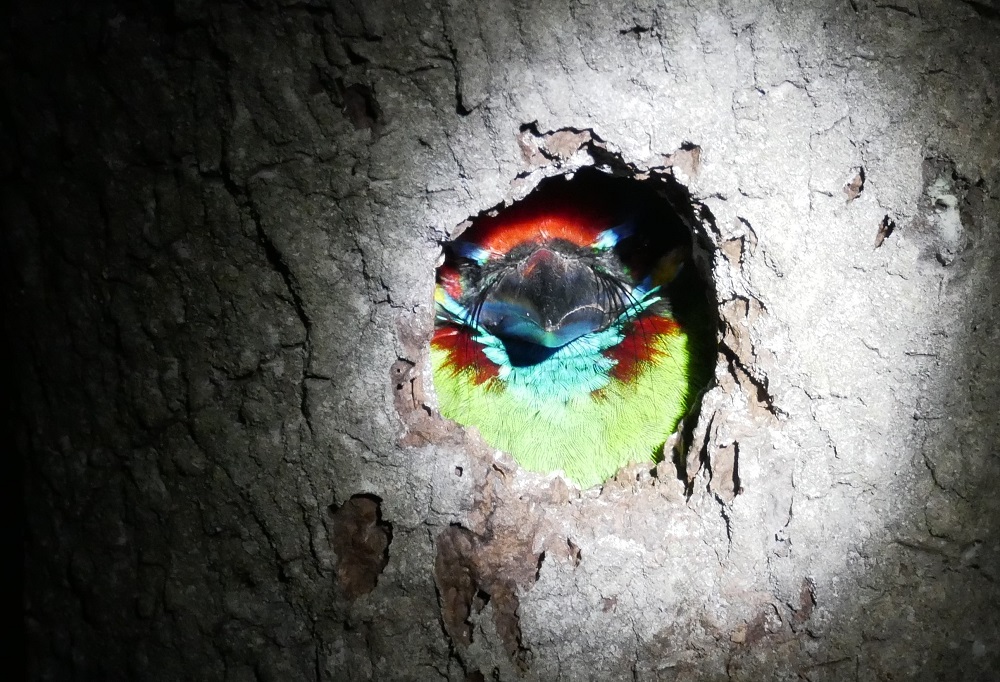
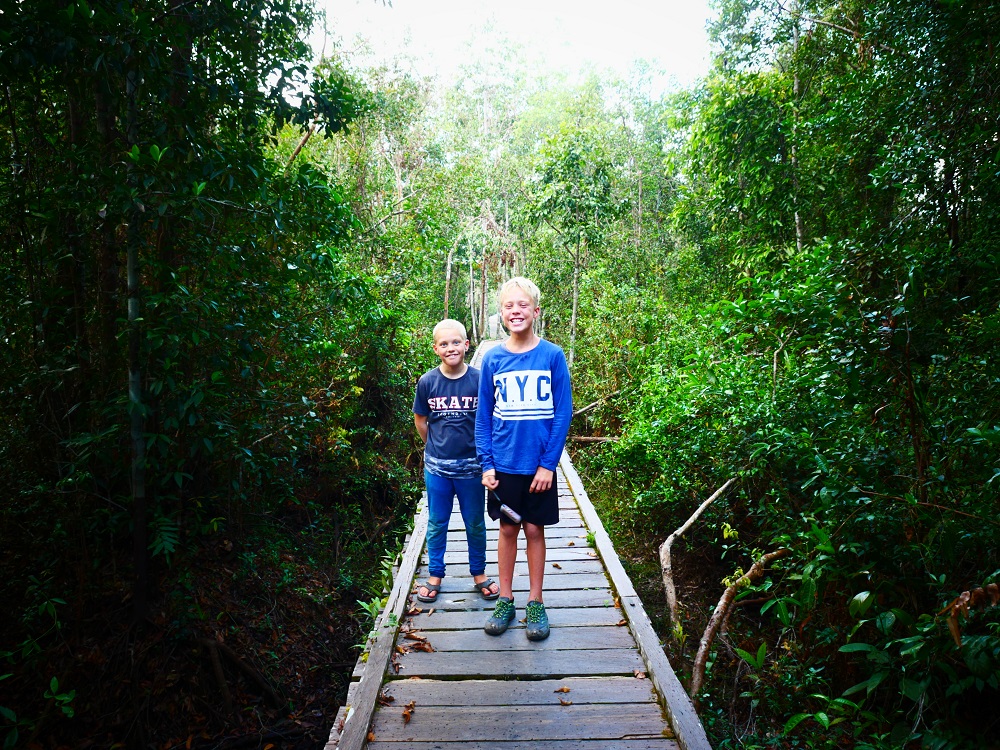
At night we went trekking in the jungle, the kids excitedly
following Aria our guide as he showed us huge bird-eating spiders and small spider-eating
birds, using a long twig to lure hairy tarantulas the size of a grown man’s
hand out of underground caves and a torch to illuminate furry caterpillars dripping
from vegetation and birds curled up into balls hiding in tree holes, as well as
the ominous tracks of wild boars.
Furry bird-eating tarantula – this one was as big as a grown man’s hand.Red-crowned barbet sleeping in a woodpecker hole.Macaque monkey.
The Borneo rainforests are magic and teeming with life, but sadly they are diminishing at an alarming rate. The critically endangered orangutans only live here and on the island of Sumatra and the populations are declining fast: 60% of Borneo’s orangutans have perished over the past 60 years. Around 45,000-69,000 orangutans remain in Borneo and these populations are projected to continue their drastic decline. The main threat to the Borneo population is logging and forest fires, at the root of which is the rapid conversion of tropical rainforest to lucrative palm oil plantations. Palm oil is used for cooking, cosmetics, mechanics and biodiesel, and Indonesia is the world’s biggest producer and consumer of the commodity, providing roughly half the world’s supply. A major economic earner for the country, palm oil contributed 11% of Indonesia’s export earnings in 2018 and production is projected to increase dramatically over the coming years as more rainforest is cleared. The oil is everywhere in Indonesia – it is the only cooking oil that you can buy in all but the large cities in Indonesia and the biodiesel is sold at all petrol stations.
David and Lukie with Aria, our guide, in front of a palm oil tree.
Palm oil is unavoidable in Indonesia and we sharply feel the irony when, after visiting a national park museum which documents the wildlife destruction caused by the insidious spread of palm oil plantations, we head back to the palm-oil fuelled klotok and eat our delicious lunch of fish deep-fried in large vats of palm oil.
Matias proudly showing off the tree he planted in Tanjung Puting National Park.
It’s a sad state of affairs and when the guide suggests that the kids each plant a tree in the reserve to help maintain the forest they jump at the opportunity. In fifteen years the trees they planted will be more than 2 metres tall and we hope that the habitat left will be enough to sustain the orangutan populations.
Long may the jungle live.
The town of Kumai is not particularly charming, and after stocking up with diesel and vegetables we left Kalimantan behind. As we sailed away from the island we mentally readied ourselves for another run in with massive squid fleets as we headed west. We were super happy to have seen the orangutans but, like so many times before here, once again feeling like we got there just in time. Oh Indonesia, land of ever-diminishing rainforests, orangutan populations and squid stocks, what will become of you?
The Rizky eatery in Kumai town couldn’t lure us to stay.
It was early morning. David and I were standing on the bow of Bob the Cat looking out over Amed Bay in northern Bali. It was a scenic shoreline, dominated to the west by the imposing volcano of Gunung Agung and to the east by the rugged hills of the north-eastern Bali interior. In front of the green mountains was a thin line of flat black sand shore backed by luscious palm trees. The morning was quiet, Hindu Bali being the first populated place in Indonesia where we had not been woken by the melodic singing from a mosque, and serene little temples carved from heavy volcanic rock were visible along the cliffs towards the western end of the bay.
Not that we were looking at the scenery. We were anxiously focused
on the nearshore conditions.
“Do you think it’s going to be OK?” I asked nervously.
“It’s pretty rough, that’s for sure,” he replied. “We don’t
want him to drown – that would be a tragedy.”
“Maybe we should move?” I suggested. “Go to a calmer place?”
“Yeah, we could do. But the next sheltered anchorage is 40 miles away, though. It’ll take us eight hours with these light winds.”
The day had come where we had to part with Paco the Cat and we were worried about how to get him ashore. There was a bit of a swell rolling into the bay and on the shore the waves were pounding brutally against the steep, back sand beaches. We’d gone ashore the day before to get some dive tanks filled and had both gotten completely soaked whilst trying to hold the dinghy in the crashing surf and loading and offloading the cylinders. Now we were worried about how to safely get the cat onshore.
“The last thing we want is another dinghy capsize,” said
David. “We don’t want him to get wet, ideally.”
I looked at the shoreline. From afar the waves looked small,
narrow white undulating lines snaking their way up and down the black beach,
insignificant foam splashing over distant sand. But landing a dinghy in
anything but the smallest waves quickly becomes quite an ordeal. We can always anchor
the dinghy off the shore and swim in but trying to keep a caged cat comfortably
dry would be problematic.
“We could bring a boogie board,” I suggested. “Put the cage
on top and surf him in on the white water…”
David looked at me sceptically. “He’ll drown if the cage
goes under,” he said. He righted himself and turned towards the stern where the
dinghy was tied on. “Maybe it’s better around the corner. I’ll take the dinghy
over and see if there is a better landing spot there. If not, I guess we’ll
have to move.”
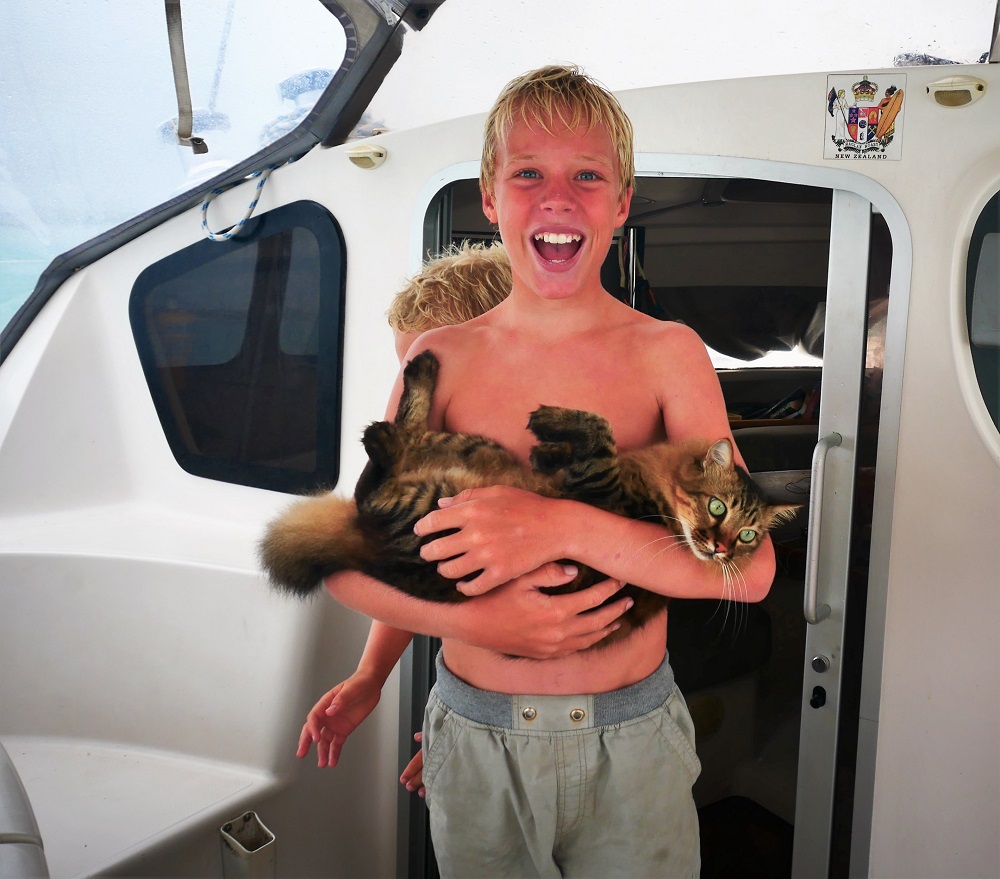
Paco the boat cat helping navigation planning.
The transfer had been planned for two weeks. Antonella and Pierrot, Paco’s owners, live in Bali, and whilst Pierrot was still in Europe, Antonella was ready to get her cat back. Their boat was on a mooring in the south of Bali, and we had agreed to drop Paco off on our way north from Lombok, making the north coast of Bali the ideal meeting spot. That morning, Antonella was on her way by road, and we had made ready for his departure, packed his little bag containing cat passport, anti-flea shampoo and fluffy towel, prepared the kids mentally for saying goodbye to him. Everything was ready. Now we just needed to keep him safe for the shore landing and all would be well.
Tiger Paco, fierce in combat.
We’d just spent ten days in the Gili Isles in north-western
Lombok. Part of the well-trodden Indonesian budget tourist path, Lombok’s Gili
isles (Gili means small island in the local dialect) are a quieter version of
the intense scene of neighbouring Bali.
It was a bit of a shock to the system to suddenly find ourselves in tourist-land. We first got a feel for the culture-clash that tourism brings to Indonesia on Lombok’s south coast where, on the kite beach, groups of local women would wander, clad in full hijabs, taking selfies against the wild ocean backdrop, whilst on the water a bikini-clad kitesurfing instructor was carving close to the water’s edge doing impressive tricks. She must have been getting crazy sunburnt in the searing sun, and also cold in the 20-knot breeze, but she continued undeterred, oblivious to the irony of parading a thong bikini a stone’s throw away from severely veiled local women. On the same beach we witnessed a skimpily clad honeymooning couple kissing in a suggestively close stance on the beach only to be met with loud cries of ‘no, no,’ from a group of local, hijab-wearing women and their accompanying menfolk who happened to be walking past.
Bikinis and boardies: tourists arriving back from snorkelling at Gili Air.Largely ignored: sign at the entrance to town asking tourists to cover up.
The Gilies take western tourism to an entirely new level. Here, ferries disgorge scores of bathing suit and board-short wearing 20-year-olds onto the floating jetty about 10 times a day, and the little island is full of young, tanned and largely naked Europeans, Asians and Australians. There’s a sign at the entrance to the town saying ‘please respect our culture,’ the local women wear veils covering their hair, and the local mosque blasts the prayers out loudly five times a day, but otherwise you could be in Ibiza, the tourists strutting about in their tight-fitting speedos, thong bikinis and high-heeled flip flops. We were anchored off Gili Air, a small round island fringed with white sand beaches leading into turquoise water sheltered behind a scenic barrier reef. The island is full of hotels and homestays, the premium water-front real estate lined with waterfront bars, hotels and restaurants offering bean bags and pastel painted loungers for punters to relax and enjoy the views. Every night the island kicks back during the three-hour long happy hour sessions where guests are served by busy waiters staggering under the weight of trays laden with pizzas and dew-dropped, crystal-rimmed margaritas, sidestepping the crowds to the beat of Ibiza Chill compilations.
Scenic view from Gili Air, north Lombok.Boat kids in a cafe.
It’s a world away from the Indonesia we’ve seen on our seven-month
long stint travelling the country, and whilst at first a bit of a shock to the
senses (the blatant bikinis, bars, blaring western music), Gili Air is quite a
nice little holiday place, an incredibly easy place to spend a week, a holiday
away from the challenges of our normal life on the boat in remote Indonesia.
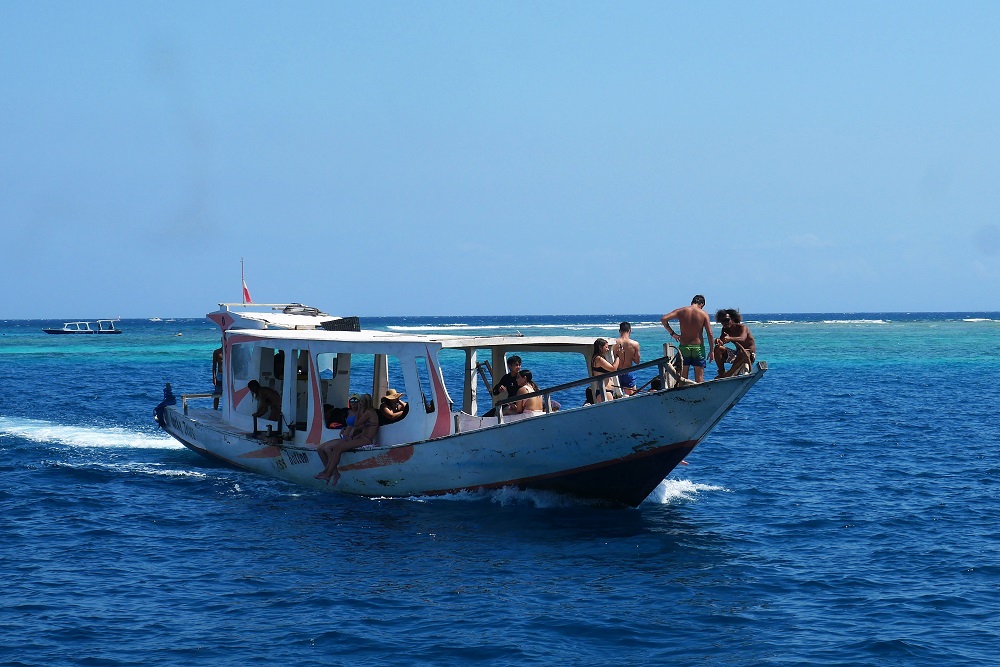
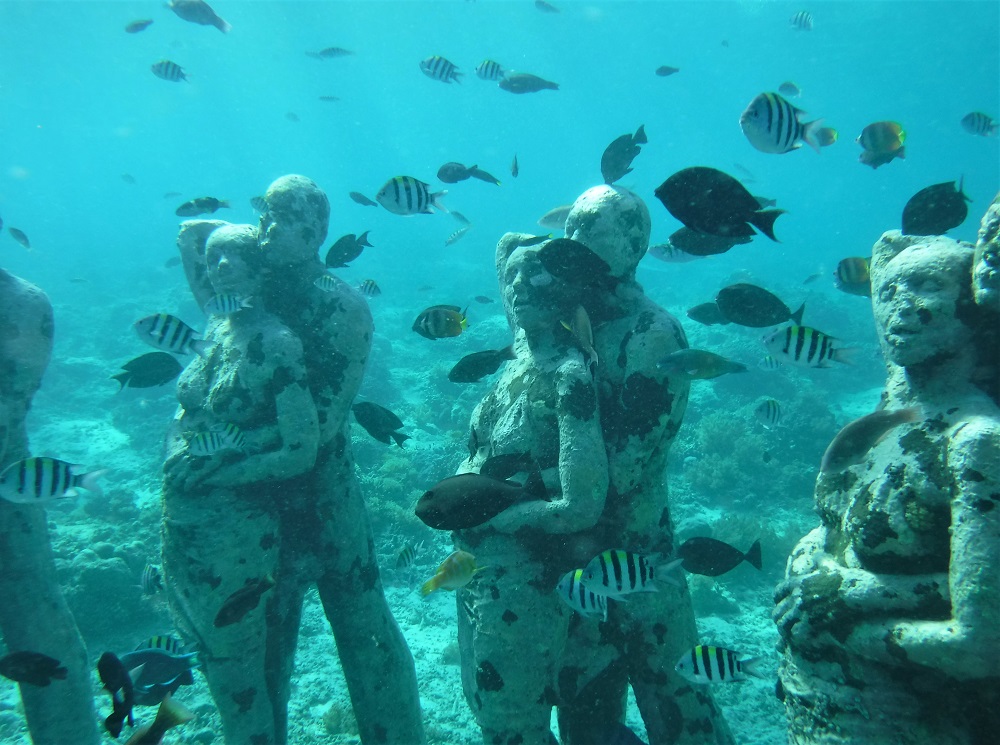
Here, everything was easy. There was a well-maintained floating dinghy dock, so we didn’t have to land the tender amongst rubbish piles on a smelly beach or tie up to a dilapidated jetty featuring rusty nails sticking out perilously close to our inflatable. Here you could wear a singlet and shorts without offending anybody, be anonymous amongst hordes of red-faced tourists, and purchase anything that you might need. Everybody on the island spoke English and the shops were stuffed with items catering to western tastes, showcasing wares we hadn’t seen in almost a year like tahini, couscous, walnuts and sunblock. There were ten dive shops on the island and about 60 snorkel tour operators, scenic underwater landscape including a sculpture park, a lovely surf break on the southern reef just next to the anchorage, as well as white beaches, clean azure waters and the obligatory touristy shops selling clothes, souvenirs and massages. The island is so small you can walk around it in an hour, and is free of motor vehicles, offering bike rental and horse-drawn carts as the only means of transport other than walking.
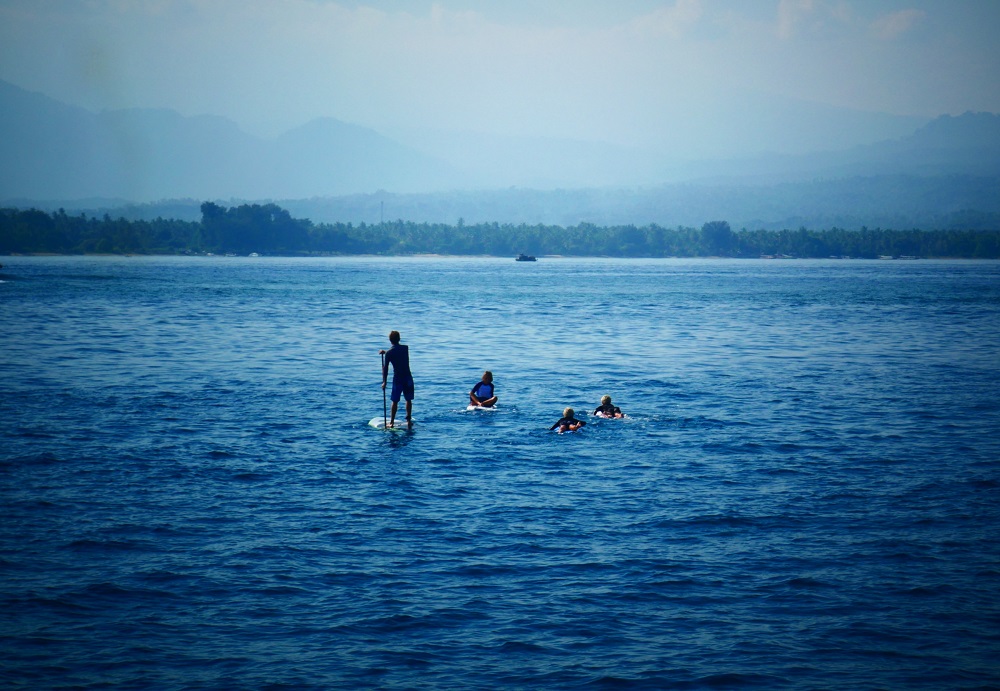
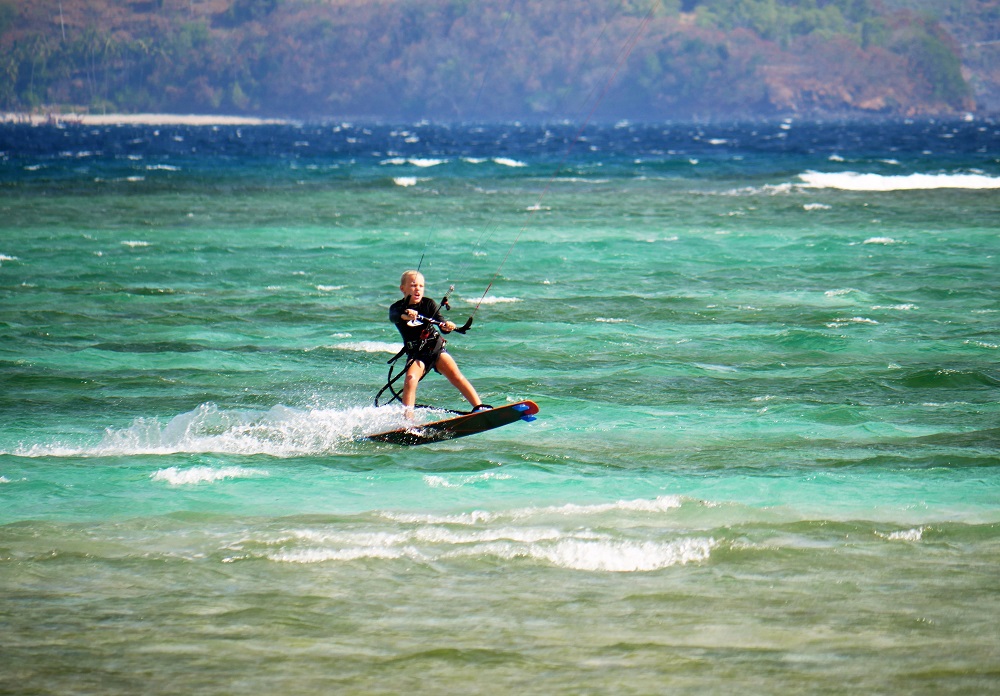
Horse-drawn carts on Gili Air.Underwater statues off Gili Meno.Heading off for a surf in the morning.Lukie surfing the Gili Air break whilst Matias is doing his dive course.Lukie attempting small kite jumps in Gili Air.
It was a perfect place to relax, and we enjoyed our stay
there, catching up with friends, eating out and drinking cocktails on the beach
overlooking the sunset, biking around the island, and snorkelling, diving,
surfing and kitesurfing the surrounds. Matias took the opportunity to complete
the PADI Junior Open Water course with a dive shop (my formal instructor
registration lapsed long ago when I stopped paying the steep PADI fees, so I
can’t give him the certification card) and enjoyed days on the dive boat by
himself, coming back a proudly certified diver full of tales of swimming pool skills,
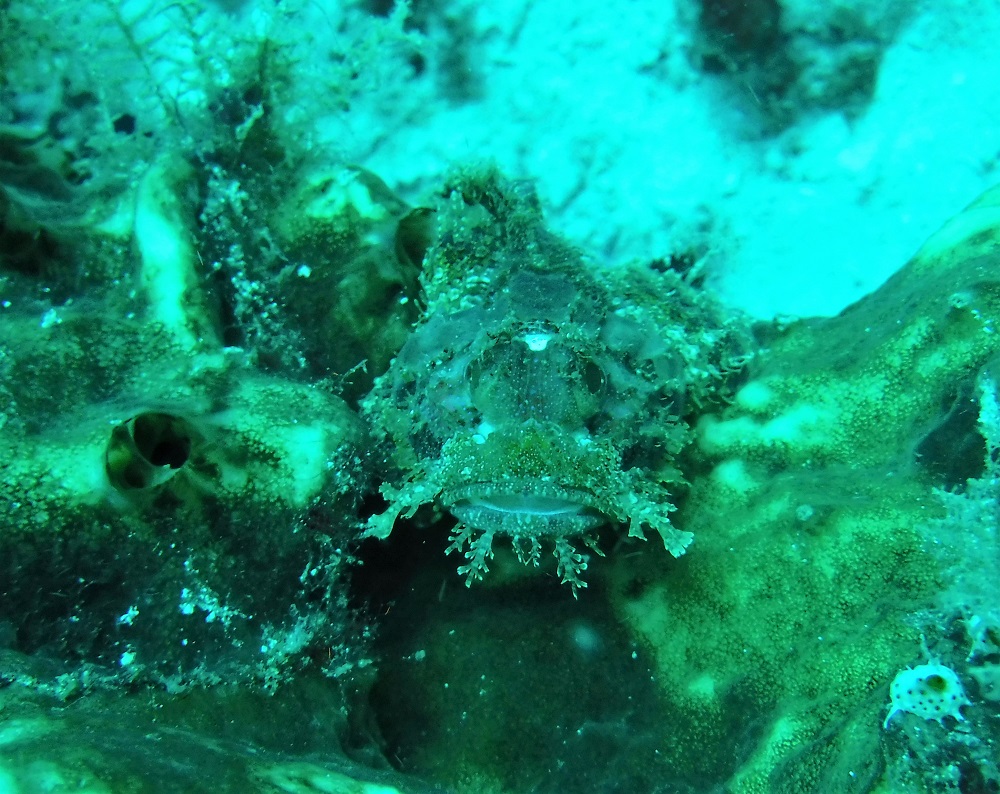
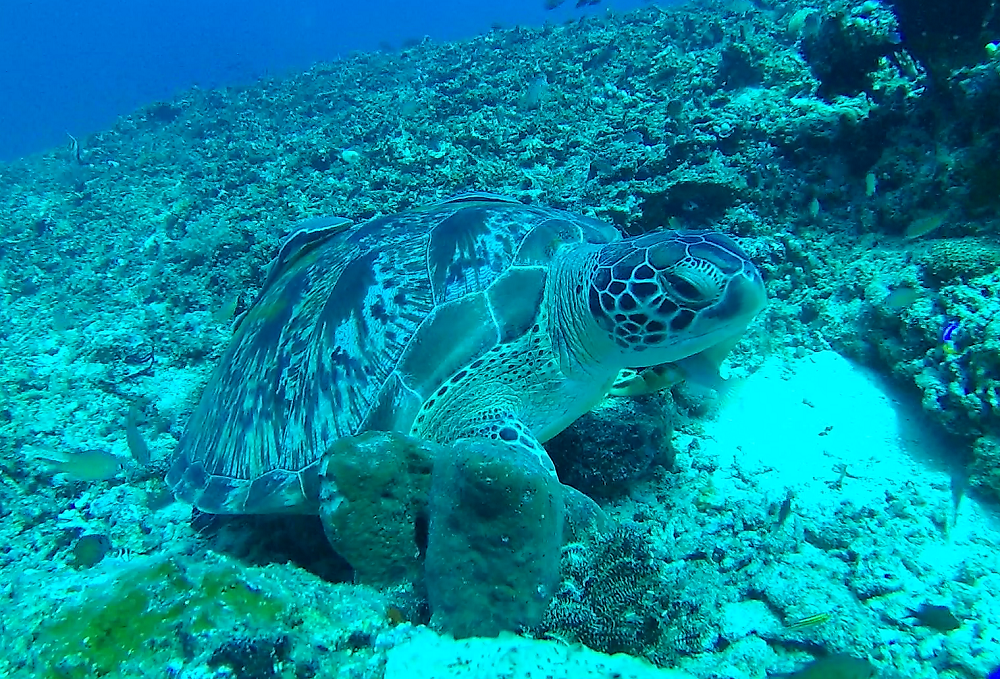
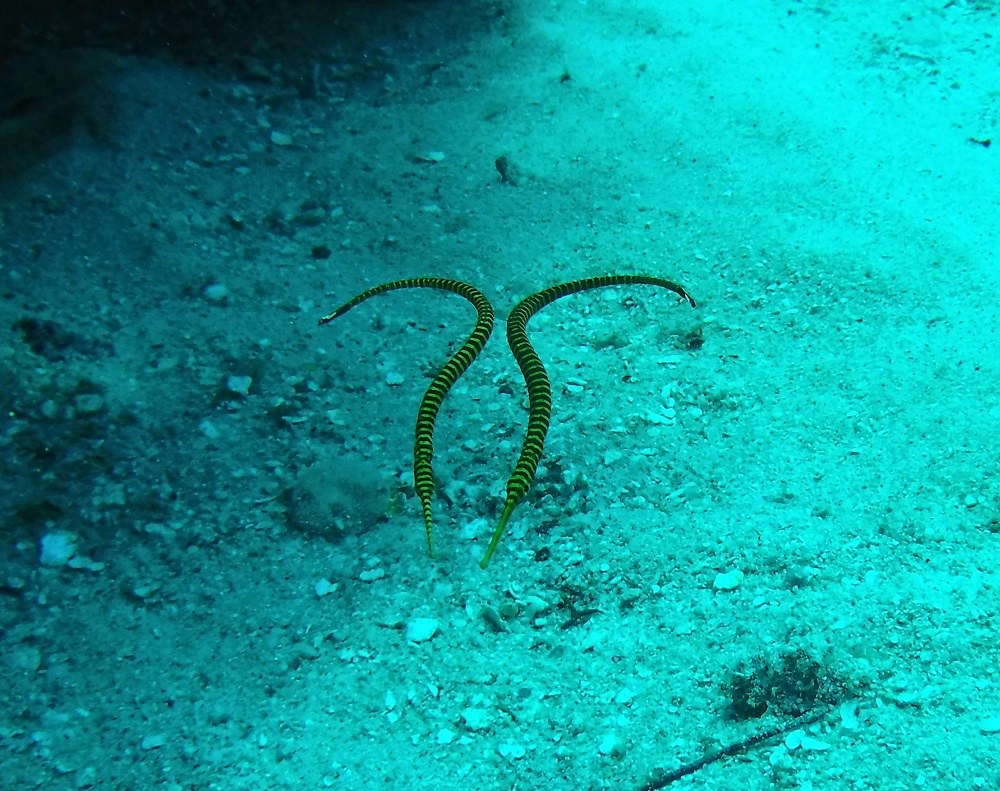
shipwrecks and scorpion fish. Our diving there was amazing, full of scenic underwater
landscapes and rare and cryptic lifeforms.
Crazy cryptic leafy scorpionfish.Scorpionfish.Weird horned thornback cowfish going about his business.Friendly turtle.Orange-banded pipefish courting.Striped puffer.Little toby hiding next to an urchin.
After nine days in the Gilies we were ready to leave, feeling
like we had seen most of the sights and that we’d had our fill of the endless tourist
crowds and the numerous ferries and tour boats speeding in the anchorage which
left Bob heaving in their wakes, glasses and plates flying about. Antonella was
eagerly awaiting the Paco delivery, and we left for Amed in Bali so that we
could be ready and waiting when she came by road.
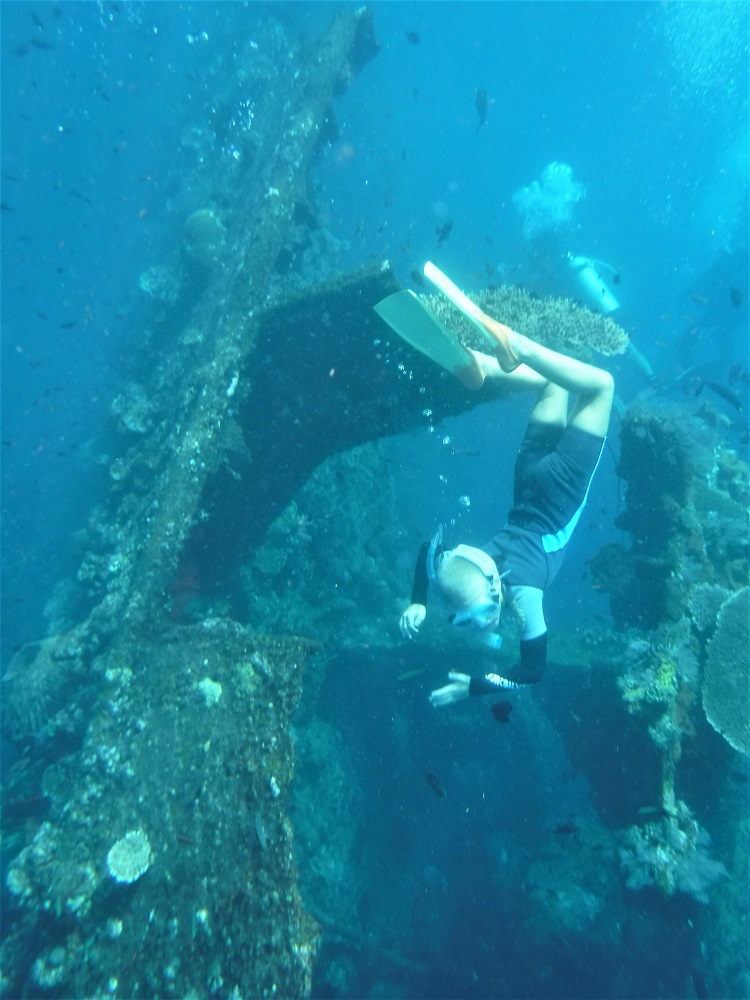
Lukie snorkelling the Liberty wreck.
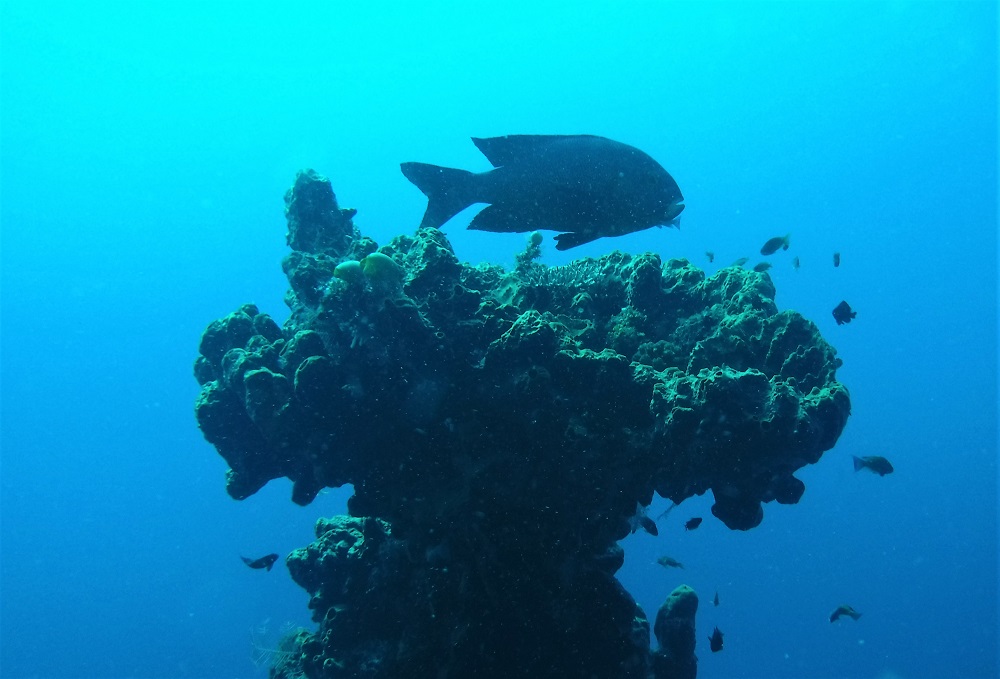
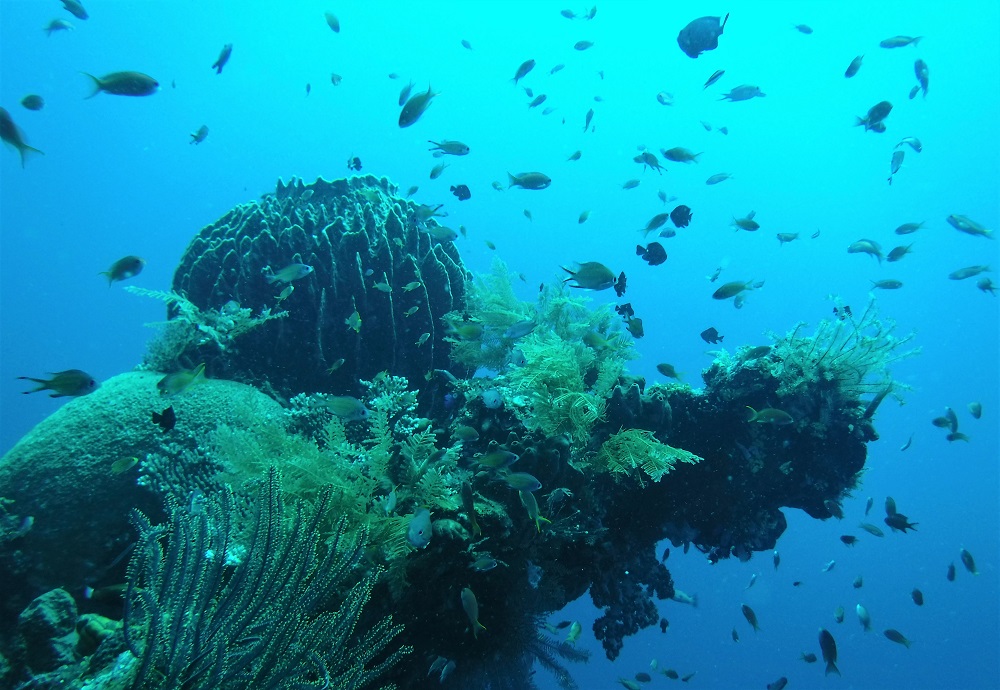
In Bali, before Antonella arrived, we had time to do a quick dive of the wreck of the USAT Liberty, a US army cargo ship which was torpedoed by a Japanese submarine in 1942 and beached in Tulamben Bay, near Amed – a wonderful coral-encrusted wreck lying in 5-30 m of water which was an exciting first dive as a qualified diver for Matias.
Friendly fish on the USAT Liberty wreck.Underwater silhouettes.Coral encrusted ship wreck, teeming with life.
Now, a day later, it was time to get serious about getting Paco ashore. I walked to the back of the boat as David was coming back from his dinghy reconnaissance.
“How was it? Any calmer over there?” I asked.
He climbed on board the boat. “It’s a bit better at the other
end of the bay.” He rubbed his chin and started laughing. “I’m making it sound
like surfing Jaws, aren’t I? It won’t be that bad, I’m sure we can do it…” He stroked
Paco who was approaching him, rubbing against his legs. “It’ll be OK, Paco, we
won’t drown you!”
Get me away from this boat and these children!Please let me go home…
In the end the transfer went smooth, David holding the dinghy
in place in the surf, Antonella lifting Paco packed away in his little plastic cage
and holding him high as she ran up the shore. And just like that he was off Bob
the Cat and out of our lives, leaving a huge Paco-shaped hole in our hearts,
the despair giving rise to eloquent art such as this poem by Matias which he
penned for homeschooling a day after Paco’s departure:

































 SV Bob The Cat