“And so, if the red light goes on permanently, it’s because it is overheating. That’s normally if the fan is failing to turn on. So then you need to check that it’s on and if it isn’t, just tap it to get it going.” David looked sternly at me.
“Uh huh,” I responded hesitantly. “What fan? I mean, where is it?”
“It’s the one under Lukie’s bed. You just have to stick your finger in there and tap the fan to restart it…”
“Okay…” I sighed. “Look, I don’t think I’ve ever seen that one. Can you show me?”
He touched my arm and started downstairs, keeping me following closely behind. Entering Lukie’s bedroom he straddled the bed and lifted up the mattress, pushing the wooden slats underneath to one end of the bed whilst doing some subtle acrobatics to ensure his weight didn’t break the fragile wood. Crouching on the upturned mattress he stuck his head down the space below the bed and from the dark void came his muffled voice saying something only barely audible.
I balanced gingerly on top of the pile of slats and crawled closer. “What’s that?”
“The fan – it’s just here. Stick your finger in and tap lightly.”
I pushed myself up next to him and stuck my head down the under-bed space, trying to make out the small fan in the semi-darkness. “I can’t see it. I’ll have to go get a torch.”
He straightened up. “Well, it’s just here. Stick your hand in and feel. And then there’s the engine…” He crawled back out into the corridor, leaving the bed a mess, and took the stairs in two steps. I rushed after him. “I forgot to get a new starter battery for the port engine, so it may not start….” He ran his fingers through his hair.
“Okay…” I looked at the gear levers uncertainly. “Then do I just use the starboard engine?”
“Yes, just start the starboard one and then wait until the battery is high enough for you to start the port side.”
Right. Makes sense. “But it is still working, right?”
“Yes, but I’ve had problems starting it the last couple of times. I was going to buy a new starter battery in Ambon, I just forgot.”
“Okay.”
“And if you move the boat, just remember that the anchor winch sometimes shorts out. If that happens, just lift the little lever in the starboard engine room back up again, that’ll reset it.”
“Right.” I sighed again. “Can you show me where that is again?”
“It’s here,” he said, opening the starboard side engine room and pointing inside.
I stuck my head down the engine room. “Where, exactly?”
“You need to crawl in – it’s under the other box, over there.” He hovered above me, his dark shape blocking out the light, a barely visible outstretched finger indicating the direction of the lever. “If you look up you’ll see a little lever. Just push that back up.”
“Right.”
“And the other thing that can go wrong is that if the button gets stuck.” He pressed his thumb against his index finger, simulating pushing a button. “If that happens, just switch off the starboard engine electrics. And then just unscrew the little unit from the wall and unplug it.”
“Hang on, I need to take notes.” I went inside to get my phone. This was going to require a bit of documenting. I started typing. “This is if the button gets stuck when we’re trying to raise the anchor?”
“Yes, if the switch sticks – it should be OK, but remember it used to sometimes stick?”
I nodded, remembering trying to frantically stop the chain from when the ‘up’ button got stuck, shouting “It’s stuck, it’s stuck,” in frustration from the anchor locker until he managed to switch off the electrics to make it stop.

“Run the water maker as much as you need – but if you don’t use it, do a fresh water cycle at least every other day.” He looked at me. “We don’t want the membrane to dry out.”
I shook my head and typed: ‘don’t let membrane dry out.’
“And try to keep the batteries above 75% charge. So if there’s no solar, run the engine to charge. Switch the fridge off once cool in the evening, so it doesn’t run all night.”
I nodded again. I knew all about fridge maintenance and battery charging. No instructions required.
He ran his fingers through his hair again. “Lock the doors at night and if you get intruders this is the safety knife.” He pointed up at the sheathed knife fastened above the door leading out into the cockpit.
“Okay… So just stab them with a sharp knife?”
“Well, don’t let them in, obviously. And if they are outside the door, use this torch.” He unclipped the torch secured just to the right of the door. “Shine it in their face – through the door or in the open. That should blind the person looking at you momentarily. Which will hopefully scare them off, buy you some time if someone’s trying to break in…” He touched my arm. “Keep the VHF on, and your best bet is to lock the door and just call the other boats if you’re in trouble.”
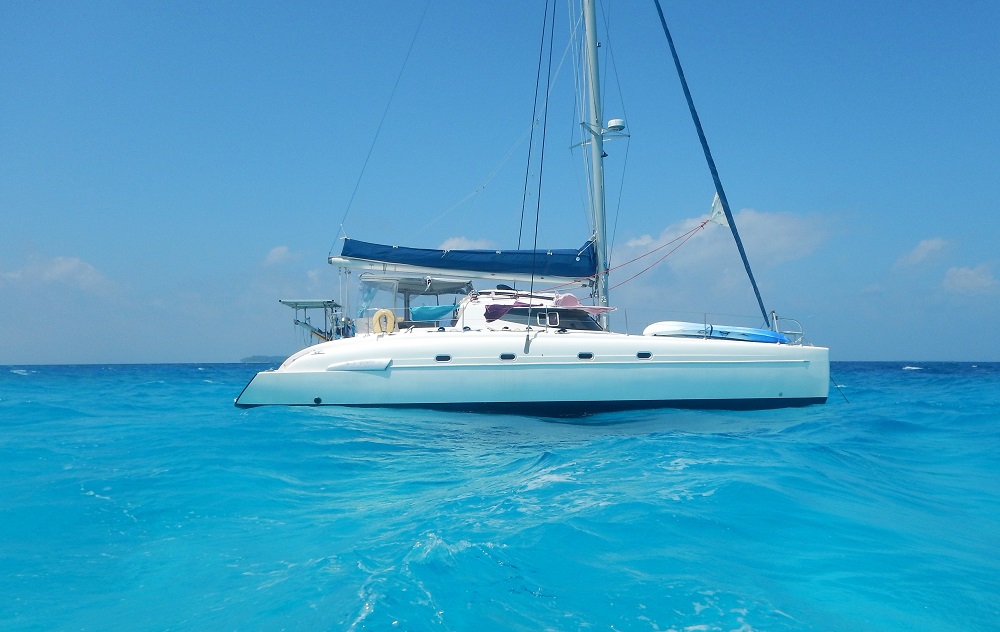
Right. I swallowed. Sounded fine. I looked around us, out over the still water of the inlet, the turquoise waters bordered by dark seagrassy reef patches, the busy shoreline, the fishing boats anchored nearby. Not a bad place to be. We could do this, the kids and I. We could survive for a week without David on the boat, here in Wanci, southern Sulawesi, Indonesia.
“And what about your lift to the airport?” I asked. “Should we organise that?”
He paused. “I guess we should go ashore and do that… If we can find a driver, then you can drop me ashore in the morning at 4 am and I should be able to make it to the airport by 5.”
I grabbed my bag. “OK, then let’s go and organise that now. Kids? Come along! We’re just going ashore to find a lift for Daddy!”

It was all a bit of a rush. David had had a family bereavement and was going to the UK for the funeral. It was 3 pm, we’d just arrived in Wanci, Wakatobi, and he was flying out the following morning at 5:30 am. He had been undecided about leaving for a week, wanting to wait to see what Wanci was like, check that he felt the anchorage was secure enough for him to leave us on our own. It looked fine here – a wide channel, safe holding, a busy town. Several friend boats to keep us company, and some interesting stuff to do in the general area.
The worst thing about travelling so far away from family is that you barely get to see them. The second worst thing is that you may be out of reach in emergencies; that you might not be able to travel back fast when needed. Thankfully we were in a populated area when he heard, had had internet to look up flights, had been able to make it to Wanci in time for him to fly back.
Now it was just a question of making sure that I remembered everything that I had to do, was able to do all his normal chores, and that I had enough knowledge to deal with the most foreseeable problems the kids and I might encounter in our week alone.
After living on this boat for several years, you would have thought that I would have no problems managing on my own. You would have thought that intimate knowledge of all our systems would, by now, be imprinted in my brain, allowing me to effortlessly retrieve any and all information required to deal with any issue at hand. You would have thought that I would be completely competent at the troubleshooting and fixing required to get by on an older boat on a daily basis, that I would have a solid handle on all battery-related questions and breeze through any conversation about how best to deal with a sticky solenoid switch for raising the anchor. You would have thought that I would be competent at changing water-maker filters and doing the backwash, proficient at dealing with plumbing emergencies, a whizz at reconditioning outboard engines and possess a steady touch for repairing scratches to the gel coat.
Alas, for me this trip hasn’t worked like that. To save time and because one person can only do so much, we’ve ended up specialising on the boat, dividing labour between us, with the result that we’ve ended up with sharply demarcated territories. David is, of course (being a weather forecaster and a much more experienced sailor than I), in charge of forecasting and route planning to optimise weather. He’s also responsible for systems and in charge of most boat repairs, although I tend to do the painting. I’m responsible for home-schooling apart from music and coding, and for all provisioning, food planning and storage, as well as most cooking. He researches diesel, I download maths resources. He sits poring for hours over weather charts, I download tempeh recipes and Google the price of wine in East Timor. He discusses batteries and gets samples of dinghy glue endlessly from other cruisers; I swap food storage tips with their wives whilst concocting a new recipe involving copious amounts of eggplant.
In summary, we’re like a super-conservative 1950s western family – he is responsible for fixing and planning, and I parent, cook and clean. It works super well most of the time: I can’t think of many things more boring than batteries; he panics whenever he enters a grocery store and tends to leave with nothing on the list bar one tin of tomatoes. I have no idea how he’s organised the tool cupboard; he can’t find the flour to save his life. We both do our share of unpalatable chores: he unplugs blocked toilets, I school the kids. But it does mean there’s no redundancy in the system, requiring a heavy handover when he suddenly ups and leaves for a week.
I’m not sure he struggled much, though, when I went to New Zealand for a week last August, leaving him and the kids to fend for themselves. He just reduced home-schooling chores, didn’t provision or clean, and lived on fried rice, effectively cancelling most of my jobs. Whereas I’m not sure I can get by with just cancelling battery charging or ignoring if we can’t raise the anchor should we need to move….
Gender roles on boats are strangely old-fashioned – in most cruiser couples I’ve met, the man does the boat maintenance and the woman cooks and does the laundry. The difference between male and female roles seems to be most pronounced on kid boats and I haven’t met any cruising families where the woman is not in charge of home-schooling and has the ultimate say in provisioning, and where the man is not responsible for refuelling. On boats sailed by couples the gender roles are more often blurred, with some men cooking up a storm and some women helming the boat and shouting orders from the cockpit. My theory is that when sailing with a family the two adults are busier (add all the kid-related chores, and cooking for, and cleaning up after, a family, to the normal chores of boat life), and as there is more work to be done, the division of labour becomes more pronounced, each party specialising and thereby saving time overall. After making (and cleaning up after) breakfast and doing the home-schooling, I feel like I have enough work on my plate, and don’t have a lot of energy left to inquire as to the state of the water-maker filter or to second-guess David’s weather routing choices other than a feeble question or two about how seasick I’m likely to get on the next passage. And I imagine that when he comes in sweaty after spending two hours bent over double in the engine room he can’t be bothered looking over my shoulder as I decide where to store the canned peaches or seriously question my new-found use of tea tree oil to wipe down interior mould.
In our case, as he is leaving, it feels like this specialisation of labour has led to an astounding level of incompetence on my part, and I am annoyed with my lack of knowledge, frustrated with my limited ability to diagnose and problem-solve boat-related issues, and angry that I’ve allowed myself to become dependent on David’s knowledge to the extent that I now fear being left alone.
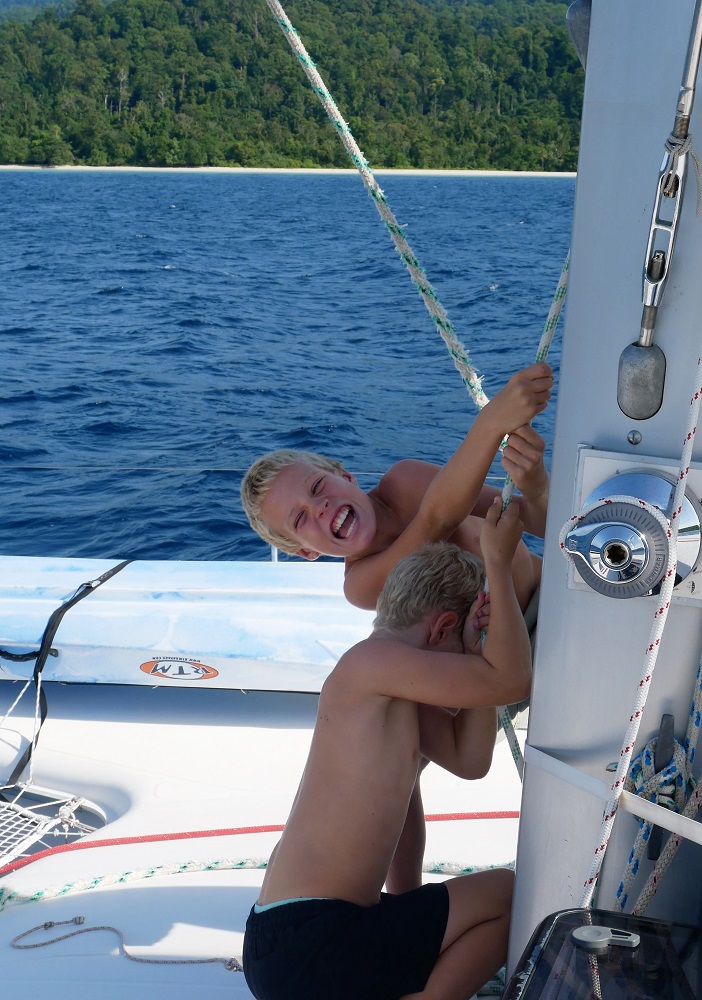
At home division of labour doesn’t mean that one party can’t leave. There, specialist are everywhere and if I have problems starting the car or can’t find the ingredients to cook, I just call the roadside insurance and the pizza shop, respectively, and my problem is solved. At home, I enjoy it when Davis is gone – the kids and I spend all afternoon on the skate park and have TV dinner late, all snuggled up closely on the sofa. Here, in the middle of Indonesia, there is nobody to call, each yacht must be a standalone unit of self-sufficiency, and I’m dreading being left alone. The kids are of course helpful – Matias is adept at driving the boat, dealing with the anchor and setting the sails, and Lukie is an expert at using a winch handle and ties a mean bowline. On top of that, we have friends here – two family boats we’ve been travelling with are in the anchorage, and if I have any problems I know I can call on them.

I dropped him off the following morning at 4 am, returning to the boat housing our sleeping children in the pre-dawn darkness. As I let myself in, my eyes fell on the ‘defence’ torch. I playfully snapped it out of its clasp, weighing the little black cylinder in my hand. I hadn’t ever realised it was there – when I hear a sound in the night, I just roll over and elbow David, mumbling: “I think there might be someone here,” and wait for him to deal with it. I switched the torch on and watched the bright pulses of light illuminate the cockpit.
Hopefully all the information that I had typed into my phone would similarly illuminate my mind, pushing aside the dark fogs of boating-related ignorance clouding my brain and allow me to enjoy this week alone safe and sound on the boat in Wanci.
 SV Bob The Cat