The busy seas of Jeneponto

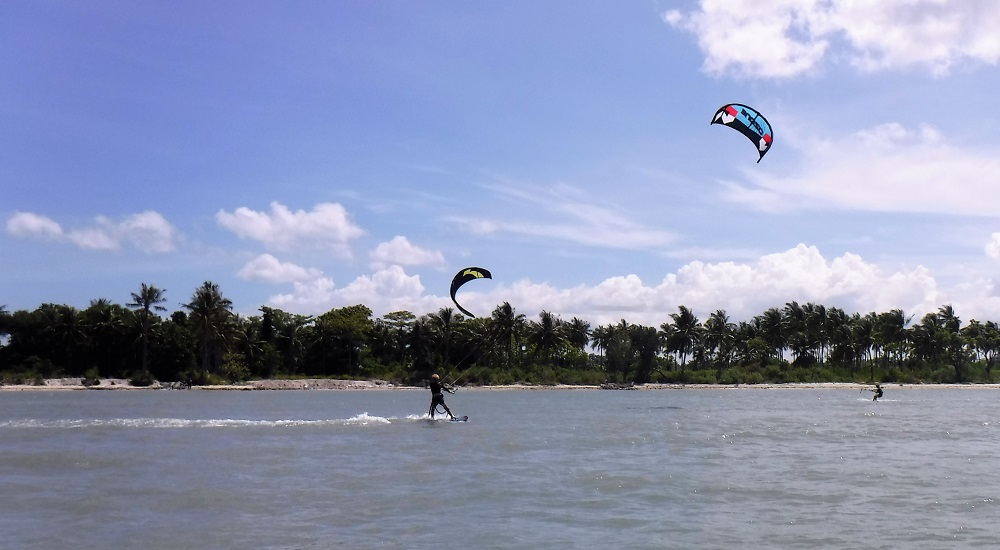
The kids kiting over shallow water.

I’m sitting on the starboard bow, squinting my eyes, binoculars at the ready, trying to spot buoys in our path as we slowly sail forward. The sea is flat and they should be easy to see, only we’re moving relatively fast, the buoys around here are very small and the afternoon sun is reflecting on the water, making it hard to see much.

Is that a buoy? I put the binoculars to my eyes and focus. Something white is bobbing up and down on the water surface, and there’s another white thing just along from it.

“Is that a buoy?” I ask Matias, who is sitting on the other bow.

He stands up and squints at the thing. “I think it’s just rubbish. There’s a net over there.” He points to our port side. Following his finger, I see a small buoy with a black flag protruding.

“Where’s the other end?” I ask, scanning the water ahead and to our starboard. Hopefully we’re not about to run over a net. “Can you see the other end?”

We’re both standing now, scanning the horizon. “Flag,” I yell to David who is at the helm.

David comes forward. “Where’s the other end? Check ahead and to starboard, I don’t want to run over it.”

It’s tricky sailing, this coastal Indonesian stuff. All day we’ve been weaving in and out of marked nets, surveying the horizon, peering at plastic on the surface trying to make out if it is tethered to the bottom, marking some sort of net, or just one of the billions of pieces of floating plastic that makes up the surface layer of the Indonesian territorial sea.
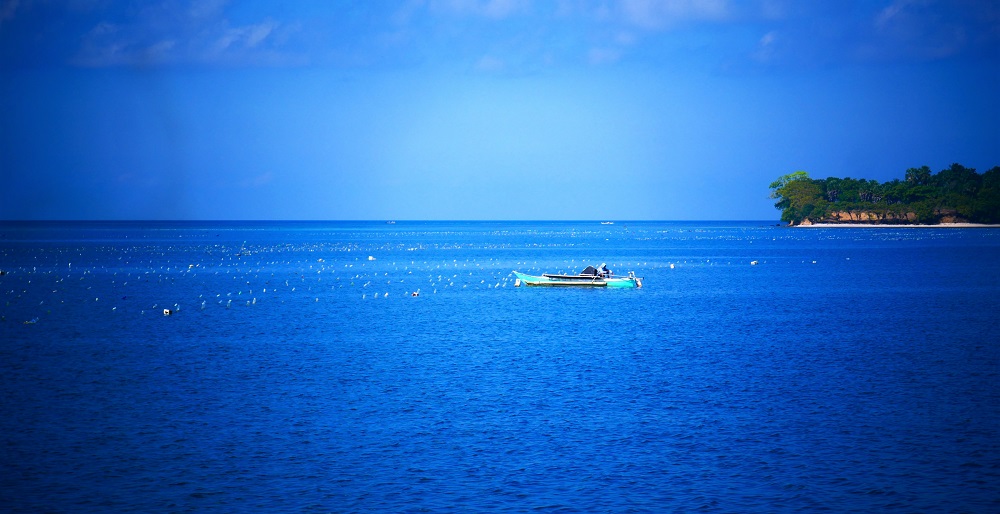
Seaweed farms tended by fishers in outriggers. The white dots on the water surface are empty plastic water bottles, each tied to the top of a vertical line of seaweed.

We’re on our way to Makassar, the capital of Sulawesi, where we need to renew our visas. The trip from Wakatobi has been interesting; as we left the deep seas of eastern Sulawesi the numerous Fish Attracting Devices (FADs) were replaced with equally numerous nets tethered to the surface of the shallow coastal shelf and, as we got closer to land, with thousands of seaweed farms.

We wanted to go kitesurfing at Jeneponto, a spot at the south-western end of Sulawesi where a kite resort is due to open in July. The area is subject to some local weather effects that make it uncharacteristically windy for Indonesia, and South-East Asia’s biggest independently run wind farm is sited just around the corner. The kite-resort-to-be is situated just back from a shallow, sandy bay opposite an idyllic-looking island with scores of spindly outrigger fishing boats landed on the white sand. On satellite imagery it looked the perfect spot to relax for a week before heading to the big smoke of Makassar, Indonesia’s fourth largest city.

We arrived in the general area late in the afternoon and found that a few developments had taken place since the last satellite photo. The entire coastal area in front of the wind farm and beyond was now full of seaweed farms, large rectangular spaces marked out by plastic bottles attached to vertical lines in neat rows, the bottles spaced about a foot apart and sticking up from the water surface at an angle, barnacle growth weighing down their submerged necks. Interspersed between the farms were fishing nets marked by buoys at either end. About one hundred fishers were labouring the small bay, working the nets or harvesting seaweed from their fragile outriggers. The farms extended into our intended anchorage and we cautiously wove our way into the bay between the lines, finally stopping in a small empty space to put down the anchor.

“I don’t see where we can go kiting,” I said, surveying the wall-to-wall seaweed farms of the bay.

“Well, let’s anchor, and then we can go ashore to scope out the resort,” replied David.

As I started lowering the anchor, a fisherman started towards us, waving his arms wildly.

Jaring?” shouted David, pointing down.

Jaring,” answered the fisherman, indicating the extent of the net by pointing to two widely space buoys.

Di mana jangkar?” asked David (where can we anchor?) and the fisherman grinned and waved for us to follow him.

“He must think we’re nuts,” I whispered to David as we followed the small outrigger to a corner of the free-looking space. “Coming here to anchor in the middle of their seaweed farms. It’s like camping in a New Zealand farmer’s cornfield.”

Tidak jaring di sini,” shouted the fisher, indicating a tiny area with no nets. It was a bit too close to the seaweed farm for comfort but provided the wind direction didn’t change we’d be OK.
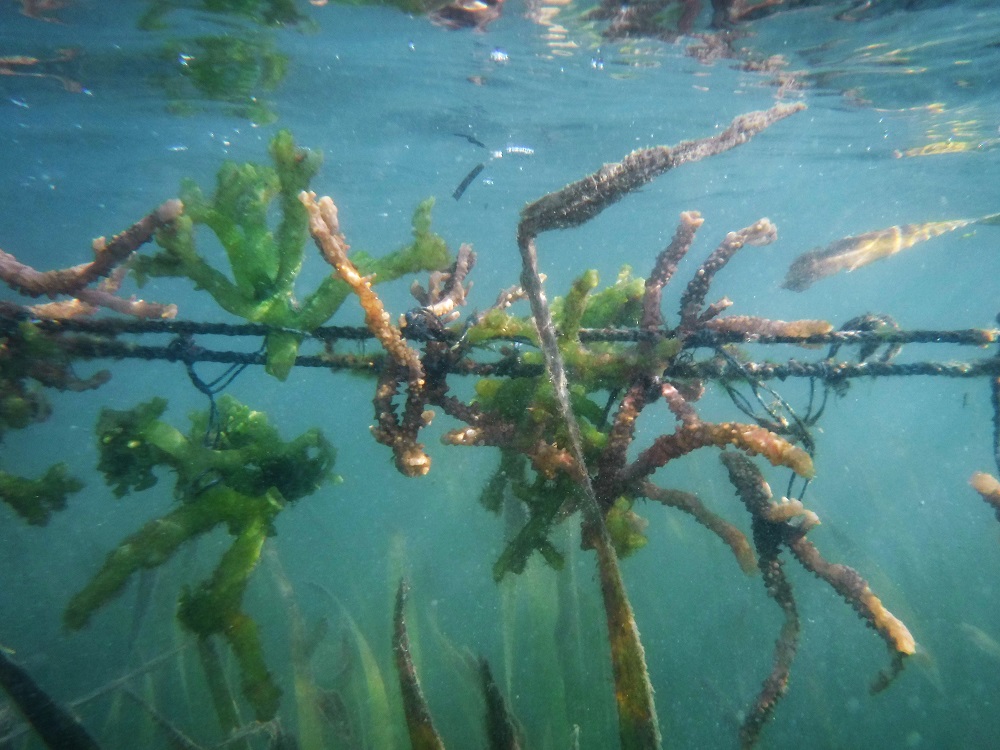
Seaweed growing on a shallow farm line.

And so we anchored, surrounded by fisherfolk looking curiously on, no doubt puzzled as to why we’d chose to stop here, right in the middle of their seaweed farms, but also presumably aware that since their farms covered the nearest 500 hectares of shallow sea we had few other options.

Back in New Zealand I used to work on a marine spatial plan, an attempt to ensure that all marine users, whether commercial or recreational, were provided adequate space to do their activities. There, not surprisingly, aquaculture is only allowed in zoned areas, and once space has been allocated for aquaculture it is marked on charts and is off-limits to non-compatible uses like yachting. In Indonesia, there are no such plans, and everybody can do what they like: if seaweed farming suddenly turns profitable, there is no stopping locals from covering the entire nearshore area in seaweed farms, even if that may preclude activities such as boating, fishing and transport.
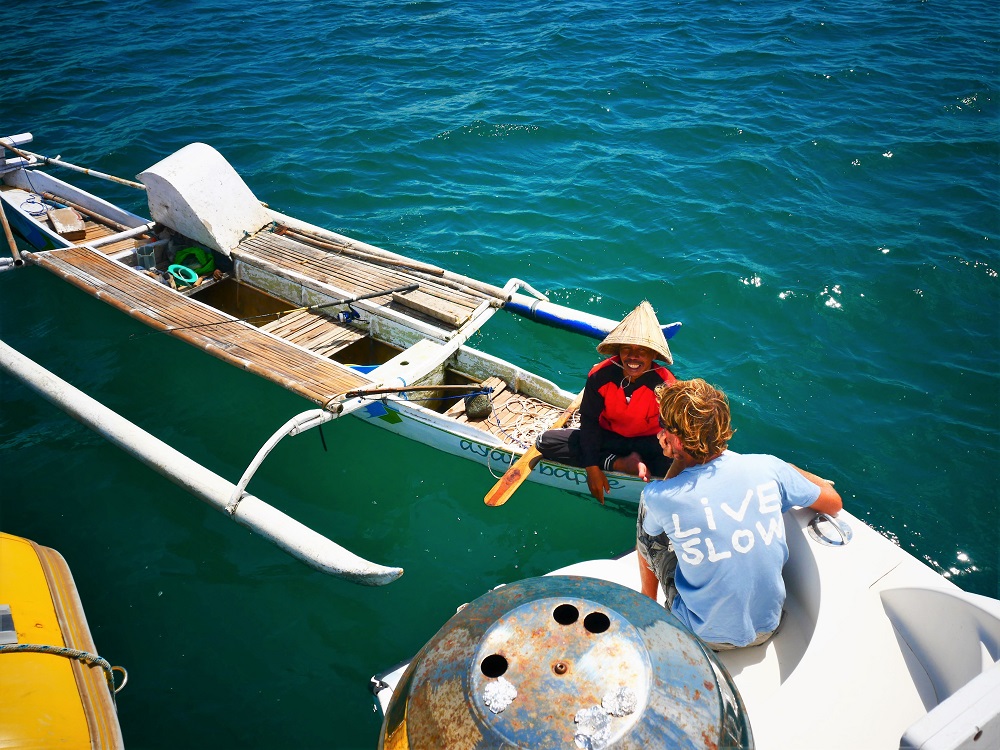
Udin visiting the boat.

Udin, a local seaweed farmer, stopped by our boat to chat. He explained that the seaweed is sold to China and that the local farmers earn about $1 per dry kg. The population pressure is high here and due to overfishing the fish stocks are dwindling, which means that fishermen turn to whatever they can to make a living. So now everybody grows seaweed and use bottom nets to catch whatever fish they can in the tight spaces between the many seaweed farms, and the bay is busy with boats manned by fishers covered in heavy clothing from top to toe, their heads shielded from the searing sun by their traditional conical hats. The fishers travel to and from the farms all day, sitting fishing during any downtime from the harvesting or sowing of seaweed onto the thin lines. At the end of the day, only a handful of tiny fish lie listless in the bottom of the boat to show for all their efforts.

It is Ramadan, which means that no devout Muslim is allowed to eat or drink between sunrise and sunset. To show respect, we don’t eat or drink during the daytime when we’re ashore, but the boat is our home and Udin came onboard just as I had set out the lunch plates. The kids were busy helping themselves, and he surveyed the bread, cheese, sliced tomatoes and cups of water with obvious discomfort.

Would he like any? I gestured, but he shook his head, saying tidak, no. It must be hard? Yes, he is very thirsty and there are five hours left till sunset. The worst is that he cannot smoke, no cigarettes during the day. He sighed and closed his eyes, his head leaning back against the seat.

It is an interesting phenomenon, Ramadan. For a whole month, people lie around listlessly and ill-tempered, plagued by raging thirst, blood-sugar lows and acute nicotine withdrawal. Everything slows down or stops, with a presumable huge knock-on effect on the economy. Ramadan started when we were in Wakatobi, and two days before it commenced I was trying to get some dive tanks filled at a dive shop, but they couldn’t do it because the guy who could operate the compressor was engaged in pre-Ramadan celebrations. Once Ramadan started I tried again, but then he was not at work because of Ramadan. Whenever we step ashore we see men and women lying sleeping the shade, turning grumpily as small children (who are allowed to eat) climb all over them, laughing and joking.
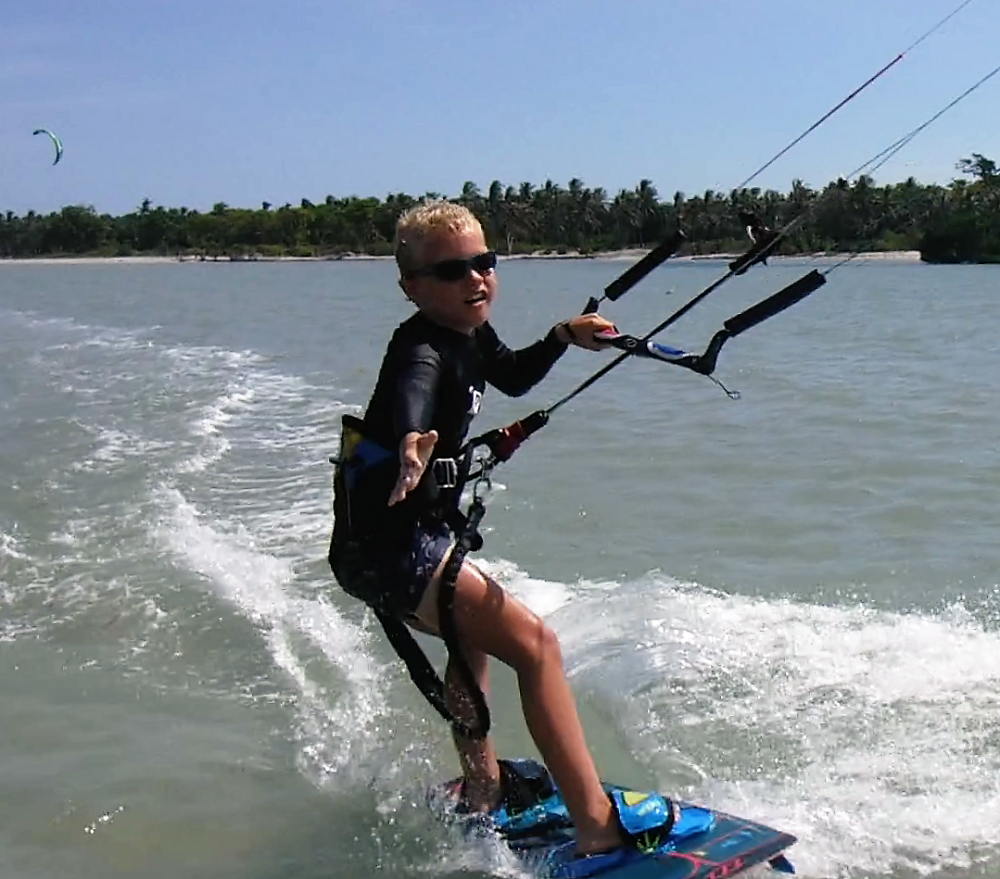
Lukie coming in for a high-five.

Despite the seaweed farms, we found a small area to kitesurf, a great spot on the intertidal sandbank where for parts of the tide it was deep enough for the kids to zoom up and down, and enjoyed a week of having the windiest spot in Indonesia all to ourselves.
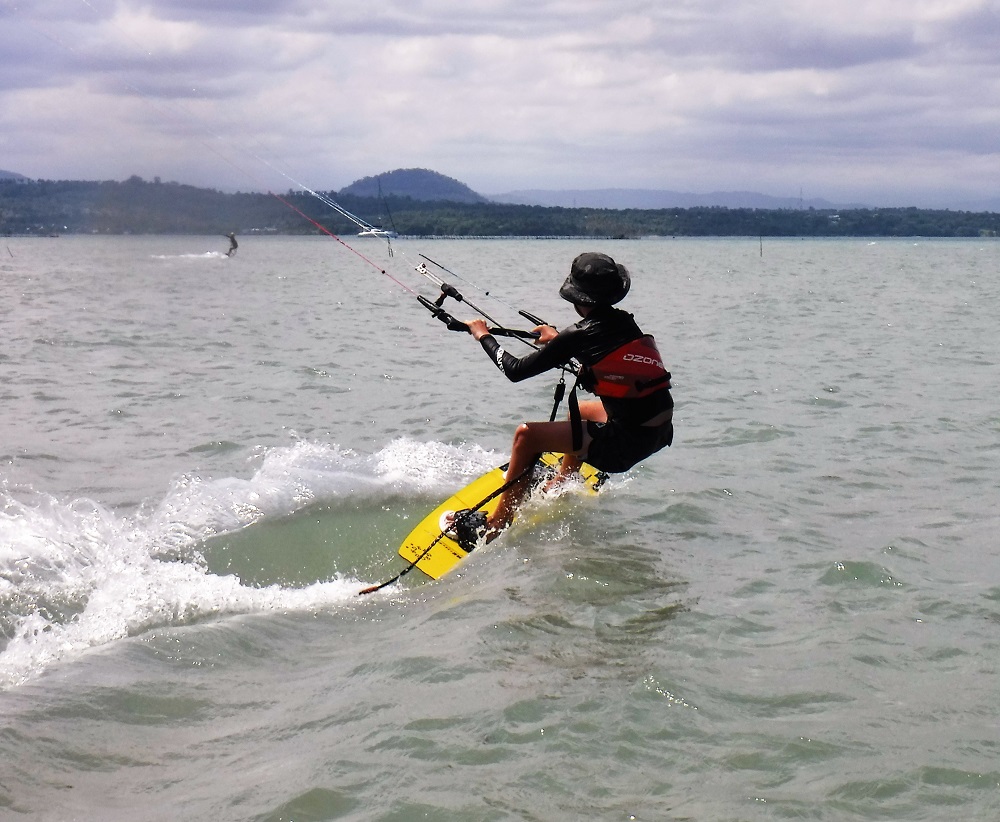
Matias kiting away, Lukie and Bob the Cat in the background.

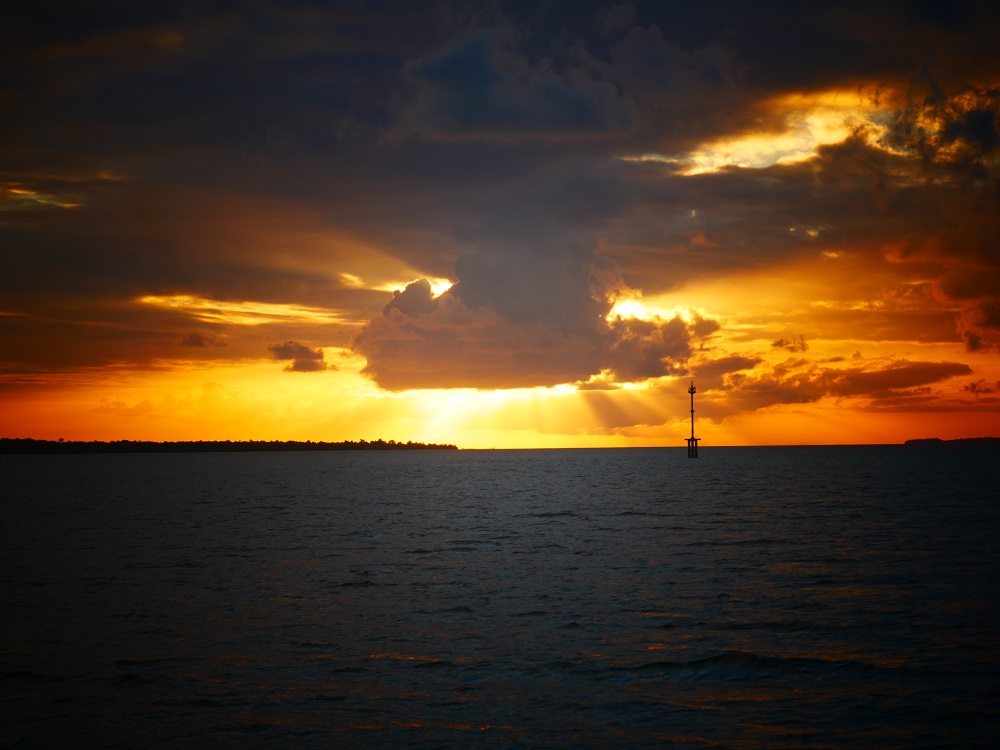
“I still don’t exactly see how they can open up a kite resort here,” I said to David one evening as we were relaxing on the deck. The sun was setting, the orange and pink hues of the sky reflecting in the thousands of plastic bottles covering the surface of the bay, the tiny outriggers of the late fishers outlined sharply against the darkening sky.

“I know,” said David. “There is no space. It’s OK for our two kids to go at the same time but imagine having 15 or 20 kiters all trying to fit into that intertidal area. And what will they do at low tide – people aren’t going to want to pay to come and wait for the tide to rise…”

Working the nets in the fading sun.

Now on the way to Makassar, as I sit on the bow trying to navigate us safely through the maze of seaweed farms, nets, and small fishing outriggers, I reflect on Jeneponto. I imagine that the developer of the resort is worried about the seaweed farms ruining his perfect kite spot, the accommodation for which he is already taking bookings online. But you can’t blame the locals for exploiting all available space for their semi-lucrative cash crop. It’s a poor area of Indonesia, and without the seaweed many families will struggle to have enough food to eat. Destructive fishing practices and general overfishing has clearly completely depleted the fish stocks on which locals traditionally relied, and something has to fill the gap. I recall a conversation with a French owner of a boutique adventure resort in Halmahera, who was complaining about the locals fishing the reefs around his resort

“I tell them it is not good to fish, that tourists will pay to come and see the fish,” he said. “They don’t have to kill them.”

I nodded. “How many local people do you employ in the resort?”

He looked down. “One,” he said. “The cook. But maybe if we grow, we can employ one or two more.”

Well. One employed person is not really going to replace the traditional income and food provided by fishing, and I guess over-exploitation of marine resources in Indonesia will not stop until realistic alternative livelihoods are available. At least the seaweed farming of Jeneponto is not extractive, and the farms will be providing shelter for juvenile fish, which may help restore the fish stocks of the general area.

And as much as I love kitesurfing, I would rather feed a couple of villages than line the pockets of an expat resort owner. So as we sail away I wish the seaweed farmers favourable conditions and bountiful harvests, and hope that somehow the kite resort can survive despite a severe lack of space.

Wakatobi water time

David got back from his trip to the UK finding the feeble flashlight with which I was supposed to ward off intruders unused and the kids and I eager to leave Wanci. Although we’d been making the best of the location, hanging out with our awesome friends, diving, snorkelling and even doing some kite surfing while he’d been gone, we were keen to see more of the famous Wakatobi National Park. Established in 2002 to protect the largest barrier reef in Indonesia and the associated area of astounding marine diversity, the National Park covers an area of 1.39 million hectares and is recognised as one of the highest priorities for marine conservation in Indonesia.

Lukie free diving down to high-five scuba-diving David.

Wakatobi is a veritable water paradise. Small sand-fringed islands are dotted over a large area of deep, clear water, each island surrounded by lush seagrass beds bordered by current-swept plunging coral walls. The ocean here is teeming with life – whales, dolphins, fish of all descriptions, several species of turtles, sea snakes, squid, and octopus.  

Seasnake on the shallow reef.

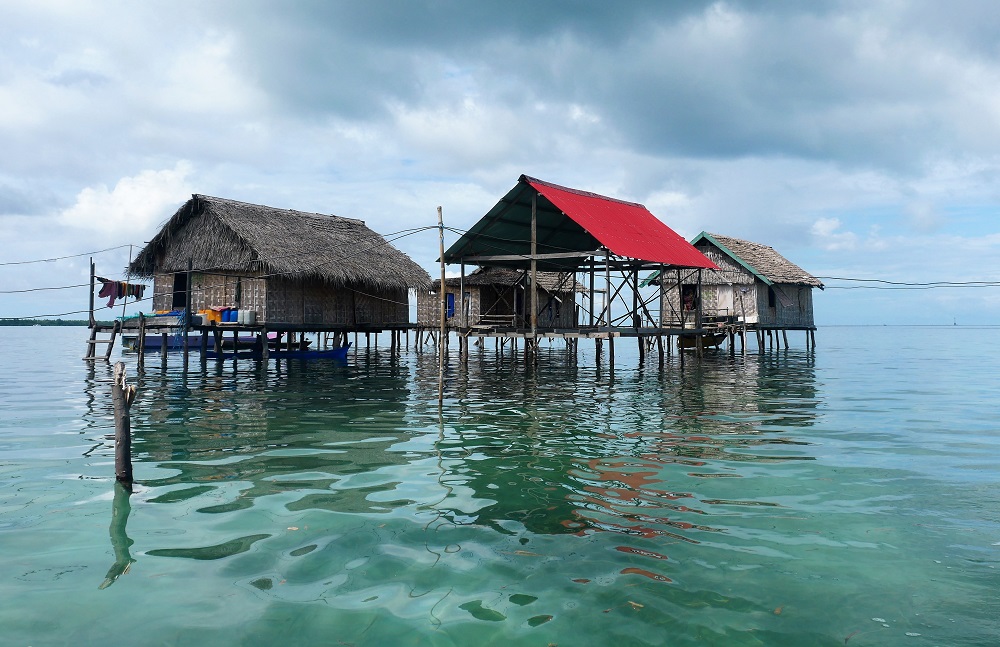
The ocean is especially important to the local people here, the Bajau sea gypsies who are a traditionally nomadic sea-dwelling tribe. Originally the Bajau lived exclusively on boats, which they sailed around in large flotillas of extended families, fishing and trading for food within a larger home area. Nowadays, the Indonesian government has encouraged the Bajau into permanent settlement and most live in wooden stilt houses built over the shallows, the walls of their small houses made from palm leaf mats, their longboats hoisted up underneath the house. Everywhere we sail in Wakatobi are these sea villages: dotting the perimeter of remote atolls, stretching out from the coastline of otherwise uninhabited islets, and extending seawards from larger, more traditional land-based townships.

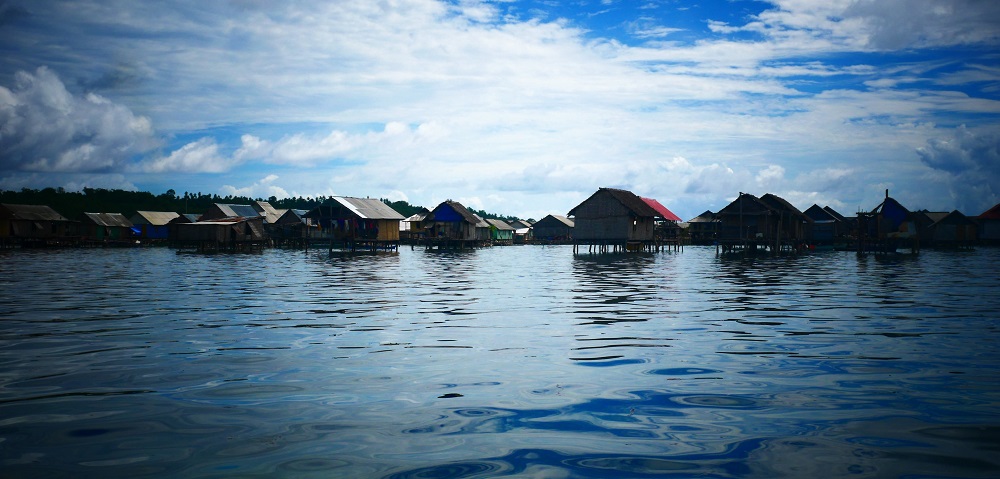
Bajau township, stilt houses stretching out in neat rows over shallow water.
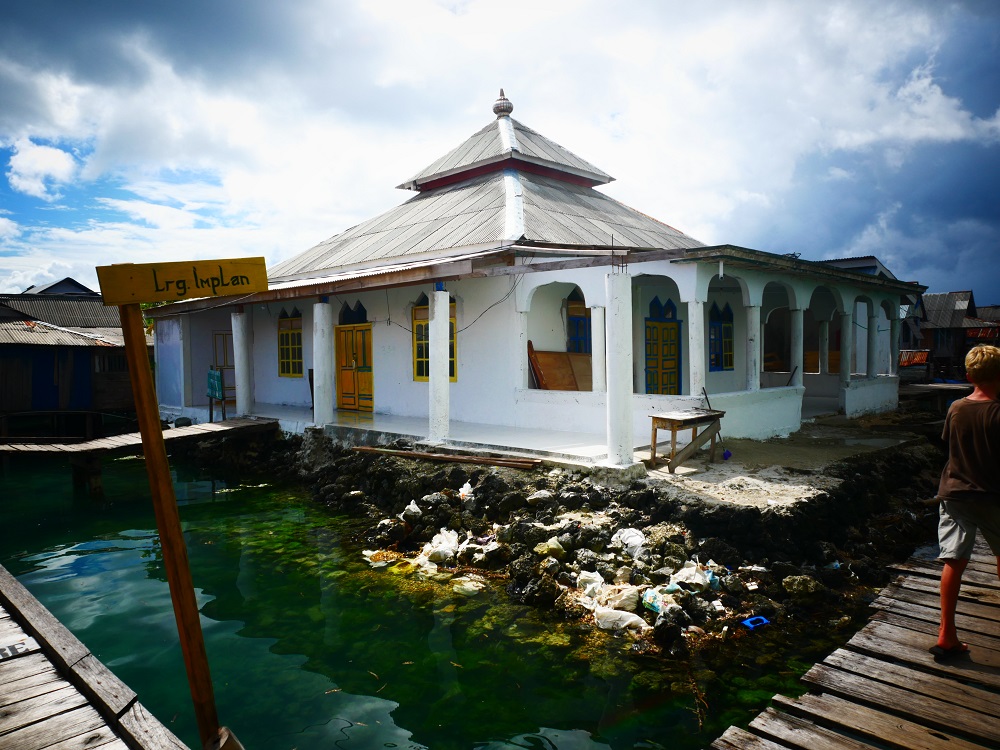
A Bajau-style mosque – I love the street sign.
Bajau boy, plaing in a bucket next to the boardwalks connecting the stilt houses.

Legend has it that the Bajau originally lived on land, but after their king lost a daughter at sea in a storm the tribe went searching for her. When they failed to find her, they feared returning to face the king’s wrath, and so they stayed afloat, travelling on the ocean forever after, following the bounty of the seas. Since they stopped being nomadic, the Bajau have been struggling to catch enough seafood to live, and in the recent past started using destructive fishing methods like blast and cyanide fishing to increase their catches. To limit resource damage, the Indonesian government has been encouraging them to use Fish Attracting Devices (FADs) instead, and the water around the Wakatobi islands is littered with little bamboo structures anchored in deep water.

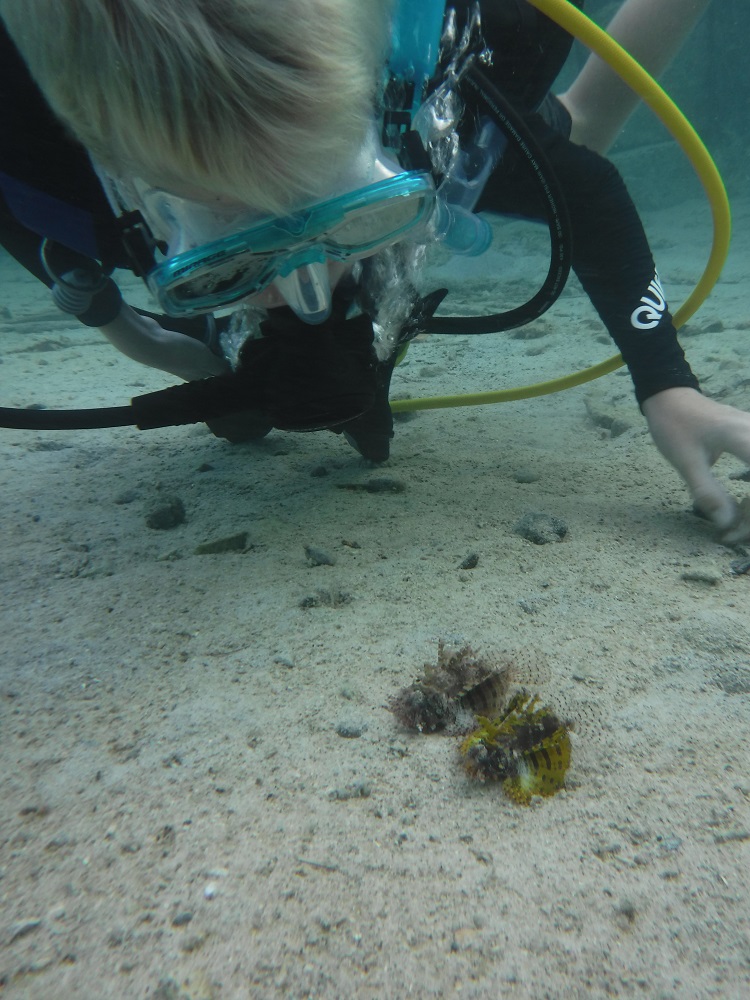
Matias surveying two baby lionfish.

The international research organisation Operation Wallacea, a branch of which is based on Hoga Island in Wakatobi, has seen the destruction first hand.

“There were just dead fish everywhere, floating on the water,” explains Nina, a student from Austria doing her marine biology project on the island. She is describing a famous dive site within the marine reserve, where she and her buddy surfaced in a tide of dead reef fish. “We’re not sure if it was blast fishing – we didn’t hear any explosions – or if it was cyanide.” She says that the Indonesian government is working with locals to promote non-fishing based livelihoods and the use of sustainable fishing practices.

The rare mandarin fish, spotted at a Wakatobi jetty.

“The government knows that this site is special,” she says. “I mean, it is the largest barrier reef in Indonesia! They want to protect it, but in reality they can’t stop the locals from fishing, and I’ve even seen big commercial fishing boats within the reserve.”

Lukie surveying the seagrass beds.

It is certainly hard to keep the Bajau from fishing. The sea is everything to them – their home, their work, their entire world. Fishing is not just a job to them; it is in their blood, the way of life of their forefathers and their children. They are famously adept at free diving and the deepest dive recorded for a working Bajau is 79 m, although most of their dives will be shallower than that. Traditionally, they spearfish, spending up to 60 per cent of their working life under water, with the result that they have some fascinating genetic adaptations to apnea diving. They have enlarged spleens that hold more haemoglobin-enriched blood than normal people’s. When they dive, the spleen contracts, pushing these extra blood cells into the general circulation, thus boosting the oxygen levels in the blood. They also have a genetic adaptation which allows them to reduce their metabolic rate and thereby lower their need for oxygen whilst diving, one which prevents dangerous levels of carbon dioxide to build up in their blood, and another which increases the degree to which blood is squeezed out of extremities when they dive, which keeps the blood circulating just in the core region where it is needed to keep up vital functions.  

Made to fish – Bajau women heading to market in Wakatobi.

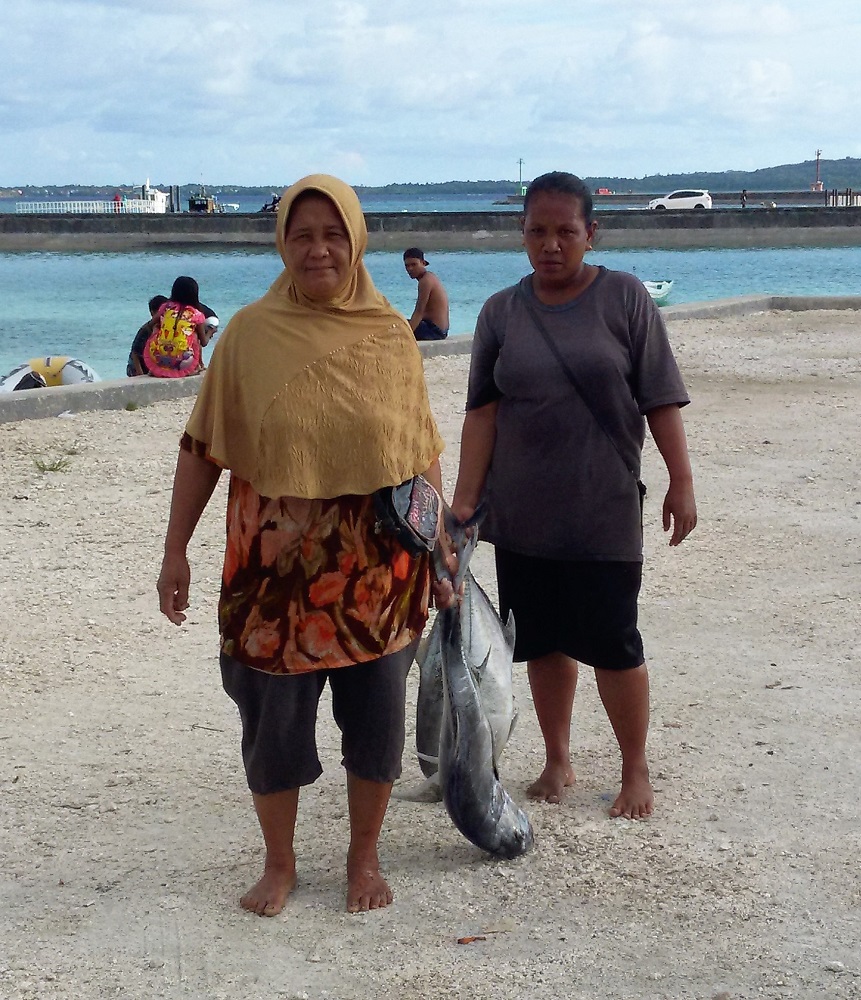
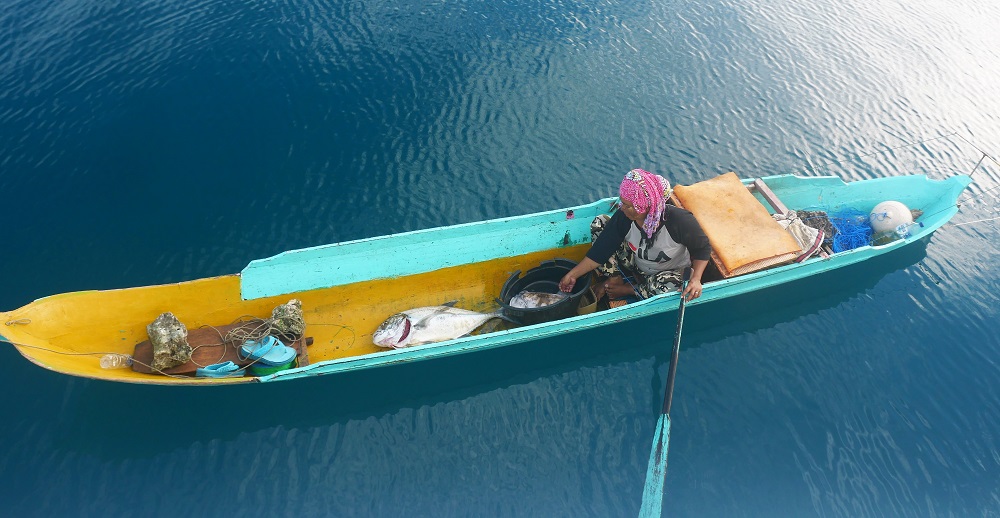
All in all, they’re the perfect diving machines, and we watch them with awe as they spearfish from their fragile boats, wearing only their traditional wooden goggles. Every day a new canoe comes to the boat, it’s owner wanting to sell today’s seafood – lobster, crab, mantis shrimp, fish, squid, cuttlefish, octopus, shellfish… We buy some to support the local population and they take the rest to the local markets where the Bajau dominate the fish aisles.

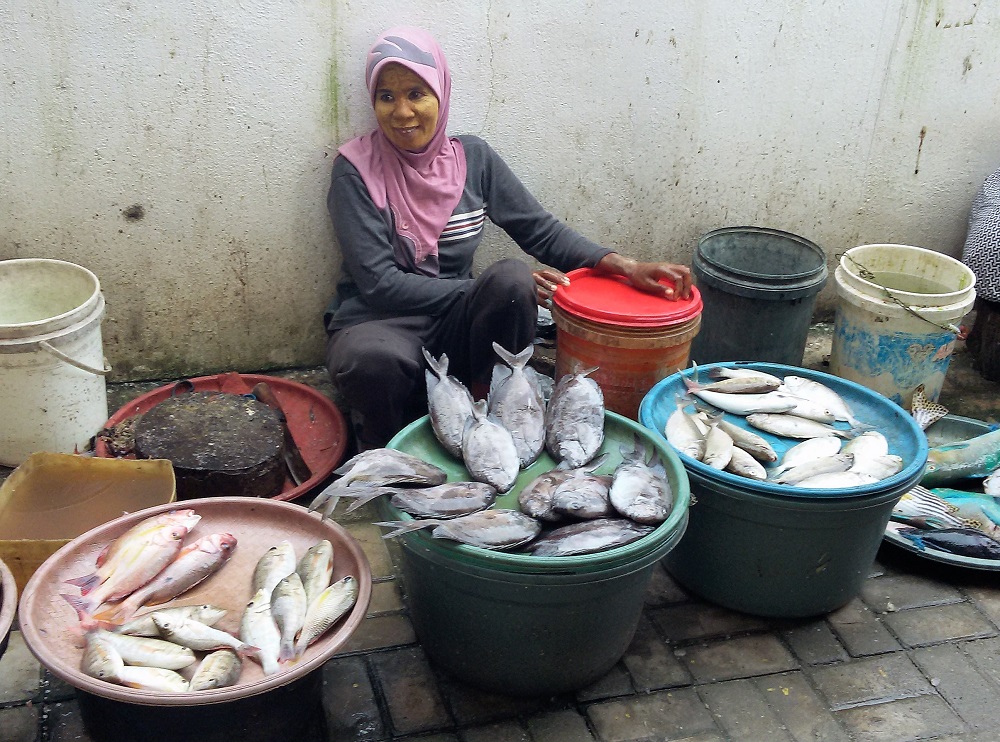
Bajau woman offering up fish for sale.
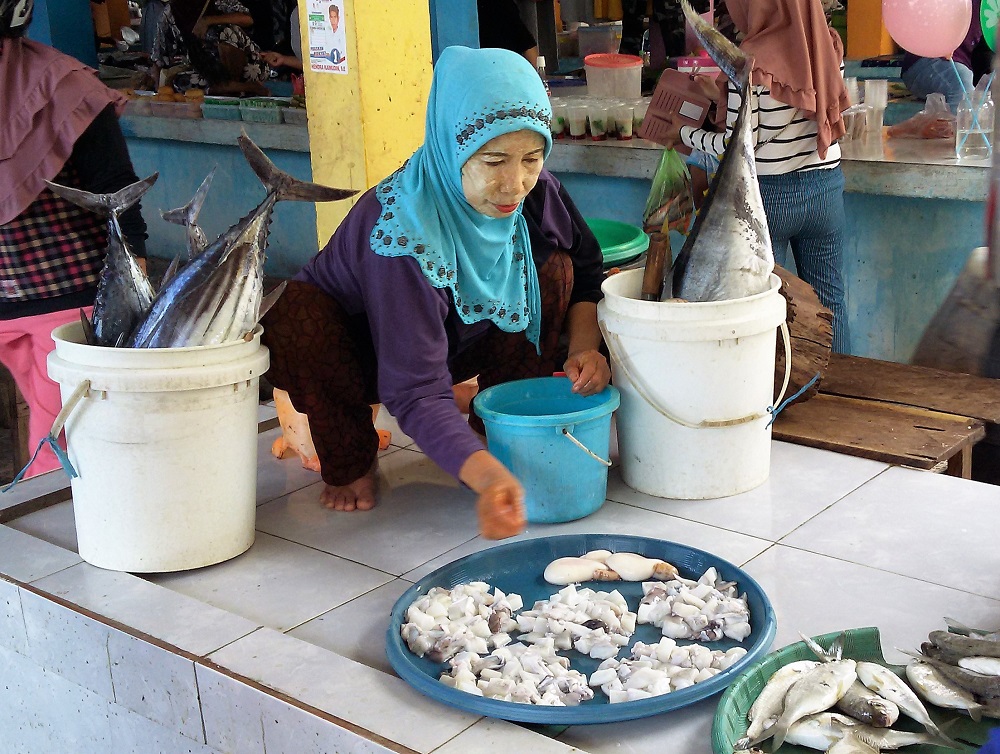
Bajau woman at the fish market. She’s wearing the traditional Bajau Sunscreen made from bark.

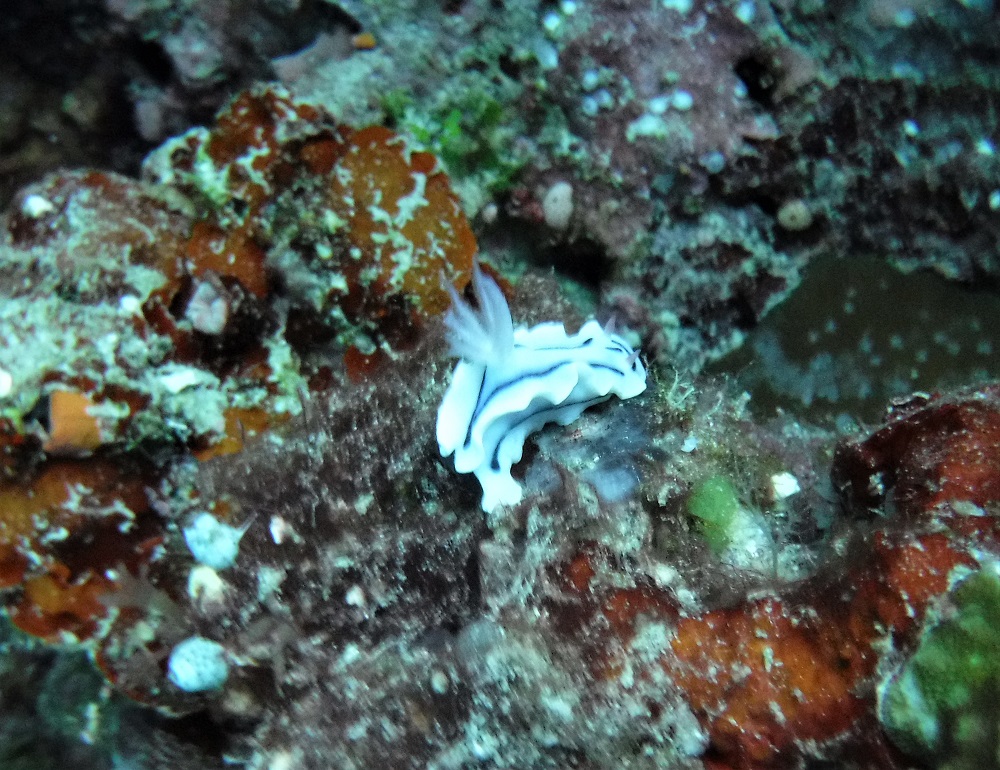
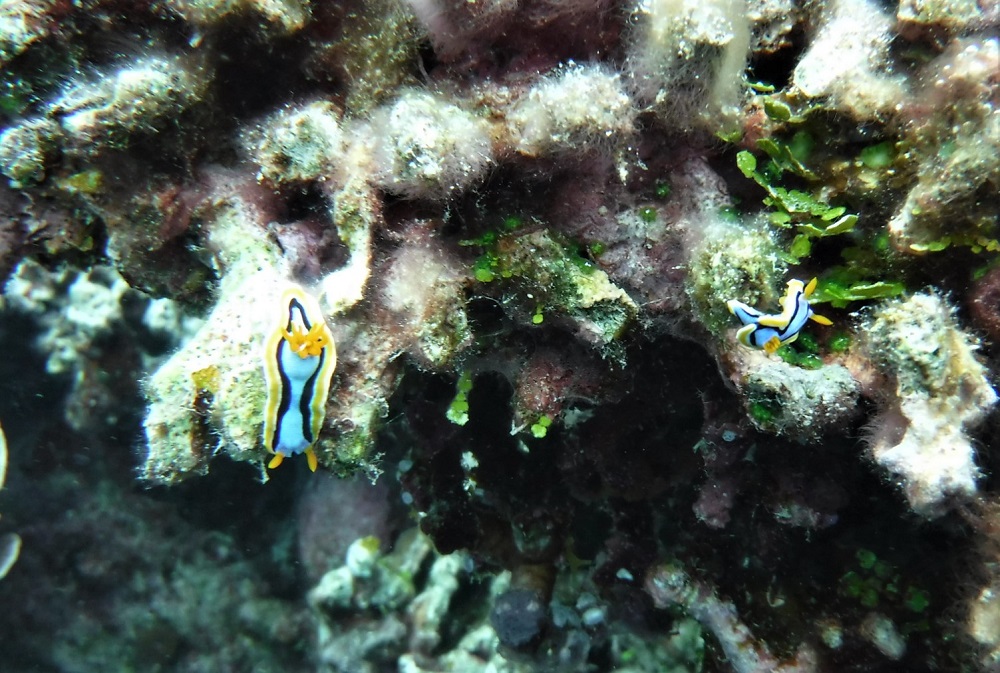
We spend our days in Wakatobi diving world-class spots – circling pinnacles rising from deep blue drop-offs, swimming under dramatic overhangs, drifting along sheer coral walls pushed by swift currents, finning leisurely over shallow reefs and seagrass beds. Everywhere you put your head down here there is something to see. Swarms of fish clouding the vision so that you can barely see the surface when you look up, seasnakes deftly exploring coral crevices, boring their heads into incredibly small holes, their tongues flicking in and out as they taste the water to find prey, and swimming vertically up and down when they go to and from the surface for a breath. On the reefs, delicate nudibranchs slowly move along sunlit coral and lazy turtles sleepily look out from deep crevices.

Pipefish in the seagrass.

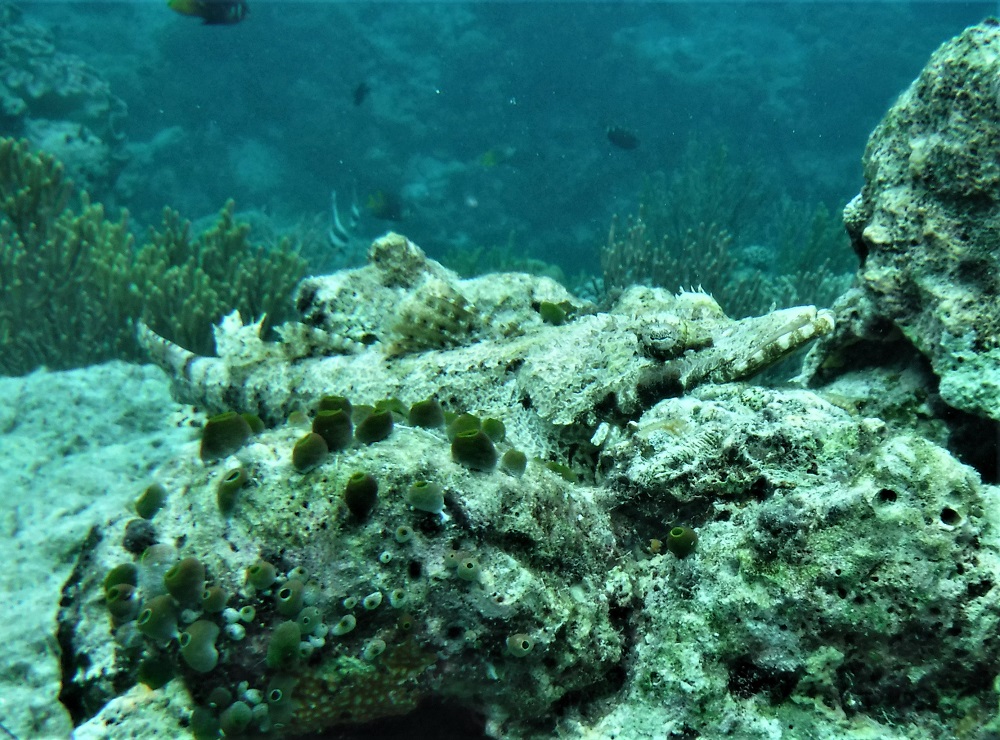
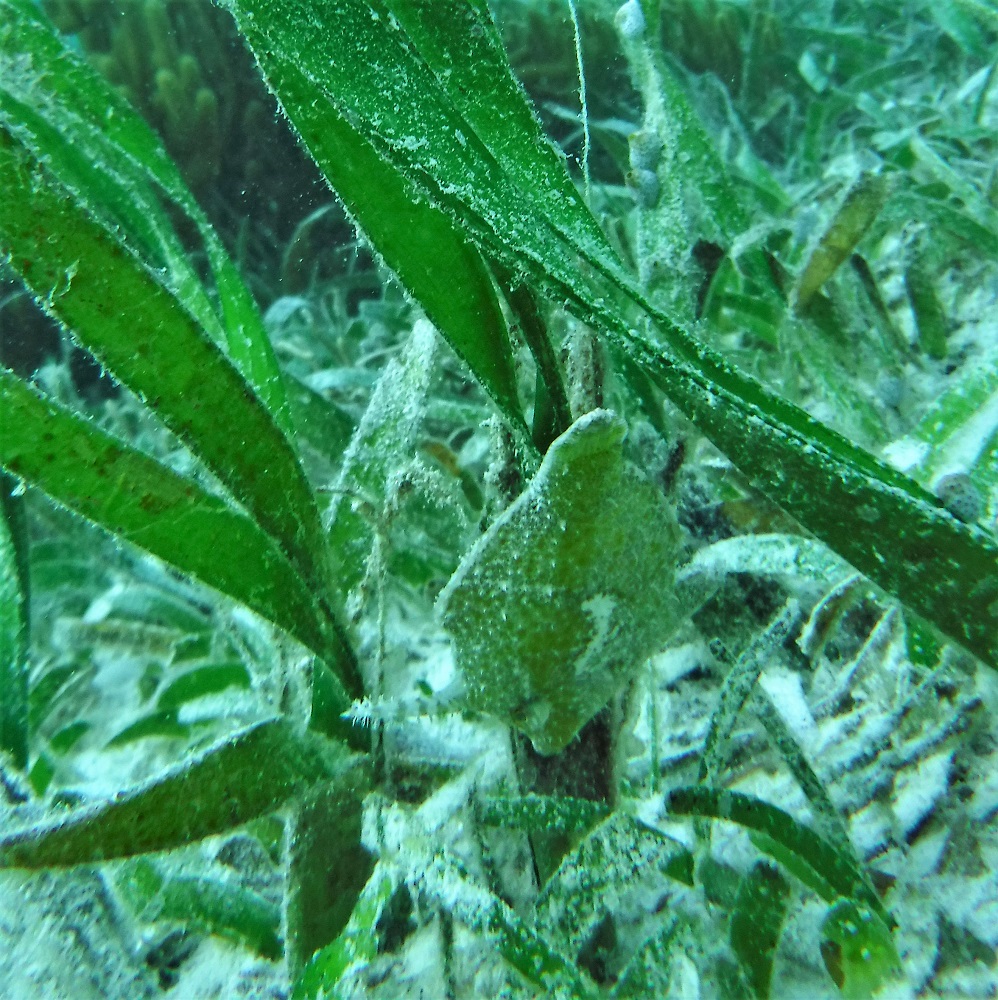
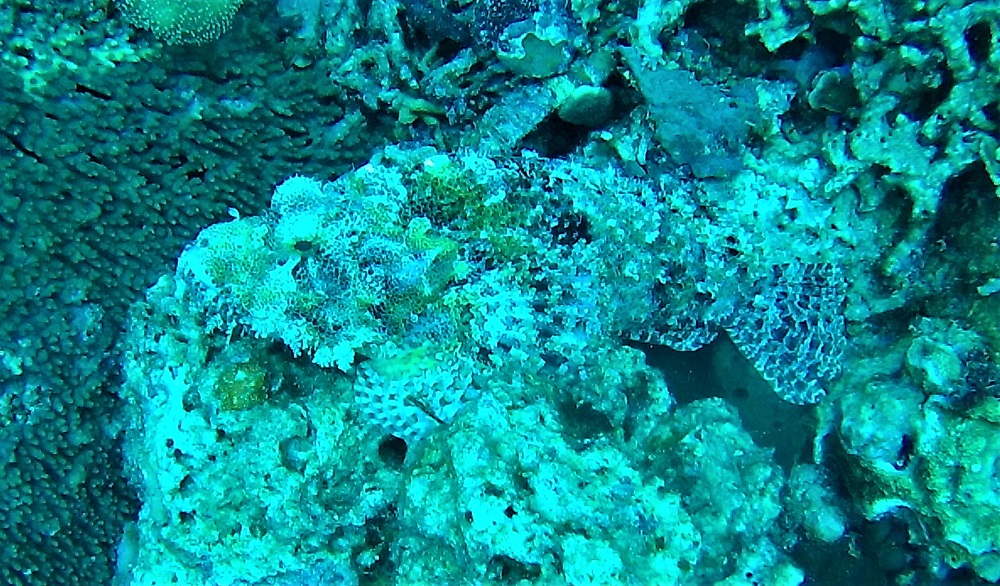
Evil-looking crocodile flathead and scorpion fish blend in superbly with the reef surface and white flatfish are almost impossible to see against the white sand. Fragile pipefish and incredibly rare cryptic filefish hide in the seagrass beds, and giant trevally and large snapper hide in the depths of a fast-flowing channel. At a late afternoon dive on a pier we are treated to about fifty mandarin fish dancing to attract a mate and see mantis shrimp coming out of their burrows in the fading shafts of yellow sunlight dancing down from the sky above.

Spot the crocodile flathead on the rock.
Look hard and you’ll see the incredibly rare diamond filefish (head down, centre of image) we found lurking in the seagrass shallows.

Wakatobi is a magic underwater paradise, and we hope the local people can find ways to fish sustainably so that it will remain as diverse and productive as it currently is.  

Well-camouflaged scorpion fish on the reef.
Nudibranch hanging out on the coral.

All alone in Wanci

“And so, if the red light goes on permanently, it’s because it is overheating. That’s normally if the fan is failing to turn on. So then you need to check that it’s on and if it isn’t, just tap it to get it going.” David looked sternly at me.

“Uh huh,” I responded hesitantly. “What fan? I mean, where is it?”

“It’s the one under Lukie’s bed. You just have to stick your finger in there and tap the fan to restart it…”

“Okay…” I sighed. “Look, I don’t think I’ve ever seen that one. Can you show me?”

He touched my arm and started downstairs, keeping me following closely behind. Entering Lukie’s bedroom he straddled the bed and lifted up the mattress, pushing the wooden slats underneath to one end of the bed whilst doing some subtle acrobatics to ensure his weight didn’t break the fragile wood. Crouching on the upturned mattress he stuck his head down the space below the bed and from the dark void came his muffled voice saying something only barely audible.

I balanced gingerly on top of the pile of slats and crawled closer. “What’s that?”

“The fan – it’s just here. Stick your finger in and tap lightly.”

I pushed myself up next to him and stuck my head down the under-bed space, trying to make out the small fan in the semi-darkness. “I can’t see it. I’ll have to go get a torch.”

He straightened up. “Well, it’s just here. Stick your hand in and feel. And then there’s the engine…” He crawled back out into the corridor, leaving the bed a mess, and took the stairs in two steps. I rushed after him. “I forgot to get a new starter battery for the port engine, so it may not start….” He ran his fingers through his hair.

“Okay…” I looked at the gear levers uncertainly. “Then do I just use the starboard engine?”

“Yes, just start the starboard one and then wait until the battery is high enough for you to start the port side.”

Right. Makes sense. “But it is still working, right?”

“Yes, but I’ve had problems starting it the last couple of times. I was going to buy a new starter battery in Ambon, I just forgot.”

“Okay.”

“And if you move the boat, just remember that the anchor winch sometimes shorts out. If that happens, just lift the little lever in the starboard engine room back up again, that’ll reset it.”

“Right.” I sighed again. “Can you show me where that is again?”

“It’s here,” he said, opening the starboard side engine room and pointing inside.

I stuck my head down the engine room. “Where, exactly?”

“You need to crawl in – it’s under the other box, over there.” He hovered above me, his dark shape blocking out the light, a barely visible outstretched finger indicating the direction of the lever. “If you look up you’ll see a little lever. Just push that back up.”

“Right.”

“And the other thing that can go wrong is that if the button gets stuck.” He pressed his thumb against his index finger, simulating pushing a button. “If that happens, just switch off the starboard engine electrics. And then just unscrew the little unit from the wall and unplug it.”

“Hang on, I need to take notes.” I went inside to get my phone. This was going to require a bit of documenting. I started typing. “This is if the button gets stuck when we’re trying to raise the anchor?”

“Yes, if the switch sticks – it should be OK, but remember it used to sometimes stick?”

I nodded, remembering trying to frantically stop the chain from when the ‘up’ button got stuck, shouting “It’s stuck, it’s stuck,” in frustration from the anchor locker until he managed to switch off the electrics to make it stop.

Raising the anchor – squid eggs stuck on the anchor chain in Wakatobi.

“Run the water maker as much as you need – but if you don’t use it, do a fresh water cycle at least every other day.” He looked at me. “We don’t want the membrane to dry out.”

I shook my head and typed: ‘don’t let membrane dry out.’

“And try to keep the batteries above 75% charge. So if there’s no solar, run the engine to charge. Switch the fridge off once cool in the evening, so it doesn’t run all night.”

I nodded again. I knew all about fridge maintenance and battery charging. No instructions required.

He ran his fingers through his hair again. “Lock the doors at night and if you get intruders this is the safety knife.” He pointed up at the sheathed knife fastened above the door leading out into the cockpit.

“Okay… So just stab them with a sharp knife?”

“Well, don’t let them in, obviously. And if they are outside the door, use this torch.” He unclipped the torch secured just to the right of the door. “Shine it in their face – through the door or in the open. That should blind the person looking at you momentarily. Which will hopefully scare them off, buy you some time if someone’s trying to break in…” He touched my arm. “Keep the VHF on, and your best bet is to lock the door and just call the other boats if you’re in trouble.” 

Right. I swallowed. Sounded fine. I looked around us, out over the still water of the inlet, the turquoise waters bordered by dark seagrassy reef patches, the busy shoreline, the fishing boats anchored nearby. Not a bad place to be. We could do this, the kids and I. We could survive for a week without David on the boat, here in Wanci, southern Sulawesi, Indonesia.

“And what about your lift to the airport?” I asked. “Should we organise that?”

He paused. “I guess we should go ashore and do that… If we can find a driver, then you can drop me ashore in the morning at 4 am and I should be able to make it to the airport by 5.”

I grabbed my bag. “OK, then let’s go and organise that now. Kids? Come along! We’re just going ashore to find a lift for Daddy!”

Boats in Wanci. Hopefully we’ll stay afloat while David is gone.

It was all a bit of a rush. David had had a family bereavement and was going to the UK for the funeral. It was 3 pm, we’d just arrived in Wanci, Wakatobi, and he was flying out the following morning at 5:30 am. He had been undecided about leaving for a week, wanting to wait to see what Wanci was like, check that he felt the anchorage was secure enough for him to leave us on our own. It looked fine here – a wide channel, safe holding, a busy town. Several friend boats to keep us company, and some interesting stuff to do in the general area.

The worst thing about travelling so far away from family is that you barely get to see them. The second worst thing is that you may be out of reach in emergencies; that you might not be able to travel back fast when needed. Thankfully we were in a populated area when he heard, had had internet to look up flights, had been able to make it to Wanci in time for him to fly back.

Now it was just a question of making sure that I remembered everything that I had to do, was able to do all his normal chores, and that I had enough knowledge to deal with the most foreseeable problems the kids and I might encounter in our week alone.

After living on this boat for several years, you would have thought that I would have no problems managing on my own. You would have thought that intimate knowledge of all our systems would, by now, be imprinted in my brain, allowing me to effortlessly retrieve any and all information required to deal with any issue at hand. You would have thought that I would be completely competent at the troubleshooting and fixing required to get by on an older boat on a daily basis, that I would have a solid handle on all battery-related questions and breeze through any conversation about how best to deal with a sticky solenoid switch for raising the anchor. You would have thought that I would be competent at changing water-maker filters and doing the backwash, proficient at dealing with plumbing emergencies, a whizz at reconditioning outboard engines and possess a steady touch for repairing scratches to the gel coat.

Alas, for me this trip hasn’t worked like that. To save time and because one person can only do so much, we’ve ended up specialising on the boat, dividing labour between us, with the result that we’ve ended up with sharply demarcated territories. David is, of course (being a weather forecaster and a much more experienced sailor than I), in charge of forecasting and route planning to optimise weather. He’s also responsible for systems and in charge of most boat repairs, although I tend to do the painting. I’m responsible for home-schooling apart from music and coding, and for all provisioning, food planning and storage, as well as most cooking. He researches diesel, I download maths resources. He sits poring for hours over weather charts, I download tempeh recipes and Google the price of wine in East Timor. He discusses batteries and gets samples of dinghy glue endlessly from other cruisers; I swap food storage tips with their wives whilst concocting a new recipe involving copious amounts of eggplant.

In summary, we’re like a super-conservative 1950s western family – he is responsible for fixing and planning, and I parent, cook and clean. It works super well most of the time: I can’t think of many things more boring than batteries; he panics whenever he enters a grocery store and tends to leave with nothing on the list bar one tin of tomatoes. I have no idea how he’s organised the tool cupboard; he can’t find the flour to save his life. We both do our share of unpalatable chores: he unplugs blocked toilets, I school the kids. But it does mean there’s no redundancy in the system, requiring a heavy handover when he suddenly ups and leaves for a week.

I’m not sure he struggled much, though, when I went to New Zealand for a week last August, leaving him and the kids to fend for themselves. He just reduced home-schooling chores, didn’t provision or clean, and lived on fried rice, effectively cancelling most of my jobs. Whereas I’m not sure I can get by with just cancelling battery charging or ignoring if we can’t raise the anchor should we need to move….

Gender roles on boats are strangely old-fashioned – in most cruiser couples I’ve met, the man does the boat maintenance and the woman cooks and does the laundry. The difference between male and female roles seems to be most pronounced on kid boats and I haven’t met any cruising families where the woman is not in charge of home-schooling and has the ultimate say in provisioning, and where the man is not responsible for refuelling. On boats sailed by couples the gender roles are more often blurred, with some men cooking up a storm and some women helming the boat and shouting orders from the cockpit. My theory is that when sailing with a family the two adults are busier (add all the kid-related chores, and cooking for, and cleaning up after, a family, to the normal chores of boat life), and as there is more work to be done, the division of labour becomes more pronounced, each party specialising and thereby saving time overall. After making (and cleaning up after) breakfast and doing the home-schooling, I feel like I have enough work on my plate, and don’t have a lot of energy left to inquire as to the state of the water-maker filter or to second-guess David’s weather routing choices other than a feeble question or two about how seasick I’m likely to get on the next passage. And I imagine that when he comes in sweaty after spending two hours bent over double in the engine room he can’t be bothered looking over my shoulder as I decide where to store the canned peaches or seriously question my new-found use of tea tree oil to wipe down interior mould.

In our case, as he is leaving, it feels like this specialisation of labour has led to an astounding level of incompetence on my part, and I am annoyed with my lack of knowledge, frustrated with my limited ability to diagnose and problem-solve boat-related issues, and angry that I’ve allowed myself to become dependent on David’s knowledge to the extent that I now fear being left alone.

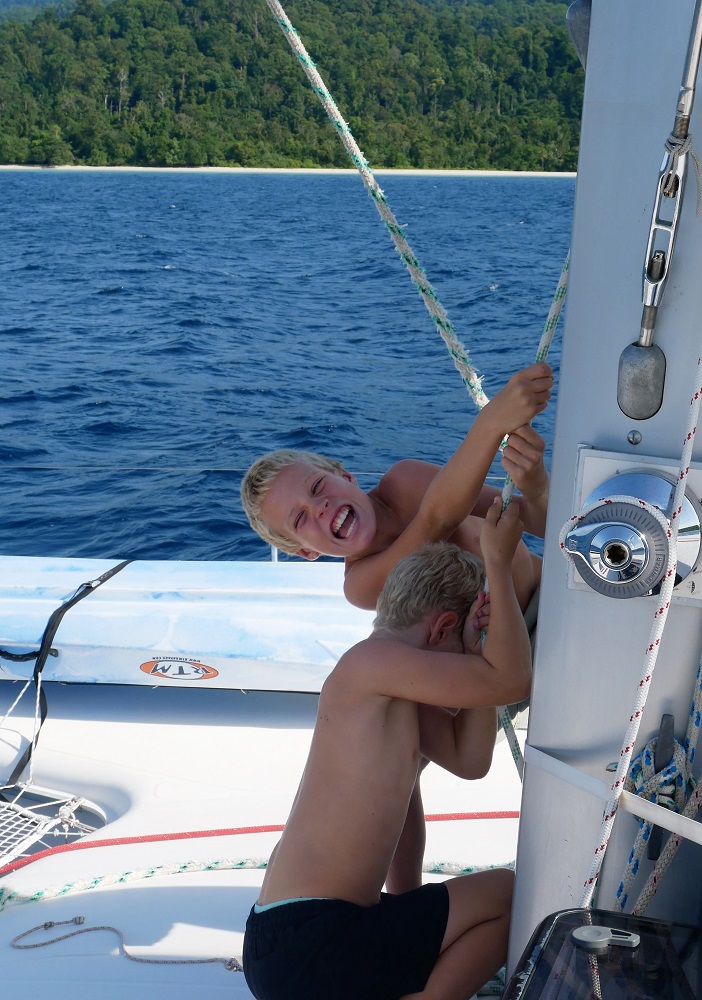
At home division of labour doesn’t mean that one party can’t leave. There, specialist are everywhere and if I have problems starting the car or can’t find the ingredients to cook, I just call the roadside insurance and the pizza shop, respectively, and my problem is solved. At home, I enjoy it when Davis is gone – the kids and I spend all afternoon on the skate park and have TV dinner late, all snuggled up closely on the sofa. Here, in the middle of Indonesia, there is nobody to call, each yacht must be a standalone unit of self-sufficiency, and I’m dreading being left alone. The kids are of course helpful – Matias is adept at driving the boat, dealing with the anchor and setting the sails, and Lukie is an expert at using a winch handle and ties a mean bowline. On top of that, we have friends here – two family boats we’ve been travelling with are in the anchorage, and if I have any problems I know I can call on them.

I dropped him off the following morning at 4 am, returning to the boat housing our sleeping children in the pre-dawn darkness. As I let myself in, my eyes fell on the ‘defence’ torch. I playfully snapped it out of its clasp, weighing the little black cylinder in my hand. I hadn’t ever realised it was there – when I hear a sound in the night, I just roll over and elbow David, mumbling: “I think there might be someone here,” and wait for him to deal with it. I switched the torch on and watched the bright pulses of light illuminate the cockpit.

Hopefully all the information that I had typed into my phone would similarly illuminate my mind, pushing aside the dark fogs of boating-related ignorance clouding my brain and allow me to enjoy this week alone safe and sound on the boat in Wanci.

Matias’s boat blog 6 May ’19

Me diving.

Impressions from Wakatobi

I have not had an idea of what to write about as we have been moving from city to atoll to reef to a dive resort, which is where we are now.

Last week, a Swedish boat with two 10 and 11-year-old girls and a 6-year-old boy invited us over for dinner. The kids didn’t speak much English so we played card games and pillow fights where Lukie attempted to suffocate me. When we arrived Mum and Dad got out of the dingy with Lukie. I was about to get out too when I noticed a moving rope on the petrol tank.

It was a sea snake! It slithered off the tank into the water at the bottom of the dingy. I picked it up and put it in the bailer. They are very poisonous but their mouths are so small that they can only bite the skin in between your fingers, so that’s why I didn’t hold it.

“What does it feel like Matias?” asked Lukie as I dropped it in the water.

“Like a sea snake,” I answered as I was getting out. It felt like a rough rubber hose.

Sea snake

The Swedish boat had bought a big trevally that we had for dinner after Lukie had decided I was not a soft toy that he could strangle. This also happened to be the first time I have tasted cuttlefish. A woman from another boat had brought a curry to the party. I ate the curry, it tasted good. Afterwards, my mum asked me if I liked the cuttlefish and I said:

“What cuttlefish?” The cuttlefish was in the curry.

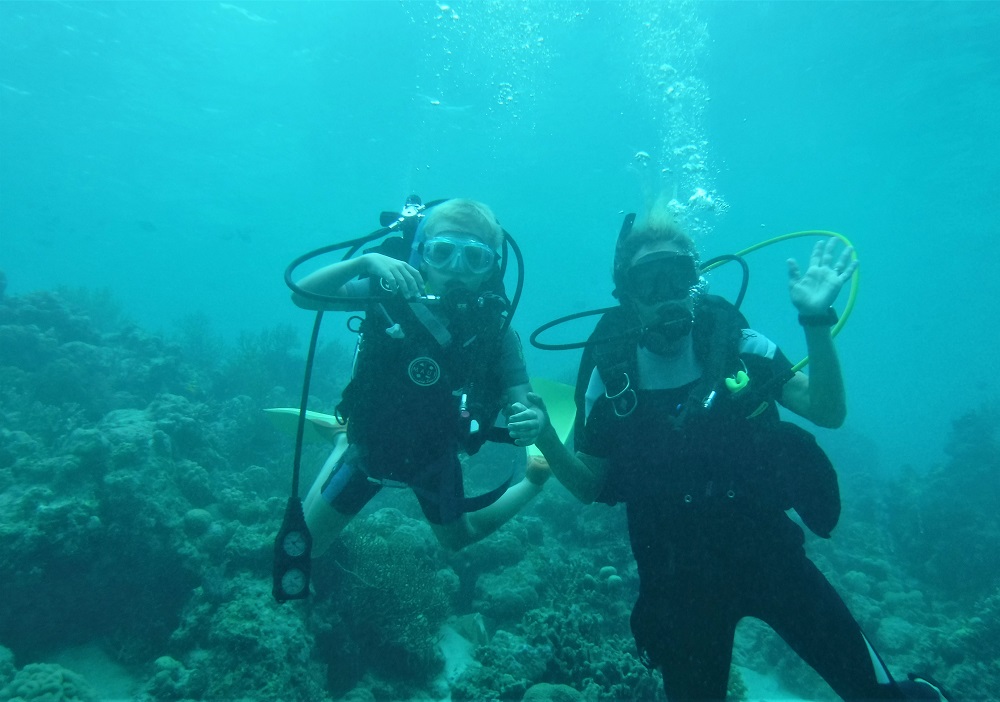
The day after the dinner, I did a try dive with my mum. I had to put on my BCD, buoyancy compensation device, and roll backwards into the water from the dinghy. I was wearing my short wetsuit so as soon as I went down to 5 metres I was freezing.

The day after, me and my mum did another 2 dives, one in the morning and one in the afternoon. On both I was wearing a longer wet suit, but on the second when I went to 11 metres I was a bit cold.

Under the water were some bamboo platforms where we practised some skills like taking off my mask and recovering my regulator so I could get it back if it fell out of my mouth. We did a tour around the area and had a spade fish follow us around. When I waved my finger at it, it started to chase my finger until the last second where it turned away and started to do fishy things again.

Me and my mum on the bamboo platform.

We also saw some nudibranchs that we had never seen before.

I like diving because you get more time in the water than when snorkelling, so you can get a better look at things.

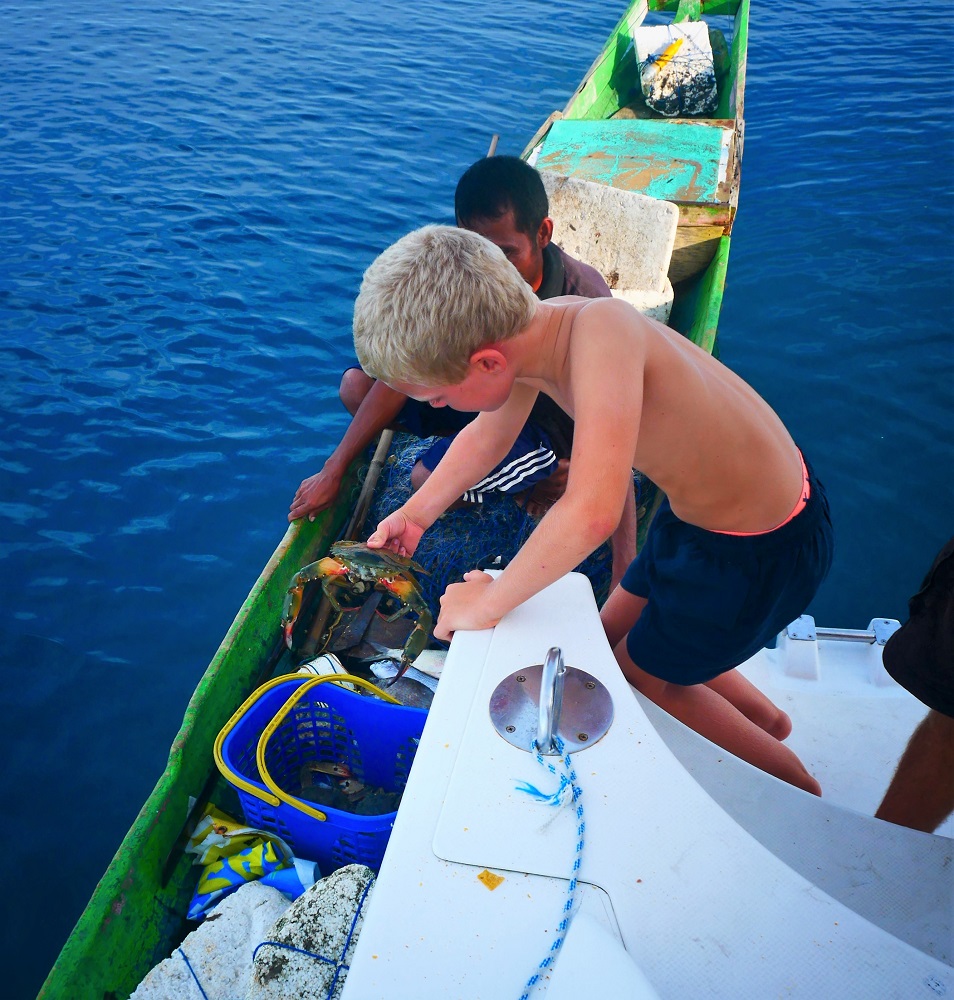
In the afternoon a local in a boat tried to sell us a fish. We already had some so we said no thanks. Then he offered us some crabs. They were half a foot long and still alive so we decided they could be dinner.

After thanking the local fisherman and giving him some money, we put them in a bag which we tied to the boat and dropped into the water. My Dad cooked them at lunch time, and at dinner I tried some. I am not a big fan of crab or crayfish, and I was not expecting it to be so cold. I would have liked them more if they were warm.

The day before yesterday I did my last dive. On the dive we did no skills and saw lots of sea snakes. When we got out Lukie said:

“Matias did you see all those sea snakes? One zoomed out from the water and nearly hit me!”

I nodded and unclipped my dive gear. Lukie asked my mum whether he could have a go so a second later he was under the water looking for more snakes.

Luki.e and my mum

Yesterday a local in a boat came up to us. He offered us a bucket of water. Inside were a bunch of lobster tails.

“Wait here,” I told him.

I went to Dad and said:

“A local want to sell us lobster tails.”

My dad looked puzzled and went to see.

“Ah, mantis shrimps!” he said.

I went inside to Mum. “What are manta shrimps?”

Mantis shrimps are fat shrimps the size of your foot with eyes and legs like a praying mantis, just only more scared-looking than evil-looking.

In the evening we had some other people over. Lukie and I were mainly playing in my room while they were there, and when they were leaving I asked: “What did we do with the mantis shrimp?”

“We had it for dinner, did you not get any?” my Dad said.

“Aw, I wanted some!” said Lukie, a little bit annoyed.

Apparently, it tasted like lobster.