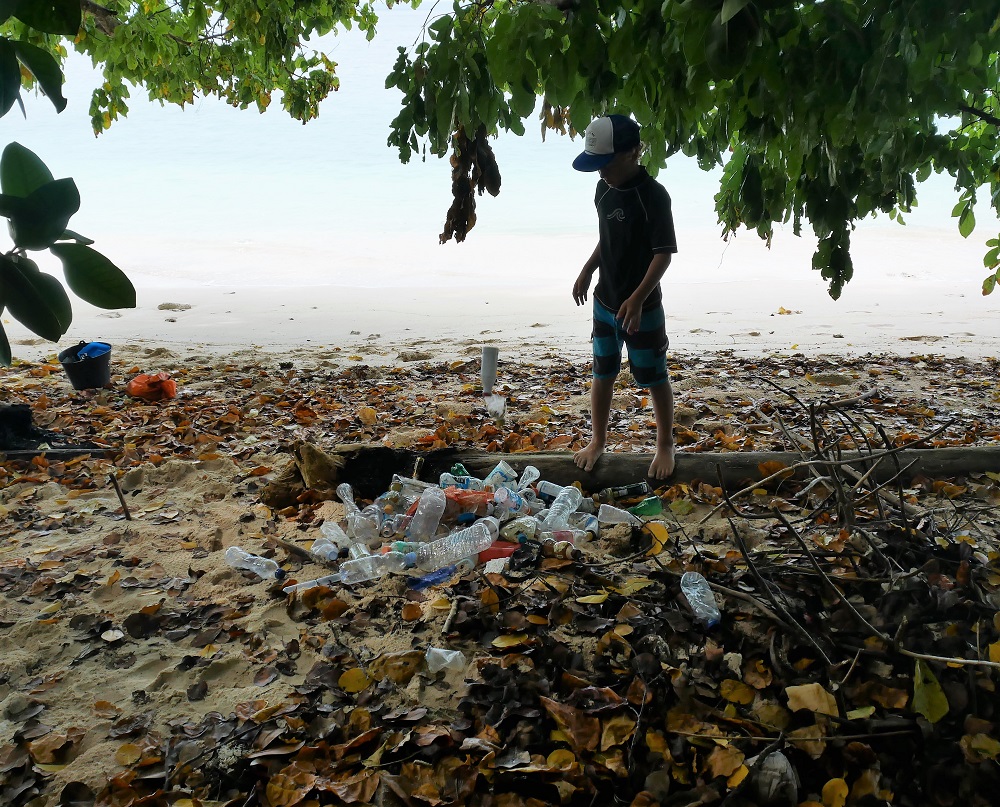
Plastic in the ocean is a problem. While sailing around in Indonesia we have seen a lot of plastic on beaches and in the ocean.
Plastic in the sea is bad because fish die. They eat plastic because they think it is food. If they keep eating plastic, their bellies will get full because they cannot digest it. The fish will keep on eating because they are hungry, but they will have no space for any more food, and then the fish will starve. Plastic ropes and nets can tangle up animals like turtles and dolphins underwater, who will die because they will not be able to move to the surface to breathe.
We came up with an idea to collect data on how much plastic there was on an island called Pulau Leleve for our boat-schooling.
Pulau Leleve is a small island east of Halmahera in the Molucca region of Indonesia. Nobody lives on Pulau Leleve but fishermen visit it sometimes. It has a beautiful white beach and further up the shore perfect, shady, plastic-filled areas of shoreline for us to sample.
Our hypotheses were:
- There is more than 20 pieces of plastic per every 10 metres of shoreline.
- Every ten metres of shoreline there is more than a bucketful of plastic.
- We will find more plastic drinking bottles than any other category.
- Most plastic on the island is under thirty centimetres long.
Methods
We went to a beach and found a place to collect rubbish. We measured a 10 x 10 m square with a measuring tape above the high tide line. Then we gathered all the plastic and counted and sorted it into categories. The categories were:
- Drink bottles
- Other bottles
- Cups
- Shoes
- Styrofoam
- Bags
- Rope
- Fragments
- Ice lolly tubes
- Lighters
We weighed all the categories and estimated the total volume of plastic found using a 10-litre bucket. We then repeated the process in a different area.


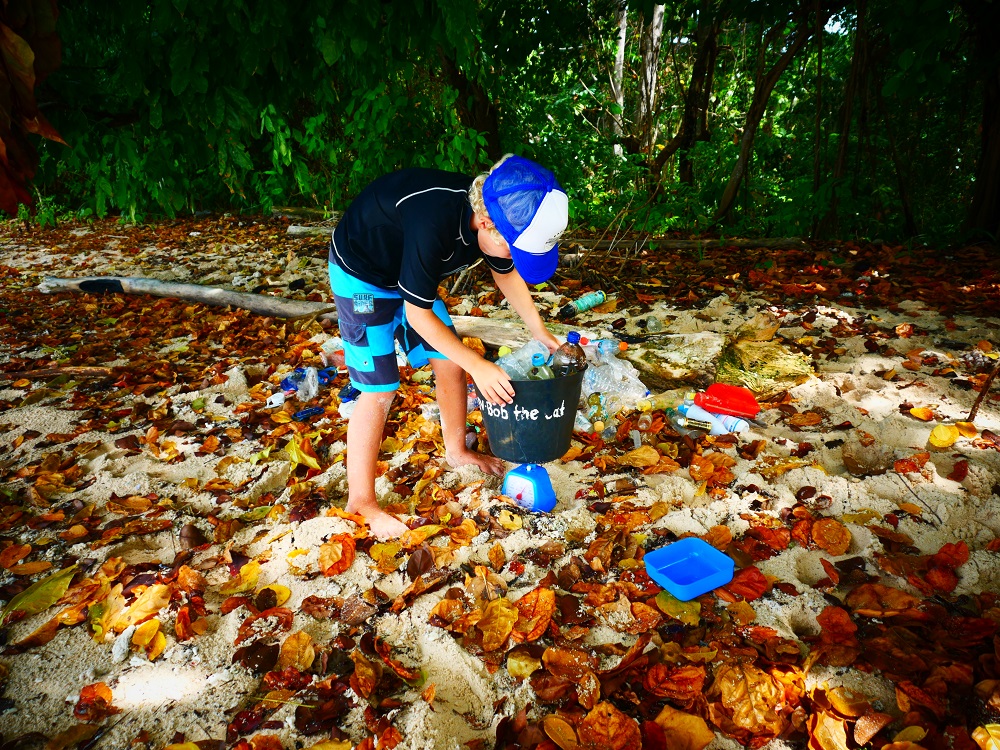
For analysing the data, we put it into an Excel spreadsheet. We plotted some graphs and made some tables. We then measured the perimeter of the island on Offline Maps and used this to estimate the total amount of rubbish on the island.
Results
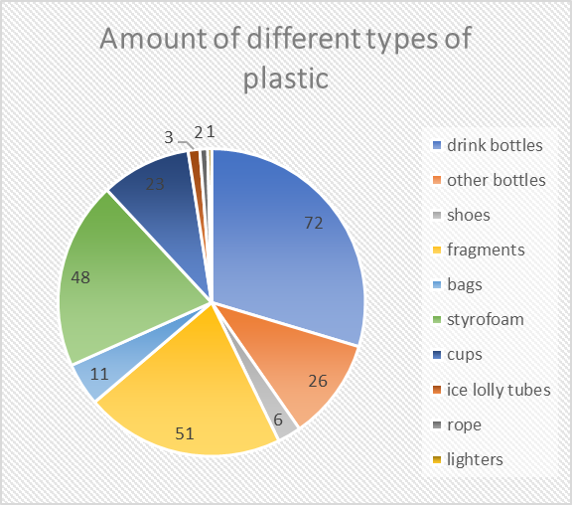
This graph shows the amount of plastic we collected in total. The most common type was plastic water bottles, followed by fragments, then styrofoam.
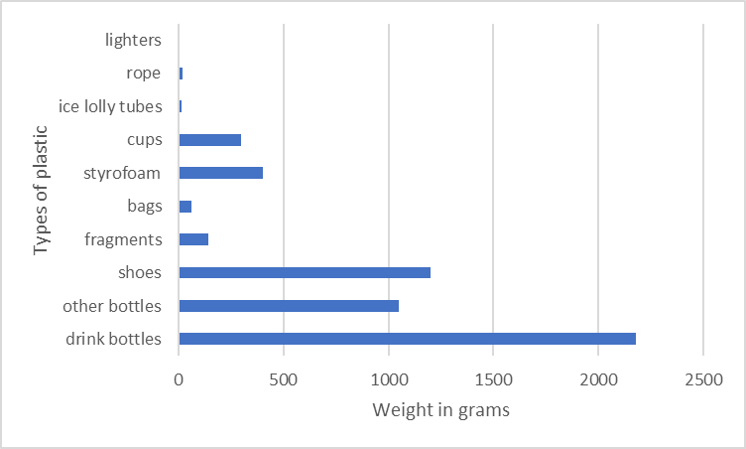
This graph shows how much the plastic weighs. We only found six shoes, but they weighed a lot.
This is a dot plot to compare how much the different types of plastic weighed and how many pieces there were. We found more water bottles in weight and number than any other category. Even though we had a lot of fragments and styrofoam they did not weigh a lot.

These tables shows how much plastic we estimate is on the entire island. If the amount of plastic we found is present everywhere, there will be close to 7000 bottles on that small island, weighing more than 225 kg! If this rate of waste keeps up there are soon going to be entire islands that are made of plastic.
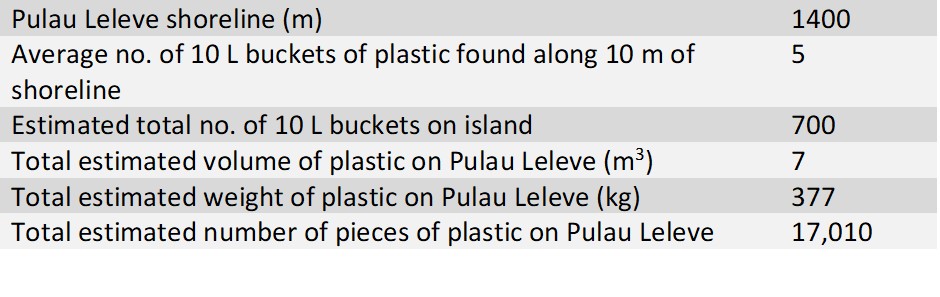
 We think there are 7 cubic meters of plastic on the island – that’s enough to fill more than 2 large family cars. In total we estimate there are more than 17,000 pieces of plastic, weighing more than 350 kg on this small island.
Discussion
Our hypothesis was that there would be more than 20 pieces of plastic per every 10 metres of shoreline. In fact, we found more than 120 pieces per 10 m – that is more than 6 times the amount we thought we would find!
Another hypothesis was that for every ten metres of shoreline there would be more than a bucketful of plastic. We found 5 bucketfuls.
We thought that there would be more drink bottles than any other type of plastic. In Area 1 there was more Styrofoam, but after adding Area 2 we had more drink bottles than any other category.
We also thought that most of the plastic would be under thirty centimetres long, and we were right again. The only plastic over thirty centimetres long was a piece of Styrofoam that was thirty-two centimetres.
We think this is a lot of rubbish to find in a small area. We reckon we probably missed out some because some bits would be too small and some could be buried under dirt and leaves.
If the plastic went into the ocean the fish and turtles in the area might die or go away. Boats might get their propellers stuck in plastic and the water will get full of microplastics.
We think the Indonesian government should ban some types of plastic that are used a lot, like water bottles. We also think the Indonesian people should be educated to stop throwing plastic on beaches and in the ocean.

 SV Bob The Cat