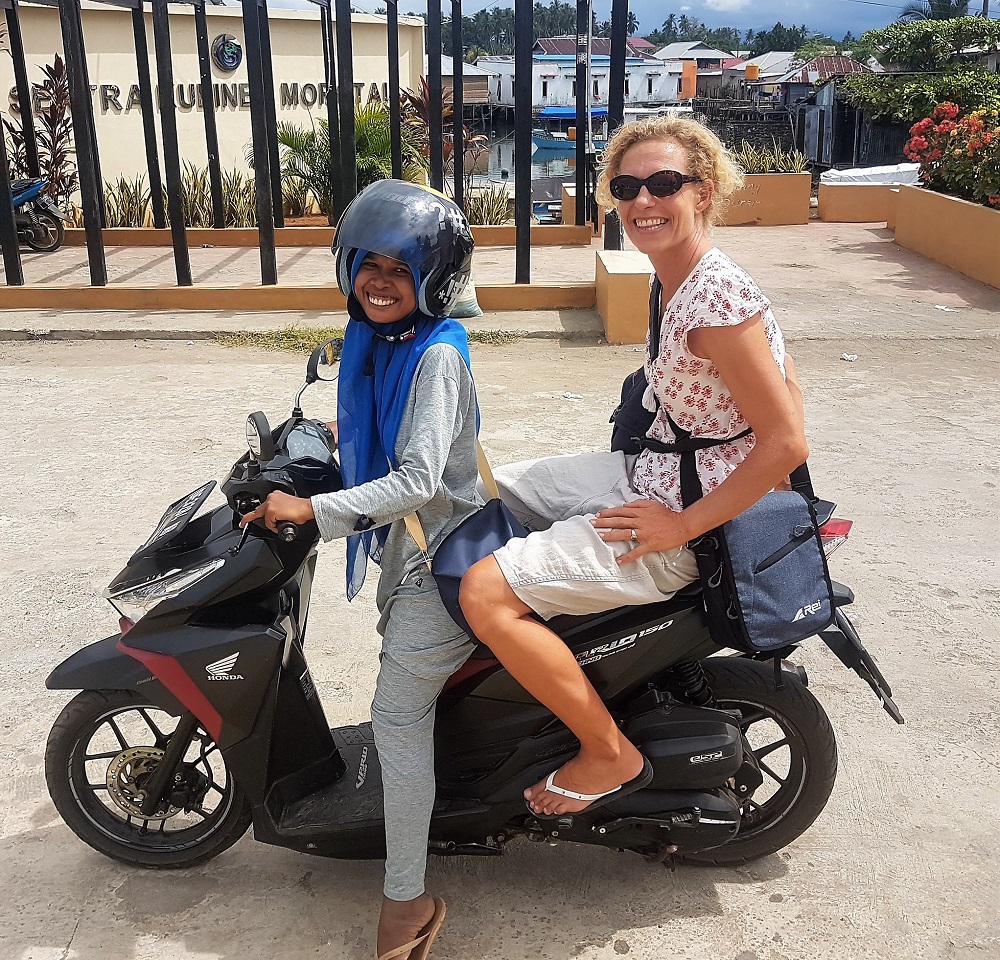
“You are very lucky you have two boys,” says Anna, beaming at our family from her seat at the table end. She sighs. “I hope God gives me children.”
I gaze over at the boys who are sitting making horrible faces at each other in the dockside eatery as they wait for their lunch to arrive. They are whispering quiet threats to one another and glancing over at me to see if I’m noticing, and generally getting as close to a fight as they can get away with when out and about. It’s noon and tempers are running high. Pre-lunch sugar low has always been a challenge in our family, and today is no different.
“Yes.” I grimace back at her. “Children are a blessing.”
“My husband says if I don’t get he will take a different wife.” She looks downcast, the headscarf that covers her hair only partly obscuring her furrowed brow as she tosses her head backwards. “But he doesn’t mean it. We love each other!”
I lean forward. “How long have you been married?”
“Four years. I meet my husband when I come here from Ternate in Halmahera, my hometown. We been married for four years but still no children.”
I nod uncertainly. “If you can’t have children, it may be… I mean, it could be either of you. It may not be a problem with you. Maybe it is him who can’t have children?”
She looks confused, shaking her head uncomprehendingly.
“How old are you?” I ask, changing tactics.
“28.” She smiles. “I hope children are coming soon.”
I pat her hand. “There is still time. You are young still.”
The conversation is interrupted as the lady from the food stall brings out steaming bowls of mie goreng, the children’s favourite Indonesian dish. They pull one more face at each other and then put aside their arguments to attack the food ferociously, the whispering stopping as their mouths get busy gaping over huge forkfuls of spicy noodles.
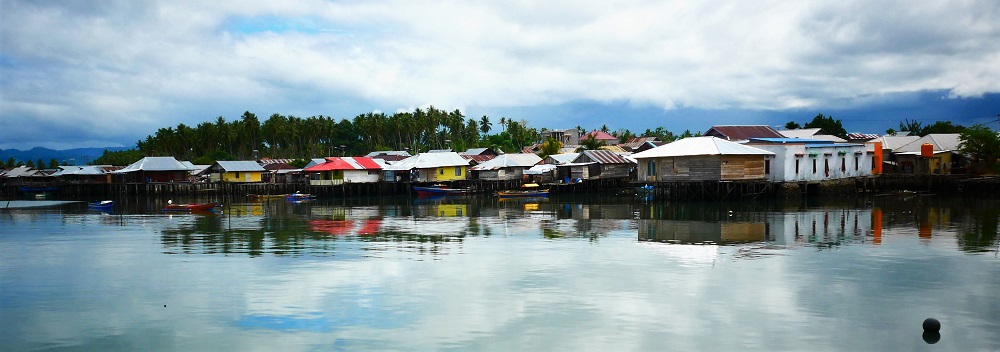
We’re in Daruba, the capital of the Island of Morotai. For the last week, we’ve been exploring the dry, deserted, and bizarrely clean islands dotted off the south-western end of Morotai, relishing in the complete tranquillity offered by the isolation of these far northern isles. The only humans we’ve met have been elderly fishermen, who nodded and smiled as they surveyed us, their opaque eyes reflecting the shining white of the sea, answering bagus, bagus (good, good) when we gestured whether it is OK to visit the beach they’re fishing from.
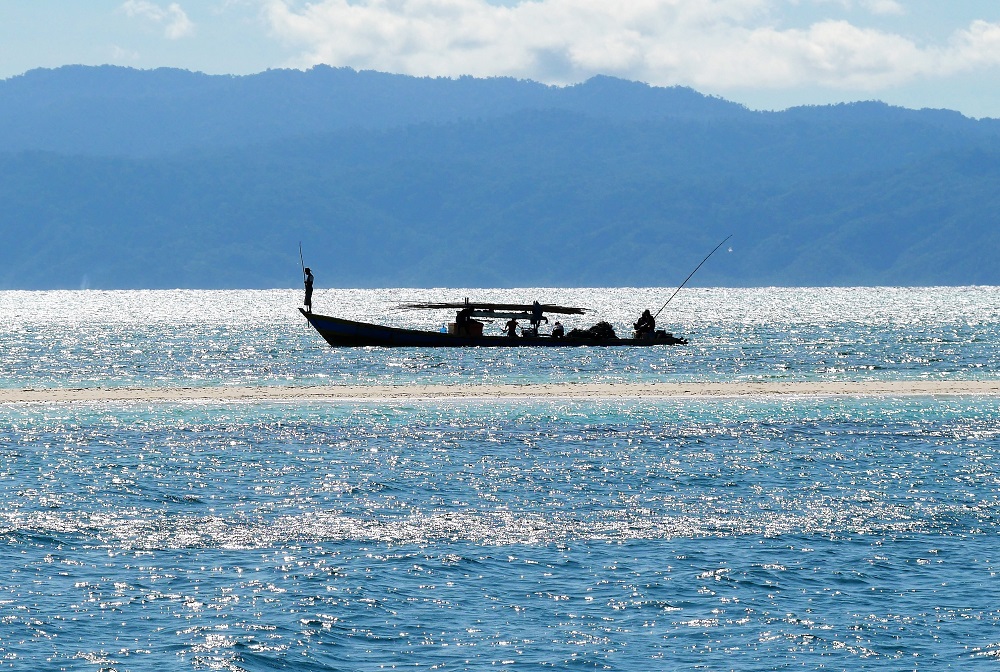
It’s a different feel here from elsewhere we’ve been in Indonesia. There are no tourists, no dive boats zooming around, no homestays or hotels. The locals in their colourful longboats see us and wave but don’t generally initiate conversation, busy as they are heads down fishing, fingers deftly handling lines or nets, cigarettes dangling from their lips. The hazy outline of the volcanoes of northern Halmahera grace the horizon, clouds circling their peaks in the daytime, the sun being speared by their jagged contours each night.
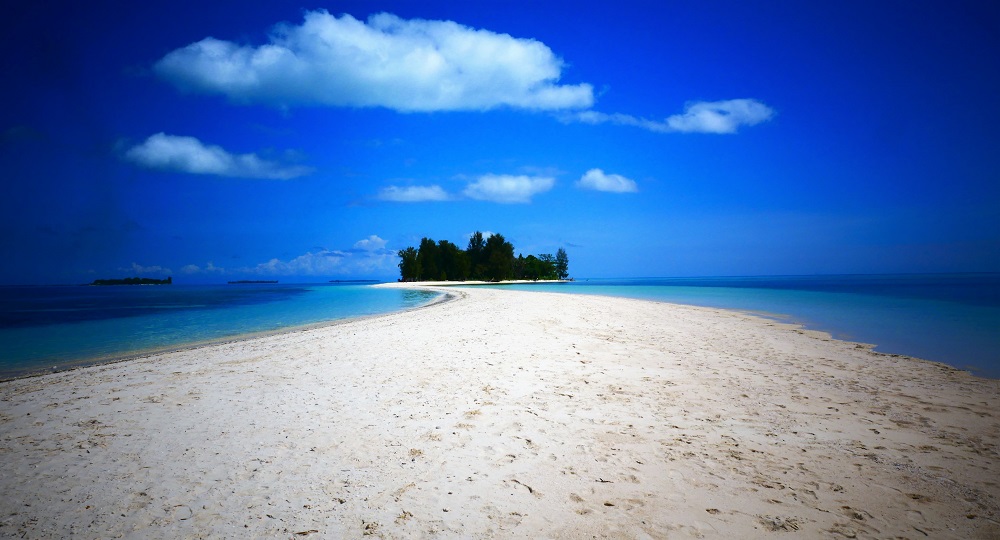


Last Friday we got to Dodola Island, two small islets joined by a long sandspit not far from Daruba. In contrast to the uninhabited islands surrounding it, Dodola featured low buildings in the bushy interior and a garishly colourful inflatable waterpark anchored just off the pristine beach. Curious, we went ashore to the empty beach, where we found a staff of twelve men sitting around, seemingly waiting for customers. We established that the kids could play on the waterpark for a minor fee and went for a walk to have a look around at the carefully painted pillars of the dock, the neatly raked beach, the empty houses and the half-finished building projects, the waterpark-induced squeals of the kids the only sound on the empty island apart from the regular pinging of the cellphones of the men sitting around.

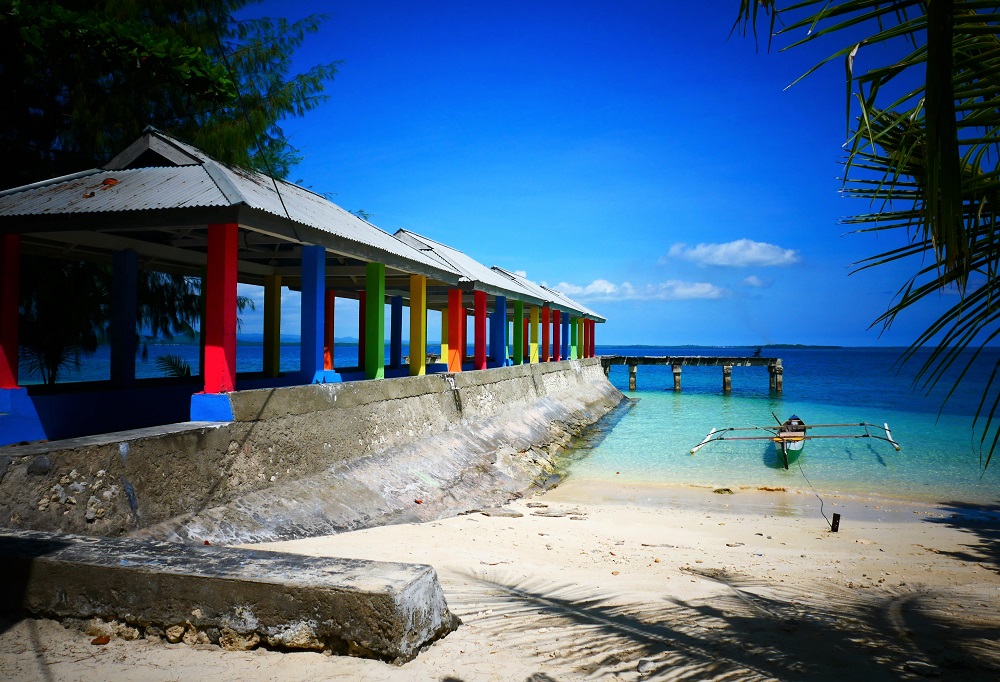
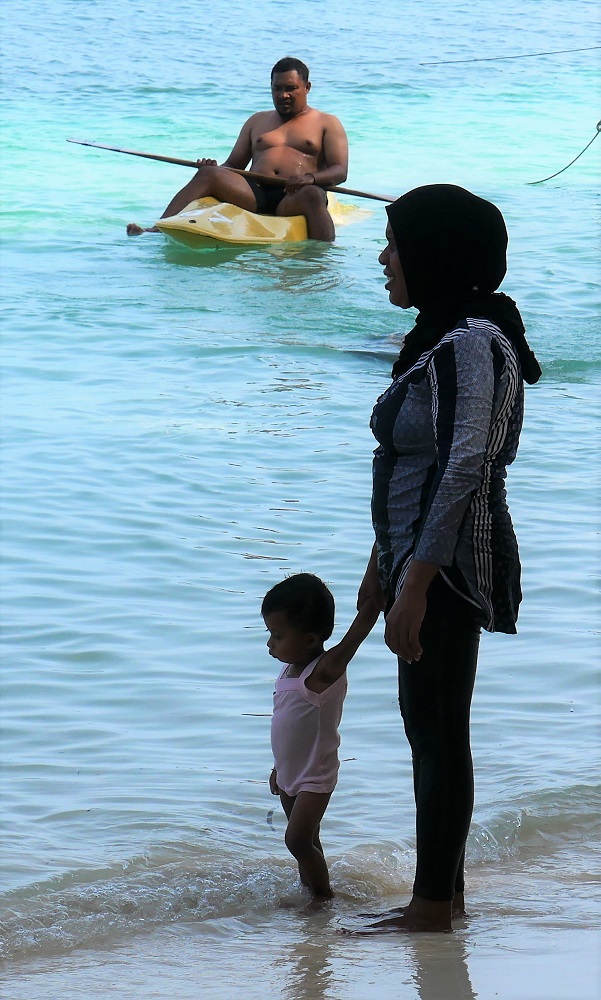
It was here that we met Anna – on the following day, a Saturday, when suddenly the island came to life as a continuous stream of boatloads of visitors from Daruba were offloaded on the beach. Families were sitting under the shady trees, music was playing from small loudspeakers, and a steady stream of lovestruck young couples were walking hand in hand along the sandspit separating the two islands, cellphones in hand as they selfied their love march. Curious to meet some locals on their weekend getaway, we’d gone ashore for a walk and hadn’t taken many steps before a tiny woman wearing wide pants, a sweatshirt and a black headscarf came up to us.
“Hello,” she said, smiling broadly. “I am Anna, guide of Morotai. I have been helping yachts with services before. If you need anything in Daruba, you can call me.”
She was here guiding an American man but would be free to help us with anything after a couple of days.
“There are sometimes problems between Muslims and Christians on Morotai,” she explained, perfect teeth gleaming in the sharp sunlight. “But I say to people, ‘No matter what you believe, you leave my guests alone.’” She wagged her finger chasteningly at us, and we smiled uneasily. “They say, ‘Sorry Anna, no problem if they are with you.’ So, you have no problem here when you with me. Come see me… – tomorrow Sunday, then Monday, come see me Saturday.”
“I think she means Tuesday,” I whispered to David. “That could work – we could go to Daruba Tuesday, see some war relics.”

Which is why we’re sitting at the dockside food stall. With the diminutive Anna to protect us against potential outbreaks of sectarian violence, we are ready to explore Morotai’s history.
Just north of the island of Halmahera, Morotai is one of Indonesia’s northernmost islands, only a stone’s throw from the southern end of the Philippines. This proximity has shaped the large (~1800 km2), densely forested island’s history profoundly. Like Halmahera further south, the Japanese occupied Morotai during World War II. Eyeing up the flat lowlands of southern Morotai, the Allies mustered a huge attack on the Island in the Battle of Morotai which commenced on 15 September 1944. Deciding that the island was suitable for the building of airfields from which attacks could be launched at the Japanese-occupied Philippines, the Allies badly wanted the island, and, realising this, the Japanese threw everything they had at defending it. After a ferocious battle, the Allies conquered southern Morotai which, because of its strategic location, went on to become an important command centre for the remainder of the war.
The seas around Morotai are littered with wartime plane- and shipwrecks, and tanks and aircrafts used to be scattered in the jungle too, until some enterprising people from Jakarta came to disassemble them and move them to the capital for selling.

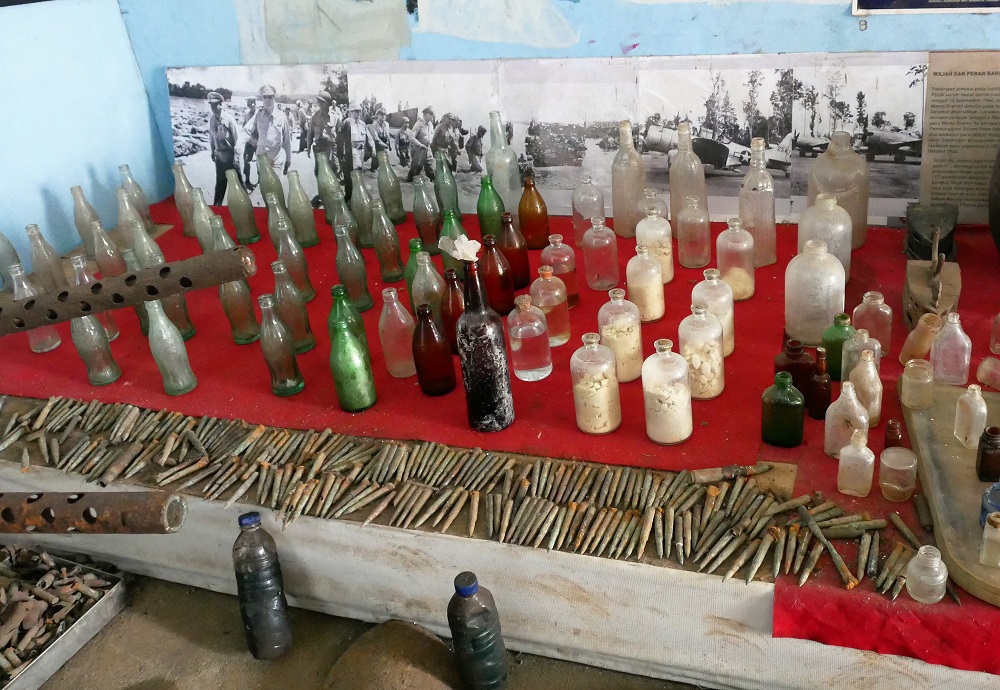
A local man has spent his life collecting smaller-sized relics and set up a museum in his home in the bush not far from the capital. Here are helmets and guns, ammunition belts and binoculars, hand-wound sirens and dog tags, as well as thousands of empty shells and a couple of grenades. He’s decorated the walls with articles and historic photos as well as his home-rendered paintings of war scenes. A bicycle left behind by the Japanese leans rustily against the wall and a collection of bottles display a snapshot of American life at war – aftershave, coca-cola, wine, beer and morphine, all neatly lined up according to content. We lean in to inspect the faces in the black and white photos on the walls – young men in uniform staring sombrely into the camera, young men with war-time haircuts riding tanks, standing next to airplanes, leaning against trucks, shirts off, grinning and laughing, and young men lying down, faces twisted in agony as nuns bend over their wounds.
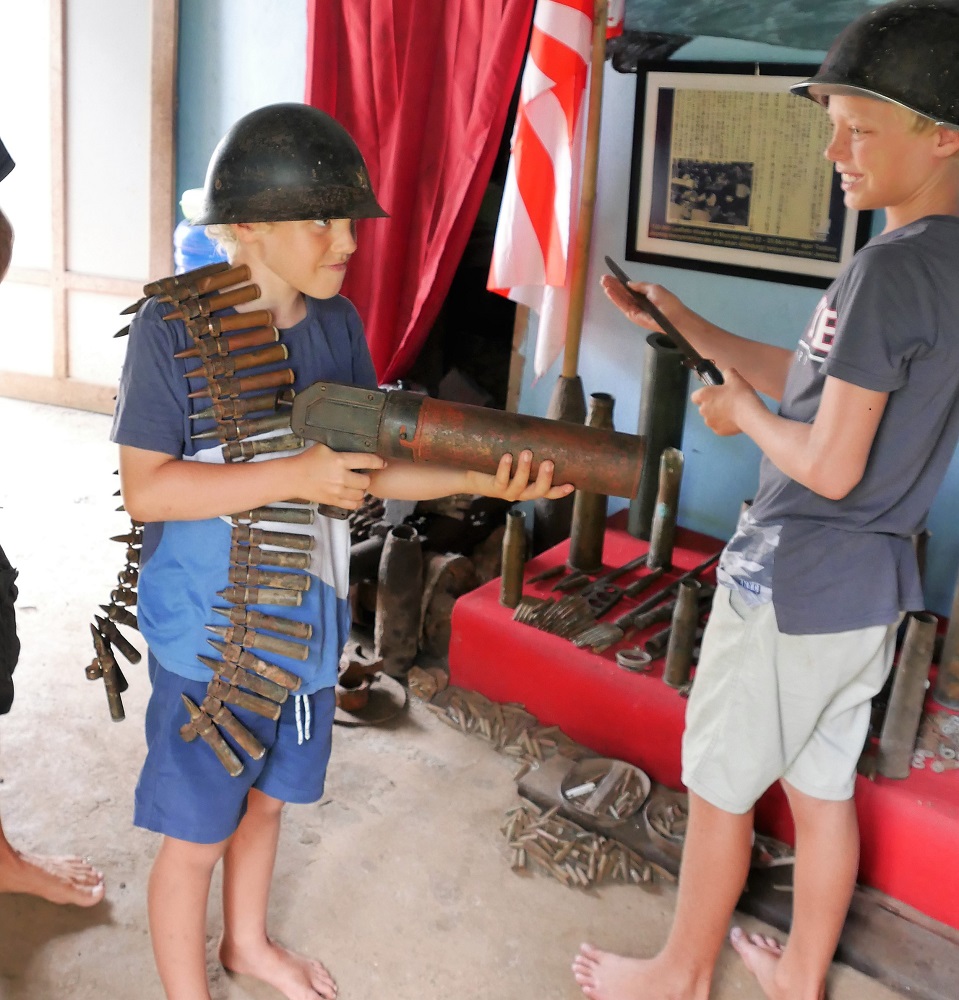
Unlike most museums the children can touch everything here – eyeing up distant cows with Japanese binoculars, holding rusty guns to each other’s faces, fingering war-time coins from Holland, the US and Japan. They each have a turn at winding up the siren and wearing the helmets, Matias from the Allied forces, Lukas Japanese.
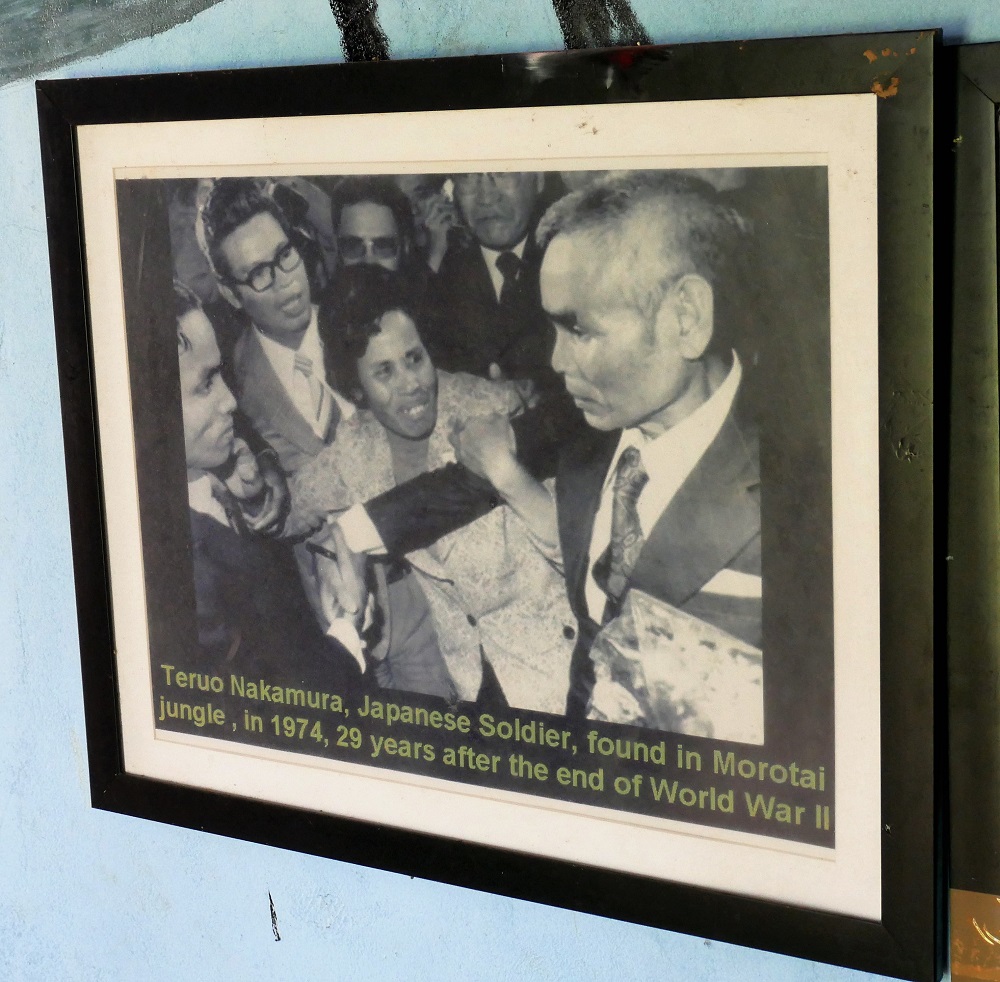
The Japanese didn’t give up easily and even after southern Morotai was taken by the Allied forces, large airfields constructed and raids sent off to liberate the Philippines, Japan continued to hold onto the northern part of the island, scattered troops hiding in the dense hilly jungle until the Japanese Empire surrendered in August 1945. One soldier in particular did not give up. In December 1974, Private Teruo Nakamura surrendered from the jungle of Morotai where he had been hiding since the war, either unaware that the war was over or believing rumours of it to be Allied propaganda. Japanese holdouts, as the stray Japanese soldiers that continued fighting long after the end of the war are known, were not uncommon in the Pacific, but Private Nakamura holds the record with his 29 years of hiding. A Taiwanese from the Austronesian ethnic aboriginal Amis tribe, the poor man didn’t speak Japanese, Indonesian, Dutch or English, and not long after being repatriated to Taiwan he died of lung cancer. One can only imagine what he must have been thinking for all those years in the jungle, a Taiwanese tribesman stuck in the war on an island far away from home, fighting for a country he didn’t belong to, whose language he didn’t even speak.
Nowadays, there are no Japanese left in Morotai, and the only fighting that goes on is that between Muslims and Christians. Sectarian conflict goes back far in this corner of the world. Originally under the influence of the Muslim sultanate on Halmahera, many inhabitants of Morotai became Catholic when a Portuguese Jesuit mission settled on the island in the 1500s. Resenting this influence, the sultanate repeatedly forced most of the Christians off the island in the 1600s, resettling them near the Halmahera capital of Ternate where they could be more easily controlled. When the religious conflicts peaked in the Moluccas in 1999 and Muslims were driven from the town of Tobelo on Halmahera, many of them settled in Morotai, and the island is currently about 75% Muslim.
At the lunch table, Anna is telling us about the latest conflict.
“It was last week, I had some guests, and they were in a car, and there was protests in the street and fighting. And my guests, they were so afraid.” Her eyes widen. “So, I got out of the car and told the men fighting to leave my guests alone!” She taps her phone and starts playing videos of street fighting, leaning across to show us images of white-clad men shouting, fists pumping, street mayhem at the capital’s government house.
When asked what sparked the fighting, she explains that some politicians from Jakarta had come with packages for the school children, which they’d distributed as part of an election rally. In the parcels were, amongst other things, some biscuits. Within the wrapping of the biscuits was a small picture – of Jesus on the cross.
“That is not OK to give to Muslim children,” she says, shaking her head. “Oh my God! A picture of Jesus, and a cross! They got very, very angry that their children were given that. So they protested at Government House and attacked Christians and the Christians they run, run! Into the bush, hiding in the jungle, waiting for violence to be over.” She leans further forward, pressing ‘play’ again and the fighting erupts once more on the tiny screen.

“Wow,” we say, leaning back in our chairs, nervously eyeing up the families sitting nearby who deviously look absolutely harmless, veiled women laughing in the sunshine, relaxed men playing chess, eating and drinking tea, the only sign of violence the squabbling between tiny children running around with slingshots.
“But no problem now, not a problem. This is last week, now is OK.” Anna smiles reassuringly.


And, indeed, we only meet kindness in Morotai; laughing kids running by shouting ‘Hello Mister, hello Mister,’ friendly people wanting to practice their English, stopping whatever they’re doing to help us tie up the dinghy in a good spot, find the fresh market, catch the attention of a bento driver to give us a lift. People who recognise our children from the floating bouncy castle in Dodola Island shout “Lukie, Lukie,” and high five them on the dock, and, bellies full, our kids smile and laugh, friends again, chasing after each other in the peaceful dockside park.
When lunch is over we say goodbye to beautiful Anna of Morotai who, with her self-taught near-perfect English and great network of contacts has helped us understand a little more of this corner of the world. May she have many, many children and may these children never find pictures of Jesus in their biscuit packets.

 SV Bob The Cat