Getting to, and leaving, Ambon

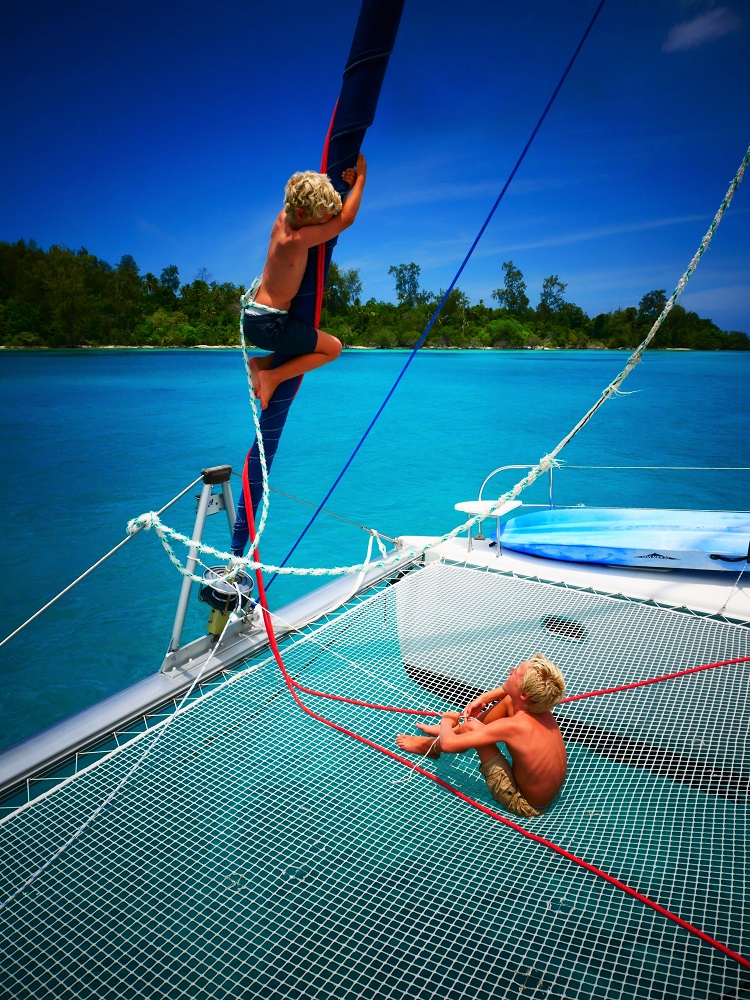
Boys getting ready for passage.

Sailing around Indonesia is not easy. It is an island nation, but with the bulk of the country hugging the equator there is rarely much wind, which means that sailors quickly become dieselers, using the engine more often than the sail. Winds are most commonly associated with thunderstorms, which frequently rise out of seemingly nowhere to whip up the seas and light up the skies. What the country lacks in steady winds it makes up for in tide, and strong currents rage along the island coastlines, sucking boats over shallow coral reefs or pushing them towards narrow channels between small islands. Added to this, Indonesia is a famous surfing destination and large swells pummel its coastlines, making some anchorages unpleasantly bouncy and upwind sailing uncomfortable (upwind sailing is always uncomfortable if the sea is not dead flat – and it almost never is). And that’s just the weather – in this country born from fishing and trade the seas are full of floating logs and rubbish, lurking just under the surface ready to wreak havoc with propellers and damage hulls. And then, of course, there are the boats, which are everywhere and few of whom follow international sailing conventions.

Dangerously overloaded Indonesian vessel presumably carrying something very heavy.

So, as can be expected, our two-day passage to Ambon was interesting. At first the wind was blowing, and we flew along at 9 knots on a flat sea, glamour sailing throughout the heat of the day. Then, in the late afternoon, the glamour gave way to grim reality as we came out of the shadow of the islands and hit the waves and were tossed mercilessly, banging and crashing our way across a disturbed sea. Normally on a catamaran you do not need to tie anything down when sailing, and most of the time we have glasses, books, plates and toys freely out on our table tops. However, this was a rough sea, and as we smashed over wave after wave we carefully placed all glasses and cups in the sink and stuffed rolled-up towels into the bottle storage to keep the glass from smashing. Prepared for wavy conditions, I had smugly cooked early, a spaghetti sauce concocted on flat seas standing ready on the stove so that all we would have to do close to dinner time was to boil some pasta.

Alas, even this proved too much.

Close to dinnertime, I put the pasta water on, bracing my body against the cabinetry as I heaved the heavy saucepan up onto the stovetop and lit the burner while we banged and crashed along. Pasta water takes a long time to boil on our boat (slow burners combined with big appetites which means lots of water = about 40 minutes to boil the water) and half an hour after putting the water on, I was sitting outside looking out over the wavy seas trying to control my seasickness, when suddenly a loud crash sounded from the kitchen.

“Whoa,” I yelled, running inside expecting the worst. And sure enough, in the galley all was mayhem – the large saucepan of pasta water had somehow evaded the metal pot-restrainer affixed to the stove and landed heavily on the floor, near-boiling water steamily sloshing about in the galley.

Holding onto the corner of the counter with one hand and the edge of the cupboards with the other to steady myself on the wildly jerking boat I surveyed the damage. “Could you grab me a sponge and a bucket?” I asked David. “I’ll try to clean it up.”

Just as he approached with the bucket another crash and a lurch heralded the boat hitting another wave and the pot holding the pasta sauce flew over the restrainer, smashing against the cupboard door just under the sink before loudly crashing to the wet floor, discharging spaghetti sauce everywhere. The boat did another violent heave and the steaming water sloshed over the semi-solid pasta sauce, splattering droplets onto the wall as it retreated with the next lurch, the galley floor turned into a shallow wave tank with the pasta sauce an island quickly eroded away by the boiling seas.
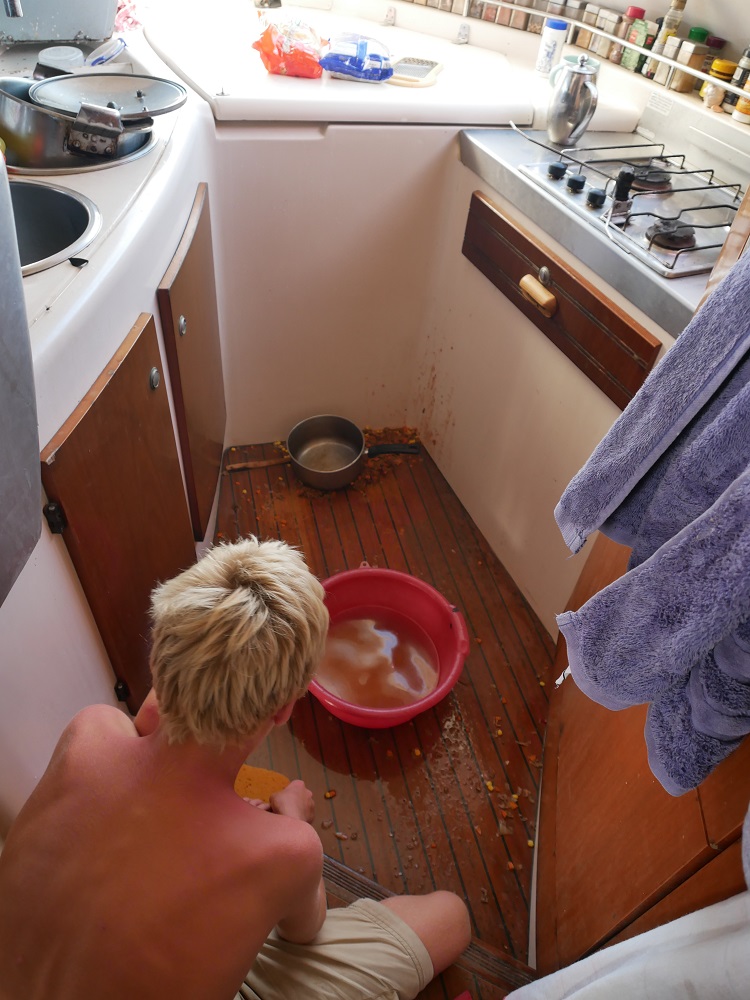
Matias cleaning up the galley mess.

It is the first time we’ve ever had pot kamikaze on Bob the Cat and as I sponged up the hot water and scooped up the sauce, I suddenly understood why the galley floor is sunken on most boats – it is presumably to contain the damage in situations like this! How clever they are, yacht designers.

It wasn’t just the waves that kept us on edge. The seas off Ambon Island are littered with Fish Attracting Devices (FADs) – tiny wooden rafts attached to small buoys anchored in impossibly deep waters (some in depths of more than a thousand metres) far, far away from the coastline. Hard enough to spot in the daytime, small, insubstantial and surprisingly far from land as they are, the FADs are near impossible to see at night. Some of them are lit with small blinking lights but many are not, which makes coastal night sailing in this area somewhat like walking blindfolded through a minefield – you never know whether you will make it out unscathed.

Fish attraction device off Ambon Island.

On my night watch, I sat tensely alert peering into the moonlit sea, trying to guess the distances to the myriad of blinking light. The radar is useful for revealing bigger targets but the FADs are too small to register, and as an added challenge Indonesian vessels don’t follow international lighting conventions – most boats here just display a set of blinking Christmas LED lights with no colour-coded port and starboard lights, which means that there is no easy way to determine whether a boat is headed towards us or away from us. All of which made for a harrowing night watch where I sat staring at the dark sea through hefty binoculars trying to make out the small shapes accompanying faint blinking lights on the waters, sometimes coming so close to FADs that I could see their shadows on the moonlit sea. The only light relief was a little pod of dolphins that followed the boat, squeaking up encouragement at me.
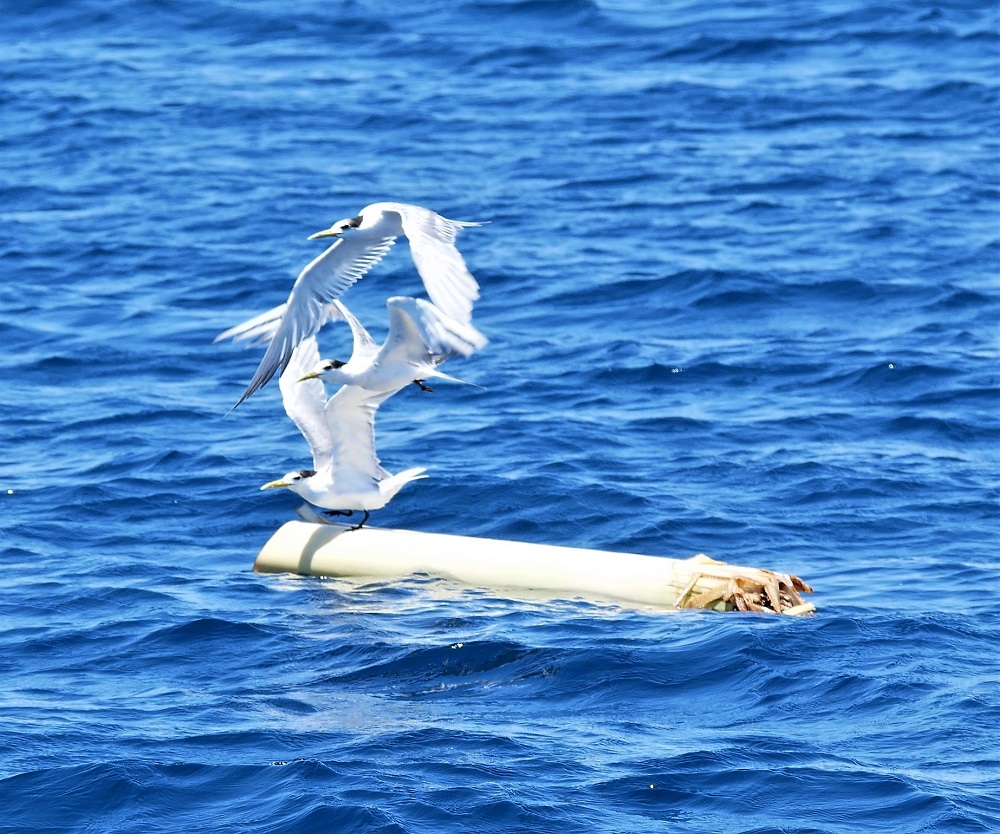
Floating logs pose a danger to yachts too.

Even big ships are hard to spot at night in Indonesia. Automatic Identification System (AIS – a transponder tracking system for ships) is mandatory for all foreign vessels that enter Indonesian waters, which is ironic since almost no Indonesian boats have AIS.  Even huge ships and large tows pass us by without leaving a trace on our AIS, and with the haphazard lighting employed by even large vessels, it is a wonder that we don’t end up colliding with anything.
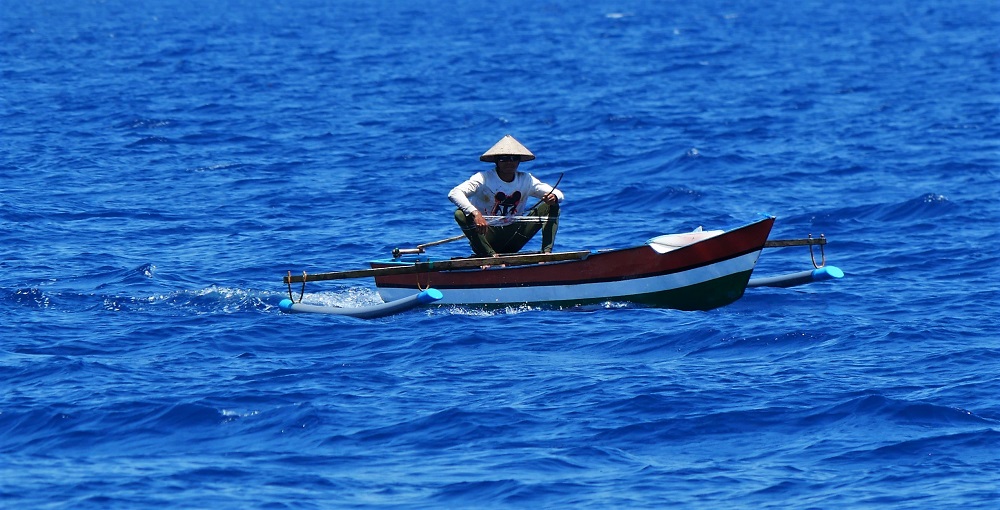
Local fisherman far from shore.


On the plus side, on this particular trip we had a hefty current pushing us along the entire way south which meant that even when the wind disappeared later on in the night, we were still going 6-7 knots, pushed along by a 3-knot invisible tide.
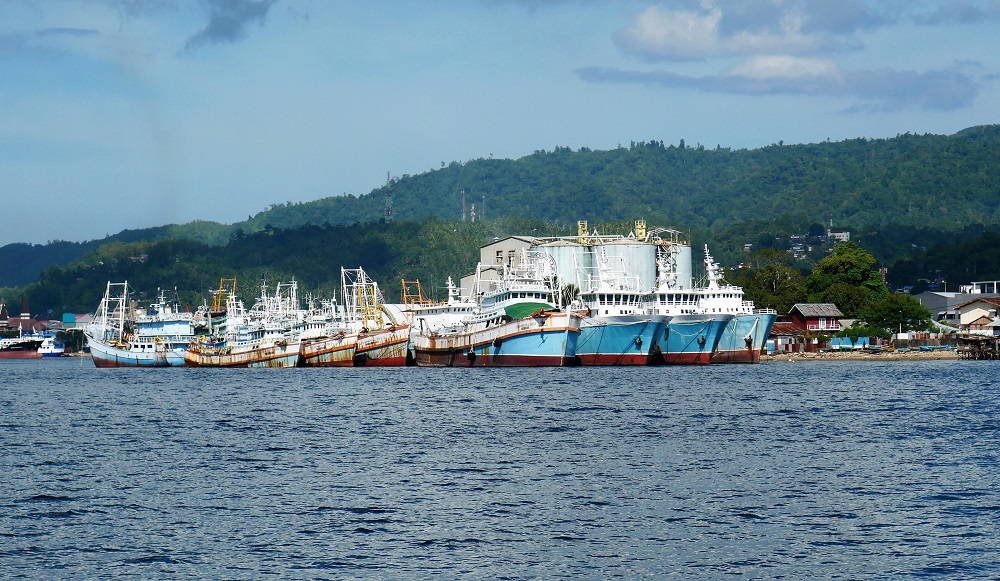
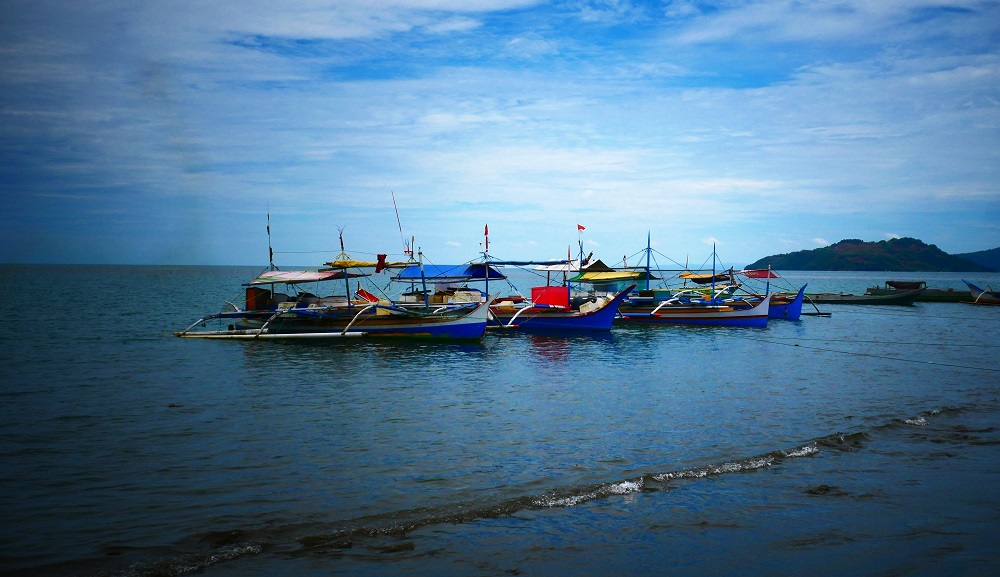
Fishing boats in Ambon Harbour.

In the afternoon on the second day we finally made it to Ambon, anchoring in deep, rubbish-strewn water in amongst cargo boats and tiny wooden fishing rafts, right in front of the city centre, with a splendid view of two large churches and one gleaming mosque.

A modern church by the waterside in Ambon City.

Ambon is roughly half Muslim and half Christian, and since the secular fighting in the late nineties the two religions have co-existed peacefully. Somewhat passive-aggressively, the churches here have adopted the Muslim way, and from large loudspeakers in the street a female voice broadcasts prayer and a sermon twice a day. Sound travels far, and out on the water the day starts at 5 am with the muezzin melodically singing the usual call to prayer, followed by a long Christian broadcast starting at 7:30, and the cacophony of loud religious transmissions continue throughout the day and into the late night. Insofar as it is a competition, Islam comes out the clear winner – the mosque starts and ends the day, and the singing is way better.
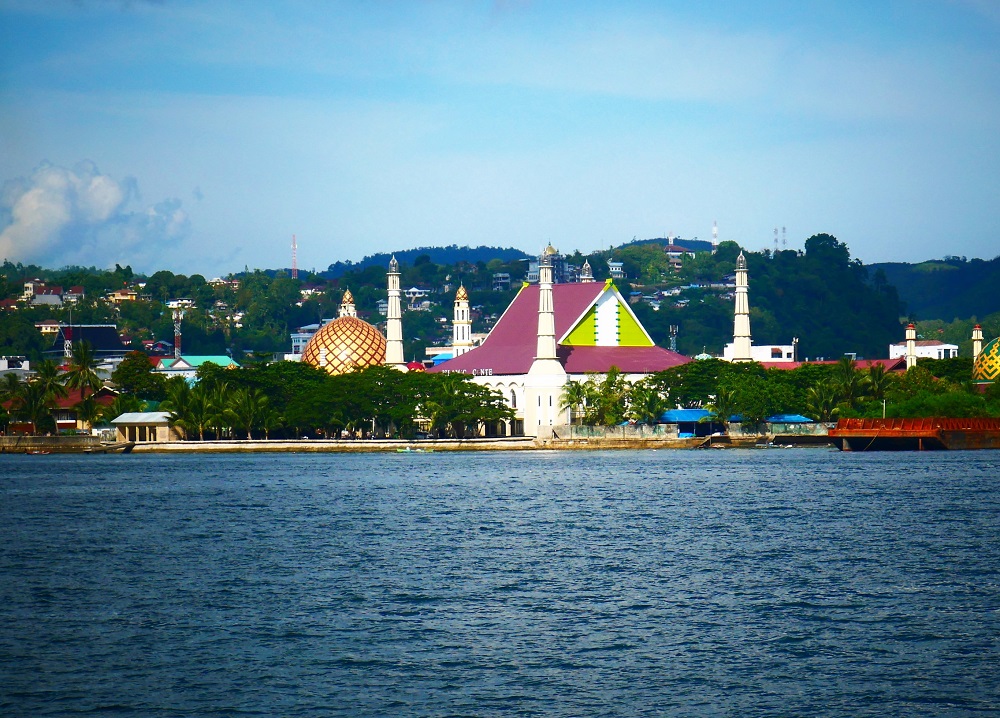
The old mosque in Ambon City Centre.

It is entertaining but loud, and after a full day there we moved around the peninsula and anchored in the middle of the huge Baguala Bay where the call to prayer from the Muslim township of Passo only rings faintly out over the otherwise quiet bay.

Supermoon over Baguala Bay, Ambon.

Our three full days in Ambon went by in a whirlwind of shore visits and endless shopping, bemo rides, eating out and walking, dripping with sweat, through narrow streets and pungent markets in the heat of the day. It is a busy place and with about half a million inhabitants it is by far the biggest city we’ve been to in Indonesia. Large, dirty, noisy, colourful and hectic, but surprisingly easy to navigate with the aid of a little Google Translate and the ever-helpful Indonesians advising us which of the nicely colour-coded bemos cruising the streets, each on their set route, we should take to get to where we need to be.
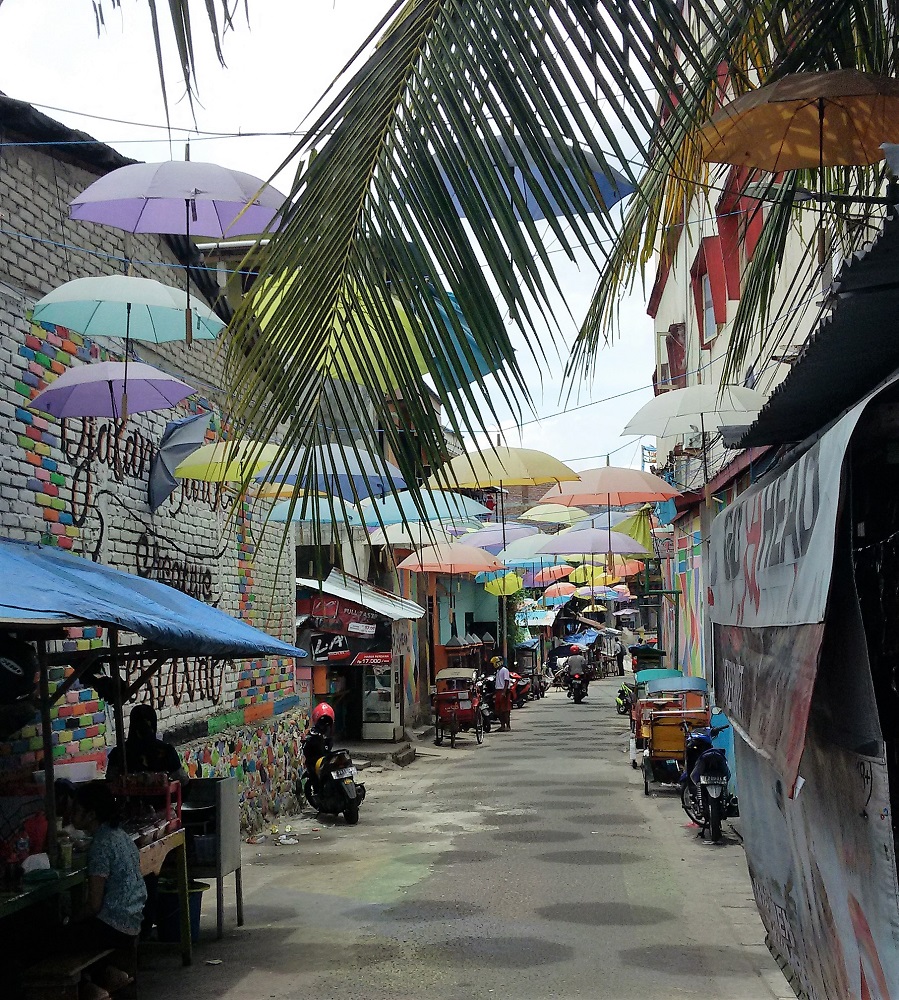
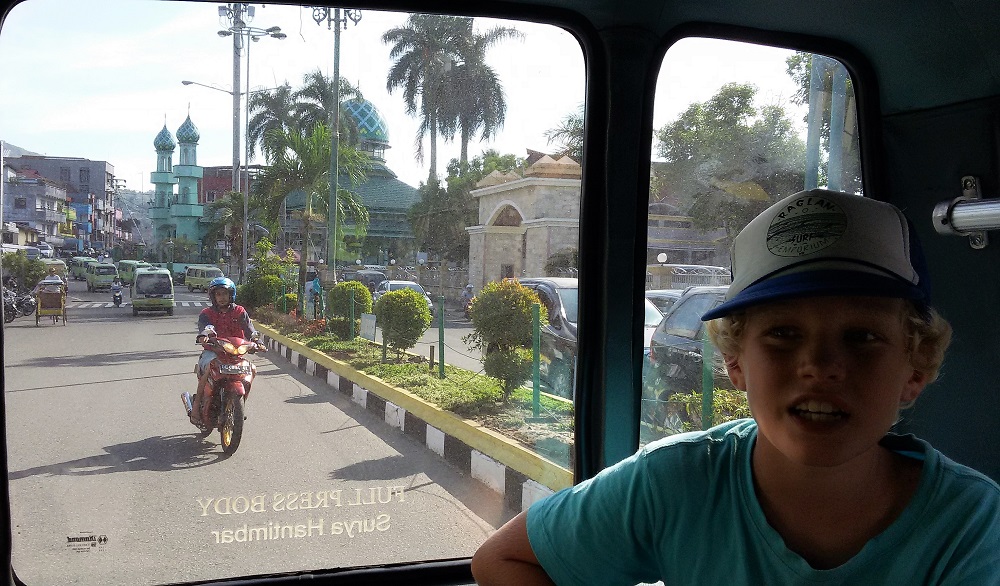
Street scene from Ambon.
Lukie in the back of a bemo.

We deposited passports at Ofisi Imigrasi and picked them up again three days later. We visited small Chinese-owned shops selling everything from dive fins to lamps, nails, rope and chain and large, air-conditioned hypermarkets where live eels are held in tanks ready for the discerning shopper to pick their dinner. We frequented tiny, roadside restaurants where no English was spoken but the food was exquisite, and a smart upscale restaurant with English menus where the owner divulged the secret ingredients of his popular fish soup. I completed a new round of medical engagements, somehow managing to score an appointment with a dentist capable of doing x-ray (I’d had a sinus ache for a while and wanted to rule out a tooth problem, but had been unable to find anyone suitably qualified in Halmahera or Morotai) as well as a visit to one of the only ophthalmologist in the Moluccas for a quick consultation. We saw churches and mosques and a Hindu temple, and visited the museum where a collection of traditional wedding robes from all the provinces of Indonesia were displayed, as well as three huge whale skeletons and a 5-metre former man-eating stuffed saltwater crocodile from the neighbouring island of Bura.

Throughout our visit we monitored New Zealand and international news, following the post-shooting mood of the world all the while pretending to be Canadians, English or Danish. Only to the immigration officials and the dentist did we reveal our true country of residence, and both expressed their horror at the massacre.

Door detail from Ambon’s Hindu House.
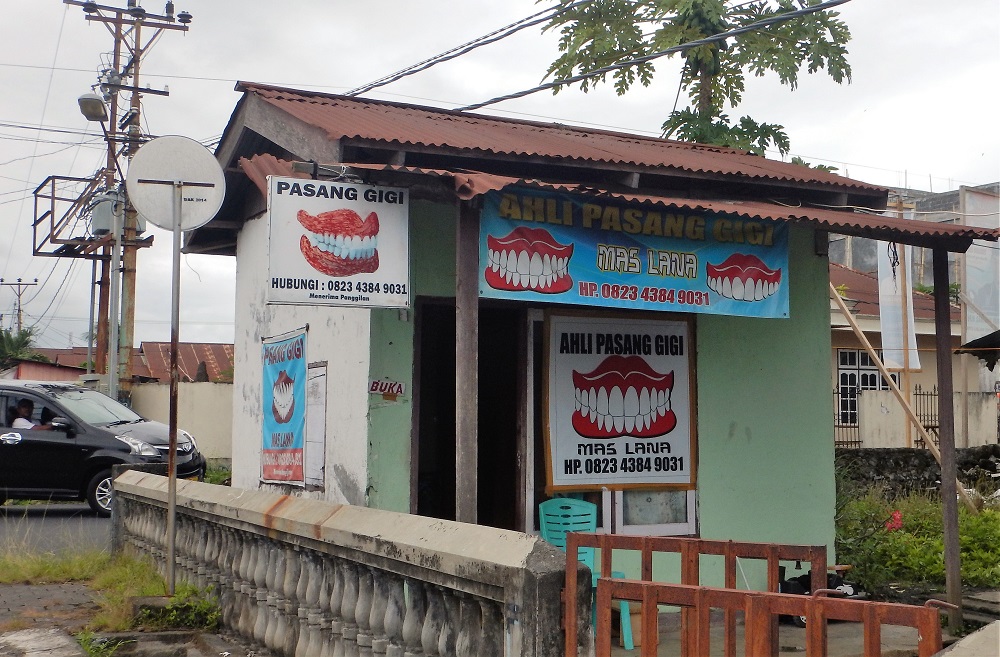
Not reassuring – a dental clinic in Halmahera.

Even when being on anchor there are navigational hazards to avoid, and on our very last morning in Ambon as we were taking the dinghy back to the boat after a last-minute shore run for fresh vegetables, our luck navigating Indonesian waters safely finally ran out. Two local outriggers with fishermen were circling the bay slowly.

“I think they’re setting nets,” said David shading his eyes against the sharp sun.

We slowly drove away from the beach, standing up to see better, gesturing to the fisher in the nearest outrigger, arms wide, asking which way we should go. The nets are fine and have hundreds of tiny white floats that are hard to spot on the glistening water.

“I think he is saying we should go right.” I indicated to David the direction the fisherman had pointed in and narrowed my eyes as I squinted through my sunglasses, trying to see the net on the sunlit reflective surface of the water.

David turned right and we drove along for a while. “He’s pointing out now,” I said. “So we can probably turn.”

David turned the dinghy and increased speed when suddenly I spotted the tiny little floats right in front of us.

“Stop! Pull up the engine, quick!”

David slammed the outboard into neutral as the propeller hit the net and we stopped, the boat lurching forward as the outboard caught on the net. The fine mesh was wrapped around the propeller but still intact and the two fishing boats quickly paddled over to check the damage and help us unravel the delicate net from the propeller.

Relieved that no damage was done we quickly pulled up anchor to head for our next destination: Banda Island.
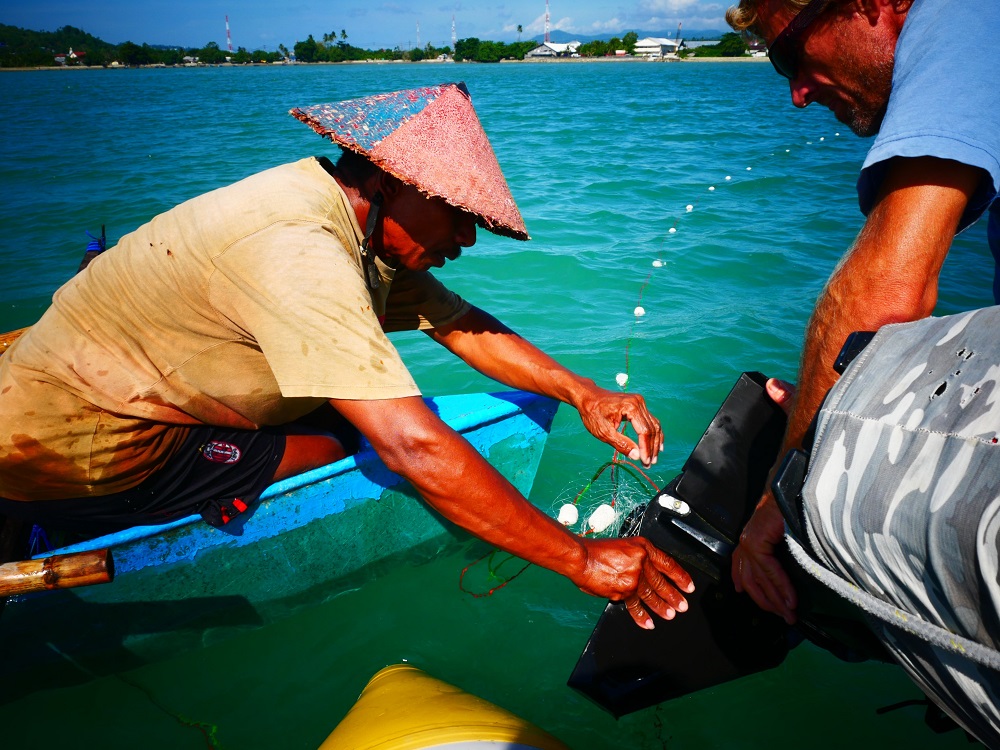
Removing net from propeller.
Fishermen in the sunset in Baguala Bay.


Of atrocities and peace – southern Halmahera to Ambon

Weather over serene atoll, Halmahera.

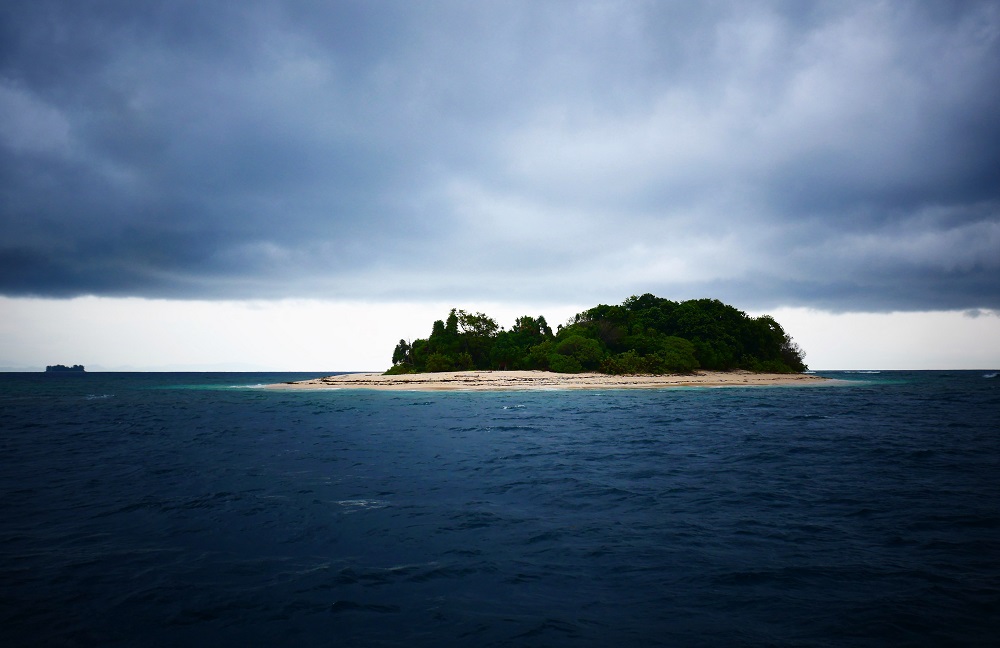
We were in Pulau Joronga, an atoll south of Halmahera, when we heard about the attack. It was early morning on Saturday 16th March. I was sitting in the cockpit looking out over the tiny islet we were anchored next to, a cup of steaming tea in my hand. Birds were singing and a large sea eagle was soaring above the tall vegetation growing on the little island. It was doing loops, away from the island and back again, surveying the shallow sea for fish.

I heard David come upstairs and put the kettle on. The children were chatting quietly in the background while he was rustling the bread bag, lighting the stove to make toast.

Pulau Joronga is a super quiet spot, a large lagoon surrounded by tiny islets. There was a mild breeze, but the air was already hot, the sun shining through the clears and warming the cockpit like an oven. The eagle passed over again, but the wind was ruffling the sea making it hard to see the fish, so it returned once more to the island, wide wings outstretched as it glided darkly against the light sky.

David came outside, hair in disarray, phone in hand.

“Did you hear? There’s been a shooting in New Zealand!”

I tore my eyes away from the eagle and looked up at him. “Oh, that gun scare – near a school? In the Bay of Plenty? That was a couple of weeks ago.”

“No, this is yesterday.” He ran his fingers through his hair. “A shooting in a mosque. 49 people dead.”

I sat up straight. “What?”

He handed me the phone and I read – CNN news, delivered via satellite. Mass shootings in two mosques in Christchurch. Men,women and children shotat. 49 dead. Right-wing, white supremacist, anti-immigration terrorist attack. In New Zealand.

It is incomprehensible. In New Zealand? But there are so few Muslims in New Zealand. It is not an issue there. I’m used to conversations about ‘the Muslim problem’ with European relatives, conversations echoing sentiments of unfamiliarity, crowdedness, foreignness, and most of all fear. I’m used to the blanket hostility against Islam of some Americans. But New Zealand? I can honestly say I’ve never heard anyone voice that Muslim immigrants pose a problem there. I’ve heard Kiwis worry about Chinese buying up land and ‘taking over’ New Zealand, and of course, we have our conflicts between Maori and Pakeha. But I’ve never heard anybody voice fear, or anger, about Muslims in New Zealand.

I sat stunned, tears in my eyes, my head in my hands. Incomprehensible.

Kids on the jetty in Pulau-Pulau Widi.

Pulau Joronga, where we were, is just south of Halmahera. Since leaving Morotai, we’ve been working our way slowly south, needing as we do to be in Ambon for the next monthly visa renewal. Ambon is in Central Maluku and so we’ve been sailing south, down the coast of Halmahera, past little townships discerned through the heat haze only via the reflection of the green, shiny mosque domes perched just uphill from the glistening water.

Mosque in Buli.

It is a peaceful part of the world and we’ve been sailing slow, sightseeing, having conversations and playing music, meeting the locals in this part of the world. And they’ve all been so nice – like all Indonesians, everyone we’ve met has been exceedingly helpful and friendly.

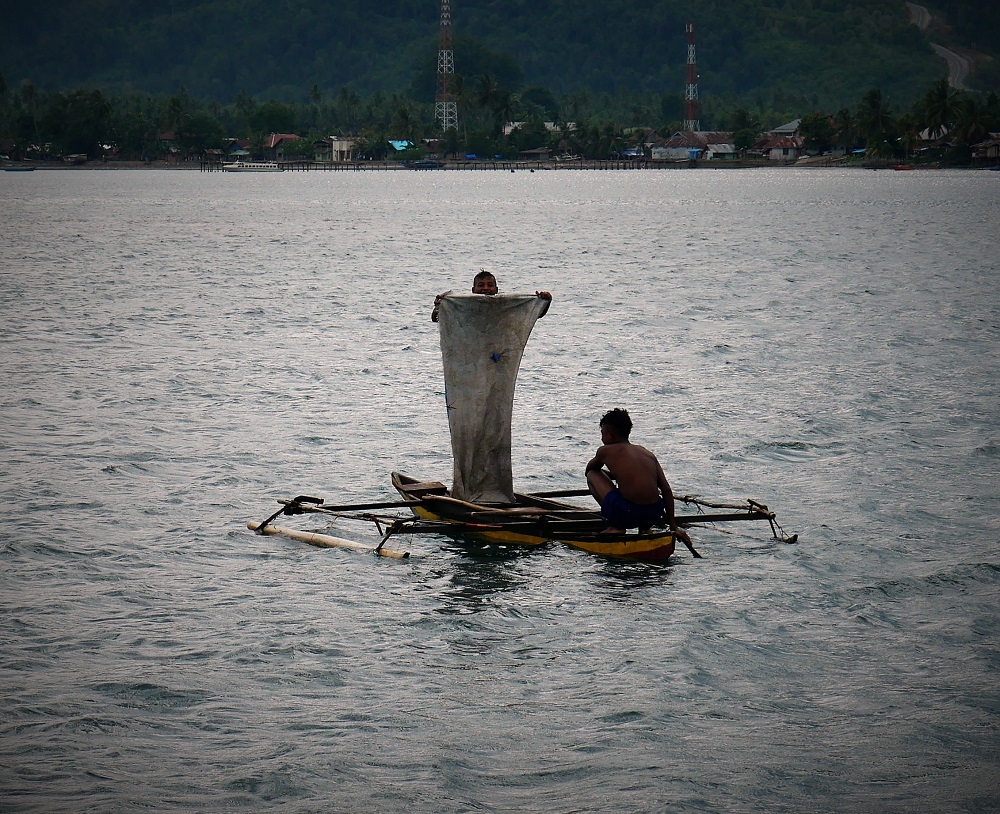
Home-made sail – kids in Buli.
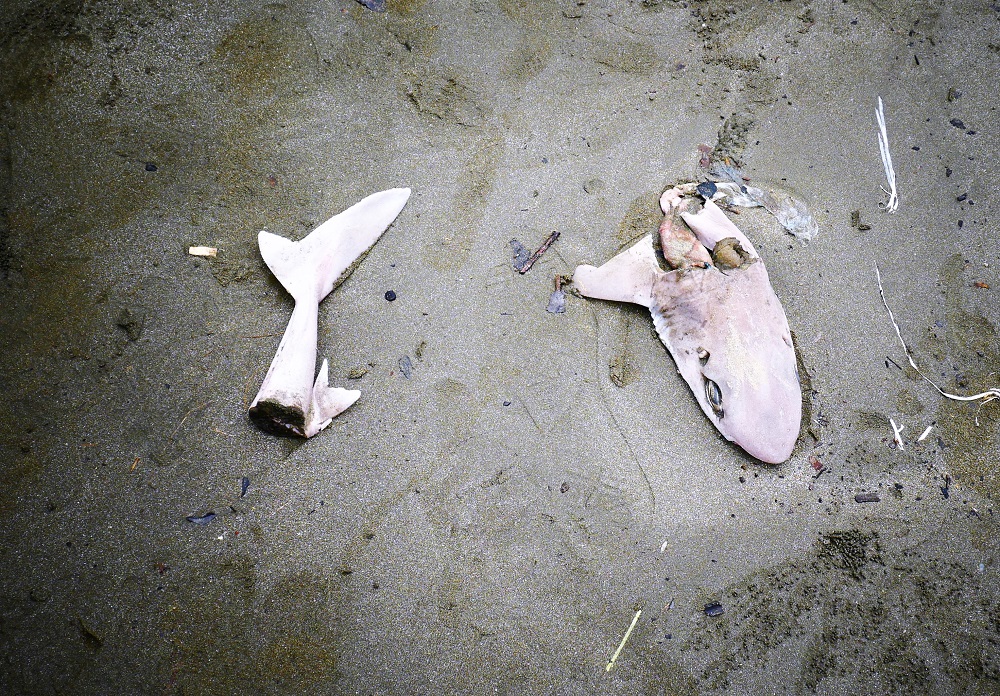
Disembowelled shark carcass on the black sand beach of Buli town, Halmahera.

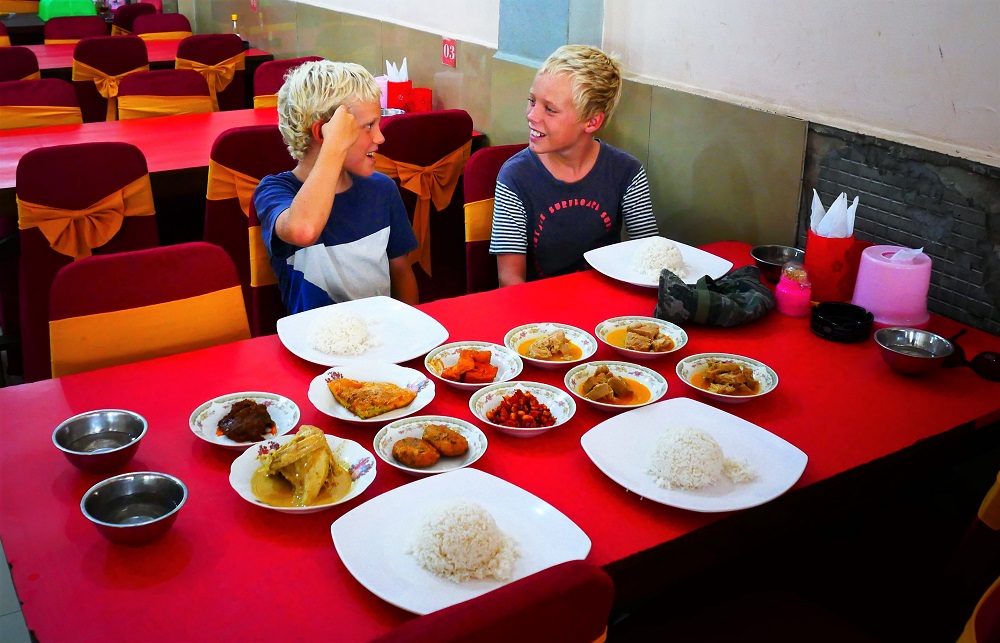
We visited Buli town, a small mining town based at the foot of scarred hills whose narrow waterside streets were drenched in the stench of drying fish. Here we bought vegetables, took selfies with local shop-owners, and went out for an immensely delicious lunch at a Padang-style restaurant, where customers choose from the many delicious dishes advertised on the shelves in the restaurant window. By pointing at different dishes, we managed to order exquisitely delicious sticky-fried sweet and sour tofu, curried jackfruit, tempeh fried with peanuts, chilli and tomatoes, beef rendang curry, vegetable-filled omelettes and potato cakes, all of which we ate quietly under the supervision of the eager restaurant matron.

A waitress serving the food from the window display.
Ready for a feast.

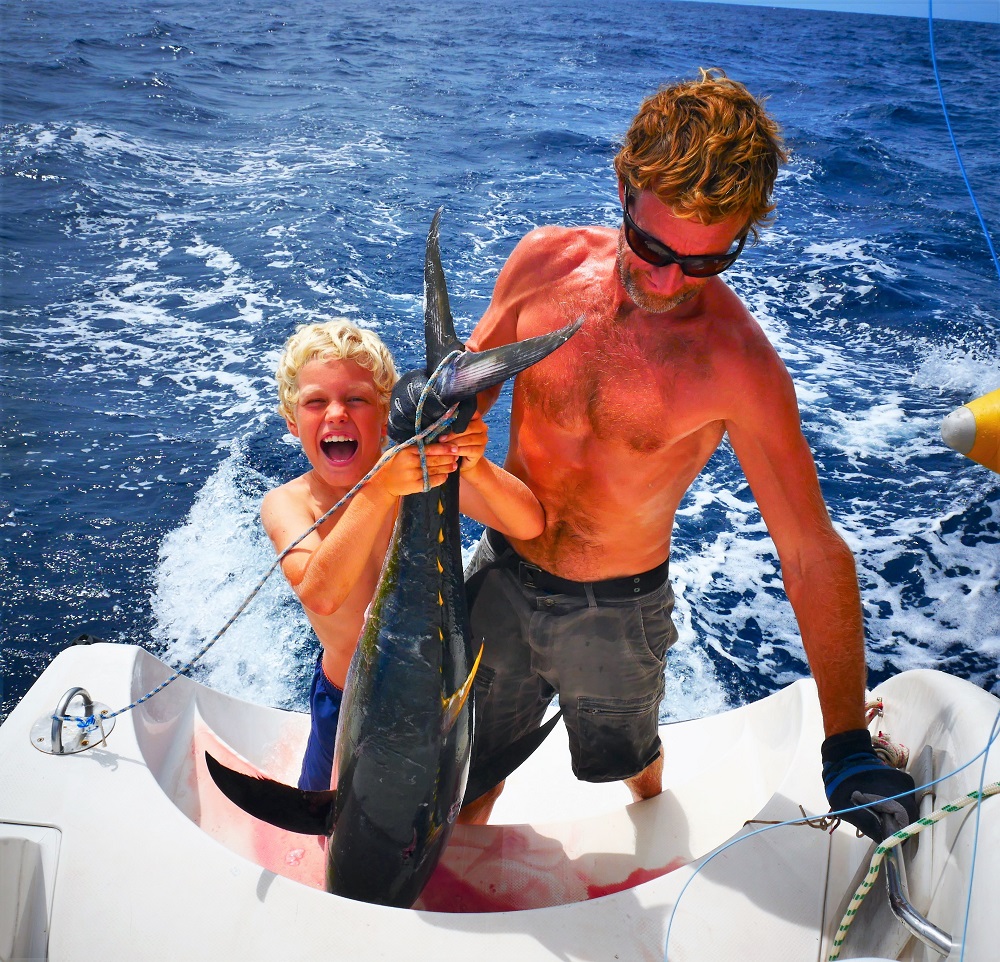
Halmahera is tuna country, and several commercial operations are based there. On the way south from Morotai we caught a huge yellowfin tuna, which at about 30 kg was only just lighter than 8-year-old Lukie. After we’d filleted half the fish our freezer was full to brim of sushi-grade tuna and we shared the rest with the fishermen we met at our first stop at some small islets off central Halmahera. When David offered them half the fish, they first refused it, saying that they had no ice or refrigeration to keep it, but once he’d filleted it we managed to distribute half-kilo chunks of tuna to the surrounding fishers no problem.

Monster fish, larger than Lukie.
Fishing boats off Buli town.

Nobody there seemed to know where New Zealand is – when we said where we’re from they just smiled uncertainly and nodded, no glimpse of recognition in their eyes. People know Australia, the UK, the Netherlands, the US. But not New Zealand.

Females of Islam – different levels of hijab in Buli town, Halmahera .

A couple of days before arriving at Pulau Joronga we were in Pulau-Pulau Widi, a huge atoll about 12 nautical miles east of southern Halmahera. Here, we met Carlos, a young builder from Java who has been contracted to build a high-end resort on the little islands lining the lagoon. The first person we’ve met who spoke English since Anna in Morotai, he came by in a longboat full of men on our first morning there.

“Hello,” he shouted.

“Hello,” we yelled back. “Selamat pagi.”

“Where are you from?” he asked, one hand holding onto our deck as he balanced upright in the wobbly longboat, the other hand shading his eyes from the sun as he squinted up at us, standing above him on the deck.

“New Zealand.”

“Ahh. Europe.” He nodded sagely.

“No – more like Australia. Near Australia.”

“Ahh. Australia. Australia. Welcome to Paradise.” He smiled and widened his hands, indicating the still lagoon, the quiet, mangrove lined islets, the turquoise sandbar behind the seagrass-filled shallow bay.

“Thank you. It is very beautiful here.”

“You come and see my buildings? Maybe one day you come and stay here, not uncomfortable like on a boat, nice houses, very comfortable.”

We were chagrined at having to describe ourselves as Australians, but now, a few days later, after this attack, we’d give a lot to go back to anonymity. Presumably, New Zealand’s status as largely terra incognita in Indonesia has changed now that we’re associated with a terror attack on Muslims, associations that will likely take many years to fade in this country already torn by secular conflict.

When we visited the building site, Carlos explained the plans. The project is run by an English lady called Natalie, who has visions of turning Pulau-Pulau Widi into a Maldive-like resort, with little cottages dotted on all the islands.

“We will build a hundred houses,” explained Carlos, extending his cigarette pack towards us and raising his eyebrows when we declined. He makes the houses in Ganelua, the nearest village on the Halmahera mainland, and then ships them to Pulau-Pulau Widi for assembly there. He is employing twelve men from the village and has so far constructed one house which they were assembling when we visited. Carlos has done business elsewhere in the world, has shipped houses to Darwin, Australia, the Philippines, and the Netherlands, and he wants to do business with us.

“You must be rich,” he said, grinning. “To be able to sail in a big boat like that.”

We smiled and said that we had been working hard and that we have to go back to work when we return to New Zealand. And that we are very happy to be able to see beautiful Indonesia.

“Well, happy is good, but happiness, it costs money.” He laughed loudly and wiped his hands on his t-shirt before offering us cigarettes again, shrugging his shoulders when we declined once more and lighting one for himself.

“I can build houses for New Zealand. You buy from me, you sell in New Zealand. I ship the house. Good, strong Indonesian hardwood. You have hardwood in New Zealand?”

“Yes, but it was all felled. It takes hundreds of years to grow. They used it all. So nowadays houses are made from pine, grown in plantations.”

“I can ship you hardwood houses.” He slapped David on the back. “I ship to you, you sell on, you take 50%! We do business together, you a businessman, yes?”

They were beautiful houses, but we’re not sure we want to be part of the demise of the Indonesian hardwood forests. On this atoll, all trees are protected.

“We can’t get wood from this island,” sighed Carlos. “We’re not allowed to cut trees. There are many good trees, good wood, here. But we can’t use.”

David and Carlos shaking hands on no deal, with two of Carlos’s crew looking on.

Apart from Carlos and his crew, there were about 30 fishers in the lagoon, living in stilt houses perched over the turquoise shallows. From the village Ganelua on the Halmahera mainland, they come to Pulau-Pulau Widi for months on end to fish, salting and drying their catch to bring back to the village to sell. The entire atoll is a forest reserve and no forest clearing or agriculture is allowed on any of the small islets surrounding the calm lagoon, so they bring vegetables along and get new supplies from the village when they run out. A policeman comes a couple of times a month to stay in a little stilt house and check that nobody is felling any trees.

The policeman’s stilt house.

We met Amat and Labeebah, a young fishing couple who live here in their stilt house for two months, then go back to the village for one month, then back here for two months, and so on. With them, we spoke in stilted Bahasa using a lot of gestures and when they asked if it is just the four of us (empat orang – four people) sailing around and we nodded they laughed and laughed, repeating it over and over, chuckling with mirth. Empat orang sailing around and around! How crazy! They served us tea and fried cassava in their immaculately clean house where we sat chatting, our faces zebraed by the stripes of the light blue water shining through the gaps between the dark hardwood floorboards. They have elegant hoisting systems for their two larger traditional outriggers, a small generator for electricity at night, and lots of small fish (bream and snapper) drying out the back – ikan garam (salt fish) as they explained. They offered to give us cassava and salt fish to go, and we declined politely even though Matias looked longingly at the cassava, and when we returned to the boat Lukie and I baked some chocolate brownies for them in an attempt to offer something back to these people who have so little and yet are willing to part with it to total strangers at the drop of a hat.

Amat and Labeebah’s stilt house.
Posing for photo amidst salt fish with Amat and Labeebah at the back of their small stilt house.

When interacting with locals here, our fish books are always a hit. Most people we meet are fishers and we have hour-long discussions about which fish we and they catch, what we see in their seas. In Pulau Widi, two middle-aged fishers came to our boat for a cup of tea, poring over fish books and our Indonesian Cruising Guide and excitedly discussing the sizes of the different fish they catch here as well as the ones they’re not allowed to catch. They can’t catch turtles, sharks, manta rays. Blast fishing is prohibited because it is bad for the reef, although we’ve seen evidence of it everywhere around Halmahera and Morotai, large patches of smashed up coral next to areas of thriving, live coral bursting with life. They laughed at the sounds of our children playing and asked whether we really only have two kids? When we answered yes, they laughed again, slapping David on the back as they held up their fingers to show how many they have – six and five, respectively. All grown up, back in Ganelua Village.

Are they Muslims, we asked? Yes, there is no mosque here, but there is one back in the village – everybody in Ganelua is Muslim.

Visitors on Bob the Cat.
Visiting fishermen poring over fish and guide books.
Stilt house of Pulau-Pulau Widi.

Pulau Widi was perhaps the serenest place we’ve ever been, and along with Morotai certainly the cleanest (no plastic pollution) location we’ve been in Indonesia – a glassy lagoon bordered by tiny, narrow islands, thousands of small white beaches backed by lush green jungle resonating with birdcalls. Mangroves line stretches of the little islands and herons took off and millions of fish jumped as we glided past silently on paddleboards. We hope that the tourists visiting the upcoming resort won’t disturb the peace and traditional way of life of the fishers in their stilt houses, but rather that they will benefit this community, create other means of income – at least for a while. I’m reading about climate change and am surprised to see anyone willingly want to copy the famously soon-to-be-under-water Maldives. Here, a major resort is planned for sites less than one metre above sea level; nowhere in Pualu-Pulau Widi is more than a couple of metres above sea level and the reality is that these atolls will all be gone in 50 years’ time. But I guess maybe there is some profit to be had in the meantime.

Pulau Joronga.

A couple of days later in Pulau Joronga, we were sitting stunned and numb, no longer noticing the eagle flying overhead, trying to process that a terrorist attack against Muslims has taken place in our country. We could only access snippets of news via satellite and learned that New Zealand is reacting by tightening gun laws and renouncing the Australian who carried out the attack. We feel awful for the families of the victims, for all the Muslims in New Zealand and for all Kiwis in general, who have had our peaceful country violated by the zealous hatred of a disturbed individual.

After the news had sunk in, we considered what it meant for us, travelling as we are in a Muslim country. We spent a day on the boat and on the beach, swimming and snorkelling, chatting to passing fishermen who brought us fresh drinking coconuts unprompted and without asking for payment. The people living there hadn’t heard the news – there was no internet there – and we tried to find out as much as we could about the Christchurch mosque attacks via satellite news before we got ready for the two-day passage to Ambon. The capital of the Moluccas, Ambon was the origin of the anti-Christian violence erupting in the Moluccas in 1990 and we’re nervous about how people feel there about this recent anti-Muslim attack. The anti-Christian sentiments in the more remote parts of Indonesia are fuelled by historic differences between neighbouring communities. But in larger cities like Ambon, there is always a risk of Muslim radicals, anti-westerners like those that engineered the Bali bombings back in 2002.

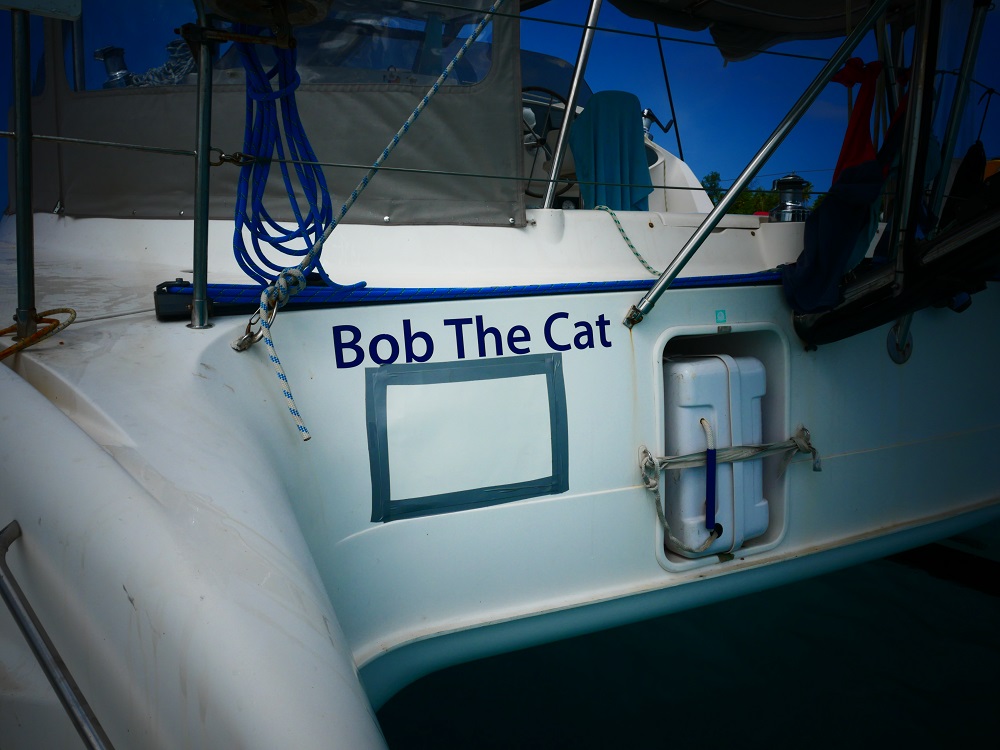
It is bad timing to go to a large Indonesian city less than a week after people have committed atrocities against Muslims in your country. Apprehensive about retributive violence we removed our New Zealand flag and covered up the large ‘New Zealand’ port of origin painted on our stern.

Port of origin erased.

I looked at David. “Where should we say we’re from, if people ask?”

“Denmark?” he suggested.

“No. They did the Muhammad cartoons, they’re known in the Muslim world.”

“Well, it sounds like the attacker was Australian, so we can’t say Australia. And the US is out, obviously. UK is probably safe, but then there’s the history of colonialism. We could just say ‘Europe’?”

“Or how about Canada? They haven’t done anything to Muslims, have they?” David is Canadian by birth, so it wouldn’t be a total lie. “Or I could say that I was born in Iran.” After all the interrogation I’ve faced in western airports around the world whilst travelling with my Danish passport listing Iran as my birthplace it would be nice to finally be able to state that I was born in Iran and receive a positive response.

“Well, I’m not sure what the status of conflict is between Sunni and Shia Muslims. So maybe not.”

He’s right, we don’t know enough about it. So we resolved to say we’re from Canada if people ask and set off towards Ambon hoping that there were no Indonesians amongst the victims and that there are no crazy radicals residing in Ambon. As a minimum, we must spend three days there (that’s how long the visa takes to process), and with nothing indicating we’re from New Zealand we hope to slip below the radar of any discerning fundamentalists patrolling the harbour or walking the streets.

New Zealand will never be the same after March 15th 2019, and neither will we. Travelling the world as we do, we never take for granted the kindness of strangers, all the people of different countries, religions, and political persuasion that we meet who go out of their way to make our acquaintance. Such tolerance and kindness make the world a better place, and I am ashamed that Muslims in New Zealand were not safe from the vile hatred of the minority.

We can only echo the many when we say: Kia Kaha to all Muslims in New Zealand, to Christchurch, and to all New Zealanders who find their world forever changed by this senseless act. From here in Indonesia we too unite with you in grief.

Kids’ blog 11 Mar ’19 – Beach cleanup

Plastic in the ocean is a problem. While sailing around in Indonesia we have seen a lot of plastic on beaches and in the ocean.

Plastic in the sea is bad because fish die. They eat plastic because they think it is food. If they keep eating plastic, their bellies will get full because they cannot digest it. The fish will keep on eating because they are hungry, but they will have no space for any more food, and then the fish will starve. Plastic ropes and nets can tangle up animals like turtles and dolphins underwater, who will die because they will not be able to move to the surface to breathe.

We came up with an idea to collect data on how much plastic there was on an island called Pulau Leleve for our boat-schooling.

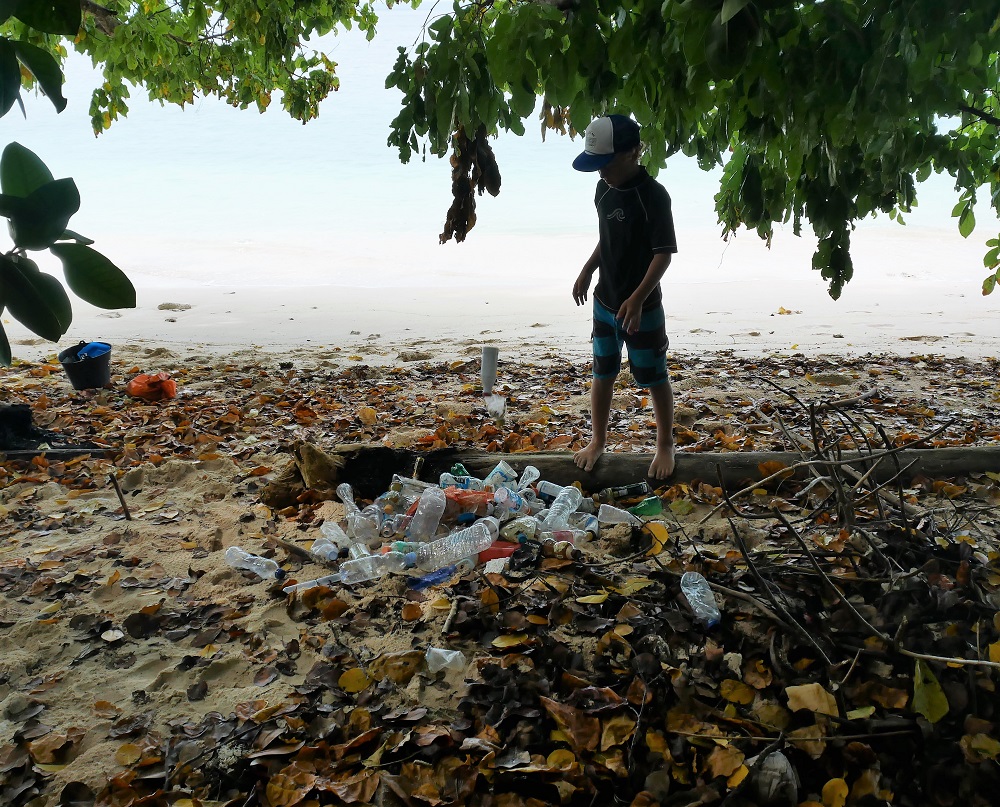
Pulau Leleve is a small island east of Halmahera in the Molucca region of Indonesia. Nobody lives on Pulau Leleve but fishermen visit it sometimes. It has a beautiful white beach and further up the shore perfect, shady, plastic-filled areas of shoreline for us to sample.

Our hypotheses were:

  • There is more than 20 pieces of plastic per every 10 metres of shoreline.
  • Every ten metres of shoreline there is more than a bucketful of plastic.
  • We will find more plastic drinking bottles than any other category.
  • Most plastic on the island is under thirty centimetres long.

Methods

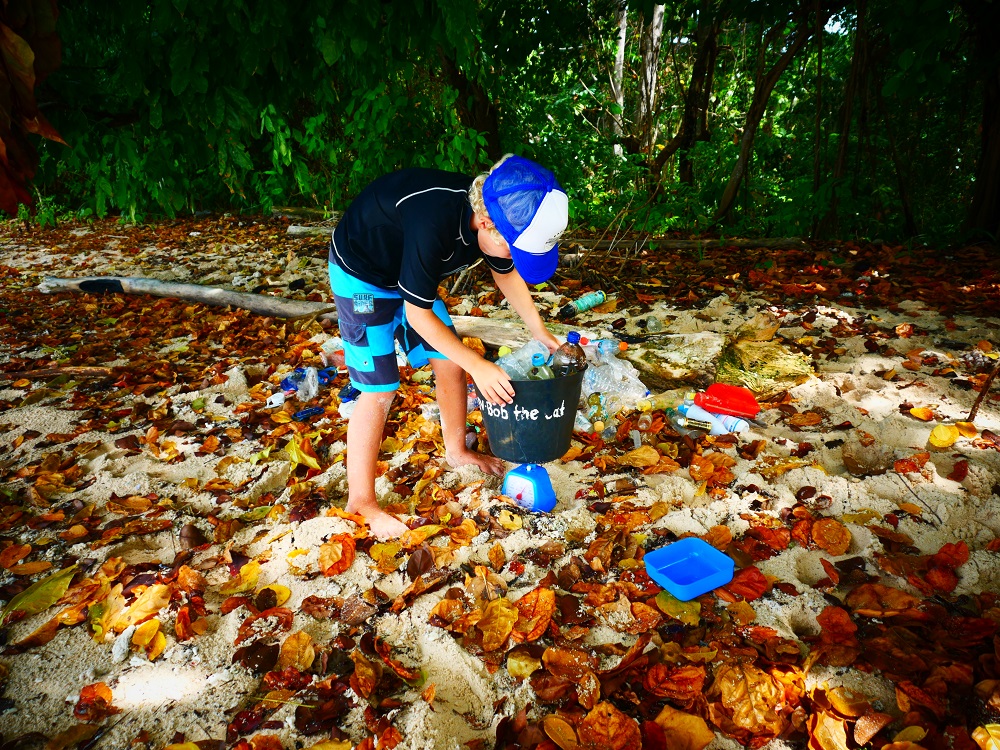
We went to a beach and found a place to collect rubbish. We measured a 10 x 10 m square with a measuring tape above the high tide line. Then we gathered all the plastic and counted and sorted it into categories. The categories were:

  • Drink bottles
  • Other bottles
  • Cups
  • Shoes
  • Styrofoam
  • Bags
  • Rope
  • Fragments
  • Ice lolly tubes
  • Lighters

We weighed all the categories and estimated the total volume of plastic found using a 10-litre bucket. We then repeated the process in a different area.

The beach on Pulau Leleve.
Picking up rubbish.
Weighing the plastic.

For analysing the data, we put it into an Excel spreadsheet. We plotted some graphs and made some tables. We then measured the perimeter of the island on Offline Maps and used this to estimate the total amount of rubbish on the island.

Results

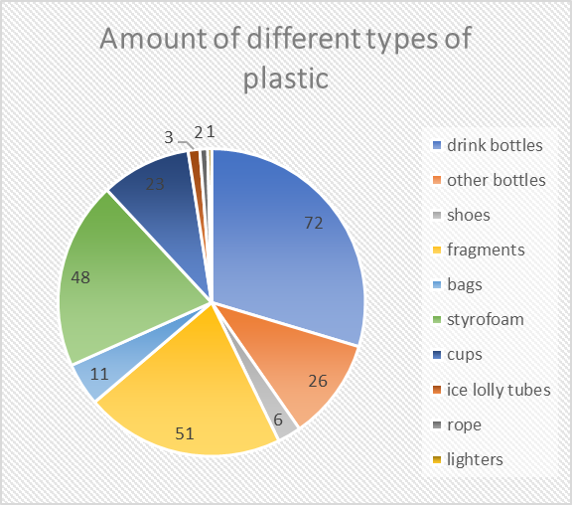
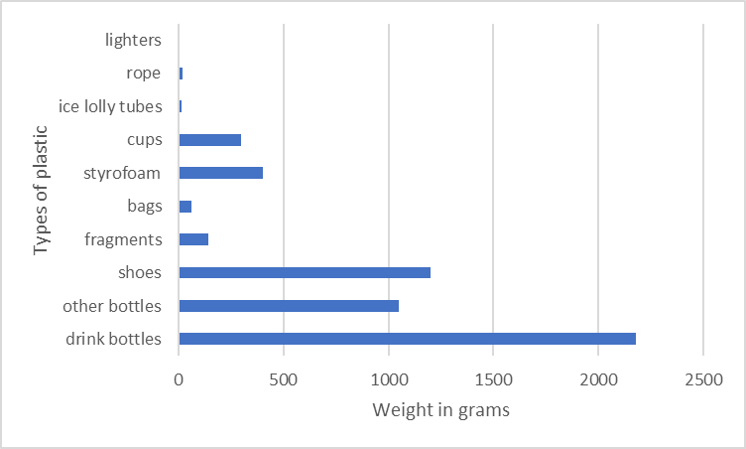
This graph shows the amount of plastic we collected in total. The most common type was plastic water bottles, followed by fragments, then styrofoam.

This graph shows how much the plastic weighs. We only found six shoes, but they weighed a lot.

This is a dot plot to compare how much the different types of plastic weighed and how many pieces there were. We found more water bottles in weight and number than any other category. Even though we had a lot of fragments and styrofoam they did not weigh a lot.

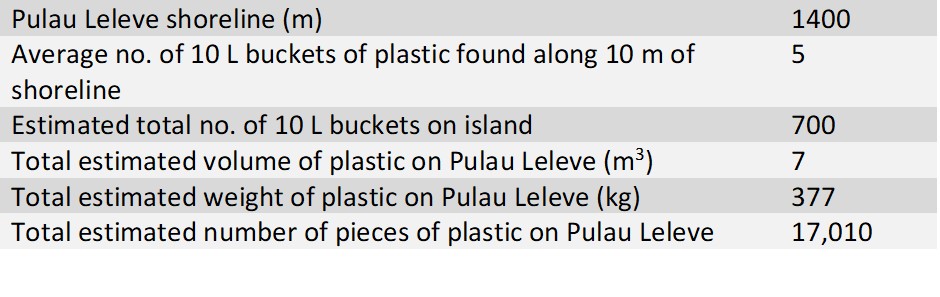
These tables shows how much plastic we estimate is on the entire island. If the amount of plastic we found is present everywhere, there will be close to 7000 bottles on that small island, weighing more than 225 kg! If this rate of waste keeps up there are soon going to be entire islands that are made of plastic.

We think there are 7 cubic meters of plastic on the island – that’s enough to fill more than 2 large family cars. In total we estimate there are more than 17,000 pieces of plastic, weighing more than 350 kg on this small island.

Discussion

Our hypothesis was that there would be more than 20 pieces of plastic per every 10 metres of shoreline. In fact, we found more than 120 pieces per 10 m – that is more than 6 times the amount we thought we would find!

Another hypothesis was that for every ten metres of shoreline there would be more than a bucketful of plastic. We found 5 bucketfuls.

We thought that there would be more drink bottles than any other type of plastic. In Area 1 there was more Styrofoam, but after adding Area 2 we had more drink bottles than any other category.

We also thought that most of the plastic would be under thirty centimetres long, and we were right again. The only plastic over thirty centimetres long was a piece of Styrofoam that was thirty-two centimetres.

We think this is a lot of rubbish to find in a small area. We reckon we probably missed out some because some bits would be too small and some could be buried under dirt and leaves.

If the plastic went into the ocean the fish and turtles in the area might die or go away. Boats might get their propellers stuck in plastic and the water will get full of microplastics.

We think the Indonesian government should ban some types of plastic that are used a lot, like water bottles. We also think the Indonesian people should be educated to stop throwing plastic on beaches and in the ocean.

Writing down numbers.


Morotai – then and now

Tiny Anna giving me a lift on her bike.

“You are very lucky you have two boys,” says Anna, beaming at our family from her seat at the table end. She sighs. “I hope God gives me children.”

I gaze over at the boys who are sitting making horrible faces at each other in the dockside eatery as they wait for their lunch to arrive. They are whispering quiet threats to one another and glancing over at me to see if I’m noticing, and generally getting as close to a fight as they can get away with when out and about. It’s noon and tempers are running high. Pre-lunch sugar low has always been a challenge in our family, and today is no different.

“Yes.” I grimace back at her. “Children are a blessing.”

“My husband says if I don’t get he will take a different wife.” She looks downcast, the headscarf that covers her hair only partly obscuring her furrowed brow as she tosses her head backwards. “But he doesn’t mean it. We love each other!”

I lean forward. “How long have you been married?”

“Four years. I meet my husband when I come here from Ternate in Halmahera, my hometown. We been married for four years but still no children.”

I nod uncertainly. “If you can’t have children, it may be… I mean, it could be either of you. It may not be a problem with you. Maybe it is him who can’t have children?”

She looks confused, shaking her head uncomprehendingly.

“How old are you?” I ask, changing tactics.

“28.” She smiles. “I hope children are coming soon.”

I pat her hand. “There is still time. You are young still.”

The conversation is interrupted as the lady from the food stall brings out steaming bowls of mie goreng, the children’s favourite Indonesian dish. They pull one more face at each other and then put aside their arguments to attack the food ferociously, the whispering stopping as their mouths get busy gaping over huge forkfuls of spicy noodles.

Stilt houses over the glassy sea in Daruba, Morotai.

We’re in Daruba, the capital of the Island of Morotai. For the last week, we’ve been exploring the dry, deserted, and bizarrely clean islands dotted off the south-western end of Morotai, relishing in the complete tranquillity offered by the isolation of these far northern isles. The only humans we’ve met have been elderly fishermen, who nodded and smiled as they surveyed us, their opaque eyes reflecting the shining white of the sea, answering bagus, bagus (good, good) when we gestured whether it is OK to visit the beach they’re fishing from.

Fishers on a glistening sea.

It’s a different feel here from elsewhere we’ve been in Indonesia. There are no tourists, no dive boats zooming around, no homestays or hotels. The locals in their colourful longboats see us and wave but don’t generally initiate conversation, busy as they are heads down fishing, fingers deftly handling lines or nets, cigarettes dangling from their lips. The hazy outline of the volcanoes of northern Halmahera grace the horizon, clouds circling their peaks in the daytime, the sun being speared by their jagged contours each night.

Dodola Island.
Dodola Island panoramic.
Bizarre underwater letters spelling Morotai off Dodola Island. Located at 6 metres of depth, the letters each stand 2 m tall. Presumably, the intention is that they will get covered in coral and form a lovely, underwater sign for tourist divers.

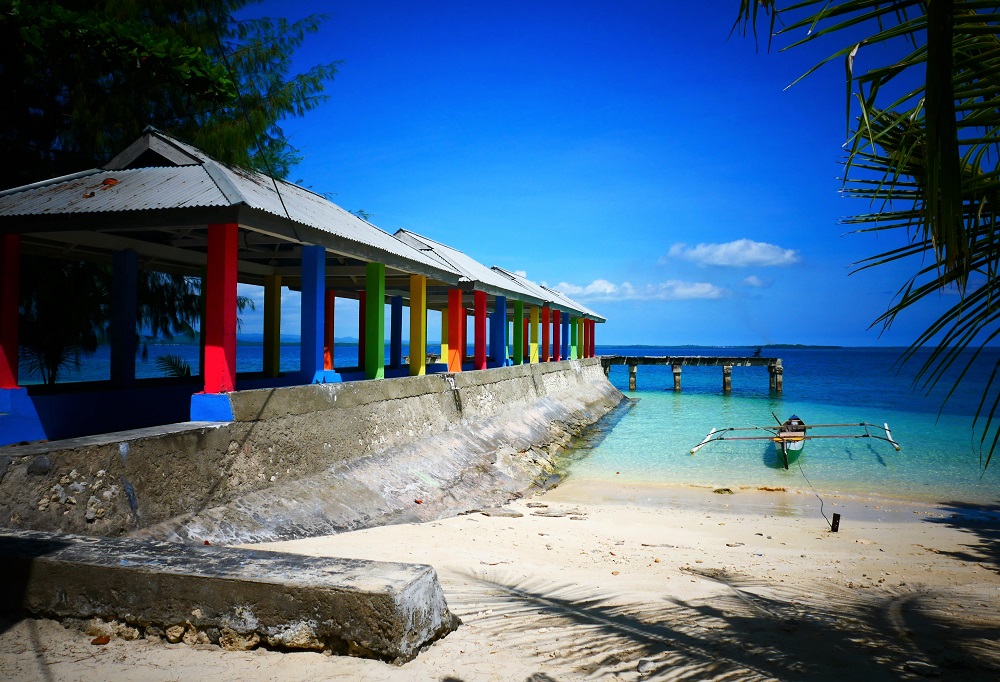
Last Friday we got to Dodola Island, two small islets joined by a long sandspit not far from Daruba. In contrast to the uninhabited islands surrounding it, Dodola featured low buildings in the bushy interior and a garishly colourful inflatable waterpark anchored just off the pristine beach. Curious, we went ashore to the empty beach, where we found a staff of twelve men sitting around, seemingly waiting for customers. We established that the kids could play on the waterpark for a minor fee and went for a walk to have a look around at the carefully painted pillars of the dock, the neatly raked beach, the empty houses and the half-finished building projects, the waterpark-induced squeals of the kids the only sound on the empty island apart from the regular pinging of the cellphones of the men sitting around.

Our kids on the empty floating waterpark anchored off Dodola Island.
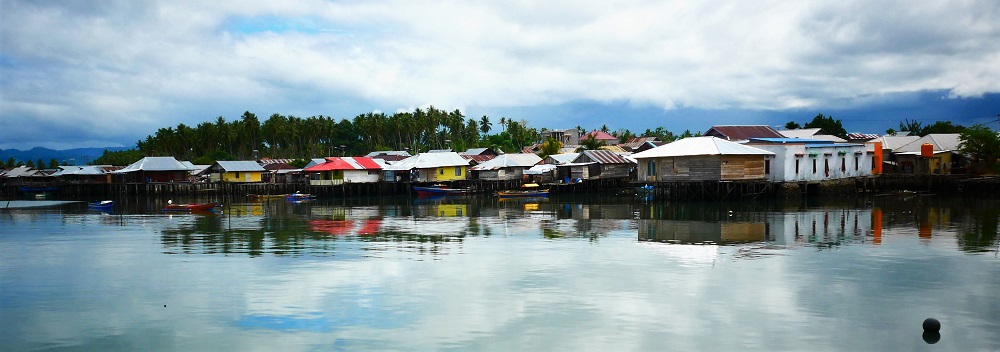
Colourful jetty.

It was here that we met Anna – on the following day, a Saturday, when suddenly the island came to life as a continuous stream of boatloads of visitors from Daruba were offloaded on the beach. Families were sitting under the shady trees, music was playing from small loudspeakers, and a steady stream of lovestruck young couples were walking hand in hand along the sandspit separating the two islands, cellphones in hand as they selfied their love march. Curious to meet some locals on their weekend getaway, we’d gone ashore for a walk and hadn’t taken many steps before a tiny woman wearing wide pants, a sweatshirt and a black headscarf came up to us.

“Hello,” she said, smiling broadly. “I am Anna, guide of Morotai. I have been helping yachts with services before. If you need anything in Daruba, you can call me.”

She was here guiding an American man but would be free to help us with anything after a couple of days.

“There are sometimes problems between Muslims and Christians on Morotai,” she explained, perfect teeth gleaming in the sharp sunlight. “But I say to people, ‘No matter what you believe, you leave my guests alone.’” She wagged her finger chasteningly at us, and we smiled uneasily. “They say, ‘Sorry Anna, no problem if they are with you.’ So, you have no problem here when you with me. Come see me… – tomorrow Sunday, then Monday, come see me Saturday.”

“I think she means Tuesday,” I whispered to David. “That could work – we could go to Daruba Tuesday, see some war relics.”

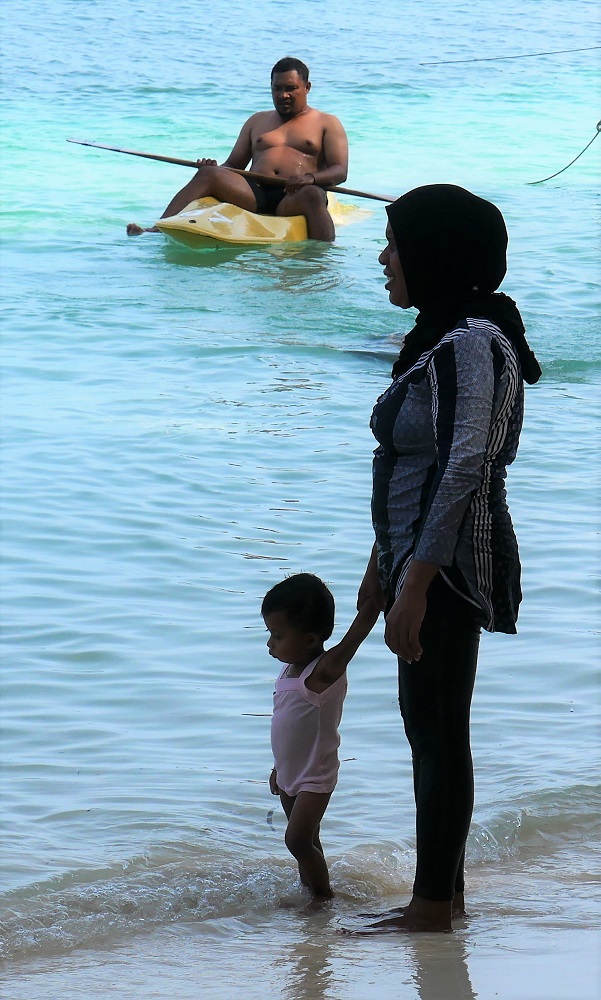
Full body suit – a local woman swimming with her son at Dodola Island.
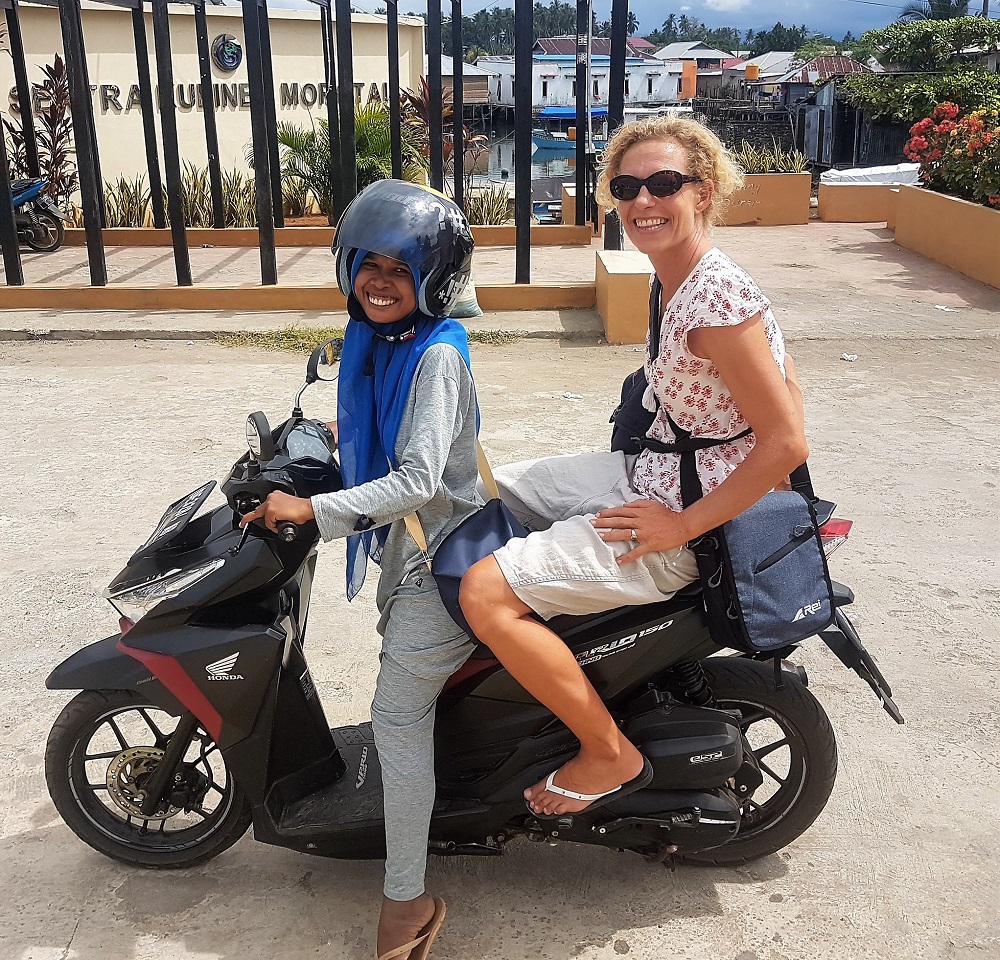
Indonesia: different dress codes for men and women…

Which is why we’re sitting at the dockside food stall. With the diminutive Anna to protect us against potential outbreaks of sectarian violence, we are ready to explore Morotai’s history.

Just north of the island of Halmahera, Morotai is one of Indonesia’s northernmost islands, only a stone’s throw from the southern end of the Philippines. This proximity has shaped the large (~1800 km2), densely forested island’s history profoundly. Like Halmahera further south, the Japanese occupied Morotai during World War II. Eyeing up the flat lowlands of southern Morotai, the Allies mustered a huge attack on the Island in the Battle of Morotai which commenced on 15 September 1944. Deciding that the island was suitable for the building of airfields from which attacks could be launched at the Japanese-occupied Philippines, the Allies badly wanted the island, and, realising this, the Japanese threw everything they had at defending it. After a ferocious battle, the Allies conquered southern Morotai which, because of its strategic location, went on to become an important command centre for the remainder of the war.

The seas around Morotai are littered with wartime plane- and shipwrecks, and tanks and aircrafts used to be scattered in the jungle too, until some enterprising people from Jakarta came to disassemble them and move them to the capital for selling.

War relics: one of the few World War II tanks left on Morotai.

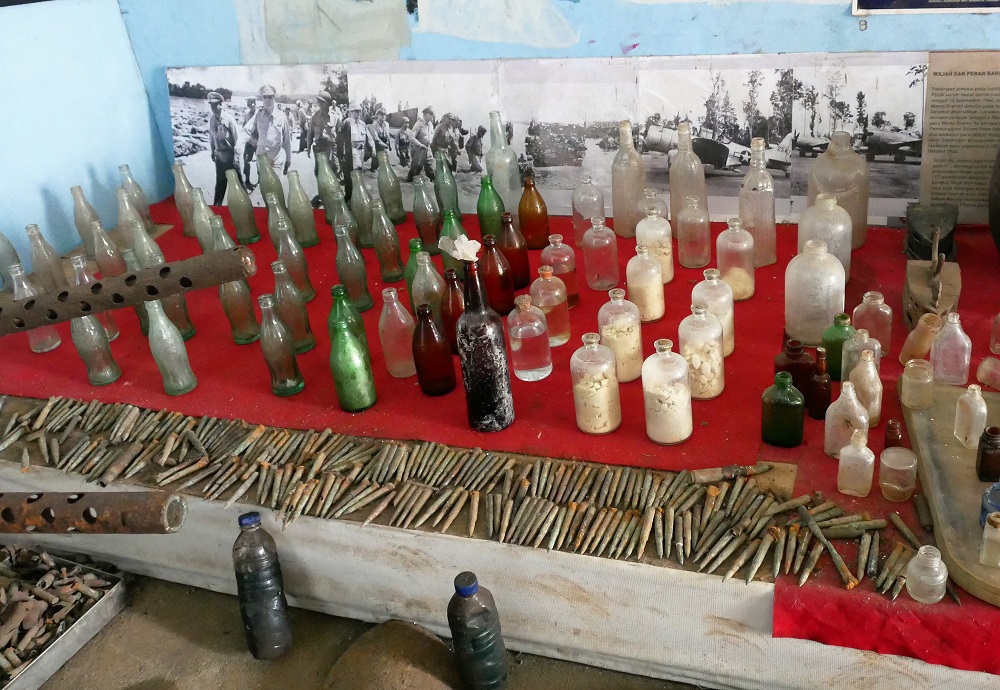
A local man has spent his life collecting smaller-sized relics and set up a museum in his home in the bush not far from the capital. Here are helmets and guns, ammunition belts and binoculars, hand-wound sirens and dog tags, as well as thousands of empty shells and a couple of grenades. He’s decorated the walls with articles and historic photos as well as his home-rendered paintings of war scenes. A bicycle left behind by the Japanese leans rustily against the wall and a collection of bottles display a snapshot of American life at war – aftershave, coca-cola, wine, beer and morphine, all neatly lined up according to content. We lean in to inspect the faces in the black and white photos on the walls – young men in uniform staring sombrely into the camera, young men with war-time haircuts riding tanks, standing next to airplanes, leaning against trucks, shirts off, grinning and laughing, and young men lying down, faces twisted in agony as nuns bend over their wounds.

Wartime bottles flanked by shells – from right to left: morphine, morphine in solution, wine, beer and coca cola.

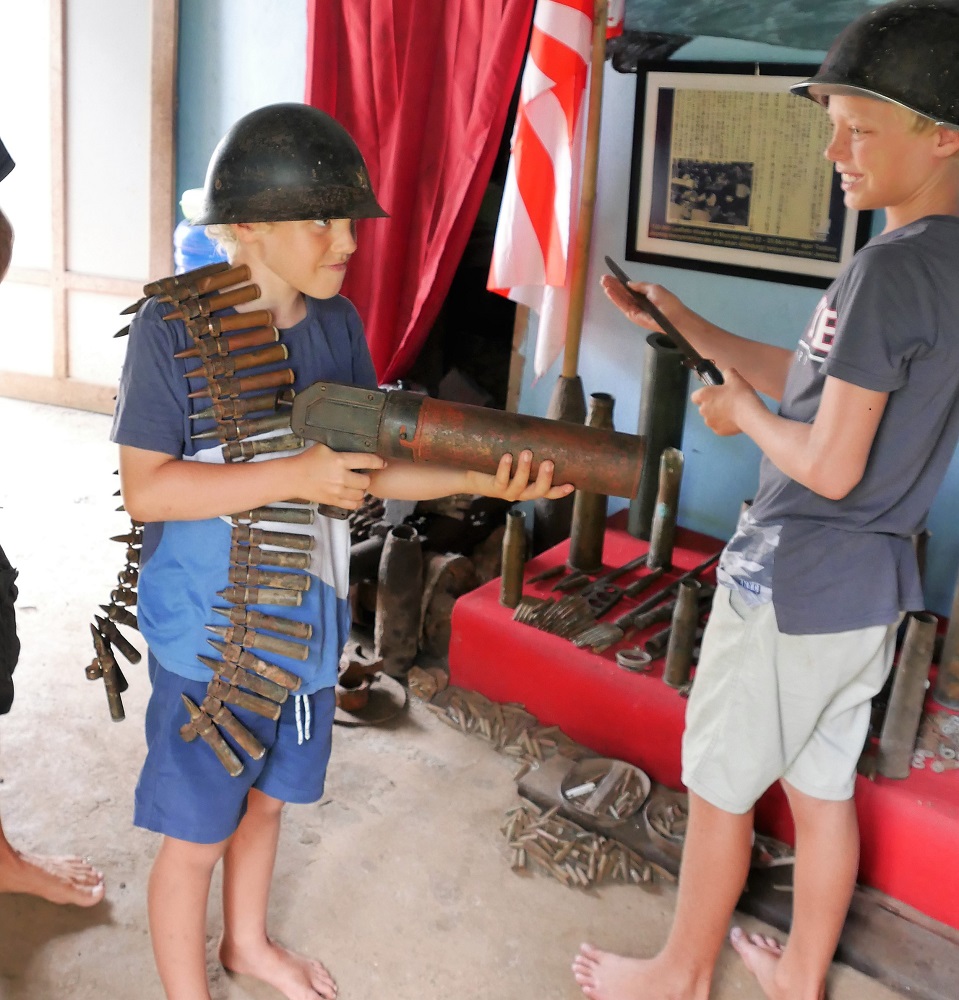
Unlike most museums the children can touch everything here – eyeing up distant cows with Japanese binoculars, holding rusty guns to each other’s faces, fingering war-time coins from Holland, the US and Japan. They each have a turn at winding up the siren and wearing the helmets, Matias from the Allied forces, Lukas Japanese.

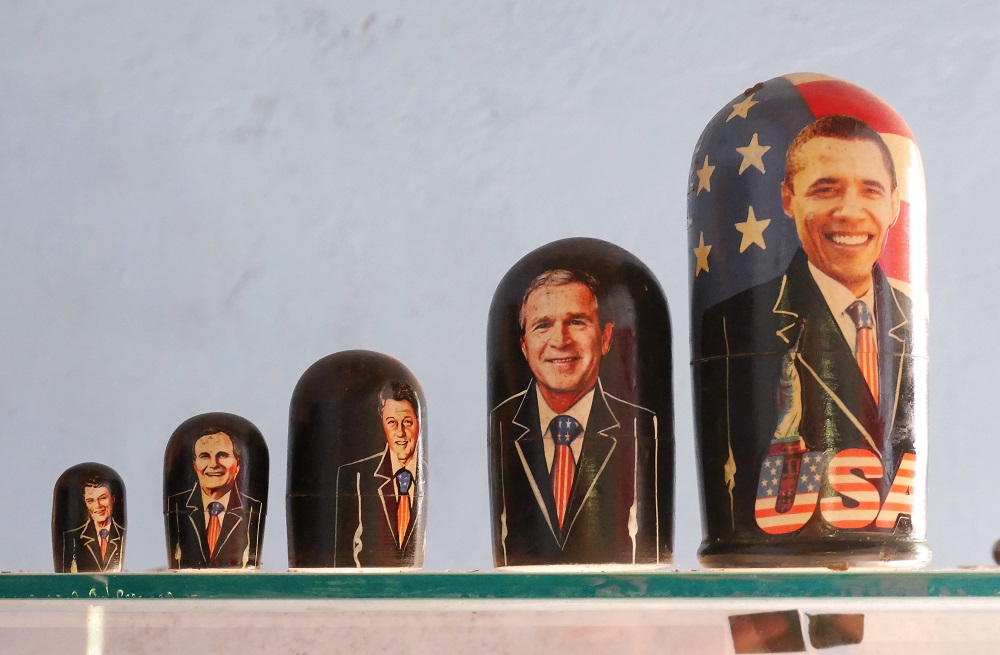
Lots of symbolism: also at the museum were Russian dolls of recent American presidents.

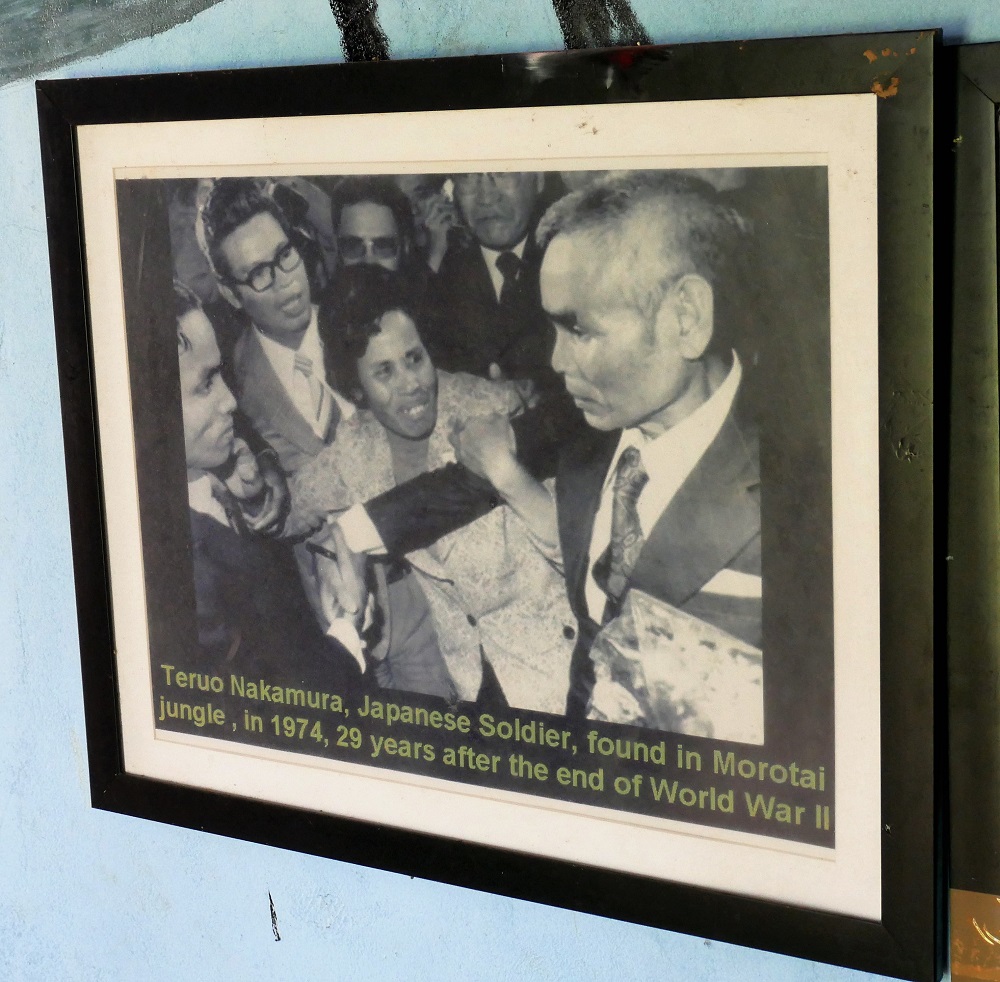
The Japanese didn’t give up easily and even after southern Morotai was taken by the Allied forces, large airfields constructed and raids sent off to liberate the Philippines, Japan continued to hold onto the northern part of the island, scattered troops hiding in the dense hilly jungle until the Japanese Empire surrendered in August 1945. One soldier in particular did not give up. In December 1974, Private Teruo Nakamura surrendered from the jungle of Morotai where he had been hiding since the war, either unaware that the war was over or believing rumours of it to be Allied propaganda. Japanese holdouts, as the stray Japanese soldiers that continued fighting long after the end of the war are known, were not uncommon in the Pacific, but Private Nakamura holds the record with his 29 years of hiding. A Taiwanese from the Austronesian ethnic aboriginal Amis tribe, the poor man didn’t speak Japanese, Indonesian, Dutch or English, and not long after being repatriated to Taiwan he died of lung cancer. One can only imagine what he must have been thinking for all those years in the jungle, a Taiwanese tribesman stuck in the war on an island far away from home, fighting for a country he didn’t belong to, whose language he didn’t even speak.

A photo of Private Nakamura when he was found in 1974.

Nowadays, there are no Japanese left in Morotai, and the only fighting that goes on is that between Muslims and Christians. Sectarian conflict goes back far in this corner of the world. Originally under the influence of the Muslim sultanate on Halmahera, many inhabitants of Morotai became Catholic when a Portuguese Jesuit mission settled on the island in the 1500s. Resenting this influence, the sultanate repeatedly forced most of the Christians off the island in the 1600s, resettling them near the Halmahera capital of Ternate where they could be more easily controlled. When the religious conflicts peaked in the Moluccas in 1999 and Muslims were driven from the town of Tobelo on Halmahera, many of them settled in Morotai, and the island is currently about 75% Muslim.

At the lunch table, Anna is telling us about the latest conflict.

“It was last week, I had some guests, and they were in a car, and there was protests in the street and fighting. And my guests, they were so afraid.” Her eyes widen. “So, I got out of the car and told the men fighting to leave my guests alone!” She taps her phone and starts playing videos of street fighting, leaning across to show us images of white-clad men shouting, fists pumping, street mayhem at the capital’s government house.

When asked what sparked the fighting, she explains that some politicians from Jakarta had come with packages for the school children, which they’d distributed as part of an election rally. In the parcels were, amongst other things, some biscuits. Within the wrapping of the biscuits was a small picture – of Jesus on the cross.

“That is not OK to give to Muslim children,” she says, shaking her head. “Oh my God! A picture of Jesus, and a cross! They got very, very angry that their children were given that. So they protested at Government House and attacked Christians and the Christians they run, run! Into the bush, hiding in the jungle, waiting for violence to be over.” She leans further forward, pressing ‘play’ again and the fighting erupts once more on the tiny screen.

Daruba school children walking home for lunch.

“Wow,” we say, leaning back in our chairs, nervously eyeing up the families sitting nearby who deviously look absolutely harmless, veiled women laughing in the sunshine, relaxed men playing chess, eating and drinking tea, the only sign of violence the squabbling between tiny children running around with slingshots.

“But no problem now, not a problem. This is last week, now is OK.” Anna smiles reassuringly.

Shipwrecks on the beach off Daruba, Morotai.
The boys squeezing into a bento with the shopping.

And, indeed, we only meet kindness in Morotai; laughing kids running by shouting ‘Hello Mister, hello Mister,’ friendly people wanting to practice their English, stopping whatever they’re doing to help us tie up the dinghy in a good spot, find the fresh market, catch the attention of a bento driver to give us a lift. People who recognise our children from the floating bouncy castle in Dodola Island shout “Lukie, Lukie,” and high five them on the dock, and, bellies full, our kids smile and laugh, friends again, chasing after each other in the peaceful dockside park.

When lunch is over we say goodbye to beautiful Anna of Morotai who, with her self-taught near-perfect English and great network of contacts has helped us understand a little more of this corner of the world. May she have many, many children and may these children never find pictures of Jesus in their biscuit packets.

Anna and the boys.