
I open the fridge and rummage through the vege boxes. Only two carrots and a quarter of a cabbage. And the eggplants. What can I possibly make?
I leave the fridge and start searching through the behind-seat storage area. How many potatoes do we have? Urgh, they are slimy. I pull out the basket of potatoes and begin discarding those that have gone off. Nothing lasts long in this heat.
I stick my head out the saloon hatch to address Matias, who is jumping on the trampoline. “Matias, what do you want for dinner on your birthday?”
He stops jumping. “Eh?”
“What do you want for dinner tomorrow for your birthday? You can choose anything. As long as it contains chicken or fish and involves eggplant or cabbage.”
He turns towards me. “So what does that mean? What can I have?”
I hesitate. “Maybe that chicken cashew curry, but with tinned peas instead of fresh beans? Or the Spanish chicken casserole, with chicken on top of the tomato rice? Or fried fish?”
“I just want something with lots of vegetables.”
“Well, maybe the chicken casserole, then. We can put orange slices and eggplant in it, and olives too. And carrots.”
He smiles. “OK. I’ll have that,” he says. “Sounds yum.”
Great. Sounds like he is happy enough even though the menu choices are narrowing down dramatically as the fridge is nearing empty.
It’s been three and a half weeks since we last stocked up on fresh fruit and vegetables, and scurvy is looming. We have next to no vegetables left, our only fruit is a handful of sour oranges, and there’s only chicken, fish and tempeh in the freezer. Not the ideal ingredients for a birthday dinner, but there’s been nowhere to provision since we left Sorong on 25 January. We’ve been touring Raja Ampat with some friend boats and there’s been no opportunity to do any food shopping at all.
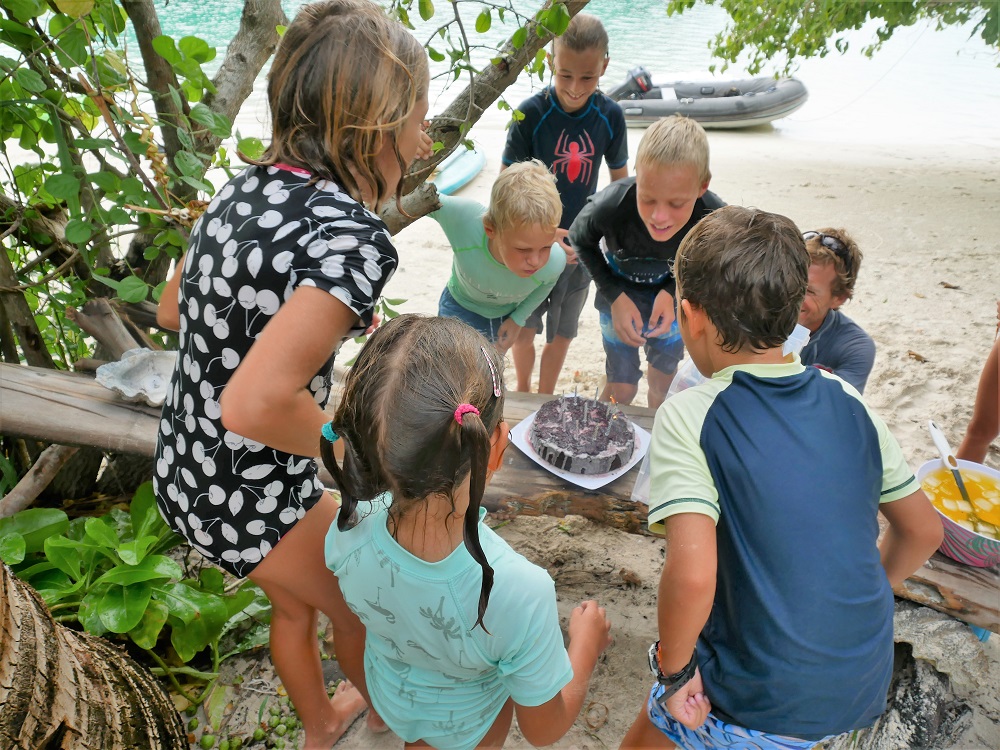
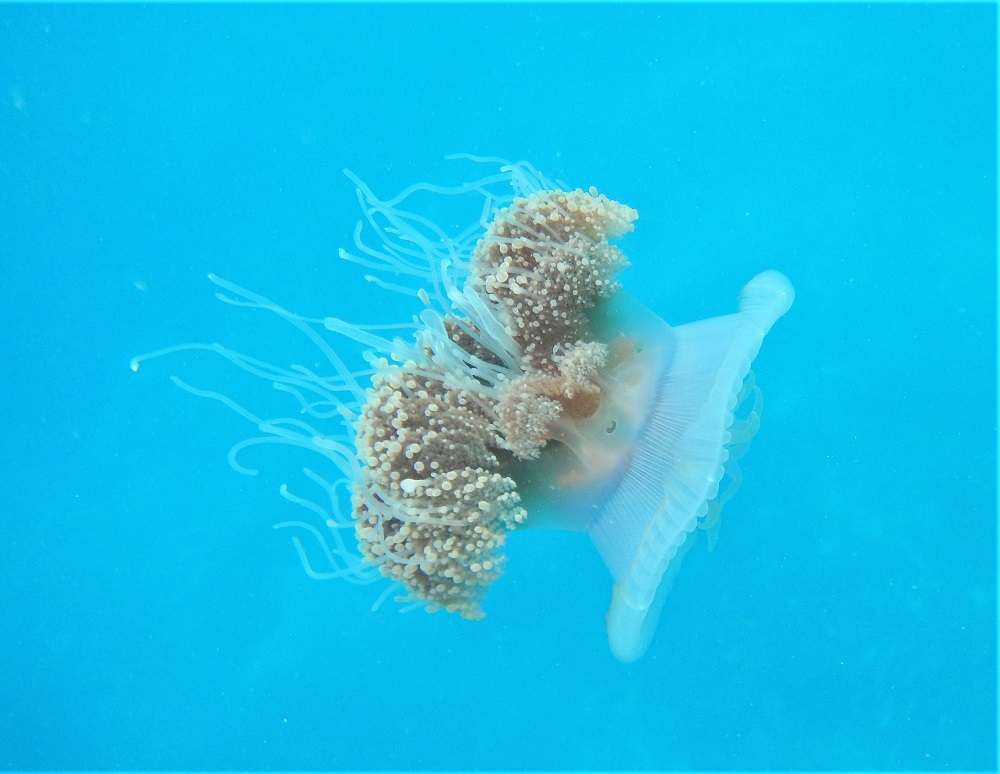


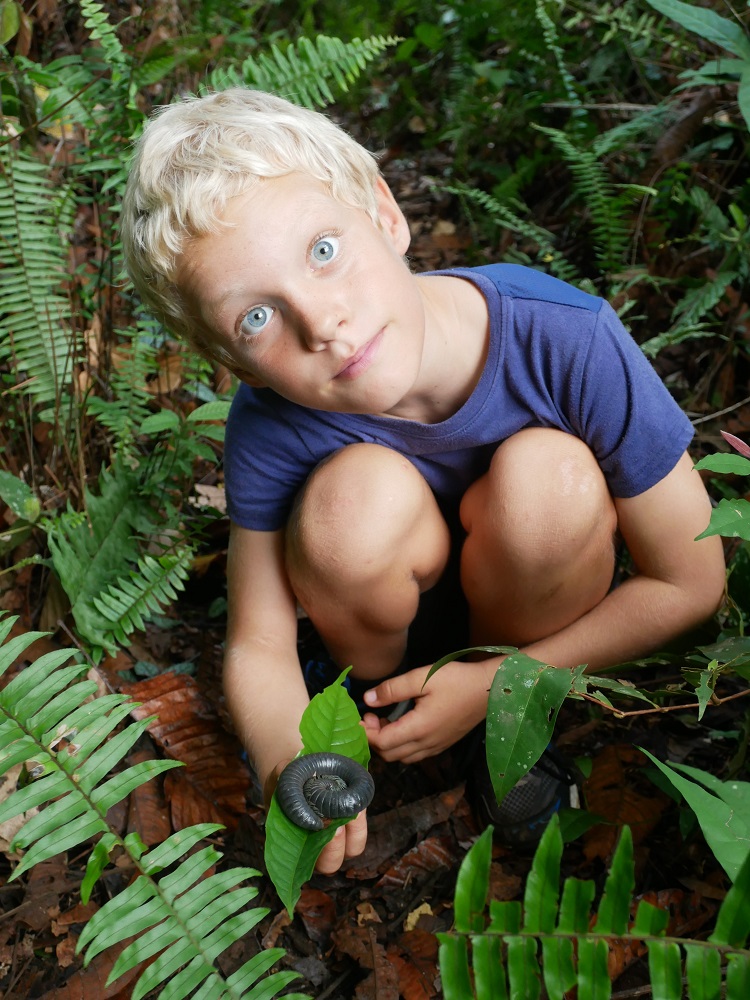
We’ve had an incredible time exploring beautiful spots full of wildlife, anchoring in deserted bays where we’ve surfed, dived and snorkelled, and climbed hills for stunning views. Raja Ampat is one of Indonesia’s top dive tourist destinations, and around every corner we’ve met countless phinisis, the tourist liveaboard boats, and lingered at dive locations that most of these visitors pay thousands of dollars to see on their once-in-a-lifetime diving holiday for which they’ve saved up for four years and flown halfway across the world. It is a very special place, full of priceless wonders.
In this stunning location I guess it is only natural that more people are trying to benefit financially from the tourists, and on this our second tour of Raja Ampat we met our fair share of them.
Unlike most yachting destinations, it is not free to come here. Raja Ampat is a marine park, and the regional government requires tourists to purchase a visitor’s permit. The permit lasts a year, costs Rp 1 million (around NZ$100) per person, and the funds go to the Raja Ampat Marine Protected Area and are used for conservation and protection of this marine wonderland. We dutifully paid the fee and obtained our permits on arrival here a couple of months back, and considered the matter sorted.
What we didn’t know was that there is great local strife over which permit is the right one, with a number of parties feeling that they’re entitled to collect their own fees.
In Alyui Bay, a picturesque inlet cared deep into the north-western tip of Waigeo Island, the Atlas South Sea Pearl Farm is nestled in along the steep shorelines. When we came to see the farm, its Australian owners told us that we had to pay the local village Rp 1 million to be allowed to use the Pearl Farm mooring buoys.
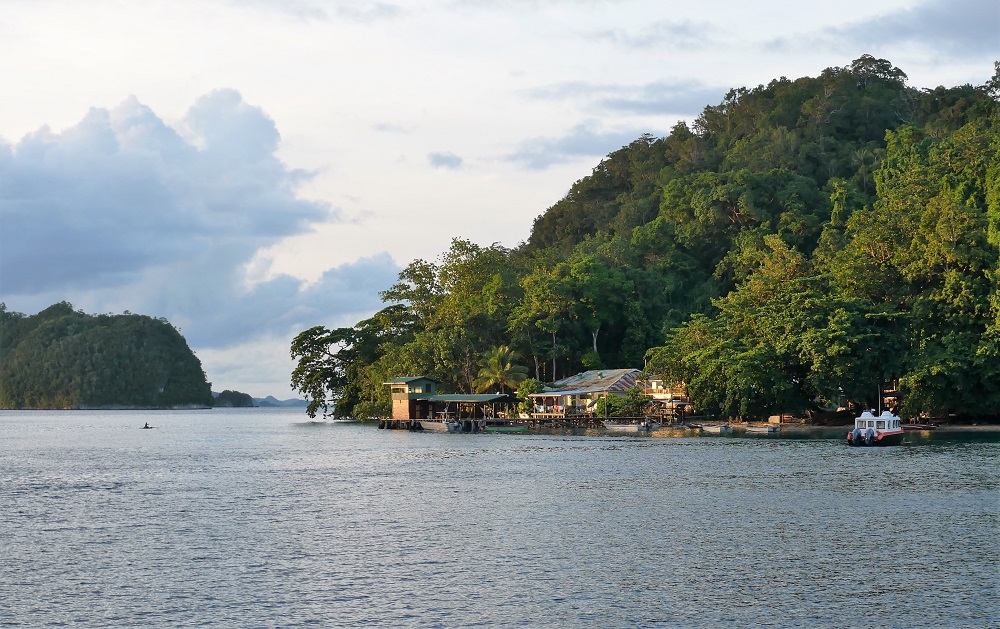
“If you don’t pay, we will be in trouble,” warned an Australian staff member who had come out to our mooring in a pearl farm boat in the late afternoon to advise us of the local fee. “Basically, the local guys will turn with machetes in the morning if you don’t pay the village fee.”
“But we weren’t going to visit the village,” we protested. “We just want to visit your pearl farm. See the operation, maybe buy some pearls.”
“It’s all a mess,” he sighed, leaning on the steering wheel of the pearl farm boat, his face dark against the setting sun. “They lease the land to us, and we put in the moorings for phinisis and yachts to use. But now the village wants anyone using our moorings to pay for being in their waters.”
“But we’ve already paid for the Raja Ampat visitor’s permit. There is no mention of any additional fees at the Marine Park offices in Waisai?”
“I know. But they’ll make my life hell if you don’t pay. We’ve got a lot of locals employed and the wider community here see the pearl farm as a cash cow to be milked. Last time we had a disagreement, they emptied all the fuel out of the pearl farm fleet, and we had to shut down operations for two weeks, causing huge losses.”
“But why isn’t this fee mentioned anywhere? We wouldn’t have come here if we’d known. We can’t start paying unauthorised fees, it will get out of hand. There are many villages and if we start paying every local village we are near, we will soon run out of money. As soon as we round the corner there will be another village asking us for money. These fees are not mentioned on any online cruiser forums or in our cruising guide – they don’t seem legitimate.”
“They aren’t, but the locals feel that they are.” He ran his fingers through his hair. “Look, I understand if you don’t want to pay. But you can’t stay on our mooring if you don’t. I’m happy to escort you to an anchorage just outside the waters we lease -” he gestured towards the outside of the bay, “and then you can stay there.”
We agreed to follow him, a convoy of four yachts heading to the outer bay in the failing light. On the way out I turned to David.
“I don’t see how anchoring just outside the pearl farm waters is going to help.”
He squinted against the setting sun. “He just doesn’t want the trouble from the village.”
“But he said they would come at dawn. With machetes.”
“No, he didn’t mean that, he just wanted us off their mooring. They don’t want to be in trouble with the locals.”
“But he said machetes,” I responded, a hysterical twinge to my voice. “That’s not cool.”
“They aren’t going to come to us. He just didn’t want to be in trouble with the locals. They won’t come to our boats.” He slowed the boat down to match the speed of the pearl boat in front; the guy was hanging over the side gesturing for us to anchor.
I placed myself in front of him. “I don’t know. He said: ‘If you don’t move, the locals will rock up with machetes tomorrow morning’. I don’t really want to stay in this bay! What about the kids? We can’t have men with machetes turning up to our boat, with the kids sleeping downstairs.”
David sighed. “OK. But I think you’re exaggerating. This place is too deep to anchor in anyway. If it makes you happy, I guess we can go back to the anchorage we used last night, I’m OK with anchoring there in the dark.”
He waved goodbye to the pearl boat and altered course to exit the bay. As we motored through the darkness, he turned to me.
“I wonder what that pearl farm has done to upset the locals. I mean, we weren’t approached by a villager – just by the pearl farm. The villagers never came to ask for any money. I wonder if they are as bad as he says.”
“I don’t know.” I look out over the black sea. “I’d rather not find out…”

It all continued the next day when we went to Wayag, an anchorage further north. On our first afternoon there a shiny, official-looking boat approached us on the anchorage. It was blue and white, featuring large fish-and-water logos accompanied by Indonesian writing containing official-looking words like Nasional and Direktorat and held four uniformed men and one civilian. With many smiles they tied up alongside and boarded our boat, explaining that they were from the National Marine and Fisheries Ministry, the agency tasked with managing the Raja Ampat Marine Protected Area.
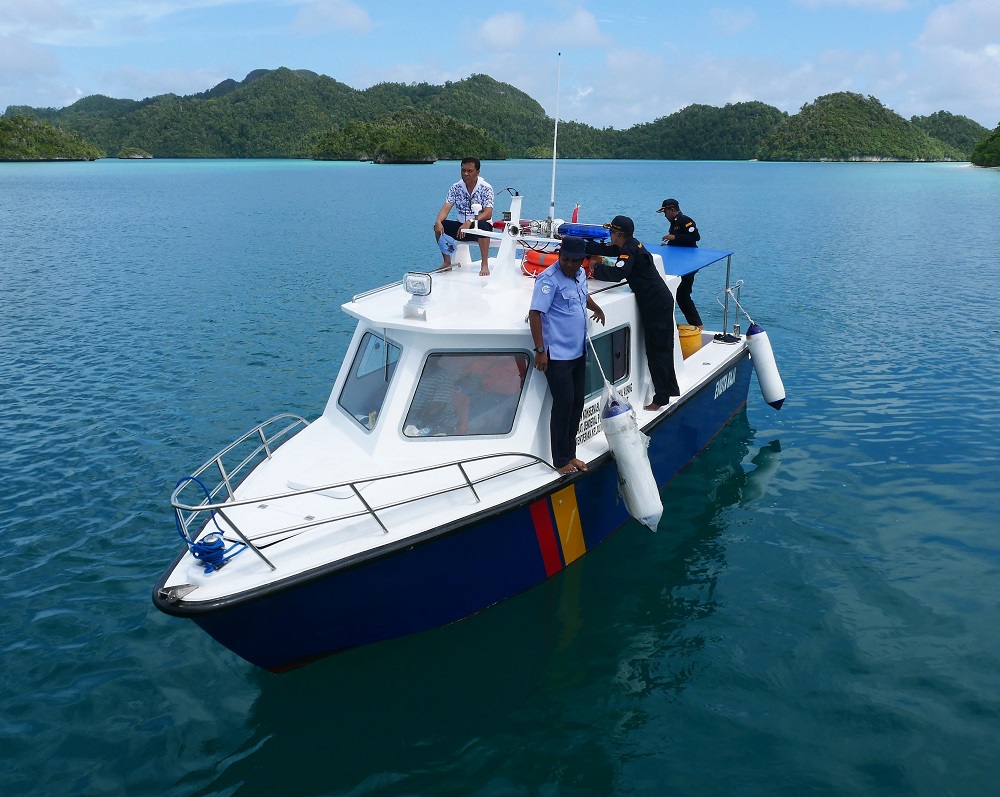
After a few pleasantries they pulled out a poster showing a map of the area, some underwater photos and otherwise covered in dense Indonesian writing featuring many bullet points and a long list of what looked to be fees – Rp10,000, Rp100,000, Rp1,000,000.
“So, this area is a marine park,” explained one of the uniformed men. “There are many important marine life here.”
“Yes,” we smiled. “We have the Raja Ampat permit, which we bought before coming here.” I showed them our visitor permits, pointing to the Rp 1 million fee listed in the bottom right-hand corner.
“Ah, yes.” He surveyed the permits, his colleague looking over his shoulder and scribbling notes on a pad. “These are permits from the Regional Authority.” He looked up at us. “We are from the National Marine and Fisheries Ministry.”
“Oh, so you are different…”
“Yes. We are protecting the marine reserve. Did you know that this is an important nursery area for the protected manta ray?” He gestured out towards the bay. “There are many young manta rays here. It is one of the most important manta nursery areas in the world.”
“Really? That is amazing.” I squinted at him through my sunglasses. “How can we help you? Come and sit down…”
They were on our boat to what they termed ‘socialise the idea’ of additional fees for visitors to Wayag lagoon. To protect the manta rays, they were proposing to ban motorised vessels altogether inside the lagoon and implement some charges that would go towards the upkeep of the reserve. If they provided moorings for yachts, would we still come and moor up in the outer bay? Even if we could only kayak or paddleboard in the inner lagoon? The proposed fees included a charge of Rp100,000 per overseas visitor per visit, with an additional Rp10,000 per surfboard, Rp20,000 per underwater camera and Rp15,000 per set of scuba diving gear. Not the end of the world, and we said that we would be happy to pay that amount, but that it was crucial that they work with the regional authorities to ensure visitors know about the fee when they first enter Raja Ampat. Could they make this additional fee part of the wider Raja Ampat permit? Otherwise it feels funny for the visitor, to have to pay so many separate fees to go to one place…
“Yes, yes, we understand.” He glanced towards a small longboat that was approaching our boat. “And then there is the village fee, some villagers are asking for one million rupiah for people to visit here.” He rolled his eyes and grimaced.
I nodded, eyeing up the boat. Two men wearing light blue shirts tied up to our stern and stepped onboard. The Ministry guys nodded at them and quickly looked away. “Yes, that sort of thing is difficult for visitors,” I said distractedly. “We don’t bring large amounts of cash to come here, and so it is important that we can buy the permit before arriving, or that we at least know about the fee in advance so we can bring cash.”
“We will make it payable online.” He gestured towards a website link on the poster.
“But there is no internet here – we haven’t had internet for weeks?”
“Yes, yes, we understand. We have to advertise the fee in Waisai and Sorong where people buy the Raja Ampat visitor’s permit.”
They nodded and smiled and scribbled down notes and then, eyeing up the two new men that had arrived they thanked us and stood to leave.
“Are these men with you?” I asked them.
“No, they are from the local village. I think they have come to check your Raja Ampat visitor’s permit.” The Ministry officials quickly boarded their boat and cast off, leaving us with the longboat men.
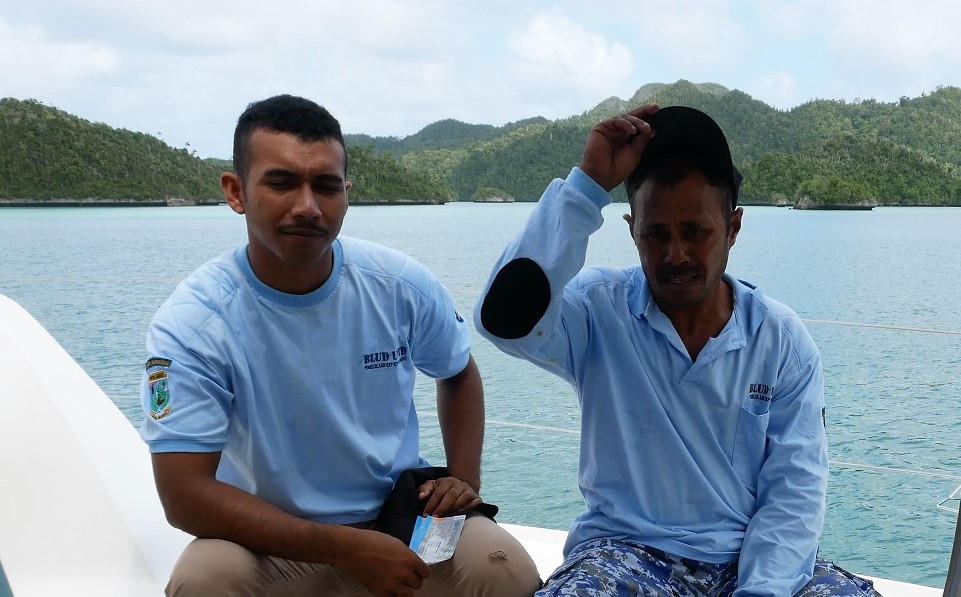
The two men remaining in the boat looked less official. One was older, and one young, and both wore a light blue shirt with a logo embroidered on the sleeve, but their purple backpack and holey pants suggested they were not altogether official.
I turned towards them. “Hello there. How can we help you?”
They were from the local ranger’s office. The younger man spoke a little English, the older only the local Papuan language. They inspected our Raja Ampat visitor permits and shook their heads sorrowfully. The older man rummaged in the purple backpack and dug out a typed letter in Indonesian, which the younger man handed to us, explaining that it was from the local village. When we explained that we didn’t read Bahasa, they rummaged some more and produced a hand-written English translation.

The letter stated that we needed to purchase a permit from the local village, the customary owners of the territory, to visit the Wayag area. The fee is Rp 1 million per visit. The younger man explained that he was just an employee at the Ranger’s Station, he was there to translate for the older man, who as a village elder represented the village demands. The older man nodded and mumbled something in Papuan.
“He would like you pay the fee now,” explained the young man.
We smiled and explained that we didn’t bring any money because we weren’t aware of these charges. We have no problem paying customary fees and respect their right to the land and surrounding seas, but as there is no way for us to get money in the area, we need advance warning.
“We have been to places where you check in with the customary owners every time you go somewhere new,” we explained. “In Fiji, they have a system where you have to present a present to the village chief everywhere you go.”
“You pay money?”
“No, there it is kava, a root that they pound or chew up and then add water to, to make a drink.”
“Really?”
“Yes, they make a drink that makes them sit and stare into space and then fall asleep.”
The younger man explained to the elder, who widened his eyes and responded with a stream of Papuan.
The young man turned to us. “Like betel nut?”
“No, it is a long root, that they dry. So in Fiji we have to present half a kilo of dried root to the chief of every village we anchor near. The chief then thanks us for the kava, claps his hands three times, and then we are allowed to be in the area. Sometimes we have to drink the kava with him.”
They conversed excitedly again. “Do you have pictures of this root?”
We discussed the Fijian habits of kava drinking for a while, before turning back to the topic at hand.
“So you cannot pay now?”
“No, we don’t have a million Rupiah on us. We would need to go to Waisai, a sail of 80 miles, to the nearest ATM, to get the money. Getting there and back would take us days.”
They talked for a while in Papuan.
“OK. That is OK. You don’t have the money. You can stay here without the permit,” said the young man. “But next time you come, can you bring the money? And can you please tell the other boats,” he indicated towards our friends who were anchored not far away, “that they need to bring money next time they come.”
We promised to let the other boats know and to bring large amounts of cash should we ever return. We also suggested that they work with the regional and national government and try to advertise the extra fees in the regional centres of Sorong and Waisai where most cruisers come before going to Wayag.
We parted as friends and before they left, the young man made us promise once more to tell the other boats. Clearly they were tired of the confrontations, fed up with daily negotiations with yachts and phinisi crew, and still unsure how to easily enforce the payments so that the customary owners would benefit from the stream of visitors.
As they motored away, David turned to me. “It’s a lot simpler in Fiji, isn’t it? There it is clear what you have to do, and everybody just does it. You bring the kava along, you go see the chief first thing when you arrive. There’s a clear system and everybody is happy.”
“Yeah. I understand why they want to benefit from all the visitors to their area. But $100 per visit is a bit too much – I doubt many yachts would come here if they knew of charges like that. Even though it is a very nice part of the world.”
It is problematic. The government’s visitor permit is supposed to pay for moorings and the rangers that protect the area, but clearly the benefits of this are not clear to the local communities. All they see are boatloads of tourists paying millions of rupiah to enjoy their area, none of which money make it to them.


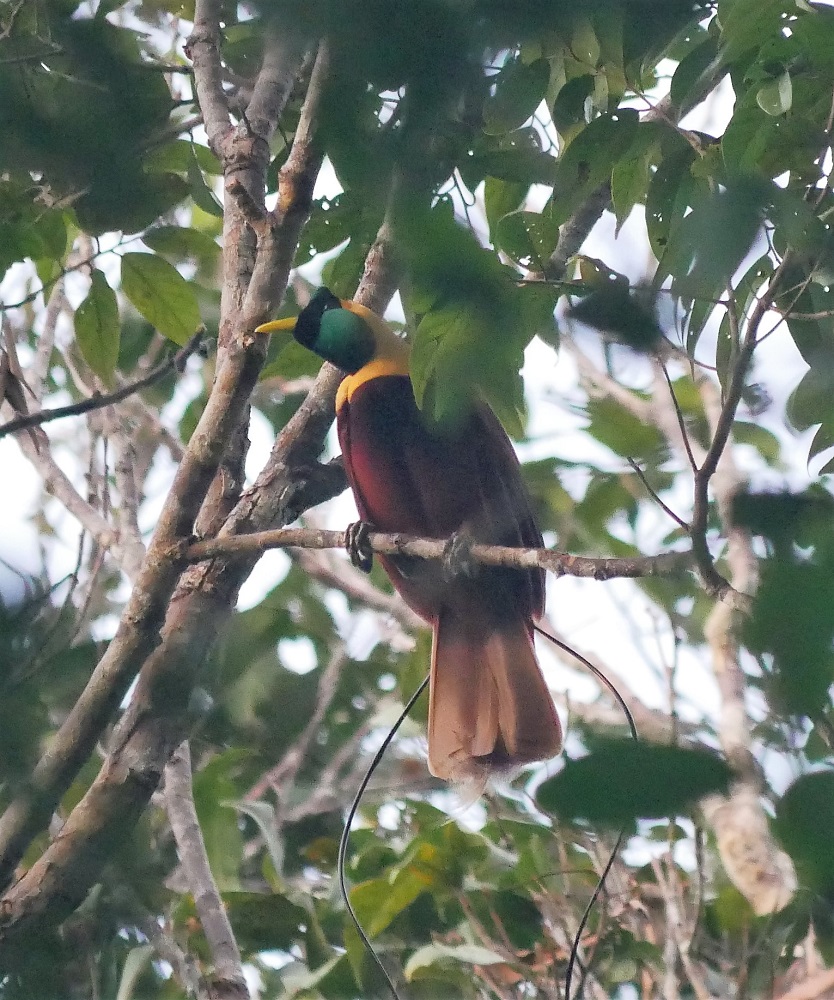
We don’t blame them – it is a precious spot and the locals too should benefit from the tourism. We would be happy to pay to see places of interest or to visit local villages and hear about their traditions. Earlier in the week we had done a jungle adventure tour down south to see the Bird of Paradise, organised by locals who know how to call to attract the birds. An early morning start, the trip had been fantastic, taking us up a calm river to a dense jungle through which we climbed uphill in the pre-dawn darkness till we reached the top of a hill where the birds gather. Experiences such as these are great ways for the locals to benefit from tourism by showing off their area.
Back at the birthday dinner, I proudly carry out the Spanish chicken casserole, a flavoursome smoked paprika risotto packed full of our last vegetables, topped with chicken, olives and slices of orange. Delicious smells waft from the steaming pot and I smile indulgently at my oldest child as I lower it to the table. I’ve spent two and a half hours making it, carefully chopping our last vegetables, browning the chicken, sautéing the onion and garlic, adding the rice, stock and a precious drop of white wine before letting it infuse over a slow burner for an hour and a half. The fridge is now empty but it is worth it – there are not many things I can give him out here, and a delicious meal of his choosing is an awesome present under our circumstances.
I lift the lid dramatically and steam bellows out, filling the cockpit with the scent of roasted chicken and smokey rice. Matias leans forward and peers over the top of the pot.
“Oh,” he says. “What is this, Mummy?”
“It’s what you asked for.” I gesture uncertainly. “The chicken risotto. With eggplant and carrot and olives…”
“Oh.” He looks up at me with confused eyes. “I thought a casserole was like a pastry thing. Like where there is pastry on top.”
“No, that’s a pie. This is that Spanish chicken dish thing – we’ve had it before. You always like it?”
“Ahh. I thought it was a pastry thing. Anyway, it is fine.”
“I’m sorry if it wasn’t what you wanted?”
“It’s fine. But I guess if I’d known what this was, I would have chosen the chicken curry….”

 SV Bob The Cat