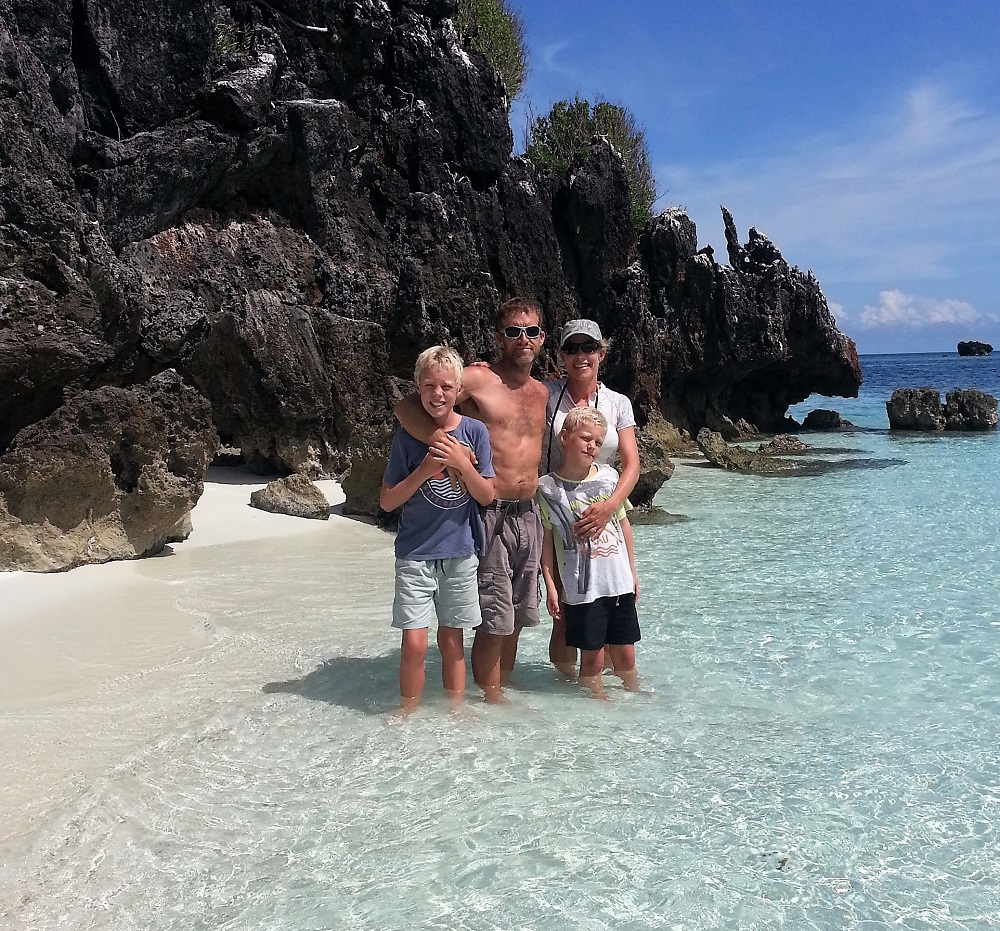
“Mais regard, what do you think?”
Indicating the sand at our feet, Pierrot turned to me. “There are claw marks here, and here.” He tutted, crouched down, closely surveying the markings in the white, damp sand. I knelt beside him and looked out over the small beach, trying to make sense of the messy patterns.
It was five days before Christmas. We were on a tiny beach of shining white sand surrounded by jagged rocky outcrops, leading into delightfully turquoise waters dotted with the dark outline of coral bommies. The sand was not pristine: clearly a huge animal had visited since the last high tide, making its way up from the rocks to the top of the beach only to turn around when reaching the vegetation, crossing over its own path to get back to the sea. The tracks were about a metre wide and consisted of a smooth section in the middle flanked by a clawlike pattern either side.
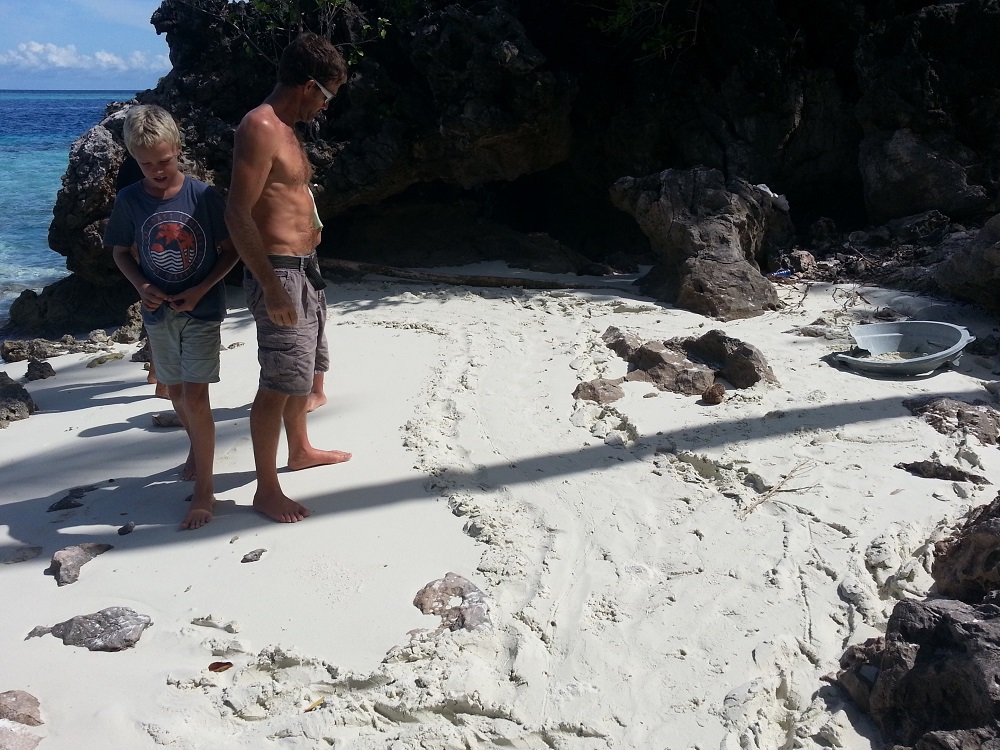
Pierrot and his wife Antonella, from the neighbouring boat SV C’est le Vent, had come in the morning to fetch us to have a look at the tracks. “We need a marine biologist,” they said. “We think a crocodile might have been on the beach.”
I didn’t pause to explain that my marine biological expertise is entirely limited to the identification of microscopic creatures that inhabit nutrient-enriched sandy sediments in shallow, warm temperate seas – a discrete niche very far from the identification of tracks made by huge carnivorous reptiles in tropical habitats. Instead I brought along 8-year-old Lukie, who only a couple of months ago completed a home-schooling inquiry on salt-water crocodiles and as a result is by far the person most knowledgeable about crocodiles on our boat. Lukie reckoned that he had seen some tracks as part of his investigations and was confident he would be able to recognise them again.
“They can swim very far,” he explained to Pierrot in the dinghy on the way over to the beach. “Hundreds of miles. But they mainly live in mangroves and are not common on coral reefs.”
On the beach we tried to recreate the animal from the tracks. If a crocodile, it would have to be huge.
“They can grow to 6.37 metres,” said Lukie. “I’m not sure how wide they are when they are that size. But they can eat sharks, I saw a photo of a crocodile with a huge shark in its mouth.”
Pierrot looked worried. “These are claw marks, no?” he said, pointing to a set of marks that could be construed to resemble a reptilian footprint.
Lukie shook his head knowingly. “I think it was a turtle,” he said. “A big one.”
“No, it is too big,” protested Pierrot, throwing out his hands. “Look, it is so wide! And what about these claws?”
“I agree with Lukie,” said David. “A croc would be able to hold up the weight of its upper body, and the tail would swish. A turtle has to drag the shell.”
Pierrot inspected the marks dubiously. “Maybe,” he said with a Gallic shrug.
“Look here,” said David. “These are the flipper marks. And then here, where it pushes itself forward, the marks are pressed together so they look like claws.”
“Perhaps you are right.” Pierrot bent down again, scrutinising the track. “Alors, we call it a turtle. And then we go snorkelling all day and come back tonight and see a huge crocodile sleeping on the beach, eh?”

We were in Misool, the southernmost part of the Raja Ampat region of Indonesia. Raja Ampat is located just west of the Bird’s Head western tip of Papua, so called because it resembles a bird’s head if you squint heavily when viewing it on a map. The area has incredibly high marine biodiversity and is a sought-after diving destination. It is also occasionally frequented by salt-water crocodiles, and divers have been attacked on the northwestern coast of Misool, at a well-known mangrove dive site. We were anchored in the outer atolls extending in a south-easterly direction from mainland Misool, a site devoid of mangroves, hundreds of miles from the crocs’ known territory.
Still, better safe than sorry. “Let’s get to another place,” I said to David. “I mean, I’m not sure saltwater crocodiles were part of the Christmas anchorage plans…”
And so we continued our northward island hopping in search of the perfect Christmas anchorage.
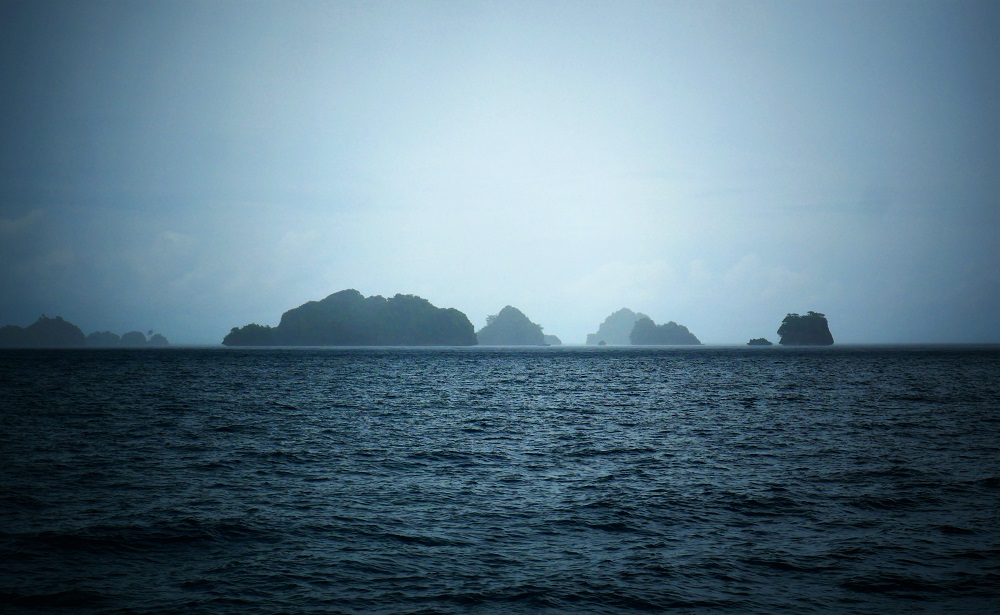
It had been a long trip already. Getting to Misool from Triton Bay in the south was a bit of a mission: a 150-mile upwind passage, which David repeatedly asked me if I was up for. Reasoning that we would like to be in Misool or further north by Christmas and that the weather didn’t look like it was going to change in the foreseeable future, I decided that we should go, even though I don’t really enjoy sailing upwind.
“But there will be squalls,” he said. “We will have rain and there will be lightning around. Are you sure you want to go? It’s not going to be comfortable.”
“Yes, yes,” I said, waving my hand impatiently. “Let’s just get it over and done with, get there and relax for Christmas. How bad can it be?”
Famous last words.
Normally we’d easily do 150 miles in 24 hours, but sailing directly upwind is slow, especially in a boat like ours with an effective tacking angle of about 110 degrees. With that in mind, we planned for a three-day passage. Diesel is very hard to buy in Indonesia (it is subsidised for vehicle transport and foreigners are not allowed to buy it at the pump, which means that you have to engage a local agent, pay them handsomely to go and collect it for you, and hope that what they bring back is actually diesel) and so we were determined to sail as much as possible, only using the engine when the wind disappeared completely.
And so began the longest stretch of upwind sailing we’ve ever done. On the chart plotter, the light blue triangle indicating the wind direction steadfastly remained at the angle of our destination, our actual course a zigzag pattern across the purple line showing where we were supposed to go. We were relentlessly pursued by thunderstorms, the radar lit up with yellow, blobby monsters that appeared seemingly out of nowhere, coagulating until they covered most of the screen, ready to engulf us as we nervously steered our way across the screen, trying to keep the purple line as far from the yellow blobs as possible.
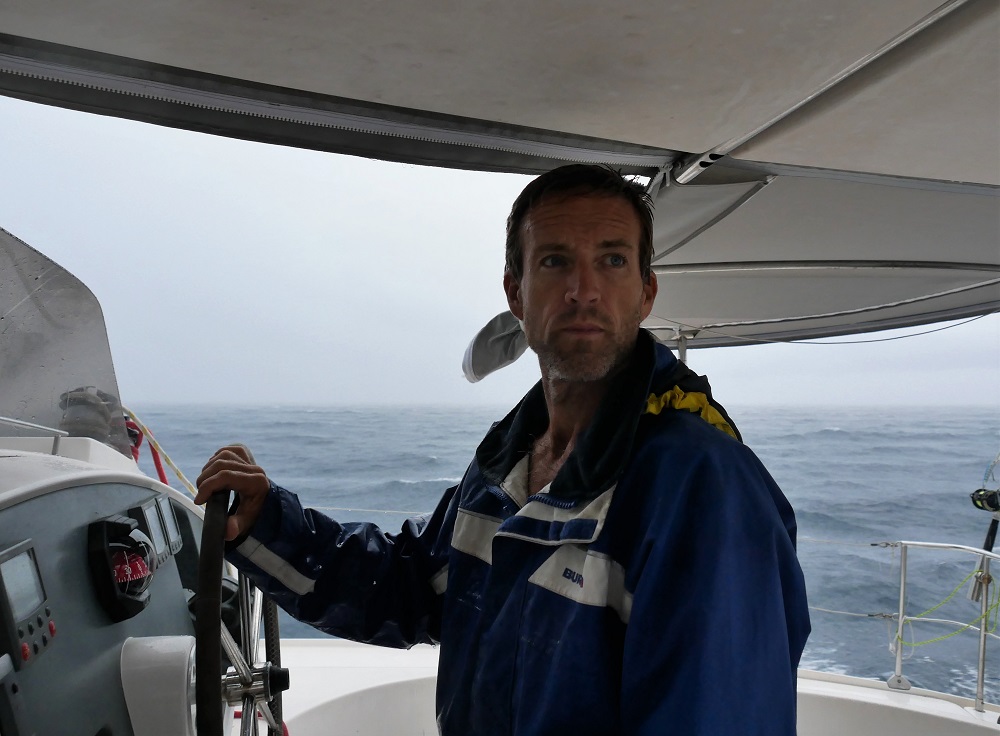
Going upwind is not only slow but also extremely uncomfortable, the boat heading directly into the waves, slamming up and down, jarring and shaking us, its contents. In the late afternoon on the first day the squalls started hitting, pelting us with rain, the wind changing from 10 to 25 knots within moments. At night the pattern would continue, with David manning the helm, me reefing sails, and the kids sleeping blithely through the thunder, lightning and crashing waves.
On the third day when I woke up in the early morning, bone tired after a night of two hours of sleep, we had 18 nautical miles to go. The wind was still coming directly from where we wanted to be, and we were travelling at a roughly 90-degree angle to the course we ought to follow, making our VMG (velocity made good – our actual progress in knots towards our target) hover between -0.2 and 0.5 depending on where the waves pushed us. Exhausted after a couple of hours dodging squalls David handed over the watch and lumbered off to bed, leaving me to sit staring at the chart plotter, a cup of steaming coffee in my hand, my eyes hurting with the effort of keeping them open, a hopeless sigh escaping my mouth. Only 18 miles to go, and we were going practically backwards. With the progress we were making it would take all day to get there. Arghh.
I stuck my head around the doorframe and peered at his sleeping shape, my loyalty towards the sailor in my life wavering. Maybe I could turn on the engine without him noticing? Take down the genoa, head directly into it at 5 knots, and be there by the time he woke up? Why all this pointless tacking, using the wind, when we could just turn on the engine and get there? Sailing is more comfortable, but at this stage we had slept perhaps a total of 8 hours each in 48 hours, every sleep interrupted by lightning storms and howling gusts. Shouldn’t we just try and get there?
My thoughts were interrupted by the kids demanding breakfast and by the time the general morning mayhem finished the winds had changed somewhat, allowing me to tack and hand steer a close course approximately towards our destination. Uplifted, I remained there until I had to wake David again with the approach of another squall.
“We’re getting there,” I said satisfied, pointing to the screen. With a bit of luck we’ll be there in three hours!”
He nodded, took the wheel, and I stumbled off to bed again.
Two hours later I woke up. Stretching in bed I checked the time, smiling at the thought that surely by now we would be approaching the island. I gaily rushed to the cockpit to check our progress only to have my hope deflated once again. In my absence the wind had changed and we were now 12 miles from our destination and heading almost due south, our current VMG a mighty 0.6 knots. Which meant that it would take us approximately 20 hours to get there.
Overwhelmed by despair I turned to David, blocking his way back into the saloon. “We need to put on the engine,” I blurbed out, tears in my eyes. “Otherwise we’ll never get there. Never.”
He looked at me puzzled. “This is sailing upwind,” he said. “Tacking is slow progress. We’ll get there.”
“But I want to put on the engines,” I said hysterically, my voice catching. “It’s been three days and now we could very well go into a fourth, just sitting here criss-crossing the course, not making any progress. I’m tired and I want to get there. I WANT TO GET THERE!”
“OK, OK,” he says, holding up both hands. “Fine, we’ll switch on the engine. Sheesh. Calm down!”
He switched on the engine and I sighed with relief, hope filling my heart as I slowly wound up the genoa and gazed lovingly at the chart plotter on which Bob was heading directly towards target.
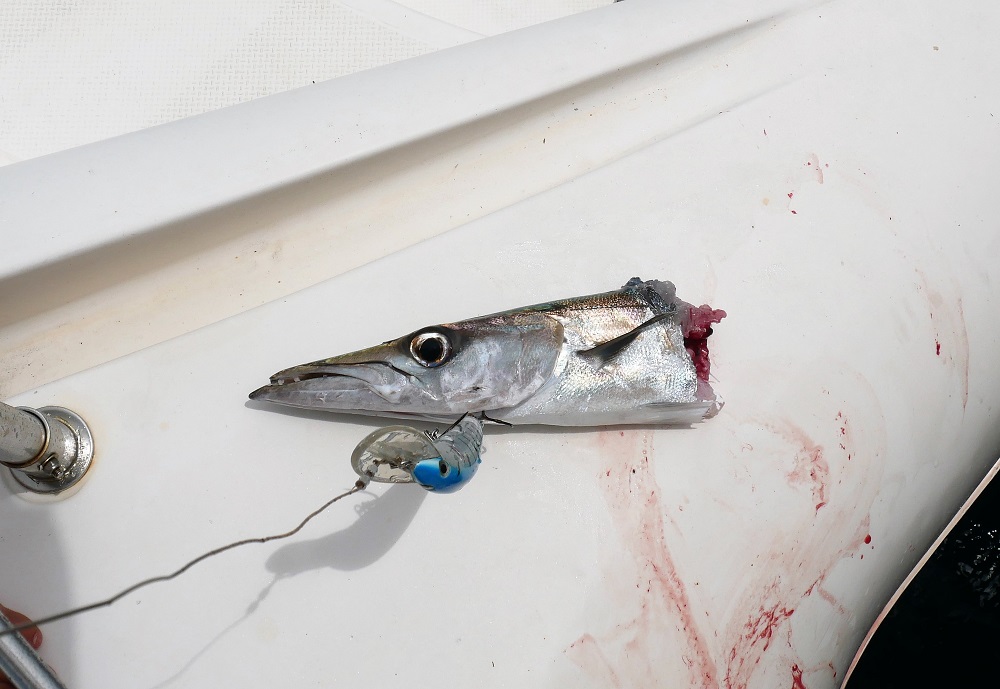
The hardships didn’t stop with the arrival at Misool. After a barracuda we hooked on the way in was immediately devoured by a sizeable shark, nobody felt much like snorkelling. The island’s anchorages are deep and treacherous, and the first evening our anchor dragged twice, sending us drifting slowly out to sea as the insane beeping of the anchor alarm filled the quiet night. After two resetting attempts we all slept lightly, expecting the alarm to go off at any moment.
Like most places hard to get to, Misool is worth it, and once we got into the groove of tying up to protruding trees from vertical karst cliffs rather than anchoring we slept soundly again. And so we island-hopped in mild weather with our friends on SV C’est le Vent, exploring one untouched paradise after another, snorkelling pristine coral reefs, seeing the occasional fleeting glimpse of a turtle in the background but thankfully no crocodiles.
The islands south-east of Misool are amazing. Part of the Raja Ampat Marine Reserve, fishing is allowed to various degrees in certain areas only, making for excellent marine life. Vertical walls covered in soft corals plunge from scraggy surface rocks to untold depths. Shallow slopes support hard coral reefs teeming with life. The water is full of microscopic life and tiny baitfish squeeze together tightly into giant, living superballs, fleeing and darting from giant trevallies, tuna and other pelagics.


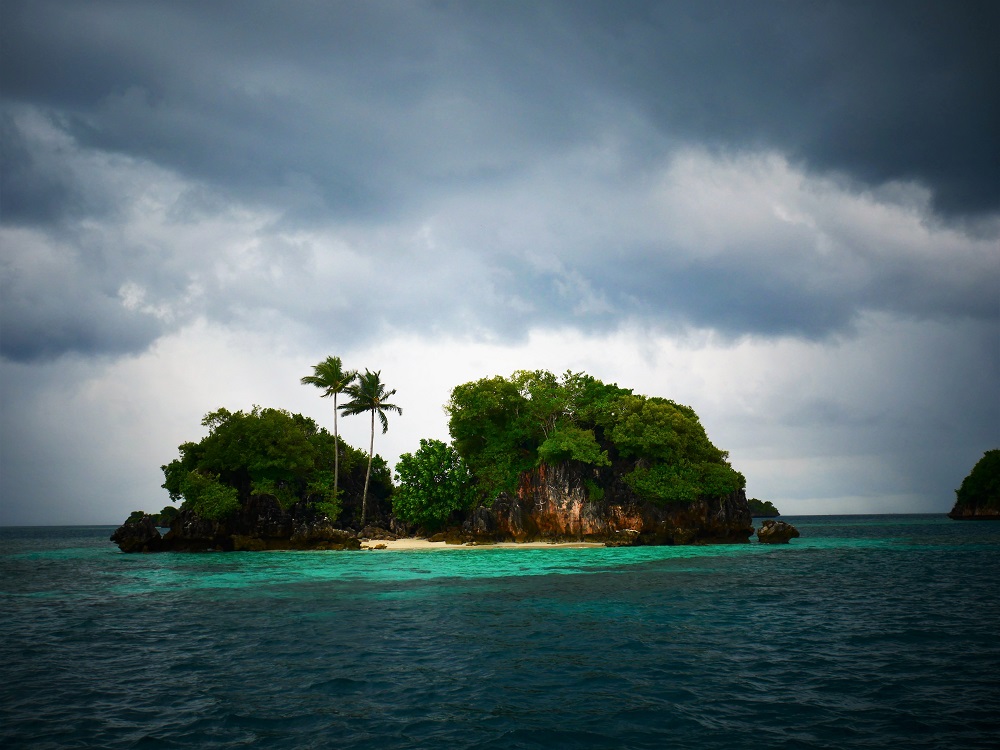
It’s not only marine life that is thriving. On the vertical karst cliffs of the small island group of Balbulol insectivorous pitcher plants clung on to the rough limestone rock in droves, and our boats, tied onto the same shores, were inundated with mosquitoes and sandflies. Three days from Christmas, I spent a day there painstakingly sowing mosquito nets for all hatches, sealing the boat up so that no unwanted insect could make its way in. But still, the severe karst cliffs didn’t fit with our expectations for Christmas so we fled north and anchored in shallow sand in a small group of sandy atolls far from mangroves, crocodiles and plunging rocky depths.


“Let’s stay here for Christmas,” I enthused to David in the late afternoon on 23 December as we lowered the anchor onto a flat, sandy bottom just offshore an idyllic sandy island covered in palm trees. “Atolls, and a flat, sandy bottom to anchor on. Perfect!”
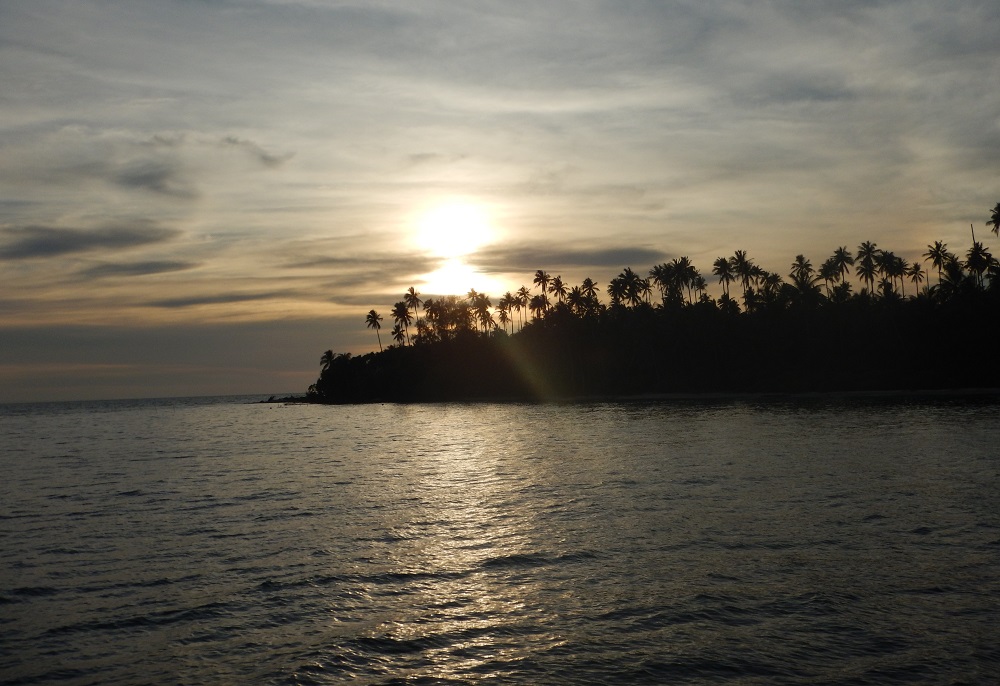
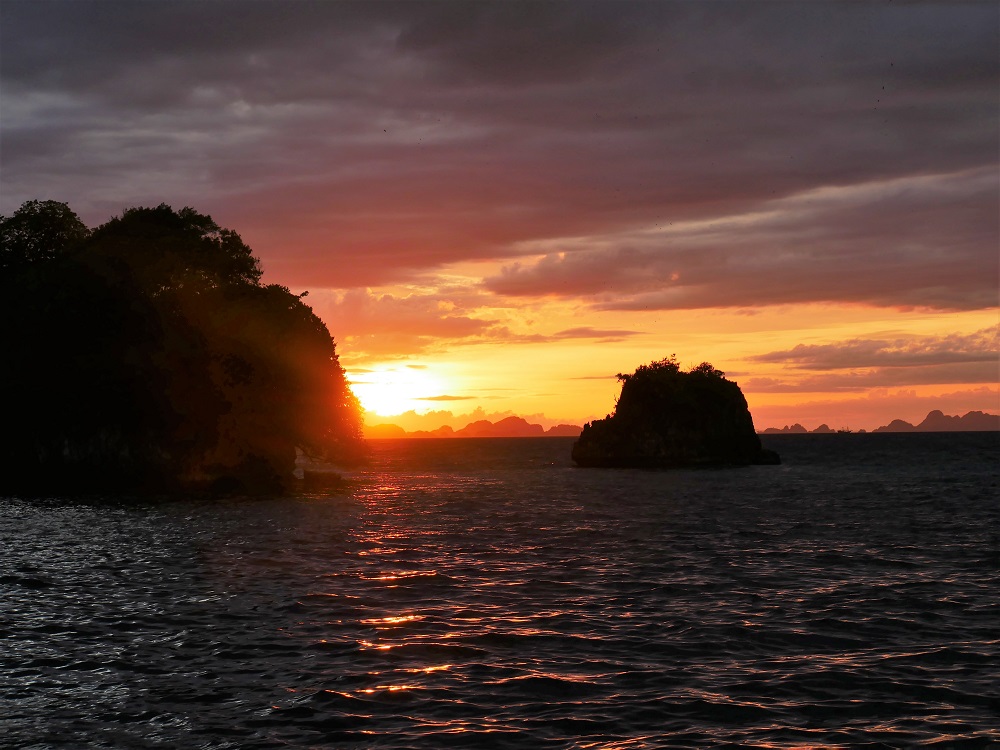
“Yay, clear shallow water,” cried the children, jumping up and down on the trampoline as the sun dropped behind the island, spreading tendrils of pink and purple over the palm-tree silhouettes and rosying the jumping boys’ cheeks.
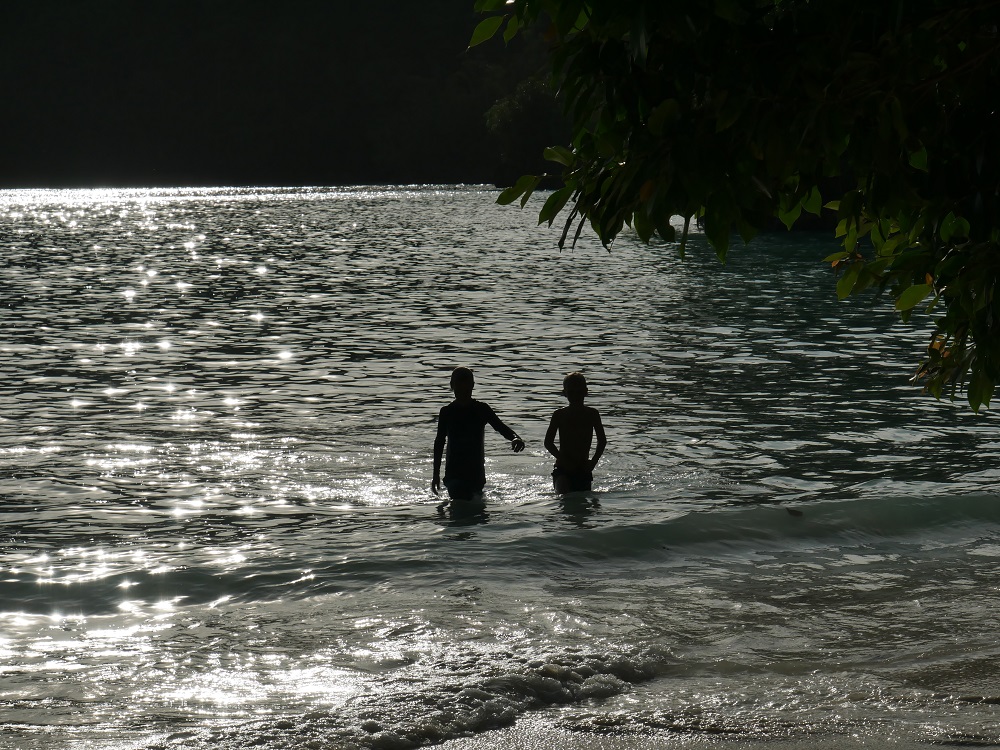
At 1 am the anchor alarm went on – the boat had swung close to the island, but the under-keel depth was still fine. At 3 am the alarm went off again – we had swung around completely and a strong current was raging, but the anchor held. In the morning, we had come back to our original position, and there was little current, but it built during the early hours and by 11 am we were jumping in from the bow and getting swept by a 2-knot current to a rope tied between the two hulls within seconds, the kids whooping with delight as they clung onto the rope against the raging tide. We played Man Overboard Survivor, practising grabbing hold of lines as we flew past the hulls, scoring extra points if we managed to hold onto the back step and pull ourselves on board. Lukie did exceedingly well but I guess he’s the one who has had the most practice with the whole getting rapidly swept from the boat thing.
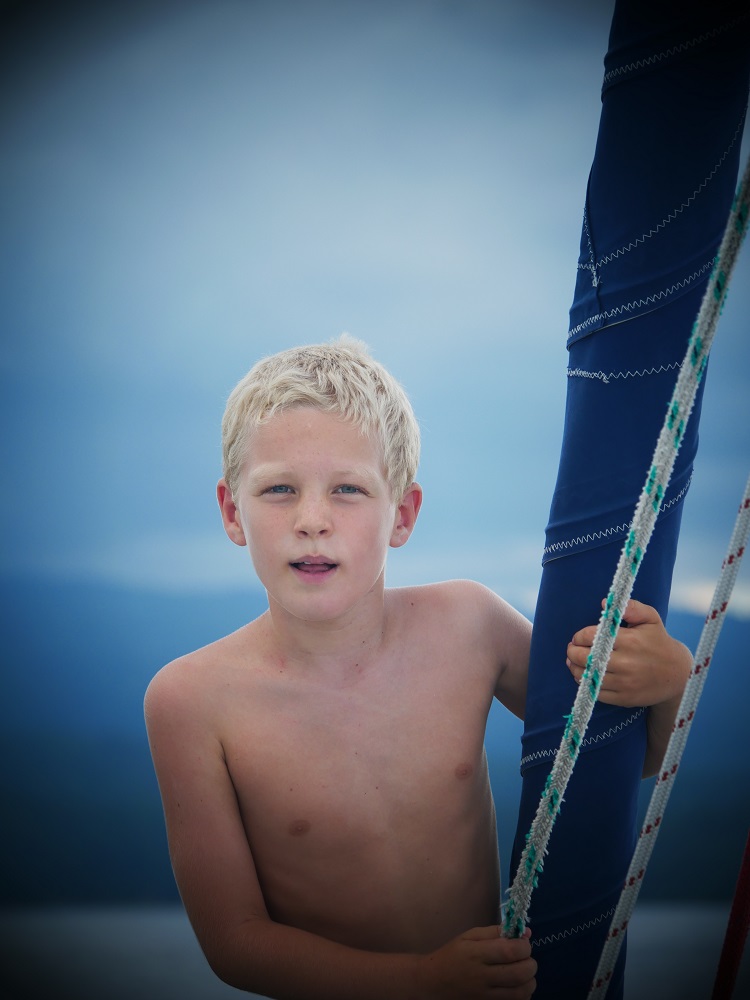
We had a fantastic Christmas at the anchorage, with a Christmas Eve beach bonfire on a deserted but rat-infested island (which wasn’t too bad – they were numerous but cute and quite shy), and despite dwindling provisions managed to piece together a lovely Christmas day lunch with our friends which was only interrupted by a serious inundation of flies and a squall that sent us inside for dessert.

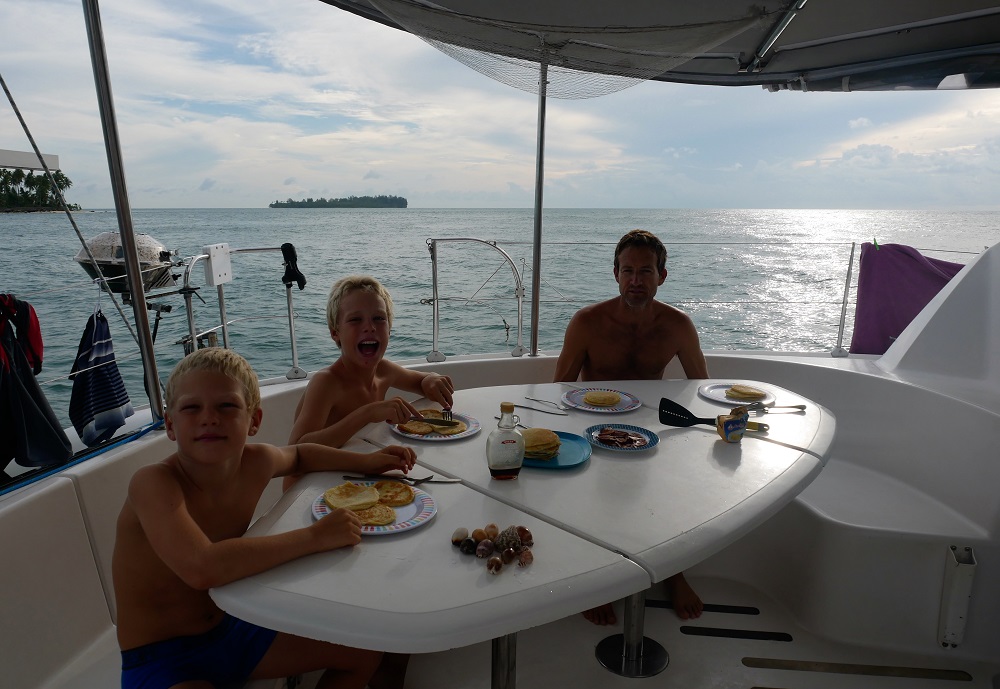
There are only so many flies a family can take, and the day after Christmas we continued north against the current in search of provisions and internet, reaching Waisai on Waigeo Island, the centre of Raja Ampat, late on the 26th. Here we will restock our meagre supplies and then head off to enjoy the region, still aiming to find a shallow, sandy anchorage with good holding, and no currents, insects, rats or crocodiles. Maybe for New Year’s Eve?
 SV Bob The Cat