North for Christmas

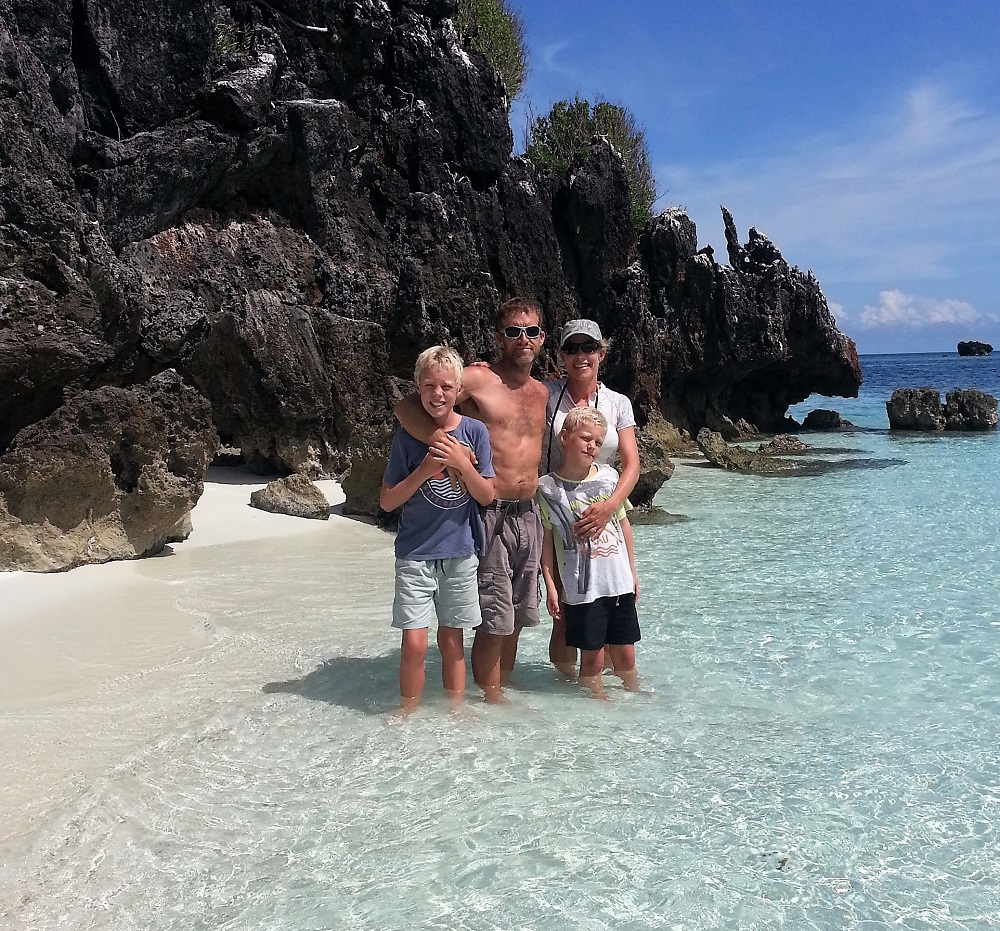
On the beach in south-eastern Misool area.

Mais regard, what do you think?”

Indicating the sand at our feet, Pierrot turned to me. “There are claw marks here, and here.” He tutted, crouched down, closely surveying the markings in the white, damp sand. I knelt beside him and looked out over the small beach, trying to make sense of the messy patterns.

It was five days before Christmas. We were on a tiny beach of shining white sand surrounded by jagged rocky outcrops, leading into delightfully turquoise waters dotted with the dark outline of coral bommies. The sand was not pristine: clearly a huge animal had visited since the last high tide, making its way up from the rocks to the top of the beach only to turn around when reaching the vegetation, crossing over its own path to get back to the sea. The tracks were about a metre wide and consisted of a smooth section in the middle flanked by a clawlike pattern either side.
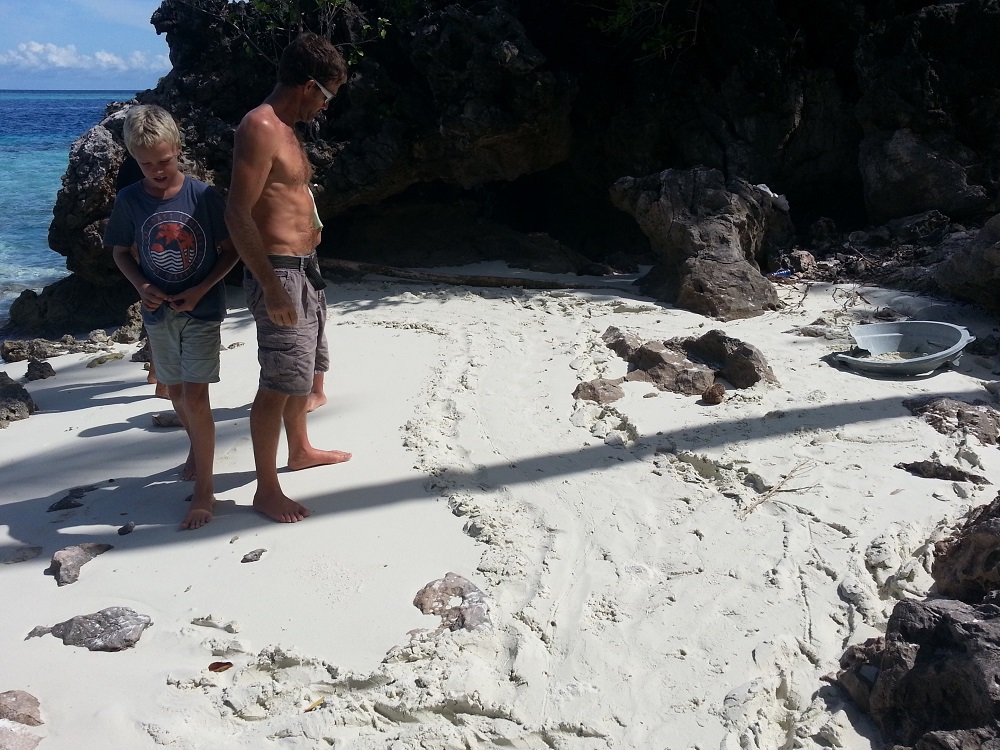
David and Matias surveying the tracks.

Pierrot and his wife Antonella, from the neighbouring boat SV C’est le Vent, had come in the morning to fetch us to have a look at the tracks. “We need a marine biologist,” they said. “We think a crocodile might have been on the beach.”

I didn’t pause to explain that my marine biological expertise is entirely limited to the identification of microscopic creatures that inhabit nutrient-enriched sandy sediments in shallow, warm temperate seas – a discrete niche very far from the identification of tracks made by huge carnivorous reptiles in tropical habitats. Instead I brought along 8-year-old Lukie, who only a couple of months ago completed a home-schooling inquiry on salt-water crocodiles and as a result is by far the person most knowledgeable about crocodiles on our boat. Lukie reckoned that he had seen some tracks as part of his investigations and was confident he would be able to recognise them again.

“They can swim very far,” he explained to Pierrot in the dinghy on the way over to the beach. “Hundreds of miles. But they mainly live in mangroves and are not common on coral reefs.”
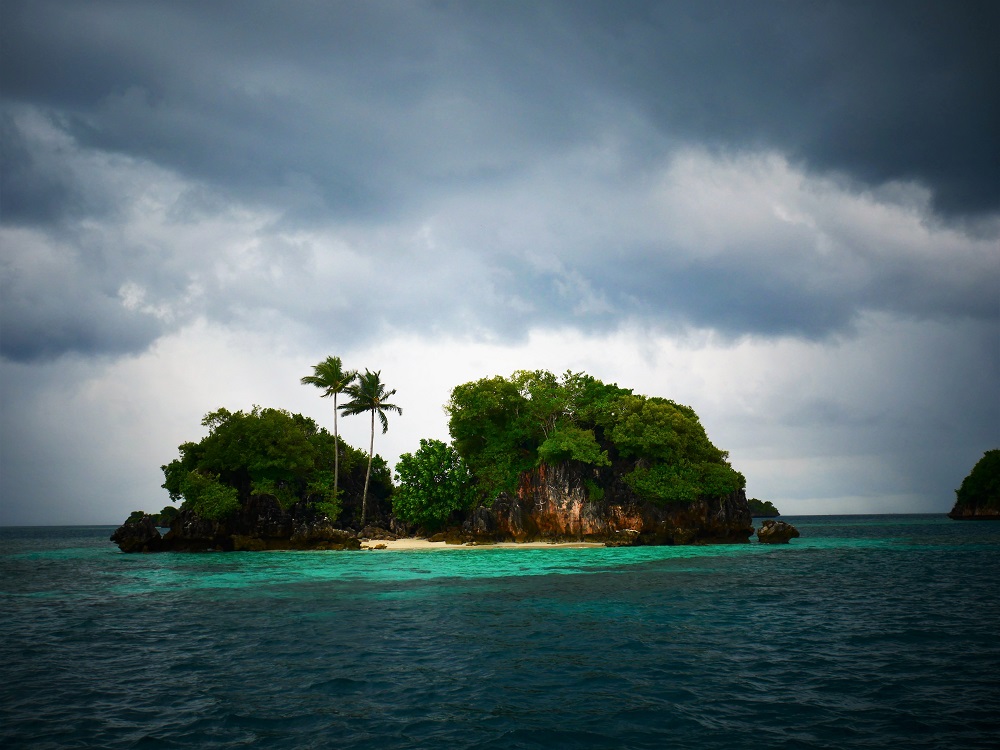
Crocodile island under threatening skies.

On the beach we tried to recreate the animal from the tracks. If a crocodile, it would have to be huge.

“They can grow to 6.37 metres,” said Lukie. “I’m not sure how wide they are when they are that size. But they can eat sharks, I saw a photo of a crocodile with a huge shark in its mouth.”

Pierrot looked worried. “These are claw marks, no?” he said, pointing to a set of marks that could be construed to resemble a reptilian footprint.

Lukie shook his head knowingly. “I think it was a turtle,” he said. “A big one.”

“No, it is too big,” protested Pierrot, throwing out his hands. “Look, it is so wide! And what about these claws?”

“I agree with Lukie,” said David. “A croc would be able to hold up the weight of its upper body, and the tail would swish. A turtle has to drag the shell.”

Pierrot inspected the marks dubiously. “Maybe,” he said with a Gallic shrug.

“Look here,” said David. “These are the flipper marks. And then here, where it pushes itself forward, the marks are pressed together so they look like claws.”

“Perhaps you are right.” Pierrot bent down again, scrutinising the track. “Alors, we call it a turtle. And then we go snorkelling all day and come back tonight and see a huge crocodile sleeping on the beach, eh?”

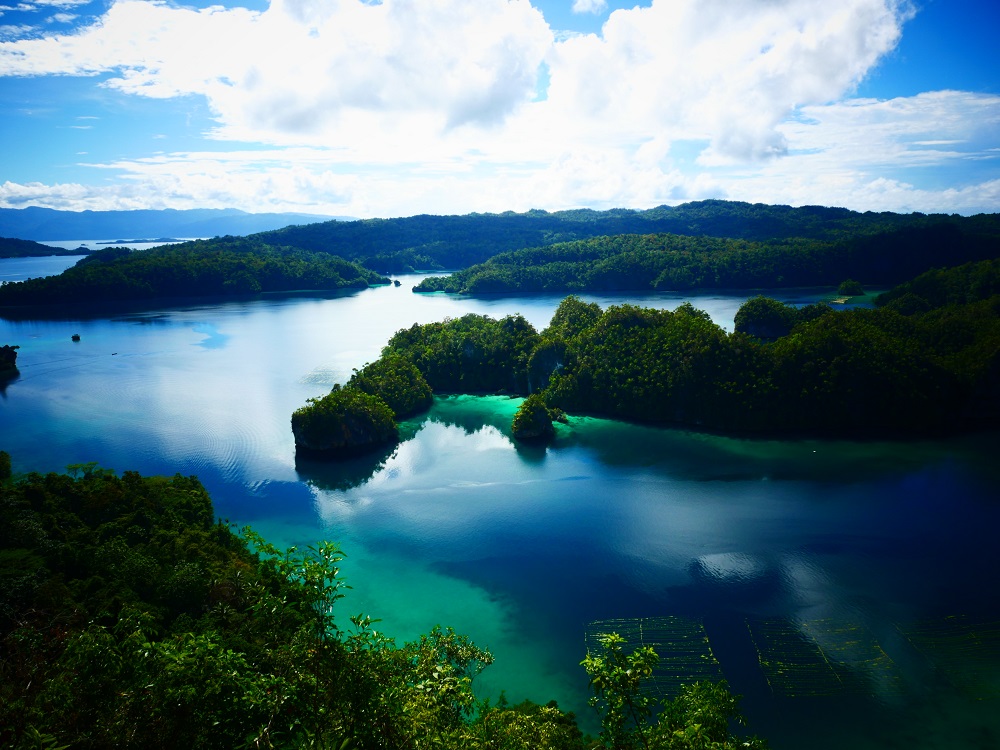
Islets in south-eastern Misool.

We were in Misool, the southernmost part of the Raja Ampat region of Indonesia. Raja Ampat is located just west of the Bird’s Head western tip of Papua, so called because it resembles a bird’s head if you squint heavily when viewing it on a map. The area has incredibly high marine biodiversity and is a sought-after diving destination. It is also occasionally frequented by salt-water crocodiles, and divers have been attacked on the northwestern coast of Misool, at a well-known mangrove dive site. We were anchored in the outer atolls extending in a south-easterly direction from mainland Misool, a site devoid of mangroves, hundreds of miles from the crocs’ known territory.

Still, better safe than sorry. “Let’s get to another place,” I said to David. “I mean, I’m not sure saltwater crocodiles were part of the Christmas anchorage plans…”

And so we continued our northward island hopping in search of the perfect Christmas anchorage.
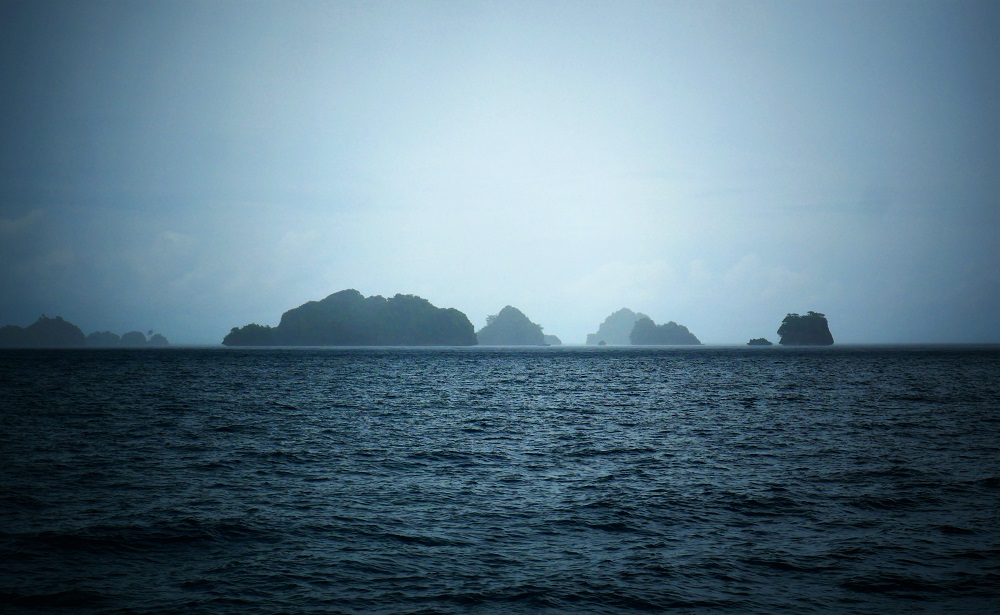
Approaching Misool – jagged cliffs rising from great depths.

It had been a long trip already. Getting to Misool from Triton Bay in the south was a bit of a mission: a 150-mile upwind passage, which David repeatedly asked me if I was up for. Reasoning that we would like to be in Misool or further north by Christmas and that the weather didn’t look like it was going to change in the foreseeable future, I decided that we should go, even though I don’t really enjoy sailing upwind.

“But there will be squalls,” he said. “We will have rain and there will be lightning around. Are you sure you want to go? It’s not going to be comfortable.”

“Yes, yes,” I said, waving my hand impatiently. “Let’s just get it over and done with, get there and relax for Christmas. How bad can it be?”

Famous last words.

Normally we’d easily do 150 miles in 24 hours, but sailing directly upwind is slow, especially in a boat like ours with an effective tacking angle of about 110 degrees. With that in mind, we planned for a three-day passage. Diesel is very hard to buy in Indonesia (it is subsidised for vehicle transport and foreigners are not allowed to buy it at the pump, which means that you have to engage a local agent, pay them handsomely to go and collect it for you, and hope that what they bring back is actually diesel) and so we were determined to sail as much as possible, only using the engine when the wind disappeared completely.

And so began the longest stretch of upwind sailing we’ve ever done. On the chart plotter, the light blue triangle indicating the wind direction steadfastly remained at the angle of our destination, our actual course a zigzag pattern across the purple line showing where we were supposed to go. We were relentlessly pursued by thunderstorms, the radar lit up with yellow, blobby monsters that appeared seemingly out of nowhere, coagulating until they covered most of the screen, ready to engulf us as we nervously steered our way across the screen, trying to keep the purple line as far from the yellow blobs as possible.

Going upwind is not only slow but also extremely uncomfortable, the boat heading directly into the waves, slamming up and down, jarring and shaking us, its contents. In the late afternoon on the first day the squalls started hitting, pelting us with rain, the wind changing from 10 to 25 knots within moments. At night the pattern would continue, with David manning the helm, me reefing sails, and the kids sleeping blithely through the thunder, lightning and crashing waves.

On the third day when I woke up in the early morning, bone tired after a night of two hours of sleep, we had 18 nautical miles to go. The wind was still coming directly from where we wanted to be, and we were travelling at a roughly 90-degree angle to the course we ought to follow, making our VMG (velocity made good – our actual progress in knots towards our target) hover between -0.2 and 0.5 depending on where the waves pushed us. Exhausted after a couple of hours dodging squalls David handed over the watch and lumbered off to bed, leaving me to sit staring at the chart plotter, a cup of steaming coffee in my hand, my eyes hurting with the effort of keeping them open, a hopeless sigh escaping my mouth. Only 18 miles to go, and we were going practically backwards. With the progress we were making it would take all day to get there. Arghh.

I stuck my head around the doorframe and peered at his sleeping shape, my loyalty towards the sailor in my life wavering. Maybe I could turn on the engine without him noticing? Take down the genoa, head directly into it at 5 knots, and be there by the time he woke up? Why all this pointless tacking, using the wind, when we could just turn on the engine and get there? Sailing is more comfortable, but at this stage we had slept perhaps a total of 8 hours each in 48 hours, every sleep interrupted by lightning storms and howling gusts. Shouldn’t we just try and get there?

My thoughts were interrupted by the kids demanding breakfast and by the time the general morning mayhem finished the winds had changed somewhat, allowing me to tack and hand steer a close course approximately towards our destination. Uplifted, I remained there until I had to wake David again with the approach of another squall.

“We’re getting there,” I said satisfied, pointing to the screen. With a bit of luck we’ll be there in three hours!”

He nodded, took the wheel, and I stumbled off to bed again.

Two hours later I woke up. Stretching in bed I checked the time, smiling at the thought that surely by now we would be approaching the island. I gaily rushed to the cockpit to check our progress only to have my hope deflated once again. In my absence the wind had changed and we were now 12 miles from our destination and heading almost due south, our current VMG a mighty 0.6 knots. Which meant that it would take us approximately 20 hours to get there.

Overwhelmed by despair I turned to David, blocking his way back into the saloon. “We need to put on the engine,” I blurbed out, tears in my eyes. “Otherwise we’ll never get there. Never.”

He looked at me puzzled. “This is sailing upwind,” he said. “Tacking is slow progress. We’ll get there.”

“But I want to put on the engines,” I said hysterically, my voice catching. “It’s been three days and now we could very well go into a fourth, just sitting here criss-crossing the course, not making any progress. I’m tired and I want to get there. I WANT TO GET THERE!”

“OK, OK,” he says, holding up both hands. “Fine, we’ll switch on the engine. Sheesh. Calm down!”

He switched on the engine and I sighed with relief, hope filling my heart as I slowly wound up the genoa and gazed lovingly at the chart plotter on which Bob was heading directly towards target.
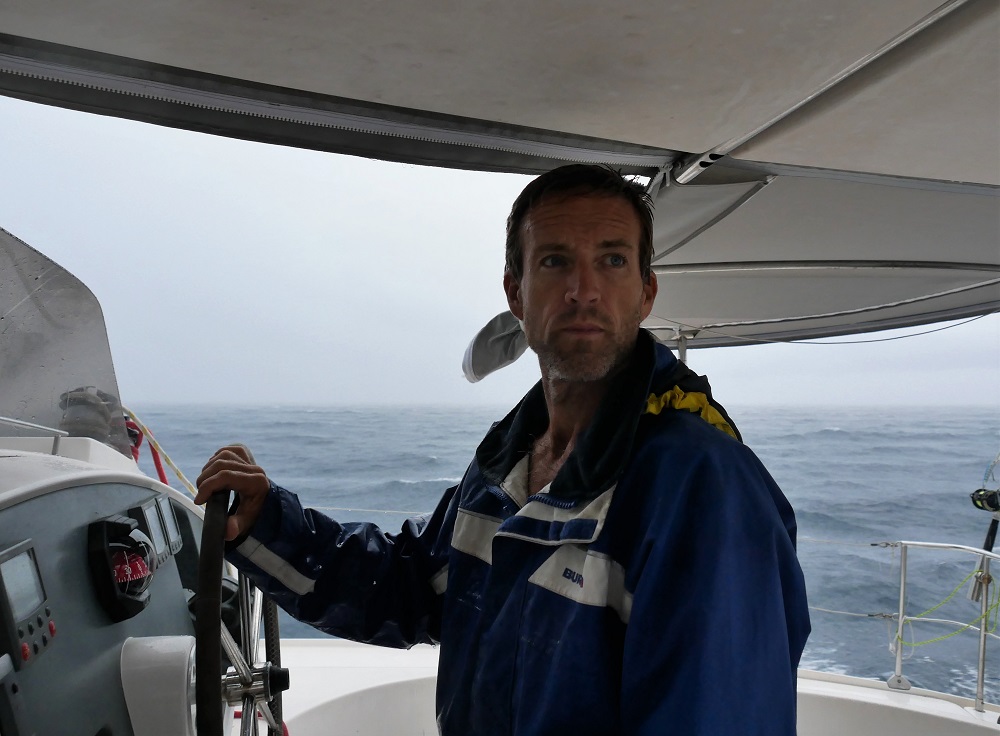
Stuck in a squall.

The hardships didn’t stop with the arrival at Misool. After a barracuda we hooked on the way in was immediately devoured by a sizeable shark, nobody felt much like snorkelling. The island’s anchorages are deep and treacherous, and the first evening our anchor dragged twice, sending us drifting slowly out to sea as the insane beeping of the anchor alarm filled the quiet night. After two resetting attempts we all slept lightly, expecting the alarm to go off at any moment.
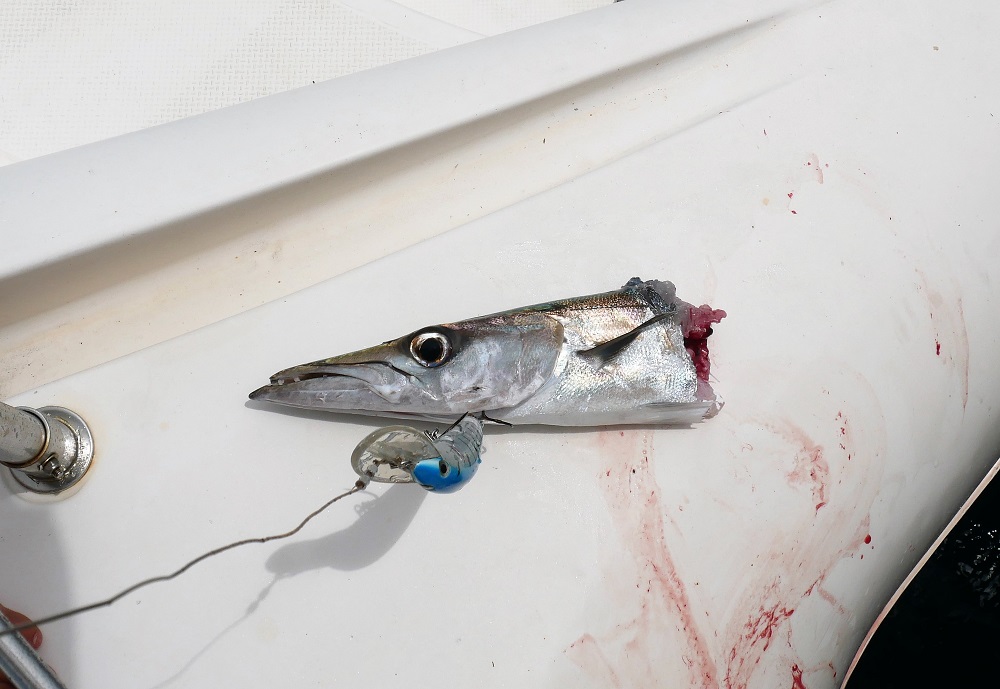
We reeled in only the head of the 1 m barracuda we hooked.

Like most places hard to get to, Misool is worth it, and once we got into the groove of tying up to protruding trees from vertical karst cliffs rather than anchoring we slept soundly again. And so we island-hopped in mild weather with our friends on SV C’est le Vent, exploring one untouched paradise after another, snorkelling pristine coral reefs, seeing the occasional fleeting glimpse of a turtle in the background but thankfully no crocodiles.

The islands south-east of Misool are amazing. Part of the Raja Ampat Marine Reserve, fishing is allowed to various degrees in certain areas only, making for excellent marine life. Vertical walls covered in soft corals plunge from scraggy surface rocks to untold depths. Shallow slopes support hard coral reefs teeming with life. The water is full of microscopic life and tiny baitfish squeeze together tightly into giant, living superballs, fleeing and darting from giant trevallies, tuna and other pelagics.

Clear waters teeming with bait fish.
Succulent giant clam winking slyly.
Friendly spadefish.

It’s not only marine life that is thriving. On the vertical karst cliffs of the small island group of Balbulol insectivorous pitcher plants clung on to the rough limestone rock in droves, and our boats, tied onto the same shores, were inundated with mosquitoes and sandflies. Three days from Christmas, I spent a day there painstakingly sowing mosquito nets for all hatches, sealing the boat up so that no unwanted insect could make its way in. But still, the severe karst cliffs didn’t fit with our expectations for Christmas so we fled north and anchored in shallow sand in a small group of sandy atolls far from mangroves, crocodiles and plunging rocky depths.

The near-vertical walls covered in insectivorous plants.
The stark cliffs of Balbulol.

“Let’s stay here for Christmas,” I enthused to David in the late afternoon on 23 December as we lowered the anchor onto a flat, sandy bottom just offshore an idyllic sandy island covered in palm trees. “Atolls, and a flat, sandy bottom to anchor on. Perfect!”

“Yay, clear shallow water,” cried the children, jumping up and down on the trampoline as the sun dropped behind the island, spreading tendrils of pink and purple over the palm-tree silhouettes and rosying the jumping boys’ cheeks.
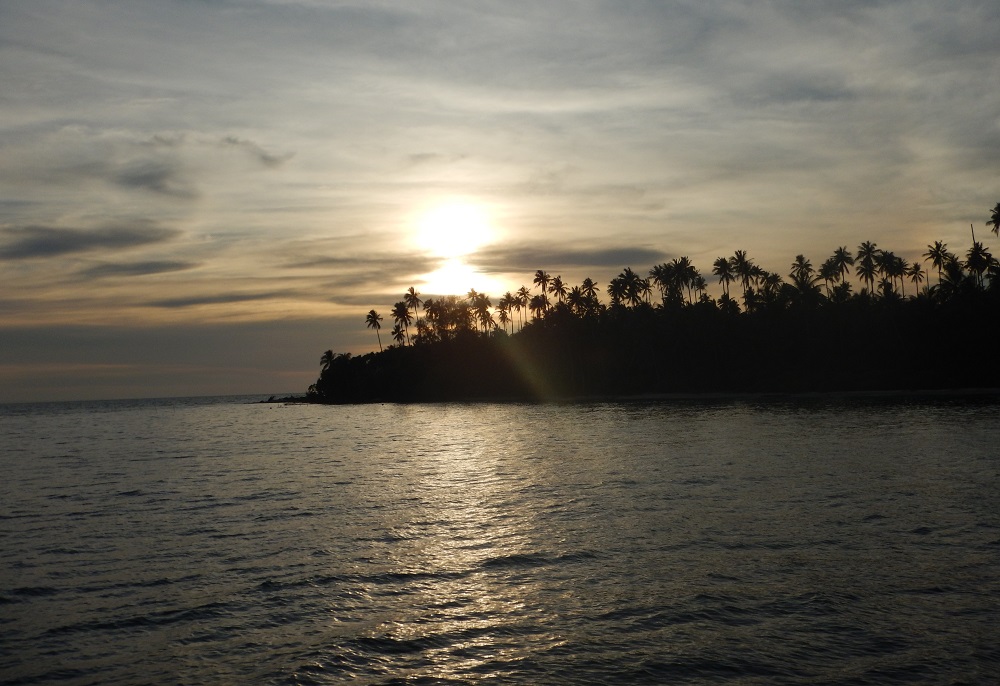
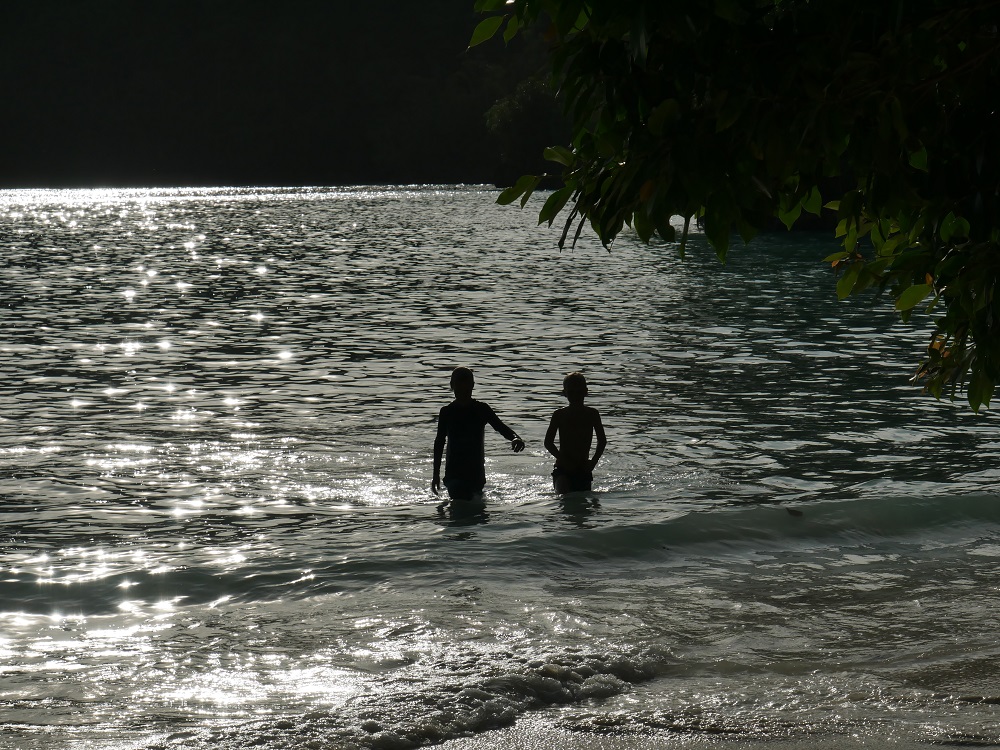
Scenic sunset at Christmas Island.
Late afternoon swim at the beach.

At 1 am the anchor alarm went on – the boat had swung close to the island, but the under-keel depth was still fine. At 3 am the alarm went off again – we had swung around completely and a strong current was raging, but the anchor held. In the morning, we had come back to our original position, and there was little current, but it built during the early hours and by 11 am we were jumping in from the bow and getting swept by a 2-knot current to a rope tied between the two hulls within seconds, the kids whooping with delight as they clung onto the rope against the raging tide. We played Man Overboard Survivor, practising grabbing hold of lines as we flew past the hulls, scoring extra points if we managed to hold onto the back step and pull ourselves on board. Lukie did exceedingly well but I guess he’s the one who has had the most practice with the whole getting rapidly swept from the boat thing.
Survivor master Lukie.

We had a fantastic Christmas at the anchorage, with a Christmas Eve beach bonfire on a deserted but rat-infested island (which wasn’t too bad – they were numerous but cute and quite shy), and despite dwindling provisions managed to piece together a lovely Christmas day lunch with our friends which was only interrupted by a serious inundation of flies and a squall that sent us inside for dessert.

Damper on a stick at the Christmas Eve bonfire on Christmas Island.
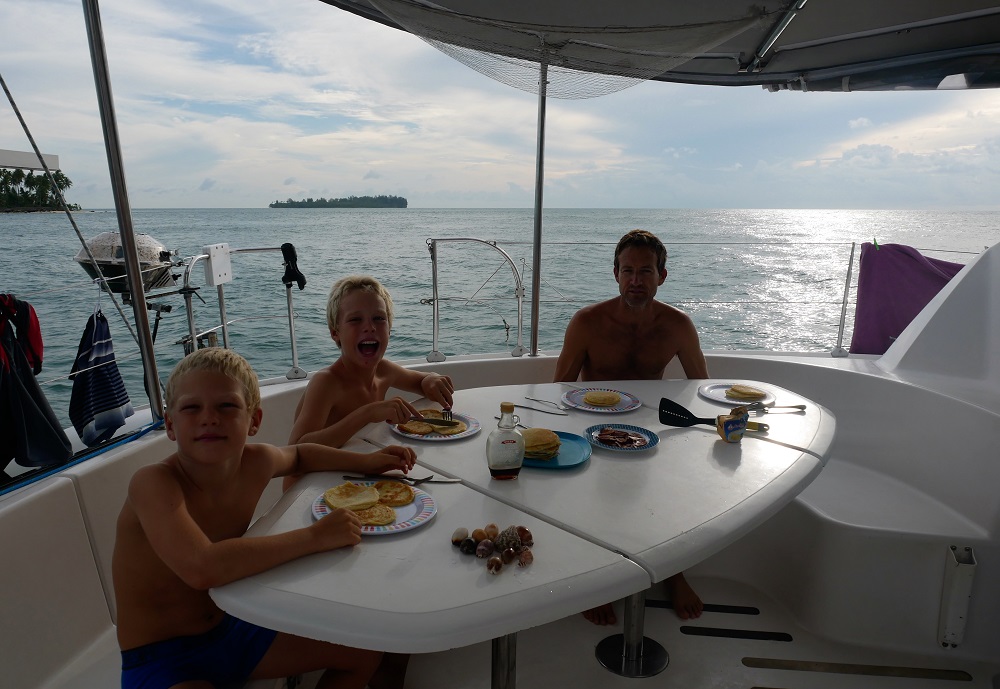
Christmas morning pancakes.

There are only so many flies a family can take, and the day after Christmas we continued north against the current in search of provisions and internet, reaching Waisai on Waigeo Island, the centre of Raja Ampat, late on the 26th. Here we will restock our meagre supplies and then head off to enjoy the region, still aiming to find a shallow, sandy anchorage with good holding, and no currents, insects, rats or crocodiles. Maybe for New Year’s Eve?
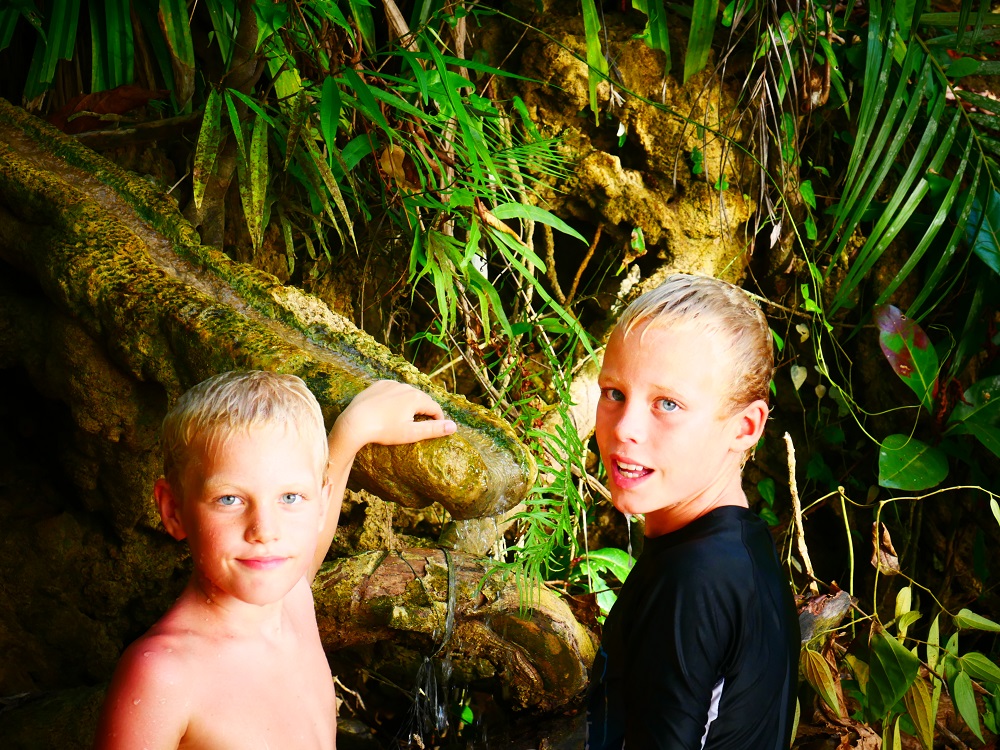
Exploring ashore.
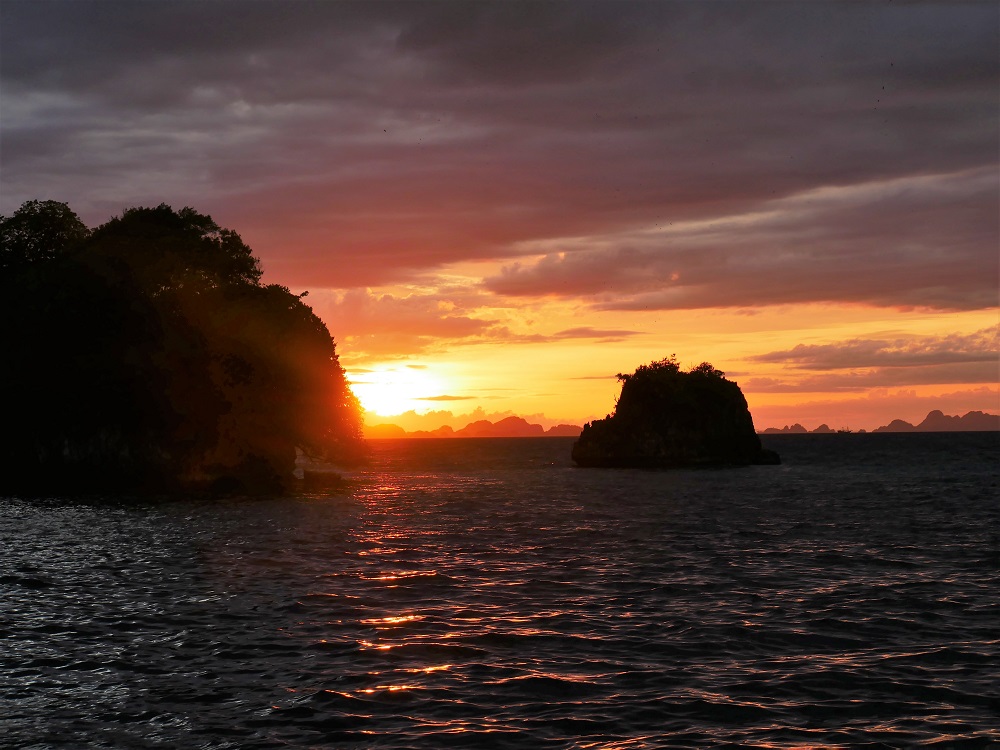
Sunset over Misool islets.


Culture shocks and beyond

Colourful waterside buildings in Tual, Indonesia.

Lukie was the first of the family to swim in Indonesia. And not in a good way.

It happened just over two weeks ago. We were fleeing the filthy port of Tual, heading for the clear waters of Triton Bay. It was a calm afternoon and we were motor sailing along at 4-5 knots in light winds on a flat sea. We’d had an uneventful trip so far – a bit of rain, a bit of sailing, but the winds were flaking off and we were getting ready for a night of motoring. It was about 4:30 pm and I was in the galley, chopping some vegetables for dinner. Matias and Lukie were playing on the trampoline when suddenly Matias started yelling.

“Must be a big whale or something for him to shout that loudly,” I thought to myself mid-chop. “Better get the camera ready!”

I put down the knife and went to fetch the camera. Matias continued to yell and suddenly my world stopped as the words took shape over the roar of the engine and the hiss of the stove.

“Man overboard! MAN OVERBOARD! Lukie is in the water!”

My heart raced. I threw the camera onto the table and rushed outside. David was at the wheel, having already put the engine in neutral and placed us hove-to to stop forward movement. Both he and Matias were pointing at Lukie who was floating in the water about 20 m behind the boat.

I scrambled over to the flotation devices and threw a yellow horseshoe float towards Lukie, and then hurried to get the float and line.

“Grab the floatie,” I shouted to Lukie. “And then swim towards the boat.”

David started reversing slowly towards Lukie, who by then was safely installed in the bright yellow floatie and swimming rapidly towards us. Within seconds he had a grip on the buoy at the end of the line and I pulled him in. He climbed onto the boat and sat down for a second, catching his breath.

“Well done, team,” said David in a light tone as he slowly put the boat back in forward gear. “Just like we practised!”

I swallowed. He was right. It was calm and collected, under control. Nobody panicked. Lukie swam steadily through the dark sea towards the boat. Matias kept pointing. David stopped the boat immediately.  I threw hi-viz floaty stuff overboard for him to grab onto and to mark the location. It was so under control that I knew the moment I came outside that we wouldn’t use the DAN buoy, the 3-metre tall orange sausage that is invaluable in marking a spot in a rough sea. The self-inflatable DAN buoy only works once, and there was never any doubt in my mind that it was to be saved for a real emergency.

During the post-mortem it became clear that Matias and Lukas had been playing at the very bow of the boat. Lukie had been swinging on a new rope we had installed for the current bout of pirate games. Whilst jumping on the trampoline, he hit the genoa and slid underneath it into the sea. Matias started yelling immediately, and David stopped the boat within seconds.

We decided that the pirate game is best kept for anchorages.

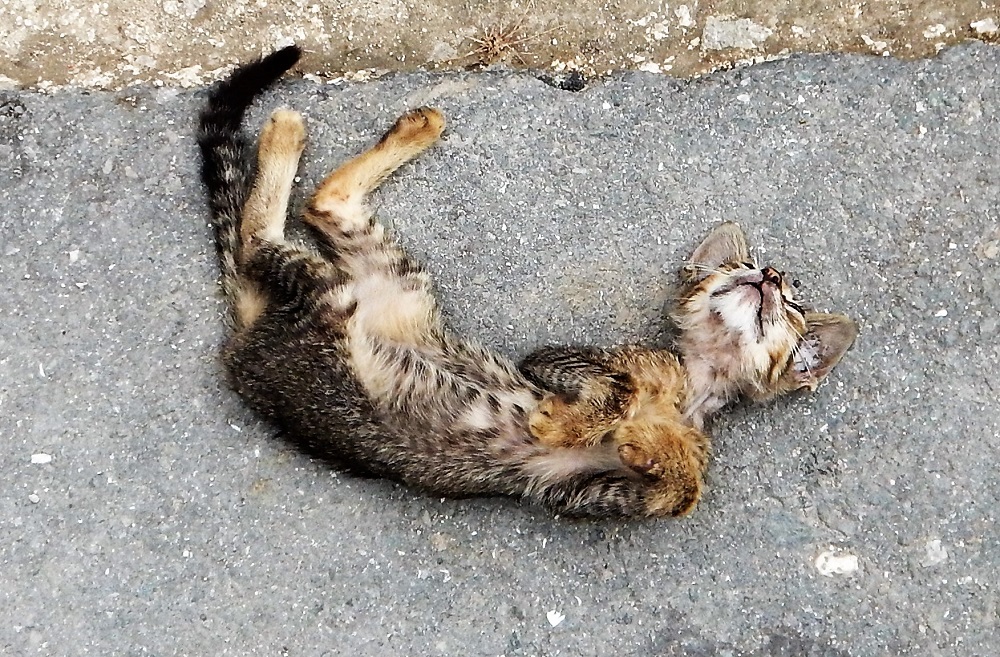
Tual: half-dead kitten in the street.

Man overboard notwithstanding, it was a relief to leave Tual behind. It took us four days to clear Indonesian Quarantine, Customs, and Immigration, four long days sweating in the hot sun in a foul anchorage, our only respite from the smelly water hectic visits to an overwhelming Indonesian port town full of people, animals, cars and mopeds.

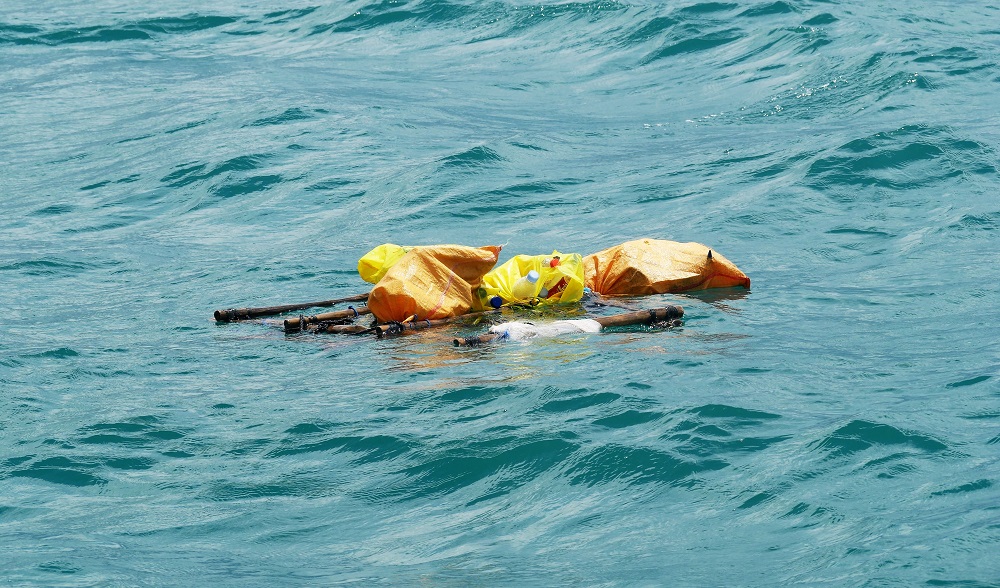
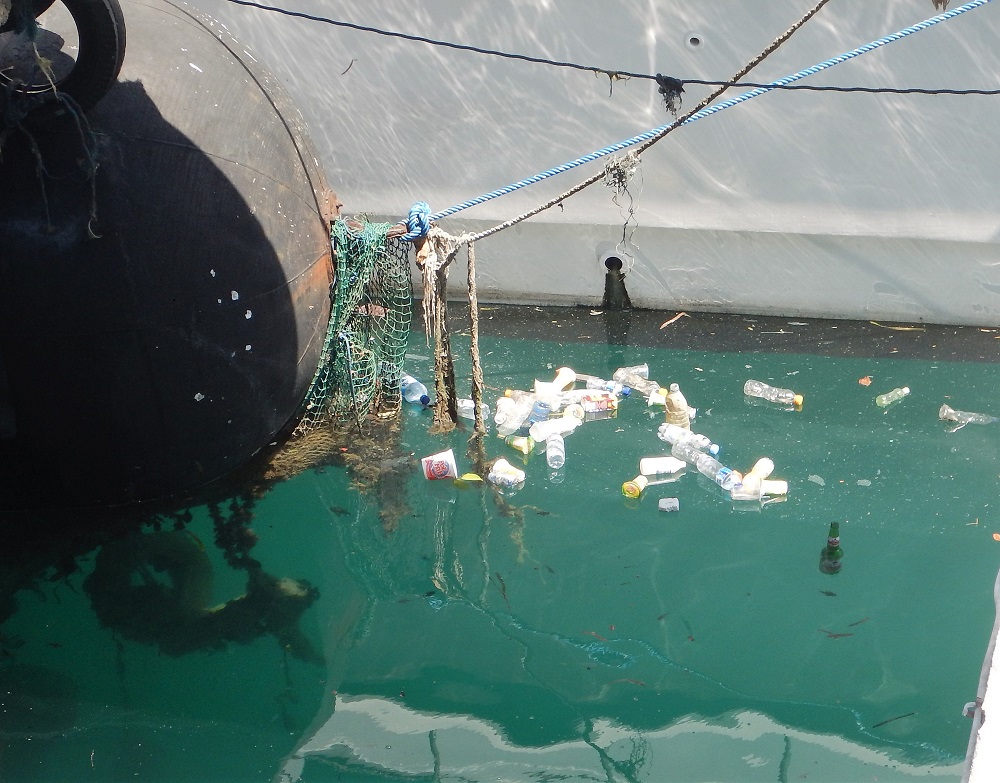
We sensed Tual, our first port in Indonesia, many miles before we arrived, getting a nauseating feel for the place as the floating rubbish steadily increased. As we neared the town anchorage a dead pig floated past the boat, its four limbs sticking out from a heavily bloated body. Getting ashore involved driving the dinghy through rubbish several layers deep, stopping every so often to untangle plastic bags from the outboard prop, a neverending supply of bags coming from the thick sheet of plastic junk swaying in the slight swell, mixed with smelly food waste decaying against the shoreline in the searingly hot sun. Drink containers, plastic bags, fishing floats, flip flops, disposable nappies, packaging. Straws, cardboard, fishing nets, bits of rope. Styrofoam breaking up into tiny seeds that tinged the water white. Balls of fishing line wrapped around a t-shirt overlying a bamboo stalk with water bottles floating underneath, holding up the raft.

One of many floating rubbish rafts.

It’s an incredible mess, a huge culture shock and a drastic change of scene from the Pacific. Yes, there is rubbish on the beaches in Fiji, but nothing like this. Yes, we saw school children happily throw their lolly wrappers into the harbour in Tonga, but most Pacific countries are working hard to ban single-use plastics, and new generations are becoming wiser. Indonesia is different. This is industrial-scale indifference, the evidence of a densely populated, rapidly expanding consumer culture that still has no regard for where the ensuing detritus ends up. On the dock our friends saw a housewife traipse down and lean over the concrete wall to carefully throw her rubbish bag into the sea. In the muddy waters lining the shore, kids play knee-deep in rubbish, trying to catch fish from the stinky sewer of discoloured water.

Plastic floating in the stinky waters near the town dock in Tual.

The town market reveals the source of the rubbish. All the stalls sell the popular Chinese products that we associate with 2-dollar stores at home – plastic toys packaged in transparent plastic, plastic buckets, rakes, hair ornaments, mirrors, all shiny, fragile, and colourful. Single-use washing powder is sold in individual plastic pouches, portion-sized sauces like ketchup and soy sauce in individual packages, condiment parcels just big enough for a small meal for one. Small blister packs of instant coffee premixed with milk powder and sugar hang next to tiny sachets of salt, pepper and monosodium glutamate. Shampoos, conditioners, soaps and cleaning products are all sold in portion-sized wrapping. It’s K-Mart on steroids, all the shiny, cheap, plastic trappings of modern civilisation proudly on display, individually wrapped, ready for the rampant consumption of an exploding culture.

Plastic fantastic – market stall in Tual.
And where it all ends up – overflowing skip in the streets of Tual.

It’s a colourful place, and loud too. The majority of the population in Tual is Muslim and five times a day the muezzin calls out from the rooftops, the melodious song being broadcast from loudspeakers scattered throughout town, resonating over garbage-covered still water. Christians live here too, and the town is full of crazy contrasts – a fully veiled Muslim woman riding a heavily adorned ‘Hello Kitty’ all-pink scooter, veil trailing behind her, high heels protruding from her long pants struggling to gain foothold on the small pedals, next to a snazzy Christian woman dressed in tight shorts and a clingy top with sparkle writing across her wonderbra chest, heavily made-up eyes hiding behind shiny sunglasses reflecting the brightly-coloured market stalls.

Muslim woman shopping for bargains.
Mosque gleaming in the midday sun.

The people are incredibly friendly. Many shouted greetings when they saw us, often the only English they knew: “Hello Mister,” only occasionally altered to “Hello Sister” for me. Shy school girls followed us around, whispering behind their hands, giggling as they rushed towards me shouting “What is my name?” then fleeing before I got a chance to explain that I wouldn’t know.

Nobody speaks any English and we were soon utterly lost, hiding behind our Swiss-Italian friends who live in Bali and know Bahasa. Even buying the simplest item is impossible without any language and after causing a stir by paying the prices asked (the women holding up fingers to indicate how many tens of thousands of Rupiah they requested) I quickly learned the numbers so that I could bargain as expected in the fruit and vegetable market.

Hijacked for photos with wedding guests. Not sure what the devious lady centre front with the black veil is up to…

The kids were an instant hit and as soon as we set foot ashore the crowds had their cell phones out, snapping away. As we walked the streets people held their phones above their heads, videoing our progress. When we accidentally gate-crashed a wedding whilst trying to make our way from the shore to the town’s main street we were greeted with open arms, invited to stay, and forced to pose for endless photos with an army of pink-clad female wedding guests. Everywhere we went people grabbed the children, coercing them to pose for selfies ensconced in the arms of their captors. Normally I’m self-conscious about taking photos of locals in countries we visit (it seems exploitatory and condescending, them going about their normal lives and me finding it fascinating and colourful); here I do it as retaliation. The children were plotting with their friends that they would start charging for photos: four blond kids charging only Rp 5000 per photo. Bargain. When I mentioned the fee to a group of very loud market women who were literally about to carry my children away after overcharging me for their produce they cackled loudly and slapped my back, repeating my ludicrous demands (about the sixth of the price of a pumpkin) to each other.

Even the officials requested selfies. The Customs officers boarding our boat solemnly asked for a group photo before they left, and our visit to the police station where we were trying to obtain yet another permit was constantly interrupted by passing officers leaning in and snapping selfies over the kids’ shoulders. By the end of our brush with town Indonesia, our children’s photos must be gracing hundreds of Facebook accounts, grim-looking blond kids scowling next to a cheerful looking local holding two fingers in the air.

Selfie with the Customs officers.
Religious tolerance: shoppers in Tual can choose to give money to a Muslim, Christian or Hindu cause. So far the mosque wins.

Four days in Tual was enough civilisation to last us a while, and after spending a day getting yet another set of permits in Kaimana, the capital of the Triton Bay area on Irian Jaya, the Indonesian part of Papua New Guinea, we felt relief at arriving in Triton Bay.


Karst islet in Triton Bay.
Triton Bay: serene beauty reflected in still water.
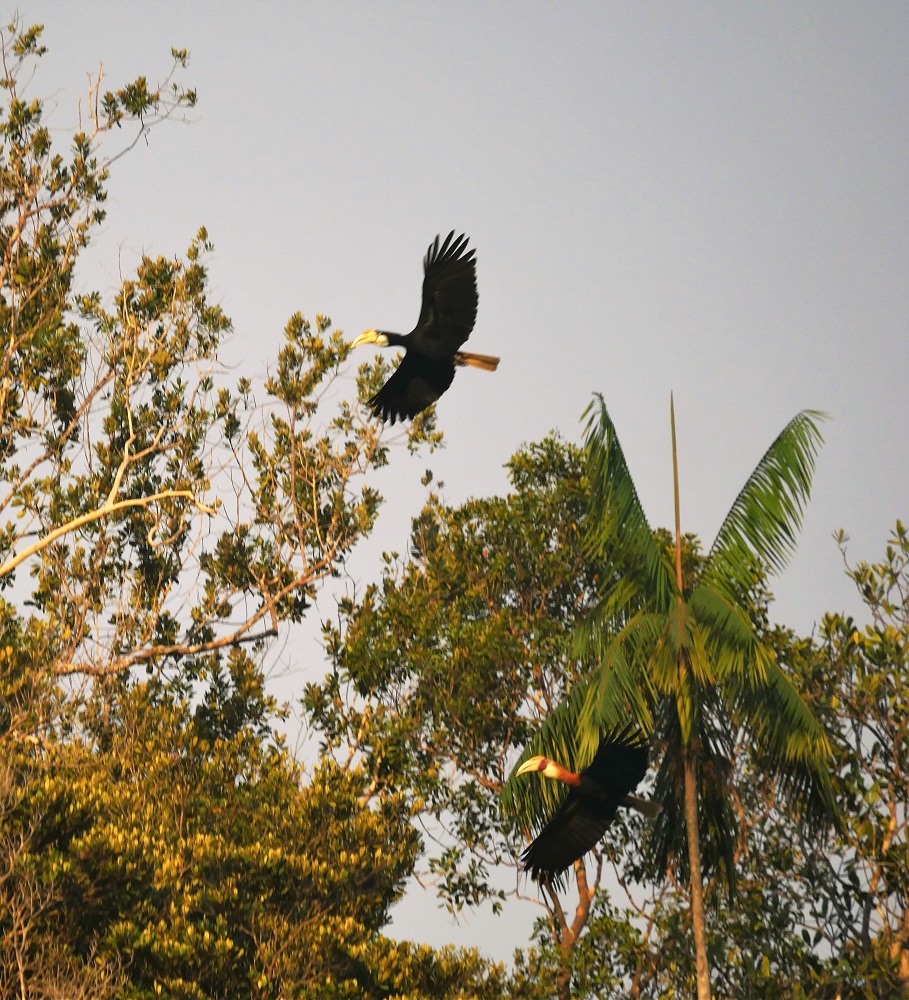
Hornbills flying over the jungle.
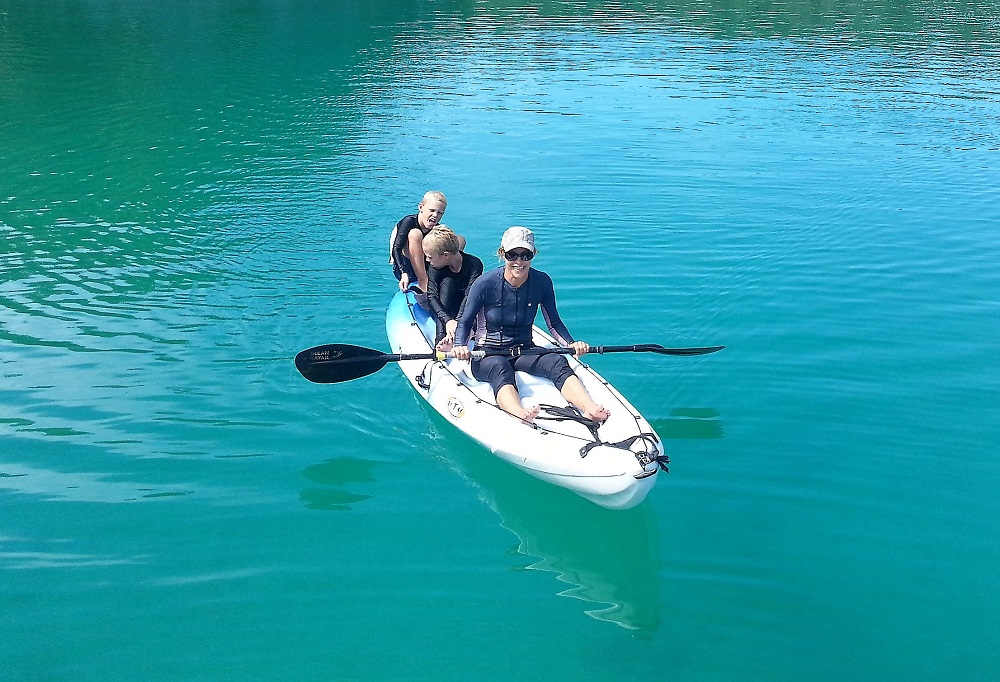
Exploring the bay with the boys.

Triton Bay is on the south-western coast of Irian Jaya, an area full of steep hillsides and small vertical islands set in glassy calm seas. Here, the only busy place is the sea, where in many respects the activity levels mirror or even exceeds that of Tual. It is an incredibly productive area; the water is thick with plankton and clouds of the tiny fish that feed on them. The schooling baitfish come in all sizes – from microscopic hovering swarms just above the extended tentacles of branches of soft coral to thousands of small fish in schools hiding under our boat and millions of finger-long silver darts streaming through the water, changing direction as one co-ordinated group when a predator approaches. The fish are so numerous that it felt as though we are diving in a bait ball: there was no knowing what was up and what was down, and definitely no seeing the reef beyond the crowds. We’re suspended in Blue Planet: the Great Feast – a smorgasbord of coastal plenty, tiny prey feeding tiny voracious predators being gulped down by larger fish, a three-dimensional world of plenty where fish lives are played out in all their terrifying swiftness.

Diving in a bait ball.

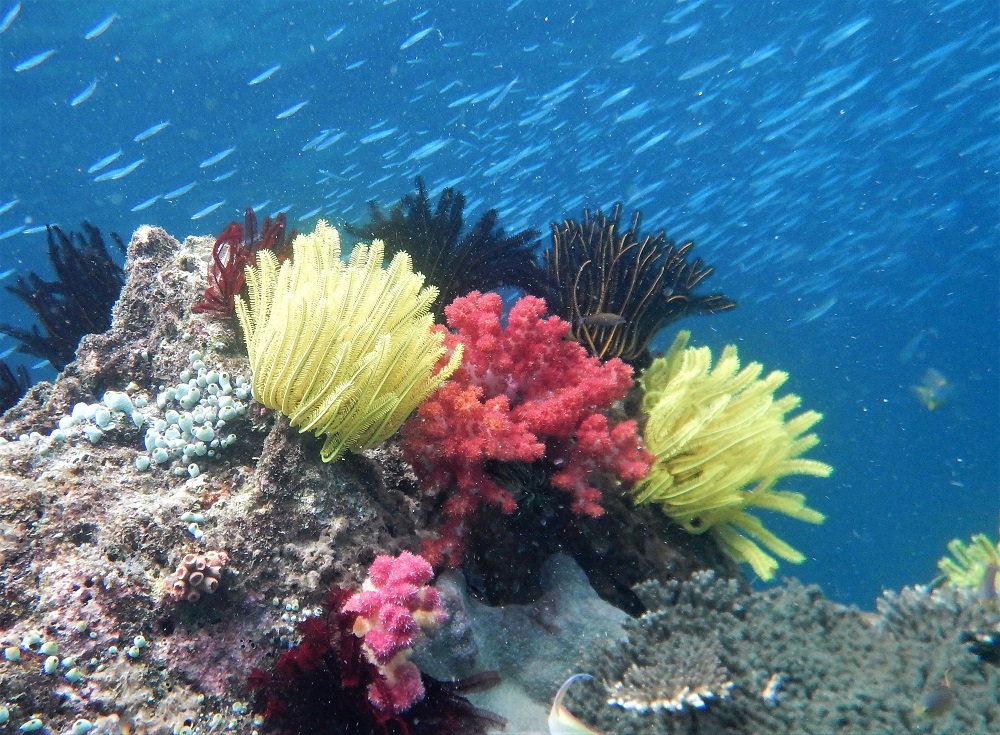
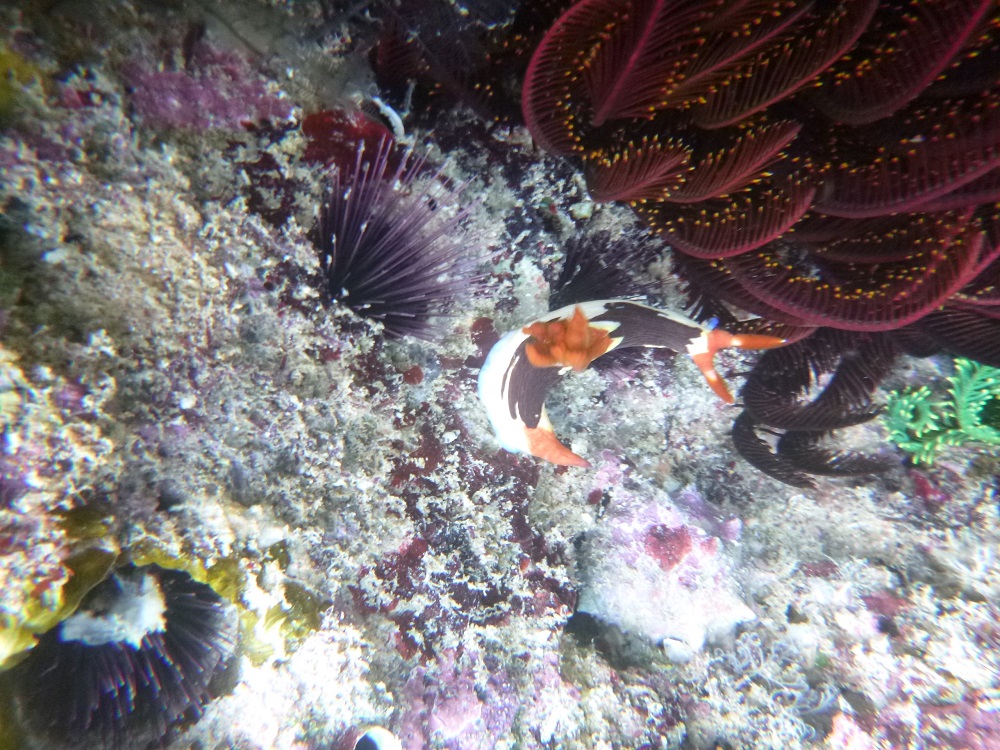
The plankton abundance gives rise to soft corals of astounding diversity; this area has the highest marine biodiversity in the world, and soft corals are not excepted. They adorn every rock, their bright colours shining like underwater mosaics, their soft shapes swaying gently in the sea. Brightly coloured feather stars lurk everywhere, their tentacular arms filter-feeding in the swift currents, bright yellow, red, stripy and black little ferns clinging to the rocks.

Soft corals, feather stars and schools of fish in the background.
A vertical wall-garden of soft corals.


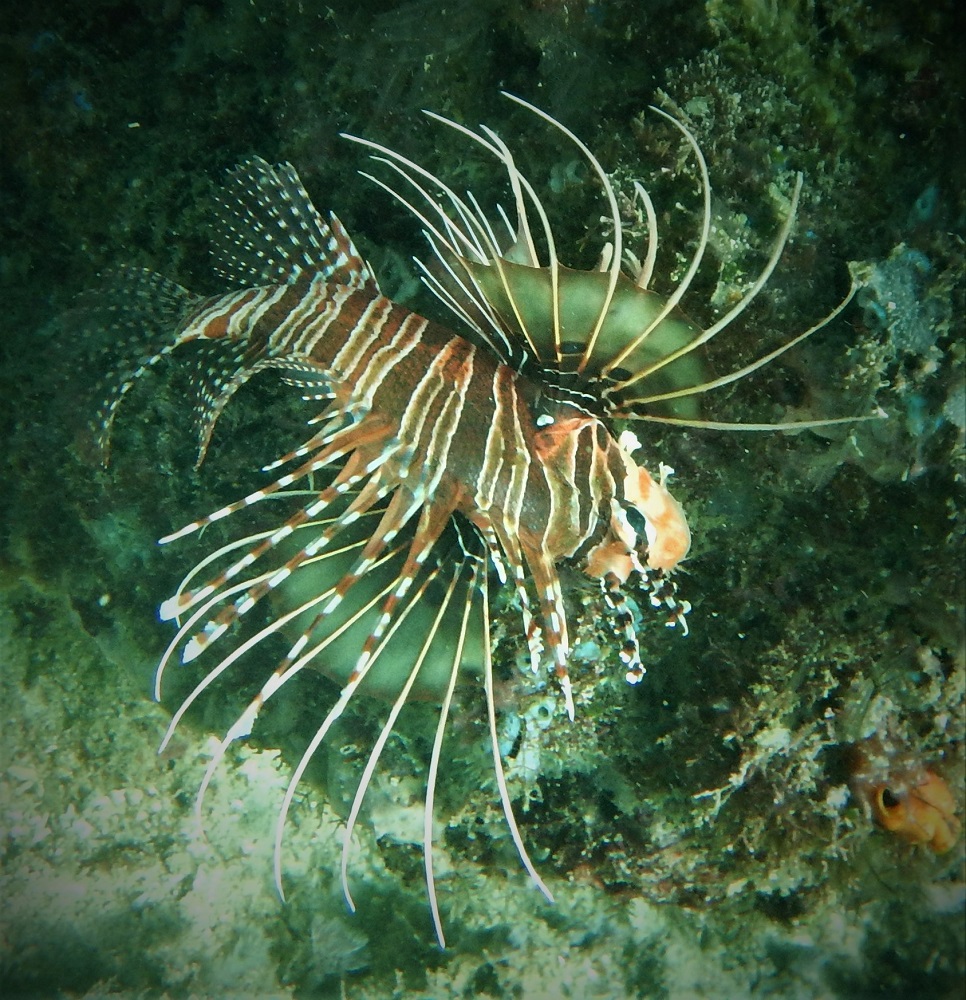
Delicate lionfish hovering over a dusty pink soft coral.
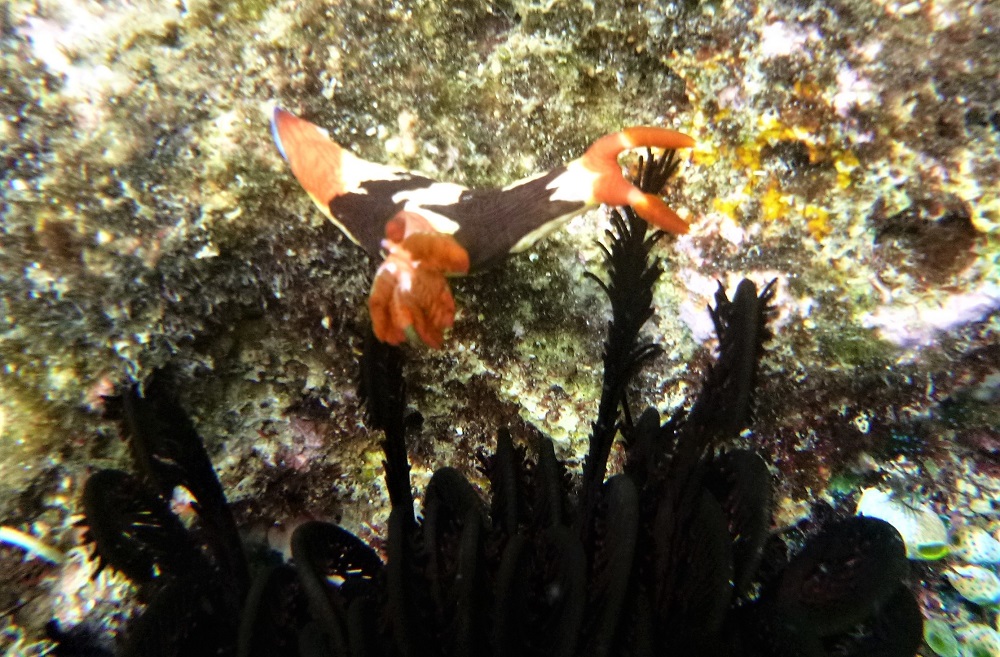
Feather star perched on a coral.
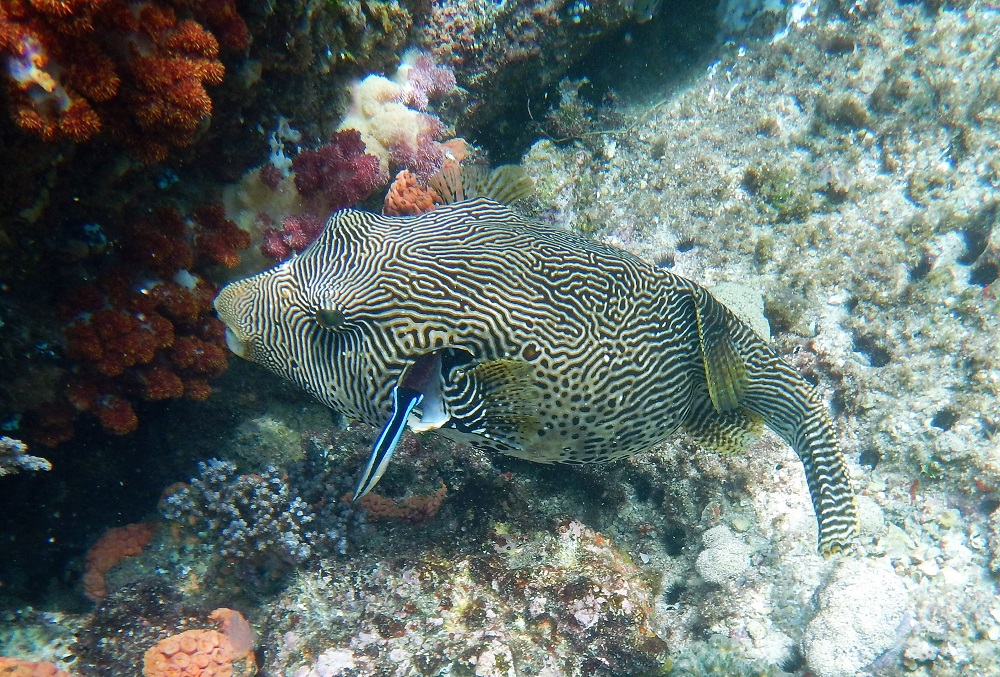
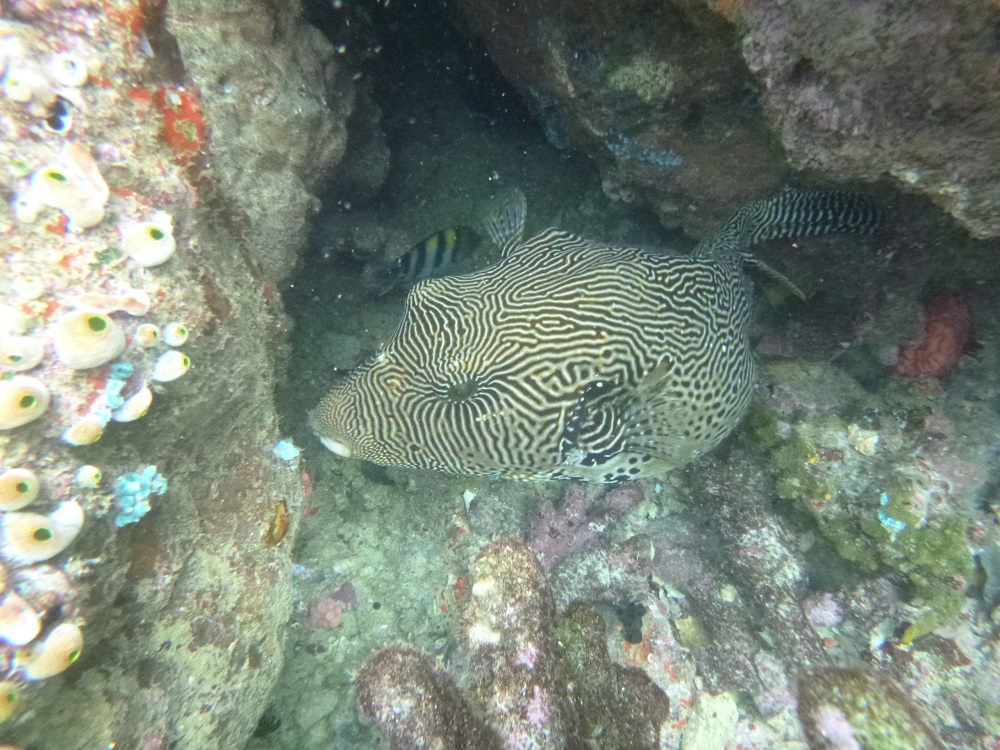
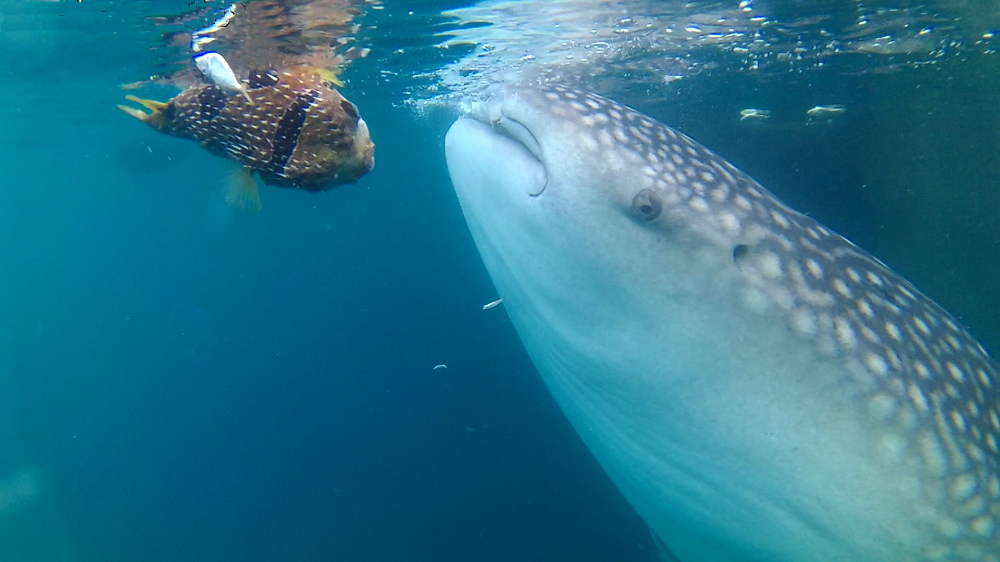
Huge pufferfish having his gills cleaned – the little cleaner wrasse were darting in and out of the gills.
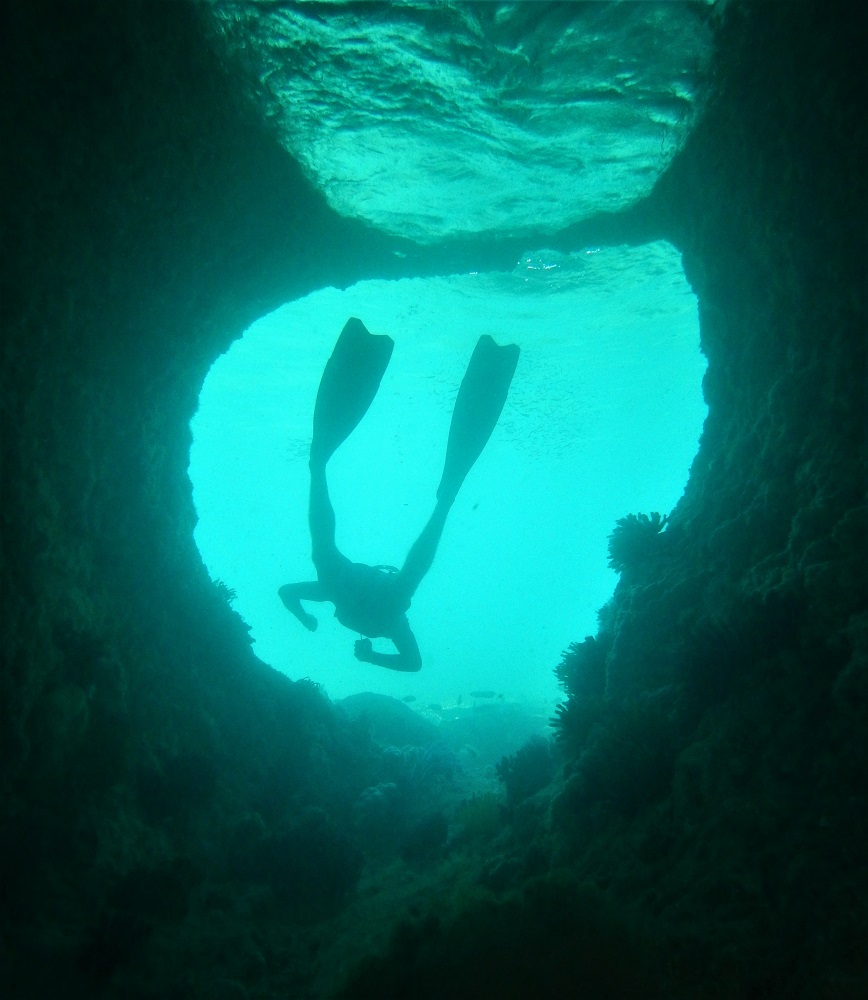
David swimming through a coral tunnel.

At night the plankton lit up the waters, luminous clouds mirroring the starry sky above. We did a night snorkel and when we turned off our torches in the moonless night we were gliding through a universe of tiny lights that switched on as we disturbed the water. It was not just our presence that was announced by underwater twinkle: from the boat we could see fish gliding by at night, their shapes fuzzily outlined in stars, a wake of glitter trailing behind.

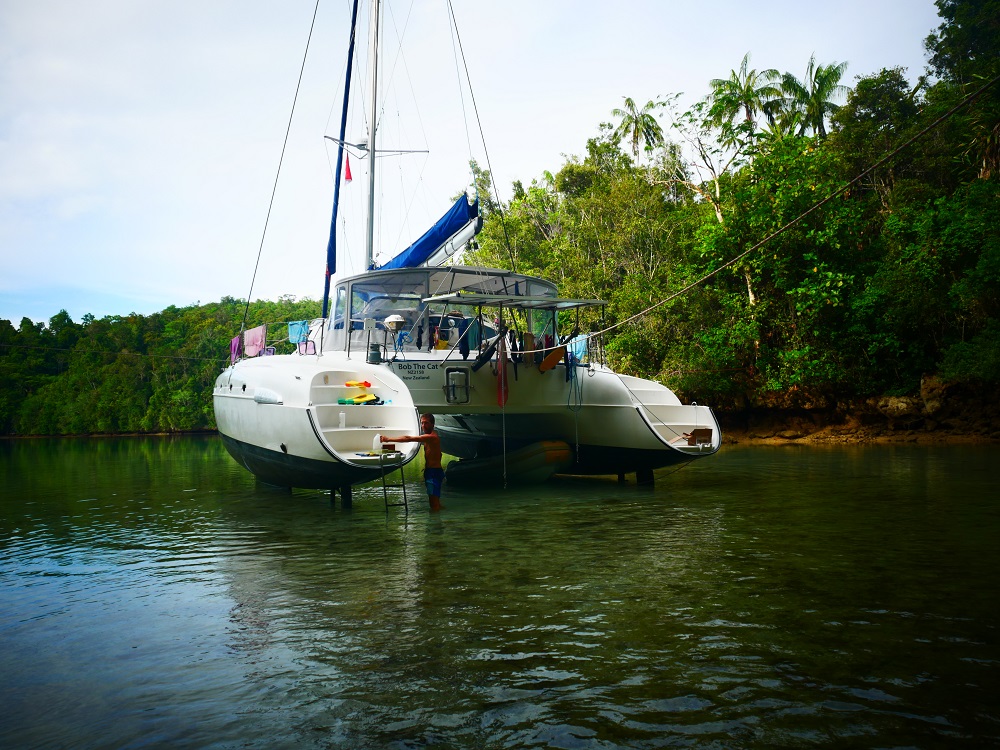
In a narrow, shallow bay we beached the Bob, tying up to branches from flimsy trees clinging to the vertical limestone cliffs at high tide. Come low tide we were perched in 10 cm of water which meant that we could exchange the spare propeller installed in Port Moresby for the new one that we got sent there. It is a relief to have the new prop installed and the spare prop safely tucked away should the starboard one fall off. With the first one falling off with no warning, we want to be safe…

Bob in the shallows.
Beached – Bob balancing on her keels.

In the shallows under the beached boats played out the lives of hundreds of shrimp and goby pairs. The seafloor was littered with narrow burrows from which the stalked eyes of a watchful goby appeared. If sensing no danger, the fish would advance and sit impassively a short distance from the burrow. Within the burrow the shrimp was busy fussily cleaning, and from time to time a small, the exhausted shrimp appeared pushing a great load of unwanted sand and small rocks out of the burrow. It pushed the muck out to where the goby was sitting, elbowing the still fish further out of the way before it returned back into the burrow to fetch more sand. Ignoring its obsessive-compulsive partner, the goby sat stoically on watch, observing the comings and goings of the tiny fish darting around the bay. We spent hours watching their busy lives.

Get out of the way, I’m trying to clean!

Just beyond the beached boat the low tide exposed an underwater tunnel leading into an inland saltwater filled bay. The tunnel was long and dark and the boys and I snorkelled through it rapidly, spooked by the darkness and the long, slimy tentacles that seem to reach up to grab us from the sea floor.

On land we were treated to amazing views on an arduous clifftop walk up a set of newly made stairs with 700+ steps. Surrounded by dark green jungle the never-ending staircase was immersed in bird calls, butterflies and shafts of sunlight filtering through the treetops to the forest floor.

Matias taking a breather on the steps.
Triton Bay views: vertical limestone walls covered in dark green jungle rising from still waters.

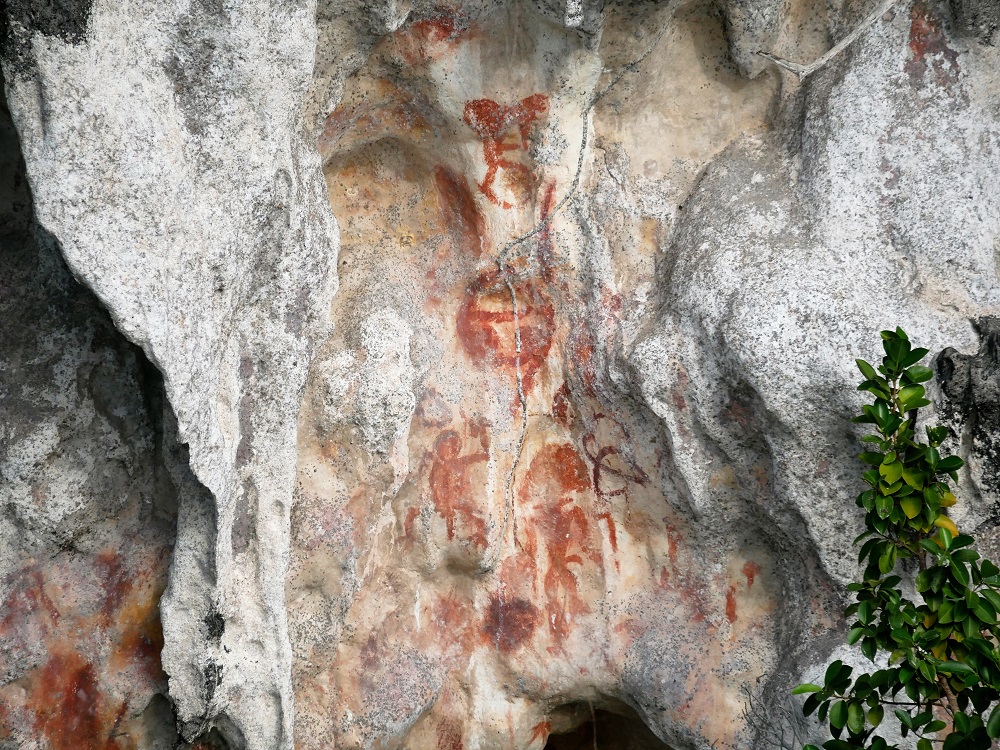
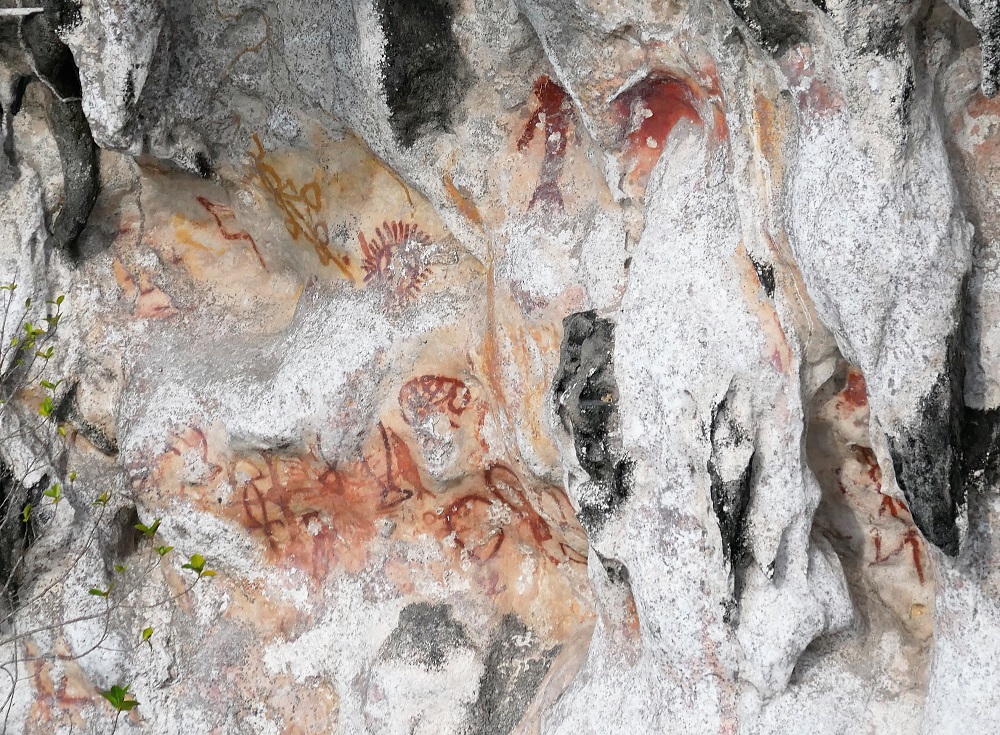
Irian Jaya has been long populated. The original people here are Papuans, Melanesians of dark skin and curly hair sporting bushy beards. Since the area became part of Indonesia Javanese settlers have arrived, and nowadays the coastal towns sport a mixture of Melanesians and Asians. Inland, the Melanesian cultures are less disturbed and several tribes remain uncontacted deep in the Irian Jayan highlands. On our way out of Triton Bay we sailed past some cliff rock-paintings that allegedly date back to the original inhabitants: ochre shaped by ancient hands into images of fish and people. Nobody knows how old the paintings are, but the locals believe them to be made by spirits.

In this magic location it is easy to see why.

Rock paintings.


Matias’s boat blog 11 Dec ’18

Hello.
Remember me?
The whale shark is definitely the biggest fish I’ve ever seen. We are in a place that looks like the Bay of Islands in Fiji. It is called Triton Bay and here we will dry out the boat. At high tide we parked in a little swimming pool sized offcut in the side of the island. In the morning (which is low tide) the boat is on the ground. My Dad wants to change the prop but it is still too deep.

Mr Round.

Me and Lukie jump in, not realising that we should be doing home schooling, and when I touch the water my feet hit the bottom before my waist gets wet. After schooling I swim around and find a strange looking bit of seaweed. I poke it and it curls around my finger. Two eyes pop open then it dawns on me what it is.

I’m in the wrong place.

A seahorse! I show it to Lukie who starts yelling for our Mum to come. “MUMMY!” “MUMMY!”

Am I a star or a fish?

I put my head under the water to drown out the noise. The next morning we leave for Triton Bay Divers and we will probably go back to the shallow bay to dry out the boat in an even shallower place. Today we will go for a snorkel in a famous dive area, let’s see how it goes.

Caution! Swim whenever!

As soon as I leave the dinghy a soft coral-covered rock comes into view. Massive butterfly fish swim about, I could swim right down to them and snap a photo. I slowly let the current drag me along.

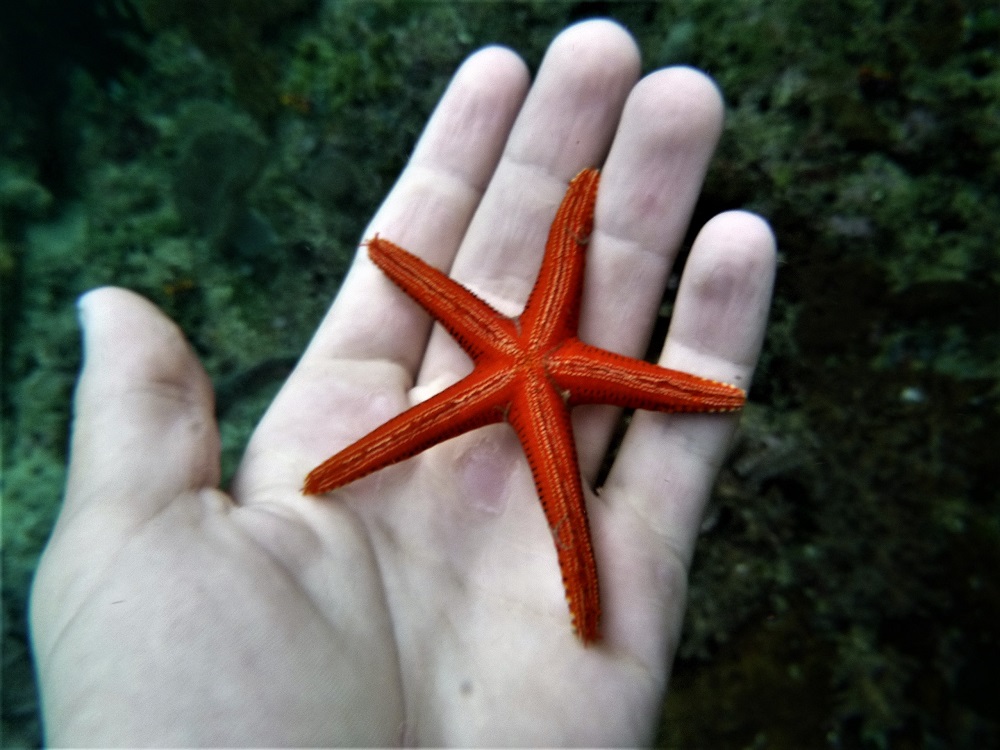
“Why did that kid lift me up?” says Orange the Starfish.

I swim around the rock and into a lion fish, spines raised and ready for attack. Lukie shows me a little orange starfish, then he tries to get me to follow him to more starfish, and I do.

Brittle star looking things that are called feather stars are curled up in balls, using their arms to catch plankton. Here really big jellyfish live, dark brown and see-through ones come across my path. I don’t go near them as they are 20cm long! That’s a big jelly.

Me a cute, lubly, flwuffy bwittle stwar fwing.

I bump into a solid object in the water, but I can’t see it. I swim back to get a better look. It’s a massive, solid, see-through plankton. That’s really weird. Now I see a nudibranch. A nudibranch is a sea slug thing. This one was really cute and it had gills on its back! That’s like having your nose on your back, how strange is that?

I’m in the right place. Nudibranch.

On this snorkel I saw a lot of weird things. Next we went to a swim through, as soon as you got through you got swept away, around a rock and back where you started. Before I went through me and my Mum took photos of a big… hang on let me think… a pufferfish? Yeah, I think it was a spikeless pufferfish, anyway.

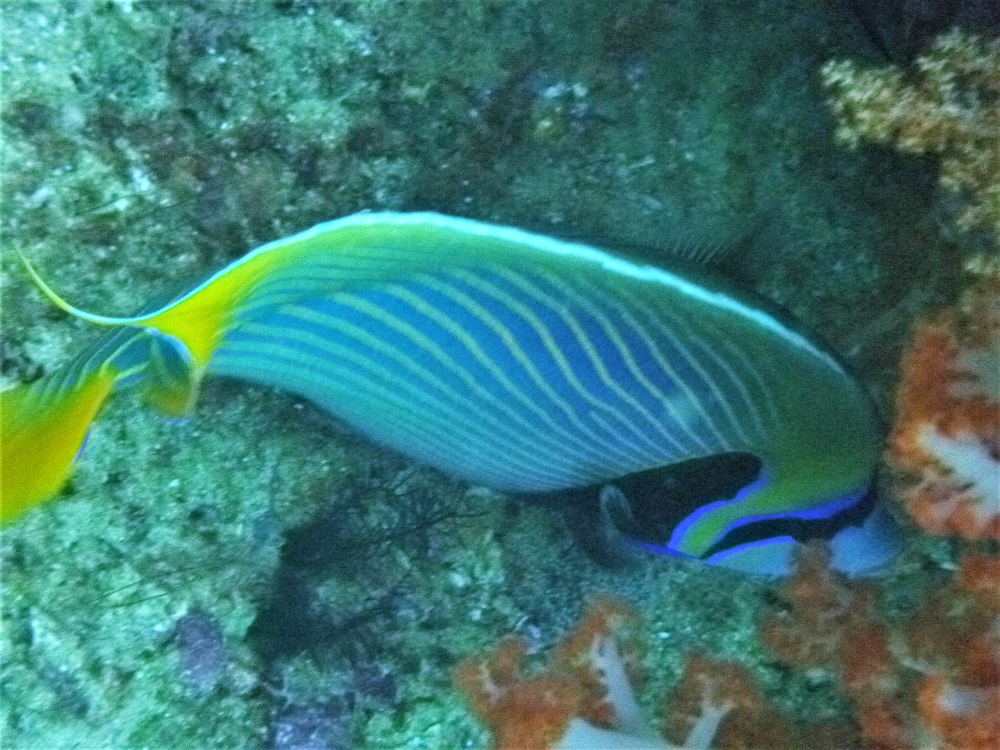
Adult butterfly fish with no punctuation

I swam through the swim through, the current quickly took me around, I did it again and again and again. Eventually I got cold, so just before I got out I swam down under a ledge to find a big fish to photo, and I found one, a big one.

I’m a big puffer!

A large shark swam around, with no tips on its fins. Instead of taking a photo I swam back up and climbed into the dinghy. We managed to stop Lukie doing another swim through, so we could leave.

Baby butterfly fish.

Some days later we saw some very old cave paintings, they were super cool, I never knew that cave people could draw that well. It was good for back then, but its really not much better than what a three-year-old could do, no offence, Cave People!

Interesting drawing from thousands of years back…
Byeeeeeee!

Matias’s boat blog 10 Dec ’18

Hello!
I’m looking at yoooooooouuuuuuuu!!!!!!!

We have left the rubbish-filled Port of Tual and we are heading to Namatote Island were apparently you can see whale sharks. We arrive in the afternoon with a Swiss boat called C’est Le Vent which is pronounced Say Le Vong in French.

Me taking a photo.

Early in the morning we get up at about half past five to get ready to see the whale shark or hopefully sharks. Apparently, there are two babies (which are boys and each about six metres long) and a nine-metre female. The locals say females are hard to catch to tag.

I’m ready to eat!

After a big breakfast and a lolly from the Christmas calendar we zoom towards one of the fishing stations out in the bay. As we get closer, we see two fishermen throwing small fish in the in the water while another two wander around.

His pet remoras.

“Look! Look!” shouts Pierre from C’est Le Vent. A big spotty, black whale-looking thing slips right under the dinghies. Lukie slides in followed closely by my mum then me and Daddy. I get my camera out of the boat and start snapping away.

Yummy fish!

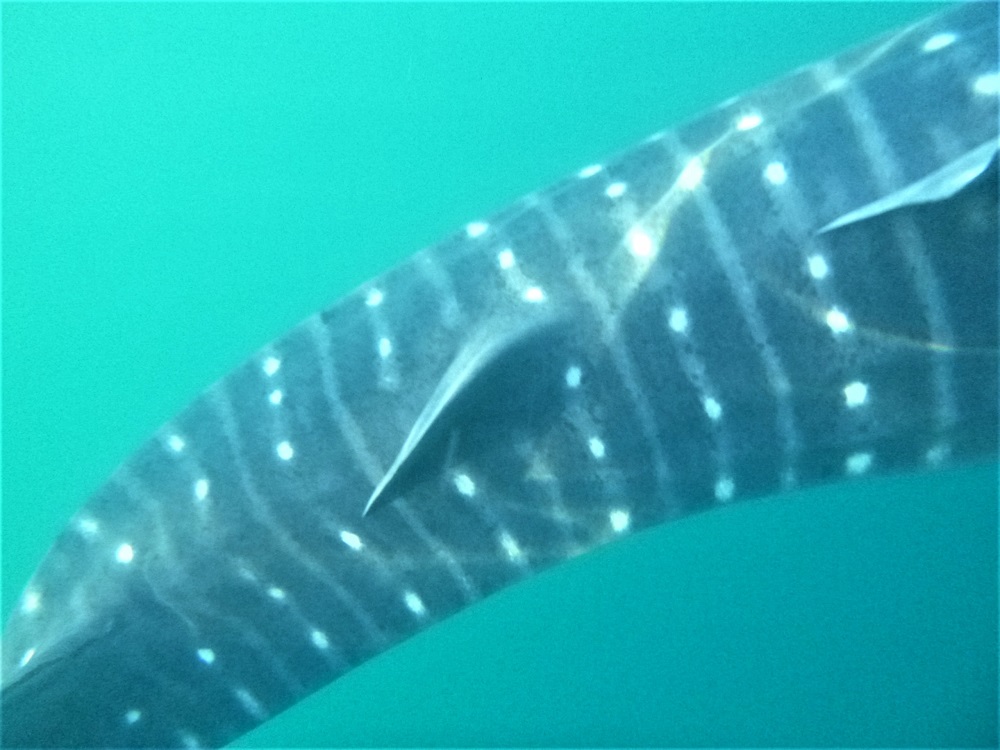
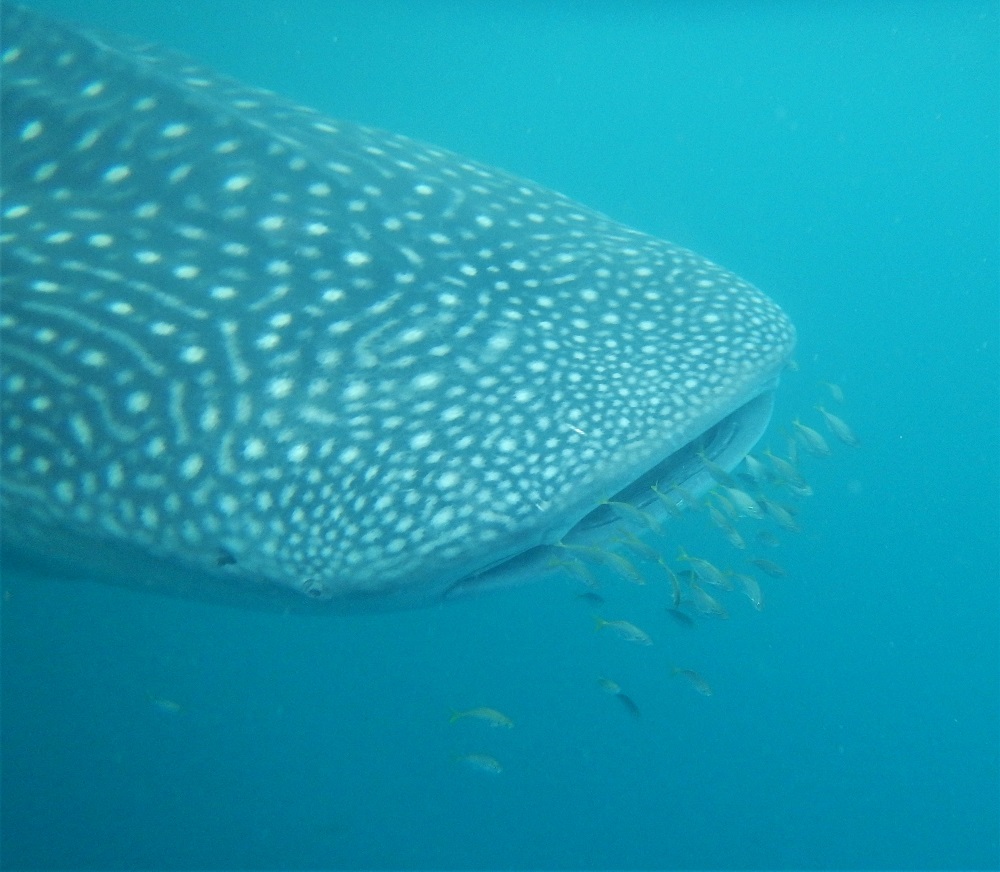
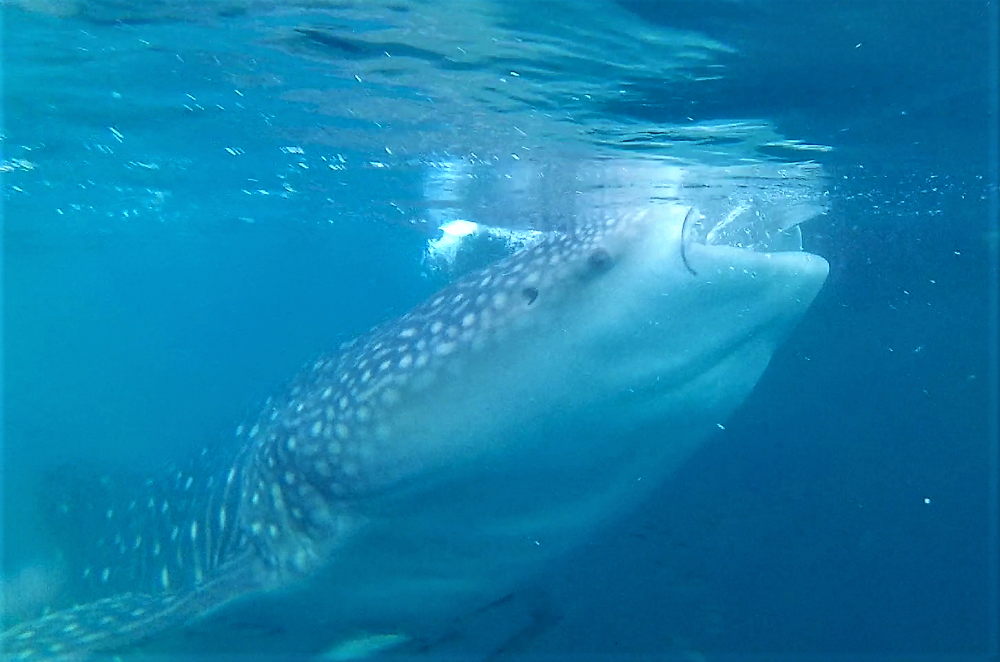
A six-metre whale shark sucks in water with small dead fish too. It was like a two-year-old. It spilt lots of fish and swam after other little fish (which were alive and swimming under him) and didn’t seem to notice us.

Look at me! I’m big!

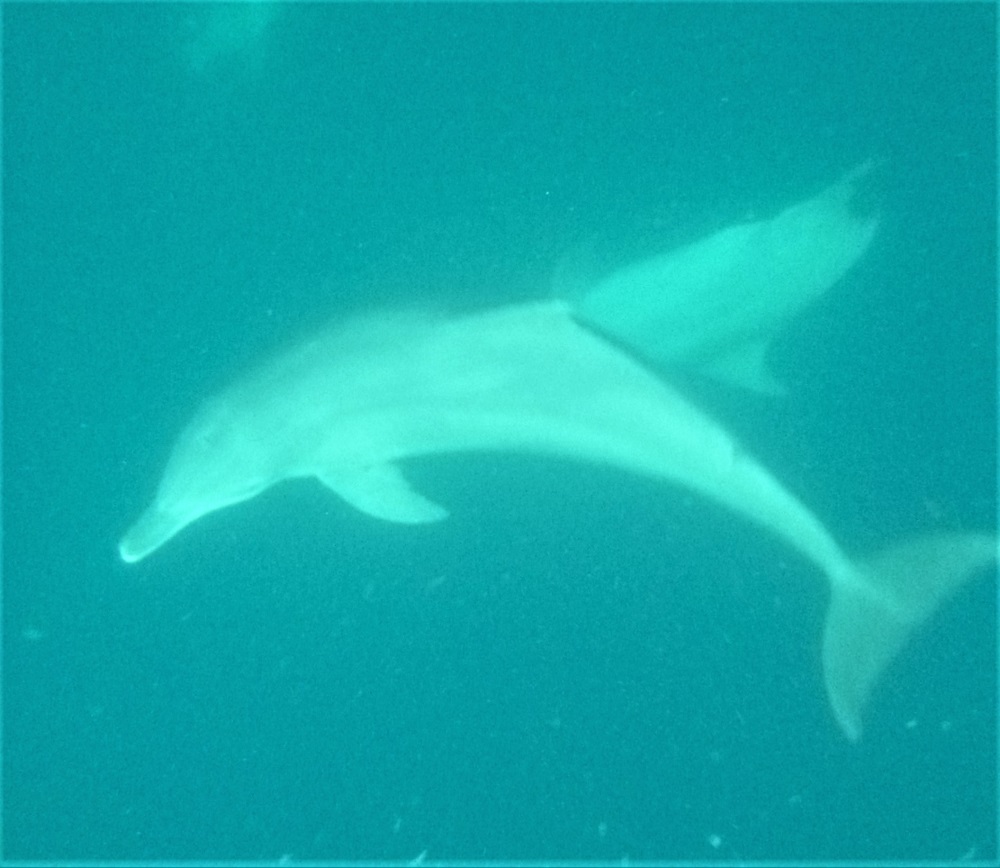
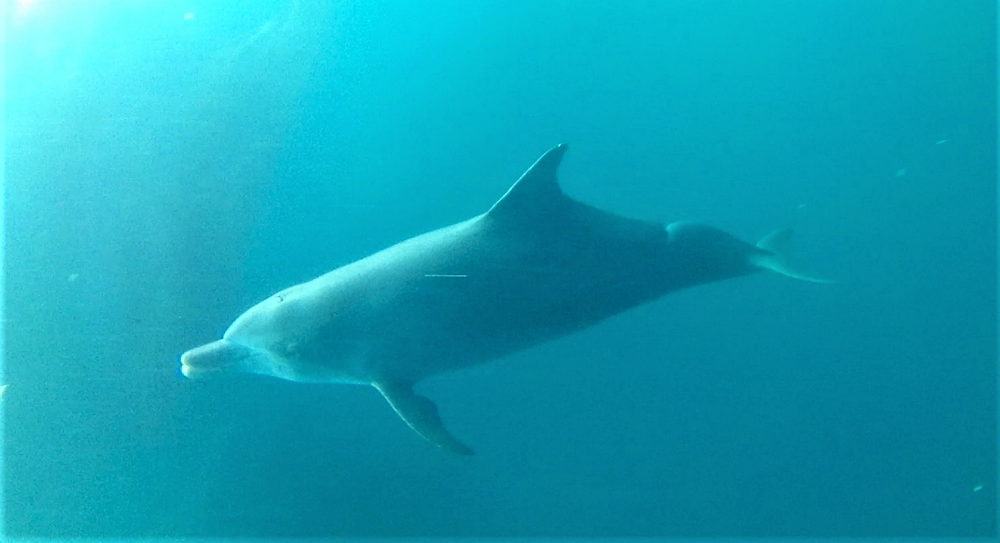
Dolphins also came in at one point to get some of the fish and the birds in the sky never really dived down. The shark swam under the fishing station and then we all started to talk.

I want fooooooooooood!

“Wow!”, “That was big!”, “Moan!!!” That “moan” was not from us. The whale shark swam into the dingy rope!

Franks tail.

It thrashed around spraying lots of water. Finally, it dived down again, we all thought it was gone, but no! It came back up chasing lots of fish that stayed just out of reach of its massive mouth. Just then a diving boat arrived, and the instructor told them to hop out.

Dolphins.

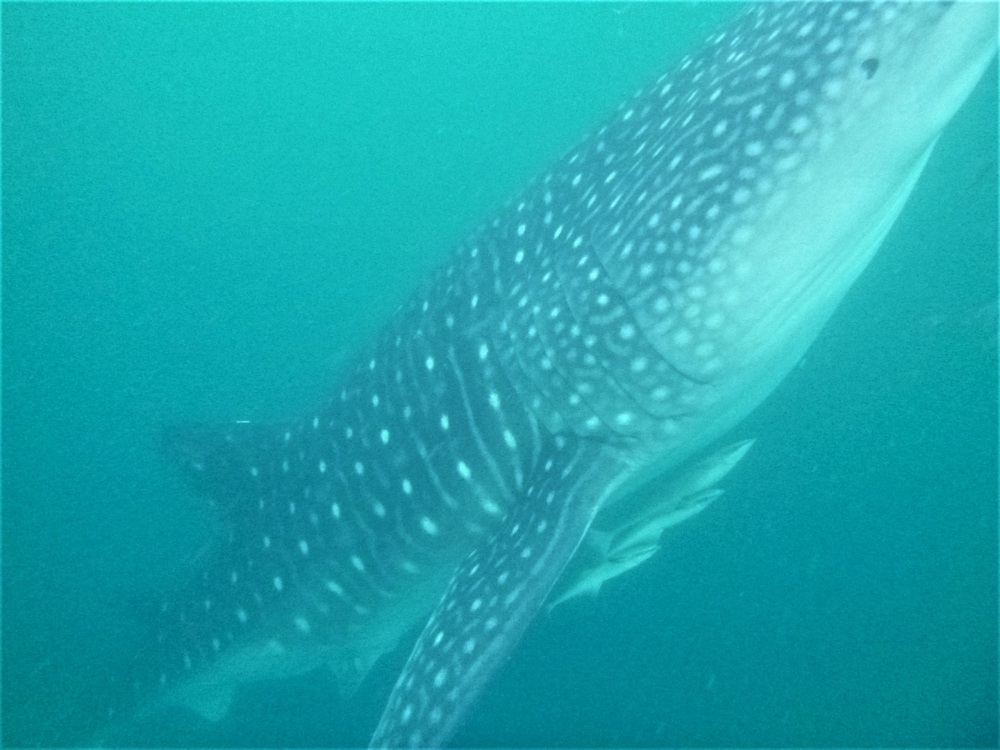
We all climbed up onto the fishing station (which was called a bagan) and watched the divers descend under the six-meter baby. Up here the view of the whale shark was not obscured by the blurry water, so it looked cool. You could see the stripy and dotty white pattern snaking down its rigged back.

“Wow,” says Lukie.

We left for Triton Bay the next morning. By the way, we called the whale shark Frank and went back to see him another day, he was so cool.

Goodbye snorkellers!

Ikan Besar – Big Fish

“Mummy, look,” shouts Lukie. “Look, Mummy, look. LOOK how big it is!!!”

I peer over the side of the dinghy where a vast, patterned shape is appearing out of the depths. “I’m going to jump in,” I mumble, hastily fumbling my fins on with one hand whilst dipping my mask in the sea with the other.

“Me too!” yells Lukie. “Yeehaaa!”

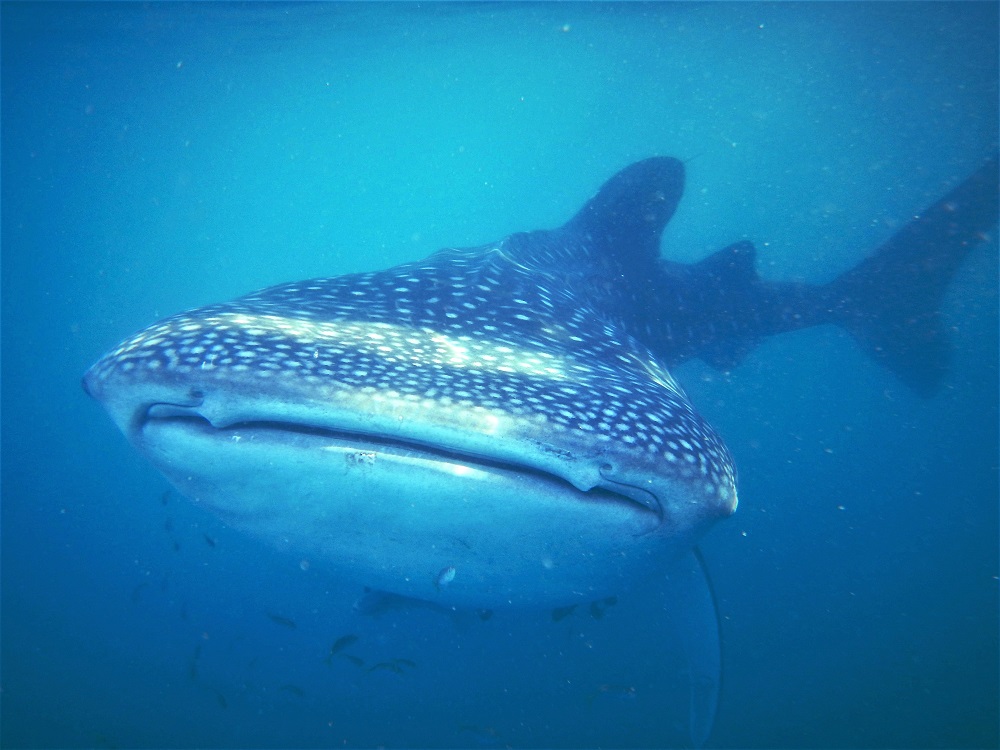
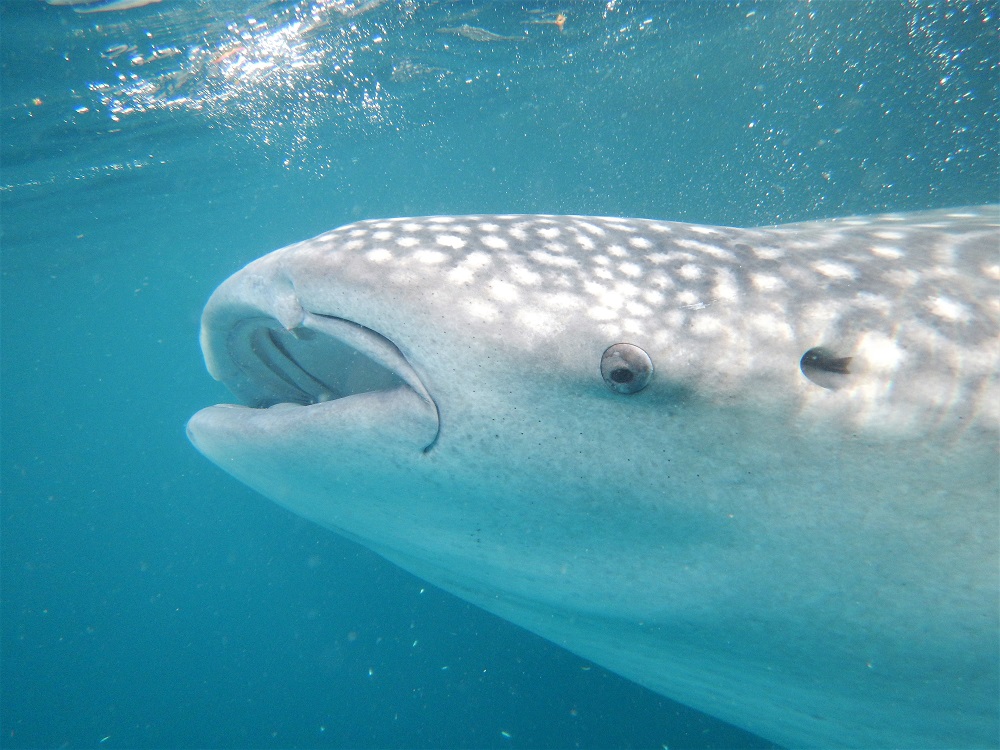
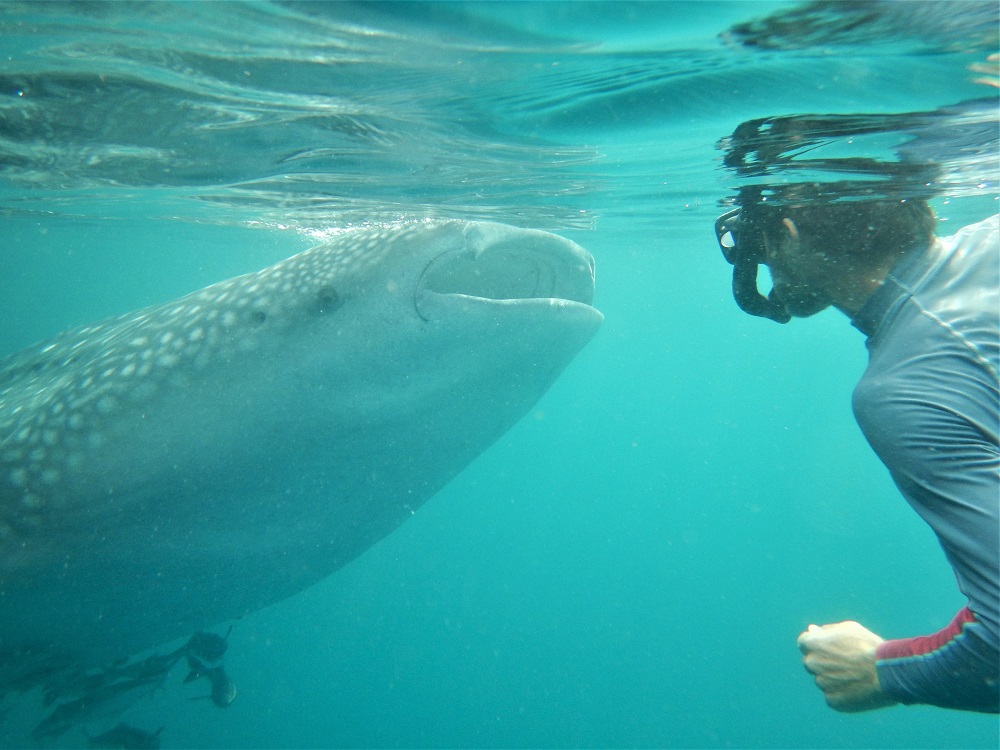
He slips over the side of the dinghy and I follow him quickly, clutching my underwater camera to my chest. When I stick my head under water the huge shape is brought into focus, the blurry, distorted creature viewed from the surface transformed into an elegantly patterned, sharply outlined monstrously large fish. It’s coming straight at me. A large open mouth sucking in a mixture of surface water and tiny fish, the huge flabby gills expelling sharp streams of water and bubbles of air. A huge expanse of white belly shines eerily in the early morning light.

Matias and the big fish.
Lukie diving down for a look.
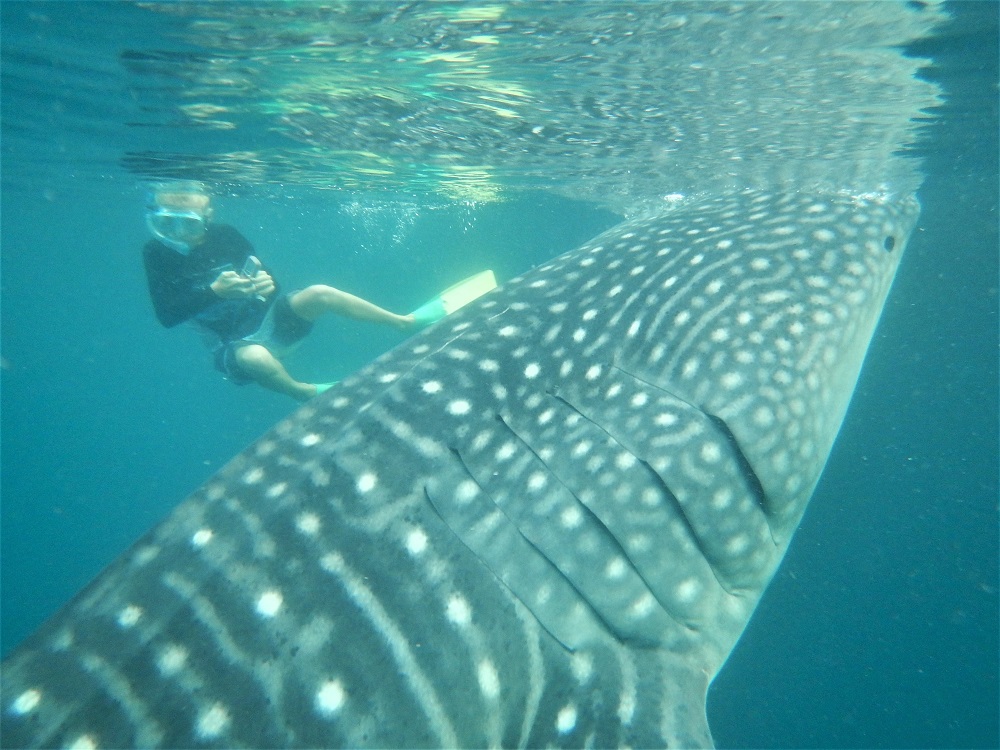
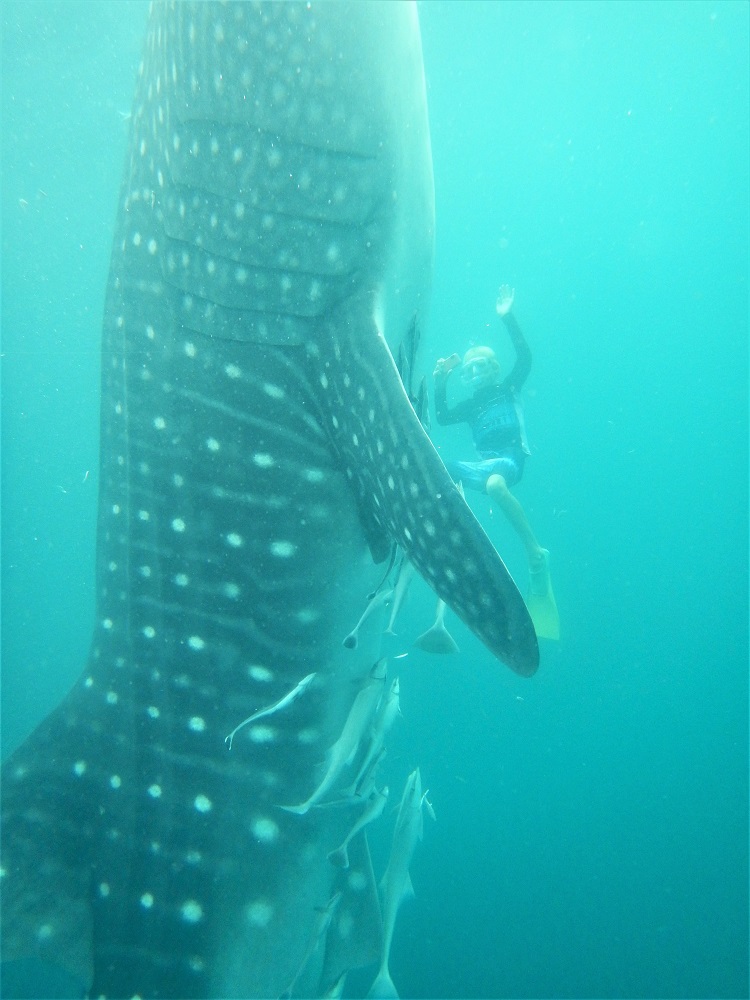
Boy (Matias) dwarfed by fish.

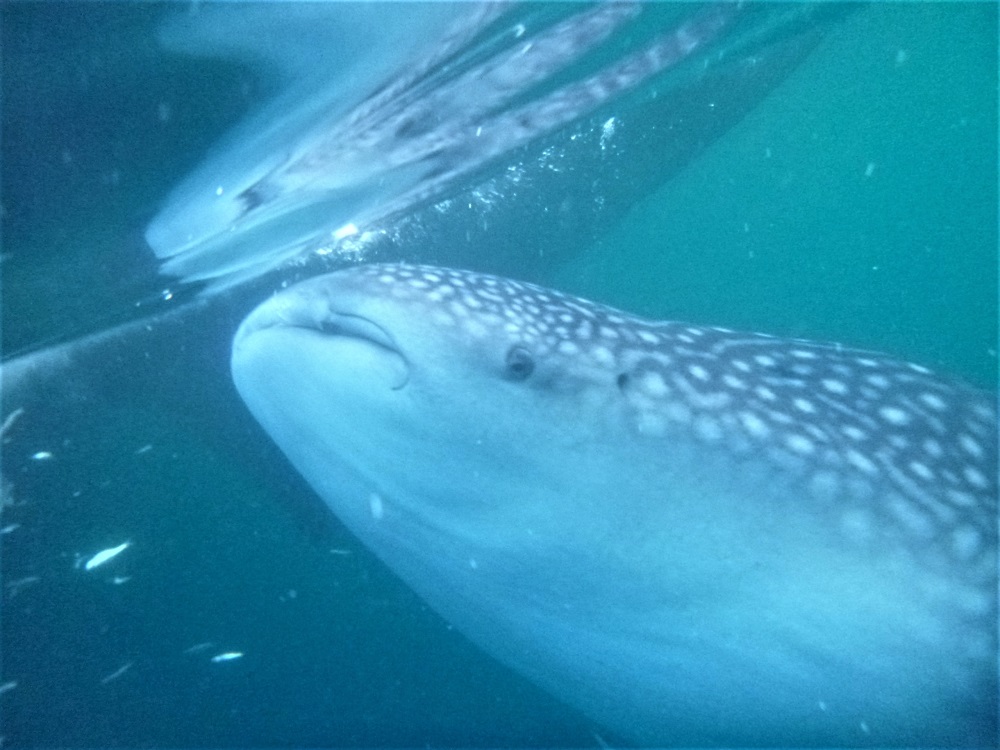
I back off hastily as the monster swims straight at me, my knees bent, my arms backpedalling. It seems fixated on the small fish just in front of its nose and doesn’t alter course. As it comes closer I can see the exquisite detail of the dot and line pattern adorning its back and sides, can count the shark suckers fighting to stick to its underside and can even make out the tail of a parasitic fish hiding in its earhole. Only at the last moment do I manage to veer off enough to prevent a collision.

This fish doesn’t care. It’s large and I’m small. It’s hungry, there is lots of food in the water, and it trusts that my small irrelevant shape will get out of the way as it swims back and forth, slurping in hundreds of small fish with every mouthful of water.

Gulp, slurp.
Notice fish tail sticking out of the whale shark’s ear.

We’re snorkelling with a whale shark, the largest fish on the planet. This one is just a teenager, a mere 6 or so metres long, the size of a giant great white shark. Large adults grow to 18 m, larger than the biggest humpback whales.

We’re in Triton Bay, on the south-western corner of Irian Jaya, the Indonesian half of the island of Papua New Guinea. The area is an up-and-coming diving destination, a place fast becoming famous for clear waters, coral reefs of amazing abundance and diversity, marine mammals and whale sharks.

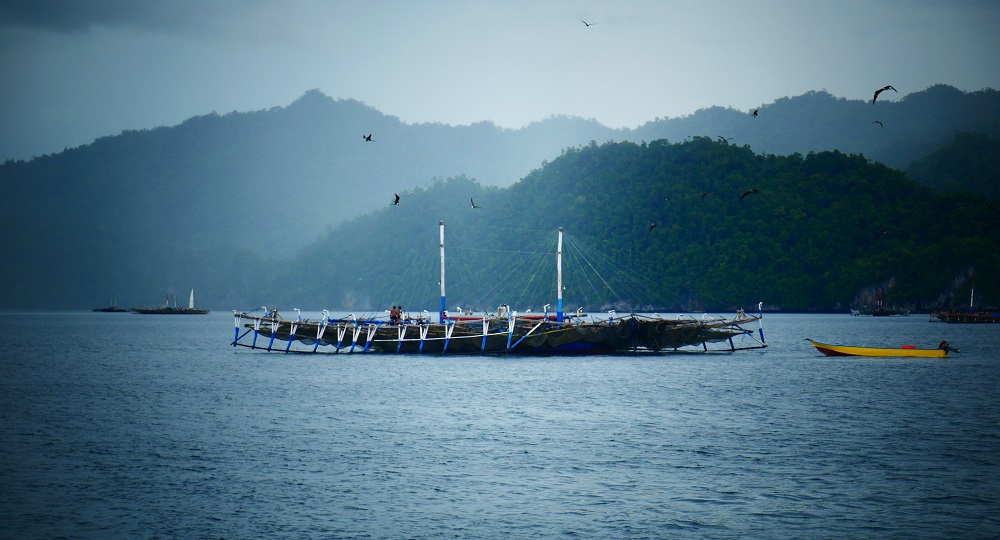
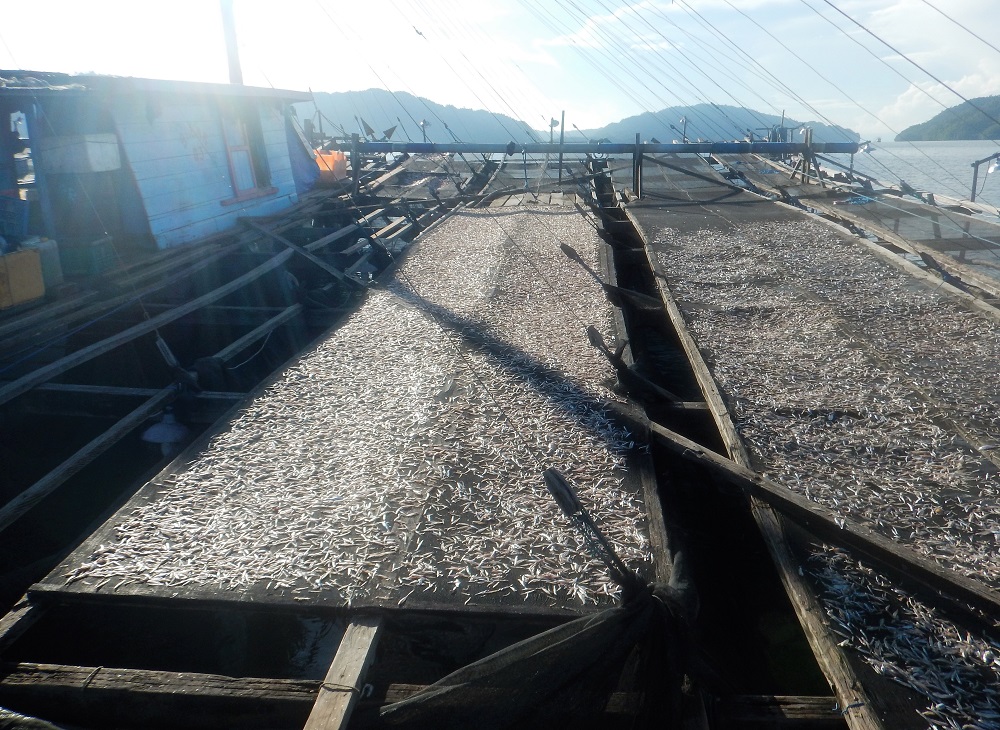
Our boat is parked off Namatote Island and anchored in deep water in the bay just next to us are two bagans, the local fishing platforms. At night the bagans are brightly lit and fishers are busy hauling in huge netfuls of tiny baitfish, which they spread out over fine-meshed metal grates for drying in the daytime sun. Early in the morning, as the fishermen hoist the last of the night’s catch, whale sharks circle to gulp up the small fish that inevitably spill over the sides of the net.

A bagan in the early morning mist.
Fish drying on the bagan.

A thick stench of fish permeates the still morning air. The sky is alive with birds, their cries echoing in the quiet bay. Huge flocks of birds are circling the bagans, large frigate birds skimming the surface to pick up tiny floating fish, seagulls dive bombing to get to the catch first. In the water the bird cries are drowned out by the squeals and clicks of the large groups of dolphins that surround the whale sharks, busily diving and jumping, bumping the birds out of the way to scoop up the leftovers from the feast. A school of giant trevally are attracted by the fish debris slowly sinking towards the ocean floor and soon they are zooming in and out, grabbing small fish from under the slower whale shark.

Dolphins circle the whale shark, eating the scraps.
Giant trevally turning up the water.

In amongst it all we swim within touching distance of the whale shark. We watch wide-eyed as it dives and circles below, and scramble to get out of the way as it comes back to the surface. The fishers above are throwing unwanted fish into the water, and the shark positions itself just below them, mouth wide open, frantically sucking the surface water, swallowing the little fish whole.

Feed me! Whale shark begging for food at the surface.

It is like a puppy under the dining table hoovering up falling crumbs, a huge, exuberant baby fish begging for food, impatiently crashing about at the surface below the nets, its toothless grin extending above the water surface, its small, beady eyes imploring the fishers to throw in some more.

The fishers laugh and throw in another handful. The whale sharks (ikan besar: large fish in Indonesian) is known to bring good luck, and the fishers treasure having them around. They sit smoking on the platform, looking out over the mayhem of birds, dolphins, sharks and us snorkelling. The radio is playing a catching tune and the men smile and tug on the small handlines they have suspended over the side, hoping to catch a big fish for dinner.

Must be an OK job.

Matias in the foreground, taking a photo.
Pufferfish swimming for its life.