
“This is a lovely place,” I say politely to Neil, a small elderly man sitting in our cockpit. He is clad in ripped shorts and a torn t-shirt and has paddled from the shore in a tiny outrigger canoe to our boat to do some trading. “A great lagoon.”
“Yes,” he nods, glancing up from the NZ Customs ‘Welcome to Opua’ magazine that he is leafing through.
“There is lots of healthy seagrass here,” I say.
“Yes, seagrass good.” He nods again without looking up, deeply absorbed in the glossy magazine.
“Do you get turtles here? They like seagrass places like these.”
“Yes, turtles come. We eat, meat tastes very good.” He grins a red toothless grin, only one heavily stained front tooth remaining, the toll of a long life of betel-chewing.
“Oh.”
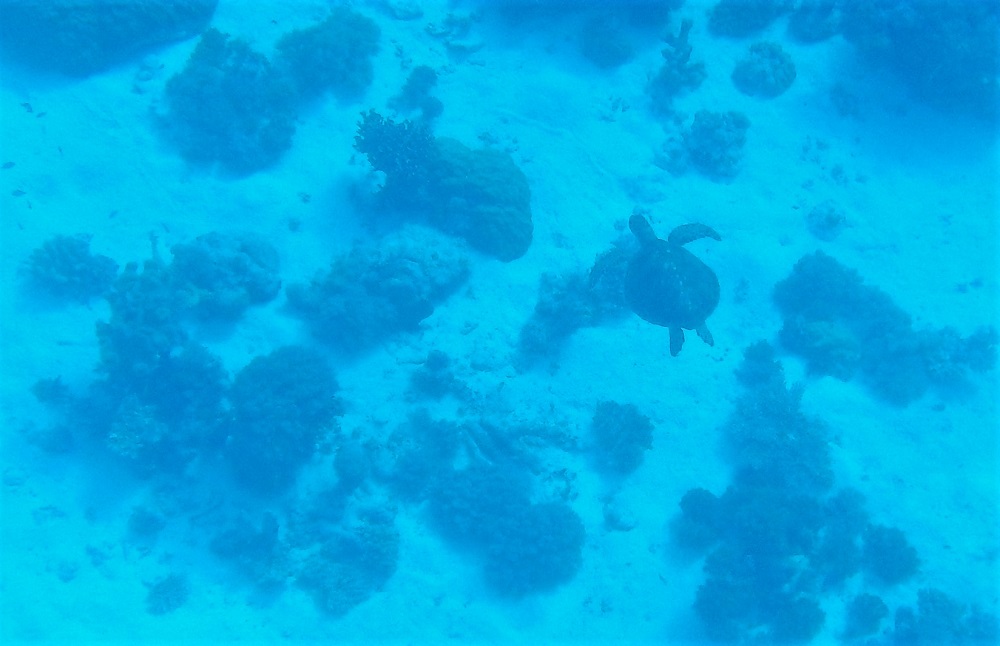
“But not too many turtles nowadays,” he adds, looking down again, his finger trailing along the text extolling the excitements of Whitianga scallop festival which accompanies a photo of a scallop glistening next to a chilled glass of champagne in a flute with condensation on the outside.
“Shellfish,” he says, tapping the page knowingly.
“Yes, we have shellfish in New Zealand,” I say. “What about dugongs, do you get them here? They like seagrass too.”
“Yes, they very tasty. Like pig. But not too many dugongs now.”
“Oh.”
“Yes, we don’t catch many dugongs now.” He nods grimly to himself and fishes out a betel nut from the flour-sack satchel he is wearing around his neck. He bites open the green, hard nut with his few remaining molars, exposing a fleshy centre which he scoops out with his tongue. He pulls out a seed pod from a small bag, takes off a large bite, slowly grinding the two together into a paste. Next, he pulls out a small jar of white powder, pours a bit into his hand and sucks it up, adding it to the mix. Masticating enthusiastically, he turns another page in the magazine, this time eyeing up a photo of bikini-clad beauties perched on a golden-sand beach next to an advertisement for Opua Marina.
The seed pod is what they call mustard and the white powder is limestone from ground up coral. The limestone powder is added to grind up the mix and abrade the gums so that the mild stimulant from the betel leaves reaches the bloodstream quicker. When chewed, the nut turns red in colour, causing everyone here to look like vampires showing off their red-stained decaying teeth in wide grins. Chewed and then spat out, betel nut is a stimulant with similar effects to coffee and tobacco, raising heart rate and general alertness. Men, women and children as young as 3 chew and tooth decay is rampant with most adults missing several teeth. The active ingredient arecoline is highly addictive and also a carcinogen. Everybody chews here and as a result oral cancer is Papua New Guinea’s highest cancer killer, and Papua New Guinea has the highest rate of oral cancers in the world.

We’re in the Louisiade Archipelago in the south-eastern corner of Papua New Guinea, a remote series of small, green volcanic islands surrounded by coral atolls and turquoise lagoons. We’re anchored in front of the gloriously named island of Panapompom, a name evocative of Hindu festivals or cheerleader chants. At the moment, the local villagers are busy diving for Beche-de-Mer – sea cucumbers – which fetch very high prices.
“The government allows 200 tonnes to be fished in total in our region every year,” explains Ismael, the Ward Councillor of the area. “The buyers come and buy from the local fishermen every two weeks. They take it to Alotau on the mainland where they sell to the Asian buyers who come in their very large ships. From there it goes to Asia. It is served in restaurants there.”
“Every man seems to be diving,” says David. “Is it good money? What do they sell for?”
“The most valuable one is the one we call white-teat. That we sell for 300 Kina a kilogram. One animal can weigh a kilogram. On a good day, we can find 10 or 20.”
David whistles quietly. “That’s a lot of money – no wonder you are all out diving.”
300 Kina (the Papua New Guinea currency) is approximately NZ$150, so a good day’s diving could see a boatful of divers earn NZ$3000 – an incredible daily income for the remote population in this third world region. The foreign buyers all come to the mainland, so the government controls the quota at the buyer end and closes the fishery once the quota is met, warning the locals that the limit is upcoming via the local buyer vessels that collect the sea cucumbers from each village.
“300 Kina per kg is an incredible price,” I comment.
“That is for white-teat. We get less for some of the other types. Down to 150 Kina per kg,” he explains.
He says that last year some Vietnamese fishermen came and dived for Beche-de-Mer illegally within Papua New Guinea’s waters. They dove at night and moved offshore during the day, so it was hard for the locals to detect them. The Papuan Navy eventually busted some of them, confiscating the catch, the tonnage of which the Ministry of Fisheries promptly removed from the annual quota.
“So we had to catch less,” says Ismael with a wry smile. “Even though we didn’t benefit.”
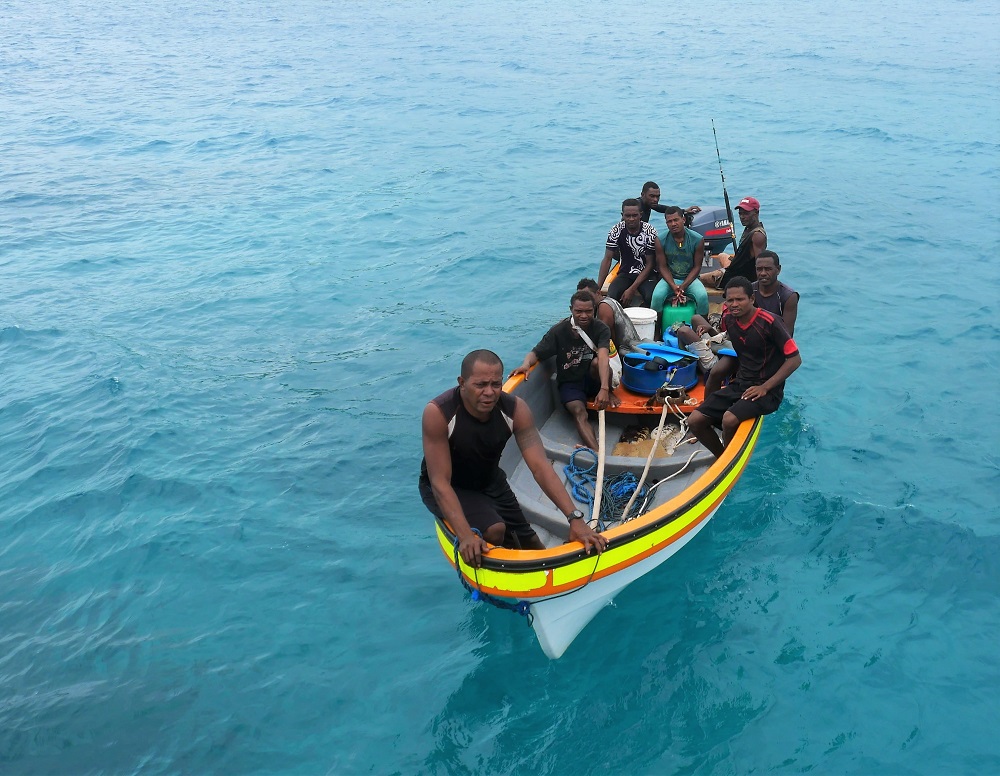
The season will close at the end of this week, and the men are out every day with masks and snorkels, covering vast tracts of lagoon. They can skin dive to about 20-25 m and use a leaded hook to catch animals that are just out of reach. The wealthier individuals use longboats with 40 HP outboard engines which can carry 6 to 8 men, the less wealthy use small traditional sailing canoes that carry one or two persons.
It is hard work and the men here are lean and fit, small and wiry, with strong muscles rippling under dark brown skin and no extra body fat. Most men here are about the height of Matias (1.52 m), our ten-year-old. The Papua New Guineans are true Melanesians, very different from the huge Polynesians found further east, who are two feet taller and about a hundred kg heavier on average. Perhaps aided by the stimulating effects from Betel nut chewing they seem to have more energy and everybody here is busy diving, fishing, sweeping, mending, carving, boat building, activity levels that far outpace the languid lifestyle of Polynesia.
Once the Beche-de-Mer season is over, they will start on the next crop: sharks.
“We get 300 Kina per kg of shark fin, so once the Beche-de-Mer quota is full we catch sharks,” he explains.
The sharks are caught using hook and line, and they are much harder to fish for than sea cucumbers. The buyer for shark fins is in Alotau on the Papuan mainland: an unscrupulous Swiss guy who is very, very rich and lives in the tallest house in town.
Beche-de-Mer diving and shark finning are both risky. Every year someone gets attacked by a shark. Ismael’s brother Noino was attacked by a large tiger shark a couple of years back and his leg is heavily scarred where the shark’s huge jaws only narrowly missed the femoral artery. He walks with a limp and is lucky to have survived – most people don’t live to tell the tale of tiger shark attack.

The vast sums involved with the Beche-de-Mer fishery prove tempting for some, and all Louisiade locals warn us from going near the Papuan mainland.
“Don’t go to the mainland,” says Nigel, a thirty-something diver in a longboat that visits us when we’re anchored at the northern end of the Sudeste lagoon. A short, muscular man, he is clad in black shorts, a torn graffitied black singlet and has a raffish urban knitted cap perched on his head topped by a dive mask worn back-to-front. The longboat has approached to see if we have anything to trade.
“We are friendly here, but they are not so friendly by the mainland. Not so safe for you.”
“No?” I ask. “So we should stay on the outer islands?”
“Yes, stay here and when you move on keep away from the mainland. You can go to the smaller islands. We are friendly here. But at the mainland there are many people, not so good people, people who maybe want trouble. Not good for you to go there.”
“Where is the trouble?” I ask. “What kind of trouble?”
“There is some piracy, some people attacking the Beche-de-Mer buyer boats,” he explains. “A lot of Beche-de-Mer buyer boats around now, big boats. And there are some bad people, some pirate people who will come to get the money from the boats. So not safe for you to go.”
“Where?”
“In Alotau, at the mainland. Stay here, you will be fine, but don’t go too close to the big islands. Lots of trouble there.”

Humans are not the only casualties of the fishing practices. Sea cucumbers clean the sandy bottoms next to the coral reefs, hovering up organic matter and keeping algal growth down. The frantic fishing takes its toll. Heavy overfishing led the Papua New Guinea government to close the fishery between 2007 and 2016 to allow stocks to recover. In 2017 it was reopened for one month, and this year the season has been four months. This is the first place I have seen tropical seabeds devoid of sea cucumbers and reefs without sharks, and one can only wonder at the effects of removing scavengers and top predators on such a massive scale.

 SV Bob The Cat