We got out of Port Moresby just in time, in more ways than one.
Four days after we left, unrest broke out, with police storming parliament to protest about lack of overtime pay during the APEC meeting. The Royal Papua Yacht Club marina went into lockdown as looting and gunfire were reported in the town; police warned people not to call them because they would not respond.
The weather in the Torres Strait also changed. The trade winds eased, then disappeared, signalling a period of calm before the onset of westerly winds, an early warning that the monsoon is setting in.
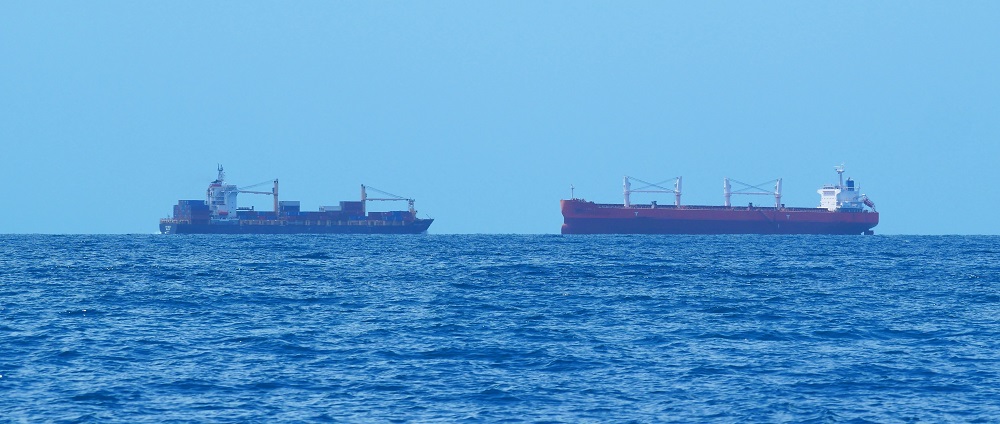
We met the calm a few days into our passage. For the first two days we had pleasant winds and were zooming along at 9-10 knots, but once we reached the barren islands of the Torres Strait the winds died and we glided through the maze of dangerous at 6 knots, carried only by the current. Large ships motored by in the distance, carefully picking their way through the shipping channel, escorted by pilot boats chatting eagerly over the VHF. Once we were safely out of the Strait, the Australian water police paid us a visit, checking why we were going so slow (there was no wind) and logging our details.
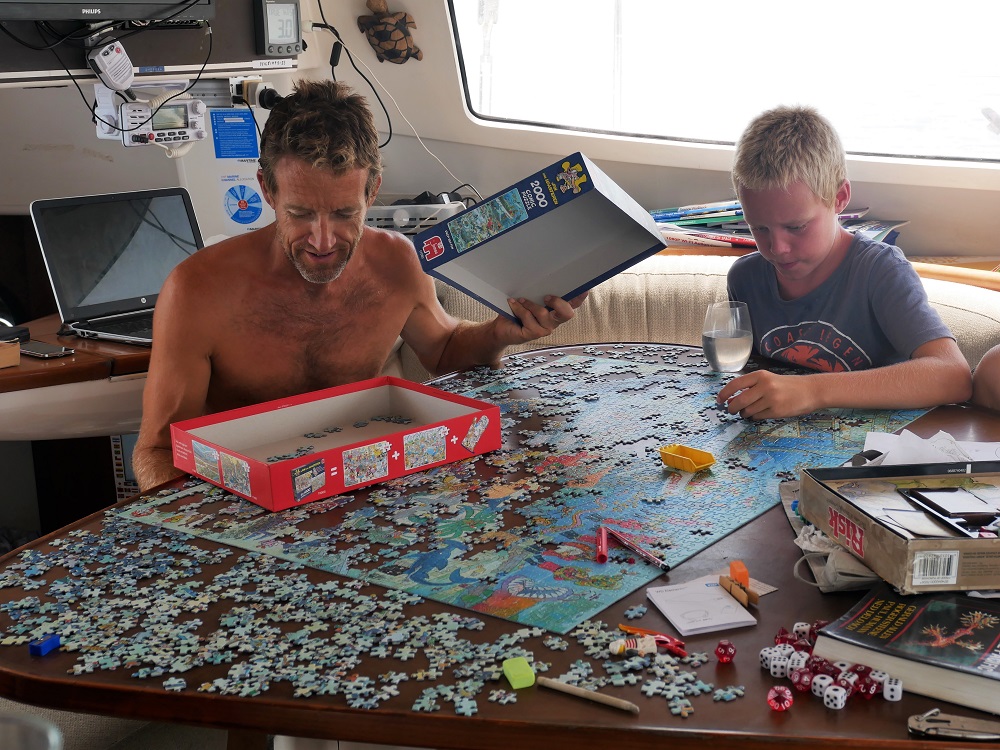
Distant ships about to pass in a tight spot of the Torres Strait. Under-keel clearance is a limiting factor for shipping in this area as the shipping channel is only about 17 m in places.Slow passage makes for good puzzling conditions: we finished a 2000-piece jigsaw puzzle in four days.
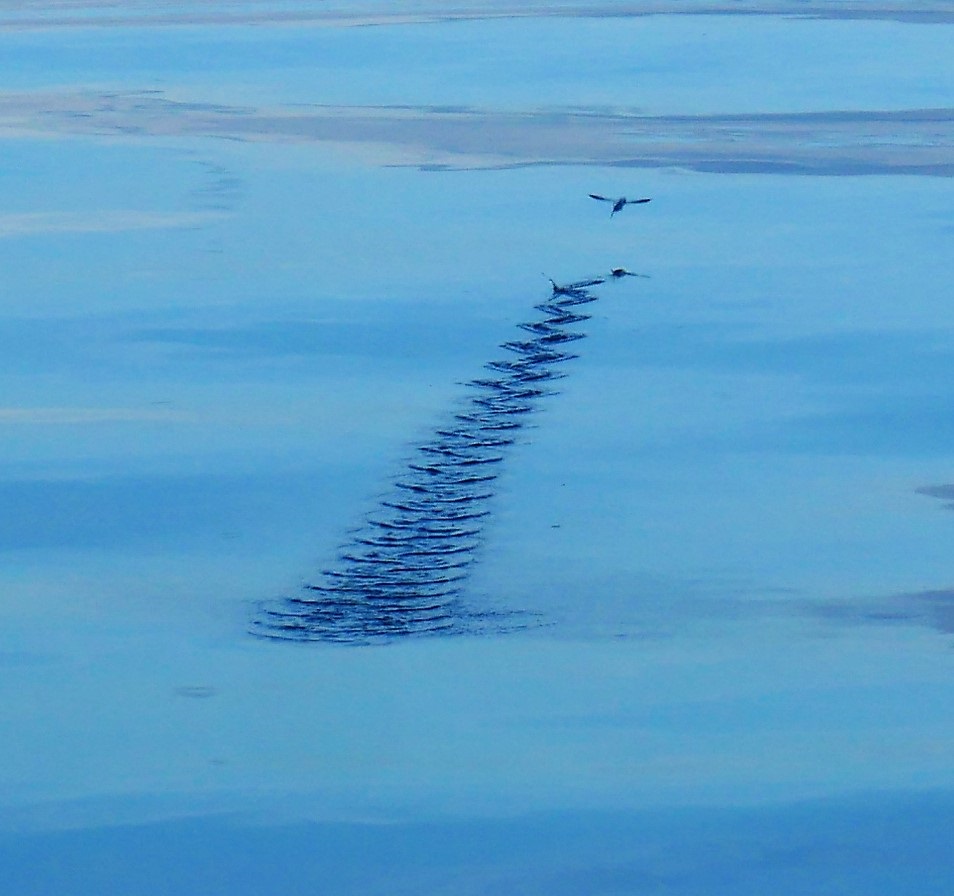
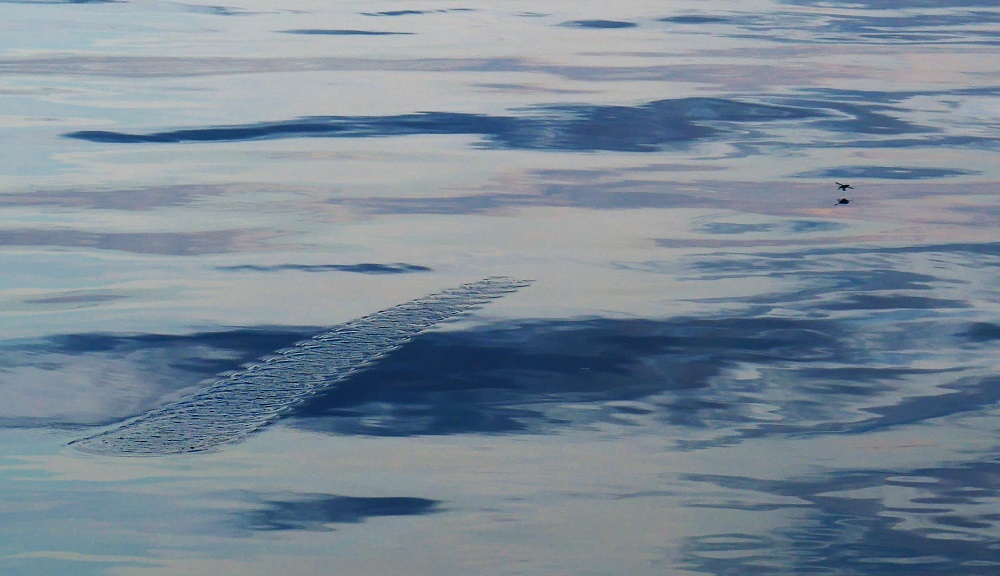
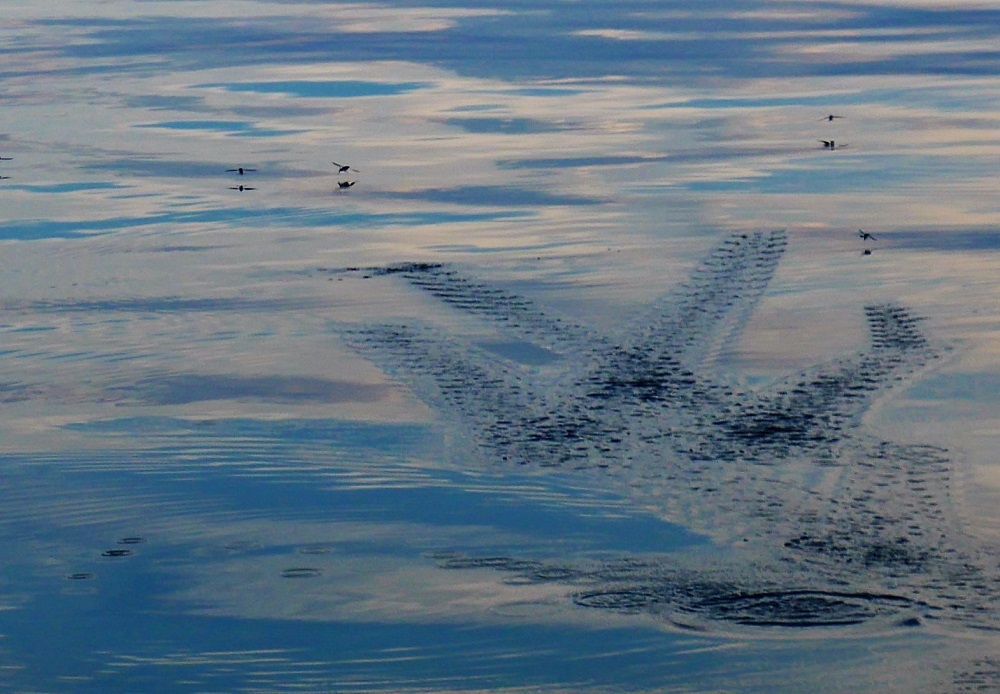
The Arafura Sea (between Australia and New Guinea) is an amazing place. Occupying about 250,000 square km, it was low-lying land during the last ice age when the ancestors of the aboriginals wandered across to settle Australia. Nowadays it is a shallow sea, 30-80 m deep, which we spent four days making our way slowly across. It is recognised as one of the richest marine fisheries in the world and as we moved along the glassy, windless surface large schools of panicking flying fish rushed away from the boat, little glittering fish-birds which, extending their wings, hovered through the air for tens to hundreds of metres just above the water surface before they exhausted splashed back in as gravity overcame the uplift of their wings.
Flying fish take-off.The flight of the fish – gliding above the glassy sea.Widespread flying fish panic as we approach.
Large groups of dolphins accompanied us for hours, providing a welcome distraction from the passage monotony. A long sea snake popped up for air, its wriggly body slithered along the water surface between our hulls before it indignantly disappeared back down again.
Lukie on dolphin watch.Expertly bow riding.
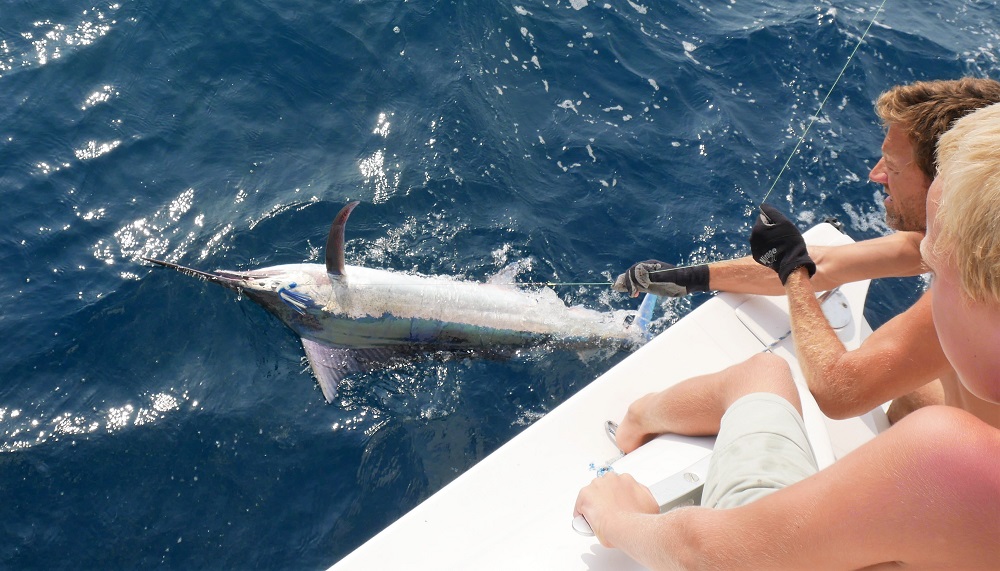
On a day with light winds we caught a marlin whilst sailing along at 4-5 knots. It offered little resistance and David easily reeled it in until it was close enough to the boat for us to release it again.
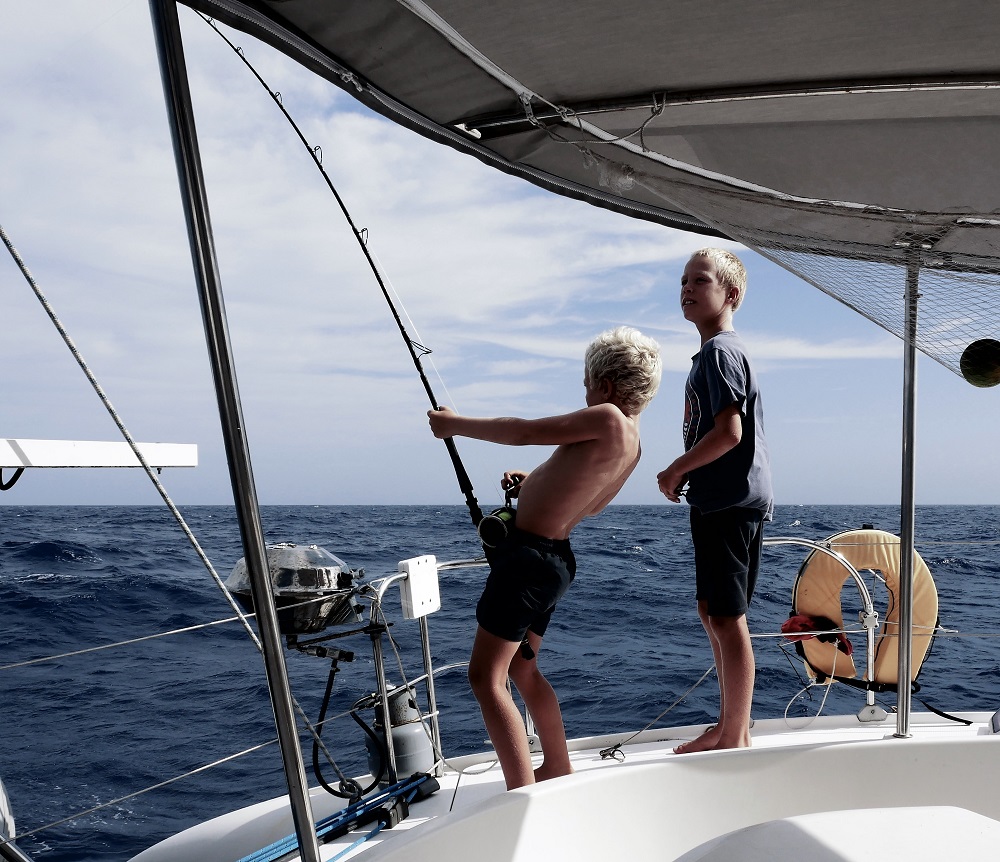
The young men and the sea.
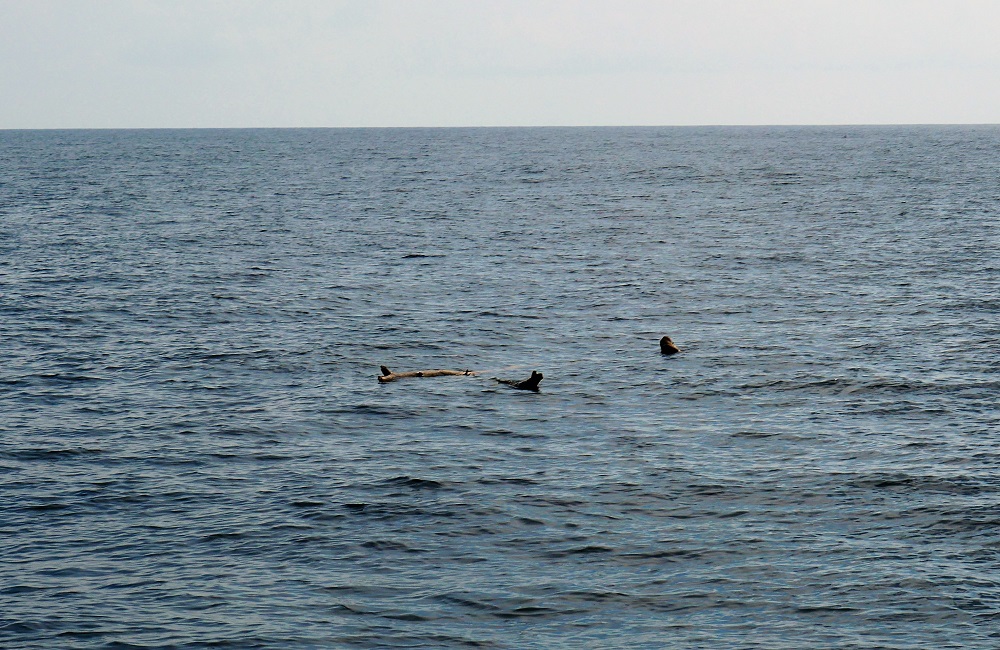
It is just as well that the waters were calm and the winds light. The waters off New Guinea are famously full of huge logs that have washed into the sea from rivers raging through logging country on the mainland, and the flat waters helped us spot them and swerve to avoid. One morning we didn’t get out of the way fast enough and hit a large log which split in half as it went under the starboard hull. David jumped in to check for damage and fortunately everything was intact – the last thing we need is to lose another propeller.
Sneaky logs hide just below the surface.
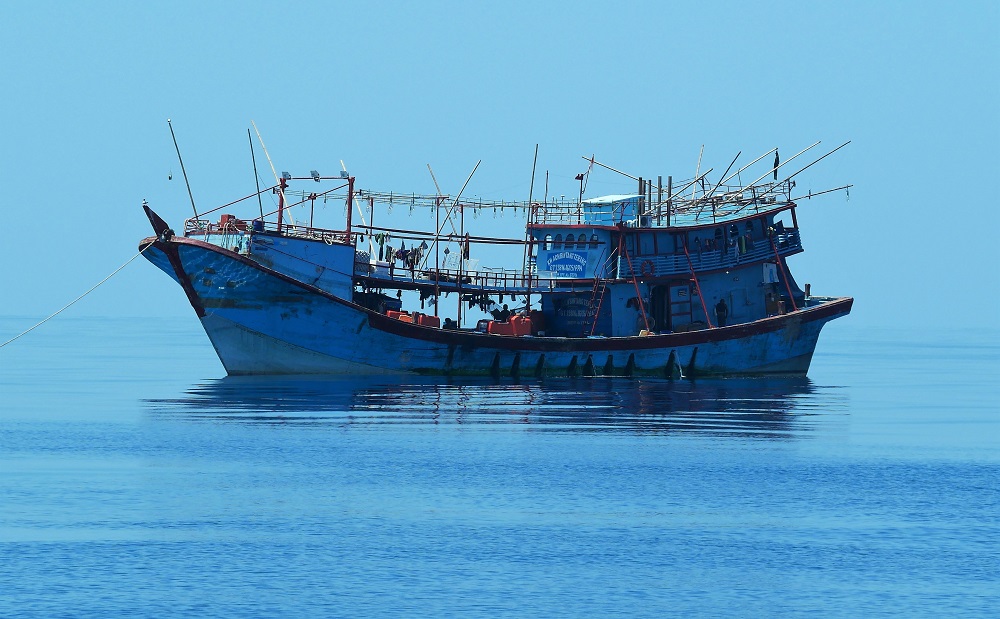
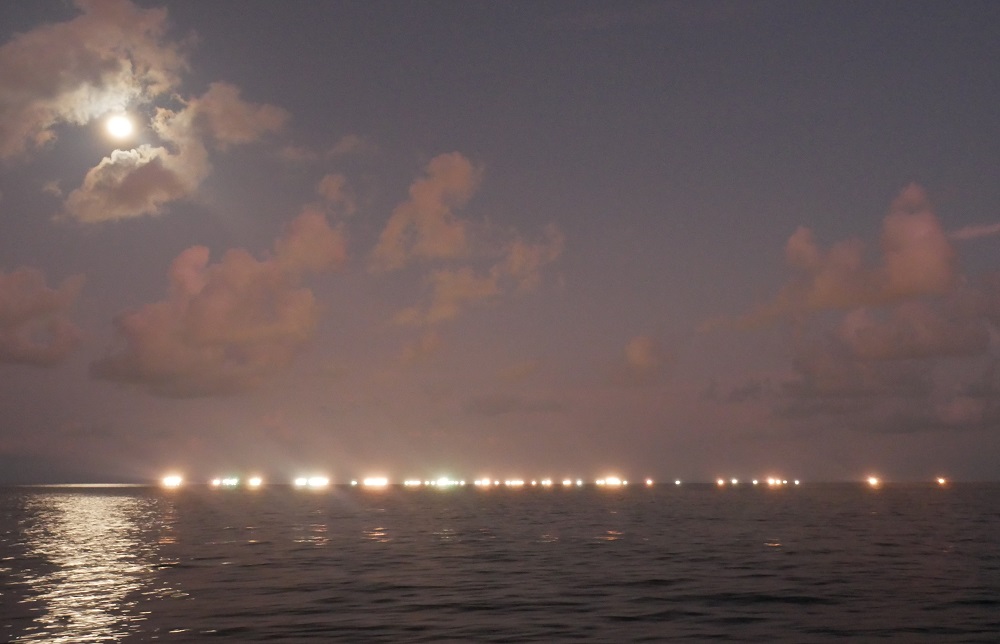
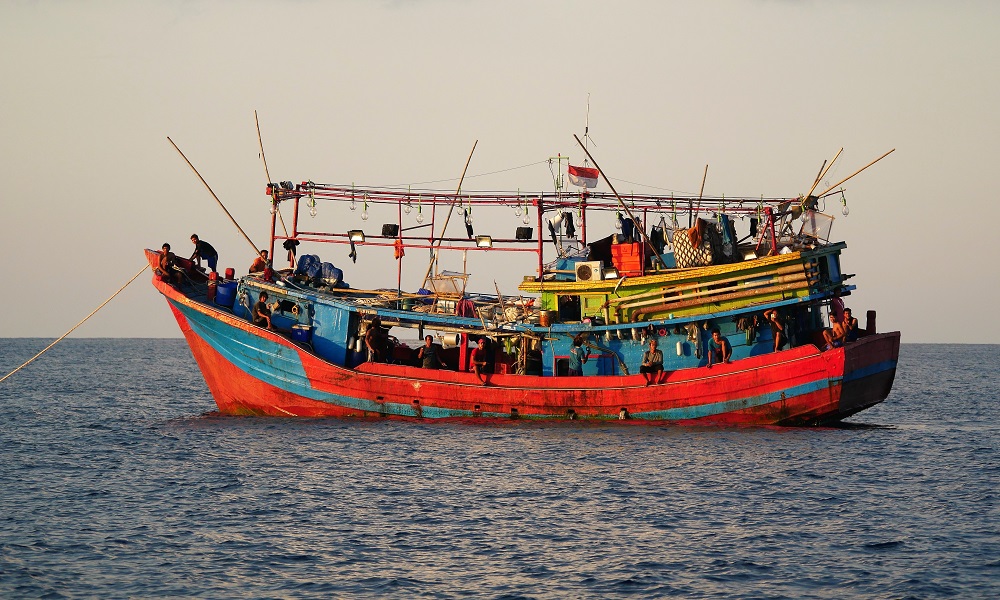
There were buoys too, low-lying dark blobs that we only spotted as they were just upon us. And as we reached a shallow (30-40 m) outcrop that goes on for 40-odd miles the squid boats started appearing. Anchored to the seabed during the day for the crew to sleep they were dotted a few miles apart, and soon the radar screen was alight with their reflections, yellow blobs everywhere. We counted hundreds just along our little route, all immobile, waiting for the night to start so they could commence fishing. As the sun went down they raised anchor and lit up brightly, filling the line of the horizon with glowing stars, the glow of a city of squid hunters.
A sea full of squid boats.
A sea of sparkles as the squid boats lit up the sky at night.The moon and the squid boats dotting the horizon in the Arafura Sea.
Without wind the passage turned unpleasantly hot, the searing hot sun in a cloudless sky turning our world into a formidable oven. We were hot and bothered – sweaty and flushed, our skin discoloured by the layers and layers of sunscreen we slathered on. This place was made for people with black skin, not pinkies like us. At night we managed to sleep under the whirring fans, evaporation cooling our sweat-soaked bodies.
The sun is setting – getting ready to fish.
On our eighth day as we approached the Kai Islands of south-eastern Indonesia we were welcomed by floating rubbish. It started sporadically with a welcoming committee of cardboard sheets and styrofoam bits appearing about 50 miles offshore and increased steadily in volume and variety as we neared the islands, until towards the end of the afternoon we entered the thick wads of floating plastic garbage, cardboard, and the occasional dead animal covering the water surface of the port of Tual. Amidst the stinking mess we anchored up and started readying for the bureaucratic hell of Indonesian officialdom that awaited us on checking in.
Tual, Indonesia. Floating plastic everywhere.
We are grateful to be stationary and for the prospect of a full night’s sleep. In just over a week we’ve moved from Melanesia to South-East Asia, and ahead lies all the adventures of a new region to explore. As soon as we are through the checking in procedure we will try to find a rubbish-free corner of some remote island to enjoy. But first we need some sleep.
The last place before Port Moresby we have been was in the Louisiades and I got a lot of pictures from the amazing reefs. One coral bommie we went to had a tunnel going the whole way through and coming out on the other side and in the very middle. Inside the tunnels, there were bazillions and trillions of fish that were the size of my fingernail.
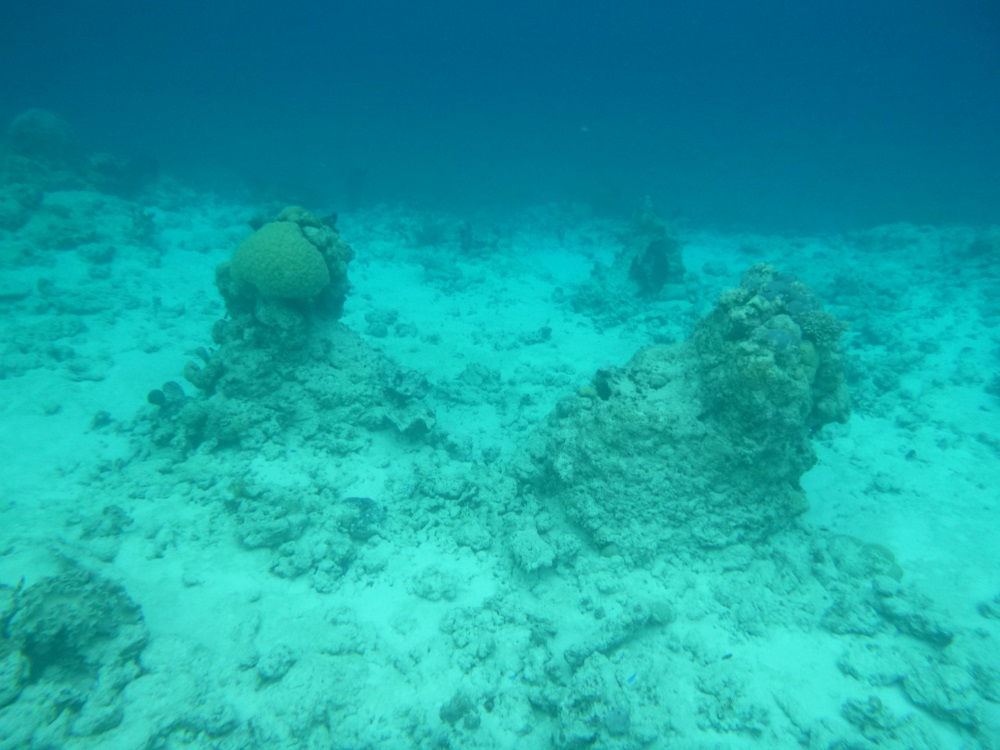
Coral stalks.Here fishie, fishie, fishie…
We went to a place in the Louisiades where we snorkelled a plane wreck. The plane was from world war 2 and it was shot down by the British. The plane was covered in coral and fish that like to bite you. I played with the biting fish a lot.
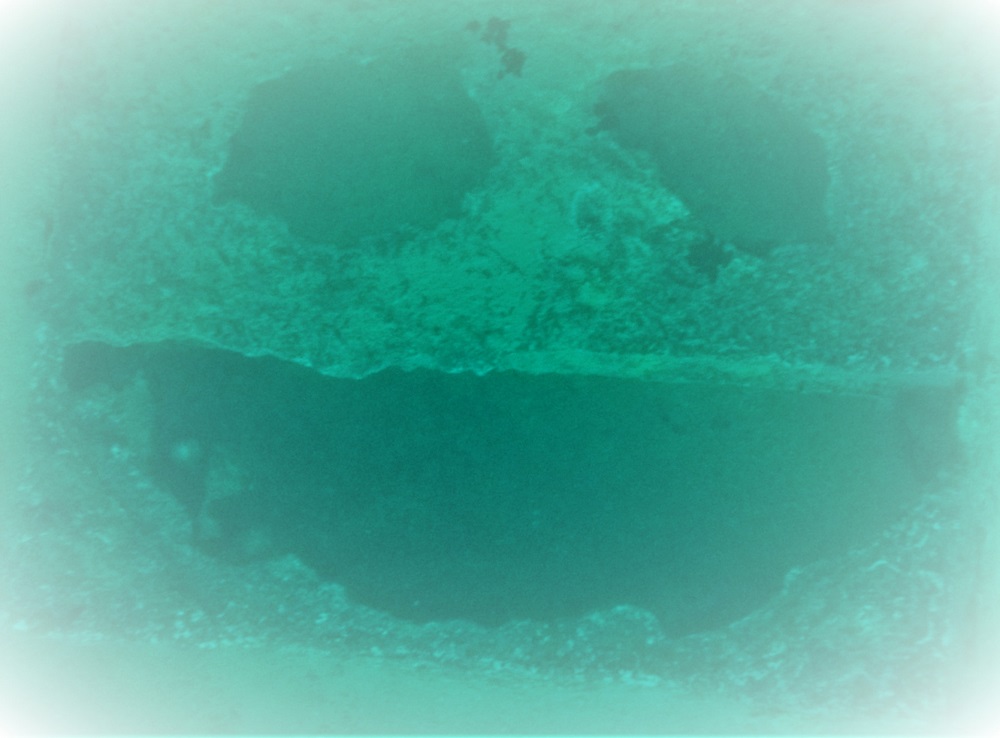
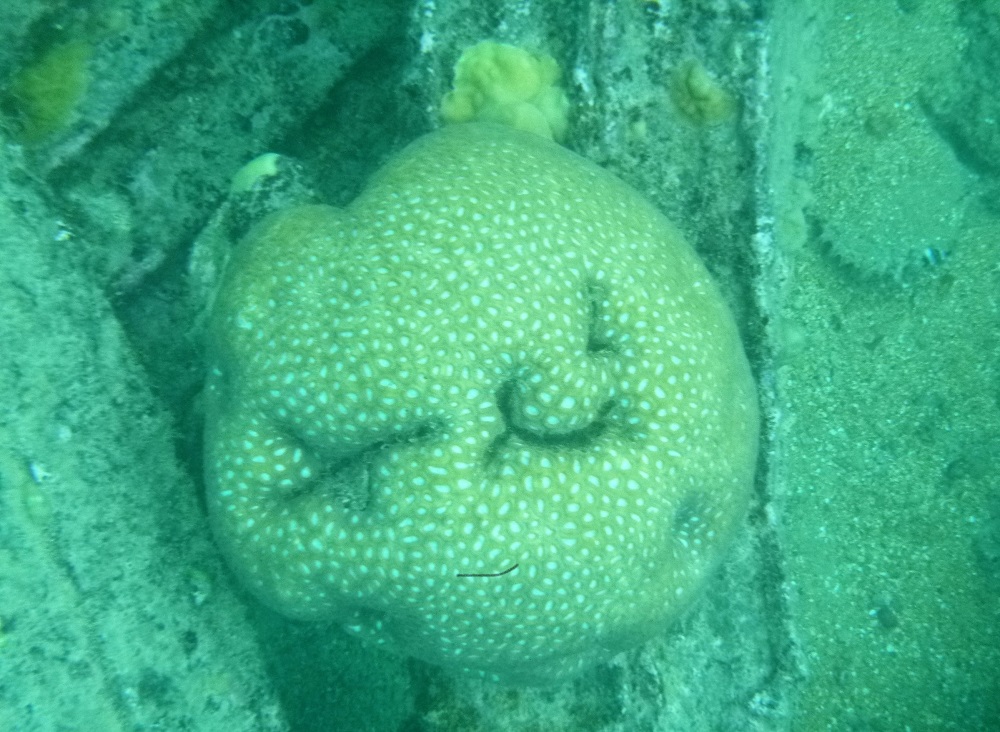
Biting clownfish.This is a random brain coral that had eyes and a mouth
We are now in an Indonesian city called Tual. Most of the people on shore have never seen a white skinned person. When we went ashore people were taking pictures and selfies with me, Lukie and our friends from So What. We had a plan to charge them 5 dollars for a picture.
The king of the sea.Dirty water colliding with clean water in Vanuatu.BYEEEEEEEEEEEEEEEEEEEEEEEEEEEEEEEEEEEEEEEEEEEEEEEEEEEEEEEEEEEEEEEEEE!
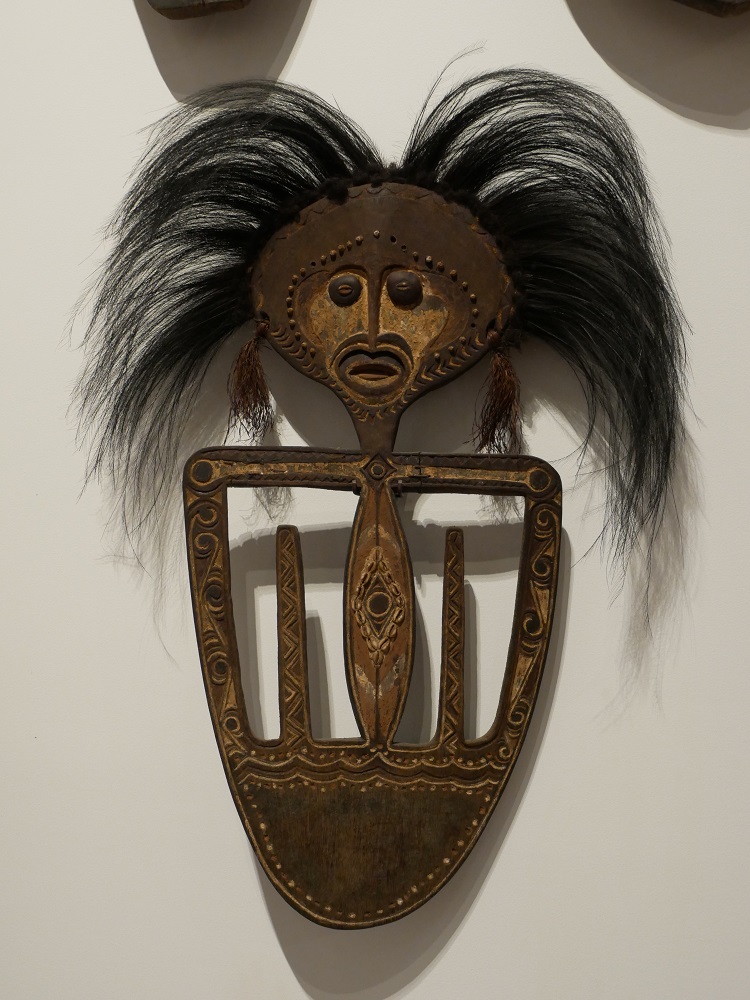
Grimacing faces – circumcision mask displayed at the Papua New Guinea National Museum.
When we left the Louisiades our port propeller disappeared. It just fell off, with no warning and leaving no trace. We think it happened on the second day of the passage.
This is bad news. With only one engine we have very little manoeuvrability. The next stage of our trip passes through the Torres Strait, the bit of ocean that separates northern-most Australia from Papua New Guinea. The Torres Strait is a tricky piece of water to get through. It is shallow (7-15 m) and narrow and has a busy shipping channel running through it. It is ravaged by strong tidal currents and bordered by treacherous coral reefs to the north and south. We need good weather, favourable winds, rested crew and two well-functioning engines to take on the Torres Strait. We scheduled our arrival in Port Moresby for early November to ensure that we have enough time to wait for a good weather window before the onset of the Indonesian monsoon. Once the monsoon sets in (normally in December), the winds will turn and we won’t be able to sail through the Strait.
We discovered the prop was gone on the third day of the passage when we switched on the engines to take the boat into the wind so that we could hoist the mainsail after sailing only under genoa for the first couple of days. David jumped in the water immediately, and to his chagrin saw that the entire prop was gone, only the grooved shaft remaining.
Now, propellers don’t just fall off – they may get damaged if you hit a reef or wind a rope around them, but they most certainly should stay in place. This prop had only done 400 hours of engine time and was still under warranty from when it was installed by a professional outfit in New Zealand less than a year ago.
Frustrated and apprehensive about having to try to source a new prop in limited time in a third world country, we arrived late afternoon in the blazing hot sun at the Royal Papua Marina in Port Moresby, the capital of Papua New Guinea.
Mainland Papua New Guinea is a notoriously dangerous place. Lawlessness, tribal warfare, gangs, random violence, disease (malaria, yellow fever, Japanese encephalitis, typhoid, cholera, intestinal parasites, zika virus), limited health care, and widespread government corruption makes it a particularly unpleasant place to live and to visit, and not a spot we would pick for staying a while to get spare parts.
Port Moresby is famously dodgy, with gun-toting local raskol (literally rascal, the tok pisin – PNG pidgin – for criminal) bands running amok, terrorising the general public with no regard to the largely ineffective local police force. Rated one of the ten most dangerous cities in the world, Port Moresby is home to about 300,000 people, of which 80% are estimated to be unemployed. Slums abound and the gulf between rich and poor leads to desperation with associated incredibly high rates of violence.
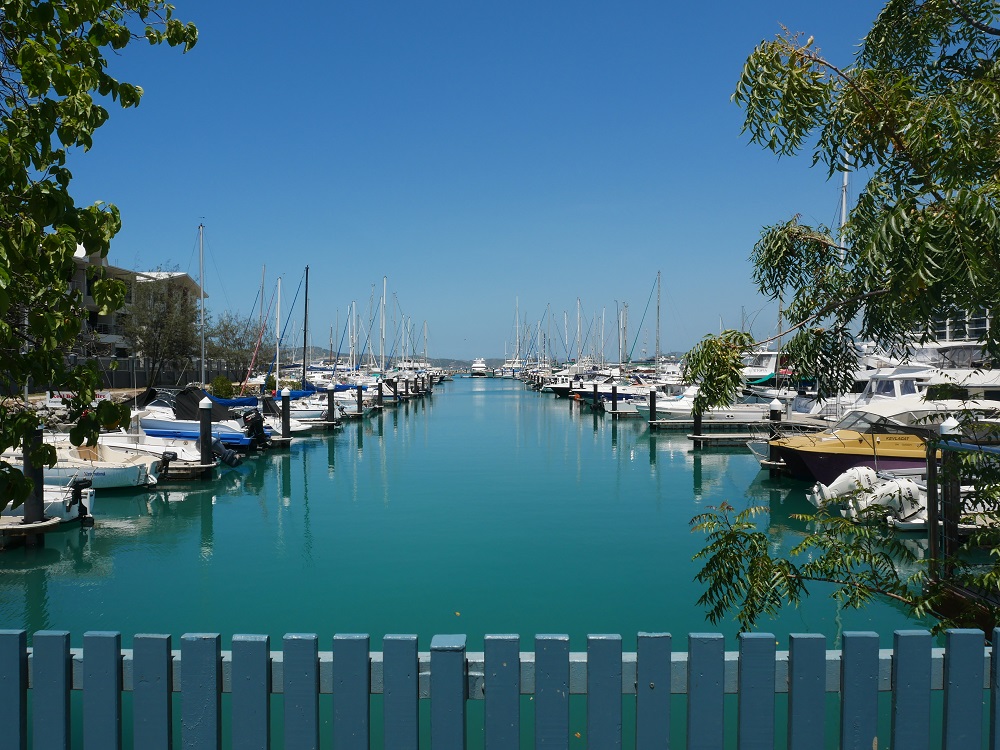
Knowing about these dangers we considered avoiding the stop but realising that we need the best possible weather to go through the Strait we decided to book a berth at the exclusive Royal Papua Yacht Club. The Yacht Club is a gated and guarded marina complex, a manicured waterfront home to the shining yachts of the capital’s well-to-do, flanked by expensive waterfront apartment blocks safely situated behind their own heavily guarded gates. Uniformed guards are everywhere in the marina, their shiny shoes and crisp white shirts with golden buttons reflecting the relentless sun as they patrol the grounds and stand guard in pairs at every external gate and doorway.
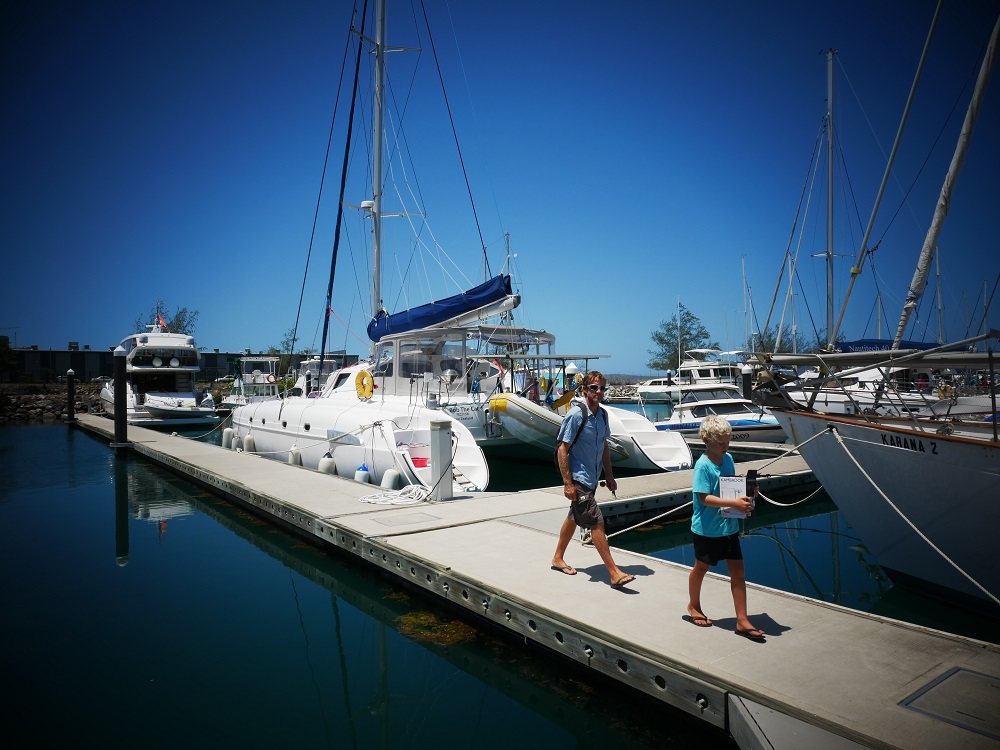
Bob in the Royal Papua Yacht Club Marina.
The marina is an awkwardly colonial place, reminding me of expensive hotels in larger African cities. The yacht club is huge and shiny, full of uniformed waiters that open doors, addressing us as Sir and Madam. Cleaners are everywhere, busily mopping the bathrooms, sweeping the concrete, shining the mahogany bar and polishing the windows, patiently wiping our kids’ fingerprints from the flawless glass doors at least 50 times a day. Heavily opulent Christmas decorations of green, gold and red adorn the pillars and ceiling arches, signalling the lavish celebrations to come. A high-end dining option in Port Moresby, the Yacht Club bar and restaurant is graced by wealthy businessmen, who lunch head-to-head discussing important matters over their stacked plates, their dark shirts stretched over bulging executive bellies. When the meal is done they get to their feet and finish lucrative deals with firm handshakes. Australians in sharp business suits strut importantly through the complex, carrying black leather briefcases and talking into cellphones with loud accents. It is a place where important leaders meet and in this country of gender inequality a male-only premise – the only women here are the waitresses and office staff.
Officially the worst city in the world to be a woman, Papua New Guinea has a dark record for gender equality. It is the world’s worst place for gender-based violence and it is estimated that in their lifetime about 70% of PNG women experience rape or assault. The police do little about domestic violence and alcohol intake is considered reason to excuse a man from charges. Widespread belief in black magic provides an easy out for any man who wants revenge, leading to epidemics of witch hunts. According to Oxfam, over 1000 witch hunts take place in Papua New Guinea each year, and the UN estimates that 200 of these result in witch killings (that’s per year!); innocent women brutally and cruelly killed by suspicious neighbours or dissatisfied husbands. Because of the widespread belief in magic, most witch killings are not reported, and of those that are reported to the police, most remain uninvestigated. The killing of witches has carried the death penalty since 2013 when the widely publicised killing of 20-year-old Kepari Leniata occurred. Accused of using sorcery to kill a neighbour’s young boy, Leniata was publicly stripped, tortured, and burned alive in a dump area of a busy slum. Excited spectators gathered in their hundreds on the street corners, egging on the mob violating her, filming her punishment and proudly sharing the graphic images on social media.
In 2017, Leniata’s six-year-old daughter was brutally assaulted by a mob of men who accused her of plotting to eat her neighbour’s heart in a quest to steal his virility. The little girl was tortured for days before a US aid worker managed to intervene and remove her.
Investigating 1440 cases of witch torture and killings over twenty years, the Australian National University found that less than one per cent of perpetrators were successfully prosecuted. The local law enforcement is so biased and the violence so widespread and insidious that real change will take many, many years.
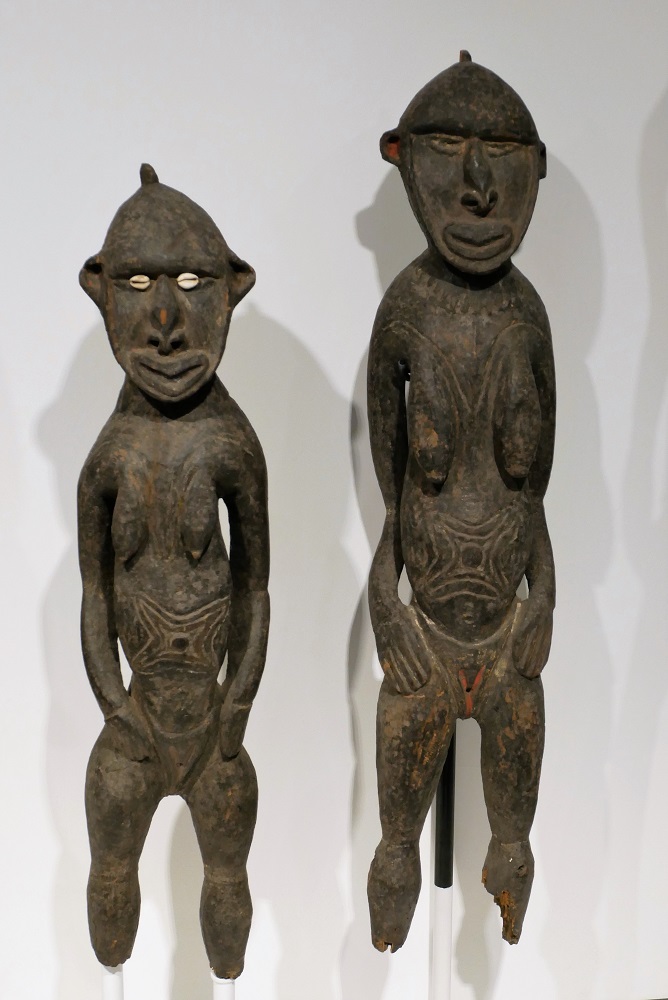
Traditional carved female fertility statues.
Given the harrowing violence statistics, it is difficult to assess whether it is safe for us to venture outside of the marina compound. A number of expats live full time on boats in the marina (accommodation is hard to find and very expensive in Port Moresby, making a yacht parked in the marina an attractive option) and they all warn us from walking outside the safety of the gates, using public transport or hailing taxis on the street.
The peaceful but very hot Royal Papua Yacht Club Marina – dare we venture outside the gate?
“It is not safe,” says a blonde our age. Sitting eating her brunch of poached eggs with hollandaise over a toasted muffin with a side of wilted spinach in the Royal Yacht Club restaurant, she gestures dismissively with her hands when we ask whether we should take a taxi to the National Museum. “You are a target, and it is not worth it.” She lifts her sunglasses to the top of her head and eyes us seriously as if to stress her point with eye contact.
“Definitely,” weighs in an elderly gentleman with a weather-beaten face on her right. “There is so much violence here. They hold up cars using roadblocks and will kill just to get your handbag. We hear reports every day.” He wipes his sweaty brow with the back of his hand and adjusts the collar of his faded pink polo-shirt before tucking back into his sausages and scrambled eggs.
“So what do we do?” I ask. “How do I get to the grocery store – we have to provision if we’re ever going to leave here?”
“I can drive you,” offers an Australian businessman who lives on a boat near our berth. “I’m going to the supermarket this afternoon. Just come and get me on my boat. Please, please do not try to walk there or hail a taxi on the street.”
At that stage I’ve already walked the 1 km to the supermarket twice in the company of Greg and Jenny from SV So What. A little uneasy we rushed along on the pavement lining the wide boulevard, suspiciously eyeing up all approaching men, mentally assessing their raskol potential, ready to break into a run and sprint the last 500 m to breathlessly reach the safety of the Waterfront Shopping Mall where uniformed guards waited by the revolving doors. On these occasions we safely managed to hail taxis to take us and our copious shopping back to the marina. But I guess there is no knowing whether we were just lucky – it is difficult to buy into the expat hysteria but their concerns are echoed in the advice featuring on all websites we visit.
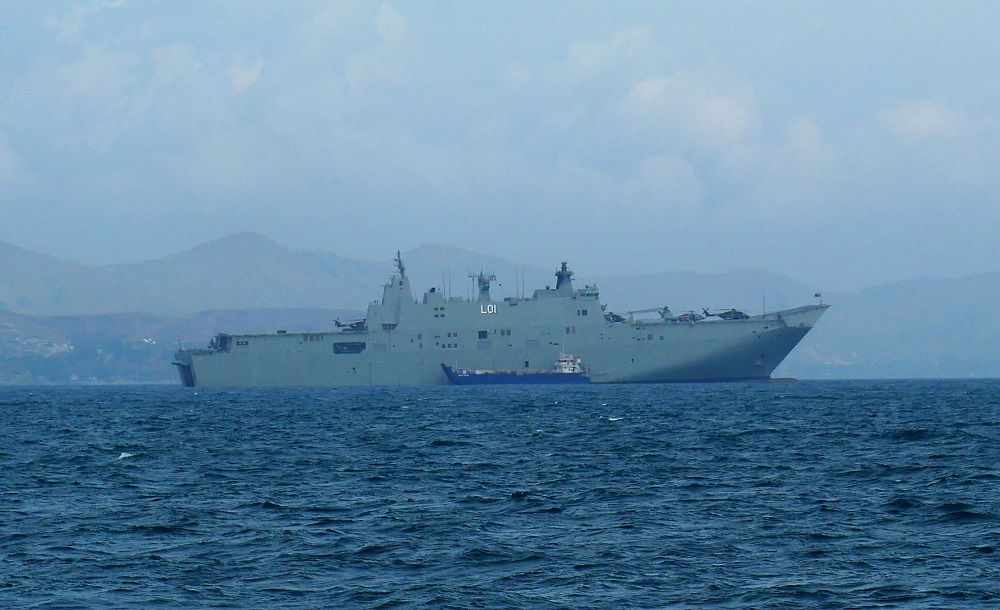
Our visit to Port Moresby coincides with the APEC Economic Forum, held in Papua New Guinea for the first time, to the great concern of the safety-conscious planners. Foreign dignitaries are arriving from every state and the city is crawling with military. The Australians have sent a huge warship, and the Americans their air force, and severe-looking muscular men with immobile pockmarked faces, army caps and mirror sunglasses, clad in camouflage uniforms, greatly outnumber civilians at all public venues. On the main streets, every tenth vehicle is a police car whose shrill sirens overwhelm other traffic noise day and night.
Australian warship in the port, sharply outlined against the hazy hills.
We ask Tracy Schreck, the aptly named expat general manager of Corps Security who is breakfasting with the marina residents, whether the APEC meeting and associated heightened security might make the city safer than usual at the moment?
“There are a couple of factors,” she responds, sitting back heavily in the garden chair of the breezy yacht club balcony. “The military presence is mainly to protect the delegates – they are not concerned about the safety of the general public.”
“Oh,” we say, chastened.
“But the police presence has definitely been ramped up and the public has been warned to toe the line,” she continues, flexing her tattooed shoulders. “Of course, the downside is that the APEC meeting is politically unpopular. They’ve spent millions shining up the city for foreign visitors, which many in the population are unhappy about. So there will be some uprising, some protests, in connection with the meetings.”
The APEC meeting is unpopular with everybody we speak to. In a country desperately in need of investment in health and education, spending millions on road upgrades and new buildings to impress foreign delegates seems absurd.
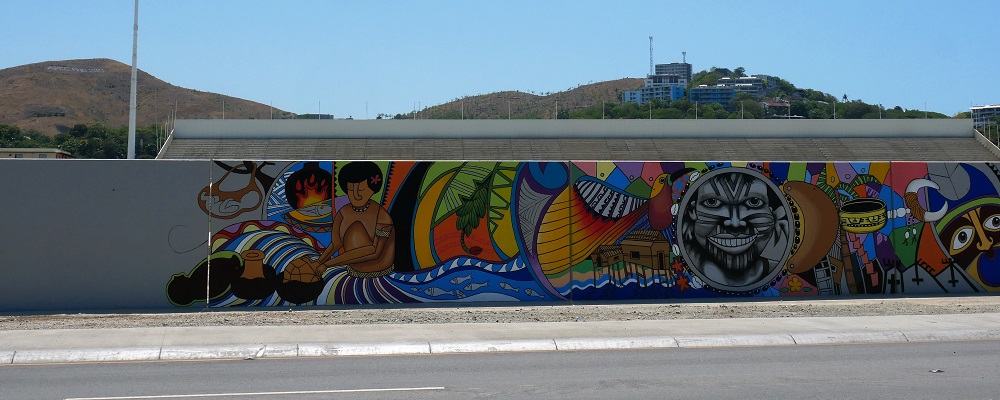
New roadside murals for APEC.
We want to take the kids to visit the National Museum, and after much deliberation we hire a ‘secure vehicle’ with driver from Tracy’s security firm. The car is a huge silver SUV with darkened windows driven by Simon, who wears a black uniform and dark imitation Ray Ban sunglasses, looking every inch the ex-military security guard. Simon is armed and a ‘duress button’ is installed in the vehicle, which if pressed will alert security headquarters from where a unit of armed guards will be dispatched to the duress location.
“Have you ever had to press the button?” I ask, leaning forward on the tan leather seat to speak over Simon’s shoulder.
“No,” he replies. “But they can see it’s a secure vehicle and know I am armed. So we are much less of a target than other vehicles.”
And so we sit in the dark car slowly cruising the busy streets, looking out over a city ready to explode. All shops have barred windows and shop car parks are protected by heavy metal gates opened and closed manually by the ever-present uniformed guards. Groups of bearded, dreadlocked men wearing rasta beanies loiter on every street corner, smoking and chatting. Workers in shop uniforms walk purposefully at the edge of the pavement, small bags worn around the neck banging against their chests, safe from pickpocketers. Women wearing loose long clothing walk hurriedly in groups, their heads down.
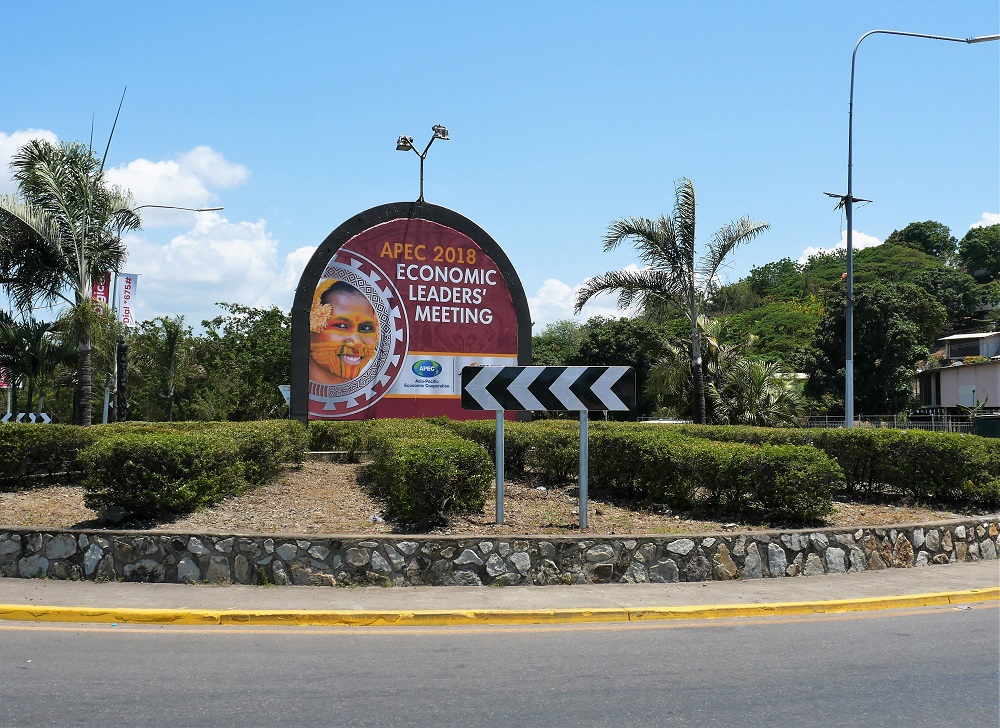
The city has been completely renovated in preparation for the APEC meeting. The roads have all been upgraded and are now smooth and wide. Every traffic circle is adorned with newly planted flowers, the arid soil around the plants carefully raked. Freshly painted murals featuring iconic Papuan and wider Pacific art adorn the concrete walls lining the streets, and brand new beautiful cultural statues stand proudly at the centre of every roundabout. Large banners advertising the APEC meeting hang pointedly from tall flag posts, the colourful posters proclaiming unity through diversity waving gently in the breeze, forming the backdrop of this city of fear.
Colourful APEC posters adorn every newly planted and finely raked roundabout.
Although women are always restricted compared to men, this is the first time I have felt my gender so keenly. I don’t enjoy being in a place where fear restricts my movements. Normally when we’re in a city I will get on with the provisioning and take the kids interesting places whilst David attends to boat repairs. Here, I keep having to ask David to accompany me to places I would normally be fine to go on my own – any trip outside the gated compound of the marina requires male company. It feels stifling and oppressive, and I wonder about the lives of the local women who have to spend their entire lives here.
I ask Rosemary, one of the Yacht Club waitresses, about going to the market by myself. Is it safe?
She laughs incredulously, hiccupping loudly. “No,” she shakes her head, still laughing, her cornrow braids glistening in the light. “No, it would not be safe for you to go alone. You need to take someone local, or at least go as a group.”
She is paid 4 Kina (NZ$2) per hour as a waitress and tells us that the Yacht Club is a strict employer.
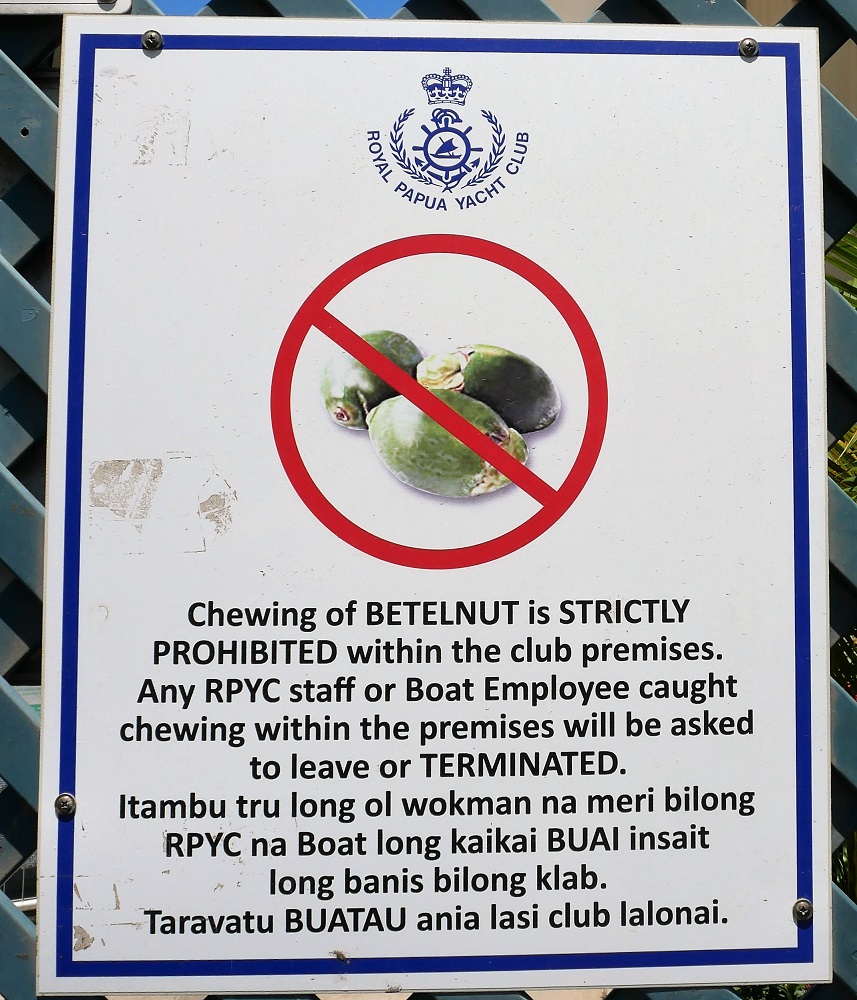
“If I am late for work, they turn me back at the gate,” she says quietly, eyeing the manager over my shoulder. “You are not allowed to smoke or to chew if you work here, they will terminate your employment if they find you chewing within the gates.” Her voice is deep and low, her English perfect.
No chewing allowed within the Royal Papua Yacht Club (RPYC).
She used to work as an intern for the Australian Embassy, who were paying for her to become educated in event management. Her life was looking promising, but then she became pregnant. Now she has two kids, the youngest 11 months old. Her husband is unemployed.
“It is not a happy situation at home,” she says. “But I try not to think about it when I’m here. It is not a great job, but it is a job.”
I smile sympathetically and feel guilty. The bill for the dinner we’re eating while I’m having the conversation with Rosemary comes to a total of 200 Kina for our family of four – it would take her more than a week to make enough money to take her family out for a meal here. Yesterday she was late for work and got turned back at the gate. She has no access to child care and has to catch three buses to make it here, making it hard for her to get here in the first place, never mind on time.
“The streets are busy at the moment,” she says. “There is police everywhere, it is making everyone nervous.”
She explains that the government has issued a warning: for the duration of the APEC summit, Port Moresby police will shoot to kill anyone causing trouble on the streets of the city.
“What kind of trouble?” I ask.
“Mainly drunkenness, but also anyone shouting or fighting,” she replies. “It is scary, you don’t want to be on the streets at the moment.”
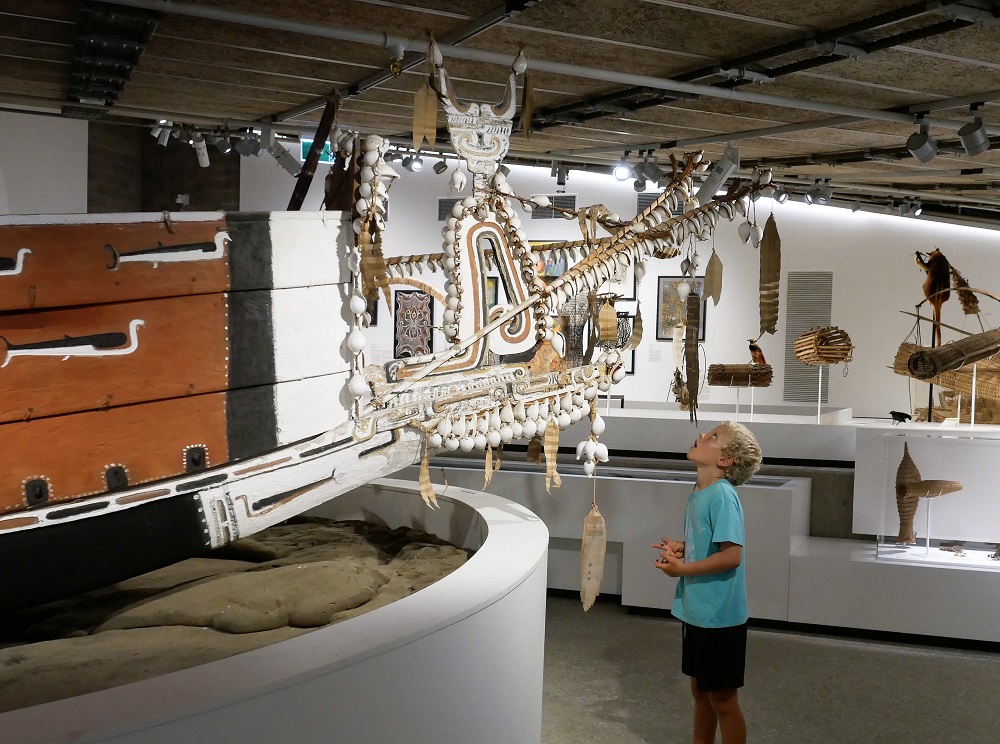
Lukie gazing up at a traditional sailing outrigger at the museum.
In the safety of the Corps Security car we manage to make it to the National Museum. Newly renovated for the APEC Summit, treasures from all areas of Papua New Guinea are elegantly displayed in the spacious building, cool spotlights and informative plaques highlighting treasured items. The museum is full of grimacing faces – masks and carvings – fashioned from wood and palm leaves, elaborately adorned with shells, feathers, shiny beetles and human hair.
One of the elaborate whole body masks shown at the National Museum.
The people of Papua New Guinea are incredibly diverse. First settled about 50,000 years ago, the steep topography of the country led to social isolation of individual tribes, and as a result the cultural variety exceeds that of any other place on Earth. When the Germans colonised Papua New Guinea in the late 1800s, the more than 800 perpetually warring tribes suddenly found themselves under colonial rule. Many tribes remained undiscovered until the 1930s, and on the Indonesian side of New Guinea, uncontacted tribes still live in the highlands. Nowadays there are more than 800 languages (languages, not dialects) spoken in Papua New Guinea, a country of about 8 million people.
It is a country steeped in magic and spirits, and animism, ancestor worship and sorcery still strongly feature in daily belief systems. The museum shows skull boards, used by headhunters to display their trophies. Up to about 100 years ago many tribes still required a young man had to get a skull for his initiation rite, after which he was allowed to carve his skull board, which he maintained throughout his life as a sacred display of enemies defeated.
Traditional skull rack.
Masks were used for all formal occasions as media for harnessing ancestral spirits. The museum shows the special masks worn for circumcision rituals as well as the elaborately adorned whole-body masks used for initiation rites. These are amazing, featuring human and spirit heads, as well as totemic animals like crocodiles, cassowaries and parrots.
As we walk through the quiet halls of the museum I reflect that perhaps the current mainland Papua New Guinean state of extreme violence is the modern expression of the ancient cultures that sparked headhunting and cannibalistic orgies. Poverty and the desperation borne from extreme inequality are strong factors too, but there are other countries in the world where the divide between rich and poor is a chasm of unimaginable proportion (India, for example), countries where there is crime but not the level of horrific and casual violence reported here.
Hamstrung by fear of leaving the secure compound and worried about the impending onset of the monsoon and associated easterly winds, we are keen to leave as soon as possible, and impatiently await the arrival of the new propeller. David has installed an old propeller to keep us safe for the time being, but sending the new propeller to Port Moresby is the only option – we can’t get it sent to Indonesia because of the legendary bureaucracy of Indonesian customs. It has to be sent from Denmark to New Zealand and then on to Port Moresby, and we receive daily updates on its progress across the world from the New Zealand agent. The outfit that installed the prop refuses to honour the warranty, arguing that they have no evidence that we didn’t cause the damage in some way ourselves. We argue that the clean shaft shows that there was no impact or strain associated with its disappearance. They admit to putting a few extra spacers in when fitting the prop. We quote the guidelines for installation that specifically state only to use the provided parts. They concede that perhaps they are at fault and that maybe the reason the port propeller fell off and the starboard propeller is abnormally mobile has something to do with those spacers. The emails fly backwards and forwards between continents, each new exchange raising or lowering our mood according to content.
The manager of DHL Port Moresby is another resident of the Royal Papua Yacht Club Marina and he promises to fast-track the arrival procedure and get the parcel containing the propeller to us as soon as it arrives.
It is incredibly hot here. Staying in a marina means that we don’t get the breeze but do get mosquitoes, and so we have to close the boat up every night. David installs small electrical fans over every bed and we leave them on hurricane force overnight, their gentle breeze cooling our sweaty bodies. Every step outside is an effort and we are constantly dripping with sweat, fighting hard to stay hydrated. It is too hot to sit on the boat, so we spend much of our time in the air-conditioning of the Yacht Club Lounge, where after a couple of days I know every cheesy 1980s tune on the playlist (‘Ebony and Ivory’ by Paul McCartney. ‘Physical’ by Olivia Newton-John. Anything ever recorded by Elton John).
While we wait we avail ourselves of the luxuries of marina life. We fill up our water tank from the dock (rainwater – it tastes heavenly after six months of distilled water-maker water), we wash load after load of sweaty t-shirts in the laundry at the marina. We have showers every day, and use shore power to run our fridge 24/7 and our newly installed fans overnight, extravagant water and electricity usage we could never get away with whilst on anchor where it all has to be powered by solar.
Finally, after nine days the prop finally arrives on Thursday evening. We swiftly check out of Papua New Guinea and depart on sunny Friday morning, relieved to leave the hottest and most dangerous location we’ve ever been to in our lives. Ahead lies the trials and tribulations of the Torres Strait; the passage that will take us from here to Tual in Indonesia will take 7-10 days, and we are keen to get going.
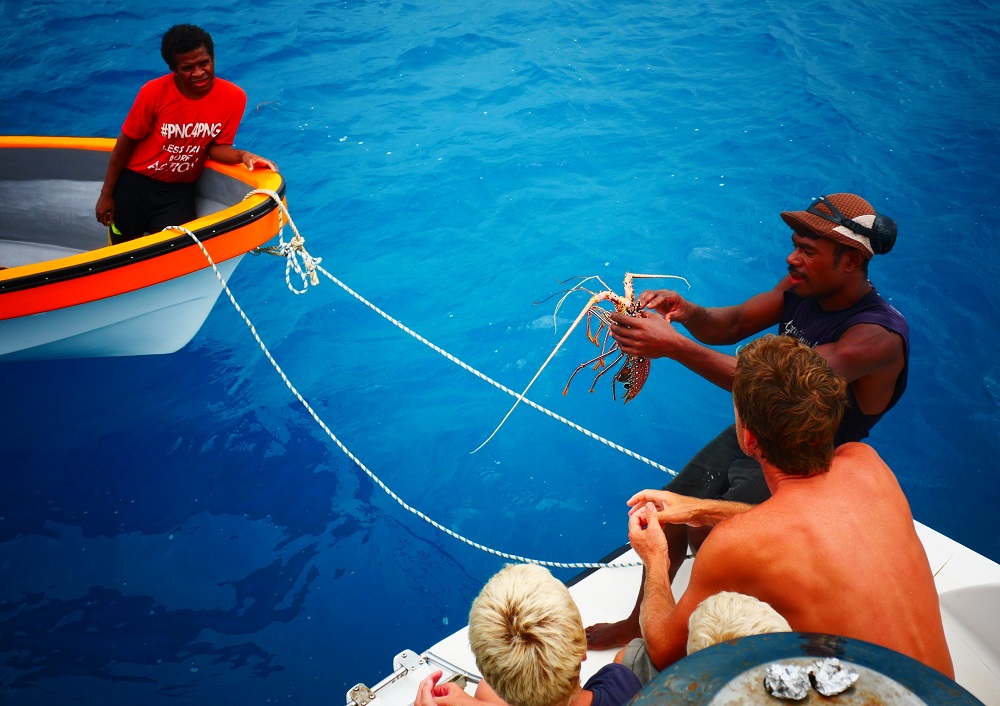
Trading for lobster with Beche-de-Mer divers. Nigel got a used dive mask for five lobsters.
The Papua New Guinean Louisiade archipelago is a cruiser’s paradise of calm lagoons, white beaches, azure waters, short day sails, good fishing and friendly locals. It is the essence of tropical islands with all the magic of endless summer and abundant seas surrounding us until we’re dizzy with 360 degrees of searing sunshine and serene atoll beauty. Small, green conical volcanic islands are dotted throughout the archipelago, surrounded by azure reef-lined lagoons featuring hundreds of smaller white-sand islets bearing coconut palms, piles of driftwood and a bit of hinterland bush. The nearshore water is turquoise, the depths beyond the reef a deep dark blue, only interrupted by the dark outline of colourful coral reefs emerging from the glaringly white sand bottom.
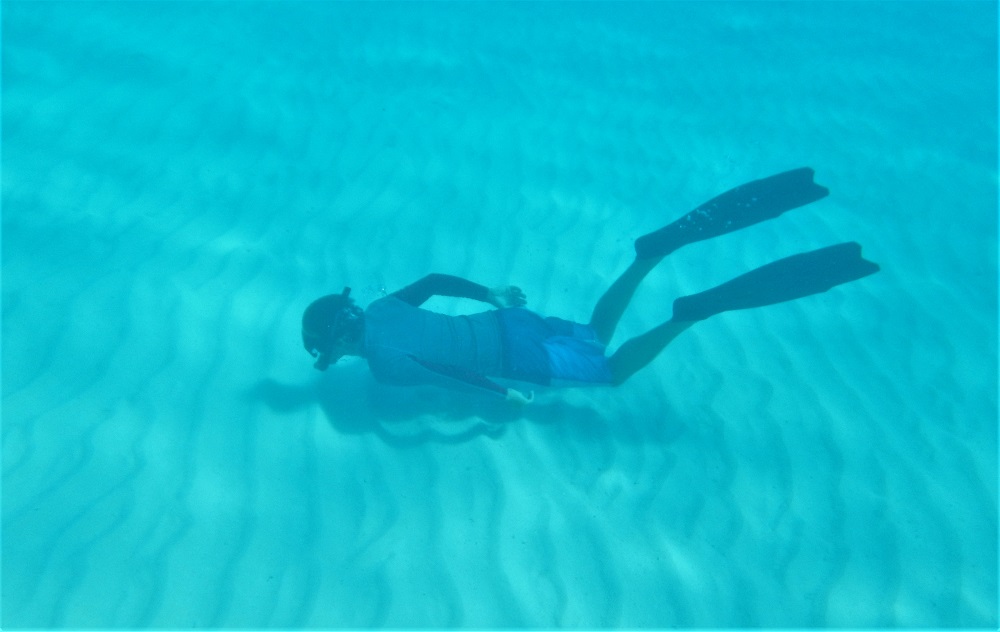
David swimming over the whitest sand bottom we’ve ever seen.
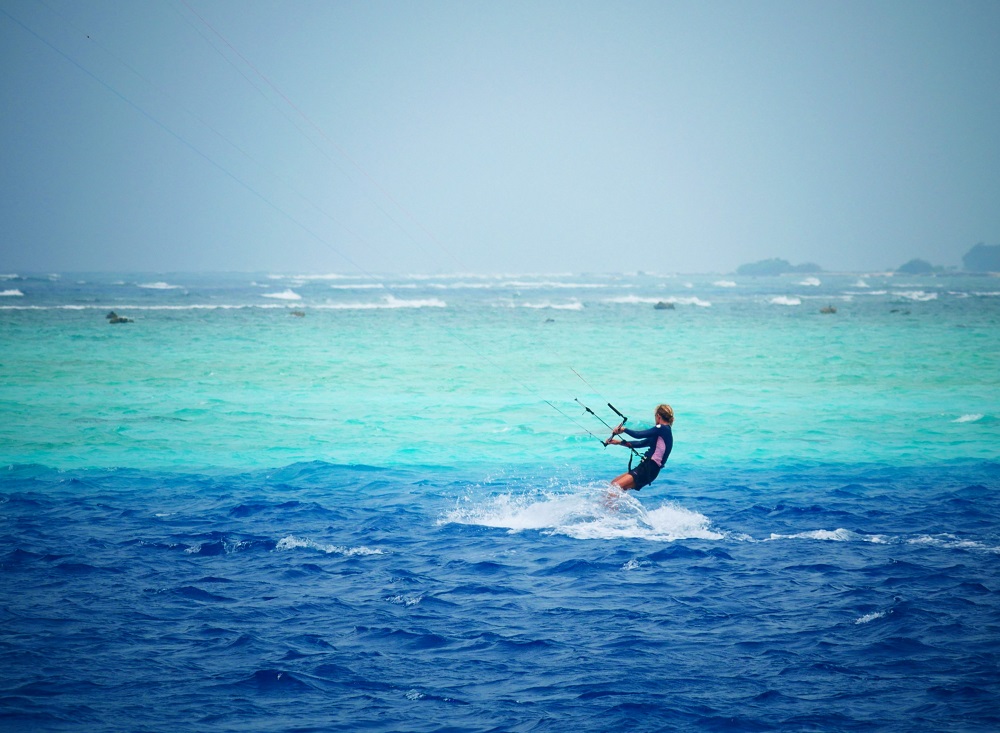
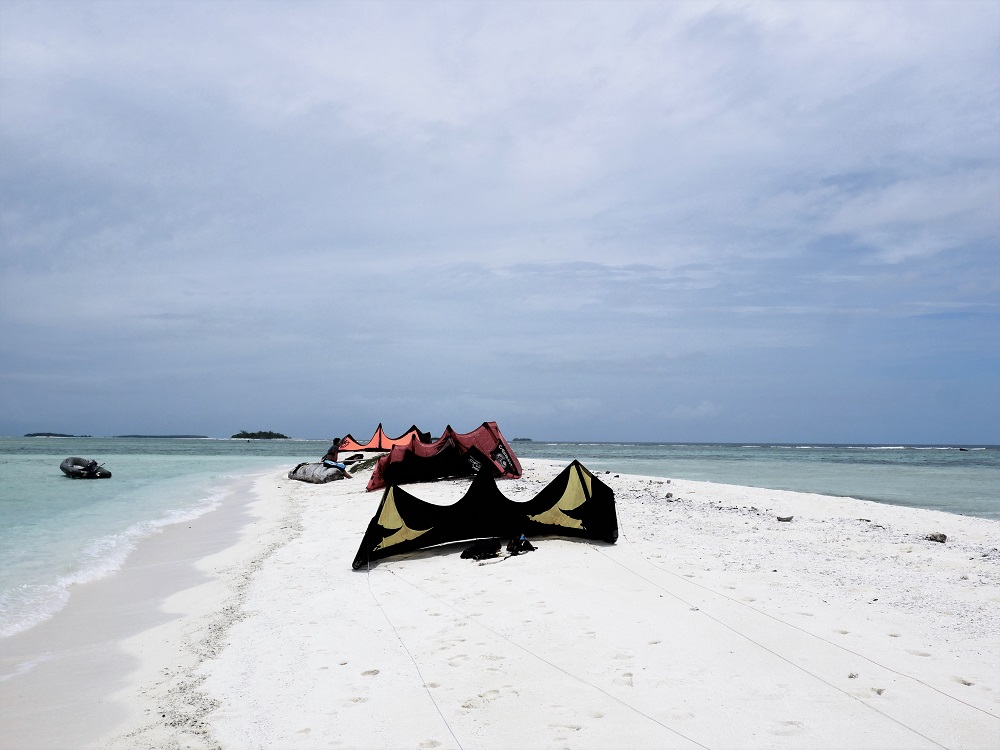
The place is littered with sandspits and graced by the tradewinds making the Louisiades an ideal spot for kitesurfing: the white beaches are great locations to launch from, the clear, warm, shallow waters of endless downwind drift ideal for the children to kite in.
The Beche-de-Mer divers come to watch us kitesurf, whooping and hollering with loud applause.Me kiting towards the shallows.Kite camp on a sandspit.
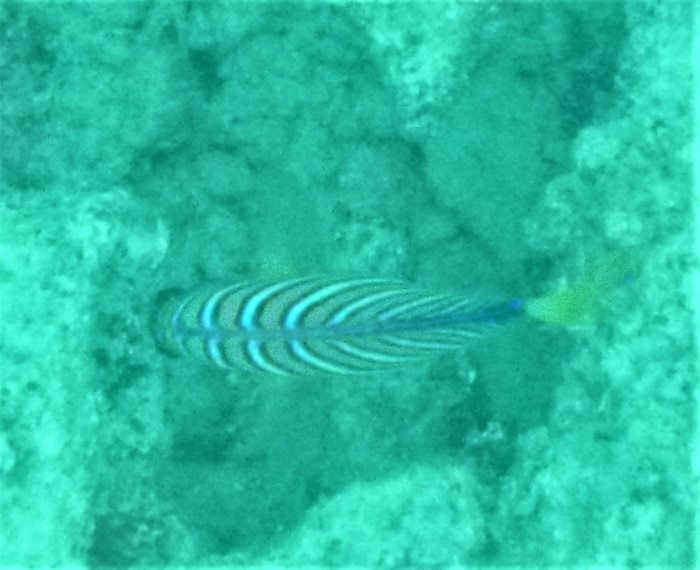
The snorkelling is great too. At the concerningly named Wuri Wuri Pass, we swim over scenic coral gardens populated by clouds of fish. In the bay off Panapompom Island lies a small wreck of a Japanese fighter plane from World War II. The Japanese occupied the neighbouring small island and when a US warship entered the bay, fighting ensued. Old men from the village still remember the event. A small plane was shot down during the skirmish and lies intact in 2 m of water. It is a lovely site – the plane is covered in anemones and aggressive damselfish vigorously defend their territory as we descend upon them: unfazed by our size they actively chase us and bite viciously with their small sharp pointy teeth.
Propeller of the plane wreck.
Trade is part of the culture in this tropical paradise. The Papuan currency, the Kina, is named after the Kina shell, a beautiful lustrous pearl shell which used to be treasured as currency. Although money has been around in the islands for a while, shells are still used as currency in remote areas, and for island communities trading is a long-held tradition essential for forming neighbourly relationships.
The kina shell.
This fundamental forming of mutually beneficial relationships extends to yachties too. As one local puts it: ‘We make friends with yachties by trading with them.’
And so, as soon as we’re anchored near a village, the traders come in droves. Outboard-driven longboats full of dripping divers wanting to trade lobsters for old dive masks, fins, or snorkels. Spindly outrigger canoes tied together with palm string manoeuvered by elderly men asking for AA batteries, magazines or pens in exchange for garden produce, or by women and wide-eyed half-naked small children trading finely woven pandanus baskets and fruit for clothes, yeast, sugar and rice. We have brought soccer balls and school books, pencils, and pads for the children, which we dole out at any opportunity.
We never turn a trade down, and so accumulate a lot of finely woven baskets, but we do try asking for the stuff that we actually need.
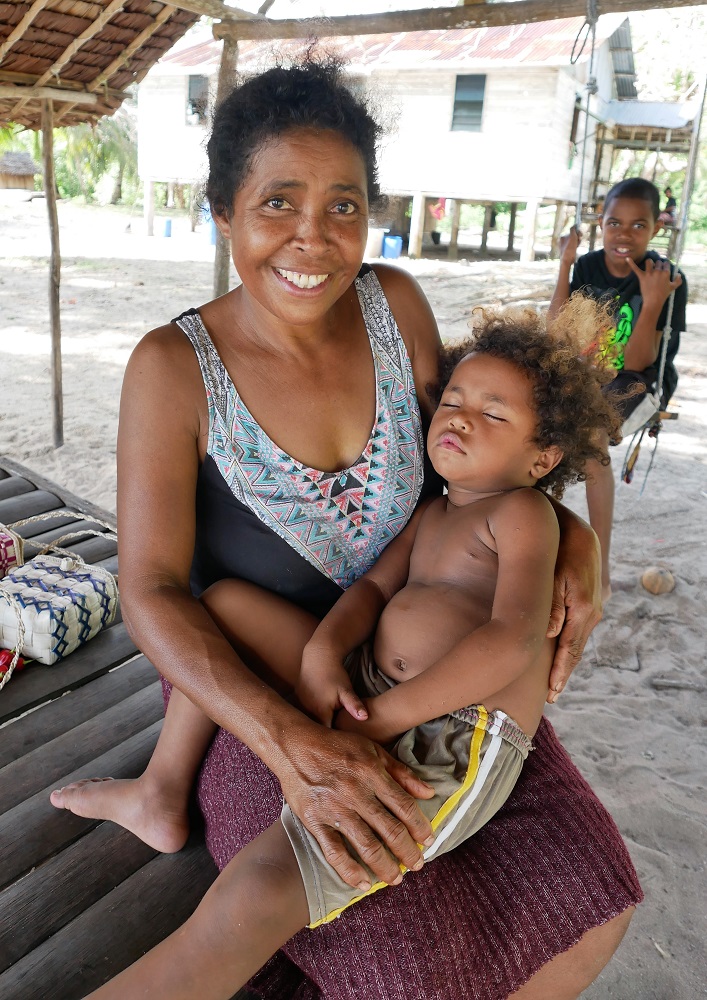
Julie and her granddaughter. We traded toothpaste and yeast for limes and greens with her.
“Have you got eggs?“ I ask Julie, a local woman one day when we’re ashore. “Or greens – anything like spinach? Cabbage?”
“Yes, I can get some of the women who have eggs to bring some tomorrow. We have some greens for cooking, and pumpkin, sweet potato, taro, and yam?” she responds.
“We don’t need pumpkin or taro. But how about tomatoes? Green peppers? Or bananas?”
“We have chilli. And bananas. Lemons too. I get some of the women to come tomorrow.”
“What can we offer you in return?”
“I try to trade with yachts for the things that I can’t buy here,” she explains. “At the moment I need yeast – I have run out. The men are diving every day so I like to bake, they are hungry. So if you have some yeast I need that.”
We assure her that we have yeast. What else do they need?
“Sugar is good,” she says. “And lollies for the children. And balloons too for the children, many yachties bring that. Notebooks and pens and pencils I need also. I am leading a women’s group, we need to write down things, so notebooks are good. And Colgate – we cannot buy that here.
Children waiting for lollies and clothes.
“I can get some vegetables from my garden, and from some of the other women. Limes, papaya, bananas. Maybe some women will have tomatoes,” she says, nodding to herself. “I will ask. We have no cabbage.”
“What can we bring for these women in exchange?”
“One, she has no clothes for her children, they are always naked apart from when they go to church. For her children’s clothes are good. Maybe sugar.”
I have nail polish and bracelets and pretty things for women – is she interested in that?
She smiles. “I have two daughters and many granddaughters. So bracelets and nail polish is good for me.”
And so the next day we head ashore, laden with jars of yeast and baking powder, bags of sugar, stacks of notebooks and bags of clothes.
It works remarkably well – we put out word of what we need (more eggs, more greens) and the next day someone paddles up to the boat with the produce asking to trade for what we indicated we still have left. There is a great appetite for trading here and we quickly run out of the most sought-after items – clothes (particularly for children), batteries, yeast, and magazines. Julie explains that the trade is supposed to be fair, that the value of what we swap should be about equal. But the temptation to keep asking for more when they suspect we’ll give it is too strong for even her to stick to principles of equal value and there is no doubt that we’re paying through the nose for the produce we get.
One morning, a young woman paddles up with her small child in a fragile outrigger. It is raining lightly and both her and the child are soaked through, tattered t-shirts and shorts clinging to their bodies. With one hand she is paddling into the wind to keep the boat next to our back, with the other she is bailing the low-lying canoe which keeps filling up from waves spilling over the edge.
“Come on board. Do you want to trade?” I ask, throwing her a rope to tie the canoe on.
“Yes,” she says, climbing onto the boat with a small banana leaf package in one hand, the toddler in the other.
“What do you have?”
She opens a wrap of banana leaves to show a small mound of sweet potatoes and a plastic cup holding one egg.
“I have sweet potatoes already,” I say. “But I’ll have the egg. What can we give you in return?”
“Hooks, fishing line?” she says. “Pens? Paper? Clothes.”
I bring out a couple of pens, three hooks and 10 m of fishing line, and she nods enthusiastically. Her sister paddles up in another outrigger canoe and they have a brief conversation in the local language.
“She has limes,” she says. “Do you want them?”
“I have limes already. But if she has any eggs I’ll take them.”
More conversation. “She has eggs back at the village. She bring tomorrow.”
I nod. “That’s good. I’ll give you rice? Sugar? And you bring eggs tomorrow morning.”
They leave with the hooks, line, pens and a kilogram each of rice and sugar. As they are paddling away, the sister turns towards me.
“I’ll bring egg tomorrow.”
I turn to David. “I hope she meant eggs, plural,” I say. “It’s a lot to pay for just one egg…”
The following day I wait in vain for my egg, but it is probably just as well – it is a long paddle for what she undoubtedly needs more than I.
“I want to encourage more yachts to come here,” says the Ward Councillor one afternoon as he is sitting onboard our boat chatting. “And we try to educate the community about not begging, about always bringing something to trade. We tell them to be respectful, not to let the canoe scratch the yacht and not to come on board unless invited.”
There is no doubt that trading leaves both parties with more dignity than outright begging, but many yachties still find the constant onslaught of visiting canoes too much after a while. There used to be an Australian rally going to the Louisiades but it was stopped, allegedly after participants found the constant interactions with locals too hard. We find people polite and respectful and everyone brings something to trade, but we still end up hiding inside when we’re doing schooling in the morning because if we go outside we will be interrupted so frequently that the children get nothing done.
It is a difficult balance – we are visiting their country, and we have so much and they so little, making them worthy receivers in every sense. I wish that I had brought more used clothing and children’s books; it would have been so easy to load up on that in New Zealand and would have been cherished here. The smaller Melanesian frames mean that our clothes fit them, unlike in Polynesia where only children were able to fit our adult clothes. (There are many charity initiatives whereby yachties transport used women’s bras to Fiji and hand out to locals, and I always wondered what all the size 26 Fijian ladies do with the size 10-16 bras that they receive from well-meaning middle-class Kiwis. They probably lean back heavily on their pandanus mats and laugh at the misplaced charity of all these pale, undernourished Palangi).
We help in other ways. David prints out charts for the area to help them in their fishing and diagnoses a battery problem in a grinding tool that isn’t working.
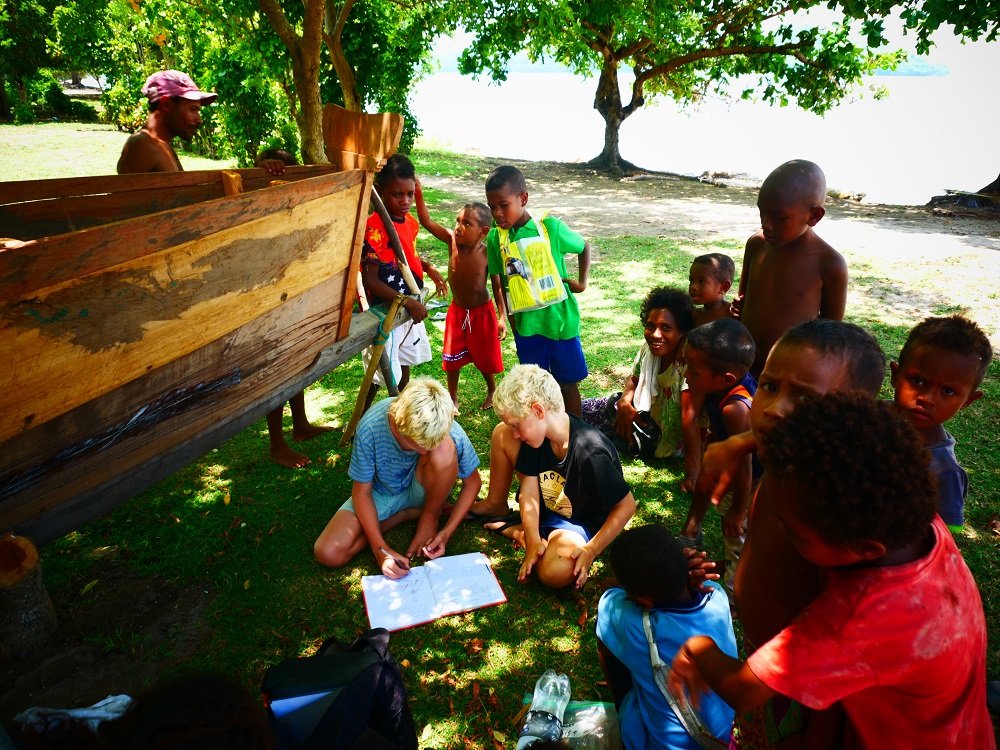
One island is famous for their sailing outriggers, and when we’re there they are building a large boat.
“It’s for the island of Sudest,” explains Martin, the elderly man in charge of the build. “We trade the boat for ten pigs and some shell-money that they have on their island. We don’t have the shell here but can use it to buy stuff from other islands.”
Lukie and Matias filling in the village guestbook while David is helping repair the outrigger.
The boat is made from planks of hardwood that they have painstakingly chainsawed to the right thickness. One long plank has a crack in it, and Martin is asking David for wood glue to repair it. Traditionally, they would have replaced the plank, but our being here means access to tools and materials.
“I don’t think wood glue would work,” says David. “But I can bring in some epoxy, and we can fill the crack with that. I can bring in some stainless-steel screws as well.”
After a morning of hard work the plank is waterproof, the boat contains a few more screws, and Martin is grateful although David is not certain that he’s added a lot to the craft’s seaworthiness.
Athletic games with the local kids.
At the menacingly named Conflict island group, trading has been taken to the extremes by some Americans who apparently traded a whole atoll, including lagoons and about a hundred islets, for some tobacco with the naïve local owners in the 1980s.
The Conflicts is a beautiful place with stunning marine life. A recognised marine biodiversity hotspot featuring higher fish species diversity than the Great Barrier Reef, the island group is home to the Conflict Islands Conservation Initiative, started by the millionaire Australian owner who is a keen conservationist. He bought the entire atoll from the original American owners who were copra (coconut) farming and developed the place into a cruise-ship destination which now receives a couple of cruise ships a month during the season.
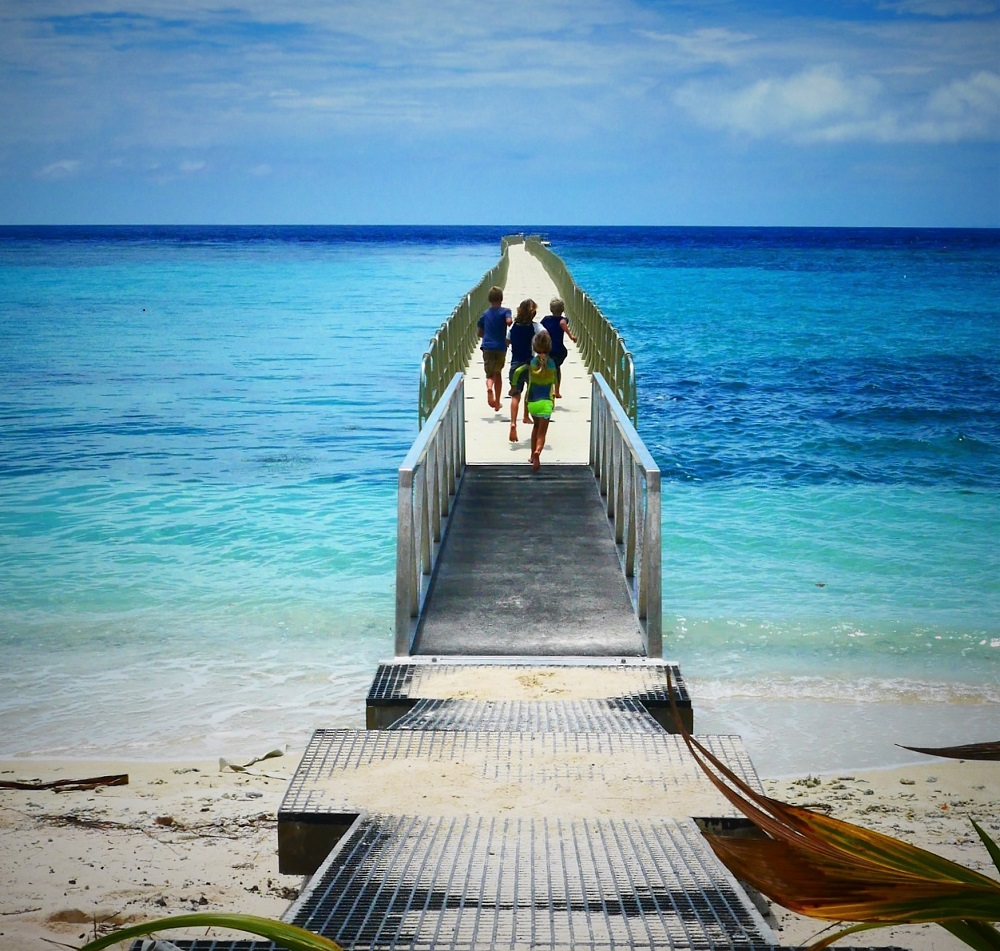
Bob on anchor in the Conflict Island Group.The kids and their friends from SV So What running down the floating pier to the edge of the reef.
Here, we swim with turtles over pristine coral, seeing white, blacktip and grey reef sharks and tawny nurse sharks in the depths below. It is an amazing place. Because the Australian owns the entire atoll he is (rightly or wrongly) discouraging fishers from staying on the little islets that rim the spacious lagoon, making it hard for Beche-de-Mer divers to erect the small temporary camps present on most small islands which allow them to come fishing from far away and stay for weeks or months. The Conservation Headquarters and the main island is located at the far western end of the lagoon, where a huge 200 m long floating jetty is built out over the water right from the shallows out until the depth drops off to thousands of metres.
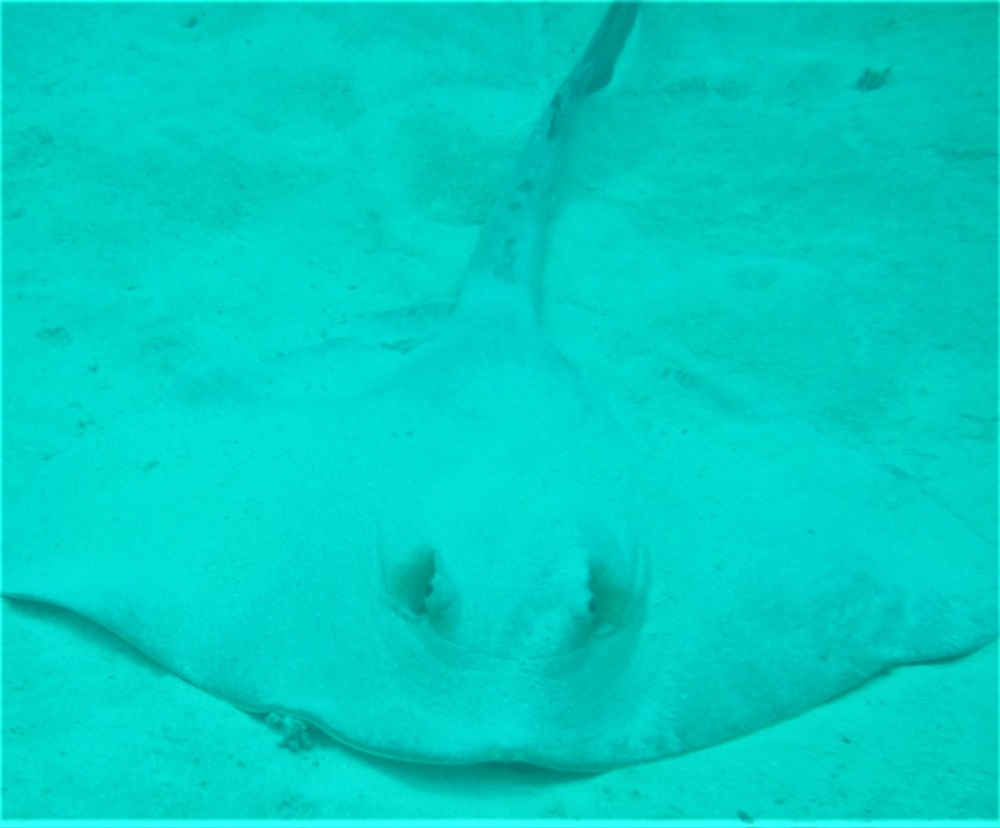
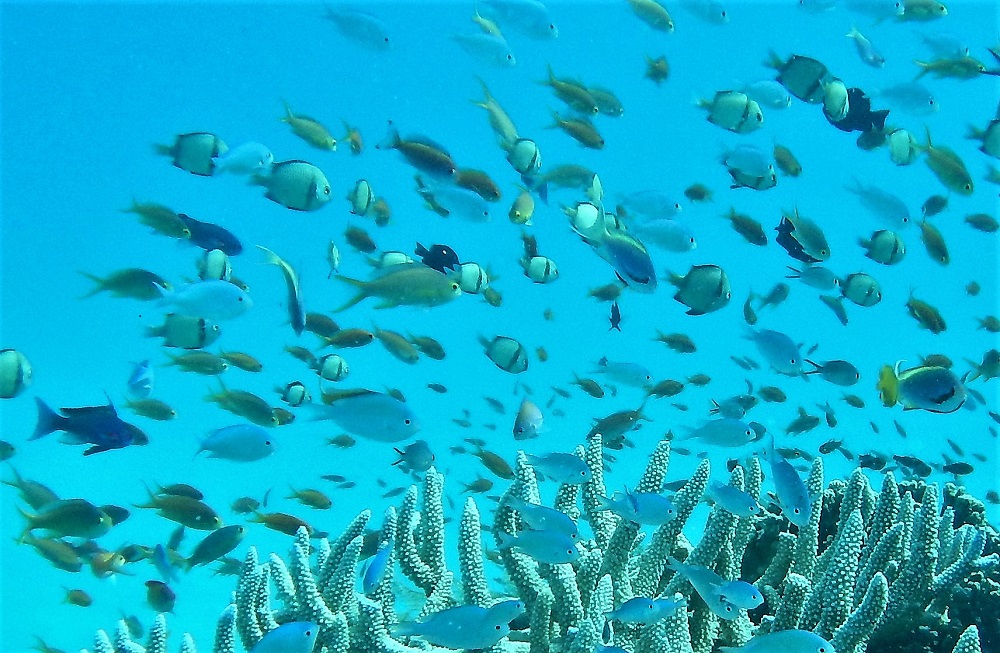
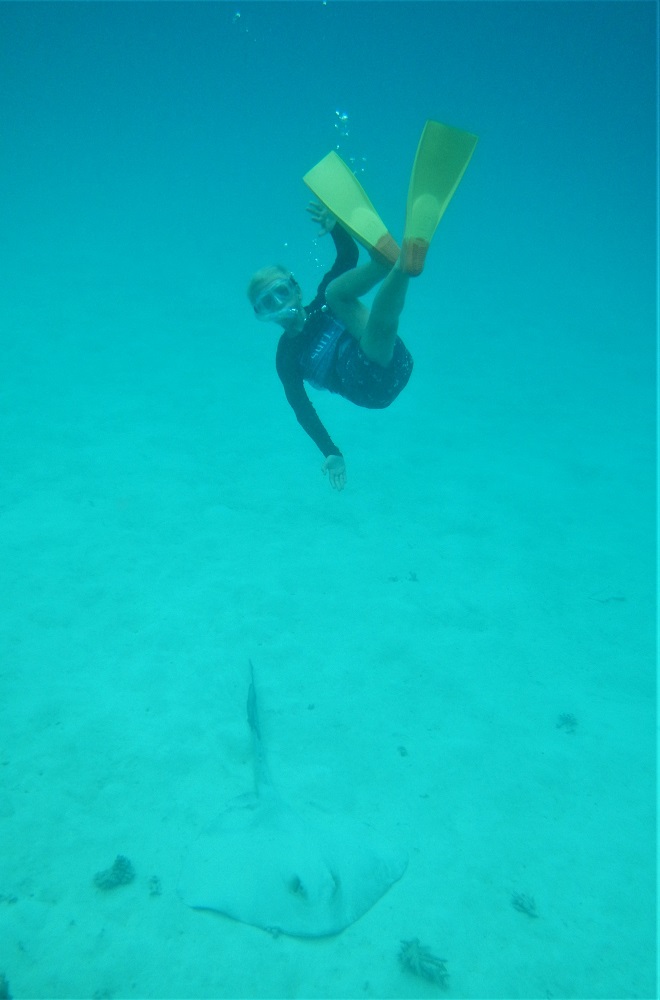
Fish soup above the coral.We never saw as many rays as in the Conflicts – hundreds of at least seven different species.Lukie diving down to point to a ray trying to disguise itself on the sandy bottom.Lukie peering through the plane wreck at Panapompom Island.
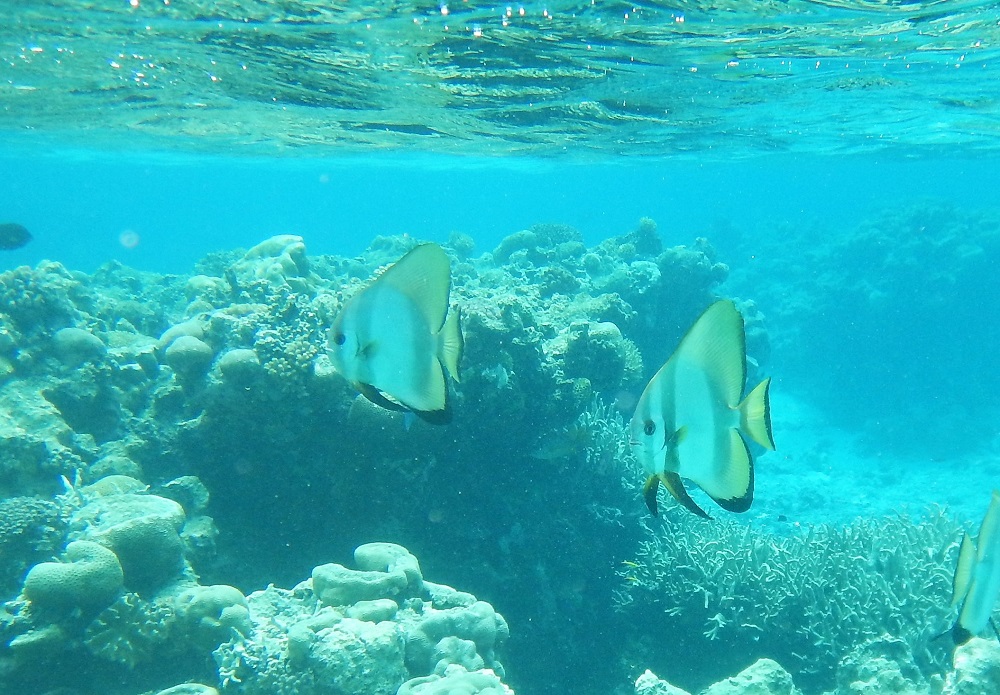
The marine protection makes for the best marine diversity I have ever seen, with thousands of coral species carpeting the outer reef walls over which dense throngs of fish of every variety hover. In this marine reserve we see sea cucumbers for the first time in the Louisiades, as well as good size turtles, sharks and a huge diversity of rays. The shallow coral reefs of the lagoon feature crystal-clear waters, aquarium-like conditions where little pristine coral reefs are dotted along the vast sandy bottom, each a home to tens of thousands of tiny fish that rapidly duck for cover within branching coral or behind swaying seafans as we approach. Onshore at the Conservation Centre is a turtle hatchery where volunteers from Australian Universities collect the Hawksbill and Green Turtle eggs from the beaches of the surrounds, transporting any at-risk eggs to the hatchery to see the babies safely hatched. They release hundreds of turtles at a time and keep some females for broodstock.
“The problem is that turtle eggs turn male if the temperature is above 28 degrees C,” explains Ed, the English manager of the island. “All the sand around here is around 31 degrees C so this year we only get male turtles hatching. The locals hunt turtles, preferentially females who they say taste better, so there are not many large-sized females left in the wild. They only breed once they’re about 30 years old.”
It is a good conservation effort trying perhaps in vain to make a difference. The Hawksbill Turtle is now critically endangered, and rising ocean temperatures combined with intensive hunting may drastically reduce the number of females to the point where local populations are not viable.
The Louisiades is full of dolphins. One day when sailing slowly west we meet a pod of Risso’s dolphins, the 4-metre ‘blackfish whale’ cousins of the melon-headed whale. About 50 of them are lingering at the surface just in front of the boat, their bulbous, beakless heads featuring what looks like a permanent smile as they log on the surface, occasionally doing headstands for no obvious reasons. The young are brownish, the females grey, and the males so heavily scarred that older individuals appear almost white, their docile-looking exterior obviously belying the true nature of their warrior ways.
Risso’s dolphin coming up for air.Risso’s dolphins as we see them under water. Their bodies are white from scarring.
Where sharks in the eastern region were scarce due to shark-finning, nearer the mainland they seem to be thriving, although our evidence is circumstantial: every fish we catch seem to be missing a chunk. We catch two fish that have been victims of cookie-cutter sharks, bearing the signature circular wound on their sides. We hook a wahoo whose tail is bitten off while we reel it in, making it the easiest wahoo we’ve ever landed, and catch a dogfish tuna which is missing a huge bite by the time we land it.
Cookie-cutter shark bite on a freshly landed skipjack tuna.Sharks getting in on our fishing action: a dogfish tuna with a bite missing.Lukie reeling in a monster fish – a huge mahi mahi with a cookie cutter shark bite.
It is hot and humid here, the air temperature 28-30 degrees C, the lagoon waters a balmy 28 degrees. When the wind is blowing the heat dissipates briefly, but on still days the scorching sun burns through the plexiglass hatches, leaving the interior of the boat like an oven. We spread a tarpaulin over the saloon hatches to keep the morning sun out and the children sit sweating doing their schooling until the sun rises high enough in the horizon to lessen the direct impact. Hottest are the rainy nights where we have to leave the hatches closed, the warm, stagnant air of the cabins festering as we lie breathless and sleepless, tossing and turning the night away bathed in sweat.
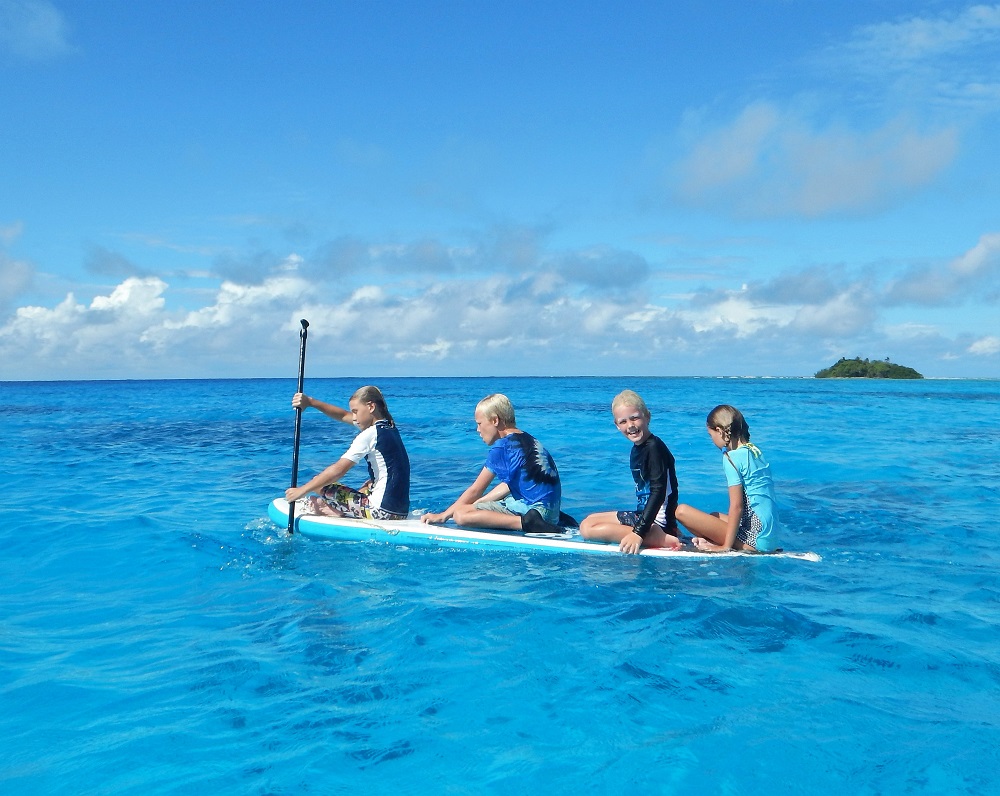
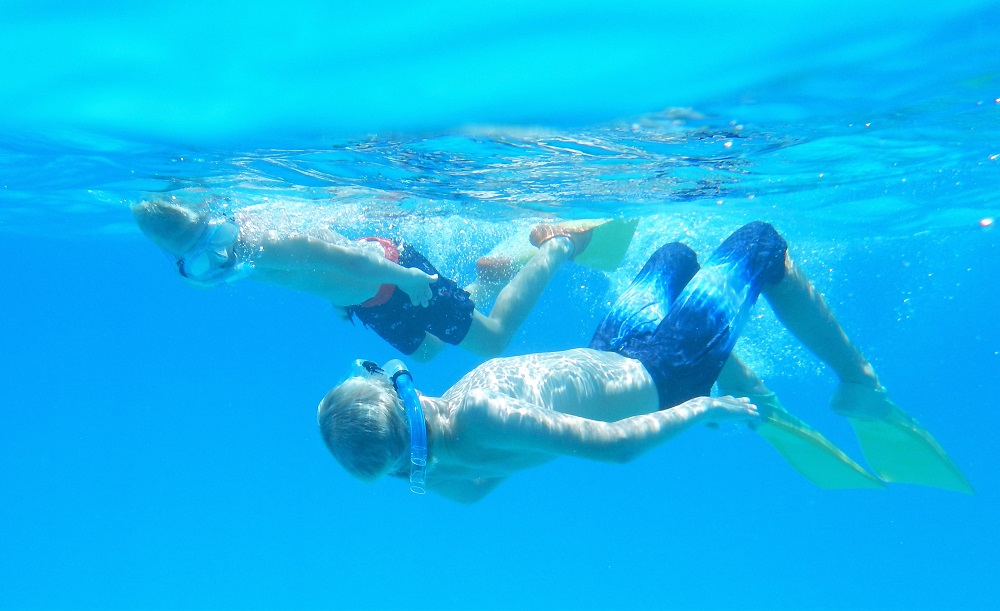
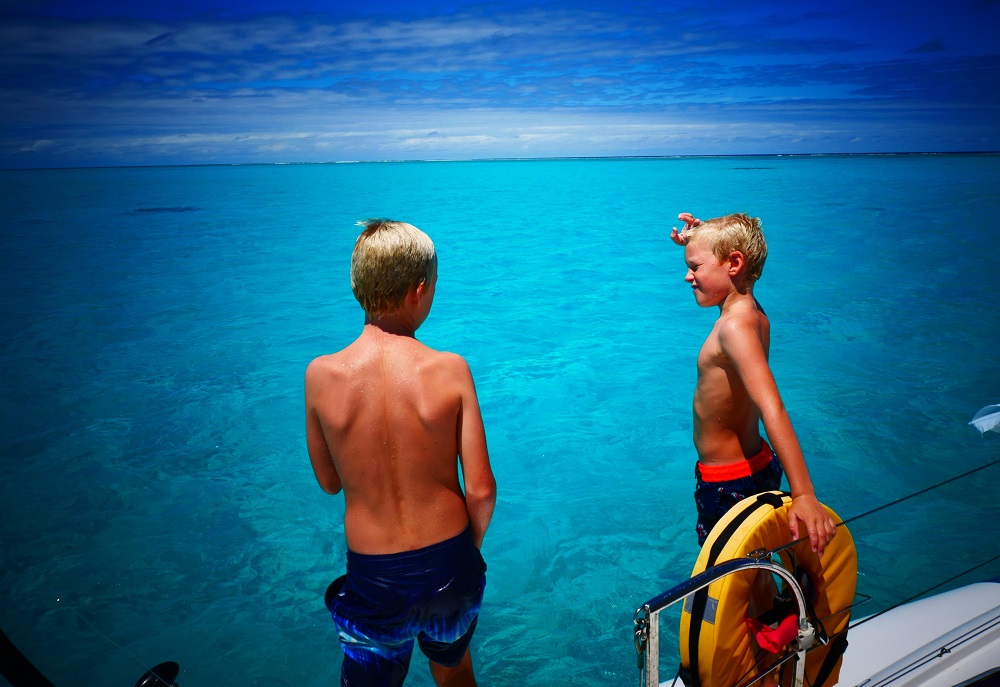
During the day the heat is easier to bear: we just jump in the turquoise water whenever we are too hot, the children spending most of their days kitesurfing, snorkelling, playing on the beach, or swimming and splashing in the shallow blue waters over sandy bottoms.
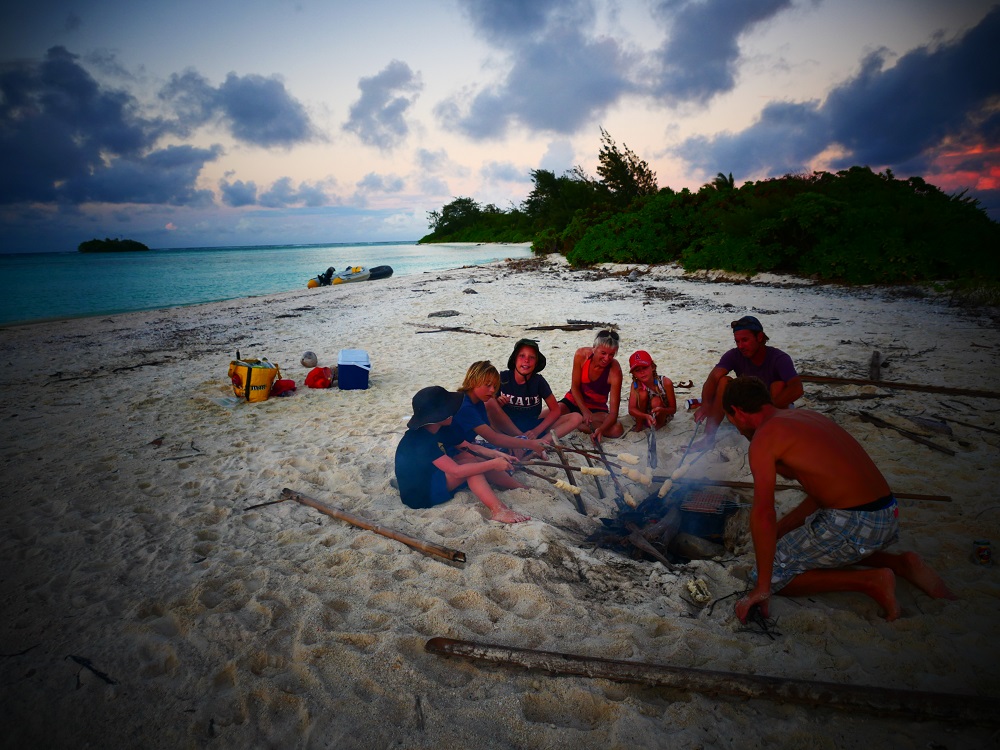
Barbeque on a deserted island with SV So What.Lukie and Annika on the beach.Four kids on a boat: ready to jump in to cool down.Kid paradise – pristine coral and clear, warm water.
By the time we leave the Louisiades we have traded all we have. Gone are the bags of sugar, rice and flour. The fishing wire and hooks have been given away, as have the soccer balls, school books, magazines and books, pens, pencils, notebooks, erasers and rulers. The spare spark plugs for outboards have changed hands, as have all extra clothes and batteries. In return we have received memories that will never be erased. We have eaten local produce and shellfish, we are brown and sore from weeks of kitesurfing, snorkelling, walking in villages and playing on beaches. The Louisiades is an amazing place, and we wouldn’t trade our experiences here for anything in the world.
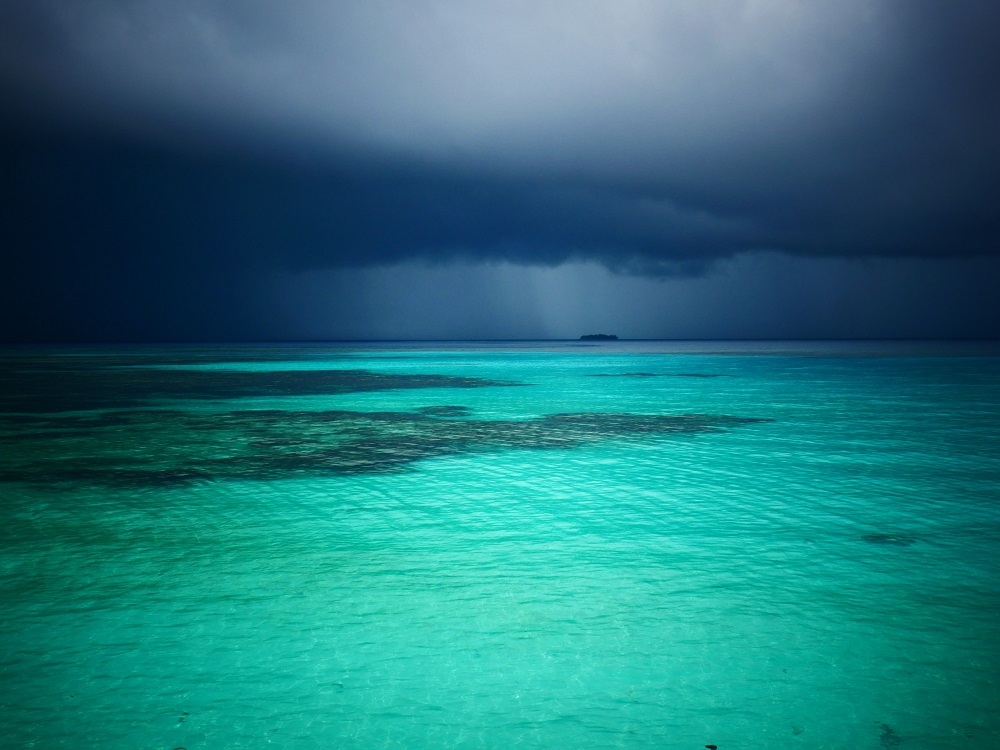
Broody skies over blue lagoon in the Conflict Islands.
Local fishermen coming to camp on a small coral islet. They stayed three days to fish for Beche-de-Mer in the surrounding area.
“This is a lovely place,” I say politely to Neil, a small elderly man sitting in our cockpit. He is clad in ripped shorts and a torn t-shirt and has paddled from the shore in a tiny outrigger canoe to our boat to do some trading. “A great lagoon.”
“Yes,” he nods, glancing up from the NZ Customs ‘Welcome to Opua’ magazine that he is leafing through.
“There is lots of healthy seagrass here,” I say.
“Yes, seagrass good.” He nods again without looking up, deeply absorbed in the glossy magazine.
“Do you get turtles here? They like seagrass places like these.”
“Yes, turtles come. We eat, meat tastes very good.” He grins a red toothless grin, only one heavily stained front tooth remaining, the toll of a long life of betel-chewing.
“Oh.”
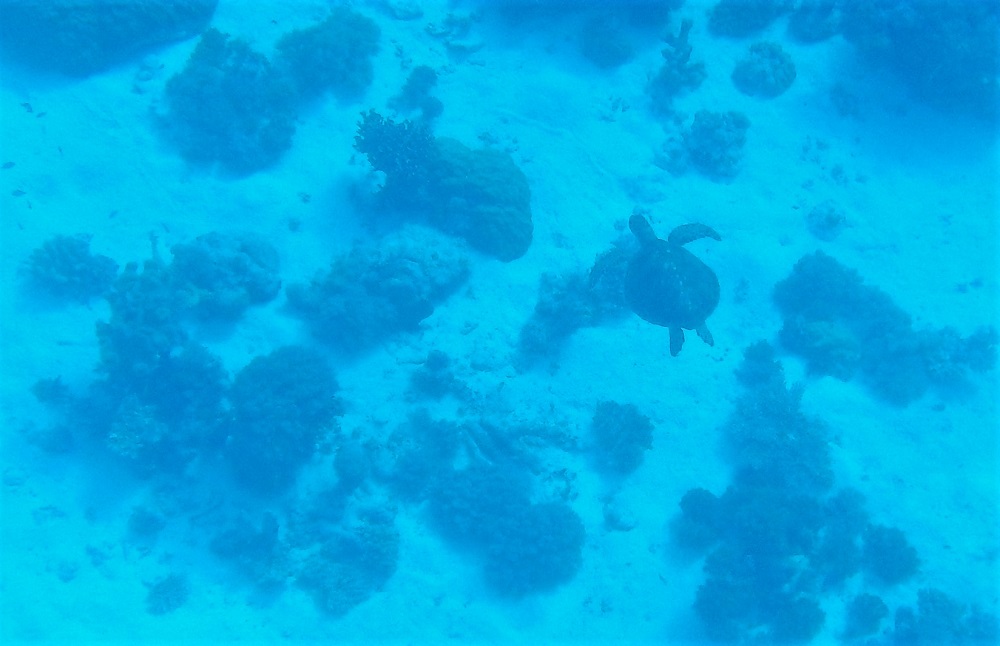
A lucky turtle that escaped – seen in the Conflict Island group.
“But not too many turtles nowadays,” he adds, looking down again, his finger trailing along the text extolling the excitements of Whitianga scallop festival which accompanies a photo of a scallop glistening next to a chilled glass of champagne in a flute with condensation on the outside.
“Shellfish,” he says, tapping the page knowingly.
“Yes, we have shellfish in New Zealand,” I say. “What about dugongs, do you get them here? They like seagrass too.”
“Yes, they very tasty. Like pig. But not too many dugongs now.”
“Oh.”
“Yes, we don’t catch many dugongs now.” He nods grimly to himself and fishes out a betel nut from the flour-sack satchel he is wearing around his neck. He bites open the green, hard nut with his few remaining molars, exposing a fleshy centre which he scoops out with his tongue. He pulls out a seed pod from a small bag, takes off a large bite, slowly grinding the two together into a paste. Next, he pulls out a small jar of white powder, pours a bit into his hand and sucks it up, adding it to the mix. Masticating enthusiastically, he turns another page in the magazine, this time eyeing up a photo of bikini-clad beauties perched on a golden-sand beach next to an advertisement for Opua Marina.
The seed pod is what they call mustard and the white powder is limestone from ground up coral. The limestone powder is added to grind up the mix and abrade the gums so that the mild stimulant from the betel leaves reaches the bloodstream quicker. When chewed, the nut turns red in colour, causing everyone here to look like vampires showing off their red-stained decaying teeth in wide grins. Chewed and then spat out, betel nut is a stimulant with similar effects to coffee and tobacco, raising heart rate and general alertness. Men, women and children as young as 3 chew and tooth decay is rampant with most adults missing several teeth. The active ingredient arecoline is highly addictive and also a carcinogen. Everybody chews here and as a result oral cancer is Papua New Guinea’s highest cancer killer, and Papua New Guinea has the highest rate of oral cancers in the world.
Kids from the village on Panapompom.
We’re in the Louisiade Archipelago in the south-eastern corner of Papua New Guinea, a remote series of small, green volcanic islands surrounded by coral atolls and turquoise lagoons. We’re anchored in front of the gloriously named island of Panapompom, a name evocative of Hindu festivals or cheerleader chants. At the moment, the local villagers are busy diving for Beche-de-Mer – sea cucumbers – which fetch very high prices.
“The government allows 200 tonnes to be fished in total in our region every year,” explains Ismael, the Ward Councillor of the area. “The buyers come and buy from the local fishermen every two weeks. They take it to Alotau on the mainland where they sell to the Asian buyers who come in their very large ships. From there it goes to Asia. It is served in restaurants there.”
“Every man seems to be diving,” says David. “Is it good money? What do they sell for?”
“The most valuable one is the one we call white-teat. That we sell for 300 Kina a kilogram. One animal can weigh a kilogram. On a good day, we can find 10 or 20.”
David whistles quietly. “That’s a lot of money – no wonder you are all out diving.”
300 Kina (the Papua New Guinea currency) is approximately NZ$150, so a good day’s diving could see a boatful of divers earn NZ$3000 – an incredible daily income for the remote population in this third world region. The foreign buyers all come to the mainland, so the government controls the quota at the buyer end and closes the fishery once the quota is met, warning the locals that the limit is upcoming via the local buyer vessels that collect the sea cucumbers from each village.
“300 Kina per kg is an incredible price,” I comment.
“That is for white-teat. We get less for some of the other types. Down to 150 Kina per kg,” he explains.
He says that last year some Vietnamese fishermen came and dived for Beche-de-Mer illegally within Papua New Guinea’s waters. They dove at night and moved offshore during the day, so it was hard for the locals to detect them. The Papuan Navy eventually busted some of them, confiscating the catch, the tonnage of which the Ministry of Fisheries promptly removed from the annual quota.
“So we had to catch less,” says Ismael with a wry smile. “Even though we didn’t benefit.”
A boatful of sea cucumber divers returns with their catch.
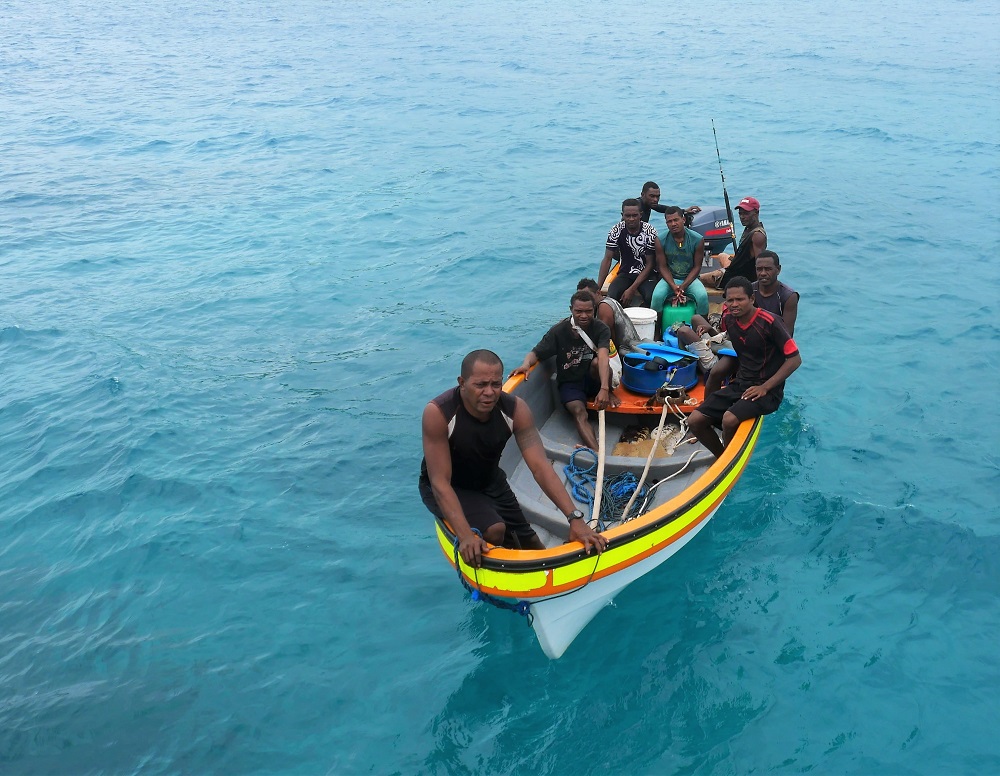
The season will close at the end of this week, and the men are out every day with masks and snorkels, covering vast tracts of lagoon. They can skin dive to about 20-25 m and use a leaded hook to catch animals that are just out of reach. The wealthier individuals use longboats with 40 HP outboard engines which can carry 6 to 8 men, the less wealthy use small traditional sailing canoes that carry one or two persons.
It is hard work and the men here are lean and fit, small and wiry, with strong muscles rippling under dark brown skin and no extra body fat. Most men here are about the height of Matias (1.52 m), our ten-year-old. The Papua New Guineans are true Melanesians, very different from the huge Polynesians found further east, who are two feet taller and about a hundred kg heavier on average. Perhaps aided by the stimulating effects from Betel nut chewing they seem to have more energy and everybody here is busy diving, fishing, sweeping, mending, carving, boat building, activity levels that far outpace the languid lifestyle of Polynesia.
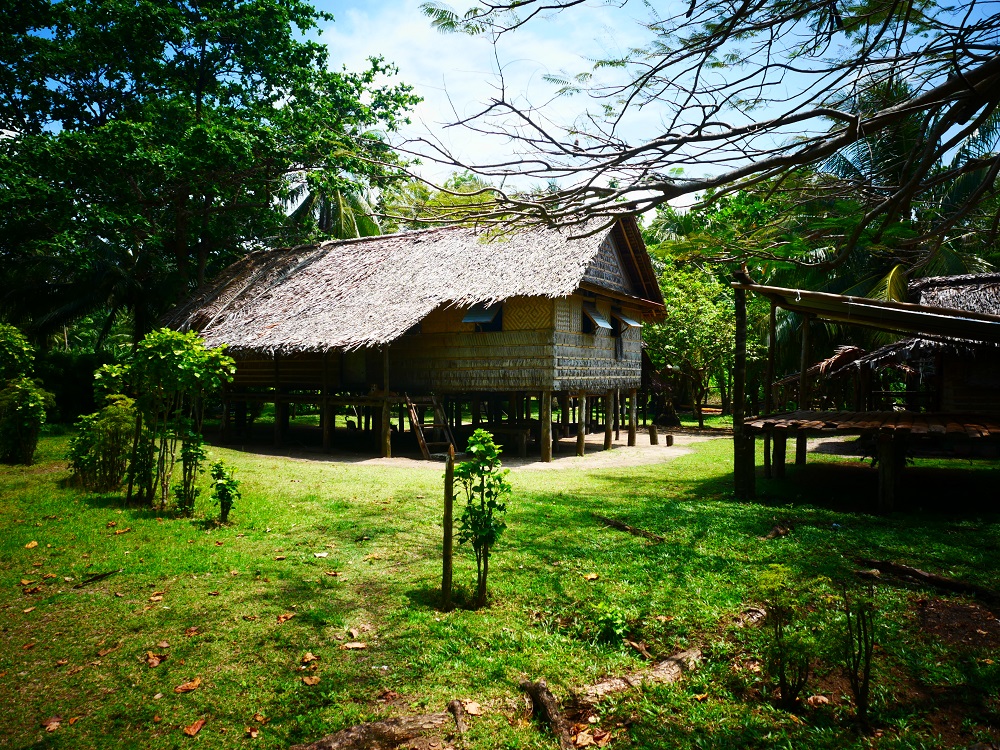
Typical village house in Panapompom.
Once the Beche-de-Mer season is over, they will start on the next crop: sharks.
“We get 300 Kina per kg of shark fin, so once the Beche-de-Mer quota is full we catch sharks,” he explains.
The sharks are caught using hook and line, and they are much harder to fish for than sea cucumbers. The buyer for shark fins is in Alotau on the Papuan mainland: an unscrupulous Swiss guy who is very, very rich and lives in the tallest house in town.
Beche-de-Mer diving and shark finning are both risky. Every year someone gets attacked by a shark. Ismael’s brother Noino was attacked by a large tiger shark a couple of years back and his leg is heavily scarred where the shark’s huge jaws only narrowly missed the femoral artery. He walks with a limp and is lucky to have survived – most people don’t live to tell the tale of tiger shark attack.
Noino showing a white-teat sea cucumber – the most valuable species. A couple of years ago he survived an attack by a tiger shark whilst spearfishing.
The vast sums involved with the Beche-de-Mer fishery prove tempting for some, and all Louisiade locals warn us from going near the Papuan mainland.
“Don’t go to the mainland,” says Nigel, a thirty-something diver in a longboat that visits us when we’re anchored at the northern end of the Sudeste lagoon. A short, muscular man, he is clad in black shorts, a torn graffitied black singlet and has a raffish urban knitted cap perched on his head topped by a dive mask worn back-to-front. The longboat has approached to see if we have anything to trade.
“We are friendly here, but they are not so friendly by the mainland. Not so safe for you.”
“No?” I ask. “So we should stay on the outer islands?”
“Yes, stay here and when you move on keep away from the mainland. You can go to the smaller islands. We are friendly here. But at the mainland there are many people, not so good people, people who maybe want trouble. Not good for you to go there.”
“Where is the trouble?” I ask. “What kind of trouble?”
“There is some piracy, some people attacking the Beche-de-Mer buyer boats,” he explains. “A lot of Beche-de-Mer buyer boats around now, big boats. And there are some bad people, some pirate people who will come to get the money from the boats. So not safe for you to go.”
“Where?”
“In Alotau, at the mainland. Stay here, you will be fine, but don’t go too close to the big islands. Lots of trouble there.”
A local outrigger used for Beche-de-Mer fishing. The men travel to small coral islets and camp there for a couple of days or weeks while they fish the surrounds.
Humans are not the only casualties of the fishing practices. Sea cucumbers clean the sandy bottoms next to the coral reefs, hovering up organic matter and keeping algal growth down. The frantic fishing takes its toll. Heavy overfishing led the Papua New Guinea government to close the fishery between 2007 and 2016 to allow stocks to recover. In 2017 it was reopened for one month, and this year the season has been four months. This is the first place I have seen tropical seabeds devoid of sea cucumbers and reefs without sharks, and one can only wonder at the effects of removing scavengers and top predators on such a massive scale.
Matias and Lukie playing soccer with the village kids in Panapompom.
“Cheers!” smiles Jenny, raising her glass of champagne.
“Cheers!” we say, placing back down on the table our crackers with fresh lobster to lift our glasses as we gaze out over the orange, pink, purple and red potpourri of sunset horizon. There is no sight of land in any direction, but if we squint we can just make out the foamy line of surf reflecting the vivid colours of the plummeting sun. The distant breaking waves provide a gentle background roar over which we hear the kids’ animated voices from inside the boat.
I sigh contentedly and lean my sore head back, savouring the cool evening breeze. It would be a perfect day if I didn’t feel so awful. All day I’ve been sneezing and blowing my nose, fighting to clear my thoughts through a fog of headache. It’s a bad head cold which has been working its way through the family since Lukie first caught it in Vanuatu. After two weeks of incredibly snotty kids I finally caught it, just as we’ve run completely out of Kleenex and I started rationing toilet paper for nose wiping. It is a long-winded snotty cold and our toilet paper supplies are dwindling by the hour, a serious worry in the middle of the ocean.
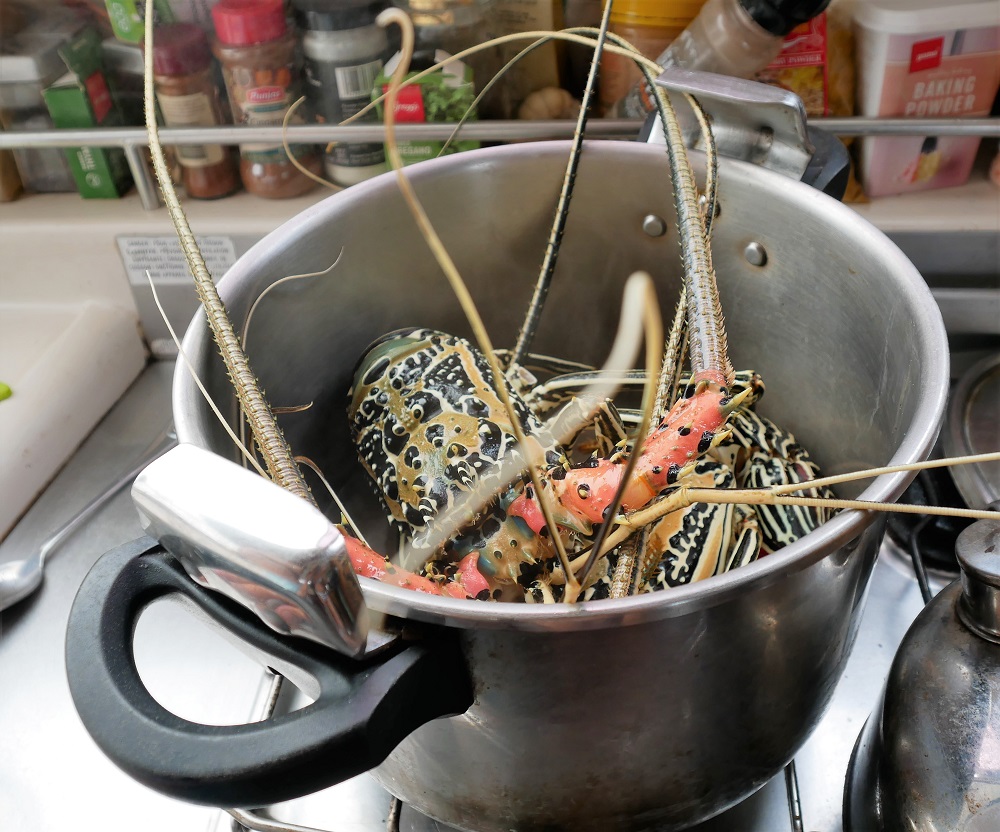
Spread before us on the table is a veritable feast – lobster drizzled with lemon with a side of home-made mayonnaise, Jenny’s special lobster dip made from cream cheese, parmesan and lobster, oven-baked ham, scalloped potatoes and crunchy fresh cabbage salad with raisins and nuts.
Lobsters in the pot.
We’re at Indispensable Reef, celebrating with SV So What, a Canadian family from Ottowa who are going to Indonesia the same way as us. Tonight they graciously invited us over to share a ham and we all savour every bite – there is no knowing when we’ll be able to buy ham on the bone next.
We had a fine passage to Indispensable Reefs, three nights and four days of light winds. The passage night watches were endless and tiring, but clear, moonless skies made for amazing star gazing – the bright stars mirrored in the phosphorescence in the water which trailed behind the boat like a wake of sparklies alighting momentarily as we passed through. Overhead, familiar constellations emerged from the thick blanket of the Milky Way spread out above our heads, the millions of pinpricks from billions of light years away putting our existence into perspective.
The night sky is always humbling, inducing the mind to ponder existential questions. The profusion of stars shining patiently through the eons is a reminder of how small we are in the universe, how all the superficial things that we imagine matter when we’re caught up in the busyness of our normal lives really are only egotistical indulgences, important in the blink of an eye to only one being in this vast universe. Out here on the foredeck at night as we travel across a deep and dark ocean looking up at a sky illuminated so brightly that one could almost read by starlight, it is hard to take the worries of normal life (whether lived on shore or on a boat) seriously. Out here, it is obvious that very little matters in an absolute sense, and that we must choose carefully what we allow to be important our lives, what we allocate energy to, and how we pass the time we have in these so fleetingly short lives played out against the backdrop of the endless universe.
It’s a feeling amplified by travelling. On a trip like this we are exposed to a whole lot of new things and we meet people of a multitude of backgrounds holding dear a variety of values – and spending time with them puts into perspective our own choices, highlighting the options we don’t even consider because cultural and societal blinkers narrow our field of view.
At the same time, it is amazing how much we do have in common with the people we meet. With the locals we share the basic stuff of humanity: the love we feel for our places and people and our fears and worries about their well-being and long-term future. With yachties, we share our lust for adventure, of discovering new places, of exploring the world slowly, one nautical mile at the time. And no matter where they’re from, the yachting families we meet all have a desire to spend more time with their children than their normal life at home allows, and to educate them hands-on about the big, wide, exciting place that is our ocean planet. Where back home our trip may seem adventurous and inspirational, or irresponsible and reckless (depending on the eye of the beholder), out here it is nothing special: all the families we meet are in the same boat.
Indispensable Reef from the lagoon.
Ready to jump in.
At Indispensable Reef we are alone with SV So What. There are no locals. Technically, the reef belongs to the Solomon Islands, and apparently they do fish here, but we don’t meet anyone during our stay. It is a huge reef system, encompassing three large lagoons stretching more than 100 nautical miles. We’re anchored in the middle lagoon which is about 25 nautical miles long and 10 miles wide.
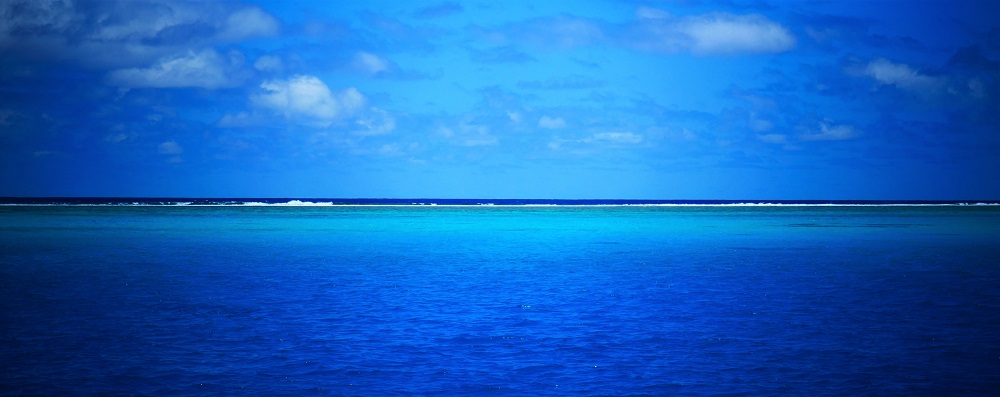
Arriving at landless reefs in the middle of the ocean is always incredible. Approaching the reef, the depth rises sharply from thousands of metres to coral just about breaking the surface, and we enter through a 200 m wide pass to the inside lagoon, an oasis of quiet calm in the middle of turbulent seas. The water depth inside the lagoon is 30-50 m but along the reef edges the sand banks shallow, and now our two little boats are bopping up and down gently, anchored as they are just adjacent to the windward reef.
Tropical aquarium.
On this day we’ve been snorkelling in the crystal-clear waters of the reef edge. Coral bommies protruded from the shallow seabed and great schools of large fish swam languidly about, not seemingly scared of us. David and Greg collected large tropical rock lobsters from under rocky ledges, and the kids dived and swam through underwater arches, marvelling at the rays, the sharks, and the largest groupers and sweetlips we’ve ever seen. Due to local fishing pressure, large fish are normally scarce in the South Pacific but in this remote lagoon the fish life is amazing, although the coral is rather wrecked, probably wave damage from two years ago when a large cyclone passed over the area.
White tip reef shark.
Relaxing on the boat I sip my champagne, sigh contentedly and blow my nose again, reflecting that I should probably go back to our boat and try to sleep off the cold. Maybe tomorrow I can fashion some old t-shirts into handkerchiefs to see us through the cold without running out of toilet paper. Now that we’re on anchor where there will be no night watches and sleep deprivation for a little while I have time to sew and to sleep off the cold.






























 SV Bob The Cat