Our passage to Vanuatu was easy, taking four days and three nights, with calm seas sighing like ghostly whales pursuing our slow progress across the ocean. Vanuatu’s capital Port Vila, on the island of Efate, is due west of Fiji, so during the four days of passage we moved further and further away from the sun, the distance covered marked by ever later sunrises and sunsets. In this age of air travel, it is gratifying to be moving so slow (about 160 nautical miles, or ~290 km a day) that the incremental distances covered are felt as minutes of delayed sunsets per day, a visceral illustration of how the Earth is just a rotating ocean-covered ball spinning around the sun.

On our second ocean day a booby hitched a ride for a night, landing on our rear solar panel after circling the boat for half an hour and remaining fast asleep with its head tucked under a wing on the bouncing boat as we transported it 100 NM west overnight. Come early morning it left after staring at us with stiff, tired eyes, indignantly lifting its head and ruffling its feathers whenever we got too close.
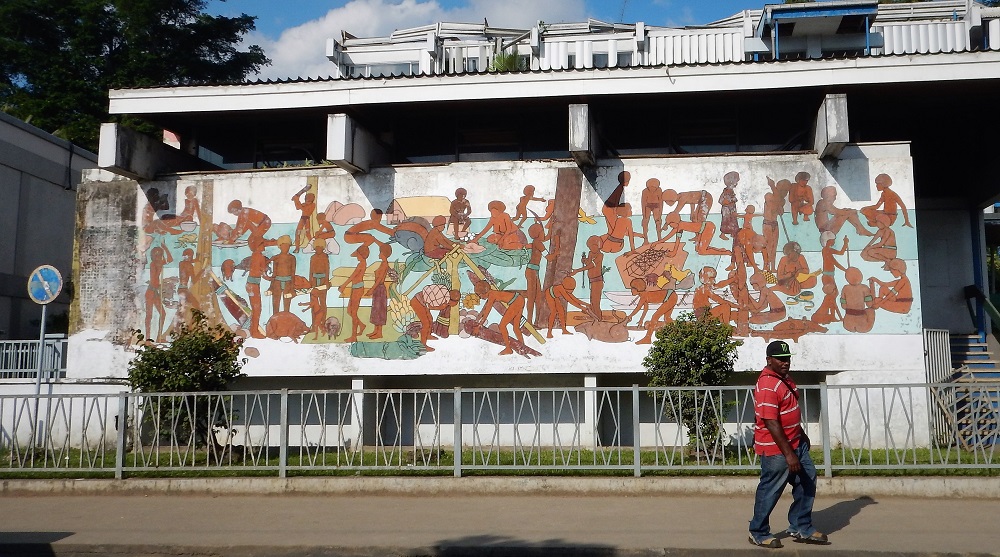
Port Vila is small and full of Australian and New Zealand cruise ship passengers and the associated duty-free shops, selling French fashion, surfwear, perfume, handbags and alcohol. There are numerous restaurants and cafes, a small park and a bit of concrete for the kids to skate on. Beautiful tropical flowers border the parks, and palm trees are scattered across the lawned waterfront.

Bislama, the official language of Vanuatu is a pidgin language based on English with a few French words thrown in. Written Bislama is best understood by reading it out loud, exaggerating every syllable until the underlying English or French word becomes obvious. We buy SIM cards and I get a message advertising ‘tripol data tedei’ (triple data today), a ‘limited taem offa’.
David and I childishly find the language hilarious, particularly the liberal use of the word ‘blong’ (literally belong).
“Here, you have to see this,” I say, pulling him over to the ATM in town. “I can read Bislama. ‘Plis pusum kad blong yu i go insaed’ – Please put card belong to you it goes inside!”
“And here, the next screen – ‘Sipod kad blong yu i lus o wan man i stilim, plis kontaktem branj blong bank blong yu’ – if card belong to you is lost or a man steal him, please contact the branch that belongs to the bank that belongs to you!”
“And look at the library,” he responds, grinning broadly whilst gesturing towards a tall, dark building nearby. “Pablik Laebri Blong Port Vila”.
Hello is ‘alo’, thank you is ‘tankyu tumas’, sorry is ‘sore’, yes is ‘olraet’. Helicopter is ‘mixmaster blong Jesus Christ’.

The provisioning here is great – if nothing else, the French left one positive legacy and the Bonne Marché is stocked with patés, cheeses, cured meats, feta cubes preserved in herbed oil, Nutella and other typical French delights. The fruit and vegetable market is sensational, a covered plaza stuffed full of fresh produce, sold by island women clad in colourful dresses sitting behind low counters. There is broccoli, red cabbage, pamplemousse grapefruits. Fragrant fresh coriander and lettuce heads strung on the bones of palm leaves. Shiny capsicums, rough custard apples, and buckets of glistening bush raspberries. Woven baskets of sweet potatoes and tripods of enormous yam, their tops tied together with palm leaves.

The entire country of Vanuatu is plastic bag free, and customers are expected to bring their own bags or baskets. At the supermarket, reusable plastic nets are provided for customers to weigh their fruit and vegetables; these must be surrendered at the check-out where you are expected to pour the produce into your own bag.
Perhaps partly as a result, Port Vila is remarkably clean. I remember the plastic mess of Tonga where we saw hordes of local kids throw plastic bags from their popsicles into the ocean. Here, there are bins everywhere, and no litter in sight.
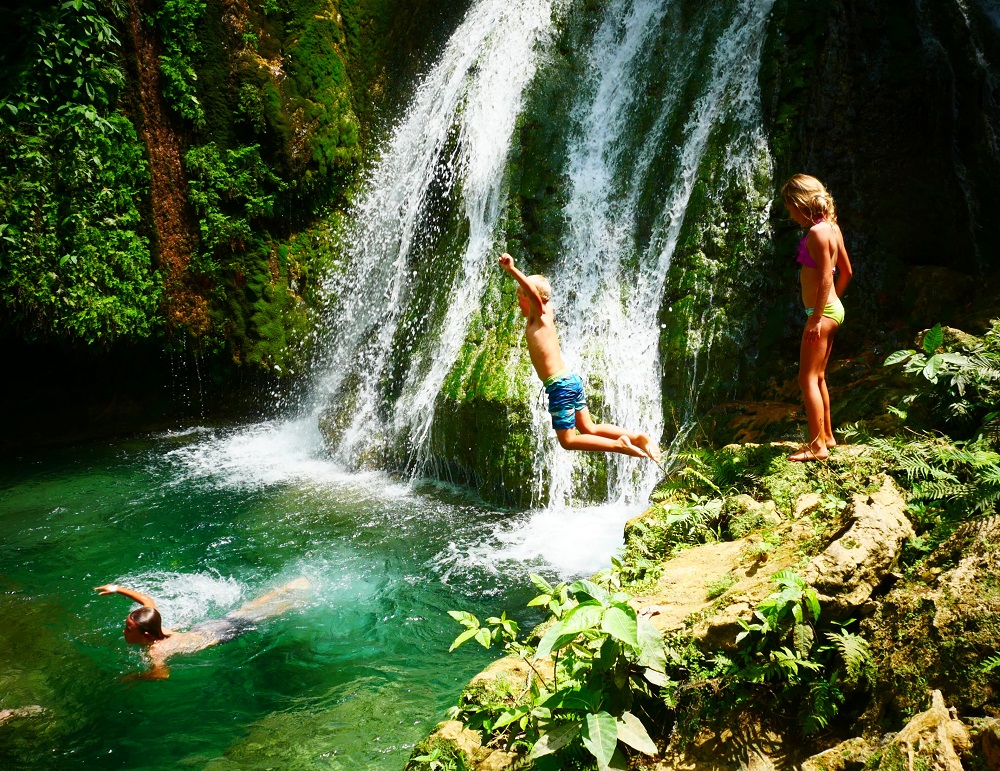
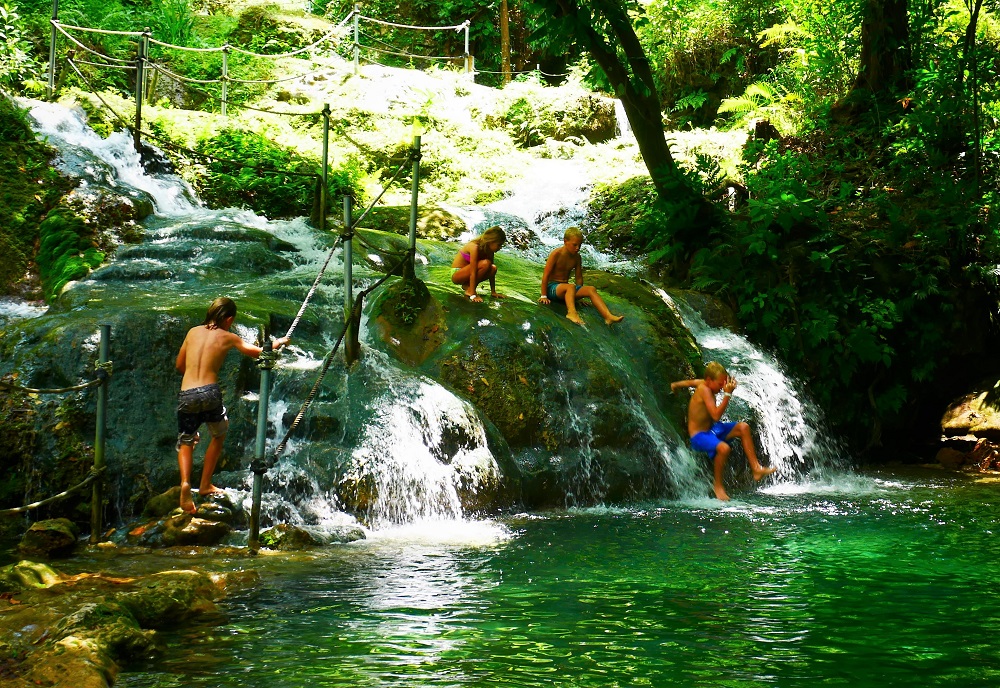
We visit the Mele Cascades not far from Port Vila, a beautiful walk up a hill through cascading clear water. We all swim in the cool water and enjoy the beautiful scenery.
Tomorrow we’ll leave to head up north, hoping to spot dugons on the way.

 SV Bob The Cat