
“PACIFIC PAWA!” shouts the man with the megaphone.
“PACIFIC PAWA!” responds the crowd, fists pumping, bodies bouncing, sweat pouring in the hot midday sun.
“WE’RE NOT DROWNING! WE ARE FIGHTING!” yells the man.
“WE’RE NOT DROWNING! WE ARE FIGHTING!” echoes the audience, erupting in cheers.
The small hair at the back of my neck rise as I feel the surge of emotions of the protesters and supporters alike. The guy with the megaphone is wearing a tie-dyed sarong and a black t-shirt with a white logo on the front. Around his neck is a long necklace of oversized wooden pearls, and on his head, a spiky crown woven from palm leaves holds in his short, tight dreadlocks. Behind him, men, women, and children jump up and down in tune to the chanting, waving homemade paper banners and flags. Many hold up dainty palm leaf windmills which spin in the light breeze, small hazy clouds of green held up on long palm leaf sticks. The air is heavy with the pungent smell of sweat mixed with frangipani flowers and the fishy smell from the adjacent market. Behind the crowd of people, the neatly lawned park fringed by palm trees is a blur, an indistinct green background to the multicoloured protest.
“YA YA YA YA! PACIFIC PAWA!” he chants, raising his arm. The crowd erupts, roaring, clapping and yelling along.
It is Saturday morning in Port Vila, Vanuatu, on 8 September which is Climate Action Open Day, an event where youth representatives from southern Pacific states unite to urge action on Climate Change. The event is organised by the NGO CARE in partnership with the University of the South Pacific, who have set up a stage in the park at the waterfront. Loud music and agitating orations are projected to a large audience. Most of the speaking is done in Bislama, the local language, but it is similar enough to English that we can understand that the protesters are imploring action from Pacific neighbours as well as increased resilience-building efforts in the Southern Pacific states. Youth representatives from every South Pacific country are part of the protest, dressed in their national costume and waving their national flags, singing, dancing and chanting. A large crowd is gathered to watch and cheer on the protest.

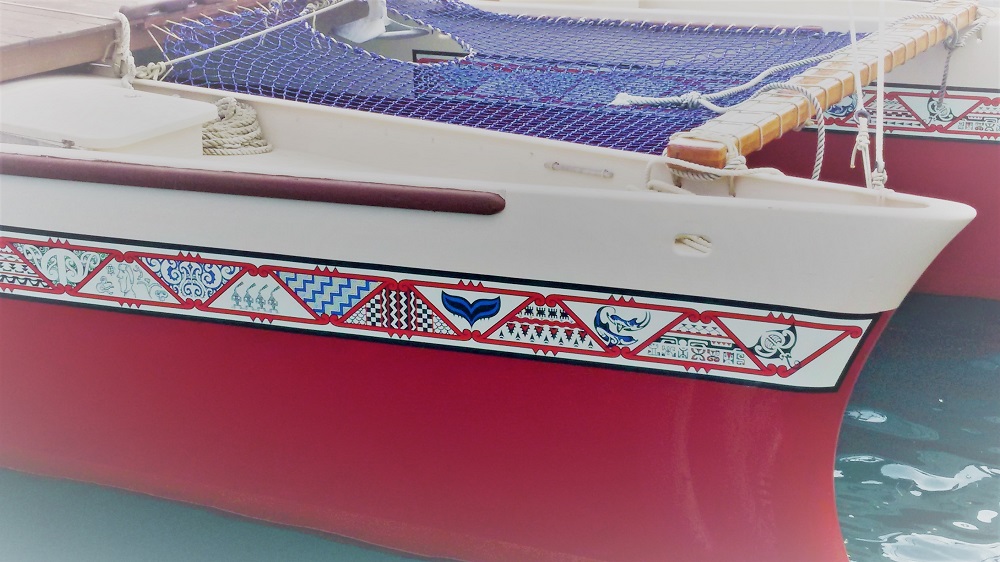
Towards the end of the demonstration, the group moves to the boat dock and boards the beautiful, traditional Polynesian Okeanos Vaka Motu, a 14-metre elaborately adorned catamaran part of an eco-tourism operation which transports visitors between local islands powered by only the wind and coconut oil. The national representatives stand proudly along the bow of the catamaran, holding up flags and banners, their traditional costumes waving in the wind. Onlookers, locals and tourists alike, cheer and clap, stomping in time with the chanting. The man with the megaphone brings a large triton shell to his lips and blow hard, emitting a curiously deep, wailing sound. He blows it three times and then the protest is over and everyone stops to chat, admire the beautiful boat, approach the multinational assembly and ask questions about the cause.
Climate change is only the latest threat in the long, brutal history of Vanuatu. The area was originally settled by the Lapita people (ancestors of Polynesians originating from Taiwan) about 3000 years ago. Around 700 AD, Melanesians arrived from the Solomon Islands displacing the Lapita entirely. For centuries thereafter, the islands were populated by autonomous clans who spoke different languages and raided each other’s villages, eating abducted victims to bodily incorporate their spiritual power.
Europeans entered the picture in 1606 when the Spanish Pedro Fernandez de Quiros sighted (and named) the island now known as Espirito Santo, thinking he had reached the elusive southern continent Terra Australis. He was attacked by locals and had to retreat, and subsequently, Vanuatu was visited by the French (Bougainville) in 1768 and James Cook (who named the area the New Hebrides) in 1774. Sandalwood traders began operating in the area from 1825 onwards; these paid for the wood with guns, tobacco or men from neighbouring villages to be cooked for important ceremonies. The traders treated the indigenous people abhorrently, occasionally taking to distributing smallpox blankets to clear areas of locals to ease access to the prized wood.
When Christian missionaries were sent from the London Missionary Society in 1839 the Ni-Vanuatu (people of Vanuatu) were tired of foreigners, and the new arrivals were promptly clubbed and eaten. After this, Polynesian missionaries were sent from Samoa, but these too sustained heavy losses and the mission was aborted until 1848 when Vanuatu’s Presbyterian mission was established on the island of Aneityum. Blackbirding, the coercion or kidnapping of villagers for use as poorly paid labour on sugar cane plantations in Australia and Fiji or nickel mining in New Caledonia, was rife, resulting in the departure of 50,000 Ni-Vanuatu men between 1863 and 1904, leaving many villages missing half their men. Few returned, although any surviving labourers in Australia were abruptly deported in 1906 when the White Australia Policy came into force.
When the Germans started to show interest in the area, the French and the English set up the Anglo-French Condominium of the New Hebrides and formally settled the islands. Close contact with missionaries, settlers, and smallpox purposefully introduced by the sandalwood traders, resulted in rampant disease which reduced the Vanuatu population from an estimated one million prior to European contact to 41,000 in 1920.
The French and the English continued to administer the islands jointly until rising discontent about land ownership (30% of the land was owned by French or English planters) led to a protracted and bloody struggle which culminated with independence in 1980.
Nowadays, the population of Vanuatu is about 280,000. The economy is mainly based on copra (coconut), beef, coffee, cocoa, and tourism is becoming more important.
Presently, climate change is the most significant threat to sustainable development in Vanuatu, mainly because of the predicted increase in extreme weather event associated with global warming. The main risk is increased frequency and severity of cyclones. In 2015, Cyclone Pam affected 64% of the economy, 60% of the population, and destroyed 96% of the country’s food crops. Apart from cyclones, other climate-related adverse effects to this tiny island state include its fisheries being impacted by rising ocean temperatures and ocean acidification, and the islands being inundated by sea level rise and associated coastal erosion.

Currently, it seems a hopeless struggle. The South Pacific states contribute almost no greenhouse gases to the atmosphere, but as low-lying island states in the cyclone belt, they are disproportionally affected by a changing world. It is great to protest, and I hope with all my being that the world is listening to the South Pacific, heeding the warnings and fulfilling the heart-breaking messages of the paper placards:
We are people of the canoe, we are resilient to climate change
We’re not drowning, we are fighting
Honour Earth all life depends on it
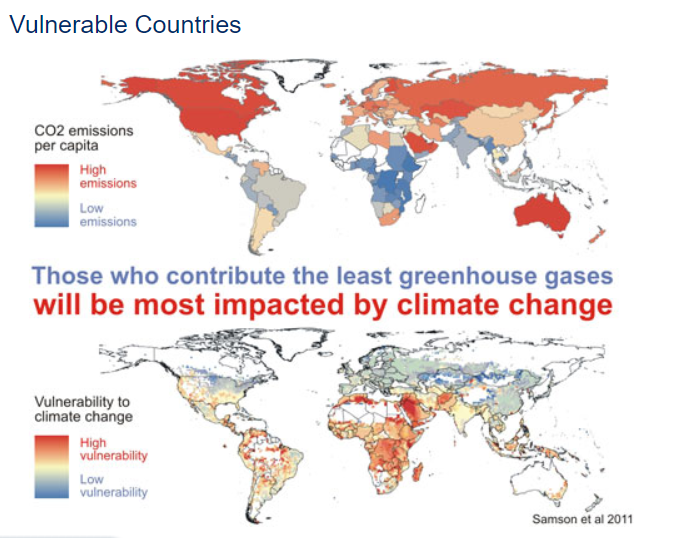
I admire the action day for its clear action focus – rather than just protesting, the slant is that everyone should join the battle to combat climate change. It is a strong and empowering message, urging Ni-Vanuatu to do something about the largest issue looming over their world today. But unfortunately, their influence over the core problem is minimal. They can work with NGOs and government organisations to increase resilience, to plan for more erratic climate, more frequent cyclones, reduced fishing crops. They can retreat from low-lying areas and plant different crops in new areas in an attempt to outsmart the weather. They can convert local vehicles to biodiesel from sugar cane and use the solar panels distributed by foreign aid organisations to minimise their own greenhouse gas output.
But the truth is that even people of the canoe can drown in a world of a couple of metres of sea-level rise. And going down fighting does not right this last in a long string of wrongs that the western world has imposed on Vanuatu since first contact.
I hope this demonstration, one of many taking place across the South Pacific to increase awareness and urge action on the issue, doesn’t fall on deaf ears.
 SV Bob The Cat