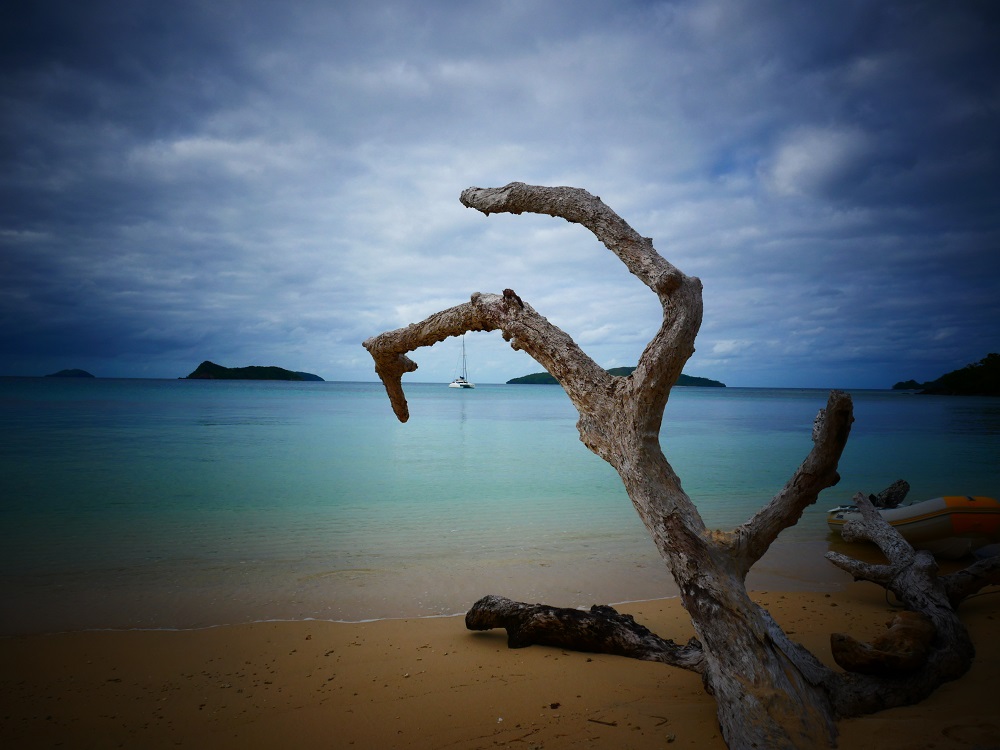
“Is something burning in the kitchen?” asks David. He’s leaning into the saloon from the cockpit, a dark shape backlit by the setting sun.
I look up from the steaming stove where I’m painstakingly stirfrying vegetables one small bunch at a time to ensure perfect crispness. “No,” I say. “Everything is fine here.”
“Are you sure?” he leans further in, sniffing the fragrant air. “There is, like, ash coming out of the kitchen side hatch. I’m pretty sure it’s from the kitchen.”
“Nope.” I turn my back to him to fish the carrots out of the pan and place a small portion of carefully cut chicken strips in the hot oil. “No fire here. And I’ve had the hatch closed the whole time I’ve been cooking. So must be from somewhere else.”
“Weird. Maybe the villagers are burning rubbish or vegetation on the shore.” He lingers a moment longer in the doorway before heading back out into the cockpit.
“I hope it’s not another volcano!” I shout after him.
Last time there was ash on deck it was a volcanic eruption in Vanuatu, about two weeks ago just when we were getting ready to leave the Lau Group for Suva. We woke up one morning to find the boat covered in a substantial layer of fine ash, and after a little investigation discovered that the source was about 700 miles away, on Ambae island in Vanuatu, the huge ash cloud from which had been carried by winds to Fiji where it settled out over the sea, the land and our boat. The ash cloud disrupted Air Fiji flights for a couple of days, and one can only imagine how bad it must have been in Vanuatu.
Back then it took us days to clean up the mess, washing and wiping grey residue from our fine white deck, scrubbing black footprints from the cockpit flooring.
Now we’re at Ono Island, in the north Astrolabe reef by Kadavu, a large island 150 nautical miles south of Viti Levu, and I’m hoping this is not another volcano.
David comes back in as I’m draining the noodles. “I can see it now, there’s a fire on the shore, behind the palms. Probably just the villagers burning rubbish.”
“Great,” I say, wiping the hot steam from my brow with the back of my hand. “Well, dinner is ready, so can you please ask the boys to set the table?”
It is not until after the kids have gone to bed that we notice that the fire hasn’t gone out. It is now completely dark, and it is clear that the fire has spread: from the isolated spot behind the near-beach vegetation where David saw it, it has now conquered half the hillside. It is definitely out of control – the flames are licking up trees and as we watch it spreads rapidly, the red glow above the yellow flames lighting up the sky, the inferno reflected in the still water below. We can hear the roar and crackle as hundreds of trees combust, and the smoke is billowing over the boat as it moves out through the calm bay through the still night.

David and I sit watching it in horror for a while. I cough. He coughs. I rub my eyes – they are stinging from the smoke. He rubs his eyes. I cough again.
Thick smoke is now rising in a tall column off the hillside, visible against the fire-illuminated sky. We’re directly downwind and are getting the full fallout. The deck is covered in charred fragments of vegetation, piles of ash are nestling in against the steps at the stern.
Over the roar of the fire, we can faintly hear Matias cough from deep within the boat.
Finally, at 11:45 pm we stir. David says, “We better get out of here. We can’t stay in all this smoke, and it’s not getting better, there’s no sign of it abating.”
“But we can’t move the boat in the dark!”
“I think we’re going to have to.”
You need great visibility to move around in shallow bays with numerous uncharted coral reefs just below the water surface. Normally, we only move when the sun is out, and once out of open water one polaroid-sunglass-wearing person is always standing watch at the bow, pointing out the reefs that emerge as we draw closer to shore.
Now, it is midnight, the only light available the red glow of a raging bushfire.
I swallow in dread, and as David starts the engine I get the large torch out. We hoist the anchor and slowly creep around the coastline towards the bay where Naqara village is located, figuring that it is upwind from the fire and so unlikely to yield much smoke – and that if it does, the villagers will almost certainly need our help. Fish jump out of the water, startled by the torchlight I beam ahead of the bow, and every time I hear a splash I fear that it’s a reef, that we’re about to crash.
But in time we make it to the middle of the village bay and find what appears to be a flat, feature- and reef-less bottom. We put our anchor down with a sigh of relief. The village is completely quiet, only one light on, and no people can be seen moving even though half the hillside beyond it is engulfed in flames.
After watching for a while, we go to bed and are lulled to sleep by the crackling fire, the smell of smoke lingering in our nostrils.
In the morning, smoke is still rising from beyond the village hills. Boats are buzzing to and from the village, but thankfully everybody is fine, no damage to any houses. Just another rubbish fire going out of control.

The bay that burned was one that is used for film sets from all over the world. Fiji is a choice location for Survivor Series and tropical movie-making alike. When we visited Naqara a couple of days earlier, Job the chief talked about how the village-owned bays are booked out for filming for the next five years.
“This year it is the Sweden Survivor movie,” he said as he was walking us back to the dinghy after the sevusevu. “They have already built all the things they need, and they will spend 40 days here filming.”
He gestured beyond the steep hill towards the bay beyond. “They will stay on that beach over there, and on that island there, and on that beach too.”
“Wow,” said David. “So you’re busy with that.”
“Yes.” Job wiped his brow as he was wading through the shallow water. “After the Sweden, we have the Survivor France, and then after that the Sweden again.”
He glanced out over the shallows. “And then the year after that it is the Poland Survivor, and then the France again, some Robinson Crusoe show. And then maybe the USA the year after that.” He smiled.
“Wow,” David said again. “That is great, everybody coming here to film their movies and Survivor series. Well, I guess it is not a bad place to survive…”
“Yes, it is very good for us,” says Job. “Very popular to come here, and the villagers get work from it.”
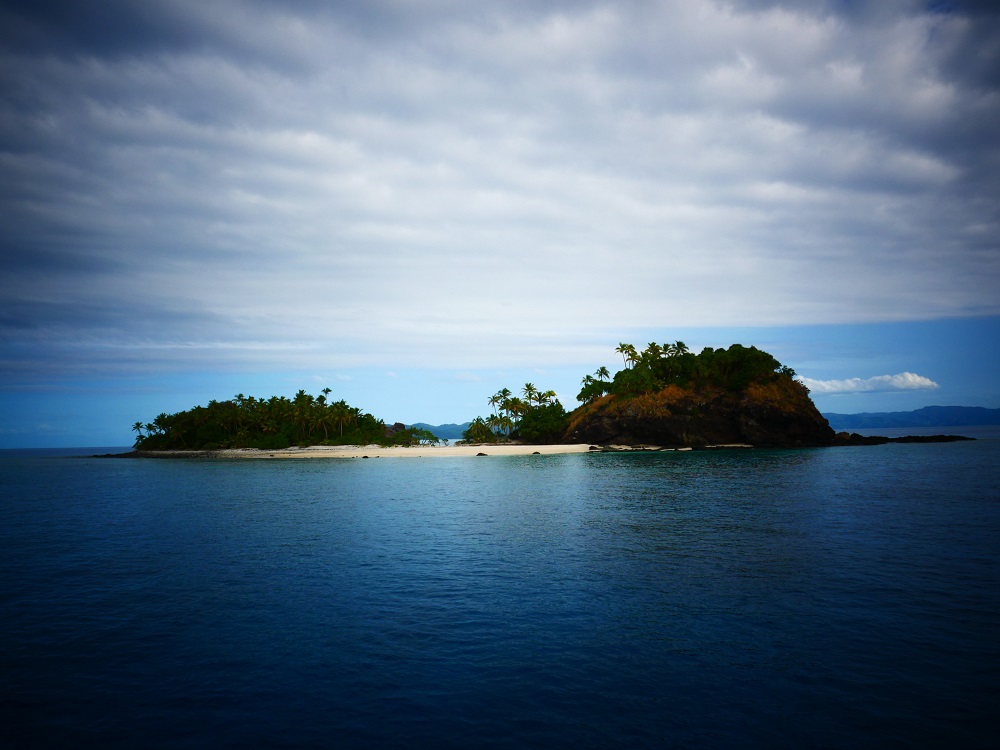
Now, we just hope that the fire hasn’t disrupted the busy filming schedule.
It is a beautiful place, perfect for tropical idyllic island moviemaking. In the quiet village bay the steep hillsides are reflected in the deep green water, the water so calm that it offers a perfect mirror image of the hills and the clouds. The beach in the bay they will film in is white, coconut palms in the background, and inland vegetation lush and dense. The bay is fringed by a coral reef teeming with fish. Birds swish through the sky everywhere, landing noisily in trees.

Now, the vegetation behind the palm trees is scorched, but the setting still looks nice, just a bit more mysterious and menacing. We think it’s the perfect setting for a survivor show and hope that the Swedes agree. It is lucky that they haven’t arrived yet – we’ve seen them scope the area, but they are not yet living there. Just as well – imagine the liability if a whole Survivor Series perished from on-set smoke inhalation.
It is great that Fiji can make money from the film industry. In 2017, 74 productions were shot in Fiji, which according to the Fiji Sun generated new economic activity of about FJ$350M. The USA Survivor show alone generates seasonal employment for 300 Fijians. It is a neat source of income for a developing country.

Sharpening wooden sticks ready for Orc attacks.It’s not just the international movie makers that want to survive outdoors in Fiji.
On our boat, the kids are increasingly keen to spend a night sleeping out by themselves on the shore. We have been trying to find them a deserted island to go to, and in the meantime, they’ve been camping out on the foredeck trampoline as a compromise.
It’s all part of the continued Lord of the Rings games. As they’re reading their way through the books it permeates everything we do, and presently they are deeply immersed in a game where the Elf Thamior (aka Lukas) and the Dwarf Thorin (Matias) find themselves in enemy territory, on a deserted beach backed by palm trees and steep bush-covered hills. Faced with such obstacles the two make plans to survive, collecting seashells, nuts, seeds and pieces of wood, all of which represents edible substances that will help them live through the night and face another day. Monsters lurk behind every corner, and as nightfall nears the two plan for a safe survival of the night, strategically storing their food, and identifying nearby cave-like shelters that might provide refuge should it rain.
The characters have evolved over time, and it is now clear that the Dwarf is rather foolhardy, recklessly tumbling headfirst into dicey situations, to the great frustration of the more reticent Elf, who deep down doesn’t really like risking his life that much. They are a good pair, though – without the Dwarf the Elf would never go anywhere, and without the Elf, the Dwarf would surely die within minutes.
And even though we encourage adventures and independence, we are very grateful that we didn’t let them sleep ashore by themselves on the night of the bushfire.
But Kadavu is not all surviving, smoke and movie sets.
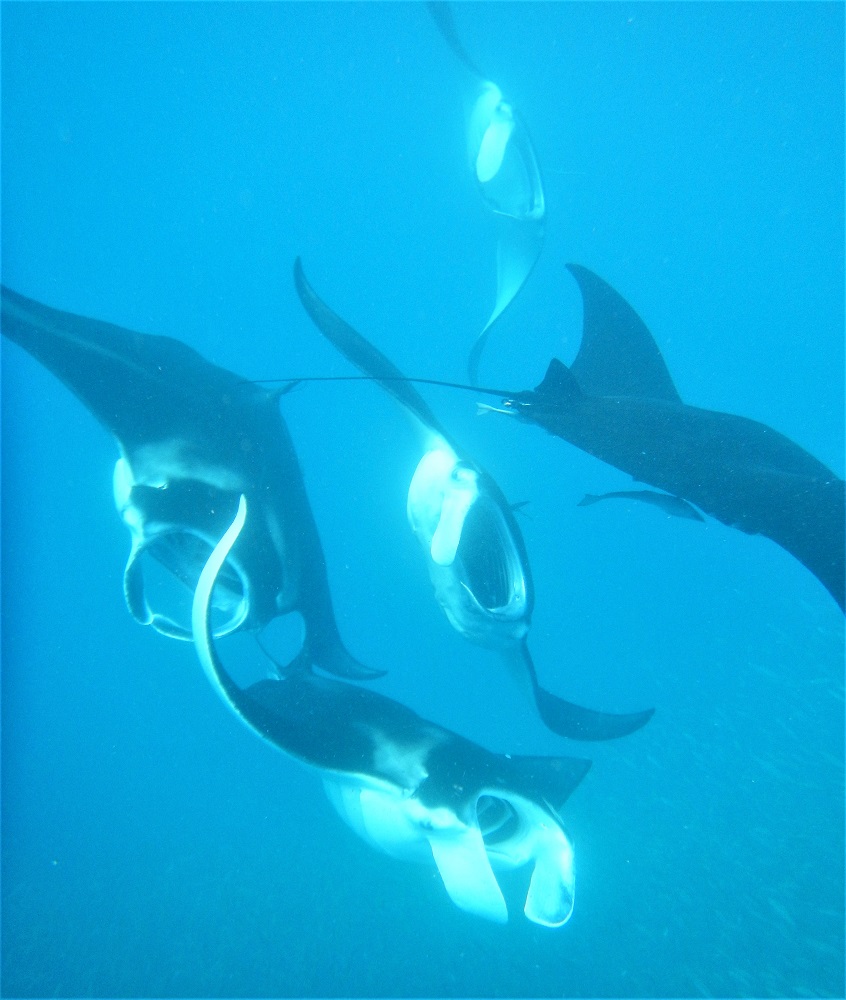
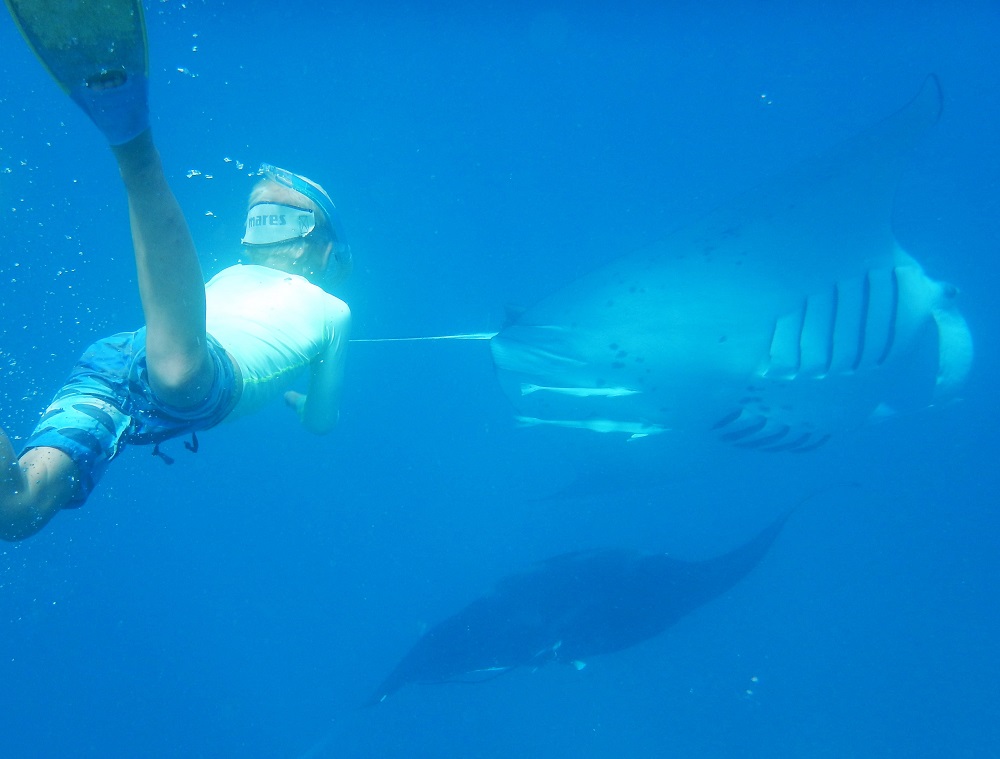
The water between the islands just north of One Island teem with manta rays. The sea there is like manta soup, and everywhere we go we see them, huge black diamonds hanging just below the water surface, waving their fin tips out the water as if to warn us they are there.
At 2-4 m across they are incredible to see up close, gentle giants gracefully gyrating, twisting, twirling, looping, mouths gaping as they suck up plankton from the rich waters. When they are feeding they come across as hollow, just a cavernous mouth opening up into a rib cage, slatted gills clearly visible on their underside. We swim and dive with them and look on in amazement.



Further south, on Kadavu Island proper we anchor in steep-sided bays and hike to inland waterfalls, swimming in the crystal clear pools below the thundering cascade. We travel up long rivers through mangrove swamps, spotting colourful native parrots, birds of prey and the occasional bat.
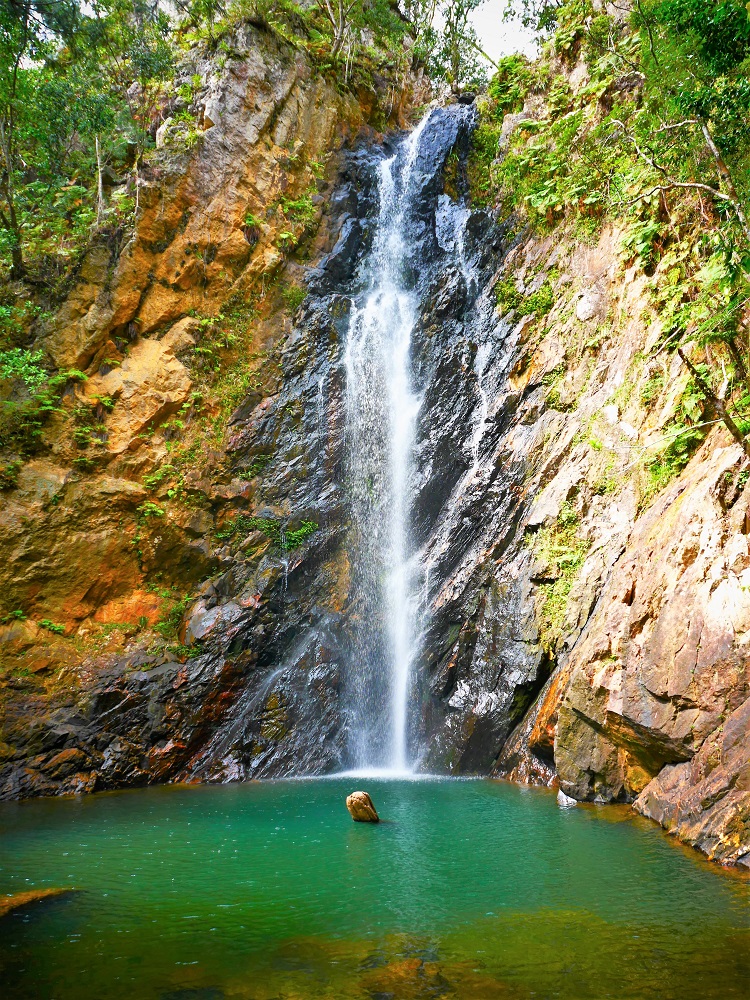
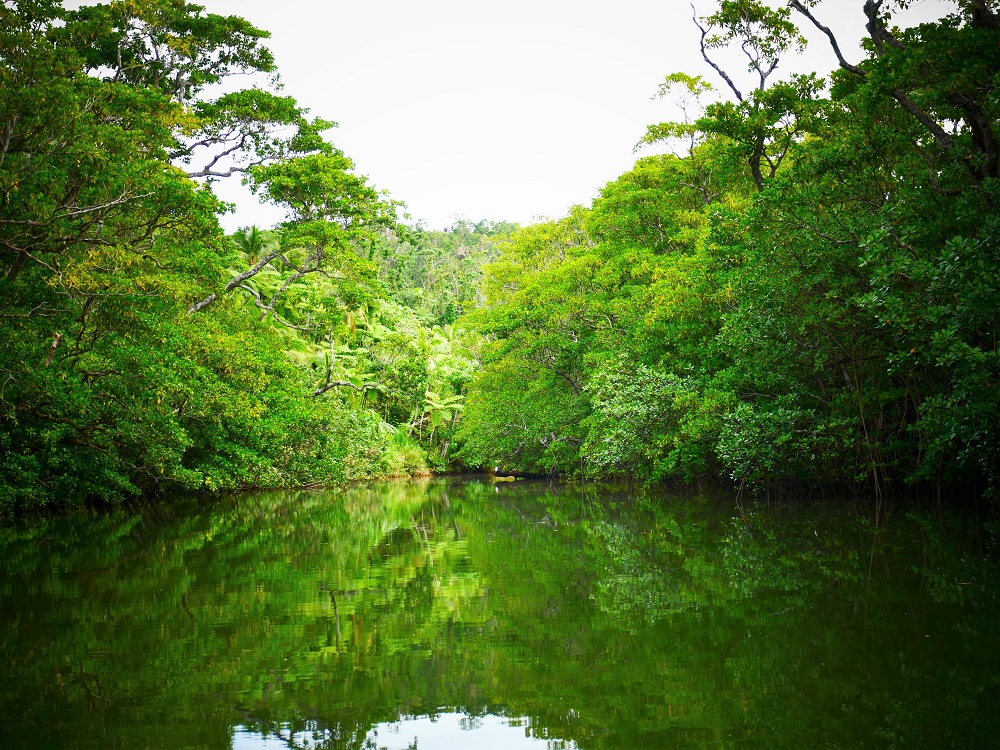

Travelling along the Kadavu coast we see fires everywhere, steaming smoke coming out of every hillside. We’re not sure how many of them are intentional but know that the pine plantations on the island are often burned off after felling and that elsewhere wild yam are harvested through burning the vegetation. But wildfires are common too in the dry season, destroying vast swathes of Fijian land every year. It certainly is fire season: it seems that no matter where we anchor we accumulate ash on deck, and after a while we get used to it, brushing off the soot and washing the deck carefully every morning.
Tomorrow we will leave Kadavu for Vatulele, a small island on the way to Viti Levu. Hopefully, the fire risk will be less there.
 SV Bob The Cat