Weee! Over the last two weeks, me and Lukie went kitesurfing and wakeboarding.
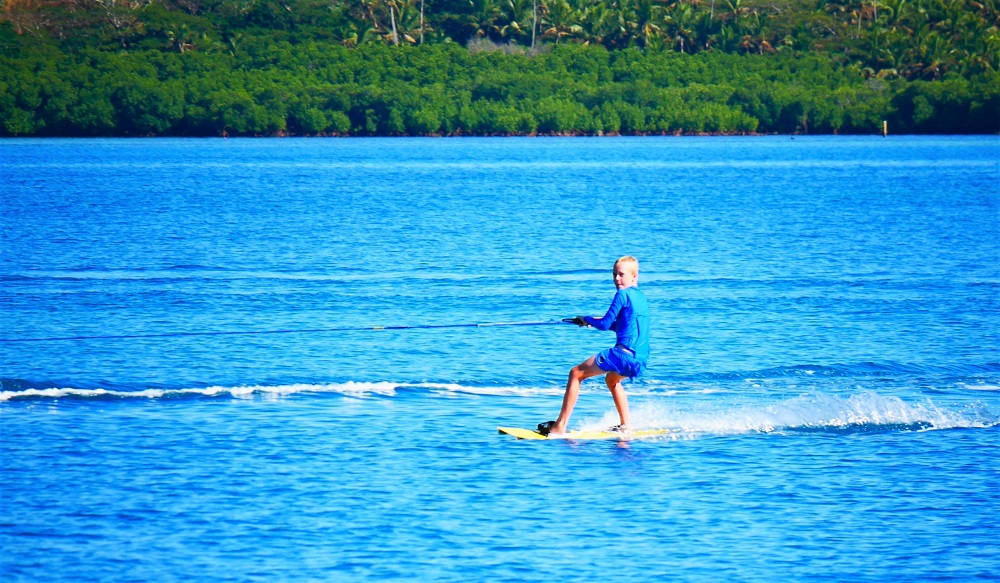
Wakeboarding is when you get a kiteboard and you hold a rope with a handle on the end. The rope is tied to the dingy. To get up the dingy drives forward and you get pulled along while you hold onto the handle.
MatiasDaBoss!
If you let go of the handle you will start sinking because you have nothing to hold you up (unless you are going really fast, then you skid along the water for about five seconds). Sometimes we fall off (it can be quite brutal, I fell and bumped my forehead). Here are some pictures, enjoy!
Me dying.Aaargh!Slam!
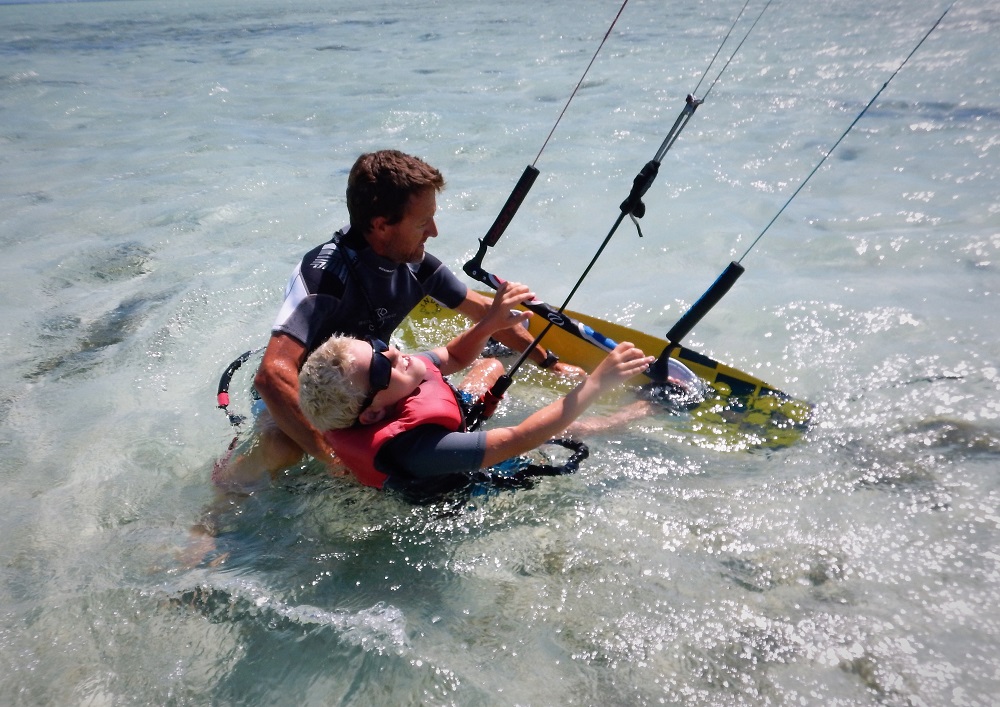
Wakeboarding is really fun but also quite difficult. Kitesurfing is also really hard until you get it. I managed to get up on the board and I went flying at about a hundred kilometres an hour. I flopped the kite on the water, so I could stop. Man, kite surfing is fun but also super-duper scary. I ham, I mean I am, so happy and grateful that I got up.
Me getting up.Me kiting to Tonga!Lukie with sunnies trying to get the feel for the board.
Lukie is about to get up, he is getting the feel for the board. We do this kite surfing on a sandspit in Musket Cove. The sandspit is perfect for starters and getting up on the board.
On Friday we are leaving for Vanuatu. It will be a four-day passage so before we go we need to reinforce our food supplies. Today we are leaving to Denarau to stock up until Friday.
For home-schooling, Lukie is doing an inquiry about saltwater crocodiles and apparently they live in Vanuatu, and we are going there! Oh no, I knew it would end this way. “Really?” says Lukie. “No, I didn’t know it would end this way.” But it might, you never know. Do you know?
Another thing is that saltwater crocodiles can swim very far. Maybe even to New Zealand!
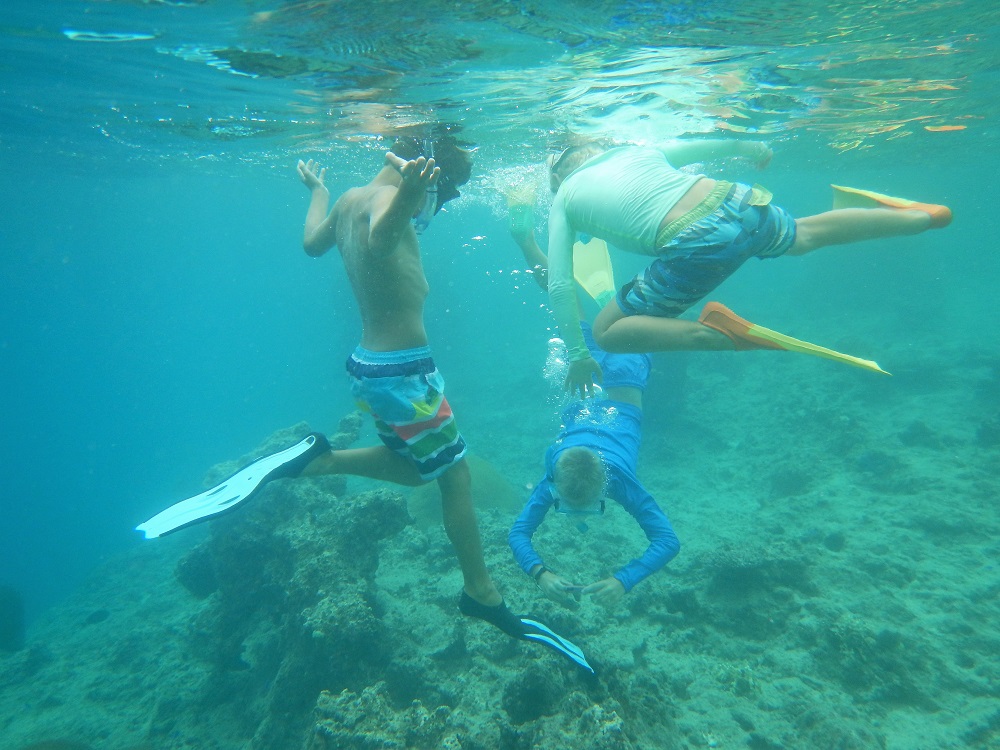
Yesterday we went wakeboarding with a friend called George who we also snorkelled with. We went snorkelling just behind the sand spit on an abyss going down to about two hundred (I think) meters in depth.
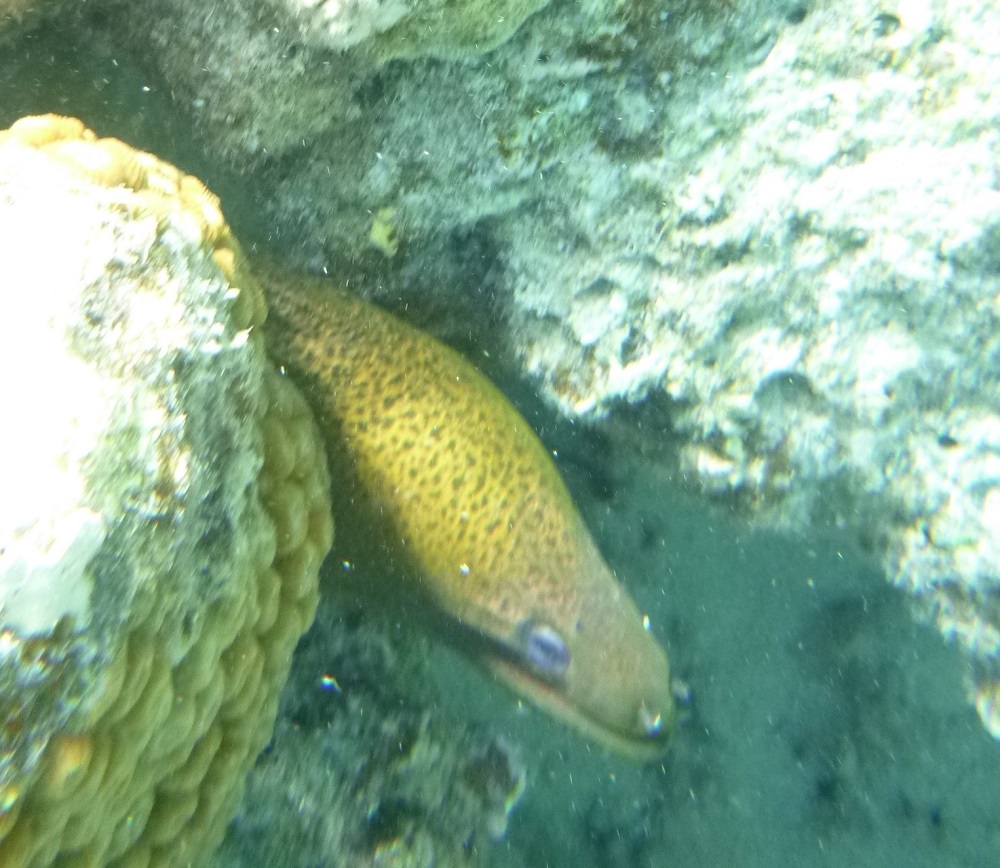
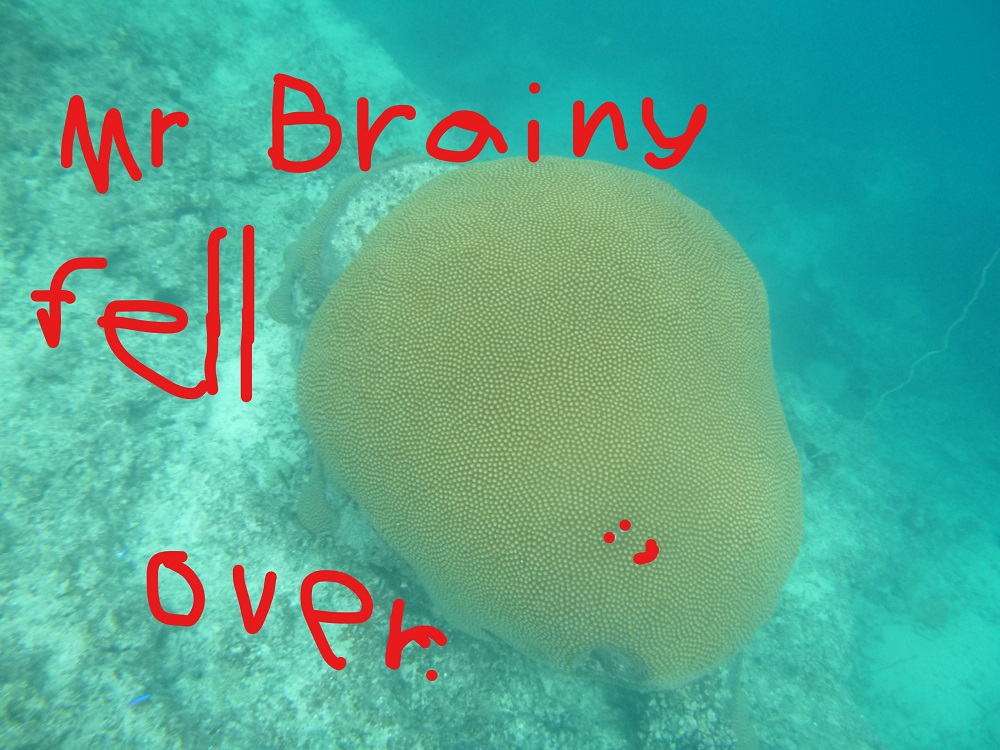
Snorkeling with George.Ninja coral which sneaked up on me.Moray eel.Crawl. “Goodbye.” Crawl, crawl, crawl.
Once upon a time, a beautiful princess, Yalewa-ni-Cagi-Bula (Lady of the Fair Wind) lived on a small island in Fiji. Of godly descent, she was the fairest of all women in Fiji; her beauty stunned all who beheld her, and any man who had set eyes on her was in awe and wanted her to become his wife.
Her home was an emerald green saltwater pool in a cave behind the ragged rocks that guard the western shores of Vatulele Island, over the seas from Viti Levu. Her beauty was so famous that chiefly warriors came from all over Fiji and beyond, from the whole of the Pacific, to ask for her hand in marriage. Each suitor brought a gift which they presented to the fair maiden, hoping that by bringing her earthly goods they could persuade her to marry them.
The princess was as picky as she was beautiful, and refused suitor after suitor, deeming them unworthy of her love.
The son of the highest chief in the north came bearing the tastiest fruit, asking for her hand. She asked him where the fruits were from, and when he spoke his home island, she refused him haughtily, saying that only fruits from heaven would be sweet enough to match her beauty.
The son of the highest chief in the south came bearing the shiniest pearls, asking for her hand. She asked him where the pearls were from, and when he spoke his home ocean, she refused him disdainfully, saying that only pearls from heaven would be shiny enough to match her lustre.
Finally, the son of the highest-ranking chief in the whole of Fiji came to ask for her hand, bringing a gift of succulent cooked prawns wrapped in banana leaf. She asked him where he was from, and he pointed just over the eastern horizon. She laughed scornfully and said that only a man from the heaven above would be supreme enough to match her divinity. Outraged, the chiefly warrior flung the prawns at the beauty, and when they scattered into the pond surrounding her they were restored to life. And that is how the prawns in the pond in the cave at Vatulele Island are red even when they are alive, unlike all other prawns who only turn red when they are cooked.
The ura mbuta, or ‘cooked prawns’ are rare, and to this day sacred to all Fijians. Visitors to the pond will sometimes see Yalewa-ni-Cagi-Bula at the cave but to locals she remains hidden. If the goddess is unhappy with you – if you haven’t presented your gifts to the chief of the island – no prawns will show themselves to you. If she is happy with you, the prawns will be out in great number.
Sacred prawn.
Mele smiles and takes a step back from Korolamalama Cave. We stand beside him, surveying the crystal-clear water and the red dots of prawns scurrying hurriedly around. There are plenty, so we must have followed good protocol when we did our sevusevu in the village. The pool is enclosed by vertical limestone rock, beyond which the coastal forest stretches, intercepted here and there by sharp rocky outcrops. The trees are big and tall, with thick, heavy roots spreading and rising far above the ground into a tangled mess of thick vertical branches. Behind the cave, a steep limestone wall rises perhaps 25 m from the ground. Trees poke out of the rock at the top, clinging to the limestone cliff with their roots stretching all the way down the side of the cliff to the bottom.
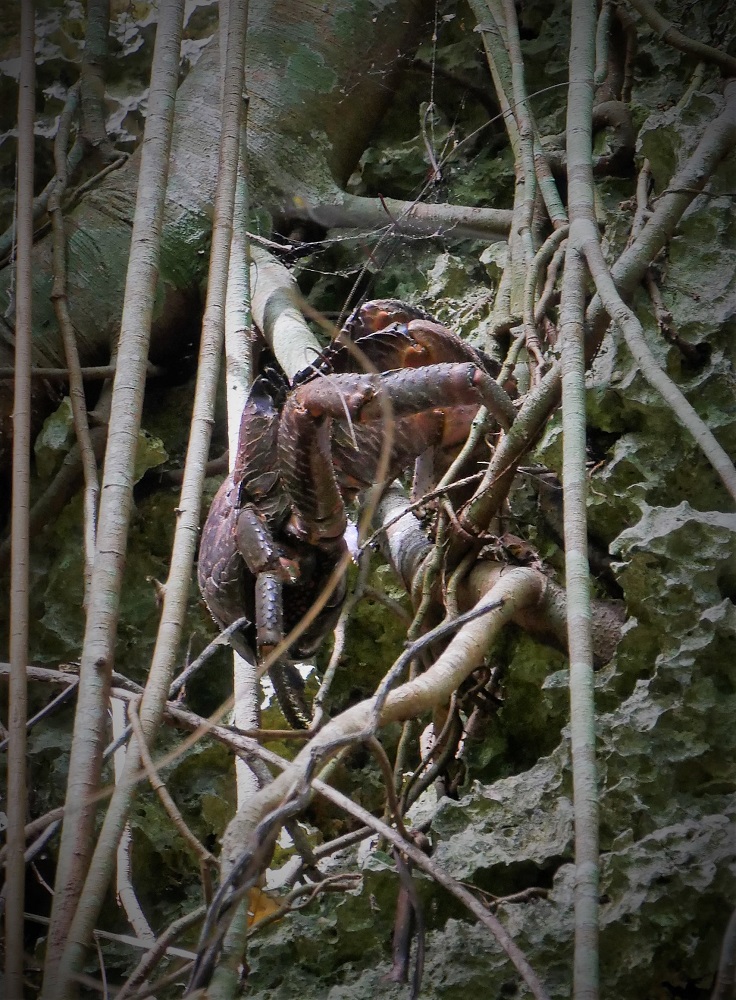
Large coconut crab crawling up tree roots hanging off the cliff.
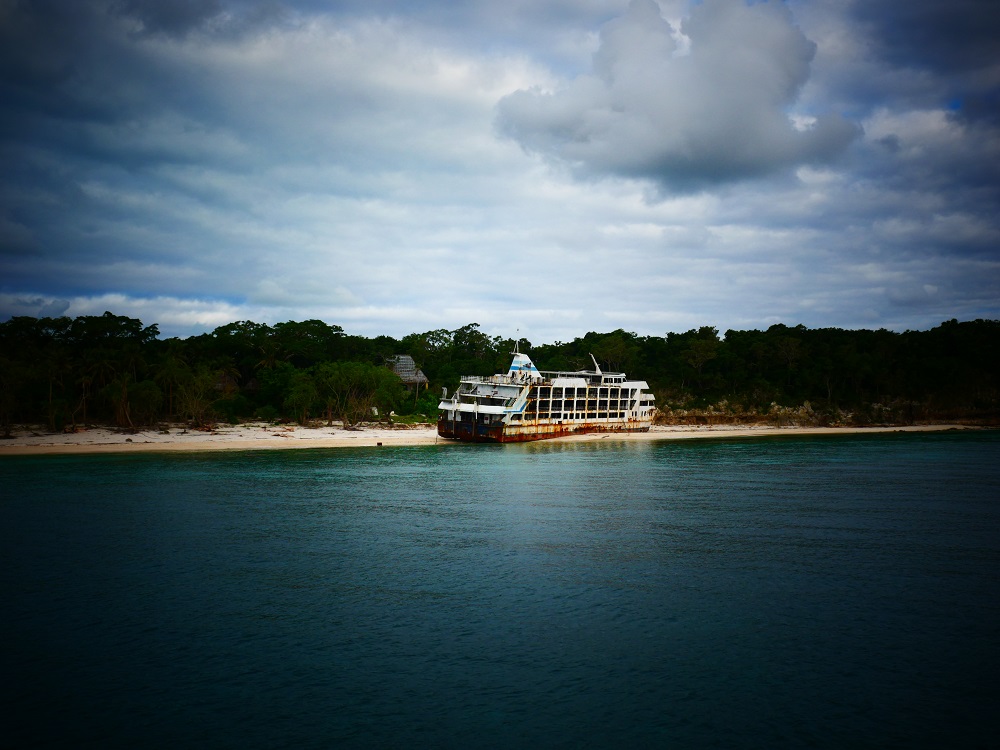
The cave is not far from where we are anchored alongside a beautiful white beach on the western side of Vatulele island. Flanking the beach is an abandoned resort, complete with 19 bure (Fijian-style huts used in tourist accommodation), a white clifftop mansion, and several unfinished buildings on the foreshore. And a huge ferry wreck, a rusty death trap measuring 60 metres in length, which is parked on the sand at the southern end of the beach, just in front of the resort’s pink honeymoon suite.
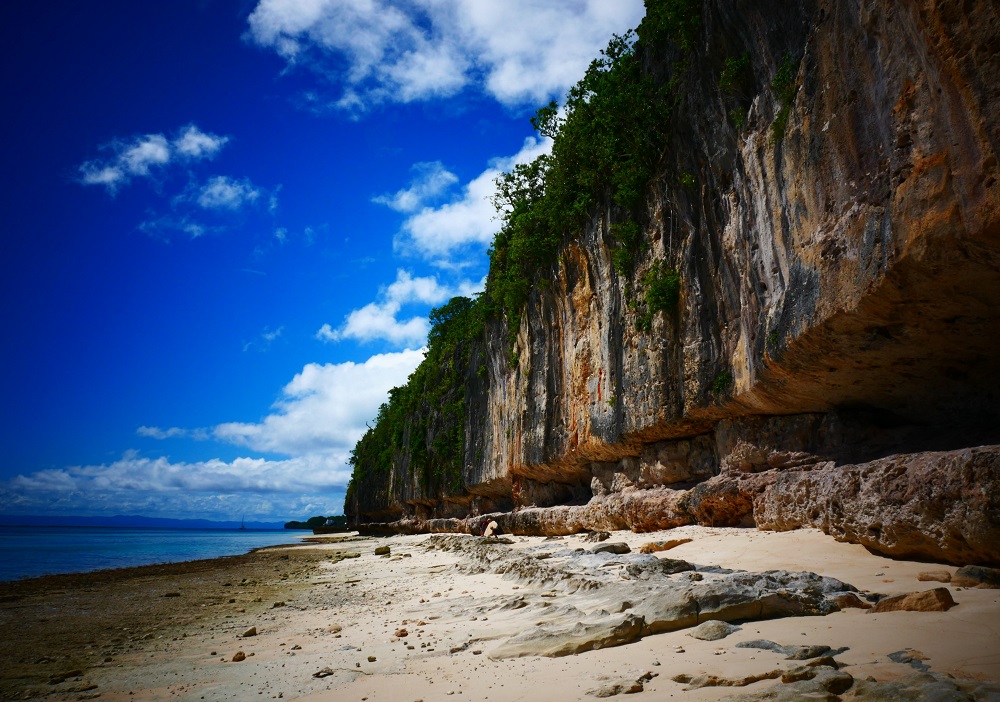
Stunning coastline.
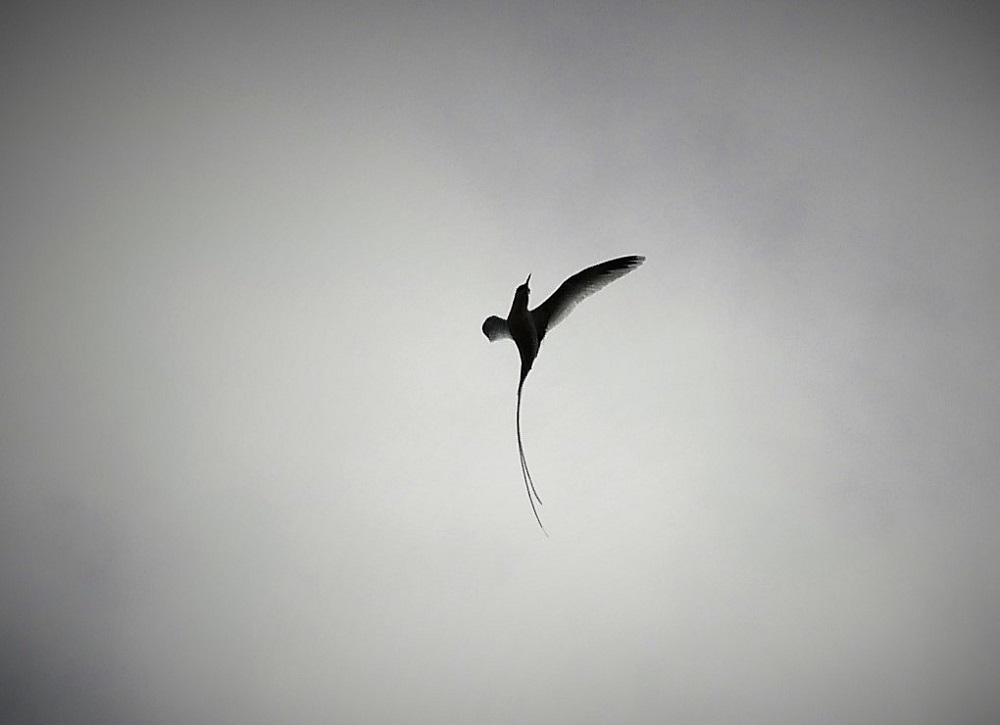
It is a stunning location. The outer reef is not far from the beach, the glassy lagoon providing calm waters for safe swimming and snorkelling on the many coral outcrops. The resort faces west which makes for spectacular water sunsets. White tropicbirds fly from the bush, their long tails clearly outlined against the deep blue sky. Whales pass on the outside of the reef, large black lumps passing by, clearly seen from the beach.
Wispy tropicbird in flight.
Forsaken since 2015, the resort has had four different owners since it first opened in 1998. The exclusive holiday accommodation was built at great expense by two Australians in a New Mexico – Fijian fusion style and for years the five-star resort was the most expensive destination in Fiji. The current owner, the multi-millionaire French-Australian Albert Bertini, closed down the resort when he ran into cash-flow problems after spending in excess of A$20M on building additions which now stand half finished on the foreshore.
Bertini, 50, was holidaying at the resort in 2011 when he decided on a whim to get married to his 24-year-old girlfriend and to buy the resort they married in to boot. The resort was in receivership at the time, and shortly after Bertini took over in 2012 he started renovating and building. A property tycoon worth an estimated A$400 million, Bertini started developing at full pace. It was around this time that he declared bankruptcy in Australia and fled the country leaving a string of creditors in his wake.
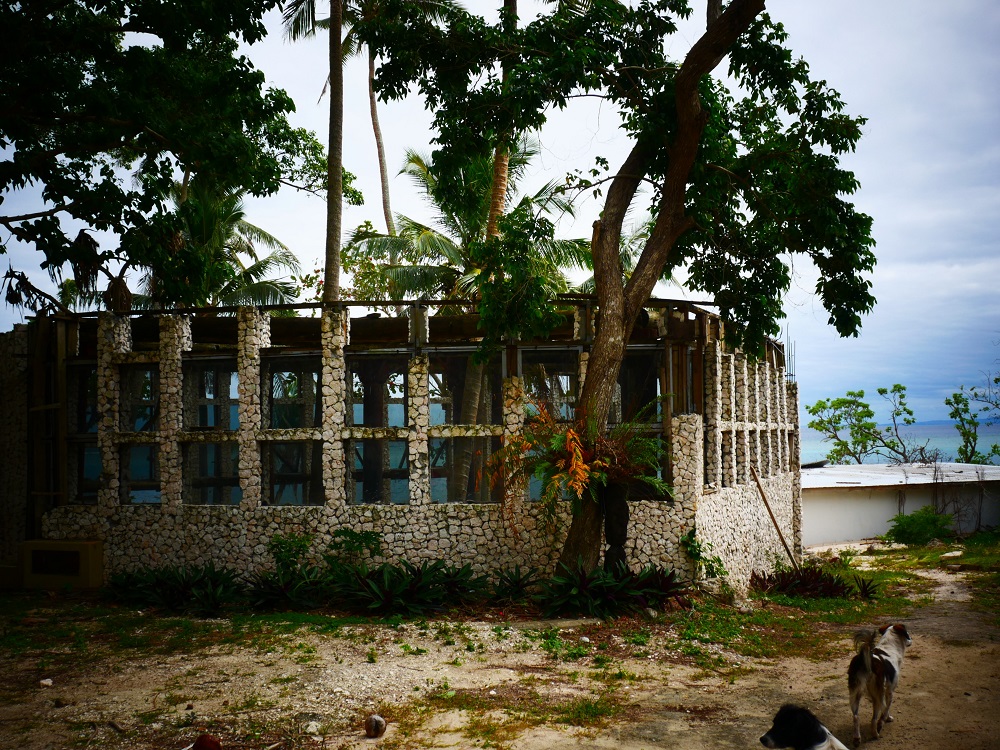
He began renovating the existing bure and started a string of new building projects, including a second floor on the white honeymoon villa to house his extensive wardrobe; more holiday accommodation at the back of the site; a stone-clad indoor garden sporting a Grecian design with 200 glassed windows hemming in a small grove of coconuts behind a swimming pool facing the beach; and a bunker-like protrusion on the foreshore, entirely clad in black mirrors, a building used as a storage facility for materials for the many building projects. His vision was to turn the resort into a paparazzi-free party venue for the rich and famous, a vision which he successfully persuaded a number of celebrities to invest in.
A half-finished building with 200 windows stands abandoned on the foreshore.
According to the villagers, he would tear the new buildings down as fast as he erected them, finding faults and changing his mind, leading to an endless cycle of building where nothing was ever completed.
The rusty ferry was his final touch, a departing gift to the site. Intended to be reconfigured to become a nightclub, he pulled it ashore at great expense, only to abandon the entire resort not long after.
Rusty ferry awaiting transformation into celebrity nightclub.
The resort is still beautiful, although neglect and the weather have taken their toll. Discrete from the outside, the insides of the bure are amazing with exquisite tapa cloth covering the ceilings entirely.
Tapa cloth covering the bure ceiling
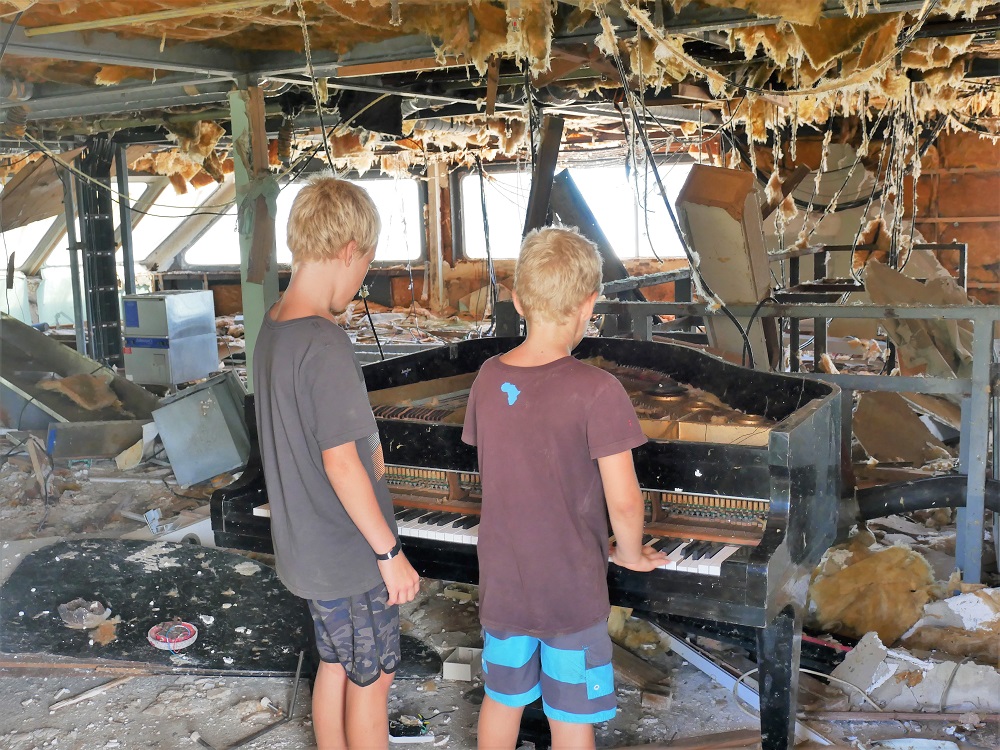
Horrible damage was done to the resort by Cyclone Keni in April this year, which resulted in standing waves higher than 15 m and flooding of the forward row of bure, carrying sand and debris into the beautiful buildings. The cyclone winds blew off roofs and smashed the mirrors lining the concrete bunker on the beach, leaving a devastation of broken glass, wrecked concrete and huge boulders strewn across the foreshore. The cyclone also smashed the ferry apart and moved it further along the beach where it now lies blocking the views from the honeymoon suite. All over the western side of the island, trees were uprooted, and because nobody has bothered cleaning up the site, the carnage is still clearly visible.
The rusty wreck as seen from the beach.Dilapidated piano left in the ferry.
Mele works at the site as a security guard. He doesn’t know when the resort will be reopened but knows that Bertini is looking for buyers, and a few have come looking in the years it has been closed. Bertini is in and out of Fiji, where he has several court cases on the go, the charges including fraud and assault. Until the resort reopens, Mele is employed to keep the villagers from plundering wood, roofing, pipes and other goods. He’s from the village himself, the cousin of the chief, but lives onsite where he takes care of the two lovely dogs that Bertini abandoned.
On our last day on the island, Bertini turns up with a mate to pick up some clothes. I bump into him deep in the forest where I’m looking for rare birds. A short, wiry man clad in a white singlet, vertically striped pants, a bandana underneath a torn cap worn back to front and handmade Italian loafers, he resembles an eccentric trapeze artist on the run from Cirque du Soleil. Around his neck is a bolt tied into a leather string. On his left shoulder is a tattoo of a dark-haired woman, her hair running down his wiry arm, almost reaching his elbow. He speaks fast with a lot of hand movements and very intense eye contact.
“You should never do business in this country, never. The government will just fleece you, as soon as they discover you have money, they will just ask for fee after fee, charging you for everything, asking you to renew licences and pay more and more, until you have nothing left. What they want is for you to develop the place and then run out of money, and then they can take it over.” He takes his cap off, adjusts the bandana, and puts the cap back on.
His speech is littered with celebrity name dropping and references to all the money he’s lost, what the resort is worth, so many million-dollar figures that I have problems keeping track of it all. He reckons that the place is worth US$28 million, or perhaps it was US$32 million. He’s lost a lot of money, perhaps US$7 million a year, for at least the first two years, although that may have just been to the Fijian banks, or perhaps the Fijian government.
He loves Vatulele and has spent long periods, or perhaps 18 months or maybe just a month, here on his own, a time where he really got to know the rhythm of the place, learning when the turtles swim and the birds fly. He’s been awake at night when the moon is as bright as daylight. He’s explored everywhere and has found amazing stuff. Lost cities, with columns and carved head statues resembling those found at Easter Island. Blue holes and caves that nobody knows about. He has a deep spiritual connection to the site, the villagers, and the whole island. He really wanted the villagers to benefit from the resort, wanted them to run it, and he has helped them lots, building many houses, and looking after the old chief after he got a stroke.
His friend thinks that Fijians are just lazy and that the Indian-run government is ruining the country, taking it away from the indigenous Fijians. Bertini thinks that the laziness is partly the kava, that it’s like in the US where they drug their citizens, turning them into fat blobs that just sit and watch TV. In Fiji, it’s the kava drugging them all.
Now, reluctantly, he is giving up on the resort. He has subdivided his lease (the land is owned by a local on the island, but Bertini holds a 99-year lease) and is having it all valued, and it is worth perhaps US$24 million or maybe it was $34 million.
When I mention that I like the dogs he left behind, he offers that we can take one of them with us.
“Take her, you can take her with you, she loves boats,” he offers generously.
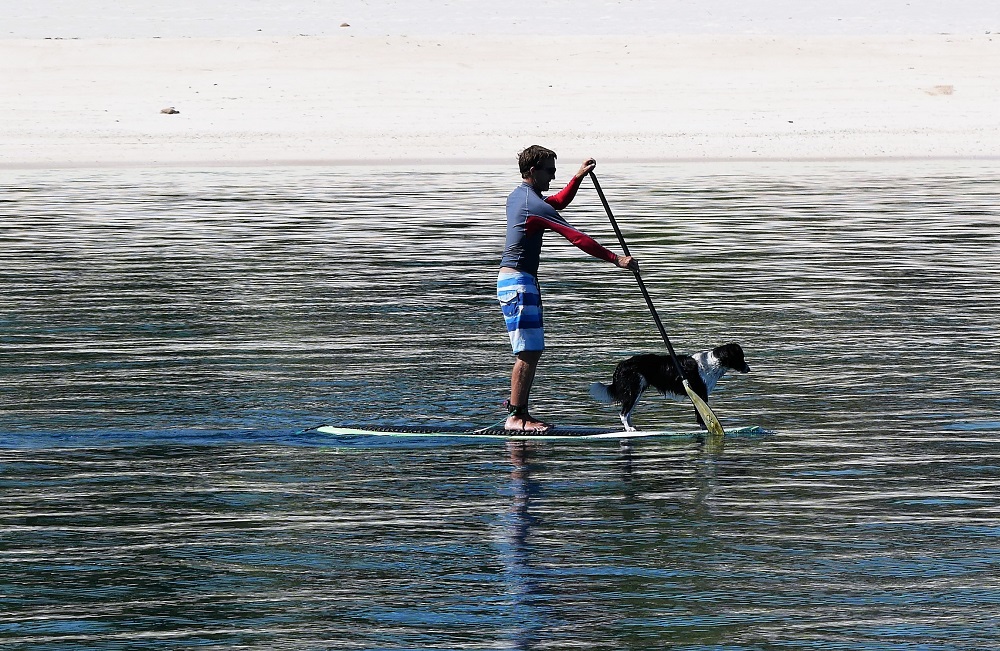
Having been here for a few days, we know that she loves boats – as soon as she sees us on anything that floats (paddleboard, kayak, dinghy), she swims out excitedly and tries to jump on board. If we refuse her advances she swims after us desolately for hundreds of metres, puffing for breath and guilting us with her big brown eyes.
The dog on the paddleboard.
The villagers allege that Bertini had a drug problem, but that kind of goes with the territory if you are a multi-millionaire wanting to develop an island for celebrities to ‘party on’ unwatched. Many mention that they did not like the direction the resort was taking, and the friends he was bringing. But they also acknowledge that had it worked out, they would have thought of him as a genius.
“If it works, he is brilliant,” comments one man. “If it doesn’t, he is a fool.”
It didn’t work, and now he is not much liked in the island’s main village.
We got all the gossip the first day when we went to the village to do our sevusevu.
“Everybody used to work in the resort,” explained Oona, the chief’s wife. “Then when it closed, suddenly there was no more work. We all want the resort to reopen, it was good for the village, good for the island. Now all we have is tapa.”
Tapa is the cloth made from the bark of the mulberry tree, and Vatulele is famous for the fine quality of the tapa they produce. The rhythmic beating of wood on wood can be heard miles away from the village, a loud, persistent dissonant banging pulsing out to sea and into the backland bush.
The banging comes from the production of tapa cloth. Each man on the island owns a stand of mulberry trees, and each woman works six days a week on the production of the valuable cloth. First, she strips the bark from the straight stem of the masi, as the tree is called in Fijian. Then she peels off the outer skin of the bark, leaving her with a white, pliable stretch of shiny bark. She next soaks it in seawater and then pounds the softened bark for hours until it forms a thin, white mat. The mat is dried in the sun, and once completely dry it is decorated with geometric patterns to make the coveted tapa cloth.
Detail from tapa cloth, showing the sacred prawns, tropicbirds, and ancient rock paintings of round faces.
The cloth used to be used as clothing by chiefly persons but nowadays is used as decorative wall hangings, table mats, or as wrapping for important gifts.
It is a lot of work. All day the women thump wood on wood, gradually working the bark fibres into each other, thinning the bark by mercilessly beating it, spreading it out with blunt force.
It’s a world away from catering to hard-partying celebrities, but with the way things turned out it is good that tapa making survived on the island. By village standards, it’s a lucrative industry, and the village appears wealthy, with many concrete and brick houses although these were probably built by Bertini.
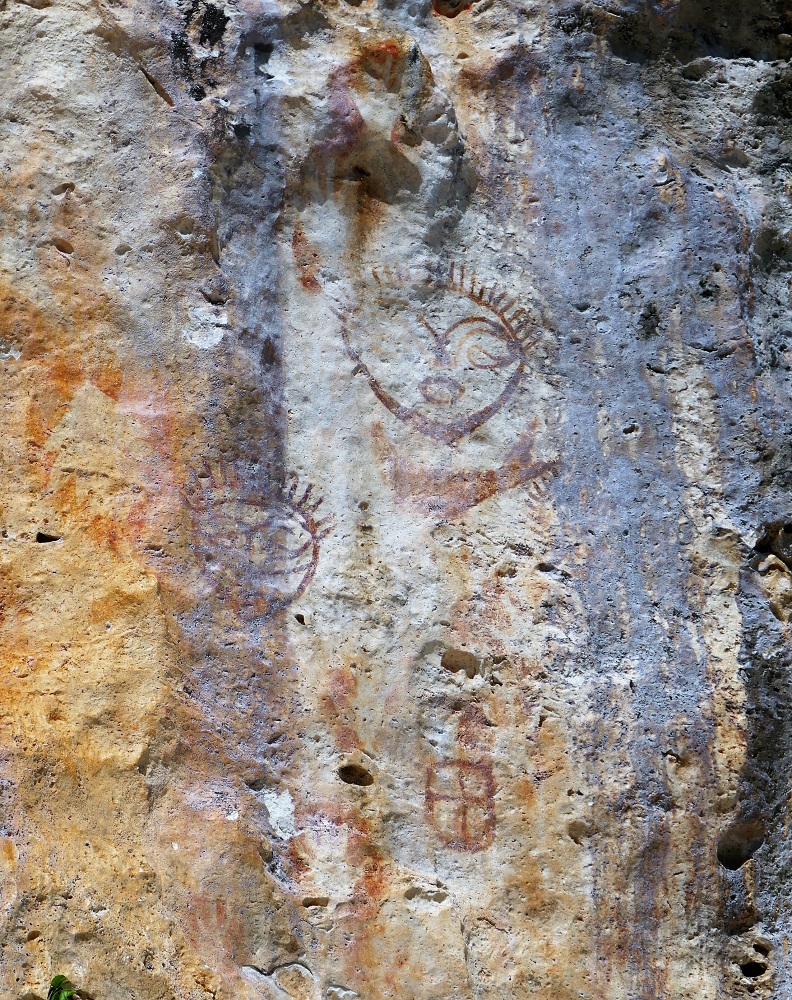
In addition to the ghost resort, the red prawns and the beautiful cloths made by the charming villagers, Vatulele sports ancient rock paintings along the steep western cliffside. According to Bertini, the paintings are 3000 years old, made by the Lapita. (Originally from Taiwan, the Lapita are named for the distinctive pottery that characterises the archaeological sites where their remains are found. They colonised the Pacific in progressive waves of eastward expansion and are thought to be the ancestors of modern Polynesians. The earliest humans to inhabit Fiji, the Lapita were mostly displaced in Fiji by a large influx of Melanesians originally from Papua New Guinea. Today’s indigenous Fijians are a unique mix of Polynesian and Melanesian heritage, in contrast to more eastward islands (like Tonga, Samoa, Tahiti, Hawai’i, and New Zealand) where there are only Polynesians, and more westward islands (like Vanuatu, the Solomons, Torres Strait Islands and Papua New Guinea) where there are only Melanesians.)
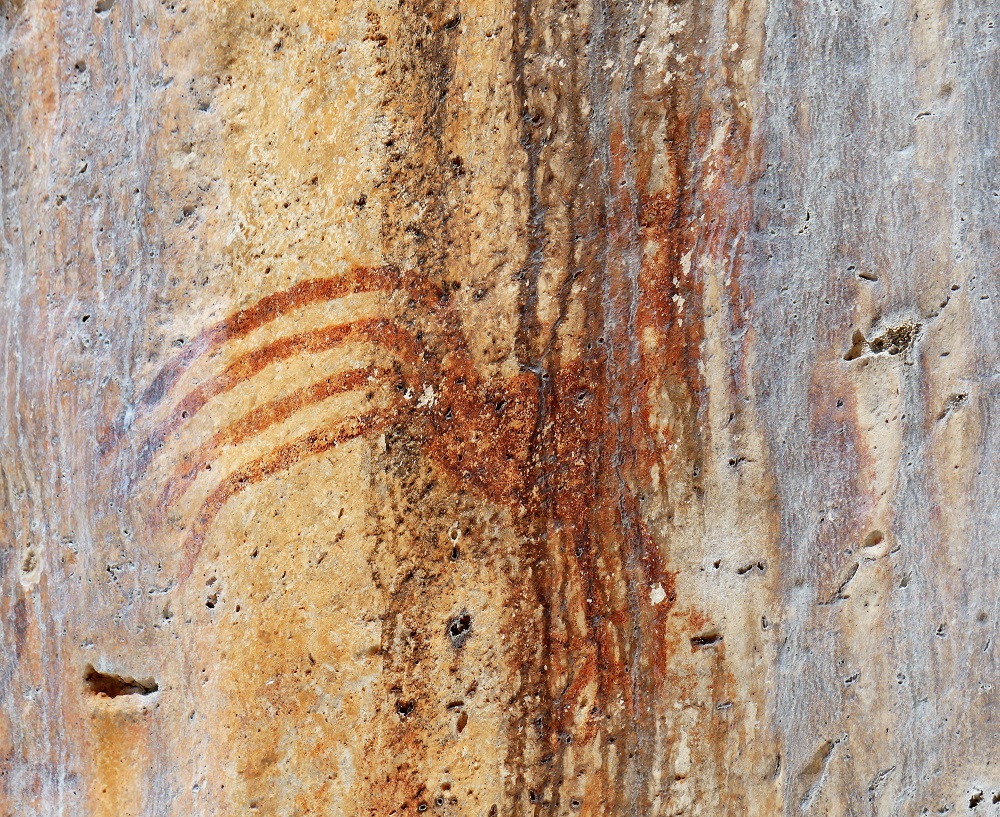
The rock paintings sit high on the steep cliffside. They depict chickens with long finger-drawn tails, handprints and round sun-like faces, immobile images looking out over the calm lagoon, providing a rare window into a past culture that left no written records. The paintings are faint in places, faded by the sun and rain, and I wonder how many have already faded out of existence, and how long the remainder will last in this exposed location. In one place, a large piece of rock has been cut out; apparently, a beautiful octopus used to be there, but someone removed it out to keep for themselves. The cliff face used to be behind a stand of trees, but Cyclone Kenny smashed the vegetation and now they are open to the elements.
Faces in the rock.Rock chicken.
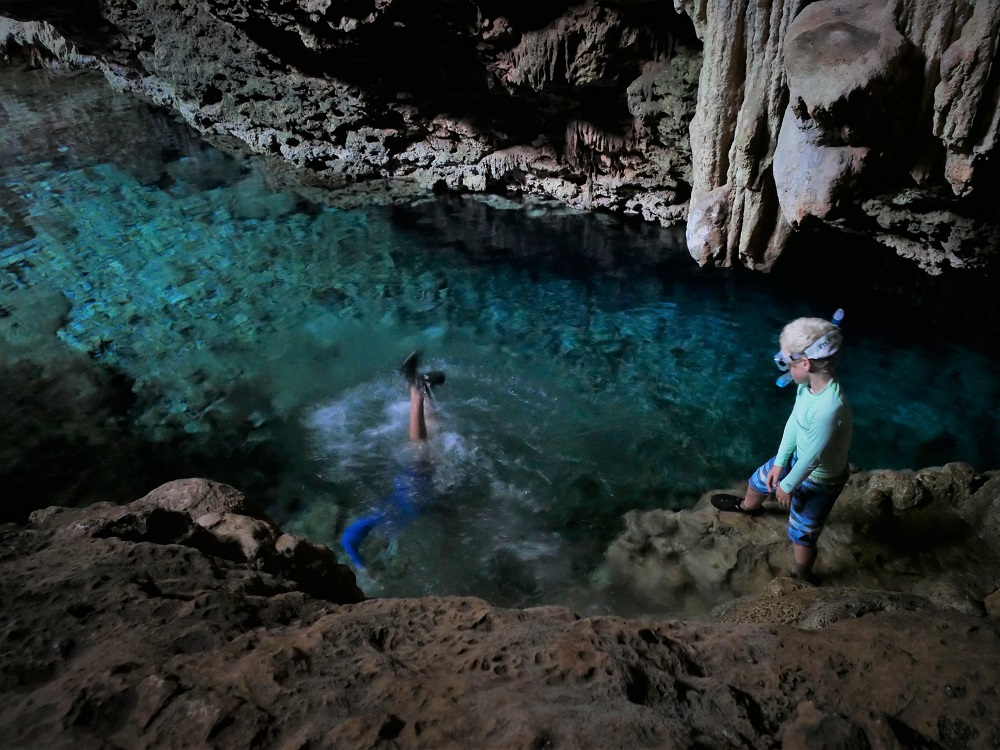
On our last afternoon, at Bertini’s urging, we visit the crystal caves, a large inland underground system which is flooded with saltwater. The cave ceiling is made entirely of crystals spilling down in lumpy bouquets like the heavy petals of a succulent flower. When you shine a torch on them they sparkle and glitter, a brilliantly shiny contoured ceiling made from crystal chandeliers. The crystals extend underwater, and the cave looks like it goes on forever, stretching darkly under water in the direction of the sea.
Glittering crystal shapes in Crystal Cave.Crystal cave shapes.Swimming in dark caves.
Like at Yalewa-ni-Cagi-Bula’s pond, faces, figures and ethereal shapes appear everywhere in the limestone rock, and it is easy to see how such landscape could inspire a deep spirituality, giving rise to legends and the ancient sun-like faces painted on the rocks of the coastline and Bertini’s ties to the island alike. Hopefully, he’ll find a good buyer for the resort, someone with plans that align better with the villagers’ aspirations.
When we leave, the dog sits on the beach looking mornfully after our boat.
“Is something burning in the kitchen?” asks David. He’s leaning into the saloon from the cockpit, a dark shape backlit by the setting sun.
I look up from the steaming stove where I’m painstakingly stirfrying vegetables one small bunch at a time to ensure perfect crispness. “No,” I say. “Everything is fine here.”
“Are you sure?” he leans further in, sniffing the fragrant air. “There is, like, ash coming out of the kitchen side hatch. I’m pretty sure it’s from the kitchen.”
“Nope.” I turn my back to him to fish the carrots out of the pan and place a small portion of carefully cut chicken strips in the hot oil. “No fire here. And I’ve had the hatch closed the whole time I’ve been cooking. So must be from somewhere else.”
“Weird. Maybe the villagers are burning rubbish or vegetation on the shore.” He lingers a moment longer in the doorway before heading back out into the cockpit.
“I hope it’s not another volcano!” I shout after him.
Last time there was ash on deck it was a volcanic eruption in Vanuatu, about two weeks ago just when we were getting ready to leave the Lau Group for Suva. We woke up one morning to find the boat covered in a substantial layer of fine ash, and after a little investigation discovered that the source was about 700 miles away, on Ambae island in Vanuatu, the huge ash cloud from which had been carried by winds to Fiji where it settled out over the sea, the land and our boat. The ash cloud disrupted Air Fiji flights for a couple of days, and one can only imagine how bad it must have been in Vanuatu.
Back then it took us days to clean up the mess, washing and wiping grey residue from our fine white deck, scrubbing black footprints from the cockpit flooring.
Now we’re at Ono Island, in the north Astrolabe reef by Kadavu, a large island 150 nautical miles south of Viti Levu, and I’m hoping this is not another volcano.
David comes back in as I’m draining the noodles. “I can see it now, there’s a fire on the shore, behind the palms. Probably just the villagers burning rubbish.”
“Great,” I say, wiping the hot steam from my brow with the back of my hand. “Well, dinner is ready, so can you please ask the boys to set the table?”
It is not until after the kids have gone to bed that we notice that the fire hasn’t gone out. It is now completely dark, and it is clear that the fire has spread: from the isolated spot behind the near-beach vegetation where David saw it, it has now conquered half the hillside. It is definitely out of control – the flames are licking up trees and as we watch it spreads rapidly, the red glow above the yellow flames lighting up the sky, the inferno reflected in the still water below. We can hear the roar and crackle as hundreds of trees combust, and the smoke is billowing over the boat as it moves out through the calm bay through the still night.
The hillside is alight
David and I sit watching it in horror for a while. I cough. He coughs. I rub my eyes – they are stinging from the smoke. He rubs his eyes. I cough again.
Thick smoke is now rising in a tall column off the hillside, visible against the fire-illuminated sky. We’re directly downwind and are getting the full fallout. The deck is covered in charred fragments of vegetation, piles of ash are nestling in against the steps at the stern.
Over the roar of the fire, we can faintly hear Matias cough from deep within the boat.
Finally, at 11:45 pm we stir. David says, “We better get out of here. We can’t stay in all this smoke, and it’s not getting better, there’s no sign of it abating.”
“But we can’t move the boat in the dark!”
“I think we’re going to have to.”
You need great visibility to move around in shallow bays with numerous uncharted coral reefs just below the water surface. Normally, we only move when the sun is out, and once out of open water one polaroid-sunglass-wearing person is always standing watch at the bow, pointing out the reefs that emerge as we draw closer to shore.
Now, it is midnight, the only light available the red glow of a raging bushfire.
I swallow in dread, and as David starts the engine I get the large torch out. We hoist the anchor and slowly creep around the coastline towards the bay where Naqara village is located, figuring that it is upwind from the fire and so unlikely to yield much smoke – and that if it does, the villagers will almost certainly need our help. Fish jump out of the water, startled by the torchlight I beam ahead of the bow, and every time I hear a splash I fear that it’s a reef, that we’re about to crash.
But in time we make it to the middle of the village bay and find what appears to be a flat, feature- and reef-less bottom. We put our anchor down with a sigh of relief. The village is completely quiet, only one light on, and no people can be seen moving even though half the hillside beyond it is engulfed in flames.
After watching for a while, we go to bed and are lulled to sleep by the crackling fire, the smell of smoke lingering in our nostrils.
In the morning, smoke is still rising from beyond the village hills. Boats are buzzing to and from the village, but thankfully everybody is fine, no damage to any houses. Just another rubbish fire going out of control.
Morning smoke…
The bay that burned was one that is used for film sets from all over the world. Fiji is a choice location for Survivor Series and tropical movie-making alike. When we visited Naqara a couple of days earlier, Job the chief talked about how the village-owned bays are booked out for filming for the next five years.
“This year it is the Sweden Survivor movie,” he said as he was walking us back to the dinghy after the sevusevu. “They have already built all the things they need, and they will spend 40 days here filming.”
He gestured beyond the steep hill towards the bay beyond. “They will stay on that beach over there, and on that island there, and on that beach too.”
“Wow,” said David. “So you’re busy with that.”
“Yes.” Job wiped his brow as he was wading through the shallow water. “After the Sweden, we have the Survivor France, and then after that the Sweden again.”
He glanced out over the shallows. “And then the year after that it is the Poland Survivor, and then the France again, some Robinson Crusoe show. And then maybe the USA the year after that.” He smiled.
“Wow,” David said again. “That is great, everybody coming here to film their movies and Survivor series. Well, I guess it is not a bad place to survive…”
“Yes, it is very good for us,” says Job. “Very popular to come here, and the villagers get work from it.”
Perfect scenery for movies.
Now, we just hope that the fire hasn’t disrupted the busy filming schedule.
It is a beautiful place, perfect for tropical idyllic island moviemaking. In the quiet village bay the steep hillsides are reflected in the deep green water, the water so calm that it offers a perfect mirror image of the hills and the clouds. The beach in the bay they will film in is white, coconut palms in the background, and inland vegetation lush and dense. The bay is fringed by a coral reef teeming with fish. Birds swish through the sky everywhere, landing noisily in trees.
Spadefish off the coral reefs in the North Astrolabe reef.
Now, the vegetation behind the palm trees is scorched, but the setting still looks nice, just a bit more mysterious and menacing. We think it’s the perfect setting for a survivor show and hope that the Swedes agree. It is lucky that they haven’t arrived yet – we’ve seen them scope the area, but they are not yet living there. Just as well – imagine the liability if a whole Survivor Series perished from on-set smoke inhalation.
It is great that Fiji can make money from the film industry. In 2017, 74 productions were shot in Fiji, which according to the Fiji Sun generated new economic activity of about FJ$350M. The USA Survivor show alone generates seasonal employment for 300 Fijians. It is a neat source of income for a developing country.
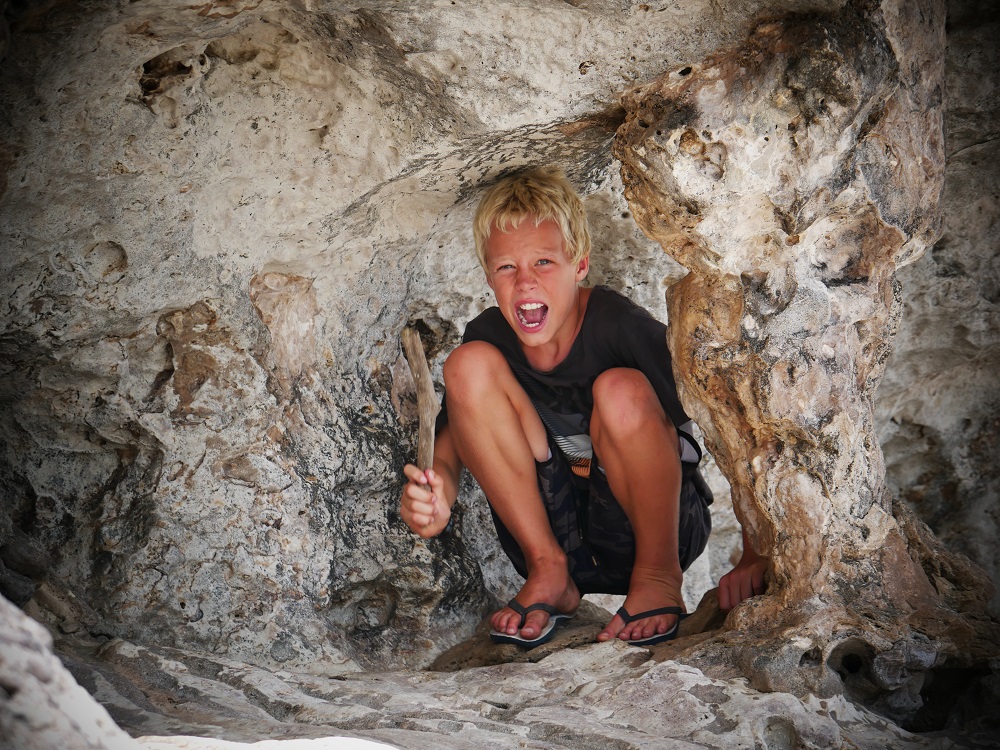
Sharpening wooden sticks ready for Orc attacks.It’s not just the international movie makers that want to survive outdoors in Fiji.
On our boat, the kids are increasingly keen to spend a night sleeping out by themselves on the shore. We have been trying to find them a deserted island to go to, and in the meantime, they’ve been camping out on the foredeck trampoline as a compromise.
It’s all part of the continued Lord of the Rings games. As they’re reading their way through the books it permeates everything we do, and presently they are deeply immersed in a game where the Elf Thamior (aka Lukas) and the Dwarf Thorin (Matias) find themselves in enemy territory, on a deserted beach backed by palm trees and steep bush-covered hills. Faced with such obstacles the two make plans to survive, collecting seashells, nuts, seeds and pieces of wood, all of which represents edible substances that will help them live through the night and face another day. Monsters lurk behind every corner, and as nightfall nears the two plan for a safe survival of the night, strategically storing their food, and identifying nearby cave-like shelters that might provide refuge should it rain.
The characters have evolved over time, and it is now clear that the Dwarf is rather foolhardy, recklessly tumbling headfirst into dicey situations, to the great frustration of the more reticent Elf, who deep down doesn’t really like risking his life that much. They are a good pair, though – without the Dwarf the Elf would never go anywhere, and without the Elf, the Dwarf would surely die within minutes.
And even though we encourage adventures and independence, we are very grateful that we didn’t let them sleep ashore by themselves on the night of the bushfire.
But Kadavu is not all surviving, smoke and movie sets.
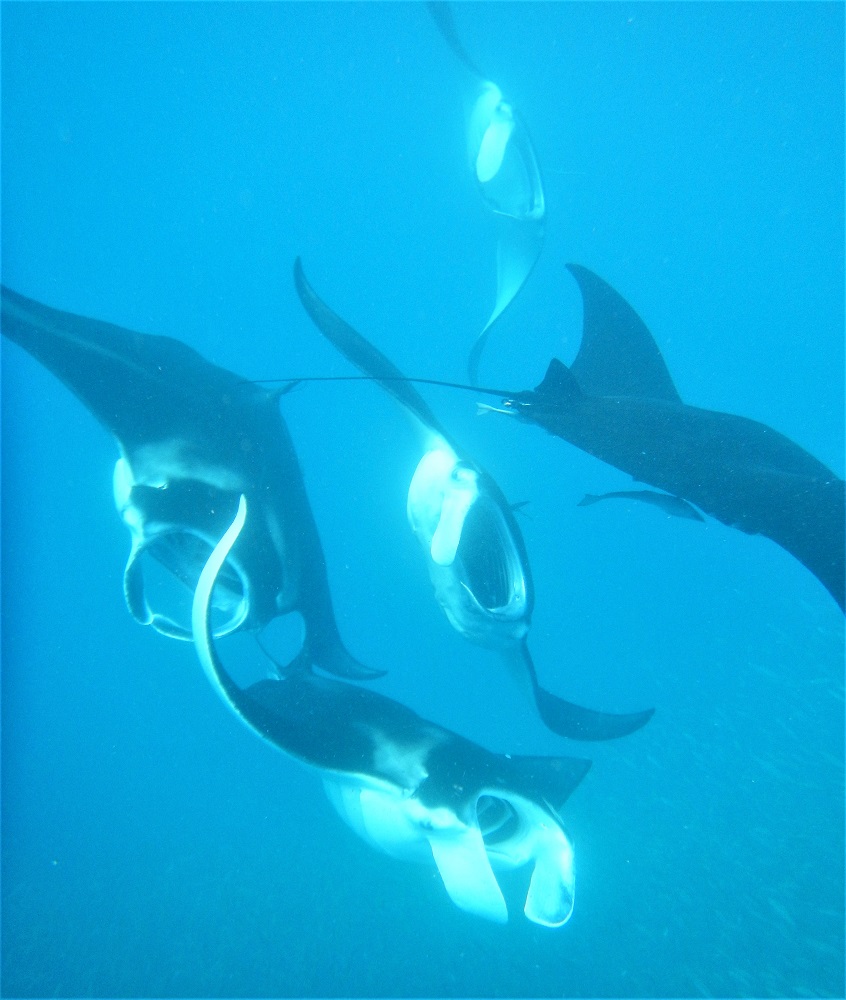
Manta soup – filterfeeding at high tide.
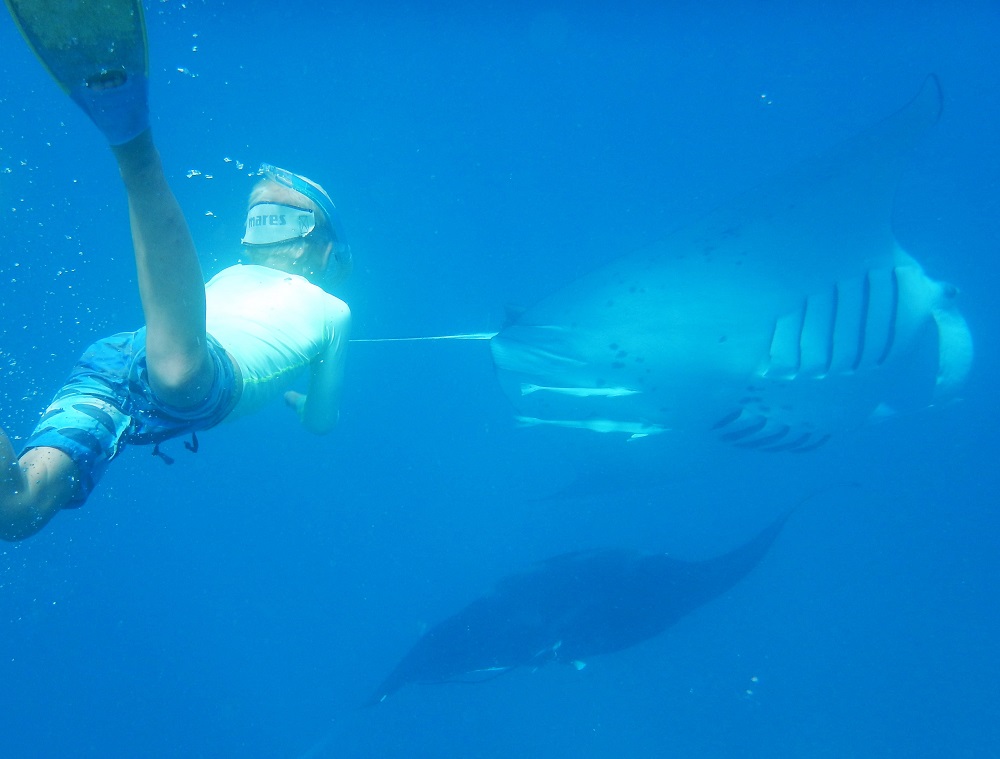
The water between the islands just north of One Island teem with manta rays. The sea there is like manta soup, and everywhere we go we see them, huge black diamonds hanging just below the water surface, waving their fin tips out the water as if to warn us they are there.
At 2-4 m across they are incredible to see up close, gentle giants gracefully gyrating, twisting, twirling, looping, mouths gaping as they suck up plankton from the rich waters. When they are feeding they come across as hollow, just a cavernous mouth opening up into a rib cage, slatted gills clearly visible on their underside. We swim and dive with them and look on in amazement.
Matias approaching a manta ray much larger than himself.Lukie checking out the remora clinging to the underside of the manta ray.David checking out a manta ray being cleaned by patient, tiny cleaner wrasse.Just one huge cavernous mouth leading into a hollow interior.Elegant like a soaring bird flanked by remora.Frantic feeding.
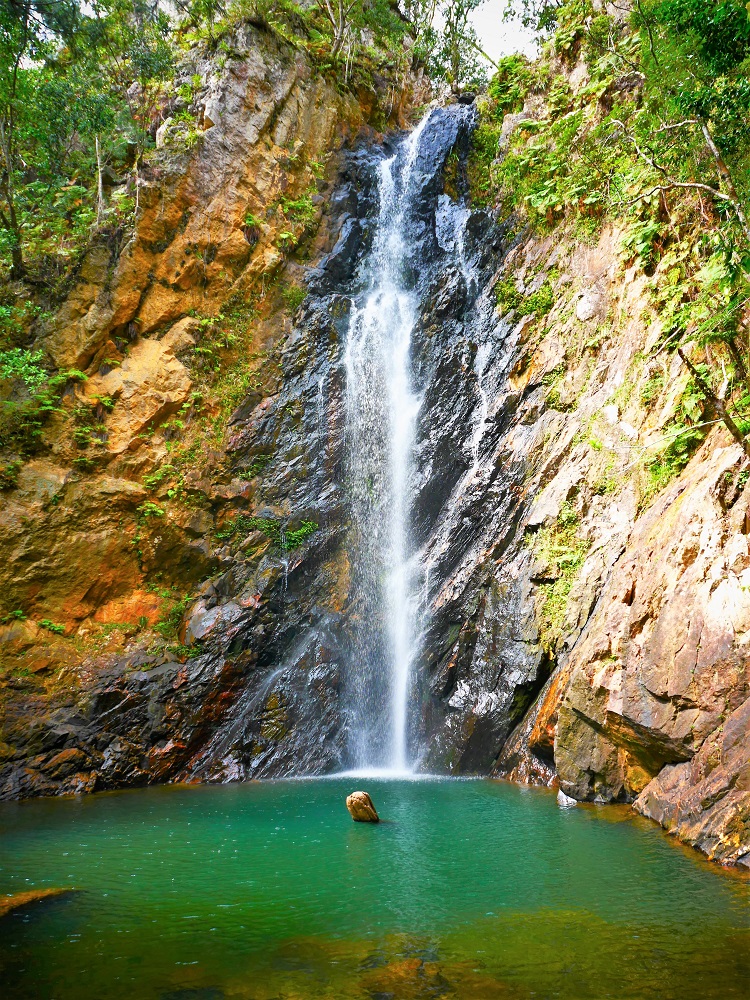
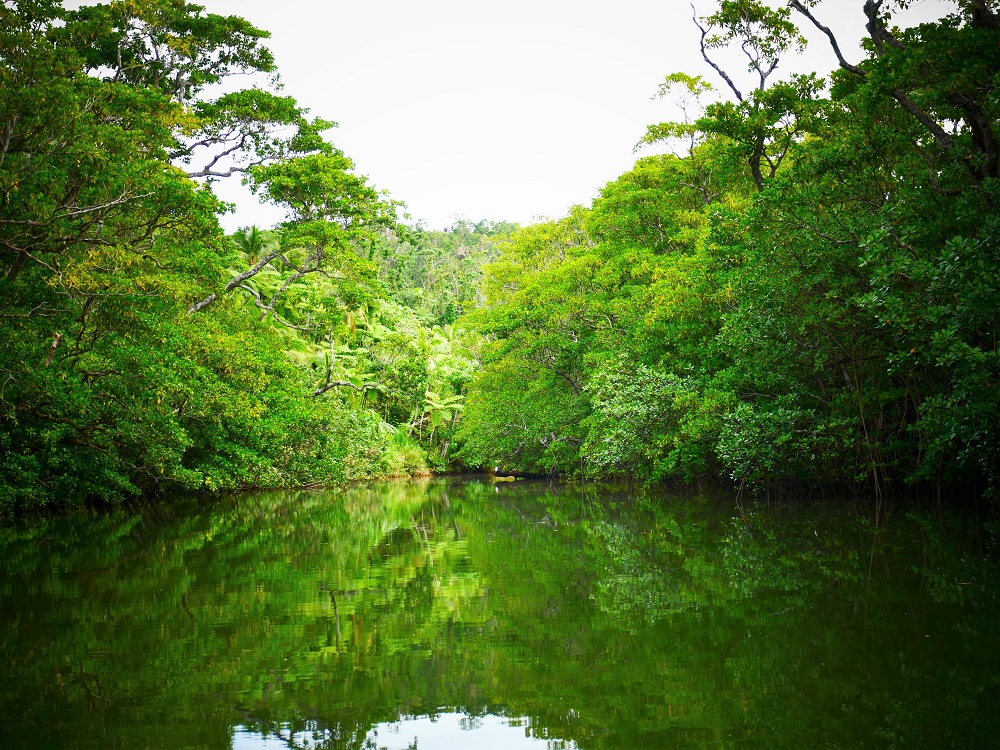
Further south, on Kadavu Island proper we anchor in steep-sided bays and hike to inland waterfalls, swimming in the crystal clear pools below the thundering cascade. We travel up long rivers through mangrove swamps, spotting colourful native parrots, birds of prey and the occasional bat.
40-metre waterfall.Quiet, long rivers reaching inland through miles of mangroves.A drowned forest at the inland end of the river.
Travelling along the Kadavu coast we see fires everywhere, steaming smoke coming out of every hillside. We’re not sure how many of them are intentional but know that the pine plantations on the island are often burned off after felling and that elsewhere wild yam are harvested through burning the vegetation. But wildfires are common too in the dry season, destroying vast swathes of Fijian land every year. It certainly is fire season: it seems that no matter where we anchor we accumulate ash on deck, and after a while we get used to it, brushing off the soot and washing the deck carefully every morning.
Tomorrow we will leave Kadavu for Vatulele, a small island on the way to Viti Levu. Hopefully, the fire risk will be less there.
Now, you might be wondering what we do on passage and on anchor.
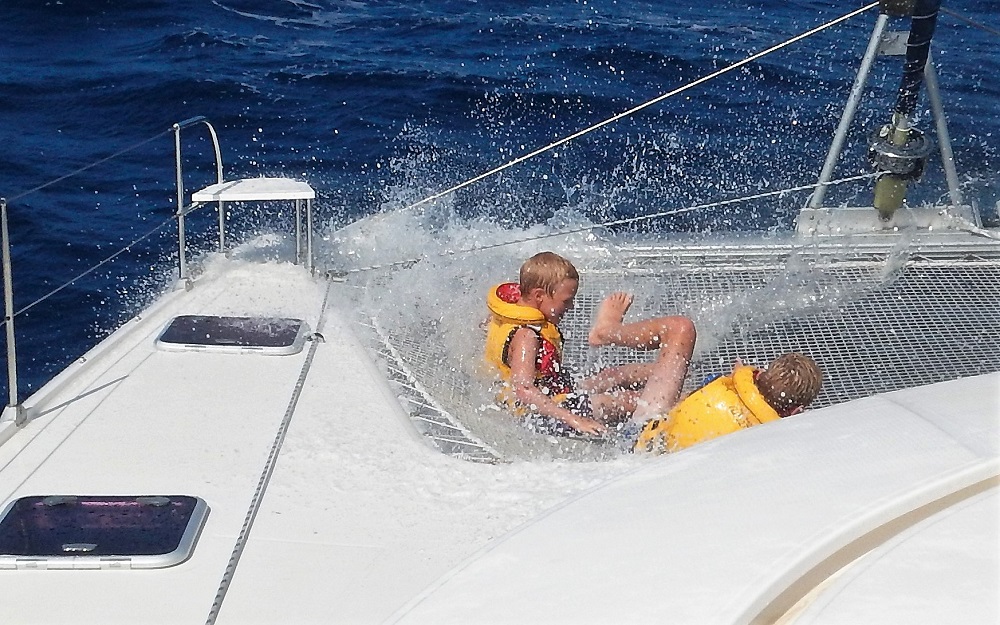
On passage, Lukie and I spend hours on the tramp. We sit down and wait for big waves to come washing over us. We put on life jackets and run, holding on to things like the railing and the floor, to the wave zone (the tramp).
The waves crash up and we try not to swallow any water. We flip, roly-poly, bounce and fly onto the deck. Sometimes the cockpit gets filled with water or the water comes up through the floorboard just outside the door.
On anchor, I mostly spend hours swinging on the ropes at the front of the boat.
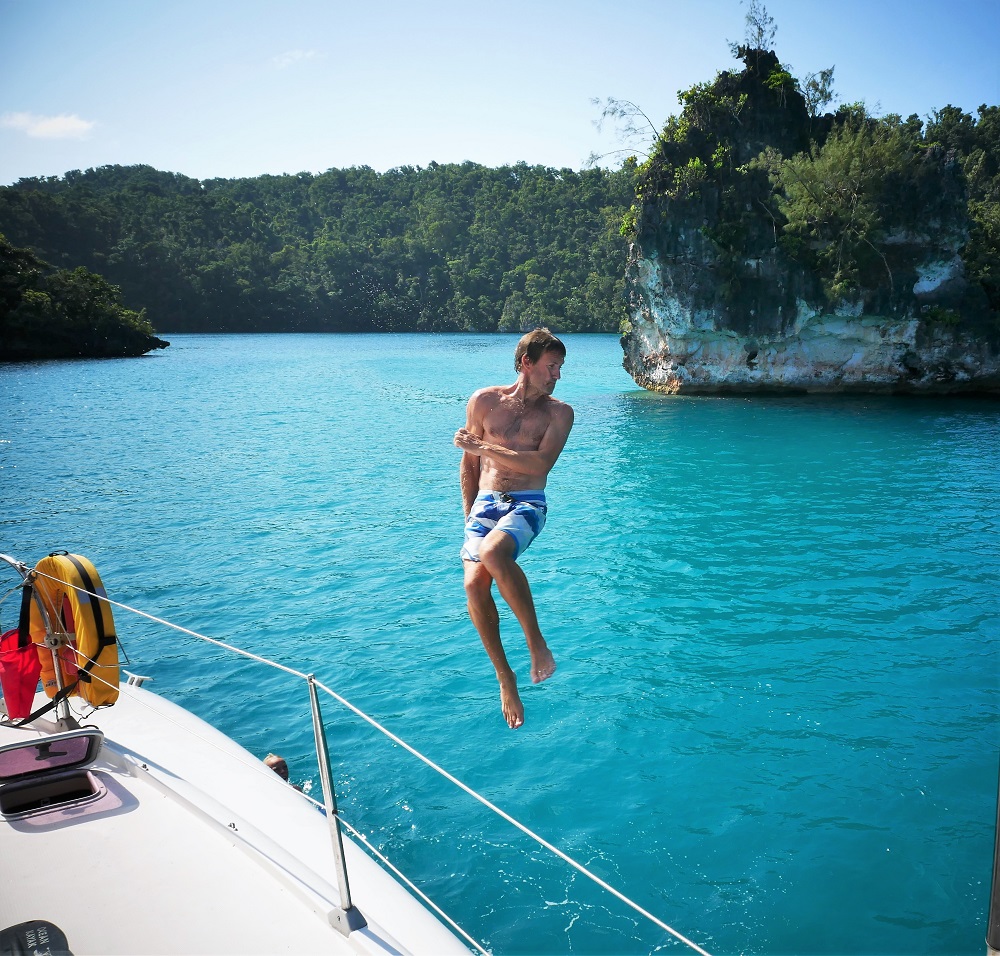
If the water looks nice, it always does, me, Lukie and Daddy jump in the water and do challenges.
Yoda!!!!!!!!!!
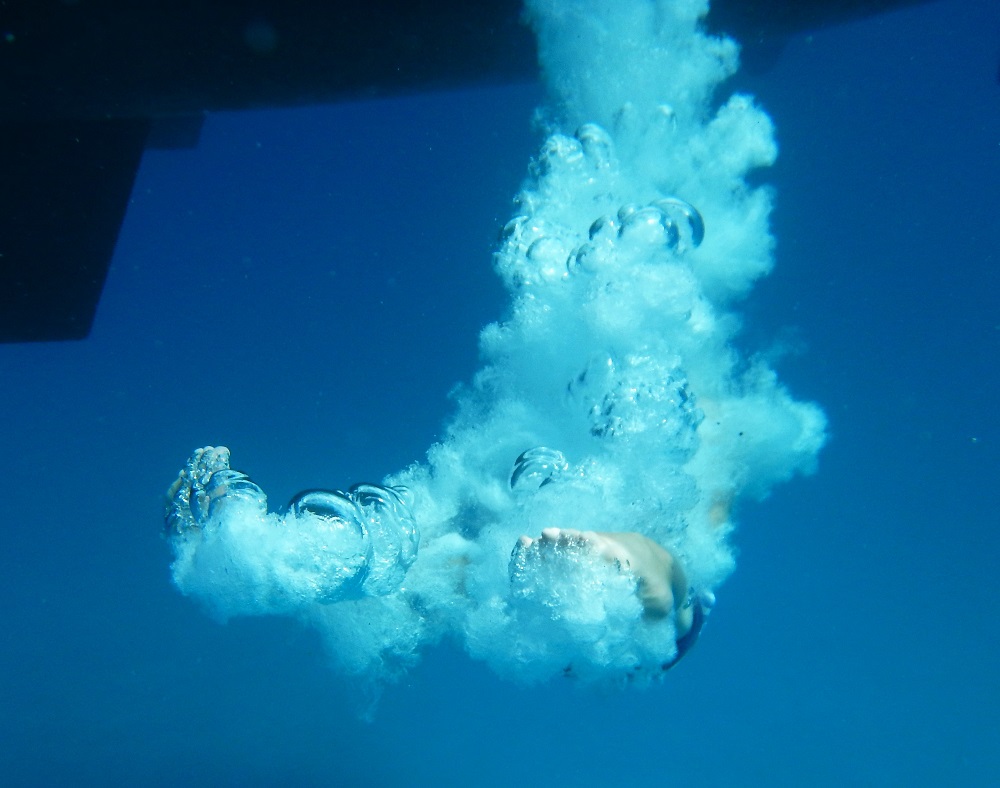
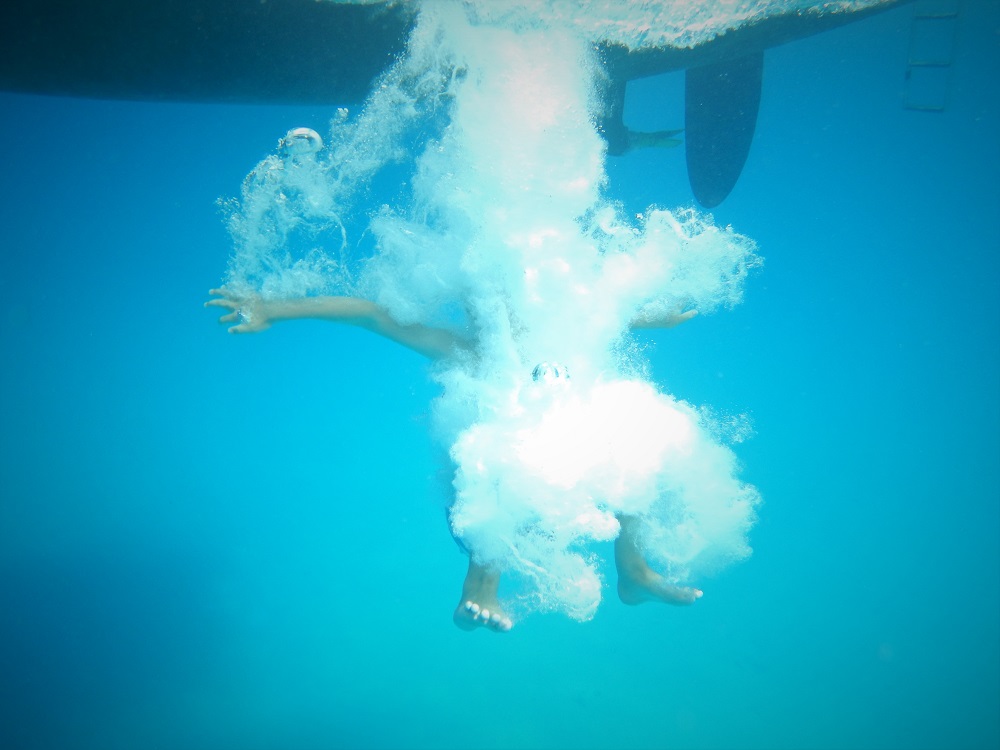
Some of the challenges are: jump in and swim under both hulls, see how far down you can go and who does the biggest bombs. We are all trying to achieve the Triple Yoda.
The Triple Yoda is where you jump in the air and spin three times around before you hit the water. The best any of us have done is the Double Yoda.
Far down in the water lives an evil bubble monster.Another bubble monster.A not so bubble monster.
On anchor, we (me and Lukie) play Lego Star Wars, Lego city and Lego random (lots of different types of Lego joined together).
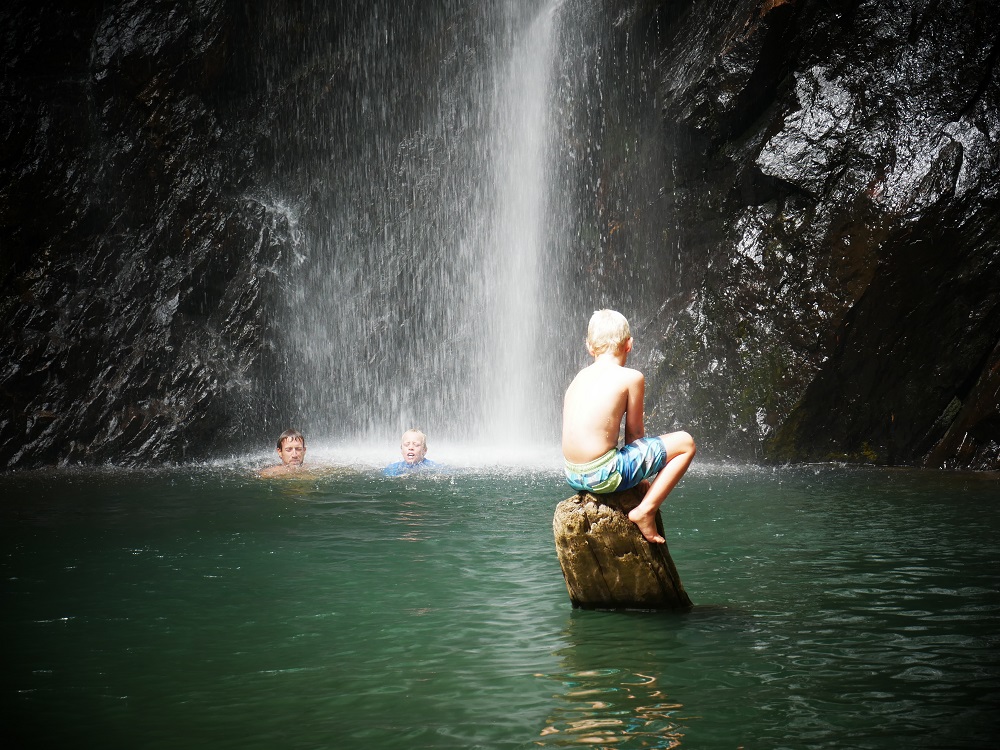
The thing that we do the most now is play Lord of the Rings. We play that on shore, on the boat and mostly in forests. Just yesterday we all went up a mountain to a waterfall in the middle of the forest (perfect for Lord of the Rings). We went swimming in the waterfall but we didn’t stay long because it was so cold!
Me under waterfall, Lukie on log.
I’m a fifth through reading the Lord of the Rings books.
Me and Lukie also play a game called Dungeons and Dragons. I cannot explain much because it is so complicated. I can explain that it is a game where you use your imagination and lots of bits of paper. It is a fantasy land where you can do anything you like, and you have a character that you make, and you travel around and complete adventures. I make up the adventures and Lukie plays them.
When other kids come on board we usually play Lego, Minecraft and Pokemon cards. We also jump in the water with them and draw.

 If you let go of the handle you will start sinking because you have nothing to hold you up (unless you are going really fast, then you skid along the water for about five seconds). Sometimes we fall off (it can be quite brutal, I fell and bumped my forehead). Here are some pictures, enjoy!
























 SV Bob The Cat