I feel miserable. My eyes ache like they have been subject to a sandfly attack. They are swollen, itchy and running. I’m sneezing again and again, my nose dripping with moisture. Clutching a tissue to my eyes, I hobble outside. “We have to get rid of it,” I sniffle, looking imploring at David.
“Okay, okay, we’ll eat it today,” he says emolliently. “But, it’s the only fruit we can get here, and you may just be getting a cold?”
I shake my head vehemently. It’s the papaya, I know it.
I developed an allergy to papaya when travelling in Africa when 18. It started out innocently enough, with slightly itchy eyes after I’d eaten the fruit. But soon it developed into a full-on condition, where I would react with violent sneezing, and runny, itchy eyes even when a papaya was within 10 m of me, particularly in enclosed spaces. Ever since then, I’ve avoided the fruit, and haven’t had a problem.
But desperate times call for desperate measures, and because we’re dangerously low on fruit and vegetables, I foolishly agreed to take one onboard for the kids and David to eat.
We’re in Vanua Balavu, in the northern end of the Lau Group in Fiji. Our trip north from Fulaga was swift and brutal. With 20-25 knots of breeze we were flying along at 8-10 knots. The side-on swell slammed us relentlessly, and we had to put foam in the liquor cabinet to keep the bottles from crashing.
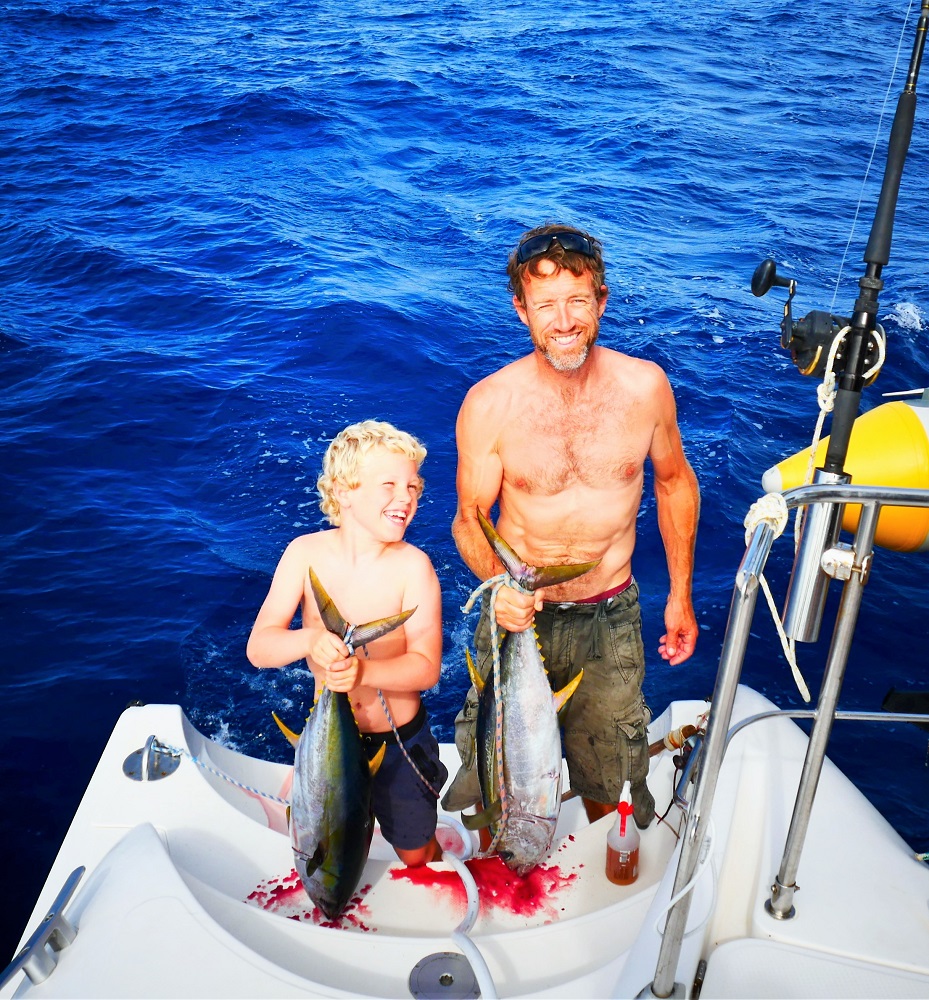
The fishing made up for the uncomfortable conditions, and we hauled in yellowfin tuna aplenty, giving fish to every village we passed and filling up the freezer and fridge to boot.
Just as well that we’re catching fish, because food-wise, we’re running a bit low. By now we’ve run out of anything fresh apart from one lone pumpkin which lies rusting in a special locker, and a couple of shrivelled lemons rapidly deteriorating in the fruit net. Long gone are even the most long-lived, carefully rationed vegetables. We’ve eaten the carrots, crunched through the cabbage, stewed or roasted the eggplants. Cucumbers and lettuce went within the first week, oranges and apples lasted two and a half weeks. Now, four weeks since we last stocked up, we have nothing fresh left.
In Vanua Balavu, we head straight to the largest village of Loma Loma in the hope that we can provision a bit. There are two small shops in the settlement. The supply boat has just been in, and as we enter the first shop, a small, blue building on the waterfront, on Saturday morning, the owner is busy opening cardboard boxes and shelving supplies. A quick scan of the shop reveals the basic staples available in all Fijian villages – Punja Breakfast Crackers, Maggi Chicken Noodles, jam, soap, shampoo, razors and sanitary products. Optimistically, I ask about vegetables, eggs, refrigerated goods. The proprietor just shakes his head sadly. There is a vegetable market, but only on Friday mornings – we’re a day late. There is a guy who bakes bread in town, but he’s run out of flour – the new supplies having only just gotten in on the boat. There are no refrigerated goods. There are eggs, but not in his shop. Try the other one.
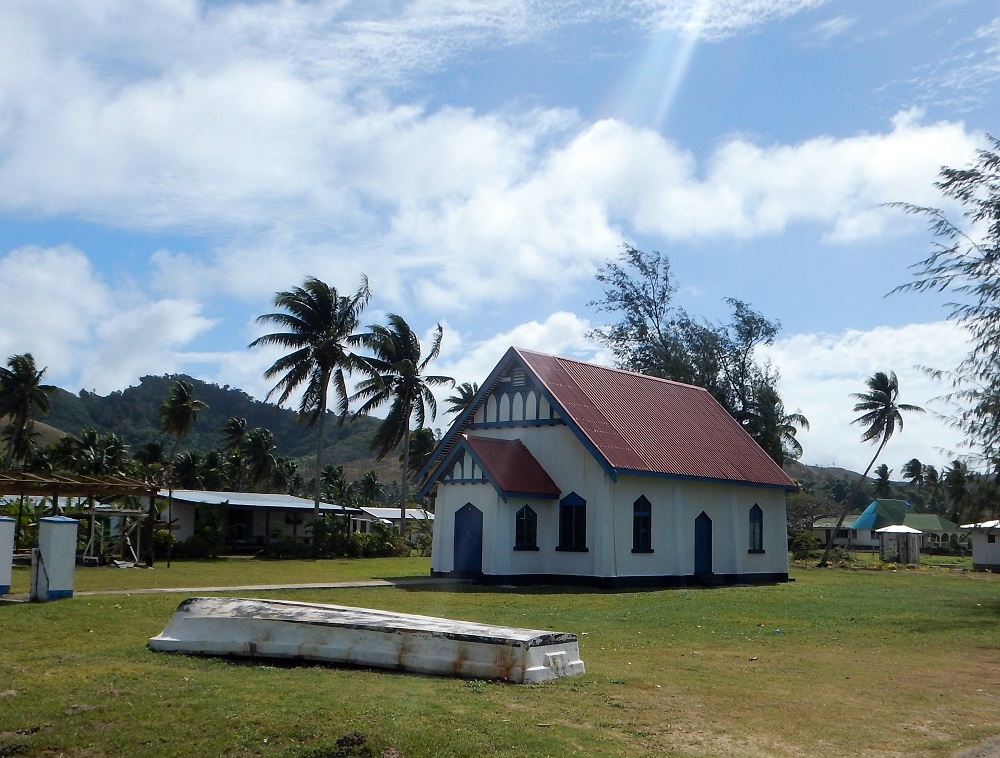
The second shop is behind the church. No signs mark it as a commercial establishment, but the veranda is clear of personal effects and when we squint we think we can see packets behind the slatted windows. We enter hesitantly.
It is indeed a shop, a dark room with a U-shaped counter backed by dusty shelves. An elderly Indian gentleman stands bent over an accounts book, entering columns of numbers. His wife is busy unpacking large, cardboard boxes.
“Bula,” I say, smiling politely. “Do you have any eggs?”
She wiggles her head, the ubiquitous Indian sign for ‘yes’, and points towards a box.
My heart lightens. Eggs. That is great.
Emboldened, I ask: “What about vegetables? Pumpkins, cabbage? Or even garlic?”
The man looks up. “No,” he answers sorrowfully, closing his booklet. “We ordered garlic, but it never arrived. But we have potatoes. And onions.”
“We also have peanut butter,” interjects his wife, holding out a jar of Kraft Smooth. “And cookies, and strawberry jam.” She gestures towards the shelf lined with brightly-coloured jars and plastic-wrapped cookies.
We settle for eggs, potatoes and some coconut cookies. In our desperation, we accept a papaya from the shop keeper’s garden, even though I know I’m allergic.
“Look on the bright side,” says David as we walk back to the dinghy. “If we had arrived yesterday, we could have gone to the market, and would have cabbages, but no eggs, because the boat wouldn’t have gotten in yet. At least we got eggs!”
I nod, and ponder our current situation of vegetable shortage, racking my brain for tasty recipes involving tinned and preserved goods.
The life of the cruising cook is one of uncertainty. Whilst in other situations, uncertainty may be the spice that makes life worth living, on a boat it most frequently leads to a spice shortage. Our food situation seems to be a repeated cycle of hoarding and bingeing, a bulimic cycle of deprivation alternated with plenty.
The problem is that when sailing, you don’t know exactly when your next stocking up opportunity is going to be. Will there be a market at the next island? Will there be a store where one can buy dry goods? Eggs? Will the villagers trade money or goods for local greens? Or will there be only coconuts, papaya, and possibly bananas?
Now, as previously described, I have stocked up, and we won’t starve. But when you’re living on a boat you occasionally want a bit of indulgence, a few delightful morsels to brighten your afternoon.
Boat cooking is a perpetual fight to stave off the hungry hordes. Meals hold off mutiny, provide a break in the routines, nourish our tired bodies, worn out from snorkelling and trekking, playing and sailing. They become a focal point. “What’s for dinner tonight?” is often the first question my perpetually hungry kids ask in the morning and David is frequently forced to listen patiently for an hour or so while I work out the ever-diminishing choices.
Before we left New Zealand, we had a month where we had to be ready to leave at a moment’s notice in a good weather window. So, whenever I could, I hoarded. I stocked up on fresh meat, vegetables, dairy at the nearest supermarket. I loaded eggs and fresh bread into my trolley. I carried last-minute muesli supplies back to the boat by the armful. I got ready for the two-week passage to Fiji. I planned at least four interesting meals cooked from fresh food that we could have first up, and then after that an assortment of meals containing longer-lasting or less-fresh ingredients. Some of the meals were appropriate for foggy mornings or chilly evenings, and I stocked a variety of spicy condiments to dress the fresh fish that we would catch.
And then, as the days passed and we didn’t leave, we slowly started eating into the supplies. Which is fine. I mean, I always knew we weren’t necessarily leaving at the first opportunity. And, let’s face it, we don’t need great meals on the passage, we can just have OK meals. So, we ate the chicken, the mince. We devoured the green beans and the eggplant. Soon, there were only three tomatoes left.
And then the dilemma started. Should we binge on the rest of the fresh while we could, eat the rest of the veggies as quickly as possible, have healthy, vitamin-filled meals, and then hurry out to stock up with fresh, to David’s disbelief? Or should we try to eke out the supplies, carefully rationing the vegetables so that we could just stock up right before leaving? Should I cut up one apple for the four of us for mid-morning snack or encourage the kids to have one each? Should I put four plump, juicy capsicum slices in Matias’s sandwich or just a smidgen of grated carrot? Would the aubergine last another day, or would it be best to eat it now but then have less variety for the journey?
Once in Fiji, we stocked up again, and for the trip to the Lau Group we carried as much fresh produce as we could. But by the time we get to Vanua Balavu it is all gone, finished, devoured, and digested, apart from aforementioned pumpkin and the newly acquired papaya.
Now, we do have tinned vegetables and half a pack of frozen peas. Tinned tomatoes, sweetcorn, peas, beans, beetroots, fruit, and some disgustingly slimy mushrooms. And preserved vegetables too – sundried tomatoes, pickled capsicums, gherkins, olives, sauerkraut, pesto. When the fresh ran out, we started on the preserves, finely slicing up precious chargrilled capsicums and sundried tomatoes, sprinkling sauerkraut like fairy dust on all dishes.
The hardest thing is not buying and storing the fresh food. It’s knowing when to use it by, judging the vegetables by their cover, opening bags and sniffing contents, feeling up firm shapes, checking for rot, slime, mould. Will the spinach go mushy if I leave it one more day? Will the oranges go dry, the apples floury? Can I stretch the pumpkin out to next week, or will it deviously look all great and then, once I open it, reveal a mouldy interior, leaving me wishing we’d eaten it straightaway? Are the eggs going to be firm and fresh or dubiously watery when I crack them?
The upside is that food shortages make for good eaters. The kids, being aware that we have nothing left, enthusiastically gulp down any vegetable we throw at them. Eggplants have never been a favourite; now they’re savoured. Freshly chopped cabbage promotes instant drooling. When Matias eyes his peas suspiciously (he’s never been a big fan), I just say it is the only thing we’ve got, and he drizzles them with lemon juice and gets on with it.
“Mummy, actually sauerkraut goes well with tuna,” he remarks after trying out a bit of sauerkraut in his tuna curry. “It tastes kinda salty, sour, like lemon juice.”
Lukie reaches across for the jar, scattering a big scoop on top of his plate. “Sauerkraut goes with everything,” he says authoritatively, biting into a forkful.
As we are running out, I find myself limiting the vegetable intake, pushing cheap carbohydrates for snacks and saving vitamin-filled foods for lunch and dinner, carefully rationing the intake so that the kids only get just enough to not develop scurvy. They have never eaten so badly before, endless amounts of crackers, pancakes, peanut butter sandwiches, and they savour every moment.
The approach of leaving everything till the last possible use-by-date leads to some seriously repetitive meals. When the cucumbers were about to go off, we had cucumber sandwiches for lunch, cucumber salad for dinner, and cucumber slices for snacks. Then it was three days of spinach, and after that, a week of eggplants – in stews, curries, on pasta, chargrilled, and oven baked.
At home, vegetables in the fridge are prone to drying out – salad will go limp, eggplant wrinkly. Here, the veggie fridge is wet. To prolong the fridge life of vegetables we have to guard them against the moisture – store them in plastic bags, wrap them in paper towel or (as I’ve taken to lately, now that we’ve run out of paper towel) the kids’ not-so-good drawings. Every item has to be checked every two days, and meal plans altered to accommodate what is deteriorating the quickest.
Back in Vanua Balau in the northern Lau, once we’ve filled up with eggs, we anchor off the village of Susui. After the sevusevu ritual is complete, they ask for a donation for rebuilding their church which was destroyed in Cyclone Winston. Thinking strategically, I smile and say that of course, we would love to donate. And then mention that we really need vegetables and that if they have anything extra, we would love to buy them off them. They smile too and promise that the ladies of the town will go pick some stuff from their gardens.
The following day we are presented with a plentiful bounty, freshly harvested. The price is a bit outrageous, but I really don’t care. The lady seems happy enough to sell them and we are desperate. Pumpkin, eggplant, lemons, spinach and coconuts. Enough to last us for weeks. We pay for the vegetables and donate extravagantly towards the church rebuild, leaving the village with everybody happy.

Whilst I scan my brain for more recipes involving pumpkin, I start mentally preparing myself for when we have to leave Fiji, sailing to Vanuatu which, somehow, I don’t imagine is great in terms of provisioning. Deciding that a wise woman knows when to ask for help, I put a notice on the ‘Women who Sail’ Facebook page, asking about provisioning in Port Vila, the capital. Within an hour, my inbox is filled with responses. I immerse myself in the replies, and after spending an afternoon online I know the best places to buy meat, salami, spices, groceries and fresh in all major centres of Vanuatu. I have also learned that bats are a staple easily obtainable in most Vanuatuan village markets and received advice on how to cook them (plenty of garlic, apparently). Getting further sucked into the online abyss, I download the Paprika recipe management app, which allows you to scrape any online recipes and store them offline (I immediately store a couple of tuna recipes, along with some advice on how to cook polenta, which I’ve been struggling valiantly to make edible lately, wondering how one eliminates the bitter aftertaste. Apparently, adding parmesan does the trick). I go all out and join the ‘Cooking on a Boat’ Facebook group, where enthusiastic boat chefs post daily food porn depicting their freshly prepared feasts (think fresh crab cakes in Maine, strawberry-drizzled hotcakes with whipped cream off Portland, Oregon, carrot cream soup with a sprig of tarragon in the Mediterranean). A mix of chefs and ordinary cruisers alike, the group soon comments on my Vanuatu provisioning enquiries with tips for preserving vegetables, eggs (waxing), butter (a process known as ‘brining’), and even cheese (cover it in oil, apparently).
A big change from my usual online shopping where a world of choice is only a click away, delectably fresh produce conveniently delivered at my doorstep within hours of ordering. Still unsure of how much of my time I want to devote to cooking (will I ever preserve eggs? Probably not. And cheese preserved in oil surely sounds like a recipe for botulism?) I am nevertheless grateful for the advice. With the remote places we’re heading, it may just be time to step up my game, learn some new skills.
But first, I need to find that papaya and throw it into the sea…

 SV Bob The Cat