
Time is dragging on, and we’re still in New Zealand. In Opua, to be specific, stuck waiting for better weather.
The on-screen weather forecasts are still red-stained horrors, but David now has a cunning plan.
“We’ll leave on Saturday,” he states firmly. “We’ll sail north as quick as we can, on the back of this big low.” He gesticulates at the screen and I lean in. The forecast for Saturday shows an enormous dark red patch just north of New Zealand. When I squint my eyes, I can just make out the numbers in the legend of the colour bar at the bottom of the screen. Dark red equals 7 m waves. Goodness.
“We will go here.” He points to a thin path of light blue screen separating two large red blobs. I squint again. Blue equals 3-4 m seas.
“So, if we stay at the back of this low, and head northeast, we’ll be able to get to here fast – there’ll be plenty of wind, but at least it’ll be downwind sailing.”
“And then,” he continues, “we will get to here, and slow right down, waiting,” – he points to a blue patch on the following screen – “until this other low has passed through ahead. Once that’s gone, we’re sweet.” He smiles.
I gulp. It seems like it will be a bit tricky, staying on the thin blue path of relatively calm sea in amongst all that red, raging ocean, keeping firmly to the ridge between two abyssal weather lows. I don’t want to be negative, but it sure doesn’t sound like the perfect weather window.
On the other hand, the weather here isn’t optimal either. We’re anchored just outside the Opua Marina, in the channel at the mouth of the Kawakawa River. This morning, our barometer seems stuck on ‘Depression – low’, and the Northland sunshine is frequently interrupted by blasts of wind and rain.
The frequent change of wind combined with strong tidal flows and large freshwater discharges makes for a tricky anchorage. When we first signed in at the marina office they warned us about the many large logs that frequently drift through the channel, smashing into boats as they float past. Inside the marina, suspiciously immobile twigs stick out of the water, suggesting larger hidden logs firmly embedded into the mud under the murky water surface. And two days ago, we watched the haul-out of a huge log which had been towed into the marina for recovery before it crushed any boats.

I’ve been sleeping lightly, listening out for any crashing noises that indicate an incoming log attack.
As it turns out, it isn’t just floating logs posing a danger to anchored boats. This morning, as we sat quietly doing home-schooling, snug inside as the wind howled outside, David noticed that one of the neighbouring boats was getting closer.
“Do you reckon that boat is dragging?” he asked, pointing.
The boat, a nice-looking catamaran, did seem a lot closer than it had been earlier in the morning.
“Maybe it’s just stretching out the chain,” he said.
“That’s the one with the little kid on it a couple of days ago, isn’t it?” I asked.
“Yeah. Apparently, they’ve been anchored here for a couple of months.“
“Well, then they can’t be dragging, really – not if they’ve been here for a couple of months. Don’t worry.” I turned my attention back towards Lukie’s math problem.
A minute later Matias jumped up. “Daddy, it’s definitely getting closer! Look, it used to be ahead of us, and now it is at the same level as us.” He pointed.
And as we all focused on it, it became clear that the boat was definitely moving, slowly but surely, heading straight for the vessel moored behind us.
David rushed outside. “Come on,” he shouted. “Get in the dinghy, we have to get onto it!”
Matias and I scrambled into the dinghy, and we hurried over to the dragging catamaran. David jumped on board and started desperately trying to start the engines. Matias and I left him on the drifting vessel, rushing back to Bob in the lashing rain to get some fenders, hoping to minimise the damage from the impending collision.
We delivered the fenders, Matias jumping on board to drag them up.
“Get the dinghy away from the boat,” yelled David. “We don’t want it getting crushed. We’re going to end up on that boat, or on the mud. Go get a phone, call for help!”
Heart beating rapidly, I returned to our boat and called the marina to explain the situation. Through the thickening droplets on the cockpit clears, I could see David and Matias as they struggled in the wind and the rain on the deck of the dragging boat, which was now colliding with the boat behind.
Having finished the call, I jumped back in the dinghy and raced through the freezing wind to bring David his mobile. The dragging catamaran was now close to the mudbank, astern of the boat it collided with.
“Matias found the spare anchor,” he yelled. “So, we’ve stopped, for now.”
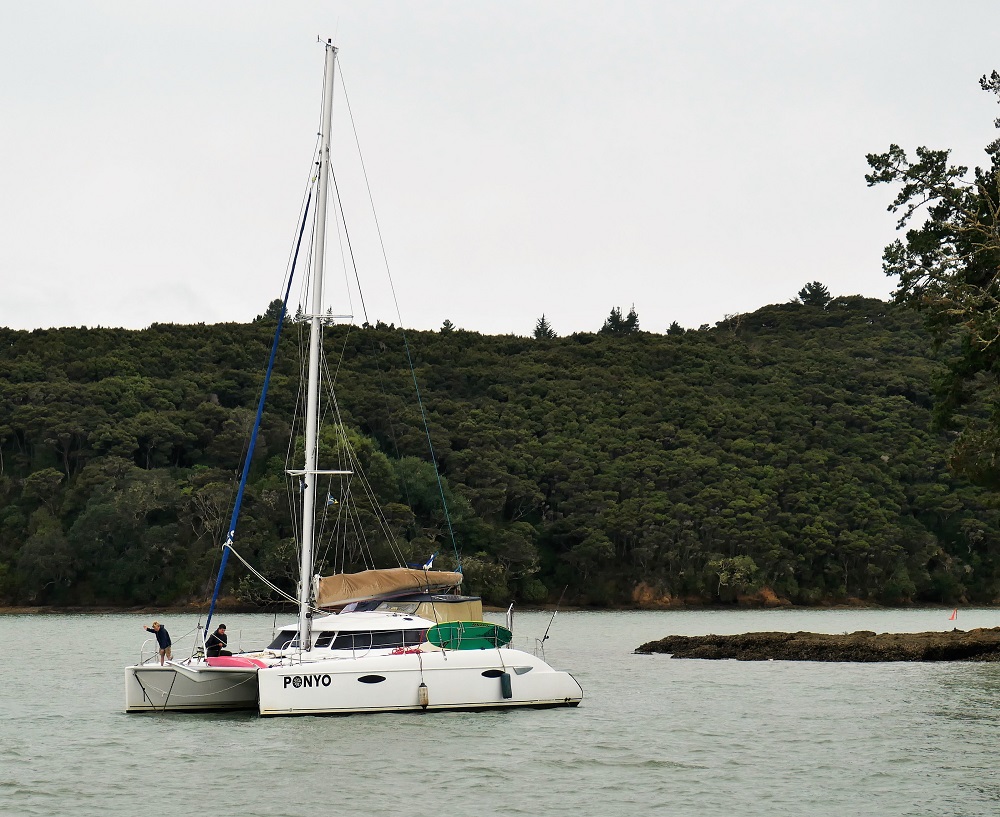
“Mummy, this boat got scratched on the side, when we banged into that other boat,” shouted Matias.
David reached for his phone. “The guy left his phone number here.”
He dialled. “Yeah, hi. I’m on your boat. It’s dragging on the anchor…”
I turned the dinghy, to get back to Lukie who was nervously waiting on our boat, and we watched from our sheltered cockpit as the boat owner came racing in his dinghy, closely followed by the marina officials. He got the engines started and Matias and David helped him raise the two anchors. The boat now under control, the marina officials peeled slowly away.
David and Matias helped the owner take the boat into the marina and secure it safely in a berth. The guy had been checking the anchor two days previously, where it had been set well in the thick mud. He, his wife and his young daughter have just moved onto the shore, as they’re expecting another child imminently and want to be on land for the delivery. He explained that in his time here, he has helped rescue several other dragging boats on the anchorage.

“It must be the tide,” says David. “As it switches direction, the anchor rolls over, and then once it’s on its back there is nothing holding it firmly into the mud. It just gets pulled along…”
Back in the warm cabin of our reassuringly stationary boat, we warm up with cups of hot milo. As the wind howls outside, rain lashing against the windows, we reflect on lessons learned. It’s probably a good idea to have a phone number clearly visible in the cockpit of your boat, in case someone else has to jump on board to save it. And having a secondary anchor ready to go is essential too.
Lukie takes a big sip of his milo. “Mummy,” he says. “That’s the longest break in home-schooling that we’ve ever had!”
“Yeah,” I sigh. “And the most excitement we’ve had in one morning for a while. Now back to your maths….”
Being on anchorage is not without risks, and navigating a thin blue path across a red ocean certainly seems more attractive as time, and boats, drag on.

 SV Bob The Cat