
“These buggers are probably losing us at least a knot”, David said, holding up a huge tuft of brown-green slime. He took off his mask and climbed on board. “We’ve gotta find a better way to clean it”, he sighed.
He had just surfaced from scrubbing the hull of the boat – he had been at it for about an hour, and there was still plenty of cleaning left. The state of Bob’s biofouling had progressively worsened over the course of this trip, and she now needs trimming rather regularly.

When we first bought the boat it had been newly antifouled, but it was a dodgy job done for the sale: she had just been lifted out and painted without scraping off the old antifouling, and the result was a terribly knobbly surface, rather like a house-owner neglecting to clean the walls prior to painting, choosing instead to paint over old peeling wallpaper and dustballs, embedding underlying imperfections firmly into a new layer of sticky paint.
Antifouling works by providing a smooth, clean surface containing compounds that are toxic to marine life, and acts to prevent the settlement of organisms and to retard the growth of those that do settle. But on our Bob you could see patches of flaky layers of old antifouling underneath the top coat, and on occasion they had even painted over barnacles, the result a roughened surface perfect for new organisms to attach themselves to. We knew all of this when we bought her, the survey report having pointed out that the antifouling was a job that needed redoing.
Fouling on boats is a problem because it aids the dispersal of marine organisms around the world; marine invasive species spread mainly via boat hulls and the ballast water that large ships take on board when they are empty of cargo and which they discharge again upon reaching a port where they are to pick up goods. And having tons of marine organisms attached to your hull also slows you down immensely by increasing the weight and drag of the boat through the water, changing the hull from hydrodynamically smooth to bulky and rough, like going from a shining race car to a combivan with weed and washing hanging out the windows.
Properly applied antifouling works a treat, although the toxic compounds contained in the paint do leach into the water, causing environmental problems in areas where there are lots of boats, or where boats are being cleaned.

When we pulled the boat out in St Martin around Christmas last year, we knew that we should really get the job done again, and properly this time – stripping back to the gel coat and re-applying new antifouling on a nice, smooth surface. But that would have taken a week at least, and cost us about $10,000, so we decided to make do with the patchy job – it was only a couple of months old, by then, and there was no growth on it yet, after all.
Predictably, the state of growth changed over time, each week of sea time adding more growth, as our antifouling gradually wore off every timed we cleaned the boat. In preparing for entering the Galapagos Islands the cleaning grew decidedly frantic: the Galapagos Biosecurity officials dive on each boat that enter their waters, and if you have any growth at all on your hull, you’re sent 40 nautical miles offshore and told to clean it off before re-entering. So on the west side of Panama we cleaned and scrubbed, and on the passage to the Galapagos we stopped at intervals to scrub some more, with the result that when we entered the Galapagos the hull was spotless, but sadly also completely devoid of antifouling.
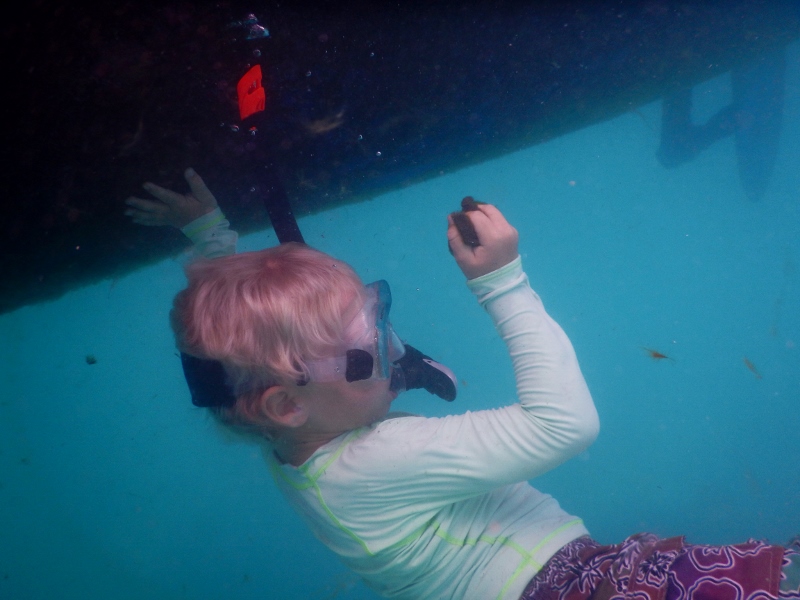
With no antifouling left, organisms attached with increasing ease, and over time it is taking more and more effort to get them off. When we first started this trip we would clean the hull with a light scrub with a cloth or a soft sponge. Now we scrub with an industrial strength Scotch-Brite, scrape with old credit cards and scour with heavy duty plastic bristled brushes creating new scratches for organisms to attach within with every clean. Cleaning the boat used to take fifteen minutes, an effort we’d have to repeat every fortnight; nowadays it takes hours and by the time we’ve finished the growth has begun back at the start and we could start again if we had the energy.
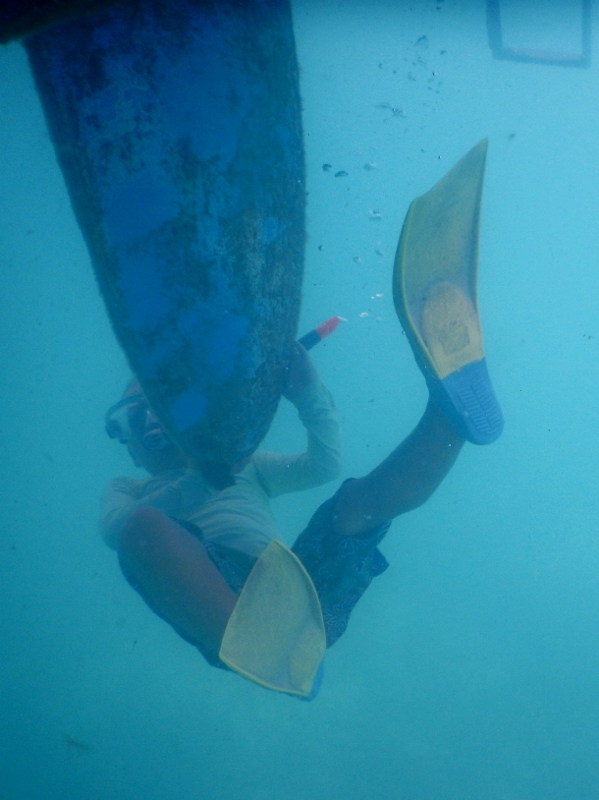
We now have an amazing array of organisms attached to the hull, a thriving ecosystem hanging off our bottom, trailing in the seas behind us. Within this ecosystem are many niches, filled with an astonishing variety of life. On the outside of the hulls, where sunlight abounds, the environment is optimal for algae. Right at the waterline, where the sun is strongest, grows green algae, long filaments of which hang down in a Rapunzel-like curtain. A sub-niche has appeared just below the toilet outflows where increased nutrient levels have boosted growth rates, resulting in foot-long filaments floating elegantly away from the boat. Below the shiny green locks comes the brown tufty algae, the holdfasts of which are near impossible to get off no matter how hard we scrub, their tiny slimy protrusions emanating from every single one of the many grooves and cracks in the numerous layers of hull paint now exposed. Further down still, where light levels are lower, goose-neck barnacles cling on, along with tiny oysters which have embedded themselves on the surface with the result that they are near impossible to prise off, even with a screwdriver.
On the inside of the hulls, the fouling is dominated by a film of tiny translucent hydroids and stalked bryozoans which can be wiped off relatively easily, but settle back almost immediately. In between these are a smattering of white encrusting worms, sponges and ordinary barnacles, all happily filter-feeding in the warm, nutrient rich environment surrounding Bob the Cat on an average day. Whenever we’re at anchor surgeon fish will come and start grazing on our keel, nipping algae off with their sharp little teeth, the grazing sound transferring through the hull, a rasping, scraping sound accompanying our every move on board, lulling us to sleep at night.
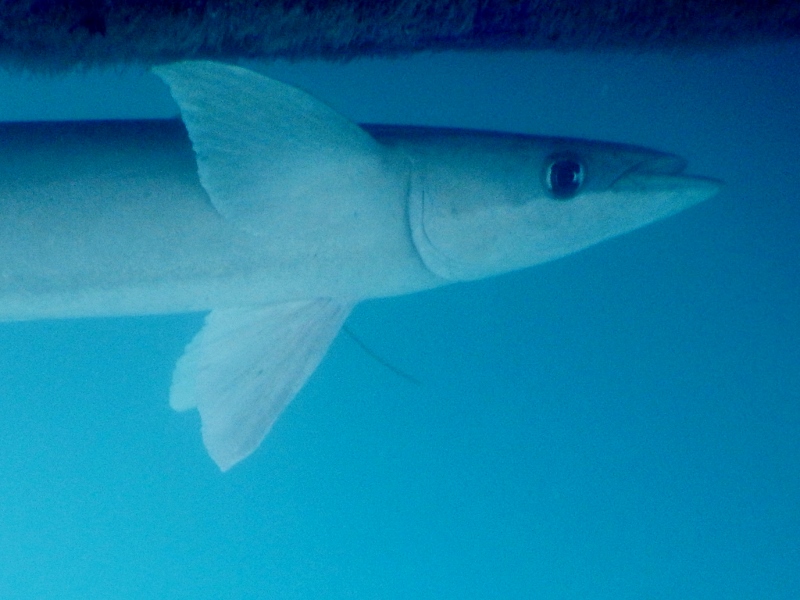
By far the largest organisms we carry are the remora, who attach themselves for a couple of days to feed off scraps and other outfall or to hitch a ride to more lucrative destinations. Up to a metre in length they cling on by the base of the keel with the strange sucker at the top of their heads (meant for attaching to sharks or manta rays), eyeing us cautiously as we clean around them, only bothering to move when we dislodge a particularly succulent looking goose barnacle which they rush over to gulp up with relish.

Sadly, we haven’t discovered any edible organisms yet – if only a few paua (abelone) would attach we would happily provide them substrate until they reached harvestable size – hell, we’d handfeed them, carefully proffering nutritious strands of algae for them to gorge on. Ditto for any pearl oysters that might happen to attach. But so far no valuable organisms have joined us.
Biosecurity New Zealand had a stall at the Musket Cove Regatta in Fiji, where they warned us that the boat has got to be spotless to get into New Zealand. When I mentioned that that might be, er, a bit of a problem, the friendly lady conceded that ‘a light algal film’ would be acceptable.
“But absolutely no animals”, she said, fixing me with her gaze from under her khaki Biosecurity NZ cap. “We don’t want barnacles, or any shellfish, or any other animals”.
We’ll definitely have to get rid of the remora, then.
I’m not sure what to do about all the hydroids either, as they seem to come back the moment we stop scrubbing. They’re quite persistent animals, and we’ve even found them growing happily within our toilet bowls, filterfeeding happily away until we go stymy their attack with a dose of vinegar and the lethal twist of a toilet brush. I guess we’ll have to attack both hulls and toilets with a vengeance before departing from New Caledonia, armed with screwdrivers, chisels and brillo pads, and then sail as fast as we can to New Zealand, hoping that no organisms manage to attach themselves on the way. David will be happy, finally an excuse to go as fast as we can…
 SV Bob The Cat