It’s the middle of the night. All is dark, only the channel marker lighting the way through the treacherous reef blinks faintly, beaming out its warning of the dangers below the surface. Bob is bopping up and down gently, small wavelets pushing her from side to side. On the nearby shore two yellow lights illuminate the breakwater protecting the shoreline against the sea, casting an eerie light over the ancient rocks.
It’s 2 am and I’m wide awake, ready to start my night watch. I’m craving a cup of tea and a midnight snack involving copious amounts of Nutella. My body is ready for hours and hours of reading, interrupted every ten or so minutes for me to put down my book and stare into the darkness to check for reefs, vessels and other hazards. I am awake.
The only problem is that I ought to be asleep. We’ve arrived, Bob is perfectly safe, and I no longer need to be on watch. We’re firmly anchored onto a featureless sandy bottom off the township of Levuka on Ovalau Island in Fiji, and I no longer need to stay awake all night to keep us clear of hazards.
David and the kids are asleep, but I’m too jetlagged to nod off. Our latest passage watch schedule has David on watch from 7 pm to 2 am after which I take over until he wakes in the morning, usually around 9 am. We’ve just come from Tonga and it worked well; after a day we settled well into the new rhythm. The passage only took three days, but this is obviously enough for me to have fully realised my nocturnal self. So here I am, alert at 2 am.
The passage was rather uneventful apart from the port engine starter motor braking down, presumably on purpose, just to keep us on our toes. It happened on the second night, on David’s watch. Later on in the night I switched on the starboard engine to charge the batteries, and after half an hour that overheated, leaving us with no working engines. This wasn’t the first time the starboard engine had overheated – it had happened regularly since the oil cooling unit had broken back in the Tuamotus. After reasoning that it probably wasn’t strictly necessary to cool the oil, David boldly bypassed the oil cooler, only for us to discover that thereafter the engine had become rather prone to overheating. As a result we had limped along for months with a starboard motor that we couldn’t run for more than 20 minutes or so before it cut out due to overheating. Finally, in Tonga, we got the unit repaired and David reinstalled it, giving us two fully functioning engines. For about two weeks, anyway, up until this passage where suddenly none of them were working.

The following morning when David got up we assessed the situation. The port engine refused to start, so we had to give up on that. Hoping that the starboard motor had just been low on coolant we filled it up again and spend much of the last day willing it to work for long enough to allow us to navigate safely into the bay and anchor upon arrival the following day. The anchor windlass is powered off the starboard motor and so anchoring without it would be very difficult.
The following day we entered the Lomaiviti group of islands east of Viti Levu, and headed straight to Levuka town on the island of Ovalau. Just before the narrow pass leading into Levuka Port we switched on the starboard engine and crossed our fingers. Thankfully the engine fired up beautifully, and held its cool allowing us time to anchor safely. Phew.
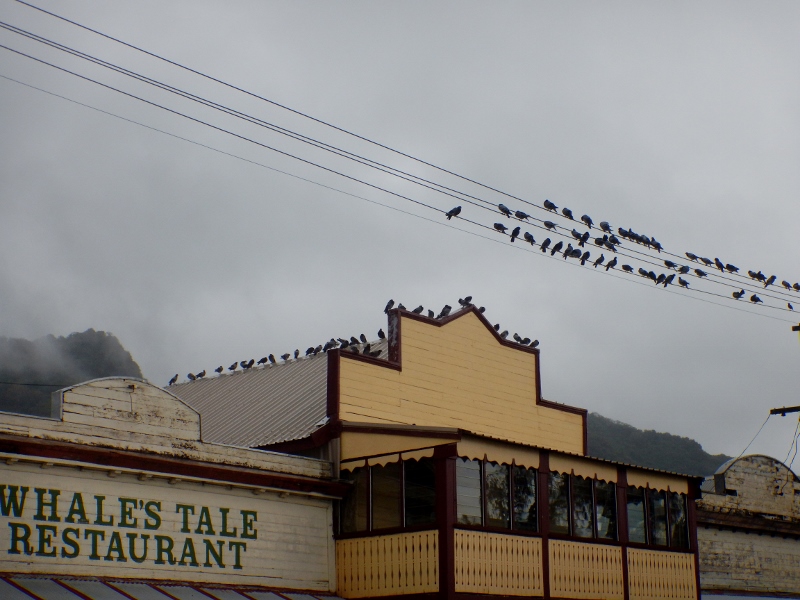
And then, there we were, in Levuka – the oldest European settlement in Fiji, the capital of the first Fijian government, the wild west frontier town which used to have a terrible reputation as a seedy lawless cesspit, for decades the home of the terrible ‘blackbirding’ practices that forever changed the population of the western Pacific.
Fiji is a fascinating place. Called Viti by its original inhabitants, this vast group of more than 300 islands has been settled since the first Lapita people arrived from Vanuatu around 1500 BC. The firstcomers were followed by successive waves of Micronesian, Melanesian and Polynesian peoples who all took up residence on the fertile volcanic islands surrounded by fringing reefs teeming with fish. Archaeologists estimate that agriculture became commonplace in around 500 BC, after which the population increased and resource wars began. So bad was Fiji’s reputation as a home for fierce warriors with cannibalistic tendencies (one man alone, named Udreudre, was reported to have eaten at least 872 people) that Europeans gave the place a wide berth for centuries until a small group of whalers finally settled in Levuka in the 1830s.
The Europeans named the area Fiji, the Tongan name for the islands, the Tongans having had intermittent control of large parts of Fiji for centuries. Access to European weapons exacerbated the already fierce tribal feuding until the bloody wars finally came to an end when Ratu Seru Cakobau from Bau declared himself the winner. Missionaries entered Fiji from Tonga, and Cakobau converted to Christianity when the his allies in Tonga threatened to remove their forces which had been supporting him.
In the 1860s, following some misfortune and few misunderstandings, Cakobau became heavily indebted to some of the large trading companies that had set up in Levuka, and overwhelmed by his debts he ended up offering Britain the control of Fiji in return for paying off his debts. And so it was, that for about $45,000 worth of debts, Fiji became a British Crown Colony in 1874, and Levuka was pronounced the capital.
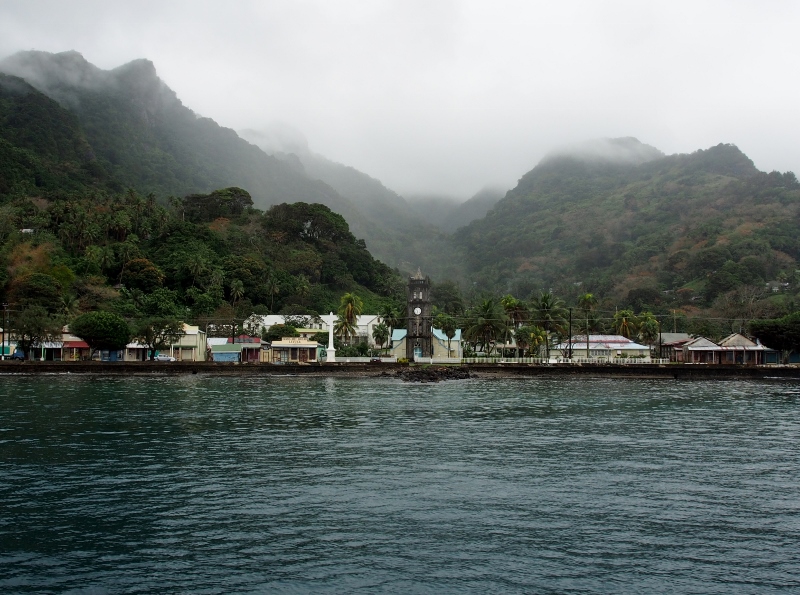
Set on a narrow fringe of foreshore backed by steep green hills, Levuka is an eerie place. Back in the 1840s and ’50s, when it was a drunken frontier town, the waterfront strip covered in bars and kava joints. It continued to grow, and in the 1870s the town was heaving, sporting 52 hotels and home to about 3000 Europeans. When Fiji became a British colony in 1874, Levuka became the capital and remained so until 1882 when it was moved to Suva because there wasn’t room for expansion in Levuka.
Levuka was also the Pacific centre of ‘blackbirding’, the large-scale movement of cheap labour from Pacific islands to Fiji, Samoa, Australia, Peru and New Caledonia. Sometimes the islanders entered the blackbirding ships of their own volition, eager to make a better life somewhere else, but often they were tricked by sailors dressed as priests or threatened at gunpoint, driven like cattle into the hulls of big sailing ships, off to spend their lives doing hard physical labour in far-flung destinations. This trade in humans devastated areas of the Pacific, leaving whole villages empty. One island in Tonga lost 40% of its population to Peruvian slave ships, and the country Tokelau lost nearly half its population to blackbirding. Huge amounts of Indians were imported as cheap labour into Fiji, to work on the sugar plantations, and to this day more than 35% of the population of Fiji are of Indian descent.

Levuka still sports some of the old buildings from its past days of seed and glory; the whole back end of town is a World Heritage site. Old churches stand next to Royal Hotels, shop facades advertise trading companies, and fine wooden buildings along the back street are interspersed with neatly mowed grassy parks, tennis courts and flagpoles, along with signs threatening legal action against anyone littering.
The historic serenity is somewhat disturbed by the town’s power plant on the water front, which sits screaming out a deafening roar 24 hours a day, creating a permanent town-wide tinnitus. Another sensory attack is provided by the tuna canning factory, cunningly located upwind of town as if to ensure that the strong fishmeal stench emanating from it will cause the maximum possible disturbance. The smell is palpable, almost physical; a mixture of aquarium fish flakes and ground up cat pellets lingering heavily in the midday heat, hovering just around nose height above the warm pavement on the main street.
After two days at anchor the noise and smell are getting to us and we decide to leave as soon as David has effected an ingenious repair to the port starter motor involving copious amounts of expoxy and duct tape. Miraculously it works, but he warns that it probably won’t last, and orders a spare part or two for us to pick up when we reach Nadi. In the market I stock up on fresh fruit and vegetables and also buy bundles of dried kava root, the obligatory gift we have to present in the customary sevusevu ceremony which we will be required to partake in whenever we anchor near any villages in Fiji. The tradition of sevusevu requires visitors to present kava to the chief of the village they’re visiting; a present in exchange for the hospitality of the hosts.
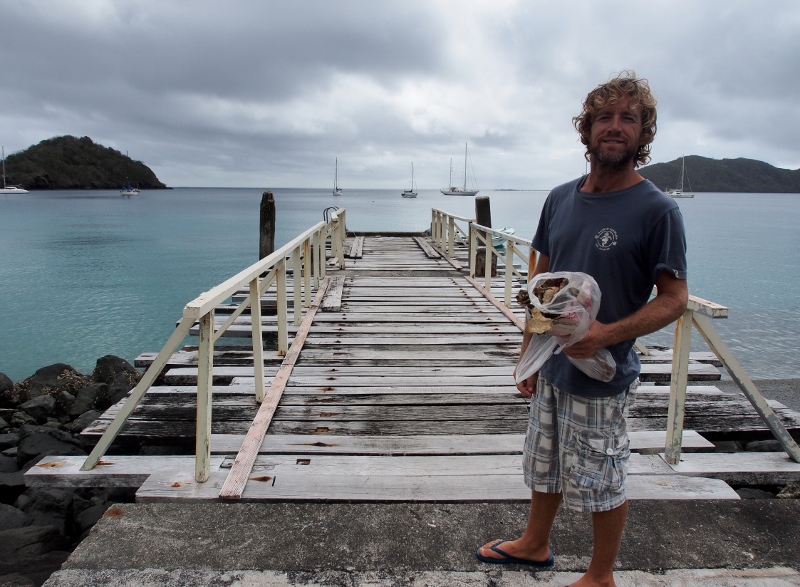
After Levuka we went to the island of Makogai. From 1911 to 1969 Makogai was a leper colony, home to thousands of leprosy patients sent here from all over the Pacific to be cared for by kind nuns. Separate villages were built on the island for different nationalities, and an old map on the wall shows the location of the European village, the Fijian village, the Indians, the Samoans and the Vanuatuans as well as a village for ‘others’. The register records that a total of 4185 patients landed on the island, of whom 1241 died.

Nowadays the island is a marine reserve and home to a giant clam hatchery. Mr Navindar, the kind manager of the hatchery facilities took us on a tour of the ruins of the leper colony, showing us the open air movie theatre and the prison used to detain patients who had engaged in disorderly conduct. More than a thousand people are buried on the hill behind the current day hatchery, many of the graves unmarked, and Navindar spoke of visitors coming to the island to retrace their ancestors who passed away from the terrible disease.


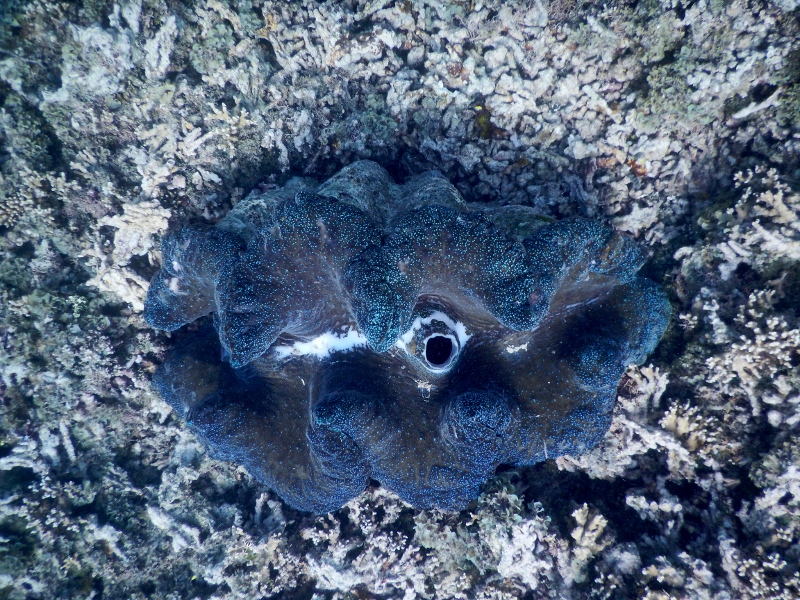
Blissfully unaware of the tragedies that once unfolded onshore are the giant clams in the bay. Imported broodstock from Australia, these gigantic molluscs lie gaping on the seabed, some up to a metre long, casually siphoning water through their glistening mantles. When we dive down to touch them they flinch but greedily remain open, not wanting to forego feeding opportunities just because of minor disturbances. These are the parents of the babies in the hatchery and are larger than any clams we’ve ever seen before. Being an excellent source of defenseless protein, the giant clam was nearly fished out in Fiji, and the hatchery was established to restock reefs around the country. Hatchery workers dive to inspect the giants in the bay regularly, peeking in at the gonads through the incoming siphon. If the gonad looks ripe, they lift the entire clam out of the water (apparently it takes four strong men to carry a large specimen), install it in a hatchery tank and inject it with serotonin, which causes the animal to spawn. Giant clams are hermaphrodites, releasing the eggs first and then a while later the sperm, and after business is completed the giant animal is taken back into the bay, placed gently on the sand, and given a respite for at least a couple of months.

Inside the tanks the eggs are fertilised and after a week or so the babies settle out from the water column after which they slowly grow until they are big enough to transfer into the wild. Giant clams are filter-feeders but most of their energy come from the photosynthesis carried out by the tiny symbiotic algae that reside in their mantle tissue. The hatchery target production was 30,000 juveniles a year, most of which will be placed on reefs around Fiji and hopefully grow into gentle giants.
After Makogai, we went to Namenalala Island which is in the centre of the marine reserve surrounding the famous Namena reef. The island is home to a booby colony and as we came close birds were everywhere, swooping down upon us, following the boat as we sailed in. They were gorgeous, wide-winged and inquisitive, hovering in the sky, spreading their tail feathers as they slowed down directly above us to have a good look.
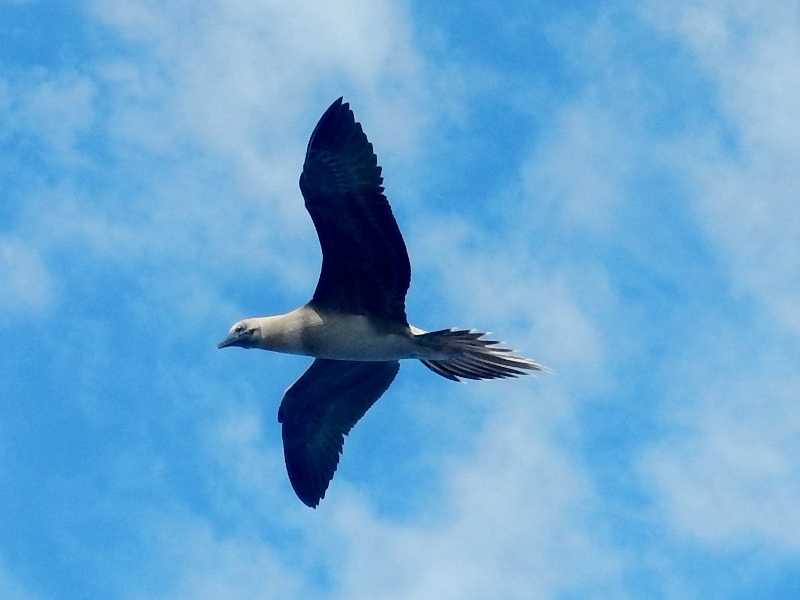
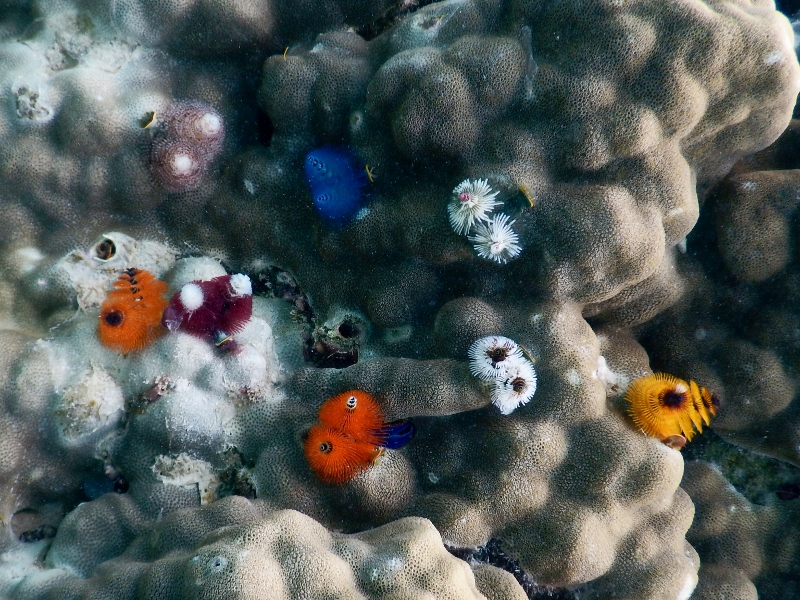
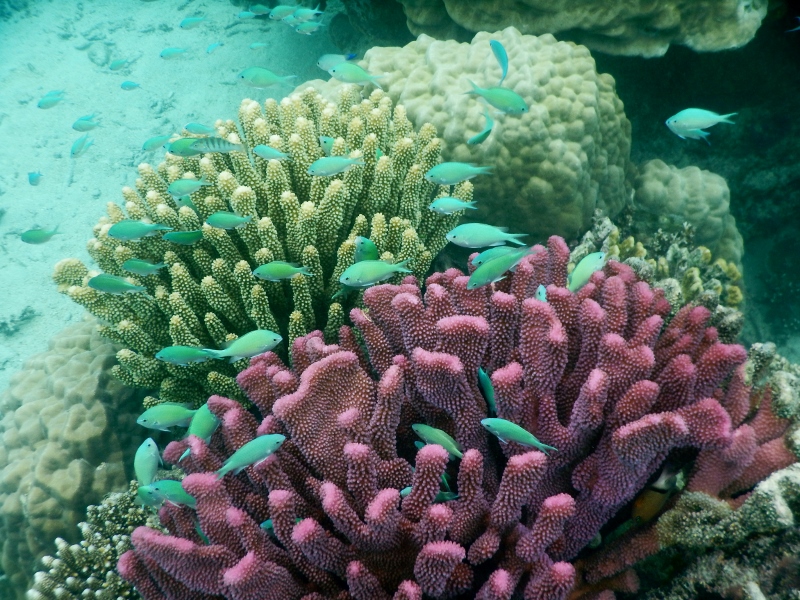
On shore the trees were full of boobies – suspicious mothers guarding small closed eyes chicks in nests, and large, clumsy, fluffy, white chicks perched atop fragile branches. The water in the bay was clear and full of corals adorned with colourful jewel-like Christmas tree worms extending their fans boldly to suck nutrition from the water. Reef sharks and rays swam in between coral boulders and schools of brightly coloured fish flittered about.
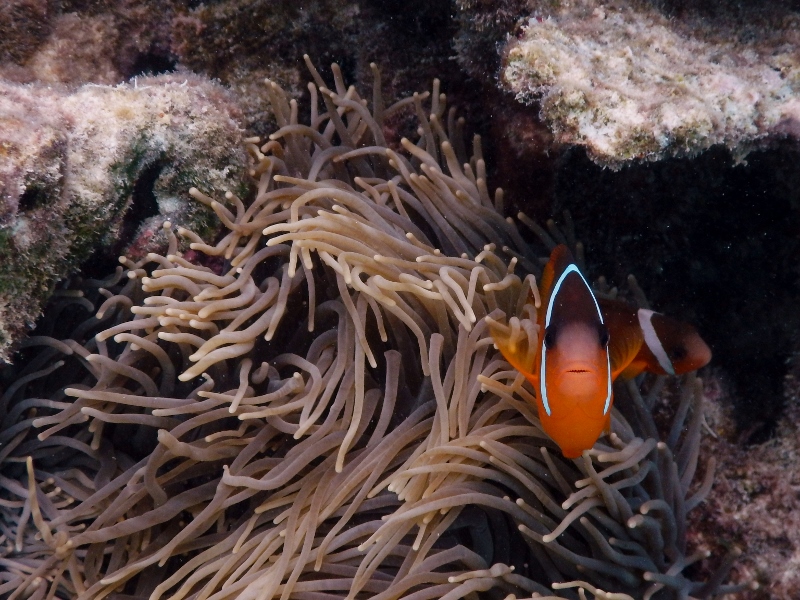
Three other boats with children were anchored in the bay and the children soon took turns jumping on our trampoline.
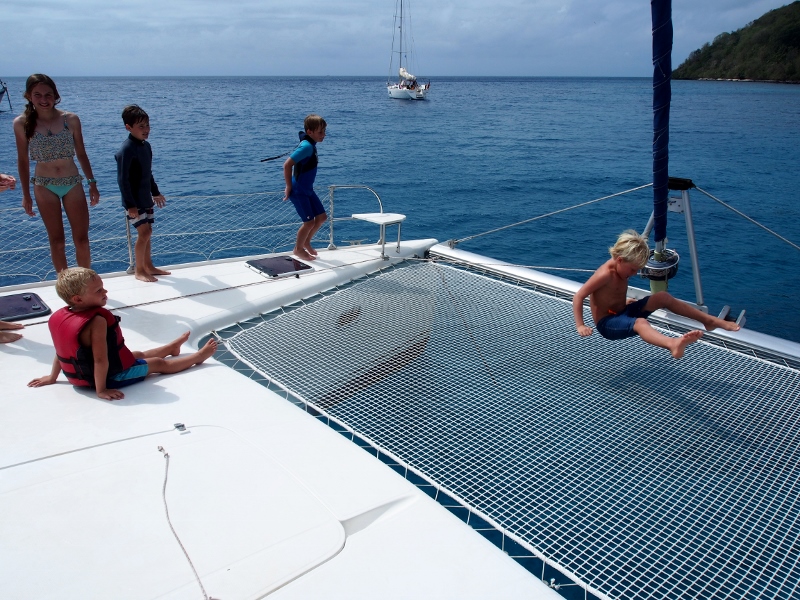
After two nights in Namena we set off to work our way towards Nadi, where we were meeting our next visitors, our dear friends the Daniels.


On the way we went to idyllic Naigani Island where we anchored in a turquoise lagoon just off a deserted white sandy beach fringed with coconut palms. Next we visited Nananu-i-ra, a small island north of Viti Levu where we had a kitesurfing holiday three years ago. We came into the island on a calm afternoon, the reflections of the houses adorning the waterfront lengthening into the glassy waters. Hot from a windless motor we rushed ashore and revisited the site where the kids had their first snorkelling experience three years ago, off the pier where swarms of fish lurked waiting to be fed by eager holiday guests. The children soon found some other boat kids to play with and spent the afternoon playing in the water.


The following morning we set out early, intending to get to Vuda Marina in Nadi before nightfall. The Daniels were arriving two days later, and we had to provision and get the proper engine parts to replace David’s impromptu epoxy job before the engine malfunctioned again. Both engines had been working well during our recent Fiji explorations, but we were reluctant to rely on the epoxy repair for too long, especially given we would have guests on board most of the time for the next month and therefore would have to be in certain places at certain times to meet people.
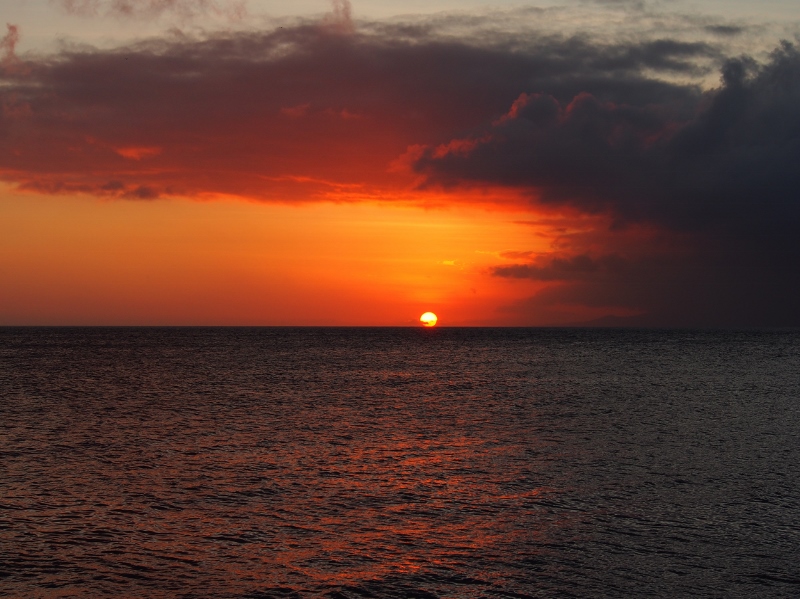
The forecast was for a gentle 5-7 knots of wind but as we motor sailed around the north western corner of Viti Levu, the wind strengthened steadily until we were driving full throttle into a 30 knot headwind. We spent the next three hours tacking every fifteen minutes in the narrow channel between the island and its fringing reef, making very little headway. As nightfall approached we had to concede defeat and head for the nearest anchorable spot, hoping that we could spot any reefs on the approach in the rapidly fading light. The bay was large and muddy, fringed with mangroves with the occasional reef sticking out, and we managed to anchor safely just as the sun set.

In the morning we pulled anchor early and headed back out into the headwind, reaching Vuda just before lunch. Finally we were here, ready to provision, excited to have our very good friends join us for a week of adventures the day after.
 SV Bob The Cat