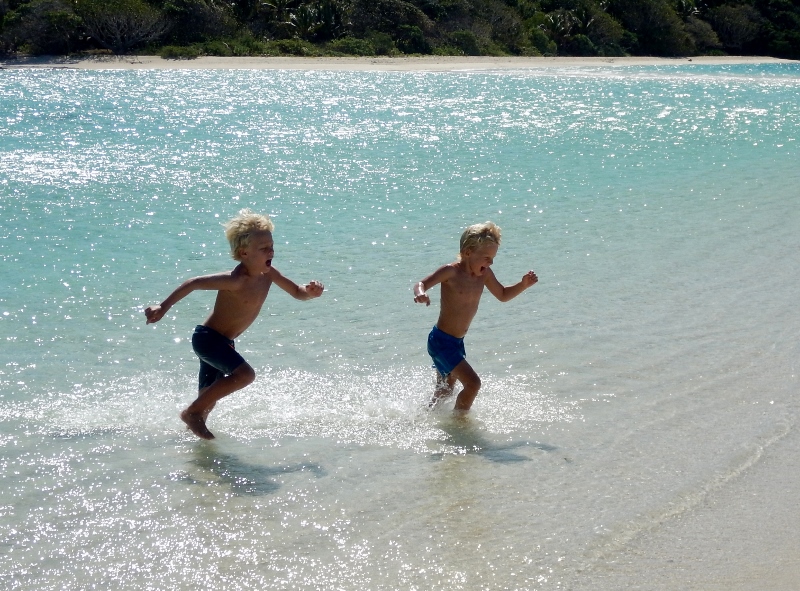
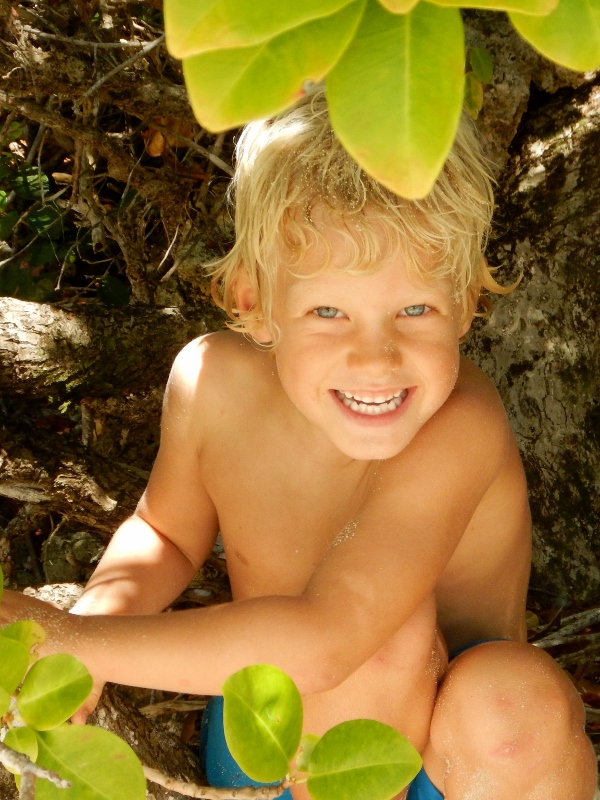
“Mummy, I’m all SPAM”, announced Lukie, hovering in the doorway, feet dripping with water. “So I can come inside.”
“You’re what?” I asked handing him a towel, my mind half on the stove. The rice was boiling over and I needed to check on the pan – was that a burnt smell?
“I’m spick and SPAM”, he said. “So can I come inside, Mummy?”
Right. Obviously our latest culinary escapades had had an effect. We’d been trying to use up our SPAM store here in Tonga, and the kids were loving it. Yummy salty, greasy meat, identically revolting to the adult palate whether labelled Roast Turkey, Lean Chicken or just plain ol’ unspecified SPAM. Having consumed his share of our reserves, Lukie now clearly identified fully with the brand – perhaps we should try and market him for commercials? “I used to hate food on the boat / my Dad always catching fish or clam / till one day finally my mum served a load / of lovely, salty, greasy SPAM”, cue catchy SPAM tune starting as the camera zooms to Lukie, fork in hand, eagerly tearing into a tin of SPAM, huge grin on his face.


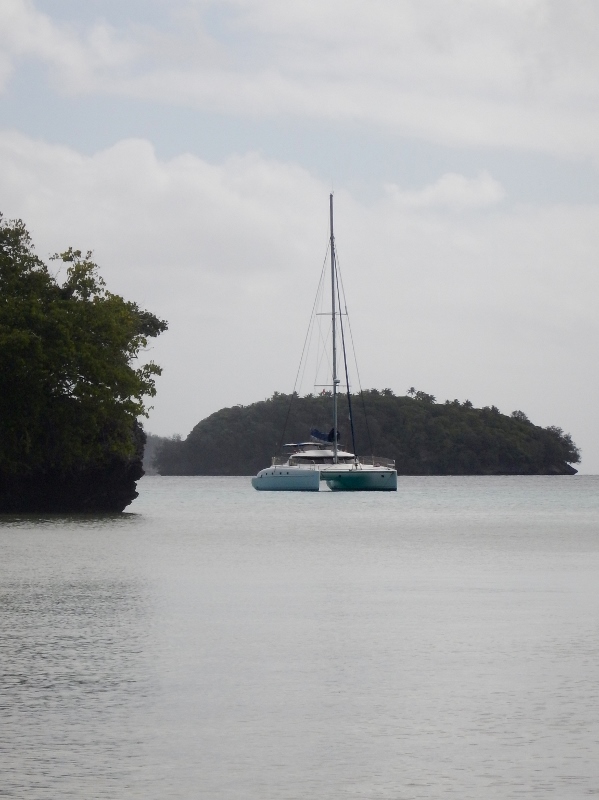
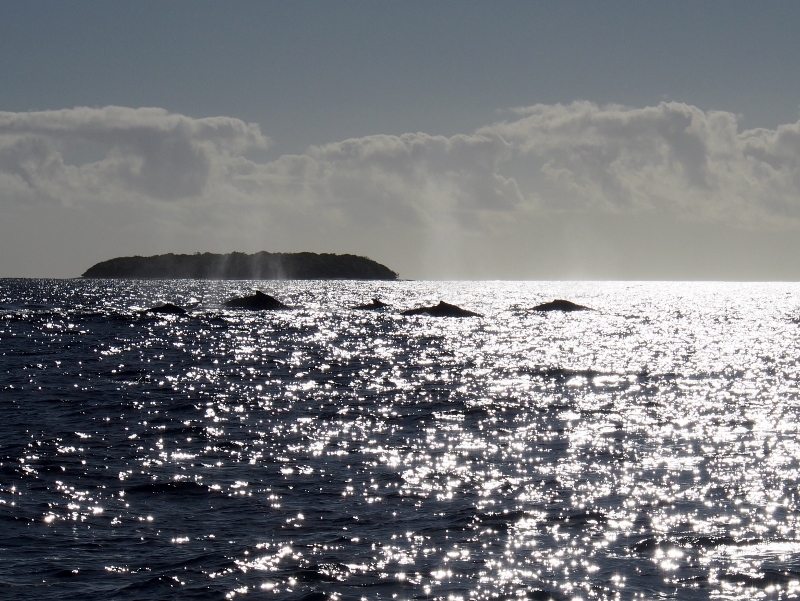
We were in the Ha’apai island group of Tonga, a stunning set of white sand islands elegantly scattered over a deep blue sea thick with whales. Tonga sports an impressive 171 islands spread over 700,000 km2 of ocean, and the Ha’apai group is in the middle of the kingdom, north of the capital island of Tongatapu and south of the Vava’u group. A rather empty place (45 of the group’s 62 islands are uninhabited), Ha’apai is home to only about 10,000 Tongans and a few resorts, making it much less busy than Vava’u where there were at least a hundred other yachts and numerous additional tourists.
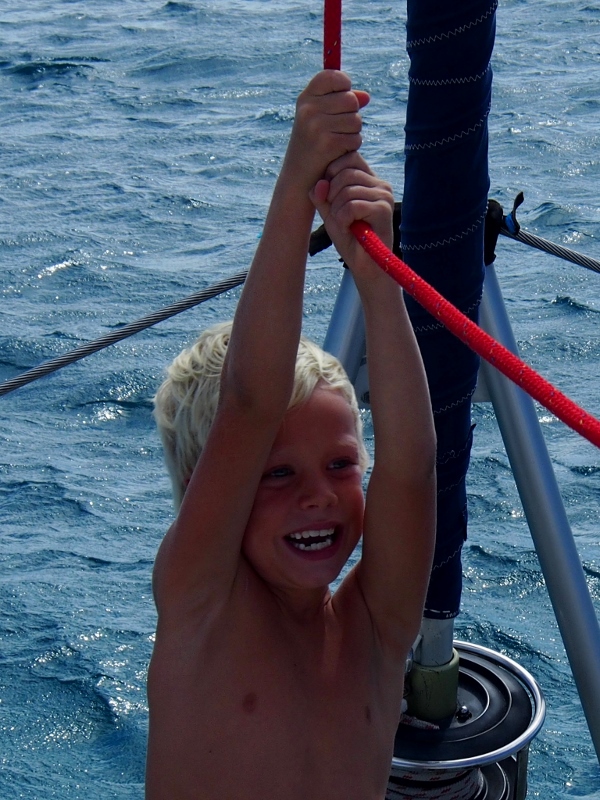
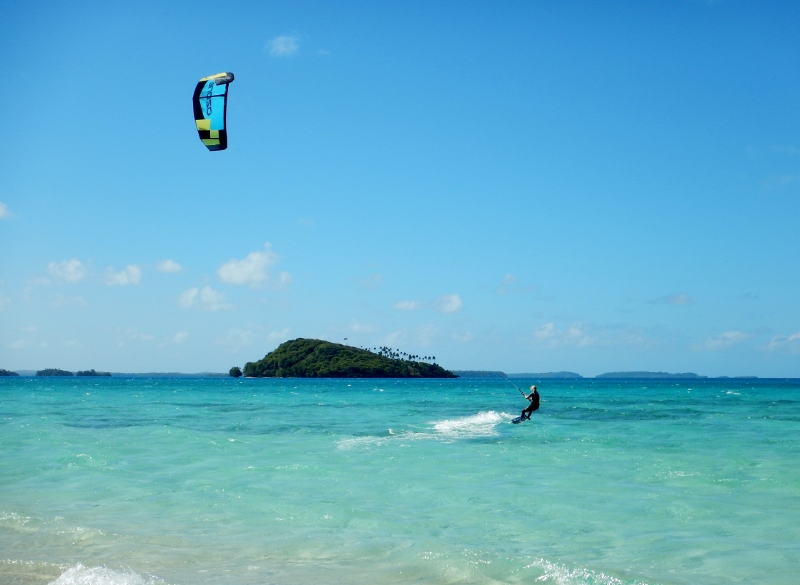
After some initial engine problems, our last week in Vava’u had been lovely, sharing beautiful sunny days with fellow cruising families. We had meant to go to the Ha’apai group sooner, but the winds were too strong for the crossing, and so we stayed in Vava’u, kitesurfing off deserted islands and expensive resorts alike, zooming over turquoise waters, the only sound around us the huffing and puffing of whales coming up for breath. Each day the group of cruising kids would jump from boat to boat, paddling to the beach by themselves in kayaks and dinghies, snorkelling and splashing in the shallow waters off white beaches before wading ashore to collect shells and crabs, building fortresses of dead coral slabs to keep them in. We’d done day trips with other yachts to idyllic snorkelling and kitesurfing locations and spent our evenings sharing meals on crowded boats or toasting marshmallows over bonfires on the beach.

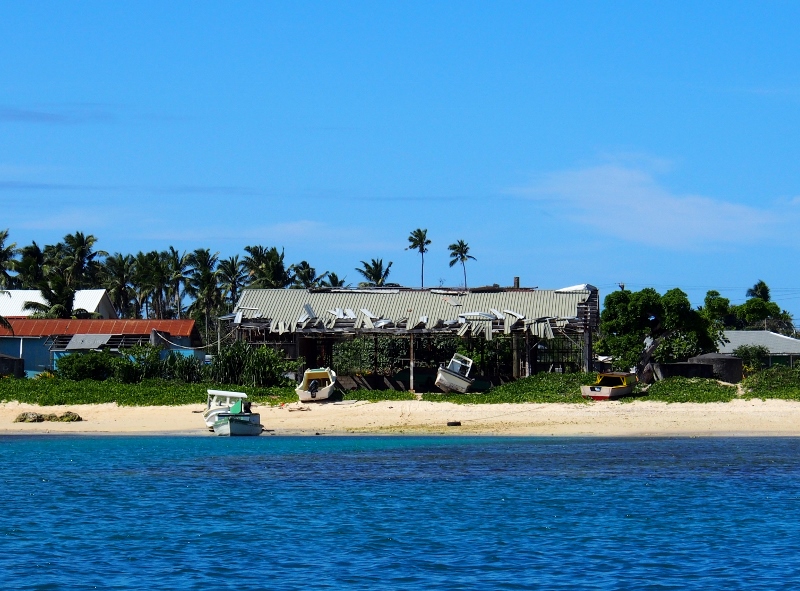
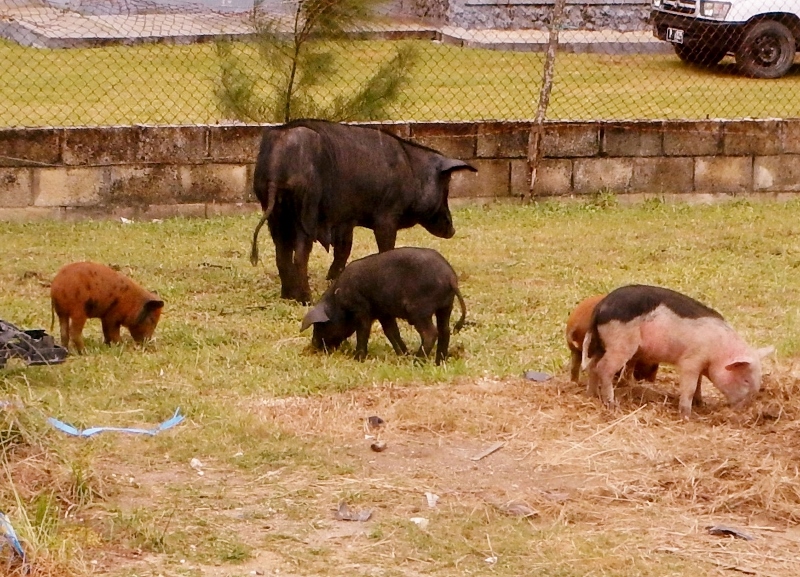
But the Ha’apais lured us away, with their promise of deserted golden beaches and plenty of wind; a kitesurfing paradise. Our first port of call was the main town of Pangai, on Lifuka island. Home to about 6000 people, Pangai was at the eye of Cyclone Ian when it hit here last year, and the testimony of cyclone damage still dominates the town. Ruins are everywhere, corrugated iron roofs twisted into awkward shapes protruding atop leaning posts barely holding together the frames of destroyed houses, unfinished building sites strewn with goats and pigs rummaging through the persistent rubble.
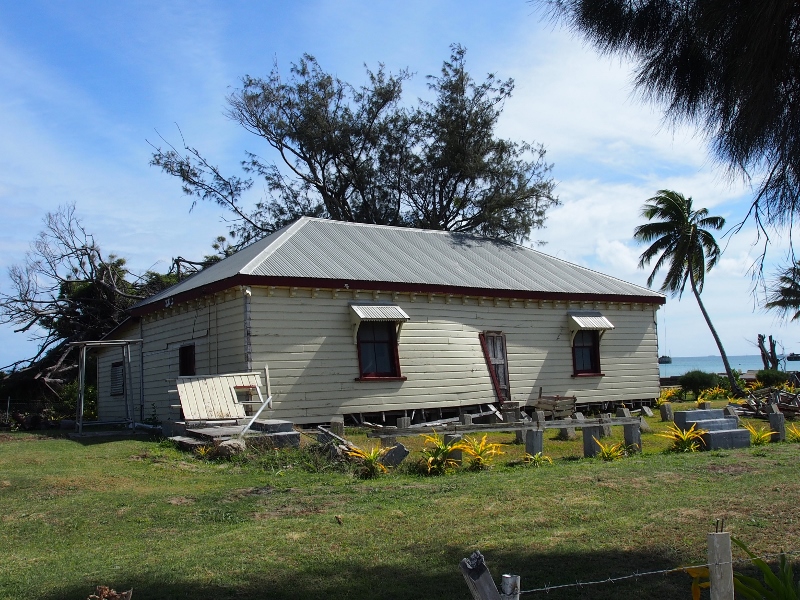
Only the churches looked unaffected by the cyclone; clearly their restoration was prioritised over, say, the Ministry of Justice building, a dilapidated wooden house which remained bent out of shape a whole year after the angry winds. And there were many fine churches in this small town. Tonga is the only Pacific nation which was never colonised, but after some initial mishaps with missionaries getting eaten by hungry locals, the nation took to Christianity with gusto. Tonga’s legislation was drafted in 1875 by Shirley Baker, a Wesleyan Minister held in high regard by King George Tupou I, and today it is still an offence to do anything on a Sunday, with people being prosecuted for fishing, working or even just visiting a beach. Modest dress is required by law to prevent any frivolity: men must wear a shirt and knee length shorts and women skirts covering their knees and tops obscuring their shoulders and cleavage, tourists included. The churches retain their dominance in everyday life and not always to the benefit of the people, relying as they do on less-than-voluntary donations that their members (40% of Tongans live below the poverty line) can unfortunately often ill afford.
Christianity is still relatively new here, though. Tonga is thought to have been first inhabited more than 3000 years ago by the Lapita people as part of their eastward push across the Pacific. According to pre-Christian myth, the islands were fished out of the sea by the God Tangaloa, although other traditions ascribe the fishing luck to the trickster God Maui. Directly descended from the Gods and related by kinship, three kings used to rule the main island groups of Tongatapu, Ha’apai and Vava’u, and bloody wars were fought by all with neighbouring nations. Tongans excelled at warfare, and at one point Samoa, Tokelau, Niue and Fiji were all under the rule of the Tongan kings, with sporadic raiding parties reaching as far away as the Solomon Islands.
The Dutch were the first Europeans to sight the islands but as the locals quickly became well known for their fierce warfare and tendency to consume the conquered enemy, no Europeans lingered in Tonga for long. Captain Cook stopped here in 1777 and narrowly avoided getting eaten in the Ha’apai group when local chiefs invited his ship and crew to a feast at an island full of supplies. Grateful for the hospitality of the friendly locals, Cook and his crew partook in the celebrations unaware that the party was a ruse for the locals to board his ship and feast on the crew. Because of a last-minute disagreement amongst the chiefs the plan was never carried out, and Cook and his men survived to innocently name the Ha’apais the ‘Friendly Islands’.

The Ha’apais witnessed further calamity when the mutiny on the HMS Bounty took place just off the volcanic island of Tofua in 1789, with the mutineers setting Captain William Bligh and 18 crew adrift in an open longboat. Hoping to get some supplies, Bligh landed on Tofua where he and his men were attacked by hungry locals who managed to kill one of the crew before the remaining refugees promptly fled. They drifted on in their longboat for months until they landed at Timor in modern day Indonesia.
More successful, from a Tongan perspective, was the attack on the British privateer vessel the Port-au-Prince in 1806, where locals finally succeeded with the same old trick of inviting the captain and crew for a feast and then proceeding to raid the ship. Only the life of the 16-year old William Mariner was spared (the Tongans believing him to be the son of the Captain), and when he was eventually allowed to return to England four years later he bore glorious tales of contemporary Tongan culture which fortunately were recorded for posterity back in England by Dr John Martin, an amateur anthropologist.
Fortunately, the Tongans are less hungry nowadays. It seems that corned beef has replaced more macabre dishes and the national fare is now corned beef stewed in coconut milk served with starchy root vegetables steamed to a mush. We had heard that canned meat is considered an outstanding delicacy preferred over all other foodstuffs and brought several tins along to trade for fresh fish, fruit and vegetables, but after learning of Tonga’s health problems we kept the cans firmly in our stores and resolved to keep our SPAM problem to ourselves. Officially the heaviest nation on earth, a whopping 84.1% of Tonga’s population is estimated to be obese and close to 100% is considered overweight. Not that they’re all unhealthy; one of Tonga’s main exports is successful rugby players, and prior to becoming officially the heaviest monarch on earth, the old king Tafau’ahau Tupou IV won the national pole vaulting championship in 1932. I wonder how hard the competition was given his royal status and the size (by which I mean number, not weight) of the population – is pole vaulting big in Tonga? How heavy was he back then? I keep imagining a giant of a man perched atop a thin, wobbly pole which is bending, quivering and only just avoiding snapping under his bulk as he gracefully leaps off the ground.
Tonga was first unified in 1875 by King George Tupou I who managed to resist the flirtations of the English who were eagerly eyeing up the Tongan islands, keen for some influence in the region. However, after his death his son George Tupou II signed a ‘Treaty of Friendship’ with Britain in 1900, making Tonga a British Protectorate. From this point onwards Britain took over the management of Tongan affairs and full sovereignty was only re-established in 1970 by the heavyweight pole-vaulter king Tafau’ahau Tupou IV.

Today Tonga is officially a democracy, but old habits die hard and Tongan society is still highly stratified with status determined by birth. Contemporary Tonga has three classes of people: royalty, nobles and the masses; people of unspeakable low value. Nobles still hold most positions of power. The Tongan word for commoners, me’a vale, literally means ‘the ignorant ones’, and when approaching the king, these vermin have to use a special language and crawl on their hands and knees, which can’t be an easy task given the nation’s obesity problem. Tafau’ahau Tupou IV resisted calls for democracy vehemently, and although he died in 2006 little has changed since: his successor apparently spent 40% of the country’s aid budget on his coronation. Judging by the opulence of the coronation we witnessed recently in Nuku’alofa, little has changed with the newest king. All government ministers are still appointed for life and up until recently few were elected by the public; most were chosen by the king from the noble families. Media are censured and journalists questioning of the status quo occasionally end up in prison.
The Tongans we met were lovely and friendly, surprisingly un-obese (just big boned, really), and unassuming and warm. Wearing their beanies and thick woollen jumpers to ward off the winter cold, they greeted us enthusiastically in English, or, if from further away, threw their head backwards and arched their eyebrows in the universal Polynesian wordless acknowledgement of another’s presence. Most men wore the traditional wraparound skirt tupenu on top of which many sported a (to us) wonderfully exotic woven waistmat made from pandanus leaves, the Ta’ovala.

Mind you, we’ve probably met as many Tongans in New Zealand as we have here in Tonga, although none wearing the traditional waist mats. Presently, about 101,000 people live in Tonga, and it is estimated that as many again live overseas, mainly in New Zealand, Australia and the US. The biggest income by far for the country are money sent home from Tongans living abroad, but tourism provide some revenue as well, as does a thriving export of pumpkins to Japan.
Every corner shop or supermarket seems owned by Chinese, who sit quietly surfing the web on their iPhone in between adding up profits from the sale of expensive tins of corned beef and cheap plastic titbits using large calculators which loudly proclaim the numbers punched into them in Chinese. Subject to much racism, the Chinese are treated with universal disdain by the Tongans, and we heard many quiet complaints about the current King’s friendly relationships with the Chinese, who allegedly donated many cars and funds for the recent coronation. The sale of land to foreigners is prohibited in Tonga, but non-Tongans are allowed to rent land for 50 to 100 years and westerners own all tourist resorts and associated businesses such as whale watching operations.
On our visit, we got the sense that the lower caste Tongans in Tonga don’t have much to do other than eat corned beef and drink kava, and that not many hold any hope for a glorious future despite the sporadic attempts of the various monarchs to lift the country out of poverty. Like elsewhere in Polynesia, substance abuse is a big problem, and I don’t only mean the corned beef – although I’m sure it adds to the stress: imagine how horrible it must be to weigh 200 kg, be of ill health, and struggling to pay for the upkeep of your corned beef habit in addition to the fees for attending church to save your soul. Perhaps it is these stresses that lead to the narcotic kava, the tuber of the plant Piper methysticum, being consumed in huge quantities by most males. Alcoholism is also common and unfortunately linked with high levels of domestic abuse.

Not that we saw much of the dark side of this Pacific paradise, staying as we did in winds strong enough to dispel any whiff of unpleasantness, kitesurfing off beautiful palm-fringed islands, whales splashing enthusiastically in the background. On Uoleva Island, just south of Lifuka, we visited a kitesurfing resort owned by Karen and Glen, an Australian-British couple who spotted the perfectly aligned sand spit on Google Earth a couple of years ago and promptly put into motion plans to come out here and develop a small resort for wind-hungry Kiwis and Australians. Their spot was excellent and we had some great days there, the kids playing with the resident kite dog, building huts and climbing trees while David and I took turns being blown all over the shallow reef against the backdrop of breaching whales.
Tonga is a Pacific Paradise, stunning, awesome and incredible, bursting with whales and fish and idyllic little islands surrounded by picturesque coral. It is an amazing place precariously close to the edge of the rising seas. We have had an incredible time here and are sad to leave these alluring islands with their large, staunch people, incredible history and the whale-saturated waters, the like of which we’ll probably never see again. Much could be done here to better the lives of the population, and if I were His Excellence the King of Tonga I would sure make a few changes. But we’re just visitors, and will have to stick to doing our bit, like buying local produce, picking rubbish off the beaches and finishing our SPAM all by ourselves, to the delight of our ever hungry children.

 SV Bob The Cat