
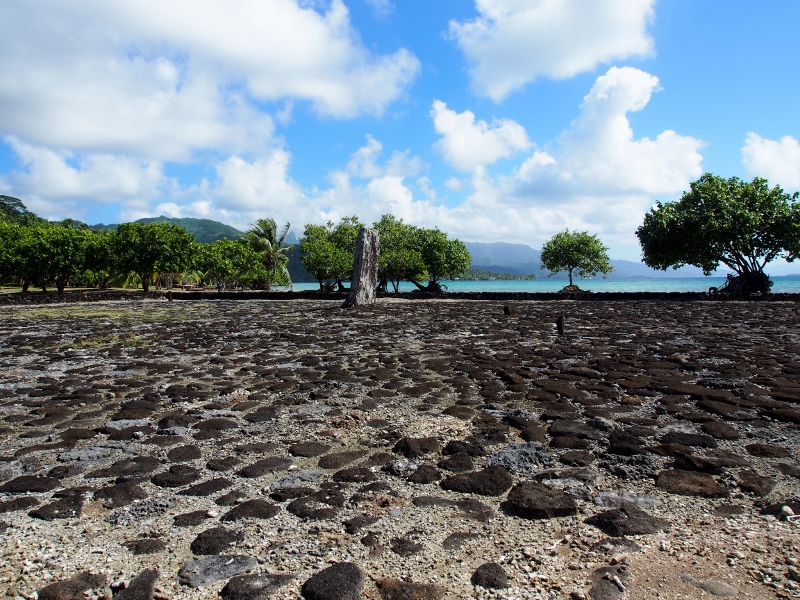
The mid-morning air is still and hot, with a faint smell of smoke. The sun is blazing down on the black basalt rocks in the large paved area where we stand just behind the water’s edge. The shallow water next to the ancient rock wall is calm and flat, but looking out we can see the thick foamy layer of white waves on top of the reef behind the blue-green lagoon. The sound of the pounding surf hums in the background, mixing with bird song and the clucking of numerous chickens that run wild in amongst the stones, pecking at crabs hiding in the sand between the rocks in the shade of large trees.

The flat coastal strip, a narrow border between the shallow lagoon and the steeply vegetated hills, is dense with rock foundations, carefully positioned by ancient hands to please the gods that ruled their world.
This courtyard was built in the 14th century, from basalt and coral rocks supplied by local families on the orders of the priests of the cult of Oro, the god of war. Using huge fossilised coral slabs standing erect and forming a jagged edge, they fenced off one end of the paved areas to demarcate an especially sacred area for the gods and ancestors. Where we are standing, thousands of people have stood in the past, focusing their hopes and aspirations into prayers to stern and demanding gods.
It’s a spine-shivering experience to be here, the religious centre of the Polynesian Pacific. We are at the Taputapuatea marae, the most important temple in all of Polynesia, on the island of Ra’iatea in the leeward Society Islands of French Polynesia. Ra’iatea used to be known as Havai’iki Nui, and legend has it that it is here that at least some of the waka (canoes) that arrived in New Zealand came from. The Taputapuatea marae was so important that each waka that took off from Ra’iatea to colonise new lands brought with them a stone from here to imbue special powers into the marae that they would erect in their new home. Ari’i (chiefs) from the Australs, the Cook Islands and New Zealand would come back for centuries to this location for important ceremonies.
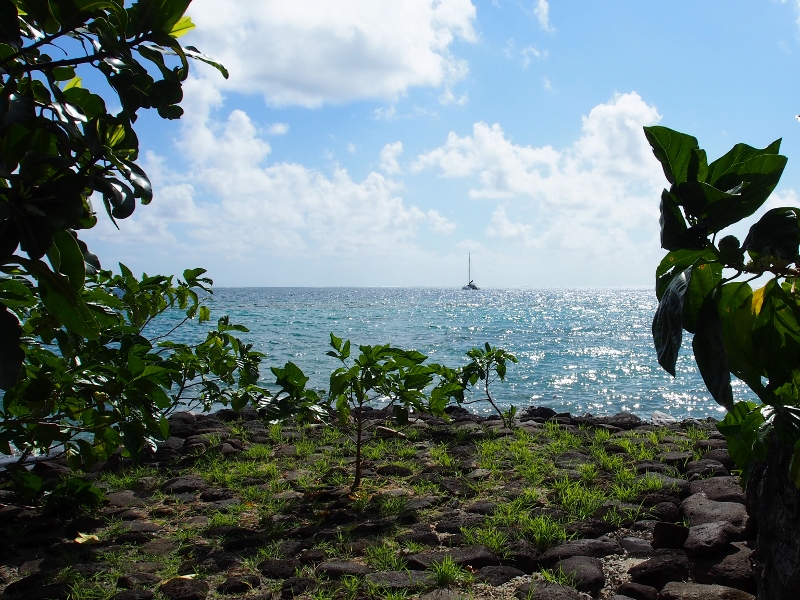
As we stand here we imagine them taking off, full of hope and fear, blessed by Oro or maybe ousted by his adherents – who will ever know? We imagine their two-masted double hulled waka packed to the max with people, water, tools, weapons, provisions and animals for a new life on distant islands yet to be discovered. We imagine the months at sea ahead of them, with storms and doldrums, their only shelter a small thatched hut joining the two hulls of the vessel; the only shade from the hot sun the triangular sails woven from palm or pandanus leaves.
It seems incredible that New Zealand was colonised by people from here, so far away. Incredible that the relatively small waka that we see drawings off could handle the journey south, and that they would face the hardship of a return journey to come back for ceremonies thousands of miles away. Incredible that we’ve been to the Tuamotus, where they have a legend about the Tainui waka, which, when it arrived in New Zealand, landed close to Raglan where we live. The Tuamotu legend features identical names of the waka and the chief on board as the Maori legend, suggesting that Tainui did indeed leave from those barren atolls. And incredible that we’re now here in Ra’iatea where at least some of the other waka left from, that we’re at the marae at the centre of the Polynesian world, at a site where thousands of direct ancestors of New Zealand Maori have stood before us.
For these people the marae was the meeting ground between humans and the divine. Archaeologists have dated the remains of the Taputapuatea marae to the 14th century, but it is likely that what we see now replaced older, more transient structures, and that the site was a place of worship for centuries before anything permanent was built. Drawings from the early European visitors to Polynesia indicate that the houses on the marae had no walls but instead had poles onto which thatched roofs were perched, with one or more rows of upright coral slabs separating the ahu (sacred part) from the rest. The fare ia manaha, the most sacred house on the marae, housed the most sacred icons, the to’o (images of gods) and ti’i (tiki in Maori and Marquesan: images of deified ancestors). This fare was so important that a human sacrifice was required for its construction, the remains of the victim buried under the central part of the house. Towering above the marae were unu, tall wooden fork-like totems, carved with images of ancestors, gods or animals, which were erected along the edges of the ahu. Special human sacrifice marae had special forked unu, without carvings or designs, erected alongside the stacked skulls of the victims. Other houses on the marae were for the dead (fare tupapa’u), where the bodies of deceased people of importance were held, sometimes for many days, before being taken away and buried. The marae also included numerous round-roofed buildings for canoes, with special structures for each of the many types of waka.
We’re interrupted in our contemplations by the kids – they’ve found a huge hermit crab in one of the ancient ahu, and after we finish looking at that it is time for lunch. It is hot and they’re thirsty and hungry, so we sit down in the shade of a large tree and have a picnic, in this peaceful location that harbours such a chilling and gruesome past.
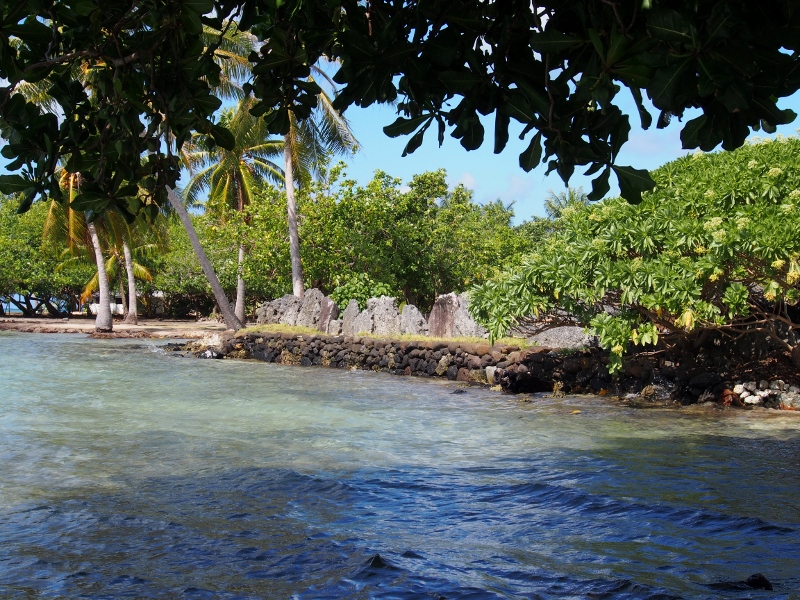
We’ve been in Ra’iatea, in the leeward group of the Society Islands, for a couple of days, having sailed here overnight from Mo’orea, a calm, moonlit passage for Pete’s first night watch. Ra’iatea is, right next to the island of Taha’a, two ancient volcanoes forming separate islands encircled by one common lagoon. After Tahiti, Ra’iatea is the second largest of the Society Islands, but it is very quiet – there are no beaches here, so not many tourists, although there are a few sailboats. Legend has it Ra’iatea was one of the first islands to be settled in the Societies, probably by people from Samoa. In ancient times Ra’iatea used to be the religious and political centre of the Societies, and it is thought that Tahiti was settled by people from here. Only when the Europeans arrived with their ships, finding Pape’ete a better harbour, did the capital of the Societies shift to Tahiti.

Our first night here we tied up to the wharf at the main town of Uturoa, a useful place next to supermarkets and sailmakers where cruisers often come to stock up. Unfortunately the conveniences come with a downside, and we were told to tie ourselves on tightly as the local youths have in the past untied yachts in the middle of the night, no doubt laughing their head off as they watched them drift towards the reef in the darkness. As it happens, the Australian boat next door ends up being broken into and having a laptop stolen during the night, but fortunately we’re spared – it’s possible that the lights we leave on all night for the kids may have deterred intruders.
Despite all this, Uturoa is heaven to us – we get minor repairs done on both our sails and even get – Hallelujah – a bottle of gas for cooking! So now we are truly free of worry – we were uncertain that we had enough gas to get us to Tonga, but because of the Tahitian gas strikes we couldn’t find any gas anywhere. Now, with gas, we can bake and do all sorts of frivolous things. I’m sure Ed doesn’t realise how close he got to eating cold tins (corn beef with sweetcorn? Artichoke hearts with beetroot and SPAM? – I’m sure we could have made it delicious), but at least now he is assured fresh bread on the passage to Tonga.

And there are other attractions to Ra’iatea too. On our way back from the marae, the boys and I kayaked up the Faaroa River, gliding swiftly over the still, green waters, our turbulence disrupting the perfect reflections of the dense jungle surrounding the river banks. The river is lined with miro trees, and whilst we were sitting amidst buzzing dragonflies admiring the scenery, their perfect yellow flowers dropped all around us like snowflakes, sending out ripples as they landed softly on the water.

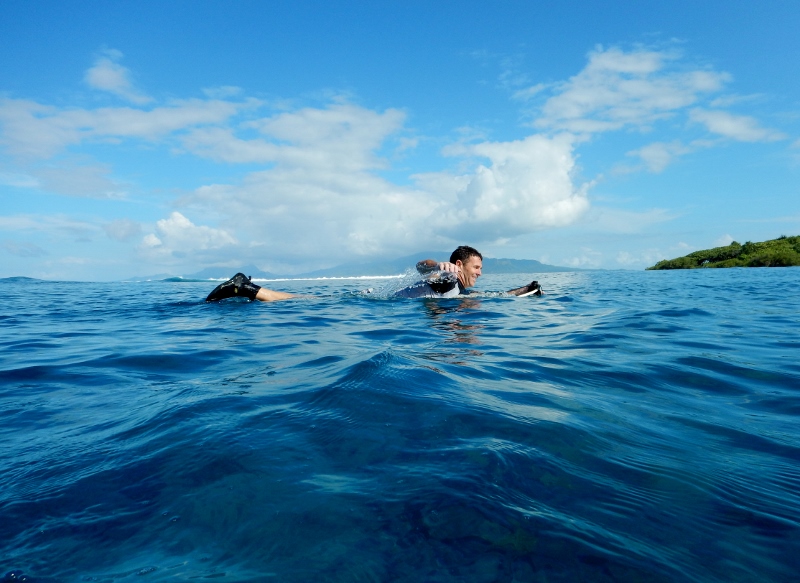
It has been hot, and we have been spending as much time as possible in the water. In the pass near Uturoa the kids and I explored a motu full of friendly cats and chickens gorging themselves on coconuts and crabs. When we snorkelled the pass, David and Pete collected spider conch and another seasnail, leading to culinary delights such as fried conch for lunch and rubbery slug curry for dinner. On our way out of Ra’iatea, Pete had a few more surfs in the lagoon off Taha’a island while David and I drift snorkelled with the kids, admiring the luminous green corals that shine with a phosphorescent hue.
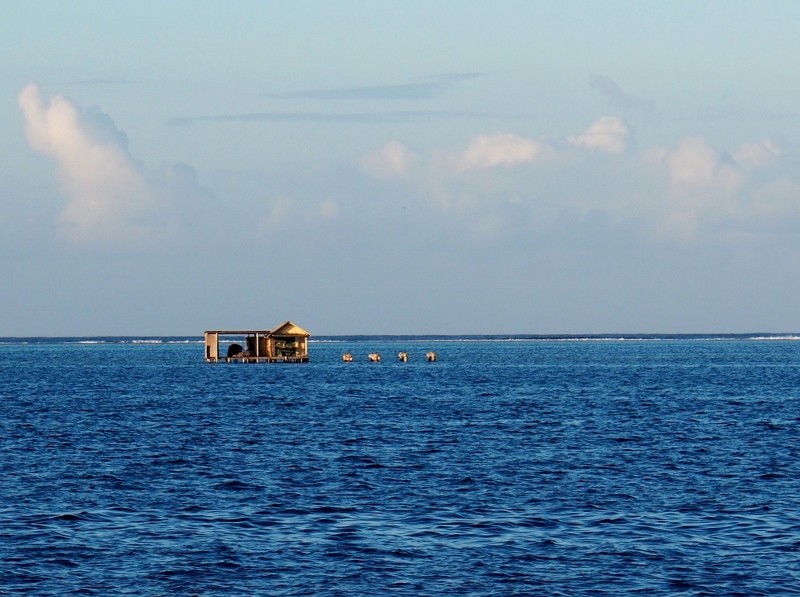
And then, as usual, it is time to leave, to get to Bora Bora to pick up Ed. And so we leave to head east, like many double-hulled waka have before us, only stocked with butane gas and tins rather than firewood and live chickens.
 SV Bob The Cat