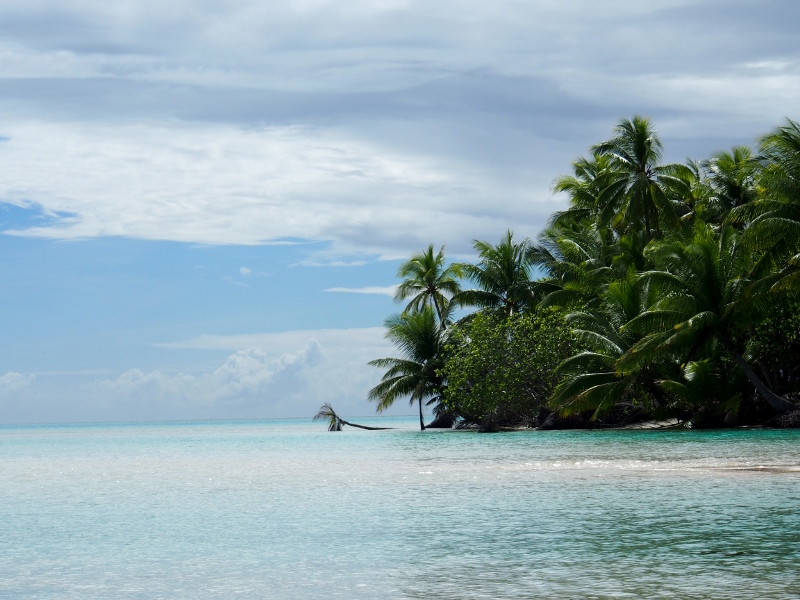
After Rangiroa we head to Fakarava, the next largest atoll in the Tuamotus. Fakarava is famous for marine life, particularly the numerous sharks dwelling in the depths of the two passes linking the huge lagoon with the outside ocean. Because of its diverse marine life the atoll is a Unesco protected area.
And sure enough, our week in Fakarava is another week of large marine animals.
First up, on the way from Rangiroa to Fakarava we meet a group of rough-toothed dolphins – large shark-like grey shapes sloping from a triangular fin to a prehistoric reptilian head complete with a narrow crocodile-like jaw. They swim alongside the boat for a while, zooming ahead, cutting across the bow as if playing chicken only to abruptly slow down and do a few jumps, displaying their beautiful pinkish underbellies. We jump in and swim with them in the blue, blue water until they lose interest in our slow progress and veer away to find something more interesting to play with. We proceed to our next mammal encounter, a pod of pilot whales greeting us just before the pass leading into Fakarava atoll.

Once inside the lagoon the water is thick with large underwater shapes moving swiftly, possibly rays but probably sharks. When taking the dinghy to shore we nearly run over a large nurse shark in the shallows – larger than our dinghy and unperturbed by our presence it flicks its long tail and glides on from under us to a few feet away where it remains, lurking by a rock undoubtedly hoping to make a bloody end to a tasty passing mollusc.

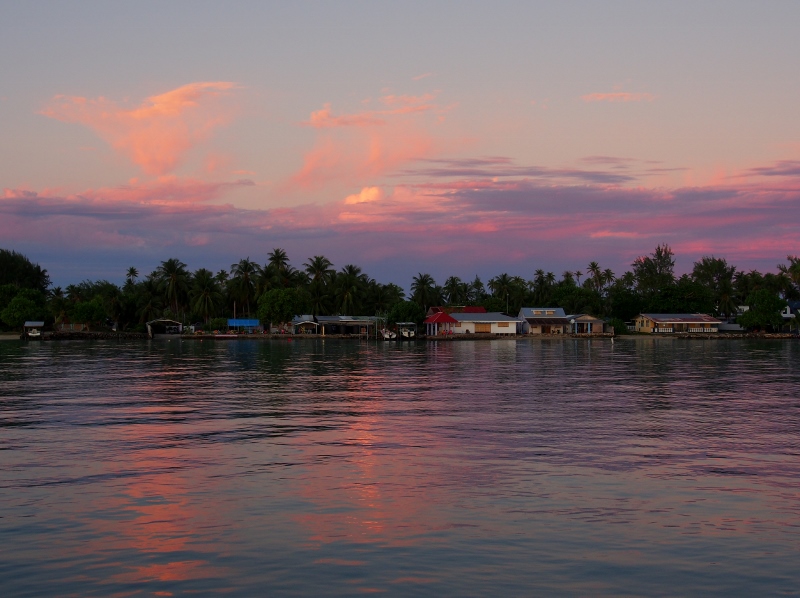
We stay a day by the main village and then head off to explore the many motu near the northern pass. Inspired by the locals, Val and David get into weaving using palm leaves and soon the boys are kitted out with skirts, belts, hats and armbands. Complete with a couple of stick on tattoos that Val brought they pose proudly for photos, pale Polynesian warriors wearing spiky sunhats, ready for anything.

The boys have quickly taken to Val and Seb who play, paint, swim and chat with endless patience. Last week we opened up a new packet of coloured pens whose fine tips have allowed ever more intricate drawings and the boat is filled with Val and Matias’s sketches of underwater scenes complete with colourful fish and skin divers kicking themselves down to peer under ledges, as well as artistic renderings of the Droideka army slowly marching through showers of bullets towards staunch Jedi knights waiting, light sabres at the ready.

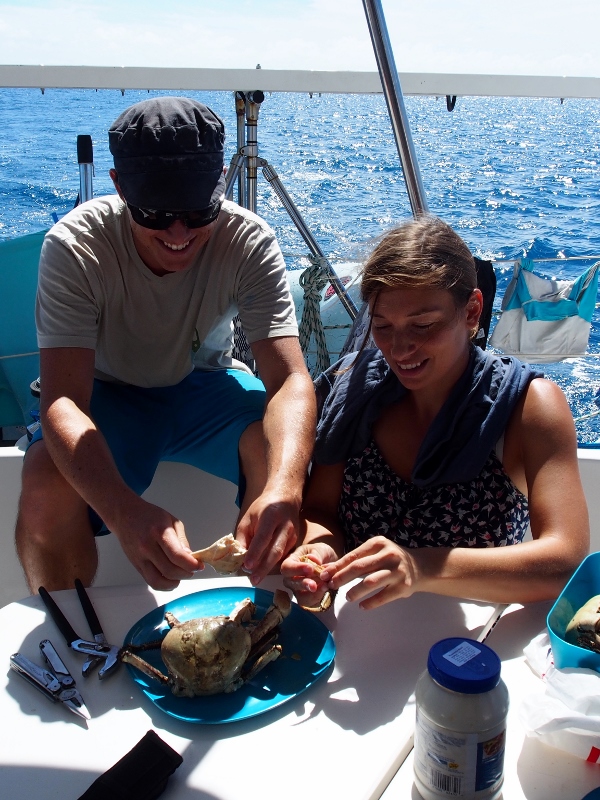
With Seb on board the seafood hunting has begun and during our week in Fakarava we manage to taste pretty much every type of crab there is on the atoll (the Unesco protection does not extend to crabs). Marine hermit crabs (yucky), land hermit crabs (better, but still not great) and large big-clawed Tupa crabs (pronounced the best yet). We find some rubbish on the beach which we use to construct a cray pot which we hope will lure in some better tasting dinner.

We figure we need some seafood, because there is not much food to buy on the island. The three Magasins are stocked with a few expensive French tins as well as Danish pork liver pate, but fresh fruit and vegetables are limited to what comes in on the supply boats once a week, only to be snapped away immediately by vitamin C deprived locals. “Jeudi”, the locals say when we ask for anything fresh, Thursday. When the boat comes in. If we show up at 6 am. It is hard to eke out a living on an atoll – water is scarce and the roots of the ever present coconut trees interfere with other plant roots making little soil available for the growing of fruits or vegetables. On Rangiroa they imported soil from Tahiti to grow papaya trees, and we think of how hard it must have been for the original settlers to adjust to these arid, sunbaked atolls, used as they were to the rolling hills and fertile waterfalls of the Marquesas or Society islands from which it is thought they were excommunicated by warring neighbours.

After a couple of days in the northern part of the atoll we head to the famous southern pass, where the waters are clear, the sharks plentiful and the Family Circus eagerly awaiting a delivery of fresh baguettes.
At the southern end of the atoll there is only a small settlement, centered around a dive shop with adjacent accommodation for the many adventurers who come to dive the world class dive site that is the pass.
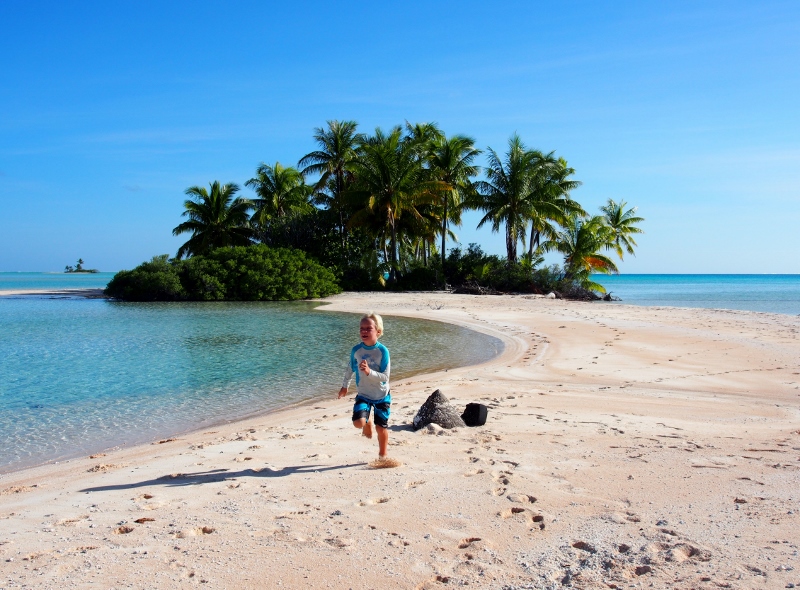
In the south everything is blue. Endless azure sky dotted with grey-blue fluff clouds grading to barely there egg shell blue at the horizon where a thin strip of white breakers or a small motu with yellow sand and green coconut palms briefly interrupts before the blue resumes in the water, turquoise over the shallow sand flats slowly morphing into the dark cobalt blue of the depth of the central lagoon.

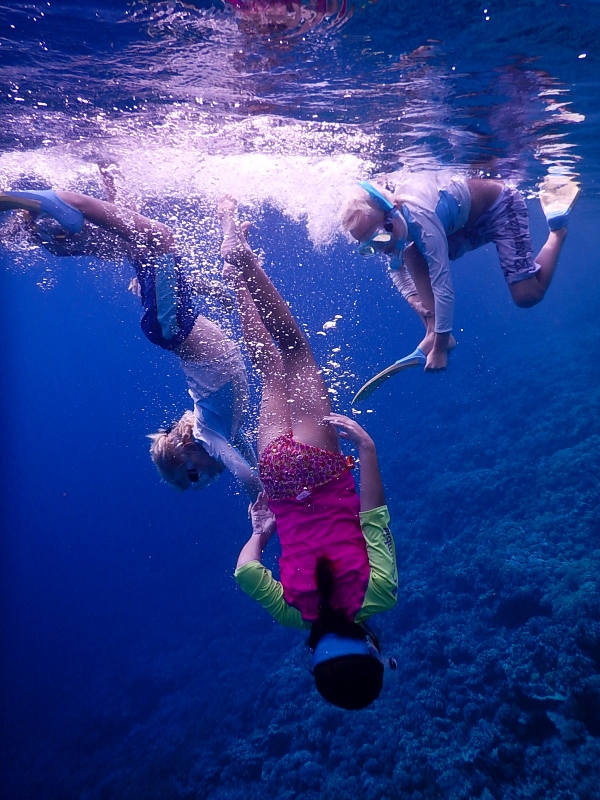
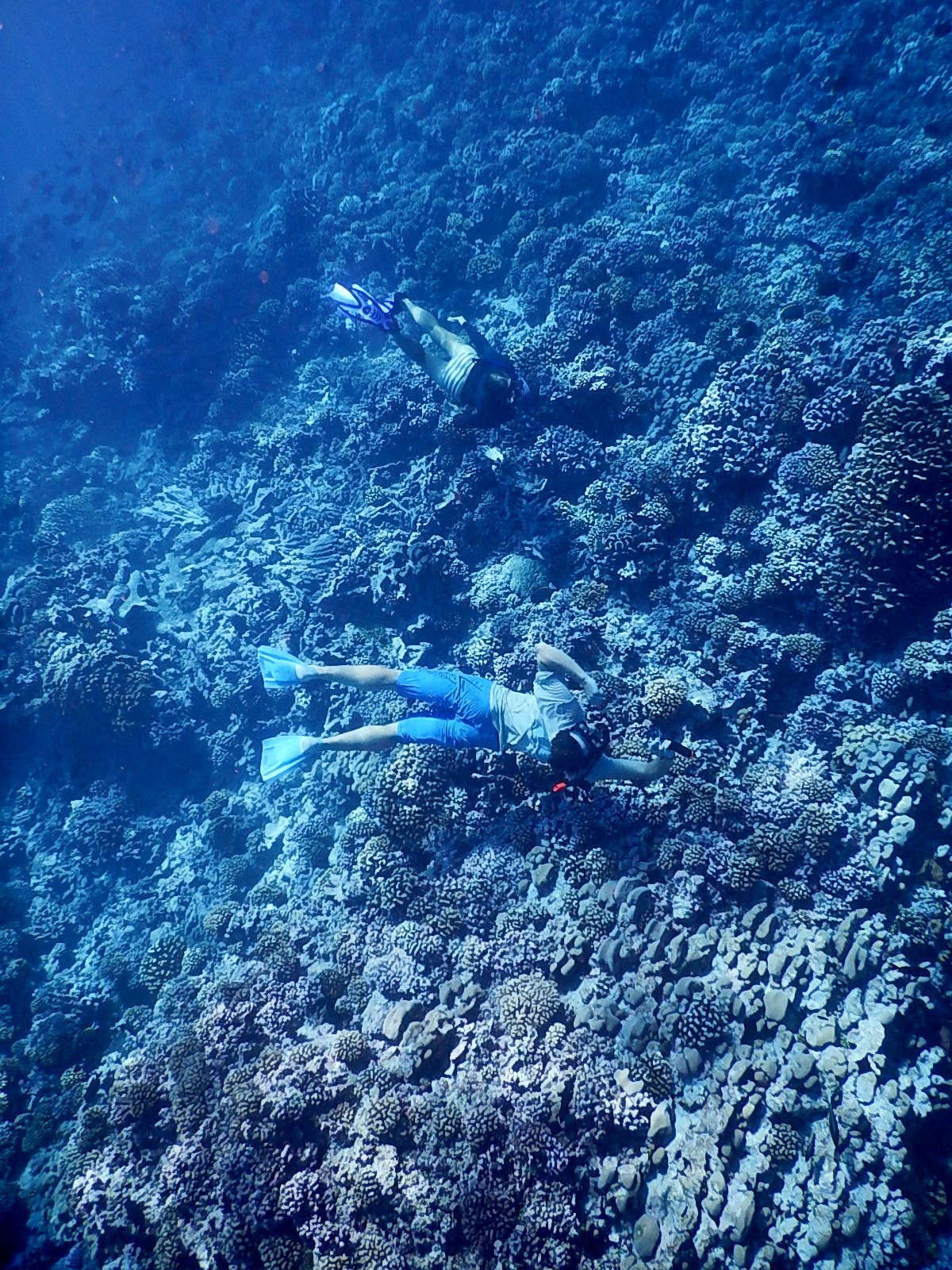
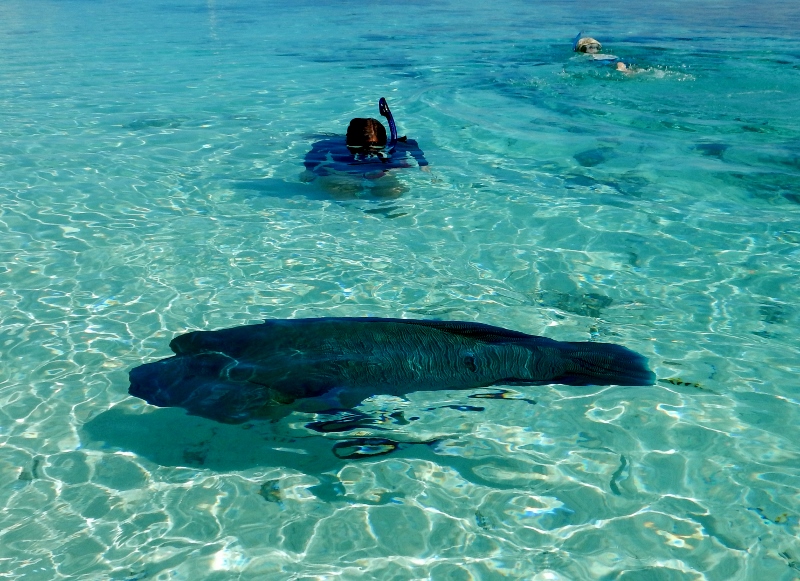
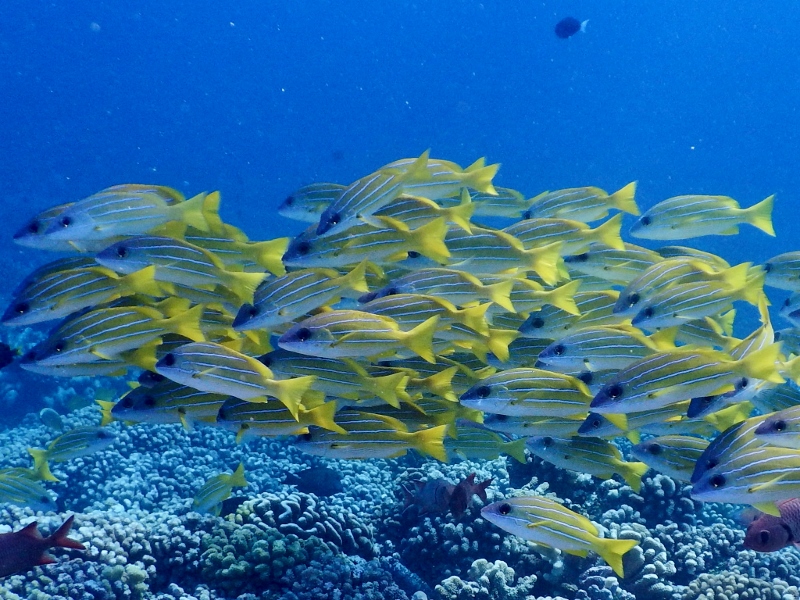
The pass lives up to its reputation, and we gorge ourselves on the best snorkelling and diving we have ever done in an amazing wonderland of infinite visibility. In the pass, the tide is either rushing in or out, providing fresh water for the corals that adorn the walls and bottom. To avoid ending up swept out to sea, we snorkel and dive on the incoming tide where the swift currents provide clear water; the ideal home for large pelagic fish and schools of 30+ grey sharks lurking in the depths. Up shallow, on the reef sides hang another 50 or so black tip reef sharks as well as numerous white tips. The sharks seem uninterested in us to the point of being almost friendly, and the children play in a shallow area near the dinghy dock called the ‘swimming pool’ where thousands of smaller fish hang out with about 20 black tip sharks. Also in the swimming pool is a group of five huge Shrek-like humphead wrasse who regard us nervously, their rotating chameleon eyes following our every movement. They are enormous, their lumpy round bodies powered by impossibly small trembly fins which they wave excitedly when they flee the advances of excited children.
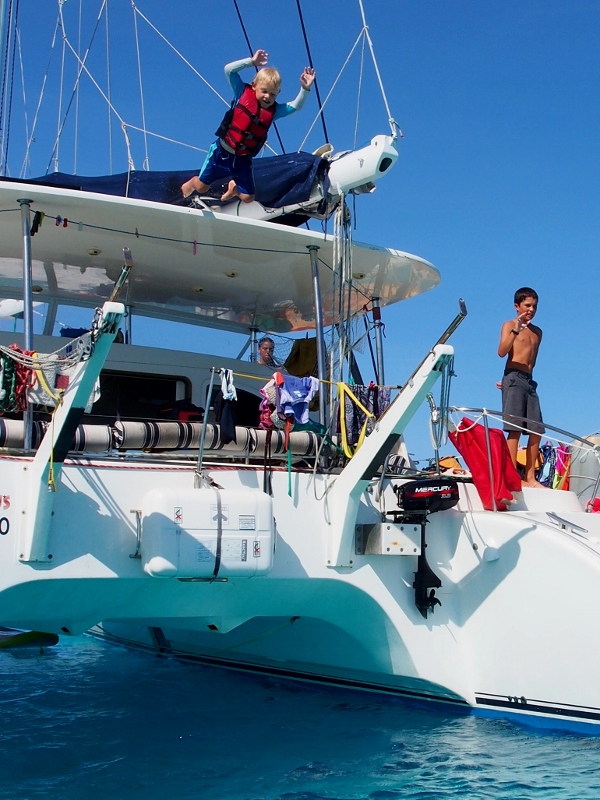
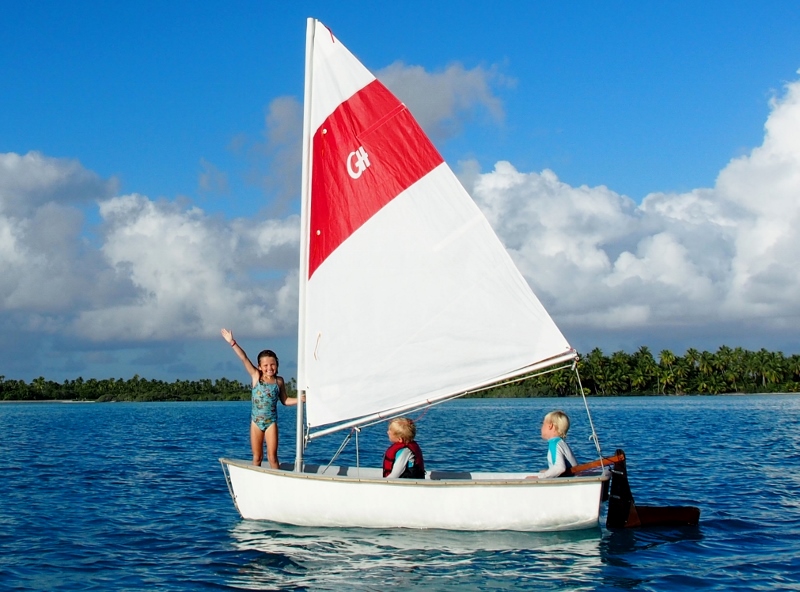
It is great to meet up with the Chris, Heather and the kids of the Family Circus again and Matias and Lukas are stoked to play with their youngest girls. They spend hours throwing sand on the beach, wading in the sea-cucumber studded waters, snorkelling the reef and jumping into the water from the rooftop of the Circus. Chris tows them around in the Circus kayak and after a quick sailing lesson Matias, Lukie and Alina inadvertently take off in a sailing dinghy on their own which they manage to sail back to the boat from the shore just fine.
One night we make a bonfire on a small motu, cooking freshly caught Tupa crab, potatoes and damper on the fire, the kids toasting marshmallows and running around excitedly finding ever larger hermit crabs, the grown ups lying back on the warm sand watching the reflection of the rising moon over the water.

Halfway through our stay a French film crew arrive – the guy who did ‘March of the Penguins’ is shooting a documentary about the Fakarava Pass – and we reckon they are feeding the sharks to improve the footage. Previously passive sharks suddenly take an interest, circling the boat aggressively on the anchorage, darting towards us when we snorkel. We get a bit spooked and exit the water swiftly after having to kick off a few lusty grey sharks. The dive shop says that the increasing swell on the outside of the lagoon is causing the currents to change, making the sharks leave the depths of the pass and scatter all over. Whatever the reason we’re out of the water and spend our last day at Fakarava playing on the beach, sailing the Family Circus dinghy and kitesurfing.
 SV Bob The Cat