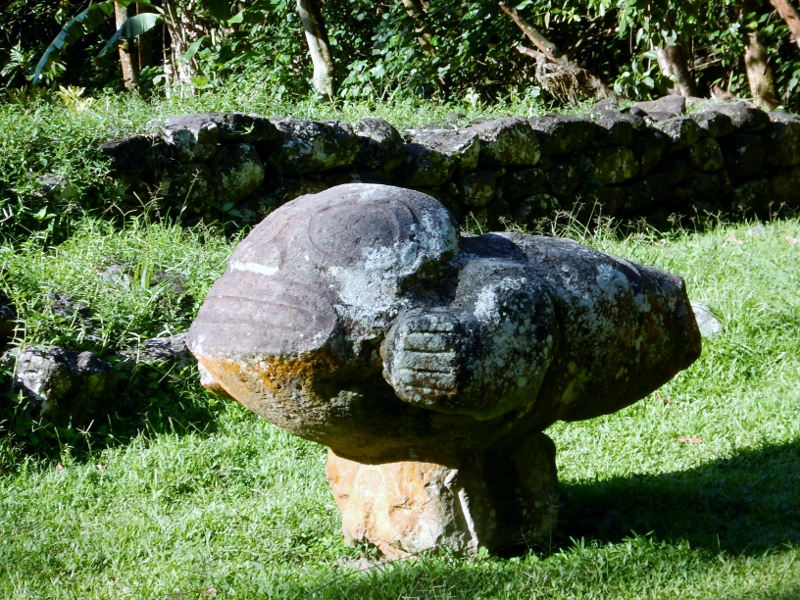
Hiva Oa is intriguing. It is the second largest island in the Marquesas group and the most important island of the southern Marquesas. It has numerous archaeologically important sites of ancient me’ae (temples) where huge tiki representing ancestors of particular importance continue to impart mana and special protection against misfortune to their descendants. The island rises sharply from the surrounding ocean, all angles, sharp peak, black volcanic rock and inaccessible land beyond.

Gauguin the famous impressionist painter lived here for a couple of years after he had to leave Tahiti following severe reprimands from the Catholic church because of his numerous relationships with under-age girls and his drinking escapades. His habits didn’t change on a new island and the fraught relationship between painter and church continued in Hiva Oa until his death from drinking in 1903 when he left behind his 14 year old mistress.
It is a beautiful place, just quite hard to get ashore.
Our initial impressions are not particularly favourable. It is pouring down when we come into the anchorage off the main town of Atuona on the southern side of the island, the tall mountains behind the town covered in impenetrable cloud. The main anchorage is behind a breakwater but when we motor in there looking for a spot we are turned away by several agitated boaties worried that we will snag their lines – the anchorage is very tight, the swell is big, and many boats lie with a stern anchor to keep them firmly bow to the swell. A wild looking Canadian man shouts that he doesn’t want us to anchor near his boat as he has a lot of line out, sweeping his arms wide as if to indicate his line could be anywhere around him. A second later the skipper of a huge French catamaran informs us he has 80 m (!) of chain out and that he doesn’t want us anywhere near. Space is obviously at a premium and because we won’t roll as much as a monohull we decide to anchor somewhat away from the other boats outside of the breakwater, in what proves to be a sickening roll.
It continues to rain throughout out stay here. We have to go to town to check in, a 45 minute walk to the Gendarmerie where they are friendly but firm, informing us that because the children are New Zealand citizens we need to either pay a deposit of thousands of dollars or come up with a one way ticket for each of them to New Zealand. The rest of us are OK because we have European passports. So we do a bit of shopping for fresh produce and head back to the boat to go online and buy tickets. Laundry prices are astronomical here so the following day I spend four hours handwashing our sheets, towels and clothes before we head off to sunnier shores.

We find a more pleasant anchorage off the small island of Tahuata just south of Hiva Oa. It is great to get some sunshine so we can open the hatches and go for a swim. The reef around Ivaiva Bay where we’re anchored is full of colourful fish and even sports a small resident black tip reef shark which follows us around looking hungry. We are quite keen to head to the main village a bit further south on this little island to look at some of the wood carvings which the island is famous for but the anchorage proves a nightmare, with the valley acting like a funnel, channelling winds of 35 knots through the bay. The anchor holds but someone has to stay on board in case we drag – the winds are so fierce that there a lot of pull on the anchor. Sarah, Steve and I try to go ashore, attempting to land the dinghy on the copra dock which is full of fishing boats tied on with stern anchors holding them off the concrete slab which is awash with big waves. We try a stern anchor but it snags and Steve has to dive down to get it free, after which we decide that we simply weren’t meant to go ashore. Just after we return to the boat a particularly strong gust of wind causes the boat to jump, the anchor clearly lifting off the bottom, and we quickly haul it up, leaving this hostile bay to look for somewhere easier to anchor and go ashore.
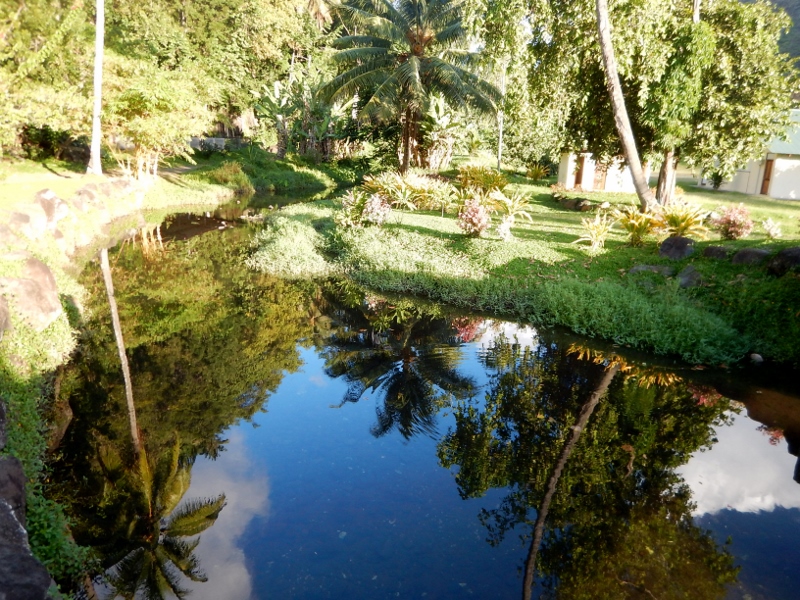
Only there aren’t really anywhere easy to go to. We are keen to see the famous ruins and tiki of Hiva Oa, and so head back there to go to the northern shores to visit a number of bays. We manage to go ashore dragging the dinghy through sizeable surf at Hanamenu Bay, a quiet spot mainly known for a natural spring running into a crystal clear pool just behind the beach. It is a lovely place, and we thoroughly enjoy a good wash in the pool, the kids playing all over the fruit tree filled garden before it is time to get salty again attempting to launch the dinghy through the surf on the beach.

The next bay over, Hanapaia, is a flower filled wonderland, the fragrance from the fruit trees and flowers filling the air and lifting our spirits out on the anchorage. Despite the odds, we manage to get ashore onto the copra dock, leaving the dinghy to bounce up and down on the waves. Once in the villagewe quickly meet a little boy who plays energetically with Matias and Lukie, while we chat to some of the locals. Most people are not fluent in French – it is mandatory in school, but 90% of French Polynesians speak their local version of Maohi at home, a language very similar to Maori. It is great to learn some phrases, and the comparison to Te Reo Maori provides a great talking point as we hesitantly try out a greeting or two. Before long the kids are enthusiastically shouting Ka Oha (the local Kia Ora) to passers-by. Chickens, pigs, goats and horses everywhere, with the odd cow looking up from the vegetation occasionally. Everything is exceptionally clean and tidy everywhere we go, with neatly mown lawns, carefully planted flower bushes and trees interspersed with fruit trees bending heavily under the weight of the ripe fruits. A friendly lady from the village gives us pamplemousse (grapefruit) and drinking coconuts, refusing to take any payment.
 Behind the villages are large coconut plantations providing the nuts for the copra production which is subsidised by the French government in an attempt to keep people from the outlying areas of French Polynesia migrating to Tahiti.
The next day we head onwards to Puamau Bay, the site of the famous Iipona archaeological site. It proves impossible to land the dinghy anywhere in the bay – the copra landing is gnarly, with sharp black rocks poking through the waves smashing down onto the slippery concrete wharf, and the beach has 3 foot waves crashing onto it. So David drops Sarah, Steve, the kids and I behind the surf and we bodysurf in, waterproof packs on our backs, waves crashing down on top of us. The me’ae is worth it, though, with five large tiki situated atop several platforms carved into the steep jungle clad hill. The tiki represent the chief Taaiki and his wife as well as other ancestors of great mana, who oversaw the rituals and meetings carried out at the site. Always keen on the macabre, the kids are thrilled to be in a place where human sacrifice used to take place. It is an eerie site, peaceful yet sinister, the statues with their timeless and menacing glare making us feel like unwelcome intruders. The local tradition has it that tiki have large powers, with endless misfortune befalling those who choose to ignore their wishes by relocating them without blessings and the like. Although we are not doing anything of the kind we feel a bit out of place and draw a sigh of relief as we walk down the road towards the sun filled valley in front of the site.

The marine life is prolific here, with dolphins greeting us at the entrance of one bay, a juvenile manta ray in another and melon headed whales along an arid stretch of coastline. The water is thick green with plankton and the visibility poor, and this combined with the many sharks we see makes us hesitant to swim. As we sail around Hiva Oa we are forever amazed by the landscape – from the arid desert like eastern end of the island to the lush tropical green peaks of the western end. Waterfalls are everywhere and the coastline is dotted with caves and blowholes, with white foamy water shooting metres into the air as the waves smash down. Strange landforms are everywhere, tall columns of rock rising from the sea or land, resembling stout severe faces keeping a sharp lookout to sea. It is impossible the catch the beauty on photos but we never stop trying – what a place!

 SV Bob The Cat