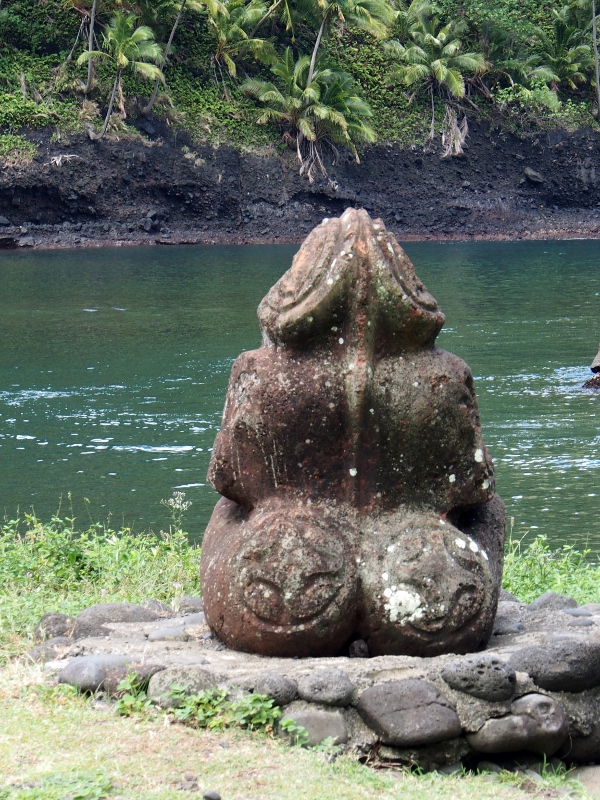
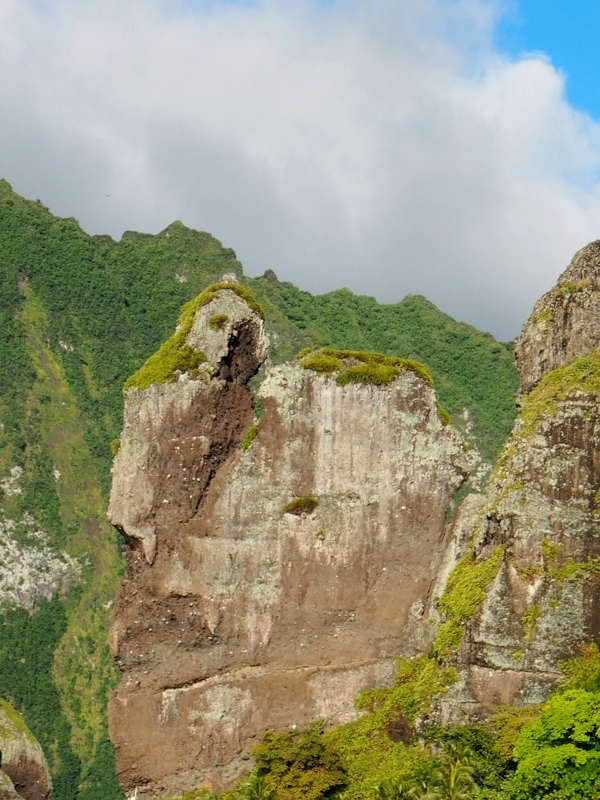
What a place to make landfall after crossing the longest leg in the Pacific! The island of Fatu Hiva rises vertically from the sea, jagged hillsides softened by vegetation with razor back ridges of sharp rock poking out. Everywhere you look there are sheer rock faces and tall columnar rocks resembling figures and faces, poking out like guardian gods overlooking their island. It is easy to see where the inspiration for the famous petroglyphs (stone carvings done on rock faces) and tiki (statues carved from stone or wood) came from – nature here is full of them.
About 1400 miles northeast of Tahiti, the Marquesas are the northernmost part of French Polynesia. There are 10 main islands in the Marquesas, lying in a 350 km chain from north west to south east. Fatu Hiva is the youngest and southernmost of the islands; at only 1.3 million years it is a mere baby compared to most other landforms in the world. Surrounded by water depths of 3000+ metres the Marquesas were formed in huge seabed volcanic outbreaks, the islands rising vertically from the bottom to the sharp tips of the numerous ridges of their volcanic shapes. I have never seen a landscape so incredible, young, steep and sharp, with none of the rounded edges that older age and weathering bestows on mountainous islands. Because of the height of its volcanoes (the tallest of which is 960 m above sea level) Fatu Hiva gets a lot of rain for the Marquesas and I imagine that its rocks will soften in a couple of million years as the water takes its toll.

We are anchored in the ‘Baie des Vierges’ (Bay of Virgins) off the small town of Hanavave. Originally named ‘Baie des Verges’ (Bay of Penises) by the first French settlers to celebrate the large phallic rock protrusions that line the bay the name was later changed by missionaries keen to suppress any improper thoughts in this remotest of locations.
Fatu Hiva used to support quite a large population, but nowadays there are only about 600 people on the whole of the island, half in Hanavave and half in the southern village of Omoa. The island was made famous by Thor Heyerdahl in his book ‘Fatu Hiva’ where he chronicled his failed attempts to live off the land in this tropical paradise with his young wife Liv (she ended up getting elephantitis and nearly died before they aborted the attempt and went back to Norway).
The Marquesas were known as ‘Te Henua Ehana’ (the Land of Men) by the Maohi (eastern Polynesians) who first settled on them around 300 BC from Samoa. The Marquesas islands were amongst the first to be settled in French Polynesia, and it is from here that subsequent settlement of Hawai’i, Easter Island (Rapa Nui) and the Cook Islands, and onwards to Aortearoa, New Zealand, occurred. As a result, the Maohi language is closer to Hawaiian, Cook island and Maori than to Tahitian.
The first Europeans to find the Marquesas were the Spanish, with Alvaro de Mandana spotting Fatu Hiva in 1595. He named them Las Marquesas de Mendoza after the wife of his benefactor the viceroy of Peru, and the Spanish continued to keep the island group a secret to prevent the English from conquering them. Living on small islands with limited resources overseen by forbidding gods had turned the Marquesans into one of the fiercest communities in the Pacific and their heavily tattooed warriors practised both cannibalism and human sacrifice. Predictably, the first encounter with the Spanish was a disaster and Mendana killed Marquesan people on sight after an initial unfortunate incident with some warrior canoes, leaving behind a bloody trail of more than 200 dead Maohi. Subsequently whalers introduced syphilis, alcohol and smallpox, and of the initial population of about 80,000 Marquesan Maohi in 1800 only 15,000 remained when the French took over the Marquesas in 1842. Today the population of the Marquesas is about 8000, mostly of Maohi descent.

All over the islands are scattered archaeological remains, mainly of me’ae (temples), tohua (meeting places) and male and female tiki representing important ancestors that ruled before Catholicism took hold.
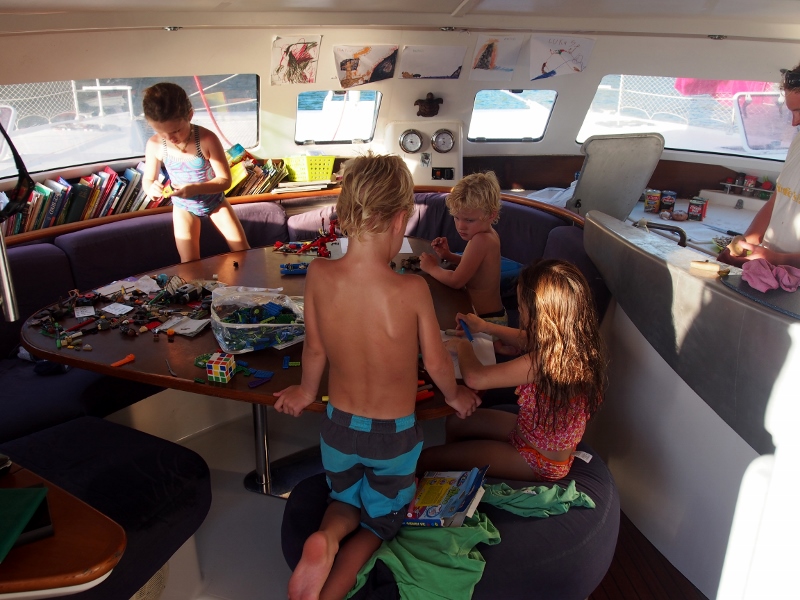
On Fatu Hiva we meet the ‘Family Circus’, two parents and their six kids travelling around the world on their 47 foot catamaran. We join forces to hike to the waterfall behind the town of Hanavave and Lukie and Matias become great friends with Alina and Amaia, who are 6 and 7. The following day we all take their boat over to the other village on the island, Omoa, and some of us walk back to Hanavave over the imposing ridges, gorging on magnificent views of the island and the sheer cliffs. Walking out of town is like entering some half-forgotten jungle out of a Tintin cartoon, where cannibals roam and carved statues representing stern ancestors lie scattered on the forest floor next to altars used for offerings to appease the gods. It is lush and green, all but the steepest hillsides covered in grasses, trees and ferns, curling vines climbing up and up towards the sun. In the two small villages and along roads and paths colourful flowers and fruit trees are everywhere – giant pomelo grapefruits, starfruits, breadfruits, rambutans, mangoes, cashews, bananas and impossibly tall coconut trees towering overhead. Coconut lies drying on roadside racks everywhere, waiting to be turned into copra to be used for livestock feed or coconut oil production.

A family is offering fruit for sale at the wharf but it appears they don’t want money for their wares, instead preferring to do trade. I guess money is not that valuable in a place like this; what would you spend it on? The woman wants hairbands, mascara, perfume, lollies, sunglasses or flip-flops, whereas the men ask for fishing hooks and line, snorkelling masks and fins, or wet weather gear for fishing. Sarah and Steve visit a local carver, and find that his beautiful statues can be part traded for goods too only we don’t have any of the things he wants so they settle for a cash price for a magnificent tiki.
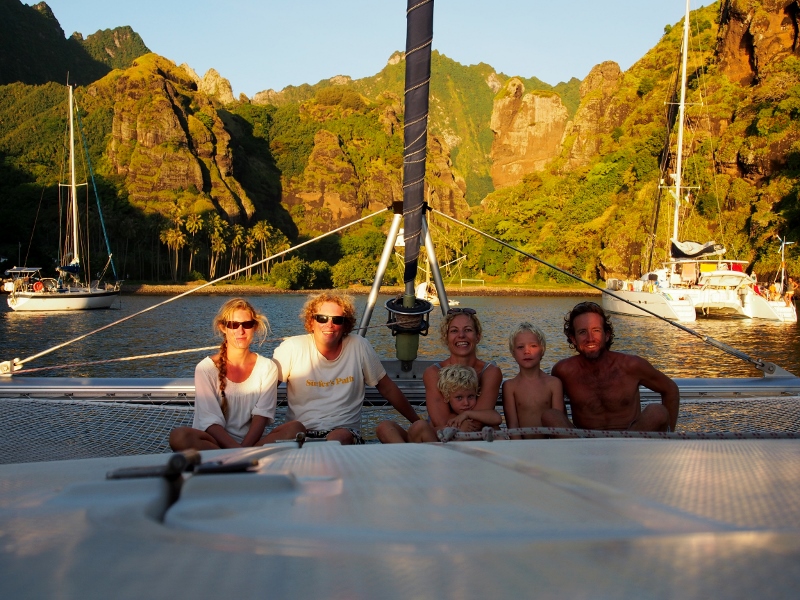
After three days at Fatu Hiva we set sail to go to Hiva Oa on 20th April – it is time to check in, hoist the French flag and do a bit of grocery shopping.

 SV Bob The Cat