Day 15
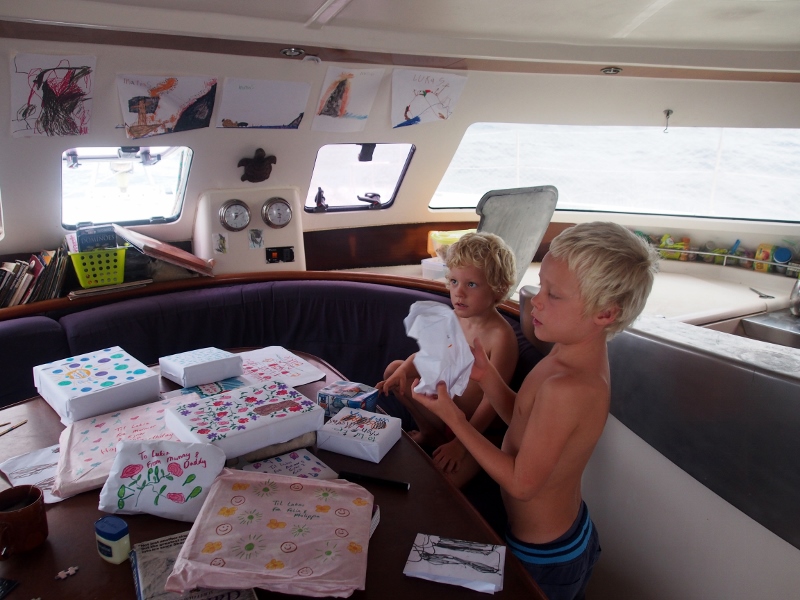
Day 15 is Lukie’s birthday. The clocks changed overnight (our third change so far on this passage), so the kids are up bright and early, 5 am new time, eager to start the celebrations. During the night we were literally pelted with flying fish and Lukie has one fried up for breakfast, which he devours in one big gulp.
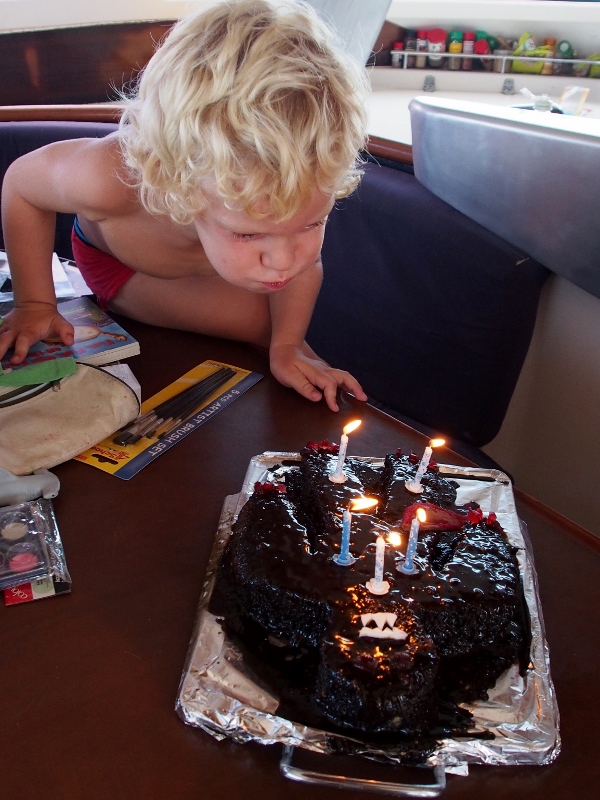
At morning tea time we have the Hulker cake, which looks awesomely scary, orange luminous eyes staring from a skull like darkened face, blood dripping from his claws, fangs bared in a wicked snarl. After that there is a complicated treasure hunt for lollies, followed by painting with the new water colours from Grandpa and Gu.
Lukie ordered mahi mahi for dinner, so we got two lures out and the fridge on in anticipation. Failing that, Steve says he knows some pretty good recipes with corned beef…
The chart plotter is beginning to show ‘Time to Arrival’, a feature which switches on when it reckons there is hope that we’ll eventually get to our destination, and its appearance lifts our spirits to a level befitting those that have just eaten an entire jar of nutella disguised as a Hulker.
We feel good – the kids are happy, the sun is shining, and there is new Lego to build. At the end of Day 15, we’ve logged 2433 miles, with 557 miles to go, we’re definitely getting closer.
Day 16
The sunny conditions continue on Day 16, but the batteries remain stuffed – they are clearly on their way out, and no amount of charging is going to fix them now. They’ll likely last until we get to the Marquesas, but probably not much longer, so we’ll have to seek out replacements at the earliest opportunity.
Like the batteries so the crew – everybody is exhausted, apart from the kids who can sleep as much as they like. We hear from the network that a boat we know has lost their autopilot only a couple of days out from the Galapagos. It’s a family with three children aged 1 to 6, and we feel for them. Fortunately they have three crew, so five adults in total to share watches, but it is still a long, long way to helm a boat, hundreds of hours to keenly look out to sea, keeping up the concentration, easily dwarfing any fatigue we’re feeling at this stage.
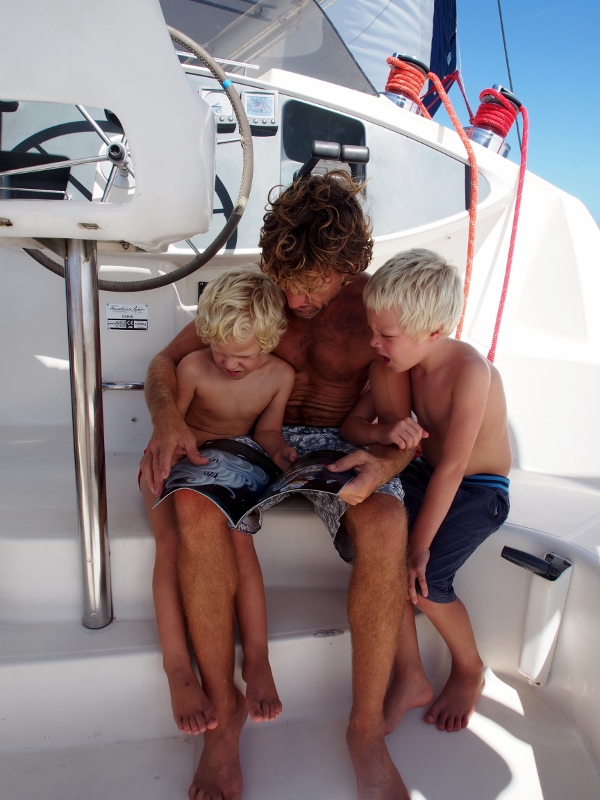
It is a weird thing spending this long at sea. For more than two weeks now all we have seen is water in various states of turmoil, deep dark blue capped by white foam, rising and falling, rolling us one way and then the other. We have quite forgotten how land looks; it will be a shock to suddenly see the solid shapes of islands rising before us, strangely immobile after all this fluidity. At the moment life is tiny, restricted to being bounced around day after day, clinging onto furniture and doorways as we move, legs always positioned wide apart to ward off falls. The familiar sick feeling in the tummy when it’s time for night watch, the bitter taste of coffees and teas gulped before spilling in the hope they’ll impart a bit of alertness. The days are segmented by meal times, and food takes on a disproportionate importance simply because it is one of the few things that happens in a day. Fortunately there is still some good stuff left – watermelons and pumpkins in particular …
But our universe will soon expand. We’re doing good speed: at the end of Day 16 we have logged 2591 miles and have 389 left to go, so it looks like we’ll arrive Thursday (Day 19) sometime.
Day 17
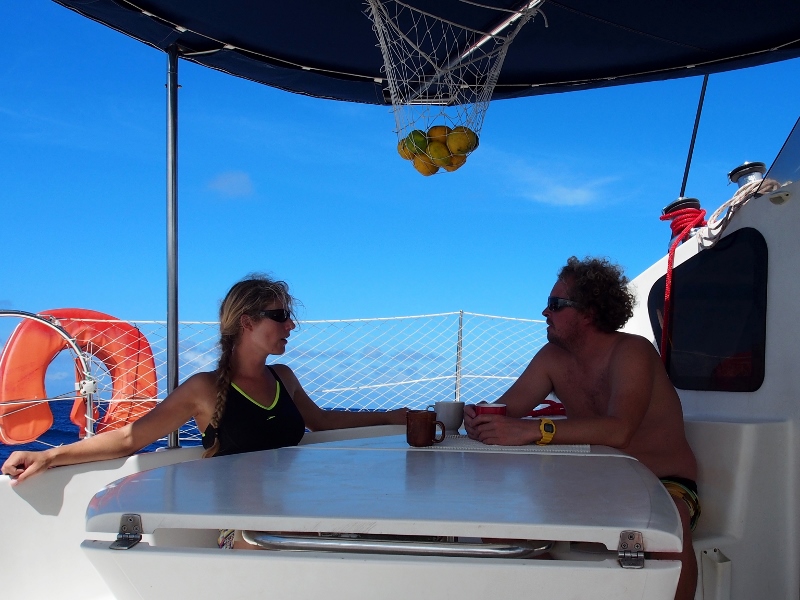
The wind has dropped and we’re snailing along at 5 – 7 knots, giving us an opportunity to open all hatches, letting in some dry air to dispel the fungal growths that emerged after the thorough soaking of the heavy rains. The sun is out in full force, treating us first to a glorious sunrise and then later to batteries virtually bursting with charge. We stare at the little panel displaying the charge with wonder, 14.2 volts! Maybe this will turn them around…
With the slower pace comes a time warp – for the last three nights the chart plotter has been predicting an arrival time in about 68 hours every time I emerge for my night watch, the time seemingly unchanging regardless of the passing of days and hundreds of miles. A bit disheartening, but with sunshine like this the thought of staying out here, forever 68 hours from land, is not too bad…
At the end of Day 17 the log estimates that we have travelled 2706 miles, however for much of the day it seems to have been under reading substantially – maybe the little propeller that records the speed has become fouled. We place more faith in the GPS, which estimates that we have 239 miles left to go.

Day 18
We’re nearing land, and bird life is increasing. During the day we see several terns off in the distance, as well as a frigate bird. In the early evening a booby comes to check us out, circling around us for about an hour, assessing whether to dare to make footfall. It approaches the bow several times, cocking its head to get a good look at us, making half hearted landing attempts only to abort them at the last minute, dissuaded by the railing, the child netting or perhaps our presence. Then it circles again a couple of times, renews its courage, and attempts a daring landing on the mast, tail feathers spreading, feet splayed. Close up to the swinging mast it loses its nerve, wings flailing desperately, and backs off again. It is entertaining to watch, but after an hour it tires and decides to fly off and roost somewhere else. It is the first bird that has come to visit – the pure ocean birds show no interest in us at all, merrily going about their fishing activities some distance off. In contrast, the land roosting birds such as frigates and boobies always gather around the boat, attracted as they are to solid ground.

We’re reading David Lewis’s ‘We the Navigators’, a detailed account of Polynesian navigation techniques. Whilst land roosting birds are a sign of land, one isolated booby or frigate bird is not a certain indicator, as individuals can roam far away from land. Groups of them, however, only tend to occur within commuting distance to land, so as a rule of thumb, if you see three or more of one species you’re within 50 miles of land. Which we aren’t, yet, but after assessing arrival times we’ve decided to land at the island of Fatu Hiva instead of at Hiva Oa as planned – the wind angle has seen us go further south than necessary for Hiva Oa and our existing course will take us straight to Fatu Hiva. It is a bit risky as we’re supposed to clear in at Hiva Oa, but yachties have been permitted to anchor there for a night or two in the past. And it cuts our travel considerably, giving us a firm arrival time of tomorrow, which is what our tired bodies need.
We’re bored, out of fresh food and one thing and another leads to the initiation of a corned beef challenge whereby each of us have to cook a meal using corned beef, with the others scoring the meal according to strict criteria. David enthusiastically concocts some Moroccan spiced corned beef falafels which he serves with a pumpkin tagine and rice, and the rest of us eat in impressed silence, mentally racking our brains for recipes to top this effort. The problem is not so much the taste as the consistency; the brand of corned beef that we have (hailing back to the French supermarkets of Martinique – it’s not a favoured ingredient so tends to languish unused in the bottom of the cupboard) is rather liquid, making it hard to recreate the texture one normally associates with meat. Still, it has to be used, and now is as good a time as any…
The wind has dropped further and we’re not moving fast, but even so the GPS reports only 92 miles to go at the end of Day 18.
Day 19
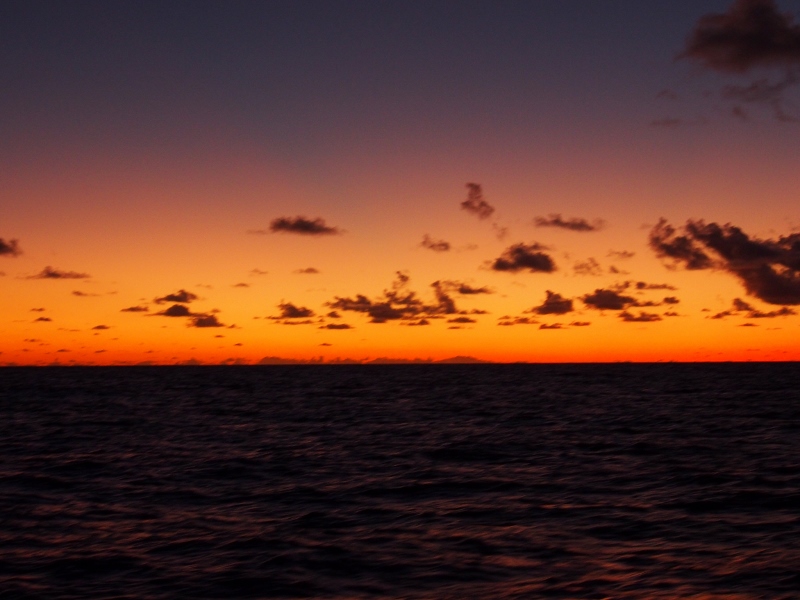
Our first glimpse of land is at sunrise on Day 19, when the island of Fatu Hiva appears in the distance ahead in the shape of three volcanic lumps rising out of the dark sea. The previous night we noticed low clouds on the horizon ahead which signalled land, but we were still too far out to glimpse the islands.
There is no wind so we’re motoring the last day, carefully monitoring the diesel supply as we go, but it appears that we are not using much. In fact the gauge shows a steady increase in fuel throughout the day – we started on a quarter of a tank, and by 2 pm the gauge is showing a full tank! A dip stick confirms that we haven’t, in fact, made diesel, and we add a bust fuel gauge to the list of upcoming repairs.
The windless conditions have the sails flapping and banging and when we’re 25 miles from land the clew on the mainsail goes, the ring attaching it to the boom breaking. It’s not too big a deal; we’ll be able to improvise a fix until we reach sail supply facilities in Tahiti. We hear of worse misfortune on the high sea when the boat Kia Ora, a husband and wife team with whom we’ve been keeping in close contact during the crossing, email us relating how they’ve lost the use of their mainsail. The sail had got stuck when they were trying to lower it meaning that Ken had to climb the mast to cut the haliot. Fortunately the wind was light and the sea calm, and he escaped unscathed. But in any type of weather a mast climb can so easily go wrong, especially when people are exhausted and stressed to the max through weeks of sleep deprivation.

All the cruisers that we’ve met seem to keep night watch, mainly to keep an eye out for oncoming vessels (the chances of spotting other dangerous items such as shipping containers, floating logs and whales are exceedingly low and most cruisers accept the risk of bumping into these). Good night watching certainly proved invaluable on the nearshore legs we did in the Caribbean, where we found ourselves in close proximity to, and on collision course with, other vessels more than once. You would have thought that large commercial vessels such as tankers or fishing boats keep an eye out, but they tend in fact to rely more on instruments than on the human eye, and most radars won’t pick up a small yacht. I guess the big ships know they’ll come out ahead in any collision, whereas yachties keep a keen eye out precisely because they are likly to sink if they hit anything.
However, in vast areas like this leg of the Pacific where you are gone for weeks on end and there are no heavily used shipping lanes there is an argument for just putting on the autopilot, the radar and the AIS and just go to sleep (AIS: automatic identification system, mandatory for commercial vessels and often used by blue water cruisers, emitting signals which allows others to identify the vessel and ascertain its course and speed). With the appropriate alarms set, you can be woken up if anything shows on the radar or the AIS, or if the speed of the boat changes noticeably. There is no doubt that some cruisers do this, especially single-handlers of course, but I doubt that all double-handlers, like couples, can truthfully say that one person is awake and keeping a look out the entire 3000-odd miles from the Galapagos to the Marquesas.
The advantages to canning the night watches is that the major risk that sleep deprivation poses to judgement, decision-making ability and reaction time is reduced substantially. Imagine Ken going up that mast on a rolling boat on a good day – it is risky, but he is secure in his harness, holding on tight with his strong leg muscles, clinging on to the sharp tools with one hand, gripping the mast with the other as he sits there, 50 metres up, swaying wildly. Now imagine him doing it after more than two weeks of no more than two hours of sleep in a row, bone tired, shaky with fatigue, hoisted up by his wife who is equally exhausted, her heart beating wildly, hands wet with cold sweat, thoughts of what would happen if her grip slips swirling in her mind… She wrote that she passed out briefly when it was all over.
It certainly would be interesting to try to quantify the risks of sleep deprivation versus relying on instrument alarms during the night; it sure would transform ocean crossings if it turns out to be just as safe to sleep as to stay up. Whether we could really fall asleep knowing that no one is watching is another matter…

Anyway, we no longer have to worry about such matters; the longest blue water crossing in the world is behind us. After the kids doing somersaults on the tramp the entire afternoon, we arrive at the Baie des Vierges on Fatu Hiva at 5:15 pm. It is a still evening, the bay is beautiful, and we’ve got corn beef pasties ready to go in the oven. Tonight, for the first time in 19 days, we will all get at get a full night’s sleep. What more can you ask for?

 SV Bob The Cat