
Day 8
Food takes up a fair amount of time when on passage. Thinking about food, planning and preparing meals and checking fresh produce to ensure that nothing goes to waste. We stocked up well from the fresh fruit and veg market in Santa Cruz, buying tons of stuff and hoping it wouldn’t go off before we could use it. Having talked to other cruisers and read up a bit about how to store fresh produce, we decided to buy about 50 green tomatoes, store them out of the sun, and see if they would keep. We stored them in the forward cabin in baskets on the shelf, but after two days it was clear that they were ripening rapidly. Then we moved them into a clothes cupboard to see if complete darkness would retard ripening. Which it sort of did, only some of them were beginning to go off – any initial blemish seems to rapidly develop into mushy disease. Saying that, a lot of them are still good, and it certainly feels magic to still be eating bruscetta with fresh basil on Day 8.
The usual large quantities of cabbage and carrots are still going strong in the fridge, and this time we also managed to stock up on hard avocadoes, beetroot, a large pumpkin and several unripe watermelons, who will taste great in the weeks to come.
The fridge has its own joys. It’s been running fine, but when the batteries get low it goes into standby mode, switching itself off. It’s been very cloudy for the last couple of days which means that there is not enough solar power to recharge the batteries completely, and so when I get up for my night watch the fridge is normally off. This makes it difficult to keep fish, and sadly the last bit of the skipjack tuna went off. We bought several packets of fresh white cheese in the Galapagos, and I hope they’re still ok, cheese being one of the things we miss a lot out here in the tropics. But even if it does, we’ve got plenty to eat – dried beans and lentils, tins of chicken, and tasty morsels like pesto with sundried tomatoes and terrine du canard which I think we’ll save for the last week…
Day 8 was Easter Sunday, and to celebrate we opened a tin of New Zealand butter (Sarah and Steve kindly brought out a couple of tins, and it tastes great) with freshly baked rolls, avocado, tomato, basil and cheese. Not bad for the middle of the Pacific… After lunch, the children did a lolly (in lieu of chocolate eggs which wouldn’t last in this heat) hunt and gorged themselves on their finds.
We’re going fast now: at the end of Day 8 we’d done 1150 miles, our first 200 NM day, and David is stoked.
Day 9
We’ve had a few water leak issues. The first is the water filter hose which has come off, causing a big leak under the kitchen sink, which has seeped down to the starboard hull corridor. It takes a while to clean up, but at least we discovered it quickly (the freshwater pump kept running, indicating the water was on somewhere), and overall not too much water was lost. There is also a mysterious gathering of greenish water in the port hull bilges, which we dry up, uncertain what caused it. Could be a leak from the shower (it smells soapy), or perhaps some of the water that’s been coming in the hatches in the head, which we kept open to ensure there is enough air for the kids to sleep.
Then, during one of the engine checks, David discovers that there is water in the compartment behind the engine on the port side, under the steps. Lots of dirty salt water, which we proceed to pump out with a hand pump. On the starboard side, the situation is even worse: here, the engine compartment is flooded too, the automatic bilge pump seemingly blocked. It takes hours to pump out the back compartment, which we estimate contains more than a hundred litres of water. David reckons it may have come in through a small repair at the back, and he spends a while trying to bung it up again. Just goes to show: even when not using the engines, we still have to check them – a little more water, and we could have lost the starboard engine (which, by the way is working brilliantly since the clutch repair). Thankfully, none of the leaks are grave, as long as we keep an eye on the back compartment for the rest of the trip we can pump it out as necessary…

We’re still flying, clocking another 200 mile plus day – at the end of Day 9, we’ve got 1668 miles to go.
Day 10
Day 10 is full of glorious sunshine, which is a relief as the batteries badly need recharging. The wind has eased a bit and we can open the hatches without getting soaked, letting the sun into the cabins. The water leaks are under control – no significant amounts of new water has entered anywhere, which is great.
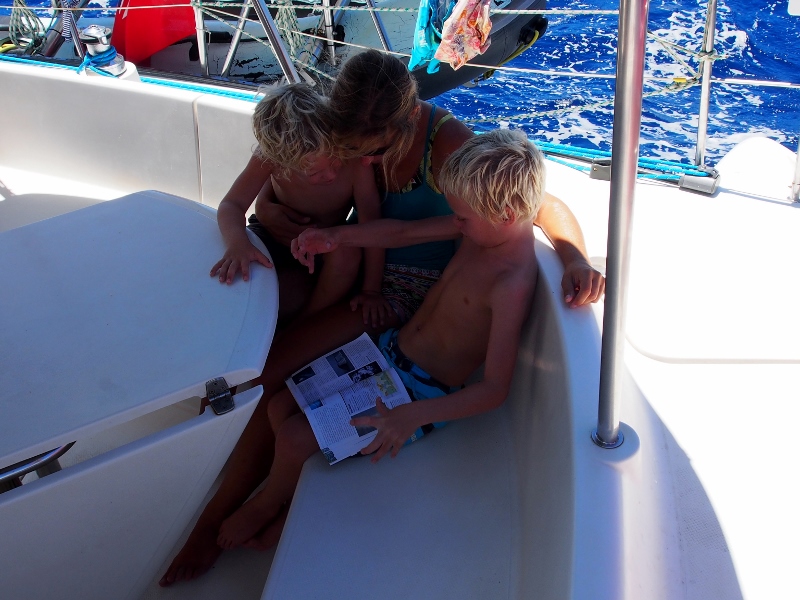
Animals abound too, which is nice – apparently it is a bit of marine desert out here, and we certainly haven’t seen nearly as much wildlife on this passage as on our travels near islands. We catch a mahi mahi just as Steve has started cooking dinner, and quickly put the pasta sauce in the fridge – fish is best eaten fresh, and it is utterly delicious. During the night a squid manages to climb on board, and Sarah finds it trying to hide in the cockpit as she starts her night watch. The following day around lunch time, just as we pass the halfway mark, a huge sperm whale swims past, only 50 metres from the boat. It breathes heavily, spouting water again and again before arching its back, flicking up its tail and diving out of view. It is Luke and Matias’s first sperm whale and they eagerly leaf through the marine mammal book with Sarah, learning all about the species.
We are keeping contact with a couple of boats that left the Galapagos around the same time as us, and through them we hear news of the rest of the fleet. Apparently most went further south than us, and some got hit by quite heavy squalls. One boat lost its main- and mizzen sails, and is now proceeding only with a genoa. A few others have some sort of engine trouble, and all are complaining that the lack of sunshine means that they are seriously short on batteries. Nobody is in serious trouble, but, like us, most have a few issues. We imagine what it must be like for some of the people we met. One couple was sailing from Galapagos to Hawaii, with three crew – a 40-odd day passage, they reckoned. They have no watermaker, and so will be on strict water rations for the duration of the trip. Most of the people we met were cooking meals for most of the trip before they left, to store in the freezer, because cooking is hard on a monohull while underway. In comparison our trip is really rather luxurious, with our sit down meals and renewable water resource. At the end of Day 10 we have 1470 miles left to go.

Day 11
Day 11 is eventful in a remote sort of way. The wind is easing and we’ve slowed down somewhat, averaging 7-8 knots, which makes for very comfortable sailing. We promptly open the front hatches to celebrate, only to shut them a short while later when the first shower starts. David has a rainwater shower – we’re permanently low on battery because of the thick cloud cover, and as a result we can’t afford to run the watermaker, hence the opportunistic use of rainwater. The kids join in, putting on their board shorts and lifejackets and running around on deck, sliding on their backs and generally enjoying a rinse off and runaround combo. Every hour or so they bring in another flying fish – the poor fish land on the deck as they fly out of the water in a desperate attempt to avoid us. There are little white birds out here too, darting in and out of the water. It is amazing that they can live so far from land.

Just after lunch we get an email from Julie and Ken off the boat Kia Ora – apparently another boat from the fleet is sinking after some large waves somehow caused them to break their rudder. A schooner is on the way to rescue the owners, and another vessel is standing by. We’re only about 24 hours away so offer our assistance, but apparently the situation is under control.
A stark contrast to our peaceful rain play, what a horrible thing to have happen. Julie warns us to look out for the waves and gives us a location and a bearing, but according to her they were 8 feet – which doesn’t sound bigger than what we had two days ago, certainly not enough to smash a boat up. All very strange. We feel for the owners and hope they have insurance – imagine watching your life savings and retirement fun plan sinking below the waves, if that was what it was – we don’t know them. It will be a traumatic event, and brings into focus how serious this ocean crossing business is. It is great that communications are so good that other boats can come to the rescue immediately. At the end of Day 11 we have 1200 miles to go.
Day 12
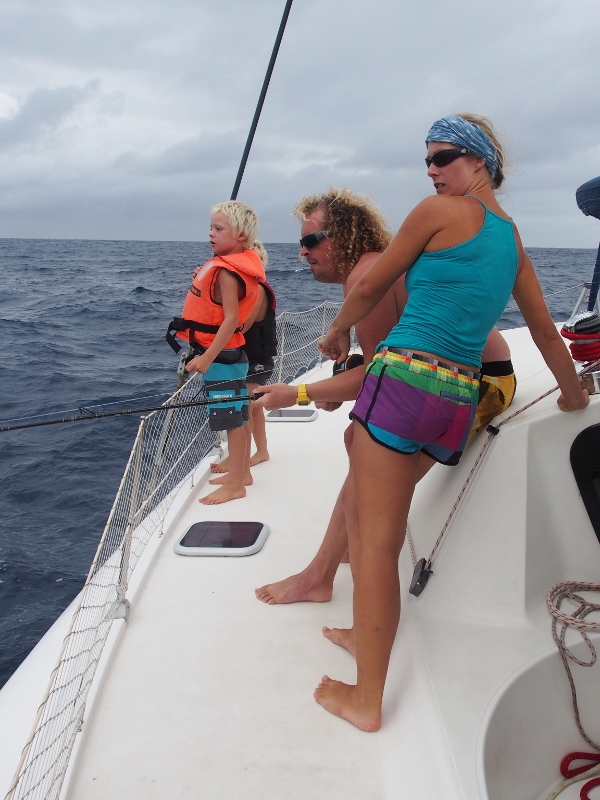
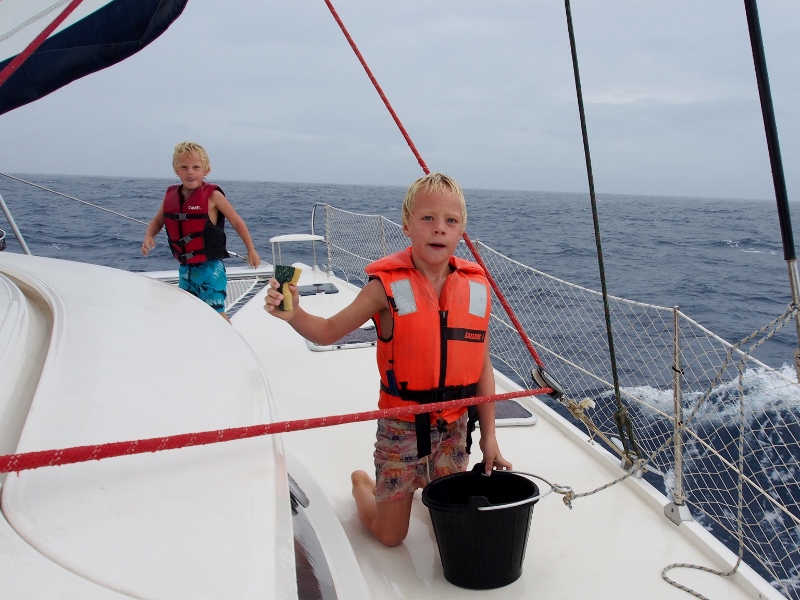
Rain is the flavour of the day with squalls rolling in, blanketing us in rain, and then disappearing again just as another one appears on the horizon. We have more rainwater showers, wash some clothes, and the kids pretend to be Jedi cleaning up their spaceship. ‘We don’t get much time to clean between missions’, Lukie explains to a slightly baffled Sarah. The rest of the day is spent sheltering in the cockpit, baking cookies and discussing possible substitutes for baking powder – we’ve somehow managed to misplace the supply we bought in the Galapagos, and it is seriously hampering the style of our cookies. In the end I try a mix of baking soda and lemon juice which turns out successful, and we have another batch of oatmeal cookies to brighten night watches.

Just before dinner, as usual, Steve reels in a huge skipjack tuna, round, fat and glistening.
The wind is shifty, coming and going with squalls, and again there is zero solar charge to the batteries. We’re pretty sure they are on their way out, because even if we charge them using the engine they drain right back again within a couple of hours. We resolve to be vigilant and charge using the engine to try to keep the fish fresh – it is large and could easily feed us for three days.
There are now 1121 miles to go, and overall we’ve logged 1892 miles since we left the Galapagos.
Day 13
On Day 13 the wet weather continues. After filleting the tuna we hang the carcass over the edge in the hope it would attract some sharks, and I half expect to find a tiger shark on the back step when I get up for my night watch. But the carcass is still there, although picked rather cleaner than it was when we put it in. So much for amazing shark senses…
During my night watch we have several heavy squalls roll over us, large continents of rain drifting across the radar screen, Bob headed boldly into the centre of something the size of Africa. Lightning is going off all around, and I count like a kid till the thunder booms, drenched to the bone. My raincoat was showing patches of mildew after a rain shower in the Galapagos and when I scrubbed it the waterproof coating must have come off, so now it just acts like a big sponge soaking up water to ensure maximum discomfort.
Around 6 am the kids come up, but I can’t come inside to make them breakfast or start homeschooling for a while as the weather is too bad for me to leave the helm – the wind keeps changing, and I’m constantly on the edge of reefing, caught between the desire to move fast to get away and concern when a gust hits 20 knots. David doesn’t get much sleep, he is constantly up to check that whoever is on watch hasn’t drowned in all the rain.
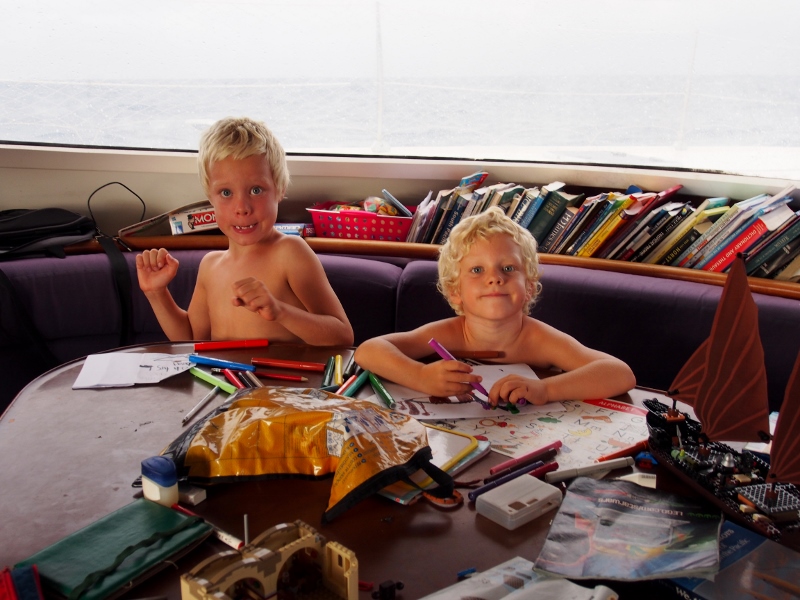
When I finally come inside the kids are sitting quietly doing their homeschooling all by themselves, Matias having written some maths problems for Lukie, bless him. After the first couple of difficult days they are coping admirably with landlessness, although they have started to ask how much further we have to go. We got lots of kid’s movies from other families we met, and they get an episode of a Star Wars cartoon most afternoons, which is generally enough to inspire Star Wars games for the remainder of the time.

The state of the batteries is becoming a concern, and it is clear that we won’t be keeping the fish for more than one day – we don’t have enough diesel to charge the batteries every two hours, and the autopilot and radar must remain the preferred power users, putting the fridge last in line.
All this weather is good for speed, though, and at the end of Day 13 we have 920 miles to go according to the chart plotter and have logged 2085 miles since leaving Galapagos (the discrepancy between the two is caused by current – the logger measures the boat speed, the chart plotter the distance we move over the ground).
Day 14
Day 14 is the day of the flying fish. Steve has a flying fish land in his face during the night, causing him to run upstairs to Sarah who’s on watch, complaining of a bed covered in scales and slime, adding to the already damp odours. Later, when the kids get up Lukie finds another flying fish on the trampoline. They are amazing creatures; with their translucent wings extended they can fly for up to 1 km.

We’re getting ready for Lukie’s birthday tomorrow, wrapping presents and baking. The hardest will be to make the cake – he wants it in the shape of a black Hulker, one of his imaginary animals. Hulkers are rare, and come in many different shapes, but the black ones look somewhat like gorillas, only they have long claws and noticeable tusks, and yellow eyes. And they carry knives… Not easy to recreate, but Matias (who is party to more Hulker talk than us) has drawn us a fierce looking monster we can use as the template. The hardest will be to make the black fur, but after some initial experimentation we feel confident that a mix of nutella and blue and red fod colouring will yield at the very least a dark shade of grey. After days of rain we’ve finally managed to outrun the bad weather and are basking in glorious sunshine. The sky is blue, with light fluffy clouds scattered here and there, the sea shiny and teeming with flying fish, dolphins splashing in the distance. The fridge is switched off now, in an attempt to save power, so we’re on a race to use perishable ingredients like cheese and ham. So it’ll be cheese scones for lunch followed by Spanish omelette for dinner. At the end of Day 14, we have logged 2257 miles, and have 743 miles left to go.
 SV Bob The Cat