Isabela is completely different from San Christobal. The largest island in the Galapagos group, Isabela is much larger than San Christobal, and gets a lot more rainfall. All the Galapagos islands are basically volcanoes that erupted out from a number of hotspots below the seabed. The tectonic plate that the islands arose from is moving quite rapidly, about 3 cm eastward a year, and as a result the oldest islands tend to be on the eastern end and the youngest at the western end. The typical life cycle of an island is that it starts out young and hot and inhospitable, then it cools down and its volcano(es) quieten down and the island is colonised by plants and animals. The higher the elevation of its volcano, the more rain the island receives, and the more lush its vegetation and abundant its animal life. As it ages, the island starts sinking under its own weight, so older islands are flatter and receive less rainfall. At the end of its lifecycle, only the tip of the volcano will stick out of the water, the rest of the island lost beneath the waves.
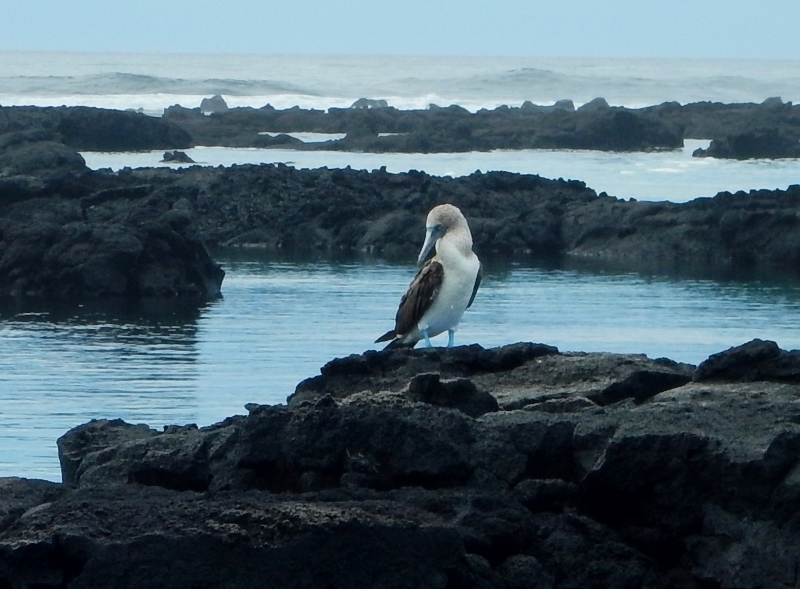
There are birds everywhere here: pelicans, frigate birds and boobies diving for prey or roosting on the black rocks, Lava Herons stalking crabs and small fish in rock pools, flamingos in the saltwater ponds behind the township, and the Galapagos penguins bobbing on the water surface or zooming through the water. The blue footed boobies fish in flocks of hundreds, synchronising their dive bombing so that each bird hits the water at the same time, creating an enormous splash that has us jumping the first time it happens next to the boat. It is an impressive sight and we wonder whether they ever mistake a snorkeller for a flock of fish – imagine hundreds of sharp beaks suddenly piercing the water above you as you come up for air.

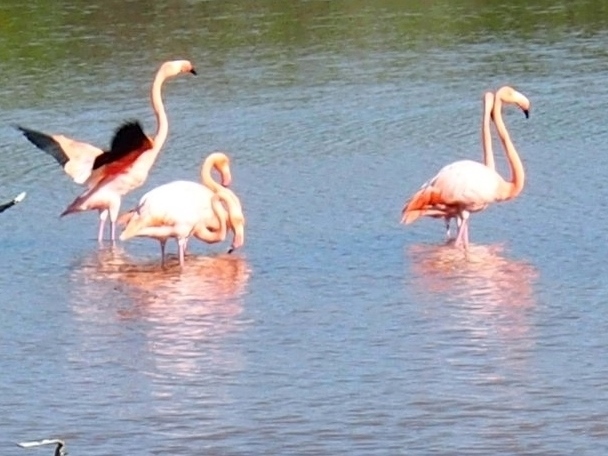
Just behind the town of Puerte Villamil are saline ponds with a lovely boardwalk through. Iguanas swim in the red water, and delicate pink flamingos stand seemingly immobile for what seems like hours, only occasionally stretching their wings a bit. They are beautiful birds and fascinating to watch; when they swim they look almost like swans with the long pink necks curved above the waterline.
The boardwalk ends at the giant tortoise breeding centre where the two subspecies of the island can be seen – there are still wild populations deep in inaccessible national park territory, but we only manage to see one wild one, at the top of Volcano Sierra Negra. Their shells are different from those of Isla Christobal so we can clearly see evolution in action – it is thought that all the giant tortoises arrived here as one species from South America, likely floating on a raft of vegetation created from a flash flood, and that the diversification into different species for each of the islands occurred over thousands of years.

East of the town and next to the pier where we land our dinghy is another boardwalk, this one through mangroves. Marine iguanas are everywhere, sunning themselves on the warm wooden walkway. They are not shy at all and just stare at us impassively as we tiptoe around them and gingerly step over their steaming bodies. At the end of the walkway is a snorkel site where a sealion comes to play, performing underwater acrobatics, whirling and zooming and spinning all around us. We try to mimic him, clumsily diving down and spinning upside down, and he appears to appreciate that, outdoing our every manoeuvre until we exit the water.

Numerous tiny Galapagos Penguins swim in the anchorage or sun themselves on the hot black rocks around the jetty. They are here, at the equator, because the Humboldt current from Antarctica cools the water enough for them to colonise the islands, and have adapted to the heat by reducing their body size, so they are truly small, about the size of a slim adult duck. They are amazing under water, zooming in and out of the rocks and mangroves, in hot pursuit of the tiny fish that hang out in big schools just below the surface. It is incredible to see mangroves, hard corals and penguins in the same swim, or to see a penguin sitting on a rock just next to a cactus.


There are not as many sealions here as where we were staying in San Christobal, and we manage to ward off colonisation attempts with some success. A small female still decides that the boat is for her, and one afternoon after a day out we came back to find a nice pile of poop just in front of the cabin door – she must have hauled herself all the way into the cockpit, spotted the nice toilet shaped depression in the floor, and decided that that was the place. After we spray a bit of water on her to chase her off, and tie up the fenders in a new configuration, and it works: she stays away.
Apparently there are Galapagos Sharks in the bay, and Matias spots tiny baby black tipped reef sharks around the boat, only about 30 cm long but still unmistakably sharky.

The atmosphere here is very different to the smooth efficient tourist machine of San Christobal. The town of Puerto Villamil is tiny and sleepy, and you get the impression that everybody is very relaxed. Relaxed almost to the point of inertia: tour boats don’t turn up when promised, trips are cancelled for no good reason, laundry is not ready when promised. Sarah comments that they seem ‘rather complacent about tourism’ and it is indeed a shame that they don’t make more of an effort – when you pay the equivalent of NZD 140 to go on a snorkel trip, you expect the boat to turn up, and we certainly wouldn’t recommend the guys we went with to anyone after spending half a morning waiting and the other half showing receipts to demonstrate that we’ve paid when they claim we haven’t. In the end we feel bound to pay another US $150 although we are quite certain that we did pay the first time around and have receipts to prove it, because otherwise the girl who lost the money will have to pay them out of her own pockets. We book a horse ride to the volcano Sierra Negro and are told to meet the truck that will take us to the start of the trek at 7:15 am, only to sit waiting for an hour until he turns up with the ingredients for a fruit stall which he has to set up before we can get going.
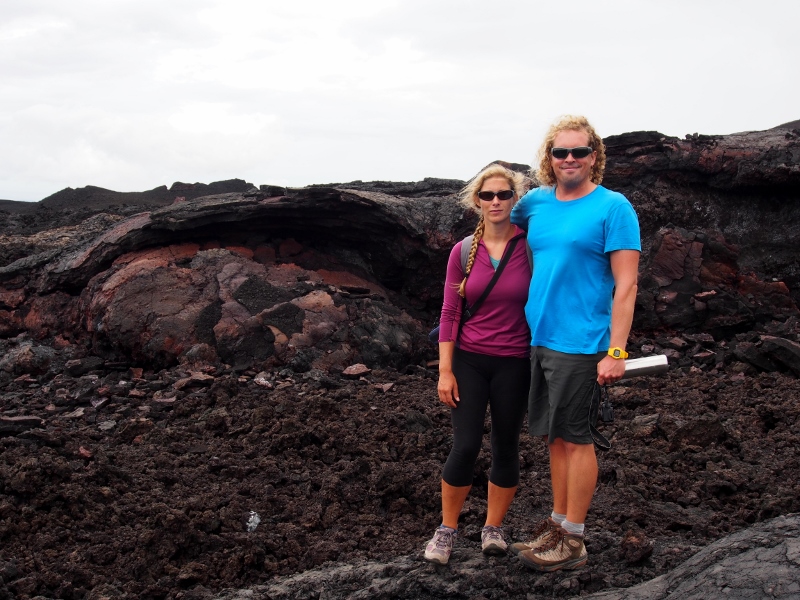
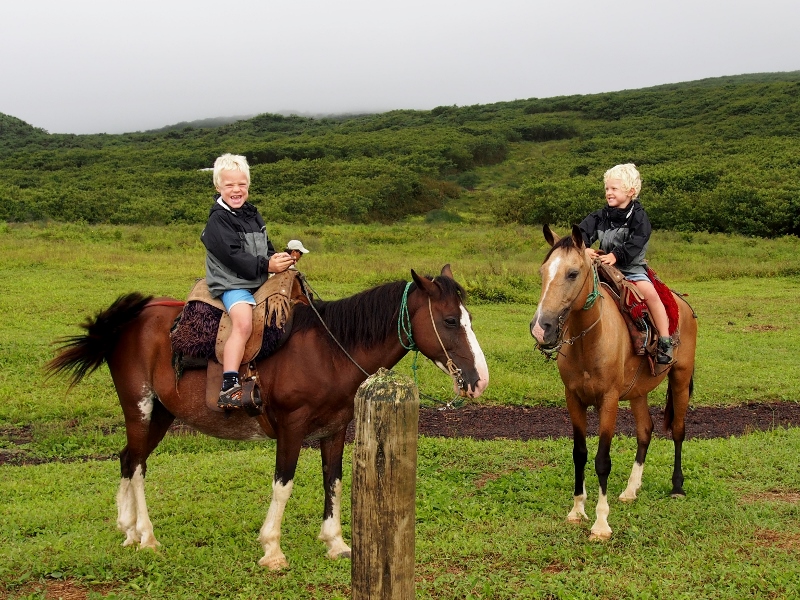
Mind you, the volcano is amazing – it last erupted in 2005, and previous eruptions took place in the 1970s and 1960s. After a truly terrifying truck drive with our lunatic taxi driver doing 120 km/h along wet roads as we scream to him to slow down up the lower parts of the mountain we arrive to get on our horses, and trot up the trail at a stately pace. Lukie and Matias are stoked to be on a horse like real knights and Matias keeps leaning forwards to pat his horse and whisper into his ears. The horses are hilarious, refusing to do anything we ask them to, not heeding any known commands. The guide keeps asking us to hurry up, but the horses seem to just go one speed on the way up. We ride for half an hour next to the huge crater at the top, looking down into the eerie black flat lava landscape that stretches for 3 km. Once at the top we dismount and climb down to view Volcano Chico, a parasite volcano that went off in 1963 and again in 1979. Here lava tunnels are running down the hills and vents are everywhere, showing as big cracks in the surface out of which hot air flows. We can see the succession of plant colonisation, with the latest lava only colonised by lichen and earlier eruptions slowly covered in cacti, mosses and eventually ferns.

On our way down the horses keep slipping on the muddy path, and the guide’s horse falls over, throwing him off. The kids’ horses keep breaking into runs, eager to get back down the mountain, and Lukas’ horse stages some vicious attacks on the other horses in its quest to get ahead.

 SV Bob The Cat