
We leave San Christobal to sail to Isabela, another island in the Galapagos group, on Friday afternoon. It is an 80 mile trip and there is no wind, so we decide on an overnight passage to give us enough time to arrive in daylight.

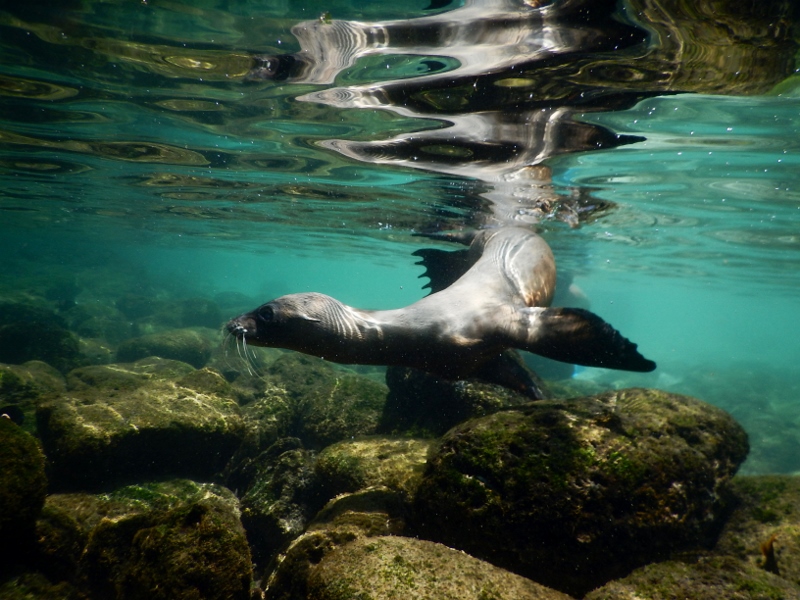
It is hard to leave Isla San Christobal, not least because one of Kevin’s female friends has moved in. On our last day in on the island we go for a goodbye snorkel at La Loberia where we swim with sealions, eagle rays and turtles in crystal clear water. When we come back to the boat we find her fast asleep next to the lifejackets in the cockpit. We try the usual clapping but she just bares her teeth and snaps at us, advancing in a vicious attack to ward us off. This works well for her until we gang up together and clap in unison, when we manage to get her out of the cockpit, her bottom only just fitting through the railing as she slips out to the steps – for a crazy moment we fear that she is stuck. She refuses to jump into the water, and no matter what we do (clapping, shouting, saltwater hose, buckets of water) she remains on the steps –indeed she appears to relish the cooling effect of the water that douse her with. In the end we give in and start the engine, hoping that she will jump off once she senses we’re moving. She doesn’t, of course, and about a mile out of San Christobal we get worried about translocating a native species and turn the water hose onto her, spraying her face until she gets the message and leaps off. She continues to pursue the boat for a while, hoping no doubt to jump on again for the night, but we manage to keep her at bay.
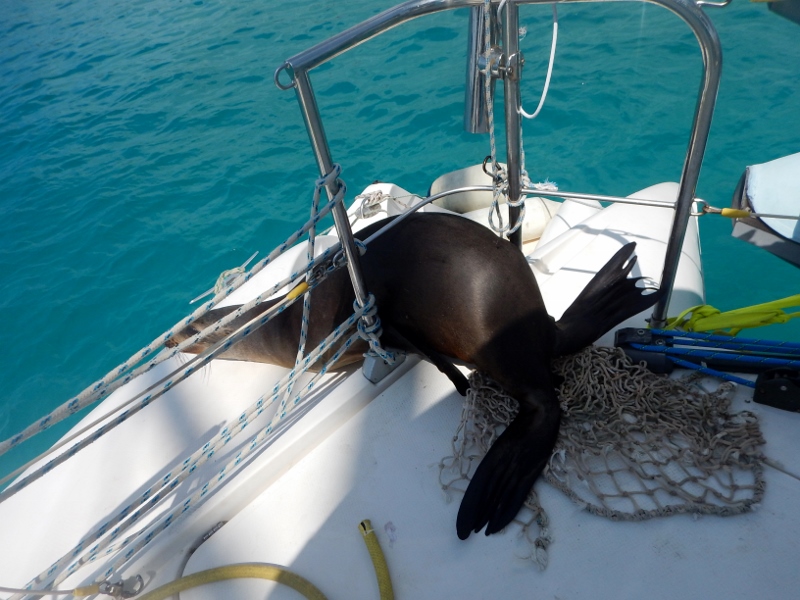
Half an hour later a larger specimen (Kevin?) comes up and hangs in the water around the boat for the evening. There is no wind, and we drift along in the current at about 3 knots, looking at birds hopping along the glassy water surface and weird configurations of jellyfish drifting past just under the surface. There are devil rays everywhere, pairs of wingtips breaking the surface rhythmically as they move along just under the surface. Something big may be chasing them, because occasionally they jump right out of the water, landing with a huge splash. Minke whales appear about 100 m off the boat, breathing loudly in the still afternoon and breaching again and again. Kevin darts forwards and backwards, swimming on his side and his back, breathing in tune with the whale and occasionally emitting loud honks just to remind us of what we will be missing when we leave him behind. Just before dark we see dark brown fins sticking out of the water, seemingly waving at us, and gather to have a closer look – is it more of Kevin’s lot, waving goodbye, or perhaps a couple of sharks? It turns out being three huge sunfish swimming merrily towards San Christobal, their fins breaking the surface as their disc like bodies glide along seemingly unhampered by their lack of tail.

Once dark, we hear loud splashing but we with no moon it is impossible to investigate whether it is dolphins or fish. In the morning about ten large bottlenose dolphins approach to frolic around the bow, and we slow down the boat and jump in the water to have a look. The dolphins swim right up to us and dart in and out between the hulls of the boat as we hang onto the swim ladder and watch. Almost immediately a couple of Galapagos sharks appear, edging closer and closer. The dolphins seem unconcerned, but when the sharks increase in number and some big ones come along we decide to get back onto the boat.

As we approach Isabela we see another large whale, possibly a Bryders, and numerous turtles and seabirds greet us.
There is a real sense of abundance in the ocean here – a feeling that there is enormous biomass below and all around us, and that if we cared to jump in we would see the water thick with life. We can only wonder what it would have been like before whaling, fishing and shark finning. The Galapagos used to be home to many whaling stations, and the whale populations here (as elsewhere) were decimated. Compared to the relatively impoverished oceans we are used to, the life here is pretty incredible. Imagine what it would have been like back then, a veritable overabundance of ocean life around these arid and inhospitable volcanic islands.
 SV Bob The Cat