Our first day on passage to the Galapagos is windy and full of wonderful sea life.
Just offshore of Las Perlas we meet a pod of Bryde’s or Minke whales – we can see the sickle shaped dorsal fin and long, dark bodies, as well as lots of tallish blows all around the boat, the closest perhaps 50 m away, and reckon that they’re probably Bryde’s, but could the slightly smaller Minke. The whales huff and puff along with us for a while before disappearing out of sight.
Later on Sarah and Steve spot a huge brown turtle from the trampoline, swimming straight under the center of the boat and coming up in the wake behind. It is hard to know what species, but we reckon maybe it is a large hawksbill.
We catch a mahi-mahi for dinner, and dolphins follow the boat for a while perhaps hoping for some leftovers, before they duck off for a while. Later on they return to join David for most of his evening watch and appear again the following morning.
During the night the wind comes up, and we put a second reef in the main around 4:30 am. Half an hour later the wind is gusting up to over 30 knots and as the autopilot goes crazy David takes over the helm until we have enough light to do a third reef. He manages to coax a whopping 15.4 knots out of the boat before we decide to take the mainsail down altogether, and just run downwind on handkerchief sized genoa, which still sees us reach 10 knots of boat speed.
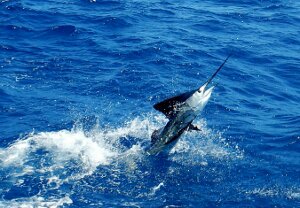
After breakfast, Steve spots a huge dark brown shark just off the stern, and later on when we get a strike on the fishing line and see a big dark shape we reckon that a shark is following our catch. But it turns out that the dark shape IS our catch – a huge white marlin! We are reluctant to struggle with a fish this size only to throw half the meat away when it goes bad, so we decide to let it go, only we’re not quite sure how to get the hook out of its mouth. Steve tries to tire it out and David positions himself on the back steps, hoping to catch a hold of its bill and yank out the hook. But it looks too big for us to try to manhandle it, and in the end we cut the line, hoping that the hook won’t impair this beautiful giant for long.
The water has turned from the muddy brown green Panama sludge to clear blue and we´re back in the the land of wonderful visibility again.
After all the initial wind, we hit the doldrums on day two when there is absolutely no wind at all. We switch on the motor as otherwise we’ll come to a standstill, swept along only by the current.
The sea is oily and slick and the swell rolls along in nice evenly spaced hills of elevated sea, keeping us in constant motion, up and down, side to side.
We take the opportunity to clean the hull of the boat again, and discover 15 new or previously unfound barnacles, which are swiftly disposed off. If we want to guarantee a troublefree entry into the Galapagos, we’ll obviously have to do it again just before entry, they seem to attach so fast. But I guess that won’t be a problem in these windless conditions.
The upside is great calm conditions for viewing sealife. Which in this particular location is dolphins, following the boat just before sunrise, doing acrobatic shows jumping high into the air just before sunset. There must be at least a hundred in the pod, striped dolphins doing a ballet for us.

We´ve been becalmed for two full days when the wind finally comes back. It is great to be sailing again, to be going fast, wind in our faces, spray in our hair.
Not that it’s been bad to stand still, it’s just very very hot when there’s no wind, but we’ve made good use of the time, cleaning the hull again and insect spraying like people possessed.
But now we’re flying again, estimated arrival in Galapagos Sunday morning. We’re not the only ones flying, birds are coming out to greet us, including blue footed boobies and swallow tailed gulls, species only found in the Galapagos. There are only about 2000 – 3000 pairs of the nocturnal swallow tailed gull in the world, and we feel privileged to be greeted by them in bird.

On the last night before arriving, we cross the equator around midnight. The kids were very excited at the prospect and wanted to be woken up, but end up unable to leave their warm beds. The rest of us open a bottle of bubbly and celebrate how far we´ve come.
We finally arrive in San Christobal midday Sunday. Like ancient seafarers, we’ve had many signs that land is near with lots of endemic Galapagos bird species coming to visit. The longest staying visitor was a red-footed booby, which landed on the port bow around 9 pm, and decided to spend the night, perched on the railing, only leaving well after sunrise.

We spend much of the last day cleaning the boat – the hull during a lull in the wind, the deck a while later, and the inside on the morning of our arrival. We are fretting a bit because we have heard of authorities turning away boats recently, and we take great care to ensure we’ve followed all our agent’s instructions.
You pay quite a bit for an agent, but can’t deal with the port authorities without one, and they do make your life easier. We’ve received specific instructions: put up a sign saying ‘Don’t throw garbage in the sea’, sort your rubbish into recyclables, organics and landfill and put up clear signs about what goes in where, make sure the engine room and the hull are both spotless. Have five photocopies of every boat document and passport ready to hand over.
We’ve done it all, and feel nervous if ready as we slowly sail up the coastline.
It’s not only the birds that are friendly:we spot several turtles and playful sealions folow the wake of the boat as we approach. Indeed, the sealions seem very friendly: when we reach the anchorage we spot them perched on the stern of the yacht anchored in front of us, and as we sit there watching we see it clamber into the cockpit…
Can’t wait to come back to one of those after a day out…
 SV Bob The Cat