Archipelago de las Perlas is stunning if murky. Apparently there are whale sharks, manta rays and humpback whales here, but the visibility is such that even if they were right next to us we wouldn’t have seen them. The whole way from Panama City to Las Perlas we notice patches of reddish brown water interspersed amongst the general green blue stuff so we assume that there are lots of algal blooms going on at the moment. When we meet several schools of brownish rays swimming close to the surface I jump in with a mask on to have a closer look, but find that I can’t see anything – the visibility is about 3m, similar to the pea soups I used to dive in in the UK. Very productive waters creating perfect conditions for large filterfeeders like mantas and whale sharks, but not so good for snorkelling. Judging from the photos in the guidebooks these murky conditions don’t persist throughout the year: most of the photos show white sandy beaches lined with turquoise waters through which you can clearly see the reefs. Perhaps the productivity comes from the shutdown of the Humboldt current which occurs from January to April every year, with clearer waters persisting the rest of the year.
We don’t mind too much as there is still plenty to see. Fish and rays are everywhere, and hundreds of seabirds relentless dive-bomb the sea, creating splashes everywhere along the horizon. We catch an albacore variety and a mahi-mahi on our first day – the albacore has the most blood red meat I have ever seen in a fish. Steve cooks it up for lunch with lots of salt and pepper, and the meat tastes just like a pepper steak. The mahi-mahi is wonderful as usual, seducing even Sarah who normally is not that fond of fish and she pronounces it the best fish she has ever tasted. Hopefully we’ll catch some more of those…
The first night in Las Perlas we anchor in a small bay near a beach which has lots of iguana tracks on it, but we can’t find them even when we return the following morning to see if they are creeping out into the sunshine to warm up. On a snorkel attempt we are attacked by savage blue bottles, and both kids and I get badly stung. The following day Sarah and I don wetsuits, leggings and long sleeved rash vests and clean the hull of the boat on anchorage in five metres of water – we can’t see the bottom, or each other, but when peering closely can just about make out that the hull is relatively clean. David and Steve have both got back twinges from the heavy carrying done when shopping in Panama and so they get to rest from cleaning for a while – we want a totally healthy crew for the passage to Galapagos.
Bob has to be spotless for the Galapagos – upon arrival inspectors will come aboard and check that we are thoroughly clean, have ecological soaps, no insects or vermin, comprehensive rubbish plans with elaborate instructions for separating out organics, recyclables and landfill, and divers will be deployed to check every inch of the hull for organisms hitching a ride. They frequently turn away boats with any fouling on them and our antifouling has never been in great shape owing to a poorly done patch-up job done before we bought it. At some point soon we will have to get the boat out of the water, sand it back down to the fibreglass and reapply antifouling, but we will wait with that until we get to New Zealand. Which means a lot of frequent cleaning to keep stuff off until we pass the test in the Galapagos – the time in Panama City has added several barnacles which we mercilessly knock off. With a thoroughly clean hull we are ready to take off, but we will stop again 40 to 60 miles out from Galapagos and give it another once-over to ensure we pass the test.
It is not only the hull that needs cleaning, the decks are absolutely filthy from Panama smog, and we hose and scrub the dirty footprints off two days in a row to get it back to just ordinary dirt.
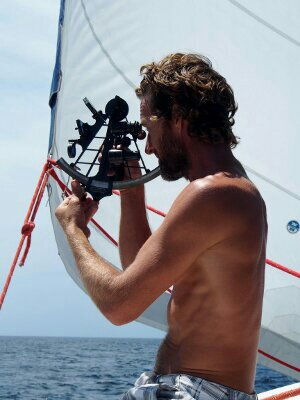
The final morning that we are leaving, Sarah and Steve check the brass sextant from 1933 that David’s Uncle Dave who used to be in the merchant navy passed onto David. We are proud to bring the sextant back to sea, and think much of Dave and Mairwen as we dust it off and practice doing the sightings – it is wonderful to have a treasured instrument like that from close family with us on our first crossing of the Pacific Ocean. Steve plans to practice the sextant navigation on the seven to ten day trip to Galapagos, and then try out some blind (i.e. no GPS) navigation on the three week trip from Galapagos to the Marquesas Islands.
At 9:20 we set off in buoyant spirits, clean boat and excited crew, ready for the long passage to the Galapagos. The weather forecast is for good breeze the first 24 hours but doldrums interrupted by thunderstorms after that – the typical weather pattern for this part of the world in a weak El Nino year like this one. Hopefully we’ll get some wind, but I guess we can always jump in and clean the hull on a quiet day…
On the passages, we can only update the blog via satellite link, which means few if any pictures, but there normally isn’t much to take pictures off anyway when we’re underway. We’ll aim to keep posting updates of our progress every few days.
 SV Bob The Cat