Crossing the Panama Canal is incredible.
Just over a hundred years old, the canal stretches 80 km from Colon on the Atlantic side to Panama City on the Pacific side, providing a convenient shortcut for the around 13,000 vessels per year that pass through it. The Canal consists of three double locks on each side, taking vessels up 26 m to Lago Gatun, a large artificial lake created in the middle.

The canal was started by the French in the 1880s, but the project was abandoned when it became clear how difficult it would be to carve a canal through a continent overgrown with jungle. At this stage it is estimated that approximately 22,000 workers had lost their lives mainly from yellow fever and malaria. Costs had escalated and it was clear that the original plan of carving a canal at sea level was going to be prohibitively expensive. In 1905 the Americans took over the project, created an artificial lake in the middle and designed and built the double locks that carry ships up to the lake level.
For those passing through the Canal, the tricky part is the locks, or rather avoiding hitting the concrete walls or other vessels whilst in the locks. During lock filling and emptying boats are kept in the middle by lines affixed to either side of the canal, with line handlers on the boat adjusting the tensions on the lines to keep it in the middle. Small boats are required to raft together to save space so that each lock can be filled as best possible.
Each vessel passing through the canal has to have an official advisor on board, as well as four line handlers in addition to the skipper. The advisors are assigned by the authorities and board vessels prior to entering the canal. The line handlers can be crew or you can hire them.
We take off about noon from Shelter Bay Marina on the Colon side, after a busy morning getting ready with last minute supplies, obtaining the heavy duty lines and fenders required for the canal, and meeting Dave, an cattle rancher from Wyoming who has kindly agreed to help us line handle. We have to be at ‘The Flats’ close to the canal entrance at 1 pm where our advisor will come on board and tell us when to go and where.
Cowboy Dave is a useful line handler – this is his third canal crossing, making him vastly more experienced than any of us. He flew out from the States at the beginning of February to help a friend through the canal, and has gone through an additional two times since just for the fun of it.

As soon as we exit the marina it becomes clear that there is something gravely wrong with the starboard engine. It starts fine, but won’t go into gear at all. Which means that we have quite restricted maneuverability, and Skipper Dave thinks that we may struggle to keep up to the 6 knots of boat speed that we signed up for (they schedule you according to the speed you can make, and won’t allow vessels to drop below 5 knots). Rather than turning around and wasting all the money we’ve already spent on canal paperworks we decide to continue to The Flats and see if we can troubleshoot it on the way. With the wind behind us, if we push the port engine to the max, we can make just above 6 knots. But it will be hard to keep the boat safe if we can’t use both engines – a catamaran easily gets blown around, and with only one engine we won’t have as much control as we’d like. Cowboy Dave happens to know a bit about diesel engines, and he and Skipper Dave soon diagnose a slipping clutch. It seems we only get a little bit of forward thrust from the engine, but it works fully in reverse. Which is a relief – if we can reverse with both engines, we can manoeuvre reasonably well.
After much discussion we think it is safe to enter the canal and decide not to tell the advisor about being down an engine unless they are rafting us up in a configuration that we think may be dangerous.
When we look up from these intense discussions we see that there are quite a few yachts anchored on the flats. Whilst we’re waiting for the advisor, the some Dave knot nerd bonding goes on: Cowboy Dave demonstrates his backwards bowline and butterfly rope coiling technique and Skipper David shares his Portuguese bowline. Roy the Advisor finally arrives to disrupt some jolly rope tying and engine fretting, and points out the larger vessel that will be in the lock with us, a green monster with ‘Green Reefer’ painted on its side and ‘Green Music’ on its back; hopefully the skipper is sober. On the way to the locks it is decided that we and a small American keel boat full of young Israelis will raft up either side of a large motorboat.

It is strange to be rafted, but at least next to a large powerboat we don’t have to worry about our engine, he’s got enough power to drive for the three of us. It turns out that we don’t have to worry about the line handling either – the powerboat is so large that they are best placed handling the lines. Guys on the docks throw us monkey fists, thin lines tied up in a decorative knot which we then tie to the larger lines that we’ve hired. Apparently the line throwers get extra points for hitting crew or solar panels so we duck behind the matresses we’ve strapped to the panels for the purpose, grab the lines as they settle down, and pass them on to the hired line handlers on the powerboat.
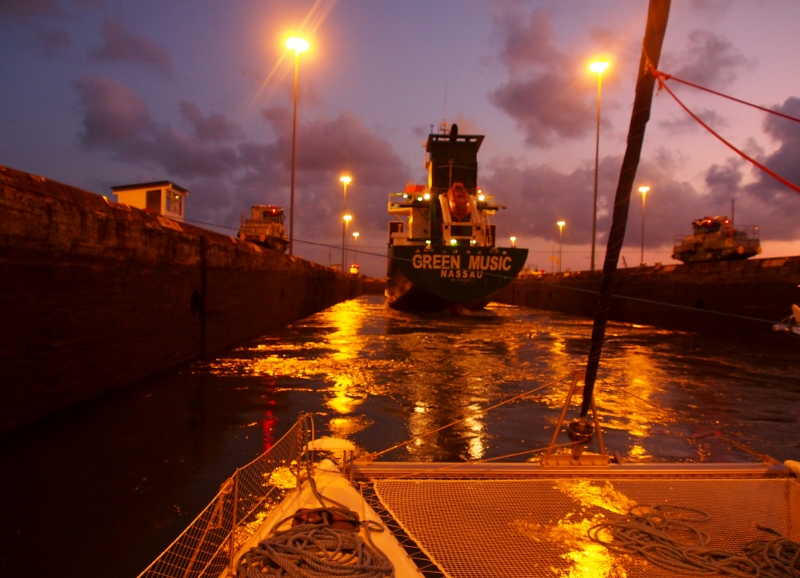
Once the four lines are tied onto the walls, the gates close behind us and the lock fills rapidly, the line handlers pulling in rope slowly to ensure that our raft stays in the middle of the lock. When full, the lock opens ahead and we drive into the next one, which rapidly lifts us an additional 8 m above sea level. It is dark once we’re through all three locks, and we untie from the raft and motor to the mooring on Lago Gatun where we’ll spend the night. I’m rushing to finish dinner so that it is ready – you’re supposed to feed your advisor, but Roy politely declines and jumps onto a pilot boat as soon as we’re tied up to the mooring.
To ensure that they would not get in the way in case all adults needed to line handle, we’ve hooked the kids up to a DVD on the computer – the first one they’ve had since we’ve been on the boat. It works: they come out to have a look while we’re in the locks, but spend the rest of the time howling with laughter at Winnie the Poo.

The evening on the lake is wonderfully quiet and we all have a good sleep. The following morning we get up early in anticipation of a new advisor coming on board at 6:30, but he doesn’t arrive on time and we have time to get to know the Israelis who are tied up to the same mooring. They and Cowboy Dave share stories about the US Coast Guard turning yachts away from Cuba.
The lake is huge, with an intricately curly shore of dense jungle dropping straight into the lake. On previous trips through the Canal Cowboy Dave has seen sloths in the treetops and Sarah eagerly peers through her binoculars as we motor along the lake shore but sees none. There are thousands of birds – pelicans, frigate birds, and some small grey and white things, all plummeting into the lake waters for fish. The water starts out blue green but as we get into the narrower section near the Pacific lock end, it goes a deep muddy colour.

Our second advisor, Oscar, is just as nice as Roy and considerably hungrier. I spend most of the morning preparing teas, coffees, scrambled eggs, coffees, teas, cookies, coffees, teas, lunch, coffee, tea and more snacks. The motor boat went all the way through the canal the night before, so we raft up only with the Israeli boat and enter the first lock going down towards Lago Miraflores and the last two locks. It is weird going down, the locks empty quickly and Cowboy Dave and Steve do some expert line handling on the port side keeping us safely in the middle of the lock, the Israelis handling the starboard lines.
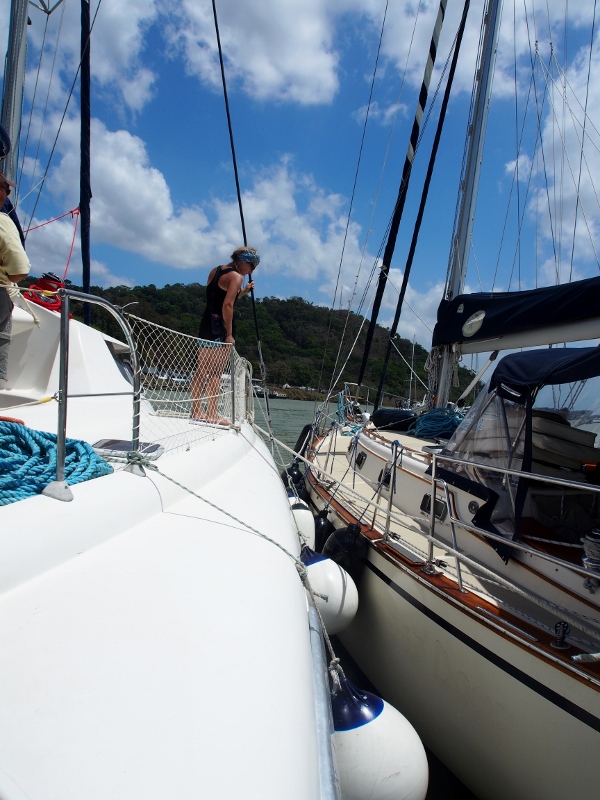
And then suddenly it’s all over, and we’re out of the locks. We untie from the Israelis, heave a sigh of relief and motor slowly on our port engine towards the anchorage in front of Panama City. We’re back in the Pacific, and a straight line on the chart plotter shows only 6500 nautical miles to New Zealand. It’s wonderful to be back in our own ocean, now all we have to do is to provision, and then of course the small matter of fixing the starboard engine clutch…
Cowboy Dave stays another night and tells us stories of his incredible travels, hunting in Mongolia, sheep shearing in New Zealand – what fantastic adventurers one meets when travelling. We are sad to see him go when he leaves the next morning but who knows – maybe we’ll visit him in Wyoming one day…
 SV Bob The Cat