We end up spending three days in Aruba, leaving before nightfall on Sunday 8th February. Initially we were planning to leave on the Monday, but the forecast is for very light winds on the passage to Panama and we want to get a head start before the winds drop. Waiting for good winds is not an option; we have to make sure Christophe is in Panama for his online flight on the morning of the 14th.

When we first arrive it is so windy that we consider deploying two anchors, but we find a relatively sheltered spot and decide to stay there for the first night so we can go to town and find a supermarket. The large spearfish is still feeding us for one last fish curry, and we manage to find some fellow sailors to gift some bags of fish to, to reduce the waste. It is not easy to keep the refrigerator running enough to keep fish, and we had to turn the engine on to recharge the batteries to keep it cold enough on the way here, leading to a domestic role reversal. Normally David is after me like a hawk asking me to turn down fridge time, but, eager to keep his catch cold, he suddenly wants to run it around the clock. The sausages in there must be resentful about being considered unworthy of fridge time; in protest they decide to go off. I’d provisioned meat for four evening meals and so far we’ve only used meat once because of all the fish we’ve caught, so I suppose it’s inevitable that some will go off.
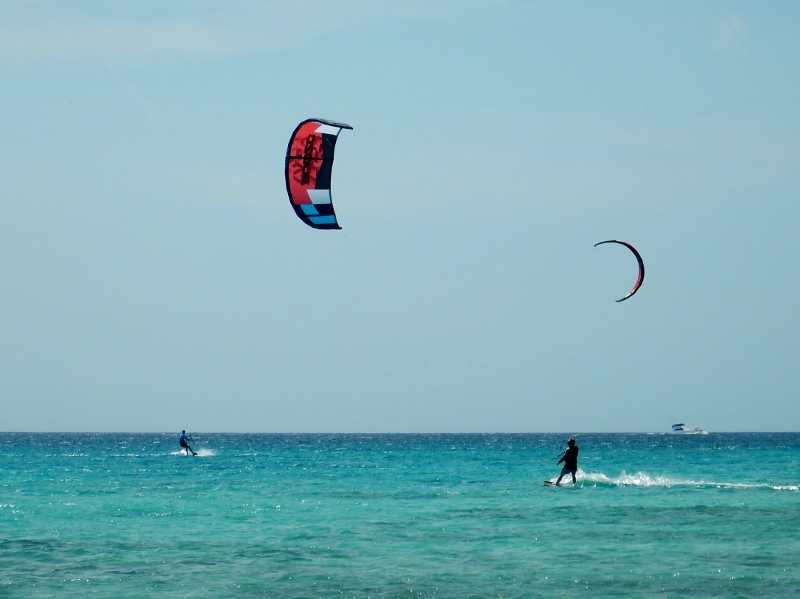
The day after arrival we move to Arashi Bay on the northwestern side of the island. The kids are enjoying access to land again, and they spend hours playing on the beach with their boogie boards, snorkelling gear, and the various local and tourist children around. Christophe, David and I take turns kitesurfing, all enjoying getting some exercise. Being very windy most of the time, Aruba is a sought after spot for wind- and kitesurfing, and we fully enjoy the vast expanse of turquoise water just next to the golden beach, even if the winds are a bit gusty.


Aruba is quite different from the other Caribbean islands that we’ve visited. Just off the coast of Venezuela, the island was first settled by a tribe of Arawak Indians from Venezuela called the Caquetios who migrated here around 1000 AD to escape attacks from the fearful Caribs. The Caquetios lived peacefully on the island for centuries, isolated by the big distances and strong winds from the remainder of the Caribbean but keeping strong cultural links with what is now Venezuela. The first Europeans to spot the island were the Spanish, who plundered it for slaves to ship to Hispaniola but otherwise established no real presence. In 1636, near the end of the 80 year war between Spain and Holland, the Dutch took possession of the island. In contrast to the volcanic islands further north in the Caribbean, Aruba was a riverless, sandy coral island with no arable land, so sugar plantations were never established and no African slaves were imported. In 1824 some gold deposits were discovered on the island, and a boom of gold mining kept the economy of the island going until 1916 when the mines were exhausted. Soon after, oil refineries were established on the island, and Aruba prospered from the refining business until the mid-eighties. The island also saw a steady increase in tourism from the 1950s onwards, with several luxury hotels built in the 1970s and 80s. Nowadays, the tourism industry is booming, with visitor numbers increasing annually, and Aruba is prosperous compared to most of the islands we’ve visited further north. The island is part of the ABC group (Aruba, Curacao and Bonaire) governed by Holland, and like St. Maarten, Aruba is recognised as a separate country within the Kingdom of the Netherlands.
The feel of Aruba is very different to the Caribbean islands further north. Just 29 km north of the Venezuelan coast, there is a strong Latin influence, and most people look South American and speak Spanish. There are no black Caribbeans here but plenty of descendants from the Caquetios, who initially were described as giants by the Spanish because of their tall stature. The tourists are mainly American and Dutch who come here for the endless sunshine, lack of hurricanes, turquoise clear waters, and steady winds for windsports. Because it is so out of the way of the rest of the Caribben there are few yachties here and we count less than twenty boats. We are here as a convenient stop for some kitesurfing before Panama, and the the other boats we meet are on their way to cruise Columbia.
The waters are clear and teeming with fish and we effortlessly catch a rainbow runner on our way to the kite spot, which we unfortunately are forced to ditch after establishing that they have ciguatera in Aruba. Ciguatera is a toxin which accumulates in fish higher up the food chain near coral reefs, and although rainbow runners are mainly pelagic predators and so at a low risk of accumulating toxins, they are still considered potentially risky. Some people we meet here have eaten the local barracuda (a fish generally avoided because of its ciguatera risk) and we gather that the risk is low, but still decide to err on the side of safety, not really wanting to add poisoning to the potential woes of our next crossing. Not that we can necessarily choose to avoid all toxins: the Aruban dump is on fire, spilling thick, black smoke over the horizon.

On anchorage at night the boat is surrounded by squid, who gather by the lights, and we are annoyed not to have a squid jig. Spurred on by our fishing luck, David and the kids spends most of our last morning in Aruba snorkelling for conch, but they have no luck. Fish everywhere, but no slugs.
We pull anchor around two and head back to Oranjenstad to find a supermarket and check out of Customs, and head into the sunset on our way to Panama just before nightfall.
 SV Bob The Cat