Stocking up to travel far

Sailing back to New Zealand means sailing long distances with no access to land. So far we’ve only been doing day hops, perhaps sailing overnight if we have a slightly long sail, but we haven’t been far from land. The time for greater adventures has come, and that requires greater self-sufficiency and a bit of planning.

After fixing and equipping the boat, and doing a bit of Caribbean cruising, the next step is to start the sail back to New Zealand. Later this week we are sailing from St. Martin to Panama, where we will wait until we get passage through the Panama Canal (apparently the waiting time can be reduced if you bribe the right people, leaving it hard for us to estimate how fast we’ll be able to afford to get through). Once through the Canal we will continue onwards into the vastness of the Pacific Ocean. We only have four days left before we set off for Panama, and we need to get ready.

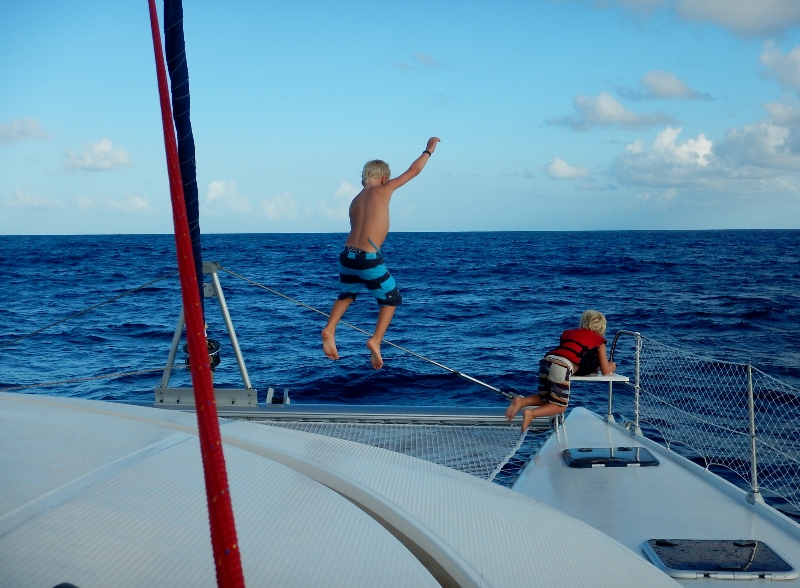
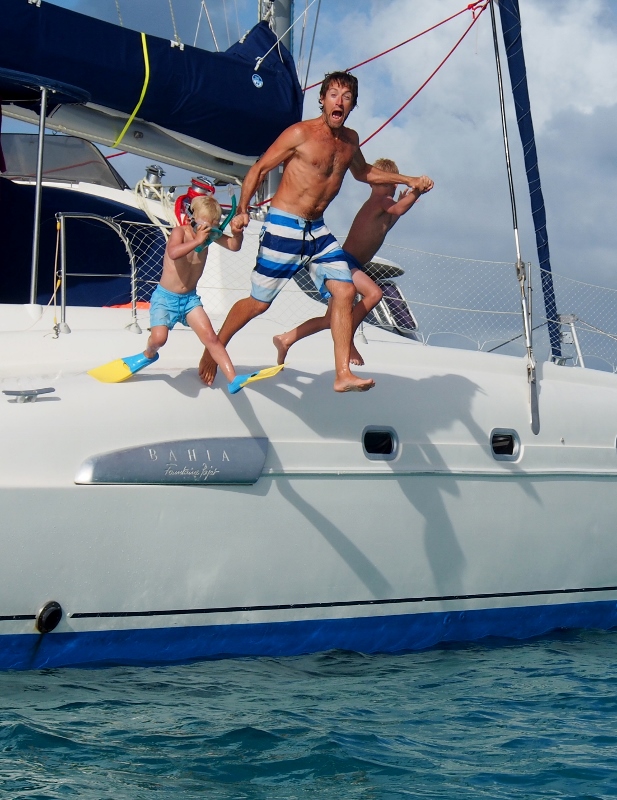
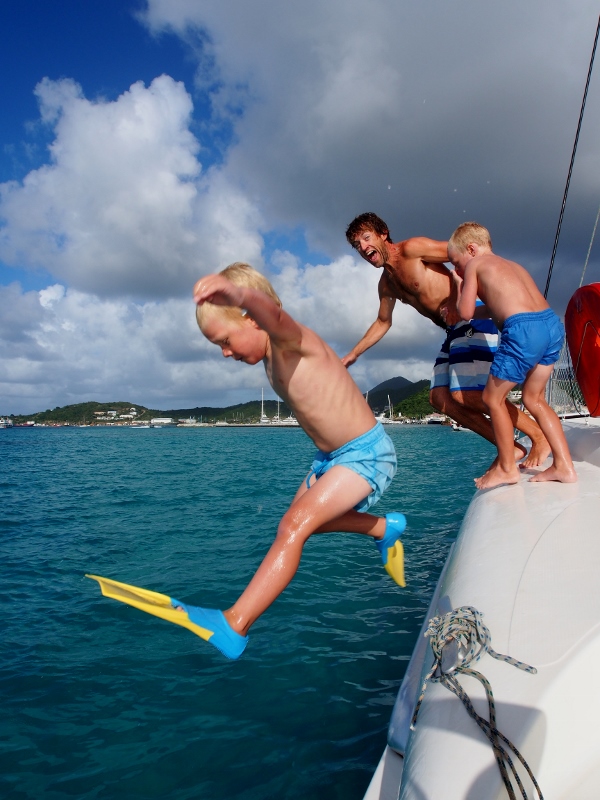
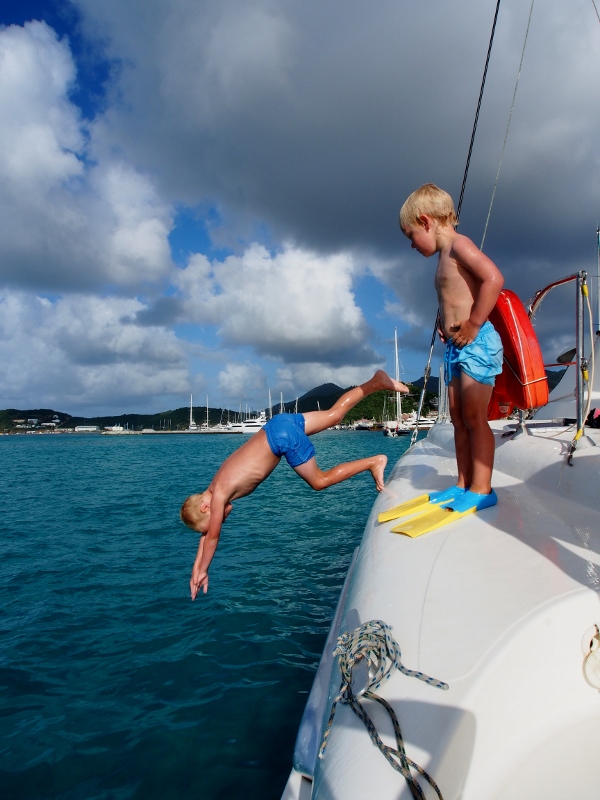
It is going to be difficult to provision for the upcoming long crossings. The children are growing like mushrooms, and eating us out of the boat already. Maybe it is because they swim so much, getting chilled, maybe it’s all the jumping. At the moment, they both seem to eat more than us at almost every meal – cereal and four pieces of toast for breakfast, four slices of bread with topping for lunch, and about half a pack of pasta each for dinner. It makes us nervous about the crossings – we can easily store lots of food, and bring enough for ourselves and two more adults for three months, but can we cook enough at each mealtime? With our small stove and an oven that doesn’t work particularly well we are already struggling to provide the volumes that our family needs, never mind adding in food for two additional hungry crew. Hopefully they like one-pot pressure cooked meals….

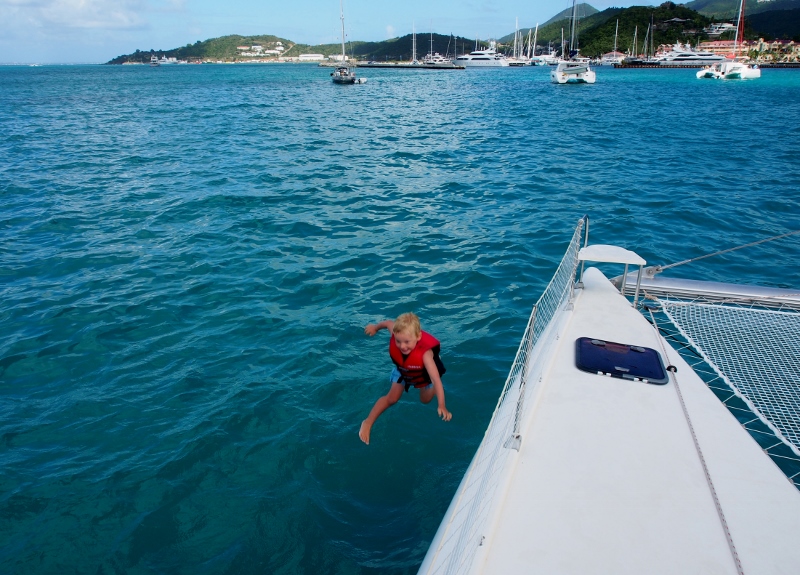
Jumping makes for hungry kids

With our fridge being as energy hungry as it is, we don’t run it much, and food doesn’t last long. Cabbage, carrots and apples easily last three weeks in the fridge, perhaps even extending into the fourth week. Potatoes allegedly last forever without refrigeration, but we’ve often found them going off after a week or two. Onions and garlic will last a long time, and oranges and grapefruit too, but melons go off quite quickly, as do fresh tomatoes, capsicums and lettuce. UHT milk provides an endless supply of milk, and we’re experimenting with UHT cream, to see how it works. Hard cheeses like parmesan can perhaps last for two or three weeks in the fridge, but softer cheeses seem to go off after about a week. Tinned vegetables obviously last, but most of them are intolerable, mushy and flavourless. However, there are a few that tin well – sweetcorn and tomatoes, and some types of mushrooms. We can also bring things like sun dried tomatoes in jars, pickled cabbage, capsicums, olives, capers and gherkins. Meat-wise there won’t be a lot –corned beef is revolting, but we can just about tolerate the small tinned cocktail sausages. We haven’t yet tried SPAM, but I somehow don’t think we’re missing much…

I was wondering how Matias, who is picky about his food, would fare on this diet of limited vegetables, but he seems to have widened his culinary horizons since leaving home, probably a case of ‘hunger teaching picky child to eat’. He now relishes broccoli and tolerates cabbage, and will even ask for oranges, a fruit he hasn’t eaten for years. Lukie as usual is omnivorous – the other day he said ‘Mummy, you don’t even need a compost bin, you have me instead, just give me the leftovers’. More or less true, although he still hasn’t branched into apple cores, onion skin or orange peel. Even so, they cheer when I put a lentil and sweet potato curry on the table, something that wouldn’t elicit a jubilant response back home although I still used to serve it, stubborn as I am.

Fortunately we are starting with smaller crossings, working our way up to the big one. For the trip to Panama, Christophe will join us here in St. Martin, and we’ll head off, hopefully stopping in Aruba on the way if there is time. That will be two passages of four to five days each. Once through the canal, longer passages await. Sarah and Steve are joining us in Panama and staying on till Marquesas or Tahiti. The crossing to Galapagos will be two to three weeks without land, and Galapagos to the Marquesas three to four weeks, depending on wind. We will be able to stock up in Panama, and can get tins and limited fresh food in Galapagos and Marquesas. But any special food we need to buy from here in St. Martin. Just as well that they have all the French specialties; we can get rabbit paté, saucisson sec, smoked oysters and four types of ratatouille, which may lighten the spirits halfway across the Pacific.

There are other areas in which we need to be self-sufficient. Water and medical supplies need to be stocked too. We are debating how much water to bring in addition to the 800 litre tank and the watermaker. Ideally we should have enough potable water for six people to survive three weeks, in case the water tank breaks, gets contaminated or someone accidentally leaves the tap on, and all this coinciding with a watermaker malfunction. Unlikely, but still. If each adult needs two litres a day to survive, and the kids half that, we need to bring 210 litres. In addition to this, we’ll bring milk, juice, soft drinks, and of course beer and rhum, David arguing that beer actually has a net hydrating effect despite being a diuretic.

We have a comprehensive medical kit, and have been stocking up on extras, so feel prepared in that regard, although we are still woefully short on the stronger painkillers that might be needed in real emergencies. The first aid kit originally contained morphine, but being a Class A drug, morphine couldn’t be shipped here to St. Martin where we received the kit. The suppliers offered to replace morphine with Tramadol, which apparently can be shipped, but when we got the kit it contained nothing stronger than ibuprofen. Which is all good for day to day stuff, but for a serious injury we would have liked a stronger option, pain control being an important aspect of treatment. As it is, we’ve just got to hope that we will never need anything stronger than aspirin….

It is not just the life essentials that we have to prepare for, it is also the stuff that makes day to day living nicer. Like spare paper and crayons for drawing, games to play, hair products to tame the frizz, books, music, washing powder and teabags. It is an interesting exercise to imagine what will feel nice in the middle of the Pacific, when land is a distant memory, but I guess anything different will be welcome break of the monotony of passages. The other thing of course is that you tend to adapt to what is available, and so provided we have the essentials covered, whatever we bring will end up being what we need…
Back to Big Fish

The trip back to St Martin is a hard beat, dead into the wind, facing a relatively small but sickeningly choppy sea.

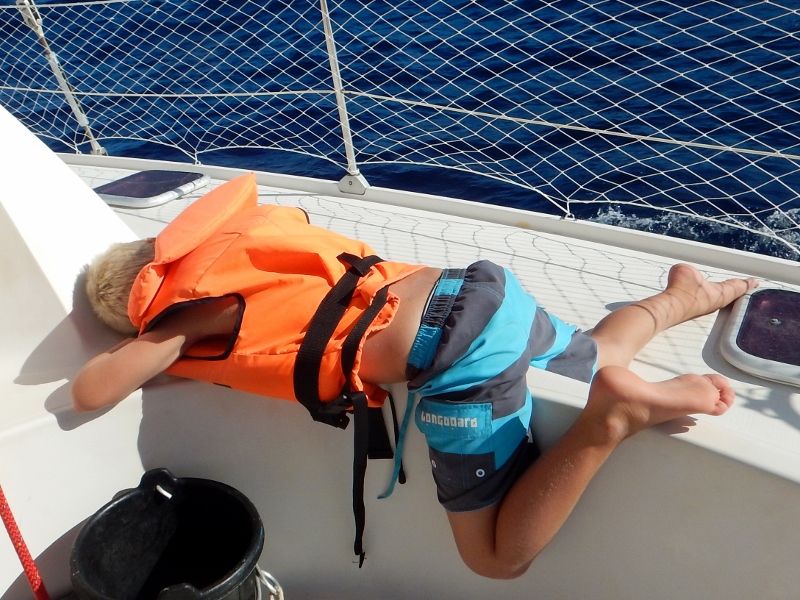
Too sick to jump
Too sick to jump

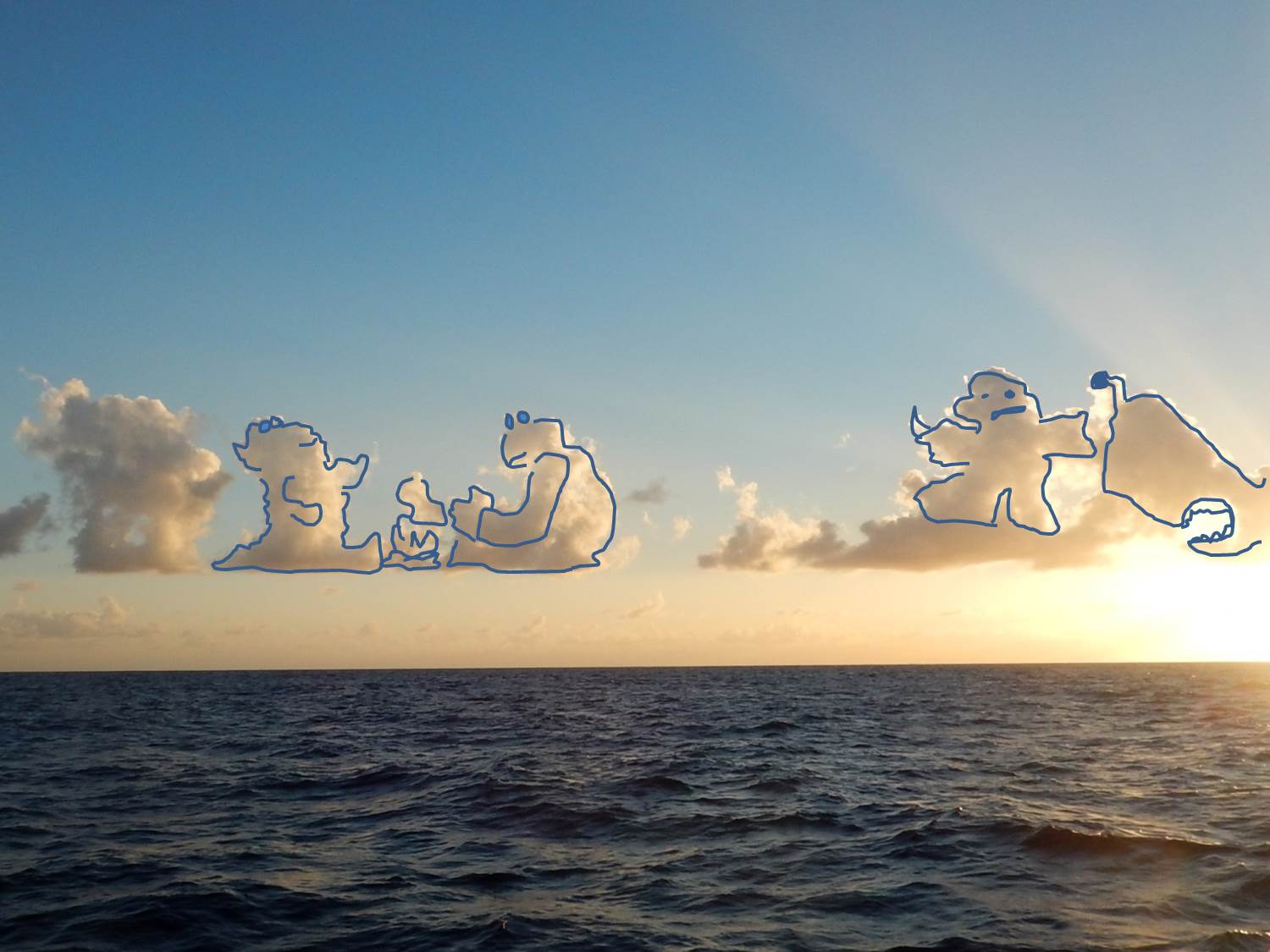
We’re all seasick, the children lying down on the deck looking green for much of the passage. After a game of dominoes with Lukie, Matias vomits over the back deck, and returns to lying down. I have to keep my eyes firmly on the horizon not to be sick. Which is not so bad, really, as the clouds are on display, providing ever more crazy imagery. Fluffy animals in toy trains clinging onto each other as they rapidly slide down a hill. Hungry mean looking fish gaping wide. Lots of dragons, and a couple of cosmic warriors fighting evil aliens, as well as several dinner parties, with creatures of various species, sizes and shapes clinking glasses and lifting plates.

Unaware of the cosmic battle behind them, Guido and his friend enjoyed a nice dinner...
Unaware of the epic battle unfolding behind them, Guido and his friend enjoyed a nice dinner…
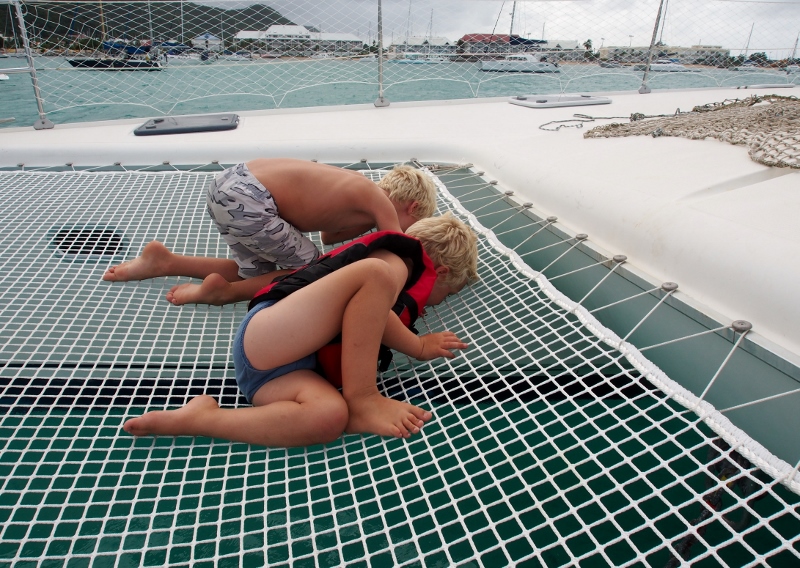
After five hours of fruitless tacking, we finally switch on the engines and attempt to motor straight into the wind. A group of dolphins come to check us out, including a mother with two babies, who swim alongside briefly. This lifts Matias’ spirits and he is able to get some exercise on the trampoline, jumping higher and higher until I fear he’ll fall in.

Jumping again
Jumping again

Just before midnight, as we’re approaching St Martin, we have an exciting encounter. I’m on watch while David is trying to get a bit of sleep, as what appears as two large objects on the radar slowly approach us. With my bare eyes I see only one very bright white light and a much smaller red one some distance behind it. When we’re about 3 miles apart, the white-lit thing starts blinking at me, and looking through the binoculars I can see a lot of lights, obscured somewhat by the blindingly bright light that soon starts blinking again. Anxiously I wake David, who at first thinks it is a stationary superyacht, but as we get closer we can make out the night lights for a towing vessel. At this stage we are about half a mile away, and we hear them calling us on the radio, the captain of the tug explaining that he has a 700 foot tow, politely requesting that we stay well clear. We turn to go behind them, and as they come even closer we can clearly see the tiny red light on the enormous ship he is towing.

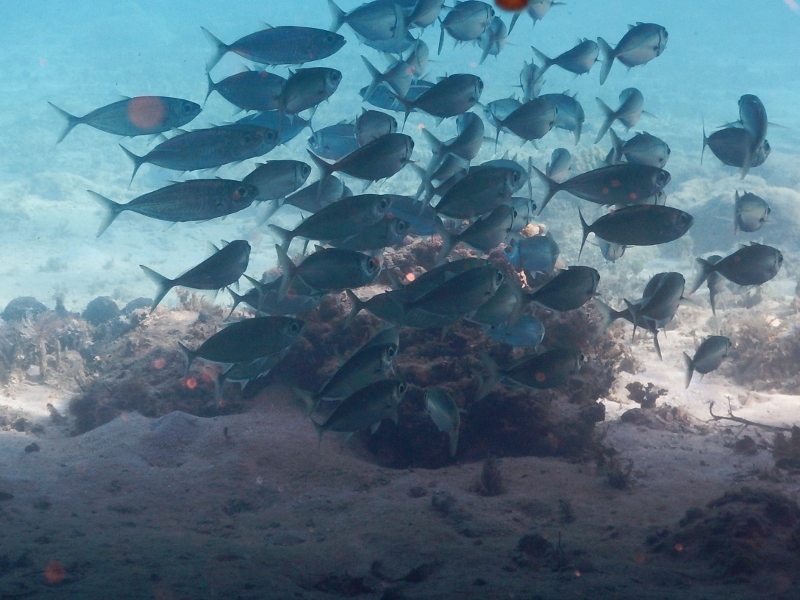
It is nice to see Marigot again, and the following day on our usual anchorage we are greeted by several turtles swimming around the boat, as well as Big Fish who has brought along his entire family to say ‘welcome back’.

Hubert the snail slid away quietly while the goat and the chicken were dining
Hubert slid away quietly when they started sharing escargot recipes…

More virgin time

Whanau on Bob
Whanau on Bob

Gordon and Ann adjust admirably to life on a small boat. They don’t complain about the limited water and the monotonous menu, the relentless motion and gruesome dinghy exits, or the never-ending requests to play cards with the kids. Ann patiently spends hours reading Captain Underpants to the children, and Gordon teaches Matias how to use water colours as they sit drawing together.

Perched at the bow
Perched at the bow

After a couple of days they appear truly relaxed, a bare chested Gordon sporting stubble, competently steering the boat and grinding the winches, Ann elegantly leaping out of the dinghy in her bathers. Gordon does baulk at going up the mast to fix the haliot, instead helpfully tailing the rope as I lower David slowly down from the top, providing another backstop against the certain death of his son should my grip slip.

Long way to fall
Long way to fall

We celebrate our time together by making a 500 piece StarWars jigsaw, and start another, harder one, the children enthusiastically jamming pieces into places they more or less fit. Gordon and Ann brought lots of games, and Lukas soon becomes an expert of the card game Uno, looking very pleased with himself as he wins again and again.

Which shade of blue fits here?

After a week amongst the main islands of BVI, we travel to the island of Anegada, a coral island about 13 NM off Virgin Gorda. The tip of an enormous coral reef, this flat island (highest point 10 m above water level) is famous for its treacherous reefs, making it the home of more than 300 shipwrecks. The island also houses flamingos, extensive inland salt marshes, and a few very threatened six foot long lizards which we’d like to see.

Saltmarshes of Anegada

To go there we pick a windless day as the normally upwind trip can be a bit rough if there is any chop. We go on the first of a couple of glassy days, the water slick like oil, no ripples on the surface and no breeze to lighten the heat. Fortunately there is the water to cool off in, and three generations of Johnson males are soon swimming in the turquoise waters off Anegada.

Cooling off in the water

Anegada provides an interesting contrast to the rest of the British Virgin Islands. Home to the largest charter fleet in the world, the BVIs are easy, comfortable and pleasing to the eyes, aimed at a wealthy, mainly American clientele. The Rockefeller family owns much of Virgin Gorda, and Richard Branson owns several of the small islands around Virgin Gorda, beautiful spots for parties with superyacht friends. Marinas abound and any bay is dotted with mooring buoys belonging to the local restaurants who serve American size portions of delicious meals at premium prices. Gone are the French delicacies, the shops here are full of US brands (Monterey Cheese, pancake mix, 20 types of tacos spice mixes), and tourist boutiques offer classy surf- and sailing clothes as well as individually plastic wrapped dried out starfish for visitors to take home as a reminder of a great holiday. In restaurants well-manicured women with made up faces dressed in flowy gowns order cocktails in posh American accents, and tanned, square-jawed, white bearded gentlemen sporting pot bellies lean back and discuss the week’s fishing.  Anegada, on the other hand, although visited by lots of yachts, is fresher, less polished, with few hotels and a relaxed, if slightly indifferent, atmosphere.

Claw prints
Claw prints

Hermit crab tracks crisscross the extensive white beaches, the backdrop to all the snorkellers. The reefs are meant to be wonderful, but on our brief foray underwater we don’t see much other than dead coral. When we ask around about where to find the elusive giant lizards in the wild nobody seems to know. Fair enough, there are not many left, and after wandering around in the windless inland for a while, we give up and decide that they probably don’t want to be spotted. The flamingos, on the other hand, are out in their glory, as are numerous other birds in the salt ponds.

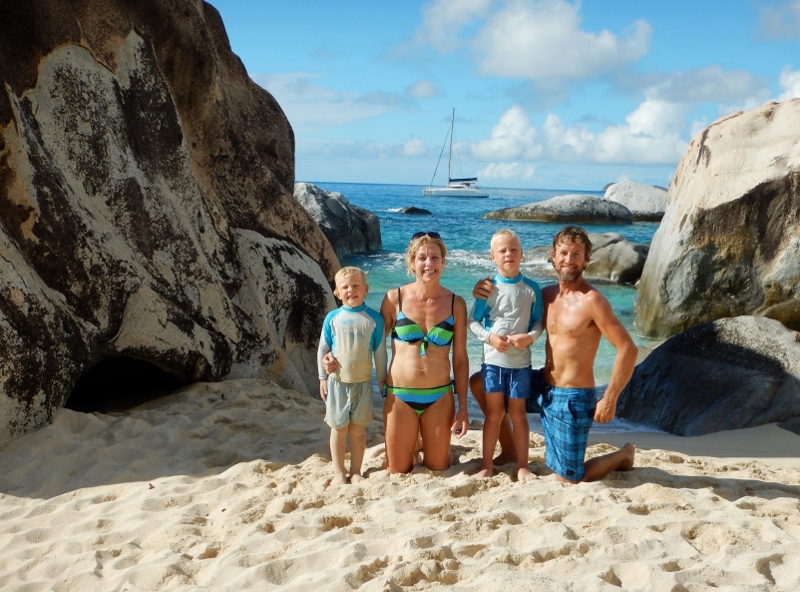
Family photo from the Baths - Bob in the background
Family photo from the Baths – Bob in the background

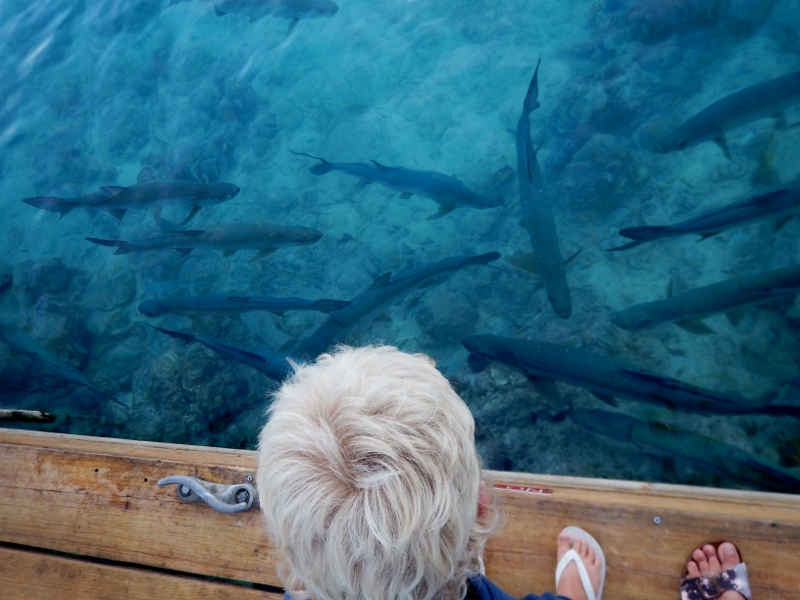
After a couple of days at Anegada, we return to Virgin Gorda, for Gordon and Ann to see the Baths and Spanish Town, before we drop them off at the Gorda Sounds, from where they’ll make their way back to Tortola, Antigua, and ultimately England. On their last night we dine out at Saba Rock, a restaurant on an island at the head of the Sound, all enjoying expertly cooked fish while the children study the huge tarpon gathering for scraps in the water beneath the restaurant decking, and play with the other kids around. Gordon complains of the restaurant moving, a sure sign that he has got his sea legs – you know you live on a boat when you feel like the land is moving ashore!

Lukie and the tarpon

It has been great to have visitors, and we are all sad to say goodbye as drop Gordon and Ann off at the Bitter End Yacht Club. The children want to sail to Britain immediately so we can see them again soon, and we promise to go back as soon as we can. It has been lovely to share our new life with family, and once again we are sad that we don’t live closer, so that we could be with family more often.

Waving goodbye from the Bitter end
Goodbye from the Bitter End

Pelicans and pirates

Our two courtesy flags

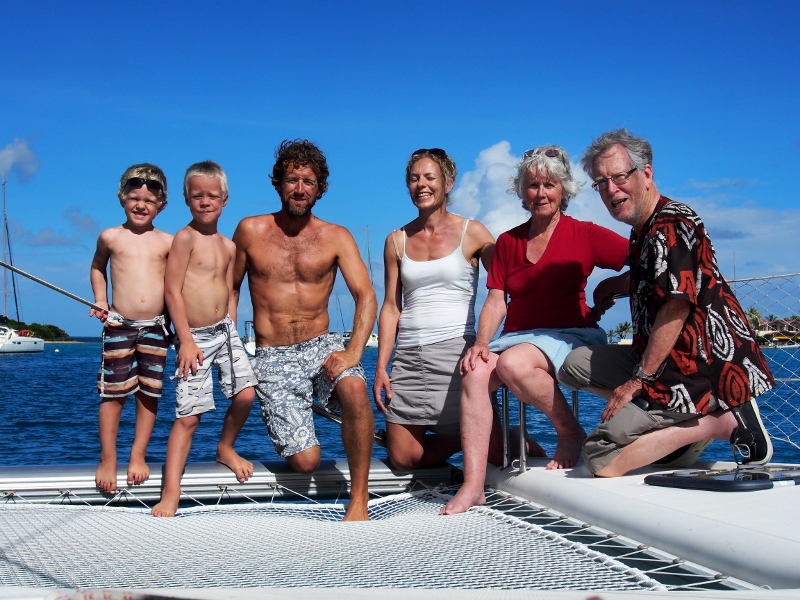
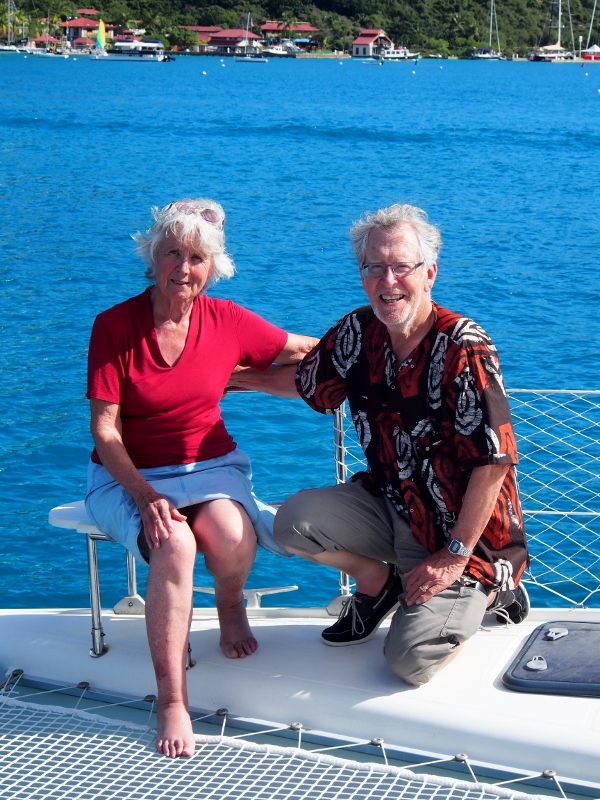
David’s parents, Gordon and Ann (known as Grandpa and Gu – Welsh for grandmother – to the children) join us in the British Virgin Islands, where we pick them up by dinghy from the small airport in Trellis Bay, Beef Island just off Tortola.

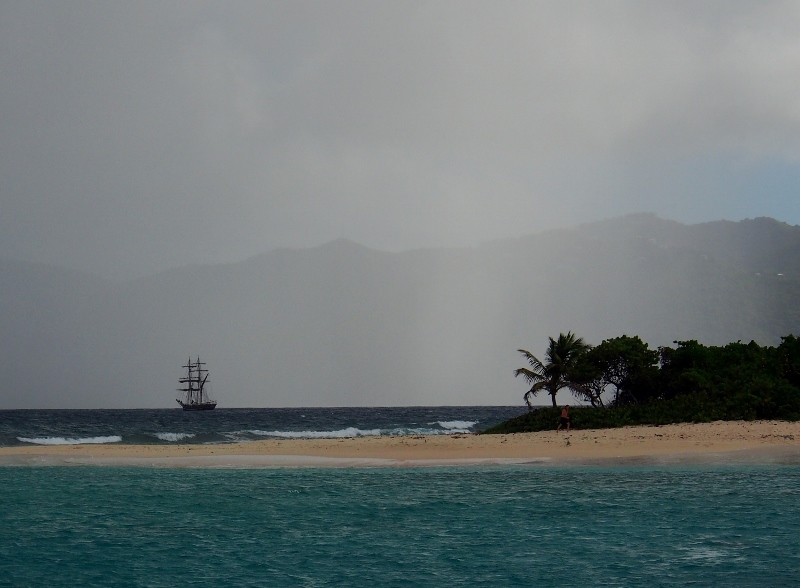
Pirate ship off Jost Van Dyke

The theme of the week is pirates, and as many birds as we can find, Gordon and Ann being keen bird watchers. The Virgin Islands were named ‘The Eleven Thousand Virgins’ by Columbus, who wrote favourably about the islands to the Spanish monarchs, but unfortunately for the Spanish they didn’t keep a presence in the area and it was quickly taken over by the British, Dutch and Danish.  The small cluster of islands became a favourite hangout for pirates, who hid amongst the numerous islands, waiting for Spanish treasure ships carrying precious cargo of gold plundered from the New World, ambushed them, and then went back to the maze of islands to hide their loot.

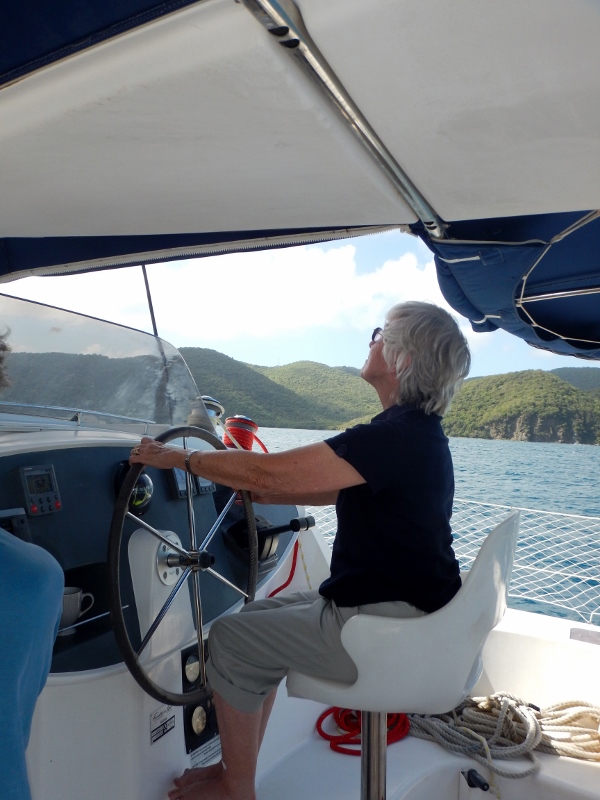
Captain Gu
Captain Gu

The pirate presence is still strong, with colourful names such as ‘Dead Man Cove’, ‘Gun Creek’, ‘Treasure Point’, ‘Dead Chest Island’  and ‘Privateer Bay’ making any landfall exciting for the kids.

DSCN0094 (2)

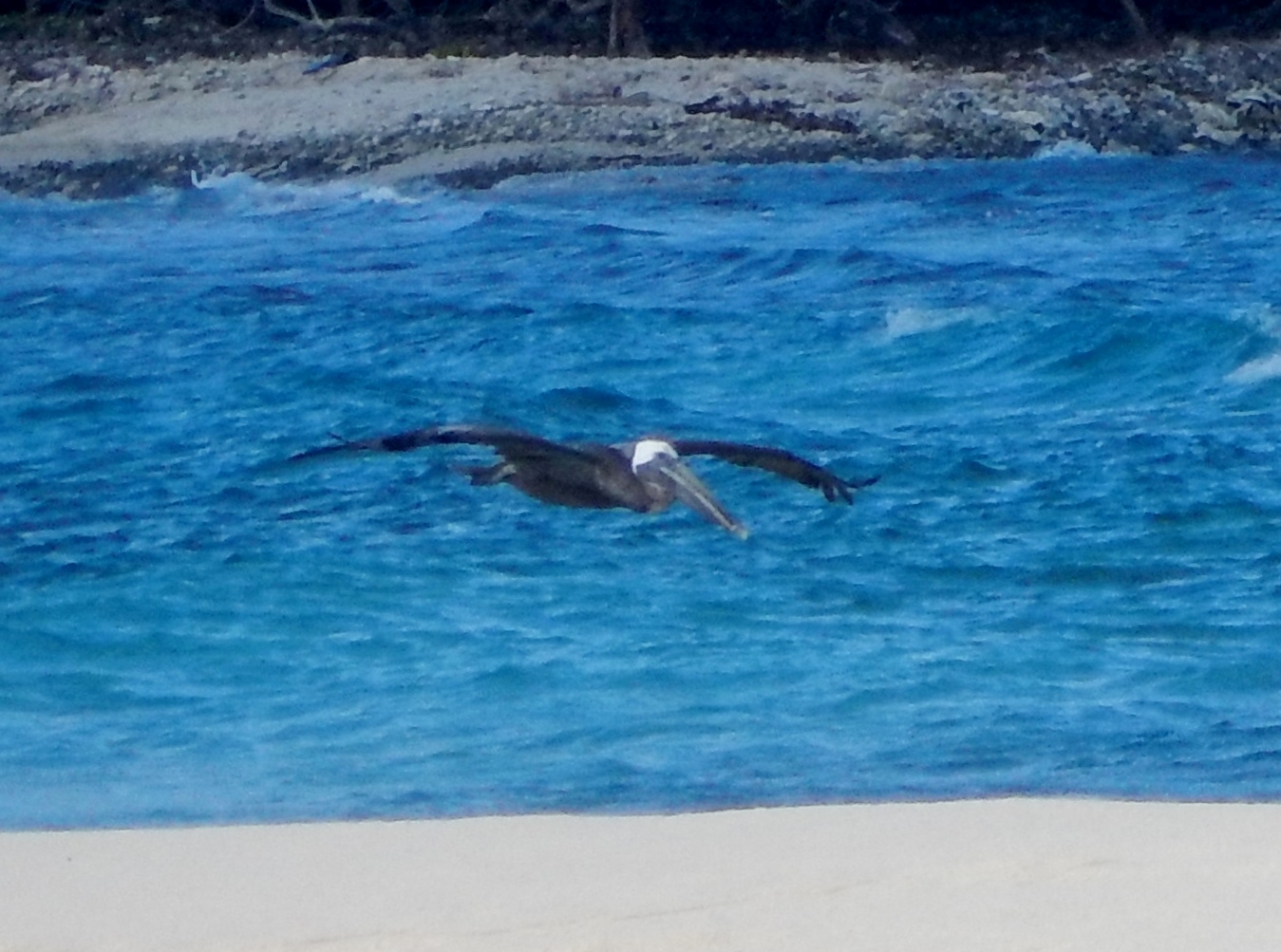
First stop on our whirlwind tour is Jost Van Dyke Island, named after a famous Dutch pirate. Paying homage to Jost, we decide to hoist the Jolly Roger Matias designed so that it can keep the official BVI courtesy flag (sporting an angelic looking virgin) company. Pelicans are everywhere, awkwardly ugly, slightly angry looking birds, beautiful in an ungainly sort of way. They hover some height above the water, looking down indignantly, spot a fish, perform a quick swoop and plunge into the water in an outraged manner, greedily gulping down their catch upon surfacing, after which they go back to bobbing on the water, looking tired and pissed off. In sharp contrast, the elegant Frigate Birds glide above, their sharp outlines against the light blue sky looking infinitely more refined.

DSCN0095 (2)

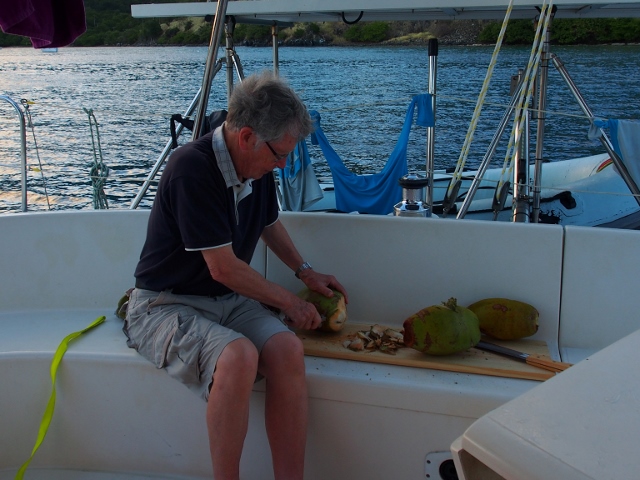
David and Lukie snorkel from one small island to the next, where David climbs a coconut palm and to Lukie’s delight drops down five good sized coconuts. They swim back laboriously, clinging onto their harvest, Lukie proudly coming onto the shore with two large coconuts. Opening the coconuts befall to Grandpa, who labours tirelessly to open a nut, so we can all taste the sweet flesh.

Cracking the nuts
Cracking the nuts

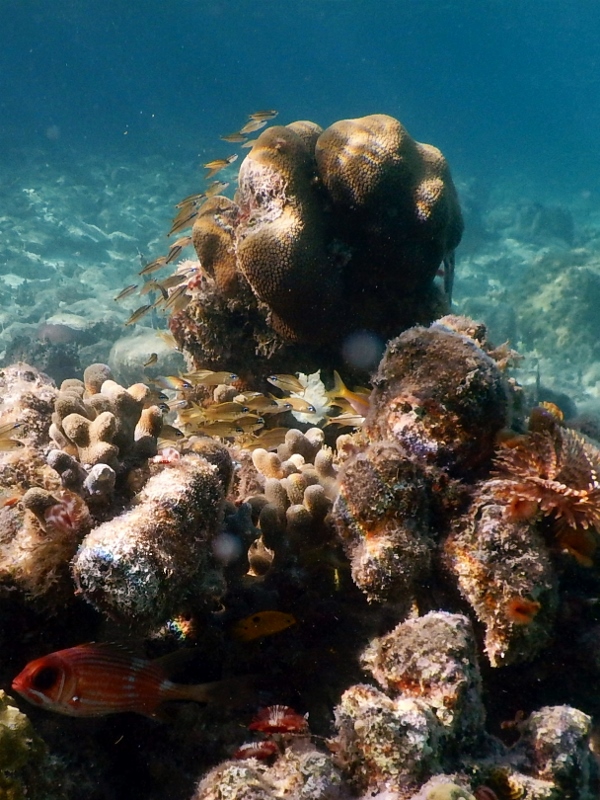
Later on in the week we visit Norman Island, allegedly the inspiration for the book Treasure Island by Robert Louis Stevenson. Local folklore has it that a family found a Spanish treasure in one of the underwater caves, and we eagerly snorkel to the caves, hoping to find loot. When we get there yellow, orange and red sponges adorn the cave walls, glittering brightly, but to the great disappointment of the children we find no gold bars.

Sponge treasures in the cave

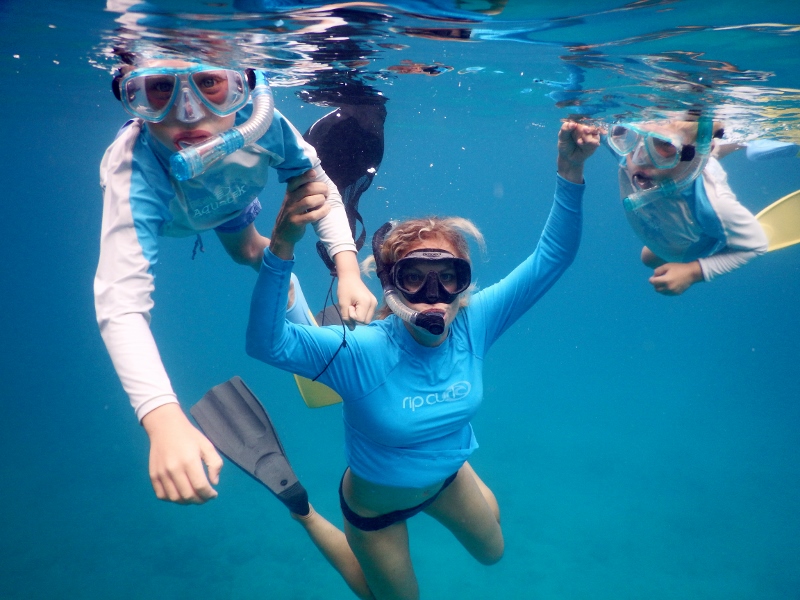
Visiting Peter Island, we anchor in Dead Man Bay, home to lots of live fish and turtles. Two large remoras are hanging under the hull of the boat, causing the children to shout ‘shark, Mummy, shark’ as they enthusiastically dive in. After a while the remoras leave us, and when we later snorkel towards the beach we see one attached to a turtle.

Matias looking at remora under the hull


The following morning we head to Salt Island, where we stop to snorkel the RMS Rhone, a British mail steamer that sank in 1867. It is a beautiful wreck, encrusted in corals, full of fish of all colours. Salt Island is named for the salt ponds which were in production for hundreds of years.

Wreckage
Wreckage

When we stop off in Road Town, the capital of Tortola, to find a laundry and a supermarket, we manage to somehow snag our anchor on two (!) chains, probably anchor chains from nearby boats, although lying at an odd angle. After much heaving, winching, grinding, tying of knots, peering over the side and plotting our escape, we manage to get them off, by tying lines onto the chain and winching them off, one by one. We never managed to find a laundry, and the pile of washing is growing as we head off for another week of cruising. The quote of the week is from David: ‘Desperate times call for desperate undies’ as he dons the multi-coloured handmade undies that I bought him from a small shop in Raglan many months ago.

Off Peter Island
Off Peter Island
Salt Island snorkelling
Snorkelling around Norman Island

Closer to the elements

We feel a lot closer to the elements here than we did at home, the wind in our faces, filling the sails, the water rushing under our feet when we’re sailing, gurgling under the hulls while on anchorage. Using only the wind to travel feels very satisfying, especially in this modern age of global bellyache from gorging on fossil fuels.

Back when these islands were first populated, the wind and food (and later on, rhum) were all the external inputs that sailors needed to go wherever they wanted. And it never ceases to amaze me, a child of the modern developed world, how powerful the wind is, how incredible it is that you can travel around the world, by wind alone.

When the wind is too strong: remnants from the last hurricane is St. Martin - a catamaran on the shore
When the wind is too powerful: remnants from the last hurricane is St. Martin – a catamaran on the shore


Without the convenience of water and electricity on tap, we have to bring everything we use with us, forcing us to notice our consumption. We’ll need to be super efficient when we get to the long Pacific crossings (which could take up to 4 weeks without any possibility of adding fuel or water); but more than that it is about trying to lower our impact, aiming to live as much as possible from the sea, the sun and the wind.

Our water tank holds 800 litres of fresh water, and we preserve it as best we can. That means washing up in salt water, and only rinsing off in fresh. Never leaving taps running. Having ultra short showers, or no showers at all. Normal soap doesn’t work in salt water, so we have special salt water soap and shampoo.

We cook with salt whenever on a clean anchorage, using half salt water, half tank water for pasta and rice, salt water for bread dough once the yeast is working, boiling eggs and potatoes in salt.

In order to get more water, we have two options: either find a place where we can buy it (which is not always easy in remote areas) or turn on our watermaker, which makes lovely fresh water from seawater through a process known as reverse osmosis.

Which brings me to power. The watermaker works off our batteries, and to keep the batteries topped up, we have a large solar panel on the back of the boat. This can easily keep our batteries topped up on a sunny day. Another option is to run the engine and charge the batteries by burning diesel. Making water is expensive in terms of power – it really drains the batteries. But as the watermaker can make about 60 litres an hour, it doesn’t have to run for long each day to replace what we use. We worked out that when we are not super careful we use about 50 litres a day for our family of four.

Sunset reflecting in our lovely solar panel

We use gas for cooking, which is quite efficient, and a bottle seems to last three months or more. And of course, we use petrol for the dinghy, although it has oars. We’ve been trying to buy a sailing dinghy, but so far have had no luck.

Apart from the watermaker, the other big power user is the fridge/freezer, which we currently only run for about an hour a day, when the sun is high in the sky. Not perhaps quite enough to be entirely foodsafe, but enough to keep the temperature below 10 degrees most of the time. We bought a thermometer to figure out how cool the fridge got, and it was working fine outside (38 degrees), fine in the water (32 degrees) but not so fine in the fridge (-23 degrees). A new thermometer shows the temperature in degrees Fahrenheit, clearly within the ‘danger zone’ for fridges. Dairy is OK for two days if we keep it in the freezer, where temperatures stay in the fridge ‘safe zone’ most of the time. As we don’t have access to a lot of dairy or meat, the exact temperature isn’t crucial, but on the other hand we could stock up with more of the stuff if we had a working fridge. Kind of chicken and egg situation (of which we currently only stock the eggs, because they’ll keep outside the fridge).

Whenever we turn the engine on, the watermaker and the fridge go on too, and we joke that in a man overboard situation, the desirable course of events is to hit the ‘Mark’ button on the GPS, turn the wheel to heave to, throw out the bouy to the person in the water, switch on the engine and then switch on the fridge and the watermaker. And then try to lower the sails and get back to the person rapidly drifting away.

On ocean crossings we may chose not to run the fridge once the fresh vegetables are finished – we’ve crossed the Atlantic on boats with no fridge before, and it doesn’t detract much from the experience.

Barring whatever energy went into making the boat, we certainly have a much smaller environmental footprint here than we did at home, where we ran cars, had baths and watered our flowerbeds. The only thing we’re doing less well on is plastic – it is everywhere in the supermarkets and hard to avoid. Of course, we’re not working while we are away, so there is no transport to and from work. And to make this trip possible, we had to fly out to the Caribbean, so there is still a hefty carbon debt to pay off. Nevertheless, it is good to teach the kids to be in touch with what we use, to be aware of the resources on which we depend, and to try to minimise the consumption of fossil fuel energy.

Now all we need is to catch some more fish, so we can start getting our food from the ocean…

Water fun

The Baths at Virgin Gorda

Finally we leave St Martin – after waiting all day for a call about an Optimist we might want to buy (which turns out to need too much fixing for us to commit – exhausted as we are after all the poo fixing of recent times) we head off for an overnight sail to Virgin Gorda in the British Virgin Islands.

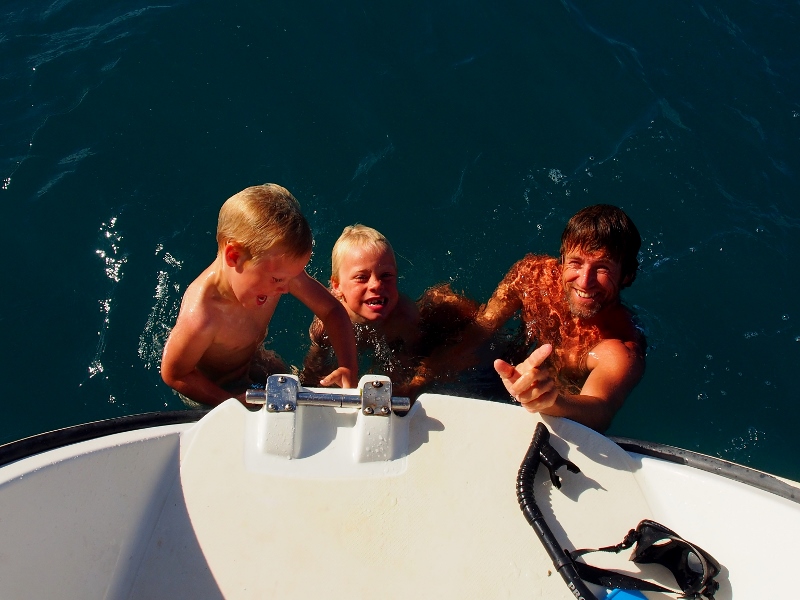
We celebrate our last day (until we come back before we leave for Panama) by jumping a lot.

OLYMPUS DIGITAL CAMERA


OLYMPUS DIGITAL CAMERA

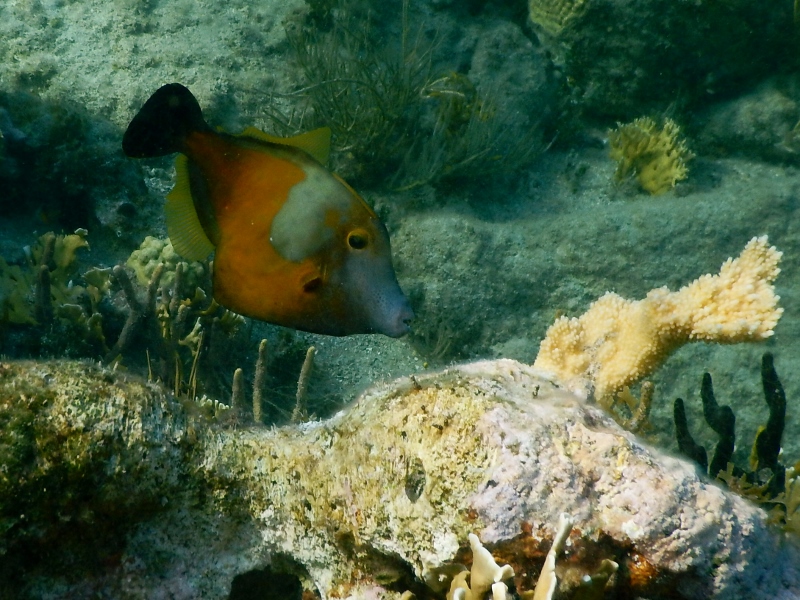
OLYMPUS DIGITAL CAMERAVirgin Gorda seems lovely. We head straight to ‘the Baths’, a famous snorkelling site within the island’s natural reserve. The water is warm and crystal clear, and we snorkel ashore, and spend hours in and out of the warm water. It is like a gigantic heated swimming pool, decorated with beautiful corals and colourful fish. Later, after dinner at anchorage, Matias swears he sees a seal!?! We’ll go search for that tomorrow…

DSCN0044 (800x600)

DSCN0017 (800x600)DSCN0067 (655x800)

DSCN0077 (600x800)


Poo-fixing

Tying knots
Tying knots

We head back to St Martin to celebrate the New Year and to continue the relentless boat work. On anchor at the ocean side of Marigot we are near to services and shops, yet in water that we can swim in, with turtles and several unidentified large fish swimming around the boat.

The main issues to solve before we head on are poo related. One is a blocked pipe in one of our four Jabsco toilets, jammed closed by wads of toilet paper left in by a child who shall remain nameless. It proves impossible to flush, and in the end we have to disassemble the whole toilet. The pipe is rigid in places, and we suspect the children of having put coral bits in there, but it turns out to be a centimetre thick layer of what looks suspiciously like fossilised poo, left behind by ten years of inadequately flushing charter guests. In reality probably just lime scale stained an unappetising brown, but still gross, and signifying an unhealthy system – like a plumbing stroke waiting to happen, a heavily plaqued artery just waiting for a blood clot.

The Jabsco Man at work

After changing the pipe we vow to douse the loos in vinegar regularly, to prevent any future poo-scale build-up.

Another issue is a more serious one. In order to enter the Galapagos Islands, we have to have a ‘black water’ system, because the discharge of human waste into the waters there is illegal. Having not got the time or the money to order in the custom made part from Fontaine Pajot, we decide to do a home-made installation. David spends days looking at tanks, taking measurements, poring over catalogues, trying to find the best solution. He brings back large tanks, and replaces them with even larger ones. He straps them up on walls, constructs shelves, drills, saws and swears a lot. Jabsco parts litter the boat, bags and boxes depicting alluring slogans like ‘Jabsco – Making your boat a better place to be’ (no doubt true), and ‘Jabsco – Why not upgrade your toilet NOW!’

We enviously eye up the nearby monohulls on anchorage – they have little deck space, they roll heavily on anchorage, they have a much higher chance of children accidentally falling overboard when underway – but they have one, maybe two toilets, compared to our four! A quarter or half the plumbing work! Imagine…

Jabsco is making a killing from us, and get plenty of free advertising from the children, who now role play a game involving a young boy called ‘Jabsco’, who is very brave and comes to the rescue when someone is drowning. ‘Matias, let’s play the Jabsco game’, Lukie shouts happily.

Following Big Fish from the tramp

After a couple of days of struggle we emerge victorious from the battle with the Jabscos, with the upside of now having out own resident large fish, a 1 m long unidentified slim bodied fish who seems to like the ‘poo scale’ arising from the cleaning of pipes. A small shark also hangs around, enjoying the spoils.

Other minor issues are dealt with too – electrical switches, turning the wash down pump from fresh to salt, installing a new stereo, replacing a broken deck shower. We buy spares and reserves and anything we imagine we might need for a Pacific crossing. We experiment with food – this is where we will stock up before heading to Panama, so we might as well try what is on offer here – and find little gems like dried mushrooms, pickled peppers, tinned lentil ragouts which might be useful for when we run out of fresh food.

On New Year’s Eve we have a beautiful dinner by the seaside in Marigot, a play in the park under the coloured lights, after which we head back to the boat to put the kids to bed. We listen to ‘St Martin Radio – Music and News’ which consists mainly of French rap and Phil Collins covers. At midnight the anchorage fleet bob around, their anchoring lights swaying like lighters at a 1980s Phil Collins concert, surrounded by fireworks going off all around. We are bathed in light. Plenty of flares fly overhead too, their red glow lingering in the night sky for longer than fireworks. We remember last New Years, where we were planning the trip, and are happy that we are here.

Jumping games
Jumping games

Later on in the week, the radio station observes two minutes of silence to commemorate the dead from the terror attack against Charlie Hedbo, and we sit here wondering at the craziness of fanaticism. I’m reading Churchill’s ‘History of the English-Speaking Peoples’ and am struck by a quote about ‘the primary right of men to die and kill for the land they live in’, which sends shivers down my spine, it conveying so well our human passions, and the violence with which we will defend what we hold dear. Capable of so much love and of so much violence, us humans. Creators of great civilizations, and of their destruction.

Crazy jumps
Crazy jumps

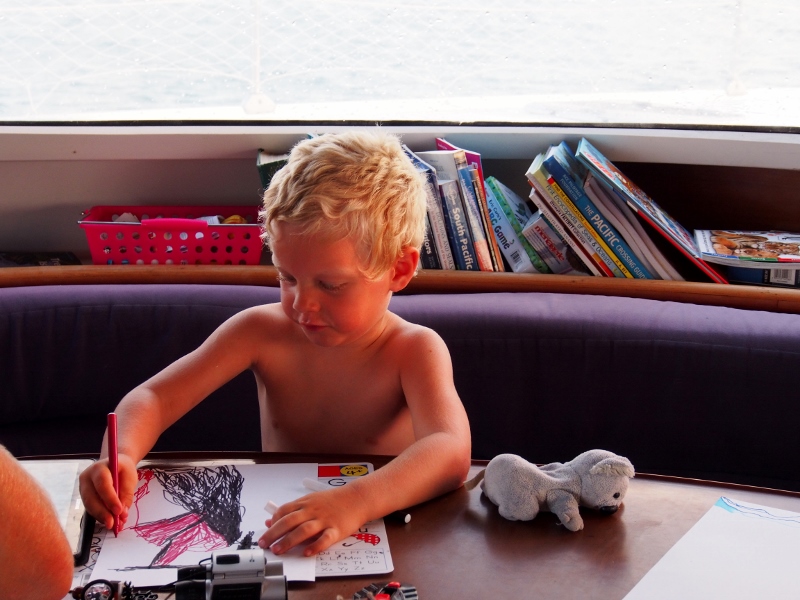
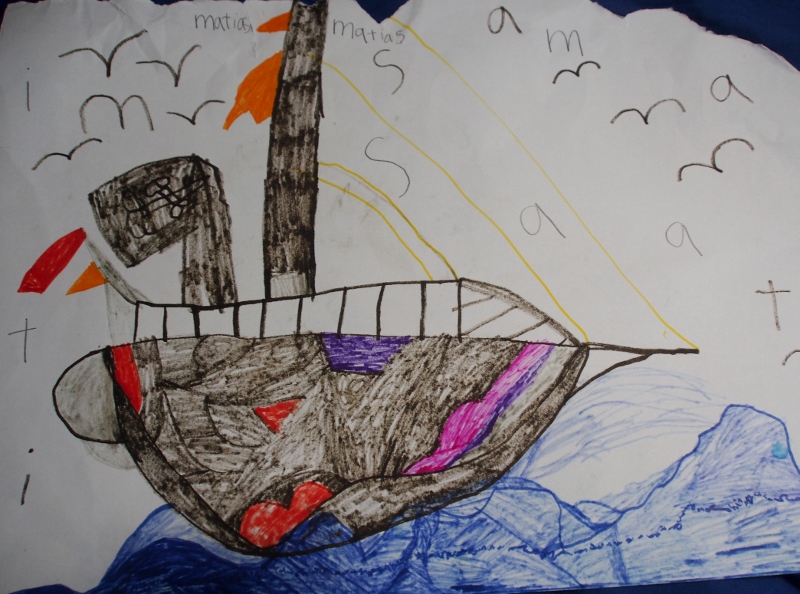
Amidst all the toilet repairs, the children spend much time drawing and playing games – cards, chess, ludo, four in a row. They jump off the boat again and again under their assumed names of Jabsco and Jack. Their drawings depict pirate ships and leisure boats, with anchors and exploding bilge pumps, surrounded by sharp rocks threatening immediate wrecking, sharks, flying fish and seagulls aplenty.

Drawing
Drawing


OLYMPUS DIGITAL CAMERA

Ilet de Tintamare

Fun in the water
Fun in the water

Exultant with the joy of having escaped Simpson Bay Lagoon, we pull anchor early on the 26th and head upwind to Orient, a bay on the eastern side of French St Martin, famous for wind- and kite surfing. The rudders still have to set, so we’re only allowed a gentle motor and it takes a couple of hours to get there.

Enjoying the surf
Enjoying the surf

We stay in Orient Bay for the day, kitesurfing, playing in the waves, mixing with the hundreds of tourists enjoying the beach. In the afternoon we head to Ilet de Tintamare, a little island just north of Orient Bay which is part of the wider nature reserve of the area.

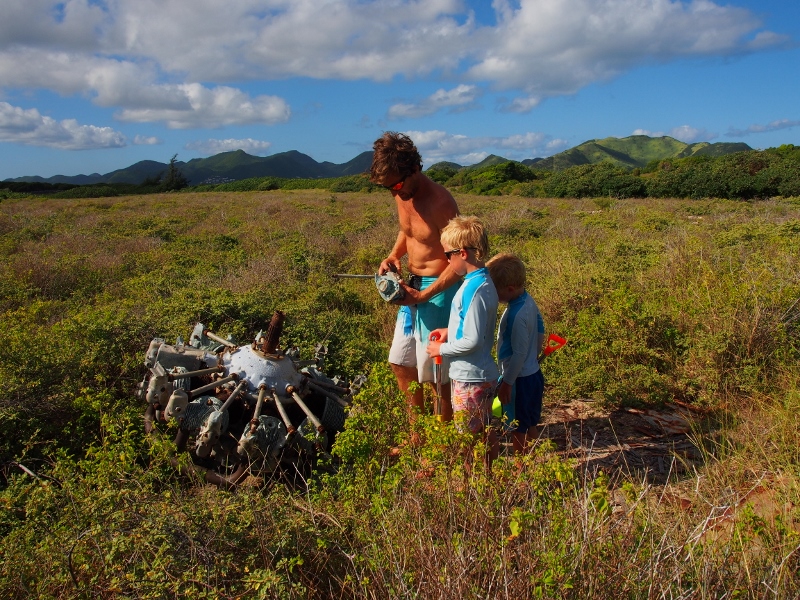
Named for its beautiful turquoise shallows, Tintamare (‘colour of the sea’) is a lovely spot. Situated 1.5 NM from Orient Bay, this uninhabited, privately owned island used to be a hub for smugglers, who used a little airstrip to fly in contraband goods for distribution throughout the Caribbean. Inland are several airplane wrecks from the 1940s, as well as numerous goats and a few stringy cotton plants, left over from when the island was inhabited.

Surveying airplane remains

The little bay where we are moored is home to at least ten turtles, who keep popping up their heads, eyeing us curiously. When I sweep the deck in the morning and throw the dust in the water about fifty fish come to have a taste, including a small shark. The kids jump in immediately, trying to see the shark, but it disappears quickly.

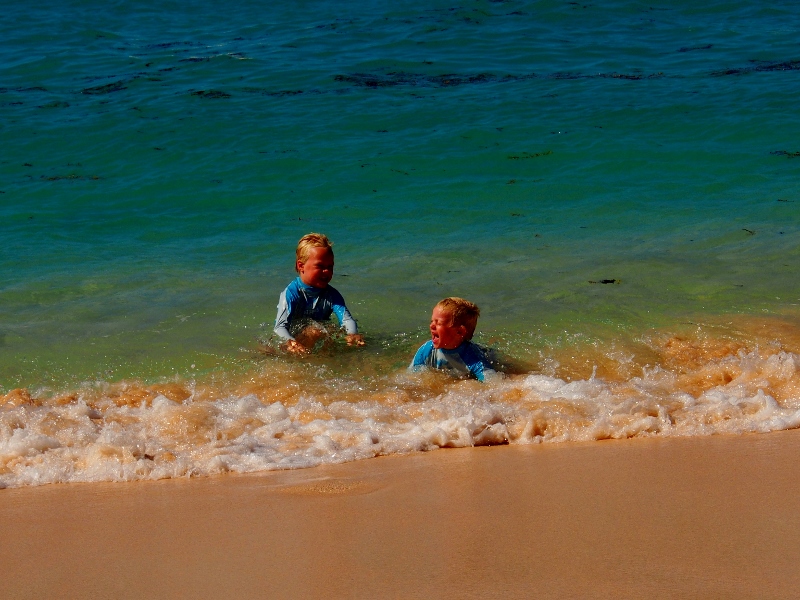
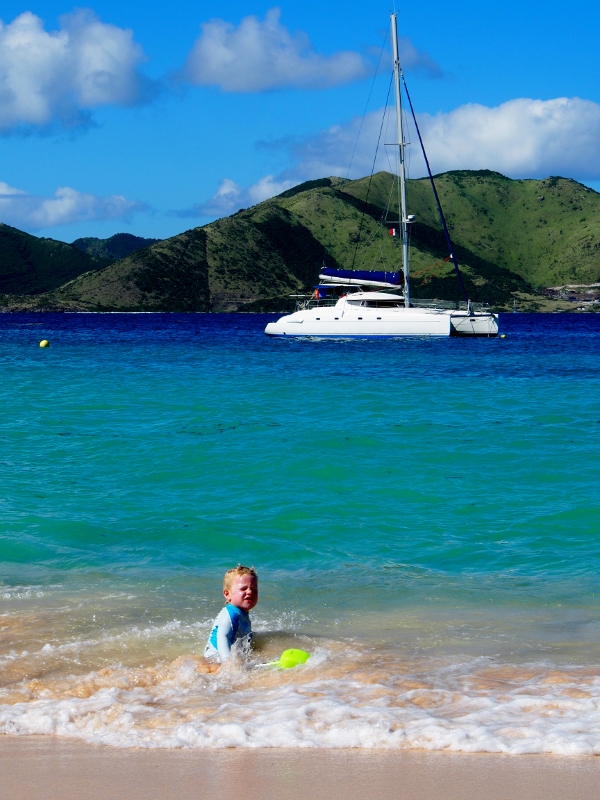
Day trippers arrive throughout the day from Marigot and Orient Bay, discharging snorkelers who happily swim with the turtles for an hour, and then head home. We head to the lagoon on the eastern side of the island for a kitesurf, which is lovely – we bought new boards before leaving Martinique, and they are great. The children spend hours playing in the surf, getting swept in and out, smashed onto the beach, swallowed up by white water, emerging happy every time.

Lukie playing with Bob in the background

In between the play we find time to do the inevitable boat work – stringing on a new trampoline, tying on child netting, slowly working on our long list of tasks.

Attempting escape

Leaving St Maarten proved almost impossible.

Bob the Cat finally got back in the water on the 23rd, and we had all intentions of leaving Simpson Bay Lagoon that afternoon. Situated on the eastern side of the island, the Lagoon is a fully enclosed water body which is only accessible from the outside under one of the two lifting bridges, one on the Dutch side, and one on the French side. Another lifting bridge divides the lagoon in half, separating the French and the Dutch sides. We want to go through the lifting bridge to the French side, exit the lagoon through the next lifting bridge, and then on to Orient Bay, where we are hoping for a nice holiday with a bit of kitesurfing.

David in the rain, determined to escape


The last day in the Megayard is hectic. Our credit cards are sucked dry, and David has to drive around to try to get internet to transfer money so that we can access funds again. I give him my card, writing my pin on the back of his hand, so he can raise money for us both. He comes back reporting that my PIN didn’t work, and I realise I gave him the wrong code. The yard charges about double what we were quoted, so I set off trying to raise more cash, armed with the right PIN code. It takes half an hour of walking in the hot midday sun to reach the nearest ATM, which promptly swallows my card, the machine displaying a message that it has been reported lost or stolen. Only I’m the card holder, and I haven’t, but I guess David’s attempts to get money using the wrong PIN code is bound to raise the alarm. The bank manager is lovely, but insists that she can’t release the card unless she hears from my bank, and it takes another four hours and several phone calls to Westpac to get the card released. At the end of it all, I am back where I started, no cash available for another 24 hours, but I am too grateful to have the card back to complain about this delay.

At this stage we’ve missed the plumber who was going to call Marie-Claire’s flat at midday to let us know when he could come to fix the water leak which is worsening rapidly, the water now pouring out of the pipe.

There is much delay getting us in the water – another boat has some engine problems and needs to stay in the dock until it is sorted. So by the time we’re back in, it is too late to exit the Dutch side, and we reluctantly anchor back by the superyachts for one more night, vowing that it will be the last.

The next day we get up early and plan to cross the lagoon bridge to the French side at 9 am. And somehow manage to miss it narrowly; we see the guy driving off as we approach. At this stage we are desperate to leave the Dutch side, and the Lagoon, to get back in the ocean where we can jump in the water without risking serious gastro consequences. David mutters under his breath that we really need to get more organised.

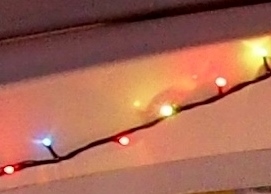
Finally, at 11, the bridge lifts only for us, and we enter the French side. The bridge out of the lagoon opens next at 5:30 pm, so we can’t make it to Orient Bay now. It being Christmas Eve we decide to stay in the flat waters of the lagoon for the evening, so we can have a nice night without too much roll. The kids open a Christmas present each, and we feast on unsustainable salmon steaks from Scotland, Bob lit up with sparkly lights to match our mood.

Christmas bling
Christmas bling

The next morning we plan to open presents and have a nice Christmas breakfast, and then escape the lagoon at 9 am, head to Orient, ready for some fun. Only somehow we manage to miss the 9 am bridge, again arriving just as it closes. David mutters some more about organisation, planning, and us really needing to up our game. We had left half an hour to get to the bridge, but the water is so shallow and the channel (if indeed there is one) so thoroughly unmarked that the progress there was painstakingly slow. It is tense navigation – at one point the depth is recorded as being 0.0 m below keel – and when we make it to the bridge in the end it is too late to escape, but at least we still have both hulls intact.

OLYMPUS DIGITAL CAMERA
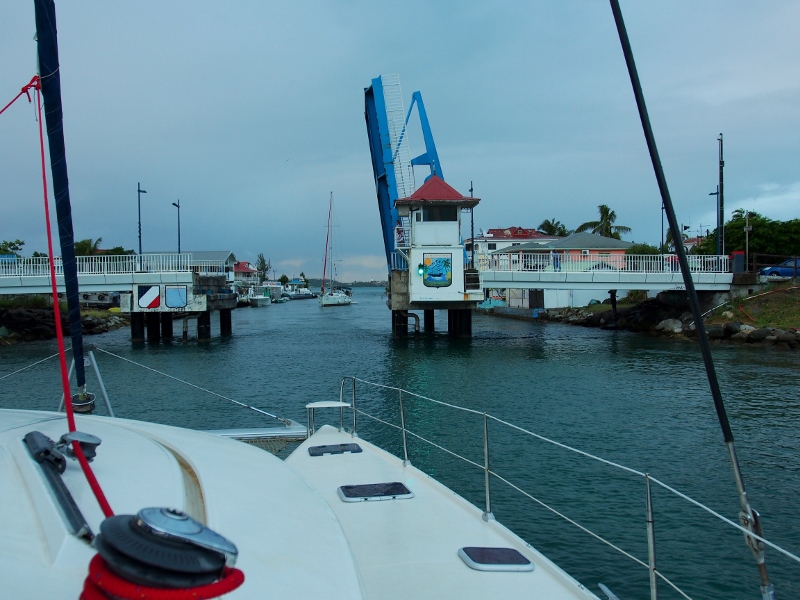
Finally a bridge that lifts as we approach

So we head to the other end of the lagoon, anchor and have a festive Christmas lunch. Dinghying to the beach we have a swim and a play, watch some crazy people hooning around on jetskis and a strange man doing some jet stream walking on water. Determined to become organised, we make it back to the boat, ready with anchor up and a whole hour left to navigate our way back over the shallows to the bridge before it opens at 5:30. This time, of course, we’re early, and as a fierce rain starts we anchor just off the bridge, waiting patiently and then nearly missing it again as it takes longer to hoist the anchor than anticipated. We manage to get through, and anchor jubilantly on the other side, Bob back in the real sea after nearly ten days!