We’re at St Marteen because the boat needed to be lifted out of the water for a change of rudder bearings. We expected a few days out of the water while we go to the beach and do some Christmas shopping, and then straight back in, after which we’d go somewhere lovely to celebrate Christmas.
It turns out that the rudders themselves are corroded, and need replacing. At the same time, a hundred other little jobs have turned up, and as they all seem really important, we’re rushing around trying to fix this, paint that, replace something else.
St Maarten is a bit of a shock to the system after our lovely forays in the windward Antilles further south. It is loud, in-your-face, highly developed and utterly schizophrenic. Upon arrival we anchor straight by Princess Juliana International Airport whilst clearing customs. Every ten minutes we stop what we’re doing as a plane thunders overhead, discharging more tourists onto the island. Couple that with the police sirens, which are going off every ten minutes, and it makes for a very noisy island. There is a constant hum of heavy car traffic, loud music spilling from the windows of cars stuck in jams, waiting at the bottleneck bridges. After clearing customs, we go through the lift up bridge to Simpson Bay Lagoon, where the boat yard is. The lagoon is huge, and full of superyachts, each bigger, shinier, and more expensive than the other.
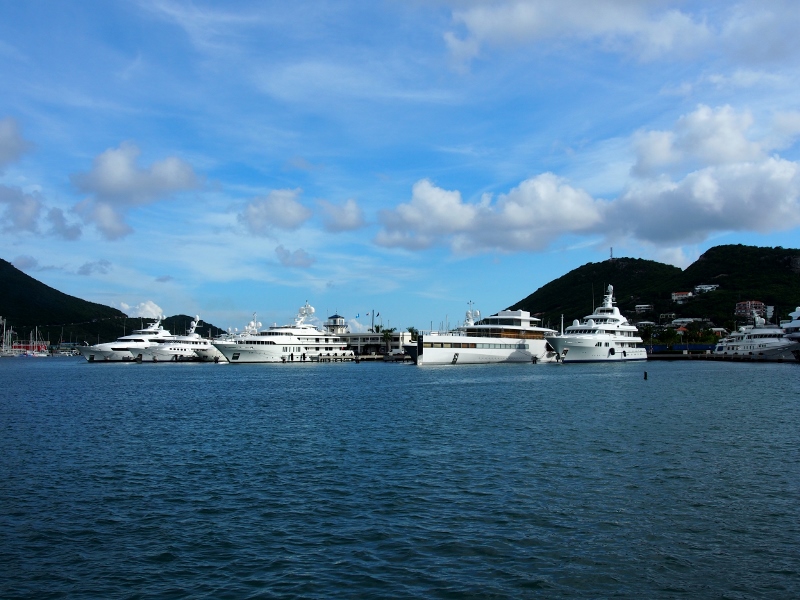
St Maarten is crazy. It is a small island (87 km2), housing roughly 75,000 people. The northern half of the island is part of France (Saint Martin), and the southern half is a separate country under the kingdom of the Netherlands (Sint Maarten). We cleared in on the Dutch side, because that is where the boat is being lifted out, but we’re living on the French side, house-sitting for the lovely Marie-Claire while she and her family are in France for Christmas. On the Dutch side they speak English, Dutch and English based Creole. On the French side they speak French. They two halves have different currencies, with Netherlands Antillean Guilder (official currency) and US dollars in use on the Dutch side, and Euro on the French side. They even have different religions, the French side being predominantly Catholic, and the Dutch side Protestant. The two sides have separate electricity supplies, with different voltages (110 volt, US style plugs in St Maarten and 220 volt, mainland Europe style plugs in St Martin). Which is a great annoyance to people like Frederick, who is helping us with all our boat repairs – he works on both sides and lives on the French side, and has to have two sets of power tools.
Like most Caribbean islands, St Maarten/Martin has an interesting history. It was named St Martin by Columbus, who claimed it for Spain when he first spotted it on St Martin’s day in 1493. Spain didn’t really care too much though, and the island was soon settled by the Dutch, who disrupted the local Caribs and took up salt production. They were followed by French colonists who grew tobacco. In 1648 France and the Netherlands signed the Treaty of Concordia, officially dividing the island into two sides. Subsequently, the island changed sides the usual few times, becoming all French, all Dutch, and even entirely English, before settling back down into its divided state for good in 1816.
The island is infamous for its corruption, crime and money laundering. The lax tax laws bring business, although plenty of it of a dodgy variety, and the island government on the Dutch side were thought to have close ties with the Italian mafia in the 1990s. For a long time it has been known as a place easy to get work, so immigration has soared – Dominicans, Haitians, people from the other Dutch islands like Curacao and Bonaire, as well as Chinese, European, South Africans and Americans. Both island halves have focused fully on tourism, and the island is now a popular cruise ship destination, bringing ashore more than 650,000 cruise ship passengers a year, mostly Americans. Philipsburg (the Dutch side capital) is a duty free port, which has made it a destination for tourists of the shopping variety. It is also a popular place for rich owners to store their superyachts. As expected, lots of poor immigrants coupled with extreme wealth on public display leads to a lot of crime. Marie-Claire advised us to never carry bags, to not walk out at night, to always lock the door of her apartment, and not open the door unless we know it is someone we want to see. Her flat is in Marigot, the French capital, and is guarded by three locks on the door, a grid iron gate over the door, as well as a gate at the entrance to the building. Funny to compare to Raglan, where many don’t lock their front doors, or their cars in the driveway. Within two days here, someone has tried to break into our hire car, and we are relieved that we got the full insurance, which includes theft and break in.
It is incredibly multicultural here. Most bus drivers and passengers seem to speak Spanish, and Chinese own all the small supermarkets with lovely names such as ‘Happy Family Supermarket’, ‘Lucky Times Supermarket’ or simply ‘Wealthy Supermarket’.

The impression is of an island that has grown way past its point of sustainability. There is a round the clock traffic jam on the main road connecting Philipsburg to Marigot. The hillsides are dotted with half-finished concrete foundations for mansions abandoned by developers. Rubbish litters the roads everywhere, and spontaneous dumps abound by the roadside. The marina waters are foul, brown and pungent, the stench mixing with the smell of food from the waterside cafes. Alongside all the rubbish is glam and glitter – the crystalline Christmas decorations overhanging the streets, the sun’s reflection in the shiny superyachts, the golden watches and diamond earrings of marina tourists traipsing around in their sky high heels.
It is wholly unrecognisable from 22 years ago, when we lived and worked here for the better part of a year – this was where we landed at Christmas after crossing the Atlantic in 1991 as hitchhikers on a small yacht. Back then, ironically, we spent Christmas painting a boat, and here we are again, doing boat maintenance as Christmas is approaching.
 SV Bob The Cat