Before we left Martinique, we met two women who have just crossed the Atlantic, on a 72 foot research sailing vessel entirely crewed by women. We get talking, and because we’re all marine scientists, the talk soon turns to work. Jenna Jambeck works for the University of Georgia, on a project tracking microplastics in the ocean. The cruise vessel was fitted with a small trawl, designed to collect whatever surface material they met along the way. They collected large volumes of plastics, and Jemma and her team are going to go back home and analyse the size fractions to predict what marine life the plastics are likely to affect, and in what ways.

We’ve seen lots of plastics floating on this trip already – although nothing compared to what I remember from Fiji, where entire windward sides of islands are covered in debris from cruise ships. Plastic bags, bottles, containers. Styrofoam, fishing line, bottle lids. On my brief holiday there a year ago, I stop picking it up after a day or two, there is just too much, overwhelming me into inaction. Similar to how many feel about climate change – it is too big, too pervasive for a single individual to do anything that might make a difference, the temptation being to give up, to not even do our best.
On this trip, plastic fatigue hasn’t yet set in, and we still pick up what we see. The children hoard plastics, guarding them from falling into the sea; we once showed them a documentary about seabirds starving to death because their tummies were full of plastics, and that made an impression that we can still easily refer back to when we need a reason not to litter.
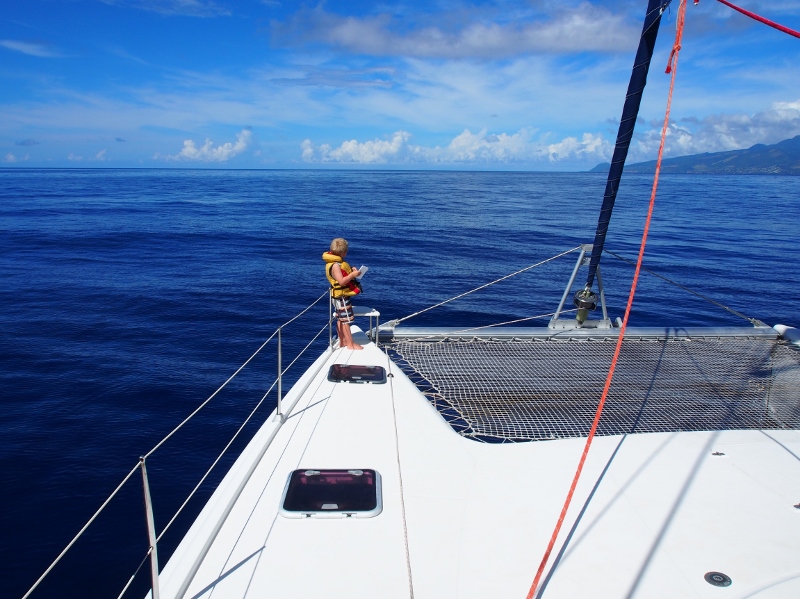
Anyway, Jemma and her team developed an app to record and track marine plastics. We are using it as an educational tool for the kids on this trip, and if anyone else is interested in recording the plastic you see around coasts and marine environments, you can read more at http://www.marinedebris.engr.uga.edu/tracking.
We’ll log on as Bob the Cat, so if you wish, you can track what we see online. The kids have taken to the logging with gusto, writing down long lists, and tallying the numbers. On normal sailing here, we don’t see a lot, but off the island of Dominica, we saw lots and lots, probably refloated from the coastline by a rainstorm.
Happy tracking to anyone else who wants to report ocean or coastal plastics. And good luck to Jemma and her team – we hope you help find out what happens to the plastic, where it goes, what it does, giving us more evidence which may persuade governments to start doing something about the problem. It certainly looks like a great research programme, and it is being taken seriously at the highest levels in the US: http://news.nationalgeographic.com/news/2014/06/140613-ocean-trash-garbage-patch-plastic-science-kerry-marine-debris/.
 SV Bob The Cat